Lancaster University Management School
Working Paper
2000/004
Liberalisation and Savings in Developing Countries: The
Case of India
Vidya Mahambare and V N Balasubramanyam
The Department of Economics Lancaster University Management School
Lancaster LA1 4YX UK
©Vidya Mahambare and V N Balasubramanyam All rights reserved. Short sections of text, not to exceed two paragraphs, may be quoted without explicit permission,
provided that full acknowledgement is given.
The LUMS Working Papers series can be accessed at http://www.lums.co.uk/publications
Liberalisation and Savings in Developing Countries: The Case of India
I Introduction
The impact of economic liberalisation on savings and investment is a matter of
considerable debate. Mackinnon (1973) and Shaw (1973) set the ball rolling with the
thesis that financial repression with ceilings on interest rates, high reserve
requirements for banks, and directed credit to specific sectors of economic activity
distorts resource mobilisation and resource allocation. Removal of these distortions
would stimulate savings and investment and hence growth. These propositions have
been challenged on the grounds that asymmetric information and moral hazard result
in market failure which can only be rectified with government intervention in
financial markets (Stiglitz and Weiss 1992). Also, removal of constraints on
borrowing by households may stimulate consumption rather than savings; interest rate
liberalisation may change the composition of savings leaving the total volume of
savings unchanged; and the causation may run from growth to savings rather than the
other way round.
India's economic reforms initiated in 1991 including measures designed to liberalise
the financial sector provide an opportunity to test the Mackinnon-Shaw type of
propositions concerning savings. This paper which tests these propositions is
organised as follows. Section II briefly reviews the literature on the relationship
between financial reforms and savings. Section III provides an overview of the
volume, pattern and growth of savings in India and the main features of financial
investigate the determinants of savings in India. Section V summarises the
conclusions of the paper.
II. Financial Reforms and Savings.
One element of the Mackinnon-Shaw thesis is that abolition of ceilings on interest
rates stimulates savings. Increased interest rates, however, may reduce rather than
increase the volume of savings for a number of reasons. First, the negative income
effect of increased interest rates might offset the positive substitution effect between
consumption and savings. Second, an increase in the real interest rate may merely
reallocate the existing volume of savings in favour of financial savings as opposed to
other forms of savings and leave the total volume of savings unchanged (Gupta 1984,
Rangarajan 1997). Such a reallocation may also occur if reforms provide a new range
of financial instruments such as shares, mutual funds, postal savings and pension
funds. Third, at very low levels of income interest rates are unlikely to stimulate
savings since the totality of incomes would be devoted to consumption. Statistical
evidence on the issue suggests that a one percent increase in the real interest rate
raises the saving rate by only about one-tenth of one percentage point in the relatively
poor countries, where as this coefficient is about two-thirds of one percentage point in
the relatively rich countries (Ogaki et al 1996). Fourth, even at relatively high levels
of income, financial reforms which ease borrowing constraints, may stimulate
consumption rather than savings (Hall 1978, Jappelli and Pagano, 1989, 1994).
Finally, increased interest rates may restrict the ability of the corporate sector to
restructure production methods and hence its productivity and growth. And if the
savings propensity of the household sector is lower than that of the corporate sector
In general empirical studies on the elasticity of savings with respect to real interest
rates have produced a mixed bag of results. Fry (1980) finds a positive relationship
between savings and the rate of interest for fourteen developing countries. So too do
Yusuf & Peters (1984) for South Korea, Leite & Makonnen (1986) for six African
countries, and Ostry & Reinhart (1992) for 13 developing countries. Mixed results
were obtained by Gupta (1987), Lahiri (1989) and Villagomez (1994). Studies that
have found a negative or insignificant relationship include Giovannini (1983, 1985),
Mwega et al (1990) and Oshikoya (1992) and Reichel (1991). The weight of evidence
supports a weak and relatively low positive elasticity of savings with respect to the
rate of interest.
Financial reforms, however, may stimulate financial savings in other ways than
through an increase in interest rates. A reduction in controls on the financial system
along with increased competition and improved customer service may result in
increased savings. Access to savings instruments may not only enhance the
willingness to save but also result in the substitution of financial savings for
investments in assets such as gold and jewellery. One other aspect of financial
reforms, which may influence household savings is taxation. Reforms which reduce
high marginal income tax rates and increase disposable incomes may not only serve to
eliminate tax evasion but also stimulate savings. Tax reforms designed to reduce
tariffs on trade and excise duties, however, may encourage consumption and reduce
Yet another issue which has aroused considerable discussion relates to the impact of
reforms on public savings defined to include current surpluses of public
administration and publicly owned enterprises. The seemingly obvious proposition
here is that reforms which tend to reduce the profligacy of the public sector would
increase public savings and hence total savings. The much discussed Ricardian
equivalence theorem, however, argues that an increase in public savings may be offset
by an equivalent reduction in private savings leaving the total volume of savings
unchanged. The Ricardian equivalence theorem rests on a number of assumptions
such as well-functioning capital markets, perfect information, an independent banking
sector free of government imposed restrictions, none of which may hold in developing
countries. In any case, empirical evidence in support of the theorem is weak. Most
studies detect a very weak negative relationship between public and private savings
(Edwards 1995, Corbo and Schmidt-Hebbel 1991). Indeed, increased public savings
may promote total volume of savings. The experience of the East Asian countries
suggests as much.
None of the existing econometric studies on savings discuss the impact of differing
types of foreign trade regimes on the savings rate. Most studies on economic
liberalisation analyse the impact of exports and foreign direct investment on growth,
but not on savings (Greenaway et al 1997). It is likely that relatively liberal foreign
trade regimes promote savings. Typically, the savings rate tends to be high in
relatively open economies such as the East Asian economies. Liberal foreign trade
regimes may promote savings for a number of reasons. Import competition may serve
to reduce the prices of consumer durables, so too would increased flows of foreign
savings, provided both the income and substitution effects of a growth in income work
in favour of savings as opposed to consumption. Liberalisation of the foreign trade
regime may promote competition and efficiency with a benign impact on growth and
hence savings. Also, increased exports may result in increased savings if the
propensity to save from export incomes is relatively high. Equally remittances from
expatriates abroad may increase with economic reforms, as has happened in India, and
promote savings.
In sum, there are no settled conclusions on the impact of financial liberalisation on the
savings rate. The one proposition which seems to be robust is that liberalisation is
likely to promote savings because of its impact on growth and not the other way
round. India's experience provides an opportunity to test this and other propositions.
Unfortunately, not all of the propositions in the literature on economic liberalisation
and savings can be econometrically tested. Some of the variables cannot be quantified,
and for some others data in the required form are not available. This study utilises
available data for India to test the following propositions:
#. The causation runs from growth to savings rather than from savings to growth.
#. The real rate of interest has a weak impact on savings.
#. Ricardian equivalence does not to hold in developing countries such as India.
#. Increased dependence of the economy on indirect as opposed to direct taxes
promote savings.
#. Removal of constraints on borrowing depresses savings.
III. Savings in India
The main features of savings behaviour in India can be briefly summarised. First,
savings in India exhibit an upward trend over the years 1960-1996 although there are
fluctuations around the trend. Second, financial savings as opposed to physical
savings show an upward trend (table 1), with financial instruments such as bank
deposits and insurance policies accounting for the bulk of financial savings. Third,
India is the world’s largest gold consumer. If such investments in gold are reckoned as
savings the savings rate would be much higher than what the official statistics suggest.
But gold purchases are regarded as consumer expenditures in official estimates,
erroneously so in our view. Fourth, remittances from expatriates abroad have
contributed to the growth in savings in recent years. The substantial growth in inward
remittances by Indian expatriates, which has steadily increased from $ 2 billions in
1990/91 to $ 12.4 billions in 1996/97, explains in part the growth of financial savings
in recent years. Foreign remittances serve as an additional income stream to
households in India and may promote savings.
While corporate savings has shown an increasing trend since reforms, public savings
continue to be dismally low. Public sector savings consist of savings by government
administration, government departments and public enterprises. None of these
components appear to have made a significant contribution to the overall savings rate.
For the most part, publicly owned enterprises have failed to make any profits. In the
early years of planning, investments in the public sector were to be funded by
surpluses these enterprises would generate. In the event, these enterprises had to be
sustained with savings generated elsewhere in the economy.
These features of India's savings behaviour merit econometric investigation. The
reform process which began in the early nineties is likely to have influenced
household savings behaviour in India. Financial liberalisation in India forms a part of
the wider stabilisation and adjustment programme initiated in 1991. These reforms
include increased market orientation of the financial system, promotion of
competition in the commercial banking sector through the entry of private banks,
interest rate deregulation, a reduction in commercial banks’ reserve requirements, and
measures to strengthen supervision of banks as well as capital adequacy norms. In
addition, controls over the pricing of new issues have been abolished and the
regulatory mechanism of the capital market has been tightened.
The upward trend in savings over the years itself warrants explanation in view of the
debate on the direction of causation between growth and savings. There are a number
of studies on India's savings behaviour (Raj 1962, Rao 1980, Mujumdar, et al 1980,
Krishnawamy et al 1987, and Lahiri 1989). Yet another study is warranted on several
counts. First, most of the existing studies, with one exception, are dated and do not
address the issue of the impact of the 1991 economic reforms on savings. Second,
most of the studies are based on the ordinary least squares technique (OLS) and the
well-know deficiencies of the technique may have yielded spurious results. The
assumption of stationarity of variables is not tested in most of the existing studies.
Third, existing studies do not model the impact of taxation, remittances from abroad,
nature of the trade regime, and changes in public savings on private savings. Also, the
interdependence of growth and savings has been neglected in most of the studies,
IV. The Model
The long run vector autoregressive (VAR) model employed here is estimated utilising
techniques of cointegration and the error correction mechanism with time series data
for the years 1960/61 to 1996/97. Here we utilise the Johansen maximum likelihood
(ML) procedure of cointegration to estimate the model for the following reasons:
#. The most commonly used Engle-Granger contegration methodology relies on the
assumption of a single cointegrating vector and can lead to contradictory results when
there are more than two I(1) variables in the model. A more satisfactory approach is to
employ a vector autoregressive (VAR) error correction model.
#. VAR is specified to take into account the endogenity of variables, most likely to be
the case with savings and income. The VAR specification, as stated earlier,
incorporates two long- run equations with financial saving as the dependent variable
in one of the equation and with per capita real income as the dependent variable in the
other. The estimated coefficients of the variables in two equations help to determine
the direction of causality between savings and income.
VAR is specified as a bivariate system with an appropriate lag structure, which
incorporates endogenity of savings and income since both the variables are allowed to
influence each other. The two equations incorporated in the VAR treat financial
saving as the dependent variable in one equation and per capita real income as the
dependent variable in the other. The dependent variable is confined to financial
savings since the data on physical savings is known to be suspect
.
11India’s reported aggregate savings consist of public, corporate and household savings. Physical saving
FS = f(Y, FL, PUBSAV, TRAS, IT XM) (1) Where,
FS = Log of financial savings/GDP at current prices
Y = Log of real per capita disposable income (1980-81 prices) FL = Log of financial liabilities/GDP (current prices)
PUBSAV = Log of public savings/GDP (current prices) TRAS = Log of inward remittances/GDP (current prices) IT = Log of indirect tax revenue/ total tax revenue XM = Log of (exports + imports)/ GDP
Recently some studies have attempted to develop an aggregate index of financial
reforms (Bandiera et al 1999). Financial liberalisation, however, is a complex process
and no single measure can capture it in its entirety. The variable FL included in
equation 1 is designed to capture one significant element of liberalisation in India,
namely the easing of constraints on the ability of households to borrow. PUBSAV is
included to test for the presence the Ricardian equivalence discussed earlier. IT is
designed to assess the impact of a reduction in taxes on consumer goods on savings.
TRAS takes into account the influence of the growing flow of inward remittances
since the early nineties on saving and XM is a measure of the openness of the
economy, which is expected to influence savings positively.
V. Results
Following the ADF tests to determine the stationarity of variables, the order of lags
and the number of cointegrating vectors2 the estimated long run saving function is as
follows.
FS = 1.6 Y - 0.82 FL - 0.28 PUBSV + 10.27 IT +0.07 TRAS + 0.22 XM– 0.12 t
LL subject to exactly identifying restrictions= 136.00
37 observations from 1960 to 1996. Order of VAR = 2, chosen r =1.
The signs of all the estimated coefficients in the long run relationship confirm a priori
expectations. Financial savings exhibit a long run positive association with the level
of GDP per capita, the ratio of indirect taxes to total taxes, and with the ratio of
inward remittances to GDP. Savings appear to decline with growth in public savings
and financial liabilities. However, an increase in public savings by one unit reduces
household financial savings by 0.28. This result suggests that growth in aggregate
domestic savings due to enhanced public savings is likely to be substantial, around
0.72. Increased access to the credit market on the part of households as denoted by the
ratio of financial liabilities of households to personal disposable income, reduces
financial savings in the long run. Similarly, a reduction in indirect taxes after reforms
is likely to promote consumer spending. A relatively open foreign trade regime seems,
for reasons stated earlier, to promote financial savings. In short, the level of real
income per capita, indirect taxes, public savings and the type of foreign trade regime
appear to be the most important determinants of domestic savings in the long run.
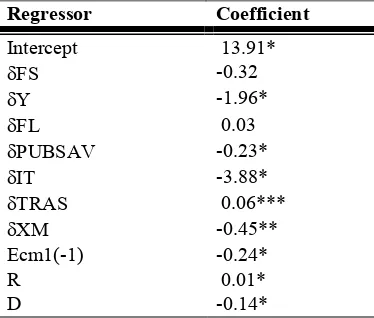
Apart from the variables included in the long run, two more variables are added to the
short-run model: real deposit interest rate (R)3, and a dummy variable (D) with a value
of 1 from 1992/93 and 96/97 and zero for the other years. In the short run equation the
coefficient of the error correction term (ecm(-1)), which shows the speed of short run
adjustment towards the long run equilibrium (table 2) has the correct sign and is
statistically significant at 1 per cent level of significance. Other results in the short run
equation suggests that the short-run elasticity of financial savings with respect to
income is negative. It is likely that in the short run households maintain consumption
standards they are accustomed to irrespective of income levels.
(Insert table 2 here)
Ricardian equivalence does not appear to hold true, the coefficient of public savings
being considerably less than one. The proxy for the borrowing constraint namely, the
ratio of financial liabilities of households to GDP, is not significant in the short-run.
The coefficient of the interest rate variable is significant and positive, but very small
in magnitude. These two results taken together suggest that in the short run
households do not borrow in order to increase consumer expenditures. They may
though do so by drawing down their savings in the face of declining incomes.
Finally the model was tested for the direction of causation between growth and
savings. The ECM term in the equation with income per capita as the dependent
variable is not statistically significant. This suggests that income per capita is weakly
exogenous with financial savings and other explanatory variables. Further, the
Granger causality test suggests that causality runs from growth to savings.
In sum, over the short run savings do not seem to respond positively to changes in
most of the variables included in the model. This is not surprising. Households
attempt to maintain consumption standards in the face of a short-run disequilibrium
situation. Several theories on consumer behaviour including Dusenbery’s relative
income hypothesis and Friedman’s permanent income hypothesis suggest that
consumers attempt to maintain their consumption standards in the face of short run
changes by drawing down their savings and regard short run changes as transitory.
Over the long run, however, when all the adjustments have taken place they revert to
normal behaviour. Results of the exercise suggest as much.
VI. Conclusions
This paper has attempted to test several of the propositions in the literature on
economic liberalisation and savings in the context of India. Results of the statistical
tests confirm many of the propositions outlined earlier. In the long run the level of
income promotes savings rather than the other way round. Ricardian equivalence does
not hold true in the Indian case. In the short run economic liberalisation appears to
depress savings, but in the long run it promotes savings through its impact on growth.
Table 1: Gross Domestic Savings (per cent of gross domestic product)
Year GDS Household FS PS Corporate Public
1960/61-69/70 13.48 9.22 2.87 6.34 1.53 2.74
1970/71-79/80 18.91 13.57 4.82 8.75 1.61 3.73
1980/81-89/90 20.03 15.17 7.17 7.99 1.83 3.02
1990/91-96/97 24.12 19.10 9.75 8.78 3.44 1.57
Post-Reform Period
1991/92 22.90 17.73 10.06 7.64 3.24 1.93
1992/93 21.99 17.68 8.80 8.00 2.78 1.52
1993/94 22.50 18.40 10.99 7.40 3.50 0.60
1994/95 25.00 19.80 12.00 7.80 3.50 1.71
1995/96 25.50 18.50 8.90 9.60 5.00 2.00
1996/97 23.30 17.10 10.40 6.70 4.5 1.70
Notes: GDS = gross domestic savings/gross domestic product = (household + corporate + public)/GDP, Household savings = financial (FS) + physical savings (PS). Source: Central Statistical Organisation.
Table 2: ECM estimated by OLS based on cointegrating VAR(2)
Dependent variable is δFS with 35 observations used for estimation from 1962 to 1996
Regressor Coefficient
Intercept 13.91*
δFS -0.32
δY -1.96*
δFL 0.03
δPUBSAV -0.23*
δIT -3.88*
δTRAS 0.06***
δXM -0.45**
Ecm1(-1) -0.24*
R 0.01*
[image:14.595.223.410.397.556.2]Appendix
Since there was no suggestion of a structural break in data using the CUSUM and CUSUMQ tests we performed ADF tests to test for stationarity. The results suggests that we cannot reject the null hypothesis that FS, Y, FL, PUBSAV, TRAS, XM and IT are integrated of order 1 i.e.; I(1) (table 1). In contrast R is I(0). All variables except R are thus stationary in first differences.
[image:15.595.99.534.267.383.2]The Akaike information criterion (AIC) suggests the VAR of order 2. The presence of trend in the cointegrating relationship was determined using LR test of the deletion of exogenous variables in VAR. Following these results a VAR with two I(1) endogenous variables (FS and Y), four I(1) exogenous variables, namely FL, PUBSAV TRAS, XM and IT, one I(0) variable; real deposit interest rate, a dummy variable, D and trend with lags set to 2 is formulated.
Table A.1: Augmented Dicky-Fuller statistics for the variables
Variable ADF Variable ADF
FS -1.00 δFS -5.66*
DY 1.47 δDY -3.41*
PUBSAV -2.18 δPUBSAV -7.14*
IT -1.76 δIT -3.55*
TRAS -0.92 δTRAS -6.02*
FL -1.95 δFL -5.33*
XM -0.31 δXM -3.41
R -3.99
Note: All variables except R are in natural logarithms, δ: difference operator, *: significant at 5 per cent level, the critical value of the ADF at the 5 per cent is –2.94
Table A.2: Cointegration LR test based on Maximal Eigenvalue of the Stochastic Matrix
Number of Cointegrating vectors
Null Alternative Statistics 95% critical value
R = 0 R = 1 41.24 33.26
R <= 1 R = 2 16.43 25.70
[image:15.595.122.499.459.513.2]Reference:
Bandiera, O. G.Caprio, P. Hanohan, and F. Schiantarelli, 1999, Does Financial Reform Raise or Reduce Savings? The World Bank Working Paper, February.
Corbo, V. and K.Scmidt-Hebbel, 1991, Public Policies and Saving in Developing Countries, Journal of Development Economics, 36, 89-115.
Edwards, S., 1995, Why are Saving Rates so Different Across Countries? An International Comparative Analysis, NBER Working Paper, W5097.
EPW Research Foundation, 1996, Economic Reform and Rate of Saving. Economic and Political Weekly, Special no, November, 2507-2526.
Fry, M. J., 1980, Saving, Investment, Growth and the Cost of Financial Repression, World Development, 8, 4 (April), 317-327.
Giovannini, A., 1983, The Interest Elasticity of Savings in Developing Countries: The Existing Evidence, World Development, 11, 7 (July), 601-607.
Giovannini, A., 1985, Saving and the Real Interest Rate in LDCs, Journal of Development Economics, 18, 2-3 (August), 197-217.
Greenaway, D., S.Leybourne, and D. Sapsford, 1997, Modelling Growth (and Liberalisation) using Smooth Transition Analysis, Economic Enquiry, 34, 4, 798-814.
Gupta, K. L., 1984,. Financial Intermediation, Interest Rates and the Structure of Savings: Evidence from Asia, Journal of Economic Development, 9 (July), 7-24.
Gupta, K. L., 1987, Aggregate Savings, Financial Intermediation, and Interest Rates, Review of Economics and Statistics, 69, 2 (May), 303-311.
Hall, R. E., 1978, Stochastic Implications of the Life Cycle-Permanent Income Hypothesis: Theory and Evidence, Journal of Political Economy, 86, 971-987.
Jappelli, T. and M. Pagano, 1989, Consumption And Capital Market Imperfections: An International Comparision, The American Economic Review, 79, 5;1088-1105.
Jappelli, T. and M. Pagano, 1994, Saving, growth, and liquidity constraints, The Quarterly Journal of Economics; 109, 1(February), 83-109.
Khatkhate, D. R., 1988, Assessing the Impact of Interest Rates in Less Developed Countries, World Development, 16, 5 (May), 577-588.
Krishnamurthy, K., K. S. Krishnaswamy, and P. D. Sharma, 1987, Determinants of Savings Rate in India, Journal of Quantitative Economics, 3, 335-357.
Lahiri, A., 1989, Dynamics of Asian Savings: the Role of Growth and Age Structure, IMF Staff Papers, 36, 228-261.
Leite, S. P. and D. Makonnen, 1986, Saving and Interest Rates in BCEAO Countries: An Empirical Analysis, Savings and Development, 10, 3 (July-September), 219-131.
MacKinnon, R.I., 1973, Money and Capital in Economic Development, Washington, DC, (Brookings Institute).
Mujumdar, N. A., Venkatachalam, T. R., and M. V Raghavachari, 1980, The High Saving Phase of the Indian Economy: 1976-79 – An Explanatory Interpretation, Reserve Bank of India Occasional Papers, 36-50.
Mwega, F. M., S. M. Ngola, and N. Mwangi, 1990, Real Interest Rates and the Mobilisation of Private Savings in Africa: A Case Study of Kenya, African Economic Research Consortium (AERC), (English Press Ltd, Nairobi).
Ogaki, M. J. D. Ostry, C. M Reinhart, 1996, Saving Behaviour in Low- and Middle-Income Developing Countries, IMF Staff Papers, vol. 43, 1 (March), 38-71.
Oshikoya, T. W., 1992, Interest Rate Liberalisation, Savings, Investment and Growth: The Case of Kenya, Savings and Development, XVI, 305-320.
Ostry, J. and C. M. Reinhart, 1992, Private Saving and Terms of Trade Shocks: Evidence from Developing Countries, IMF Staff Papers, 39 (September), 495-517.
Raj, K. N., 1962, The Marginal Rate of Saving in the Indian Economy, Oxford Economic Papers, 14. Rangarajan, C., 1997, Financial Development and Economic Growth, Dr. V. K. R. V. Rao Lacture, The Institute of Social and Economic Change, January.
Rao, V. K. R. V., 1980, Savings, Capital Formation and National Income, Economic and Political Weekly XV, 965-977.
Reichel, R., 1991, The Macroeconomic Impact of Negative Interest Rates in Nigeria: Some Econometric Evidence, Savings and Development, 15, 273-282.
Singh, A (1993) The Stock Market and Economic Development: Should Developing Countries encourage Stock Markets? UNCTAD Review, No.4, 1-28.
Stiglitz, J. E. and A. Weiss, 1992, Asymmetric Information in the Credit Market and its Implications, Oxford Economic Papers, 44,4, 694-725.
Villagomez, F. A., 1997, Private Saving, Interest Rates and Liquidity Constraints in LDCs: Recent Evidence, Applied Economics, 29, 607-615.