A transputer based parallel database system.
GRAY, Jonathan Patrick.
Available from Sheffield Hallam University Research Archive (SHURA) at:
http://shura.shu.ac.uk/19717/
This document is the author deposited version. You are advised to consult the publisher's version if you wish to cite from it.
Published version
GRAY, Jonathan Patrick. (1991). A transputer based parallel database system. Doctoral, Sheffield Hallam University (United Kingdom)..
Copyright and re-use policy
See http://shura.shu.ac.uk/information.html
Sheffield City Polytechnic Library
REFERENCE ONLY
Fines are charged at 50p per hour
ProQuest Number: 10697019
All rights reserved
INFORMATION TO ALL USERS
The quality of this reproduction is dependent upon the quality of the copy submitted.
In the unlikely event that the author did not send a com plete manuscript and there are missing pages, these will be noted. Also, if material had to be removed,
a note will indicate the deletion.
uest
ProQuest 10697019
Published by ProQuest LLC(2017). Copyright of the Dissertation is held by the Author.
All rights reserved.
This work is protected against unauthorized copying under Title 17, United States C ode Microform Edition © ProQuest LLC.
ProQuest LLC.
789 East Eisenhower Parkway P.O. Box 1346
A Transputer Based Parallel Database System
by
Jonathan Patrick Gray
A thesis submitted to the Council for National Academic Awards in partial fulfillment of the requirements for the degree of Doctor of Philosophy
Sponsoring Establishment: School of Computing and Management Sciences, Sheffield City Polytechnic
Collaborating Establishment: National Transputer Support Centre, Sheffield
Abstract
A sophisticated database application generation environment known as DB4GL has been developed at Sheffield City Polytechnic. A unique feature of DB4GL is the object-oriented application model used to specify and generate database applications. Although DB4GL has many advanced and powerful features, such as a self-describing data dictionary and extensive integrity rule processing facilities; the system has not been designed for high performance in either the generation tools or the generated database applications. The Parallel-DB4GL (P-DB4GL) project represents an attempt to improve the performance of the generated database applications, by constructing a new concurrent implementation of DB4GL for execution on transputer-based parallel hardware.
Acknowledgements
Contents
Chapter 1 Introduction
1.1 Motivation for the Research...1
1.2 Aims of the Research...2
1.3 The P-DB4GL Approach... 3
1.4 P-DB4GL Project Development...5
1.5 Outline of Thesis Contents... 6
Chapter 2 The DB4GL Database Application Generation System 2.1 DB4GL Project Overview...10
2.2 Application Generation and Prototyping... 10
2.3 DB4GL Application Development... 11
2.4 The DB4GL Application Model...12
2.4.1 A Generic Architecture...12
2.4.2 Presentation Objects... 13
2.4.3 Information Units...14
2.4.4 Data Relationships... 15
2.4.5 Levels of Data Description...16
2.5 Implementation of the Application Model...16
Chapter 3 Object-Oriented Database Approaches 3.1 A Classification of Object-Oriented Approaches... 30
3.2 Object-Oriented Approaches and DB4GL... 32
Chapter 4 Transputers. Occam, and Databases 4.1 Transputers...38
4.2 Occam...38
4.3 Transputers and Databases... 39
4.4 Project Resources...42
Chapter 5 Developing the Prototype Parallel-DB4GL 5.1 Project Objectives... 45
5.2 Design Methodology... 45
5.4 Implementation...47
5.5 Testing...51
5.6 Results... 53
5.7 Evaluation...54
Chapter 6 Designs for a Fully Functional P-DB4GL 6.1 A Multiprocessor Fully Functional P-DB4GL...67
6.2 Channel Multiplexors and Message Routers...68
6.2.1 Channel Multiplexing...68
6.2.2 P-DB4GL Channel Multiplexors... 69
6.2.3 P-DB4GL Message Routing...70
6.3 Communication Loads and Protocol Overheads... 72
6.4 Designs for P-DB4GL Hardware Configurations ...75
6.5 Code Factoring...77
6.6 Code Generation...78
Chapter 7 P-DB4GL Project Evaluation 7.1 Summary... 90
7.2 Communication Loads and Object Clustering... 90
7.3 Object Inheritance... 91
7.4 Occam 2 as an Implementation Language... 91
7.5 Improvements in Secondary Storage Technology... 92
7.6 The Next Generation of Transputer Products...93
7.7 Advantages of a Prototyping Development Cycle... 95
Chapter 8 Conclusions...97
Bibliography...99
Appendices Appendix A - Algorithm Syntax Definition... 110
Appendix B - Message Formats and Occam Channels...I ll Appendix C - Entity and Schema Handler Algorithms...115
Appendix D - Disc and Filer Algorithms...126
Appendix E - Filer Harness Specification...130
Appendix F - User Process Test Harness ...138
List of Figures
Figure 1.1 - Thesis Contents...9
Figure 2.1 - DB4GL Development Environment... 18
Figure 2.2 - Information for Application Specification... 19
Figure 2.3 - DB4GL Application Model...20
Figure 2.4 - Database Applications as Instantiations...21
Figure 2.5 - Examples of Application Structures... 22
Figure 2.6 - Data Dependencies and Object Activity... 23
Figure 2.7 - Prime View and Non-prime View Information Units... 23
Figure 2.8 - Domains and Relationships... 24
Figure 2.9 - Information Unit Groups and Schema Links...24
Figure 2.10 - ANSI/SPARC DBMS Model...25
Figure 2.11 - Levels of DB4GL Data Description...26
Figure 2.12 - Implementation of the Application Model...27
Figure 2.13 - Generated Application Instances... 28
Figure 2.14 - DB4GL Code Generation... 29
Figure 2.15 - Modular Structure of Implemented Applications ... 29
Figure 3.1 - An Object-Oriented Design... 36
Figure 3.2 - DBMS/Object-Oriented Environment Interface... 37
Figure 4.1 - Transputer Architecture... 43
Figure 4.2 - The Occam Language...44
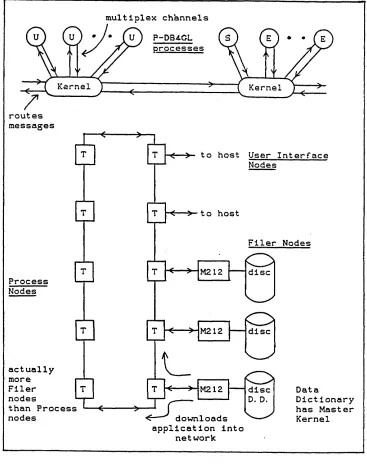
Figure 5.1 - System Configuration for P-DB4GL...58
Figure 5.2 - Concurrent Message Passing Processes...58
Figure 5.3 - Typical P-DB4GL Database Application... 59
Figure 5.4 - DB4GL and P-DB4GL Message Passing...59
Figure 5.5 - Concurrent Execution of Data Access Processes... 60
Figure 5.6 - Developing the Prototype P-DB4GL System...61
Figure 5.7 - Mapping Entity Handlers to Discs... 62
Figure 5.8 - Typical Test Application Configuration... 63
Figure 5.9 - Version 4 Handlers Test Run Times...64
Figure 5.10 - Normalized Coupling Entity Update... 64
Figure 5.11 - Version 4 Handlers Improvement Factor...65
Figure 5.12 - Test Run Processor Loading...65
Figure 5.13 - Processing/Disc Access Ratio... 66
Figure 5.14 - Processor Loading and Parallel Configuration... 66
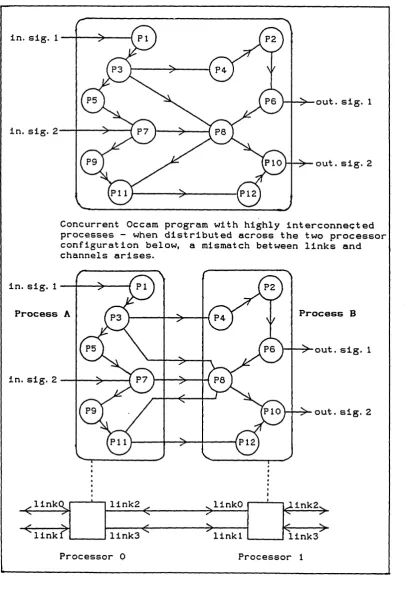
Figure 6.1 - Insufficient Links for Filer Connection... 80
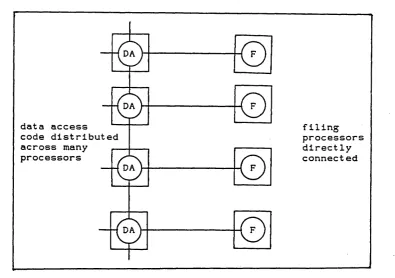
Figure 6.2 - Distributing the Data Access Code...80
Figure 6.3 - Designs for a Fully Functional Multiprocessor P-DB4GL... 81
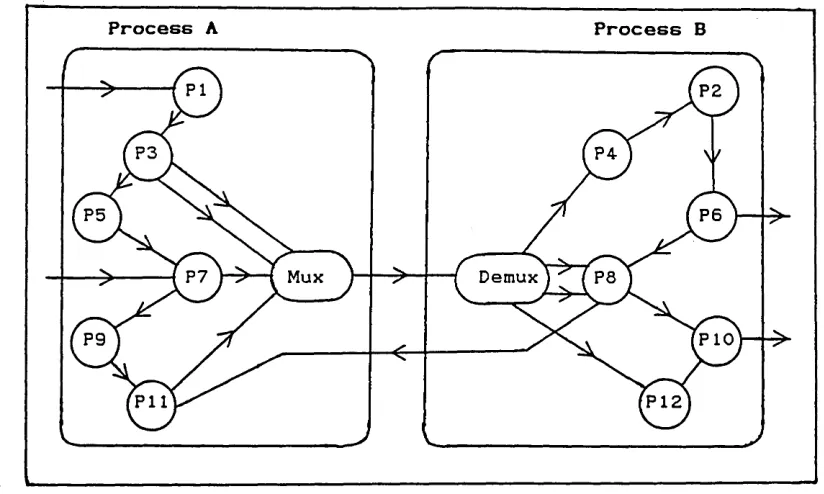
Figure 6.5 - Addition of Multiplexor Processes...83
Figure 6.6 - Modified Prime Entity Handler...83
Figure 6.7 - P-DB4GL Decoder Process... 84
Figure 6.8 - Routing Messages Through a P-DB4GL Network... 84
Figure 6.9 - Different Types of P-DB4GL Messages...85
Figure 6.10 - Multiplexing Filer Channels...85
Figure 6.11 - A Separate Interconnection Network...86
Figure 6.12 - A Reconfigurable Network...87
Figure 6.13 - Replacement of Schema Handler by IUG Process...88
Figure 6.14 - An Alternative Presentation Object Implementation... 88
Figure 6.15 - Methods of Code Generation...89
Figure 7.1 - An HI Based P-DB4GL Design...96
Figure B1 - P-DB4GL Message Formats... 114
Figure El - Filer Harness Record Representation...136
Figure FI - A Single Transaction...140
Figure F2 - Optimised Sequence of Transactions ;... 141
Figure F3 - A Sequence of BCU Messages...142
Figure F4 - Effect of User Harness Delays...143
Figure G1 - Test Entities (Information Units)...147
Figure G2 - Test Schemas...148
Figure G3 - Test Data Access Code...149
Figure G4 - Test Configurations...150
Figure II - Effect of Message Size on Transfer Rate...174
Figure 12 - Channel Protocol Converter Processes... 174
Figure 13 - Protocol Conversion Test Configuration... 175
Figure J1 - P-DB4GL Router Process... 188
Figure J2 - Network8 Ring Router Process... 188
Figure J3 - Network9 Ring Router Process... 189
Figure J4 - Netl6 Ring Routing Test Configuration... 190
Figure J5 - Netl8 Ring Routing Test Configuration... 190
Chapter 1
Introduction
1.1 Motivation for the Research
This PhD thesis describes the work undertaken and results obtained from the Parallel DB4GL (P-DB4GL) research project. The P-DB4GL project is an extension of continuing research at Sheffield City Polytechnic in the areas of databases and automated systems development. During recent years several research projects concerned with data dictionaries, 4th Generation Languages (4GL's), and application prototyping have been undertaken at the Polytechnic [Cooper83] [Beazley84] [Ewin84] [Bal85] [Priti86] [Kilo86]]; culminating in the development of a sophisticated database application generation environment known as DB4GL (Data Base 4th Generation Language) [Ewin85a] [Ewin85b] [Poole87] [Hird89].
The DB4GL research was motivated chiefly by concerns of improving programmer productivity and automating software development. DB4GL, like many 4GL's, exists as a collection of productivity enhancing tools [Nelson85]. These tools, such as data dictionaries, normalization engines, screen painters, report generators, and code generators, are used by system analyst/designers and programmers to improve efficiency and shorten development time in the traditional software system development cycle, or "waterfall" life cycle [Boehm76], of analysis-specification-design-implementation-testing [Cobb85] [Forage85]. Such 4GL tools can also be used to rapidly build, or "prototype", applications in a modified software development cycle [Brittan80] [McCraken82] [Appleton83] [Johnson83].
L,napter i
The DB4GL generated database applications, and the DB4GL tools themselves, have not been designed with performance in mind. Some of the DB4GL tools, the generator tools in particular, are very slow in operation. The compiled program code that constitutes the generated DB4GL applications is slow in execution, and could have been more efficiently designed and coded. Because DB4GL has been developed as a research vehicle rather than a commercial product, performance issues have not been a major concern. Fortunately, DB4GL is fully portable to any system supporting a COBOL compiler, and many of the performance problems can be solved by transferring to target hardware of a higher specification than the PC system currently used. However, even with more efficient coding and faster hardware, there is a limit to the improvements that can be obtained with the existing DB4GL implementation.
The motivation for the P-DB4GL project is performance. To try and solve the performance problems encountered in the sequential COBOL implementation of DB4GL, a radically different approach has been taken, that is, the construction of an entirely new parallel implementation of DB4GL.
1.2 Aims of the Research
The aim of the P-DB4GL project is to redesign the DB4GL generated database applications so that they can be executed on parallel hardware. The potentially massive processing power of this parallel hardware can then be used to speed-up the performance of the generated applications, and also allow the applications to be scaled-up to much larger database sizes without loss of performance. The DB4GL application model is retained. This has been shown to be a suitable software architecture for application specification and generation, and the P-DB4GL project is a test of the application model's suitability for parallel implementation. In particular, the object-oriented aspects of the application model are examined to see if an object-oriented specification facilitates parallel implementation.
unapter i
Data) [Flynn72] architectures. Each transputer microprocessor is a "computer on a chip" and combines on a single integrated circuit, CPU, RAM and high speed serial communication links. Transputers are relatively cheap and are easily connected together by their serial communications links to produce large extensible parallel architectures. The low cost and extensibility of transputers, combined with the availability of several high level parallel languages, makes them suitable candidates for the parallel hardware. Also, at the start of the P-DB4GL project, it was envisaged that the parallel DB4GL database applications would be essentially "shared nothing" architectures [Stonebraker86], and the transputer's built-in communication facilities were considered appropriate for the construction of such architectures.
1.3 The P-DB4GL Approach
The P-DB4GL project differs significantly from many other research projects concerned with database performance issues. In particular, there are three aspects to the P-DB4GL approach which differentiate it from other database approaches. First, it differs architecturally from established database machine approaches. Secondly, the DB4GL application model represents a novel approach to database application development. Thirdly, P-DB4GL is intended for use in a prototyping development environment, and this offers certain advantages; in particular, it facilitates performance "tuning" of the generated database applications.
The P-DB4GL project is not an attempt to construct a dedicated "backend" database machine [Hsiao83]. Typically, such database machines are constructed from specialized custom hardware, and are invariably concerned with improved disc access and file processing, for example: CAFS [Babb79]. DIRECT [DeWitt79], SABRE [Gardarin83], RDBM [Schweppes83], DBMAC [Missikof83], Gamma [Schneider89]. They are generally not stand-alone machines, but dependent on either a host machine (usually a mainframe computer) in which they replace some of the operating system's functions and execute DBMS code more efficiently than the host machine; or else function as a database server forming part of a networked or distributed system, receiving database queries (typically in SQL [BSI88]) from client processors, processing these requests and returning results of this query to the clients. DB4GL differs from such database machines in that all of the database application executes entirely on the transputer-based hardware, there are no separate client or host processes being serviced by P-DB4GL.
-3-y^ riu jJizT 1
Secondly, P-DB4GL applications are fully distributed parallel applications, and exhibit inter-query parallelism which arises from the inherently concurrent specification of DB4GL applications.
A unique feature of the P-DB4GL research is the DB4GL application model. This application model represents an attempt to specify and generate database applications in their entirety. It encompasses all facets of a database-oriented information system - that is, processing, data model, user interface, and integrity constraints - within a uniform structure. Thus, DB4GL differs from other database approaches, in that there is no distinction between DBMS functions and separate application programs using the DBMS. The application model is not relational, but has certain object-oriented characteristics. Specifically, a database application is defined by the model as a set of concurrently executable message passing Presentation Objects, and each particular generated application is considered as an instantiation of the application model. DB4GL is further distinguished from some other database approaches by the special emphasis placed upon the attribute, rather than tuple or relation, as the primary data item.
The use of DB4GL within a prototyping development environment has a significant effect on some implementation features. DB4GL applications are oriented towards on-line transaction processing (OLTP) rather than on-line query processing. This means that all the access paths (explicit data relationships) and patterns of data usage are known and defined in advance of end-user operation of the generated application. Consequently certain optimizations to data access mechanisms, such as the establishment of indexes on frequently used tables, are possible. Indexes reduce search time and improve response time to transactions, however, one disadvantage of indexes is the processing overhead entailed by the maintenance of indexes following an update to the table over which they are defined. The use of parallel processing hardware to improve index maintenance is a key feature of the P-DB4GL system.
K-rwpier 1
P-DB4GL running on parallel hardware is the potential for greatly reduced application generation time, thereby improving the query processing facilities of DB4GL.
The prototyping development cycle facilitates the "tuning" of P-DB4GL applications for optimal performance. A problem common to many parallel database implementations is efficient resource utilization, that is, matching processing and communication loads of the database software to the available hardware. Because P-DB4GL development is cyclic, at each cycle in the application development, the system analyst/designer has the opportunity of altering the mapping of application code and database data to the available processors and secondary storage devices (disks). Thus allowing the possibility of experimentation with different configurations to find a well balanced configuration offering optimal performance.
1.4 P-DB4GL Project Development
The first stage in the parallel DB4GL investigation was the development of a prototype P-DB4GL system. In this prototype system, simplified "cut-down" database applications were designed and implemented. These P-DB4GL test applications are of reduced functionality, and are equivalent to applications generated by the original [Ewin85a] DB4GL. In a fully functional P-DB4GL, the parallel database applications would be generated automatically by P-DB4GL generation tools, but these tools are not yet fully implemented, and in the prototype system the test applications were hand coded. The test applications were run on several different network configurations, and designs for a fully functional P-DB4GL system are proposed based on the results obtained from these tests.
The reasons for constructing a prototype P-DB4GL are:
determine the exact amount of parallelism inherent in the DB4GL application model;
test the soundness of the design approach, that is, of a relatively simple translation from an object-oriented specification to an implementation of concurrent communicating processes;
K^riujJiZT i
examine the feasibility of using transputers as the basis of the parallel processing hardware, both for P-DB4GL in particular and other database (and data intensive) systems in general.
Briefly, the main findings from the prototype P-DB4GL investigation are: • significant performance benefits were obtained from parallel index
maintenance;
• speed-up of any given application by the simple addition of more processors is very difficult to obtain;
• good scale-up in performance by the addition of more processors and discs can be obtained as an application grows larger;
• the P-DB4GL database applications do not significantly load the processors, but applications often become communication bound. Based on these findings, some design considerations for a fully functional P-DB4GL system are discussed in Chapter 6.
1.5 Outline of Thesis Contents
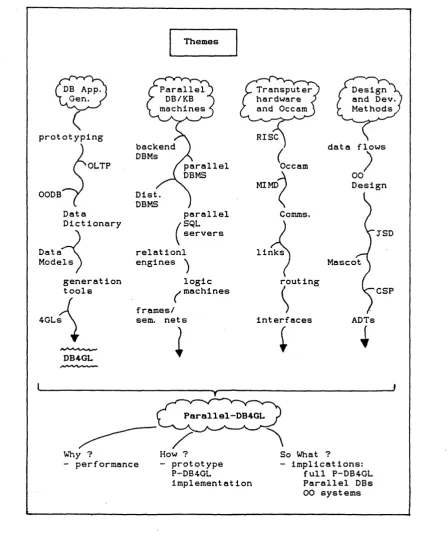
The P-DB4GL research project, as described in this thesis, brings together a number of strands, or themes, of different research interests (Figure 1.1). One of the core themes, providing motivation and background to the DB4GL project, concerns database application generation and prototyping software development. Another core theme is concerned with the technology of parallel processing hardware, specifically transputers and Occam, and the application of transputer technology to data intensive application areas. Parallel architectures for databases and knowledge based systems, including dedicated database machines, specialized relational and logic language machines, and hardware support for object-oriented environments, is a third theme of research. Finally, a concern with software design and development methodologies for concurrent systems completes the picture.
These four different themes of research interest are all components in the P-DB4GL project, and are present in various chapters of this thesis. In the following description of each chapter's contents, the relevance and influence of these themes is indicated.
simpler 1
Chapter 2 describes the DB4GL Database Application Generation System. DB4GL is the result of research encompassed by the theme of database application generation. Chapter 2 describes the DB4GL system as developed by [Hird89], and pays particular attention to the DB4GL application model which has been greatly influenced by developments in object-oriented research.
Chapter 3, Object-Oriented Database Approaches, provides a simple classification of object-oriented approaches to database development. This classification is used to provide a background, or framework, in which the influence of object-oriented concepts on DB4GL is explained. DB4GL is not representative of the "mainstream1' Object-Oriented Database Systems, but the development of DB4GL has drawn heavily on research developments in the object-oriented fields.
Chapter 4, Transputers, Occam and Databases, provides a short introduction to the transputer technology, and the concurrent programming language Occam, used in the construction of the parallel architecture for P-DB4GL. Other database research projects, also using transputer-based technology, are described; and the advantages of transputers for parallel database implementations is explained.
Chapter 5 describes the development of the Prototype Parallel-DB4GL system. The design, implementation, and testing of the prototype P-DB4GL implementation is described in detail. In particular, the design approach, a translation from concurrent object specification to an implementation of communicating concurrent Occam processes, is explained. Based on the results obtained from this prototype system, designs for a fully functional P-DB4GL system are proposed.
Chapter 6, Designs for a Fully Functional P-DB4GL. describes design proposals for a multiprocessor fully functional P-DB4GL system. Some features of these designs, such as channel multiplexing and message routing, have been implemented and tested, and in the light of these results, revisions to the designs are made.
-7-K^napier 1
Chapter 7 provides an Evaluation of the P-DB4GL Project, including both the prototype P-DB4GL system and the fully functional designs, and indicates where opportunities for further research lie.
Chapter 8 provides some overall Conclusions from the P-DB4GL project.
Themes
DB App.
Gen. > ParallelDB/KB
machines
Transputer hardware . and Occam ’
Design \
and Dev. Methods
prototyping RISC
backend
DBMS data flows
OLTP parallel
DBMS Occam 00
Design MIMD
OODB Dist.
DBMS Data
Dictionary parallelSQL
servers
Comms.
JSD Data ^
Models relat ionl engines > links Mascot
logic machines generation
tools routing CSP
f rames/ sem. nets
4GLs interf aces ADTs
DB4GL
Parallel—DB4GL
How ?
- prototype P-DB4GL
implementat ion Why ?
- performance So What ?- implications:
[image:21.621.87.536.67.611.2]full P-DB4GL Parallel DBs 00 systems
Chapter 2
The DB4GL Database Application Generation System
2.1 DB4GL Project Overview
DB4GL (Data Base 4th Generation Language) [Ewin85a] [Ewin85b] [Hird89] [Poole87] is a database application generation environment that has been developed at Sheffield City Polytechnic. It is a result of research conducted in the Department of Computer Studies (now incorporated into the School of Computing and Management Sciences) in the areas of database application prototyping and Fourth Generation Languages (4GL's). DB4GL is intended for use within a rapid system building (or prototyping) development cycle [Appleton83] [Dearnley83] [McCraken82]. DB4GL is designed primarily for the generation of on-line transaction processing systems, rather than on-line enquiry systems.
Although DB4GL has been developed principally as a research vehicle, it has been applied to commercial problems. The first version of DB4GL [Ewin85a] was used successfully to generate database applications for a construction company [Ewin84] [Ewin85a]. Subsequent DB4GL research [Poole87j [Hird89], concentrating in the areas of improved specification tools, integrity rule processing, and data dictionary operation, has transformed the original DB4GL system into a sophisticated 4GL environment with a unique object-oriented application model.
2.2 Application Generation and Prototyping
The term "prototyping", when used in the context of software development, means rapidly building an implementation for trial purposes. This provides users with a (sometimes partially) working model of the proposed system in order to identify and define their requirements more precisely. There are two main forms of prototyping:
• "throw-away" requirements analysis prototyping, whereby the prototype systems are discarded once user requirements are fully established;
L,napter z
An application generator is a piece of software (more normally a suite of software tools) that produces a program in some object language, which is tailor-made to fit a specific set of requirements. Application generators (or 4GL's) differ from general purpose high level language translators in that:
• the target language is usually another high level language;
• the range of programs that can be generated, is limited to a particular application domain, for example, database applications; • often, input to a 4GL does not have to conform to rigid rules of
syntax, input is via a dialogue with the user, who may respond in some free format;
• the user of 4GL may not be a professional programmer, he may be an end user or system analyst/designer.
2.3 DB4GL Application Development
DB4GL is an application generation system specifically for database applications. DB4GL generates single user database applications to run on an IBM PC AT microcomputer. The target language generated by DB4GL is COBOL. The specifications of required applications are input to DB4GL using menu-driven screen-based database maintenance applications. DB4GL can be used for either "throw-away" prototyping or for "evolutionary" prototyping. The DB4GL system is intended to be used principally by a system analyst/designer rather than an application end user.
DB4GL is a collection of tools - report generators, screen painters, code generators - based around a data dictionary. The DB4GL data dictionary is active, in that, applications are generated from the specifications stored in the data dictionary at generation time, the data dictionary does not just passively describe applications. The DB4GL data dictionary is itself maintained by DB4GL generated applications and uses a hybrid self-describing [Mark85] [Mark86] [Roussopoulos85] data model [Hird89] [Poole87], originally based on the Entity-Relationship approach [Chen76] [Howe83], but also influenced by other data models, for instance, DIAM [Senko73] [Senko76] and CODASYL [011e78].
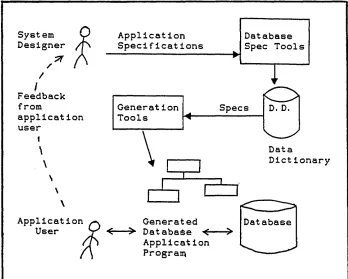
The DB4GL application development cycle is illustrated in Figure 2.1: the specification/generation/user-feedback cycle iterates until the system designer and application user are satisfied with the generated database
-\~rutjjicr
application. DB4GL is used mainly for "evolutionary" prototyping, in which the final generated prototype is the delivered database system. The delivered database system can then be operated by the application user without further DB4GL support.
Figure 2.2 illustrates the types of information that constitute the specification of a DB4GL database application, it includes:
• data model description, in terms of entities, attributes, domains, and schema links (access paths);
• processing requirements, in terms of standard maintenance operations and query and report producing functions defined over the entities and attributes of the application;
• user interface, in terms of screens and windows of input and ouput data requested and produced by the processes specified above.
Often, considerable data analysis skills are needed, particularly in the case of large complex applications, in order to properly specify the required database application. Such skills are not normally possessed by application end users. It is therefore unlikely that an application end user would be able to define and generate a DB4GL database application without the help of a skilled system analyst/designer.
2.4 The DB4GL Application Model
2.4.1 A Generic Architecture
The DB4GL application model, or "architecture of a database application", is central to the generation of database applications (Figure 2.3). This application model is a generic structure or template from which particular application instances are derived. The DB4GL generation tools use the specifications stored in the DB4GL data dictionary to produce a required database application that is an instantiation of the generic DB4GL application model (Figure 2.4). The key features of the application model are:
• an application task is defined as a set of Presentation Objects (PO’s);
• each constituent PO of an application task includes both information entities and their associated processing tasks;
L,napter z
communicating control/data messages;
• during the execution of an application task, the course of computation is message driven.
In the simplest of database application, all the required data and processing can be encompassed in a single application task. It is, however, more usual for a DB4GL database application to be constructed as a suite of application tasks. The application tasks are linked together by a menu-driven selection program, produced by a DB4GL menu generator tool. The menu program is used by the application user to select a database processing option, and the menu program invokes the appropriate application task.
2.4.2 Presentation Objects
The concept of the Presentation Object (PO), and its role in the Application Model (AT), is of fundamental importance to DB4GL. Essentially, a Presentation Object combines descriptions of:
persistent database data;
processing operations, with their associated transient data, performed upon this persistent data;
integrity rules, controlling updates to the persistent data.
The definition of an AT partitions a database into a number of disjoint, though related, parts; and each PO operates upon one of these separate parts of the database. The execution model is one of co-operating non-interfering objects.
Specifically, each PO is composed of:
• a Presentation Unit (PU), which defines the sequence of data access and program control required to support the user interaction for the PO;
• an Information Unit Group (IUG), that is, a collection of related data entities, known as Information Units (IU's), processed by the PO;
• a Process Schema (PS), with a number of Process Tasks (PT's) for processing the IUG, the PT's may be functions performing simple data type conversions, or they can be complex processes generating aggregate values and derived data from the IUG;
• a Presentation Format (PF), describing both the appearance of the PO to application users and the interface to other PO's within an
-13-L,napter z
application;
• a set of Integrity Rules controlling updates to the IUG, some of these may be Generic rules applicable to all application tasks, others may be application dependent rules specific to this application task.
When a Presentation Object (PO) is activated, its Presentation Unit (PU) controls the PO's user interaction. The PU provides a dialogue between the PO and application user, whereby the application user can effect a range of query and maintenance operations upon the data defined in the PO. Typically, these are operations to select, insert, modify, and delete particular entities and attributes in the PO's IUG. The user dialogue includes commands to suspend the PO's activity and transfer user interaction to another PO within the application task.
The component Presentation Objects (PO's) in a DB4GL application are, in principle, capable of concurrent execution. However, relationships between PO’s, based on data dependencies between the data entities defined within each PO, determine the order in which PO's are activated during application execution. This ordering of PO activation during application execution is known as an application structure, and a notation for expressing this application structure has been developed in [Hird89]. Many different application structures can be defined using this notation, Figure 2.5 illustrates some of these. Figure 2.6 provides an example of the use of this notation to define a simple application structure composed of just two PO’s. It illustrates how a sequence of PO activation is imposed by a relationship between the ORDER entity, defined in superordinate POl, and the dependent ORDER-LINE entity, defined in subordinate P02.
2.4.3 Information Units
L,napter a
it. A non-prime view IU permits access to its prime view IU occurrences using a non-key attribute, and is formed from a concatenation of the non key attribute with the primary key of the prime view IU. A non-prime view IU is said to be closely coupled to its prime view IU, in that, any updates to the prime IU must also be accompanied by corresponding updates to all the associated non-prime IU's. At the physical storage level, each IU is realised by a single relation implemented as an Indexed-Sequential file of records and a processing object known as an entity handler. Prime view IU's have a prime entity handler, non-prime IU's have a coupling entity handler. Thus, a non-prime view IU's coupling entity handler can be seen as maintaining a kind of "index" to a prime IU's "base relation".
2.4.4 Data Relationships
All attributes are defined over domains. These domains specify the range and type of possible attribute values, eg 4 digit integer, 80 character alphanumeric, 5 digit fixed point with 2 d.p., etc. Relationships between Information Units (IU's) are established on the basis of their domain related attributes. Figure 2.8 illustrates one-to-many relationships between ORDER, ORD-LINE, and PART IU's, established through the common domains 0# and P#.
When application tasks are defined, relationships between IU's are made explicit through the specification of schema links. Schema links are represented by unidirectional arcs (Figure 2.9). Each link has a source attribute, which may be key or non-key, and a target attribute, which must be a key attribute. Within an IUG, a schema link denotes a one-to-one relationship between the connected IU's. Between IUG’s, a schema link normally denotes one-to-many relationships.
nap ter z
2.4.5 Levels of Data Description
DB4GL contains a number of levels of data description or data abstraction. In terms of the ANSI/SPARC [Jardine77] [Tsichritzis78] DBMS reference model (Figure 2.10), it is possible to identify the three corresponding levels of data description in DB4GL (Figure 2.11). The DB4GL conceptual level is represented by the set of all the information units (IU's) defined in a DB4GL system, together with the complete set of generic integrity rules defined over these IU's. Explicit data relationships between IU's, defined by schema links, are not represented at the conceptual level. The definition of application tasks with their presentation objects, information unit groups, schema links, and application specific integrity rules belong to the external level. The indexed-sequential files (tables of records), used to implement the IU's, correspond to the physical level.
2.5 Implementation of the Application Model
The DB4GL application model is implemented by a number of generic code modules (Figure 2.12). These modules can be broadly classified into:
• User Modules (Screen, Window, and Process modules) that process user requests and send commands to the data access schemas, and;
• Data Access M odules (Schema handler and Entity handler modules) that retrieve and store persistent application data in the filestore.
Figure 2.12 shows the mapping from the application model to the code modules. The user modules implement the presentation units, process schemas and process tasks of an application task's presentation objects. Each information unit in an application task is supported by an entity handler module. A schema handler module supports the application task's data access schema.
K-nupitT z
l.napter
System Designer
7T
/ /
/
Feedback f rom
applicat ion user
t
\ \
N \
\
Application User
Application Specif icat ions
Specs
Data
Diet ionary
Generated
< Database ^
Applicat ion Program
Database Generat ion
Tools
[image:30.617.123.471.44.323.2]Database Spec Tools
unapter z
SUPPLIERS
data model
SUP-PART
SName
El S# SLocat ion
PARTS
E3 P# PName PType
E2 S# P# Qnty-ordered
processing
Procl fEl (entry ^ —
point)
Proc2 (repeat
n times)
windowl
E3 write
E2 write
— - - window2
App = (Procl (Proc2)).
user interface
screenl
windowl
window2
Specification of a simple D84GL application to process a small (3 entitles) Suppllers-Parts database
Application Task
Presentat ion Objects
i=l
Presentation Object i
Presentation Format i Present at ion
Unit i
Process Schema Inf ormat ion
Unit Group i
Applicat ion Dependent Integrity Rules
Process Inf ormat ion
Generic Integrity Rules
Process Task i,K Inf ormation
Unit i, M
unapter
- architecture is a GENERIC structure or TEMPLATE from which particular application INSTANCES are derived
O - O
S. D. Specs
I n s t a n t i a t e
A
Architecture
(Generic) GeneratedApplication
(Instance)
cnapter
initiated by the appearance of "trigger data items in superordinate PO's.
P03
P01 App = <P01 (P02) CP03 (P04) CP05) <P06>>>.
Tree structures are the most common form of application structure.
P02 P03
P04, P05, and P06 can be concurrently active.
P04 P05 P06
Chapter
App = <P01 (P02)).
0
^P02^
A one-to-many relationship between the data entity ORDER, defined in POl, and ORDER-LINE, defined in P02, imposes a sequence of Presentation Object activity. P02 cannot process member ORDER-LINE occurrences until "triggered" by the processing of an owner ORDER occurrence in POl.
ORDER
OrderNo Customer Date
ORDER-LINE
A
OrderNo OrderLine Quant ity PartNo
Figure 2.6 - Data Dependencies and Object Activity
IU CUSTOMER
(prime view) non-key attributes
CustNo CustName CustAddress CustLoc CustCredit
key
at tribute
IU CUST-LOCATION
(non-prime view) Cust Loc'--- „--- iCustNo
key attributes
Non-prime view Information Unit CUST-LOCATION is closely coupled to its prime view Information Unit CUSTOMER, in that, updates performed on CUSTOMER must also be
accompanied by corresponding updates to CUST-LOCATION.
s^napier
IU ORDER
OrderNumber Cust omer Date
O#
IU PART
Part Number PartDesc
P#
IU ORD-LINE
OrdNo LineNo PNo Quant ity
O# P#
The common attribute domain O#, over which both
OrderNumber and OrdNo are defined, is the basis of an implicit one-to-many relationship between IU's ORDER and ORD-LINE. Similarly, the common domain P# implies a relationship between PART and ORD-LINE.
Figure 2.8 - Domains and Relationships
App = (POl (P02 >) .
i iugi
i
| IUG2
J
An application task with two Presentation Objects <PO's) is defined. Each PO has an Information Unit Group (IUG) identified with it, and explicit data relationships are specified using schema links. The intra-IUG link for P02 denotes a one-to-one relationship, the inter— IUG link between POl and P02 denotes a one-to-many relationship.
OrdNo PartNumber
OrderNumber
L,napter
mappings
mapping External
Schema 2 External
Schema 1 External Schema N
Conceptual Schema
Physical storage Schema
L,napter
Appl AppN Applicat ion
Tasks
EXTERNAL LEVEL
IU IU
Generic Integrity Rules
IU IU
CONCEPTUAL LEVEL
tables of records
| O l
I. S. f ilesprocessing objects (code modules)
PHYSICAL LEVEL
Chapter 2
App
Screen
PO User
Process modules
I---PFi
Window 1 Window N
IUG1 PSi
IUi, 1 Tl, I
Schema
Data Access modules
IUI, n 'Tl, m
!_____ Entity 1 Entity N
f ile s t o r e
Object-oriented generic
application structure Generic code modules usedto implement the model
Figure 2.12 - Implementation of the Application Model
-27-L^napter z
\ P02
f ile s to r e Enty0013
EntyOOl1 Enty0014
Wind0102 WindOlOl
SchmOlOO ScrnOlOO
A simple database application as an instance of the generic application model
Instantiated code modules produced by the DB4GL code generators
K_riUJJltT z
speci f icat ions as
database data
D. D. file store
compiled code modules generated source code generated source code skeleton code modules and application __ specif ications
I INPUT t erminal keyboard)
OUTPUT terminal, screen; printer
DB4-GL DB4GL COBOL
Applicat ion Code Compiler
Specif icat ion Generators
Programs
©
©Figure 2.14 - DB4GL Code Generation
•- > - denotes parameters
calls
calls
Schema Handler
Ent ity Handler N Ent ity
Handler 2 User Process
Ent ity Handler 1
Hierarchical control structure of separately compiled code modules, calling and passing parameters that communicate control and data information.
Chapter 3
Object-Oriented Database Approaches
3.1 A Classification of Object-Oriented Approaches
The ’’object-oriented" literature is vast. However, a useful collection of papers giving an introduction to this area can be found in Proc. of ECOOP88 [Gjessing88]. The terminology in the area of object-oriented programming in general, and object-oriented databases in particular, tends to be inconsistent and somewhat confusing. There is some disagreement about what an object-oriented database is, authors in this field each have their own opinions. The position taken in this thesis, is not to give the definition of "an oriented database"; but to first identify a number of object-oriented database approaches, and then use this as a framework in which to explain the influence and relevance of object-oriented concepts to DB4GL
An object-oriented database approach is a theoretical or practical approach to the design and implementation of database systems that is influenced by the object-oriented perspective [Lindsjorn88]. This perspective is derived from object-oriented programming [Cox84] [Cook86] [Stefik84], which is characterised by the following features:
• type/instance differentiation;
• encapsulation of code and data within objects;
• inheritance of object properties via a generalisation/specialisation hierarchy;
• inter-object interaction via message passing.
It is possible to identify a number of database approaches influenced by the oriented perspective. A (non-exhaustive) list of the main object-oriented database approaches can be
made:-Approach I
L.napter 5
interfaces; support of functionally defined (derived) data; and concurrent/parallel implementations with message-driven computation.
Approach II
The use of an object-oriented development approach [Booch86] [Korson90] (Figure 3.1) to the specification and implementation of database systems, for example [Baroody81] [Neuhold86] [Sernadas87]. This has similarities with the Abstract Data Type (ADT) approach to software engineering [Kerridge89], and, to a lesser extent, with the modelling approach of JSD [Jackson83] [Hull89]. In this approach (II), the principal object-oriented concerns are those of: encapsulation/abstraction; system decomposition based on the object concept; the use of object structures as models of the real world; and issues of concurrency and communication. A recent development in this area is the amalgamation of object-oriented design with structured design methodologies, for example [Wasserman90].
Approach III
The use of an object-oriented programming language (OOPL) to implement database systems. This could be an object-oriented language such as Smalltalk [Xerox81] or C++ [Stroustrup86]. Alternatively, it could be an OOPL specifically tailored for programming knowlege-based/database systems; for example OOPS+ [Laenens88], in which database concepts are integrated with knowledge representation techniques such as demons and rule based inference. Note that - approach (IE) is different, because approaches (I) and (II) do not necessarily involve an object-oriented programming language; also, the implemented database system might not be recognized as an object-oriented DBMS of the type described in approach (I).
Approach IV
Interfacing a database system to an object-oriented programming environment, whereby a conventional relational DBMS maintains the persistent data, and an interface component constructs from this data, complex objects required by the object-oriented environment (OOE) (Figure 3.2). An example of this approach can be found in [Wiederhold86] which emphasises the similarity between objects in an OOE and the view concept in relational databases. A single complex
-31-^napter j
object when stored in a relational database is decomposed into a number of tuples which are distributed across many separate relations. When this complex object is retrieved from the relational database it has to be reconstructed from the many separate tuples; this is effected by the application of relational operations to the appropriate relations. Views in a relational database can be defined by the application of relational operations to a number of base relations. Thus, there is a similarity between the storage and retrieval (decomposition and reconstruction) of complex objects and the maintenance of views in relational database.
3.2 Object-Oriented Approaches and DB4GL
Such a crude taxonomy of ideal-typical object-oriented database approaches inevitably oversimplifies the situation. Any particular example of an actual object-oriented database project will normally contain elements of more than one approach. In the DB4GL project, there is a mixture of principally approaches (I) and (II). The vocabulary of the object-oriented paradigm, in particular, the terminology of "mainstream" OODB research (approach I) is used in the description of the DB4GL application model. This is not because DB4GL was originally intended to be an example of such an OODB system, in fact, the original motivation and direction of DB4GL research was in the area of application generation and prototyping system development. In the search for a unifying formal structure for database application specification and generation the DB4GL application model has been developed, and this model has acquired several features normally associated with the object-oriented paradigm.
L*napter j
Central to the operation of DB4GL as an application generator is the self describing DB4GL data dictionary. The data dictionary contains a description of the application model, and is also used to store the specifications of particular database applications. These specification are in terms of Presentation Objects, combining data with processing and integrity rules. For this reason, the data dictionary can be described as an object dictionary. Furthermore, the relationship between the application model and the generated database applications is one of generic type to particular instances; that is, the generated database applications can be considered as instantiations of the DB4GL application model.
The object-oriented development approach (II) has been another source of object-oriented influence upon the DB4GL project, particularly with respect to the software engineering task involved in the construction of a parallel version of DB4GL. A specific object-oriented design methodology has not been adopted in either the original DB4GL implementation or in the P-DB4GL implementation. However, the principal concerns of this approach (II) are addressed in the DB4GL implementations; less so in the original implementation, but more obviously in the parallel P-DB4GL implementation. In the original DB4GL implementation, the design translation from specification objects to executable code modules endeavoured to produce well factored modular program designs with clearly defined module interfaces. The message driven computation inherent in the application model was retained, but the implementation in a sequential programming language necessitated a data flow inversion, converting the inter-object message passing into parameter passing at sub-module calls. The object-oriented development concern with the use of object structures as models of the real world is reflected in the use of Presentation Objects to define applications. For example: an ORDER PO corresponds to an item of concern in the application domain, and in common with the real world Order item, the ORDER PO encapsulates the many different properties (such as data attributes, processing/methods, life history/update dependencies, presentation/interface) of this Order item.
The influence of the object-oriented development approach (II) is far more significant in the P-DB4GL project. The principal design approach has involved a relatively direct translation from specification objects to implementation processes. In order to construct the prototype P-DB4GL
-33-implementation this design approach has been somewhat compromised, and the translation made less clear, the reasons for this compromise are given in Chapter 5 section 5.4. The objective of this translation was to retain the parallelism inherent in the specification of an application as a set of independent, concurrently executable, Presentation Objects, and transform it into an explicitly concurrent process based program suitable for execution on parallel transputer hardware. The process based implementation language (Occam) provides good encapsulation of data and code. In the course of P-DB4GL development certain design concerns have been examined in great detail. For example, the granularity of concurrency: Occam permits arbitrary levels of concurrent decomposition, whereas some other concurrent design methodologies (JSD) only permit a single level of concurrent description. The choice of suitable concurrent units has been very important in P-DB4GL designs, especially when considering how the concurrent programs are to be distributed. Also, the details of the communication mechanisms used to implement inter-object message passing (such as synchronization, buffering, layered protocols, message formats) have been examined to a greater degree of detail than might be encountered in some design methodologies.
There is no evidence of the third object-oriented approach (HI) within the DB4GL project. The DB4GL systems have not been implemented in an object-oriented language or environment - the original version was implemented in COBOL, whilst the parallel version used Occam. Although the object-oriented development approach (II) has been influential, the process based concurrent Occam language has been used in preference to an object-oriented language. This is in order to extract the maximum possible performance from the transputer based parallel hardware. During the development time of the P-DB4GL project, no fully functional example of an object-oriented programming environment has been available on transputers. It is doubtful whether such an environment would permit full advantage of the transputers' parallel performance. The processing overheads and types of communication mechanism provided by a general object-oriented environment may not be suitable for the specific requirements of the DB4GL system.
^ ..rtu ytcr o
\~najner o
p e
/\ct
e k
cC(
unapter
Data
Base R elational]DBMS I n t e r f a c eComponent O b j e c t - o r ie n t e dEnvironment <OOE)
r e l a t i o n r e l a t i o n
r e l a t i o n
complex obj a ct m anipulat ad in OOE
Chapter 4
Transputers, Occam, and Databases
4.1 Transputers
Transputers are a family of programmable VLSI devices produced by Inmos Ltd [Inmos89b]. Transputers are principally designed for the construction of parallel processing architectures based on local memory and point-to-point serial communication [Inmos89a]. The family of devices includes: microprocessors; dedicated peripheral controllers; digital signal processors; and communications devices. A typical transputer 32 bit microprocessor (eg T414-20) contains in a single integrated circuit: a CPU; internal memory (2K on-chip RAM); an external memory interface; four high-speed (20 Mbit/s) bidirectional serial links, and is capable of 20 MIPS (peak) instruction rate (Figure 4.1). Transputer microprocessors have a low level microcoded scheduler which enables any number of processes to execute together on a single processor, with each process sharing processor time.
Using transputers, parallel systems are built as networks of microprocessors and peripheral controllers connected by the devices' point-to-point serial links. Various network topologies can be constructed, for example, rings, trees, regular arrays, and hypercubes. Because there is no shared memory or communication bus connecting the processors, the communication bandwidth of a transputer based system grows in proportion to the number of processors present. Thus, transputer based parallel architectures tend to be very scalable, it is usually just as simple to construct a ten processor network as a thousand processor network. However, not all parallel algorithms can benefit from such large numbers of processors, and though the parallel hardware may be readily scalable, many parallel algorithms are not.
4.2 Occam
s^riuyicr *
were designed together, every transputer implements the Occam concepts of concurrency and communication, and the transputer instruction set contains instructions for the optimal implementation of Occam [Inmos88d].
When a transputer network is programmed in Occam, configuration information has to be supplied to an Occam program. This configuration information places particular processes at numbered processors in the network, additionally, the Occam channels connecting processes have to be mapped onto the point-to-point serial links connecting the transputers. Configuration information is static, and fixed when a compiled program is linked. All the code intended to rim on a processor must be explicitly placed on it during configuration. Occam programs do not allow one process to remotely invoke another process placed on a separate processor. Operating systems, providing facilities such as dynamic load balancing of networks, message routing, program scheduling, and filestore management, are now becoming available for transputers, for example Helios [Perihelion89] [Grimsdale89] and Mercury [Oakley89]. However, it is more usual for transputer applications to run without operating system support; applications are typically developed on a host computer (such as a PC), then the compiled, linked and configured programs are loaded onto the target transputer network.
4.3 Parallelism and Databases
Parallel architectures are being applied to database applications in a number of ways. One type of approach is to transfer some of the database processing normally performed in the CPU into the storage devices. Using specialized hardware, these associative storage devices can perform database operations equivalent to relational selections and projections, thus relieving the CPU of such computationally intensive tasks. These devices are essentially single instruction multiple data (SIMD) architectures, and generally only implement specialized search functions of a DBMS, most of the DBMS code executes on a separate host machine. Some of these associative storage devices perform "logic per track" processing [Parker71], for example RAP [Ozkarahan75] [Ozkarahan77], CASSM [Su75a] [Su75b], and RARES [Lin76]. Other devices such as CAFS [Babb79] do not have a processor per track, but process a number of multiplexed disk channels.