Munich Personal RePEc Archive
Robust Correlates of County-Level
Growth in the U.S.
Higgins, Matthew and Young, Andrew and Levy, Daniel
Georgia Institute of Technology, University of Mississippi, and
Bar-Ilan University
4 May 2007
Online at
https://mpra.ub.uni-muenchen.de/3088/
Robust Correlates of County-Level Growth in the U.S.
Matthew J. Higgins College of Management Georgia Institute of Technology
Atlanta, GA 30308-0520 [email protected] Tel: 404-894-4368. Fax: 404-894-6030
Andrew T. Young* Department of Economics
University of Mississippi University, MS 38677 [email protected]
Tel: 662-915-5829, Fax: 404-894-6030
Daniel Levy Department of Economics
Bar-Ilan University Ramat-Gan 52900, Israel
Tel: +972-3-531-8331, Fax: +972-3-535-3180
JEL Codes: O40, O11, O18, O51, R11, H50, and H70
Key Words: Economic Growth, Conditional Convergence, Extreme Bounds Analysis, County-Level Data
Last Revision: May 4th, 2007
2
Robust Correlates of County-Level Growth in the U.S.
Abstract
Higgins et al. (2006) report several statistically significant partial correlates with U.S. per capita
income growth. However, Levine and Renelt (1992) demonstrate that such correlations are
hardly ever robust to changing the combination of conditioning variables included. We ask
whether the same is true for the variables identified as important by Higgins et al. Using the
extreme bounds analysis of Levine and Renelt, we find that the majority of the partial
correlations can be accepted as robust. The variables associated with those partial correlations
1. Introduction
Higgins et al. (2006) study U.S. county-level income growth from 1970 to 1998
controlling for 41 demographic conditioning variables. Their findings include: (1) conditional
-convergence; (2) federal, state and local government employment negatively correlate with
growth; (3) the relationship between educational attainment and growth is nonlinear; and (4)
finance, insurance, and real estate industry employment and entertainment industry employment
correlate positively with growth, whereas education employment correlates negatively with
growth. Higgins, et al. use a consistent 3SLS estimation method of Evans (1997a, 1997b) and
include all 41 conditioning variables in the cross-sectional regressions.
However, Levine and Renelt (1992), employing a version of Leamer’s (1983, 1985)
extreme bound analysis (EBA), show that growth regression estimates can be very sensitive to
small changes in the set of conditioning variables.1 In order to determine whether findings (1)-(4)
from Higgins et al. (2006) are model dependent, we replicate Levine and Renelt’s EBA using the
same data set as Higgins et al. We find that 7 out of 11 variables of interest are robust partial
correlates with U.S. county-level growth.
Section 2 outlines the EBA methodology and describes the data. Section 3 reports our
results. We conclude in Section 4.
2. Extreme Bounds Analysis (EBA)
In response to sensitivity issues, Leamer (1983, 1985) proposes an EBA to identify
“robust” empirical relations. For a specific variable of interest, the extreme bounds of the
1
Levine and Renelt (1992) find that, using an international sample, very few variables are robust correlates with growth. Sala-i-Martin, et al. (2004) introduce an alternative Bayesian sensitivity analysis. Their analysis is
4
distribution of the associated coefficient estimates are calculated as the smallest and largest
values that are not rejected at the 0.05 significance level given all possible combinations of the
remaining conditioning variables taken 3 at a time. If the two bounds have differing signs, then
the variable is labeled as fragile; otherwise it is labeled robust.2
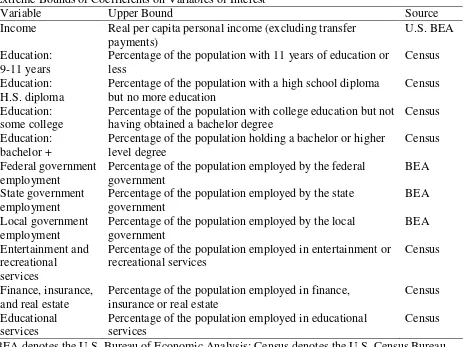
The 11 conditioning variables of interest are listed in Table 1. These variables are 1970
values for 3,058 U.S. counties. The dependent variable is per capita real income growth from
1970 to 1998. See Higgins et al (2006, Table 1 and Section III) for a description of the data set,
including the list of the remaining 30 conditioning variables.
Since it is well-established that initial income be included in growth regressions, the EBA
for "income" is constituted by the results of C(40,3) = 9,880 OLS regressions. The EBAs for the
remaining 10 conditioning variables of interest are constituted by the results of C(39,3) = 9,139
OLS regressions.
3. Results of Extreme Bounds Analysis
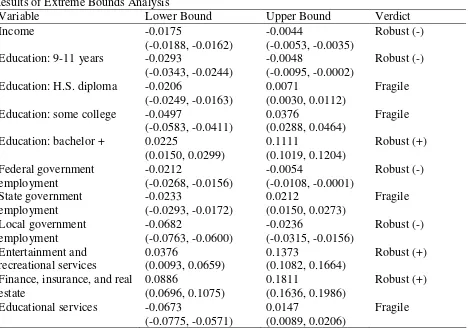
The extreme bounds for coefficients are reported in Table 2 along with their 95 percent
confidence intervals. A full 7 of 11 variables, found to be significant correlates with economic
growth by Higgins et al. (2006), are robust as defined by the EBA. Furthermore, the robust
correlates according to the EBA carry the same signs as reported in Higgins et al. (2006).
First, the initial level of income is a robust, negative correlate with per capita income
growth. This confirms that a conditional convergence effect exists across the U.S. at the
county-level. This can also be viewed as consistent with studies by Barro and Sala-i-Martin (1992),
2
Evans and Karras (1996a, 1996b), Sala-i-Martin (1996), and Evans (1997a, 1997b) who
document conditional convergence using state-level data; and with Young et al. (2006) who find
conditional convergence within many individual U.S. states using county-level data.3 The
existence of conditional convergence is always encouraging in the limited sense that it implies
that if a relatively poor economy can emulate the policies and institutions of its wealthier
counterparts, then it can expect to grow faster and catch-up in terms of its per capita income.
The robust estimated effects of educational attainment variables appear reasonable. The
larger a percent of a county's population not obtaining the remedial communication and
analytical skills associated with completing high school, the lower is the county's growth rate.
Likewise, a larger percent of a population achieving at least 4 college-years-worth of human
capital correlates with a higher rate of growth.4 Of note, the effect associated with some college
attainment, but less than a bachelor degree, is fragile. This can be viewed as consistent with
Higgins et al.'s (2006) finding that no statistically significant effect is associated with that
variable. One interpretation is that the opportunity costs of education at those levels of
attainment are comparable to the social returns.
Turning to the government employment variables, the robust negative correlations
associated with federal and local government are consistent with Higgins et al. (2006). However,
Higgins et al. also found state government employment to be negatively correlated (significantly
at the 1 percent level) with growth using 3SLS estimation. Here we find that, using an EBA, that
negative correlation is fragile. Of note, Higgins et al. (2006) also report, as a baseline, OLS
3
This type of convergence is known as -convergence and is necessary but not sufficient for -convergence, i.e., for a narrowing of the income distribution over time. Young et al. (2007) find that, over the same 1970 to 1998 time period, statistically significant -divergence actually occurred.
4
6
coefficient estimates. For the state employment variable the Higgins et al. OLS estimate is
negative but insignificant; the EBA here produces a stronger finding that, changing the set of
conditioning variables, can produce both negative and positive statistically significant coefficient
estimates.
Two of the industry employment variables are robust, positive correlates with
county-level growth. In both cases the positive sign is consistent with the findings of Higgins et al.
(2006). While growth effects associated with entertainment and recreational services are not
widely documented in the literature, the robust positive correlation of growth with the prevalence
of finance, insurance, and real estate industry is in agreement with existing cross-country
evidence.5
4. Conclusions
Higgins et al. (2006) report several statistically significant partial correlates with U.S. per
capita income growth at the county-level. However, Levine and Renelt (1992) demonstrate that,
for cross-country data sets, such correlations are hardly ever robust to changing the combination
of conditioning variables included. It is natural, then, to ask whether the same is true for the
variables identified as important by Higgins et al.
We carry out an extreme bounds analysis of the Levine and Renelt (1992) type using the
U.S. county-level data of Higgins et al. (2006). We find that the majority of the partial
correlations put to test (7 out of 11) can be accepted as robust correlates with U.S. county-level
growth. The variables associated with those partial correlations stand solidly as variables of
interest for other studies of U.S. growth.
5
References
Barro, R.J., Sala-i-Martin, X.X., 1992 Convergence. Journal of Political Economy 100, 223-251.
Evans, P, 1997. How fast do economies converge? Review of Economics and Statistics36, 219-25.
Evans, P., 1997. Consistent estimation of growth regressions. Unpublished Manuscript, available
at http://economics.sbs.ohiostate.edu/pevans/pevans.html.
Evans, P., Karras, G., 1996. Do economies converge? evidence from a panel of U.S. states.
Review of Economics and Statistics 78, 384–388.
Evans, P, Karras, G, 1996. Convergence revisited. Journal of Monetary Economics 37, 249–265.
Higgins, M.J., Levy, D., Young, A.T., 2006. Growth and convergence across the U.S: evidence
from county-level data. Review of Economics and Statistics88, 671-681.
Leamer, E. 1983. Let’s take the con out of econometrics. American Economic Review 73, 31-43.
Leamer, E., 1985. Sensitivity analysis would help. American Economic Review 75, 308-313.
Levine, R., Renelt, D., 1992. A sensitivity analysis of cross-country growth regressions.
American Economic Review 82, 942–963.
Levine, R., 2005. Finance and growth: theory and evidence. in Handbook of Economic Growth,
Aghion P., Durlaf, S. eds. Elsevier Science, Netherlands.
Sala-i-Martin, X., Doppelhofer, G., Miller, R., 2004. Determinants of long-term growth: a
Bayesian averaging of classical estimates (BACE) approach. American Economic
Review 94, 813-835.
Young, A.T., Higgins, M.J., and Levy D., 2006. Heterogeneous convergence. working paper.
Young, A.T., Higgins, M.J., and Levy, D., 2007. Sigma convergence versus beta convergence:
8
[image:9.612.77.544.121.468.2]Tables
Table 1
Extreme Bounds of Coefficients on Variables of Interest
Variable Upper Bound Source
Income Real per capita personal income (excluding transfer payments)
U.S. BEA
Education: 9-11 years
Percentage of the population with 11 years of education or less
Census
Education: H.S. diploma
Percentage of the population with a high school diploma but no more education
Census
Education: some college
Percentage of the population with college education but not having obtained a bachelor degree
Census
Education: bachelor +
Percentage of the population holding a bachelor or higher level degree
Census
Federal government employment
Percentage of the population employed by the federal government
BEA
State government employment
Percentage of the population employed by the state government
BEA
Local government employment
Percentage of the population employed by the local government
BEA
Entertainment and recreational services
Percentage of the population employed in entertainment or recreational services
Census
Finance, insurance, and real estate
Percentage of the population employed in finance, insurance or real estate
Census
Educational services
Percentage of the population employed in educational services
Census
Tables (cont.)
Table 2
Results of Extreme Bounds Analysis
Variable Lower Bound Upper Bound Verdict Income -0.0175
(-0.0188, -0.0162)
-0.0044
(-0.0053, -0.0035)
Robust (-)
Education: 9-11 years -0.0293
(-0.0343, -0.0244)
-0.0048
(-0.0095, -0.0002)
Robust (-)
Education: H.S. diploma -0.0206
(-0.0249, -0.0163)
0.0071
(0.0030, 0.0112)
Fragile
Education: some college -0.0497
(-0.0583, -0.0411)
0.0376
(0.0288, 0.0464)
Fragile
Education: bachelor + 0.0225
(0.0150, 0.0299) 0.1111 (0.1019, 0.1204) Robust (+) Federal government employment -0.0212 (-0.0268, -0.0156) -0.0054 (-0.0108, -0.0001) Robust (-) State government employment -0.0233 (-0.0293, -0.0172) 0.0212 (0.0150, 0.0273) Fragile Local government employment -0.0682 (-0.0763, -0.0600) -0.0236 (-0.0315, -0.0156) Robust (-) Entertainment and recreational services 0.0376 (0.0093, 0.0659) 0.1373 (0.1082, 0.1664) Robust (+)
Finance, insurance, and real estate 0.0886 (0.0696, 0.1075) 0.1811 (0.1636, 0.1986) Robust (+)
Educational services -0.0673
(-0.0775, -0.0571)
0.0147
(0.0089, 0.0206)
Fragile