Durability Characteristics of Self Compacting Self Curing by using Light
Weight Aggregate
Sneha D
1Sanjay Raj A
21
P.G. Student
2Assistant Professor
1,2
REVA University, Bengaluru, India
Abstract— The objective of this study about durability characteristics of self-compacting concrete. This research is proposed to replace the constituent materials by mineral Admixtures and adding chemical admixtures. Also it is proposed to use self-curing compound instead of conventional water curing. Many researchers studied about the self-compacting concrete and not for self-compacting and self-curing concrete, but this study proposed a methodology for self-compacting and curing concrete. Durability properties such as acid attack, sulphate attack, Alkaline Attack, water absorption and sorptivity has been found out and compared with conventional concrete. Cube in size of 150mm×150mm×150mm were cast and tested to analyze the durability characteristics. Attributes deliberated for diverse percentages of self-curing agent (0%, 5%, 10%, 15% weight of cement) and from the outcomes, conclusion may perhaps draw that 15% LWA SCSCC blend offered more strength and durability.
Key words: SCC, SCSCC, LWA, Light Weight Aggregate
I. INTRODUCTION
Self-compacting concrete was proposed by Professor Hajime Okamura in 1986, but it was first by Professor Ozawa. Self-compacting concrete (SCC) is a revolutionary concrete which does not require quivering for placing and compaction. It as ability to flow under it’s own weight and achieving full compaction even in the areas of crowded steel reinforcement. In hardened state, SCC has durability that are comparable to that of conventional concrete. Worldwide, the use of self-compacting concrete (SCC) has gained wide acceptance in the precast industry as well as in-situ constructions on account of reduction in the time of construction, reduction in the noise of construction by eliminating vibration, possibility of usage of complex formworks and members with highly congested reinforcement etc leading to Replacement of cementations material like fly ash has increased the paste content, and hence enhance the fresh and strength properties. Partial replacement of metakaoloin with silica fume helped attaining high earlier strength of around 50-70 MPa of SCC.
Contribution of silica fume in SCC improve the durability properties like permeability, water absorption, abrasion resistance, resistance to marine as well as a sulphate attack.
In past decades, the effect of self-curing concrete possesses improved properties while comparing to identically cured controls. It was found that, initial surface absorption, chloride ingress, carbonation, corrosion potential and freeze and thaw resistance characteristics were comparatively better by air cured self-cure concrete than the air cured control.
This paper presents the experimental work which includes the materials used and the testing procedure adopted.
II. OBJECTIVE OF PRESENT STUDY
1) This study is to evaluate the effectiveness of various percentages of mineral and chemical admixtures in SCSCC
2) To study durability characteristics like acid attack, sulphate attack, Alkaline Attack, water absorption and sorptivity of the Self Curing and Self Compacting Concrete (SCSCC).
III. MATERIAL USED
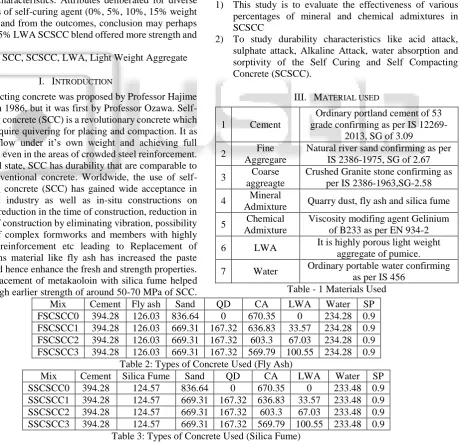
1 Cement
Ordinary portland cement of 53 grade confirming as per IS
12269-2013, SG of 3.09
2 Fine
Aggregare
Natural river sand confirming as per IS 2386-1975, SG of 2.67
3 Coarse
aggreagte
Crushed Granite stone confirming as per IS 2386-1963,SG-2.58
4 Mineral
Admixture Quarry dust, fly ash and silica fume
5 Chemical
Admixture
Viscosity modifing agent Gelinium of B233 as per EN 934-2
6 LWA It is highly porous light weight
aggregate of pumice.
7 Water Ordinary portable water confirming
as per IS 456 Table - 1 Materials Used
Mix Cement Fly ash Sand QD CA LWA Water SP
FSCSCC0 394.28 126.03 836.64 0 670.35 0 234.28 0.9
[image:1.595.91.555.302.746.2]FSCSCC1 394.28 126.03 669.31 167.32 636.83 33.57 234.28 0.9 FSCSCC2 394.28 126.03 669.31 167.32 603.3 67.03 234.28 0.9 FSCSCC3 394.28 126.03 669.31 167.32 569.79 100.55 234.28 0.9
Table 2: Types of Concrete Used (Fly Ash)
Mix Cement Silica Fume Sand QD CA LWA Water SP
SSCSCC0 394.28 124.57 836.64 0 670.35 0 233.48 0.9
SSCSCC1 394.28 124.57 669.31 167.32 636.83 33.57 233.48 0.9
SSCSCC2 394.28 124.57 669.31 167.32 603.3 67.03 233.48 0.9
SSCSCC3 394.28 124.57 669.31 167.32 569.79 100.55 233.48 0.9
IV. RESULTS AND DISCUSSION
A. Acid Attack:
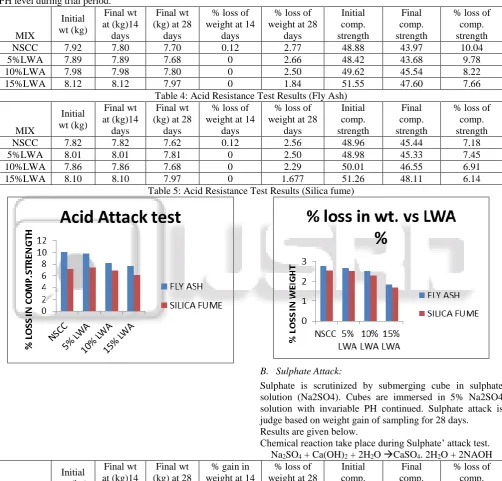
Experiment was conducted for with and without replacement of LWA scrutinize meant for acid attack. Conflict in opposition to chemical attack deliberate by submerging concrete cubes in Sulphuric acid (H2SO4). Cubes submerge in 5% H2SO4 solution. For 4 weeks keep up with constant PH level during trial period.
Later than 4 weeks of trail cubes are detached from solution and kept for drying and then ultimate weights and compression loss are concluded. Test is performed keeping, reference that was acquired from mechanical test results as an evident.
Chemical reaction take place during acid’ attack test. 2H2SO4 + Ca(OH)2Ca(SO4)2 + 2H2O
MIX Initial wt (kg) Final wt at (kg)14 days Final wt (kg) at 28
days
% loss of weight at 14
days
% loss of weight at 28
days Initial comp. strength Final comp. strength
% loss of comp. strength
NSCC 7.92 7.80 7.70 0.12 2.77 48.88 43.97 10.04
5%LWA 7.89 7.89 7.68 0 2.66 48.42 43.68 9.78
10%LWA 7.98 7.98 7.80 0 2.50 49.62 45.54 8.22
[image:2.595.46.549.162.643.2]15%LWA 8.12 8.12 7.97 0 1.84 51.55 47.60 7.66
Table 4: Acid Resistance Test Results (Fly Ash)
MIX Initial wt (kg) Final wt at (kg)14 days Final wt (kg) at 28
days
% loss of weight at 14
days
% loss of weight at 28
days Initial comp. strength Final comp. strength
% loss of comp. strength
NSCC 7.82 7.82 7.62 0.12 2.56 48.96 45.44 7.18
5%LWA 8.01 8.01 7.81 0 2.50 48.98 45.33 7.45
10%LWA 7.86 7.86 7.68 0 2.29 50.01 46.55 6.91
15%LWA 8.10 8.10 7.97 0 1.677 51.26 48.11 6.14
Table 5: Acid Resistance Test Results (Silica fume)
B. Sulphate Attack:
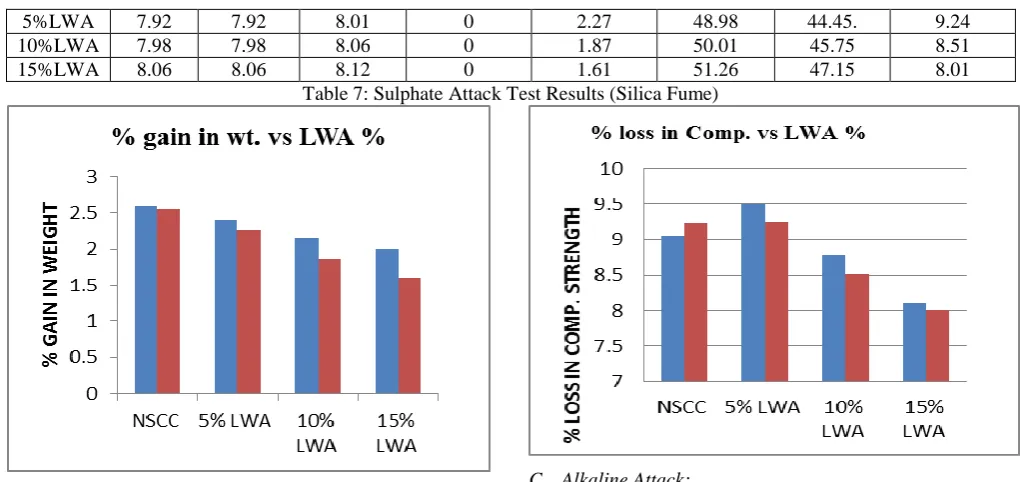
Sulphate is scrutinized by submerging cube in sulphate solution (Na2SO4). Cubes are immersed in 5% Na2SO4 solution with invariable PH continued. Sulphate attack is judge based on weight gain of sampling for 28 days. Results are given below.
Chemical reaction take place during Sulphate’ attack test. Na2SO4 + Ca(OH)2 + 2H2O CaSO4. 2H2O + 2NAOH
MIX Initial wt (kg) Final wt at (kg)14 days Final wt (kg) at 28
days
% gain in weight at 14
days
% loss of weight at 28
days Initial comp. strength Final comp. strength
% loss of comp. strength
NSCC 8.43 8.52 8.65 0.9 2.60 48.88 43.26 9.05
5%LWA 7.82 7.82 8.01 0 2.42 48.42 43.82 9.50
10%LWA 7.89 7.89 8.06 0 2.15 49.62 45.26 8.78
15%LWA 7.96 7.96 8.12 0 2.01 51.55 47.37 8.10
Table 6: Sulphate Attack Results (Fly Ash)
MIX Initial wt (kg) Final wt at (kg)14 days Final wt (kg) at 28
days
% gain in weight at 14
days
% gain of weight at 28
days Initial comp. strength Final comp. strength
% loss of comp. strength
5%LWA 7.92 7.92 8.01 0 2.27 48.98 44.45. 9.24
10%LWA 7.98 7.98 8.06 0 1.87 50.01 45.75 8.51
15%LWA 8.06 8.06 8.12 0 1.61 51.26 47.15 8.01
Table 7: Sulphate Attack Test Results (Silica Fume)
C. Alkaline Attack:
Alkaline Attack is calculated by knowing in% loss of weight for 4weeks. Concrete cubes are immersed in 5% NaoH solution. Then after 28 days it is taken out and tested for its loss in weight and compression strength.
MIX
Initial wt (kg)
Final wt at (kg)14
days
Final wt (kg) at 28
days
% loss in weight at 14
days
% loss of weight at 28
days
Initial comp. strength
Final comp. strength
% loss of comp. strength
NSCC 7.83 8.04 7.754 0.10 0.970 48.88 43.89 9.67
5%LWA 7.89 7.89 7.815 0 0.950 48.42 45.59 7.39
10%LWA 7.92 7.92 7.845 0 0.943 49.62 46.79 6.40
[image:3.595.42.555.63.304.2] [image:3.595.45.553.349.739.2]15%LWA 8.11 8.11 8.037 0 0.900 51.55 46.65 6.26
Table 8: Alkaline’ Attack Test Results (Fly Ash)
MIX
Initial wt (kg)
Final wt at (kg)14
days
Final wt (kg) at 28
days
% loss in weight at 14
days
% loss of weight at 28
days
Initial comp. strength
Final comp. strength
% loss of comp. strength
NSCC 7.52 7.63 7.457 0.11 0.916 48.96 43.2 10.28
5%LWA 7.65 7.65 7.583 0 0.875 48.98 45.13 9.39
10%LWA 7.72 7.72 7.655 0 0.841 50.01 44.98 9.24
15%LWA 7.96 7.96 7.896 0 0.80 51.26 48.18 8.46
Table 9: Alkaline Attacks’ Test Results (Silica Fume)
D. Water absorption:
that keep that in distilled water for an about 24 hours and then take out and wipe out with absorbent cloth the surface cleanly and take down the change in weight.
% absorbent of water = (W2-W1)/W1 *100
Fly ash Silica fume
MIX
Dry Weight in (Kg) (w1)
Wet Weight after 24 hrs in (Kg) (w2)
% absorbent of water
Dry Weight in (Kg) (w1)
Wet Weight after 24 hrs in (Kg) (w2)
% absorbent of water
NSCC 7.82 8.05 2.84 7.89 8.09 2.66
5%LWA 7.77 7.98 2.70 7.58 7.78 2.63
10%LWA 7.84 8.04 2.55 7.92 8.12 2.52
15%LWA 7.96 8.09 2.51 8.12 8.32 2.46
Table 10: Water Absorption Test Results (Fly Ash and Silica Fume)
E. Sorptivity:
Sorptivity action is penetration of water into minute opening in concrete by capillarity. Once the curing is done, samplings of all batch are taken and cover-up are sealed, kept in contact with water capable of depth of 5mm from below. Water absorption and Sorptivity test were conducted for M40 grade and the results have been tabulated in the table below:
I= (𝑚/𝑎) 𝑑
Where,
I= water absorption in mm
m= change in mass of the specimen in grams d= density of water i.e., 0.001 g/mm3
Sorptivity= 𝐼 √𝑡
Sl.no. Mix id At 30 mins At 60 mins At 90 mins At 120 mins At 150 mins At 180 mins
1. 5%LWA FA 0.000569 0.000517 0.000469 0.000365 0.000327 0.000298
2. 10%LWA
FA 0.000650 0.000517 0.000469 0.000325 0.000290 0.000265
3. 15%LWA FA 0.000894 0.000746 0.000656 0.000487 0.000436 0.000398
4. 5%LWA SF 0.000488 0.000459 0.000469 0.000365 0.000327 0.000298
5. 10%LWA SF 0.000650 0.000517 0.000563 0.000365 0.000327 0.000298
6. 15%LWA SF 0.000569 0.000574 0.000609 0.000406 0.000363 0.000331
Table 11: Sorptivity Test Results (fly ash and silica fume)
V. CONCLUSION
1) The action of acids on concrete is the conversation of calcium compound into calcium salts of the attacking
LWA with CA and silica fume as a admixture as greater durability than the 15% LWA with CA and fly Ash. 2) Based on results obtained, it shows that the sulphate
resistance of SCSCC3 is greater than the NSCC. In this result the partial replacement of LWA with Silica Fume as better resistance than that of LWA with fly ash. 3) Based on the result, alkaline resistance of SCSCC is
soaring compared to normal SCC. Among SCSCC blend with fly ash and silica fume, silica fume has shown less % loss in compressive strength which indicates that the alkaline resistance of SCSCC mixes with silica fume is more compared to that of fly ash. It can also be observed that the mix with 15% LWA replacement of coarse aggregates has shown the better alkaline resistance. 4) Based on the curing condition concrete which are
exposed to the air curing adsorbs low water than that of immersed in water. However surface water absorption was higher than that of internal curing regard less of curing condition.
5) Water absorption slightly decreases with increase in the percentage of LWA.
6) It is designated that SCSCC containing Silica Fume provides lesser sorptivity rate than SCSCC containing fly ash. There is noticeable difference in the capability of water absorption by capillary action flanked by SCCSCC with Silica Fume and SCSCC with fly ash. Highest Sortivity value has been obtained from SCSCC with fly ash and lowest Sortivity value obtained from SCSCC silica fume.
REFERENCE
[1] EFNARC (European Federation of National Trade associations representing producer application of specialist building products), specification and Guidelines for Self-Compacting Concrete, Feb 2002, U.K.
[2] “Self-Compacting Concrete and Its Properties” by S. Mahesh Int. Journal of Engineering Research and Applications ISSN: 2248-9622, Vol. 4, Issue 8( Version 7), August 2014, pp.72-80
[3] “Durability Properties of High Strength Self Compacting Concrete using Silica Fume and Quarry Dust” by Mr.Karthick.M, Dr.Nirmalkumar. K, International Journal of Scientific Engineering and Applied Science (IJSEAS) – Volume-2, Issue-4, April 2016 ISSN: 2395-3470.
[4] “An experimental study on durability of high strength self-compacting concrete (HSSCC)” by N. Venkat Rao1, M. Rajasekhar2, MohdMujeebuddinahmed IJRET: International Journal of Research in Engineering and Technology eISSN: 2319-1163 | pISSN: 2321-7308 [5] “Study on Durability Characteristics of Self-Compacting