Ph.D. Dissertation in Economics:
Endogenous Growth and
Underdevelopment Traps:
a theoretical and empirical analysis.
Candidate: Fabrizio Zilibotti
UMI Number: U056B28
All rights reserved
INFORMATION TO ALL USERS
The quality of this reproduction is dependent upon the quality of the copy submitted.
In the unlikely event that the author did not send a complete manuscript and there are missing pages, these will be noted. Also, if material had to be removed,
a note will indicate the deletion.
Dissertation Publishing
UMI U056B28
Published by ProQuest LLC 2014. Copyright in the Dissertation held by the Author. Microform Edition © ProQuest LLC.
All rights reserved. This work is protected against unauthorized copying under Title 17, United States Code.
ProQuest LLC
ACKNOWLEDGMENTS
ABSTRACT
The Thesis investigates issues of growth and development economics from both a theoretical and empirical perspective. The basic stylised fact which motivate the analysis are the existence, documented in the work, of poverty traps and the obser vation that there is a critical stage in which growth becomes the normal condition of a society. The main objective of the work is to identify economic determinants which explain the growth-stagnation dichotomy, or why countries find more difficulties in activating growth rather than in keeping growth going.
In the first chapter, I construct a model which combines self-sustained growth and ‘underdevelopment traps’ into a common analytical framework. The model exhibits aggregate non-convexities and thresholds which separate a region in which the equi librium growth path converges to a stationary steady-state from a region in which growth is self-sustained. The core of the chapter is a set of original formal propo sitions about non-linear economic dynamics of which I make use in both this and the following chapter. The outcome of some simulations are also discussed. The findings are used to interpret some historical episodes like the take-off experience of different countries during the Industrial Revolution.
The second chapter presents a model built on a similar analytical framework, based on the parable of an economy of many island which grow different fruits from spe cific trees, whose fertility increases when fertilisers taken from different islands are employed. The parable aims at explaining how the cost of ‘market activity’ and intermediation affect growth and, possibly, cause underdevelopment traps. The fol lowing chapter tests some implications of the model.
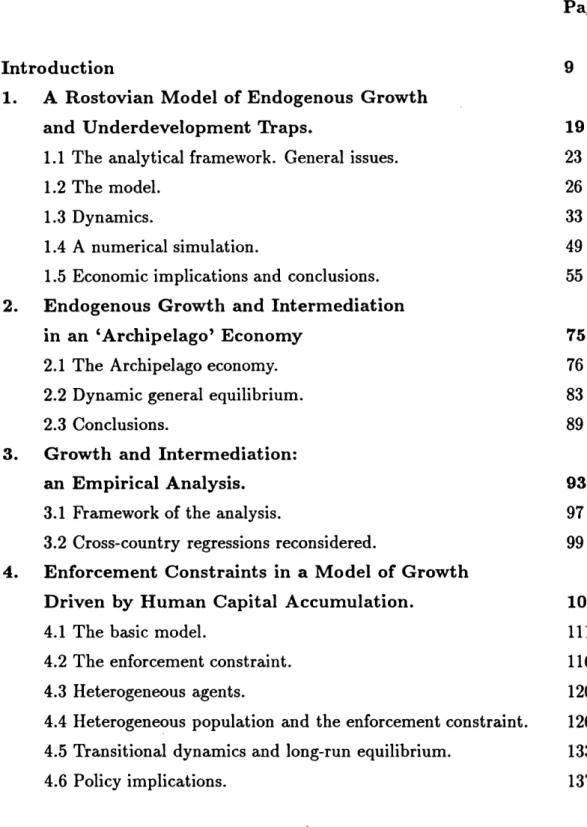
TABLE OF CONTENTS
P age
In tr o d u c tio n 9
1. A R o sto v ia n M o d el o f E n d ogen ou s G row th
and U n d erd ev elo p m en t Traps. 19
1.1 The analytical framework. General issues. 23
1.2 The model. 26
1.3 Dynamics. 33
1.4 A numerical simulation. 49 1.5 Economic implications and conclusions. 55
2. E n d o g en o u s G row th and In term ed ia tio n
in an ‘A rch ip ela g o ’ E co n o m y 75
2.1 The Archipelago economy. 76 2.2 Dynamic general equilibrium. 83
2.3 Conclusions. 89
3. G row th and In term ed ia tio n :
an E m p irical A n a ly sis. 93
3.1 Framework of the analysis. 97 3.2 Cross-country regressions reconsidered. 99
4. E n fo rcem en t C on strain ts in a M o d el o f G row th
D riv en by H u m an C ap ital A ccu m u la tio n . 107
4.1 The basic model. I l l
4.2 The enforcement constraint. 116
4.3 Heterogeneous agents. 120
4.4 Heterogeneous population and the enforcement constraint. 126 4.5 Transitional dynamics and long-run equilibrium. 133
4.7 Long-run equilibria and historical accidents.
Pallas-land vs. Lotus-land 140
4.8 Appendix 143
5. S to c h a s tic T re n d s a n d M a c ro e c o n o m ic F lu c tu a tio n s :
a M u ltic o u n tr y A p p ro a c h . 157
5.1 Identification. 160
5.2 A two-country case. 162
5.3 Results. 165
5.4 Conclusions. 173
5.5 Appendix. 174
R e fe re n c e s . 179
LIST OF FIGURES
P a g e
F ig u r e s o f c h a p te r 1
Figure 1. 60
Figure 2. 61
Figure 3. 62
Figure 4. 63
Figure 5a. 64
Figure 5b. 65
Figure 5c. 66
Figure 6a. 67
Figure 6b. 68
Figure 6c. 69
Figure 7. 70
Figure 8. 71
Figure 9. 72
Figure 10. 73
Figure 11. 74
F ig u re s o f c h a p te r 2
Figure 1. 90
Figure 2. 91
Figure 3. 92
F ig u r e s o f c h a p te r 4
Figure 1. 144
Figure 2. 145
Figure 3. 146
Figure 5. 148
Figure 6. 149
Figure 7. 150
Figure 8. 151
Figure 9. 152
Figure 10a. 153
Figure 10b. 154
Figure 11a. 155
Figure l i b . 156
F ig u re s o f c h a p te r 5
Figure 1. 177
LIST OF TABLES
P a g e
T a b le s o f c h a p te r 1
Table 1. 20
T a b le s o f c h a p te r 3
Table 1. 102
Table 2. 105
T a b le s o f c h a p te r 5
Table 1. 167
Table 2. 169
Table 3. 175
INTRODUCTION
In a recent survey article, Lucas (1993) addresses the question of what ex planations growth theory can provide to those episodes of very rapid income growth, th at he calls ‘economic m iracles’. He notes th at in 1960 the Philippines and South Korea had about the same per capita GDP, and the main struc tural economic indicators were rather similar (apart from a difference in the higher education schooling rates th at was clearly in favour of the Philippines). These preconditions notw ithstanding, from 1960 to 1988, GDP per-capita in the Philippines grew at about 1.8 per cent per year, without any evidence of ‘convergence’ to the GDP levels of the rich countries. Korea, on the other hand, ‘grew at 6.2 per cent per year, a rate consistent with the doubling of living standards every 11 years’ (p. 251).
Traditional growth literature fails to provide satisfactory explanations to these contrasting performances. On the one hand, neoclassical models follow ing the Solow-Cass-Koopmans tradition predict th a t backwardness itself is one m ain reason for rapid growth. When we control for technological and taste param eters, convex growth models predict th a t countries with a lower initial capital stock will grow faster than rich countries towards the steady-state long- run equilibrium. This may help explain the Korean miracle, but does not say why the Philippines did not do the same, and is even more sharply contra dicted by the Sub-Saharan Africa experience of stagnation throughout the last decades. On the other hand, generations of trade and development theorists of more or less radical inclination (Baran, 1957; Frank, 1967; Lewis, 1977; Krug- m an, 1981) argue, to the opposite, th a t due to the nature of the North-South relations growth and development are impossible for poor country. According to these authors, relative backwardness, far from being a source of growth, is a cause of stagnation. This claim, consistent with diverse example of poverty traps, seems contradicted by the Korean miracle.
satisfactory theory of growth and ‘miracles’ are that:
• ‘since it is a fact th at the poor are either not gaining on the rich, or are gaining only very slowly, one wants a theory th at does not predicts otherwise’ (p. 269);
• ‘a successful theory of economic miracles should, ..., offer the possibility
of rapid growth episodes, but should not imply their occurrence as a simple consequence of relative backwardness. It should be as consistent with the Philippine experience as with the Korean’ (p.269).
The m ain objective of this thesis is to develop a theory of economic devel opm ent which is consistent with these guidelines and with a num ber of other stylised facts which will be presented throughout the work. Our initial objec tive is an analytical foundation for the existence of underdevelopment traps. We observe th a t both historical and cross-country evidence (discussed in the beginning of chapter 1) suggest th at it is more difficult for countries to acti vate a development process than to keep growth going. This leads to a natural emphasis on non-convexities and increasing returns to scale. On the other hand, m otivated by the stylised facts identified by Prof. Rostow’s m onum en tal work, we aim at explaining why single once-over episodes may activate a self-sustained growth process, with the take-off periods being characterised by particularly high growth rates.
location decisions of other people - which also depend on their expectations of future earnings. Thus, there is at least potentially a possibility of self-fulfilling prophecies’ (p.654). This idea stretches back to the traditional ‘Big P ush’ doc trine of Rosenstein Rodan (1943), recently revisited and formalised by Murphy, Shleifer and Vishny (1989). More precisely, Pareto-rankable m ultiple equilib ria can be obtained in macroeconomic models when both externalities and strategic com plem entarity (Cooper and John, 1988) are present1.
In the first, second and fourth chapter, we develop a num ber of analytical models which try to explain why structurally identical country at some stage of their history may take some divergent routes. Our approach abstracts from im portant idiosyncratic factors (like cultural, anthropological or social differ ences) and, following Lucas (1988), tries to identify ‘a mechanics of economic development - the construction of a mechanical, artificial world, populated by the interacting robots th a t economics typically studies, th a t is capable of ex hibiting behaviour the gross features of which resemble the actual world ...’
(p . 5 ).
The first chapter of the thesis constructs an endogenous growth model whose most original feature is a particular type of m ultiplicity of equilibrium solution trajectories. These trajectories all but one converges to a stationary steady-state, whereas one exhibits perpetual growth. This is, in our opinion, the m ost sensible representation of the growth-stagnation dichotomy. Related literature on underdevelopment trap issues has identified a num ber of economic mechanisms which generate m ultiple equilibrium trajectories converging to al ternative steady-states. O ther papers have shown the possibility of zero-growth corner solutions in endogenous growth models. In the former group of papers, we might m ention models of sectoral allocation (Krugm an, 1991; M atsuyama,
1991, Rodriguez, 1993), models with pecuniary externalities coming from tech nological complementarities (Young, 1993; Ciccone and M atsuyam a, 1992), models with search and trade externalities (Diamond and Fudenberg, 1989), or other types of external effects (Benhabib and Farmer, 1991; Boldrin, 1993). In the second group we find mainly some models which assume non-convexities in the technology of hum an capital accumulation (Azariadis and Drazen, 1990; Becker, Murphy and Tamura, 1990), but also models with stochastic endoge nous innovation (Aghion and Howitt, 1992). To our knowledge, however, our model is the first to dem onstrate the possibility of saddle-path (interior) equi librium solutions a la Cass (1965) co-existing with self-sustained growth equi libria a la Romer (1986). The analytical intuition is th at such dynamics emerge whenever both decreasing and increasing returns occurs, such th a t the produc tivity of reproducible assets is larger than the social discount rate in the ‘large’ economy, but falls below it for some range of interior values of the state vari able. We rationalise this in a model with externalities of the learning-by-doing type. The main analytical issue is th a t standard argum ents of existence and determ inacy2 of the solutions do not apply to this framework. The core of the contribution is contained in a technical section which provides analytical conditions for such properties to be satisfied. We interpret the model as a formalisation of the Rostovian idea of economic take-off. M ultiple equilibria are a possible feature of this model.
Results obtained by m anipulating the aggregate production function such as assuming various types of externalities can always be criticised on the grounds of the ad hoc nature of the assumptions. In the second chapter, we develop a two-sector model which exhibits the same dynamics as those dis cussed in the first chapter without any special assumption about technology. The model has the nature of a parable about an economy of islands in which
there are transaction costs and specialised operators whose activity consists of trading heterogeneous productive resources owned by agents who live in different island. The main intuition is th at if there are imperfections in the ‘interm ediation sector’, and the degree of imperfection is decreasing with the size of the m arket, it is possible to obtain the alternance of increasing and de creasing returns which makes this model observationally equivalent with th at characterised by technological externalities discussed in the first chapter.
integrated in international m arket networks which make their political borders of low importance. The theoretical predictions of the model should be taken as conditional on these dimensions.
C hapter 3 tests some implications of the model of section 2. The model predicts th at interm ediation costs3 should be negatively correlated with growth rates. We assume for sitnplicity th at the m arket power of the banking sector is representative of th a t of the whole interm ediation sector. Then, we take the wedge between the borrowing and lending interest rate as a measure of such m arkup, which, according to our theory, should be negatively correlated with, tfie growth rates across countries. The results are clearly supportive of the hypothesis, after controlling for several typical explanatory variables in cross-country growth regressions4. Though we take this empirical analysis as ju st preliminary, the results look encouraging. The main lim itation, which we plan to cope with in future investigation, is th a t the test does not consider explicitly the trap issue, which plays a main role in the theoretical analysis.
In the models of the first two chapters, we do not take any explicit view on the nature of the resources whose accumulation determines growth. Traditional growth theorists would call it ‘physical capital’; Romer (1986), on the other hand, referred to it as ‘knowledge’; in the first chapter we simply define it as the vector of ‘reproducible resources’. There exists a class of endogenous growth models, however, which entails a clear characterisation of the driving force of the growth process as the accumulation of hum an capital (Lucas, 1988; Santos and Caballe, 1993; Barro and Sala-i-Martin, 1993). From an analytical viewpoint, there is a clear distinction between these models and the those discussed earlier. Models with hum an capital accumulation do not need any
3By intermediation we mean here all economic activities which, without being directly productive, allow economic agents to perform exchanges activity which improve the alloca tion of productive resources. Financial intermediation is the main economic activity of this type; other examples are mentioned in the introduction to chapter 2.
4Here, we are not faithful to our previous discussion, and m aintain the country as the unit of analysis. We leave to future research to check the robustness of results when control is made for the degree of openness of countries.
force which sustains the productivity of physical capital (or analogue concepts) to keep growth going as the stock of capital increases. Since the productivity of labour is continuously augmented by the investments in education, these models do not have any genuinely fixed factor which enters the production function. The stock of capital can increase for ever without losing productivity at the margin, because the complementary factor - labour in efficiency units - also grows over tim e and constant returns to scale are sufficient to generate endogenous growth. If the critical assum ption of non-decreasing returns to the accum ulation of hum an capital is satisfied, there is an engine of growth. This is the framework of our model of chapter 4.
A theory of underdevelopment traps within this framework needs to explain why agents in poor countries find it lowly profitable to devote tim e to increase their future labour productivity and wage. The key issue is to identify an eco nomic mechanism such th a t people in very poor countries expect to receive too low a benefit from augmenting their productivity to justify the effort and the opportunity cost of learning and not invest in education. Earlier models simply assume th a t there are increasing social returns to hum an capital accumulation (Azariadis and Drazen, 1990). In our model, low investment in education is caused by the lack of some complementary inputs to labour in the economy. An isolated electronic engineer cannot expect to take great advantage from his qualification in a prim itive rural economy. The model identifies a vicious circle th a t two-way links low hum an capital accumulation to the absence of devel opm ent of a modern industrial sector of activity. Recent experience suggests th a t foreign investments are an im portant vehicle of industrialization and de velopment, particularly in those activities (manufacturing sector) th a t entail a significant technological transfer towards poor countries. This suggests a rela tion of com plem entarity between the capability of a country to a ttra ct foreign investors, and th a t of inducing the accumulation of local hum an resources.
investors feel unsafe about property rights. Political changes, revolutions or changes in the attitu d e of the local governments can underm ine the control of the investor over the resources invested. The issue of property right enforce m ent has been recently discussed within endogenous growth models, b ut usu ally without explicit reference to foreign investment. Benhabib and Rustichini (1991) assume an heterogeneous two-group population and show th a t the poor definition of property rights (each group may lobby to redistribute the existing resources in favour of the consumption of its members) may negatively affect the investm ent and growth rate of the economy. Persson and Tabellini (1991a) relate this issue to th a t of income distribution. They assume th a t heteroge neous agents vote about a linear tax schedule on capital to finance lump-sum redistribution. The higher the degree of inequality, the higher the petition for redistribution and th e equilibrium tax rate, and the lower the growth rate. Saint-Paul and Verdier (1991) argue, on the other hand, th a t high inequality leads to higher growth, since it causes more pressure for redistribution in the form of public education. O ther papers include Perotti (1990), Alesina and Rodrik (1991) and Bertola (1991). In all these papers, the conflict is about redistributing a stock of resources owned by members of the social community in a way th a t could be either favourable or unfavourable to growth.
seizing foreign resources be not too large. This implies th at in equilibrium the am ount of foreign investments is rationed below the first-best level by the investor themselves. By the previous argum ent, this feeds back to reducing the rate of hum an capital accumulation and the growth rate of the economy.
The model allows for heterogeneous agents, with different human capital endowments and income, and contains predictions about the effects of distri bution on growth. In particular, it is consistent with the Kuznets curve and predicts a relation between growth and distribution similar to th at found by Aghion and Bolton (1992) and P iketty (1993) assuming information issues in capital m arkets.
The model of chapter 4 shares some features with those presented in the previous chapters. Multiple equilibria are possible due to the nature of the interactions between political equilibrium and individual choices of human capital investments. The selection between alternative outcomes only depends on the expectations prevailing within the members of a particular generation. In one type of equilibrium there is higher investment in education in the host country and higher foreign investm ent, whereas the other type of equilibrium is characterised by a lower level of both variables. We show by simulation th at a single episode, namely the choice of one or another equilibrium may have dram atic long-run consequences. The succeeding generations may no longer face the m ultiplicity of equilibria, and we can construct cases in which given two initially identical countries, th at which selected the good equilibrium takes off into sustained growth, whereas the other declines irreversibly.
GNP is per se sufficient to diminish the role attrib u ted by traditional models to tem porary (e.g. m onetary) disturbances in explaining output fluctuations. This view was later challenged by work in a m ultivariate framework (Blanchard and Quah, 1989; King et al., 1991) which rescued the Keynesian argum ent ac cording to which dem and shocks play a main role as a source of business cycle. Recent work using cointegration analysis (Bernard and Durlauf, 1991) estab lished th a t the d ata reject both the view th a t growth is driven by a common trend worldwide and the view th at growth has an entirely idiosyncratic na ture. This means th a t output in each country is affected by more than one independent disturbance with a perm anent nature and th a t the share of out put variability explained by tem porary disturbances m ight be smaller than th a t found by Blanchard and Quah assuming th a t output growth is driven by one stochastic trend only.
CHAPTER 1
A Rostovian Model of Endogenous Growth and
Underdevelopment Traps
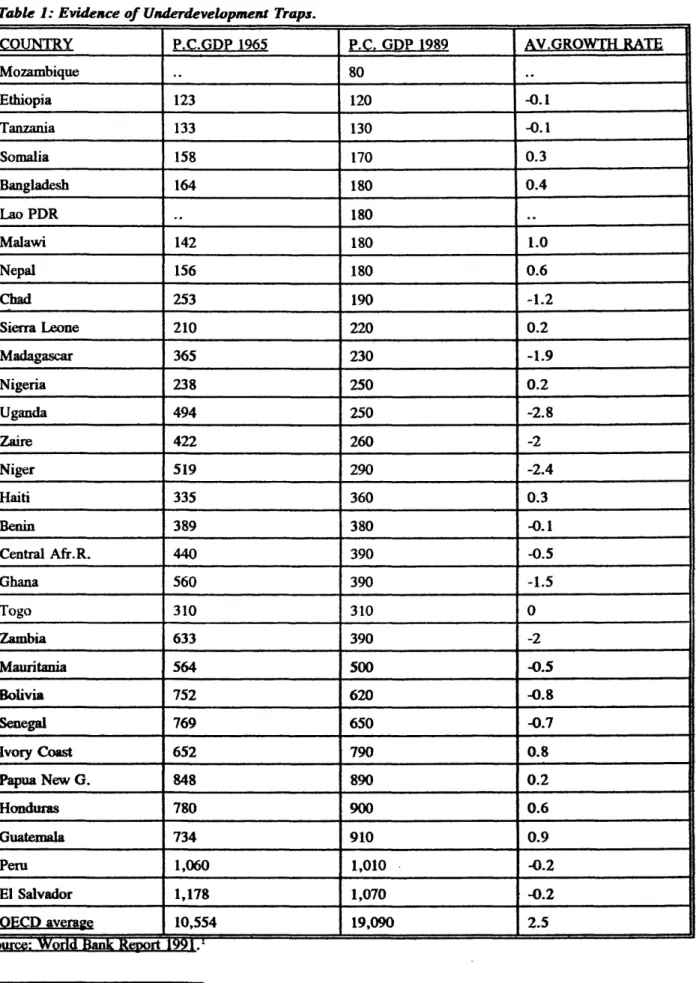
Table 1: Evidence o f Underdevelopment Traps.
COUNTRY P.C.GDP 1965 P.C. GDP 1989 AV.GROWTH RATE
Mozambique 80
Ethiopia 123 120 -0.1
Tanzania 133 130 -0.1
Somalia 158 170 0.3
Bangladesh 164 180 0.4
LaoPDR 180
Malawi 142 180 1.0
Nepal 156 180 0.6
Chad 253 190 -1.2
Sierra Leone 210 220 0.2
Madagascar 365 230 -1.9
Nigeria 238 250 0.2
Uganda 494 250 -2.8
Zaire 422 260 -2
Niger 519 290 -2.4
Haiti 335 360 0.3
Benin 389 380 -0.1
Central Afr.R. 440 390 -0.5
Ghana 560 390 -1.5
Togo 310 310 0
Zambia 633 390 -2
Mauritania 564 500 -0.5
Bolivia 752 620 -0.8
Senegal 769 650 -0.7
Ivory Coast 652 790 0.8
Papua New G. 848 890 0.2
Honduras 780 900 0.6
Guatemala 734 910 0.9
Peru 1,060 1,010 -0.2
El Salvador 1,178 1,070 -0.2
QECP average 10,554 19,090 2.5
Source: World Bank Report 1991.1
In a classic contribution to the economics of development, Rostow (1990) claims th at there is a ‘decisive interval in the history of a society when growth become its normal condition... The beginning of take-off can usually be traced to a particular sharp stimulus. The stimulus may take the form of a political revolution ..., a technological innovation ..., a newly favourable international environment .... W hat is essential is ... the fact th at the prior development of the society and its economy result in a positive, sustained and self-reinforcing response to it: the result is not a once-over change in the production function ..., but a higher proportion of potential innovations accepted in a more or less regular flow, and a higher rate of investm ent’ (pp.36-37).
The idea th a t underdeveloped economies may be trapped in stable, or ‘quasi-stable’ equilibria with low per capita income, investment and technical progress has a long tradition in the development literature (Rosenstein-Rodan 1943 and 1957; Nelson, 1956; Leibenstein, 1957; Basu, 1984), stretching back to the M althusian theory of endogenous population growth. In a recent revival of interest, the poverty traps issue has been analysed in the framework of the coordination failure literature (Cooper and John, 1988). Murphy, Shleifer and Vishny (1989) develop a model with increasing returns to scale and im per fect com petition. O ther papers include Krugman (1991), M atsuyam a (1991); Zilibotti (1993a). The main lim itation of this literature is th a t it only proves the existence of m ultiple Pareto-rankable steady-state equilibria, rationalising the existence of differences in the long-run income levels between structurally identical countries, but does not explain the stagnation-growth dichotomy de scribed by Rostow.
New growth theories characterise the economy as endowed with a self- sustaining engine of growth. Standard endogenous growth models (Romer, 1986; Lucas, 1988), however, do not answer the question of why starting the engine of growth should be more difficult than keeping it going.
an overlapping generations model to show th at if the private yield on hum an capital is increasing in the stock of human capital, then there may be bifurca tions and m ultiple equilibria with different growth rates associated with each of them (including a zero-growth solution). A similar result is found by Becker, M urphy and Tam ura (1990) in a model where fertility rates are endogenized. A problem w ith these models is th a t they characterise stationary traps as zero-income corner solutions. On the other hand, Reynolds (1983) argues con vincingly th a t both contemporary poor countries and pre-industrial European economies actually look quite dynamic and not unresponsive to innovation, though unable to produce sustained per capita income growth (p.948). Also Rostow (1990, ch.3) stresses the im portance of those cultural and economic changes taking place during the stages of development at which a society is still unable to produce continuing growth, which represent, in his words, the ‘preconditions’ for take-off. Models in which the equilibrium dynamics drive any ‘tra p p ed ’ economy to a zero-income solution, however, fail to capture any difference between societies which are in a pre-take-off stage and rule out th a t any structural change may have perm anent effects before the ‘big push’ occurs. We find it somewhat counterintuitive to think of some centuries of history which preceded the Industrial Revolution in term s of a completely immobile equilibrium.
Our model aims at capturing more closely Rostow’s stylised fact. The ‘extensive growth’ or pre-take-off stage turns out to be characterised by the absence of self-sustained growth, but episodes of short run growth, technical change and perm anent increase in per capita income are possible. The Solow- Cass model, with its implication of long-run stationarity, provides the natural framework to describe economies th at do not grow at a sustained rate in per capita term s. Once the take-off has occurred, however, the same economies exhibit a Rom er-type behaviour with sustained growth. Furtherm ore, we have a role for both development thresholds and m ultiple self-fulfilling prophecies.
emerges from the observation of cross-sectional data, namely the existence of a hum p in the p attern of growth. Though very poor countries grow on aver age less than advanced countries, with many of them exhibiting zero growth, middle-income countries grow on average faster than rich countries. Average per capita growth rates obtained from the Summers and Heston (1988 and 1991) postwar d ata turn out to be below 1% for low-income countries, 3.2% for middle-income, 2.2% for rich countries. Some Asian newly industrializing countries exhibit growth rates well above 5% per year for prolonged periods. Both traditional and recent growth models, by focusing on balanced growth solutions, are at odd with explaining this evidence.
Section 1 relates our analytical framework to the existing growth literature. Section 2 discusses the assumptions of the model. Section 3 characterizes the dynam ic solution of the model through a series of formal propositions. Section 4 presents the results of some numerical simulations based on a specification of the model. Section 5 discusses the economic implications and concludes.
1
T h e a n a ly tica l fram ew ork. G en eral issu es.
of a Cobb-Douglas specification), implying th at the marginal productivity to capital alone tends to zero in the ‘large’ economy. Under these circumstances, long-run growth is only possible if an exogenous factor-augmenting technolog ical trend is imposed to the production function. However, a point th a t seems to have been ignored by the literature is th at the analytical solution found by Cass (1965) and Koopmans (1965) carries over to a model in which the productivity of capital falls below the social discount rate only ‘locally’, rather th an globally as in standard neoclassical models. In other words, it is possible to obtain the standard long-run stationary saddle-path as ju st one of a num ber of equilibrium solutions of the model, rather than the unique one, when some types of aggregate non-convexities are allowed.
Modern growth theory has examined a num ber of economic mechanisms which m ight sustain the marginal productivity of capital, as accumulation proceeds. Among the factors which have been identified are learning-by-doing externalities (Romer, 1986 and 1989), accumulation of hum an capital (Lucas, 1986), ‘intentional’ innovation (Romer, 1990; Aghion and Howitt, 1992) and financial development (Greenwood and Smith, 1993; Saint-Paul, 1992; Zili- b o tti, 1993b). In most cases, reasons of analytical convenience have induced th e researchers to focus on models which generate balanced-growth solution trajectories. In other words, the existing literature has accorded a generalised preference for reduced-form solutions which are linear in the reproducible fac tor (sometimes known as the A A -type).
analytical framework which fits well Rostow’s description of take-off and de velopment.
The formal results of this chapter apply to a reduced-form solution which can be generated by a potentially vast set of structural models. The critical feature of these models is th at the social productivity of the reproducible fac tors of production, given the stock of factors in exogenous supply, be decreasing at lower levels of accumulation and increasing at higher level of accumulation. Can we think of economic circumstances which make this picture realistic? In the abstract, reduced-form solutions exhibiting this type of non-linearity are neither more nor less plausible than those displaying the exact linearity of the social productivity of capital in its stock, as in m ainstream endogenous growth models. To be concrete, however, we will base the formal discussion on a stylised economic model, close in spirit to Rostow’s analysis, which generates the required reduced form.
2
T h e m od el.
In this section we discuss the benchmark model. Imagine a world in which two types of innovation take place. The first type, which we will call ‘scientific advancem ents’ has the character of large-size episodic events, like changes in th e dom inant scientific paradigm or development of new machines based on previously unknown principles (e.g. the wheel, the steam engine and so on). The second type is a continuous flow of technical progress resulting from the daily effort to translate the potential warranted by the current state of scien tific knowledge into actual improvements to the technology used to produce goods. In other words, we draw a distinction between technical revolution and technical evolution.
We make the simplifying assumption th at the former are entirely exoge nous; in particular the productive activity does not affect the occurrence of revolutionary changes. One can imagine th a t these innovations come from the research activity carried on in academic and other institutions, whose ac cum ulated knowledge moves the frontier of possible technical improvements, w ithout being directly applicable to productive activity.1.
The second type of innovation continuously augments the factor productiv ity. This technical change is assumed to be the by-product of the investm ent activity as in standard learning-by-doing models (Arrow, 1962, Romer, 1986)2. In other words, technical progress driven by the process of accum ulation is the channel through which the state of technical efficiency catches up with the frontier productivity level warranted by the state of knowledge. The central
1This assumption is criticizable, since much of the research activity conducted in modern societies receives a determ inant impulse from the needs of the productive sector. However, this linkage has not always been so strong as today (for instance, the Copernican revolution was not the result of any stimulus from the productive sector). Furthermore, even in the contemporary world, many countries do not participate in a significant way in the produc tion of great scientific changes, but simply endeavour to catch-up with the technological capabilities of the leading countries, taking as given the frontier of knowledge.
idea of the model is th at when the conditions for sustained investm ent are not fulfilled, the process of technical change is also arrested and the economy gets locked into an underdevelopment trap. Stagnation and low levels of income and productivity are two sides of the same coin.
We now introduce two strong simplifying assumptions. First, though it would be appealing to use a vintage structure in which innovation is embodied only in newly installed plants, we avoid the formal complications which this would bring about by assuming th at the flow of technical progress affects the whole existing capital stock. Second, as in the first generation of endogenous growth models, we treat the learning-by-doing effect as a pure externality, so th a t any agent cannot exclude others from benefitting from the productivity improvements coming from his investment activity.
Consider a one-sector competitive economy, k (called capital for simplicity) is a composite good consisting of the private component of any reproducible private factor of production like human and physical capital. The technology depends on this composite variable, a non-reproducible factor in fixed sup ply, n, and a variable, A t representing the state of technical efficiency. To fix ideas, the non-reproducible factor could be thought of as labour. The produc tion function yt = y (kt, n , A t) is assumed to be continuous, twice differentiable and to exhibit constant returns to scale in capital and labour and increasing returns to scale in all the three arguments. A t is a pure public good and does not receive explicit compensation. W ith reference to the previous discussion,
A t is not ju st worldwide available knowledge, but is rather th a t p art of it which is applicable to production activity at tim e t in a certain country.
We characterise the ‘learning equation’ as a function of two variables: - the distance between the current state of technical knowledge and the
frontier of technical knowledge, determ ined by past scientific discoveries; - the current level of aggregate investments.
throughout the analysis3. We implicitly assume th at scientific knowledge is publicly available worldwide at zero cost. The learning function is assumed always to satisfy the following properties:
A t = h ( [ a - A t\ , K t) , h ( Q ,k t ) = h { [ a - A t ] , Q ) = 0 , hx > 0, h2 > 0, (1)
with subscripts denoting partial derivatives and dots denoting tim e derivatives. Notice th a t K% denotes aggregate capital, whereas kt is used to indicate capital at the level of the production unit. A convenient specification, originally used for diffusion of techniques among firms in a given m arket (Mansfield, 1968), but also used in growth models (Ricottilli, 1990) th at fits well in our framework is a function of the type:
i i =
q ( a ~ A l ) k t(2)
A t a
where At < a and q is a positive param eter. The rate of technical change is positive only in the presence of a positive rate of accumulation. Furthermore, given the level of investment, it is higher the further a country is from the frontier of technical knowledge. W hen integrated, this formulation gives a logistic solution of the form:
A t = ---7---- ——r (3)
1
+
(t - 9
e ~ , K twhere the term inside bracket reflects the initial state of the system. This formulation implies increasing learning effects in the first stage of the accu m ulation process and decreasing effects at later stages. The core argument of this chapter, summarised by a num ber of formal propositions in the following section, does not rest, however, on a specific param etrisation. For this rea son, when not specified we will only assume some weaker restrictions on the
function A ( K t), which are satisfied by (3), but could in principle come from an alternative structural model (see the previous section). These restrictions are th at A (K t) be positive, strictly increasing and bounded from above and below. Summarising:
A t = A ( K t) > 0, A '( K t) > 0, lim A(I<t) = a, lim A(I<t) = A0, 0 < A 0 < a.
K t—►oo K t—*-0
(4)
The im portant assumption here is boundedness, the other restrictions be ing familiar from other growth models with technological externalities (Romer, 1986 and 1989). If A ( K t) were unbounded above, we could not use an asymp totically linear production function to sustain growth in the long-run, since the technology would become globally unbounded. This restriction notw ithstand ing, our specification is more robust than those usually employed in AAr-type endogenous growth models with an externality, which rests on non-generic pa ram eter configurations such th at the aggregate productivity is exactly linear in capital4.
The following assumptions characterise the technology, specifying the na tu re of technical progress and the asym ptotic behaviour of the production function.
yt = y ( A ( K t)kt, n), (5)
y i ( A ( K t)kt,n ) > 0 , yu ( A ( K t)kt ,n ) < 0, (6) lim y \( A ( K t) k t ,n ) = oo , lim y i ( A ( K t)ku n) = fl > 0. (7)
k t —*0 k t-* o o
Assumption (5) requires th at technical progress only affects the productivity of the reproducible factor. In the conventional terminology, technical progress is of the pure ‘capital augm enting’ type. Notice th at if n is interpreted as labour and k as capital, in a literal and statistical sense, this assumption generates some counterfactual implications. Empirical evidence suggests th at in most countries the capital-output ratio tends to be constant in the long-run, whereas
labour productivity shows a tendency to grow over time. This is consistent with labour-augm enting rather than capital-augmenting technical progress. In our model, however, the choice of the labels ‘capital’ and ‘labour’ as the relevant factors is merely conventional; land or natural resources m ight also play the role of fixed factor, instead of labour5. Assumption (5) means in fact th at growth is driven by a vector of reproducible factors, whose productivity is enhanced by endogenous technical progress, and is lim ited by the presence of a vector of fixed factors whose productivity is not affected by technical progress. Assumption (6) means th at the technology is concave when A ( K t)
is taken as param etric, as we will assume it to be the case for firms. It is essential to m aintain the competitive nature of the model. Assumption (7) requires th a t the marginal productivity of the reproducible factor be bounded from below by the positive constant fI, as in Jones and Manuelli (1990).
Throughout the rest of the chapter, we normalize the size of the fixed factor
n to unity and ignore it, simply rewriting the production function (with licence of notation) as j/t = y ( A ( K t)kt), where y' > 0 and y" < 0.
The set of technological assumptions (5)-(6) and (7) encompasses standard param etrizations like a C.E.S. function with two factors of production (the fixed factor and capital in efficiency units), constant returns to scale and elas ticity of substitution between factors strictly greater than one. Since it will be useful at some stage to refer to a fully param etrised version of the model, we specify here the following convenient production function:
y, = D A (K ,)k , + Z [ A ( K t)kt]° , 0 < 0 < 1, (8)
5Still, it is perfectly coherent to interpret n as the non-accumulable component of human activity (purely physical labour) and think, as a m atter of simplification, th at the produc tivity of manual activity is not subject to technical progress as opposed to both physical and hum an capital. Also, notice th at assumption (7), when n is taken to be labour, implies th at the competitive labour share would tend to zero in the large economy, whereas empir ical evidence suggests th a t the income shares of capital and labour remain approximately constant in the long-run. However, the unconventional definition of kt and n renders the usual measure of income shares irrelevant. A more correct test of this assumption would involve seeing whether the share of unqualified labour has been declining through time in industrialized countries.
which is a conventional constant returns to scale Cobb-Douglas function (the term n, here om itted because normalised to one, should appear in the second term at the power of 1 — 0), augmented by a term which increase linearly with the capital stock in efficiency units (D and Z are param eters).
We assume a continuum of atom istic identical profit-maximising firms on the real interval [0,1]. Firm s act competitively, taking prices as param etric, and atomistically, neglecting the effects of their investm ent decisions on the aggregate stock of public good A t6. Assumption (6) ensures th at the problem of profit maxim ization facing each firm is concave and well-defined. Under these conditions, the existence of a com petitive equilibrium may be proved, using a fixed-point argum ent (Romer, 1989). In equilibrium, firms’ expectations are self-fulfilling.
Finally, we specify the consumers’ preferences as param etrised by a stan dard intertem porally separable isoelastic utility function with a constant time- discount factor S €]0,1[. Infinitely-lived identical consumers maximize the utility function:
r oo f J ~ a
u (ct) = I 7^ e~Stdt (9)
Jo
1 —
<TThe com petitive solution for this economy is equivalent to the solution of a second-best welfare maximization problem, where the planner is constrained to ignore the externalities when he solves the problem (see Romer, 1989, for a proof of the equivalence). This corresponds to treating A t as param etric. The equilibrium conditions are then substituted into the First Order Condition, obtaining the com petitive analogue. The problem is then:
fo°
max{ct;jfct} J^
s.t. kt = y ( A ( K t)kt ) - ct (11) w ith kt > 0; ct > 0; K t = K t\ k0 = k0.
We have assumed for simplicity th a t capital does not depreciate. The necessary conditions for an optim um can be found from the solution of the current-value Hamiltonian equation:
H (ct , k t, K t ,fj,t) = -p — + nt[y(A (K t)kt) - ct\ (12)
I — <7
By the standard procedure, we find the First Order conditions (treating c* as th e control variable, kt as the state variable, fit as the costate variable and
K t as exogenous), then substitute in the equilibrium conditions kt = Kt and
d = Ct, and finally rearrange the expressions to elim inate fit. The necessary conditions for optim ality are summarized by a planar autonomous system of differential equations in Ct and K t (Euler equations).
C, = [A(Kt)y '(A (K t)Kt) - Z}— (13)
(7
K t = y (A { K t) K t) - Ct (14) An additional condition th at the plan has to satisfy is the transversality condition, which guarantees th at the non-negativity constraint on K t is binding at infinity:
lim e - ftC r " K , = 0 (15)
t—►OO
A plan th a t satisfies (13), (14) and (15) plus the non-negativity constraints is a dynam ic com petitive equilibrium for some set of consistent expectations on th e path of K t.
In order to rule out trivial cases, we will focus on economies whose prefer ences and technological structure make sustained growth attainable for some set of initial conditions. The problem which we will be interested in is to find conditions th a t prevent some economies from achieving this outcome. To this aim , we need to assume th at the productivity of capital is higher th an the social discount rate, when the frontier of technical knowledge is reached and th e size of the capital stock is arbitrarily large:
lim A ( K t )y '(A (K t) K t) = att = $ > 6 (16)
K t —* oo
where a and Cl have been defined in (1) and (7), respectively.
3
D y n a m ics.
This section is more technical than the rest of the chapter. We summarize here the main ideas before going through formal propositions.
We are interested in two types of solutions: saddlepaths converging to a stationary state and trajectories characterised by perpetual growth. The assumptions of the model, particularly (7) and (16) guarantee th at orbits with sustained growth exist, which satisfy (13) and (14). However, they are not sufficient to ensure th a t the boundary and the transversality conditions are also satisfied. We provide conditions for the existence of a com petitive equilibrium with sustained growth satisfying (13), (14) and (15). We show th a t such a trajectory asym ptotically approaches a ‘balanced growth’ path where capital, consumption and income grow at a common constant rate.
Stagnation is also a possible outcome when there are trajectories th a t sat isfy the Euler equations and converge to a stationary steady-state. These orbits always satisfy the transversality condition. In fact, they closely resem ble the unique solution of the Cass-Koopmans model and are interpreted here as ‘extensive growth’ trajectories converging to zero long-run growth. Small exogenous shocks may raise the long-run steady-state and produce tem porary growth, but it is not self- sustaining. On the other hand, a sequence of cum u lated changes (say, subsequent ‘revolutions’ which shift repeatedly the term a
in the learning function) will cause the disappearance of the stationary equi librium .
Under some additional assumptions we prove th a t in the take-off stage, along the equilibrium path, capital grows at a faster rate than consumption, w ith the difference shrinking as accumulation proceeds. Technically, this guar antees the existence of (at least) a com petitive equilibrium for all initial con ditions.
in which, for any initial state with low capital, alternative sets of agents’ con sistent beliefs drive the economy to either a sustained growth or a long-run stationary path. On the other hand, there exist economies th a t, if the capital stock is below some threshold level, are uniquely destined to be locked into a trap condition.
The first issue is to analyze under what conditions stationary (steady-state) solutions exist. An im m ediate implication of equation (13) gives the following prelim inary result:
L e m m a 1 Let C (K t) = {Ct E R + \ Kt = 0, given K t}. For any Kt, C ( K t) is a univalued, continuous and monotonically increasing function o f Kt.
P roof. Follows immediately from (14), since y ( A ( K t) K t) is non-negative, continuous and increasing w ith K t. □
We now identify the conditions under which an economy exhibits zero- growth. Define the function r ( K t ) = A ( K t)y '(A (K t) K t), where r is the interest rate in the laissez-faire economy.
P r o p o sitio n 1 (a) I f r ( K t)
> 6,
V K t, then the system o f differential equations (13)-(14) has no fixed point, i.e. no steady-state solution exists. I f a solutionexists, it must be characterised by Ct > 0, K t > 0 and Ct < C ( Kt), Vf.
(b) I f 3 K t such that r ( K t) < 6, then there will exist at least two steady-state
solutions.
Proof (a) T hat C* > 0 follows directly from (13). Assume th a t, for some t, K t < 0 . Then the condition K t > 0 will be vi olated in finite time. To show this, differentiate (14) obtaining:
Kt = [A(Kt) + A \ K t ) K t ] y '( A ( K t ) K t ) k t - C t < 0, as K t < 0, Ct > 0,
[At + A 'K tjy' > 0. Thus K t will reach zero in finite time.
and conclude th at r ( K t) = 8 for at least two values of K t. Let us call these values K* and K**; by (13), we know th at Ct — 0 at K* and K**. But, by Lemma 1, there exist C* = C(K*) and C** = C ( K**), such th at K t = 0. Then (C*, K*) and (C**, K**) are fixed points of the dynamic system (see fig. 1). □
FIG. 1 HERE
P art (a) establishes th at, if the marginal productivity of capital always exceeds 8, then no ‘tra p ’ will exist. If the reward to capital does not fall too much in the first stage of the accumulation process, then the economy is of the Jones and Manuelli-type. P art (b) establishes th a t, when a steady-state exists, it cannot be the only one (in generic economies). The behaviour of the function
r ( K t ) in this second case is represented in F ig.l. The particular way in which the externalities affect the marginal productivity of capital in equilibrium ( A t,
increasing with Kt, multiplies t/J, decreasing with K t) causes the alternation of decreasing and increasing returns to capital alone. There is a range of values of K t (precisely K t E [K*, K**]) in which consumption is decreasing, whereas outside th a t range it is everywhere increasing, since the com petitive interest rate rt exceeds the social discount rate. Notice th a t r ( K t ) in F ig.l decreases m onotonically to zero in the traditional neoclassical model (Cass, 1965) as well as it decreases monotonically in the model of Jones and Manuelli (1990), where it is however bounded from below by $ . In standard A k-type endogenous growth models, finally, it is a horizontal line and the dynamic system does not exhibit any fixed point (steady-state). In our model, if the function r ( K t )
of local stability analysis.
The stability properties of the steady-state solutions are dealt with by the next proposition. None of the fixed points of the dynamic system turns out to be stable, the dimension of the unstable manifold associated with each of them being either one or two. ‘Odd’ steady-state solutions - namely the first, third and so on starting from the fixed point with the lowest level of capital stock - are shown to be saddlepath stable (Cass-Koopmans type) and are interpreted as asym ptotes of growth paths for economies th a t are in a trap region. ‘Even’ steady-states are fully unstable.
P r o p o s itio n 2 Consider a generic economy, described by the system of dif ferential equations (13)-(14), whose fixed points are all hyperbolic. Then, this
economy is characterised by an even number o f steady-state solutions. The di
mension o f the unstable manifold associated with each fixed point is either one
or two, according to an alternate pattern. The unstable manifold associated
with the fixed point with the lowest K has dimension one.
Proof. Since all fixed points are hyperbolic, we can apply the Theorem of H artm an and Grobman and linearise of the vector field about each steady- state. Let (C, K) be a fixed point. Then:
1
■G
1 i o
i - 1
Z [ A 'y '+ {A + A ' K ( A 'K + A)y'
Ct - C _
K t - K (17)
where all functions and derivatives are calculated at (C , K ). The trace of the Jacobian is always positive. If r '(K ) = A 'y ' + (A 'K -f A ) A y n < 0, then the Jacobian has a negative determ inant the dimension of the un stable manifold associated with the fixed point is one (saddle-point). If
r '(K ) = A'y' + ( A 'K + A )A y " > 0, then the determ inant is positive, implying th a t the dimension of the unstable manifold associated with the fixed point is two. In this case, the fixed point is either a source if the eigenvalues of the linearised system are complex and conjugate, or a node, otherwise7. If the
7The occurrence of complex eigenvalues is associated, ceteris paribus, with low values of
<r.
first-order linearisation is not decisive, one can consider higher-order lineari sations.
Using (7), compute MmKt-+or(Kt) = oo, and lim ^ -n * r ( K t) = $ > 6. De fine K* as the lowest and K** as the highest steady-state level of capital. Then, by the Interm ediate Value Theorem it is clear th at r '(K *) < 0 and r'(K**) > 0. So, K* is a saddle-point, whereas K** is a fully unstable fixed point. The ar gum ent can be easily extended to cases in which there n steady-states proving th a t the second fixed point is fully unstable, whereas the n — I st fixed-point is a saddle-point, th a t the third fixed point is a saddle-point, whereas the n — 2nd
is a fully unstable and so on.
T h at the equilibria are even in num ber is proved by contradiction. Suppose th a t they are odd in number. Then, by the previous argum ent, r'(K**) < 0. Furtherm ore, r(K t) < 6, V K t > K**, contradicting assumption (16). So, the num ber of equilibria m ust be even. □
Fig. 2 represents the phase diagram of an economy with two steady-states, (<7*, I<*) and (<7**, K**). Notice th at Ct < 0 for I<t E [K*, #**], whereas Ct > 0 for all K t outside this interval. The locus K t = 0 represents the aggregate pro duction function which includes the external effects. There is positive (nega tive) capital accumulation when the value of consumption is greater (smaller) th an the level of production. The non-convex region exhibited by the schedule
K t = 0 is not in contradiction with the assumed concavity of the production function at the firm level. Furthermore, the production function becomes ap proxim ately linear for high values of K t. The saddle-point nature of ((7*, K*)
is evident from the diagram, whereas the purely geometric analysis is not sufficient to establish the repulsive nature of (C**, K**). W ithout loss of gen erality, we will lim it attention in the rest of the chapter to systems which, like th a t represented in Fig. 2, exhibit only two fixed points. This allows us to refer unambiguously to ((7*, K*) and (C**, K **) as the saddle-point and the source/node, respectively.
Until now only the existence and the nature of steady-states have been dis cussed. The following Proposition characterises the equilibrium trajectories. The first part, establishes th at a plan converging to a steady-state equilibrium, as in the traditional Cass-Koopmans model, is a competitive equilibrium. The second part establishes the existence (under some conditions) and the unique ness of an equilibrium trajectory with perpetual growth of K t and Ct. This equilibrium trajectory converges to an ‘asym ptotic’ balanced growth condi tion characterized by the equal constant growth rate of K t and Ct and is the unique trajectory of the dynamic system with perpetual growth which satisfies the transversality condition. The solution identifies the long-run consumption to capital ratio, and the constant long-run saving rate.
P r o p o s itio n 3 (a) A plan { C t , K t}t>o represented by points belonging to the stable manifold o f a saddle point is a competitive equilibrium.
(b) I f either a > 1 or <$ < y— then for some z 6 R + and any Kq > z
there exists a competitive equilibrium, or a plan { C t , K t}t>o which satisfies (13), (14)> (15) and the boundary conditions. This plan is characterised by
the following asymptotic conditions:
lim ^ = l i m ^ = ^ (18)
t-oo Ct *->«> K t a v 7 £ = » ( < r - l ) + g (19) *-°° K t a
Furthermore, this plan is unique.
(c) There exists no trajectory such that lim ^oo ^ > limt_oo > 0. Tra jectories along which lim ^oo = 0 are not competitive equilibria.
P r o o f (a) Since the plan follows an orbit of the vector field, the necessary conditions are obviously satisfied. The transversality condition is also satisfied, since limt_oo e~8iK tCT° = lim^oo e~5tK*C*~a = 0.
consumption. Then, from the assumptions about the asym ptotic behaviour of the technology:
9 =
9 =
from which:
lim = lim
t —► OO ( j f t —t-oo
t-*oo K t t-+ oo K t ^ ►oo K t
$(<r — 1) + £
lim = t^oo K t
The param eter restrictions stated in the proposition ensure
(20)
(21)
(22)
th at lim ^oo j£- > 0. Next, it must be shown th at this candidate path satisfies the transversality condition. First, observe that:
lim Cx = lim C0e{°sAT)dT = lim I V 1 (23)
t —fOO t —► oo t —*oo
where T = limT-+ooC£~a e h * dr is a constant8 gc(T) = r(Kr)~6 js the consumption growth rate at tim e r . We have used the fact th a t along the equilibrium trajectory gc(T) tends to the constant g. Finally, rewrite (15) as:
T lim = 0
lim =
1 -OO Ct $(<7 — 1) + 8 t —*oo (24)
since <jr(l — cr) — S = < 0 by the assumptions of the proposition. Imposing the asym ptotic boundary condition and solving backwards iden tifies a set of initial states K q such th a t there exists a plan { C t, Kt}t>o which
converges to the asym ptotic condition. However, we have to show th a t such a plan is unique, or th a t given K q there exists only one Cq such th at the path
through (Co, A'o) satisfies the asym ptotic term inal condition. In order to prove this, we show th a t trajectories through two arbitrarily close points in the re gion where K t > K** and Ct < C ( K t) diverge one from another as t grows (see
Fig. 3). More precisely, fix Ko and call Co the consumption level which iden tifies the trajectory converging to the balanced growth solution. Then, choose two alternative consumption levels Cq and C q , such th a t Cq > C Q > C q ,
and indicate the three trajectories identified by each point with corresponding superindices. From (13) and (14), we have:
C '
>
t o > k'Q < k o < K'£. (25) Then, the trajectories diverge one from each other. Since the divergence occurs at each t > 0, then there will be only one critical trajectory which converges to the asym ptotic condition(c) The first part of the statem ent stems from the fact th at limt_*oo > limt_oo > 0 implies unbounded growth of violating feasibil ity, since the productivity of capital is bounded. The second p art is proved by checking th a t a path along which jf- —> 0 as t —> oo violates the transversality condition. To show this, observe th at in this case we would have lim ^oo = $ and lim ^oo and the transversality condition is violated, since:
lira C r ' K t e ~ 6‘ = A e (~ a±^ +<l- 6')t = A > 0, (26) £—►00
where A = Cq^ Kq limT-^oo * ^~r^Kr^~T^ dT. To show th at A > 0 is equivalent to show th a t the integral of its expression does not diverge to minus infinity. This is necessarily true, since:
(i) - — r ( K T) > 0,V r, from the concavity of y(.);
(ii) - limr-^oo fo < 0 0■ This is proved by observing that:
1
* dr = ^ e f o T * ? -* + * K r)*r (27) where v ( K T) is an (uninteresting) function of K such th a t lim /r^oo v ( K T) = 0. Since, by assumption, — $ < 0, then one can choose a large enough z such
th a t — $ + v ( K t ) < 0,V r > z . Then, rewrite:
lim [ T -jr-dr = f + lim P % - d r =
This shows th at A > 0 and the trajectory is not an equilibrium. □ FIG. 3 HERE
This proposition requires comment. First, since $ > 8, by assumption (16), Proposition 3-b restricts the range of feasibility for values of $ , when a < 1, to the open interval ]£, y ~ [. The intuition is th a t if 6 a n d /o r a are too small, agents postpone consumption too much and no solution to the programme exists.
Second, there is a class of candidate trap trajectories th a t we have ignored, i.e. closed orbits. It is possible, in fact, to find conditions under which the occurrence of closed orbits is impossible. Bendixson’s criterion (Guckenheimer and Holmes, 1983, p.44, Theorem 1.8.2) ensures th at if there is no sign change for the trace of the Jacobian evaluated at all points of a two-dimensional flow, then there exists no closed orbit. The expression of the trace as a function of
K is given by:
T r ( K ,) = A ( K ,)y '( A ( K t)K t) - S + + A ’{I<t)Kt]y'(A{I<i)I<ty (28)
(T
The second term is always positive, whereas the first term is zero at all fixed points, and is positive in the region of the plane in which Ct > 0, including in particular all points such th at K t < K* and all points at which Kt > K**. So, for Bendixson’s criterion to be satisfied - which, remember, provides only suffi cient conditions for the non-existence of closed orbits - it remains to be checked th a t [(1 + <r)A(Kt) + a K tA \ K t) ] y \ A ( K t) K t) > 6 , VI<t G ] K m, K**[.Though this condition is certainly violated for arbitrarily small values of cr, it is evi dent th a t rather mild restrictions on the admissible param eters (particularly, a lower bound on cr dependent on the technological specification) would ensure th a t it is satisfied. For this reason, we will ignore the issue in the rest of the chapter.
initial states of the system. In fact it only establishes existence for large enough
t f o ’s. If we can show th at an equilibrium with perpetual growth necessarily exists for all initial states Kq > K**, however, this is sufficient to ensure th at at least one equilibrium (either long-run stationary or with sustained growth) exists for any initial state of the system. It is in fact easy to establish (the proof is om itted) th a t for all states K t belonging to the region of the plane such th a t 0 < K t < K** there exists at least one point belonging to the stable manifold of the saddle-point (C*, K*), namely an equilibrium saving decision. The next proposition provides these conditions. Define the variable </>t =
and its long-run equilibrium value as <f>* = —te.~J)+s Also, let g be defined, as before, as the asym ptotic growth rate along the equilibrium growth path. Using these definitions, rearrange (13)-(14) to obtain:
& = 4>t j ( 6 - <P) + I A ( K t)y'(A (K t )K t ) - a ^ A i ^ K t ) _ $ ( i _ a ) \ (29)
Kt = Kt { g + y{A{I^
Kt)
- $ (3 0)where we notice th a t <^f = The unique equilibrium trajec tory converges here to the conditions {K t = g K t, </>t = 0}, w ith <f>t = and
A ( K t)y'(A (K t)K t) = = it js clear then th a t our problem is equiv alent to establishing th at for any Ko > K** there exists a strictly positive plan {<t>t, K t } t>0 which satisfies these asym ptotic conditions. Before going through the formal analysis of the general case, we study geometrically the simplest case, consistent with Fig.l and Fig.2, in which the com petitive in terest rate ( r ( K t) = A ( K t) y \ A ( K t ) K t ) ) is monotonically increasing