Gateway Opportunities:
A Guide to
Federal Programs
for Rural Gateway Communities
Karen Steer
and
Nina Chambers
National Park Service
Social Science Program
September 1998
NATIONAL PARK SERVICE DEPARTMENT OF THE INTERIORPreface ... ii
Introduction
...
1
How to Use this Guide ... 2
Part 1: Background
...
3
Part 2: An Inventory of Federal Funding Opportunities
Topic Areas of Federal Funding and Technical Assistance Programs
...
7
Comprehensive Federal Programs ... 10
Community Planning ... 12
Conservation Easements/Land Acquisition ... 13
Cultural Resource Management ... 13
Economic Development ... 14
Environmental Education ... 15
Infrastructure ... 15
Job Training ... 16
Natural Resource Management ... 16
Recreation ... 17
Transportation ... 18
Federal Departments and Agencies Offering
Funding and Technical Assistance
...
19
Corporation for National and Community Service ... 19
Department of Agriculture... 20
Department of Commerce ... 26
Department of Education ... 27
Department of Housing and Urban Development ... 27
Department of the Interior ... 28
Department of Transportation ... 31
Environmental Protection Agency ... 32
National Endowment for the Arts ... 33
Small Business Administration ... 34
Part 3: Contact Information and Additional Resources
...
35
Contact Information... 35
Gateway communities—their histories, economies, cultures, and most importantly,
their residents—are part of the tradition and landscape of our National Park
System. Hence, the mission of the National Park Service (NPS), as well as other
federal agencies, directs collaboration with nearby communities on development,
environmental conservation, visitor services, and other issues.
Gateway
Opportuni-ties: A Guide to Federal Programs for Rural Gateway Communities
is a basic inventory
of federal programs that may provide support for partnerships between gateway
communities, the NPS, and other federal agencies. Its objective is to create
awareness of the opportunities that exist for collaboration, resource conservation,
and community development. Its primary audience includes managers of the
National Park System and leaders of gateway communities.
We hope readers find
Gateway Opportunities
a useful tool. The NPS Social Science
Program is committed to delivering “usable knowledge” to NPS managers and
the public.
Gateway Opportunities
was prepared by Ms. Karen Steer, a graduate
student at Yale University, through an internship with the Social Science
Pro-gram. This internship program provides graduate students in the social sciences
with opportunities to work in Washington, D.C. and gain an understanding of the
role of social science in the NPS. Nina Chambers co-authored the report, and is
a Research Associate with the Social Science Program.
Dr. Gary Machlis
Visiting Chief Social Scientist
National Park Service
G
ateway communities are cities or towns
adja-cent to national parks and other protected areas.
Visitors often use these communities as gateways
to the parks—staying in their campgrounds or
hotels, eating meals in town, purchasing supplies,
and learning about the park’s natural and cultural
resources. Increasingly, these communities face
the simultaneous challenges of economic
develop-ment and environdevelop-mental managedevelop-ment. Critical
issues include rapid growth, appropriate land use,
tourism development, and the economic shift
from extractive to service industries. Many
federal funding opportunities exist to address such
issues. Federal programs, when used effectively,
can foster greater collaboration between
commu-nities and federal agencies such as the National
Park Service (NPS). Awareness of available
programs is a first step to collaboration and
action.
Gateway Opportunities: A Guide to Federal Programs
for Rural Gateway Communities
focuses on
pro-grams most relevant to rural gateway
communi-ties. Its main objective is to provide a basic
description of federal funding and technical
assistance programs available to rural gateway
communities. Throughout this guide several
specific terms are used; these are briefly defined
below.
The National Park System is comprised of 376
areas with designations including national parks,
national monuments, national preserves, national
lakeshores, national seashores, national historic
sites, national battlefields, national memorials,
national recreation areas, and wilderness areas. In
addition, the NPS has a stewardship and technical
assistance role in national heritage areas, wild and
scenic rivers, national scenic trails, and other
affiliated areas. Over 200 of these park units are
located in rural areas.
According to the NPS (1995), the term gateway
community
refers to a community adjacent to a
National Park System protected area. The local
economy and social fabric of gateway
communi-ties are strongly influenced by NPS land
manage-ment policies, as well as by the large number of
visitors to the protected areas. Gateway
communi-ties are often located in spectacular and remote
landscapes with a natural character and local
tradition unique to the region. The term rural
gateway community refers to a community
located in a non-metropolitan area, with
federally-defined population limits which range from 2,500
to 50,000 people. A rural designation is
impor-tant because there are federal funds allocated
specifically to communities defined as rural.
The NPS has a vested interest in rural
develop-ment that meets the shared goals of the NPS and
gateway communities. Rural development
im-plies:
•
economic prosperity
and
diversification
that does
not compromise quality of life or
environmen-tal protection;
•
sustainable community development
, such as
appropriate infrastructure, land use planning,
and open space management, that maintains a
sense of place; and
•
cultural and social development
that allows for the
preservation and promotion of traditional local
values.
How to Use this Guide
This guide focuses on federal agencies and
pro-grams relevant to rural gateway communities and
the NPS. It is also relevant to other public land
agencies and their gateway communities. The
guide describes a wide range of programs. An
important limitation of the information presented
here is the changing nature of federal assistance.
Program funding depends on appropriations from
Congress, and programs vary in their availability
and funding level from year to year. Often,
federal programs work through the states, and the
states have additional opportunities available not
presented in this guide. Programs limited to
specific parks, regions, or communities are not
addressed in this guide. In addition, there are
many non-profit and community-based
organiza-tions which also provide opportunities for funding
and technical assistance, and these are also not
included in this guide. What
is
included is a
comprehensive list of federal programs relevant
to gateway communities.
The guide is organized in three parts. Part 1
provides background information about the role
that the National Park Service and other federal
agencies can play in rural gateway community
development. Part 2 is an inventory of federal
funding opportunities. This inventory is presented
in two ways. It is first presented by topic area, so
that funding programs that support specific types
of projects can be easily found. Second, the same
information is presented by the department or
agency that manages the program. This listing
includes contact information. (Names of agencies
have been abbreviated, e.g., the USDA Forest
Service is described as the “Forest Service.”)
Communities working with specific agencies can
use this list to identify possible opportunities for
collaboration. Finally, Part 3 provides contact
information and additional references to learn
more about these programs.
T
he NPS mandate is to “preserve unimpaired
the natural and cultural resources and values of
the National Park System for the enjoyment,
education, and inspiration of this and future
generations.” In earlier eras, it was often seen as
sufficient to protect and promote what lay within
park boundaries. Over the past several decades, it
has become increasingly evident that parks can
not survive as “islands,” and that activities and
conditions outside park boundaries affect the
management of resources within them. Examples
of negative effects include the loss of habitat due
to human population growth and development
pressures, an increase in air, water and noise
pollution, and the decrease in the quality of
visitor experiences. There is also a growing
recognition that gateway communities can benefit
resource management in parks. For example,
communities adjacent to parks can provide
necessary visitor services, offer additional
educa-tional opportunities, protect ecosystems, and
promote desirable landscapes—as they benefit
economically from visitors.
That the futures of many national parks and their
gateway communities are intertwined is obvious.
The overall goals of parks and communities are
increasingly similar, with value placed on open
space, good jobs, clean air and water, productive
lands, and healthy, vital communities (Howe
et al
.
1997).
Yet, some barriers continue to hinder NPS/
gateway community partnerships in conservation
and rural development efforts. Financial,
techni-cal, and political constraints do not always allow
park staff to become involved with external
development issues. Park staff may not have
expertise in community development-related
skills, such as conflict resolution and
micro-enterprise development. Additionally, park
managers may not be aware of the wide range of
federal support available for rural development
activities.
Barriers exist in gateway communities as well.
Community leaders sometimes lack awareness of
the federal and non-federal support available to
them. Many times, community leaders do not
have experience working with the federal
govern-ment and may not know how to begin. In
addi-tion, rural communities seldom have the financial
resources to plan development projects or to pay
salaries for fundraisers or proposal writers.
These barriers can be overcome, and current
trends make federal/local partnerships more
attractive. Federal policies for rural development
have undergone dramatic changes over the past
20 years. Federal rural assistance programs reflect
these changes, with less funds allocated for
extractive natural resource use and farming, and
more funding available for infrastructure,
envi-ronmental protection, and small business support.
Increasing emphasis is placed on collaboration,
cooperation, and co-management. Table 1
pro-vides examples of mandates of key federal land
management agencies. The table illustrates that
common interests and goals exist, and that
inter-agency collaboration for rural gateway
commu-nity development is possible.
Part 1:
Background
Table 1. Examples of Federal Agency Mandates Relevant to Rural Development
y c n e g A r o t n e m t r a p e D Mandate : e r u t l u c i r g A f o t n e m t r a p e D e c i v r e S t s e r o F r o f d n a l e h t f o y t i s r e v i d d n a , y t i v i t c u d o r p , h t l a e h e h t n i a t s u s o T d n a , s n o i t a r e n e g e r u t u f d n a t n e s e r p f o t n e m y o j n e d n a e s u e h t e l b a n i a t s u s e h t r e d n u t n e m e g a n a m d n a l y t i l a u q e v e i h c a f o s d e e n e s r e v i d e h t t e e m o t t p e c n o c t n e m e g a n a m e s u -e l p i t l u m . e l p o e p e d i v o r p l l i w e c i v r e S t s e r o F e h t , n a l p c i g e t a r t s e h t r e d n U g n i p o l e v e d n o s e i t i n u m m o c l a r u r h t i w g n i k r o w n i p i h s r e d a e l t a h t s e s i r p r e t n e d n a s e i t i n u t r o p p o d e s a b -e c r u o s e r l a r u t a n l a r u r f o y t i l a t i v l a i c o s d n a c i m o n o c e e h t o t e t u b i r t n o c n a ) 1 : s a e r a e e r h t n o s i s u c o f e h t , y l t n e r r u C . s e i t i n u m m o c d n a g n i n n a l p e v i t a r o b a l l o c ) 2 , h c a o r p p a e d i w -y c n e g a d e t a r g e t n i ” . A D S U m a e t “ ) 3 d n a , h c a e r t u o d e s a b -y t i n u m m o c : e r u t l u c i r g A f o t n e m t r a p e D , t n e m p o l e v e D l a r u R t n e m p o l e v e D y t i n u m m o C f o e c i f f O , s e c i f f o t n e m p o l e v e d l a r u r r e h t o o t t r o p p u s l a c i n h c e t e d i v o r p o T e t a n i m e s s i d , s e i t i n u m m o c l a r u r r o f s e v i t a i t i n i l a i c e p s t n e m e l p m i t u o b a s e i c n e g a d n a s e i t i n u m m o c l a r u r o t n o i t a m r o f n i n e e w t e b g n i k r o w t e n e t o m o r p d n a , s e i g e t a r t s t n e m p o l e v e d . s e i t i t n e r e h t o d n a s e i c n e g a t n e m n r e v o g , s e i t i n u m m o c e c r e m m o C f o t n e m t r a p e D Topromotejobcreation,economicgrowth,sustainable s n a c i r e m A l l a r o f s d r a d n a t s g n i v i l d e v o r p m i d n a , t n e m p o l e v e d , s e i t i s r e v i n u , s e s s e n i s u b h t i w s p i h s r e n t r a p g n i p o l e v e d y b . s r e k r o w d n a , s e i t i n u m m o c : r o i r e t n I e h t f o t n e m t r a p e D t n e m e g a n a M d n a L f o u a e r u B f o s l a o g e e r h t s e n i l t u o ” e r u t u F e h t r o f t n i r p e u l B “ s ’ M L B e h T e v i t a r o b a l l o c e t o m o r p o t ) 1 : t n e m p o l e v e d l a r u r o t e c n a v e l e r d n a l c i l b u p h t i w s p i h s r e n t r a p e v i t c e f f e g n i d l i u b y b t n e m e g a n a m t n e m n r e v o g d n a s e i c n e g a r e h t o , s r e n w o d n a l t n e c a j d a , s r e s u e v o r p m i o t ) 2 ; s n o i t a z i n a g r o l a t n e m n r e v o g -n o n d n a , s e i t i t n e c i m o n o c e d n a , l a i c o s , l a t n e m n o r i v n e f o g n i d n a t s r e d n u d e s a b -y t i n u m m o c e t o m o r p o t ) 3 d n a ; s d n e r t d n a s n o i t i d n o c . g n i n n a l p : r o i r e t n I e h t f o t n e m t r a p e D e c i v r e S k r a P l a n o i t a N d n e t x e o t s r e n t r a p h t i w s e t a r e p o o c e c i v r e S k r a P l a n o i t a N e h T d n a n o i t a v r e s n o c e c r u o s e r l a r u t l u c d n a l a r u t a n f o s t i f e n e b e h t e h T . d l r o w e h t d n a y r t n u o c s i h t t u o h g u o r h t n o i t a e r c e r r o o d t u o o t t r o p p u s d n a e s i t r e p x e s t i d n e t x e o t y t i r o h t u a d a o r b s a h S P N r i e h t f o s s e l d r a g e r , n o i t a n e h t t u o h g u o r h t s e i t i n u m m o c s k r a p e h t t c e t o r p o t d e d e e n s l l i k s e h T . s t i n u k r a p o t y t i m i x o r p r i e h t t c e t o r p o t g n i k e e s s e i t i n u m m o c o t e l b a l i a v a e b o s l a d l u o h s s m a r g o r p p i h s r e n t r a P . s e c r u o s e r l a r u t a n d n a l a r u t l u c d e r u s a e r t , n o i t a v r e s n o c n i p l e h o t S P N e h t r o f s y a w s u o i r a v r e f f o d e s a b -y t i n u m m o c g n i d i v o r p y b n o i t a v r e s e r p d n a , n o i t a e r c e r . e c n a t s i s s a l a i c n a n i f d n a e s i t r e p x e l a c i n h c e t : n o i t a t r o p s n a r T f o t n e m t r a p e D n o i t a r t s i n i m d A y a w h g i H l a r e d e F , e f i l f o y t i l a u q e h t , y t i l a t i v c i m o n o c e s ’ y r t n u o c e h t e c n a h n e o T . t n e m n o r i v n e e h t d n aIn addition, federal laws authorize the National
Park Service and other federal agencies to
col-laborate with rural communities and extend
management action beyond their protected
boundaries. Some of these authorities and laws
are described below.
The authority to mitigate resource threats to NPS
protected areas:
• the Organic Act Redwood National Park
Amendments (1978) express a legal duty to
protect park resources against threatening
activities arising on adjacent lands,
• the Endangered Species Act (1973) imposes a
legal duty to protect endangered and
threat-ened species,
• the Clean Air Act (1977) and amendments
impose a legal duty to prevent and control air
pollution,
• the Clean Water Act (1972) imposes a legal
duty to prevent and control water
contamina-tion, and
• the Historic Sites Act (1935) provides the
authority to protect historic sites.
The authority to work in partnership with community
groups:
• the Endangered Species Act (1973) directs the
Secretary to consult with states and cooperate
with federal agencies;
• the Land and Water Conservation Fund Act
(1965) directs the NPS to assist states in
plan-ning, acquiring, and developing lands;
• the Federal Grant and Cooperative Agreement
Act (1978) and separate NPS authority (1996)
allows the NPS to enter into cooperative
agreements with communities;
• the Outdoor Recreation Act (1963) declares a
national policy to support recreation activities,
and identifies the NPS as the leading agency;
and
• the National Parks and Recreation Act (1978)
directs the NPS to develop general
manage-ment plans with public input.
The authority to work with other agencies:
• the National Environmental Policy Act (1969)
mandates that management plans include
inter-agency agreements;
• the National Forest Management Act (1976)
imposes a clear legal obligation for the Forest
Service to coordinate its land use planning
process with other federal agencies, such as the
NPS;
• the Federal Land Policy and Management Act
(1976) declares that agencies can work together
to establish, protect, develop, and enhance
public lands; and
• the Endangered Species Act (1973) allows
agencies to enter into cooperative agreements
with other agencies for species conservation.
NPS areas—parks, historic sites, recreation areas,
and others—are important neighbors to rural
gateway communities. The NPS has both
oppor-tunity and responsibility to provide assistance in
guiding development adjacent to National Park
System lands so that it is achieved in a viable and
sustainable way. Many federal funding programs
currently exist that are available to the NPS, state
agencies, and gateway communities to support
shared interests and goals. These programs can
assist with open space conservation,
environmen-tal protection, enhancement of visitor services,
and strengthening of local economies. The NPS
can increase its collaboration with other federal
and state agencies to assist gateway communities
through such rural development and conservation
programs. Gateway communities can increase
their collaboration with the NPS and other
federal agencies. This guide to federal programs
may help further such efforts.
This part of the guide provides an inventory of
federal funding programs available to rural
gateway communities for conservation and
development activities. The programs listed offer
financial and/or technical assistance. Although
this is not an exhaustive inventory, and other
relevant federal programs exist, the programs
described below are directly relevant to
collabo-rative conservation and/or development projects.
The programs are presented in two sets of tables.
First, they are presented by topic area. Second,
the same programs are presented by sponsoring
agency or department and include contact
infor-mation to find out more about the programs.
Topic Areas of Federal Funding and
Technical Assistance Programs
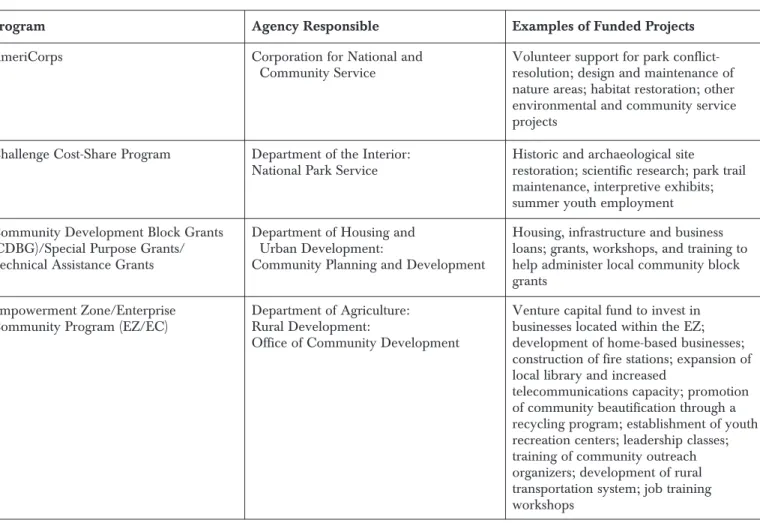
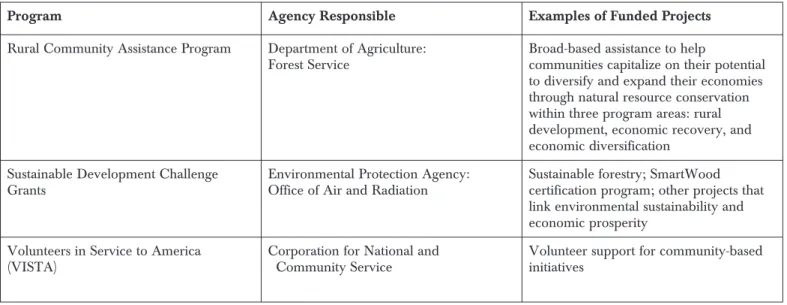
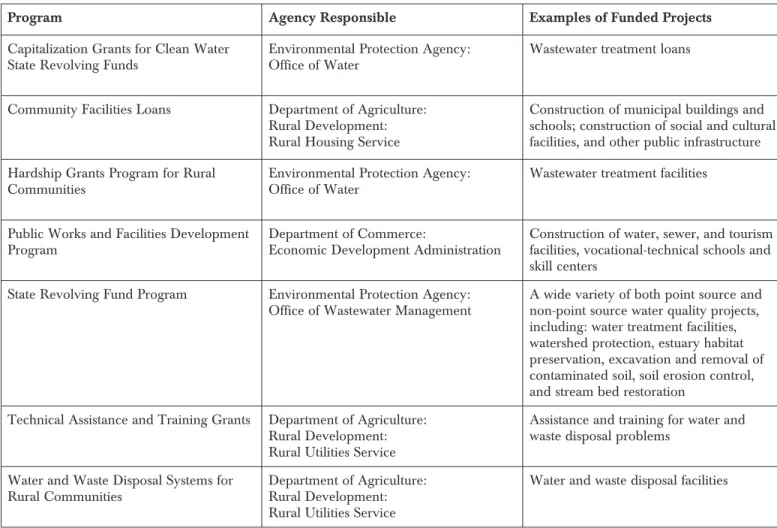
Tables 2-12 provide a brief description of funding
opportunities by key topic areas. Comprehensive
programs are presented first. These are programs
that have a broad scope encompassing several
topic areas. Specific topic areas and available
programs follow, presented in alphabetical order.
Topic areas include:
• Community Planning,
• Conservation Easements/Land Acquisition,
• Cultural Resource Management,
• Economic Development,
• Environmental Education,
• Infrastructure,
• Job Training,
• Natural Resource Management,
• Recreation, and
• Transportation.
Each table presents: a) the program name, b) the
agency or department responsible for managing
the program, and c) a brief description of the kind
of projects that have been or can be funded by
that program. Some programs have multiple
objectives and are listed in more than one
cat-egory.
A brief description of the topic areas, with
illustra-tive examples, is provided below.
Comprehensive Federal Programs
Federal authority has increasingly been returned
to the state and local level. This, coupled with
development strategies that target a geographic
area and address development opportunities
specific to that area, has encouraged the
establish-ment of comprehensive federal funding programs.
These programs offer wide-ranging activities.
Some provide extensive financial assistance, while
others offer technical assistance and increased
leverage of other federal funds.
For example, a Resource Conservation and
Development (RC&D) Program operating in
Little Colorado, Arizona, joined to work with
other organizations on heritage resource tourism,
preservation, and education projects in the
four-corners region. The Four Corners Heritage Trails
were designed and developed, other cultural
resources are being inventoried, and a marketable
tourism package is being planned. The RC&D
Part 2:
An Inventory of
Program played a vital role in identifying
oppor-tunities in the area, generating publicity, and
leading visioning exercises and conferences.
Federal funds invested in rural Empowerment
Zones/Enterprise Communities
(EZ/EC)—includ-ing loans, grants, and tax incentives—are be(EZ/EC)—includ-ing
used to develop plans and organizational
struc-tures for revitalizing community economies. The
Kentucky Highland EZ, for example, has
estab-lished a four-pronged approach to revitalizing its
communities—developing economic opportunity,
promoting tourism, building infrastructure, and
enhancing the quality of life. EZ/EC areas often
attract additional funding from other programs to
complement and support on-going development
efforts.
Comprehensive assistance programs encourage
partnerships between federal, state, and
non-governmental agencies. For example, the Canyon
County Partnership was formed in Moab, Utah as
an alliance of four counties, the Bureau of Land
Management, Forest Service, NPS,
three state
agencies, The Nature Conservancy, and
AmeriCorps—all to work together on a recreation
management strategy.
Community Planning
Community planning is often key to economic
restructuring, local policy changes, development
opportunities, and bringing about community
action. Many federal programs now include
assistance for community planning to aid
commu-nities and help ensure that programs have a
higher rate of success in achieving their
objec-tives.
For example, Estes Park, Colorado (gateway
community to Rocky Mountain National Park)
underwent an extensive and formal planning
process to protect the community from
over-development, maintain open spaces, and improve
its relations with the park. Estes Park is often cited
as a model for park-community planning, due to
the level of collaboration and partnership, and the
changes in local policy and attitudes that resulted.
Conservation Easements/Land Acquisition
Several federal programs encourage conservation
easements, or can assist in land acquisition for
wetlands, farmlands, wildlife habitat, or
recre-ation. Conservation easements are flexible and
often designed specifically for each individual
land parcel. A wide range of management
possi-bilities exist under such agreements.
Develop-ment and access limitations can be placed on any
part or all of the land; activities such as farming or
grazing can continue on all or part of the land.
The landowner can benefit through tax
incen-tives.
For example, the Colorado Cattlemen’s
Agricul-tural Land Trust was formed to facilitate
conserva-tion easements around Steamboat Springs and
other rapidly developing communities in
Colo-rado. By donating development rights to the land
trust, future estate taxes are cut in half and the
land is guaranteed to be used in perpetuity for
ranching.
Cultural Resource Management
In addition to the importance of protecting the
NPS cultural and historic sites, the historic
char-acter of many gateway communities is an
impor-tant asset and can enhance the connection
be-tween park and community and maintain local
cultural heritage. Federal assistance exists for
aspects of historical and cultural site inventory,
assessments for restoration, and educational
activities. Opportunities exist for gateway
com-munities to restore historic downtown districts or
protect cultural/historic sites in a region.
For example, the Los Caminos del Rio Heritage
Project in Lower Rio Grande, Texas, is a 200-mile
cultural heritage corridor that has produced
significant benefits to the area in the form of
increased recreational opportunities, land
conser-vation, economic opportunities, and cultural
resource protection. Funding for this project was
provided by a Department of Housing and Urban
Development (HUD) block grant for historic
preservation and Department of Transportation
funds. The NPS provided technical assistance and
outreach.
Economic Development
Economic development programs help
commu-nities diversify their local economies by providing
business counseling, feasibility studies for new
businesses, infrastructure, planning, and other
forms of assistance that support new economic
activities.
Rural Cooperative Development Grants and
Small Business Development Centers can assist in
identifying and assisting potential small
busi-nesses. Business and Industrial Loans and Rural
Business Enterprise Grants can provide funding
for project development. Business and Industrial
(B&I) Loans and Rural Business Enterprise Grants
(RBEG) are two important funding sources for
tourism ventures.
Environmental Education
Environmental education builds an informed and
aware citizenry and can benefit parks and
gate-way communities by increasing understanding of
key issues associated with park resources. Federal
programs can provide teacher training, curricula
and educational materials development, and
demonstration projects.
For example, the EPA’s Environmental Education
Grants Program supports the development of
materials that focus specifically on park resources
and community-park relations. A park can thus
be used as an outdoor learning center and
labora-tory for local school programs. Students can also
contribute to their local park through experiential
learning while assisting in park improvement
activities.
Infrastructure
Infrastructure includes facilities such as water and
sewage treatment plants, landfills, municipal
buildings, schools, and other public buildings
(roads are included in the section on
transporta-tion). Infrastructure is a critical need in many
rural gateway communities, necessary to
accom-modate and encourage sustainable economic
growth. Public Works and Facilities Development
Grants can provide funding for projects from
water treatment plants to tourism facilities to
vocational training schools. Federal assistance
programs can help establish basic community
services for a growing population, or for tourism
development. These programs can also provide
community buildings for schools or training
facilities, cultural events, or interpretive centers.
To alleviate development pressures within the
park, many park managers are promoting the
transfer of operations and services to the local
community.
Job Training
As an often necessary complement to economic
development, job training programs assist in
community development and benefit the NPS.
Local human resources can offer valuable
techni-cal support to park operations. Training centers
that offer courses in hospitality and customer
services, small business, nature-guiding, and
tourism management can be encouraged in many
communities for job creation.
Natural Resource Management
The benefits to NPS resources when gateway
communities engage in sustainable natural
re-source management projects are significant.
Clean air, clean water, protected watersheds,
wetlands, and upland habitat protection all
increase the quality of the park as well as the
natural amenities of the local communities.
Federal programs assist a wide range of natural
resource management issues, from wildlife habitat
protection to pollution management. Many
programs focus on water, watersheds, and
wet-lands.
For example, the San Miguel River Watershed,
near Telluride, Colorado, is threatened by human
settlement, tourism, and a decline in traditional
economies. With a Wetlands Protection
Develop-ment Grant, a wetlands study was conducted,
river sedimentation mitigation completed, and
coordinated management strategies developed.
The NPS contributed to these efforts through its
Challenge Cost-Share Program.
Recreation
Many federal programs can assist with the
con-struction of new trails, interpretive centers, picnic
areas, and local beautification projects. Such
improvements can enhance the recreation
experi-ence of visitors both inside and outside park
boundaries.
For example, Tyrell County, North Carolina,
recently improved the community’s economy by
increasing outdoor recreation opportunities for
visitors. A greenway now connects canoe trails,
bike paths and walkways; a highway rest area has
been constructed by the Department of
Transpor-tation; interpretive centers and information
brochures are available to tourists; wildlife
view-ing and fishview-ing areas have also been established.
Recreational opportunities such as these can be
funded by the Recreational Trail Program.
Transportation
Parks, greenways, and trails have been
demon-strated to increase property values, enhance local
tax revenues, and attract tourists. Roads are
necessary for access, safety, and sustainable
development. The Federal Highway
Administra-tion, and other federal agencies sponsor programs
that assist in trail and scenic byway construction.
These programs can enhance tourism in gateway
communities, as well as relieve traffic congestion,
improve air quality, and minimize impacts within
the parks.
To maintain the traditional small town
environ-ment of one of the communities adjacent to the
Iditarod Trail in Alaska, a seven mile corridor was
planned to connect the town to the trail. This
used Federal Highway Administration Funds,
NPS Challenge Cost-Share funds, and Bureau of
Land Management support.
m a r g o r P AgencyResponsible ExamplesofFundedProjects s p r o C i r e m A CorporationforNationaland e c i v r e S y t i n u m m o C -t c i l f n o c k r a p r o f t r o p p u s r e e t n u l o V f o e c n a n e t n i a m d n a n g i s e d ; n o i t u l o s e r r e h t o ; n o i t a r o t s e r t a t i b a h ; s a e r a e r u t a n e c i v r e s y t i n u m m o c d n a l a t n e m n o r i v n e s t c e j o r p m a r g o r P e r a h S -t s o C e g n e l l a h C DepartmentoftheInterior: e c i v r e S k r a P l a n o i t a N e t i s l a c i g o l o e a h c r a d n a c i r o t s i H l i a r t k r a p ; h c r a e s e r c i f i t n e i c s ; n o i t a r o t s e r ; s t i b i h x e e v i t e r p r e t n i , e c n a n e t n i a m t n e m y o l p m e h t u o y r e m m u s s t n a r G k c o l B t n e m p o l e v e D y t i n u m m o C / s t n a r G e s o p r u P l a i c e p S / ) G B D C ( s t n a r G e c n a t s i s s A l a c i n h c e T d n a g n i s u o H f o t n e m t r a p e D : t n e m p o l e v e D n a b r U t n e m p o l e v e D d n a g n i n n a l P y t i n u m m o C s s e n i s u b d n a e r u t c u r t s a r f n i , g n i s u o H o t g n i n i a r t d n a , s p o h s k r o w , s t n a r g ; s n a o l k c o l b y t i n u m m o c l a c o l r e t s i n i m d a p l e h s t n a r g e s i r p r e t n E / e n o Z t n e m r e w o p m E ) C E / Z E ( m a r g o r P y t i n u m m o C : e r u t l u c i r g A f o t n e m t r a p e D : t n e m p o l e v e D l a r u R t n e m p o l e v e D y t i n u m m o C f o e c i f f O n i t s e v n i o t d n u f l a t i p a c e r u t n e V ; Z E e h t n i h t i w d e t a c o l s e s s e n i s u b ; s e s s e n i s u b d e s a b -e m o h f o t n e m p o l e v e d f o n o i s n a p x e ; s n o i t a t s e r i f f o n o i t c u r t s n o c d e s a e r c n i d n a y r a r b i l l a c o l n o i t o m o r p ; y t i c a p a c s n o i t a c i n u m m o c e l e t a h g u o r h t n o i t a c i f i t u a e b y t i n u m m o c f o h t u o y f o t n e m h s i l b a t s e ; m a r g o r p g n i l c y c e r ; s e s s a l c p i h s r e d a e l ; s r e t n e c n o i t a e r c e r h c a e r t u o y t i n u m m o c f o g n i n i a r t l a r u r f o t n e m p o l e v e d ; s r e z i n a g r o g n i n i a r t b o j ; m e t s y s n o i t a t r o p s n a r t s p o h s k r o w
Table 2. Comprehensive Federal Programs
m a r g o r P AgencyResponsible ExamplesofFundedProjects a c i r e m A l a r u R r o f d n u F DepartmentofAgriculture: : s c i m o n o c E d n a n o i t a c u d E h c r a e s e R n o i t a c u d E h c r a e s e R e t a t S e v i t a r e p o o C e c i v r e S n o i s n e t x E d n a t n a r g -d n a l h g u o r h t e c n a t s i s s a n o i s n e t x E ; s e c i f f o n o i s n e t x e d n a s e i t i s r e v i n u h t o b ( e c n a t s i s s a l a c i n h c e t d e s a b -h c r a e s e r ) h c r a e s e r e c n e i c s l a i c o s d n a l a r u t a n d n a l o o h c S a c i r e m A e v r e S d n a n r a e L s m a r g o r P d e s a B -y t i n u m m o C d n a l a n o i t a N r o f n o i t a r o p r o C e c i v r e S y t i n u m m o C l a t n e m n o r i v n e n i n o i t a p i c i t r a p t n e d u t S ; s e i t i v i t c a n o i t a v r e s n o c d n a e c n e i c s s t c e j o r p n o i t a r o t s e r l a c i r o t s i h s e i t il i c a F s n o i t a c i n u m m o c e l e T c il b u P m a r g o r P : e c r e m m o C f o t n e m t r a p e D s n o i t a c i n u m m o c e l e T l a n o i t a N n o i t a r t s i n i m d A n o i t a m r o f n I s s e c c a y t i n u m m o c l a r u r f o t n e m e v o r p m I , y t e f a s c il b u p , e r a c h t l a e h , n o i t a c u d e o t s e c i v r e s y t i n u m m o c r e h t o d n a t n e m p o l e v e D d n a n o i t a v r e s n o C e c r u o s e R ) D & C R ( m a r g o r P : e r u t l u c i r g A f o t n e m t r a p e D e c i v r e S n o i t a v r e s n o C s e c r u o s e R l a r u t a N d e n w o -y l e v i t a r e p o o c o t e c n a t s i s s A g n i v l o v e r a f o t n e m p o l e v e d ; s e s s e n i s u b ; s t c e j o r p y t i n u m m o c r o f d n u f n a o l ,t n e m e g a n a m t i f o r p -n o n n i s p o h s k r o w ; g n i n n a l p e s u -d n a l ,t n e m e g a n a m t n a r g s d n a l t e w ; t n e m p o l e v e d r e t n e c y t i n u m m o c d n a s e c n e r e f n o c m s i r u o t ; n o i t c e t o r p t a t i b a h m a e r t s d n a ; s t n e v e g n i n n a l p n o i t a r o t s e r n o i t a v r e s n o C d n a s li a r T , s r e v i R ) A C T R ( m a r g o r P e c n a t s i s s A : r o i r e t n I e h t f o t n e m t r a p e D e c i v r e S k r a P l a n o i t a N l a i c n a n i f e m o s d n a l a c i n h c e t s e d i v o r P t c u r t s n o c o t s e i t i n u m m o c o t e c n a t s i s s a : s e d u l c n i , s a e r a n o i t a e r c e r r e h t o d n a s li a r t s t r e v n o c h c i h w , m a r g o r P s li a r T -o t -s li a R ) 1 ; s li a r t n o i t a e r c e r o t s d e b y a w li a r d l o h c i h w n i , m a r g o r P p i h s r e n t r a P e g a t i r e H ) 2 e g a t i r e H s a d e t a n g i s e d s e i t i n u m m o c r o f t r o p p u s l a c i n h c e t e v i e c e r s r e n t r a P ; n o i t a t n e m e l p m i d n a g n i n n a l p t c e j o r p s e v i t a i t i n I s r e v i R e g a t i r e H n a c i r e m A ) 3 o t g n i t a l e r s t r o f f e d e l -y t i n u m m o c t r o p p u s , n o i t a z il a t i v e r c i m o n o c e r u p s t a h t s r e v i r c i r o t s i h e v r e s e r p , s e c r u o s e r l a r u t a n t c e t o r p A C T R r e h t o ) 4 d n a ; e g a t i r e h l a r u t l u c d n a s r o d i r r o c r e v i r t r o p p u s t a h t s m a r g o r P o t e c n a t s i s s a l a c i n h c e t ,t n e m e g a n a m s y a w n e e r g r e v i r , s n o i t a i c o s s a d e h s r e t a w s r e v i r c i n e c s d n a d li w d n a ,t n e m p o l e v e d m a r g o r P t n e m e c n a v d A y t i n u m m o C l a r u R DepartmentofAgriculture: e c i v r e S t s e r o F d n a t c e r i d r o f g n i d n u f s e t a d il o s n o C s n a o l l a s o p s i d e t s a w d n a r e t a w d e e t n a r a u g e c n a t s i s s a r e t a w y c n e g r e m e , s t n a r g d n a , s t n a r g t n e m e g a n a m e t s a w d il o s , s t n a r g . s t n a r g d n a d n a l y t il i c a f y t i n u m m o c t n e m p o l e v e D l a r u R l a n o i t a N e h t n I [ t n e r e f f i d m o r f s e v i t a t n e s e r p e r , s p i h s r e n t r a P s t i f o r p -n o n d n a s e i n a p m o c , s e i c n e g a l a r e d e f o t d n a s e v i t a i t i n i e t a n i d r o o c p l e h o t k r o w l a r u r r o f s e c r o f k s a t d n a s m a e t e t a e r c ] . s e i g e t a r t s t n e m p o l e v e d
Table 2. Comprehensive Federal Programs (continued)
m a r g o r P AgencyResponsible ExamplesofFundedProjects m a r g o r P e c n a t s i s s A y t i n u m m o C l a r u R DepartmentofAgriculture: e c i v r e S t s e r o F p l e h o t e c n a t s i s s a d e s a b -d a o r B l a i t n e t o p r i e h t n o e z i l a t i p a c s e i t i n u m m o c s e i m o n o c e r i e h t d n a p x e d n a y f i s r e v i d o t n o i t a v r e s n o c e c r u o s e r l a r u t a n h g u o r h t l a r u r : s a e r a m a r g o r p e e r h t n i h t i w d n a , y r e v o c e r c i m o n o c e , t n e m p o l e v e d n o i t a c i f i s r e v i d c i m o n o c e e g n e l l a h C t n e m p o l e v e D e l b a n i a t s u S s t n a r G : y c n e g A n o i t c e t o r P l a t n e m n o r i v n E n o i t a i d a R d n a r i A f o e c i f f O d o o W t r a m S ; y r t s e r o f e l b a n i a t s u S t a h t s t c e j o r p r e h t o ; m a r g o r p n o i t a c i f i t r e c d n a y t i l i b a n i a t s u s l a t n e m n o r i v n e k n i l y t i r e p s o r p c i m o n o c e a c i r e m A o t e c i v r e S n i s r e e t n u l o V ) A T S I V ( d n a l a n o i t a N r o f n o i t a r o p r o C e c i v r e S y t i n u m m o C d e s a b -y t i n u m m o c r o f t r o p p u s r e e t n u l o V s e v i t a i t i n i
Table 3. Community Planning Programs
m a r g o r P AgencyResponsible ExamplesofFundedProjects n o i t i s n a r T c i m o n o c E n i s e i t i n u m m o C DepartmentofAgriculture: : s c i m o n o c E d n a n o i t a c u d E h c r a e s e R n o i t a c u d E h c r a e s e R e t a t S e v i t a r e p o o C e c i v r e S n o i s n e t x E d n a t n e m p o l e v e d s s e n i s u b l l a m s r o f g n i n n a l P m a r g o r P s n o i t a r e p O n o i t a v r e s n o C DepartmentofAgriculture: e c i v r e S n o i t a v r e s n o C e c r u o s e R l a r u t a N -y t i n u m m o c g n i p o l e v e d n i e c n a t s i s s A t n e m e g a n a m d n a n o i t a v r e s n o c d e s a b s n a l p e c i v r e S n o i s n e t x E e v i t a r e p o o C DepartmentofAgriculture: : s c i m o n o c E d n a n o i t a c u d E h c r a e s e R n o i t a c u d E h c r a e s e R e t a t S e v i t a r e p o o C e c i v r e S n o i s n e t x E d n a o t s e i t i s r e v i n u t n a r g d n a l l a c o l f o e s U , l a r u t l u c i r g a , c i m o n o c e t c u d n o c y t e f a s d n a h t l a e h d n a , l a t n e m n o r i v n e s e i t i n u m m o c r o f s e s y l a n a m a r g o r P e c n a t s i s s A l a c i n h c e T l a c o L DepartmentofCommerce: n o i t a r t s i n i m d A t n e m p o l e v e D c i m o n o c E o t s e c r u o s e r y t i s r e v i n u l a c o l f o e s U e h t n i s e i t i n u t r o p p o c i m o n o c e h c r a e s e r y t i l i b i s a e f p o l e v e d o t d n a , y t i n u m m o c s t c e j o r p e v i t a v o n n i n o s e i d u t s l a r u R t n e d n e p e D -t s e r o F l a n o i t a N m a r g o r P s e i t i n u m m o C : e r u t l u c i r g A f o t n e m t r a p e D e c i v r e S t s e r o F ; g n i n n a l p t n e m e v o r p m i d n a t s r e b m i T -e u l a v r o f g n i n n a l p ; s e i t i v i t c a g n i t e k r a m n o i t c u d o r p d e d d a c i m o n o c E r o f m a r g o r P g n i n n a l P d n a , s e b i r T n a i d n I , s t c i r t s i D t n e m p o l e v e D s a e r A t n e m p o l e v e d e R : e c r e m m o C f o t n e m t r a p e D n o i t a r t s i n i m d A t n e m p o l e v e D c i m o n o c E h g u o r h t s e i t i v i t c a g n i n n a l p r o f e c n a t s i s s A e c n a t s i s s a l a c i n h c e t d n a l e n n o s r e p d e r i h t n e m p o l e v e D l a i c o S d n a c i m o n o c E , l a r u R DepartmentofAgriculture: : s c i m o n o c E d n a n o i t a c u d E h c r a e s e R n o i t a c u d E h c r a e s e R e t a t S e v i t a r e p o o C e c i v r e S n o i s n e t x E d n a o t s e i t i s r e v i n u t n a r g d n a l l a c o l f o e s U h c r a e s e r e c n e i c s l a i c o s d e i l p p a t c u d n o cTable 2. Comprehensive Federal Programs
(continued)
Table 4: Conservation Easements/Land Acquisition Programs
m a r g o r P AgencyResponsible ExamplesofFundedProjects s e i c e p S d e r e g n a d n E e v i t a r e p o o C d n u F n o i t a v r e s n o C : r o i r e t n I e h t f o t n e m t r a p e D e c i v r e S e f i l d l i W d n a h s i F s e i c e p s d e r e g n a d n e r o f n o i t i s i u q c a d n a L n o i t c e t o r p m a r g o r P n o i t c e t o r P d n a l m r a F DepartmentofAgriculture: e c i v r e S n o i t a v r e s n o C e c r u o s e R l a r u t a N d e n e t a e r h t n o s t n e m e s a e n o i t a v r e s n o C s d n a l m r a f -o t -s d n a L l a r e d e F e c i v r e S k r a P l a n o i t a N m a r g o r P s k r a P : r o i r e t n I e h t f o t n e m t r a p e D e c i v r e S k r a P l a n o i t a N c i l b u p r o f d n a l l a r e d e f f o n o i t i s i u q c a d n a L e s u n o i t a e r c e r d n a k r a p , n o i t i s i u q c A n o i t a e r c e R r o o d t u O d n a d n a L ( g n i n n a l P d n a t n e m p o l e v e D ) s t n a r G d n u F n o i t a v r e s n o C r e t a W : r o i r e t n I e h t f o t n e m t r a p e D e c i v r e S k r a P l a n o i t a N r o f d n a l l a r e d e f f o n o i t i s i u q c A s a e r a n o i t a e r c e r r o o d t u o f o t n e m p o l e v e d s e i t i l i c a f d n a m a r g o r P s l i a r T l a n o i t a e r c e R DepartmentofTransportation: n o i t a r t s i n i m d A y a w h g i H l a r e d e F s l i a r t r o f d n a l f o n o i t i s i u q c A , m a r g o r P n o i t a t r o p s n a r T e c a f r u S s e i t i v i t c A t n e m e c n a h n E n o i t a t r o p s n a r T : n o i t a t r o p s n a r T f o t n e m t r a p e D n o i t a r t s i n i m d A y a w h g i H l a r e d e F d n a s t n e m e s a e c i n e c s f o n o i t i s i u q c A s e t i s c i r o t s i h m a r g o r P e v r e s e R s d n a l t e W DepartmentofAgriculture: e c i v r e S n o i t a v r e s n o C e c r u o s e R l a r u t a N e r o t s e r o t s t n e m e s a e n o i t a v r e s n o C s d n a l e t a v i r p n o s d n a l t e w n o s t r e b o R -n a m t t i P ( n o i t a r o t s e R e f i l d l i W ) m a r g o r P : r o i r e t n I e h t f o t n e m t r a p e D e c i v r e S e f i l d l i W d n a h s i F s n o i t a l u p o p e f i l d l i w r o f n o i t i s i u q c a d n a L e s u n o i t a e r c e r d n a m a r g o r P AgencyResponsible ExamplesofFundedProjects m a r g o r P s e c r u o s e R e g a t i r e H DepartmentofAgriculture: e c i v r e S t s e r o F f o n o i t c e t o r p d n a , n o i t a r o t s e r , y r o t n e v n I s e c r u o s e r l a r u t l u c d i A -n i -s t n a r G d n u F n o i t a v r e s e r P c i r o t s i H DepartmentoftheInterior: e c i v r e S k r a P l a n o i t a N c i f i c a P ( r e y a l e c r u o s e r l a r u t l u c S I G x a t n o i t a t i l i b a h e r c i r o t s i h ; ) t s e w h t r o N ; n o i t c u d o r p e p a t -o e d i v ; m a r g o r p t i d e r c n o i t a r o t s e r g n i d l i u b c i r o t s i h o t s t n a r G s t r A e h t f o n o i t o m o r P s l a u d i v i d n I d n a s n o i t a z i n a g r O : s t r A e h t f o t n e m w o d n E l a n o i t a N d n a s t r A e h t n o n o i t a d n u o F l a n o i t a N s e i t i n a m u H e h t c i r o t s i h s ’ o c i x e M w e N f o n o i t a v r e s e r P f o n o i t a v r e s e r p ; s e h c r u h c e b o d a r o t n e m ; n o i t i d a r t l a c i s u m s ’ a m a b a l A l a n o i t i d a r t t u o b a h t u o y h c a e t o t m a r g o r p e r u t l u c e c r u o s e R l a r u t l u C d n a n o i t a e r c e R t n e m e g a n a M : r o i r e t n I e h t f o t n e m t r a p e D t n e m e g a n a M d n a L f o u a e r u B d n a g n i n i a r t l a c i g o l o e a h c r a r o f g n i d n u F l a r u t l u c r o f s n g i s e v i t e r p r e t n i ; h c r a e s e r s e t i s , m a r g o r P n o i t a t r o p s n a r T e c a f r u S s e i t i v i t c A t n e m e c n a h n E n o i t a t r o p s n a r T : n o i t a t r o p s n a r T f o t n e m t r a p e D n o i t a r t s i n i m d A y a w h g i H l a r e d e F n o s t n e m e s a e c i n e c s f o n o i t i s i u q c A r o f d n a , s y a w h g i h c i r o t s i h , s e t i s c i r o t s i h f o n o i t a r o t s e r ; n o i t a v r e s e r p e t i s c i r o t s i h s e r u t c u r t s , s g n i d l i u b n o i t a t r o p s n a r t c i r o t s i h d n a g n i n n a l p l a c i g o l o e a h c r a ; s e i t i l i c a f d n a h c r a e s e rTable 5. Cultural Resource Management Programs
Table 6. Economic Development Programs
m a r g o r P AgencyResponsible ExamplesofFundedProjects s n a o L l a i r t s u d n I d n a s s e n i s u B DepartmentofAgriculture: : t n e m p o l e v e D l a r u R e c i v r e S e v i t a r e p o o C -s s e n i s u B l a r u R ; n o i s n a p x e s s e n i s u b i r g a ; g n i m r a f h s i f t a C m s i r u o t ; n o i t a t s o i d a r a f o t n e m p o l e v e d -n o i t a v r e s n o c ; t n e m p o l e v e d e r u t c u r t s a r f n i t n e m p o l e v e d e s i r p r e t n e -o r c i m d e s a b n o i t i s n a r T c i m o n o c E n i s e i t i n u m m o C DepartmentofAgriculture: : s c i m o n o c E d n a n o i t a c u d E h c r a e s e R n o i t a c u d E h c r a e s e R e t a t S e v i t a r e p o o C e c i v r e S n o i s n e t x E d n a d e d d a -e u l a v ; t n e m p o l e v e d m s i r u o T t n e m p o l e v e d s s e n i s u b s e s s e n i s u B l l a m S r o f s n a o L SmallBusinessAdministration Establishmentandmaintenanceofsmall s e s s e n i s u b l a r u R t n e d n e p e D -t s e r o F l a n o i t a N m a r g o r P s e i t i n u m m o C : e r u t l u c i r g A f o t n e m t r a p e D e c i v r e S t s e r o F ; s s e n i s u b l l a m s m r a f -n o n f o t n e m p o l e v e D ; t n e m p o l e v e d m s i r u o t d n a n o i t a e r c e r t n e m h s i l b a t s e t e k r a m s r e m r a f c i m o n o c E r o f m a r g o r P g n i n n a l P d n a , s e b i r T n a i d n I , s t c i r t s i D t n e m p o l e v e D s a e r A t n e m p o l e v e d e R : e c r e m m o C f o t n e m t r a p e D n o i t a r t s i n i m d A t n e m p o l e v e D c i m o n o c E , s e s s e n i s u b w e n f o t n e m p o l e v e D n o i t a c i f i s r e v i d c i m o n o c e t n e m p o l e v e D s e i t i l i c a F d n a s k r o W c i l b u P m a r g o r P : e c r e m m o C f o t n e m t r a p e D n o i t a r t s i n i m d A t n e m p o l e v e D c i m o n o c E ; s r e t n e c l a n o i t a c o v f o n o i t c u r t s n o C d n a r e t a w ; s g n i d l i u b c i r o t s i h f o n o i t a v o n e r n o i t c u r t s n o c y t i l i c a f r e w e s t n e m p o l e v e D d n a n o i t a v r e s n o C e c r u o s e R s n a o L : e r u t l u c i r g A f o t n e m t r a p e D : t n e m p o l e v e D l a r u R e c i v r e S s e i t i l i t U l a r u R n o i t a e r c e r d e s a b -r e t a w f o t n e m p o l e v e D t n e m p o l e v e d c i m o n o c e r o f s e i t i n u t r o p p o s t n a r G e s i r p r e t n E s s e n i s u B l a r u R DepartmentofAgriculture: : t n e m p o l e v e D l a r u R e c i v r e S e v i t a r e p o o C -s s e n i s u B l a r u R -l l a m s ; t n e m p o l e v e d k r a p l a i r t s u d n i -o c E f o n o i t c u r t s n o c ; t n e m p o l e v e d s s e n i s u b d e s a b -n o i t a v r e s n o c ; s n o i t a r e p o g n i l c y c e r t n e m p o l e v e d e s i r p r e t n e -o r c i m s t n a r G t n e m p o l e v e D e v i t a r e p o o C l a r u R DepartmentofAgriculture: : t n e m p o l e v e D l a r u R e c i v r e S e v i t a r e p o o C -s s e n i s u B l a r u R d n a t n e m p o l e v e d e s i r p r e t n e -o r c i M d n a n o i t a c i f i t n e d i ; e c n a t s i s s a l a c i n h c e t s s e n i s u b r o f s e i d u t s y t i l i b i s a e f s e i t i n u t r o p p o s t n a r G t n e m p o l e v e D l a r u R DepartmentofAgriculture: e c i v r e S t s e r o F d n a s e i g o l o n h c e t w e n f o t n e m p o l e v e D ; s e i r t s u d n i t c u d o r p t s e r o f e v i t a n r e t l a r o f e c n a t s i s s a g n i t e k r a m d n a y t i l i b a n i a t s u s , s b r e h s a h c u s ( s t c u d o r p t s e r o f l a i c e p s ; ) s e l d e e n e n i p d n a , s s o m , s m o o r h s u m s a h c u s t n e m p o l e v e d y r t s u d n i d e d d a -e u l a v e r u t i n r u f d n a s n a o L t n e m p o l e v e D c i m o n o c E l a r u R s t n a r G : e r u t l u c i r g A f o t n e m t r a p e D : t n e m p o l e v e D l a r u R e c i v r e S e v i t a r e p o o C -s s e n i s u B l a r u R ; s t n a l p t n e m t a e r t e g a w e s d n a r e t a W s t c e j o r p n o i t a r e n e g -e m o c n i s e v i t u c e x E d e r i t e R f o s p r o C e c i v r e S SmallBusinessAdministration Businesscounselingandtechnical s e s s e n i s u b l l a m s r o f e c n a t s i s s a r e t n e C t n e m p o l e v e D s s e n i s u B l l a m S m a r g o r P n o i t a r t s i n i m d A s s e n i s u B l l a m S Businesscounseling,feasibilityand h c r a e s e r s s e n i s u b r e h t o , s e i d u t s s t e k r a mm a r g o r P AgencyResponsible ExamplesofFundedProjects s t n a r G e t a t S n o i t a c u d E t l u d A DepartmentofEducation: n o i t a c u d E t l u d A d n a l a n o i t a c o V f o e c i f f O d n a g n i n i a r t -r e h c a e t f o t n e m p o l e v e D s t c e j o r p n o i t a r t s n o m e d l a i c e p s m a r g o r P s t n a r G n o i t a c u d E l a t n e m n o r i v n E EnvironmentalProtectionAgency: n o i t a c u d E l a t n e m n o r i v n E f o e c i f f O m a r g o r p g n i n i a r t d n a n o i t a c u d E l a t n e m n o r i v n e h t i w t n e m p o l e v e d , s d o h t e m d l e i f f o n g i s e d ; a l u c i r r u c f o t n e m s s e s s a ; s e u q i n h c e t d n a , s e c i t c a r p s m e l b o r p r o s e u s s i l a t n e m n o r i v n e c i f i c e p s
Table 7. Environmental Education Programs
Table 8. Infrastructure Programs
m a r g o r P AgencyResponsible ExamplesofFundedProjects r e t a W n a e l C r o f s t n a r G n o i t a z i l a t i p a C s d n u F g n i v l o v e R e t a t S : y c n e g A n o i t c e t o r P l a t n e m n o r i v n E r e t a W f o e c i f f O s n a o l t n e m t a e r t r e t a w e t s a W s n a o L s e i t i l i c a F y t i n u m m o C DepartmentofAgriculture: : t n e m p o l e v e D l a r u R e c i v r e S g n i s u o H l a r u R d n a s g n i d l i u b l a p i c i n u m f o n o i t c u r t s n o C l a r u t l u c d n a l a i c o s f o n o i t c u r t s n o c ; s l o o h c s e r u t c u r t s a r f n i c i l b u p r e h t o d n a , s e i t i l i c a f l a r u R r o f m a r g o r P s t n a r G p i h s d r a H s e i t i n u m m o C : y c n e g A n o i t c e t o r P l a t n e m n o r i v n E r e t a W f o e c i f f O s e i t i l i c a f t n e m t a e r t r e t a w e t s a W t n e m p o l e v e D s e i t i l i c a F d n a s k r o W c i l b u P m a r g o r P : e c r e m m o C f o t n e m t r a p e D n o i t a r t s i n i m d A t n e m p o l e v e D c i m o n o c E m s i r u o t d n a , r e w e s , r e t a w f o n o i t c u r t s n o C d n a s l o o h c s l a c i n h c e t -l a n o i t a c o v , s e i t i l i c a f s r e t n e c l l i k s m a r g o r P d n u F g n i v l o v e R e t a t S EnvironmentalProtectionAgency: t n e m e g a n a M r e t a w e t s a W f o e c i f f O d n a e c r u o s t n i o p h t o b f o y t e i r a v e d i w A , s t c e j o r p y t i l a u q r e t a w e c r u o s t n i o p -n o n , s e i t i l i c a f t n e m t a e r t r e t a w : g n i d u l c n i t a t i b a h y r a u t s e , n o i t c e t o r p d e h s r e t a w f o l a v o m e r d n a n o i t a v a c x e , n o i t a v r e s e r p , l o r t n o c n o i s o r e l i o s , l i o s d e t a n i m a t n o c n o i t a r o t s e r d e b m a e r t s d n a s t n a r G g n i n i a r T d n a e c n a t s i s s A l a c i n h c e T DepartmentofAgriculture: : t n e m p o l e v e D l a r u R e c i v r e S s e i t i l i t U l a r u R d n a r e t a w r o f g n i n i a r t d n a e c n a t s i s s A s m e l b o r p l a s o p s i d e t s a w r o f s m e t s y S l a s o p s i D e t s a W d n a r e t a W s e i t i n u m m o C l a r u R : e r u t l u c i r g A f o t n e m t r a p e D : t n e m p o l e v e D l a r u R e c i v r e S s e i t i l i t U l a r u R s e i t i l i c a f l a s o p s i d e t s a w d n a r e t a WTable 9. Job Training Programs
m a r g o r P AgencyResponsible ExamplesofFundedProjects m a r g o r P t n a r G e t a t S n o i t a c u d E t l u d A DepartmentofEducation: n o i t a c u d E t l u d A d n a l a n o i t a c o V f o e c i f f O l a i c e p s d n a g n i n i a r t -r e h c a e T s t c e j o r p n o i t a r t s n o m e d n o i t i s n a r T c i m o n o c E n i s e i t i n u m m o C DepartmentofAgriculture: : s c i m o n o c E d n a n o i t a c u d E h c r a e s e R n o i t a c u d E h c r a e s e R e t a t S e v i t a r e p o o C e c i v r e S n o i s n e t x E d n a , m s i r u o t r o f e c n a t s i s s a d n a g n i n n a l P d e d d a -e u l a v , s e s s e n i s u b d e s a b -e m o h l l a m s d n a , t n e m y o l p m e h t u o y , y r t s e r o f s e s s e n i s u b c i m o n o c E r o f m a r g o r P g n i n n a l P d n a , s e b i r T n a i d n I , s t c i r t s i D t n e m p o l e v e D s a e r A t n e m p o l e v e d e R : e c r e m m o C f o t n e m t r a p e D n o i t a r t s i n i m d A t n e m p o l e v e D c i m o n o c E l a c i n h c e t -l a n o i t a c o v f o t n e m h s i l b a t s E g n i n i a r t r o f s r e t n e c l l i k s d n a s e i t i l i c a f m a r g o r P d l i u b h t u o Y DepartmentofHousingand : t n e m p o l e v e D n a b r U t n e m p o l e v e D d n a g n i n n a l P y t i n u m m o C -k r a p d n a n o i t c u r t s n o c r o f g n i n i a r t h t u o Y e c r u o s e r l a r u t a n s a h c u s , s e i t i v i t c a d e t a l e r d n a , s e c i v r e s m s i r u o t , g n i r o t i n o m n o i t a t e r p r e t n iTable 10. Natural Resource Management Programs
m a r g o r P AgencyResponsible ExamplesofFundedProjects r e t a W n a e l C r o f s t n a r G n o i t a z i l a t i p a C s d n u F g n i v l o v e R e t a t S : y c n e g A n o i t c e t o r P l a t n e m n o r i v n E r e t a W f o e c i f f O n o i t c e t o r p r e f f u b n a i r a p i R m a r g o r P s n o i t a r e p O n o i t a v r e s n o C DepartmentofAgriculture: e c i v r e S n o i t a v r e s n o C e c r u o s e R l a r u t a N n o i t a v r e s n o c n i e c n a t s i s s a l a c i n h c e T s e c i t c a r p m a r g o r P e v r e s e R n o i t a v r e s n o C DepartmentofAgriculture: e c i v r e S m r a F ; d n a l m r a f e v i t i s n e s f o n o i t a v r e s n o c d n a L n o i t c e t o r p e f i l d l i w d n a , r e t a w , l i o s s e i c e p S d e r e g n a d n E e v i t a r e p o o C d n u F n o i t a v r e s n o C : r o i r e t n I e h t f o t n e m t r a p e D e c i v r e S e f i l d l i W d n a h s i F t a t i b a h / s e i c e p s r o f t n e m p o l e v e d m a r g o r P n o i t c e t o r p s e v i t n e c n I y t i l a u Q l a t n e m n o r i v n E m a r g o r P : e r u t l u c i r g A f o t n e m t r a p e D e c i v r e S n o i t a v r e s n o C e c r u o s e R l a r u t a N e c r u o s e r l a r u t a n d n a , r e t a w , l i o S s d n a l m r a f n o n o i t a v r e s n o c m a r g o r P y a w h g i H d i A -l a r e d e F DepartmentofTransportation: n o i t a r t s i n i m d A y a w h g i H l a r e d e F s d n a l t e w ; n o i t a c i f i t u a e b e d i s d a o R n o i t c e t o r p m a r g o r P s e v i t n e c n I y r t s e r o F DepartmentofAgriculture: e c i v r e S n o i t a v r e s n o C e c r u o s e R l a r u t a N g n i t n a l p e e r T l a r u R r o f m a r g o r P s t n a r G p i h s d r a H s e i t i n u m m o C : y c n e g A n o i t c e t o r P l a t n e m n o r i v n E r e t a W f o e c i f f O n o i t a t i n a s l a r u r d n a t n e m t a e r t r e t a w e t s a W l a r u R t n e d n e p e D -t s e r o F l a n o i t a N m a r g o r P s e i t i n u m m o C : e r u t l u c i r g A f o t n e m t r a p e D e c i v r e S t s e r o F r o f s b o j n o i t a r o t s e r l a t n e m n o r i v n E s r e g g o l d n a s r e m r a f d e y o l p m e n u t n e m p o l e v e D d n a n o i t a v r e s n o C e c r u o s e R s n a o L : e r u t l u c i r g A f o t n e m t r a p e D : t n e m p o l e v e D l a r u R e c i v r e S s e i t i l i t U l a r u R n o i t a l l a t s n i ; n o i t a v r e s n o c r e t a w d n a l i o S h t i w r i o v r e s e r y l p p u s r e t a w l a p i c i n u m f o d n a h s i f , n o i t a e r c e r r o f s t i f e n e b l a n o i t i d d a e f i l d l i w