Information Technology Outsourcing in Financial Services12
González, R. Llopis, J. Gascó, J.
Department of Business Organisation. University of Alicante. San Vicente del Raspeig Campus, P.O. Box 03080. Alicante. SPAIN. Phone and Fax: +34965903606
Abstract:
Regulatory pressures and strong competitiveness, as well as the need to control costs and keep up to date with Information Technologies have turned outsourcing into a basic tool at the disposal of financial entities. Our paper has as its aim to show the peculiarities of Information Technology Outsourcing in the Financial Services Industry, additionally suggesting a decision framework which can help firms minimise risks.
Keywords:
Information Technologies, Outsourcing, financial sector
1
This article was written thanks to the funding provided by the Office of the Vice Chancellor for Research, Development and Innovation of the University of Alicante (GRE- 09-08) and the Regional Department of Education of the Generalitat Valenciana [Valencian Regional Government] (GV72011/029).
2
The authors would like to express their gratitude to the editor and the two anonymous reviewers for all their helpful suggestions.
Introduction
The financial sector can be identified as one of the main agents triggering the economic crisis that we have been suffering around the world since 2008. However, this sector has become one of its most important victims as well. Not even the considerable efforts made by the public sector of different countries to inject liquidity into the credit system with the aim of avoiding its collapse sufficed to prevent many banks, including some with a great reputation and a long tradition, from facing their closure. In other cases, mergers or acquisitions took place between financial entities which sought to join forces for the purpose of mitigating the unstable conditions in the sector.
As a result of the financial crisis, this sector has had to face not only a growing number of regulations imposed by the public authorities, but also the loss of numerous clients who are afraid to lose their investments. The panorama is far from encouraging but, of course, those entities with enough liquidity and a sufficient level of implementation of risk management mechanisms as well as innovative strategies will stand much better chances of retaining their clients’ loyalty and could even become reinforced after the crisis (Battistella, Biotto & De Toni, 2012; Lee, Hwang & Choi, 2012; Özbay, Dincer & Hacioglu, 2011).
Such innovative strategies include the unstoppable modernisation of the financial system and largely depend on its firm commitment to the Information Technology (IT) sector; especially when clients, whether they are private individuals or enterprises, seek access to their accounts 24 hours a day and 365 days a year, real-time information via mobile phones and not only fast but also safe transactions (Bolton, 2008).
Both regulatory pressures, together with the need for modernisation and updating in technological matters, and cost control, which becomes vital within an environment that is not only highly competitive but also hostile, point at Information Technology Outsourcing (ITO) as an essential tool to cope with the challenges with which the financial sector is currently faced (Garcés-Ayerbe, Rivera-Torres, & Murillo-Luna, 2012; Ravi, Jain & Sharma, 2011); hence the focus on the peculiarities of ITO in this sector adopted in the present paper. The framework that we are going to describe now should act as a guiding instrument for those in charge of ITO-related decisions inside financial entities, helping them reduce the risks inherent to those entities to a great extent. Although insurance companies also form part of this sector, the present study is especially focused on the banking sector.
ITO: Peculiarities in Financial Services
A wide range of facts and figures confirm the status of IT outsourcing as a growing, increasingly global phenomenon at the beginning of this new millennium. Forrester estimates that the value of the world’s outsourcing market is 120 billion $ per year (Takahashi & Sayer, 2007). 87% of the companies interviewed by KPMG plan to maintain –or increase– their current outsourcing level (ZDNet, 2007). According to a mid-2009 report on the state of IT outsourcing carried out by AMR Research Inc., roughly 80% of enterprises plan to increase their ITO volume or keep it at the same level3. The most recent reports show that outsourcing will grow even after the end of the financial crisis, since over 20% of the new entrants, that is, firms outsourcing for the first time, did so in 2010 (Jain & Natarajan, 2011). Furthermore, staff numbers in the application development areas of outsourcing firms grew from 2,700 in 2009 to 13,700
3
in 2010 (Solera, 2011). In short, although the numerical estimates of ITO figures vary from one source to another, no one can deny their magnitude or the expectations for growth in the coming years.
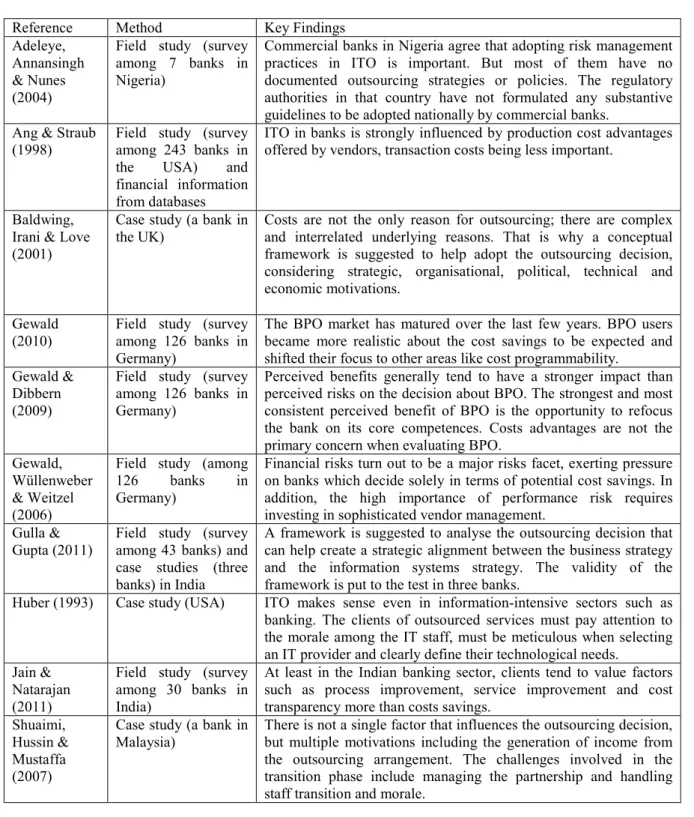
INSERT TABLE 1
Academic literature on ITO is extensive (Lacity et al., 2010); however, not many research works have focused on the financial sector in general or banking in particular. Table 1 lists some of these works; analysing this table leads us to conclude that, although the financial sector was chosen in many of them for the importance that IT has on this sector, the results obtained are not necessarily exclusive of this economic sector. In fact, those results could most probably be extrapolated to other non-financial firms. Nevertheless, a number of ITO peculiarities which are characteristic of the financial sector deserve to be mentioned. These peculiarities could be summarized in: a) IT importance at financial services; b) ITO suitability for financial services; and c) special ITO issues and risks at financial services.
a) IT importance at financial services
The first ITO contracts in the financial sector date back to the 1980s but this area did not receive much attention from the general public or the academic context until the 1990s, the decade in which IT began to be regarded as a first-rate competitive advantage factor (Gewald, Wüllenweber & Weitzel, 2006). Information-intensive sectors such as banking see Information Technologies (IT) as the “jewel in the crown” because they represent state-of-the-art development and the possibility of business growth, apart from being a symbol of advance and progress (Ang & Straub, 1998).
Information Systems (IS) play a highly relevant role in any financial entity. These systems underpin these organisations, allowing them not only to operate efficiently but also to maintain their competitive advantage (Adeleye, Annansingh & Nunes, 2004). The IT/IS area in any financial entity is closely linked to its business strategy and constitutes an essential part of the firm’s infrastructure. The traditional role assigned to the IT department as a mere service (‘utility’) has now been abandoned; instead, it is seen as a central part of the organisation which makes it possible for the bank to deliver competitive services (Baldwing, Irani & Love, 2001).
Financial entities handle large volumes of information, both in paper and in electronic format (López, 2004); and financial processes can be almost totally digitised, which means that the banking and finance industry is strongly dependent on Information Technologies but has also developed a capacity to process enormous transaction volumes (such as the management of payments and collections), simultaneously permitting the emergence of new financial products and services such as online banking (Gewald, Wüllenweber & Weitzel, 2006).
As information-intensive users, banking offices acquire IT services from a variety of sites, such as their own computer departments or those of their parent bank. Other times they embark upon joint ventures or resort to outsourcing (Ang & Straub, 1998).
b) ITO suitability for financial services
Being based on information, financial services are more easily outsourced than material products (Bradley, Kim, Kim & Lee, 2012). After all, there is no need to coordinate a flow of physical goods together with the information flow. Moreover, numerous
financial business processes are repetitive and involve highly repetitive tasks which can be standardised; therefore, it becomes easier to outsource those tasks (Braun & Winter, 2005). To this must be added that financial entities are forced to face processes involving mergers, takeovers or modifications of their organisational structures during crisis periods, and ITO can provide a good opportunity to consolidate scattered processes or departments; to restructure and reorganise departments, and even to remove some services4.
Considering what has been said the above, the fact that the banking industry has an enormous potential to benefit from outsourcing worldwide should come as no surprise. After all, the financial sector is the one which has most widely used ITO all over the world (Jain & Natarajan, 2011) and the popularity of outsourcing keeps growing, both in terms of quantity and regarding the variety of outsourced services and activities; so much so that outsourcing has currently become a basic strategy for the survival of financial entities (Ravi, Jain & Sharma, 2011). Among the activities which have already been outsourced for several years in the context of banking stand out payment processing, cheque processing, call centres, Automatic Teller Machines (ATMs) and cash management (Shuaimi, Hussin & Mustaffa, 2007).
Although banks already own a long experience at ITO implementation, they still have not made so much progress in BPO (Business Process Outsourcing), that is, in the outsourcing not only of IT management but also of the business process associated with it (Gewald, 2010). BPO, still considered a great challenge in the banking sector as a
4
whole, can indeed provide an excellent opportunity to achieve sufficiently flexible and efficient organisations (Gewald, Wüllenweber & Weitzel, 2006; Bolton, 2008).
c) Special ITO issues and risks at financial services
As mentioned above, outsourcing presents all firms with important challenges and benefits; financial services face two special issues though. One of them involves concerns about maintaining the privacy of clients’ financial information; the other has to do with the relatively high degree of regulation imposed on these firms (Lopez, 2004). Regarding the first issue, any firm must obviously safeguard the privacy and confidentiality of the data owned by their IS, especially those which have a personal nature. And this obligation becomes even more evident in the case of financial entities which, due to the characteristics of their activity, handle huge volumes of personal data, above all referring to their clients, with which they must be particularly careful. That is why financial entities are among the most strongly regulated organisations in the world. Regulations seek not only to protect depositors, but also to promote healthy banks, to keep a strict watch on banking operations in order to stop financial fraud, and to prevent money laundering as well as the financing of terrorism. In this respect, EU and US regulations force banks to assume full responsibility for every operation even if some of their functions have been outsourced (Isern & Bendixen, 2007).
Entities such as the Committee of European Banking Supervisors (CEBS) on an international level, along with a number of central banks or other entities (Bank of Japan, De Nederlandsche Bank, the Swiss Federal Banking Commission (SFBC), the New York Stock Exchange, etc.) on a national level, have recently established guidelines which are bound to provide useful orientation for outsourcing within the
financial sector, additionally limiting and protecting the outsourced activities (The Joint Forum, 2005). Thanks to ITO, the monitoring of these regulations will partly be transferred from the client (the financial entity) to the service provider (Blaskovich & Mintchik, 2011).
Below can be found a set of principles suggested by The Joint Forum (2005) to financial entities which outsource any of their activities:
1. The financial entity seeking to outsource activities should have in place a comprehensive policy to guide the assessment of whether and how those activities can be appropriately outsourced. The board of directors or an equivalent governing body retains responsibility for the outsourcing policy and the associated overall responsibility for the activities undertaken under that policy.
2. The financial entity should design a comprehensive outsourcing risk management scheme which can address both the outsourced activities and the relationship with the service provider (Sashi, 2012).
3. The financial service should ensure that outsourcing arrangements neither diminish its ability to fulfil its obligations to customers and regulators nor prevent effective supervision by regulators.
4. The financial service should conduct appropriate due diligence when selecting third-party service providers.
5. The financial service should be governed by written contracts that clearly describe every material aspect in the outsourcing arrangement, including the rights, responsibilities and expectations of all parties.
6. The financial entity along with its service providers should establish and maintain contingency plans, including a plan for disaster recovery and the periodic testing of backup facilities.
7. The financial entity should take appropriate steps to ensure that service providers protect all confidential information belonging either to the regulated entity or to its clients from intentional or inadvertent disclosure to unauthorised persons.
In short, the financial sector requires the establishment of well-defined structures, with highly detailed procedures and policies, to handle risk management in ITO agreements, (Adeleye, Annansingh & Nunes, 2004).
The ITO Decision Framework in Financial Services
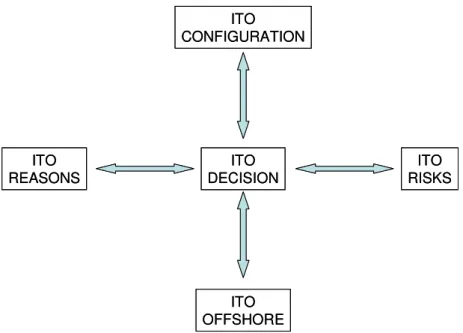
The ITO decision is not a simple one; a wide variety of aspects need to be taken into account before outsourcing any type of service (Hacklin & Wallnöfer, 2012). That is why a decision framework based on the items collected in Figure 1 appears as an ideal option resulting from a thorough review of the ITO literature and more than ten years of research in this field, which included interviews with several managers from over six hundred private enterprises and more than four hundred public organisations in our country (Spain)5.
INSERT FIGURE 1
a) ITO Configuration
The ITO configuration consists in an in-depth description focused not only on the most often outsourced activities but also on other attributes which capture the essence of different outsourcing contracts. The term ITO Configuration stems from Cullen, Seddon & Willcokcs (2005), according to whom an outsourcing relationship is defined by the
5
This framework was validated through four broad surveys carried out by the authors in Spain. The results of the surveys are widely known (see, for example, Claver, Gonzalez, Gasco & Llopis, 2002, Gonzalez, Gasco & Llopis, 2005, 2007, 2010a, 2010b, 2010c, 2011) and their technical specifications can be found in the Appendix. The authors have equally developed extensive literature research supporting this framework (e.g. Gonzalez, Gasco & Llopis, 2006a, 2006b; Gonzalez, Llopis, Gasco, 2011).
following attributes: 1) outsourcing scope; 2) number of providers; 3) financial scale; 4) price structure; 5) contract length; 6) resource ownership; and 7) client-provider commercial relationship.
1) Outsourcing scope describes what services are outsourced (e.g. development, programming or maintenance), who receives those services (a department, division or corporate level) and whether ITO is going to be implemented onshore or offshore –ITO offshore will be discussed later. According to Young (2007), those activities which the firm does not consider basic (core) ones are more prone to be outsourced; however, outsourcing the most complex and professional areas is no easy task either, due to the power owned by workers and to the difficulty involved in measuring and controlling the specifications related to them. In turn, Helgason & Klareskov (2005) claim that the outsourcing of uncomplicated, low-category activities can only bring limited benefits, whereas complex services have a greater potential to generate cost savings if they are outsourced. The dilemma lies in the fact that the more complexity of tasks and the more potential savings, the more risk of failure in outsourcing.
2) Number of providers. Following the advice given by the literature, firms should look for several providers in ITO arrangements. The multiple-provider option allows the client firm to negotiate outsourcing contracts with a variety of providers differentiated by competence, experience and market positioning (Cross, 1995), which makes the different providers’ skills complementary. However, this option has its risks too, such as the difficulty not only to manage and coordinate the work of several providers (Currie & Willcocks, 1998) but also to specify the responsibilities to be assumed by each one of them (Loh & Venkatraman, 1992), especially when the outsourced processes are interdependent. 3) Financial scale refers to the financial dimension of outsourcing or to the outsourcing level, that is, to whether it is total or selective outsourcing. It is highly advisable not to
outsource every IT activity, selective outsourcing representing a better option (Lacity, Willcoks & Feeny, 1996) thanks to which firms can retain the internal knowledge required to handle the outsourcing provider or even to revert the outsourcing process (Vaiman, Scullion & Collings, 2012).
4) Price structure. There can be one price fixed by contract, one that depends on the contract (on its length, for instance) and another one based on the cost that these services mean to the provider. This price-fixing method offers optimum results when the outsourcing client’s level of demand can be predicted (Cullen, Seddon & Willcocks, 2005). Contracts are much less frequently based on the service units received (for example, the number of payrolls processed by the provider). This second method implies that clients pay only for what they consume. A third method exists where contract price depends on the costs that providers must incur in order to supply services to their clients. This option is likely to generate a certain degree of opportunism on the part of the provider (Lacity, Willcocks & Feeny, 1995), who can decide to inflate costs disproportionately. No wonder this is the least commonly used way to finance ITO. 5) Contract length. The signature of short-term contracts seems to represent the best option to minimise risks associated with outsourcing (Currie, 1998, Earl, 1996; Hurst and Hanessian, 1995, Lacity, Willcocks & Feeny, 1995). It gives more flexibility to clients, who can credibly maintain the threat that they will look for another provider if they are not satisfied with the provider’s performance at the end of the contract, something that would prove much more difficult to do in a long-term contract.
6) Resource ownership. It is necessary to specify who owns the hardware and the software and even where the outsourced services are delivered (at the client’s or at the provider’s facilities). The complexity of an outsourcing decision not only affects the functions being outsourced but also the definition of the ownership status for the
resources incorporated into the outsourced IS functions (Dibbern, Goles, Hirscheeim & Jayatilaka; 2004).
7. Client-provider commercial relationship. A final characteristic of the ITO configuration refers to the determination of the commercial relationship existing between the client and provider firms. This link can range between total independence of the firms –with only a market-based contractual link– and a rather strong mutual dependence, which partly removes the risk of opportunism and ensures quality conditions in the service received by the client –as in the case where the provider is an affiliate or subsidiary of the client firm. Nevertheless, some authors describe this as a ‘quasi-outsourcing’ rather than a true outsourcing relationship (Barthélemy & Geyer, 2005). Although it is not so common, there are cases where some initiatives are shared despite the absence of ownership relationships (Alvarez-Suescun, 2007), which represents a first step toward the maturity of outsourcing contracts, since joint initiatives can lead to a partnership-type link where the hired services acquire more added value (Gottschalk & Solli-Sather, 2007). Cases in which either the client owns a part of the provider’s social capital or that provider is an affiliate or a subsidiary of the client firm are less common.
b) ITO Reasons
For 42% of the firms surveyed in 2007, their outsourcing contracts had definitely improved their financial performance, and according to another 27%, outsourcing had enhanced their competitiveness (Khan, 2007; KPMG, 2007). In fact, several reasons and motivations lead to ITO; they can be summarised as follows: 1). Focusing on Strategic Issues; 2) Increasing Flexibility; 3) Improving IS Quality; 4) Getting Rid of Routine Tasks; 5) Facilitating Access to Technology; 6) Reducing the Risk of Obsolescence; 7)
Saving Staff Costs, 8) Having Alternatives to the IS Staff; 9) Saving Technology Costs; and 10) Following Fashion.
1. Focusing on Strategic Issues. Market forces are somehow driving firms to outsource everything but the core business (Gupta & Gupta, 1992) and outsourcing makes it easier for banks and financial services to focus on their basic competences (Bhasin, 2012; Gewald, 2010; Grover, Cheon & Teng, 1996; Hayes, Hunton & Reck, 2000; Lacity, Hirschheim & Willcocks, 1994; Smith, Mitra & Narasimhan, 1998; Willcocks, Feeny & Olson, 2006).
2. Increasing Flexibility. Financial firms can increase their flexibility through a continuous redesign of their contracts that will allow them to meet their information needs at any given time (Clark, Zmud & McCray, 1995; Ume-Amen, 2010). The contract signed between Bankinter and IBM in September 2010 is an example: IBM will be in charge of Bankinter’s technological platform until 2020, including the mainframe and 800 servers. In this way, the bank fulfils its aspirations to have a dynamic technological infrastructure with wide flexibility and capacity (IBM, 2011). Outsourcing additionally provides a large degree of flexibility in the utilisation of IT resources and makes it easier to face business level volatility, as the provider is left to deal with fluctuations in IT workloads (Jurison, 1995). To this must be added that ITO can be used as a strategy for firms to achieve flexibility during a restructuring or reorganisation process.
3. Outsourcing can Improve the Quality delivered by IS services. The provider not only gains access to more advanced technologies but also has more motivated staff and better management systems in order to be able to achieve a better service coordination or
control, or, simply, these employees are more strongly committed than the internal staff to make the alliance with the client work properly (Clark, Zmud & McCray, 1995)6. 4. Outsourcing very often helps Get Rid of Routine Tasks –which are highly time-consuming– in IT management (Grover, Cheong & Teng, 1996; Hayes, Hunton & Reck, 2000; Lacity & Hirschheim, 1993a). As mentioned above, financial services include many repetitive routine activities which can therefore be easily standardised. 5. Facilitating Access to Technology. Outsourcing brings client firms advantages related to technology (Jurison, 1995), since financial organisations can access specialised, state-of-the-art technology supposedly supplied to them by the provider. On the other hand, an efficient use of ITO will most probably reduce the need to make investments in mature technology, simultaneously increasing the availability of resources linked to new technologies for the client (Clark, Zmud & McCray, 1995). ITO is likely to emerge as a way to experiment with new technologies (Baldwing, Irani & Love, 2001). By way of example, La Caixa (Europe’s largest savings bank) has recently signed a ten-year, €2 billion (£1.65 billion) IT outsourcing deal with IBM, expecting not only to save €400 million over the ten-year agreement validity period but also to acquire new technology that can support business development both in Spain and in its global markets (Savvas, 2012).
6. Reducing the Risk of Obsolescence. The fast pace of change in the IT field places firms in front of a difficult dilemma: either making highly frequent investments in new technologies or working with very mature technology. ITO can equally help minimise this problem, since the technology accessed by the client is owned by the provider,
6
For instance, the Managing Director of CaixaBank says that they have formed a strategic alliance with IBM in order to boost projects around mobility, social networking and cloud computing. Their investment
which means that the latter, and not the former, assumes this risk (Clark, Zmud & McCray, 1995; Grover, Cheon & Teng, 1996).
7. Saving Staff Costs. The provider is an IT firm and, therefore, it finds itself in a better position to select, train and manage its technological staff; clients can thus have at their disposal high-level specialists without them having to be permanent staff members (Alner, 2001; Ang & Straub, 1998). The effort to retain a permanent workforce with a high-level, up-to-date training is made by the provider (Olson, 2007).
8. ITO contributes to Have Alternatives to the IS staff. This reason closely correlates with the aforementioned increase in IS management flexibility. There is no doubt that, thanks to outsourcing, a firm does not need to depend exclusively on its internal IS resources (Claver et al., 2002).
9. Saving Technology Costs. Service providers dedicate all their capacity to IT service provision, as a result of which greater economies of scale and scope can be obtained (Smith, Mitra & Narashimhan, 1998). A part of those economies are presumably transferred to the client through lower prices in the achievement of the same services through ITO (Hayes, Hunton & Reck, 2000).
10. Following fashion. This last argument is by no means a trivial one (Lacity & Hirschheim, 1993b, Udo, 2000); firms decide to adopt outsourcing in order to copy the success of other organisations that have already outsourced (Lacity, Hirschheim & Willcocks, 1994). In this sense, we can talk about an ITO fashion in financial services.
c) ITO Risks
The other side of the coin corresponds to ITO risks. Even though several reasons for the implementation of ITO have been mentioned so far, some companies actually express
frustration with ITO results7. That is why a great deal of attention must be paid to the following ITO risks: 1) Provider Staff Qualification; 2) Lack of Compliance with the Contract by the Provider; 3) Dependence on the provider; 4) Loss of Technical Knowledge; 5) Provider’s inability to adapt to New Technologies; 6) Hidden Costs; 7) Unclear Cost-Benefit Relationship; 8) Security Problems; 9) Irreversibility of the Decision; 10) Staff Problems; and 11) Staff Opposition.
1) Provider Staff Qualification. Although ITO theoretically facilitates the access to IT specialists’ technical knowledge and expertise, it very often happens that the outsourcing firm is supported by the same staff as before (Fowler & Jeffs, 1998; Glass, 1996; Tafti, 2005), since that staff has been transferred from the client firm to the provider. In this respect, Lacity & Hirschheim (1993b) warn that many of the firms which decide to outsource feel that they have lost business knowledge and experience because, after signing the contract, providers send their most highly qualified workers to achieve new clients in other firms within the sector.
2) Lack of Compliance with the Contract by the Provider. Client needs may not be properly met, or priorities may be erroneously established, because the provider does not quite understand what the business is all about (Martinsons, 1993).
3) Problems are likely to arise in relation to the Dependence generated by this service. Firms find it difficult to quantify and define their needs in terms of information services, which additionally tend to evolve over time. Therefore, extra fees will be applied unless every service has been agreed in the original contract, thus increasing total costs (Fowler & Jeffs, 1998).
4) Loss of Technical Knowledge. When a service is outsourced, clients gradually lose their understanding of the service over time. Even if the provider delivers innovative services to
the client, a large proportion of the new knowledge required remains in the provider’s hands and cannot be transferred to the client (Tuan, 2012) and, more importantly, the firm may lose its capacity to stay up to date with the latest technological advances (Clark, Zmud & McCray, 1995).
5) Another risk is the Provider’s inability to adapt to New Technologies. If providers do not identify clear benefits in the incorporation of new technologies, they might show reluctance to adopt them and decide to focus their attention on exploiting to the full the IT that they are already offering. What is more, unless the contract includes a clause specifically devoted to technological evolution, the latter will most probably not be completed (Glass, 1996).
6) Hidden Costs, among which stand out the following (Willcocks, Lacity & Fitzgerald, 1995; Barthélemy, 2001; Whitten & Wakefield, 2006): a) Search for vendors and hiring; b) Transition costs; and c) Costs linked to provider control and coordination.
7) Unclear Cost-Benefit Relationship. Taking account of all relevant ITO factors and trying to translate them into monetary terms is no easy task –for instance, how to value the potentially better service delivered by the provider or how to measure the consequences derived from a poor quality service on the part of the provider (Gupta & Gupta, 1992).
8) Possible Security problems deserve to be mentioned as well. These problems become especially relevant in financial services. Security in ITO will depend on the provider firm and, therefore, a negotiation must take place within the framework of the outsourcing contract for the purpose of establishing policies and procedures meant to ensure that IS security aims (effectiveness, efficiency, adequacy, integrity, validity, authorisation and privacy) continue to be achieved (Fink, 1994).
9) Taking all this into consideration, it is hardly surprising to check that many firms fear the Irreversibility of the Decision to outsource their IS, especially if users have got rid of the technical and human infrastructure needed to reconstruct their IS ‘in house’ (Barthélemy, 2001; Fowler & Jeffs, 1998).
10) Outsourcing generates various Staff Problems, since workers face an uncertain situation which provokes anxiety, low morale and a feeling of insecurity which can lead to a decrease in their productivity levels during the period that precedes the signature of the contract, and even after the contract has been signed (Palvia, 1995). When only a part of the staff is transferred, lack of motivation can be easily detected among the employees who stay in the client firm. These professionals may even feel offended because it might seem to them that they are not considered good enough to form part of a specialised firm like a computer service provider (Willcocks & Fitzgerald, 1996). Among staff-related problems stands out what Gewald, Wüllenweber & Weitzel (2006) call ‘psychosocial risk’ –a psychological risk derived from the negative perception that managers may have of themselves because outsourcing has caused undesired effects or by a loss of status suffered by these managers for the same reason.
11) Many firms consequently fear a Possible Opposition of their Staff to the outsourcing decision, which poses a threat to their jobs (Grover, Cheon & Teng, 1994; Claver et al., 2002). This risk actually becomes even greater in global or offshore outsourcing.
d) ITO Offshore
A final important issue within the decision framework refers to whether our ITO providers will be onshore or offshore, that is, whether the services that we have outsourced should be confided to providers located in our country or abroad. Following some analysts, like the Hackett Group, 270,000 more IT jobs will be offshore between
2012 and 2016 from the USA and Western Europe to developing nations (McDougall, 2012). Factors triggering the emergence and growth of ITO Offshore in recent years have been very varied and are related to one another too. Globalisation, both of the economy and of markets, is one of these factors, since Offshore can be seen as another consequence of the globalisation and relocation process (Kliem, 2004).The shortage of qualified staff with IS/IT skills both in the United States and in Europe during the late 1990s also has to do with the appearance of ITO Offshore (Erber & Sayed-Ahmed, 2005; Tafti, 2005), as the solution to this staff problem tends to be sought in India –or in Southeast Asian and Eastern European countries. The need to shorten the development cycle of IS projects represents another factor worth considering (Sobol & Apte, 1995; Yu & Kho, 2012) because IT products and services are reducing their lifecycle more and more, which in turn means that flexibility and speed are required (Ekenrode & Kopp, 2003). However, the main strengths identified in Offshore come from the side of technological and economic dimensions. Technologically speaking, the developments in network technology, digitisation and storage of information are undoubtedly transforming IT-related operations –above all in those tasks which can more easily become part of a routine– into an undifferentiated service that can be delivered from anywhere and at any time. Cost reduction is another determining factor in economic terms, actually one of the most relevant factors. For instance, a programmer who can earn 100,000 $ in California would only earn 30,000 $ more or less in India (Menon, 2005).
ITO Offshore entails problems which resemble those associated with outsourcing on a national level and is attractive for similar reasons. Nevertheless, it poses a set of challenges which are specific and differ from those found nationally, as firms dealing with these services have to face problems related to language barriers between client
and provider firms, along with cultural and work-related differences and different time zones (Mukherjee, Lahiri, Mukherjee & Billing, 2012). Firms embarking on offshore must make efforts to cope with problems linked to the data security supplied by the provider, privacy problems, or lack of knowledge about the diverse laws and regulations applicable in foreign countries (Carmel, 2006; Oshri, Kotlarsky & Willcocks, 2007; Ranganathan & Balaji, 2007; Rottman & Lacity, 2004). On the other hand, the Hackett Group predicts that ITO offshore will have lost importance by the year 2016 due to the disappearance of many offshore works, as automation increases, allowing corporations to improve their capacity to do more things with fewer workers (McDougall, 2012).
Conclusions
Despite the large volume of research already dedicated to ITO, in our opinion, it is necessary to continue insisting on its study, particularly in situations like the ones we are experiencing at present, characterised by an increased competitiveness, the need to reduce and/or control costs, and a higher exigency level on the part of clients. And it is essentially necessary to do research into the most suitable way to carry out this type of outsourcing in the financial sector, for the idiosyncrasy of its functions and considering its strong dependence on IT. Furthermore, although it is possible to find some ITO studies focused on the financial sector, they are still scarce and, therefore, a more in-depth research into this area would be advisable bearing in mind the relevance that both IT and outsourcing have acquired in this sector.
The decision framework suggested here can help assess different issues which need to be faced prior to outsourcing and, despite being placed within the framework of financial entities, it could be extrapolated to firms belonging to any sector. This framework does not seek to become a quantitative index meant to give a numeric assessment about the situation of a firm in front of an ITO decision; it should rather be
seen as a guide to understand this decision from which firms can extract numerous recommendations.
ITO cannot be regarded as a mature field because the gradual appearance of new technologies leads to changes in the outsourcing forms themselves, which in turn entails the need to evaluate the extent to which Information Technologies influence outsourcing decisions. Hopefully our paper will attract more researchers to this study area which, in our view, still has a long way to go in future.
References
Adeleye, B.C., Annansingh, F. & Nunes, M.B. (2004). Risk management practices in IS outsourcing: an investigation into commercial banks in Nigeria. International Journal of Information Management. 24 (2), 167-180.
Alner, M. (2001). The Effects of Outsourcing on Information Security. Information Systems Security. 10(2), 35-43.
Alvarez-Suescun, E. (2007). Testing Resource-Based Propositions about IS Sourcing Decisions.
Industrial Management & Data Systems. 107(6), 762-779.
Ang, S. & Straub, D. (1998). Production and Transaction Economies and IS Outsourcing: A Study of the U.S. Bank Industry. MIS Quarterly. 22(4), 535-552.
Baldwing, LP; Irani, Z. & Love, P. (2001). Outsourcing Information Systems: Drawing Lessons from a Banking Case Study. European Journal of Information Systems. 10(1), 15-24. Barthélemy, J. (2001). The Hidden Cost of IT Outsourcing. MIT Sloan Management Review.
42(3), 60-69.
Barthélemy, J. & Geyer, D. (2005). An empirical investigation of IT outsourcing versus quasi-outsourcing in France and Germany. Information & Management. 42(4), 533-542. Battistella, C., Biotto, G. & De Toni, A. (2012). From design driven innovation to meaning
strategy. Management Decision. 50(4), 718-743.
Bhasin, S. (2012). An appropriate change strategy for lean success. Management Decision.
50(3), 439 - 458.
Blaskovich, J. & Mintchik, N. (2011). Information Technology Outsourcing: a Taxonomy of Prior Studies and Directions for Future Research. Journal of Information Systems. 25(1), 1-36.
Bolton, J. (2008). The Strategic Case for Outsourcing Back-Office Chores. American Banker Magazine. 118(8), 46.
Bradley, S., Kim, C., Kim, J. & Lee, I. (2012). Toward an evolution strategy for the digital goods business. Management Decision. 50(2), 234-252.
Braun, Ch. & Winter, R. (2005). Classification of Outsourcing Phenomena in Financial Services. ECIS Proceedings. http://aisel.aisnet.org/ecis2005/2
Carmel, E. (2006). Building your Information Systems from the Other Side of the World: How Infosys Manages Time Zone Differences. MIS Quarterly Executive. 5(1), pp. 43-53. Clark, T.D.; Zmud, R.W. & McCray, G.E. (1995) The Outsourcing of Information Services:
Transforming the Nature of Business in the Information Industry. Journal of Information Technology. 10, 221-237.
Claver, E.; Gonzalez, R.; Gasco, J. & Llopis, J. (2002) Information Systems Outsourcing: Reasons, Reservations and Success Factors. Logistics Information Management. 15(4), 294-308.
Cross, J. (1995). IT Outsourcing: British Petroleum’s Competitive Approach. Harvard Business Review. May-June, 94-102.
Cullen, S.; Seddon, P.B. & Willcocks, L.P. (2005). IT outsourcing Configuration: Research into Defining and Designing Outsourcing Arrangements. Journal of Strategic Information Systems. 14(4), 357-387.
Currie, W.L. (1998). Using Multiple Suppliers to Mitigate the Risk of IT Outsourcing at ICI and Wessex Water. Journal of Information Technology. 13(3), 169-180. Currie, W.L. & Willcocks, L.P. (1998). Analysing Four Types of IT Sourcing Decisions
in the Context of Scale, Client/Supplier Interdependency and Risk Mitigation. Information Systems Journal. 8(2), 119-143.
Dibbern, J.; Goles, T.; Hirschheim, R. & Jayatilaka, B. (2004). Information Systems Outsourcing: A survey and Analysis of the Literature. Database for Advances in Information Systems. 35(4), 6-102.
Earl, M.J. (1996) The Risk of Outsourcing IT. Sloan Management Review, 37(3), 26-32. Ekenrode, J. & Kopp, G. (2003). Outsourcing in Financial services: Cost Savings or
Competitive Advantage? Bank Systems and Technology. 40(3), 32-34.
Erber, G. & Sayed-Ahmed, A. (2005). Offshore Outsourcing. A global shift in the present IT Industry. Intereconomics. 40(2), pp. 100-112.
Fink, D. (1994). A Security Framework for Information Systems Outsourcing. Information Management & Computer Security. 2(4), 3-8.
Fowler, A. & Jeffs, B. (1998). Examining Information Systems Outsourcing: A Case Study from The United Kingdom. Journal of Information Technology. 13(2), 111-126.
Garcés-Ayerbe, C., Rivera-Torres, P. & Murillo-Luna, J. (2012). Stakeholder pressure and environmental proactivity: Moderating effect of competitive advantage expectations. Management Decision. 50(2), 189-206.
Gewald, H. (2010). The perceived benefits of Business Process Outsourcing. An empirical study of the German Banking Industry. Strategic Outsourcing: An International Journal. 3(2), 89-105.
Gewald, H. & Dibbern, J. (2009). Risks and Benefits of Business Process Outsourcing: a study of transaction services in the German Banking industry. Information & Management. 46(4), 249-257.
Gewald, H.; Wüllenweber, K. & Weitzel, T. (2006). The influence of perceived risks on Banking Managers’ Intention to Outsource Business Processes –a Study of the German Banking and Finance Industry. Journal of Electronic Commerce Research. 7(2), 78-96. Glass, R.L. (1996). The End of the Outsourcing Era. Information Systems Management. 13.(2),
89-91.
Gonzalez, R.; Gasco, J. & Llopis, J. (2005). “Information Systems Outsourcing Reasons in the Largest Spanish Firms”. International Journal of Information Management. 25(2), 117-136.
Gonzalez, R.; Gasco, J. & Llopis, J. (2006a). Information Systems Offshore Outsourcing: a Descriptive Analysis”. Industrial Management & Data Systems. (106), 1233-1248. Gonzalez, R.; Gasco, J. & Llopis, J. (2006b). Information Systems Outsourcing: A Literature
Analysis. Information & Management. 43(7), 821-834.
Gonzalez, R.; Gasco, J. & Llopis, J. (2007). El outsourcing de Sistemas de Información. Un estudio descriptivo y longitudinal. Universia Business Review. (16), 86-103.
Gonzalez, R.; Gasco, J. & Llopis, J. (2010a). Information Systems Outsourcing Reasons and Risks: A new assessment. Industrial Management & Data Systems. 110(2), 284-303. Gonzalez, R.; Gasco, J. & Llopis, J. (2010b). Outsourcing and Information Systems Managers:
an empirical Study. Industrial Management & Data Systems. 110 (3), 325-350.
Gonzalez, R. Gasco, J. & Llopis (2010c). Information Systems Offshore Outsourcing: an Exploratory Study of Motivations and Risks in Large Spanish Firms. Information
Gonzalez, R.; Gascó, J. & Llopis, J. (2011). Relaciones entre Outsourcing y Estrategia en los Ayuntamientos Españoles. Auditoría Pública. (53), 33-46.
Gonzalez, R.; LLopis, J. & Gasco, J. (2011). What do we know about outsourcing in Hotels?
Service Industries Journal. 31(10), 1669-1682.
Gottschalk, P. & Solli-Sather, H. (2007). Knowledge Transfer in IT Outsourcing Relationships: Three International Case Studies. International Journal of Innovation and Learning. 4(2), 103-111.
Grover, V.; Cheon, M.J. & Teng, T.C. (1994). A Descriptive Study on the Outsourcing of Information Systems Functions. Information & Management .27(1), 33-44.
Grover, V.; Cheon, M.J. & Teng, T.C. (1996). The Effect of Service Quality and Partnership on the Outsourcing of Information Systems Functions. Journal of Management Information Systems. 12(4), 89-116.
Gulla, U. & Gupta, M.P. (2011). Deciding the level of information Systems Outsourcing. Proposing a Framework and Validation with three Indian Banks. Journal of Enterprise Information Management. 25(1), 28-59.
Gupta, G. & Gupta, H. (1992). Outsourcing the IS function. Is it necessary for your organization?
Information Systems Management. 9(3), 44-50.
Hacklin, F. & Wallnöfer, M. (2012). The business model in the practice of strategic decision making: insights from a case study. Management Decision. 50(2), 166-188.
Hayes, D.C.; Hunton, J.E. & Reck, J.J. (2000). Information Systems Outsourcing Announcements: Investigating the Impact on the Market Value of Contract-Granting Firms. Journal of Information Systems. 14(2), 109-125.
Helgason, K.S. & Klareskov, V. (2005). When the Halo Wears Off. Public Manager. 34(4), 42-48.
Huber, R.L. (1993). How Continental Bank outsourced its crown jewels. Harvard Business Review. 71(1), 121-129.
Hurst, I. & Hanessian, B.G. (1995). Navigating IT Channels: Integrate or Outsource? The McKinsey Quarterly, (3), 103-110.
IBM (2011). IBM gestionará la plataforma tecnológica de Bankinter hasta 2020. Internet Document. http://www-03.ibm.com/press/es/es/pressrelease/33363.wss
Isern, J. & Bendixen, M. (2007). Outsourcing for financial service providers: a decision framework. CSO conference 2007. Internet document download 2/12/2011. http://www.poms.org/conferences/CSO2007/talks/20.pdf
Jain, R.K. & Natarajan, R. (2011). Factors Influencing Outsourcing Decisions: a Study of the Banking Sector in India. Strategic Outsourcing: An International Journal. 4(3), 294-322.
Jurison, J. (1995). The Role of Risk and Return in Information Technology Outsourcing Decisions. Journal of Information Technology. 10( 4), 239-247.
Khan, I. (2007) Outsourcing Not Slowing Down: Study, Internet Document, download 13/12/2007. http://www.ddj.com/architect/197005853?cid=RSSfeed_DDJ_All
Kliem, R. (2004): Managing the Risk of Offshore IT Development Projects. Information Systems Management. 21(3), pp. 22-27.
KPMG (2007) Strategic Evolution. A Global Survey on Sourcing Today. Internet Document. http://www.kpmg.com.au/Portals/0/rasita_strategic-evolution200701.pdf
LaBarre, O. (2012). Q&A: Antonio Massanell, Managing Director of CaixaBank, on Succeeding Globally. Bank, Systems & Technology. Internet Document. http://www.banktech.com/management-strategies/232600916
Lacity, M. & Hirschheim, R. (1993a). Implementing Information Systems Outsourcing: Key Issues and Experiences of an Early Adopter. Journal of General Management. 19(1), 17-31.
Lacity, M. & Hirschheim, R. (1993b). The Information Systems Outsourcing Bandwagon. Sloan Management Review. 35(1), 73-86.
Lacity, M.; Hirschheim, R. & Willcocks, L. (1994). Realizing Outsourcing Expectations. Incredible Expectations, Credible Outcomes. Information Systems Management. 11(4), 7-18.
Lacity, M.C.; Willcocks, L.P. & Feeny, D.F. (1995). IT Outsourcing Maximize Flexibility and Control. Harvard Business Review. May-June. 84-93.
Lacity, M.C., Willcocks, L.P. & Feeny, D.F. (1996). The value of selective sourcing. Sloan Management Review. 37(3), 13-25.
Lacity, M.C.; Khan, S.; Yan, A. & Willcoks, L. (2010). A review of the IT Outsourcing empirical literature and future research directions. Journal of Information Technology. 25(4), 395-433.
Lee, S., Hwang, T. & Choi, D. (2012). Open innovation in the public sector of leading countries". Management Decision. 50(1), 147-162.
Loh, L. & Venkatraman, N. (1992). Diffusion of information technology outsourcing: influence sources and the Kodak effect. Information Systems Research. 3(4), 334-358.
López, J.A. (2004). Outsourcing by Financial Services Firms: The Supervisory Response.
FRBSF Economic Letter. Internet Document download 7/12/2011. http://www.frbsf.org/publications/economics/letter/2004/el2004-34.pdf
McDougall, P. (2012). 270,000 more IT jobs headed Offshore. InformationWeek. Internet Document, http://www.informationweek.com/news/services/outsourcing/232700043 Martinsons, M.G. (1993). Outsourcing Information Systems: A Strategic Partnership with Risk.
Long Range Planning. 26(3), 18-25.
Menon, M.K. (2005). A Strategic Decision Framework for Offshoring IT Services. Journal of Global Business. 16(31), 89-95.
Mukherjee, D., Lahiri, S., Mukherjee, D. & Billing, T. (2012). Leading virtual teams: how do social, cognitive, and behavioral capabilities matter?. Management Decision. 50(2), 273-290.
Olson, D.L. (2007). Evaluation of ERP Outsourcing. Computers & Operation Research. 34(12), 3715-3724.
Oshri, I.; Kotlarsky, J. & Willcocks, L. (2007). Managing Dispersed Expertise in IT Offshore Outsourcing: Lessons from Tata Consultancy Services. MIS Quarterly Executive. 6(2), 53-65.
Özbay, Dincer, H. & Hacioglu, Ü. (2011). Internet Based Innovation Strategy for the Banks in the Era of 2008 Global Financial Crises. International Journal of Business and Social Science. 2(22), 85-91.
Palvia, P.C. (1995). A Dialectic View of Information Systems Outsourcing: Pros and Cons.
Information & Management. 29(5), 265-275.
Pico, P. (2011). Nuevo cómplice en las fusiones bancarias. CINCO DÍAS. Internet document,
http://www.cincodias.com/articulo/especiales/nuevo-complice-fusiones-bancarias/20111024cdsesp_4/
Ranganathan, C. & Balaji, S. (2007). Critical Capabilities for Offshore Outsourcing of Information Systems. MIS Quarterly Executive. 6(3), 147-164.
Ravi, S.P.; Jain, R. K. & Sharma, H.P. (2011). An Analysis of Business Process Outsourcing Strategies of Public and Private Sector Banks in India. The International Business & Economics Research Journal. 10(2), 1-11.
Rottman, J.W. & Lacity, M.C. (2004). Twenty Practices for Offshore Sourcing. MIS Quarterly Executive. 3(3), 117-130.
Sashi,C.M. (2012). Customer engagement, buyer-seller relationships, and social media.
Management Decision. 50(2), 253-272.
Savvas, A. (2012). La Caixa Banks on huge £1.7bn IBM outsourcing deal. Computerworld. Internet Document. http://www.computerworlduk.com/news/outsourcing/3328050/la-caixa-banks-on-huge-17bn-ibm-outsourcing-deal/
Shuaimi, M.A.; Hussin, H. & Mustaffa, M. (2007). Information Systems Outsourcing: Motivations and the Implementation Strategy in a Malaysian Bank. Business Process Management Journal. 13(5), 644-661.
Smith, M.A.; Mitra, S. & Narashimhan, S. (1998). Information Systems Outsourcing: A Study of Pre-Event Firm Characteristics. Journal of Management Information Systems. 15(2), 61-93.
Sobol, M.G. & Apte, U. (1995). Domestic and global outsourcing practices of America’s most effective IS users. Journal of Information Technology. 10, 269-280.
Solera, E. (2011). Las compañías españolas buscan un aliado flexible. Cinco Días. 2/10/2011. Tafti, M.H.A. (2005) Risk factors associated with offshore IT outsourcing. Industrial
Management & Data Systems. 105(5), 549-560.
Takahashi, S. & Sayer, P. (2007) European IT/Telecom Converged Service Delivery Outsourcing Deals: H1 2006. The Battle Rages Between IT And Telecom Service
Providers. Internet document, download 3/2/2008.
http://www.forrester.com/rb/search/results.jsp?No=25&N=50174
The Joint Forum (2005). Outsourcing in Financial Services. Internet document, download 1/12/2011. http://www.bis.org/publ/joint12.pdf
Tuan, L. (2012). Behind knowledge transfer. Management Decision. 50 (3), 459-478.
Udo, G.G. (2000). Using analytic hierarchy process to analyse the information technology outsourcing decision. Industrial Management & Data Systems. 100(9), 421-9.
Ume-Amen, M. (2010). Outsourcing of recruitment and selection is beneficial for an organization. Interdisciplinary Journal of Contemporary Research in Business. 2(5), 355-382.
Vaiman, V., Scullion, H. & Collings, D. (2012). Talent management decision making.
Management Decision. 50(5), 925-941.
Whitten, D. & Wakefield, R.L. (2006). Measuring Switching Costs in IT Outsourcing Services.
Journal of Strategic Information Systems. 15, 219-248.
Willcocks, L.P. & Fitzgerald, G. (1996) IT Outsourcing and the Changing Shape of the Information Systems Function, in: Earl, M.J. (Ed.), Information Management. The Organizational Dimension. Oxford University Press. Oxford. 270-294.
Willcocks, L.; Feeny, D. & Olson, N. (2006). Implementing Core IS Capabilities: Feeny-Willcocks IT Governance and Management Framework Revisited. European Management Journal. 24(1), 28-37.
Willcocks, L.P., Lacity, M.C. & Fitzgerald, G. (1995). Information Technology Outsourcing in Europe and the USA: Assessment Issues. International Journal of Information Management. 15(5), 333-351.
Young, S. (2007). Outsourcing: uncovering the complexity of the decision. International Public Management Journal. 10(3), 307-325.
Yu, H. & Kho, H. (2012). Integrating Kano model with strategic experiential modules in developing ICT-enabled services: An empirical study. Management Decision. 50(1), 7-20
ZDNet (2007) 87% of Outsourcing Buyers to Continue Outsourcing. Internet Document, download 4/4/2008. http://blogs.zdnet.com/ITFacts/index.php?cat=29
Table 1: Some studies about ITO in the financial sector Reference Method Key Findings Adeleye,
Annansingh & Nunes (2004)
Field study (survey among 7 banks in Nigeria)
Commercial banks in Nigeria agree that adopting risk management practices in ITO is important. But most of them have no documented outsourcing strategies or policies. The regulatory authorities in that country have not formulated any substantive guidelines to be adopted nationally by commercial banks.
Ang & Straub (1998)
Field study (survey among 243 banks in the USA) and financial information from databases
ITO in banks is strongly influenced by production cost advantages offered by vendors, transaction costs being less important.
Baldwing, Irani & Love (2001)
Case study (a bank in the UK)
Costs are not the only reason for outsourcing; there are complex and interrelated underlying reasons. That is why a conceptual framework is suggested to help adopt the outsourcing decision, considering strategic, organisational, political, technical and economic motivations.
Gewald (2010)
Field study (survey among 126 banks in Germany)
The BPO market has matured over the last few years. BPO users became more realistic about the cost savings to be expected and shifted their focus to other areas like cost programmability.
Gewald & Dibbern (2009)
Field study (survey among 126 banks in Germany)
Perceived benefits generally tend to have a stronger impact than perceived risks on the decision about BPO. The strongest and most consistent perceived benefit of BPO is the opportunity to refocus the bank on its core competences. Costs advantages are not the primary concern when evaluating BPO.
Gewald, Wüllenweber & Weitzel (2006)
Field study (among 126 banks in Germany)
Financial risks turn out to be a major risks facet, exerting pressure on banks which decide solely in terms of potential cost savings. In addition, the high importance of performance risk requires investing in sophisticated vendor management.
Gulla & Gupta (2011)
Field study (survey among 43 banks) and case studies (three banks) in India
A framework is suggested to analyse the outsourcing decision that can help create a strategic alignment between the business strategy and the information systems strategy. The validity of the framework is put to the test in three banks.
Huber (1993) Case study (USA) ITO makes sense even in information-intensive sectors such as banking. The clients of outsourced services must pay attention to the morale among the IT staff, must be meticulous when selecting an IT provider and clearly define their technological needs.
Jain & Natarajan (2011)
Field study (survey among 30 banks in India)
At least in the Indian banking sector, clients tend to value factors such as process improvement, service improvement and cost transparency more than costs savings.
Shuaimi, Hussin & Mustaffa (2007)
Case study (a bank in Malaysia)
There is not a single factor that influences the outsourcing decision, but multiple motivations including the generation of income from the outsourcing arrangement. The challenges involved in the transition phase include managing the partnership and handling staff transition and morale.
Figure 1: The ITO Decision Framework
Source: Own Elaboration
ITO CONFIGURATION ITO REASONS ITO RISKS ITO OFFSHORE ITO DECISION ITO CONFIGURATION ITO REASONS ITO RISKS ITO OFFSHORE ITO DECISION
APPENDIX: Technical specifications in the surveys which form the basis of our framework Year 1999 Year 2001 Year 2006 Year 2009
Scope Spain Spain Spain Spain
Population
The 47 Spanish Public Universities The 4,416 largest Spanish businesses (by sales) The 4,107 largest Spanish businesses (by sales) The 1,000 Spanish largest Town Halls (by population)
Sample size 35 valid answers
(74.5%) 357 valid answers (8.08%) 329 valid answers (8.01%) 388 valid answers (38.8%) Sampling error 1.2% 5% 5% 3.8%
Survey date December 1999-
January 2000
June-October, 2001 September-December, 2006