MPRA
Munich Personal RePEc Archive
Assessing difference: examining Florida’s
initial teacher preparation programs and
exploring alternative specifications of
value-added models
Patrick L. Mason
Florida State University
2010
Online at
http://mpra.ub.uni-muenchen.de/27903/
Assessing difference: Examining Florida’s initial teacher preparation programs and exploring alternative specifications of value-added models
Patrick L. Mason
Professor of Economics & Director,
African American Studies Program (Florida State University) & Tallahassee, FL
[email protected] June 10, 2010
Abstract: This study explores important statistical issues on the appropriate functional form and model specification of the value-added educational achievement equation. We also wish to estimate the causal effect of a teacher’s institution of academic preparation and pedagogical training. Standardized test scores, viz., the Florida Comprehensive Assessment Tests (FCAT), provide a measure of pupil academic achievement. Accordingly, this study uses a value-added regression model to establish whether there is a “college preparation effect” on the average pupil’s FCAT reading and mathematics scores. We find that value-added regression analysis fails to uncover robust and substantive college preparation effects. Regardless of race (African American, Hispanic, or white), male or female status, or FCAT mathematics versus FCAT reading, pupil academic achievement does not vary substantively according to a teacher’s college of preparation. Further, the statistical significance of teacher program effects also depends on the functional form and specification of the value-added model.
JEL codes: I2, J15, J44, J45, J48
Key words: teacher quality, value-added model, historically black colleges and universities, HBCU, teacher productivity, education and value-added
I thank the staff of the Florida PK-20 Education Data Warehouse for their assistance in obtaining and interpreting the data used in this study. All errors, omissions, opinions, and conclusions expressed herein are solely the author’s and do not necessarily reflect the opinions of the Florida Department of Education and its subsidiary administrative units.
© Copyright by 2010 Patrick L. Mason. All rights reserved. Short sections of text, not to exceed two paragraphs, may be quoted without explicit permission provided that full credit, including © notice, is given to the source.
1
Teacher preparation institutions are now being challenged to defend the effectiveness of their graduates in the classroom. Many also suggest that the pay and promotion of teachers should be strongly tied to their in-class productivity, as measured by their pupils’ performance on standardized examinations. Such discussions presume 1) there is a strong consensus on how to assess a teacher’s value-added with respect to students’ academic achievement, 2) there are substantively large teacher program effects across alternative institutions. This study explores important statistical issues on the appropriate functional form and model specification of the value-added educational achievement equation. We also wish to estimate the causal effect of a teacher’s institution of academic preparation and pedagogical training. We find that the statistical significance and substantive importance of alternative teacher preparation programs vary
according to the specification of the value-added regression.
Section I of this paper presents pertinent information of the institution context of Florida’s supply of new teachers and the utilization of the state’s standardized test for public schools. Section II provides a discussion of the various econometric issues involved in estimating the academic achievement equation. Sections III and IV presents the study’s data and results, respectively. We conclude in section V with a discussion of the study’s results and limitations.
I. Pupil academic achievement and Florida’s supply of new teachers: institutional context Florida Comprehensive Assessment Test
The Florida Comprehensive Assessment Test (FCAT) is a criterion-based examination established by the State of Florida, used to assess learning effectiveness in reading and
mathematics, for pupils in grades 3 – 10. The FCAT tests student mastery at each grade level and yields developmental scale scores for the Sunshine State standards. School accountability,
2
teacher pay and promotion, and student graduation criteria are based on the FCAT developmental scale scores.
Based on the developmental scale scores, student achievement on the FCAT is assigned an ordinal rank of 1 – 5. Level 1 and 2 are the lowest levels of achievement, signifying minimal or limited grade-level content. Achievement level 3 (the lowest level consistent with proficient achievement) signifies that performance is on grade-level, students are at least partly successful with grade-level content. Levels 4 and 5 indicate that students are mostly successful or
completely successful with the most challenging grade-level content.
A pupil is deemed to have made an annual learning gain when one of the following conditions hold: i) there is improvement on the achievement level over the previous year; or, ii) the student has maintained a proficient achievement level on FCAT relative to the previous year; or, iii) pupil remained within FCAT achievement levels 1 or 2 but demonstrated more than 1 year’s growth on the FCAT development scale score (Florida Department of Education, 2010b). The later method is not applicable for pupils retained at the same grade level, persons whose who declined a grade level, or pupils who are 2 or more grade levels higher than the previous year; for these pupils, learning gains are accessed according to method i) or ii). If a pupil’s FCAT achievement level declines from one year to the next, the pupil is not deemed to have made an annual learning gain.
Teacher preparation
The State University System of Florida, private universities and colleges, and other public and private institutions supply new teachers to Florida’s public school’s through 1 of 4 paths: 1) initial teacher preparation program (ITP); 2) alternative certification in an educator preparation institute (EPI); 3) alternative certification program in school district (DAC); and,
3
professional training option (PTO) for non-education majors. ITP completers are graduates of the State University System of Florida (11 public universities), the Florida College System (community colleges), and independent colleges and universities. All State University System institutions are ITP participants. Chipola College, Miami-Dade College, and St. Petersburg College are the only Florida College System institutions with an ITP, but 27 Florida College System institutions have an EPI. Eighteen of Florida’s independent colleges and universities have an ITP.
ITP programs provide the traditional route for entering the teaching profession.
Individuals must demonstrate general and subject knowledge, along with mastery of professional preparation and education competence. ITP program completers are qualified for a Professional Certification upon program completion. Often, ITP program completers will have completed one or more years of teaching at the point of program completion.
Colleges and universities offering ITP programs “are also authorized to offer an approved Professional Training Option (many times delivered as a minor in education) to degree seekers outside of the college of education or as a post-baccalaureate program of study (Milton, et al., 2008:2).” PTO teachers enter the profession by completing all the education courses required for professional preparation, along with obtaining a subject area bachelor’s degree outside of the college of education. The PTO is design for undergraduate students in a discipline where there is a Florida Department of Education certification, but where the college or university does not offer the disciplinary specialty within the college of education. For example, FAMU’s College of Education has decided to offer the PTO only for disciplines such as journalism, agriculture, etc.
EPIs are also managed by Colleges of Education. Certification via EPI differs from PTO in that the EPI is a program designed for individuals who currently hold a degree in another
4
field; but wish to enter into education. EPI individuals enter the teaching profession by demonstrating mastery of professional preparation and education competence.
Colleges of Education are not involved in DAC programs. Each local school district manages its own DAC, though each program is approved by the Florida Department of
Education. The district programs generally serve bachelor’s degree holders hired to teach with a Temporary Certificate. According to Milton, et al. (2008:3), “These programs [DAC and EPI] were conceived to help primarily with critical shortage areas in secondary education where a content major in the areas of arts and sciences could be paired with intense pedagogical training to move teachers without delay into the classroom with the tools they need to become effective.”
During 2003-2004, 71 percent, 19 percent, and 10 percent of individuals completing a Florida teacher preparation program were graduates of public universities of Florida,
independent colleges and universities of Florida, DAC programs, respectively (Florida
Department of Education, 2009b). For 2006-2007, the supply shares were public universities (54 percent), independent colleges and universities (16 percent), DAC programs (18 percent), EPI programs (9 percent), and public colleges (3 percent).
Fifty-five percent and 53 percent of EPI and ITP program completers, respectively, go on to enter teaching but 87 percent of DAC program completers enter into the teaching profession (Florida Department of Education, 2010). Among all program completers of 2007-2008, 65 percent were ITP program completers, 19 percent were DAC program graduates, and 16 EPI program graduates. Among all program completers of 2007-2008 who were employed as a teacher during 2008-2009, 58 percent were ITP program completers, 28 percent were DAC program graduates, and 14 EPI program graduates.
5
Measured by the percentage of pupils with at least 50 percent learning gains, there appears to be little difference in the effectiveness of ITP, DAC, and EPI programs (Table 1).
[Insert Table 1]
According to the Florida Department of Education (2009a), 64 percent of FAMU ITP completers had 50 percent of their pupils make learning gains during 2007-2008.
State University System of Florida
The State University System of Florida consists of 11 public universities differing in size, scope, and student demographics, disbursed throughout the state’s population centers (Table 4). New College of Florida is a small liberal arts institution, classified as a Baccalaureate College by the Carnegie Foundation. It does not have a College of Education. Florida Gulf Coast University (FGCU) and the University of North Florida (UNF) are Master’s Colleges and Universities (Larger Programs). FGCU does not have offer tenure to its faculty nor does its College of Education offer a doctoral degree.
Florida A & M University (FAMU) and the University of West Florida (UWF) are medium size universities classified as Doctoral/Research Universities. UWF and FAMU offer a Doctor of Education and a Doctor of Philosophy, respectively, in educational leadership.
Florida Atlantic University (FAU) and University of Central Florida (UCF) are Research Universities - High Research Activity. Both offer Doctor of Education and Doctor of Philosophy degrees. FAU has an EPI, while UCF has a PTO program.
Florida State University, University of Florida, University of South Florida, and Florida International University are Research Institutions - Very High Research Activity. Each offers multiple doctoral degrees. The US News and World Report shows that the University of Florida’s College of Education has nationally ranked graduate academic programs: Counselor
6
Education (No. 3), Special Education (5) and Educational Administration (26). “Overall, the college ranks 54th nationally and 25th among public education institutions in the elite Association of American Universities (http://www.coe.ufl.edu/).”
[Insert Table 4] II. Model
The quality of preparation provided to students may vary across and within universities. College students of greater ability or greater willingness to work may be disproportionately attracted to higher quality (more challenging) academic majors. Hence, the teaching ability of graduating teachers may vary both because of heterogeneity in the ability, effort, and background of college students and because of heterogeneity in the quality of academic majors and teaching program.
Consider pupil i potential achievement for grade g, where A1,igt is the pupil’s year t potential achievement if the pupil’s teacher entered teaching via a degree from college 1 and A0,igt is the pupil’s year t potential achievement if the pupil’s teacher entered teaching via college 0. Let
1
t
ig
A represent pupil i actual achievement during the previous year. Hence, the potential
annual achievement gain to each pupil is A1,igt = A1,igt – 1 t ig A and A0,igt = A0,igt – Aigt1.
If there are no endogeneity problems, the differences in achievement represent the value added by college 1 teachers (the treatment group in the experiment) relative to college 0 teachers (the control group in the experiment). For any given pupil i, we observe either A1,igt or A0,igt (or, A1,igt or A0,igt), but not both. We observe the average pupil’s achievement according to the
7
collegiate program (P) of the teacher and therefore we may state the observed difference in pupil achievement as E(A1,igt) – E(A0,igt) = E(Aigt|P = 1) – E(Aigt|P = 0).
In a regression framework, this is Aijgt = 0 + 1Pijgt + it,
for student i and teacher j and where P = 1 if teacher has a college degree from teacher
preparation program P, but 0 otherwise. If E(|P) = 0, then 1 = E(Aigt|P = 1) – E(Aigt|P = 0) is the mean value-added attributable to teachers having a collegiate program P degree.
For observational data, it is likely that E(|P) 0. Consistent and efficient estimation of the differential productivity effect of teacher program P training (1) is conditional on our ability to resolve this endogeneity problem via our sampling framework and empirical specification of the pupil achievement equation. All of the teachers included in this study are new graduates of public universities in the state of Florida; as such, each teacher from university P received pre-professional training from a university of identical academic standards and resources and on-the-job training is not correlated with P status.
To construct a regression model free of other endogeneity problems, we must further control for nonrandom assignment of college students across universities, nonrandom assignment of pupils to schools, and nonrandom matching of teachers and pupils within schools. We do so by adding the following vectors to our regression model: teacher characteristics (T), pupil’s grade level and other characteristics (C), and school characteristics (S). In this case,
1 = E(Aijkt|P = 1, gradeijkt, Tijkt, Cijkt, Sijkt) – E(Aijkt|P = 0, gradeijkt, Tijkt, Cijkt, Sijkt) is the mean value-added attributable to teachers having a program P degree, conditional on the characteristics of i = 1, …, n pupils, j = 1, …, J teachers, and k = 1, …, K schools.
8
Equation (1) states that pupil academic achievement (Ai) is a function of pupil ability and prior learning (Ai,t-1), teacher preparation program P, pupil grade level, teacher characteristics (T), additional pupil characteristics (C), school fixed effects (S), and ε is a random error term. (1) Aijkt = 0 + Ai,t-1 +
P p ijpt p P 1, + 2Gradeit + Ttβ3 + Ctβ4 +
k k kt School + εt,where P = {p1, p2, …, pn} is set of mutually exclusive and collectively exhaustive binary variables representing alternative undergraduate teacher preparation institutions.
Teacher’s demographic characteristics = {years of teaching experience, African
American male, African American female, white male, white female (omitted), Latino, Latina, Native American male, Native American female, Asian male, Asian female, mixed race male, mixed race female, other race male, other race female}. We capture a teacher’s analytical skills, intellectual development, and work ethic prior to college entry by a vector of college entry examination scores, viz., scholastic achievement test (SAT) mathematics and verbal scores, and teacher’s undergraduate grade point average within the State University System of Florida.
The following variables control for pupil heterogeneity: race (black, white, Hispanic) and gender identity of the pupil; English language learner status of the pupil, that is, whether the pupil is currently enrolled in classes specifically designed for limited English proficiency (LEP) students or pupil is classified as LEP pupil but not enrolled in LEP classes, pupil who left the LEP program within past 2 years or who left the LEP program more than 2 years ago; pupil is eligible for free or reduced price lunch; primary exceptionality (22 controls for learning disabilities, alternative measures of handicap status, and giftedness).1
Other controls include grade of pupil and year of examination.
Teacher’s college major consists of 21 academic disciplines within the College of Education and 36 content areas outside of the College of Education.
9
The teacher preparation institutions included in this study include Florida’s initial teacher preparation programs, which consist of three mostly two-year degree institutions, Chipola
College, Miami-Dade College, and St. Petersburg College, and the SUS institutions. We test for the statistical significance and substantive educational importance of teacher’s program of preparation. Our primary hypotheses are
H0: 1,p= 0 for each p and
H1: 1,p 0.
Pupil learning during a given period depends on a pupil’s entire history of learning, as affected by previous socioeconomic status, past teachers, natural ability, developed ability, past peers, and so forth. Thus, Ai,t-1 is a baseline achievement measure, a sufficient statistic for all past unobserved educational inputs and a pupil’s endowment of mental capacity. Todd and Wolpin (2003) show that baseline achievement (Ai,t-1) is endogenous, that is, E(εt|Ai,t-1) 0.
There are functional form and specification challenges posed by this endogeneity issue. One approach ignores the endogeneity problem and estimates (1) as specified (Noelle, et al., 2008; Boyd, et al., 2008; Chingos and Peterson, 2010). This approach yields parameter estimates that are biased and inconsistent and the standard errors are incorrect.
A second approach seeks to eliminate the endogeneity problem via an annual gain specification of the achievement function. This approach assumes = 1 and uses ordinary least squares to estimate (2) Aijkt - Ai,t-1 = 0 + P p ijpt p P 1, + 2Gradeit + Ttβ3 + Ctβ4 +
k k kt School + εt.10
However, the annual gain specification is inappropriate on three grounds: i) it imposes a very strong assumption on learning persistence; ii) it misspecifies the achievement function; and, iii) it exacerbates the endogeneity problem.
The annual gain specification requires perfect learning persistence (α = 1), that is, all learning from the previous year carries over without loss to the current year and to all future years of learning. For this assumption to hold, everything a pupil learned in 2nd grade would persist (without any decay) for the pupil in 3rd grade and equal the achievement effects for every grade beyond 3rd grade. Harris and Sass (2008) address this problem by allowing the persistence coefficient (α) to take on a range of values within the interval [0.20 – 1.0]. Mostly, for
elementary school and middle school, their results show that parameter estimates and standard errors decline as α decreases from 1.0 to 0.20. For high school, the opposite effect holds; namely, parameter estimates and standard errors increase as α decreases from 1.0 to 0.20.
Harris and Sass find no changes in the qualitative effects of parameters as the persistence coefficient varies and no changes in statistical significance for high school pupils, and no
changes in statistical significance for 9 of 10 middle school equations. For the sole middle mathematics equation where there is an important change in statistical significance, the size of the test for the coefficient on the variable on interest moves from 0.05 to 0.10 as α decreases from 0.60 to 0.40 and the size of the test becomes greater than 0.10 at α = 0.20. Similarly, for a middle school reading equation, the size of the test for the parameter of interest moves from 0.05 to 0.10 as α decreases from 0.40 to 0.20.
For elementary school, for 3 of 5 reading equations, Harris and Sass (2008) find that the size of test is constant at 0.10 as the persistence coefficient takes on a range of values within the interval [0.60 – 1.0]. But, the size of the test > 0.10 for α = 0.40 and α = 0.20. For the elementary
11
school mathematics equations, the parameter of interest becomes statistically insignificant for α = 0.60, α = 0.40, and α = 0.20 and is significant at the 5 percent and 10 percents levels α = 1.0 and α = 0.80, respectively.
The Harris and Sass results suggest that for both reading and mathematics and for elementary, middle, and high school, the persistence coefficient falls into the range 0.60 ≤ α < 1.0. Mason (2010) finds complementary results, though Mason also shows that learning persistence may vary according the race and gender of pupils as well as grade level. Using the instrumental variables specification (discussed below), Mason finds that point estimates for mathematical persistence are in the interval [0.65 – 0.78] and point estimates for reading persistence are in the interval [0.72 – 0.89]. For both reading and mathematics achievement, elementary school pupils have the highest persistence effect.
Equation (1) is an autoregressive distributive lag model. For this class of models, it is well known that = 1 indicates that the achievement function has a unit root; hence, neither E(At |A0) nor Var(At |A0) is a constant, so the achievement values will increase overtime without limit. When a unit root exists, coefficients are biased (though consistent), the standard errors are
incorrect, and spurious correlation may occur.
Differencing the dependent variable is a common method for insuring that the series is stationary. Differencing equation (1) yields
(3) At - At-1 = At-1 - At-2 + β1(Xt - Xt-1) + (εt - εt-1) or ∆At = ∆At-1 + β1∆Xt + νt.
where X represent all explanatory variables other than prior year achievement. Note that the correct annual gain specification, equation (3), is different in important ways from the annual gain specifications that are usually estimated in econometric practice, equation (2). Specifically, equation (2) suffers from omitted variable bias, since ∆At-1 is omitted, and misspecification of
12
the covariates, since Xt is used in equation (2) instead of ∆Xt as in equation (3). Equation (3) worsens the endogeneity problem associated with equation (1). We know E(εt |At-1) ≠ 0, E(εt-1 |At-2) ≠ 0, and E(εt-1 |At-1) > 0; hence, E(νt |∆At-1) ≠ 0. Differencing (1) solved the stationarity problem but it amplified the endogeneity problem. Utilizing (3), we would need instruments for both At-1 and At-2.
Instrumental variable estimation provides a third approach for estimating (1). Per Todd and Wolpin (2003), E(εt|Ai,t-2) = 0 and E(Ai,t-1|Ai,t-2) 0. We may use the latter conditional expectation to obtain a predicted baseline achievement measure Aˆi,t1 and thereby obtain
consistent parameter estimates from equation (4). (4) Aijkt = 0 + Aˆi,t1 + P p ijpt p P 1, + 2Gradeit + Ttβ3 + Ctβ4 +
k k kt School + εt.This approach requires at least 3 years of test scores. Only the final year of observations is available for analysis. For an imbalanced 3-year panel, such as that utilized in this study, only a fraction of the final year of observations is available for analysis. If a non-random fraction of pupils have 3 years of test scores then the instrumental variable procedure may introduce selection bias into the estimation process.
Equation (5) presents a fourth approach. It is an imputed persistence approach, combining the strengths of the annual gain and instrumental variable specifications. Specifically, we use the instrumental variable specification to obtain a race-sex group specific estimation of the
persistence coefficient (α). Given the race-sex estimate ˆrswe then estimate an annual gain specification that is free of the assumption that α = 1. A strength of this approach is that we will have just as many observations as in the annual gain specification; hence, we avoid both the possibility of selection bias, as in equation (4). Further, by not imposing α = 1, we also avoid
13
strong assumptions on learning persistence, the unit root problem, and the amplified endogneity problem, all associated with equation (2).
A weakness of equation (5) is that the imputed point estimate for the persistence parameter (ˆrs) may not unbiased or consistent; hence, the dependent variable of equation (5) may suffer from measure error. If so, the coefficient estimates will be unbiased, consistent, and efficient but the standard errors of the estimates are larger than they would be in the absence of the error-in-variables problem for the dependent variable. Further, measurement error will reduce R2 (goodness-of-fit) relative to the case without measurement error. Hence, coefficient estimates from (5) are less likely to reject the null hypothesis relative to a model estimated without
measure error for the dependent variable. (5) Aijkt - ˆrsAi,t-1 = 0 + P p ijpt p P 1, + 2Gradeit + Ttβ3 + Ctβ4 +
k k kt School + εt.Finally, rather than concentrating on estimating the level of pupil academic achievement, equation (6) seeks to estimate the net growth in academic achievement. This is a flow-to-flow specification: a flow of teacher, pupil, family, and school resources during current year yields a flow of net academic growth during the current year.
(6) 1 , 1 , , t ijk t ijk t ijk A A A = 0 + P p ijpt p P 1, + 2Gradeit + Ttβ3 + Ctβ4 +
k k kt School + εt.Nevertheless, this specification suffers from all of the weaknesses of equation (2). Its primary strength is the ease of interpretation of its coefficients. Namely, the coefficients represent annual growth rates or rates of return associated with particular explanatory variables. Mean levels of learning gains (expected increases in standardized test scores) vary according to grade level, so that a given annual gain for 4th grade and 10th grade does not represent the same mean percentage
14
increase. (See Mason 2010). The net growth specification, equation (6), allows us to compare the program effects on learning growth across grade levels.
For each specification we estimate 12 equations: separate equations for male and female pupils, for African Americans, Hispanics, and whites, and for mathematics and reading
achievement. Equation (5), the imputed persistence parameter specification, is our preferred model. The measurement error associated with this model creates higher standard errors than would be the case in the absence of measurement error (though the parameter estimates are efficient) and reduces the overall fit of the model; hence, the signs of the coefficients are valid, even though the t-statistics are less likely to reject the null hypothesis than would be the case if we did not have measurement error, and R2 will be lower. The instrumental variable specification (equation 4) may create selection bias in our sample because we do not have a balanced sample. Our sample is limited to pupils with teachers with less than 5 years of experience; hence, for a given three-year period, we would not have the pupil’s test score for the year or years the pupil had a highly experience teacher, that is, a teacher with 6 or more years of experience. Also, during a given three year period, pupils may move into or out of the sample, which also
contributes to imbalance. When the imputed persistence and instrumental variable specifications have parameters with the same sign and the parameter is statistically significant in both
specifications, we can be confident of the qualitative effect of the parameter estimate.
By contrast, the parameter estimates are inconsistent and the standard errors are incorrect for the lagged dependent variable (equation 1), annual gain (equation 2), and net growth
(equation 6) specifications. For these specifications, we do not know the direction of the bias of the estimated coefficients. The lagged dependent variable specification suffers from endogenous variable bias, while the annual gain and net growth specifications require perfect learning
15
persistence and suffer from omitted variable bias, variable misspecification, measurement error, and heighten endogenous variable bias.
III. Data
Description of variables
The data are provided by Florida’s K20 Education Data Warehouse, covering pupils and their new teachers who graduated from a Florida university during the academic years 2000-2001 to 2005-2006. The teacher sample is limited to persons teaching mathematics or English courses. Pupil data refer only to pupils in mathematics and English/reading courses taught by teachers in Florida’s public schools, with FCAT scores for 1998-1999 to 2005-2006. Teachers and pupils are merged via a common course identification number. Each educator teaches within the state of Florida and, therefore, has passed an identical series of state administered
certification examinations. Since all educators are new teachers (no teacher has more than 5 years of post-graduation experience), they were trained by a roughly similar set of teacher-educators and other collegiate faculty at each undergraduate institution.
Experience and attrition will have a positive (negative) correlation if professional attrition is relatively higher (lower) among poor quality teachers. Given the short duration of their
teaching career, on-the-job training effects (captured by years of experience) will not be
confounded by attrition (Kane, Rockoff, and Staiger, 2006). If experience varies by institutional status, then estimates of the marginal effect of teacher preparation on pupil learning will be biased, inconsistent, and inefficient because of the correlation of experience and attrition. Hence, given a sample of new teachers, on-the-job training and undergraduate teacher preparation program status are uncorrelated.
16
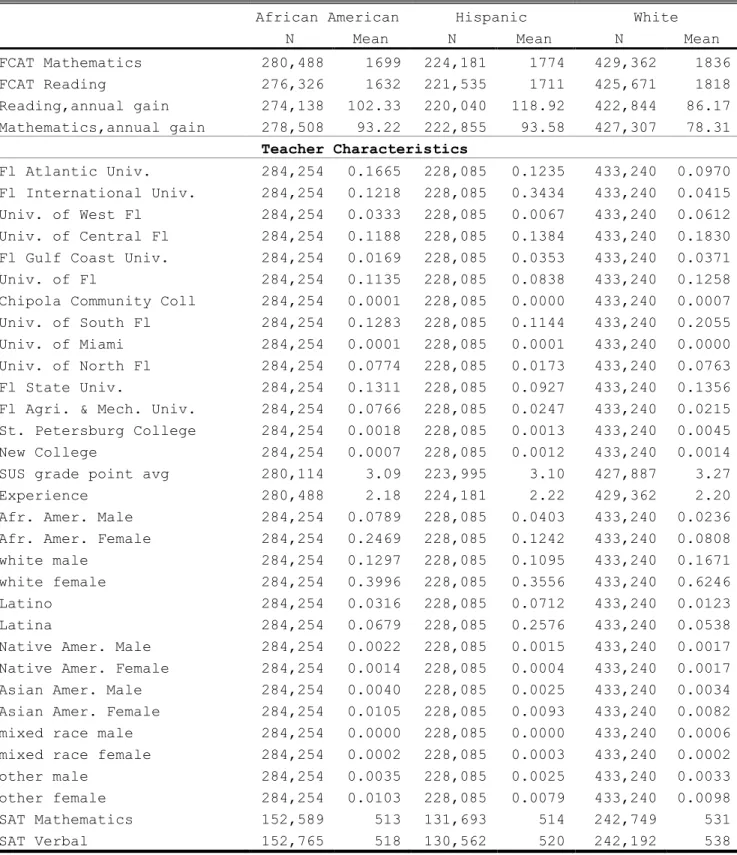
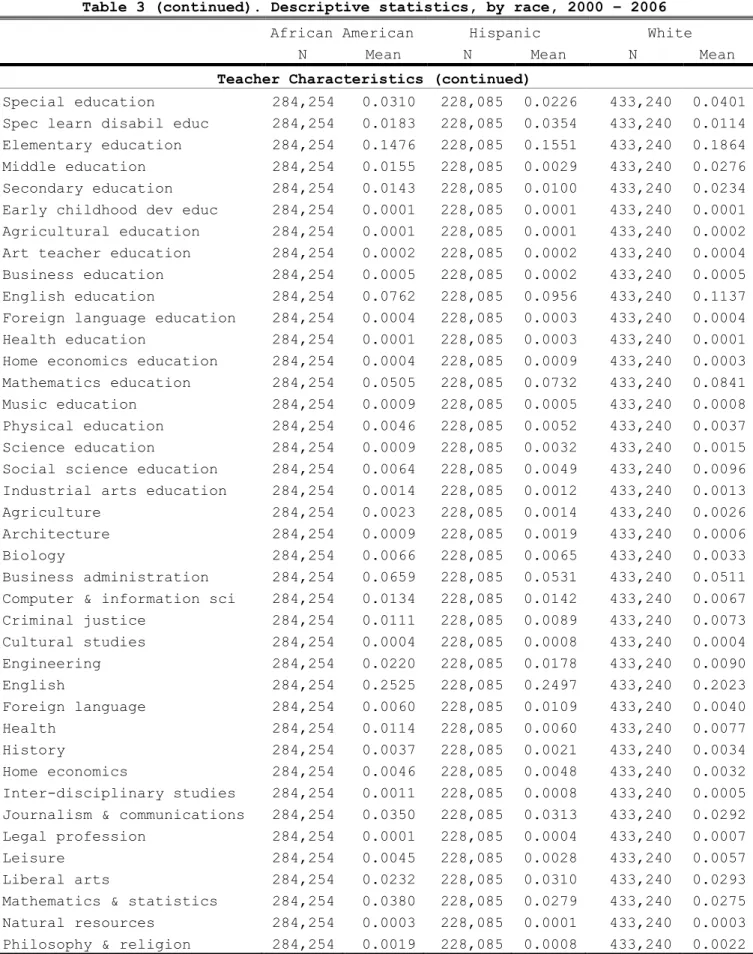
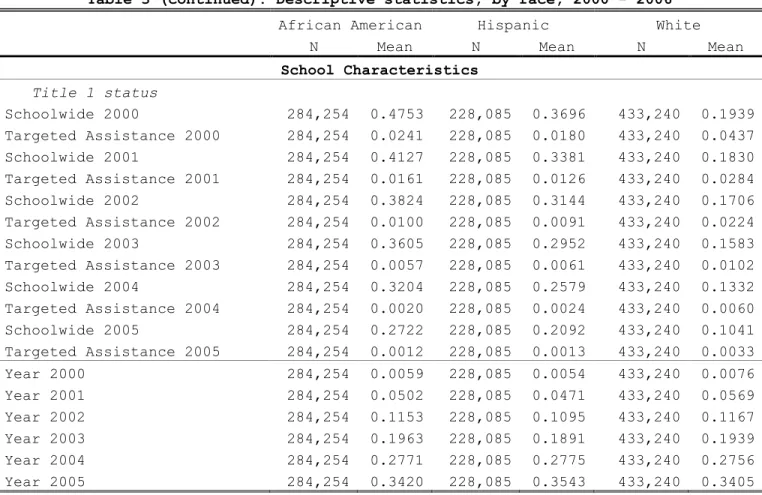
Table 3 presents descriptive statistics by race of pupil. Eight percent, 2.5 percent, and 2 percent of African American, Hispanic, and white pupils, respectively, are taught by graduates of FAMU. Seventeen percent of African American pupils are taught by graduates of FAU, while 34 percent and 21 percent of Hispanic and white graduates are taught by graduates of Florida Intl. University and Univ. of South Florida, respectively. White women are the largest group of teachers of African American (40 percent), Hispanic (36 percent), and white pupils (62 percent). African American and Hispanic pupils have teachers with nearly equal SAT scores, though the SAT scores of teachers of white pupils are slightly higher.
[Insert Table 3]
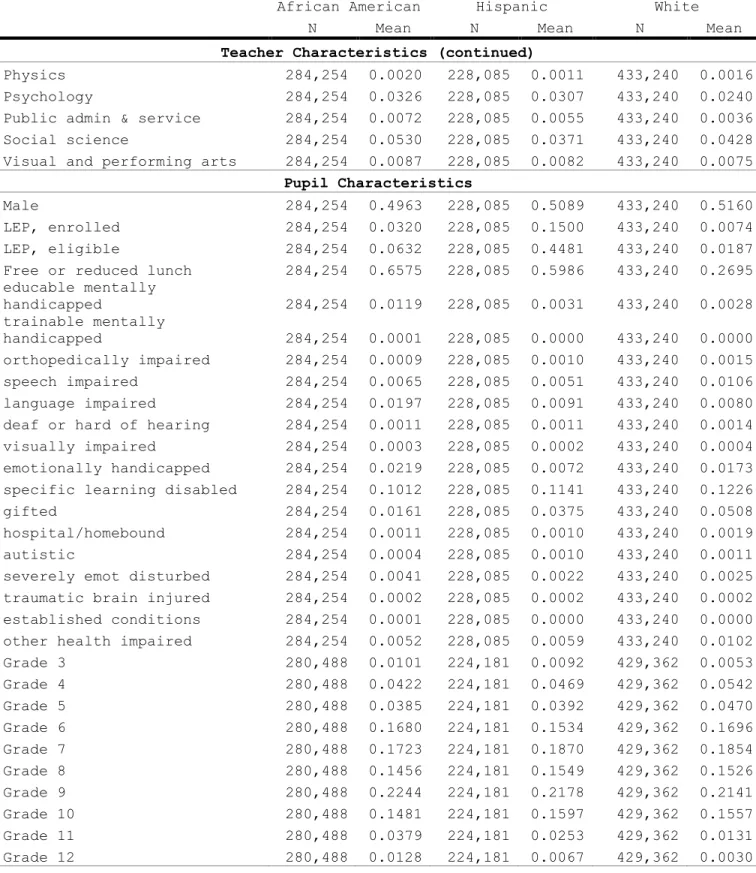
Thirty-eight percent of teachers of African American pupils have an education degree, versus 43 percent and 51 percent of teachers of Hispanic and white pupils. Twenty-five percent of teachers of African American and Hispanic pupils have English degrees, while 20 percent of teachers of white pupils have English degrees. Just 4 percent of teachers of African American pupils have a degree in mathematics or statistics, while only 3 percent of teachers of Hispanic and white pupils have a mathematics or statistics degree.
About 10 percent of African American pupils and 2.5 percent of white pupils are enrolled in or eligible for enrollment in limited English proficiency courses. However, 60 percent of Hispanic pupils are currently enrolled in or eligible for enrollment in limited English proficiency courses. Two-thirds of African American pupils and 3/5 of Hispanic pupils are eligible for free or reduce price lunch, but only 27 percent of white pupils are eligible for free or reduced price lunch.
Ten percent, 11 percent, and 12 percent of African American, Hispanic, and white pupils have a specific learning disability, but 1.6 percent, 3.8 percent, and 5.1 percent, respectively, are
17
classified as gifted pupils. Roughly equal percentages of each group of pupils are enrolled in grades 3 – 11.
IV. Results
We estimate five specifications of the pupil academic achievement equation. The teacher program effects have virtually no sign differences between alternative specifications, though the specifications do exhibit differences in the statistical significance and absolute value of
parameters. Regardless of specification or statistical significance, most teacher program parameters are negative, indicating that pupils taught by teachers who graduated from Florida Atlantic University, the comparative institution, will attain higher FCAT scores than otherwise identical pupils taught by teachers prepared at other Florida universities and colleges.
For the imputed persistence specification (equation 5), Tables 5a, 6a, and 7a (discussed below) present the teacher program effects for elementary school, middle school, and high school mathematics scores of pupils, both male and female. Tables 5b, 6b, and 7b present the same information for the reading scores of pupils. The appendix contains the results for the lagged dependent variable specification (equation 1, Tables A1 – A3), annual gain specification (equation 2, Tables A4 – A6), instrumental variable specification (equation 4, Tables A7 – A9), and net growth specification (equation 6, Tables A10 – A12).
The annual gain specification requires 100 percent achievement persistence, that is, α = 1, while the net growth model assumes equal achievement persistence, regardless of race, gender, subject matter, or grade level. Table 4 shows that neither assumption is appropriate. Except for the reading achievement of African American females, achievement persistence declines as pupils advance from elementary school to high school. Regardless of subject matter or grade level, achievement persistence is about 10 percentage points lower among African American and Hispanic pupils than among white pupils. High school achievement persistence is greater among
18
females than males, though there does not appear to be a gender difference for elementary school and middle school. Finally, except for Hispanic and white elementary pupils, reading persistence is greater than mathematics persistence.
[Insert Table 4]
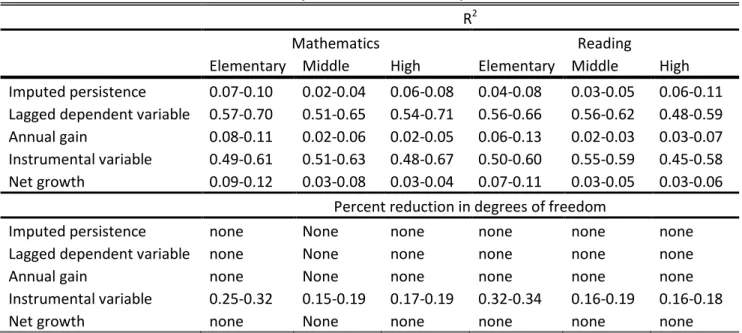
Because of differing dependent variables, the R2 statistics for the alternative specifications are not comparable. However, it is noteworthy that R2 is much lower for the specifications affected by measurement error for the dependent variable (imputed persistence, annual gain, and net growth) than for the lagged dependent and instrumental variable
specifications. For example, for the imputed persistence, annual gain, and net growth specifications, for both reading and mathematics, and for male and female pupils, R2 never exceeds 0.13 and is usually below 0.09. (See Table A13). But, for the lagged dependent variable and instrumental variable specifications, R2 is never below 0.45 and is usually above 0.50.
With a balanced panel, the instrumental variable specification would be the preferred specification. However, with our unbalanced panel the instrumental variable specification is associated with a great reduction in degrees of freedom. For elementary school, we lose 1/4 to 1/3 of the observations. (See Table A13). For middle and high school, we lose 15 – 19 percent of the observations. These reductions are non-random. Pupils are most likely to have new teachers for multiple years in a row at schools with high teacher turnover. Such large non-random reductions in degrees of freedom create sample selection bias.
Tables 5 – 7 present the teacher program effects taken from the imputed persistence equations. Given the econometric problems associated with alternative specifications, along with the empirical information on the signs of the coefficients, achievement persistence, differences in
19
R2, and changes in sample size, the imputed persistence equation is our preferred specification. It is the only specification with consistent and efficient parameter estimates.
In addition to the normal procedure of identifying statistically significant parameters, we also use a system of superscripts to facilitate comparisons between statistical models. The superscript “a” indicates that a parameter is statistically significant and has the same sign for both the imputed persistence and instrumental variable specifications. When a parameter is statistically significant and has the same sign for the imputed persistence, instrumental variable, and annual gain or net growth specifications, it is identified by a “b” superscript. A “c”
superscript is assigned to parameters that are statistically significant and has the same sign for both the imputed persistence and annual gain or net growth specifications. A “d” superscript is used to identify parameters that are insignificant in the imputed persistence model, but that are significant in either the annual gain or net growth specification and that have the same sign as the imputed persistence specification. Finally, an “e” superscript indicates that a parameter has the same sign in both the imputed persistence and instrumental variable specifications but that it is significant only in the latter model.
Elementary school
The imputed persistence model suggests multiple teacher program effects for the mathematics scores of Hispanic male and white female elementary pupils, but only limited teacher program effects for the mathematics scores all other race-gender pupils (Table 5a). Many of the statistically significant imputed persistence estimates are also significant in the other specifications of the pupil achievement equation.
For elementary school Hispanic males, FIU and FAMU, the state’s two minority serving institutions, have mathematics achievement scores that are 37 points and 54 points lower,
20
respectively, than otherwise identical pupils taught by FAU trained teachers. For elementary white females, the FIU, UF, and FAMU program effects are -26 points, -27 points, and -29 points, respectively. For both race-gender groups, these are the largest program effects.
[Insert Tables 5a and 5b]
The imputed persistence model suggests the fewest number of significant teacher program effects for the reading scores of Hispanic male and female elementary pupils, with a greater number of teacher program effects for the reading scores all other race-gender pupils (Table 5b). Nearly all of the statistically significant imputed persistence estimates are significant in the other specifications of the pupil achievement equation.
The reading scores of African American males and females, white males and females, and Hispanic males taught by graduates of New College are lower than the reading scores of otherwise identical pupils taught by graduates of nearly all other other teacher programs, with program effects of -80 points and -35 points, -52 points and -43 points, and -44 points,
respectively. Just St. Petersburg College has larger program effects for the reading achievement of white male (-64 points) and female (-81 points) elementary pupils.
Middle school
The imputed persistence specification reveals diverse teacher program effects for the mathematics scores of Hispanic male, African American female, and Hispanic female middle school pupils, with fewer statistically significant program effects for the mathematics scores of all other race-gender pupils (Table 6a). Many of the statistically significant imputed persistence estimates are significant in the additional specifications of the pupil achievement equation. However, it is also the case that statistically significant parameters for the instrumental variable specification are not necessarily significant for the imputed persistence specification.
21
For middle school Hispanic males, FSU, UCF, and USF, have mathematics achievement scores that are 18 points, 22 points, and 24 points lower, respectively, than otherwise identical pupils taught by FAU trained teachers. For middle school African American females, UWF and FAMU have the largest mathematics program effects, -47 points and -32 points, respectively, while UCF (21 points), UF (-18 points), USF (-17 points), and FSU (-18 points) have smaller program effects. UCF, UNF, and FSU also have the only significant program effects for Hispanic females, -30 points, -29 points, and -17 points, respectively.
[Insert Tables 6a and 6b]
The imputed persistence specification uncovers no statistically significant program effects for the reading scores of middle school African American males and Hispanic females (Table 6b). Mostly, the statistically significant imputed persistence estimates are significant in the additional specifications of the pupil achievement equation, even as the alternative
specifications identify statistically significant parameters that are insignificant for the imputed persistence specification.
The reading scores of Hispanic males taught by graduates of UWF are 97 points higher than the reading scores of otherwise identical pupils taught by graduates of FAU, though the program effects for UCF, USF, and UNF are -16 points, -34 points, and -35 points, respectively.
High school
The imputed persistence specification reveals diverse teacher program effects for the mathematics scores for all race-gender groups of high school pupils (Table 7a). Many of the statistically significant imputed persistence estimates are significant in the instrumental variable specification of the pupil academic achievement equation. Yet, the imputed persistence
22
of high school pupils; the instructional variable specification has a larger number of statistically significant parameters, though far less than for mathematics achievement.
[Insert Tables 7a and 7b]
For mathematics achievement, the imputed persistence specification identifies St. Petersburg College as the most distinct teacher preparation program since for 4 of the 6 race-gender equations, St. Petersburg College has the largest or the next to the largest program effects for the mathematics scores of high school pupils: -49 points (African American males), -46 points (Hispanic males), -38 points (African American females), and -35 points (Hispanic females).
V. Discussion: limitations and conclusions
We estimate five specifications of the pupil academic achievement equation: lagged dependent variable (1), annual gain (2), instrumental variables (4), imputed persistence (5), and net growth (6) specifications. For all specifications, ordinary least squares is the estimation procedure. The standard errors are adjusted for clustering: pupils with the same teacher have correlated standard errors. We estimate separate regressions for elementary (grades 3 – 6), middle (grades 7 – 8), and high school (grades 9 – 12). Within each of these educational segments, we estimate separate regressions for African American males, African American females, Latinos, Latinas, white males, and white females. For each race-gender group, we estimate a separate equation for mathematics and readings. Finally, we control for teacher
preparation program effects via a complete set of binary controls representing all universities and where FAU is the comparative institution. The estimation strategy yields a set of 72 regressions.
Our results show that: 1) the imputed persistence and instrumental variable specifications provide superior approaches to estimating value-added models of pupil academic achievement;
23
and, 2) except for Florida Atlantic University, we found little systematic evidence of a college preparation effect: pupils taught by teachers educated at Florida Atlantic University attain higher FCAT scores than pupils with identical observable characteristics but with teachers trained other Florida institutions, but there appears to be no systematic difference in teacher program effects on pupil academic achievement among the Non-FAU trained teachers.
The near absence of college preparation effects on pupil achievement is for teachers with 1-5 years of experience; hence, it is unlikely to have occurred because of differences in teacher attrition based on a teacher’s college of preparation. Also, this study does not contain any information on the cost of training teachers by college of preparation. If, as this study suggests, teachers are of nearly equal quality regardless of their institution of preparation, but teacher preparation are relatively less expensive at some Florida institutions than at other Florida institutions, then there may be efficiency differences among Florida’s institutions of higher education.
An important limitation of this study is that we do not have information on the effectiveness of Florida-trained teachers employed outside the state of Florida or outside of teaching within the State of Florida. Milton, et al. (2008) find that 72 percent of Initial Teacher Preparation program completers are employed in a Florida school. Only 59 percent of our Florida A & M University college of education completers is employed in a Florida school compared to 71 percent for Florida Atlanta University, 76 percent for Florida International University, 60 percent for Florida State University, and 61 percent for the University of Florida. Hence, strictly speaking, our results provide program effects for teachers who graduated from a Florida university and who choose to remain within the state of Florida. An additional important limitation of this study is that we do not control for the quality of educational leadership of
24
individual schools. We have no information on the direction or the statistical significance of the correlation between the preparation program of teachers and the quality of educational leadership of the schools of employment of teachers.
Also, the present study as well as the professional literature equates college preparation effects with mean test scores. But, the absence of a mean test score effect does not rule an inequality effect as capture that the standard deviation of test scores. For example, teachers trained at an institutions which emphasized “excellence” and teachers at institutions which emphasize “equity” may have pupils with identical mean test scores but with statistically significant differences in the standard deviation of test scores. Knowing whether a high mean score has occurred because a teacher has raise the scores of all pupils or just raised the scores of a few superstar pupils is a substantive policy issue.
Finally, this study has modeled education as a single product industry, that is, we have assumed that pupil standardized test scores are the sole output. However, it may be the case that education is a joint product industry, producing standardized test scores, disciplinary behavior, information regarding career opportunities, retention and promotion, and so forth. The near absence of a college preparation effect for standardized test scores does not provide information on these simultaneous educational outcomes. Further, our study does not examine academic outcomes other than reading and mathematics. Historical knowledge, science, art, and vocational preparation are important academic outcomes that may have college preparation effects. Finally, there are important non-academic outcomes that may have college preparation effects teen pregnancy prevention, absence of negative contact with the criminal justice system, and constructive civic engagement.
25
Notes
1
Primary exceptionalities include the following: educable mentally handicapped, trainable mentally handicapped, orthopedically impaired, occupational therapy, physical therapy, speech impaired, language impaired, deaf or hard of hearing, visually impaired, emotionally
handicapped, specific learning disabled, gifted, hospital/homebound, profoundly mentally handicapped, dual-sensory impaired, autistic, severely emotionally disturbed, traumatic brain injured, developmentally delayed, established conditions, other health impaired, unknown.
26
References
Chingos, Matthew and Paul E. Peterson. (2010). “Do Schools Districts Get What They Pay For? Predicting Teacher Effectiveness by College Selectivity, Experience, Etc.” Harvard University Program on Education Policy and Governance Working Papers Series 10-08.
Corcoran, S. P., & Jennings, J. L. (2009). Review of “An Evaluation of Teachers Trained
Through Different Routes to Certification: Final Report.” Boulder and Tempe: Education and the Public Interest Center & Education Policy Research Unit.
Florida Department of Education. (2009). “Overall Performance of 2007-08 Teacher Preparation Program Completers Teaching Reading and Mathematics Grades 4-10 during 2008-09.”
November.
Florida Department of Education. (2010a). “Teacher effectiveness in reading and mathematics 2008-2009.”
Florida Department of Education. (2010b). “Rule 6A-1.09981: Implementation of Florida’s System of School Improvement and Accountability,” Florida Administrative Weekly & Florida Administrative Code. https://www.flrules.org/gateway/RuleNo.asp?id=6A-1.09981 (April 12, 2010).
Florida Department of Education. (2004). “Fall Staff and Student Survey Data,” State Board of Education.
Harris, Douglas and Tim R. Sass. (2006). “Value-Added Models and the Measurement of Teacher Quality,” Florida State University, Working paper.
Harris, Douglas and Tim R. Sass. (2008). “Teacher training, teacher quality and student achievement,” Florida State University, Working paper.
Kane, Thomas J., Jonah E. Rockoff, and Douglas O. Staiger. (2006). “What does certification tell us about teacher effectives? Evidence from New York City,” National Bureau of Economic Research Working Paper 12155. http://www.nber.org/papers/w12155.
Milton, Sande, Pamela Flood, Melinda Dukes, Fely Curva, Ryan Wilke, Eileen McDaniel, Kathryn S. Hebda, Genae Crump, and Rebecca Pfeiffer (2008). “Beginning Teachers from Florida Teacher Preparation Programs: A Report on State Approved Teacher Preparation Programs with Results of Surveys of Program Completers.” Florida Department of Education, The Florida Center for Interactive Media, College of Education, Florida State University. January.
Noell, George H., Bethany A. Porter, R. Maria Patt, Amanda Dahir. (2008). “Value Added Assessment of Teacher Preparation in Louisiana: 2004-2005 to 2006-2007,” Technical Report. Baton Rouge, Louisiana: Louisiana State University.
27
Rockoff, Jonah E. (2004). “The impact of individual teachers on student achievement: evidence from panel data,” American Economic Review Papers and Proceedings.
Todd, Petra E. and Kenneth I. Wolpin. (2003). “On the specification and estimation of the production function for cognitive achievement,” Economic Journal, 113 (February):F3-F33.
28
Table 1. Percent of pupils with 50 percent or higher learning gains
Reading Mathematics
ITP DAC EPI ITP DAC EPI
Elementary school 88 83 93 81 85 77
Middle school 91 90 91 79 82 84
High school 37 35 31 89 96 82
Data are taken from Florida Department of Education, 2010.
Table 2. State University System of Florida (SUS)
Institution Students Carnegie Classification College of Education
FL A & M Univ. 13,067 DRU: Doctoral/Research Universities Ph.D., Educ. Leadership PTO
FL Atlantic Univ. 25,319 RU/H: Research Universities (high research activity)
Ed.D., Curriculum Instruction, Exceptional Student Ed. Ph.D., Counselor Educ., Educ. Leadership
EPI FL Gulf Coast Univ. 5955 Master's L: Master's Colleges and
Universities (larger programs)
M.A. & M.Ed., Many programs EPI, PTO
FL International Univ. 34,865 RU/VH: Research Universities (very high research activity)
Ed.D., Adult Ed. & Human Resource Dev., Curriculum & Instruction, Ed. Admin. & Supervision, Execeptional Stud. Educ.,
Higher Educ. Admin., Ph.D., Curriculum & Instruction PTO
FL State Univ. 38,431 RU/VH: Research Universities (very high research activity)
Ph.D. & Ed.D., Many programs PTO
New College of FL 692 Bac/A&S:
Baccalaureate Colleges--Arts & Sciences
No Education degree
Univ. of Central FL 42,465 RU/H: Research Universities (high research activity)
Ph.D. & Ed.D., Many programs PTO
Univ. of FL 47,993 RU/VH: Research Universities (very high research activity)
Ph.D. & Ed.D., Many programs EPI, PTO
Univ. of South FL 42,238 RU/VH: Research Universities (very high research activity)
Ph.D., Ed.D. Many programs
Univ. West FL 9,518 DRU: Doctoral/Research Universities Ed.D., Alternative/Special Education, Teaching and Learning EPI, PTO
Univ. of North FL 14,533 Master's L:
Master's Colleges and Universities (larger programs)
Ed.D., Educational Leadership EPI
Table 3. Descriptive statistics, reading and mathematics classes, grades 3 -12,
by race, 2000 – 2006
African American Hispanic White
N Mean N Mean N Mean
FCAT Mathematics 280,488 1699 224,181 1774 429,362 1836 FCAT Reading 276,326 1632 221,535 1711 425,671 1818 Reading,annual gain 274,138 102.33 220,040 118.92 422,844 86.17 Mathematics,annual gain 278,508 93.22 222,855 93.58 427,307 78.31 Teacher Characteristics Fl Atlantic Univ. 284,254 0.1665 228,085 0.1235 433,240 0.0970 Fl International Univ. 284,254 0.1218 228,085 0.3434 433,240 0.0415 Univ. of West Fl 284,254 0.0333 228,085 0.0067 433,240 0.0612 Univ. of Central Fl 284,254 0.1188 228,085 0.1384 433,240 0.1830 Fl Gulf Coast Univ. 284,254 0.0169 228,085 0.0353 433,240 0.0371 Univ. of Fl 284,254 0.1135 228,085 0.0838 433,240 0.1258 Chipola Community Coll 284,254 0.0001 228,085 0.0000 433,240 0.0007 Univ. of South Fl 284,254 0.1283 228,085 0.1144 433,240 0.2055 Univ. of Miami 284,254 0.0001 228,085 0.0001 433,240 0.0000 Univ. of North Fl 284,254 0.0774 228,085 0.0173 433,240 0.0763 Fl State Univ. 284,254 0.1311 228,085 0.0927 433,240 0.1356 Fl Agri. & Mech. Univ. 284,254 0.0766 228,085 0.0247 433,240 0.0215 St. Petersburg College 284,254 0.0018 228,085 0.0013 433,240 0.0045 New College 284,254 0.0007 228,085 0.0012 433,240 0.0014 SUS grade point avg 280,114 3.09 223,995 3.10 427,887 3.27 Experience 280,488 2.18 224,181 2.22 429,362 2.20 Afr. Amer. Male 284,254 0.0789 228,085 0.0403 433,240 0.0236 Afr. Amer. Female 284,254 0.2469 228,085 0.1242 433,240 0.0808 white male 284,254 0.1297 228,085 0.1095 433,240 0.1671 white female 284,254 0.3996 228,085 0.3556 433,240 0.6246 Latino 284,254 0.0316 228,085 0.0712 433,240 0.0123 Latina 284,254 0.0679 228,085 0.2576 433,240 0.0538 Native Amer. Male 284,254 0.0022 228,085 0.0015 433,240 0.0017 Native Amer. Female 284,254 0.0014 228,085 0.0004 433,240 0.0017 Asian Amer. Male 284,254 0.0040 228,085 0.0025 433,240 0.0034 Asian Amer. Female 284,254 0.0105 228,085 0.0093 433,240 0.0082 mixed race male 284,254 0.0000 228,085 0.0000 433,240 0.0006 mixed race female 284,254 0.0002 228,085 0.0003 433,240 0.0002 other male 284,254 0.0035 228,085 0.0025 433,240 0.0033 other female 284,254 0.0103 228,085 0.0079 433,240 0.0098 SAT Mathematics 152,589 513 131,693 514 242,749 531 SAT Verbal 152,765 518 130,562 520 242,192 538
Table 3 (continued). Descriptive statistics, by race, 2000 – 2006
African American Hispanic White
N Mean N Mean N Mean
Teacher Characteristics (continued)
Special education 284,254 0.0310 228,085 0.0226 433,240 0.0401 Spec learn disabil educ 284,254 0.0183 228,085 0.0354 433,240 0.0114 Elementary education 284,254 0.1476 228,085 0.1551 433,240 0.1864 Middle education 284,254 0.0155 228,085 0.0029 433,240 0.0276 Secondary education 284,254 0.0143 228,085 0.0100 433,240 0.0234 Early childhood dev educ 284,254 0.0001 228,085 0.0001 433,240 0.0001 Agricultural education 284,254 0.0001 228,085 0.0001 433,240 0.0002 Art teacher education 284,254 0.0002 228,085 0.0002 433,240 0.0004 Business education 284,254 0.0005 228,085 0.0002 433,240 0.0005 English education 284,254 0.0762 228,085 0.0956 433,240 0.1137 Foreign language education 284,254 0.0004 228,085 0.0003 433,240 0.0004 Health education 284,254 0.0001 228,085 0.0003 433,240 0.0001 Home economics education 284,254 0.0004 228,085 0.0009 433,240 0.0003 Mathematics education 284,254 0.0505 228,085 0.0732 433,240 0.0841 Music education 284,254 0.0009 228,085 0.0005 433,240 0.0008 Physical education 284,254 0.0046 228,085 0.0052 433,240 0.0037 Science education 284,254 0.0009 228,085 0.0032 433,240 0.0015 Social science education 284,254 0.0064 228,085 0.0049 433,240 0.0096 Industrial arts education 284,254 0.0014 228,085 0.0012 433,240 0.0013 Agriculture 284,254 0.0023 228,085 0.0014 433,240 0.0026 Architecture 284,254 0.0009 228,085 0.0019 433,240 0.0006 Biology 284,254 0.0066 228,085 0.0065 433,240 0.0033 Business administration 284,254 0.0659 228,085 0.0531 433,240 0.0511 Computer & information sci 284,254 0.0134 228,085 0.0142 433,240 0.0067 Criminal justice 284,254 0.0111 228,085 0.0089 433,240 0.0073 Cultural studies 284,254 0.0004 228,085 0.0008 433,240 0.0004 Engineering 284,254 0.0220 228,085 0.0178 433,240 0.0090 English 284,254 0.2525 228,085 0.2497 433,240 0.2023 Foreign language 284,254 0.0060 228,085 0.0109 433,240 0.0040 Health 284,254 0.0114 228,085 0.0060 433,240 0.0077 History 284,254 0.0037 228,085 0.0021 433,240 0.0034 Home economics 284,254 0.0046 228,085 0.0048 433,240 0.0032 Inter-disciplinary studies 284,254 0.0011 228,085 0.0008 433,240 0.0005 Journalism & communications 284,254 0.0350 228,085 0.0313 433,240 0.0292 Legal profession 284,254 0.0001 228,085 0.0004 433,240 0.0007 Leisure 284,254 0.0045 228,085 0.0028 433,240 0.0057 Liberal arts 284,254 0.0232 228,085 0.0310 433,240 0.0293 Mathematics & statistics 284,254 0.0380 228,085 0.0279 433,240 0.0275 Natural resources 284,254 0.0003 228,085 0.0001 433,240 0.0003 Philosophy & religion 284,254 0.0019 228,085 0.0008 433,240 0.0022
Table 3 (continued). Descriptive statistics, by race, 2000 – 2006
African American Hispanic White
N Mean N Mean N Mean
Teacher Characteristics (continued)
Physics 284,254 0.0020 228,085 0.0011 433,240 0.0016 Psychology 284,254 0.0326 228,085 0.0307 433,240 0.0240 Public admin & service 284,254 0.0072 228,085 0.0055 433,240 0.0036 Social science 284,254 0.0530 228,085 0.0371 433,240 0.0428 Visual and performing arts 284,254 0.0087 228,085 0.0082 433,240 0.0075
Pupil Characteristics
Male 284,254 0.4963 228,085 0.5089 433,240 0.5160 LEP, enrolled 284,254 0.0320 228,085 0.1500 433,240 0.0074 LEP, eligible 284,254 0.0632 228,085 0.4481 433,240 0.0187 Free or reduced lunch 284,254 0.6575 228,085 0.5986 433,240 0.2695 educable mentally handicapped 284,254 0.0119 228,085 0.0031 433,240 0.0028 trainable mentally handicapped 284,254 0.0001 228,085 0.0000 433,240 0.0000 orthopedically impaired 284,254 0.0009 228,085 0.0010 433,240 0.0015 speech impaired 284,254 0.0065 228,085 0.0051 433,240 0.0106 language impaired 284,254 0.0197 228,085 0.0091 433,240 0.0080 deaf or hard of hearing 284,254 0.0011 228,085 0.0011 433,240 0.0014 visually impaired 284,254 0.0003 228,085 0.0002 433,240 0.0004 emotionally handicapped 284,254 0.0219 228,085 0.0072 433,240 0.0173 specific learning disabled 284,254 0.1012 228,085 0.1141 433,240 0.1226 gifted 284,254 0.0161 228,085 0.0375 433,240 0.0508 hospital/homebound 284,254 0.0011 228,085 0.0010 433,240 0.0019 autistic 284,254 0.0004 228,085 0.0010 433,240 0.0011 severely emot disturbed 284,254 0.0041 228,085 0.0022 433,240 0.0025 traumatic brain injured 284,254 0.0002 228,085 0.0002 433,240 0.0002 established conditions 284,254 0.0001 228,085 0.0000 433,240 0.0000 other health impaired 284,254 0.0052 228,085 0.0059 433,240 0.0102 Grade 3 280,488 0.0101 224,181 0.0092 429,362 0.0053 Grade 4 280,488 0.0422 224,181 0.0469 429,362 0.0542 Grade 5 280,488 0.0385 224,181 0.0392 429,362 0.0470 Grade 6 280,488 0.1680 224,181 0.1534 429,362 0.1696 Grade 7 280,488 0.1723 224,181 0.1870 429,362 0.1854 Grade 8 280,488 0.1456 224,181 0.1549 429,362 0.1526 Grade 9 280,488 0.2244 224,181 0.2178 429,362 0.2141 Grade 10 280,488 0.1481 224,181 0.1597 429,362 0.1557 Grade 11 280,488 0.0379 224,181 0.0253 429,362 0.0131 Grade 12 280,488 0.0128 224,181 0.0067 429,362 0.0030
Table 3 (continued). Descriptive statistics, by race, 2000 – 2006
African American Hispanic White
N Mean N Mean N Mean
School Characteristics Title 1 status Schoolwide 2000 284,254 0.4753 228,085 0.3696 433,240 0.1939 Targeted Assistance 2000 284,254 0.0241 228,085 0.0180 433,240 0.0437 Schoolwide 2001 284,254 0.4127 228,085 0.3381 433,240 0.1830 Targeted Assistance 2001 284,254 0.0161 228,085 0.0126 433,240 0.0284 Schoolwide 2002 284,254 0.3824 228,085 0.3144 433,240 0.1706 Targeted Assistance 2002 284,254 0.0100 228,085 0.0091 433,240 0.0224 Schoolwide 2003 284,254 0.3605 228,085 0.2952 433,240 0.1583 Targeted Assistance 2003 284,254 0.0057 228,085 0.0061 433,240 0.0102 Schoolwide 2004 284,254 0.3204 228,085 0.2579 433,240 0.1332 Targeted Assistance 2004 284,254 0.0020 228,085 0.0024 433,240 0.0060 Schoolwide 2005 284,254 0.2722 228,085 0.2092 433,240 0.1041 Targeted Assistance 2005 284,254 0.0012 228,085 0.0013 433,240 0.0033 Year 2000 284,254 0.0059 228,085 0.0054 433,240 0.0076 Year 2001 284,254 0.0502 228,085 0.0471 433,240 0.0569 Year 2002 284,254 0.1153 228,085 0.1095 433,240 0.1167 Year 2003 284,254 0.1963 228,085 0.1891 433,240 0.1939 Year 2004 284,254 0.2771 228,085 0.2775 433,240 0.2756 Year 2005 284,254 0.3420 228,085 0.3543 433,240 0.3405
Table 4. Estimates of achievement persistence: by race, gender, grade, and subject matter
Males
African
American Hispanic White Elementary school Mathematics 0.77 0.75 0.86
Reading 0.77 0.74 0.85 Middle school Mathematics 0.69 0.66 0.78 Reading 0.76 0.71 0.80 High school Mathematics 0.58 0.64 0.71 Reading 0.71 0.71 0.79
Females
African
American Hispanic White Elementary school Mathematics 0.77 0.78 0.83
Reading 0.77 0.74 0.88 Middle school Mathematics 0.69 0.67 0.77 Reading 0.78 0.70 0.79 High school Mathematics 0.61 0.67 0.73 Reading 0.77 0.70 0.86
Table 5a.
Imputed persistence coefficient specification, mathematics: elementary school, program effects
Male Female
African
American Hispanic White
African
American Hispanic White Florida Intl. University -37.78**,b -36.95***,b -41.96***,b -14.25 -17.32*,a -26.16** (16.64) (9.328) (9.813) (14.22) (9.592) (12.33) Univ. of West Florida -52.98**,b -8.278e 17.80 -6.659 -8.878 -11.86 (25.73) (43.28) (20.15) (19.98) (43.39) (15.09) Univ. of Central Florida 15.31 -17.21*,a -3.648 36.37***,c -0.669 -16.54** (13.10) (9.947) (8.089) (13.39) (13.90) (8.364) Fl. Gulf Coast University -18.22 2.799 5.339 7.533 -1.372 -5.791 (22.14) (12.97) (13.71) (22.14) (16.23) (12.08) University of Florida -13.94 -21.23**,a -6.618 11.64 -9.513 -26.98***,a (14.15) (10.77) (8.415) (12.27) (11.24) (9.403) Univ. of South Florida -5.739 -21.39**,a -4.131 10.44 -3.600e -15.43*,a (13.40) (10.46) (7.841) (13.27) (11.16) (8.795) Univ. of North Florida -12.54 -49.44 -1.957 -0.895 9.950 -5.893 (13.87) (36.39) (9.544) (22.69) (38.96) (10.58) Florida St. University -5.550e -5.630 0.301 -8.341 -1.987 -8.125 (13.34) (14.98) (10.68) (14.52) (15.77) (10.14) Florida A & M University -5.372e -53.74*** -25.56** -8.286 -20.39 -28.60* (15.52) (19.11) (11.75) (14.14) (20.07) (15.52) St. Pete College 11.22 16.10 -23.09 2.936 (22.13) (17.12) (18.88) (16.14) New College 0 0 0 0 0 0 (0) (0) (0) (0) (0) (0) Observations 4719 4128 7267 4724 3869 6602 R2 0.065 0.102 0.086 0.074 0.102 0.098
* 10 percent level of significance, ** 5 percent level of significance, *** 1 percent level of significance
a
statistically significant for both imputed coefficient and instrumental variable specifications and same sign
b
statistically significant for both imputed coefficient, instrumental variable, and annual gain or net growth specifications and same sign
c
statistically significant for both imputed coefficient and annual gain or net growth specifications and same sign and same sign for imputed coefficient and annual gain or net growth
d
same sign for imputed coefficient and annual gain or net growth
e
Table 5b. Teacher preparation program effects (imputed coefficient), reading: elementary school
Male Female
African
American Hispanic White
African
American Hispanic White Florida Intl. University -22.53**,a -7.772 -8.564 -22.20*,a 1.932d -13.13d (11.15) (10.95) (12.90) (12.26) (10.25) (9.632) Univ. of West Florida -33.97 -24.87 -11.32 -1.624 14.41 -11.95 (25.79) (19.19) (13.36) (15.65) (17.11) (16.26) Univ. of Central Florida -16.57**,c -19.77**,c -9.136d -10.66d -5.106 -11.51d (8.390) (8.994) (6.937) (7.745) (8.541) (7.552) Fl. Gulf Coast University -36.30**,c -35.24**,b -15.56*,a 6.896 -11.96 -19.64*,a (16.47) (16.46) (8.823) (16.34) (12.37) (11.28) University of Florida -30.18***,b -23.20**,a -20.87***,b -24.39***,b -19.72** -21.95***,b
(9.891) (11.04) (7.188) (7.825) (9.869) (7.657) Univ. of South Florida -28.97***,b -15.57 -20.53***,a -17.26*,a -15.20 -11.76 (10.51) (11.41) (7.673) (9.985) (11.33) (8.017) Univ. of North Florida -23.06d 7.011 -24.57**,b -16.66*,a 18.74 -37.49***,b
(14.04) (17.93) (11.11) (9.851) (24.41) (13.20) Florida St. University -43.69***,b -13.09 -8.729 -23.13***,b 2.290 -4.189 (9.366) (10.29) (7.836) (7.996) (9.762) (7.852) Florida A & M University 2.855 -7.569 -26.20**,a 4.996 -11.73 -43.48***,b (12.75) (21.64) (12.39) (12.18) (18.15) (14.38) St. Pete College -156.3*,a -63.76d,e -40.40*,a -80.53d,e
(94.53) (47.34) (21.61) (50.16)
New College -80.38***,b -10.33 -51.74***,b -35.38***,a 43.72***,c -42.53***,b (11.44) (12.05) (8.742) (9.543) (12.35) (9.272)
Observations 12549 10077 20944 12346 9357 19342
R2 0.065 0.073 0.043 0.073 0.078 0.053
* 10 percent level of significance, ** 5 percent level of significance, *** 1 percent level of significance
a
statistically significant for both imputed coefficient and instrumental variable specifications and same sign
b
statistically significant for both imputed coefficient, instrumental variable, and annual gain or net growth specifications and same sign
c
statistically significant for both imputed coefficient and annual gain or net growth specifications and same sign and same sign for imputed coefficient and annual gain or net growth
d
same sign for imputed coefficient and annual gain or net growth
e