Effectiveness of a multicomponent school based intervention to reduce
bullying among adolescents in Chandigarh, North India:
A quasi-experimental study protocol
Monica Rana,
1Madhu Gupta,
1Prahbhjot Malhi,
2Sandeep Grover,
3Manmeet Kaur
11
Department of Community Medicine, School of Public Health,
2Department of Paediatrics,
3Department of
Psychiatry, Post Graduate Institute of Medical Education and Research, Chandigarh, India
Abstract
Background:Bullying perpetration and victimization is asso-ciated with significant academic, psychosocial and health related problems among adolescents. There is a need to develop effective interventions to prevent bullying among adolescents, especially in low and middle income countries. This paper presents the study protocol to develop, and evaluate the effect of multi-component school based prevention program for bullying in India.
Design:Quasi-experimental study.
Methods:The study will be conducted among 846 students of grade 7th and 8th in the intervention and control schools in
Chandigarh, Union Territory, North India. A government and a private school will be selected purposively in each of the interven-tion and control arm. The interveninterven-tion is based on socio-ecologi-cal model, and will be administered at individual, relationship (parents and teachers) and school level. The primary study out-come will be the proportion of students experiencing any kind of bullying (bullying, victimization, or both), in each study arm. The effectiveness of the intervention will be measured by performing difference in difference analysis and generalized estimating equa-tions.
Expected impact for public health:Bullying is an aggressive behaviour with significant morbidities, including psychological or physical trauma, affecting individuals not only in their adoles-cence, but also later in their adulthood. This quasi-experimental study is expected to provide evidence on whether multi-compo-nent bullying prevention intervention program, can reduce the burden of bullying perpetration and victimization among school adolescents in India. The results of the study will add in the exiting literature on bullying intervention program, especially, from the low middle-income countries, as there are limited studies avail-able on this topic in these countries.
Introduction
Bullying is an aggressive behaviour with significant morbidi-ties affecting individuals not only in their adolescence, but also later in their adulthood.1 It is a common stressful experience
affecting on an average 35% adolescents worldwide, especially, during school hours.2 Bullying behaviour is recognized by an
imbalance of power, repetitiveness, and the intention of bully to harm the victim.3Bullying can range from less serious situations,
like teasing or name calling, to very serious physical, sexual or verbal abuse, which can result into psychological or physical trau-ma, which may continue till adulthood.4Bullying behaviours have
emerged as a significant factor influencing the adjustment of both bullies and victims and the learning environment of all the stu-dents. It is reported that adolescent’s role as a perpetrator, victim, or bystander, is associated with significant academic, psychosocial and health related problems. One highly worrisome outcome that has been found to be particularly high among bullies and victims is suicide.5
A study from India, reported the prevalence of aggression among students studying in grades 9thto 10thto be 53% (19.2%
victims and 13% bullies).6This indicates that problem of bullying
exists in India. Studies that focus on bullying in India are more important because the education system is India is highly achieve-ment oriented, which involves long hours of reading and memo-rizing lessons. This puts the students with additional mental stress, anxiety and frustration, which is a precipitator of bullying.7
Educational system in India is divided into government and pri-vate schools. There is no documented difference between govern-ment and private schools prevalence in regard to bullying. However, in government schools, generally students from lower/middle socioeconomic status are enrolled, and in private schools, students from all (low/middle/high) socioeconomic status are enrolled. In our earlier unpublished study (Rana et al.),8it is
observed that prevalence of any kind of bulling is higher among students studying in the private schools (33.1%) as compared to the students in the government school (19.2%). Also type of school (government vsprivate) is a significant predictor of bully-ing (OR=0.63).Thus, it is important to plan and conduct a bullybully-ing prevention intervention studies in India. Additionally, such studies will add to the limited literature available regarding development or impact of bullying prevention interventional program per se in schools in India, which has the world’s second largest adolescent’s population.9To deal with bullying, school based anti-bullying
pre-vention programs have been developed and evaluated in the high income countries (HICs). Though their curricula vary but in gen-eral, these provide students with information about bullying, Significance for public health
Bullying is one of the important but neglected health concern among adoles-cents especially in low and middle income countries. The results of this study might guide the policy makers and public health professionals, not only in India but in other low and middle income countries, in formulating policy or guidelines for universal implementation of bullying prevention program in the schools with an aim to improve the overall health of the adolescents, and ultimately contribute in achieving the United Nation’s Sustainable Development Goals, three and four, of ensuring good health and well-being, and providing quality education, respectively.
Study Protocol
Non-commercial
intend to change how adolescent think and feel about it, and devel-op adolescent’s skills to avoid bullying and resolve disputes through nonviolent means. Olweus bullying prevention program was one of the first intervention program to target bullying prob-lem in schools in Norway.10 It was successful in significantly
reducing victimization (10% to 3.6%) and perpetration among the school students (7.6 to 3.6%). A systematic review of school based antibullying intervention program reported that the whole school based interventions reduce bullying perpetration and victimization by an average of 17-23%. It is also reported that interventional pro-grams that are of shorter duration, with no parental involvement or that lack whole school approach, have less effect on bullying behaviours.11The antibullying intervention in this study is
devel-oped using the whole school based approach along with involve-ment of parents, so as to overcome the limitations of the previous intervention programs. Lancet’s commission on Adolescent Health and Well Being has pointed towards the need of interventions to improve adolescent health in Lower Middle Income Countries (LMICs), where focus from several decades has been on reproduc-tive and sexual health, and important health priorities like mental heath, violence and injuries have been neglected.12LMICs are the
countries that has gross national income per capita between $1006 and $3955, as per World Bank classification of countries based upon income.13These efforts are expected to contribute in
achiev-ing the United Nation’s Sustainable Development Goals, three and four, of ensuring good health and well-being, and providing quality education, respectively.14
In view of this, this study is planned with the objective to first design and develop a multi-component prevention program on bul-lying perpetration and victimization, and then examine the effec-tiveness of this intervention in reducing the bullying perpetration and victimization among school adolescents in Chandigarh, a North Indian Union Territory. We hypothesize that a multi-compo-nent school based intervention package will reduce the proportion of adolescents involved in bullying, victimization and perpetration in the post intervention phase.
Materials and Methods
Study design
The study design of this study is quasi experimental, where the groups are non-randomized into intervention and control groups, and selected purposively.
Sample
This study is conducted in the schools located in Chandigarh, Union Territory. Indian educational system is structured into two types of school: Government schools (funded by government) and private schools (not funded by government, and administered by private organizations). There are a total of 175 middle (upto 8th
grade), high (upto 10th grade) and senior secondary (upto 12th
grade) schools in Chandigarh. Among these, 106 are government and 69 are private schools. All these schools were eligible to par-ticipate in this study, except only boys (n=2) and only girls (n=4) schools, so as to have equal representation from boys and girls.
We chose to conduct this intervention study among students studying in grades 7thand 8th, because earlier studies have reported
that bullying tend to peak in middle school years and early adoles-cence.
Only four schools are purposively selected out of 175 schools, including one government and one private school each in the
inter-vention and control arm, due to manpower and time constraints. No randomization is done because full voluntary cooperation and participation of the intervention schools is required for the imple-mentation of the interventions. The selection of the schools is based upon their willingness to participate in the study and imple-ment the bullying intervention program (intervention arm), the strength of students (meeting the sample size requirement) in 7th
and 8th classes, and ratio of male to female students (1.5:1, so as to
represent the overall male to female student’s ratio in Chandigarh’s schools).
The control schools are carefully chosen so that they have sim-ilar baseline characteristics like strength of the school, location of the school, language medium of the school, as of the intervention schools. Number of sections and students studying in each section of 7thand 8thgrade are first listed. All the sections and students in
7th and 8th grade of selected schools are enrolled in the study.
Students who will change schools within the study period will not be followed up. This proportion is projected to be 2%, by review-ing the school records of the last year.
Although all the children studying in 7thand 8thclasses in the
selected schools are enrolled in the study, yet sample size calcula-tions is done to ensure if adequate sample is obtained to draw con-clusions. The assumption in analysing school based study is that data within cluster, i.e. classes or schools, are more similar than between clusters. The clustering effect has to be taken into account, which statistically is defined as 1+(m-1)p, where m is number of units in a cluster (students within a section of a class), and p is intraclass correlation coefficient (ICC).15On the basis of
prior research, the expected ICC is 0.02 for both victimization and perpetration as the outcome.16On an average, a section of a class
approximately comprises of 40 students, thus leading to clustering effect of 1.78. Assuming the primary outcome (proportion of chil-dren with any bullying) to be 31%,17 12% reduction in bullying
after implementation of the intervention (on an average school based intervention program reported to reduce bullying by 17-23%),6significance level of 5%, power of 80%, non response rate
of 5%, the sample size is estimated to be 416 students in each arm. The total students recruited in this study are 846 (425 in con-trol and 421 in intervention arm), which indicates that the sample size is adequate. Mean age of the students is 12.68 (SD=0.77). Males (57%) to females ratio (43%) is 1.4:1. Students from 8th
(52%) and 7thgrade (48%) are almost equally represented.
Study period
The study has been ongoing since October 2016. Baseline information was collected in November- December 2016. The study will be continued till January 2018.
Instruments
A baseline assessment was done, in the intervention and con-trol schools, to measure the burden of bullying and its correlates using self-administered Revised Olweus Bully/victim Questionnaire (Olweus 1996),18Rosenberg self esteem
question-naire and strength and difficulties questionquestion-naire,19,20respectively.
The Olweus Bully-victim Questionnaire provides information on bullying in the past 6 months. It is a validated tool with cronbach’s alpha of 0.80. The questionnaire contains 40 items including ques-tions on verbal, relational physical and cyber bullying. Participants will be categorized into one of the four bullying subgroups accord-ing to their frequency of responses with bullyaccord-ing: Not involved participants: defined as who had not been bullied/bullied others or involved only once or twice; Victim: categorized as who had been bullied 2 or 3 times a monthor more; Bully: categorized who bul-lied other 2 or 3 times a monthor more; Bully-victim: Involved in
Non-commercial
bullying others and had been bullied 2 or 3 times a monthor more. Self-esteem score of the students will be measured as per Rosenberg’s self esteem questionnaire. This is a 10 item scales, each of which is scored on a four point scale. This scale generally has a high reliability, and is also validated on Indian population with cronbach’s alpha of 0.81. For item 1, 2, 4, 6, and 7, the score of 4 indicated strongly agreeand score 1 indicated strongly dis-agree, and for the rest of the items the scoring was reversed as
strongly agreeindicated by 1 and strongly disagreeindicated by 4 (higher scores indicating higher self-esteem).
Social and emotional well being of children which will be measured by total difficulty scores as per the strength and difficul-ty questionnaire (SDQ). It is a validated tool on Indian population with good psychometric properties and is available in English as well as Hindi versions with cronbach’s alpha of 0.61.There are 25 items in SDQ which comprise of 5 sub-scales: emotional problems scale, conduct problems scale, hyperactivity scale, peer problems scale and pro-social scale. Students have to respond on a three point scale not true, somewhat trueor certainly trueon the basis of their behaviour in last 6 months. A total difficulties behaviour score will be calculated by summing scores from all the scales except the pro social scale (higher scores indicates greater prob-lem).
Before the data collection, the author had visited all the sec-tions of 7thand 8thclasses, in the intervention and control schools,
to inform the children about the study, and encourage them to par-ticipate. Parental consent of the students for participation in the study was obtained through the school principal. In addition, assent from the students themselves was also obtained. The ques-tionnaires were administered to all those adolescents who assent-ed/consented to participate. This phase of the study was conducted from November to December, 2016.
Data analysis
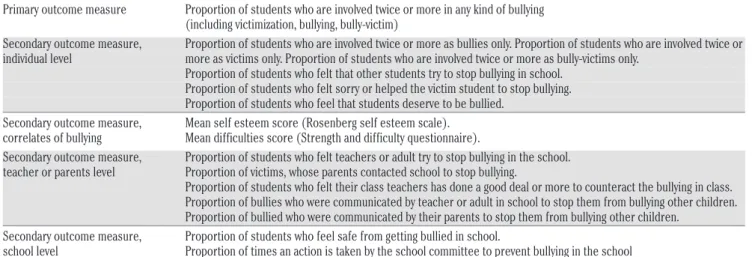
Data will be entered into statistical package for social sciences, version 16.0, which will be used for all statistical purposes. The outcome measures will be measured at individual level (students level), teachers, parents and school level. The primary and second-ary outcome measures are enlisted in Table 1.
Mc-Nemar chi-square test wiil be used to see significant differ-ences between group pre- and post test. ANOVA will be used to estimate significant difference between means of groups pre- and post test. Further difference-in-differences (DID) analysis will be
used to compare the changes over time between intervention and control groups to estimate effectiveness of the intervention. Hence, in this study the change in bullying prevalence in intervention group minus the change in bullying prevalence in control group is estimated by DID. DID remove the initial difference in control and intervention group, which is not removed by single difference and hence does not underestimate the program impact. Further logistic mixed model analysis will be done to calculate relative risks in control schools as compared to intervention schools. Differences between groups will be considered significant at 95% confidence interval. To analyze the longitudinal differences (pre- and post intervention) in categorical variables, generalized estimating equa-tion (GEE) method across three timelines. Repeated measures ANOVA will be used to assess the impact of intervention on the means of scores of correlates of bullying (difficulty score and self esteem score).
Designing and pretesting phase of the intervention
program
The intervention program is designed and finalized after indepth review of previously published literature on bullying (Supplementary Table 1), effectiveness of anti-bullying interven-tion programs; conducting focus group discussions with parents, teachers and adolescents (to explore the perceptions, beliefs and suggestions regarding bullying prevention program) and conduct-ing a consultation workshop with all the stakeholders (teachers, principals, school counsellors, students, psychiatrists and public health experts). The bullying intervention program was pretested among 60 adolescents studying in 7th (n=30) and 8th(n=30) grades
in a school located outside the study area for feasibility, applicabil-ity of the content, and estimating the duration for delivery of each component of the intervention program per school. Pretesting was done in October 2016.
Intervention phase
Intervention in this study is based on Social Ecological Model,21 as it incorporates all the factors affecting adolescent’s
behaviours. The key concept of this model is that it uses individual level, relationship level and community level factors to understand the factors that influence the adolescent’s behaviour. The preven-tion strategies that work at all levels of the social-ecological model are necessary for deep and sustained prevention of bullying
Table 1. Outcome measures to assess the effectiveness of bullying prevention program.
Primary outcome measure Proportion of students who are involved twice or more in any kind of bullying (including victimization, bullying, bully-victim)
Secondary outcome measure, Proportion of students who are involved twice or more as bullies only. Proportion of students who are involved twice or individual level more as victims only. Proportion of students who are involved twice or more as bully-victims only.
Proportion of students who felt that other students try to stop bullying in school. Proportion of students who felt sorry or helped the victim student to stop bullying. Proportion of students who feel that students deserve to be bullied.
Secondary outcome measure, Mean self esteem score (Rosenberg self esteem scale). correlates of bullying Mean difficulties score (Strength and difficulty questionnaire).
Secondary outcome measure, Proportion of students who felt teachers or adult try to stop bullying in the school. teacher or parents level Proportion of victims, whose parents contacted school to stop bullying.
Proportion of students who felt their class teachers has done a good deal or more to counteract the bullying in class. Proportion of bullies who were communicated by teacher or adult in school to stop them from bullying other children. Proportion of bullied who were communicated by their parents to stop them from bullying other children.
Secondary outcome measure, Proportion of students who feel safe from getting bullied in school.
school level Proportion of times an action is taken by the school committee to prevent bullying in the school
Non-commercial
behaviour. Therefore, the intervention strategies are first formulat-ed at these three levels to prevent bullying in this study, as given in Figure 1.
The multi-component school based intervention strategy will be administered at three levels i.e.,individual (students), relation-ship (parents and teachers), and school level. Details of the inter-vention package are provided in the Supplementary Table 2. Brief description of the package is given below:
Individual level strategy (classroom-based curriculum)
The classroom-based curriculum will be delivered through conducting group meetings with the adolescents in their class-rooms by the authors themselves. The group meetings will be facil-itated by the power point presentations, videos, and structured group activities, so as to maintain the homogeneity in the content of intervention in each school. Videos and group activities will make the session interactive and interesting for the students, and aim at enhancing the participation of the students in the interven-tion. Three group activities will be conducted including: i) slogan making competition on bullying; ii) poster making competitions depicting the problem of bullying in schools; and iii) experience sharing sessions on bullying incidents in school. The activities will be conducted in groups and will be conducted after the power-point sessions. The group activities will help in understanding whether students developed the understanding of the sessions. A separate talk on cyber bullying, and the ways to prevent it will also be given to all the enrolled students. The content of the interven-tion will be bilingual (in Hindi and English language). This class-room curriculum will be delivered in three sessions. The duration of two sessions will be one-hour each, and third session will be of 2 hours duration. The classroom-based curriculum is aimed at increasing their knowledge regarding bullying behavior and its harmful effects and strengthening their skills to prevent bullying victimization.
Relational level strategy (parents and teachers)
Relationship level strategy will be delivered through parent and teachers module separately.
Parent’s module will be delivered by conducting two group meetings with the parents of one hour duration each. These meet-ings will be organized on the parent-teacher-meeting day in the
school premises. Parents will be first oriented about bullying prob-lem, and then explained about the signs of bully or victim so that they can identify if their child is a bully or a victim or has been wit-nessing bullying in school. Specific parenting skills will be impart-ed to the parents to enable them to tackle bullying if their child has been involved in it. A talk on cyber bullying and its preventive strategies will also be delivered to parents. These meetings will be facilitated by power-point presentations in the bilingual language. In addition, on the subsequent parent-teacher-meeting (once every month) days, which will be held during the intervention phase, an interactive session will be held with the parents to clarify and dis-cuss their doubts.
In the teacher’s module, classroom rules and teaching skills will be provided to the teachers in the group meetings with them, to prevent bullying in the class or school. Teachers will be provid-ed with the ways (To do list) to respond to the bullying, like talking to bully and victim separately to understand the situation, and most importantly is to tell the victim not to ignore the bullying. A ses-sion on relationship building with adolescents will be held, as it is an important strategy for preventing adolescents to involve in bul-lying. This content will be delivered in both Hindi and English depending upon the medium of the language used in the school, and will be facilitated by power point presentation. There will be 2 sessions of one hour duration each with the teachers. Teachers will be followed up every week, to make sure they are implementing the intervention program.
Community level strategy (school level)
Community level strategy will be delivered by creating enabling environment in the school and sensitizing the school administrators regarding the bullying problem. Conducting group meetings with the school administrators including school princi-pal, vice-principal and school coordinators will do this. A commit-tee comprising of principal, vice principal, counselor and two teachers will be formulated to deal with the bullying problem and implement bullying prevention program in the intervention schools. A meeting with the committee once every month will be held to ensure proper implementation of the program. This com-mittee will also introduce school rules against bullying, and dis-play messages and posters against bullying on bulletin boards with in the school premises.
Figure 1. Social ecological model based strategies to prevent bullying.
Non-commercial
The extent of implementation of the intervention program will be measured by assessing the status of various program compo-nents twice in a month during the intervention phase.
Control schools
In the control schools, the school authorities will conduct the routine adolescent health sessions like reproductive and sexual health.
Post intervention phase (endline assessment)
Mid- and end-line assessment will be done at three and eight months, respectively, of implementing the intervention on the same students using the same questionnaire, to measure bullying and its correlates, as used in the baseline assessment of the study.
Ethical consideration
Ethics committee of Postgraduate Institute of Medical Education and Research has approved this study (Approval no: INT/IEC/2015/258).Prior permission to conduct the study in schools has been obtained from Director Public Instructions (DPI), Chandigarh. Written consent from the parents of the adolescents and assent from adolescents in the language they understand is obtained before conducting the study. The respondents were briefed about the purpose and objective of the study by providing the study information sheet. The information collected from the students will be kept confidential and anonymous. The study will be contributing to PhD public health thesis for the first author.
Discussion
This quasi-experimental study is expected to show whether multi-component bullying prevention intervention program will contribute in reducing the burden of bullying perpetration and victimization among adolescent students. The present interven-tion program has been designed considering the needs of the stakeholders (students, parents and school staff) by conducting focus group discussions, which is essential for the success of any intervention. The effectiveness of the program will be evaluated by collecting post intervention data twice which will give short as well as long term effects of the program.
Bullying is a significant public health problem because it has serious long term harmful health consequences. Due to the harm-ful consequences of bullying, several studies have been conduct-ed to evaluate the effectiveness of anti-bullying prevention pro-grams .With one in every three children2 involved in some form
of bullying,2it is important to have effective antibullying
inter-ventions as bullying is accompanied with devastating conse-quences. Even though violence and bullying are higher in less developed countries, majority of the intervention studies reported are from European and North American countries.22Therefore,
the present study will contribute to new scientific evidence on effectiveness of bullying prevention programs in LMICs, where there is very less research on this topic.
The strength of this study is that it is a whole school based intervention program that involves not only students but school administrators, teachers and parents, who play an important role in the success of any school program for adolescents. The use of videos will also be done for increasing the interest of the adoles-cents on this issue. Regular follow up with the school adminis-trators and teachers will be done for increasing the extent of the implementation of the intervention. The present intervention program focuses on both traditional and cyberbullying. The
quasi-experimental study design was purposefully chosen for this study, because motivation and full co-operation of the school administration is required for the successful implementa-tion of the program in the schools. Previous intervenimplementa-tion pro-grams have also documented that quasi experimental study design has been one of the reasons for the success of bullying programs. Zych et al.,23reviewed 10 anti-bullying intervention
programs and concluded successful anti-bullying intervention program components like antibullying committee, rules against bullying, improving school environment and involving families. These components have been included in the present bullying intervention program. However, this design has limitations like lack of randomization which results into selection bias both at individual and school level. To minimize the bias baseline char-acteristics of the study population were matched. However, potential sources of selection bias like socioeconomic status of students, strength of school can be included as confounders in the analysis to reduce the effect of selection bias in the esti-mates. Another limitation of the study is the use of self adminis-tered questionnaire in which students may find difficulty in understanding few questions. To tackle this limitation, the authors had explained all the questions to the participants before administering the questionnaire.
The public health implication of this study is that it will gen-erate evidence on the effectiveness of the intervention in dealing with bullying problem among students, which can guide the pol-icy makers on formulating polpol-icy or guidelines for universal implementation of this program in the schools not only in India, but in other low and middle income countries as well.
Trial registration
The study protocol is registered with Clinical Trials Registry, India. Registration number is CTRI/2017/04/008413.
Correspondence: Madhu Gupta, Department of Community Medicine and School of Public Health, Room No. 130, PGIMER, Chandigarh, India. Tel.: +91.1722690727 - Fax: +911722744401.
E-mail: [email protected]
Key words: Adolescents; Bullying; Intervention; Schoolbased; Victimization. Acknowledgements: the authors would like to thank Director Public Instructions, Education department Chandigarh for granting permissions to conduct the study.
Contributions: MR developed the first draft of the manuscript. MG, SG, PM and MK contributed to the conception and design of the study. All authors provided feedback during manuscript development. Each author has read and approved the final manuscript.
Conflict of interest: the authors declare no potential conflicts of interest. Funding: MR is funded by Indian Council of Medical Research, New Delhi-Junior Research Fellowship (JRF) for undergoing PhD program.
Received for publication: 9 November 2017. Revision received: 15 March 2018. Accepted for publication: 13 April 2018. ©Copyright M. Rana et al., 2018 Licensee PAGEPress, Italy
Journal of Public Health Research 2018;7:1304 doi:10.4081/jphr.2018.1304
This work is licensed under a Creative Commons Attribution NonCommercial 4.0 License (CC BY-NC 4.0).
Non-commercial
References
1. Srabstein J, Leventhal B. Prevention of bullying related mor-bidity and mortality: a call for public health policies. Bull WHO 2010;88:403.
2. Modecki K, Minchin J, Harbaugh A, et al. Bullying prevalence across contexts: A meta-analysis measuring cyber and tradi-tional bullying. J Adolesct Health 2014;55:602-11.
3. Olweus D. Bullying at school: What we know and what we can do. Oxford & Cambridge: Blackwell Publishers; 1993. 4. Klomek A, Sourander A, Elonheimo H. Bullying by peers in
childhood and effects on psychopathology, suicidality and criminality in adulthood. Lancet Psychiatry 2015;2:930-41. 5. Kelly EV, Newton NC, Stapinski LA, et al. Suicidality,
inter-nalizing problems and exterinter-nalizing problems among adoles-cent bullies, victims and bully victims. Prev Med 2015;73:100-5.
6. Malhi P, Bharti B, Sidhu M. Aggression in schools: psychoso-cial outcomes of bullying among Indian adolescents. Indian J Pediatr 2014;81:1171-6.
7. Deb S, Strodl E, Sun J. Academic Stress, Parental Pressure, Anxiety and Mental Health among Indian High School Students. Int J Psychol Behav Sci 2015;5:26-34.
8. Rana M, Gupta M, Malhi P, et al. Prevalence and correlates of bullying perpetration and victimization among adolescents in schools in Chandigarh; 2018.
9. United Nations Children’s Fund (UNICEF). The state of the World’s children 2011: Adolescence: An age of opportunity. February 2011. New York USA.
10. Smith PK, Morita Y, Junger-Tas J, et al. The nature of school bullying: A cross-national perspective. London: Routledge; 1998. pp 28-48.
11. Ttofi M, Farrington D. Effectiveness of a school based pro-grams to reduce bullying: a systematic and meta-analytic review. J Exp Criminol 2011;7:27-56.
12. Patton G, Sawyer S, Santelli J, et al. Our future: Lancet com-mission on adolescent health and well being. Lancet 2016;387:2423-78.
13. The World Bank data. Lower middle income countries. Available from: https://data.worldbank.org/income-level/lower-middle-income. Accessed on 11 March 2018. 14. UNPD. Sustainable development goal. Available from:
http://www.undp.org/content/undp/en/home/sustainable-development-goals.html. Accessed on 11 March 2018. 15. Hemming K, Girling A, Sitch A, et al. Sample size calculation
for cluster randomized controlled trials with fixed number of clusters. BMC Medical Research Methodol 2011;11:102. 16. Karna A, Voeten M, Little TD, et al. A large scale evaluation of
the KiVa antibullying program: grades 4-6. Child Deve 2011;82:311-30.
17. Kshirnagar VY, Agarwal R, Bavdekar SB. Bullying in Schools: Prevalence and short-term Impact. Indian Paediatrics 2007;44:25-27.
18. Olweus D. The revised Olweus Bully/Victim Questionnaire. Bergen: Research centre for health promotion;1996.
19. Blascovich J, Tomaka J. Measures of self-esteem. In: Robinson J, Shaver P, Wrightsman L, eds. Measures of Personality and Social Psychological Attitudes. 3 rd ed. Ann Arbor: Institute for Social Research; 1993. pp. 115-160.
20. Goodman R. The strengths and difficulties questionnaire: A research note. J Child Psychol Psychiatry 1997;38:581-6. 21. Bronfenbrebber U. The ecology of human development:
Experiments by nature and design. Cambridge, Mass: Harvard University Press; 1979.
22. Zych I, Ortega-Ruiz R, Rey RD. Scientific research on bully-ing and cyberbullybully-ing: where have we been and where are we going. Aggression Violent Behav 2015;24:188-98.
23. Zych I, Farrington DP, Llorent VJ, Ttofi MM. Protecting Children against bullying and its consequences. Switzerland: Springer; 2017.