CORRELATION-BASED BOTNET DETECTION
IN ENTERPRISE NETWORKS
A Thesis Presented to The Academic Faculty
by Guofei Gu
In Partial Fulfillment
of the Requirements for the Degree Doctor of Philosophy in the
College of Computing
Georgia Institute of Technology August 2008
CORRELATION-BASED BOTNET DETECTION
IN ENTERPRISE NETWORKS
Approved by:
Dr. Wenke Lee, Advisor College of Computing
Georgia Institute of Technology
Dr. Jonathon Giffin College of Computing
Georgia Institute of Technology
Dr. Mustaque Ahamad College of Computing
Georgia Institute of Technology
Dr. Chuanyi Ji
School of Electrical and Computer Engineering
Georgia Institute of Technology
Dr. Nick Feamster College of Computing
Georgia Institute of Technology
To my dear family:
ACKNOWLEDGEMENTS
During my Ph.D. study, I have been extremely lucky to have support, encouragement, and inspiration from many people; without them, this work would not have been possible.
My sincere and deep gratitude goes to my advisor, Dr. Wenke Lee, for his kind guidance and consistent support. He led me on this journey, guided me towards the right direction, influenced me as an active thinker, and provided me with insightful and inspiring advice throughout my entire Ph.D. study. He has had an enormous impact on my professional development, and I hope to guide my students as well as he has guided me.
I would also like to thank other members of my committee, Dr. Mustaque Ahamad, Dr. Nick Feamster, Dr. Jonathon Giffin, and Dr. Chuanyi Ji, for their interest in my work. Their insightful comments have significantly improved the quality of my work.
I have also been very fortunate to be a member of a great security research team in our lab at Georgia Tech. I wish to thank Xinzhou Qin, David Dagon, Yi-an Huang, Prahlad Fogla, Monirul Sharif, Oleg Kolesnikov, Mohamad Kone, Takehiro Takahashi, Roberto Perdisci, Bryan Payne, Paul Royal, Kapil Singh, Junjie Zhang, Robert Edmonds, Abhinav Srivastava, Manos Antonakakis, Martim Carbone, Artem Dinaburg, Long Lu, Ying Li, Jennifer Stoll, Ikpeme Erete, and Claudio Mazzariello, for their valuable assistance on my research and for their contribution to the wonderful and enjoyable graduate experience I have had at Tech. They have enriched my life at Georgia Tech and made it happy and memorable. Their friendship has been my best fortune.
I would also like to thank Phillip Porras and Vinod Yegneswaran for mentoring me during my summer internship at SRI International.
I would particularly like to thank my family. Always supportive and encouraging, my parents are my foundation. I know I owe them my life. Finally, there are no words to
express my love and appreciation to my wife, Jianli. Her exceptional kindness and love makes everything worthwhile.
TABLE OF CONTENTS
DEDICATION . . . iii ACKNOWLEDGEMENTS . . . iv LIST OF TABLES . . . x LIST OF FIGURES . . . xi SUMMARY . . . xiii I INTRODUCTION . . . 11.1 Botnets: Current Largest Security Threat . . . 2
1.2 Botnet Detection: Research Challenges and Our Goals . . . 6
1.3 Solution Overview . . . 8
1.4 Thesis Contribution and Organization . . . 12
II RELATED WORK . . . 14
2.1 Intrusion and Malware Detection . . . 14
2.2 Alert Correlation and IDS Cooperation . . . 18
2.3 Botnet Measurement and Honeypot-based Tracking . . . 21
2.4 Existing Work on Botnet Detection . . . 22
2.5 A Taxonomy of Botnet Detection Techniques . . . 24
III BOTHUNTER: DIALOG CORRELATION-BASED BOTNET DETECTION . 28 3.1 Bot Infection Dialog Model . . . 30
3.1.1 Understanding Bot Infection Sequences . . . 30
3.1.2 Modeling the Infection Dialog Process . . . 32
3.2 BotHunter: System Design and Implementation . . . 35
3.2.1 A Multiple-Sensor Approach to Gathering Infection Evidence . . 37
3.2.2 Dialog-based IDS Correlation Engine . . . 44
3.3 Evaluating Detection Performance . . . 48
3.3.1 Experiments in an In situ Virtual Network . . . 48
3.3.3 An Example Detection in a Live Deployment . . . 54
3.3.4 Experiments in a University Campus Network . . . 55
3.3.5 Experiments in an Institutional Laboratory . . . 57
3.4 Discussion . . . 58
3.5 BotHunter Internet Distribution . . . 60
3.6 Summary . . . 61
IV BOTSNIFFER: SPATIAL-TEMPORAL CORRELATION-BASED BOTNET DE-TECTION . . . 63
4.1 Botnet C&C and Spatial-Temporal Correlation . . . 65
4.1.1 Case Study of Botnet C&C . . . 66
4.1.2 Botnet C&C: Spatial-Temporal Correlation and Similarity . . . . 67
4.2 BotSniffer: Architecture and Algorithms . . . 69
4.2.1 Monitor Engine . . . 70
4.2.2 Correlation Engine . . . 72
4.2.3 Single Client C&C Detection Under Certain Conditions . . . 80
4.3 Experimental Evaluation . . . 81
4.3.1 Datasets . . . 81
4.3.2 Experimental Results and Analysis . . . 84
4.4 Discussion . . . 87
4.4.1 Possible Evasions and Solutions . . . 87
4.4.2 Improvements to BotSniffer . . . 90
4.5 Summary . . . 91
V BOTMINER: HORIZONTAL CORRELATION-BASED, PROTOCOL- AND STRUCTURE-INDEPENDENT BOTNET DETECTION . . . 92
5.1 Problem Statement and Assumptions . . . 95
5.2 BotMiner: Architecture, Design and Implementation . . . 97
5.2.1 BotMiner Architecture . . . 97
5.2.2 Traffic Monitors . . . 99
5.2.4 A-plane Clustering . . . 107
5.2.5 Cross-plane Correlation . . . 109
5.3 Experiments . . . 111
5.3.1 Experiment Setup and Data Collection . . . 111
5.3.2 Evaluation Results . . . 114
5.4 Limitations and Potential Solutions . . . 117
5.4.1 Evading C-plane Monitoring and Clustering . . . 117
5.4.2 Evading A-plane Monitoring and Clustering . . . 119
5.4.3 Evading Cross-plane Analysis . . . 119
5.5 Summary . . . 120
VI BOTPROBE: CAUSE-EFFECT CORRELATION-BASED BOTNET C&C DE-TECTION USING ACTIVE TECHNIQUES . . . 121
6.1 Problem Statement and Assumptions . . . 124
6.2 Active Botnet Probing: Architecture and Algorithms . . . 127
6.2.1 Architecture Design . . . 127
6.2.2 Design Choices of Active Probing Techniques . . . 129
6.2.3 Algorithm Design for Botnet Detection Using Active Probing . . 132
6.2.4 Evaluating User Disturbance and Detection Accuracy Tradeoff . 136 6.3 Experiments with BotProbe . . . 137
6.3.1 BotProbe: a Prototype Active Botnet Probing System . . . 137
6.3.2 In Situ Experimental Evaluation . . . 139
6.3.3 User Study on Normal Chat Probing . . . 144
6.4 Discussion . . . 146
6.4.1 Legal Concerns . . . 146
6.4.2 Limitations and Potential Solutions . . . 147
6.5 Summary . . . 149
VII LESSONS LEARNED AND A FUTURE BOTNET DETECTION SYSTEM . 150 7.1 Summary of Bot* Systems . . . 150
7.3 Combining Multiple Techniques in a Future Botnet Detection System . . 154
VIII CONCLUSION AND FUTURE WORK . . . 158
8.1 Conclusion . . . 158
8.2 Future work . . . 160
REFERENCES . . . 162
LIST OF TABLES
1 Selective well-known botnets in history. . . 3
2 Performance comparison of 1-gram PAYL and SLADE. . . 43
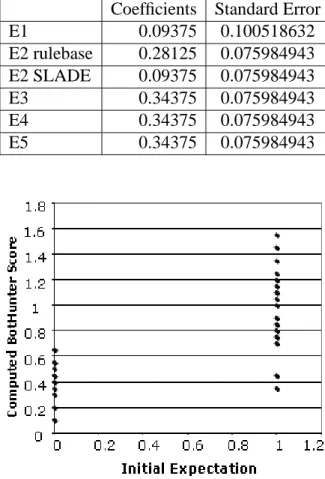
3 Estimated regression coefficients as initial weighting. . . 46
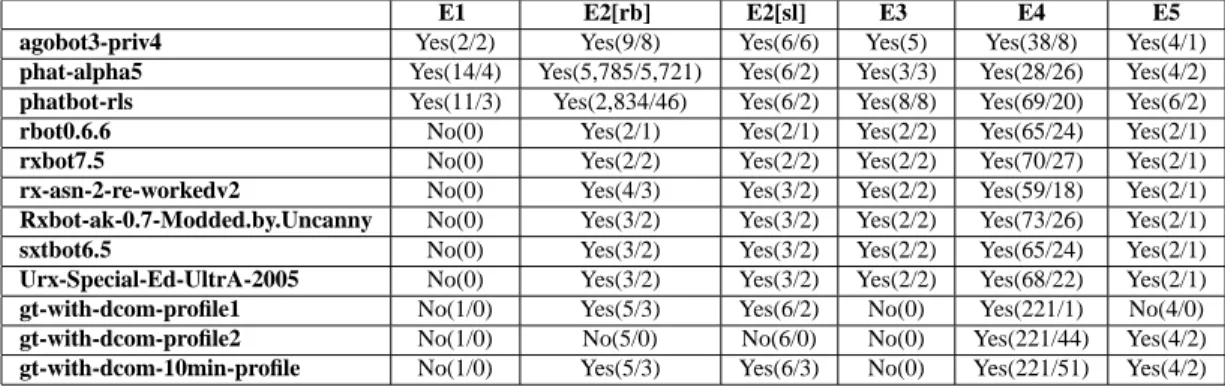
4 BotHunter detection and dialog summary of virtual network infections. . . 50
5 Dialog warnings (raw alerts) of BotHunter in 4-month operation in CoC network. . . 56
6 Normal traces statistics (left part) and detection results (right columns) in BotSniffer evaluation. . . 82
7 Botnet traces statistics and detection results in BotSniffer evaluation. . . 83
8 Collected botnet traces in BotMiner evaluation, covering IRC, HTTP and P2P based botnets. Storm and Nugache share the same file, so the statistics of the whole file are reported. . . 112
9 C-plane traffic statistics, basic results of filtering, and C-flows in BotMiner evaluation. . . 114
10 C-plane and A-plane clustering results in BotMiner evaluation. . . 115
11 Botnet detection results using BotMiner. . . 116
12 BotProbe test on Spybot and Rbot. . . 141
13 User study of performing P1 and P2 probing, using Interleaved-Binary-Response-Hypothesis algorithm. Most users are detected as normal in two or three rounds. . . 145
LIST OF FIGURES
1 Botnet: a typical structure. . . 2
2 Our correlation-based botnet detection framework. . . 8
3 Simplified bot infection life cycle. . . 26
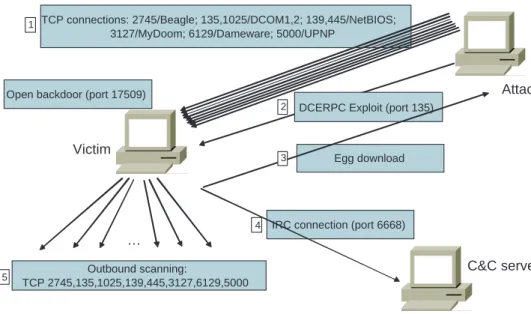
4 Phatbot infection dialog summary. . . 31
5 Bot infection dialog model. . . 33
6 BotHunter system architecture. . . 36
7 BotHunter network dialog correlation matrix. . . 45
8 Scoring plot from expectation table. . . 46
9 Scoring plot: 2019 real bot infections. . . 47
10 Honeynet interaction summary for W32/IRCBot-TO. . . 52
11 Corresponding BotHunter profile for W32/IRCBot-TO. . . 53
12 Extended bot infection dialog model. . . 60
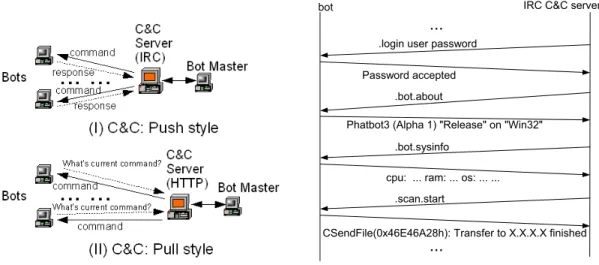
13 Centralized botnet command and control: two representative styles and an IRC-based example. . . 66
14 Spatial-temporal correlation and similarity in bot responses (message re-sponse and activity rere-sponse). . . 69
15 BotSniffer architecture. . . 70
16 θ(q), the probability of crowd homogeneity withq responding clients, and thresholdt. . . 77
17 Probability of two independent users typing similar length of messages. . . 78
18 E[N|H1], the expected number of crowd rounds in case of a botnet (vary θ0(2),q,αand fixβ = 0.01). . . 80
19 Possible C&C structures of a botnet: (a) centralized; (b) peer-to-peer. . . . 96
20 Architecture overview of our BotMiner detection framework. . . 98
21 C-plane clustering. . . 101
22 Visit pattern (shown in distribution) to Googlefrom a randomly chosen normal client. . . 103
23 Scaled visit pattern (shown in distribution) toGooglefor the same client in Figure 22. . . 104
24 Two-step clustering of C-flows. . . 105 25 A-plane clustering. . . 107 26 Example of hierarchical clustering for botnet detection. . . 111 27 Two-layer architecture of using active techniques for identifying botnet
C&Cs. . . 127 28 Example active probing techniques. Here cmd0 means a modified
com-mand packet,seq0means modification is needed on the sequence/acknowledge
number to keep the TCP session. . . 130 29 Disturbance to normal user and the effect on detection. . . 137 30 Click configuration for BotProbe. The figure shows a configuration for
black-box testing on existing bot binaries. If BotProbe is deployed as a middlebox into a real network, we can remove the IRC Server, SimpleRe-sponder, and DNSResponder elements. . . 138 31 Example combination of multiple techniques in a future botnet detection
SUMMARY
Most of the attacks and fraudulent activities on the Internet are carried out by malware. In particular, botnets, as state-of-the-art malware, have become a primary “platform” for attacks on the Internet. A botnet is a network of compromised computers (i.e., bots) that are under the control of an attacker (i.e., a botmaster) through some command and control (C&C) channel. It typically contains tens to hundreds of thousands of bots, but some even had several millions of bots. Botnets are now used for distributed denial-of-service (DDoS) attacks, spam, phishing, information theft, distributing other malware, etc. With the mag-nitude and the potency of attacks afforded by their combined bandwidth and processing power, botnets are now considered as the largest threat to Internet security.
Counteracting this emerging threat requires better detection techniques that identify botnets (bots and/or their C&C servers) so that we can mitigate their damage and defend against them. In this thesis, we focus on addressing the botnet detection problem in an enterprise-like network environment. We present a correlation-based framework for bot-net detection consisting of detection technologies already demonstrated in four systems: BotHunter, BotSniffer, BotMiner, and BotProbe. Among these systems, BotHunter and BotProbe focus on detecting the individual behavior of bots, while BotSniffer and Bot-Miner are targeted to detect the group behavior of bots. A common thread of these systems is correlation analysis, i.e., vertical (dialog) correlation, horizontal correlation, and cause-effect correlation. BotHunter presents vertical correlation, or dialog correlation, a new kind of network perimeter monitoring strategy that examines the behavior of each distinct internal host and focuses on recognizing the infection and coordination dialog occurring
during a successful malware infection. BotSniffer and BotMiner present another comple-mentary network perimeter monitoring strategy, i.e., horizontal correlation, which focuses on recognizing behavioral similarities and correlations across multiple hosts. BotSniffer is designed mainly to capture centralized botnet C&C channels using multiple rounds of spatial-temporal correlation, while BotMiner provides a more general framework for protocol- and structure-independent botnet detection using clustering analysis of network traffic; thus, BotMiner can be effective even when botnets change their C&C techniques (e.g., protocols and structures). Finally, different from the above passive monitoring strate-gies, which usually require a relatively long time to observe several rounds/stages of botnet communications/activities, BotProbe uses active botnet probing techniques in a middle-box to achieve sufficient confidence of a cause-effect correlation caused by the command-response pattern of botnet C&C, and only requires observing at most one round of actual C&C interaction. In short, we build a comprehensive correlation-based framework for multi-perspective botnet detection, and implement different correlation techniques in dif-ferent systems that complement each other.
All these Bot* systems have been evaluated in live networks and/or real-world net-work traces. The evaluation results show that they can accurately detect real-world botnets for their desired detection purposes with a very low false positive rate. These systems are already starting to make an impact in the real world. For example, BotHunter is avail-able to the public athttp://www.cyber-ta.org/BotHunter/, and in the first five months after its public release, it amassed more than 6,000 downloads.
We find that correlation analysis techniques are of particular value for detecting ad-vanced malware such as botnets. Dialog correlation can be effective as long as malware infections need multiple stages. Horizontal correlation can be effective as long as malware tends to be distributed and coordinated. In addition, active techniques can greatly comple-ment passive approaches, if carefully used. We believe our experience and lessons are of great benefit to future malware detection.
CHAPTER I
INTRODUCTION
During the last few decades, we have witnessed the explosive rise of the Internet and the applications based on it to the point at which they have become an integral part of our lives. While providing tremendous convenience, the growing reliance on the Internet also presents a number of great security challenges. Internet security thereby has become more and more important to those who use the Internet for work, business, entertainment, or education.
Most of the attacks and fraudulent activities on the Internet are carried out by malicious software, i.e., malware, which includes viruses, trojan, worms, spyware, and recently bot-nets. Such malware has risen to become a primary source of most of the scanning [94], distributed denial-of-service (DDoS) activities [71], direct attacks [11], and fraudulent ac-tivities [25, 63, 84] taking place across the Internet. These Internet malware keeps evolving in their forms, e.g., from worms to botnets. Among all the forms of malware, botnets, in particular, have recently distinguished themselves as the primary “platform” [63] on which cyber criminals create global cooperative networks to support the ongoing growth of crim-inal attacks and activities such as DDoS, spam, phishing, and information theft.
In this chapter, we first introduce the botnet problem and explain why it is a serious security threat. We then outline the research challenges for botnet detection, which is es-sential for further botnet mitigation and defense, and clarify the goals we want to achieve in our solution. Next, we provide an overview of our solution: a correlation-based framework and the Bot* series of systems for botnet detection. Finally, we present the contributions of the thesis and the organization of the remaining chapters.
1.1
Botnets: Current Largest Security Threat
We begin with the definitions of “bot” and “botnet,” the key words of the thesis. A bot is a software robot, or more precisely in the context of our research, a malware instance that runs autonomously and automatically on a compromised machine without the user’s consent. The bot code is usually professionally written by some (funded) criminal groups and includes a rich set of supported functionalities [16] to carry out many malicious attacks and activities. Sometimes, we may also use the term “bot” to refer to the bot-infected computer (or, “zombie” computer). A botnet (short for robot network) is essentially a network of bots that are under the control of an attacker (usually referred to as “botmaster” or “botherder”). In the remainder of the thesis, we more formally define a botnet as “a coordinated group of malware instances (bots) that are controlled by a botmaster via some command and control (C&C) channel.”1 We may also refer to a botnet as “a bot army.”
Figure 1 illustrates a typical structure of a botnet.
bot C&C botmaster bot bot . . .
Figure 1: Botnet: a typical structure.
As a state-of-the-art malware form, a bot typically uses a combination of existing ad-vanced malware techniques. For example, a bot can use keylogger techniques (to record a user’s keyboard input such as password) and rootkit techniques (to hide its presence in the system). In addition, like the previous generation of malware such as worms, a bot can self-propagate on the Internet to increase the size of the bot army, e.g., infect remote vulnerable
hosts through direct exploitation, or propagate through social engineering approaches such as email and instant message. Recently, in one emerging trend, botmasters use compro-mised Web servers to infect those who visit the websites through drive-by download [81]. By using multiple propagation vectors, the botmaster can recruit many victims. Currently, a botnet typically contains tens to hundreds of thousands of bots, but some had several millions of bots [61].
All bots distinguish themselves from the previous malware forms by their ability to establish a command and control (C&C) channel through which they can be updated and directed by a botmaster. Once collectively under the control of a botmaster, bots form a
botnet. To control the bot army, a botmaster can use several control mechanisms in terms
of protocols and structures. The Internet Relay Chat (IRC) protocol is the earliest, and still the most widely used C&C channel at present. HTTP is also used because Web traffic is generally allowed in most networks. Although centralized control was very successful in the past, botmasters are also exploring distributed control in order to avoid the single point of failure problem. For example, they can use a peer-to-peer structure to organize and control a bot army [44, 52, 64, 106, 112]. We will discuss other related background on botnet C&C mechanisms when we present our detection systems in later chapters.
Within the last decade, many infamous botnets have attracted considerable media cov-erage. Table 1 lists several examples of such well-known botnets and briefly describes their features.
Table 1: Selective well-known botnets in history.
Date Name C&C Protocol Structure Distinguishing Description
04/1998 GTbot IRC Centralized First widely spreading IRC bot using mIRC executables and scripts 04/2002 SDbot IRC Centralized First stand-alone and open-source IRC bot
10/2002 Agobot IRC Centralized Very robust, flexible, and modular design 04/2003 Spybot IRC Centralized Extensive feature set based on Agobot 2004 Rbot/rxbot IRC Centralized SDbot descendant, code base wildly distributed 03/2004 Phatbot WASTE P2P Experimental P2P bot using WASTE protocol 05/2004 Bobax HTTP Centralized First well-known spambot using HTTP as C&C 04/2006 Nugache Self-defined P2P First “practical” P2P bot connecting to predefined peers 01/2007 Storm Kademlia P2P Famous large-scale P2P botnet mainly used to send spam
04/2008 Kraken Self-defined Centralized Large botnet penetrating into at least 50 of the Fortune 500 companies
targeted for real financial gain, i.e., they are truly profit-driven. Recently, Vint Cerf, “the father of the Internet,” likened the botnet scourge to a pandemic and speculated that up to
a quarter of all computers on the Internet may be participating in botnet-related activities
[116]. The magnitude of bot armies and the potency of attacks afforded by their combined bandwidth and processing power have led to a recognition of botnets as the largest threat to Internet security [63]. Currently, botnets are the root cause of many Internet attacks and illicit activities [12, 25, 84], listed as follows.
• DDoS attacks. A bot army can be commanded to launch a targeted, distributed denial-of-service attack against any single Internet system/service (e.g., a website) in an attempt to consume the resources (e.g., bandwidth) of the system so that it can-not properly serve its intended users. Nowadays, all DDoS attacks are launched from botnet platforms. Although simple in principle and technique, a DDoS attack is very effective because of the magnitude and the accumulated bandwidth of the botnet, and it is very hard to prevent and defend against. As a recent well-known example, such a DDoS attack was launched against the Estonian government and commercial websites in May 2007 [33].
• Spam production. More than 95% of email on the Internet is spam [114], accounting for several billion spam messages in Internet traffic daily and frustrating, confusing, and annoying e-mail users. Most of these spam messages are actually sent from bot-nets. Although the detailed percentage of spam sent from botnets may vary according to different statistics (e.g., 80% in 2004 [65]), many people believe it accounts for more than 95% now. A number of well-known botnets have been used mainly for sending spam, including Bobax [96], an early spambot using HTTP as its C&C, and Storm worm (a.k.a. Peacomm) [44, 52], another infamous P2P botnet aggressively conducting spam activities.
• Click fraud. A botmaster can easily profit by driving the bot army to click on on-line ads (i.e., issue HTTP requests for advertiser web pages) for the purpose of per-sonal or commercial gain. For example, as reported by Google Click Quality and Security Teams [32], Clickbot.A is a botnet that controls 100,000 machines to execute a low-noise click fraud attack through syndicated search ads. According to ClickForensics (http://www.clickforensics.com), click fraud accounted for 27.8% of all pay-per-click advertisements in the first quarter (Q1) of 2008. Bot-nets are boosting click fraud, e.g., click fraud traffic generated from botBot-nets in Q1 2008 was 8% higher than that in Q4 2007.
• Information theft. Bots are actively used to steal sensitive information such as iden-tities, credit card numbers, passwords, or product keys on a user’s local machine. By using keyloggers and screen capture, a bot can also easily steal the password of an online banking account. This is becoming a very serious problem. For exam-ple, in 2005, the FBI estimated that botnets caused 20 million dollars in losses and theft [20], “including one scheme that bilked a Midwest financial institution out of millions.”
• Phishing. Botnets are widely used to host malicious phishing sites. Criminals typi-cally send out spam messages (e.g., using botnets) to trick users to visit fake phishing sites (usually financial related), so that they can obtain users’ sensitive information such as usernames, passwords, and credit card numbers on the real financial websites. The independent research and advisory firm Financial Insights [3] estimated that in 2004, global financial institutions experienced more than $400 million in fraud losses from phishing. U.S. businesses lose an estimated $2 billion a year as their clients be-come phishing victims.
• Distributing other unwanted software, e.g., adware/spyware. Botnets are naturally a good platform on which a botmaster can distribute many other forms of malware.
According to a recent report [105], a discovered botnet “illegally installed adware on hundreds of thousands of computers in the U.S., including some belonging to the military.”
Botnets can launch several other forms of attacks or illicit activities. A detailed analysis of these and the impact of malware, particularly botnets, on the Internet economy can be found in a recent report [7] from OECD (Organization for Economic Co-operation and Development) and APEC (Asia Pacific Economic Co-operation).
1.2
Botnet Detection: Research Challenges and Our Goals
To counter botnet attacks, the current largest security threat, we first need to detect the existence of botnets (bots and/or their C&C servers) within a monitored network in order to effectively mitigate and defend against them. Botnet detection has become a daunting task because botnets, as state-of-the-art malware, present considerable challenges:
• Bots are stealthy on infected machines. Since they are used for long-term purpose to make profits, unlike some previous malware such as viruses and worms, bots usu-ally do not aggressively consume CPU/memory/bandwidth resources nor perform noticeable damage to computers in order to avoid the awareness of the user. They can disable existing anti-virus tools and use rootkit techniques to protect them from being detected at a local host. Thus, a host-based solution may not be very effective. In this thesis, we thereby focus primarily on a network-based solution.
• Bot infection is usually a multi-faceted and multi-phased process, incorporating sev-eral computing assets, multiple bidirectional network flows, and different infection stages. Thus, looking at only one specific aspect (or, event, stage), as many existing solutions do, may be not effective; it may lead to more false positives and false neg-atives. In contrast, looking at multiple aspects is more robust and likely to reveal the big picture of a bot infection.
• Bots are dynamically evolving. For example, they can frequently update their bina-ries as directed, more quickly than a user updates his anti-virus signature base. Thus, static and signature-based approaches may not be effective.
• Botnets can have a very flexible design of C&C channels. They can use different protocols such as IRC or HTTP. They can encrypt the content (e.g., commands) in a C&C communication. They can even use a different structures to organize and control the bot army, e.g., using P2P techniques. Thus, a solution very specific to a certain botnet C&C instance is not desirable.
Because of these challenges, existing techniques such as traditional anti-virus tools cannot sufficiently handle the botnet detection problem. In Chapter 2, we provide a detailed overview of various related work (e.g., intrusion/malware detection, honeypot-based botnet tracking, and existing botnet detection approaches) and further explain why these existing solutions are not adequate for botnet detection.
In this thesis, we propose our network-based solution for botnet detection. When de-signing the solution, we have the following four goals in mind:
1. Our solution should be guided by sound principles that capture the fundamental in-variants of botnet behavior rather than symptoms (e.g., scanning).
2. Our solution should provide complementary techniques and cover multiple stages, dimensions, and perspectives.
3. Our solution should be general and extensible. By general, we mean the solution should not be restricted to a specific botnet instance or dependent on a specific symp-tom. By extensible, we mean the solution should provide an open and flexible frame-work that can easily incorporate new user-provided components/plug-ins.
4. Our solution should provide practical prototype systems that can work in real-world networks. By practical, we mean that the detection systems can accurately detect
real-world botnets for their desired detection purposes and have a low false positive rate in real-world normal traffic as well as reasonable resource usage.
1.3
Solution Overview
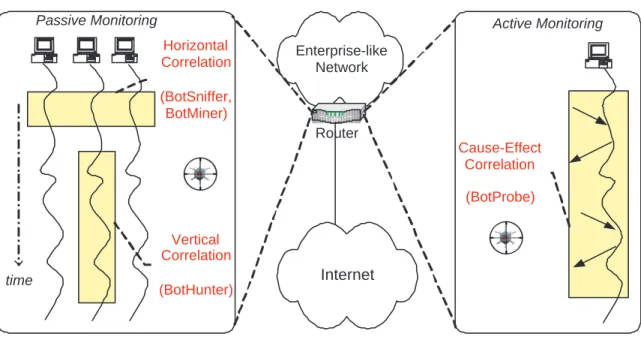
We propose a correlation-based framework for effective network-based botnet detection in an enterprise-like network environment such as a university campus network, a regular en-terprise network, or simply a local area network (LAN). Within this framework, we present three different correlation techniques: vertical (dialog) correlation, horizontal correlation, and cause-effect correlation. Based on these techniques, we build four anomaly/behavior-based detection systems: BotHunter [46], BotSniffer [48], BotMiner [45], and BotProbe. These four systems can be deployed at the network edge router to monitor through traffic; they will issue alerts when detecting some internal hosts/groups (indicated by IP addresses) as suspicious bots/botnets. Enterprise-like Network Internet Router time
Passive Monitoring Active Monitoring
Vertical Correlation (BotHunter) Horizontal Correlation (BotSniffer, BotMiner) Cause-Effect Correlation (BotProbe)
Figure 2: Our correlation-based botnet detection framework.
Figure 2 illustrates our correlation-based botnet detection framework and four detec-tion systems. Among these systems, BotHunter uses vertical correladetec-tion, and BotSniffer
and BotMiner use horizontal correlation. While these three systems use a passive monitor-ing strategy, BotProbe uses an active monitormonitor-ing strategy and the cause-effect correlation technique. These Bot* systems have two different detection focuses: BotHunter and Bot-Probe are used to detect the individual behavior of bots, while BotSniffer and BotMiner are used to detect the group behavior of a botnet.
BotHunter [46] presents vertical correlation, a new kind of network perimeter moni-toring strategy that examines the behavior history of each distinct host. It recognizes a correlated dialog trail (or, evidence trail) consisting of multiple stages and representing a successful bot infection. Therefore, this strategy is also referred to as “dialog correlation.” BotHunter is designed to track two-way communication flows between internal assets and external entities, and recognize an evidence trail of data exchanges that match a state-based infection sequence model. BotHunter consists of a correlation engine driven by several malware-focused network detection sensors, each charged with detecting specific stages and aspects of the malware infection process, including inbound scanning, exploit usage, egg downloading, outbound bot coordination dialog, and outbound attack/propagation. The BotHunter correlator then links the dialog trail of inbound intrusion alarms with those out-bound communication patterns that are highly indicative of a successful local host infec-tion. When a sequence of evidence matches BotHunter’s infection dialog model, a consol-idated report is produced to capture all the relevant events and event sources that played a role during the infection process. More details of BotHunter are discussed in Chapter 3.
BotHunter has some limitations. It is restricted to the predefined infection life cy-cle model, and at some stages such as C&C communication, it currently provides only signature-based sensors. Thus, to complement BotHunter, we propose another two sys-tems, BotSniffer [48] and BotMiner [45], which do not necessarily require the observation of multiple different stages on an individual host, nor require botnet-specific signatures. Unlike BotHunter’s vertical correlation, BotSniffer and BotMiner present another com-plementary novel network monitoring strategy, “horizontal correlation,” which examines
the correlation and similarity across multiple hosts. This horizontal correlation technique is inspired by the observation that, because of the pre-programmed activities related to C&C under the control of a botmaster, bots within the same botnet will likely demon-strate spatial-temporal correlation and similarity. For example, they engage in coordi-nated/similar communication, propagation, and attack and fraudulent activities. However, normal independent hosts (even the previous generation of isolated malware instances) are unlikely to demonstrate such correlated malicious activities. By using horizontal correla-tion and anomaly deteccorrela-tion techniques, both systems do not require a priori knowledge of botnets such as captured bot binaries and hence the botnet signatures, and C&C server names/addresses.
BotSniffer [48], designed to detect mainly centralized C&C channels, monitors multiple rounds of spatial-temporal correlation and similarity of message/activity responses from a group of hosts that share some common centralized server connection (e.g., IRC or HTTP). Using statistical algorithms, it can achieve theoretical bounds on the false positive and false negative rates within a reasonable detection time (quicker than BotMiner). More details of BotSniffer are discussed in Chapter 4.
An important limitation of BotSniffer is that it is restricted to the detection of botnets mainly using centralized C&C channels. BotMiner [45] presents a more general detec-tion framework that is independent of botnet C&C protocol and structure. We start from the definition and essential properties of botnets. As defined before, a botnet is a
coordi-nated group of malware instances that are controlled by a botmaster via some C&C
chan-nel. The essential properties of a botnet are that the bots communicate with some C&C servers/peers, perform malicious activities, and do so in a similar or correlated way. Ac-cordingly, BotMiner clusters similar communication traffic and similar malicious traffic, and performs cross cluster correlation to identify the hosts that share both similar commu-nication patterns and similar malicious activity patterns. Therefore, these hosts are consid-ered bots in the monitored network. More details of BotMiner are discussed in Chapter 5.
While BotHunter, BotSniffer, and BotMiner use a passive monitoring strategy, which usually requires a relatively long time to observe multiple stages/rounds of botnet commu-nications/activities, BotProbe uses an active monitor strategy to shorten the detection time. It can actively participate in a network session (e.g., a suspicious IRC chatting session), if necessary, by injecting some well-crafted packets to the client within the monitored net-work. We call this technique “active botnet probing.” Our motivation is that, for a large portion of botnet C&C channels (e.g., those using chatting-like protocols such as IRC, which is currently used by most of the existing botnets), a C&C interaction has a determin-istic command-response pattern. By using active botnet probing in a middlebox, we can gain enough confidence of the cause-effect correlation caused by this command-response pattern. Although controversial and clearly limited, BotProbe demonstrates effectiveness on real-word IRC-based botnet detection, and requires observing at most one round of C&C interaction. This is very useful in a real-world situation in which IRC botnets are still the majority and their C&C interaction is usually infrequent. More details of BotProbe are discussed in Chapter 6.
Our correlation-based framework and Bot* systems meet our four design goals. We provide a brief explanation here and leave the details for the remaining chapters:
First, each correlation analysis captures some perspective of the invariants of botnet behavior, i.e., infection dialog (dialog correlation) and command-response pattern (cause-effect correlation) within the individual host, and correlated behavior within the group (hor-izontal correlation). We believe that the idea of correlation analysis can potentially capture the behavior invariants of future malware.
Second, most correlation techniques by themselves involve multiple detection sensors covering different stages/aspects. For example, BotHunter employs several sensors cov-ering multiple different infection stages. In addition, different correlation techniques and detection systems complement each other quite well. For instance, some focus on
each system may have its own limitations and coverage. However, when combined, they can complement each other to enlarge the detection coverage from multiple different per-spectives. We show the architecture of combining our multiple techniques in a future botnet detection system in Chapter 7.
Third, our framework and systems are general and extensible. In design, they target a certain class of botnets. In other words, they are not restricted to a very specific bot-net instance. Even BotProbe, although it appears to target an IRC botbot-net, is applicable to a general class of botnets that have deterministic, interactive C&C (e.g., chatting-like communication such as IRC or instant message). In addition, these systems are open and extensible. That is, they are amenable to the adding of new detection sensors. We provide a concrete example in Chapter 3.
Finally, our systems are practical and can work in the real world. This will be discussed in detail throughout the remainder of the thesis.
1.4
Thesis Contribution and Organization
In this thesis, we make the following main contributions:
1. We propose a correlation-based framework for multi-perspective botnet detection. In this framework, we introduce several new and complementary network monitor-ing and correlation analysis techniques, i.e., vertical (dialog) correlation, horizontal correlation, and cause-effect correlation. Each of these correlation techniques pro-vides a relatively sound principle that captures some fundamental behavior invariant of botnets to guide our anomaly-based detection schemes. While vertical correla-tion captures the dialog nature in the multi-stage bot infeccorrela-tion life cycle, horizontal correlation captures the coordination and similarity nature within the same botnet. The cause-effect correlation captures the non-human driven, deterministic command-response pattern of a certain class of botnet C&C channels. We believe the general principles behind these correlation analysis techniques could also be applicable to
detecting future advanced malware.
2. We provide four practical botnet detection prototype systems (i.e., BotHunter, Bot-Sniffer, BotMiner, and BotProbe) that use our correlation techniques. These sys-tems are evaluated on real-world network traffic and shown to accurately detect botnets with a low false positive rate. Our work is starting to make an impact in the real world. For example, BotHunter, available to the public at http://www. cyber-ta.org/BotHunter/, has amassed more than 6,000 downloads in the first five months since its public release.
The remainder of this thesis is organized as follows. Chapter 2 introduces related work and explains why the existing work cannot adequately solve the botnet detection problem. In particular, we present a taxonomy of botnet detection techniques and show the difference and coverage of existing detection approaches. Chapter 3 presents the motivation of dia-log correlation and the detailed design, implementation, and evaluation of the BotHunter system. Chapter 4 presents the motivation of using spatial-temporal correlation, and the design, implementation, and evaluation of the BotSniffer system, as well as a discussion on the limitations and further improvement. Chapter 5 introduces the BotMiner system, explains its unique feature of protocol- and structure-independence, presents the design, implementation and evaluation of BotMiner, and then discusses its limitations. Chapter 6 presents BotProbe system, including the motivation, design, implementation and evalua-tion. Chapter 7 summarizes the lessons learned from the Bot* systems and presents an architecture that combines multiple discussed techniques in a future botnet detection sys-tem. Finally, Chapter 8 concludes the thesis and describes directions for future work.
CHAPTER II
RELATED WORK
In the previous chapter, we identified the research challenges for botnet detection. In this chapter, we will answer the following questions: Why are existing techniques not sufficient for botnet detection? How are they related to or different from our solution? In particular, to compare existing solutions, we propose a taxonomy of botnet detection techniques and clarify the coverage of different approaches.
2.1
Intrusion and Malware Detection
Existing intrusion and malware detection techniques can generally be categorized into host-based or network-host-based solutions. Host-host-based detection techniques are very important to recognize malware binaries (e.g., viruses) and host-level anomaly behavior (e.g., a certain system call invoked, a certain registry key created). Among these techniques, anti-virus tools are useful for traditional virus detection for a long time [99]. Another typical ex-ample of host-based intrusion detection techniques is system call-based monitoring [39]. However, when facing the botnet issue, these purely host-based detection techniques have several problems. First, traditional anti-virus tools are based on signatures and essentially requiring a comprehensive, precise, and frequently updated signature base. However, bot-nets can easily evade signature-based detection by updating themselves more frequently than users update their signature base. Second, host-based detection systems are at the same privilege level as bots on the same host. Thus, bots can disable anti-virus tools in the system and/or use rootkit techniques to protect themselves from detection at the lo-cal host. Actually, as state-of-the-art malware, numerous bots have already used all these tricks. Indeed, the detection rate of bots is relatively low compared to that of traditional malware. For example, Kraken was reported to be undetected by 80% of the commercial
anti-virus tools on the market [62]. In 2007, a study from PandaLabs [4] found that even with correctly installed up-to-date protection (e.g., anti-virus tools), a significant portion of PCs (22.97%) still became infected by malware. Considering the fact that millions or even 1/4 of Internet PCs are related to botnet activities [116], the actual percentage could be higher. Finally, behavior-based host level realtime monitoring usually contributes to significant system performance overhead, so these solutions become even less attractive to normal users.
Therefore, in the scope of this research, we care more about network-based detection solutions and consider host-based techniques orthogonal to our network-based approaches. In the remainder of this chapter, we limit our focus to the most relevant work, mainly network-based studies.
Network-based intrusion detection research has proposed many techniques and sys-tems. Snort [86] and Bro [74] are two representative misuse (or, signature) based intrusion detection systems (IDSs). They rely on a large signature base (which precisely describes what attacks look like) to recognize intrusion attempts in network traffic. The fundamen-tal weakness of these signature-based IDSs, similar to traditional anti-virus tools, is that they cannot detect new attacks because they have never been seen before, and thus have no signatures. Anomaly-based IDSs can solve this limitation by describing what normal traffic looks like, and any significant deviation from the normal is considered an anomaly. Two examples of such IDSs are PAYL [110, 111] and Anagram [109], which examine the payload of an inbound packet, perform n-gram analysis, and then detect exploits (e.g., shellcode) in the payload. The main weakness of such an anomaly-based solution is that it may cause more false positives.
Prior to the prevalence of botnets, worms were the typical malware form. A worm is essentially a self-propagating malware instance that can replicate itself through network infection (or sometimes through social engineering tricks such as email or instant message). The main difference between worms and botnets is that worms do not have a command
and control (C&C) channel. Thus, botnets are fundamentally more flexible than worms. Another difference could be their motivation. Whereas worms are more likely fun-driven, launched by attackers who want to have fun or show off in the “blackhat” community, botnets are more profit-driven, launched by attackers for profit.
There is numerous work on worm detection. Since worms generally use scanning, which provides a quick and automatic way to propagate [93], almost all of the worm detec-tion approaches focus on the detecdetec-tion of scanning traffic/behavior. Moore [70] proposed the use of distributed “network telescopes” for early warning, i.e., using a reasonably large fraction of dark address space to observe security events such as worm scanning traffic occurring on the Internet. Provos [80] and Dagon et al. [30] proposed to use honeypot techniques to gather and identify worm attacks. Zou et al. [127] proposed a Kalman filter-based detection algorithm, an approach that detects the trend of illegitimate scans to a large unused IP space. Wu et al. [120] proposed a victim counter-based detection algorithm that tracks the increasing rate of newly infected outside victims. Jung et al. [57, 58] and Weaver et al. [115] proposed worm detection approaches based on the observation that scanning worms usually cause a high failed connection ratio. Gu et al. [47] proposed the Destination-Source Correlation (DSC) algorithm for worm detection by using an anomaly detection technique that considers both the infection propagation nature and the scanning activity of worms.
While some of the above existing intrusion and malware detection techniques can be helpful in recognizing some anomaly aspect of botnets, they are not by themselves well-suited for botnet detection for the following reasons:
• Most detection systems focus on examining mainly (or only) inbound network traf-fic for signs of malicious point-to-point intrusion attempts. They have the capacity to detect initial incoming intrusion attempts, and the prolific frequency with which they produce such alarms in operational networks is well documented [91]. However,
distinguishing a successful local host infection from the daily myriad scans and intru-sion attempts is as critical and challenging a task as any facet of network defense. In addition, because of recent advances in malware, particularly the botnet, it is harder to accurately detect when it initially penetrates the monitored network, as machines can be infected by botnets using many ways other than traditional remote exploita-tion. For example, an internal user may click on a malicious email attachment and get infected, or a user may visit a website and get infected via drive-by downloads, which is now occurring quite frequently [81]. Moreover, an already infected laptop may be carried in and connected to the monitored network. Such examples have compelled us to develop a detection capability for already compromised machines inside monitored networks regardless of how they have been infected. Therefore, we must monitor both inbound and outbound network traffic instead of just incoming traffic.
• A botnet is very flexible, and its infection life cycle can consist of several different stages and aspects. However, existing approaches examine only some certain symp-toms such as scanning, so they are less likely to detect botnets. They can cause false positives if a non-bot machine (probably a normal host or other forms of malware) has scanning-like activities. They can also cause false negatives if a bot does not scan, or although still does scan, it evades the specific scan detection technique. Therefore, we still need new techniques that are more suitable for botnet detection and ideally, that follow the four design goals we have proposed.
Finally, we agree that traditional intrusion and malware intrusion detection techniques are still useful for recognizing certain aspects of botnets. As we show later in our detailed solution in the following chapters, some of these existing techniques can be the building blocks for a new system that combines them with our detection techniques following a systematic correlation strategy.
2.2
Alert Correlation and IDS Cooperation
A significant amount of related work has investigated alert correlation and IDS cooperation techniques that combine multiple alerts, events, or aspects of network intrusion detection. These techniques enable an analyst to obtain higher-level interpretations of network detec-tor alert streams, thereby alleviating noise-level issues with traditional network IDS.
The main purpose of alert correlation is for log reduction, multi-step attack detection, and attack intention recognition. In particular, the techniques used to recognize multi-stage attacks share some similarities with our vertical (dialog) correlation technique used in BotHunter. We address their differences as follows.
One approach to capture complex and multi-step attacks is to explicitly specify the stages, relationships, and ordering among the various constituents of an attack. As an il-lustration, USTAT [54] and NetSTAT [104], two IDSs based on state transition analysis techniques, specify computer attacks as sequences of actions that cause transitions in the security state of a system. In addition, Valeur et al. [103] performed multi-step attack correlation according to attack scenarios specified a priori using STATL [36], a language for expressing attacks as states and transitions. Other such systems are JIGSAW [100], a system that uses notions of concepts and capabilities for modeling complex attacks, and a system proposed by Ning et al. [73], which provides a formal framework for alert correla-tion, and CAML [22], a language framework for defining and detecting multi-step attack scenarios. Unlike BotHunter, all of these techniques are based on strict causal
relation-ships, e.g., pre-conditions and post-conditions, or a strict temporal sequence of attacks.
One of their obvious limitations is that the dependencies and sequences need to be manu-ally specified a priori for all attacks, yet such dependencies/sequences are often unknown or very loose. Moreover, a missing event in the dependences/sequences will fail the entire correlation. With regard to botnet detection, although bot infections do regularly follow a series of general stages, we find it rare to accurately detect all steps, and find it equally difficult to predict the order and time-window in which these events are recorded. Thus, the
above alert correlation techniques are not suitable for botnet detection. In contrast, BotH-unter does not have a strict restriction in causal dependences or temporal sequences, and can tolerate missing events during the infection flow.
Another IDS, GrIDS [95], aggregates network activity into causal graphs that can be used for analyzing causal structures and identifying policy violations. Ellis et al. [37] and Jiang et al. [56] describe behavioral-based systems for detecting network worms based on tracking propagation graph. In contrast to the above systems based on a global causal graph or a propagation graph, BotHunter focuses on the problem of bot detection and uses local infection dialog correlation as a means to define the probable set of events that indicate a bot infection.
Sommer et al. [91] described contextual Bro signatures as a means for producing ex-pressive signatures and weeding out false positives. These signatures can capture two di-alogs and precisely define multi-step attacks. BotHunter differs due to the requirement that several flows be simultaneously monitored across many participants (e.g., infection source, bot victim, C&C, propagation targets) and that the evidence-trail-based approach loosely specifies bot infections.
Alert correlation modules such as CRIM [26] provide the ability to cluster and correlate similar alerts. The system can extract higher-level correlation rules automatically for the purpose of intention recognition. Alert fusion techniques can greatly reduce log size by clustering similar events under a single label [102]. The similarity is usually based upon either attributing multiple events to a single threat agent or providing a consolidated view of a common set of events that target a single victim. Valdes and Skinner [102] proposed a two-step probabilistic alert correlation based on attack threads and alert fusion. We con-sider this line of work to be complementary to BotHunter, i.e., these fusion techniques could be integrated into our detection systems as a preprocessing step in a multi-sensor environment.
in order to detect distributed and coordinated attacks such as worm propagation. Such tech-niques share some similarities with our horizontal correlation techtech-niques used in BotSniffer and BotMiner. We address their differences as follows.
Several work, including EMERALD (Event Monitoring Enabling Responses to Anoma-lous Live Disturbances) [78], AAFID (Autonomous Agents For Intrusion Detection) [15], DIDS (Distributed Intrusion Detection System) [90], and CARDS (Coordinated Attack Re-sponse & Detection System) [123], proposed distributed architectures that combine multi-ple monitors/detectors/agents for intrusion detection and response capability. These tech-niques provide a distributed, architectural-level solution for tracking distributed and coordi-nated attacks across multiple machines. In another related work, Abad et al. [9] proposed to correlate data among different sources/logs (e.g., syslog, firewall, netflow) to improve final intrusion detection accuracy. All these techniques are different from BotSniffer/BotMiner in that they merely provide an abstract, high-level, architectural solution as a general hy-brid IDS instead of providing concrete detection algorithms and techniques for concrete attacks such as botnets. However, these architectural solutions could be complementary to our work.
Xie et al. proposed Seurat [122], which can detect aggregated anomalous events such as worm propagation by correlating host file system changes across space and time. Malan [67] proposed to use collaborative groups of machines to exchange summaries of recently executed system calls, in order to detect commonly propagated malware (e.g., worm) within the network. These two approaches are similar to our horizontal correlation used in Bot-Sniffer/BotMiner. However, fundamentally different from BotSniffer/BotMiner, they re-quire deploying a host-based sensor to monitor system file changes or system call sequences on every machine in the network. First of all, these host-based monitors can cause signif-icant performance overhead on a local machine. Second, such wide-scale installation on every machine is costly and generally not very realistic. Third, as discussed before, these host-based monitors can be disabled or fooled by advanced bots. BotSniffer and BotMiner,
however, using a network-based solution, avoid the above weaknesses. Although similar in concept, the detailed correlation and detection algorithms also differ. Finally, we note that because their features (file system change and system call sequence) are different from those of BotSniffer/BotMiner, Seurat [122] and the techniques from Malan [67] can po-tentially complement our solution.
2.3
Botnet Measurement and Honeypot-based Tracking
Much of the research on botnets has focused on gaining a basic understanding of the na-ture and full potential of the botnet threat, e.g., on the measurement study, collection, and tracking issues.
Measurement studies can help us understand the botnet threat. Cooke et al. [25] con-ducted several basic studies of botnet dynamics. Dagon et al. [31] proposed using the DNS sinkholing technique for botnet study and pointed out the global diurnal behavior of bot-nets. Barford and Yegneswaran [16] examined the bot source code to provide an inside look at the botnets. For example, they analyzed the structural similarities, defense mechanisms, and command and control capabilities, of major bot families. Collins et al. [24] presented their observations of the relationship between botnets and scanning/spamming activities.
For effective botnet collection and tracking, researchers commonly use honeypot tech-niques. Freiling et al. [40], using honeypots to track botnets, provided an early report for understanding the phenomenon of botnets. Nepenthes [13] is a low-interaction honeypot that simulates several vulnerabilities and automates the collection of malware binaries. Ra-jab et al. [82] conducted a multi-faceted approach to collect bots and track botnets, and provided an in-depth study of current botnet activities. By using honeypot techniques to collect and track botnets, researchers can analyze bot binary and behavior, and then extract signatures for content-based detection or C&C server information for response (e.g., DNS sinkhole [31]).
several limitations. First, low-interaction honeypots such as Nepenthes [13] can capture attacks from only a limited number of known exploits that they faithfully emulate, and high-interaction honeypots can neither implement all services nor deal with the problem of scaling. Second, honeypots are mainly designed to capture malware that propagates via scanning for remote vulnerabilities, so they cannot easily capture malware using other propagation methods such as email and Web drive-by download,1which are probably two of the most widely used propagation vectors [6, 81]. Third, there is no guarantee on the frequency or volume of malware captured using this approach because a honeypot can only wait and hope for the malware to contact it. Fourth, malware may avoid scanning the networks with “known” honeypots [17], and it can detect virtual machine environments commonly used for honeypots [41,50,128] and alter its behavior to evade analysis. Finally, honeypots report infections on only their decoy machines; they generally cannot directly tell which non-decoy machines in the enterprise network are members of a botnet. These weaknesses limit the capability of honeypots as effective detection systems.
2.4
Existing Work on Botnet Detection
Botnet detection is a relatively new area. Recently, several papers have proposed various approaches for detecting botnets.
Binkley and Singh [18] proposed combining both IRC statistics and TCP work weight (i.e., anomaly scanning activity) for detecting IRC-based botnets. Their approach is useful only for detecting certain botnet instances, i.e., IRC bots that perform scanning.
Ramachandran et al. [85] proposed using DNSBL (DNS blacklist) counter-intelligence to locate botnet members that generate spam. The basic assumption of this approach is that botmasters may use DNSBL to query the status of their bots, and a machine that queries many others but that is rarely queried by others is suspicious. This heuristic may be useful in some cases, but not generally valid and can cause many false positives. As a result, this 1Recent advance of client-side honeypot techniques like HoneyMonkey [113] and web-based
approach is restricted to limited instances of spam botnets.
Rishi [43] is a signature-based IRC botnet detection system that matches known nick-name patterns of IRC bots. Similar to a typical signature-based anti-virus tool or IDS, this approach is accurate only if a comprehensive and precise signature base is available, but possesses the inherent weaknesses of signature-based solutions such as its inability to detect bots without using known nickname patterns.
Livadas et al. [66, 98] proposed a machine learning based approach for botnet detection using some general network-level traffic features (e.g., bytes per second) of chatting-like protocols such as IRC. Karasaridis et al. [59] studied network flow level detection of IRC botnet controllers for backbone networks. The above two approaches are similar to our BotMiner’s work in C-plane clustering but different in many ways. First, they are used to detect IRC-based botnets (by matching a known IRC traffic profile, e.g., low volume, chatting-like, or having a PING-PONG pattern), while BotMiner does not have the as-sumption of using known C&C traffic profiles. Second, they can detect botnets using only a centralized structure, while BotMiner can detect any C&C structures such as P2P. Third, BotMiner uses a different traffic feature set based on a new communication flow (C-flow) data format instead of traditional network flows. Finally, BotMiner uses full knowledge in both C-plane and A-plane information instead of only (or mainly) C-plane network flow records.
Stinson and Mitchell proposed BotSwat [97], a host-based taint tracking system to iden-tify programs that use received network data (from an untrustworthy external source) in some system call argument without intended local user input or explicit permission (e.g., whitelist), an attempt to identify the potential remote control behavior of bots. This ap-proach may cause non-negligible false positives (because many legitimate programs may also use a portion of network traffic in some of their system call arguments) and a perfor-mance penalty (taint propagation analysis is very heavy, so it is generally used only for the purpose of analysis instead of detection).
Yen and Reiter proposed TAMD [124], a system that detects potential malware (in-cluding botnets) by aggregating traffic that shares the same external destination, similar payload, and that involves internal hosts with similar operating systems. The concept of traffic aggregation is similar to the horizontal correlation strategy used in BotSniffer and BotMiner. TAMD’s aggregation method based on destination networks focuses on net-works that experience an increase in traffic as compared to a historical baseline. In addi-tion, this aggregation method is limited to aggregate bots using a centralized C&C structure (i.e., bots that share a common destination server), so it will likely fail on P2P-based bot-nets. Different from BotSniffer and BotMiner, which focus on botnet detection, TAMD aims to detect a broader range of potentially suspicious hosts as long as they share the same external destination, similar payloads, and similar OS platforms; hence TAMD could cause a higher false positive rate than BotSniffer/BotMiner. Since the aggregation features of TAMD differ from those of BotSniffer/BotMiner, they can complement one another in botnet and malware detection.
2.5
A Taxonomy of Botnet Detection Techniques
In this thesis, we propose four new botnet detection systems: BotHunter [46], BotSnif-fer [48], BotMiner [45], and BotProbe. We leave the details of the techniques of each system for the following chapters. Here, to provide the reader with quick and system-atic knowledge of the features, relationships, and differences among all existing detection techniques including ours, we present a taxonomy of botnet detection methods from seven dimensions.
Our first dimension is whether the solution is based on host or network. We have already discussed the advantages and disadvantages of each solution. Among botnet detection systems/techniques we have introduced, BotSwat [97] is the only host-based solution; the others, including our Bot* systems, are network-based techniques.
For this dimension, Rishi [43] is the only signature-based solution; the others, including our Bot* systems, are behavior/anomaly-based techniques. The advantages and disadvantages of both solutions have already been discussed before. We note here, although mainly us-ing behavior/anomaly-based techniques, our Bot* systems have been carefully designed by combining various techniques covering different aspects within each system and across different systems to complement each other. Therefore, we can achieve a very low false positive rate, as shown in the following chapters.
Our third dimension is whether the solution is passive or active. All the above tech-niques/systems are passive, i.e., they passively monitor the network traffic or system behav-ior, except BotProbe, which uses an active monitoring strategy and which may participate in a botnet communication by inserting or modifying some traffic, if necessary. Compared with an active strategy, the advantage of a passive one is clear: it is safe because it does not interfere existing communication/activity. However, many such passive solutions may require monitoring a relatively longer time to observe multiple stages/rounds/instances of botnet communications/activities in order for accurate detection. An active approach such as BotProbe can compensate for this limitation. For example, BotProbe only requires ob-serving at most one round of C&C interaction. By performing active botnet probing several times, BotProbe can gain enough confidence of a cause-effect correlation caused by the command-response pattern of botnet C&C. Nevertheless, an active approach such as Bot-Probe is still controversial and clearly limited. Thus, our framework includes both passive and active approaches that complement each other.
The fourth dimension we consider is the detection phase. The infection life cycle of a bot has roughly two phases:2 preparation and operation. In the preparation phase, an
innocent host becomes a bot by a remote infection or by the mistaken execution of some malicious executable (e.g., in an email attachment), and prepares to be controlled through C&C. A host starts its preparation phase when it is initially attacked, and completes this
Innocent Host Preparation Operation Bot Attacked Controlled Remedied
Figure 3: Simplified bot infection life cycle.
phase when the full functional bot binary is executed. When this bot attempts to connect to a C&C channel, it begins its operation phase, when it can be directed by a botmaster to perform any activities. Thus, we can classify a botnet detection technique according to which phase alerts can be issued, during the preparation phase or during the operation phase. All introduced botnet detection systems/techniques, except BotHunter, work only in the operation phase. BotHunter can issue alerts either in the preparation phase (detecting early bots during penetration time) or in the operation phase (detecting bots when they are already there regardless of how they penetrated into the network).
The fifth dimension we consider is the detection target, or, whether the target is an
individual bot or a network/group of bots. Livadas et al. [66, 98], Karasaridis et al. [59],
TAMD, BotSniffer, and BotMiner focus on the detection of groups of bots, while others focus on detecting individual bots. These two kinds of solutions are fundamentally com-plementary. While the group-based approach requires observing more bots (e.g., at least two) for detection, it could discover an anomaly that may not be noticeable at an individual host level. Our framework includes both individual-based (BotHunter and BotProbe) and group-based (BotSniffer and BotMiner) approaches.
Our sixth dimension relates to the detection assumptions, that is, whether a solution requires other out-of-band information (e.g., DNSBL) or not. Among introduced solutions, some (Ramachandran et al. [85]) requires information from other sources such as DNSBL, and some (Karasaridis et al. [59]) requires bootstrapping the clustering analysis from alert
information (e.g., scanning activity) provided by other systems. Except for these two, other techniques/systems require no out-of-band information. They are relatively independent and capable of working directly on network traffic or a host system.
Our final dimension is whether a solution is restricted to or dependent on some certain C&C technique (e.g., protocol and structure). Many existing approaches work for only a certain C&C protocol or structure. Rishi [43] and the approach by Binkley and Singh [18] are designed for only IRC-based botnets. Likewise, approaches by Livadas et al. [66, 98] and Karasaridis et al. [59] are shown to detect IRC botnets in their papers. Their techniques could be used to detect other chatting-like C&C. However, they are still restricted to a cen-tralized structures, and both require knowledge of the C&C traffic profile. TAMD [124] is not restricted to C&C protocols, however, its aggregation by destination is restricted to centralized C&C structures only. Similarly, our BotSniffer focuses on centralized botnet C&C detection. BotSwat [97], the solution by Ramachandran et al. [85], BotHunter and BotMiner are independent of the botnet C&C techniques. However, BotSwat [97] is a host-based solution, and the solution by Ramachandran et al. [85] is fundamentally limited to the detection of specific spambots. In addition, BotHunter is dependent on the infection model. Only BotMiner is a fundamentally general network-based botnet detection frame-work independent of botnet C&C protocols or structures.
In the following chapters, we will introduce the details of our Bot* systems one by one and then provide a comprehensive summary of the four systems.
CHAPTER III
BOTHUNTER: DIALOG CORRELATION-BASED BOTNET
DETECTION
We have introduced the botnet problem, and explained why previous work cannot suffi-ciently counter this current largest security threat. In this chapter, we introduce our dialog (vertical) correlation-based detection system, BotHunter.
New Approach: We introduce an “evidence-trail” approach to recognizing
success-ful bot infections through the communication sequences that occur during the infection process. We refer to this approach as the infection dialog correlation strategy. In dialog correlation, bot infections are modeled as a set of loosely ordered communication flows ex-changed between an internal host and one or more external entities. Specifically, we model all bots as sharing a common set of underlying actions that occur during the infection life cycle: target scanning, infection exploit, binary egg download and execution, command and control channel establishment, and outbound attack/propagation. We assume neither that all these events are required by all bots nor that every event will be detected by our sensor suite. Instead, our dialog correlation system collects an evidence trail of relevant infection events per internal host, looking for a threshold combination of sequences that will satisfy our requirements for bot declaration.
New System: To demonstrate our methodology, we introduce a passive network
mon-itoring system calledBotHunter, which embodies our infection dialog correlation strat-egy. The BotHunter correlator is driven by Snort [86] with a customized malware-focused ruleset, which we further augment with two additional bot-specific anomaly-detection plug-ins for malware analysis: SLADE (Statistical payLoad Anomaly Detection Engine) and SCADE (Statistical sCan Anomaly Detection Engine). SLADE implements a lossy n-gram