Outlier Detection for Fine-grained Load Balancing in Database Clusters
Jin Chen
†, Gokul Soundararajan
?, Madalin Mihailescu
†, Cristiana Amza
?†
Department of Computer Science
?
Department of Electrical and Computer Engineering
University of Toronto
{
jinchen,madalin
}
@cs.toronto.edu
{
gokul,amza
}
@eecg.toronto.edu
Abstract
Recent industry trends towards reducing the costs of ownership in large data centers emphasize the need for database system techniques for both automatic perfor-mance tuning and efficient resource usage. The goal is to host several database applications on a shared server farm, including scheduling multiple applications on the same physical server or even within a single database en-gine, while meeting each application’s service level agree-ment.
Automatic provisioning of database servers to applica-tions and virtualization techniques, such as, live virtual ma-chine migration have been proposed as useful tools to ad-dress this problem.
In this paper we argue that by allocating entire server boxes and migrating entire application stacks in cases of server overload, these solutions are too coarse-grained for many overload situations. Hence, they may result in re-source usage inefficiency, performance penalties, or both. We introduce an outlier detection algorithm which zooms in to the fine-grained query contexts which are most affected by an environment change and/or where a perceived over-load problem is likely to originate from. We show that iso-lating these query contexts through either memory quota en-forcements or fine-grained load balancing across different database replicas of their respective applications allows us to alleviate resource interference in many cases of overload.
1
Introduction
In this paper, we investigate fine-grained selective tuning of resource allocations to applications in the database back-end of large scale dynamic content web sites. Dynamic content web sites commonly use a three-tier architecture, consisting of a front-end web server, an application server
Physical Hardware
Database Server
Virtual Machine Monitor (VMM) Operating System Operating System
Database Server
Database Server
App1 App2 App1 App2
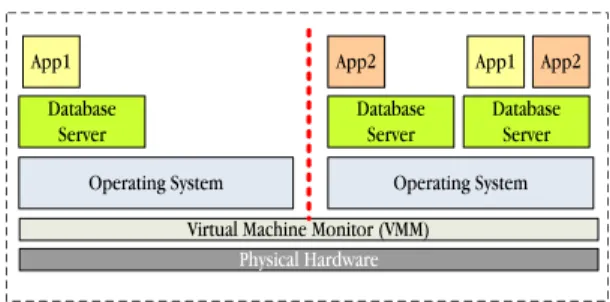
Figure 1. Multiple Services hosted using Xen
implementing the business logic of the site, and a back-end database server storing and querying the (dynamic) content of the site. The diverse nature and complex relationships among the components that make up such server systems and the multitude of tuning knobs for each component e.g., cache size, number of active connections, etc., make their performance-tuning difficult and time-consuming for hu-mans.
Database self-management techniques in stand-alone database systems [6, 16], and provisioning of database servers to applications [22] have been recently introduced to address this problem. On the other hand, recent indus-try trends towards efficient resource usage through server consolidation e.g., for savings on power and cooling, have further increased the inherent difficulty of the resource al-location problem. In order to reduce the costs of owner-ship, large service providers now run many concurrent ap-plications and efficiently multiplex their requests over ex-isting hardware resources. As a result, server boxes may be dynamically allocated to applications from a shared re-source pool and several concurrent applications may run on the same physical server. In these environments the use of Virtual Machine Monitors (VMMs), such as Xen [4], which virtualize the underlying hardware has recently increased in popularity. VMMs allow for security and failure
isola-tion between database applicaisola-tions placed in separate Vir-tual Machine containers (see Figure 1). Furthermore, live Virtual Machine (VM) migration [10] is a technique which allows online migration of entire application stacks from an overloaded server to alternate servers. In this paper we argue that previous database replica provisioning and live VM migration techniques are too coarse-grained for effi-cient load balancing of applications. Moreover, these exist-ing coarse-grained provisionexist-ing solutions, even commercial ones such as IBM’s Tivoli Intelligent Orchestrator, typically use very simple techniques, such as monitoring the CPU us-age to trigger provisioning of server boxes.
With this paper, we take a first step towards accurate di-agnosis and selective retuning for shared database clusters. We propose fine-grained adjustments of resource allocation to applications, which may be more appropriate for the most common load-balancing needs. We observe that the above mentioned shared hosting environment has a natural hierar-chy in terms of both system and application structure. Each physical server can host several Virtual Machines (VM). A VM may host several database engines or a single database engine running multiple applications. Each database appli-cation in its turn typically has several logical structural lev-els. For example, a database application is formed of client interactions, which consist of database transactions. Finally, database transactions consist of queries. Coupled with this system and application hierarchy, the possible underlying causes of a perceived overload situation on any particular physical server may be at different levels of granularity. For example, the perceived overload at a particular server may be caused by i) a VM-level change, such as a change in the set of applications scheduled on the same VM or on the same physical server as a whole and the resulting re-source interference, ii) an application-level change, such as an increase in the number of clients of a single application running within a VM container together with other appli-cations or iii) a query-level change, such as an increase in the frequency of a particular resource-intensive query or a change in access patterns for a particular query. Examples of root causes for localized access pattern change are data evolution over time or an index change affecting only a few queries.
Load balancing through VM-migration is clearly overkill for most of these scenarios and may lead to lower resource usage, hence higher costs. Our contribution is a minimally intrusive approach to fine grained resource allocation taking into account both memory and CPU usage for addressing bottlenecks in shared database clusters.
Our hypothesis is that a localized change leading to an SLA violation typically produces outlier metric values, i.e., statistically remarkable points outside the normal stable state distribution. The rationale is that a change in a few queries can be so significant as to impact the SLA of one or
more applications only if these queries clearly “stand-out” by being either: i) heavyweight in terms of some metrics, such as memory usage and with a moderate to large devia-tion from stable state metrics or ii) moderately heavyweight but showing a large deviation from stable state metrics.
Based on this observation, we use a fine-grained anomaly detection algorithm that allows us to pinpoint the overload problem to specificquery classes, and to apply a focused solution to the problem. Within each DBMS, we perform lightweight on-line monitoring of several metrics, such as the buffer pool hit ratio, page accesses, etc., and we tie statistics collection to each query class. We use recorded statistics in order to determine query contexts which con-tain outlier measurements compared to the most recent sta-ble state average values for the respective monitored met-rics on the same server. A stable staterecord of average values for all metrics is made whenever the SLA is continu-ously met for an application during a measurement interval. For query classes which show outliers in terms of mem-ory usage metrics, such as number of accessed pages or buffer pool misses, we investigate memory usage changes more precisely, by dynamically tracking the miss ratio curve (MRC) [24] in the buffer pool per query class. This allows us to focus our diagnosis on queries that might be the root cause of the problem by creating memory interference. De-pending on our diagnosis of the outlier contexts, we either incrementally schedule problem query classes on a different replica or limit the memory quota allocation of these query classes while maintaining their placement.
If no outliers are detected or fine-grained resource allo-cation fails to solve the problem, we fall back on coarse-grained server provisioning and application isolation tech-niques. The rationale is that the cost of the more precise analysis of detailed metrics and placement reshuffling of
many queries for near-optimal resource usage might out-weigh any potential benefits from fine-grained load balanc-ing; such algorithms would be more appropriate at initial application deployment or as periodic system maintenance. Our technique does not imply any change to predefined interfaces or component structure and is transparent to the clients.
In our prototype implementation, we leverage our previ-ous work [2, 22], on scheduler-based asynchronprevi-ous replica-tion schemes with strong consistency, which provides scal-ing and consistency in replicated database clusters.
A scheduling tier [22] can dynamically allocate disjoint server sets to applications and maintains consistency be-tween the instances of an application allocated on different physical servers by a read-one-write-all technique. In this paper, we enhance our previous scheme by allowing mul-tiple applications to be scheduled to execute on the same physical server or even within a single database engine. Fur-thermore, we implement and experiment with fine-grained
memory allocation and load balancing techniques based on outlier detection.
We present a preliminary evaluation of our techniques in different scenarios of dynamic change leading to SLA vi-olations. In our experiments we use the industry-standard TPC-W e-commerce benchmark, which models an on-line book store, such as Amazon.com and the RUBiS on-line bidding benchmark modeled after eBay.com. In order to record the various metrics, we instrument the buffer pool management and other internal operations of the MySQL InnoDB database engine. We vary the load or access pat-terns of specific queries when running each application alone or both applications together. We show that investi-gating contexts with outlier measurements can lead to selec-tive retuning solutions that inherently have a lower overhead and potentially better resource usage than coarse grained so-lutions.
The rest of this paper is organized as follows. Sec-tion 2 provides the necessary background on MRC-based dynamic memory allocation schemes. Section 3 introduces our fine-grained resource allocation and load balancing so-lution. Section 4 describes details of our prototype imple-mentation, our benchmarks and methodology. Section 5 presents our results. Section 6 discusses related work. Sec-tion 7 concludes the paper.
2
Background: Miss Ratio Curve Tracking
The miss-ratio curve (MRC) of an application shows the page miss-ratios at various amounts of physical memory. This approach was first used in cache simulation and was recently proposed for dynamic memory management [24]. MRC reveals information about an application’s memory demand, and can be used to predict the page miss ratio for an application given a particular amount of memory. The MRC can be computed dynamically through Mattson’s Stack Algorithm[17]. The algorithm is based on the inclu-sion propertythat states that a memory ofk+ 1pages con-tains contents of a memory ofkpages. The popular Least-Recently Used (LRU) algorithm exhibits the inclusion prop-erty thus allowing us to estimate the miss ratio for a given
amount of memorym.
The LRU algorithm can be represented using a stack where the top of the stack contains the most recently ac-cessed page and the bottom of the stack contains the least recently used page. A machine with physical memory of npages would be represented by a stack of sizen. In ad-dition, we maintain an array of hit counters (Hit[ ]) which counts the number of page hits for each memory size. The data structures are updated as follows. For each memory reference (p) in a sequence of memory accesses, the page is searched in the stack. If the page is found at location (i) from the top of the stack, it indicates that a memory of size
iwould have kept pagepin memory, and we increment the number of hits for memory sizeiby 1. If the page is not found, it indicates that either the page is accessed for the first time or a memory ofnpages was not enough to keep this page in memory. In this case, we incrementHit[∞]by 1. We calculate the miss ratio using:
M R(m) = 1− Pm i=1Hit[i] Pn i=1Hit[i] +Hit[∞] (1)
3
Design
We introduce a fine-grained resource allocation and load balancing algorithm in a replicated database system. We as-sume that several applications run concurrently on a shared database cluster. The optimizer’s task is to dynamically pro-vision replicas for applications and to schedule requests on those replicas in such a way to maintain the individual la-tency requirements of each application. Maintaining query latency under an average query latency bound is considered the service level agreement (SLA). We further assume that dynamic changes, such as load bursts, failures and query pattern changes can occur at any given time. However, we also assume that the frequency of dynamic changes is such that the system is able to achieve stable states where the SLA is continuously met for at least some of the supported applications at least during some measurement intervals.
3.1
Environment
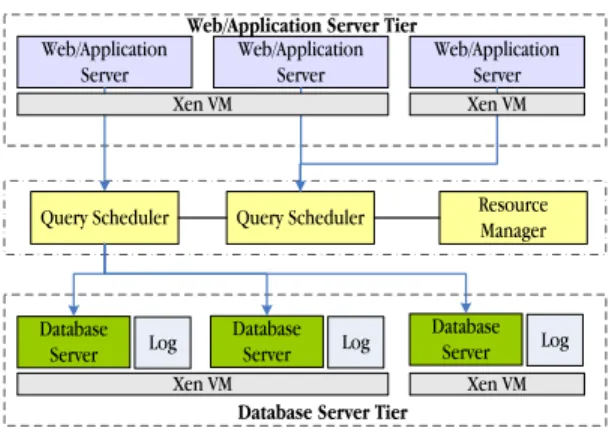
Our dynamic content server architecture consists of the web/application and database server tiers (see Figure 2). In-terposed between the application and the database tiers is a set of schedulers, one per application, that distribute incom-ing requests to a cluster of database replicas. Each machine in the database tier uses either Xen as a VMM and hosts one or more virtual machines or hosts one or more database sys-tems directly on top of the native Linux OS. The scheduler tier contains a resource manager [22] responsible for dy-namically allocating replicas for each application on physi-cal servers.
The resource manager makes global replica allocation decisions across the different applications. Each sched-uler is in charge of maintaining replica consistency between different replicas of a single application and for load bal-ancing read-only queries among the set of replicas allo-cated for the corresponding application. We assume that the data of an application is fully replicated and kept con-sistent on all physical servers allocated to that application. Each scheduler, upon receiving a query from the application server, sends the query using a read-one, write-all replica-tion scheme to the replica set allocated to its corresponding application.
Web/Application Server Web/Application Server Web/Application Server Xen VM Database Server Xen VM Database Server Tier
Resource Manager Query Scheduler
Log Database Server Log Database Server Log Xen VM
Web/Application Server Tier
Query Scheduler
Xen VM
Figure 2. Cluster Architecture
The schedulers communicate with a set of decision man-agers, one per physical server. The decision managers in their turn use a set of log analyzers, one per database sys-tem running on their server to detect outlier contexts for applications running on their designated server.
3.2
Overview of Selective Retuning
Algo-rithm
Our goal is to avoid coarse grained configuration retun-ing for entire applications in favor of selective fine-grained retuning. Our goal for selective retuning is to employ a potentially imprecise, but lightweight algorithm based on monitoring of a set of system and application counters.
Given an existing set of replicas for an application across a database cluster, scheduling and placement is done at the level ofquery class contexts. Our scheduling unit, a query class, consists of all query instances of an application with the same query template but different arguments. The scheduler determines the query templates of each applica-tion on the fly. Each query class is placed by the scheduler on a sub-set of replicas of its application and load balanced across these replicas.
For each physical server, we maintain a vector of met-ric averages measured during the last stable state for each query class of an application executing on that server. We differentiatestableversusunstablesystem behavior based on whether the SLA for the corresponding application as a whole was met (stable) or encountered one or more viola-tions (unstable) during a measurement interval.
Upon an application-level SLA violation, we use a statis-tical approach to pinpoint the fine-grained application con-texts most affected by the dynamic change. For each server where the application is running, we compare current mea-sured metric values with stable metric values for each query class executing on the same server. We determine outlier metricsthat are likely to be correlated with the high level
problem by either having a wide variation compared to their stable state counterparts or by having a moderate variation in an otherwise heavyweight query for the particular met-ric. We define query contexts where outlier measurements occur as outlier contexts. We use outlier context detection as a guide for an incremental diagnosis and fine-grained re-source allocation and load balancing solution as described next.
3.3
Statistics Collection
In order to guide system anomaly detection and cor-rection, our system monitors several system, application-level and DBMS-application-level performance metrics. System met-rics include CPU usage, I/O usage, and memory usage col-lected fromvmstaton each physical server. Application-level metrics, such as average query latencies and av-erage throughput, are tracked through the scheduler for SLA compliance checks. Within each DBMS, we perform lightweight on-line monitoring of several metrics, and we tie statistics collection to corresponding query class con-texts. Specifically, we track the latency, throughput, buffer pool misses, the number of page accesses, the I/O block re-quests, the number of prefetch (read-ahead) rere-quests, and a window of the most recent page accesses issued by the DBMS on behalf of the queries belonging to each specific query class.
Whenever astable measurement interval occurs for an application, i.e., an interval when the SLA has been contin-uously met, we update the last stable value seen (as an av-erage over the duration of the respective interval) for each metric on each server where the application is running. We maintain these average metrics in a data structure called a
stable state signature; one such signature is maintained per query context.
We also maintain the parameters of the MRC curves for each query class in the stable state record for their cor-responding application. The MRC is determined when a query class is first scheduled on the system and is not computed unless an SLA violation occurs and memory re-lated counters show outlier measurements for that partic-ular query class. We define two parameters for the MRC curve of a query class context: total memoryneeded and
acceptable memory needed. The total memory needed is the smallest of the following two numbers: the maximum amount of memory on a physical server and the memory size for which the miss ratio is estimated to be 0. The miss ratio associated with thetotal memoryneeded is called the
ideal miss ratioof the corresponding context. The accept-able memoryneeded is the estimated memory for which the miss ratio is within a fixed threshold of theideal miss ratio. Theacceptable miss ratiois the miss ratio associated with theacceptable memoryneeded.
3.3.1 Outlier Context Detection
The goal of outlier context detection upon an SLA violation is to determine query class contexts on each server running that application which show deviation from stable state be-havior and are likely to have impacted application perfor-mance significantly.
We divide the current measured metrics by their last recorded average stable value. Then we multiply the result with the weight of the corresponding query in the applica-tion for this metric to obtain the weighted metric showing that metric’s impact, calledmetric impactvalue. Weights are assignedper metric by normalizing each metric value to the least value across all queries for the same metric. For example, a query is assigned a high weight for the page access metric if its contribution to the total number of page accesses for all queries is high. Next, we use a clas-sic outlier detection algorithm to find out the outliers for the weighted values of metrics. For each weighted met-ric, we determine the range of all current measured val-ues for all query classes, and we define Q1 and Q3 to be the first and third quartile of this range. We define IQR to be the interquartile range (Q3−Q1), the range
[Q1−1.5∗IQR, Q3 + 1.5∗IQR]is defined as the in-ner fence, and the range[Q1−3∗IQR, Q3 + 3∗IQR]is defined as the outer fence.
If a metric impact value is outside of the inner fence, it will be labeled a mild outlier; if it is outside the outer fence, it will be labeled an extreme outlier. We then con-sider as outlier query contexts, the query contexts which contain outliermetric impactvalues.
3.3.2 Memory Interference Detection and Alleviation
For each query class which shows outlier measurements in memory related counters e.g., miss ratio and page access counts, we classify the query class as a problem query class. We investigate further by triggering the recomputation of the MRC curve for each problem query class. If the param-eters of the MRC curve show a significantly higher total memory need for the query class, then this query class is likely associated with memory interference, hence it con-tinues to be suspect. This case includes new query classes that have been scheduled on the system and for which we have not computed the MRC curves before. We compute the MRC curves of these new queries and we classify them as problem query classes.
We have two options for addressing problem query classes that are suspected to cause memory interference: The first option is to schedule a suspect query class on a different replica. The second option is to limit the amount of buffer pool that the problem query class is allocated, by enforcing a fixed quota allocation for the respective query class, while maintaining the placement of the query on the
same replica as before.
There are trade-offs between these two solutions. By placing the problem query classQC on a different replica, we incur the overheads of possibly having to create or up-date that replica, and of warming up the buffer pool for the respective query class on that replica. On the other hand, allocating a fixed memory quota for the buffer pool used by a given query class may decrease memory utilization on that machine. For example, the queries within the respec-tive query class may not occur in the workload mix for a period of time or may have phases when they leave most of theQC quota underutilized. Fully exploring these trade-offs is beyond the scope of this paper. In this paper, we use a simple heuristic solution. For each physical server where changes in MRC have occurred, we determine if the cur-rent placement of query contexts can meet thetotal memory needof all query contexts. If this is not the case, we perform an iterative algorithm to determine if we can maintain the placement of each problem query classQCon that replica. The algorithm attempts to find a memory quota for eachQC such that the miss ratios for allQCand the rest of the ap-plication queries scheduled on the same physical server, are predicted to be their respectiveacceptable miss ratiosat the respective memory quotas by the MRC algorithm. If appro-priate quotas can be found, we limit the memory usage for each problem query class while maintaining close to ideal performance. Otherwise, we reschedule the problem query class on an another replica. The same algorithm as above is used to determine the appropriate replica for placement.
If no outlier query contexts can be determined, we use similar algorithms as above on the top-k heavyweight queries in terms of memory metrics. Finally, if our fine-grained retuning action is ineffective, we fall back on the coarse grained allocation solutions. We allocate new repli-cas and isolate applications on them until all applications meet their SLAs.
3.3.3 Other Resource Interference Scenarios
For other cases of resource interference, such as CPU and I/O, we do not currently maintain a sufficient number of per-context metrics to enable accurate problem diagnosis through outlier detection. If CPU saturation on a server is detected as the root cause of an SLA violation, the sched-uler reactively provisions more servers from the available pool for the set of query classes running on the overloaded server. In cases of I/O interference, a simple heuristic is to remove query contexts from the physical server where I/O interference occurs in decreasing order of their I/O rate until the perceived problem on that server is normalized.
4
Implementation Details and Methodology
We use two applications in our experimental evalua-tion: TPC-W and RUBiS. The TPC-W benchmark from the Transaction Processing Council (TPC) [1] is a transactional web benchmark designed for evaluating e-commerce sys-tems. Several web interactions are used to simulate the ac-tivity of a retail store. The database size is determined by the number of items in the inventory and the size of the tomer population. We use 100K items and 2.8 million cus-tomers which results in a database of about 4 GB. We use the TPC-W shopping mix workload with 20% writes which is considered the most representative e-commerce workload by the TPC.
We use the RUBiS Auction Benchmark to simulate a bidding workload similar to e-Bay. The benchmark im-plements the core functionality of an auction site: selling, browsing, and bidding. We are using the default RUBiS bid-ding workload containing 15% writes, considered the most representative of an auction site workload according to an earlier study of e-Bay workloads [21].
We have implemented the two applications on a dynamic content infrastructure consisting of the Apache web server, the PHP application server and the MySQL InnoDB (ver. 5.0.24) database engine. We run our applications use on a cluster of Dell PowerEdge servers with 4 Intel Xeon pro-cessors, running at 3.00 GHz. All servers use the Ubuntu Linux operating system with Linux kernel 2.6.27. We per-form lightweight logging of different events by instrument-ing MySQL. We assume an SLA in terms of average query latency per server of 1 second for all applications.
The fully automated parts of our prototype include pro-visioning for CPU saturation, scheduling based on query placement, lightweight logging of metrics, recording of metric values corresponding to stable states, outlier analysis and determination of outlier query contexts. For statistics collection, we instrumented the MySQL InnoDB database engine to record query level metrics with little or no over-head. To avoid locking overhead, we create a private log-ging buffer per thread. We log the specified counts, statistics and unique page accesses per query class. Finally, we flush the logs to disk only when the buffer is full or if the thread is being shutdown. While collecting the traces, there was no noticeable decrease in the throughput of the applications.
Other aspects of our prototype are automated only through off-line trace analysis although they could be used
on-line as well. These include determination of MRC
curves for query classes. Yet other aspects, such as detect-ing I/O interference, are poorly automated and still depend on our direct observation and interpretation of statistic col-lection.
5
Results
5.1
Overview
In this section, we present different performance degra-dation scenarios in our dynamic content server architecture and how they can be effectively mitigated using our fine-grained resource allocation and load balancing technique. We show a variety of resource interference scenarios which we believe representative of real-world shared platform sce-narios. We also present the diagnosis and reaction mecha-nisms applicable in each case ranging from a fully auto-mated reaction to CPU saturation to an administrator view-point observation in the I/O interference case.
In the first scenario, we show a workload change situ-ation leading to automatic reconfigursitu-ation when only one application is running on the system. Second, we show the effect of interference in the buffer pool by an access pat-tern change in one query class. Third we show the memory interference due to buffer pool sharing by multiple applica-tions within the same database system. Finally, we show the effect of I/O interference when two applications run within separate virtual machines on the same physical server. In all of these scenarios, we show the fine grained outlier de-tection and fine-grained resource allocation actions for alle-viating the problem.
5.2
Alleviation of CPU Saturation
We use our TPC-W client emulator to emulate a sinu-soid load function, shown in Figure 3(a). This function is in terms of the number of clients presented to the web server. In addition, the emulator adds some random noise on top of the load function by randomly varying the session time and thinking time of clients. When CPU usage is saturated, our reactive provisioning algorithm is triggered. The dy-namic machine allocation is shown in Figure 3(b). All query classes of TPC-W are load balanced on an increasing set of replicas. Figure 3(c) shows that the average query latency drops back below the SLA after provisioning of a sufficient number of replicas.
5.3
Alleviation of Memory Interference
due to Index Mis-configuration
To show the effect of a localized change, we drop the
O_DATE index from the TPC-W database configuration.
This index is used only in the execution of theBestSeller
query, which also uses two other indexes. After removing the index, the response time of TPC-W rises significantly from an average of 600ms to 2 seconds.
In Figure 4, we plot the ratios of the measured values of 4 metrics divided by their respective stable state average val-ues. The problem has caused the overall latency to increase,
(a) Sine load function (b) Machine allocation (c) Average query latency
Figure 3. Alleviation of CPU Contention
0.1 1 10 100 1 3 5 7 9 11 13 15 17 19 21 23 25 27 29 Query Id Ratio (a) Latency 0.1 1 10 1 3 5 7 9 11 13 15 17 19 21 23 25 27 29 Query Id Ratio (b) Throughput 0.1 1 10 1 3 5 7 9 11 13 15 17 19 21 23 25 27 29 Query Id Ratio (c) Misses 0.1 1 10 100 1 3 5 7 9 11 13 15 17 19 21 23 25 27 29 Query Id Ratio (d) ReadAhead
Figure 4. Dropping theO DATEIndex
0 0.1 0.2 0.3 0.4 0.5 0.6 0.7 0.8 0.9 1 0 5000 10000 15000 20000 Miss Ratio
Memory Size (in pages) MRC
Figure 5. Miss Ratio Curve ofBestSellerunder
Normal Configuration
the throughput to decrease, and the buffer pool misses to in-crease; but only a few queries have a sharp increase in read aheads. Indeed, this is expected as result of the increased
Hit Ratio (%) BestSeller Non-BestSeller
Shared Buffer 95.5 96.2
Partitioned Buffer 95.7 99.5
Exclusive Buffer 96.1 99.9
Table 1. Hit Ratio of Different Buffer Pool Management Algorithms
resource interference that the unoptimizedBestSellerquery is causing for all other queries on many metrics.
Outlier detection on the memory related counters, such as page accesses, page misses and read-ahead determines that6distinct query classes are mild outliers, including the
NewProducts(#19)) andBestSeller(#18). To further narrow down the cause of the problem, we re-compute the MRC curves of these problem queries based on recent page ac-cesses.
We find that only theBestSellerquery class shows sig-nificant change in the total memory and acceptable memory. The MRC curve of theBestSellerwithout index has a longer tail than its index-based counterpart shown in Figure 5.3 as expected. We thus suspect that this query class is likely as-sociated with the root cause of memory interference.
The newBestSellerquery class has a flatter MRC curve, and thus the memory quota that it needs to meet its accept-able miss ratios is 3695 pages, less than the original 6982 pages for the index-based query class. We enforce a fixed quota allocation for this problem query class, while main-taining the placement of the query on the same replica as before.
We use a simulator of buffer pool management driven by traces of page accesses per query class to demonstrate the benefits of our algorithm. The buffer pool is divided into two dedicated partitions: one partition for servicing the
BestSellerquery class and the other partition for all other queries of the application.
We show the hit ratio in the buffer pool before buffer partitioning, after buffer partitioning and if each of the Best-Sellers and the non-BestBest-Sellers queries, respectively, were allocated the whole buffer pool (exclusively used buffer pool) in Table 1. The hit ratio under the exclusive use of the buffer pool are the ideal hit ratio that each set of queries can reach, respectively. They would also correspond to the hit ratio if we isolated the BestSeller query class on a different replica. For the partitioned buffer pool case, theBestSeller
has almost the same hit ratio (95.7%) as running in a shared buffer pool (95.5%) or running in an exclusively used buffer pool (96.1%). With a partitioned buffer pool, the hit ratio for Non-BestSeller queries improves from96.2%to99.5%, reaching close to the ideal hit ratio of99.9%. These results show that the partitioned buffer pool on a single replica has similar performance while using fewer physical machines than isolating the BestSeller and non-BestSeller parts of the application on two different replicas.
This example shows that our algorithm has the potential to automatically narrow the problem down to the one query which causes the performance degradation. We also show that fine grained targeted actions can minimize the perfor-mance impact, while maintaining good resource usage.
5.4
Alleviation of memory contention in a
shared buffer pool
Placement Latency Throughput
(s) (WIPS)
TPC-W IDLE 0.45 7.10
TPC-W RUBiS 5.42 4.29
TPC-W RUBiS∗ 1.27 6.44
Table 2. Effect of memory contention in a
shared buffer pool. RUBiS∗ is the RUBiS
workload with theSearchItemsByRegion
sched-uled on a different machine.
In this section, we study a scenario representative of an environment change where initially only TPC-W is run-ning within a DBMS, but then the RUBiS workload is also started within the same DBMS in a shared buffer pool con-figuration.
Table 2 shows the baseline scenario where TPC-W is al-located the entire buffer pool. It also shows the case where TPC-W and RUBiS compete for space in the buffer pool. In all cases, the database instance is given 128MB buffer pool space, which corresponds to 8192 memory pages. With a shared buffer pool, TPC-W’s throughput drops to 4.29 WIPS and its latency increases ten-fold to 5.42s compared to running alone. 0 0.1 0.2 0.3 0.4 0.5 0.6 0.7 0.8 0.9 1 0 2000 4000 6000 8000 10000 12000 Miss Ratio
Memory Size (in pages) MRC
Figure 6. Miss Ratio Curve of RUBiS
SearchItemsByRegionQuery
In the absence of CPU saturation, we check memory related counters for TPC-W query classes, including page misses, page accesses and read-ahead requests. Five distinct TPC-W query classes are detected as mild outliers. How-ever, after we recompute the MRC curve for each problem query class, we find that their total memory and acceptable memory parameters show no change. Hence these query classes themselves are not the cause of the performance anomaly.
We compute the MRC curves for the newly added RU-BiS queries, considering them as potential problem query classes. Following our heuristic memory alleviation algo-rithm, we determine whether we can find a memory quota for each problem query classQCsuch that the miss ratios for bothQCand the rest of the application queries on the same server are predicted to meet their respective accept-able ratios. The top ranking problem query is the RUBiS
SearchItemsByRegion. Its MRC curve is shown in Figure 6, and its acceptable memory needed is around 7906 pages. It is clear that this query cannot be co-located with the TPC-W application in a shared 8192 pages buffer pool, since only theBestSellerof TPC-W needs at least 6982 pages.
Therefore, we scheduleSearchItemsByRegionon a dif-ferent replica. We show the result of this fine-grained load balancing change in the last row of Table 2. We see that after changing the placement of theSearchItemsByRegion
query class, TPC-W recovers to a latency of 1.27 sec, and a throughput of 6.44 WIPS.
5.5
Alleviation of I/O contention among
VM domains
While virtual machines provide strong isolation guaran-tees among different domains in terms of faults, security and privacy, they do not provide performance isolation. This is evident, for example, when the applications are I/O tensive. We perform an experiment, where two RUBiS
in-stances are placed on a machine running the Xen virtual machine monitor. We use two virtual machine domains and place a RUBiS instance in each domain.
Placement Latency Throughput
Domain-1 Domain-2 (s) (WIPS)
RUBiS IDLE 1.50 97.15
RUBiS RUBiS 4.78 30.47
RUBiS RUBiS∗ 1.50 95.37
Table 3. Effect of I/O contention among differ-ent domains.
We experiment with two different placements shown in the first two rows of Table 3: (1) a baseline where RUBiS is placed in domain-1 and domain-2 is kept idle and (2) a configuration with RUBiS on both domain-1 and domain-2. In this case each RUBiS application is running on its own separate data (as if two distinct applications were running on the system).
In both cases, we set the virtual memory of each domain to 256MB and set the MySQL buffer pool to 128M. We run 200 clients on each RUBiS instance. As Table 3 shows in our baseline case, the latency of RUBiS is 1.5 seconds and the throughput is 97 web interactions per second (WIPS). If two RUBiS instances are placed on the VMM, there is a significant drop in throughput (to 30 WIPS) and a sharp increase in latency (to 4.8s).
Our current techniques do not allow us to automate the diagnosis of this case. However, by analyzing the logs of statistics for the respective runs we observe that i) the CPU usage of each domain is low, ii) by plotting and analyzing the MRC curves of the two applications we determine that there is no memory interference and iii) RUBiS is an I/O intensive application. Thus, we suspect that the problem is due to I/O contention on domain-0 (the Xen controller) due to the I/O intensive nature of the two applications.
A naive solution is to schedule the virtual domains of the two applications on two different physical machine. How-ever, our heuristic I/O interference alleviation algorithm can potentially be used in this case to reschedule only a subset of the queries on a different machine. Indeed, if we remove queries in decreasing order of their I/O rate, performance returns to normal. Specifically, the query associated with the SearchItemsByRegion web interaction in RUBiS con-tribute a large majority (87%) of the I/O accesses, and thus is the first query to remove. The third row of Table 3 shows
the benefits with RUBiS on domain-1 and RUBiS∗ (with
SearchItemsByRegion removed)on domain-2. We can see that after removing the heaviest query, the latency is 1.5s and the throughput is 95 WIPS, which is almost the same as the baseline case.
6
Related Work
The management and performance optimization of database systems by humans is becoming increasingly
costly and time consuming [19]. Therefore, many
re-lated research efforts are studying methods for automat-ing problem diagnosis through statistical machine learn-ing approaches to find the root cause of performance prob-lems [9, 11], to deal with software upgrades and operator mistakes [19], and to detect failures [8].
In order to track the cause of perceived problems and to understand the interactions between components in com-plex systems, several recent methods propose tagging re-quests as they pass through different layers [7] while oth-ers determine a causal order using a temporal join of var-ious logs [3]. [11, 12] correlate various system metrics to service level objective (SLO) violations. They use a Tree-augmented Bayesian Network to determine a subset of metrics that correlate to a SLO violation. Furthermore, the authors generate signature of different metric combina-tions [12]. Using the signatures, they determine if the cur-rent situation is similar to a previously diagnosed problem. They show that determining a causal order between events can then be used to detect anomalies. Other papers [8] use statistical analysis of interactions between components to detect failures and system evolution.
A number of independent database replication solutions exist that provide both scaling and strong consistency in replicated database clusters [23, 15, 20, 14, 18]. With a few notable exceptions [14] [18] [13], these systems either do not investigate database replication in the context of dy-namic adaptation or do not consider fine grain load balanc-ing or allocation.
Our fine-grained memory allocation algorithm is related to commercial solutions for dynamic memory allocation, such as in DB2 9 (Viper) and to previous work [5] on parti-tion sizing within the buffer pool to accommodate the work-ing sets and ensure per-class response time goals for queries from multiple applications.
7
Conclusions and Future Work
Recent industry trends emphasize efficient resource us-age through server consolidation for reducing the costs of ownership of large data centers. As a result, multiple ap-plications are commonly multiplexed on the same hard-ware. Resource multiplexing may involve hosting multi-ple database systems within different virtual machines run-ning on the same physical server or even hosting multiple database applications on a single database system. These complex environments make achieving differentiated ser-vice level agreements for applications challenging due to
the many potential sources of dynamic change. For exam-ple, the set of applications scheduled on any physical server, the database system configuration, the application workload mix, the client load of an application, or an application’s access patterns may change over time. If the cause of per-formance degradation cannot be identified, the reaction to the problem will likely be inaccurate. For example, in or-der to address a perceived overload problem on a particular server, the system might overreach and isolate applications on different physical servers, which is wasteful in terms of resource usage.
We have designed and prototyped a technique, called outlier detection, for detecting fine-grained application con-texts that are likely to contain either the cause of the prob-lem, or be affected most by it. We have augmented a previ-ous scheduling technique on replicated database clusters to isolate fine-grained application contexts pinpointed by the outlier detection technique. We have further used an exist-ing memory usage trackexist-ing technique at the level of individ-ual query classes to validate the outlier findings in terms of memory usage anomalies. We show that fine-grained mem-ory allocation and load balancing based on outlier detection are effective methods for alleviating performance problems due to dynamic change within an application or resource interference between applications. Our technique is trans-parent to clients and has negligible overhead.
Finally, outlier detection is a promising approach for narrowing down the search for other system or application anomalies, such as invoking a query with the wrong argu-ments, lock contention or deadlock situations. We are plan-ning to study such applications in our future work.
References
[1] Transaction processing council. http://www.tpc.org. [2] C. Amza, A. L. Cox, and W. Zwaenepoel. A
compara-tive evaluation of transparent scaling techniques for dynamic content servers. InICDE, 2005.
[3] P. T. Barham, A. Donnelly, R. Isaacs, and R. Mortier. Using magpie for request extraction and workload modelling. In
OSDI, 2004.
[4] P. T. Barham, B. Dragovic, K. Fraser, S. Hand, T. L. Harris, A. Ho, R. Neugebauer, I. Pratt, and A. Warfield. Xen and the art of virtualization. InSOSP, 2003.
[5] K. P. Brown, M. J. Carey, and M. Livny. Goal-oriented buffer management revisited. InSIGMOD, 1996.
[6] N. Bruno and S. Chaudhuri. Automatic physical database tuning: A relaxation-based approach. InSIGMOD, 2005. [7] A. Chanda, K. Elmeleegy, A. L. Cox, and W. Zwaenepoel.
Causeway: Support for controlling and analyzing the execu-tion of multi-tier applicaexecu-tions. InMiddleware, 2005. [8] M. Y. Chen, A. Accardi, E. Kiciman, D. A. Patterson,
A. Fox, and E. A. Brewer. Path-based failure and evolution management. InNSDI, 2004.
[9] M. Y. Chen, E. Kiciman, E. Fratkin, A. Fox, and E. A. Brewer. Pinpoint: Problem determination in large, dynamic internet services. InDSN, 2002.
[10] C. Clark, K. Fraser, S. Hand, J. G. Hansen, E. Jul, C. Limpach, I. Pratt, and A. Warfield. Live migration of virtual machines. InNSDI, 2005.
[11] I. Cohen, J. S. Chase, M. Goldszmidt, T. Kelly, and J. Symons. Correlating instrumentation data to system states: A building block for automated diagnosis and con-trol. InOSDI, 2004.
[12] I. Cohen, S. Zhang, M. Goldszmidt, J. Symons, T. Kelly, and A. Fox. Capturing, indexing, clustering, and retrieving system history. InSOSP, 2005.
[13] S. Elnikety, S. Dropsho, and W. Zwaenepoel. Tashkent+: Memory-aware load balancing and update filtering in repli-cated databases. InEuroSys’07(to appear), 2007.
[14] B. Kemme, A. Bartoli, and ¨O. Babaoglu. Online reconfig-uration in replicated databases based on group communica-tion. InDSN, 2001.
[15] Y. Lin, B. Kemme, M. Pati˜no-Mart´ınez, and R. Jim´enez-Peris. Middleware based data replication providing snapshot isolation. InSIGMOD, 2005.
[16] V. Markl, G. M. Lohman, and V. Raman. Leo: An au-tonomic query optimizer for DB2. IBM Systems Journal, 42(1), 2003.
[17] R. Mattson, J. Gecsei, D. Slutz, and I. Traiger. Evaluation techniques for storage hierarchies. InIBM System Journal, pages 78–117, 1970.
[18] J. M. Mil´an-Franco, R. Jim´enez-Peris, M. Pati˜no-Mart´ınez, and B. Kemme. Adaptive middleware for data replication. InMiddleware, 2004.
[19] K. Nagaraja, F. Oliveira, R. Bianchini, R. P. Martin, and T. D. Nguyen. Understanding and dealing with operator mis-takes in internet services. InOSDI, 2004.
[20] C. Plattner and G. Alonso. Ganymed: Scalable replication for transactional web applications. InMiddleware, 2004. [21] K. Shen, T. Yang, L. Chu, J. Holliday, D. A. Kuschner, and
H. Zhu. Neptune: Scalable replication management and pro-gramming support for cluster-based network services. In
USITS, 2001.
[22] G. Soundararajan, C. Amza, and A. Goel. Database repli-cation policies for dynamic content applirepli-cations. In Eu-roSys’06, 2006.
[23] S. Wu and B. Kemme. Postgres-r(si): Combining replica control with concurrency control based on snapshot isola-tion. InICDE, 2005.
[24] P. Zhou, V. Pandey, J. Sundaresan, A. Raghuraman, Y. Zhou, and S. Kumar. Dynamic tracking of page miss ratio curve for memory management. InASPLOS-XI, 2004.