University of Central Florida University of Central Florida
STARS
STARS
Electronic Theses and Dissertations, 2004-20192019
Game-Theoretic Frameworks and Strategies for Defense Against
Game-Theoretic Frameworks and Strategies for Defense Against
Network Jamming and Collocation Attacks
Network Jamming and Collocation Attacks
Ahmed HemidaUniversity of Central Florida
Part of the Electrical and Computer Engineering Commons Find similar works at: https://stars.library.ucf.edu/etd University of Central Florida Libraries http://library.ucf.edu
This Doctoral Dissertation (Open Access) is brought to you for free and open access by STARS. It has been accepted for inclusion in Electronic Theses and Dissertations, 2004-2019 by an authorized administrator of STARS. For more information, please contact [email protected].
STARS Citation STARS Citation
Hemida, Ahmed, "Game-Theoretic Frameworks and Strategies for Defense Against Network Jamming and Collocation Attacks" (2019). Electronic Theses and Dissertations, 2004-2019. 6314.
GAME-THEORETIC FRAMEWORKS AND STRATEGIES FOR DEFENSE AGAINST NETWORK JAMMING AND COLLOCATION ATTACKS
by
AHMED HOSSAM ANWAR ABDO HEMIDA B.Sc. Alexandria University, Egypt 2011
M.Sc. Nile University, Egypt 2013
A dissertation submitted in partial fulfilment of the requirements for the degree of Doctor of Philosophy
in the Department of Electrical and Computer Engineering in the College of Engineering and Computer Science
at the University of Central Florida Orlando, Florida
Spring Term 2019
c
ABSTRACT
Modern networks are becoming increasingly more complex, heterogeneous, and densely con-nected. While more diverse services are enabled to an ever-increasing number of users through ubiquitous networking and pervasive computing, several important challenges have emerged. For example, densely connected networks are prone to higher levels of interference, which makes them more vulnerable to jamming attacks. Also, the utilization of software-based protocols to perform routing, load balancing and power management functions in Software-Defined Networks gives rise to more vulnerabilities that could be exploited by malicious users and adversaries. Moreover, the increased reliance on cloud computing services due to a growing demand for communication and computation resources poses formidable security challenges due to the shared nature and virtu-alization of cloud computing. In this thesis, we study two types of attacks: jamming attacks on wireless networks and side-channel attacks on cloud computing servers. The former attacks disrupt the natural network operation by exploiting the static topology and dynamic channel assignment in wireless networks, while the latter attacks seek to gain access to unauthorized data by co-residing with target virtual machines (VMs) on the same physical node in a cloud server. In both attacks, the adversary faces a static attack surface and achieves her illegitimate goal by exploiting a stationary aspect of the network functionality. Hence, this dissertation proposes and develops counter ap-proaches to both attacks using moving target defense strategies. We study the strategic interactions between the adversary and the network administrator within a game-theoretic framework.
First, in the context of jamming attacks, we present and analyze a game-theoretic formulation between the adversary and the network defender. In this problem, the attack surface is the network connectivity (the static topology) as the adversary jams a subset of nodes to increase the level of interference in the network. On the other side, the defender makes judicious adjustments of the
topology to reduce the impact of the attack. The defender’s strategy is based on playing Nash equilibrium strategies securing a worst-case network utility. Moreover, scalable decomposition-based approaches are developed yielding a scalable defense strategy whose performance closely approaches that of the non-decomposed game for large-scale and dense networks. We study a class of games considering discrete as well as continuous power levels.
In the second problem, we consider multi-tenant clouds, where a number of VMs are typically collocated on the same physical machine to optimize performance and power consumption and maximize profit. This increases the risk of a malicious virtual machine performing side-channel attacks and leaking sensitive information from neighboring VMs. The attack surface, in this case, is the static residency of VMs on a set of physical nodes, hence we develop a timed migration defense approach. Specifically, we analyze a timing game in which the cloud provider decides when to migrate a VM to a different physical machine to mitigate the risk of being compromised by a collocated malicious VM. The adversary decides the rate at which she launches new VMs to collocate with the victim VMs. Our formulation captures a data leakage model in which the cost incurred by the cloud provider depends on the duration of collocation with malicious VMs. It also captures costs incurred by the adversary in launching new VMs and by the defender in migrating VMs. We establish sufficient conditions for the existence of Nash equilibria for general cost functions, as well as for specific instantiations, and characterize the best response for both players. Furthermore, we extend our model to characterize its impact on the attacker’s payoff when the cloud utilizes intrusion detection systems that detect side-channel attacks. Our theoretical findings are corroborated with extensive numerical results in various settings as well as a proof-of-concept implementation in a realistic cloud setting.
ACKNOWLEDGMENTS
First, and foremost, all praise and thanks are to Allah for his generosity and blessings. I would like to express my sincere gratitude and appreciation to Dr. George Atia for his guidance. I would like to thank him for his constant support, encouragement, and inspiring advice. His help and guidance throughout my study at UCF are invaluable. I am also very grateful to Dr. Mina Guirguis for his amazing guidance and support. I would like to thank him and his group at Texas State University for their productive collaboration.
I want to thank my doctoral committee members, Prof. Marwan Simaan, Dr. Azadeh Vosoughi, and Dr. Gita Sukthankar for their time, and also, for providing insightful comments and stimulating thoughtful discussion. My deepest gratitude to Diana Camerino for her kind help throughout my course of study.
Many thanks to all my brilliant DSP mates. I would like to express special thanks to my lab-mate A. Aldahab, and my dearest friends A. Zewail, A. Ibrahim, and M. Ashour at PSU for sharing my memories, my sorrows, and critical situations. The help all of you offered, the thoughts we exchanged, and the interests we shared made these Ph.D. years unforgettable.
I would like to express my deepest gratitude and appreciation to my parents and my sister who have offered everything to me to reach this point in my life. Their encouragement and support are unbounded. I am truly lucky to have my wife Salwa, and my beautiful daughter, Talia, who always sacrifice their happiness for me. I am very lucky to have such a loving and respectful person in my life. I love you.
TABLE OF CONTENTS
LIST OF FIGURES . . . xiii
LIST OF TABLES . . . xx CHAPTER 1: INTRODUCTION . . . 1 1.1 Science of Cybersecurity . . . 2 1.2 Attack Surface . . . 4 1.3 Defense Strategies . . . 5 1.4 Game Theory . . . 5
1.4.1 Normal Form Game . . . 7
1.4.2 Nash Equilibrium . . . 8
1.5 Contributions . . . 8
1.6 Organization . . . 12
CHAPTER 2: PINBALL ATTACKS AGAINST DYNAMIC CHANNEL ASSIGNMENT IN WIRELESS NETWORKS . . . 13
2.2.1 Channel Assignment Techniques . . . 16
2.2.2 Security Implications of Channel Assignment . . . 17
2.3 System Model . . . 18
2.3.1 Channel Assignment Technique . . . 19
2.3.2 Decoy Pinball Attack . . . 22
2.3.3 MDP Formulation . . . 23
2.3.4 Optimal Attack Policy . . . 27
2.3.5 Suboptimal Attack Strategy . . . 29
2.3.6 Feature Selection . . . 30
2.3.7 Dimensionality Reduction: Big Graphs . . . 32
2.4 The Dual Problem . . . 33
2.4.1 Equivalence Formulation . . . 33
2.4.2 Attacking Isomorphic Graphs . . . 38
2.5 Experimental Results . . . 39
2.5.1 Average Path Reward . . . 43
2.5.2 Conflict Analysis . . . 47
2.5.4 Conflict Decay Analysis . . . 54
2.5.5 Conflict Size Distribution Analysis . . . 55
2.5.6 Conflict Induction and Accumulation Analysis . . . 56
2.5.7 Graph Connectivity Analysis . . . 56
2.5.8 Attacking Networks of Repeated Structures . . . 58
2.5.9 Attacking Networks of Arbitrary Structures . . . 64
CHAPTER 3: ADAPTIVE TOPOLOGIES AGAINST JAMMING ATTACKS IN WIRE-LESS NETWORKS . . . 66
3.1 Related Work . . . 68
3.1.1 Security in Wireless Channel Allocation Techniques . . . 68
3.1.2 Game-Theoretic Formulations in Security Games . . . 69
3.2 System Model . . . 71
3.2.1 Dynamic Channel Assignment . . . 72
3.2.2 Jamming Attacks . . . 72
3.2.3 General Framework . . . 73
3.3 Game Formulation . . . 74
3.3.1.1 Decomposition-based approach . . . 78
3.3.1.2 Progressive decomposition approach . . . 80
3.3.2 Discrete Game with Explicit Constraints . . . 81
3.3.3 Continuous Game . . . 86
3.3.4 Extension to Multiple Bands . . . 93
3.4 Experimental Results . . . 94
3.5 Stochastic Games . . . 108
3.5.1 Mixed strategy, state evolution and objective function . . . 111
3.5.2 Q-minmax Algorithm . . . 113
3.6 Approximate Policy . . . 114
3.7 Experimental Results . . . 115
3.7.1 Learning step . . . 116
3.7.2 Testing step . . . 119
CHAPTER 4: VIRTUAL MACHINES MIGRATION TIMING PROBLEM . . . 121
4.1 Introduction . . . 121
4.2 Related work . . . 123
4.2.2 Cloud security using game-theoretic techniques . . . 124
4.3 System Model . . . 126
4.3.1 The cloud . . . 126
4.3.2 The game . . . 127
4.3.2.1 Defender’s action space . . . 127
4.3.2.2 Attacker’s action space . . . 128
4.3.2.3 Attacker’s utility . . . 129
4.3.2.4 Defender’s utility . . . 130
4.4 Theoretical Analysis . . . 131
4.4.1 General reward functions . . . 132
4.4.2 Special instantiation analysis . . . 136
4.5 Generalization: Game Model with IDS . . . 141
4.6 Numerical Analysis . . . 143
4.6.1 Utility functions . . . 146
4.6.2 Cost effect and monotonicity . . . 148
4.6.3 Best response curves . . . 151
4.6.5 Game simulation and implementation . . . 157
4.6.6 Extended model with IDS . . . 158
CHAPTER 5: CONCLUSION . . . 162
LIST OF FIGURES
2.1 Step 1: Initial channel assignments, the network has 3 conflicts. Step 2: After an AP switches from channel 9 to 2, the network has 1 conflict. Step 3: After
an AP switches from channel 7 to 10, the network is conflict-free. . . 21
2.2 Step 1: System starts with 3 conflicts. Step 2: Attacker jams its victim node with jamming channel 3 and the system switched the node using channel 9 to the non-interfering channel 2. However, due to the jammer the new fre-quency is now suffering interference. Step 3: The system is not only unable to resolve conflicts in 3 steps, but also three nodes may not find any vacant non-interfering channels, resulting in perpetual switching among other nodes as well. . . 21
2.3 Approximate policy and exact policy path reward comparison. . . 31
2.4 Edge attack topology. . . 37
2.5 Edge attack topology mapped to node attack problem. . . 38
2.6 A 6-node chain network topology. . . 41
2.7 5-node interconnected network topology. . . 41
2.8 A 6-node ring network topology. . . 42
2.9 A 7-node tree network topology. . . 42
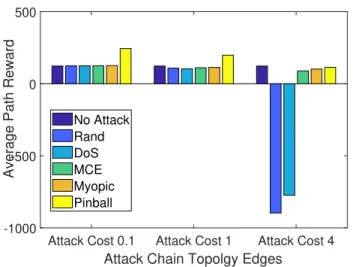
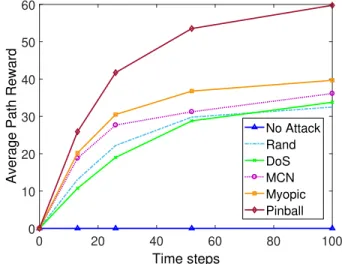
2.11 Comparing different attack policies on the 5-node interconnected network
topology. . . 43
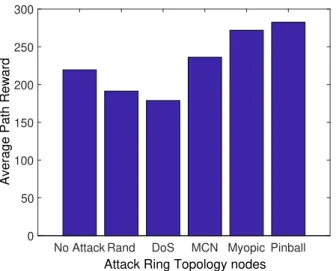
2.12 Comparing different attack policies on the 5-node ring topology. . . 45
2.13 Comparing different attack policies on the 7-node tree topology. . . 45
2.14 A 6-node topology representing the network of the tested building. . . 46
2.15 Plan view of the tested building. . . 46
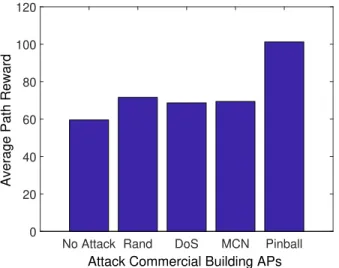
2.16 Comparing different attack policies on commercial building APs. . . 47
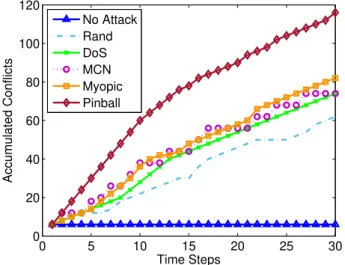
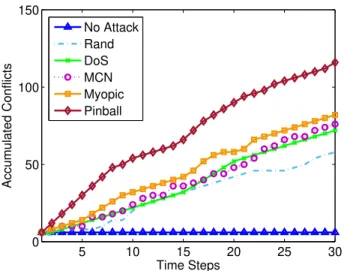
2.17 Accumulation of conflicts in the 7-node tree network for different attack poli-cies. . . 48
2.18 Accumulation of conflicts in the 5-node interconnected network for different attack policies. . . 49
2.19 Accumulation of conflicts in the 8-node mixed network topology. . . 49
2.20 An 8-node mixed network topology. . . 50
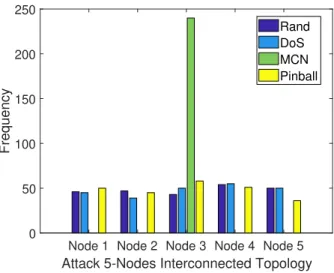
2.21 Frequency of attack actions for the interconnected network topology. . . 50
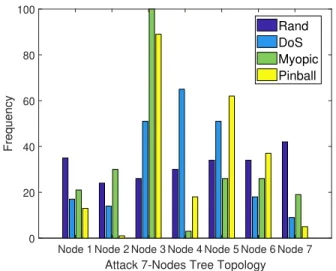
2.22 Frequency of attack actions for the tree topology. . . 51
2.23 Frequency of attack actions for the 8-node mixed network topology. . . 51
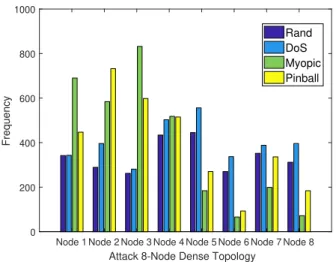
2.24 Frequency of attack actions for the 8-node dense network topology . . . 52
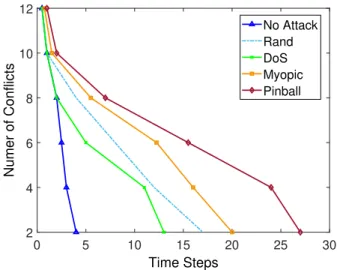
2.26 Conflicts resolution over time for the 8-node mixed network topology. . . 54
2.27 Frequency of different conflict sizes in the 8-node mixed network topology. . 54
2.28 Path reward gained over time when 8-nodes mixed network topology starts from a zero-conflict state . . . 55
2.29 A 10-node graph withδavg= 1.8. . . 57
2.30 A 10-node graph withδavg= 4. . . 57
2.31 Comparing the performance of different attack policies as we increase the connectivity of a 10-node graph. . . 58
2.32 Graph with repeated ring structure. . . 59
2.33 Graph with repeated interconnected subgraph structure. . . 60
2.34 Graph with repeated tree structure. . . 60
2.35 Comparing attack policies for graph with repeated ring structure. . . 61
2.36 Comparing attack policies for graph with repeated interconnected subgraph structure. . . 61
2.37 Comparing attack policies for graph with repeated tree structure. . . 62
2.38 Partial view of an 800-node network with a repeated structure. . . 62
2.39 Comparing attack policies for the 800-node network. . . 63
2.41 A 32-node network of a repeated structure . . . 64
2.42 The gap due to approximating a graph with a repeated structure graph . . . . 65
3.1 Building block topologies, (a) 7-node tree, (b) 5-node star, (c) 5-node inter-connected network. . . 94
3.2 Defender reward for the 7-node tree network topology versus attack cost. . . . 96
3.3 Defender reward for different attack costs for the 5-node star network. . . 96
3.4 Defender reward for the 5-node interconnected network topology vs attack cost. . . 97
3.5 Defender reward for topology (a) vs number of conflicts. . . 98
3.6 Defender reward for topology (a) vs attack cost against two colluding jammers. 99
3.7 (Left) Mixed strategy for power assignment of 28 nodes in 3-floor building, (Right) The top plot shows the defender reward vs the attack cost, and the bottom plot displays the time evolution of the conflicts with and without de-fense. . . 100
3.8 Run time in seconds. . . 100
3.9 Defender’s reward for a randomly generated 64-node topology. . . 101
3.10 Defender’s strategies in a 3-floor building. 2D projection of the 3D footprint of each access point, without coverage constraints (left) and with coverage constraints (right). . . 101
3.11 3D wireless footprints based on marginal strategy. . . 103
3.12 Tradeoff between the number of non-conflicting APs and the minimum net-work coverage. . . 103
3.13 Power assignment in 3-floor building over two different wireless bands to enhance coverage . . . 104
3.14 Defender reward for the 7-node tree network topology versus attack cost. . . . 106
3.17 Power radii for different minimum coverage constraints. . . 106
3.15 Defender reward for different attack costs for the 5-node star network. . . 107
3.16 Defender reward for the 5-node interconnected network topology vs attack cost. . . 108
3.18 A 3-node chain network topology . . . 116
3.19 Convergence of the state value function for a 3-node chain network. . . 117
3.20 The defender strategy at a sample state for a 3-node chain network converges to a mixed NE strategy. . . 117
3.21 The attack strategy at a sample state for a 3-node chain network converges to a mixed NE strategy. . . 118
3.22 The defender’s NE average path reward for a 3-node chain network against an attacker that plays best response and one that uses a random attack. Com-parison to no-defense is also shown. . . 118
3.24 The defender’s average path reward for a 5-node interconnected network
compared with other attack and defense policies. . . 120
4.1 System model illustration for different placement events. . . 126
4.2 Attacker evades IDS by early stopping of malicious activity. . . 142
4.3 Attacker detected by the IDS. . . 143
4.4 For the shown action space,A = Ad × Aa, the game admits a NE in pure strategies. . . 144
4.5 At τd = 0.1, the attacker payoff is monotonically decreasing, but not for τd= 2, in agreement with the bound onCain Theorem 15. . . 145
4.6 Defender’s utility versus migration timeτd . . . 147
4.7 Attacker’s utility versus attack rateλa . . . 148
4.8 Defender’s utility versus migration timeτdforCd= 0.03 . . . 149
4.9 Defender’s utility versus migration timeτdforCd= 10 . . . 149
4.10 Attacker’s utility versus attack rateλaforCa= 0.01. . . 150
4.11 Attacker’s utility versus attack rateλaforCa= 6. . . 151
4.12 Players best response curves forCd = 2.5andCa = 1 . . . 152
4.13 Players best response curves forCd = 0andCa= 0 . . . 153
4.15 Players best response curves forCd = 0andCa= 6 . . . 154
4.16 Defender’s best response curves for different reward scaling regimes. . . 154
4.17 Attacker’s best response curves for different reward scaling regimes. . . 155
4.18 Attacker’s payoff with and without IDS. . . 159
4.19 Attacker’s utility vs stopping timesat different costs of detection. . . 160
4.20 Comparison between the proposed migration approach and no-migration. . . 160
4.21 Comparing the defender’s utility with the proposed and the random migration policies at several migration cost values. . . 161
LIST OF TABLES
CHAPTER 1: INTRODUCTION
Networks are now densely connected and heterogeneous to enable more services to an ever-increasing number of users. For instance, modern networks connect computers with different operating systems and protocols, wireless networks accommodate different access technologies and are able to provide services through a Wi-Fi LAN or through a cellular network as in heteroge-neous wireless networks. Moreover, an increasing number of devices are being added to networks everyday. For example, the deployment of wireless-enabled devices (e.g., Internet of Things, wear-ables, etc.) has made our networks larger and denser. Hence, networks are prone to higher levels of interference, which makes them more vulnerable to jamming attacks. To accommodate such growth under spectrum constraints, significant research efforts focused on developing spectrum management techniques through the use of Software Defined Networks (SDNs), Network Func-tion VirtualizaFunc-tion (NFV), and Cognitive Radios (CR) to improve the spectrum utilizaFunc-tion. These techniques rely on sensing the current conditions (e.g., channels used, transmission power, inter-ference levels, etc.) and dynamically making the appropriate allocation decisions. Current Access Points (APs) can dynamically select their channels and their transmission ranges to minimize in-terference with surrounding APs in wireless mesh networks (e.g., Cisco’s Transmit Power Control) [1]. The shared nature of wireless communication, however, has made many of the above tech-niques susceptible to attacks.
SDNs seek to separate network control functions from network forwarding functions, while NFV seeks to abstract network forwarding and other networking functions from the hardware on which it runs. Thus, both depend heavily on virtualization to enable network design and infrastructure to be abstracted in software and then implemented by the underlying software across hardware platforms and devices [2].
When SDNs execute on an NFV infrastructure, SDNs forward data packets from one network device to another. At the same time, SDNs’ networking control functions for routing, policy defi-nition and applications run in a virtual Machine (VM) somewhere on the network. Thus, NFV pro-vides basic networking functions, while SDNs control and orchestrate them for specific uses. SDNs further allow configuration and behavior to be programmatically defined and modified. These new technologies are now replacing the infrastructure of traditional communication networks. How-ever, it has led to a new set of vulnerabilities and security holes due to the reactive and dynamic nature of frequency assignment and power management protocols. Therefore, we shed more light on attackers’ techniques first and how they exploit such vulnerabilities, then we propose effective remedies to those attacks.
Moreover, the growing usage of virtualization have increased the number of security issues in future networks. Therefore, security challenges in cloud servers are getting more attention. Virtu-alization is one of the main components of a cloud. But this poses major security risks. Ensuring that different instances running on the same physical machine are isolated from each other is a major task of virtualization which is not guaranteed completely in existing platforms [3]. In this thesis, we focus on the issue of collocation between neighboring VMs in public cloud servers and how to overcome possible collocation attacks. Before we delve into the detailed contributions of this dissertation, we first put our work into the context of cyber science.
1.1 Science of Cybersecurity
The annual Data Breach Investigations Report (DBIR) issued by Verizon Inc reported more than 53,000 security related incidents and 2,216 confirmed data breaches in the year 2018. Although
76%of the crimes were financially motivated,58%of the victims were small businesses and25%
unsafe emails, attacks caused by malware went down from50%in 2017 to30%in 2018. However, the total number of security incidents and data breaches is increasing which poses more challenges to network and system administrators regarding how to secure their database servers and in case of being under attack, how to mitigate the effects of such attacks.
The domain of science of cybersecurity comprises phenomena that involve malicious agents used to hack and damage a network of computing devices to perform actions desired by the attacker and generally contrary to the intent (the policy) of the network administrator (the defender). More specifically, the objects of research in cybersecurity can be summarized into:
• An attacker or (a set of colluding attackers) along with the attacker’s tools and techniques (set of actions)
• A network defender with a set of defensive tools and actions
• The operational assets, networks and systems, which represent the target of the attacker.
• A set of defender’s assertions or requirements about what events should and should not happen. To simplify, we may focus on cyber incidents and events that should not occur [4].
The science of cybersecurity develops a coherent family of models of relations between attributes, structures and dynamics of: violations of cybersecurity policy; the network of computing devices under attack; the defenders’ tools and techniques; and the attackers’ tools and techniques where malicious software plays the central role.
For example, in theintrusion detectionproblem we seek to derive the best response actions for the defender given the system status, actions taken by the adversary and the set of unwanted events. In other words, the goal is to find defense techniques that detect certain types of malicious activities
Another field of study within the science of cybersecurity is to assess the networkvulnerabilities. In this case, the goal is to identify the weaknesses of the system and the structures of the network with respect to the defender given the possible actions that can be taken by an attacker.
In this thesis we focus mainly on deriving defensive techniques and securing actions to protect wireless networks and cloud servers against jamming and collocation attacks, respectively.
1.2 Attack Surface
In the domain of software security, the attack surface of a software environment is the collection of points through which an unauthorized user (the attacker) can try to enter data to, or extract data from, an environment. Hence, security experts aim to reduce the attack surface. In this thesis, we use the same notion of attack surface to represent the main points that the attacker is exploiting within the network to disrupt the natural operation of the network. Specifically, we investigate two attack scenarios that have the same attack surface nature as explained next.
We study two types of attacks: jamming attacks on wireless networks and side-channel attacks on cloud networks. The former attacks disrupt the natural network operation by exploiting the static topology and dynamic channel assignment in wireless networks, while the latter attacks seek to gain access to unauthorized data by co-residing with target VMs on the same physical node in a cloud network. In both attacks, the adversary exploits a fixed or static attack surface and achieves her illegitimate goal by exploiting a stationary aspect of the network functionality. Hence, this dissertation proposes and develops counter approaches to both attacks using Moving Target Defense (MTD) strategies to shift and modify the attack surface periodically. We study the strategic interactions between the adversary and the network administrator within a game-theoretic framework.
1.3 Defense Strategies
The most common and widely implemented reactive defense approach is the Intrusion Detecction and Prevention system (IDPS). Such systems analyze the behavior of the users online and capture anomalies and malicious activities as a reactive defense mechanism. However, the network ad-ministrator needs to develop defense strategies in order to prevent and mitigate the effects of those attacks and keep hold of the network resources until the IDPS identifies the malicious user and knocks her out of the network. To defend against an attacker who is exploiting the static nature of the network’s attack surface, we rely on Moving Target Defense (MTD) strategies as a proactive defense technique to change the attack surface of the system over time. In this case, the defender continuously moves the attack surface and controls the network resources in order to mitigate the damage of the attack and alter any prior knowledge that the attacker may have obtained. As a re-sult, the adversary attacks the network based on outdated information, or instead spends additional time to monitor the system before launching another attack. In order to understand the strategic interactions between the attacker and the system’s defender we develop a game-theoretic frame-work between the two players. This thesis studies the trade-offs between the direct impact of the aforementioned attacks and the attack cost incurred by the adversary.
Next, we introduce the standard definition of normal form games which are commonly used to model security games in networks and systems.
1.4 Game Theory
Game theory can be defined as the study of mathematical models of conflict and cooperation between intelligent rational decision-makers. It provides general mathematical techniques for ana-lyzing situations in which two or more individuals make decisions that will influence one another’s
welfare. As such, it offers insights of fundamental importance for researchers in several branches of science as well as for practical decision-making [5]. Game theory is widely adopted by the en-gineering community as a distributed optimization and control framework for networked systems, partly for taking into account preferences of individual users, who share and compete for system resources. Resting upon a rich mathematical foundation, game theoretical approaches, especially strategic (non-cooperative) games, have been valuable for the analysis and design of various re-source allocation protocols in wireless and wired networks. Problems such as rate control, inter-ference management, and power control (e.g. in wireless and optical networks), for example, have been investigated using game theoretical methods.
A non-cooperative game is a game with competition between individual players and in which only self-enforcing alliances are possible due to the absence of external means to enforce cooperative behavior. This is in contrast to cooperative games, which allow for external enforcement of co-operative behavior. Coco-operative games focus on predicting which coalitions will form, what the possible joint group actions are, and the resulting collective payoffs. On the other hand, non-cooperative game theory focuses on predicting individual players’ actions and payoffs. Players are aware of the fact that the outcome of the game is affected by each individual in the game. One of the principal assumptions in game theory is that all players are rational, which means that they have well defined objectives over the set of all possible actions of the game and would implement the best available strategy to pursue those objectives.
To study the strategic interactions between attackers and defenders, game theory has provided a rigorous framework to model the strategies of each player and has been instrumental in advancing the state-of-the-art in various security areas. In the following chapters of this dissertation, we present different classes of games. These games are classified according to the type of the players’ action space (e.g, continuous or discrete). Also, those games can fall into one of two categories, static or dynamic games depending on whether they are played in one shot or sequentially.
1.4.1 Normal Form Game
Also called Strategic Form Game, a normal formal game is defined as a tripleΓ(K,A,R)
• Kis a finite set of players.
• A = A1 × A2 ×...× A|K| is the action profile of the game defined as the product of the
action space of all players.
• R={R1, R2, ..., R|K|}is the reward (payoff) function, where the reward of theithplayer is
Ri :A →R.
A joint action is a = (a1, a2, ..., aK), where K = |K| is also known as strategy profile. A best response is the strategy which maximizes the outcome of a player in response to certain actions taken by his opponents. In other words, for a fixed collection of other players strategies a−i, a strategyai played by theithplayer is a best response if,
Ri(ai, a−i)≥Ri(a0i, a−i) , ∀a0i ∈ Ai. (1.1)
Definition 1. In an N-person nonzero sum game, let ui(a1, . . . , ai, . . . , aN) be the utility
func-tion of player i. For each player i ∈ {1, . . . , N}, assume that the maximum of ui with
re-spect to ai ∈ Ai can be attained for any players’ action profile a−i ∈ A−i, where a−i := {a1, . . . , ai−1, ai+1, . . . , aN} and A−i ≡ A1 × . . .× Ai−1 × Ai+1 × . . .× AN. Then, the set Ri(a−i)⊂ Ai defined by
ui(a−i) ={ζ ∈ Ai :ui(ζ, a−i)≥ui(ai, a−i), ∀ai ∈ Ai},
is called the reaction curve [6, 7].
1.4.2 Nash Equilibrium
Nash equilibrium (NE) is a strategy profile such that each strategy is a best response (maximizes payoff) to all the other strategies. An outcome a∗ = (a∗1, a∗2, ..., a∗K) is a NE if for each player i∈ K,
Ri(a∗i, a
∗
−i)≥Ri(ai, a∗−i) ∀ai ∈ Ai (1.2)
Accordingly, it follows from the definition of a NE (in that no player can gain by a unilateral change of strategy if the strategies of the other players remain unchanged) that the intersection points of the best responses are NE. Hence, NE is considered self-enforcing in the sense that no player has an incentive to deviate unilaterally.
1.5 Contributions
Finally, we state the main contributions of our dissertation:
• In a wireless network setting, we characterize a new type of jamming attacks and propose defense strategies.
– We characterize a new type of attack strategy (aka pinball attacks) that aims to induce a cascading channel switching behavior exploiting the adaptive nature of Dynamic Chan-nel Assignment (DCA) algorithms and the connectivity of the wireless nodes. We show that the attacker can solve an MDP to maximize the expected long-term reward.
in an approximate dynamic programming framework to deal with the explosion of the state space.
– We devise approximations to scale the policies learned for simple topologies to larger size networks with repeated structures.
– We study two general setups (node and edge centric) and establish a duality principle, namely, pinball attack policies learned for one setup can be directly mapped to attack policies on the other.
– We conduct an extensive numerical evaluation to study the impact of pinball attacks on various network topologies in different scenarios, including a wireless network of APs deployed in a commercial building. Our results demonstrate that pinball attacks can cause significantly more damage than other attack policies even on large scale networks.
– We develop a unified game-theoretic formulation in which the defender simultaneously adapts the footprint of N wireless nodes to maximize his utility against a jamming adversary who selects a node (or a subset of nodes) to jam to increase the degree of interference between nodes. We consider various cases of the action spaces of the players (e.g., binary, discrete based on multiple power levels and continuous). In all these cases, we consider a zero-sum game parameterized by an “attack-cost” metric that captures the risk of exposure for the adversary, a “coverage” metric or constraint that captures the level of service that needs to be maintained by the defender (e.g., preventing nodes from having too small of footprints that they do not become useful), and a measure of the “attack-impact” on the network due to the action of the jammer. This formulation is very different from previous work in this area that typically consider the defender as a single sender-receiver pair along with a jamming attacker [8, 9]. In particular, our formulations capture the dependencies between neighboring nodes
resulting in coupled optimization problems that we solve efficiently.
– In addition we develop concrete decomposition approaches (c.f. Section 3.3.1.1, 3.3.1.2) to obtain scalable defense strategies which are applicable to large networks. Due to the combinatorial nature of the action space for the defender (e.g., selecting the footprint of N nodes based on just two transmission power levels is2N), finding optimal strategies for large networks is computationally prohibitive for the discrete control set settings considered. In the decomposition-based approach, we developed two novel techniques: 1. We decompose the game into N games, one for each AP. We solve a sub-game for each AP assuming a worst-case scenario for the defender based on the state of the surrounding nodes. Solutions for the sub-games are combined to yield a global tractable and scalable mixed-strategy that well approximates the optimal best response strategy based on the non-decomposed game.
2. We consider progressive games in which we sequentially solve small sub-games per node according to a predefined ordering of the nodes. The footprints obtained for a node and its neighbors are leveraged and fed to subsequent sub-games until all nodes are exhausted to obtain a solution for the game.
3. We consider a discrete action space with multiple power levels and explicit cover-age constraints. To address complexity, we optimize over marginal strategies that satisfy local and global coverage constraints to ensure network dependability (c.f. Section 3.3.2). Then, we show that the obtained marginalized strategy is imple-mentable, i.e, can be expressed as a convex combination of the pure actions of the defender.
– Moreover, we consider a continuous version of the game wherein the utility function is redefined in terms of the continuous domain of the node and jamming power distribu-tion. We prove that this setting admits a unique pure strategy NE.
– We support our findings with results from a real network topology consisting of 28 nodes deployed in a 3-floor academic building, in addition to results from extensive simulation studies based on “building-block” topologies. We evaluate the performance of our defense strategies played against various adversaries (e.g., random, rational, computationally unrestrained, greedy) and demonstrate their effectiveness.
• In a cloud network setting, we develop timely migration defense approach to secure VMs running on public clouds against side channel attacks. The proposed approach is based on moving target defense strategy.
– We provide a new game-theoretic formulation for the VM collocation timing problem. We do not assume the defender has prior knowledge of the exact location of the attacker, thereby allowing for realistic threat and defense models. The defender has to migrate the VMs at the right time(s) to defend against malicious collocating users.
– We analytically characterize the NE for the studied game model and derive sufficient existence conditions.
– We study the behavior of the adversary when the defender adopts an intrusion detection system (IDS). In this case, the adversary not only takes attack actions, but also decides when to stop her attack to reduce the risk of being detected.
– We provide extensive numerical experiments to support our theoretical findings. In our numerical evaluation, we consider several reward functions to reflect the degree of the attack and the severity of the data breach. As a proof of concept, we also implement the migration defense approach on a realistic cloud setup using the Xen hypervisor.
1.6 Organization
This dissertation is organized as follows: A motivational security problem is proposed in Chapter 2 to explore the security challenges in wireless networks [10]. In Chapter 3 we present a static security game to secure wireless networks against jamming attacks [11]. We also present a dynamic version of the game [12]. In Chapter 4 we present a timing game to secure public clouds against side-channel attacks, [13]. In Chapter 5 we conclude our work.
CHAPTER 2: PINBALL ATTACKS AGAINST DYNAMIC CHANNEL
ASSIGNMENT IN WIRELESS NETWORKS
2.1 Introduction
Spectrum shortage and spectrum interference are two major challenges that face the evolution and innovation of wireless technologies. On one hand, we are witnessing a tremendous growth in the numbers and types of wireless devices owing to the emergence of the Internet of Things (IoT) with different (often high) bandwidth requirements and provisioned Quality of Service (QoS) that supports mobility. By 2021, it is envisioned that there will be up to 27.1 billion networked devices putting strain on the available wireless resources [14]. On the other hand, the available wireless spectrum is not growing as fast as it is tightly regulated by the Federal Communications Com-mission (FCC). These challenges have prompted notable research efforts in the areas of Cognitive Radio (CR) Networks [15], Software Defined Networks (SDNs) [16] and femtocells [17] so that the frequency spectrum can be efficiently utilized among devices. Improving the utilization of the wireless spectrum requires the wireless nodes to monitor the spectrum (e.g., channels, noise, load) and adapt their own usages (e.g., choice of channel, power).
To minimize interference among wireless nodes (e.g., access points (APs) in a building), each radio interface should be assigned a different frequency channel from those assigned to other adjacent radio interfaces. Due to spectrum shortage, the number of available channel is limited. For exam-ple, only 11 channels are allowed in the US in the 802.11 specifications and only channels 1, 6 and 11 do not overlap [18]. In general, signal interference is classified into two types:
transmission delays due to medium contention as nodes must wait for an idle medium before transmission.
• Adjacent-Channel Interference (ACI):ACI occurs between two or more radio interfaces that use adjacent overlapping frequency channels. In ACI, a node’s transmission is perceived as a noise signal to nearby nodes on adjacent overlapping channels. ACI causes poor quality of service and packet loss to the involved nodes.
To address CCI and ACI, channel assignment (CA) techniques carefully assign frequencies to ra-dio interfaces in a non-overlapping non-interfering manner, whenever possible. CA techniques are classified into two groups: Static Channel Assignment (SCA) and Dynamic Channel Assignment (DCA) techniques. While SCA is typically used in smaller networks with limited mobility, DCA allows nodes to dynamically select frequencies based on the network state and the sensed assign-ments of their neighbors. Wireless networks employing DCA techniques to provide the nodes with this self-resolving capability in software, however, are vulnerable to pinball attacks introduced in this work. An example is SDNs, where the DCA function has been pushed to the software layer [19], making them susceptible to such exploits.
The goal of an RF jammer is to increase the interference on the radio channel to degrade the signal quality at the receiver [20]. On the other hand, MAC layer attacks typically target specific protocols that are responsible for power management and/or disrupt the association process of stations with the APs [21]. The adaptive nature of DCA techniques makes them susceptible to attacks [22, 23]. An attacker can easily trigger unnecessary switching behavior by inducing a conflicting channel that causes nearby victims to switch their channels (with a possible cascading effect of damage). A channel switch involves some overhead. For example, an AP must perform availability check prior to switching, then broadcast an 802.11h channel switch announcement, and switch channels at the end. This process takes 224 microseconds in hardware, but at Layer 2 or 3 it can take more
than 320ms [24, 25]. Excessive channel switching behavior based on induced conflicts increases the network latency and could potentially prevent the network from reaching a resolving state. Furthermore, an intelligent attacker can tailor their attack to cause nodes to switch to an overall configuration that has a higher number of conflicts, exploiting the way nodes are connected and their node degrees. Understanding the effect of attacks that exploit software-based network activity is crucial to improving the security of various wireless networks (e.g., SDNs) and is the focus of this chapter.
In this chapter, we identify a class of stealthy attacks – which we coin pinball attacks – that target DCA algorithms with the goal of inducing conflicting channels to lure the network into a cascading channel switching behavior that increases the levels of interference and instability in the network1.
Pinball attack policies are the solutions to various Markov Decision Process (MDP) problems in which the attacker aims to maximize their long-term net reward through choosing the right action (e.g., which node to attack and what channel to use for interference). The rewards are composed of a damage component that reflects the degree of interference induced by the attack and a cost component that captures the cost incurred in mounting a pinball attack. Due to the large state space representation, we develop approximation methods that rely on a well-chosen set of features to approximate the value of being in any state of the network. We study two general setups. In the first setup, we consider pinball attacks that induce interference in wireless networks composed of APs that each should be assigned a different frequency from its neighbors. This setup appears in campus buildings, apartment complexes and residential neighborhoods. In the second setup, we consider pinball attacks that induce interference in networks composed of nodes running multiple radio interfaces where every two interfaces on every neighboring nodes should be assigned the same frequency to communicate. This setup arises in various sensor networks and 1The attack resembles the pinball arcade game in which the player strikes different targets with a ball using flippers
other applications with automatic resource assignment that can be intentionally triggered to cause instability.
2.2 Related Work
The problem to be investigated in this chapter is related to a large body of research on CA tech-niques in wireless networks and their security implications. We discuss representative pieces of work that are most related to our work.
2.2.1 Channel Assignment Techniques
CA is instrumental in the design and operation of wireless networks and is done through static and dynamic techniques that seek to minimize interference and improve the wireless spectrum (e.g., [26, 27, 28, 29, 30, 18]). In general, the assignment of channels amounts to a graph coloring prob-lem so channels can be reused efficiently in a non-interfering manner [26]. In [27], the authors develop a CA algorithm for maximizing the signal-to-interference ratio for users connected to ac-cess points in a wireless local area network (WLAN). In [28], the authors develop an interference estimation technique based on a multi-radio conflict graph to assign channels to minimize interfer-ence within a mesh network. The authors in [29] cast the CA problem in a multi-radio interface setting as an optimization problem. They develop centralized and distributed algorithms through semidefinite and linear programs to derive lower bounds on the overall channel interference. A greedy heuristic CA algorithm in multi-radio mesh networks is developed in [30] to identify con-nected and low interference topologies. The authors in [18] surveyed DCA algorithms that seek to minimize interference in IEEE 802.11-based WLANs.
the proliferation of the Internet of Things (IoT) and Cyber-Physical Systems (CPS) [31, 32, 33]. For example, vacant channels can be dynamically allocated to secondary users when they are not in use by primary ones.
2.2.2 Security Implications of Channel Assignment
The adaptive nature of DCA techniques has been shown to be vulnerable to various attacks (e.g., [34, 22]. The work in [34] investigates three types of attacks that can potentially lead to a break-down of the CA protocol of multi-interface and multi-channel (MIMC) networks thereby reducing the overall network throughput. Security vulnerabilities in the 802.11 standard were identified in [22], where the authors have shown that a one-minute denial of service (DOS) attack can be achieved with a single message if the attacker forges the channel switch information. Other attacks such as radio interference jamming attacks on wireless networks were investigated in [35], and sev-eral intelligent jamming attacks were studied and analyzed in [36]. The work in [37] exposes three types of attacks against CA algorithms that capitalize on attacking the channels with the highest loads. One of those attacks is the Low-Cost Ripple Effect Attack (LORA) that aims to force the network in a quasi-stable state by continuously inducing channel conflicts. On the defense front, the authors in [38, 39, 40] address the control channel jamming attacks and propose a randomized distributed scheme in which nodes can reestablish the control channel using frequency hopping techniques. Furthermore, in [39] the authors introduce two methods for identifying the jammers whether acting individually or colluding.
Within SDNs and CRs, various works have investigated related security issues (e.g., [41, 42, 23]). In [43], the authors show a number of vulnerabilities in MAC protocols due to greedy CR users that attempt to gain more than their fair share of resources. The authors in [44] propose a stochastic game between cognitive attackers and secondary users and develop a minimax-Q learning method
for the users to learn an optimal strategy.
Unlike previous work, we formulate the interference problem as an MDP problem, in which the attacker seeks to find an optimal interference policy – exploiting the topology and the channels used in the network. We apply approximation methods to obtain suboptimal policies due to the intractable nature of the problem [45]. We believe this work shows inherent susceptibility of DCA methods that are becoming critical components in SDNs and CRs.
2.3 System Model
In this section, we present a model of a wireless network employing DCA techniques. In this setup, it is desired that each node (representing an AP in a static topology) uses a channel that does not conflict with any of its neighbors, if possible.
An N-node network is represented by an interference graph, G(V,E), where V = {vi}, i = 1, . . . , N, is the vertex set of APs, and E = {eij}, i, j ∈ {1, . . . , N}, is the edge set. Each node v ∈ V is assigned a frequency channel cv ∈ C, where C is the set of all usable frequen-cies. For example, in the United States there are11usable channels in the 2.4 GHz band for the 802.11n network specifications [46], in which caseC = {1,2, . . . ,11}. The network topology is described by a standardN ×N adjacency matrix, such that any APs connected by an edge cannot use the same or adjacent channels without experiencing interference. Therefore, in this model two nodes are considered adjacent, thus connected by an edge, if they are within each other’s interfer-ence radius. Later in Section 2.4, we use different graph representations in which edges represent communication links between the nodes.
2.3.1 Channel Assignment Technique
We present a discrete-time interference-aware DCA technique to reduce channel conflicts for a given network topology. We letNv denote the neighbors of nodev ∈ V,
Nv ={u∈ V|evu ∈ E}. (2.1)
We also defineδv, v ∈ V,as the degree of nodev, i.e., the cardinality|Nv|of the neighboring set.
In the event of a channel conflict with one or more neighbors, we assume an AP can determine which channels are available to switch to so that it is no longer in conflict with its neighbors. An available channel is one that is in the set of usable channels but not in any of the interference sets of the AP’s neighbors. An interference set includes all channels that overlap with the assigned channel based on a channel separation constant. For an AP,v ∈ V, on channel cv ∈ C, the AP’s interference set denotedIvconsists of adjacent channels, i.e.,
Iv ={max(cv −∆,1), . . . , cv−1, cv, cv+ 1, . . . ,min(cv+ ∆,|C|)}, (2.2)
where∆is the channel separation constant. For example, for a separation value of 2, a channelcv will overlap with channelscv −2, cv −1, cv + 1andcv + 2. For all examined test cases, we used a channel separation constant∆ = 2. The set of channels an AP v can freely switch to, denoted
Lv, is thus the set difference of usable channels and the union of the interference sets of all its neighbors, i.e.,
Lv =C \
[
u∈Nv
Iu , u, v ∈ V. (2.3)
its interference set, i.e.,
Dv ={u∈ Nv :cu ∈ Iv}. (2.4)
Since we can count how many times a given channel appears in an interference set, we can build a histogram∀c∈ C to find the least interfering channel.
Without loss of generality, we follow the following procedure to assign a new channel to a certain nodev, albeit pinball attacks apply to other DCA algorithms. IfLv is non-empty, i.e.,Lv 6=∅, then v is assigned any channel drawn randomly fromLv. Otherwise,v is assigned theleast interfering
channelaccording to the histogram. Graph coloring is generally NP-hard. Therefore, we do not attempt to obtain a state of minimum conflict. Instead, we adopt a greedy graph coloring approach to channel assignment as described in Algorithm 1.
Before randomly assigning channels to any node, the nodes are sorted in decreasing order accord-ing to their node degrees, thereby givaccord-ing priority to the hub nodes with the higher degrees. Let
vsorteddenote the ordered sequence of nodes.
Algorithm 1CA based on Greedy Graph Coloring
1: procedure CHANNELASSIGNMENT(vsorted,C)
2: forvinvsorteddo
3: Find:Lv,NvandIv.
4: Update: Channel Histogram. 5: if Lv 6=∅ then
6: Assignva channelcv =c, c∈ Lv, drawn randomly.
7: else
8: Choosecvas theleast interfering channel.
9: end if
10: end for
11: end procedure
non-interfering channel or a least interfering channel. At any time stage, the system may trigger this algorithm to resolve a conflict. Based on this algorithm, no channel switching would occur unless it resolves or reduces the network interference as in the DCA protocol applied in the Cisco Radio Resource Management (RRM) system [1]. In the RRM system, the wireless controller collects information from all the APs to estimate the interference and noise levels experienced by each channel, and makes channel switching decisions accordingly.
Figure 2.1: Step 1: Initial channel assignments, the network has 3 conflicts. Step 2: After an AP switches from channel 9 to 2, the network has 1 conflict. Step 3: After an AP switches from channel 7 to 10, the network is conflict-free.
2 11 9 4 2 7 10 7 2 11 2 4 2 7 10 7 3 2 11 2 4 2 7 10 10 3 (a) (b) (c)
Figure 2.2: Step 1: System starts with 3 conflicts. Step 2: Attacker jams its victim node with jamming channel 3 and the system switched the node using channel 9 to the non-interfering channel 2. However, due to the jammer the new frequency is now suffering interference. Step 3: The system is not only unable to resolve conflicts in 3 steps, but also three nodes may not find any vacant non-interfering channels, resulting in perpetual switching among other nodes as well.
neigh-boring nodes assigned adjacent frequencies interfere. While the generation of the interference map (hence, the underlying topology) depends on the physical distances between the nodes, the chan-nel attenuation, and the used power levels, only the emerging adjacency structure and the actual channel assignment are relevant to the occurrence of conflicts and to channel switching decisions2.
For example, in DCA protocols, channel switching occurs when the interference levels exceed certain thresholds – and the topology already specifies which nodes interfere at levels that warrant switching. In turn, the adjacency structure and the channel assignment information are sufficient for optimal policy design by an attacker aiming to increase the number of conflicts and induce a cascading channel switching behavior. Therefore, we henceforth use the distance in hops as our distance measure.
2.3.2 Decoy Pinball Attack
An attacker mounting a decoy attack aims to degrade network performance by increasing network instability and delays with unnecessary channel switching, increasing signal interference and con-gestion by causing more conflicts, and preventing the system from reaching a conflict-free channel assignment if one exists. Since each AP relies on the state of its neighbors to make switching decisions, an attacker can travel to an AP in the network (e.g., by driving to, and taking a place, near a home in a neighborhood) and broadcast a high-power signal that overwhelms the victim AP. Neighboring APs detect and make switching decisions off the fake channel as well. It is also worth mentioning that an attacker who can hijack an AP and switch its channel to a conflicting one can achieve a similar attack behavior and outcome. We do not explicitly consider those hijacking attacks since it is generally easier to broadcast a channel than to hijack an AP. An example of the progression of a system that initially suffers 3 conflicts with ∆ = 2is shown in Fig. 2.1. The 2This is not the case if we also consider system dynamics, such as due to power control, or time-varying channel
system can fully resolve all conflicts within 3 steps using Algorithm 1. On the other hand, Fig. 2.2 shows that under pinball attacks, the system fails to reach a zero conflict state within the same number of steps.
Launching an attack does not guarantee that the system will enter into a worse state. One AP may switch its channel per state transition, so even if an attacker creates a fake conflict, an AP involved in a real conflict elsewhere in the network may be selected to switch instead of one of the APs affected by the attack. Additionally, if an affected AP is selected to switch, it will not necessarily switch to a conflicting channel. For this reason, the attacker must weigh the potential benefit of successfully causing damage against the definite cost of launching an attack. We consider the attack cost to be the risk of exposure, which means that the attack cost scales with the network density as measured by node degree. Attacking an AP with a high node degree could possibly impact a large number of surrounding APs, but the attacker runs a higher risk of being caught (e.g., see [47, 48] on localizing jammers based on jamming effect analysis).
2.3.3 MDP Formulation
To maximize the damage caused in comparison to the costs incurred, the attacker must program-matically find a damaging attack pattern by maximizing (resp. minimizing) a reward (resp. cost) function. When attacking a victim, a single attacker must travel to be within an attacking radius from the desired victim AP’s location in order to launch the attack. The possible victims available to the attacker at each step depend on the attacker’s location, so the travel distance is the limiting factor in possible victims. We use the distance in hops between APs to represent the travel distance for the attacker.
In this system model, an attacker has knowledge of the network state, i.e., the topology and the currently assigned channels, and can compute additional information such as node degrees and hop distances between the APs.
For anN-node network, the state of the systemsk at timek is represented by the tuple
sk = (ck, nk, bk),
whereckis a vector of lengthN containing the channels assigned to each AP at timek,nkis the AP most recently attacked (if any), and bk is the number of steps since the last attack. Also, let ak = [v, c] denote the action of the attacker at timek, which consists of a victim nodev and an attack channelc ∈ Iu, for some u ∈ Nv ∪ {v}. The system transitions from sk to a new state sk+1 when an AP switches channels, thus modifying the assignment vector. Being in statesk, the system evolves to the next statesk+1with a transition probabilityp(sk+1|sk, ak), which is uniform over the set of reachable future states under actionaktaken by the attacker at timek.
As the system transitions fromsktosk+1, the attacker collects an immediate rewardr(sk, ak, sk+1), which is the sum of conflicts in the reached statesk+1,
r(sk, ak, sk+1) =
X
v∈V
mk+1(v) (2.5)
where the sum is over all the nodes in the graph andmk+1(v)is the number of channel conflicts at
nodev at timek+ 1defined as
The costσ(sk, ak)of an attack actionak = [v, c]is σ(sk, ak) = h·d(nk, v) +δv ifd(nk, v)≤bk+ 1 ∞ otherwise (2.7)
whered(nk, v)is the number of hops between the last attacked APnkand the victim nodev,his a constant cost per hop, andδv is the node degree of the AP. Thus, mounting an attack incurs a cost that takes into account the distance to the node (it is more costly to attack further away nodes), and the importance of the node being attacked. Hence, this cost model captures the relative importance of the different nodes. In practice, much traffic goes through central APs (hubs), hence disruption of their operation could have a lager impact on the entire network. Therefore, associating a higher cost with vital nodes (having larger node degrees) reflects the fact that attacking such nodes is generally more costly to the attacker. The plausibility of this cost abstraction is evidenced by a good number of recent studies showing that jammers can be better localized based on the effect of their jamming [47, 48], or the increased difficulty in hijacking a central hub normally readied with a more secure defense system. Also, note that the distance to the victim AP must be less than or equal to the number of stepsbksince the last attack plus1. To clarify, we note that if the attacker can only travel a distance of one hop at each transition, then at each time instant the reach of the attack extends only to the neighboring nodes of its last visited node. Therefore, if the attacker chooses not to mount an attack in a given stage and to save his jamming power, then the set of reachable victim nodes will grow to encompass those nodes within a two-hop distance, and so on. Thus, the infinite cost in (2.7) ensures that infeasible actions (i.e., attacking far away nodes that are not within the reach of the attacker) will not be selected by the attacker. An alternative justification for the cost in (2.7), is that if the attacker chooses not to attack for a number of steps (thereby saving power), then an attack can be launched at future steps at higher power levels (to reach nodes that are further away) without violating his power budget constraint. In other words, the attacker can increase the
radius of the attack based on the time spent without launching an attack. In this case, the infinite cost concerns attacking nodes that cannot be reached without violating the power constraint.
The net reward, denoted g(sk, ak, sk+1), is the difference between the immediate reward and the
cost of the attack. Hence,
g(sk, ak, sk+1) =r(sk, ak, sk+1)−σ(sk, ak). (2.8)
The expected net rewardg(sk, ak)when transitioning from statesktosk+1 is
g(sk, ak) =
X
sk+1
p(sk+1|sk, ak)g(sk, ak, sk+1).
The more conflicts an attacker causes over the transition, the higher the path reward, which is the sum of rewards as the system transitions along a discrete Markov chain. The reward earned during a transition fromsk tosk+1 is weighted by the probabilityp(sk+1|sk, ak)of transitioning fromsk tosk+1.
In order to find a favorable tradeoff between reward and attack cost, the attacker must identify a sequence of attack policies π = {µ0, µ1, . . . ,}, where µk : S → A, is the attack policy at time k, i.e., a mapping from the state space S to the control space A. An attack policy describes the sequence of actions the attacker should take over some time frame for all sequences of system states. An optimal policy should optimize the tradeoff between the reward and attack cost so the attacker can inflict maximum damage to the system at little expense. This is a discrete-time system with observable state, hence the attacker can solve an MDP problem to identify an attack policy. Since this channel switching model has an infinite horizon, we use a discount factor0< γ < 1to
weight the potential rewards and bias the attacker towards closer rewards. In particular, let Jπ(s0) = ∞ X k=0 γkE[g(sk, µk(sk), sk+1)], (2.9)
wheres0 is the initial state,E[.]the expectation w.r.t. the future states (which are unknown at the
times of the decisions), andπ = {µ0, µ1, . . . ,}the attack strategy. The attacker aims to solve for
the optimal strategyπ∗ = {µ∗0, µ∗1, . . .}that maximizes the total discounted expected reward, i.e., solve the optimization problem
maximize π ∞ X k=0 γkE[g(sk, µk(sk), sk+1)] . (2.10)
The optimal solutionJπ∗(s0)is the optimal value functionJ∗(s0).
Remark 1. Our formulation assumes that the state of the network is observable to the attacker, wherefore the problem is modeled as a fully observed MDP. The assumption of full observability implicitly assumes worst case damage due to a powerful attacker capable of acquiring global net-work information by listening to the channels before deciding on the next move. If the attacker only has access to partial state information, then the problem can be modeled as a Partially observable MDP (POMDP) with the main difference that the state is replaced with a posterior probability distribution over the state space (so-called belief) given all past information. In this case, the be-lief plays the role of the state and the state evolution is replaced by a bebe-lief evolution. However, a POMDP formulation does not lead to fundamental changes from a conceptual standpoint.
2.3.4 Optimal Attack Policy
We have modeled our system as an MDP in which an attacker uses sequential decision-making to navigate discrete system states by defined state transitions. The optimal solution to this problem is
a time-invariant policyµ∗[49] defining the optimal action for the attacker to take at each state, and can be obtained as a solution to the Bellman equation,
J(sk) = max ak∈A(sk)
{g(sk, ak) +γE[J(sk+1)]}, (2.11)
whereA(sk)denotes the set of allowable controls given the current statesk.
In order to obtain the optimal attack policy µ∗, the attacker would need to solve a set of linear equations to evaluate the expected rewardJµof a policyµ
Jµ(s) =
X
s0
p(s0|s, µ(s))·[g(s, µ(s), s0) +γJµ(s0)], (2.12)
fors= 1, . . . ,|S|.The summation above is over all statess0 reachable froms. Then, the attacker would iteratively improve the policy by solving
¯ µ(s) = arg max a∈A(s) X s0 p(s0|s, a)·[g(s, a, s0) +γJµ(s0)], (2.13)
and then evaluateJµ¯as in equation (2.12). The attacker iterates over policy evaluation in (2.12) and
policy improvement in (2.13) until convergence to the optimal policy that maximizes the reward3.
The optimal policy obtained as an exact solution describes the optimal action the attacker should choose given any state. For a very small network, an attacker could possibly enumerate every state and select actions that lead to states with the best reward, but since we focuses on a state space similar to a real-world network withN nodes and |C| channels, the exact solution is intractable. Even if the maximum number of successive no-attack actions is restricted toK, the state space would be of size|C|N ×N ×K, which grows exponentially with N. Thus, it is computationally 3Convergence is guaranteed in this case since the transformation defined through policy iteration is a contraction
intractable for the attacker to evaluate the expected state reward for every possible state and action combination.
2.3.5 Suboptimal Attack Strategy
Instead, we develop suboptimal attack policies using Approximate Policy Iteration (API) based on estimations of the state reward. Rather than examining every possible state, API uses representative states and features. Representative states are used as training states during policy improvement, so they must be selected in such a way that they capture most possibilities for the system and give wide coverage of useful regions in the state space. Recalling the definition of a state sk, the representative states have to capture all important combinations of the three variables, ck, nk, andbk. Since, the initial distribution of conflicts among the network is a function of ck for a given network topology, we selected representative states containing a spectrum of possible conflict states, from minimal conflicts or a conflict-free assignment to maximum conflicts with all APs assigned the same channel. All APs may start on any default channel, so an experimental run may begin with any number of conflicts. The minimal size of a single conflict is 2 and the maximal size ismaxv∈Vδv, the largest degree of an AP in the network.
From the representative states, a set of representative features is extracted that capture the char-acteristics of the state and can be weighted and used to estimate its value. In API, the attacker evaluates an approximate parametric expected state rewards using a weight vectorr,
˜ Jr(s) = M X j=1 rjφj(s), (2.14)
where M is the total number of features, φj(s) denotes thej-th feature for state s, and rj, j = 1, . . . , M (thej-th entry of vectorr) the weight of thej-th feature. Instead of iteratively evaluating
and improving the policy until the iteration loop naturally terminates, API uses Monte Carlo sim-ulations to evaluate the feature weights over a number of independent trajectories from these rep-resentative states. More specifically, the weight vectorris obtained as a solution to a least-squares problem minimizing the square error between the empirical average reward of these trajectories and the parametric approximationJ˜r in (2.14). Then, to compute an improved action for states, we solve ˜ µ(s) = arg max a X s0 p(s0|s, a)hg(s, a, s0) +γJ˜r(s0) i , (2.15)
where the value function is replaced by the approximate parametric formJ˜r.
2.3.6 Feature Selection
API relies on a set of representative features to capture the characteristics of each state and approx-imate the state value. For topologies with a diverse range of node degrees, we used the following features:
• φ1 = Number of APs in conflict with one or more neighbors in the current state
• φ2= Ratio of maximum number of APs involved in the same conflict to degree of the network
graph
• φ3 = Average number of APs involved in the same conflict • φ4 = Average number of channels unavailable to an AP • φ5 = Average conflict size of the highest degree APs • φ6 = Last attacked AP
• φ8= Flag for whether attacker is at most complex node (MCN), i.e., node with highest degree • φ9 = Degree of last attacked location
• φ10= Conflicts at last attacked location
• φ11= Available channels of last attacked location • φ12= Degree of largest neighbor
• φ13= Fraction of APs within hop distance
We also fine tune the features used depending on the network topology. For a ring topology, for example, we omitted features 8, 9, 12 since all APs in a ring have the same degree. To evaluate how well the selected features capture the state characteristics, we compared the estimated path reward computed based on the features to the actual path reward of an attacker over 35 steps and found them to be fairly close. An example is shown in Fig 2.3.
0 5 10 15 20 25 30 35 Time 0 10 20 30 40 50 60 Path reward
Estimate vs. Actual Path Reward
Estimate Actual