Vol.43, No. 1 APPLIEDANDENVIRONMENTALMICROBIOLOGY,Jan.1982,p.24-244
0099-2240/82/010240-05$02.00/0
Failure
of
Legionella pneumophila
Sensitivities to
Predict
Culture
Results from Disinfectant-Treated
Air-Conditioning
Cooling
Towers
ALBERTC. ENGLANDIII,* DAVID W. FRASER, GEORGE F. MALLISON, DON C. MACKEL, PETERSKALIY, ANDGEORGE W.GORMAN
BacterialDiseasesDivision, Centerfor InfectiousDiseases, CentersforDisease Control, Atlanta, Georgia 30333
Received 1 May1981/Accepted 24 August 1981
The disinfection ofcooling towers based on manufacturers' treatment proto-cols, as employedin units installed at various public gathering places in Dallas, Tex. (hotels, municipal auditorium), and at the city health department, was evaluated for effectiveness incontrolling Legionella pneumophila andcompared with previous laboratory studies. In
specimens
collected inSeptember
andDecember, 1978, L. pneumophila was isolated from 2 of 4 specimens from
untreated cooling towers, 2 of 4 specimens from towers treated with agents
deemed ineffective in earlier laboratory tests, 6 of 11 specimens from towers
treated withputatively effectiveagents, and 0 of 4specimensfromtowerstreated
with anagent of unknown
efficacy.
These results suggest the need for further studies to identify biocidal agents effective in eliminatingL. pneumophila fromair-conditioningcooling towers.
Legionella pneumophila is a well-known
cause ofrespiratory illness (10, 11). The
orga-nismcanbe spread intheairfromwaterin air-conditioning coolingtowers (2, 4)and
evapora-tive condensers (3, 11). Except for turning off air-conditioning units knowntospreadL.
pneu-mophila (4, 11), effective measuresfor
prevent-ing legionellosis have not been identified.
Pre-liminary
studies of the effect of disinfectants on L.pneumophila suspended in tapwatersuggest that some agents (chlorine, 2,2-dibromonitrilo-propionamide, andquaternaryammoniumcom-pounds) areeffective indestroying viable cells, whereas others (isothiazolone, thiocarbamate,
and chlorophenol) are not (15). These studies
provided a basis for the recommendation of agents to inhibitgrowth in cooling-tower water, but few field trial results for these agents are
available. Becauseair-conditioning systems are sowidelyused in theUnited States and because
they can be a source of L. pneumophila, it is
important to identify biocidal agents that can
decontaminate them.
Of approximately 8,600 participants of the
Veterans of ForeignWars convention held 17 to 25 August 1978 in Dallas, Tex., 19 had
Legion-naires disease2to 10days later; 2 died. Risk of
illnesswas greater for those who stayed at hotel
A, the headquarters of the convention (P <
0.001;x2 = 13.2; df= 1). For male participants
who stayed elsewhere, risk of the illness was
greater with increased exposure to hotel A (P =
0.05, Wilcoxon rank sum, one sided). These
findings suggested that the source of the
out-break was in or nearhotel A. Infected
partici-pants athotelA were morelikelythan those who were notinfected tohave stayedin rooms that
receivedfresh air fromventslocated threefloors
above thehotel'sair-conditioning coolingtower thaninroomsthatreceived fresh air fromvents
located on the side of the hotel away from a
cooling tower (P = 0.08, Fisher's exact, one
sided).
On 20 and 21 September 1978 we obtained information about equipment used in, and
main-tenanceprotocolsfor, the ventilationsystemsof the 10 hotels that housed conventioneers, the
municipalauditoriumwhere conventioneers met on20 and 21August, and thecity health depart-ment building, where no convention activities had beenheld. Evaporative condensers were not used atany ofthese sites. The water tempera-ture was measuredin eachcooling tower, and a water specimen was obtained at that time and
again in the period from 5 to 7 December.
Specimenswere collected insterile plastic 500-mlcontainers.From towers known to be treated with achlorine-containingcompound, a second
specimen was collected in a similar bottle to
which0.4 mlof 10% sodiumthiosulfate had been
addedas aneutralizer.Specimenswere stored at
4°C and processed by established procedures
NOTES 241
(13). Suspected L. pneumophila isolates were
confirmed byobservation for typical growth and morphology on charcoal-yeast extract (6) and Feeley-Gorman (7) agars,for browningon
Fee-ley-Gorman agar, for lack of growth on 5%
sheep blood agar, and for typical cellular fatty
acidpatternsby gas-liquid chromatography(14). Peakconcentrations of disinfectants usedinthe cooling towers were estimated by the amounts
of agents added and by cooling-tower basin, conduit pipe,and condenser capacities.
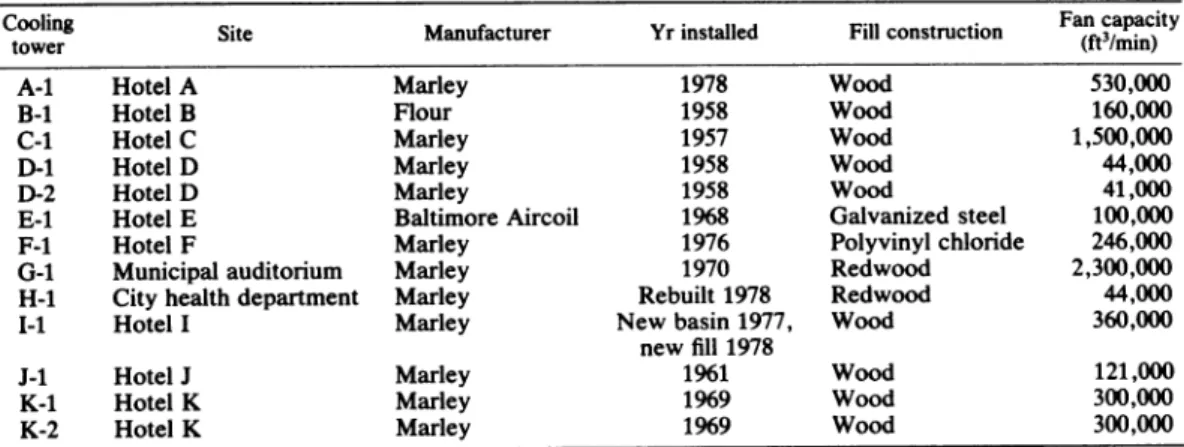
Thirteencoolingtowersweresurveyed (Table
1). All but one (cooling tower F-1) received makeup water from the Dallas municipal
sys-tem.The coolingtowershad been built by three differentmanufacturersand installed in the peri-od 1957 to 1978; all contained wood, steel, or
polyvinyl chloride asfill material. Zerotothree of six classes ofdisinfectant agents wereused.
At least one agent was given at recommended peak concentrations in 9 of the 11 towers in which agentswereused (coolingtowersI-1 and J-1 were nottreated), atthe recommended
fre-quencyin 5 of11, and in accordance with both recommendations in 4 of 11. All of these 11 towerswere regularly treated with disinfectant
agents(Table 2).
L. pneumophila was isolated from 7 cooling
towers-6 of the 13sampled in September and 4 of the 10sampled in December (Table 3). Use of
a disinfectant effective against L. pneumophila
inlaboratorytestsdidnotpredict the results of cooling-tower water cultures even when the recommended schedule of treatment was
fol-lowed (Table 3). In all, 6 of the 11 specimens from towers treated with putatively effective agentswere positive, aswere 2 of4 specimens from towers treated with agents deemed to be ineffective, 2 of4 fromtowers nottreated with
anyagent,and0of4from towers treated withan
agentof unknown efficacy. Three of fivetowers
positive in September were also positive in
December, whereas onlyoneof fivetowersthat
was culture negative in September was culture
positive in December. Basin temperatures in September ranged from 24 to 31°C, and in De-cemberthey ranged from 7to 27°C; water tem-peraturesinculture-positivetowersweresimilar tothoseinculture-negative towers.Noneof the physical characteristics listed in Table 1 distin-guished culture-positive cooling towers from culture-negative towers.
It is important to identify biocidal agents
effective againstL.pneumophila in cooling
tow-ersandevaporative condensers for several rea-sons.First,as weobserved in this investigation,
L. pneumophila is a common environmental
contaminant (8, 13). Second, cooling toweror
evaporative condensercontamination
occasion-allypresentsan important public health hazard
(3, 11). Third, coolingtowersconstantlyexpose
tremendous volumes of airto recirculating
wa-ter,creatingaerosols (12). Studies of drift froma
modern 18-m-tall mechanical-draft cooling
tow-erwith anexitvelocity of 33 km/h have shown thatapproximately 75% of aerosolized particles
arefrom1to5,um in diameter and that sentinel bacteria can be recovered 1,600 m downwind
(1). Therefore, since L. pneumophila can be
transmitted in air(9) and theseasons ofcooling
tower usage and legionellosis are similar (5),
identifying disinfectant agents effective against L. pneumophila may provide a means of
pre-venting some casesoflegionellosis.
Until thepresentinvestigation,theonly avail-able information about the efficacy of biocidal agents against L. pneumophila was based on
laboratory tests (15) and on chlorination of a
cooling tower shown to be the source of a
Legionnaires disease outbreak (2).In the
labora-TABLE 1. Coolingtowerdataa
tower Site Manufacturer Yrinstalled Fill construction
Fan/capacity
A-1 HotelA Marley 1978 Wood 530,000
B-1 Hotel B Flour 1958 Wood 160,000
C-i Hotel C Marley 1957 Wood 1,500,000
D-1 Hotel D Marley 1958 Wood 44,000
D-2 HotelD Marley 1958 Wood 41,000
E-1 HotelE Baltimore Aircoil 1968 Galvanized steel 100,000 F-1 HotelF Marley 1976 Polyvinylchloride 246,000 G-1 Municipalauditorium Marley 1970 Redwood 2,300,000 H-1 Cityhealthdepartment Marley Rebuilt 1978 Redwood 44,000 I-i HotelI Marley New basin1977, Wood 360,000
newfill 1978
J-1 HotelJ Marley 1961 Wood 121,000
K-1 HotelK Marley 1969 Wood 300,000
K-2 HotelK Marley 1969 Wood 300,000
aAll dataobtained in 1978 from sites inDallas,Tex.
TABLE 2. Actual and recommendeduseof biocides incooling towers
Dayssince last Recommendeduse
Estimated F f usebefore
Coolingtower Biocide peakconcn
usen
(o978)
September Peak Frequency(mg/liter) us 17)
specimencon,(g
Frqeycollection concn, (mg/ (per wk) A-1 Quaternary ammonium 26 Once/wk 5 6-13 Once
Tri-n-butyl
tin 5 Once/wk 5 1-3 OnceB-1 Chlorine 6 Once/wk 6 19 Once
Quaternary ammonium 10 Once/wk 4 21 Once C-i Quaternaryammonium 18 Once/wk 2 6-i13 Once Tri-n-butyl tin 4 Once/wk 2 1-3 Once Chlorine 3 Once/mo <30 2-14 As needed D-1, D-2 Quaternary ammonium 7-10 Once/wk 3 1-12 Twiceor asneeded E-1 Quaternary ammonium 53 Once/yr 51 3-5 Twiceor asneeded F-1 Alkyl propanediamine 10 Once/2 wk <14 8-12 Onceor asneeded
(until 15 Quaternary ammonium 4 Once/2 wk <14 3-5 Twiceor asneeded November)
F-1 Pentachlorophenol 13-53 Once/10days NAa 50 Onceor asneeded (after 15
November)
G-1 Pentachlorophenol 1 Once/wk <7 10-20 Once H-1 Pentachlorophenol 60 Once/2mo 64 10-20 Once
I-1 None NA NA NA NA NA
J-1 None NA NA NA NA NA
K-1, K-2 Methylenebisthiocyanate 3 Twice/yr <180 1-6 Twice
aNA, Notapplicable.
tory, Skaliy and colleagues exposed the
Phila-delphia1strain ofL.pneumophila, suspended in steriletap water at aconcentration of
105
to106
viable cells per ml, to six disinfectants at threeconcentrations (corresponding tothe
manufac-turer's recommended initial and maintenance concentrations andonehalf of therecommended maintenance concentration) for as long as 168 h (15). Three disinfectants (chlorine,
2,2-dibro-monitrilopropionamide, and quatemary ammo-nium compounds) were rapidly effective at all concentrations tested (15). In the only instance offield testing of which we are aware, continu-ouschlorine treatment to maintain a free residu-alofat least 3 mg/liter was associated with a
7-day lag between initiation of treatment and
elimination of L. pneumophila from the
cooling-tower water (2), despite the observation that
chlorineat aconcentration of 3.3 mg/liter (free
residual) immediately eliminated all viable L.
pneumophila in the laboratory (15). This infor-mation further supports the need to identify
biocidal agents effectiveagainstL.pneumophila incoolingtowersand evaporativecondensers.
In the present investigation, we found no
association betweentheisolation ofL. pneumo-phila and the efficacy of disinfectant agents as
determined in the earlier laboratory tests (15),
despite the fact that 4of11 coolingtowershad
been treated according to the manufacturer's
recommendations. Manufacturers'
recommen-dationsarebasedonempiric observation ofthe
concentrationneeded topreventinterferenceby
microbiological organisms with the efficient
functioning ofair-conditioning systems (12). In our investigation,L. pneumophila was isolated
fromtowerstreated withquaternary ammonium
compounds alone, quaternary ammonium
com-pounds in combination withchlorine, or quater-nary ammonium compounds in combination
withtri-n-butyl tin (an agent of unknown effica-cyagainst this organism). Althoughthe
concen-trations ofL. pneumophila or biocides in the cooling-tower water specimens were not
TABLE 3. Biocidalagents, water basintemperatures, and cultureresults of coolingtowers Results for specimens collected in:
September December
Cooling towerCoolingtower
~~~~Culture
CultureBasin result Basin
result
temp
(°C)
(serogroup) temp(CC)
(serogroup) Effectiveabiocidalagents,recommendedschedule A-1 NAb + (1) 23 +(1) B-1 NA + (1, 5) 9 +(1, 5) C-i 31 - 11 -D-1 25 + (1, 5) NA NA D-2 26 - NA NA
Effectivea biocidal agents,
improperschedule
E-1 27 - 7
-F-1(before 15 November) 24 + (1) NA NA
Ineffective' biocidal agents
F-1(after15November) NA NA 27 + (1) G-1 NA - NA + (1) H-1 NA - NA NA Noagent I-1 27 + (1) NA -J-1 NA + (1) 11
-Agentof uncertainaefficacy
K-1 27 - 20
-K-2 28 - 17
-IBasedonlaboratorystudies(see text).
bNA, Not
available.
sured,the observation that three of six culture-positive cooling towers sampled in September had been treated in the preceding week with recommendedconcentrations of agents that had been effective in the
laboratory
suggests that these agents would not be effective in similar towers. Previouslaboratory studies ofL. pneu-mophila sensitivities of biocidal agents failedtopredict culture results from treated cooling tow-ers. It is
clearly important
to testpotentially
effectivebiocidal agents andcombinations in the field to determine whether they preventcon-tamination withL.pneumophila.
Weacknowledgetheassistanceof E. LowellBerry,
Depart-mentofPublicHealth,andGeorge Hintgen, Environmental Health andConservation, CityofDallas;CharlesR. Webb,
Jr.,and HerbertMunson, Tex.;DepartmentofHealth; Wat-sonS. Keeneyand AllanTalbot,Marley Co., Dallas, Tex.;
WallaceA. Rhodes, Jr., RhodesConsultants, Atlanta; and LindaCorcoran, StellaA. J.Goings,WilliamT.Martin, and George K. Morris, Bacterial Diseases Division, Center for InfectiousDiseases,Centers for Disease Control.
LITERATURECITED
1. Adans,A.P., J. C. Spendlove,E. C. Rengers,M. Gar-bett,and B.G.Lewis.1979. Emission of microbial
aero-solsfrom vents ofcoolingtowers.I. Particle size, source strength and downwind travel. Dev. Ind. Microbiol. 20:769-779.
2. Band, J. D., M. LaVenture, J. P. Davis, et al. 1981. Epidemic Legionnaires' disease: airborne transmission downachimney.J.Am.Med. Assoc.245:2404-2407. 3. Cordes, L. G.,D. W.Fraser, P.Skally,etal. 1980.
Le-gionnaires'disease outbreakat anAtlanta, Georgia, coun-tryclub: evidence forspreadfromanevaporative con-denser. Am. J.Epidemiol. 111:425-431.
4. Dondero,T.J., Jr.,R.C.Rendtorff,G.F.Mallison,etal. 1980. An outbreak ofLegionnaires' disease associated withacontaminated air-conditioning coolingtower. N. Engl. J. Med. 302:365-370.
5. Enad,A.C.,III,D. W.Fraser,B. D.Plikayts,T. F. Tsal,G.Storch, and C. V. Broome. 1981.Sporadic legion-ellosisin theUnitedStates: the first thousandcases.Ann. Intern. Med. 94:164-170.
6.Feeley, J.C.,R.J.Gibson,G. W.Gorman,N. C. Lang-ford, J.K.Rasheed,D. C.Mackel,and W. B.Baine.1979. Charcoal-yeastextractagar:primaryisolation medium for Legionella pneumophila.J.Clin. Microbiol. 10:437-441. 7. Feeley, J.C., G.W. Gorman, R. E. Weaver, D.C.
Mackel,andH. W.Smith. 1978.Primaryisolation media for Legionnaires disease bacterium. J. Clin. Microbiol. 8:320-325.
8. Fllermans,C.B., W. B. Cherry,L.H. Orrbson, and L. Thacker. 1979. Isolation ofLegionellapneumophilafrom nonepidemic-relatedaquatichabitats.Appl.Environ. Mi-crobiol. 37:1239-1242.
9. Fraser,D. W.1980. Legionellosis: evidence ofairborne transmission. Ann. N.Y. Acad. Sci. 353:61-66.
APPL.ENVIRON. MICROBIOL.
10. Fraser, D. W., T. F. Tsai, W. Orenstein, et al. 1977. Legionnaires' disease: description ofanepidemic of
pneu-monia. N.Engi.J. Med. 297:1189-1197.
11. Glick, T.H., M. B. Gregg, B. Berman, G. Mallison, W.W.Rhodes,Jr., and I. Kassanoff.1978.Pontiac fever:
anepidemic of unknown etiology inahealthdepartment.
I.Clinical andepidemiologicaspects.Am.J.Epidemiol.
197:149-160.
12. Miller, R.P. 1979.Coolingtowersandevaporative
con-densers. Ann. Intern. Med. 90:667-670.
13. Morris, G.K., C. M. Patton, J. C. Feeley,et al. 1979.
Isolation of the Legionnaires' disease bacterium from environmentalsamples.Ann.Intern.Med. 90:664-666. 14. Moss, C.W., R. E. Weaver, S. B. Dees, and W. B.
Cher-ry.1977. Cellularfatty acid composition of isolates from Legionnairesdisease. J. Clin. Microbiol. 6:140-143. 15. Skaliy,P.,T.A.Thompson, G. W. Gorman, G. K.
Mor-ris,H. V.McEachern,and D.C. Mackel.1980. Labora-torystudies ofdisinfectants against Legionella pneumo-phila. Appl.Environ. Microbiol. 40:697-700.