Evolution, Bounded Rationality
and Institutions
Inauguraldissertation
zur
Erlangung des Doktorgrades
der
Wirtschafts- und Sozialwissenschaftlichen Fakultät
der
Universität zu Köln
2017
vorgelegt
von
Dipl. Math. Johannes Buckenmaier
aus
List of Tables v
List of Figures vi
Introduction and Summary vi
1 Trader Matching and the Selection of Market Institutions 5
1.1 Introduction . . . 5
1.2 Related Literature . . . 8
1.3 The Model . . . 9
1.3.1 Matching and Institutions . . . 9
1.3.2 Behavioral Assumptions . . . 13
1.3.3 Learning Dynamics . . . 17
1.4 Analysis . . . 19
1.4.1 Absorbing States . . . 19
1.4.2 Stochastic Stability . . . 20
1.4.3 The Stability of Centralized Institutions . . . 22
1.4.4 Matching-Efficient Institutions . . . 23
1.4.5 Optimism, Pessimism, and Decentralized Institutions . 25 1.5 Conclusion . . . 28
Appendix 1.A: Proofs . . . 28
2 Cournot vs. Walras: A Reappraisal through Simulations 36 2.1 Introduction . . . 36
2.2.1 The Discrete Cournot Oligopoly . . . 44
2.2.2 Imitation with Bounded Memory . . . 46
2.3 The Simulations . . . 48
2.3.1 Simulation Protocol . . . 48
2.3.2 The Simulation Parameters . . . 50
2.4 Computational Results . . . 53
2.4.1 Cournot, Walras, or Both? . . . 54
2.4.2 The Shape of the Invariant Distribution . . . 56
2.4.3 Regression Analysis . . . 63
2.5 Discussion . . . 69
3 Cognitive Sophistication and Deliberation Times 71 3.1 Introduction . . . 71
3.2 The Model . . . 75
3.2.1 Related Models . . . 77
3.3 Experimental Design . . . 79
3.3.1 The Games . . . 79
3.3.2 Design and Procedures . . . 83
3.4 Results . . . 85
3.4.1 Results for the Beauty Contest Game . . . 86
3.4.2 Results for the 11-20 Games . . . 88
3.4.3 Effect of Incentives in the 11-20 Game . . . 93
3.5 Additional Observations . . . 98
3.5.1 Other Level-0 Specifications in the 11-20 Game . . . . 98
3.5.2 A Social Preference Variant - SOCP . . . 101
3.6 Discussion . . . 102
Appendix 3.A: Sequence of Games . . . 104
Appendix 3.B: Behavior in the 11-20 Games . . . 105
4 Institutional History, Leniency and Collusive Tax Evasion 106 4.1 Introduction . . . 106
4.2 Experimental Design . . . 110
4.3 Results . . . 116
4.3.1 Collusive Behavior . . . 117
4.3.2 What Are the Drivers of Collusion? . . . 121
4.3.3 Effects on Tax Evasion . . . 129
4.4 Discussion and Conclusion . . . 131
Appendix 4.A: Theoretical Analysis of the Bribery Game . . . 133
Appendix 4.B: Summary Statistics . . . 136
Appendix 4.C: Additional Analysis . . . 137
5 Timing, Uncertainty and Institutional Deterrence 138 5.1 Introduction . . . 138
5.2 Theoretical and Empirical Background . . . 141
5.3 Design and Hypotheses . . . 143
5.3.1 Experimental Design . . . 143
5.3.2 Experimental Procedures . . . 146
5.3.3 Hypotheses . . . 147
5.4 Results . . . 151
5.5 Discussion and Conclusion . . . 156
List of Tables
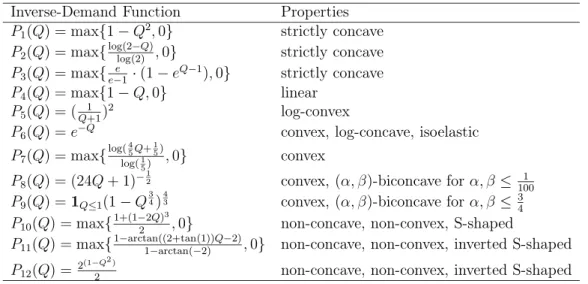
2.1 Inverse-demand functions used in the simulations. . . 50
2.2 Cost functions used in the simulations. . . 51
2.3 Range of parameters used in the simulations. . . 52
2.4 Pseudo-code of the N-player learning model. . . 55
2.5 Overview average and minimum fraction of time spent within the interval [qC, qW]. . . 56
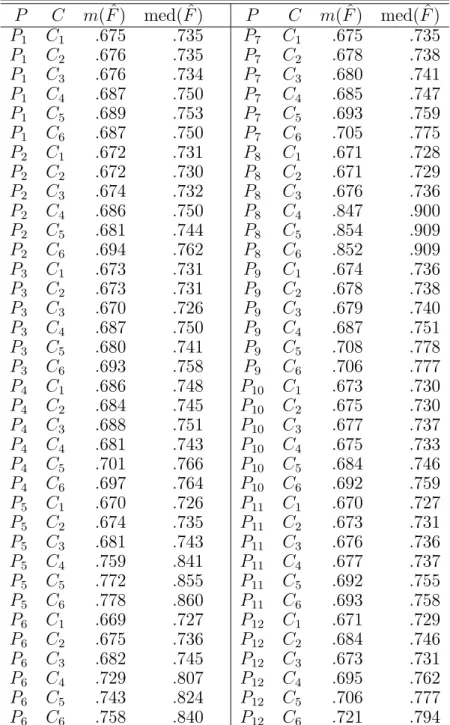
2.6 Overview average quantity and median quantity. . . 61
2.7 Linear regressions on average and median quantity. . . 64
2.8 Fractional logit regressions. . . 67
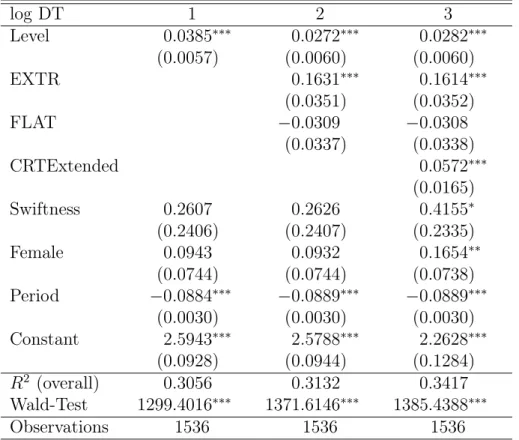
3.1 Linear regressions onlog DT for the beauty contest game. . . 87
3.2 Random effects log DT regressions on level (full sample). . . . 89
3.3 Random effects log DT regressions on level. . . 91
3.4 Random effectslogDT regressions with controls for the payoff structure. . . 92
3.5 Random effects Tobit regressions of level with controls for bonus and cost. . . 94
3.6 Random effects log DT regressions with interaction of level and bonus. . . 95
3.7 Random effects panel log DT regressions with interaction of level and cost. . . 97
3.8 Lower bounds onp0 . . . 99
3.9 Pseudo-randomized sequences of the 11-20 games used in the experiment. . . 104
4.1 Overview over the treatments and number of subjects assigned to each treatment. . . 114
bribe size. . . 137
5.1 Overview of timing of resolution of uncertainty and punish-ment in the different treatpunish-ments. . . 145 5.2 Total Cheating using GLS Random Effects Regressions . . . . 153 5.3 Conditional Cheating using OLS . . . 155 5.4 Predictions for Total Cheating under DEU . . . 159 5.5 Predictions for Total Cheating under UAE . . . 159
List of Figures
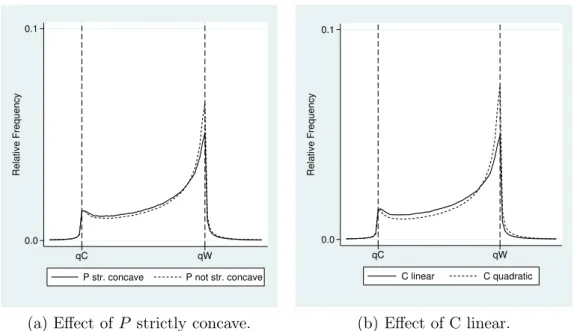
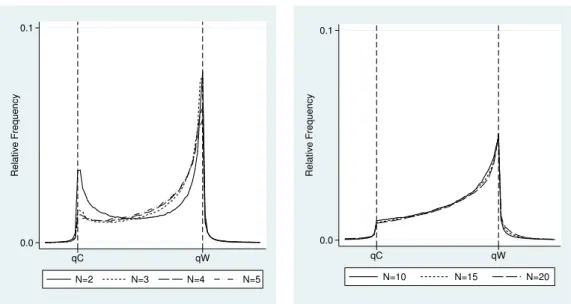
2.1 Effect of strict concavity ofP and strict convexity of C. . . 58
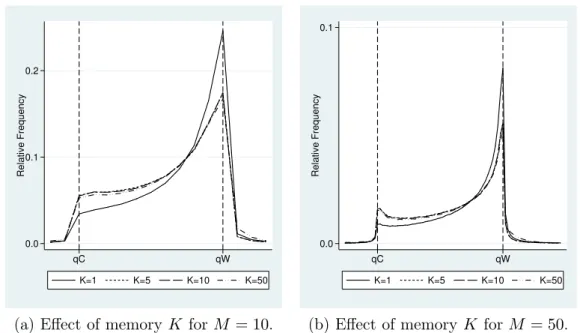
2.2 Effect of memory. . . 59
2.3 Effect of number of firmsN. . . 60
2.4 Effect of noise. . . 66
3.1 Generalized 11-20 game. . . 80
3.2 Payoff structure for the different variants with low cost. . . 81
3.3 Payoff structure for the different variants with high cost. . . . 83
3.4 Choices and deliberation times in the beauty contest game. . . 86
3.5 Payoff structure for SOCP in the low (top panel) and high (bottom panel) cost version. . . 102
3.6 Distribution of choices in the 11-20 games. . . 105
4.1 Representation of the bribery game (with leniency). . . 111
4.2 Average collusion in NoLENand LEN. . . 118
4.3 Average collusion in NoL-L and L-NoL. . . 120
4.4 Frequency of bribes offered and bribe acceptance rate inNoLEN and LEN. . . 123
4.5 Frequency of bribes offered and bribe acceptance rate in NoL-L and L-NoL. . . 125
4.6 Bribe size over rounds across treatments. . . 128
4.7 Amount of taxes finally paid over rounds and across treatments.130 5.1 Timeline of the experiment for each treatment. . . 144
5.2 Average Total Cheating. . . 152
This dissertation consists of five self-contained research papers that cover theoretical work, simulation-based research, and experimental studies. My research interests are mainly focused on two interrelated areas within eco-nomics. One area is concerned with the economic consequences as well as the foundations of boundedly rational behavior. The other area is more spe-cific and concerns the design of institutions and how they can be used to shape behavior and align incentives. The first chapter belongs to both areas, Chapters 2 and 3 cover topics from the former area, whereas the last two chapters contribute to the latter area. Chapter 1 concerns the role of trader matching with regard to the selection of market institutions by boundedly rational traders. Chapter 2 presents results on the stability of the Cournot-Nash and the Walrasian equilibrium under imitative behavior. Chapter 3 presents a model linking response times and iterative thinking and provides experimental evidence regarding the underlying processes of iterative think-ing. Chapter 4 investigates the effects of a leniency mechanism on collusive bribery and tax evasion. Chapter 5 asks how the timing of punishment and the timing of the resolution of uncertainty affect deterrence of illicit behav-ior. In the remainder of this section I present a brief introduction for each chapter and summarize the main findings.
Chapter 1 is the result of joint work with Carlos Alós-Ferrer (University of Cologne) and has been published under the title “Trader Matching and the Selection of Market Institutions” in the Journal of Mathematical Eco-nomics. We analyze a stochastic dynamic learning model with boundedly rational traders who can choose among trading institutions with different matching characteristics. The framework allows for institutions featuring multiple prices (per good), thus violating the “law of one price.” We find that centralized institutions are stochastically stable for a broad class of dy-namics and behavioral rules, independently of which other institutions are available. However, some decentralized institutions featuring multiple prices
can also survive in the long run, depending on specific characteristics of the underlying learning dynamics such as fast transitions or optimistic behav-ior. Work on this paper was shared among the authors as follows: Carlos Alós-Ferrer 50%, Johannes Buckenmaier 50%.
Chapter 2 is the result of joint work with Carlos Alós-Ferrer (University of Cologne) and has been published under the title “Cournot vs. Walras: A Reappraisal through Simulations” in the Journal of Economic Dynam-ics and Control. Best-reply behavior in Cournot oligopolies generally leads to Cournot-Nash equilibrium, but imitative behavior selects the Walrasian equilibrium as the unique stochastically stable state. Previous work (Alós-Ferrer, 2004) showed that in the presence of memory, imitative behavior leads to a non-trivial dynamics selecting all quantities between the Cournot and Walrasian outcomes. However, the scope of previous results was limited to specific assumptions on demand and cost functions, and did not provide information on the shape of the distribution of outcomes. We use computa-tional simulations to address these limitations. We show that the selection result for non-trivial memory holds beyond the set of well-behaved Cournot games previously analyzed. Further, we find that, in Cournot games, the limit distribution of long-run outcomes is highly skewed towards the Wal-rasian quantity. Although longer memory increases the importance of the Cournot equilibrium, the competitive outcome remains the dominant predic-tion. Work on this paper was shared among the authors as follows: Carlos Alós-Ferrer 50%, Johannes Buckenmaier 50%.
Chapter 3, entitled “Cognitive Sophistication and Deliberation Times,” is the result of joint work with Carlos Alós-Ferrer (University of Cologne). Cognitive capacities differ among individuals. Models of iterative thinking put forward heterogeneity in the depth of reasoning as a source of individ-ual differences in behavior. So far there has been little direct evidence that sophistication (depth of reasoning) corresponds to cognitive effort. Choice data alone cannot provide such evidence, hence additional evidence is neces-sary. We argue that deliberation times can provide such evidence. We pro-vide a simple model linking cognitive sophistication and deliberation times, taking into account stylized facts from the psychophysiological literature on
reasoning. We then test the predictions in an experiment. We find longer deliberation times for choices commonly associated with more steps of rea-soning in games where iterative thinking is salient, confirming the prediction of our model that deliberation time is increasing in cognitive sophistication. However, this relation breaks down when iterative thinking is not natural or when there is a conflict between alternative decision rules. Further, we find that larger incentives decrease the time required to perform a single step of reasoning, which, in line with our predictions, is consistent with a closeness-to-indifference effect. If the underlying processes are clearly identified, we observe a strong link between deliberation times and steps of reasoning sup-porting level-k thinking. Additionally, however, deliberation times also allow us to detect when other elements enter the picture, and hence are also helpful for further theory development. Work on this paper was shared among the authors as follows: Carlos Alós-Ferrer 50%, Johannes Buckenmaier 50%.
Chapter 4, entitled “Institutional History, Leniency and Collusive Tax Evasion,” is the result of joint work with Eugen Dimant (University of Penn-sylvania) and Luigi Mittone (University of Trento). We investigate the effects of an institutional mechanism, that incentivizes tax payers to blow the whistle through a leniency program, on collusive corruption and tax compliance. In our experiment, we nest collusive corruption within a tax evasion framework. We not only study how the presence of such a mechanism affects behavior, but also investigate the role of institutional changes, that is, the dynamic ef-fect caused by the introduction and the removal of leniency. We find that in the presence of a leniency mechanism subjects collude less, accept less bribes and pay more taxes, while we find no evidence that it encourages bribe of-fers. Further, our results show that the introduction of the opportunity to blow the whistle decreases collusion, decreases the bribe acceptance rate, and increases the tax yield collected, while not encouraging bribe offers. In con-trast, the removal of the institutional mechanism does not cause effects in the opposite direction, suggesting a positive spillover effect of leniency that persists even after the mechanism has been removed. Work on this paper
was shared among authors as follows: Johannes Buckenmaier 33%, Eugen Dimant 33%, Luigi Mittone 33%.
Chapter 5, entitled “Timing, Uncertainty and Institutional Deterrence,” is the result of joint work with Eugen Dimant (University of Pennsylvania), Ann-Christin Posten (University of Cologne) and Ulrich Schmidt (Univer-sity of Kiel). Reducing criminal acts in society is a crucial duty of gov-ernments. Establishing punishment structures to attain this goal involves high costs. Typically, both theorists and practitioners resort to the adjust-ment of severity and/or certainty of punishadjust-ment as effective deterrents of criminal behavior. One more cost effective, but scientifically understudied mechanism for effective deterrence is the swiftness or celerity of punishment. We carry out a controlled economic experiment to study the effectiveness of swiftness of punishment along the following two dimensions: the timing of punishment and the timing of the resolution of uncertainty (regarding the punishment). Our results indicate an inverted U-shaped relation between the delay of punishment, the delay of uncertainty resolution regarding the detection of deviant behavior, and any resulting deterrence. In fact, insti-tutions that either reveal detection and impose punishment immediately or maintain uncertainty about the state of detection and impose punishment sufficiently late deter individuals at equal rates. Further, we find that the same institutional settings that are capable of reducing recidivism are also the ones deterring deviant behavior in the first place. Our results yield pol-icy implications for designing effective institutions in mitigating misconduct and reducing recidivism. Work on this paper was shared among the authors as follows: Johannes Buckenmaier 25%, Eugen Dimant 25%, Ann-Christin Posten 25%, Ulrich Schmidt 25%.
1.1 Introduction
Market institutions come in many flavors. In many markets, institutions with different characteristics exist, even for the same good. Those can be formal, as e.g. specific Business-to-Business (B2B) or Business-to-Consumer platforms, middlemen agencies, or local markets for perishable products (fish and produce), or informal, as e.g. exchange arrangements, black markets, or the set of particular conventions surrounding real-estate and rental markets in certain countries (group-tenant vs. individual visits). The characteristics of such market institutions in turn influence market outcomes in terms of efficiency, surplus distribution and convergence to market-clearing outcomes. It is hence important to understand what promotes coordination on a specific institution.
In this work, we build upon the evolutionary approach to the selection of trading institutions, and in particular on Alós-Ferrer and Kirchsteiger (2010, 2015) and Alós-Ferrer et al. (2010). The essence of the approach is the study of long-run stability. Suppose a host of alternative institutions are present in a market, whatever their origin might be. Are there any partic-ular institutions whose survival is more likely in the long run? To answer these questions, we analyze the selection and stability of market institutions when boundedly rational traders employ certain “rules of thumb” to decide at which competing institution to trade. The assumption of bounded ra-tionality seems reasonable since, due to the complexity of the evaluation of institutional characteristics, rational learning is rather implausible. Follow-ing the evolutionary approach, we will concentrate on the long-run outcomes of the discrete-time, stochastic dynamical system which results when traders revise their institution choices over time on the basis of the behavioral rules.
Chapter 1 Trader Matching and the Selection of Market Institutions
We use the notion of stochastic stability in a dynamic learning framework with vanishing mistakes (Kandori et al., 1993; Young, 1993; Blume, 1993; Ellison, 2000) to determine which institutions survive in the long run.
For practical purposes, a market institution can be defined as a set of trad-ing rules and conventions which determine the matchtrad-ing and price formation process, i.e. who trades with whom and at what price. As most of the existing literature, Alós-Ferrer and Kirchsteiger (2010, 2015), and Alós-Ferrer et al. (2010) focused on the price-formation part, analyzing market selection when institutions generate possibly biased prices (implying rationing) but feature a single price (per good) only. However, institutions also influence who trades with whom. This paper takes the next natural step and concentrates on the trader matching process. Specifically, we study whether traders learn to coordinate on centralized, market-clearing institutions or whether other in-stitutions can survive in the long run, in a framework where inin-stitutions are solely characterized by a matching mechanism. Hence, we allow for violations of the law of one price, that is, we study the stability of general institutions including decentralized non-market clearing ones where a single good might be traded at different prices within a single institution. In order to isolate the effects of matching, however, we concentrate on the effects arising from differences in the matching mechanisms and abstract away from any other complications. In particular, and unlike in the works cited above, institutions will be characterized by market clearing (within each institution), excluding both rationing and price biases. Further, we exclude trader heterogeneity and consider a model with homogeneous buyers and sellers.
We hence identify each institution with a certain matching pattern for the traders who choose to use it. Examples include the “bazaar” where buy-ers and sellbuy-ers are randomly matched, auction houses where each good is offered to a subgroup of buyers, and of course centralized markets. Our first result is that centralized institutions are always stable in the long run. This clear-cut result is conceptually in line with the stability of market-clearing institutions in Alós-Ferrer and Kirchsteiger (2010, 2015). It is a rather strong result, because it holds independently of the number and properties of other available institutions, of the characteristics of trader demand and supply, of
the behavioral rules within the general class we consider, and of the exact specification of revision opportunities (and hence speed) in the dynamics.
Stochastic stability, however, only means long-run survival, and not nec-essarily the identification of a unique prediction. It turns out that other decentralized institutions can also survive in the long run. Unlike in the case of a centralized institution, we also show that their survival depends on, e.g., the characteristics of the behavioral rules and the specification of the dynam-ics. In keeping with our aim for generality, we ask ourselves whether general conditions can be identified without specifying concrete examples of behav-ioral rules, dynamics, and market characteristics. Our second main result identifies a general necessary condition for stochastic stability, which we term efficiency. Informally speaking, a trading institution is matching-efficient if it leaves no unmatched trader when all or almost all traders have already coordinated on it. Although many institutions are matching-efficient, many others, as e.g. a bazaar defined merely by random matching, are not, and hence the condition does have cutting power.
Interestingly, under a strengthening of our assumptions on revision op-portunities (requiring the dynamics to be fast enough), matching-efficiency fully characterizes the set of stochastically stable institutions. However, we also show that without this strengthening, matching-efficient institutions can fail to be stochastically stable in general. Hence, the take-home message is that, while full centralization ensures stochastic stability, other institutions might also survive, and a full characterization thereof for specific markets will require active market design, in the sense that institutions will need to be tailored to the specifics of trader behavior and other relevant market characteristics.
The article is structured as follows. Section 1.2 briefly reviews the re-lated literature. Section 1.3 describes the elements of the model, i.e. the characteristics of market institutions, the behavioral assumptions underlying institution choice by (boundedly rational) traders, and the actual (discrete-time, stochastic) learning dynamics. Section 1.4 contains the results, start-ing with an analysis of the stochastic stability of centralized institutions and proceeding to the conditions under which decentralized institutions might be
Chapter 1 Trader Matching and the Selection of Market Institutions
stochastically stable. Proofs are relegated to Appendix 1.A.
1.2 Related Literature
This article belongs to a line of research started in Alós-Ferrer and Kirch-steiger (2010), which studied the selection of alternative market institutions in a multi-good, general equilibrium setting, and continued in Alós-Ferrer and Kirchsteiger (2015), in a partial equilibrium buyers-sellers model. The main result of those works is that, even if alternative (biased) market institu-tions exist, market-clearing (unbiased) instituinstitu-tions are always stochastically stable. However, other, alternative institutions might also be stochastically stable and hence survive in the long run, giving rise to a multiplicity of insti-tutions. Which other institutions survive depends on many factors, ranging from the elasticity of individual demands and the heterogeneity of the traders to the speed of the particular dynamics considered. Since this implies that the design of institutions becomes meaningful, Alós-Ferrer et al. (2010) con-sidered fully rational market designers who actively design alternative mar-ket platforms, which are then chosen by boundedly rational traders.1
The present contribution differs from Alós-Ferrer and Kirchsteiger (2010, 2015), and Alós-Ferrer et al. (2010) in that we allow for violations of the law of one price and study the effects of different trader matching within an institution, but we exclude the possibility of price biases and rationing.
The analysis here and in Alós-Ferrer and Kirchsteiger (2010) is also re-lated to the literature on the stability properties of perfectly competitive behavior in learning models with boundedly rational agents. Those works (Alós-Ferrer and Ania, 2005; Mandel and Gintis, 2014) provide a learning-based foundation for perfectly competitive behavior when the market insti-tution is fixed. In contrast, we do not consider the stability of outcomes by themselves, but rather the stability of market institutions which chan-nel those outcomes. Hence, one of our aims is to examine the stability of
1
Hence that work built a bridge to the “asymmetric rationality program” where rational firms are confronted with boundedly rational consumers (Ellison, 2006; Spiegler, 2006; Gabaix and Laibson, 2006). See also Shi (2015).
“Walrasian,” centralized institutions allowing for full market clearing.
Conceptually, the current paper bridges the strand of the literature de-scribed above and the literature on evolutionary dynamics and surplus divi-sion. The latter asks how cooperative game solutions can be implemented via learning processes, either for bilateral trading (Nax and Pradelski, 2015; Klaus and Newton, 2016) or for general cooperative games modeling surplus sharing among more than two players (Agastya, 1999; Newton, 2012). Our work is complementary to those in that we examine the evolution of institu-tions as characterized by matching mechanisms, and, hence, the evolution of the matching process itself. However, there are also similarities in the results. The works just mentioned typically select outcomes within the core. Here and in Alós-Ferrer and Kirchsteiger (2010, 2015), we obtain that states where all traders coordinate on a single centralized institution are stable, a result which can be related to the core as no coalition of traders could improve (in the sense of increasing overall efficiency) by moving away.
1.3 The Model
There is a single homogeneous good to be traded by a finite population of traders consisting of buyers and sellers. We consider a buyers-sellers model with a fixed set B of n ≥2 homogeneous buyers and a fixed set S of m≥2 homogeneous sellers, where traders’ roles are fixed and predetermined. We view this setup as reasonably general while ensuring tractability.
Our model has three components, which will be discussed in three sepa-rate subsections below. First, we need to specify the characteristics of market institutions and how trade is conducted within an institution. Second, we will detail the behavioral assumptions underlying institution choice by (bound-edly rational) traders. Third, we will describe the actual (discrete-time, stochastic) learning dynamics.
1.3.1 Matching and Institutions
Buyers and sellers can trade the good at different market institutions. We assume that there is a set of N + 1 different institutions Z = {z0, . . . , zN},
Chapter 1 Trader Matching and the Selection of Market Institutions
and traders can choose at which institution they want to trade. For our purposes, the important part of a market institution is how the matching process is structured within it, and how the trading prices are determined; in other words, who can trade with whom and at what price. That is, we identify an institution with a trading rule that specifies the matching and price formation process. When modeling the matching process we rely on the following notion of a matching.
Definition 1. A matchingfor two (possibly empty) sets X and Y is
• a partition of X, {X0, X1, . . . , Xℓ}, and • a partition of Y, {Y0, Y1, . . . , Yℓ},
such that Xi 6=∅ 6=Yi for alli= 1, . . . , ℓ. A matching isnon-trivialif ℓ ≥1,
or, equivalently, X0 (X and Y0 (Y.
The interpretation is as follows. Given a set of buyers X and a set of sellers Y, all of them present at the same institution, a matching partitions all traders into matching groups or sub-markets(Xi, Yi)fori= 1, . . . , ℓ, while
possibly leaving a subset of buyers X0 and a subset of sellers Y0 unmatched.
Unmatched traders do not trade at all. Buyers in Xi can potentially trade
with sellers in Yi, and vice versa, at a price to be determined by a specific
price formation process that depends solely on Xi and Yi. That is, within
each matching group there will be a unique trading price, but the prices within a single institution can differ across matching groups.
The simplest market institutions could now be defined by assigning a fixed matching to each potential pair of sets (buyers and sellers). Market institutions, however, are rarely fully deterministic. Hence, an institution will rather be defined by a distribution over potential matchings, together with a specific price formation process that determines prices within matching groups. We formally define an institution as follows.
Definition 2. Given a set of buyersB and a set of sellersS, aninstitution
z is characterized by a matching function Mz which, for any two subsets
matchings for Bz and Sz. An institution is non-trivial if suppMz(Bz, Sz)
contains at least one non-trivial matching whenever Bz 6=∅ and Sz 6=∅.
For given subsets Bz ⊆ B and Sz ⊆ S of traders and sellers at an
in-stitution z, a realization of the distribution Mz(Bz, Sz) is hence a matching
(Bz i, Siz)
ℓz
i=0 in the support of Mz(Bz, Sz).
We endow buyers with a common demand function d and sellers with a common supply function s. Demand and supply functions satisfy standard properties as captured by the following assumptions.2
M1. The demand function d:R+ −→R+∪ {∞} is continuous and strictly
decreasing in p, with d(p)>0 for all p≥0 and limp−→∞d(p) = 0.
M2. The supply functions :R+ −→R+ is continuous and (weakly)
increas-ing in p, withs(0) = 0and s(p)>0 for all p >0.
For any realized matching (Bz i, Siz)
ℓz
i=0 , prices pz1, . . . , pzlz at z are
deter-mined by local market clearing, i.e.
|Bz i|d(p z i) =|S z i|s(p z i) for i= 1, . . . , ℓz. (LMC)
Since all buyers are identical (and characterized by the demand function d) and all sellers are identical (and characterized by the supply function s), given the matching, condition (LMC) is enough to describe the results of trading. Under M1 and M2 there always exists a unique, strictly positive price pz
i solving (LMC) for i = 1, . . . , ℓz, which yields demand and supply
strictly above zero. Further, the price pz
i only depends on the buyer-seller
ratio rz
i = |Biz|/|Siz| within the respective matching group (Biz, Siz), and of
course on the shape of the supply and demand functions, which we assume to be fixed. Given a ratio r, we denote the corresponding price byp(r). Note also that p(r)is strictly increasing in r.
Assume buyersBz ⊆B and sellers Sz ⊆S want to trade at institutionz.
The matching function Mz determines all the matchings which occur with
positive probability for Bz and Sz, namely the support of Mz(Bz, Sz) (the
2
Chapter 1 Trader Matching and the Selection of Market Institutions
exact probability is not important for our results). After matching groups have been realized trade takes place in the matching groups at the price specified by (LMC) at group level. Note that under (LMC) traders are not rationed.3
We will assume that z0 ∈ Z is always a centralized market-clearing
in-stitution as follows, i.e., an inin-stitution of this type is always available. This is an institution where all traders are matched in a single group (no trader remains unmatched) and hence trade at the same price. The (single) price at the centralized institution depends only on the number of buyers and sellers that wish to trade there.
Example 1. A centralized institution, denoted z0, matches traders
ac-cording to a fixed matching with ℓ0 = 1, B0z0 = S
z0
0 = ∅, B
z0
1 = Bz0 and
S1z0 =Sz0 (whenever Bz0 6=∅ 6= Sz0). Thus z0 always features a single price
p0 =p(r
0) with r0 =|Bz0|/|Sz0|.
Our definition of market institution, however, is rather general. It in-cludes “classical,” centralized market-clearing institutions as above, but also many others. The following is an example of a different institution that leaves some traders unmatched but still features a unique trading price.
Example 2. Abazaaris any institutionzB that matches buyers and sellers
in pairs and leaves the remaining traders unmatched.
If the number of buyers and sellers at a bazaar are not identical, then this institution leaves some traders unmatched. In this symmetric setting, if trade occurs it does so in many sub-markets (each consisting of one buyer and one seller) but at the same single price given by p(1). There are, however, also institutions that violate the law of one price, as the following, rather stylized, example shows.
Example 3. A double one-to-many institutionis an institutionzD that
always selects a single buyer and a single seller (provided at least two traders 3
For example, Alós-Ferrer and Kirchsteiger (2015) study institutions characterized by a rationing parameter.
of each type are present) and matches all remaining sellers to the singled-out buyer and all remaining buyers to the singled-singled-out seller. Hence the institution selects both a random monopolist and a random monopsonist. If there is only a single buyer (seller), it matches all sellers (buyers) to that single buyer (seller). This institution features at most two matching groups and hence at most two prices. Denote them by pD ≤pD. If there are at least
3 sellers and at least 3 buyers at zD, then we have pD < p(1) < pD and the
institution fails the law of one price.
The double one-to-many institution is, in a sense, as far away from a centralized market-clearing institution as possible. Most of the time zD will
feature two prices, thus violating the law of one price. In sharp contrast to centralization, the spread between the realized prices will often be large.
1.3.2 Behavioral Assumptions
Traders select an institution where they want to trade from the set of feasible institutions Z = {z0, z1, . . . , zN}. The state of the learning dynamics is
completely determined by the choices of traders. Recall that there are n buyers andmsellers, therefore the state spaceΩis given byZn+m. We denote
by ω(k)∈ Z the institution chosen by trader k in state ω ∈ Ω. For a state ω ∈Ω, we write Bz(ω) ={i∈B |ω(i) = z}and Sz(ω) ={j ∈S |ω(j) =z}
for the sets of buyers and sellers currently at z, respectively. The number of buyers and sellers at z is given by nz(ω) =|Bz(ω)| and mz(ω) =|Sz(ω)|,
respectively. We will also denote nz(ω), mz(ω)by nz, mz if no confusion can
arise.
Given ω, the sets Bz(ω) and Sz(ω), z ∈ Z, determine the distribution of
traders among the available institutions. For each institution z, a potential matching realization is an element γz = (Biz, Siz)
ℓz
i=0 ∈suppMz(Bz, Sz). Let
Γ(ω) ={(γz)z∈Z |γz ∈suppMz(Bz(ω), Sz(ω))∀z ∈Z}
be the set of vectors of potential realizations with typical element γ ∈Γ(ω). We then call Ω ={(ω, γ)|γ ∈Γ(ω)}the set of (potential) state-matching pairs.
Chapter 1 Trader Matching and the Selection of Market Institutions
For a given state-matching pair (ω, γ) we say that an institution z is
active if γz is non-trivial, and inactive otherwise. Denote by A(ω, γ) the
set of active institutions at (ω, γ). Further, for each institution z ∈A(ω, γ), let Tz(ω, γ) ={pz1, . . . , pzℓz} be the set of realized prices at z for (ω, γ).
We assume that traders observe the prices at all institutions. From the point of view of an individual traderk, the relevant market outcome at(ω, γ) is given by the pair (p(k), q(k))containing the price at which he trades and the quantity he can trade. In our setting, however, if a trader trades at price p he can trade exactly the quantity he desires (that is, either d(p) or s(p), depending on his role). Thus, traders are never rationed. Hence, it is reasonable to base traders’ behavior on the observation of prices only, since demand and supply given a price will always be fulfilled. Note that prices at a given institution are directly linked to the ratio of buyers to sellers within the institution’s sub-markets through the local market-clearing condition (LMC). Specifically, traders’ behavior in our model is based on the following two main (and minimalistic) assumptions. First, traders prefer trade over no trade. Second, buyers prefer lower prices and sellers prefer higher prices. Of course, these assumptions could be obtained from first principles by postu-lating appropriate utility and profit functions compatible with the supply and demand functions, or alternatively by deriving decisions from consumer and producer surplus. We follow here Alós-Ferrer and Kirchsteiger (2010, 2015) and Alós-Ferrer et al. (2010) and base our behavioral model on these properties only.
We assume that agents look at observed, actually realized outcomes to (myopically) select an institution in the subsequent period. Traders’ be-havior is captured by discrete-time, stochastic behavioral rules, which are mappings specifying the probability of choosing each available institution given the previous market outcome. We will keep the approach as general as possible. In particular, the exact choice probabilities will not be important; rather, the key property of a behavioral rule will be which institutions can be selected with positive probability. Hence, it will be enough for our anal-ysis to specify (families of) behavioral rules through the set Sk(ω, γ) ⊆ Z
pe-riod if the current state-matching pair is (ω, γ). That is, if (ω, γ) occurs at time t, trader k will choose some institution in Sk(ω, γ) in t+ 1, each one
with positive probability. A similar approach was adopted in Alós-Ferrer and Weidenholzer (2014).
An example of a behavioral rule is the Imitate-the-Best-Max (IBM) rule used in Alós-Ferrer and Kirchsteiger (2015). Essentially, for a trader k this rule is specified by definingSk(ω, γ)to be the set of active institutions that are
evaluated best according to some evaluation function reflecting the behavioral fundamentals of the model (e.g., an indirect utility function). While rules of this type will be an example allowed in our analysis, we adopt a more general approach.
Our specification through the sets Sk(ω, γ)already focuses on families of
behavioral rules, since the exact choice probabilities might vary from rule to rule without affecting our results. We allow for even larger classes of be-havioral rules and use an “axiomatic” approach. In other words, rather than focusing on a specific behavioral rule, we allow traders to use any behavioral rule satisfying two general assumptions.
Our first behavioral assumption is that traders prefer trade over no trade, hence traders never switch to inactive institutions if alternative active insti-tutions are available. Recall thatA(ω, γ)denotes the set of active institutions for a state-matching pair (ω, γ).
ACT. Consider an arbitrary trader k and a state-matching pair (ω, γ). If k is matched, or if k is unmatched but there is an active institution z 6=ω(k), thenSk(ω, γ)⊆A(ω, γ).
Matched traders are those currently active, i.e. matched and hence al-lowed to trade. In our setting, matched traders trade positive quantities, hence a switch to an inactive institution will never be beneficial for the trader (at least from his myopic perspective). Under ACT traders never switch to institutions that are inactive at the current state-matching pair as long as there is at least one alternative active institution available. For unmatched traders, ACT only applies if there is actually some active institution other than the one the trader is currently at. The reason is that, if a trader is
Chapter 1 Trader Matching and the Selection of Market Institutions
unmatched but all other institutions are inactive, there is no clear (myopic) advantage to staying in the only active institution for the trader, and requir-ing to stay in the current institution would be unnecessarily restrictive.
For each trader k denote the price at which he trades by p(k)(if he does trade); we abuse notation here by dropping the obvious dependence on(ω, γ). In the absence of rationing, any sensible model based on first principles will lead to the conclusion that buyers prefer low prices and sellers prefer high prices. Following this logic an institution z is “attractive” for a traderk if all the prices realized at z are weakly better for k than p(k), the price at which he currently trades. In this case, a myopic trader will expect not to be worse off at z.
Definition 3. Consider an arbitrary trader k and an institution z 6= ω(k) with set of realized prices Tz at (ω, γ).
• For a matched trader k trading at price p(k), we say z is attractive for k at(ω, γ)if Tz 6=∅and all p∈Tz are weakly better thanp(k)for
k (that is, p(k)≤ p∀p∈Tz if k is a seller, p(k)≥p∀ p∈Tz if k is a
buyer).
• For an unmatched trader k, we say that z isattractive for trader k at (ω, γ) if z is active.
Our second main behavioral assumption states that if an institution z is attractive to some trader in the sense described above this trader will (at least with some positive probability) leave his current institution, for instance (but not necessarily) towards z.4
SELF. Consider an arbitrary trader k and a state-matching pair (ω, γ). If there exists an institution other thanω(k)that is attractive fork, then with positive probabilitykswitches to some active institutionz 6=ω(k), that is, (Sk(ω, γ)\ {ω(k)})∩A(ω, γ) 6= ∅. If k is unmatched and all
4
Requiring the trader to move to z with positive probability wheneverz is attractive would be unnecessarily restrictive. For instance, it would exclude all rules of the Imitate-the-Best-Max type, where the best institution according to some criterion is the only one selected even if there are several attractive ones.
institutions other than ω(k) are inactive, then Sk(ω, γ) = Z, i.e. k has
positive probability of switching to every institution.
On the one hand, SELF is quite conservative in evaluating other insti-tutions because it just requires a trader to leave his current institution with positive probability only if there exists another institution where all prices are “better” for the trader. It is, however, less conservative regarding the eval-uation of the current institution because only the price at which the trader is actually trading is used for comparison purposes (in the sense of Defini-tion 3). That is, the condiDefini-tion incorporates a form of self bias because the trader’s actual decision might occasionally be triggered by the comparison of his own price (outcome) with the outcomes at another institution, neglect-ing outcomes of other traders at his own institution. Note, however, that
SELF is just a sufficient condition for switching institutions with positive probability, but not a necessary one. That is, it only requires that traders do not stay with probability one if an attractive institution exists, but not that they always switch. The probability with which they leave can be very small. That is, SELF still allows for rationalistic rules where traders take all prices into account and perform complex computations to determine their next move, but with some small probability bolt into action if they see that their own price at the current institution is unsatisfactory.
For example, the following behavioral rule would fulfill both ACT and
SELF. Compute the average price at each active institution, taking all prices into account, and move to the one with the best average (largest for sellers, smallest for buyers). In case the current institution is the best according to this criterion, but there exists an attractive institution (in the sense of Defi-nition 3), switch there with a fixed (small) probability δ. If k is unmatched and all institutions other than ω(k) are inactive, then randomize uniformly among all institutions.
1.3.3 Learning Dynamics
We study a dynamic learning model where traders interact repeatedly in discrete timet= 0,1,2, . . .. In each period traders observe all prices realized
Chapter 1 Trader Matching and the Selection of Market Institutions
at all institutions in the previous period. Based on this information each trader k chooses an institution to trade at according to a behavioral rule Sk
(possibly different across traders). Following traders’ institutional choices, matchings and prices are determined at all institutions and demand and supply are realized. At the end of each period the proceeds of trade are consumed. Next period, demand and supply functions are reset, i.e. the game is played recurrently.
Agents are potentially allowed to revise their decisions (choice of institu-tion) in any period, but might uphold their decisions (inertia) in some. The specification of how and when revision opportunities arise is an integral part of evolutionary dynamics. Results that are fragile with respect to minor vari-ations regarding the specificvari-ations of the revision process could be criticized as lacking robustness (see, e.g., Alós-Ferrer and Netzer, 2015). We therefore refrain from imposing a specific form of how revision opportunities arise, but rather consider a general class of random revision processes that satisfy cer-tain “minimal” assumptions, following Alós-Ferrer and Kirchsteiger (2015). Denote by E(k, ω) the event that agent k receives revision opportunity in state ω, and byE∗(k, ω)the event that agent k is the only agent of his type
with revision opportunity at ω. We allow for any specification of revision opportunities that satisfy the following two assumptions. For every traderk and state ω,
D1. P r(E∗(k, ω))>0.
D2. either P r(E∗(k, ω)T
E∗(k′, ω))>0 for any traderk′ of the other type,
or P r(E∗(k, ω)T
E(k′, ω)) = 0 for all suchk′.
The first condition ensures that in any state any trader has positive prob-ability of being able to revise. Further, it requires that there is always a small probability that only one trader is allowed to revise. The second condition implies some form of independence of revision opportunities between buyers and sellers. Specifically, the assumption implies that there is no correlation in the presence of revision opportunities as there would be if, e.g., a pair formed by one buyer and one seller would always receive them together.
One could also consider stronger conditions on the dynamics, at the ex-pense of generality. In particular, consider the following additional assump-tion on revision opportunities.
D3. P r T k∈BE(k, ω) >0and P r T k∈SE(k, ω) >0.
ConditionD3requires that there is always some positive probability that all buyers (respectively all sellers) revise simultaneously. Intuitively, this makes the dynamics relatively quick, since a whole market side might switch in a single period. Dynamics with independent inertia (meaning that in any period every agent has a positive, independent probability of not being able to adjust) satisfy D3, but dynamics with asynchronous learning (meaning that each period a single agent is randomly chosen and only that agent is allowed to revise) not. We will not assume D3, but we will return to this condition later for a particular result.
1.4 Analysis
1.4.1 Absorbing States
We consider a family of learning processes satisfying the assumptions laid out above, that is, a behavioral rule satisfying ACT andSELF together with a revision process satisfyingD1andD2. Given two statesω, ω′ ∈Ω, denote by
P0(ω, ω′) the probability of transition fromω toω′ in one period for a fixed
learning process, which we will refer to as the unperturbed dynamics.5
The transition matrix is given by P0 = [P0(ω, ω′)]
ω,ω′∈Ω. An absorbing set of
the unperturbed dynamics is a minimal subset of states which, once entered, is never abandoned. Anabsorbing state is an element which forms a singleton absorbing set, i.e. P0(ω, ω) = 1.
We first introduce some terminology. A state ω determines the sets of buyers Bz and sellers Sz at each institution z ∈ Z. Thus (Mz(Sz, Bz))z∈Z
induces a probability distribution over vectors of realizations Γ(ω). In what 5
Of course the actual transition probabilities depend on the specific behavioral rule, but in what follows we drop this dependence to increase readability.
Chapter 1 Trader Matching and the Selection of Market Institutions
follows we adopt the notation Pr(Bz
0 = ∅ | ω) to denote the probability
(conditional on the state ω) of the set of matchings of the form γ = (γz)z∈Z
with γz = (Biz, Siz) ℓz
i=0 such that B0z = ∅. Other expressions of this type are
defined analogously. Last, we say an institution z matches all traders at
ω if Pr(Bz
0 ∪S0z = ∅ | ω) = 1, i.e. there is no state-matching pair (ω, γ)
with unmatched traders at z (analogously, we will also speak of institutions “matching all buyers” or “all sellers”).
A particular class of states will be of specific interest. Given an arbitrary institution z, the monomorphic state ωz is the state where Bz = B and
Sz = S, i.e. all traders are at z. Monomorphic states are absorbing states,
provided the institution manages not to leave traders unmatched when all traders choose that institution. The reason is simple. Since all traders are at z, all other institutions are inactive. If all traders at z are matched, by
ACT they will stay at z.
Lemma 1. Let Z be an arbitrary set of institutions. Assume ACT. For every institution z that matches all traders at ωz, the monomorphic state ωz
is an absorbing state.
This result already indicates that in general there will be a multiplicity of absorbing states, at least one per each institution which avoids unmatched traders in case of full coordination. Additionally, in general there might be non-singleton absorbing sets. Absorbing sets and states, however, are just an intermediate and not always necessary step of the analysis, as we are interested in the long-run stability of outcomes. To study the latter, it is not always necessary to characterize the former, especially if techniques along the lines of Ellison (2000) are used.
1.4.2 Stochastic Stability
Our analysis of the learning dynamics follows a stochastic stability approach using methods and concepts introduced by Kandori et al. (1993) and Young (1993). Detailed overviews can be found, e.g., in Samuelson (1997), Fuden-berg and Levine (1998), Young (1998), and Sandholm (2010). In our context,
we aim to analyze the stability of situations where traders coordinate on par-ticular trading institutions. To this purpose, the dynamics is enriched with a perturbation in the form of experiments (or mistakes) in the following way. With an independent, small probability ε > 0, each agent, in each period, might discard the prescriptions of his behavioral rule and experiment (or make a mistake, or “mutate”). In that case, the trader simply picks an insti-tution at random, independently of other considerations, with all instiinsti-tutions having positive probability.
The dynamics with experimentation is called theperturbed dynamics. Its transition matrix is denoted by Pε. Since experiments make transitions
between any two states possible, the perturbed process has a single absorbing set formed by the whole state space (i.e., the process is irreducible). There is a unique probability distribution over states µε ∈∆(Ω)which, if taken as
initial condition, would be reproduced in probabilistic terms after updating (more precisely, µεPε = µε). This µε is called the invariant distribution
of Pε. For the perturbed dynamics Pε the limit invariant distribution
µ∗ = lim
ε→0µε exists and is an invariant distribution of the unperturbed
dynamics P0 (see e.g. Kandori et al., 1993; Young, 1993; Ellison, 2000).
The states in the support ofµ∗, i.e. {ω ∈Ω|µ∗(ω)>0}are the
stochas-tically stable states or long-run equilibria. Standard results (see e.g. Ellison, 2000, Theorem 1) then imply that the set of stochastically stable states is a union of some absorbing sets of the original, unperturbed chain (ε= 0). In other words, stochastic stability selects among the absorbing sets of the unperturbed dynamics.6
To simplify terminology, we will say that a institution z is stochasti-cally stable if ωz is stochastically stable. Note, however, that the set of
stochastically stable states might not be a singleton, for example if several market institutions are stochastically stable.
6
In the following, whenever we say absorbing sets or states, we refer to the unperturbed dynamics. Since the perturbed dynamics is irreducible, no confusion should arise.
Chapter 1 Trader Matching and the Selection of Market Institutions
1.4.3 The Stability of Centralized Institutions
The centralized, market-clearing institution z0 always matches all traders
and features a unique price (recall Example 1). Our first result is that this institution is always stochastically stable, independently of how many and which other institutions are also available.
The proof of this result proceeds in two steps. Letω0 be the monomorphic
state with full coordination at z0. First, the following lemma, whose proof is
in Appendix 1.A, shows that from any state (monomorphic or not) where z0
is active, there is a dynamic pressure towards coordination on this institution. This results in a positive probability path towards the monomorphic state where all agents are at z0.
Lemma 2. LetZ be an arbitrary set of institutions with z0 ∈Z. UnderD1,
D2, ACT, andSELF, for any state-matching pair(ω, γ)where z0 is active,
there is a positive-probability path (of the unperturbed dynamics) leading to ω0.
Intuitively, Lemma 2 makes use of the fact thatz0 satisfies the law of one
price featuring always a single priceponly. For a given alternative institution z, p is then either larger than all prices at z, making z0 attractive for all
sellers, or smaller than all prices atz, making z0 attractive for all buyers, or
there exist prices at this institution that are both larger and smaller thanp, making z0 attractive for at least one buyer and one seller. This property can
then be used iteratively to construct a path towards full-coordination on z0
as stated in Lemma 2.
The last step relies on standard results from the stochastic stability liter-ature (see Appendix 1.A). Essentially, the intuition is as follows. From any state, a few traders experimenting with z0 suffice to make this institution
active. In view of Lemma 2, it is hence easy to construct a path towards ω0. This strong property allows us to complete the analysis without needing,
for instance, a full characterization of the absorbing sets of the unperturbed dynamics, because they can all be easily destabilized independently of their particular characteristics (except for the singleton {ω0}). However, in order
a large number of traders experimenting away, so that z0 becomes inactive;
else, by Lemma 2 again, the dynamics will lead back to ω0 with positive
probability and without further experiments.
Theorem 1. Let Z be an arbitrary set of institutions with z0 ∈ Z. Under
D1, D2, ACT, and SELF, the centralized institution z0 is stochastically
stable.
We conclude that centralized market clearing displays rather strong sta-bility properties, in the sense that such institutions will survive in the long run independently of what other trading coordination opportunities are avail-able. Indeed, Theorem 1 holds independently of how many other institutions are available and what their characteristics are. Further, the result holds independently of trader characteristics, as captured by demand and supply functions, and independently of the exact details of the behavioral rules and the specification of the dynamics as long as our basic conditions hold.
Note that there might very well be several centralized institutions avail-able, and by Theorem 1 any such institution is then stochastically stable. In general, other institutions might also be stable, and their stability might depend on trader characteristics and the specification of the dynamics. The following subsections illustrate which and when other institutions are and are not stochastically stable.
1.4.4 Matching-Efficient Institutions
In the next step we seek to establish that many institutions are always stochastically unstable in our setting. In fact, a necessary condition for stochastic stability of an institution is that at or near full coordination on that institution, there should be no unmatched traders. This is captured by the following concept (recall that the number of buyers and sellers at z is given by nz(ω) =|Bz(ω)| and mz(ω) =|Sz(ω)|, respectively).
Definition 4. An institution z ismatching-efficient if the following three conditions hold.
Chapter 1 Trader Matching and the Selection of Market Institutions
• at every state ωwith(nz(ω), mz(ω)) = (n, m−1),z matches all buyers
with probability one; and
• at every stateω with (nz(ω), mz(ω)) = (n−1, m), z matches all sellers
with probability one.
Proposition 1. Let Z be an arbitrary set of institutions with z0 ∈ Z.
As-sume D1, D2, ACT, and SELF. If an institution z ∈ Z is stochastically stable, then it must be matching-efficient.
To illustrate the intuition behind Proposition 1, consider an institution z that does not match all traders at ωz, i.e. the first condition in Definition
4 fails. There is at least one unmatched trader k ∈ Sz ∪Bz at ωz. As all
other institutions are inactive, by SELF there is positive probability that k switches to any other institution, for instance to z0. We thus reach a
state where a trader is at z0. From this state, a single mutation (a trader
of the other type switching to z0) is enough for z0 to become active. By
Lemma 2, the process then drifts to ω0 with positive probability. However,
reaching ωz from ω0 requires destabilizing ω0, which as commented above is
not easy. It follows that ωz is easier to leave than to reach. Standard results
in stochastic stability (Ellison, 2000) are then enough to establish thatωz is
not stochastically stable.
Proposition 1 states that matching all traders at states where “almost all” traders are at a given institution is a necessary condition for stochastic stability. As a consequence, many institutions are unstable. The following example shows that the bazaar is one of them.
Example 4. Consider the bazaar of Example 2, zB, and letωB be the
corre-sponding monomorphic state. Ifn 6=m, there must be an unmatched trader at ωB. If n = m, then there is no unmatched trader at ωB, but at any
state with (nz, mz) = (n, m−1)a buyer is unmatched and at any state with
(nz, mz) = (n−1, m) a seller is unmatched. Therefore, the bazaar is not
matching-efficient and can never be stochastically stable.
This is natural in our setting, because since we concentrate exclusively on matchings and not, say, price biases, the bazaar is just the institution which
matches traders in pairs, all of them obtaining the same price. This aspect of the bazaar (matching groups as pairs) leads to instability. Actually, the argument above can be generalized to show that no institution with fixed group size can be stochastically stable.
Strikingly, under the additional assumptionD3on revision opportunities, we obtain a full characterization of stochastically stable, non-trivial institu-tions, because the necessary condition to be matching-efficient becomes also sufficient.
Theorem 2. Let Z be an arbitrary set of institutions with z0 ∈ Z. Assume
D1–D3, ACT, and SELF. A non-trivial institution z ∈Z is stochastically stable if and only if it is matching-efficient.
Since matching-efficiency is a relatively weak condition, Theorem 2 reveals that a large class of institutions is stochastically stable for quick dynamics. This should not be overinterpreted, though. The results of Theorem 2 depend heavily on the speed of the dynamics since a quick enough dynamics allows the process to “jump over” unstable states. As we will show below, this result fails for slower dynamics.
Further, as already commented above, matching-efficiency does exclude a relatively large number of potential institutions. For instance, consider one-sided institutions which try to implement price biases in favor of only one side. The only way to implement such an outcome is to leave traders unmatched, in particular in the case of full coordination.
1.4.5 Optimism, Pessimism, and Decentralized Institutions
To better understand the scope of the results, it is worth briefly exploring the behavioral assumptions, and in particular SELF. Remember that this assumption states that, if all the prices realized at an institutionz are weakly better for a trader k than the price p(k) at which that trader is currently trading, there is some positive probability that k leaves his current institu-tion to some active one, for instance to z. One natural possibility yielding alternative assumptions is to capture more optimistic or pessimistic behavior. Consider the following possibility.
Chapter 1 Trader Matching and the Selection of Market Institutions
OPT. Consider an arbitrary trader k and a state-matching pair (ω, γ). If k is matched and there is an institution z 6= ω(k) that features some price that is weakly better than p(k) (larger for k ∈ S, smaller for k ∈B), then there is positive probability thatkswitches to some active institution other than ω(k). If k is unmatched, then k has positive probability of switching to every institution.
Under this (extreme) assumption, a trader can be interpreted as being optimistic because he focuses on the better prices at z, ignoring the ones worse thanp(k). For instance, if he actually switches toz, one interpretation is that after switching the trader believes that he will be able to achieve the best observed outcome at the new institution even if, in the previous period, it was only obtained by some traders there. Obviously, OPT impliesSELF
and the results derived above hold. In particular, in the presence of D3, the characterization of stochastically stable institutions identified in Proposition 2 remains unchanged.
For general dynamics (in the absence ofD3), Theorem 1 shows that, given
ACT and SELF, a centralized institution is stochastically stable indepen-dently of the details of the dynamics, of which other institutions are avail-able and of what their specific characteristics are. If SELF is strengthened to OPT, it can be shown that all other matching-efficient but decentralized institutions are stochastically stable for all possible dynamics and alternative institutions. That is, a characterization as that in Theorem 2 holds.
Proposition 2. LetZ be an arbitrary set of institutions with z0 ∈Z. Under
D1, D2, ACT, and OPT a non-trivial institution z ∈ Z is stochastically stable if and only if it is matching-efficient.
To gain some quick intuition, consider for example the double one-to-many institutionzD (recall Example 3). This institution usually features two
prices which are highly asymmetric (a monopolistic price and a monopsonistic one). Hence, zD is rarely attractive for conservative traders as they require
both prices to be better than the one they trade at. However, for optimistic traders this asymmetry makes zD always appealing for at least one market
side. Thus OPT facilitates a transition towards the double one-to-many institution rendering it a long-run equilibrium for general learning dynamics. The result above is instructive for the general research agenda, since it does not rely on restrictions on the dynamics but rather concentrates on a subclass of behavioral rules. For instance, as long as behavioral rules fulfilling OPT are considered reasonable, Proposition 2 shows that there is no reasonable strengthening of the current assumptions which would render centralized institutions uniquelystochastically stable.
Results as Proposition 2 are of course less robust than Theorem 1, as they hinge on more restrictive assumptions. One can conceive other behavioral rules or dynamics for which the alternative institutions fail to be stable in the long run. Consider, for instance, a pessimistic behavioral rule as follows.
PES. Consider an arbitrary trader k and a state-matching pair (ω, γ). If there exists an institution other thanω(k)that is attractive fork, then k switches to an institution z 6=ω(k) with positive probability if and only ifz is attractive for k. If k is unmatched and all institutions other than ω(k)are inactive, then k has positive probability of switching to every institution.
Obviously, if a behavioral rule satisfies PES, it also fulfills SELF, but it must violateOPT(note thatPESalso impliesACT). A trader fulfilling this assumption can be interpreted as being overly cautious, since he will never switch to an institution where some realized price is worse than the one he is currently trading at. Since the double one-to-many institution is matching-efficient it follows from Theorem 2 that it is also stochastically stable under
PES, provided the dynamics fulfills D3. However, under slower dynamics, this result is not true any more.
Proposition 3. LetZ ={z0, zD}and n, m >3. Assume PES. Under
asyn-chronous learning, the double one-to-many institutionzD is not stochastically
stable.
In general, the intuition is that for slow dynamics and pessimistic (or cautious) behavioral rules, the attractiveness of the double one-to-many in-stitution vanishes and this inin-stitution fails to be stochastically stable. Again,
Chapter 1 Trader Matching and the Selection of Market Institutions
this result is instructive. While for fast dynamics (fulfillingD3) a full, simple characterization of the class of stochastically stable institutions is feasible (as given by Theorem 2), the results above prove that for general dynamics such a simple characterization is impossible. Institutions as the double one-to-many example are stochastically stable for all dynamics and certain types of behavioral rules fulfilling SELF, but stop being stochastically stable for the same dynamics and other types of behavioral rules which, however, do fulfill
SELF. Hence, there simply exists no characterization in the absence of as-sumptions on the speed of the dynamics beyond D1–D2 and in the absence of stronger assumptions on the behavioral rules.
1.5 Conclusion
This contribution is a parsimonious step in the study of the selection of market institutions by boundedly rational traders. Our results have been obtained in a setting which is as general as possible in some dimensions (dynamics, trader behavior) but remains necessarily stylized in others. Ac-cordingly, they pave the way for a number of possible extensions which are currently in our research agenda. First, the basic result can be used to study market design under asymmetric rationality as in Alós-Ferrer et al. (2010). Second, combining the results here with Alós-Ferrer and Kirchsteiger (2015) should allow to study more realistic institutions which combine restrictions on trader matching and price biases (rationing). Third, trader heterogeneity and multiple goods can be incorporated, either in buyer-seller models or in general equilibrium settings along the lines of Alós-Ferrer and Kirchsteiger (2010).
Appendix 1.A: Proofs
We start with some preliminary results. Given two absorbing sets A and B, denote by c(A, B) the minimal number of mistakes required for a transition fromAtoB, called the transition cost fromAtoB. Note that any transition along a path that has positive probability under the unperturbed dynamics
has a cost of zero; we refer to such paths as positive-probability paths. To show stochastic stability we use the following result, which is a straightfor-ward adaptation of results in Ellison (2000, Theorem 3) (see also Alós-Ferrer and Kirchsteiger, 2010, Lemma 2).7
Lemma 3. Let A be an absorbing set and define the Radius of A by R(A) = min{c(A, B)|B is an absorbing set , B 6=A}
and the Coradius of A by
CR(A) = max{c(B, A)|B is an absorbing set, B 6=A}
Then
(a) If R(A)≥CR(A), the states in A are stochastically stable.
(b) If R(A)> CR(A), the only stochastically stable states are those in A. (c) If the states in an absorbing setB are stochastically stable andR(A) =
c(B, A), the states in A are also stochastically stable.
(d) If B is an absorbing set with c(B, A)< R(A), then B is not stochasti-cally stable.
We say that an institution z is a single-price institution if the set of realized prices Tz is a singleton at any (ω, γ) such that z is active. We
now prove a preliminary result for single-price institutions. Lemma 4 shows that if active, a single-price institution is always attractive for at least some traders.8
Lemma 4. Consider a state-matching pair (ω, γ) where both a single-price institution z and another institution z′ 6= z are active. Then (at least) one
of the following cases holds. 7
Ellison (2000) credits Evans (1993) with the introduction of the radius-coradius con-cept.
8
This does not hold for an arbitrary decentralized institution. For example, suppose there are two active institutionszandz′
withpz< pz′ < pz< pz′. Then none of the cases
from Lemma 4 applies. The crucial part of Lemma 4 is that, given a fixed, single-price institution z, it can be applied toz andanyother institutionz′
Chapter 1 Trader Matching and the Selection of Market Institutions
(i) z is attractive for all buyers atz′ (andz′ is attractive for all sellers
at z),
(ii) z is attractive for all sellers atz′ (andz′ is attractive for all buyers
at z), or
(iii) there exist a buyer i and seller j at z′ such that z is attractive for
both i and j.
Proof of Lemma 4. Let z be a single-price institution. Fix a state-matching pair (ω, γ) with z, z′ ∈A(ω, γ) and let p be the (unique) price at z. Clearly
Tz′ 6= ∅ as z′ is active. Further, p is larger than all prices in Tz′ (resulting
in case (i)), or p is smaller than all prices in Tz′ (resulting in case (ii)), or p
lies (weakly) between two prices at z′, i.e. there exists p′, p′ ∈T
z′ such that
p′ ≤ p≤p′. In the latter case, there is a buyer at z′ trading at price p′ that
is (weakly) lower thanp, and a seller atz′ trading at pricep′ that is (weakly)
higher than p, hence we are in case (iii).
We now prove the results in Subsection 1.4.3. Note that a centralized institution is also a single-price institution, hence Lemma 4 applies. The proof of Lemma 2 makes use of Lemma 4 in an iterative fashion.
Proof of Lemma 2. Let z0 ∈Z. Fix a state-matching pair(ω, γ)where z0 is
active. If z0 is the only active institution, then all traders currently not at
z0 are unmatched. Thusz0 is attractive for all these unmatched traders. By
SELF, given revision opportunity any such trader leaves his current insti-tution with positive probability towards some active instiinsti-tution, i.e. towards z0. On the other hand, by ACT no trader leaves z0 as all are matched and
there is no other active institution. As a consequence we reach a state where all traders are at z0, which yields a positive probability path toω0 from any
state where only z0 is active.
Now suppose that another institution z 6= z0 is active at (ω, γ). By
Lemma 4, there are three cases to consider.
Case (i). z0 is attractive for allk∈Bz(andzis attractive for allk ∈Sz0).
Let j ∈ Bz be a buyer. Since z0 is attractive for j, by SELF there is

![Table 2.8: Fractional logit regressions. F (qˆ C ) F (qˆ W ) F ((qˆ C , q W )) F ([qˆ C , q W ]) K 0.00351 ∗∗∗ −0.00602 ∗∗∗ −0.00036 −0.00893 ∗∗∗ (0.00021) (0.00023) (0.00017) (0.00019) Duopoly 0.85686 ∗∗∗ 0.08372 ∗∗∗ −0.33407 ∗∗∗ −0.15500 ∗∗∗ (0.01240) (0](https://thumb-us.123doks.com/thumbv2/123dok_us/10197231.2922592/76.892.150.737.228.542/table-fractional-logit-regressions-qˆ-qˆ-qˆ-duopoly.webp)