SOLID WASTE MANAGEMENT IN ROMANIA
Ana-Maria Şchiopu1, Prof. Dr. Maria Gavrilescu1 & Dr. Abdelnaser Omran2 1
Technical University of Iaşi, Chemical Engineering Faculty, Department of Environmental Engineering and Management, 71 Mangeron Blvd., 700050 Iasi, Romania
2
School of Housing, Building and Planning, Universiti Sains Malaysia, 11800, Minden, Pulau Pinang, Malaysia
ABSTRACT: Pollution and health risks generated by improper solid waste management are important issues concerning environmental management in developing countries including Romania. In most cities, the use of open dumps in common for the disposal of wastes, resulting in soil and water resource contamination by leachate in addition to odors and fires. Solid waste management infrastructure and services in developing countries are far from achieving basic standards in term of hygiene and efficient collection and disposal. The paper presents an overview of current solid waste management (SWM) practices in Romania and suggests solutions to some of the major problems. Urban and rural waste management is considered and collection, transport, processing, recycling or disposal of waste materials is discussed relative to the National Waste Management Strategy and the National Plan for Waste Management, as well as European and national legislative framework. It was showed that land disposal will continue to be a disposal option but due to stricter regulation. Local and regional authorities are heavily and increasingly involved in the management of waste. In most cases, they are responsible for developing and implementing municipal waste management plans based on the medium to long term. Due to an increase in population and changes in lifestyle, the quantity and quality of MSW in Romania has changed. Lack of infrastructural, suitable planning and public awareness are the main challenges of MSW management in Romania.
Keywords: Solid waste, management, landfill, pollution prevention, Romania
1. INTRODUCTION
Romania is an average-size country comparatively with other European countries, having an area of 238,391 km2 (the thirteenth country in Europe as size) and a population of about 21.7 million inhabitants (according to statistical data for 2004) (PNG, 2004; SOP, 2006). Romania is situated in the South-Eastern part of Europe, on the Lower Danube and bordering the Black Sea, at the intersection of main European communication axes West-South-East and North-South-East. The neighboring countries are Ukraine in the North, Republic of Moldavia in the East, Bulgaria in the South and Hungary and Serbia and Montenegro in the West (Fig. 1). Natural resources
represent an essential part of Romania’s richness and the exploitation of these resources, both renewable and non-renewable raw material, and their transformation into goods, determines the social and economic development of the country, environmental status and living conditions of the population. In order to contribute to the quality of life in Romania, natural resources need to be exploited in a sustainable manner (Macoveanu, 2005a; Macoveanu, 2006; Negulescu and Ianculescu, 2005). The government programme lays down three basic principles for Romania’s environment policy, according to European and international law: ensuring the protection and conservation of nature, the protection of biological diversity, and the sustainable use of their components. An important problem in Romania as regards environmental protection is the management of waste. This notion covers activities of collection, transport, treatment, recovery and disposal of waste (Nicu, 2001; SOP, 2006).
Figure 1. Romania map (http://www.perfect-tour.ro/imagini/harta_romania.png)
Romania adopted in 1999 a long-term National Sustainable Development Strategy (NSDS) and subsequently prepared a National Action Plan for the implementation of the NSDS and the introduction of the Local Agenda 21 process in the country. In protecting the environment in the context of sustainable development and global warming, Romania agreed to respect the ratified multilateral environmental
key issue for Romania; as an objective, this can only be achieved by integrating environmental protection and nature conservation into sectoral policies. Integration is extremely important in areas such as land utilization, rural development, sustainable use of waters, waste management and environmental safety, as well as regional and settlement development and physical planning (SOP ENV, 2006).
Better management of waste can contribute to:
- reducing greenhouse gases – notably methane from landfill sites but also carbon dioxide emission (through re-use and recycling)
- improving resource efficiency – saving energy and reducing material use through waste prevention, re-use, recycling and renewable energy recovery
- protecting public health through safe management of potentially hazardous substances
- protecting ecosystems (soils, groundwater, emissions to air)
- safeguarding social amenity – by ensuring household waste is collected, reducing fly tipping by households and businesses, and limiting local nuisances from waste facilities
This approach – to make better use of resources by policies prioritizing waste management measures – is encapsulated in the waste hierarchy shown below
2. THE WASTE RE-COLLECTING, COLLECTING, LIFTING AND TRANSPORTATION SYSTEM
Municipal wastes are collected at local levels by the local authorities who have this responsibility (Law 139/2002 to approve the GEO No. 87/2001 regarding the sanitary public services). Every local authority (municipal councils) is obliged to organize this service for the population. In small towns there is only one sanitary company, but in the large cities there are many companies involved in this activity. In rural areas, the activity of waste collection from the population and economic units is not organized, excepting the rural areas located near the cities. It is estimated that only 5% of the rural population benefits of these services (PNG, 2004). The waste collecting in Romania is done in containers supplied by the sanitation operator. To this end, there are used 4 m3 containers, 1.1 m3 euro bins (poubelles) on wheels, and also poubelles of 120L and 240L placed in specially arranged places. They are usually emptied mechanically (Table 2).
Table 2.The situation of the recipients for municipal waste collection (1999) (PNG, 2004)
Recipient types Number
Euro bins 143,720 Metallic bins 112,862 Containers 29,914 Bags 149,872 Other recipients 47,480 Total 483,848
In the areas with individual houses there are used personal containers, improvised most of the times, of different sizes, property of the owner, that have to be emptied manually, or containers supplied by the operator (Porfiriu, 2005). There are seldom used uncovered 4 m3 containers, usually employed to transport the earth from construction or the debris resulted from demolitions and which now are transported with special vehicles, unloaded directly at the landfill. These containers are very old (before 1990), out of order, inconvenient and uneconomical. Only sporadically can be seen containers (poubelles painted in different colors or special containers) for separate collecting of recyclable materials (Bucharest, Iasi, Timisoara, Ramnicu Valcea, Slatina, Pitesti, Buzau). These containers usually belong to the operators. The recyclable materials are temporarily stored in certain locations that do not have special technical equipment so that they can be prepared for their handing over to the Collecting Centers of revaluating materials. In the last years the separate collection was introduced in Romania only as pilot projects. For example in Iasi the project aimed to recover the paper and cardboard waste. The project budget was USD 50,000. The pilot project focused on a certain pilot area containing economic units in the city center for one year (1999-2000). Over 80 tones of paper and cardboard waste were collected. The paper was sold after a sorting process or bulk pressed in packs. The reduced quantity of paper and cardboard waste separately collected was due to the economical unit’s lack of motivation. Because the paper sorting process needs a minimum of 10,000 tones/year to be an economically feasible solution, the separate collection did not continue or develop to the city or county level (PNG, 2004).
3. SITUATION OF THE LANDFILLS
In 1998, in Romania there were 250 landfills for urban waste. Unlike 1990, many small landfills have been closed and some of the large landfills have been cleaned. In 2004, 251 landfills for municipal waste were functioning, out of which:
- 15 complying landfills;
- 236 non-complying landfills.
In 2005, 3 complying waste municipal landfills started to function and 4 non-complying landfills were closed (SOP, 2006). Regarding the 116 not dangerous landfills:
- 11 landfills fulfill the requirements of Directive 1999/31/EC;
- 4 landfills will fulfill the requirements by 2009;
- 101 landfills that now are not conform to the requirements will be gradually closed (36 landfills will stop depositing on 31.12.2006, 42 landfills between 01.01.2007 and 16.07.2009, and 23 landfills, using waste “hydro-transport” installation will be closed down by the end of the transition period- 16.07.2017) (PNG, 2004).
Out of the total 18 complying landfills, 11 had been built before the European norms regarding landfills were introduced into the Romanian legislation, but they comply from the construction point of view with these norms (ConstanŃa, Chiajna, Brăila, Piatra NeamŃ, Sighişoara, Sibiu – Cristian, Ploieşti-Boldeşti, Vidra, Glina, Băicoi and Câmpina-Băneşti). They do not require major investments in order to meet the standards; the costs necessary for the improvement of the operation and monitoring activities were estimated to about 3.5 million Euro. The other 7 were built according to EU norms and they began to operate during 2003, 2004 and 2005 (Braşov, Buzău-Gălbinaşi, Arad, Slobozia, Costineşti, Oradea, Craiova). The investment costs necessary to ensure compliance of the existing municipal landfills have been estimated to Euro 1,775 million (SOP, 2006). Today there are 13 authorized ecological landfills: Constanta (Navodari), Sighisoara, Chiajna, Vidra and Glina for Bucharest, Boldesti- Scaeni for Ploiesti, Baicoi, Banesti, Piatra Neamt, Sibiu, Braila, Buzau, Sacele for Brasov county and it is in an advanced stage of implementation another objective in Mofleni for Craiova county, waiting to be opened soon (Porfiriu, 2005). Two public authorities obtained ISPA funds for the implementation of integrated waste management systems: in Ramnicu Valcea and Piatra Neamt. The opening of these two objectives is scheduled for 2006- 2007. Other municipalities have opted for the association in public-private partnerships and the realization of regional projects for
waste management: Mures and Calarasi- Ialomita counties, Arad, Oradea, Craiova Town (Porfiriu, 2005). Fig. 2 illustrates the situation of landfilling in Romania from different projects. Apart from the landfills in urban areas in Romania there are 2,686 dumping sites in rural areas, the most having a surface of 1 ha. The closure and cleaning of these spaces will be done until 16 July 2009, in parallel with the extension of collection services in rural areas, the organization of transport and transfer systems and construction of zonal landfills (PNG, 2004; SOP, 2006). As regards the landfill of waste, the following objectives are established (IP, 2004):
• reduction of the quantities of waste going to landfills (by preventing generation, material and energetically recovery); reduction of the quantities of biodegradable waste going to landfills (introducing the separate collection and recovery of certain types of municipal waste and mechanical biological treatment of the municipal landfilled waste);
• providing the conditions for the landfill of the hazardous treated waste in order to reduce its hazardous content;
• implementation of the waste management plans both at county and regional level. Figure 2. The situation of landfills in Romania in 2003 (Porfiriu, 2005)
4. E U R O P E A N R E G U L A TIONS FOR WASTE MANAGEMENT AND TRANSPOSITION IN ROMANIAN LEGISLATION
- Framework provisions on such matters as legal definitions, waste plans, requirements for the statutory authorization of waste facilities and the regulatory control over waste movements;
- Operational standards for particular types of waste management facilities, such as landfills and incinerators;
- Initiatives affecting priority waste streams, such as packaging waste and end-of-life vehicles.
The last few years have seen a switch of emphasis away from the former two options to the final category. The most relevant European regulations on waste are:
- Directive 75/439 on the Disposal of Waste Oils
- Directive 75/442 on Waste
- Directive 91/157 on Batteries and Accumulators
- Directive 91/689 on Hazardous Waste
- Regulation 259/93 on the Supervision and Control of Shipments of Waste within, into and out of the European Community
- Directive 94/62 on Packaging and Packaging Waste
- Directive 96/59 on the Disposal of Polychlorinated Biphenyls and Polychlorinated Terphenyls (PCBs/PCTs)
- Directive 96/61 concerning Integrated Pollution Prevention and Control
- Directive 99/31 on the Landfill of Waste
- Regulation 1420/99 establishing Rules and Control Procedures to apply to Shipments to Certain Non-OECD Countries of Certain Types of Waste
- Regulation 1547/99 determining the Control Procedures under Council Regulation 259/93 to apply to shipments of Certain Waste to Certain Countries to which OECD Decision C(92)39 final does not apply
- Directive 2000/53 on End-of-Life Vehicles
- Directive 2000/76 on the Incineration of Waste
- Decision 2000/532 on a List of Wastes and Hazardous Wastes
- Regulation 2037/2000 on Substances that Deplete the Ozone Layer
- Regulation 1774/2002 laying Down Health rules concerning Animal by-Products not intended for Human Consumption
- Regulation 2150/2002 on Waste Statistics
- Directive 2002/95 on the Restriction of the Use of Certain Hazardous Substances in Electrical and Electronic Equipment
They are transposed in Romanian legislation as follows:
Framework Directive no. 75/442/EEC on waste, amended by Directive no. 91/156/EEC
Law no. 426/2001 amending Emergency Ordinance no 78/2000 regarding waste regime
Government Decision 123/2003 regarding the amending of National Plan for Waste Management
Directive no. 91/686/EEC regarding hazardous waste;
Directive no. 75/439/EEC regarding waste oil, amended by Directive no. 87/101/EEC and Directive no. 91/692/EEC;
Government Decision No. 662/2001 regarding waste oil management, completed and modified by Government Decision no. 441/2002;
Directive no. 91/692/EEC regarding batteries and accumulators that contain certain dangerous substances;
Directive no. 93/86/EC regarding battery labeling;
Government Decision no. 1057/2001 regarding the regime of batteries and accumulators that contain dangerous substances;
Directive no. 99/31/EC regarding waste storing;
Government Decision no. 162/2002 regarding waste storing;
Order of the Ministry of Waters and Environment Protection No. 1147/2002 regarding the amending of Technical Normative for waste incineration;
Directive no. 2000/76/EC regarding waste incineration;
Government Decision no. 128/2002 regarding waste incineration;
Order of the Ministry of Waters and Environment Protection No.1215/10.01.2003 regarding the amending of the Normative for waste incineration;
Directive no. 94/62/EC regarding packing and packing waste;
Government Decision no. 173/2000 regarding the regulation of special regime for the administration and the control of polychlorinated biphenyls and of other similar compounds;
Order of the Ministry of Waters and Environment Protection No. 279/2002 regarding the establishment of Technical Secretary for Man Chemical Compounds
designated in the Waste and Hazardous Chemical Substances Management Department;
Decision no. 2000/532/CE, amended by Decision no. 2001/119 regarding the waste list (that replaces Decision no. 94/3/CE regarding the waste list and Decision no. 94/904/CE regarding hazardous waste list);
Government Decision no.856/2002 regarding the evidence of waste management and the amending of the waste list, including hazardous waste;
Regulation no. 259/93 regarding the control of waste transportation in, from and to European Community;
Government Decision no.1357/2002 regarding the pointing of the responsible authorities with the control and monitoring of the waste import, export and transit;
Directive no. 86/278/EEC regarding environment protection and soil in particular, when sludge from the water purifying plants is used in agriculture;
Directive no. 2002/96/EC regarding electric and electronic equipment waste (EEEW);
Directive no. 2000/53/EC regarding taken out of use vehicles;
Besides the European regulations mentioned, the Community Aquis in the field of waste management also contains:
The Directives regarding waste from titanium dioxide industry (78/176/EEC, 82/883/EEC, 92/112/EEC)- the transposing is not necessary because in Romania this industry doesn’t exist;
The Regulation regarding the supervising and control of waste transport (259/93/EEC)- the transposing is not necessary because it will automatically activate and it will be directly applied in the moment of Romania’s accession to the European Union, respecting the transition periods requested for waste importing (4 years-green list; 13 years - yellow and red list).
Apart from the Community Aquis contents and framework regulations for the environment protection, the Romanian legislation also contains a series of regulations regarding waste management, as follows:
- Government Decision no. 87/2001 regarding towns sanitation public services, amended by Law no. 139/2002;
- Government Decision no. 21/2002 regarding towns and rural places administration; agreement and Control of
- Government Decision no. 188/2002 for amending the regulations regarding the conditions for discharging the waste waters in the aquatic medium;
- Order of the Ministry of Health No. 536/1997, for amending the Technical Regulation regarding the management of the waste resulted from medical activities and the Methodology of data collecting for the national data-base regarding the waste resulted from medical activities;
- Law no. 98/1994 regarding the establishing and sanctioning of the contraventions to the legal regulations of hygiene and public health.
5. ROMANIAN CASE OF WASTE MANAGEMENT AND TREATMENT
In Romania waste statistics were introduced in 1993 using a Romanian waste catalogue (1993–95). Since 1995 the waste statistics have been based on the European waste catalogue, although the official adoption of the European classification system was only issued in Government Ordinance No 155 in 1999. The European waste list has been transposed into Romanian law in 2002 by Government Decision No 856/2002 on keeping records on waste and on introducing a new waste list. The first survey according to the European waste list is to be carried out in 2003 with 2002 as the reference year. Romania has collected data on waste generation regularly since 1993. Since 1995, data has been collected according to a classification based on the European waste catalogue (EWC), and the methodology has been improved and adapted to European requirements steadily. As a result, a comprehensive and homogeneous set of data is available from 1995 to 2000 without major breaks in time series. The latest data reported to Eurostat refer to 2000. Additional information is available from the draft national strategy for waste management in Romania (Eurostat, 2004).
6.
EUROPEAN AQUIS IN ROMANIA CONCERNING WASTE MANAGEMENTIn European aquis from Romania is very well specified that no-dangerous industrial solid waste disposal it will be possible until 31.07.2009 in existing conform or no conform landfills or in conform no hazardous landfill from urban areas. No-dangerous industrial solid waste for which no other valorization method are not available, for example treatment or direct elimination it is not feasible, will be disposal only in conform landfills for no-dangerous solid waste until 2009. In the same time Romania
quantity 3.75 millions of tones in 2004 until to 2.2 millions of tones in 2013. In 2004 it was disposal approximately 383.500 tones industrial solid waste. After the negotiations for Chapter 22 Environment, Romania obtained transition periods until December 31st 2013 for getting the performance target in reutilization/valorization program. For this valorization/treatment target (25%, respectively 50%) and in the same time the specified targets for each packing categories and increase until 2013, Romania must develop new installation for recycle and recovery in order to reach a proficient waste packing management is necessary to have an appropriate system for selective collection of the municipal solid waste (PNG, 2004). Out of the 42 counties, 7 counties are implementing integrated waste management projects, co- financed by ISPA Program. Another 11 counties have built new facilities, especially waste landfills, inside public-private partnerships. Despite all these, waste production in Romania is still at a high rate (approximately 34.08 million tones in 2002); the recycling percentage is still low (approximately 20% of the entire waste quantity in 2002); selective collecting is mostly implemented by pilot centre. In addition, the most stringent of problems is represented by the large number of old waste landfills, both in urban areas and in rural ones, which affect the environment and human health and, as a consequence, they must be closed as being non-conform with the legal requirements. On the other hand, the investment supply in the public services infrastructure also aims to eliminate in this sector the disparities between different regions (Puscasu, 2005).
7. ELIMINATION AND RECYCLING OF MUNICIPAL WASTE
According to PNG, (2004), waste management data for Romania refers to two important waste categories:
• municipal waste and similar – generated in the urban and rural areas (domestic waste from the population and from the economic units, waste from the sanitary services, domestic wastewater treatment sludge, construction and demolition waste, excepting the industrial waste)
• industrial and agricultural waste, including the mining industry waste and the waste from the energy production.
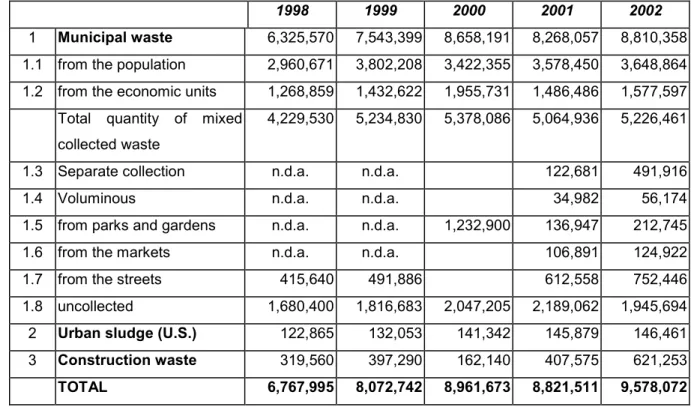
In 1998 – 2002 the ratio of these two categories varied from one year to another, the average being 6% municipal wastes and 94% industrial waste (Table 3).
Table 3. Municipal waste generation in 1998 – 2002 (tones) (Source: ICIM waste database)
1998 1999 2000 2001 2002
1 Municipal waste 6,325,570 7,543,399 8,658,191 8,268,057 8,810,358 1.1 from the population 2,960,671 3,802,208 3,422,355 3,578,450 3,648,864 1.2 from the economic units 1,268,859 1,432,622 1,955,731 1,486,486 1,577,597
Total quantity of mixed collected waste
4,229,530 5,234,830 5,378,086 5,064,936 5,226,461
1.3 Separate collection n.d.a. n.d.a. 122,681 491,916 1.4 Voluminous n.d.a. n.d.a. 34,982 56,174 1.5 from parks and gardens n.d.a. n.d.a. 1,232,900 136,947 212,745 1.6 from the markets n.d.a. n.d.a. 106,891 124,922 1.7 from the streets 415,640 491,886 612,558 752,446 1.8 uncollected 1,680,400 1,816,683 2,047,205 2,189,062 1,945,694 2 Urban sludge (U.S.) 122,865 132,053 141,342 145,879 146,461 3 Construction waste 319,560 397,290 162,140 407,575 621,253 TOTAL 6,767,995 8,072,742 8,961,673 8,821,511 9,578,072 Note: n.d.a. = no data available D.M. = dry material
Source: ICIM waste database
The quantity of municipal waste generated varies from one year to another and, in the last 6 years, a general ascending trend was recorded determined both by the increase of the consumption and by the increase of the population covered by public sanitation services in centralized system. Data on generation and management of municipal waste in 2004 are presented in Table 4. The biggest part of the total municipal waste is represented by the household waste and similar waste, generated from households, respectively from economic units, commercial activities, offices, public institutions, sanitary establishments.
Table 4. Municipal waste generated in 2004 in Romania (SOP, 2006)
Collected household waste and similar waste 5,161 74 5,087 Waste from municipal services (including sludge
from wastewater treatment plant
840 9.5 830.5
Constructions and demolition waste 715 0.5 714.5 Non-collected waste (estimated on the basis of the
average generation ratio)
1,482 0 1,482
Total municipal waste 8,198 84 8,114
Their composition has varied in the last years, the biodegradable waste representing the major part (Fig. 5). In 2004, the biodegradable waste represented about 49% of the household waste collected; the glass and plastics represent also important quantities (SOP, 2006).
Figure 5. The average composition of household waste collected (5,161 million tonnes) (SOP, 2006)
Municipal waste is still stored, in a higher grade, while selective collecting and waste recycling are still insufficient. Regarding the waste recycling and revaluation, the National Plan of Waste Management established certain targets for different waste categories (Wehry and Orlescu, 2000; PNG, 2004):
material and energetic revaluation of approximately 50% of biodegradable waste by 2013;
energetic revaluation of approximately 50% of the wood dust quantity by 2013;
global revaluation of 50% and individual revaluation of 15% of plastic quantity by 2011;
recycling of 22.5% of plastic by 2013; recycling of 60%, according to the weight, of paper and cardboard and 50% of metal, by 2008;
recycling of 15% of wood, by 2011;
recycling of 60% of glass, by 2013.
Only six municipalities developed systems for waste selective collecting and composting of biodegradable waste. The treatment of biodegradable municipal waste is taken in view only at pilot projects level (Nicu, 2001; Nicu and Apostu, 2005).
7.1 Packaging waste
In the last years, private economic operators started activities of cardboard and PETs supported collection. In some localities, the activity of placing certain „deposit/collection points” where the population can deposit (with or without remuneration) wastepaper, cardboard, glass, plastic has started. In Romania, there are authorized institutions in glass, paper and cardboard and plastic industry, which started to take the waste from the collection points in order to recycle and/or recovery. In some cities, pilot stations for biodegradable waste composting were set up. A special attention must be given to the prevention of packaging waste generation, ensuring their revaluation/recycling, as well as minimization of the risk determined by the presence of hazardous substances in the packaging (Gavrilescu et al., 2005; Gavrilescu and Nicu, 2005; Gavrilescu, 2006). Separate collecting, sorting, processing and finale recycling of packing waste will be carried out so that a packing waste recycling rate should reach 55,1% and a packing waste revaluating rate of 62% (785.225 tones) by the end of 2013 (Wehry and Orlescu, 2000).
8. HAZARDOUS WASTE
The management of hazardous waste has become a worldwide problem. This waste category has the biggest impact over human health and the environment. A proficient waste management represents a complex problem and requires a coherent and methodical approach, able to pursue their prevention in the first place. The prevention of hazardous waste producing must be scheduled according to the raw materials finite products and implied technologies management. The prevention of waste producing not only would reduce waste management costs for the concerned companies, but
Particularly for small and medium businesses it is necessary the applying of the environment protection measures. Romania doesn’t have a developed service net regarding hazardous waste management to ensure the services of hazardous waste collecting and/or the revaluating/treatment. In Romania there are a small number of services operators for hazardous waste management. They usually ensure the collecting, without transportation services, because of the insufficient transportation capacity. The transportation of hazardous waste is ensured by the waste producers (Wehry and Orlescu, 2000). With all these, more than 89% of the total hazardous waste quantity is generally stores or stocked near the generator source, with minimal transportation costs. Exceptions are medical wastes, waste oil, collected and transported waste in order to be treated/revaluated and/or final disposal. Romania must develop a hazardous waste management system that is able to fulfill the following objectives (SOP, 2006):
the reducing of the possibilities of hazardous waste storing in the same place with other industrial waste;
the developing of waste collecting and transportation services to the authorized facilities of treatment, recycling and/or final disposal, to the interest of the industry;
collecting and transportation activities regulation and control, in order to ensure hazardous waste’s safe transit;
the avoiding of excess of regulations and of the redundant regarding the regulations and the control.
As to wastes from constructions and demolitions, in Romania, today, their total quantity is smaller compared to the member states of the European Union. Only a small percent of the waste from constructions and demolitions is separately collected and stored, thus resulting small quantities in this category. Generally, this type of waste is re-used. There is a “black market” of re-used waste from constructions and demolitions because of the high costs of constructing materials and the population’s growing needs.
Concurrent to the economical development of the country, the activities of constructing, re-constructing and renovating of the existing buildings and the demolition of the old ones that cannot be renovated, will lead to the substantial growth of the quantity of waste from constructions and demolitions and to the change of their quality. Thus it is
necessary the promotion of investing in re-using, recycling, treatment for their adequate recovery/elimination, by strict segregation of construction waste from demolition waste in all regions (heavy urbane, urbane and rural) and their utilization after pre-treatment in road rearranging or other activities. Regarding the medical waste, hospitals must act in order to minimize the total quantity of this type of hazardous waste. For final disposal of medical waste the three existing private installations must be improved and the old incinerators from inside the hospitals must be shut down, in steps, according to the existence of zonal authorized hazardous waste incinerators. For the pre-treatment of hazardous medical waste there will be implemented mobile or stationary specific technologies (Wehry and Orlescu, 2000). As to the electric and electronic equipment waste it is necessary to be given a special attention to the developing of a selective collecting system, as well as to ensure optimal solutions for stocking, treatment, revaluating, recycling and disposal, towards a rational ecological management. The collecting of electric and electronic equipment waste is made taking into consideration the value of the contained recyclable materials. Across the country there are approximately 300 economical agents authorized to collect metallic waste from both individuals and juridical persons, at least one of them existing in each county. They collect electric and electronic equipment waste, especially the large ones and with a high content of recyclable metal (such as washing machines, boilers, refrigerators). There are no specialized centers for selective collecting of the electric and electronic equipment waste. The treatment is realized by disassembling, cutting, balling to the end of revaluating the metal. There is one disintegrator in Bucharest, with a capacity of 8000 tones/month, that helps treat certain categories of electric and electronic equipment waste, with a high content of recyclable metal (refrigerators, washing machines, boilers etc.). Today in Romania there are no recycling/revaluating solutions for:
• activated glass; • plastic;
• textiles, resulted from disassembling/treatment of electric and electronic equipment. In Romania, today, there are no solutions for construction of waste integrated systems in less developed regions/counties and applying the hierarchy of waste, (Gavrilescu and Nicu, 2005). The end of this strategic compound is the improvement of the waste management standards, according to the “hierarchy of waste” (prevention, selective
conform landfills). Romania has specific commitments to this end. The accepted transition periods for reaching the European standards regarding waste management, assume (PNG, 2004):
- non-hazardous waste landfills situated in urban areas- transition period until 2017; - temporary stocking industrial hazardous waste- 2009;
- industrial non-hazardous waste landfills- transition period until 2013.
In order to respect the mentioned commitments, there will be implemented integrated waste management projects, according to the National Plan and the Regional Plans of Waste Management. Those projects will cover at least the main urban and rural agglomerations, at county level. The target beneficiaries are represented by local/county authorities. The integrated waste management systems will include the following actions:
ensuring of the adequate facilities for the collecting and transportation of wastes in the aimed towns;
building of adequate treatment and disposal facilities; closing of non-conform landfills that are dangerous for human health and the environment
9. CONCLUSION
The fundamental principles behind the Community Strategy are set out in a three-level waste hierarchy. This describes the three fundamental concepts behind the EU waste strategy, which are in order of preference:
- Waste prevention
- Waste recovery (including re-use, recycling and energy recovery, but with a preference to materials recovery)
- Waste disposal (which includes incineration without energy recovery and landfill)
These concepts are applied not only to enhance levels of environmental protection, but also to deal with the loss of valuable resources implicit in the existence of discarded residuals. In order to attain the goals of these principles in Romania as a whole, as well as in its counties, it is necessary to achieve a significant strategic waste management planning on a regionalized basis, and to ensure a dramatic reduction in confidence on landfill, by encouraging the integrated waste management approaches, which make
use of a range of waste treatment options to carry ambitious recycling and recovery objectives.
10. REFERENCES
Burnley S.J., (2007). A review of municipal solid waste composition in the United Kingdom,
Waste Management, 27, pp. 1274-1285.
CE Directive, (1994b). European Parliament and Council Directive 94/62/EC of 20
December 1994 on packaging and packaging waste, Official Journal L 365 ,
31/12/1994 P. 0010 – 0023.
Caruso C., Colorni A., Paruccini M., (1993). The regional urban solid waste management system: A modelling approach, European Journal of Operational Research, 70, pp.16-30.
Costi P., Minciardi R., Robba M., Rovatti M., Sacile R., (2004). An environmentally sustainable decision model for urban solid waste management, Waste Management, 24, pp. 277-95.
EEA, (1998). Europe’s Environment: The Second Assessment, European Environment
Agency, Copenhagen, Office for Official Publications of the European Communities,
Luxembourg.
Eriksson O., Carlsson Reich M., Frostell B., Björklund A., Assefa G., Sundqvist J. -O., Granath J., Baky A., Thyselius L., (2005). Municipal solid waste management from a systems perspective, Journal of Cleaner Production, 13, pp. 241-252.
EUR, (1999). Overview of the Environment and Health in Europe in the 1990s, Report, EUR/ICP/EHCO 02 02 05/6, On line at: http://www.euro.who.int/document/e66792.pdf. Eurostat, (2004). Hazardous and Industrial Waste Management in Accession Countries,
Theme 8, Environment and energy Office for Official Publications of the European Communities, Luxembourg.
GO, (2004). Governmental Ordinance No. 1470/2004 regarding the approval of the National Strategy on Waste Management and the National Plan on Waste
Management, Published in the Official Monitor No. 954 bis/18.10.2004.
Hall D., (2003). Public Service Work! Information, Insights and Ideas for our Future, Report, Public Services International, On line at: http://www.psiru.org/reports/2003-09-U-PSW.pdf
Gavrilescu M., Nicu M., (2005). Source Reduction and Waste Minimization, EcoZone Press, Iasi, Romania.
Gavrilescu M., Ungureanu F., Cojocaru C., Macoveanu M., (2005). Modelling and
Simulation of Proceses in Environmental Engineering, Vol.1, EcoZone Press, Iasi,
Romania.
Gavrilescu M. (2006). Overwiew of in-situ remediation technologies for sites and groundwater, Environmental Engineering and Management Journal, 5, pp. 79-114. Ianculescu O., Ianculescu D., (2002). Solid Waste Engineering, MatrixRom Press,
Bucharest.
Ilie D. M., Gavrilescu M., (2006). Implementing the European legislation concerning dangerous chemicals and goods. The material safety data sheet, Environmental
Engineering and Management Journal, 5, pp. 847-862.
Ilie D. M., Peiu N., Gavrilescu M., (2005). Ecological footprint – an instrument of
sustainable development, Bulletin of Polytechnic Institute of Iasi, Fasc. 1-2.
IP, (2004), Implementation Plan for Directive 1999/31/EC on the landfill of waste, Romanian Government, Bucharest.
Macoveanu M., (2005a). Methods and Techniques for Ecological Impact Assessment, EcoZone Press, Iasi, Romania.
Macoveanu M., (2005b). Environmental Audit, 2nd Edition, EcoZONE Press, Iasi, Romania. Macoveanu M., (2006). Environmental Policies and Strategies, EcoZONE Press, Iasi,
Romania.
Moletta R., (2002). Gestion des problemes environnemetaux dans les industries
agroalimentaires, Ed.Tec & Doc. Paris.
Negulescu M., Ianculescu S., (1995). Environmental Protection, Technical Press, Bucharest.
Nicu M., (2001). Waste Management, Treatment and Valorization, „Gh. Asachi” Technical University Press, Iasi, Romania.
Nicu M., Apostu F., (2005). Aspects concerning waste management in agrotourism,
Environmental Engineering and Management Journal, 4, pp. 89-94.
NWMS, (2004). National Waste Management Strategy, Ministry of Environment and Water Management, Bucharest, Romania.
PNG, (2004). National Plan on Waste Management, Ministry of Environment and Water Management, Bucharest, Romania.
Profiriu M., (2005). Management of Public Organizations, Economic Press, Bucharest. Puscasu V., (2005). Regional Development, Economic Press, Bucharest.
Robu B., (2005). Evaluation of Impacts and Risks induced in the Environment by Industrial
Activities, EcoZone Press, Iasi, Romania
Steurer, A., (1996), Material Flow Accounting and Analysis, Statistics Sweden, May 1996, Stockholm, Sweden.
Tchobanoglous G., Theisen H., Vigil S. A., Vigil S. A., (1993). Integrated Solid Waste
Management: Engineering Principles and Management Issues. McGraw-Hill Science
Engineering.
Tsiliyannis C.A., (2007). A flexible environmental reuse/recycle policy based on economic strength, Waste Management, 27, pp. 3-12.
Wehry A., Orlescu M., (2000). Recycling and Ecological Disposal of Waste, University Horizons Press, Timişoara, Romania.
SOP, (2006), Sectoral Operational Programme Environment,Ministry of Environment and Water Management, Romania.
Negulescu M., Ianculescu S., (1995). Environmental Protection, Technical Press, Bucharest.
CE Directive, (1994a). Council Directive 94/67/EC of 16 December 1994 on the incineration of hazardous waste, Official Journal L 365 , 31/12/1994 P. 0034 - 0045