1
ATHABASCA UNIVERSITY
IMPROVING LEARNER MOTIVATION THROUGH
ENHANCED INSTRUCTIONAL DESIGN
BY
DENNIS MARGUERATT
A thesis submitted to the
Athabasca University Governing Council in partial fulfillment Of the requirements for the degree of
MASTER OF DISTANCE EDUCATION
Athabasca, Alberta April 2007
ii
DEDICATION
This thesis is dedicated to my wife, Sally Margueratt, for her considerable support and patience over the years it took to complete this and my previous graduate degree. Sally ensured for nine long years that tea was served in the office when my studies started to get the best of my energy. Without her love and encouragement, completing these studies would have been far less rewarding.
iii
ABSTRACT
The purpose of this thesis was to examine the relationship between the
instructional design methodology used to design and develop a distance learning product and learner motivation. Evidence from readings consulted in preparing this thesis
suggested that motivation is not often a prominent consideration in the design of distance learning products. In the early 1970s, John Keller wrote about the relationship between motivation and instructional design resulting in the creation of four elements -- Attention, Relevance, Confidence, and Satisfaction (ARCS) -- that has become a predominant model of learner motivation.
A quasi-experimental research design, a One-Group Pretest and Posttest, was used to investigate the influence of instructional design methodology on learner motivation. The sample for this study consisted of 204 learners enrolled in the Defense Management Course at the Royal Military College in Kingston, Ontario. Two questionnaires,
administered before and after an instructional design intervention based on Keller’s ARCS model, were used to gather data on learner motivation. A significant difference between the means for the total scores between the two questionnaires was demonstrated using a Paired Sample T-Test. The analysis of the ARCS elements was conducted using a Non-Parametric, Two Related Samples, Wilcoxon statistical test. Statistical analysis revealed that, with the exception of Relevance, all of the ARCS elements were
significantly positively influenced as a result of changes made to the instructional design of the revised lessons. Finally, an analysis of the dependent motivational components of locus of control, self-efficacy, and intrinsic and extrinsic motivation are provided and discussed in terms of their relationship with the ARCS elements.
iv
ACKNOWLEDGEMENTS
I wish to thank my thesis supervisor, Dr. Susan Moisey, for her considerable help and guidance during the development and writing of this thesis. I gained a great deal of insight into the thesis writing process through Dr. Moisey’s ongoing support and gentle critiquing of this work at its various stages. I would also like to thank my thesis advisory committee, Dr. Rick Kenny and Dr. Tom Jones, for their help and guidance in crafting this research effort. Last but not least, I would like to thank the entire MDE staff at Athabasca University for their wonderful administrative support over the years I was an Athabasca student. Principal among those at Athabasca who have been extremely helpful is Ms. Glenda Hawryluk. Glenda was always available to answer questions on any subject I might conjure up and consistently maintained the spirit of Athabasca University with her “Cheerio from Athabasca” sign-offs on email. She was also of significant help in assembling the data received in the process of developing this thesis. My learning experience at Athabasca would have been certainly diminished without Glenda’s contributions.
v
TABLE OF CONTENTS
CHAPTER 1 – INTRODUCTION……….1
Statement of the Purpose……….4
Research Question………...5
Assumptions of the Study………6
Significance……….7
Limitations………...8
Delimitations………9
Definition of Terms……….9
Summary………13
Organization of the Thesis……….14
CHAPTER II – REVIEW OF RELATED LITERATURE The Importance of Motivation………16
Motivational Elements that Instructional Design May Affect………26
The Adult-Learner………...32
Instructional Design and Motivation………...35
Keller’s ARCS Model……….50
Summary………...63
CHAPTER III – METHODOLOGY Introduction……….65
Research Design……….65
Subjects………...………66
vi Procedure………68 Data Analysis………..69 Revision Strategy………70 Summary……….75 CHAPTER IV – RESULTS Introduction……….77
Purpose of the Study………77
Instruments………..78
Subjects………78
Descriptive Statistics………80
Research Question #1……….………..81
Research Question #2………...82
Effect on Locus of Control, Self-Efficacy, Intrinsic/Extrinsic Motivation………..86
Summary………...87
CHAPTER V – CONCLUSIONS AND RECOMMENDATIONS Introduction………...89
Theory of Instructional Design……….90
Review of Research Results………..92
Recommendations and Implications for Instructional Designers……….93
Suggestions for Further Research……….98
REFERENCES………....100
APPENDIX A………104
vii
APPENDIX C...113 APPENDIX D……….120
viii
LIST OF TABLES
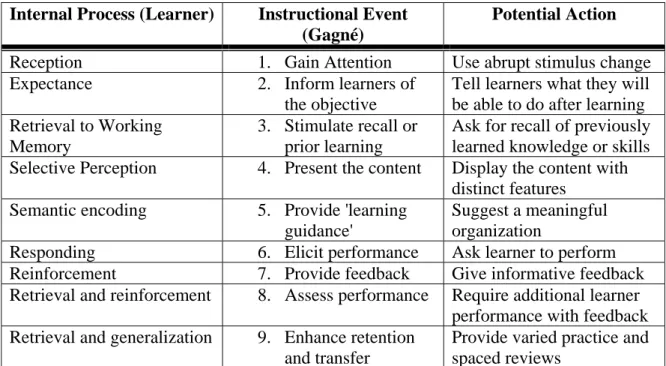
1. Internal Process and Their Corresponding Instructional Events with Action
Examples...43
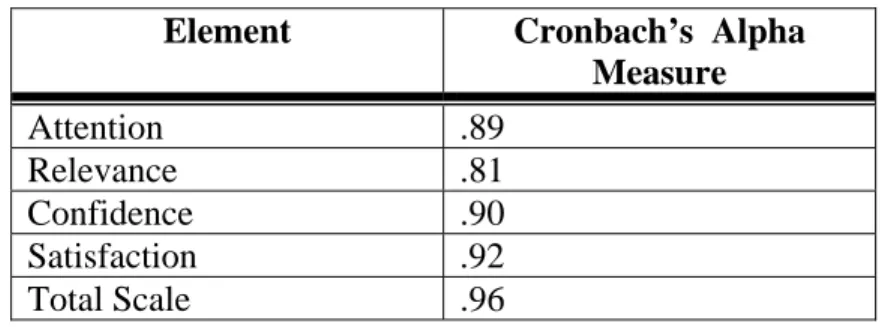
2. Keller’s (1993) Questionnaire Reliability Measure………..…68
3. Questionnaire Demographics………79
4. Descriptive Statistics……….81
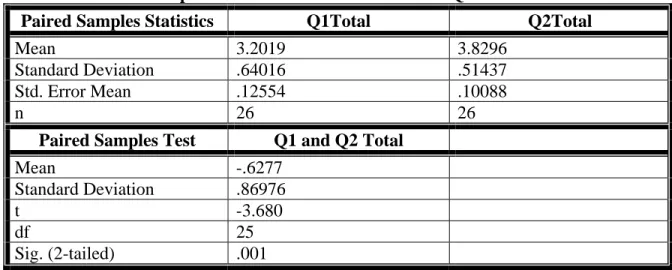
5. Paired Sample T-Test of Total Means between Questionnaire #1 and #2………82
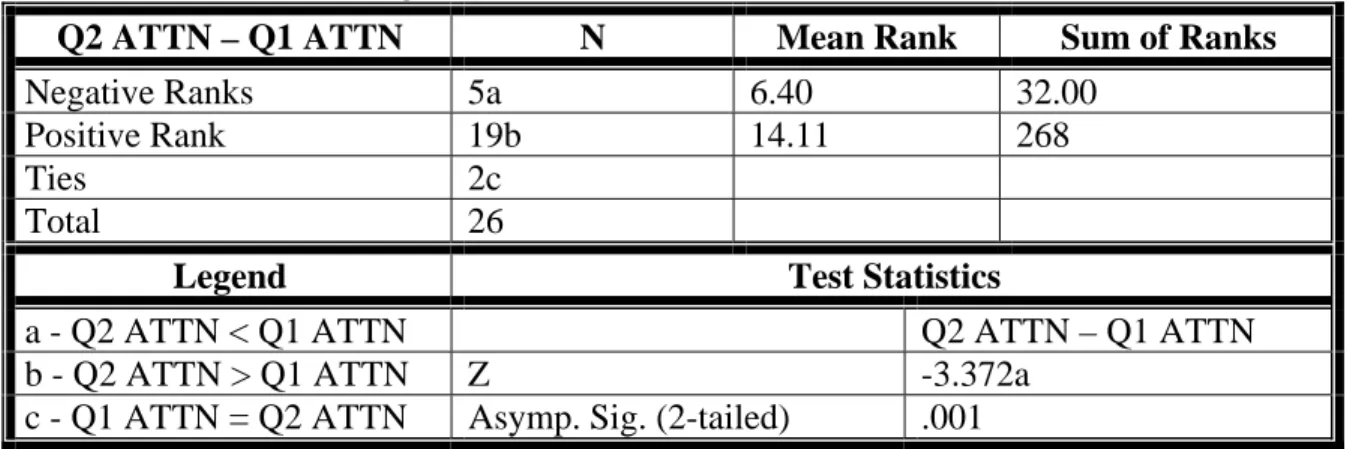
6. Non-Parametric Two Related Samples Wilcoxon Statistical Test of Attention Elements for Questionnaire #1 and #2………..83
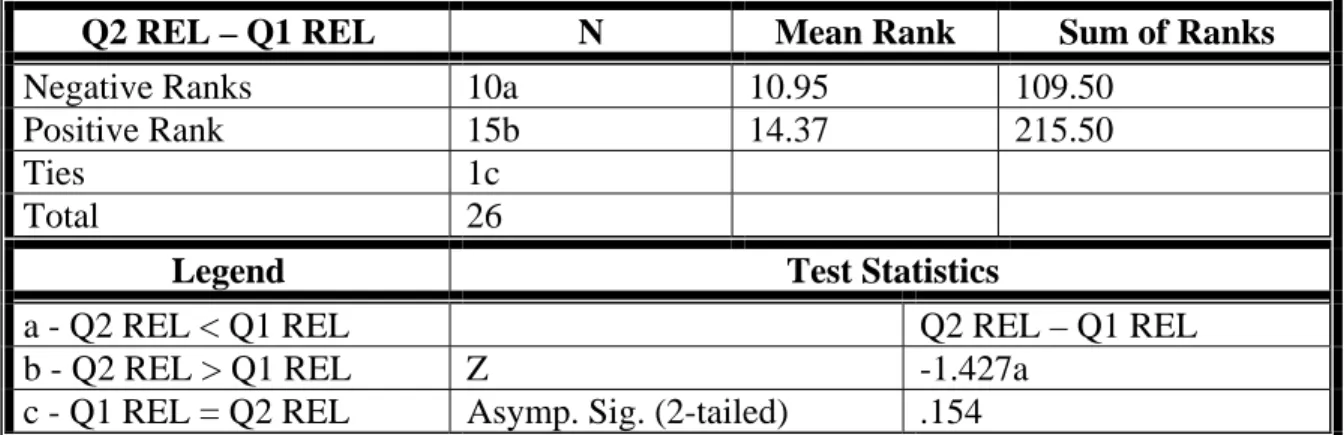
7. Non-Parametric Two Related Samples Wilcoxon Statistical Test of Relevance Elements for Questionnaire #1 and #2………..………84
8. Non-Parametric Two Related Samples Wilcoxon Statistical Test of Confidence Elements for Questionnaire #1 and #2………..…………85
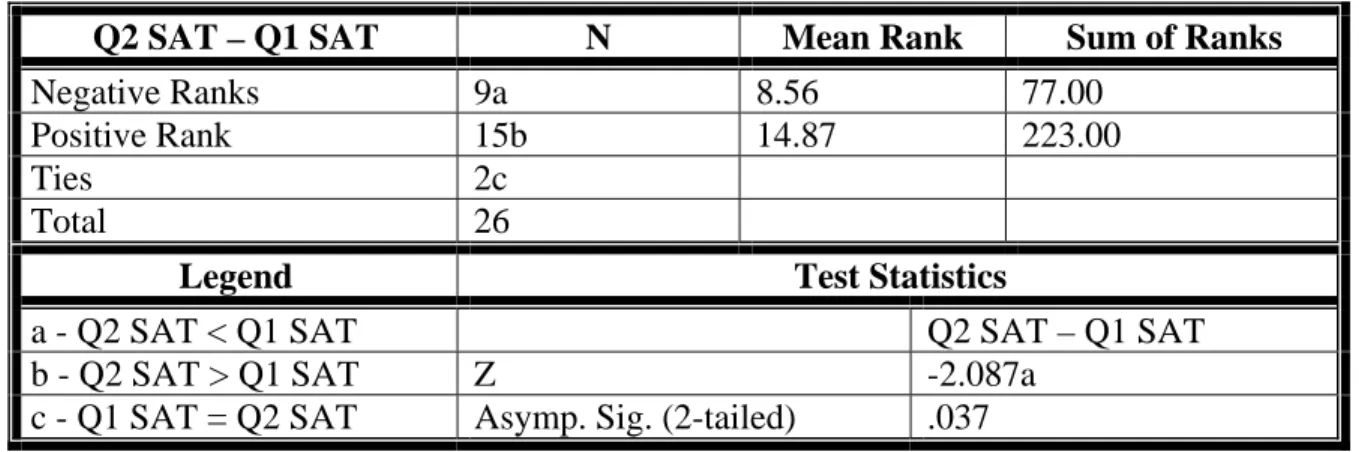
9. Non-Parametric Two Related Samples Wilcoxon Statistical Test of Satisfaction Elements for Questionnaire #1 and #2………..86
1
CHAPTER 1
INTRODUCTION
Many of the articles written and research conducted on the subject of learner motivation in the context of distance learning focuses on learner attributes. The premise of these writings and research is that understanding learners and what motivates them to persist in distance education will help distance educators anticipate what mechanisms might be incorporated in the distance learning program to attract and retain distance learners. Certainly, such studies have had a very positive impact on the quality of distance learning resulting in much greater awareness of such elements as administrative support, timely feedback, flexible learning models, control over the learning process by the learner, respect for the learner, and so forth. But what of the process through which distance learning is created? What about the instructional design process and the effect of instructional design strategies on learner motivation?
As the scope of the literature on this subject attests, motivation is a very
translucent term that takes on various meanings depending on the context in which it is viewed. Some authors argue that motivation is principally a factor of self that is developed over years of influences from family, education, society, and general life experiences (Roblyer, 1999). Others, such as Keller and Burkman (1993), attribute learner motivation to the role courseware designers and instructors play in the design, development, and delivery of instructional materials. They point out that, all too often, designers and instructors consider motivation to be the student’s responsibility. As Keller and Burkman paraphrase, "I can design (or teach) a good course, we often hear, but it's up
2
to the students to decide if they want to learn it" (p. 4). It is true that an educator cannot totally control a learner's motivation; however, it is reasonable to assume that poor instruction can demotivate an otherwise motivated student, and excellent instruction can inspire an otherwise unmotivated learner. What is agreed within the context of education is that motivation is a prominent determinant of how well learners will do in their learning endeavors and their persistence to remain in an educational program. The ability to affect learner motivation is particularly relevant in distance learning where the instructor is physically removed from the learner and therefore may have less influence on learner motivation. Consequently, it is very important that distance educators, administrators, and those designing distance-learning products appreciate the effect of motivation to the continued involvement of their learners (Abdul-Rahman, 1994).
Brindley (1987) and Fasig (1982) highlight the importance of nurturing learner motivation in order to reduce attrition rates within distance learning programs. High dropout rates have a significant financial impact on institutions for various reasons including the administrative and overhead costs associated with processing admissions only to have a number of students withdraw early in a program. The effect, they argue, is lost revenue over the longer term coupled with the need to finance increased marketing in an effort to attract other students to the program. Brindley in particular notes that while specific motivational factors related to course withdrawal are difficult to specifically identify, there is a definite relationship between motivational factors and attrition. As a result, understanding what motivates learners in an educational program and attending to those motivational factors early in the instructional design process that are most likely to enhance persistence, will invariably pay dividends over the longer term.
3
Learners are generally motivated to enter a distance learning program for reasons of career enhancement, improvement in job related performance, or for the convenience distance learning offers those learners living and working in locations that do not afford easy access to a residential program (Cannon et. al., 2001). Once engaged in a learning experience, the reason for remaining engaged in learning turns to "incentive motivation" wherein the individual strives to achieve a pre-established goal or target for which they perceive a reward for fulfilling their intended goal (Gagné & Driscoll, 1988, p. 25). Gagné and Medsker (1996) also note that not only do motivated learners focus on a goal they have established for themselves, that goal must be achievable. Consequently, motivation of the learner must be sustained throughout the learning experience in order for goal achievement to remain a reality and the focus of learning.
In the late 1970s, John Keller commenced work on learner motivation that eventually resulted in the development of an instructional design model referred to as ARCS. ARCS is an acronym for Attention, Relevance, Confidence, and Satisfaction (Smith & Ragan, 1999). Gagné and Driscoll (1988) provide the following definition of the four ARCS terms:
Attention: Arousing and sustaining learner curiosity and interest.
Relevance: The learner is aware that the learning being undertaken has personal value or importance.
Confidence: Learners must believe that they can accomplish the goal of learning successfully.
Satisfaction. Satisfaction is the feeling accompanying the process of reinforcement (p. 71).
4
Keller developed instructional design strategies to address each of the elements in his ARCS model. Although these strategies have been available for several years, there is little evidence they receive specific attention by instructional designers in the broad context of designing distance-learning courseware. While instructional design invariably tries to follow a set design model, such as that found in a variety of Instructional Systems Design (ISD) formats, elements specifically focusing on learner motivation often appear to be missing indicating the authors have neglected to adequately consider learner motivation as part of their design strategy.
Statement of the Purpose
The purpose of this study was to examine the influence of instructional design strategies and methodologies on learner motivation.
Some research, notably that conducted by John Keller, has already identified areas where instructional design can positively impact learner motivation, principally in face-to-face educational settings. However, as Miltiadou and Savenye (2003) note, more research is required that will "shed light on which motivational constructs can be
identified as predictors of success in an online environment." (p. 21). As they point out, there is a growing interest by learners in online courses; however, there is a lack of sufficient studies on the effects of design criterion that can potentially heighten learner motivation and concomitantly reduce attrition rates in online courses. Abdul-Rahman (1994) identified a similar concern with respect to dropout rates and suggested that "identifying factors that interact to affect students' completion or non-completion of a distance education course" (p. 9) would go a long way to arming administrators and
5
distance educators with information and tools that will help reduce learner attrition in distance education.
The overall purpose, then, of this study will be to examine the effect of certain instructional design practices, elements, strategies, and methodologies intended to improve the motivation of distance learners. In addition to the effects of enhanced motivation on attrition is the need for distance educators to identify the more lasting benefits of instructional design on learner attitudes toward future distance education programs and courses.
Research Question
This study will focus on the relationship between instructional design and learner motivation to determine how varying the instructional design methodology may influence learner motivation toward distance learning. In addition, the study will explore the relationship between an instructional design strategy that specifically targets learner motivation and elements of individual motivation (i.e., locus of control, intrinsic and extrinsic motivation, and self-efficacy).
Theoretically, enhancing the instructional design methodology, particularly in the direction of learner motivation, such as through the use of Keller's ARCS model, will have a positive influence on learner motivation. If learner motivation is enhanced through the selection of a particular instructional design methodology, then using this methodology to design and develop distance learning programs and courses will presumably have a positive effect on learner attitudes toward distance learning.
6
1. Does the type of instructional design methodology used in course development affect learner motivation?
2. To what degree, if any, does varying the instructional design methodology affect locus of control, intrinsic and extrinsic motivation, and self-efficacy?
Assumptions of the Study
The course selected for this study currently exists in a paper based,
correspondence format consisting of two modules. For the purpose of this study, two lessons of the second module were redesigned and provided to learners as a MS Word email attachment. Learners had the option of either printing the document or using it electronically. In the latter mode, learners could take advantage of the electronic navigation and links imbedded within the module.
It is assumed that delivering the two lessons of the second module in a slightly different format (electronic Micro Soft Word) from that of the hard copy first module will not affect learner motivation. In other words, had the first module been delivered in the same format as the second module, learner motivation would be consistent across both modules regardless of the delivery technology.
Some learners taking the course used in this study normally undertake these studies in partial fulfillment of mandated professional development. They are, it could be argued, a captive audience whose motivation toward learning is driven to a large degree by the desire for professional advancement. It is assumed, therefore, that any
improvement in motivation toward distance education, measured as a part of this study, is the result of enhancements made to the instructional design of the second module and not
7
a consequence of the need to complete the course in order to satisfy a requirement of the learner's professional development.
Significance
It is anticipated this study will contribute in a significant manner to the body of knowledge related to increased learner motivation through enhanced instructional design. As Wlodkowski (1999) points out: "although there are numerous research studies of adult motivation to participate in structured adult education programs (as cited in Deshler, 1996), there are no major research studies that thoroughly examine the relationship between adult motivation and learning" (p. 4). The literature review conducted in support of this study supports Wlodkowski's findings.
In addition, it is anticipated that determining certain instructional design elements that improve learner motivation will positively affect dropout rates in distance education. Dropout is a major concern, as highlighted by Sung (1986) and Brindley (1987), and is a significant element of consideration for decisions made to improve distance education. The assumption being, a more motivated learner is likely to continue studying through distance education than one who finds distance education a sub-optimal method of learning.
Finally, Keller (1983) noted that "the assumption all too often" is that if "instruction is of good quality, motivation will take care of itself. Unfortunately, this assumption has been found to be only partly true. When we examine the meaning of quality instruction, we discover that it generally refers to results in more or better learning per unit of time than other comparable methods of instruction" (p. 388). Keller goes on to
8
say that quality does not adequately account for motivation because quality is generally linked to efficiency and effectiveness rather than to sound instructional design strategies that focus on learner motivation. Rothwell and Kasanas (1992) agree with Keller in the debate of “efficiency vs. effectiveness” as they relate to the quality of design. They observe that efficiency can be stated simply as - "Are we doing things right” (p. 5). In this question the phrase doing things right means "without unnecessary expenditures of time, money, or effort" (p. 5). Effectiveness, however, often means the match between results achieved and those needed or desired. The central question related to
effectiveness is - "Are we doing the right things” (p. 5). In this question, the phase right things typically means, "what others expect or need from the organization, group, or individual” (p. 5). The focus of both definitions clearly relates to factors outside the quality of the instruction as reflected in Keller's concern over the use of these two terms when considering the quality of design. This study focused on improving the quality of design of the courseware used in the research.
Limitations
The following was identified as a limitation of this study:
• The original sample for the quantitative analysis of this study consisted of 204 subjects; however, data from 26 subjects was eventually used to conduct the analysis because of low questionnaire returns. A larger sample size would have been
desirable; however, because a module of program content was redesigned to incorporate specific instructional design elements intended to enhance learner
9
motivation, a course of limited capacity and one accessible to the author had to be selected.
Delimitations
Creswell (2003) describes delimitation as a means of limiting the scope of a study. This study has the following delimitations assigned to focus the study within a
manageable framework:
• The study only used two lessons taken from an existing course as the test bed for measuring learner motivation in relation to particular instructional design elements. • The study utilized print-based media alone in order to accommodate available
technologies and the ability of the learners to adapt to the revised module format without extensive direction in the use of an unknown medium.
Definitions of Terms
The following is a list of terms and definitions used during this research.
Motivation
Gagné and Medsker (1996) define motivation as "cognitive persistence: the drive, tendency, or desire to undertake or complete a task, expend effort, and do a quality job" (p. 168). Russell (1971) determined that the term, motivation, has three characteristics that surfaced in most definitions:
• It is a presumed internal force; • It energizes for action; and
10
Hamachek (1968) provided a similar list of factors affecting motivation, but with a slant toward motivation in learning. His list views motivation as a process that:
• Leads students into experiences in which learning can occur;
• Energizes and activates students and keeps them reasonably alert; and • Keeps their attention focused in one direction at a time (p. 3).
The concept of being energized or aroused is prevalent in many of the definitions found in the literature. Learners who are energized are anticipated to act in a certain manner that keeps the learner moving in the direction of increasing knowledge (Qureshi, 2001; Arkes & Garske, 1982). Johnson and Johnson (1985) provide a perspective on motivation to learn in which they define motivation – "as the degree to which students commit effort to achieve academic goals (e.g., the intended learning benefits of increased understandings and skills) that they perceive as being meaningful and worthwhile" (p. 250). Keller and Burkman (1993) continue this behavioural perspective by noting that motivation defines that - “which determines the magnitude and direction of behaviour. Magnitude is generally regarded as degree of effort and direction is generally defined in terms of goal orientation” (p. 3). It is apparent from these definitions that there needs to be some mechanism within the instruction that will stimulate the learner into action and that will somehow maintain that stimulation over time. Simply arousing the learner in the introduction to a learning experience is not sufficient. The excitement of learning must be maintained throughout the learning experience. The ability to sustain interest throughout the learning experience then is the challenge for the instructional designer.
11
Locus of Control
Locus of control is a trait that reflects the extent to which an individual views their actions or inactions as affecting outcomes in their life. Persons who exhibit a strong internal locus of control believe that their success or failure is directly related to their own efforts and abilities. Whereas those with a strong external locus of control perceive events and factors affecting their lives as originating more out of luck or circumstances beyond their control than something they affect personally (Miltiadou & Savenye, 2003). As Abdul-Rahman (1994) notes – "locus of control is an attitudinal or belief variable that represents the individual's perception of the amount of personal or external control over life outcomes: it refers to an individual's inclination to attribute success or failure to himself or herself or to the external forces outside his or her control" (p. 31). The importance of locus of control in regards to increasing motivation through instructional design is found in the amount of control over the learning process the designer is prepared to provide to the learner. There are also elements of influence and reinforcement of the learner's activities at play in instructional design that can be affected depending on the learner's perceived locus of control (Keller, 1983).
Persistence
"Persistence is a synonym for student progress and refers to behaviour whereby students continue to make progress through a course or degree program by remaining continuously enrolled" (Kemp, 2001, p. 10).
12
Instructional Design
Smith and Ragan (1999) refer to instructional design as the systematic process of, "translating principles of learning and instruction into plans for instructional materials, activities, information resources, and evaluation" (p. 2). Several years earlier, Reigeluth (1983) wrote that confusion often existed in instructional design because of the attempt, as Smith and Ragan have done in their definition, to link learning theory with
instructional development. Reigeluth speculated that there was a difference in the two processes because, as he explains, instructional development focuses on methods of instruction, whereas learning theory is directed at the process of learning. Instructional design, he contends, "is concerned with understanding, improving, and applying methods of instruction" (p. 7). Although there is little doubt that instructional design deals with methods of instruction, it is extremely important that these methods consider learning theory and how these theories might affect motivation when selecting the methods of instruction. For the purposes of this study, therefore, learning theory must be considered in the instructional design process if motivation is to be affected.
Intrinsic and Extrinsic Motivation
Intrinsic motivation is an important ingredient in the design of course materials for distance learning. It is intrinsic motivation that should be inherent in any learning activity if one of the goals of that activity is to motivate the learner. As Johnson and Johnson (1985) elaborate, intrinsic motivation is learning for – "the joy of it, to benefit others, and as the result of personally meaningful feedback are intrinsic to learning activities" (p. 260). Abdul-Rahman (1994) noted that Kembler (1989) defined intrinsic motivation as
13
the interest learner's exhibit for the content of a course. Extrinsic motivation, on the other hand, is motivation toward attaining personal goals such as high grades or course
completion and graduation. Extrinsic motivation focuses on the outcome of the learning experience more so than what the experience offers (Johnson & Johnson, 1985).
Self-Efficacy
Sandler (1998) notes three aspects of self-efficacy:
• It represents a composite of all life's past successes and failures experienced by an individual;
• Individuals will exhibit differences in their general self-efficacy expectations; and • In general, self-efficacy ought to affect an individual's mastery expectations in a new
situation (p. 42).
Self-efficacy is important, therefore, to the motivation learners might experience before beginning a learning experience and while engaged in a learning experience. It is important from the outset of a learning experience that students have a reasonable
expectation of succeeding. Instructional designers can partially influence this expectancy by ensuring the tasks and assessment standards, which the learner will meet, are relevant and achievable by the anticipate learning community.
Summary
Chapter 1 introduced the topic of this thesis and provided the Research Questions that will be the focus of the research effort related to this thesis. These questions are repeated as follows:
14
1. Does the type of instructional design methodology used in course development affect learner motivation?
2. To what degree, if any, does varying the instructional design methodology affect locus of control, intrinsic and extrinsic motivation, and
self-efficacy?
The chapter provided the assumptions of the study and the significance of this study on the body of knowledge related to the linkage between motivation and
instructional design. The various terms to be used in the study were defined and the organization of the thesis outlined. The next chapter details the literature reviewed as part of this research effort and will provide a comprehensive review of the importance of motivation to learning and the manner in which motivation is linked to instructional design.
Organization of the Thesis
This thesis consists of five chapters beginning with the introduction just read. Chapter 2 provides a literature review focused on determining the importance of motivation to learning in general and more specifically to distance learning. It then considers in greater detail the individual elements of motivation reflected in locus of control, self-efficacy, and intrinsic and extrinsic motivation. A section is then dedicated to considering the attributes commonly found in adult learners, as it is adults who most often select distance learning as their learning methodology. The chapter concludes with an examination of the various instructional design elements that must be considered in constructing an instructional experience in which motivation is a primary consideration.
15
Chapter 3 considers the methodology used to conduct the research for this thesis. It provides an overview of the course and audience used in this research and then takes the many instructional design elements reviewed in Chapter 2 and formulates them into actual instruction instruments specifically intended to improve learner motivation. Data collection and analysis techniques are also presented. Chapter 4 examines the results of the research effort and Chapter 5 provides a conclusion and recommendations stemming from the overall thesis effort.
16
CHAPTER II
REVIEW OF RELATED LITERATURE
This chapter reviews selected literature reflective of the effect motivation has on learning and the potential impact of instructional design on learner motivation. The chapter considers the importance of motivation for distance education in particular and then reviews the principle motivating elements that were examined while developing an instructional design philosophy. Next the chapter looks at characteristics of adult learners in a distance education. The chapter concludes by reviewing the effect of instructional design on motivation by examining several parts of the instructional design process that support the theory of improving learner motivation.
The Importance of Motivation
In this section of the literature review, elements and philosophies of motivation are introduced, particularly in the context of learner motivation. Providing a fundamental grounding in the theory of motivation is necessary for understanding of the linkage between instructional design and motivation.
Perhaps the most noted scholar on the subject of motivation in recent times is Abraham Maslow. Maslow undertook research in the early 1950s on the subject of motivation that later became the benchmark for future motivational studies. Maslow (1968) postulated that there is a hierarchy of needs that people must satisfy in search of life's fulfillment. Once needs of safety, belonging, love, respect, and self-esteem are met, people look to satisfy their need for self-actualization. At this point, they seek to
17
actualize their potential, capacities, and talents by developing a fuller knowledge of, "and acceptance of, the person's own intrinsic nature, as an increasing trend toward unity, integration or synergy within the person" (Maslow, 1968, p. 25). He noted that as people realize self-actualization and find gratification in their accomplishments, their motivation heightens and grows. Times become more exciting and opportunities for success and achievement are sought out rather than avoided. People who grow within themselves begin to want more and more for themselves, particularly in the area of learning and formal education.
Maslow later separated his hierarchy into two categories, deficiency motivation and growth motivation. He noted that once people have satisfied their motivational elements in the deficiency category, they are ready to move toward self-actualization in the growth motivational category (Russell, 1971). Self-actualized individuals are gratified in their basic needs and become far less dependent, far more self-directed, and far more autonomous than those functioning at a lower level in the motivational hierarchy (Maslow, 1968; Abdul-Rahman, 1994; Arkes & Garske 1982). Generally speaking, people who undertake distance learning have already arrived at the growth motivation level in their development by having satisfied their lower level needs. They are now ready to engage in efforts that will satisfy their need for self-actualization. It is the instructional designer’s challenge to ensure this need for self-actualization is nurtured and allowed to grow.
A fundamental assumption of distance learning is that learners who chose to undertake studies at a distance are already motivated to place themselves in a learning situation (Gagné & Driscoll, 1988). As the act of learning continues over time, several
18
factors influence motivation to continue learning, not the least of which is the learning experience and the quality of the learning products experienced. Uhlig (2002) posits that distance learners must, by nature of the format through which they study, be
self-motivated and self-disciplined. Because of the freedom and flexibility of a distance-learning environment, learners must be motivated to accept the tremendous commitment associated with distance learning. A sense of compulsiveness is a vital characteristic that drives distance learners to continue and to achieve.
Keller (1983) continues the theme of self-motivation by noting that distance and adult learners are already motivated to learn by virtue of the fact they self-select to engage in their studies: they make a conscious commitment to undertake distance studies. He also contends that learners choose distance learning over more traditional classroom-based learning because the latter does not satisfy their needs. Keller notes that some authors base their appreciation of why individuals select distance learning on the assumption of individual ability to engage in this particular mode of study. He disputes this assessment of individual characteristics noting, "motivation refers, in a general way, to what a person will do, whereas ability refers to what a person can do" (Keller, 1983, p. 388). The difference between will do and can do is subtle, but very important in the context of motivation. While a learner may have the potential to undertake distance learning (can do), they may not possess the motivation (will do) to subject themselves to this form of educational development. Keller and Burkman (1993) state that learner motivation colours all that follows in the learning event and therefore requires the attention of the instructional designer if learning is to be successful. They go on to note that motivation must be a consideration throughout the entire instructional design process
19
and not simply an embellishment selectively included at certain stages of the process. Keller (1983) further notes that motivation is affected by a myriad of influences that instructional designers would find almost impossible to account for in their entirety. Trying to categorize motivational characteristics into a “one-size fits all” format is an effort in futility and one that should be avoided. Each student entering a program of study will have experienced different life events, different social settings, different educational experiences, and will have different goals. However, this is not to suggest that
instructional designers avoid attempts to address the spectrum of potential motivational characteristics. There are a number of immutable truths about what motivates people to study and to continue their studies that can be considered. However, instructional designers should not be discouraged or surprised if their efforts to incorporate motivational techniques in their learning products fail to appeal to some learners.
Achievement is a strong motivating influence. Individuals exhibiting the need to achieve require the ability to gain control through their own actions, to produce
something meaningful. Gagné and Driscoll (1988) note that individuals exhibiting the need for achievement have been variously described as possessing a "universal positive motivation for competence and effectiveness" (p. 65), the desire to manipulate their environment in order to create something new or at the very least create change.
A distinct source of learner motivation is curiosity. Curiosity is aroused by novel stimuli that are complex and unpredictable (Gagné & Driscoll, 1988). To motivate learners, an arrangement of unusual, unfamiliar patterns should be presented. It is also useful to include pictures that stimulate the sense of vision while being pleasing to the eye or novel in their portrayal of events that relate to the topic under consideration. A
20
common difficulty that instructional designers experience in raising learner curiosity is the need to sustain this sense of arousal over the period of a lesson or module. To sustain curiosity, it is important not to stimulate at too great a level at the outset or to use only one mechanism. Variety is the key to motivating learners as they proceed through the learning process to conclusion.
A more focused aspect of motivation that is relevant to distance education is social cognitive learning theory. According to Miltiadou and Savenye (2003), there are six motivational constructs of social cognitive learning theory that can be grouped into the following three classifications:
• The first family refers to individuals' perceptions about their ability to accomplish a task. It includes constructs such as self-efficacy, locus of control, and attributions. • The second family pertains to individuals' reasons or purposes for engaging in a task.
It encompasses constructs such as goal orientation and intrinsic versus extrinsic motivation.
• The third family refers to individuals' techniques and strategies for accomplishing a task and includes self-regulation.
Appreciating the motivational attributes associated with social cognitive theory offers the instructional designer insight into the fundamental motivational characteristics of learners that are germane to the development their learning products. As Wlodkowski (1999) points out, if two people of identical ability decide to take the same course under identical conditions, the motivated person will invariably do better on the course than the unmotivated person. Attending to elements of social cognitive learning theory during instructional design can only result in a more motivated learner. These social cognitive
21
characteristics that affect learner motivation will be examined in greater detail later in this chapter.
Cannon (2001) postulates, however, that student motivation upon entering a program shapes their expectations for the content of the program and the support they expect to receive once engaged in the course of study. The suggestion being that an unmotivated learner experiencing a learning environment that does not cater to enhancing learner motivation will only serve to substantiate the learner's expectations. An earlier study conducted by Sung (1986) disputes Cannon's view in some respects by suggesting that entry-level motivation is less significant than the motivation instilled in learners once engaged in distance education. Sung found that the manner in which learners were
treated while engaged in a distance education program -- the sense of responsiveness from the institution, the faculty, and the course content -- all served to shape their persistence in remaining in a distance education program and their beliefs in the effectiveness of
distance education. Such debate over where motivation must reside in order to enhance the learning experience in distance education is undoubtedly moot. Certainly, motivation at both levels, before engagement and during engagement in learning, will serve to enhance the distance education experience and increase the likelihood of learners
continuing both within a program of study and within distance education. In terms of the instructional designer's responsibilities in this equation, it is important that courseware developed for distance learning exhibit qualities that allow learners to "proceed toward meeting unmet needs, resolving unwanted conditions, or reaching desired goals, motives for learning" (Merriam & Caffarella, 1999, p. 397) in order to ensure attainment of experiences of success and satisfaction with distance education.
22
The value of improving learner motivation is not a revelation to those who instruct distance learners. Instructors have long recognized that motivation improves the learning experience and, in many respects, is a consequence of learning (Wlodkowski, 1999). When learners are motivated, communication between instructor and student flows smoothly, anxiety associated with learning decreases, and learning creativity and engagement is more in evidence. Learners who complete an exciting and rewarding learning experience leave "feeling motivated to seek future learning opportunities and to use what they have learned" (Wlodkowski, 1999, p. 5).
Perhaps the most all encompassing view of motivation in the context of learning is provided by Russell (1971). Although he uses the typical classroom environment to contextualize his summary of learner motivational elements, the same context can be applied to distance education. Russell determined the following:
• The motivation that produces behaviour is the result of a complex array of interrelated motives;
• A teacher cannot know the sources and levels of each motive but can observe the behaviour resulting from the totality;
• Natural tendencies of the student to imitate, explore, manipulate, and master his environment are the strongest motives available for school learning;
• Successful experience intensifies the anticipation and expectancy of future success, and this experience constitutes a major thrust into and through new learning; • Setting goals and standards of excellence for themselves increases students'
motivation for achievement;
23
• Increases and decreases in arousal level can be induced by controlled circumstances external to the learner;
• Motivation for school learning is a function of the student interacting with his environment, which includes all aspects of the school program as they touch him; • Planned movement from extrinsic to intrinsic reinforcement can lead students into a
love of learning;
• Teachers, in their modeling, planning, and conducting behaviours, exercise a significant influence upon student motivation (Russell, 1971, p. 97).
Certainly, the last point applies to instructional designers as well as teachers or instructors.
Keller (1983) contended that motivation is often not considered when designing approaches to instruction and is rarely considered an essential element of instructional design and instructional theory. Although Keller was disappointed to see a lack of attention paid to learner motivation in the design of learning products in the early 1980s, his message did not go unheeded as most instructional design texts today contain at least a few pages on the subject of learner motivation.
Dick, Carey, and Carey (2001), for example, pay considerable attention to several aspects of motivation and make extensive reference to the need for instructional designers to consider motivational elements in the design of learning products. They give particular emphasis to Keller's ARCS model, noting that the first aspect of providing motivational learning is to gain the learner's attention and to sustain that attention throughout the learning sequence. They suggest that motivation can be aroused through the use of
24
emotional or personal information, by asking questions, by providing mental challenges, and perhaps best of all, through the use of relevant examples.
In addition to gaining learner attention at the outset of a learning experience, Dick et al. (2001) also emphasize the importance of sustaining that attention by listening carefully to what learners are saying and determining what life experiences are relevant to them. This latter attribute is more pertinent to the actual instruction of distance learning than to the design of learning products, but it does point to the need for designers to have a thorough understanding of their target audience before setting to work on the
instructional design process. Dick et al (2001) conclude their examination of Keller's ARCS model stating that "taken alone, any of the four aspects of Keller's model may not be sufficient to keep a learner on task in a learning situation. When you incorporate all four -- attention, relevance, confidence, and satisfaction -- into your strategy, the likelihood of maintaining the learner's interest is greatly increased" (p. 190).
Keller (1983) admits, however, that the distinction between conditions and
methods can greatly affect the ability of installing motivational techniques in instructional design to influence learner motivation. He points out that there are two types of
motivational problems, "those located within the individual (conditions) and those located within the instruction (method)" (p. 398). If the learner suffers from severe motivational problems, it is unlikely that even instructional materials designed with motivation in mind will be sufficient to deal with such learner problems. In the case of severe internal
motivational problems, the intervention of an experienced counsellor is likely the best avenue to improving learner motivation.
25
Keller also draws a distinction between performance and effort when assessing learner motivation. Performance, he notes, is a measure of accomplishment, whereas effort is a determinant of the actions undertaken by the individual to accomplish the assigned task. Although performance provides an indication of knowledge gained, effort on the part of the learner is a much better indicator of motivation. Performance is a product of a variety of factors, including a combination of the motivational patterns and is, at best, a crude measure of motivation (Maehr, 1984).
More recently, Keller (2005) has turned a portion of his attention to the aspect of learner volition in relation to motivation. Keller notes that historically, motivation has been considered on two levels:
• The first is will which refers to a person’s desires, wants, or purposes together with a belief about whether it is within one’s power to satisfy the desire, or achieve the goal. • The second level is the act of using the will, or volition, which refers to a process for
converting intentions into actions (p. 9)
The distinction is between will and action. While a learner may be interested in engaging in a learning intervention, will he or she be sufficiently motivated to turn desire into the actual act of learning, and will he or she be sufficiently motivated to continue in that learning intervention once demonstrating a volition to learn. Keller points out that there generally needs to be some form of extrinsic motivator that will convert learner intentions or will into action or volition. Such extrinsic motivators are beyond the means of the instructional designer to control, but as Keller points out in quoting Kuhl (1985),
whatever extrinsic motivator energized the learner to act needs to be nurtured during the learning intervention in order to sustain the learner’s intended actions.
26
In sum, when learning is perceived to be relevant and meets the learner's needs, it is likely that learner motivation will increase. Accordingly, Gagné and Medsker (1996) suggest it is the responsibility of the instructional designer to determine what is most likely to motivate individual learners or learning groups, and then build learning activities that best satisfy these motives into the instructional design.
Motivational Elements that Instructional Design May Affect
Locus of control, self-efficacy, and intrinsic and extrinsic motivation are factors that instructional designers should consider in order to enhance overall learner motivation and, by extension, to improve the distance learning experience.
Locus of Control
Julian Rotter introduced the term "Locus of Control" in 1966 as a result of work conducted with the United States Air Force. Locus of control is essentially an
individual's perception of where the control of events affecting one's life and social framework originates. People with an inherently focused internal locus of control believe that events affecting their lives are within their control to influence and are contingent on their behavior. Success for those with an internal locus of control is the result of personal initiatives, efforts, and abilities. On the other hand, people who perceive that events affecting their lives are beyond their control to influence exhibit an external locus of control (Keller, 1983; Gagné & Medsker, 1996). For such individuals, success is the result of luck, external circumstances, or the actions of other people. For someone with an external locus of control, there is a general lack of self-determination and often a feeling of pressure and tension. Consequently, when a learning environment includes
27
positive experiences, effectance-relevant feedback, and concern for the learner's performance, intrinsic motivation will be enhanced (Ryan et al., 1985).
Burns, Fraser, Kick, and Wang (1999) note that "contemporary and long-standing evidence" (p. 286) support the view that individuals exhibiting a strong internal locus of control are more highly motivated and generally perform better academically than those possessing a more externally focused locus of control. Miltiadour and Savenye (2003.) also note from work conducted by Parker (1994) that individuals exhibiting a strong internal locus of control tend to be more successful in a distance education environment than those with an external locus of control. While locus of control is a character trait that may be difficult to influence by varying the instructional design methodology of a course, it seems reasonable that attempting to provide learners with increased control over their learning experience will improve their motivation by catering to the learner's internal locus of control. Merrill (1994) postulates that locus of control depends on who does the adapting: the learner or the learning system. “In a learner-control model, the choice of the best display to be given next is made by the learner; however, in a system-control model, the choice of the best display to be given next is made for the learner” (p. 255). In fact, Militadou and Savenye (2003) note that control of learning positively affects motivation by raising learner expectancy of success through the belief that their effort to learn will result in positive outcomes. Similarly, control of learning influences learner perception of the value of learning, which in turn encourages students to take more interest in the learning content and process.
Developing content for a homogeneous group of learners possessing an internal locus of control would certainly be easier than developing similar content for those with
28
an external locus of control. As the literature highlights, learners with an internal locus of control are very likely already motivated. However, homogeneous groups of learners are rare. Therefore, the instructional designer must accommodate this diversity by including control and feedback mechanisms within the content that are relatively easy to use, that give learners a sense of direction and satisfaction from the learning experience, and that instill learner confidence (J. Keller, personal communication, November 23, 2005).
Self-Efficacy
Miltiadou and Savenye (2003), citing Bandura (1986), describe self-efficacy as an "individuals' confidence in their ability to control their thoughts, feelings, and actions, and therefore influence an outcome"(p. 6). They also note from studies conducted by Pintrich and De Groot (1990) that any improvement in student self-efficacy leads to increased use of cognitive and meta-cognitive strategies resulting in higher academic performance. Several researchers (Miltiadou & Savenye, 2003; Schunk & Parjares, 2002; Bandura, 1997) have established that those learners exhibiting a strong sense of self-efficacy have a greater chance of succeeding in an academic environment in comparison with learners possessing a diminished sense of self-efficacy. Gagné and Driscoll (1988) also note the learners can develop convictions that certain behaviour will produce a particular kind of performance outcome. They may know what behaviour is expected to achieve a good grade in a course "(outcome expectation), but believe they cannot successfully perform that behaviour (efficacy expectation)" (p. 65).
Unfortunately, the cultivation of a strong sense of self-efficacy begins at a very early age and relies on numerous life experiences for development. Consequently, it is
29
difficult for any individual instructor or instructional designer to significantly alter an already well developed sense of efficacy, particularly if past academic performance has not been generally positive. Schunk and Parjares (2002) suggest that one method
instructional designers might use to enhance student self-efficacy is to set specific, short-term learning goals, that are viewed as challenging yet attainable within the student's perceived abilities. They note that timely performance feedback, particularly feedback that highlights student progress in achieving their learning goals, serves to strengthen self-efficacy and sustain motivation.
Bandura (1994) posits that social persuasion can have a very positive effect on self-efficacy by enlisting the confidence necessary for learners to succeed and by
providing the mechanisms that will permit them to master assigned activities. Persuasion, particularly from the instructor, can also sustain motivation toward completion of course activities and belay self-doubts that learners might harbor regarding their ability to succeed with their studies. Bandura (1994) also notes that efficacy builds "structure situations [for learners] in ways that bring success and avoid placing [learners] in situations prematurely where they are likely to fail" (p. 72).
Bandura (1997) further expands upon the need to nurture self-efficacy, explaining that "most human motivation is cognitive" (p. 122) and that a positive or negative
learning experience in the present can have lasting implications for future preferences. The impact for distance education, therefore, is that an early negative experience with distance education can have a lasting impact.
Bandura (1997) also draws a clear distinction between efficacy and locus of control, noting that self-efficacy relates to one’s abilities to undertake certain activities,
30
whereas locus of control is concerned about whether one's actions can affect certain outcomes. For example, students may assess that they have the ability (efficacy) to complete a particular assignment satisfactorily, but may wonder if significant study will achieve the desired results (locus of control) given that they have fallen behind in their studies. Bandura notes that by virtue of this distinction, efficacy is a much better indicator of future behavior than locus of control, principally because ability can be determined to a certain extent from past performance. Locus of control, on the other hand, involves variables that may be beyond the learner's ability to affect. The
instructional designer, however, can use an external locus of control to situate learning such that it positively impacts on the learner's efficacy and internal locus of control.
From an instructional design perspective then, anticipating or knowing a learner's potential efficacy can help determine the level of confidence building the designer must consider in the creation of learning content and delivery methodology. A learner
population that traditionally exhibits considerable ability toward distance learning and the subject under consideration will require less confidence-building attributes in their
learning content than someone who has demonstrated difficulty with or an aversion to distance education.
Intrinsic and Extrinsic Motivation
Intrinsic motivation stems from an inner sense of accomplishment that leads one to undertake activities often for the sheer joy of learning or doing. Jensen (1998) notes that most students are already intrinsically motivated; however, the motivation is very context dependent. He also suggested that any discussion about intrinsic motivation
31
needs to include the learner’s search and subsequent construction of meaning from the learning content. People exhibiting intrinsic motivation do not necessarily need an exterior motive for their actions. For example, a skier experiencing the excitement and pleasure of rushing down a hillside through new fallen snow is intrinsically motivated. In contrast, a person experiencing extrinsic motivation undertakes a task for reasons that are rooted in attaining some required outcome. For example, the officers taking the Defence Management course described in detail in Chapter Three may be considered extrinsically motivated because completion of the course is a requirement for further progression in their career. Keller and Burkman state, however, that “extrinsic rewards help maintain motivation to learn repetitive material, or material that is in other ways intrinsically uninteresting” (p. 26). Consequently, while it would be best if all students were intrinsically motivated, there are occasions when the nature of course materials favour learners with a strong sense of extrinsic motivation.
Ryan and Deci (2000) have determined that instructors who are "autonomy supportive (in contrast to controlling)" (p. 70) instill in their students a greater sense of intrinsic motivation, curiosity, and desire for a challenge. The literature on the value of intrinsic or extrinsic motivation suggests that either motivating principle can be enhanced by an instructor who internalizes learning by showing that a relation exists to real world activities. While intrinsic motivation is ideally suited to learning, it is often unrealistic to suggest that students universally engage in learning solely for the joy of the experience, as there is usually some ulterior motive for learning beyond pure satisfaction. In fact, Ryan, Connell, and Deci (1985) argue that any event that facilitates the perception of an
32
"internal locus of causality" (p. 16) toward an activity is likely to enhance intrinsic motivation for that activity.
The Adult-Learner
Although this study deals with the subject of motivation, and more specifically, motivation in instructional design, it is useful to consider the subject of adult learners because the majority of distance education revolves around adult learners. In fact, past studies have determined that the majority of distance learners were working adults, primarily female (Roblyer, 1999). "USA Today (1999) found that five of every 11 students attending U.S. colleges and universities were 25 or older. They also predicted that the number of college students 35 and older would exceed the number of 18- and 19-year-old students in this decade. These students are adult by definition" (Qureshi, 2001, p. 31).
The main reason why distance education is attractive to adult learners is its inherent flexibility, particularly for those adult learners who are geographically removed from a suitable university or who are fully employed either at home or in the work place and must therefore pursue their education on a part-time basis (Wallace, 1996). Since many of these learners are fully employed, they tend to be older with less flexibility on where and when they are able to learn. Many adult distance-learning students identify reasons of economics, time flexibility, and geography as principal reasons for selecting distance learning as their preferred method of study (Brindley, 1987).
There are volumes written about the characteristics of adult learners;
33
publications. Instead, the review will turn to the originator of the term "androgogy" for a summary of adult learner characteristics. In 1970, Malcolm Knowles published a text entitled The Modern Practice of Adult Education that has become the foundation for discussion on the subject of how adults learn. In this text, Knowles prescribes four crucial assumptions that characterize adult learners:
• they are self-directed;
• they bring a reservoir of experience to the learning environment; • learning is oriented to tasks associated with social roles; and
• there is a need for immediate application of the learning material (Knowles, as cited in Fasig, 1982, p. 9).
It is important that those designing distance education courses, particularly those with a concern for learner motivation, appreciate these four characteristics. For although they are broad in context, these characteristics provide a basic framework around which courses can be developed that will enhance adult learner motivation to engage and continue in distance education.
Self-direction is a recurring theme in the literature related to adult learners who choose distance learning as their mode of educational development. Self-direction is considered a fundamental of adult learning (Murphy, 1995) and consequently an
important consideration for instructional designers producing learning products intended for an adult learning audience. Wlodkowski (1999) notes that there are two basic
34
• Adults have a self-concept of being responsible for their own lives...they develop a deep psychological need to be seen and treated by others as being capable of self-direction; and
• Adults become ready to learn those things they need to know or...to cope effectively with their real-life situations (pp. 10-11).
Wlodkowski (1999) goes on to note that adults generally arrive at distance learning with a positive attitude and high motivation, but these attributes can diminish quickly if learning is not found to be meaningful and rewarding. He emphasizes the need to make adult goals, interests, and perspectives a central theme of any distance learning design intended for an adult audience. A learning experience delivered in an engaging format concerning a relevant topic is "intrinsically motivating because it increases the range of conscious connections to those interests, applications and purposes"
(Wlodkowski, 1999, p. 76) that are important to adult learners. Qureshi (2001) further emphasizes the need for concrete and immediate learning goals when he writes about adult learners as individuals who know "what is important to them and are frustrated when others impose their ideas of what is important" (p. 31).
It cannot be assumed, however, that adults arrive at distance learning experience already fully motivated (Gagné & Medsker, 1996). There are many factors that affect adult motivation toward learning, including past performance with learning, their current state of mind, and the perceived importance the impending learning activity holds for the adult learner. Still, adults who choose to engage in a distance learning experience will generally be easier to motivate than will their counterparts who perceive learning as a form of coercion or an ends to a means. Several research efforts have shown that four
35
motivational conditions substantially enhance adult motivation to learn: "inclusion, attitude, meaning, and competence" (Wlodkowski, 1999, p. 69). Wlodkowski (1999) also notes that adult learners generally recognize they are personally responsible for their life's activities and see responsibility as a significant motivator for the events they choose for themselves.
Interestingly, Sandler (1998) also highlights the ability to identify with an
institution of higher learning as a source of motivation for adult learners. Identifying with an institution tends to increase their attitude of persistence and is likely to be a
determining factor in a student’s decision to re-enrol in a program of study. It would seem an institution's ability to project an image as a quality place to learn can greatly impact adult motivation to enrol at the institution.
Instructional Design and Motivation
An important characteristic of instructional design highlighted in the literature is the systems approach or Instructional Systems Design (ISD). "Instructional design is concerned with understanding, improving, and applying methods of instruction" (Reigeluth, 1983, p. 7). Gagné, Wagner, Golas, and Keller (2005) also suggest that instructional design’s aim is to aide in learning not the process of teaching. They also advocate that instructional design is aimed at “intentional learning” as opposed to “incidental learning” (p. 2). Treating instructional design in a systematic approach ensures that the various functions of the process are not carried out intuitively, but rather are treated as issues or problems for which solutions must be identified. Rothwell and Kasanas (1992) quoting Kaufman (1972) write that instructional design is – "a planned
36
process by which needs are identified, problems are selected, requirements for problem solutions are identified, solutions are chosen from alternatives, methods and means are obtained and implemented, results are evaluated, and required revisions to all or part of the system are made so that the needs are eliminated" (p. 9). Johnson and Johnson (1985), writing on the subject of instructional design, warn against subscribing to the technology fallacy in which the designer focuses on the technology to be used in
delivering learning as the mechanism for exciting students to learn, rather than focusing on overall design strategies intended to motivate learners.
The methodology prescribed by the different ISD processes follow many of the same patterns. There is an analysis phase normally included at the outset of the process during which the need for a learning intervention is determined. During this stage, learner attributes are also assessed as a means of determining the most appropriate
instructional process for the learning style of those subjected to the learning intervention. This phase is often referred to as a needs assessment or analysis. Rothwell and Kasanas (1992) refer to this phase as that which identifies, documents, and justifies gaps between what is valid now and what should be valid for any gaps in knowledge to be closed.
The next phase normally focuses on a design function through which the intended instructional piece is sculpted. This is perhaps the most critical phase of the process because the eventual shape and format of the instructional product is created during the design phase. Keller (1983) points out that during the design phase, consequences related to motivation are identified and combined with cognitive techniques to influence the eventual outcome of the instructional process. The blending of these two design
37
the instruction. Keller emphasizes the need to keep motivational and cognitive aspects of the design process in mind at all times and not allow influences of efficiency and
effectiveness to subsume the overall process.
Following design is development in which the architectural framework created in the design phase is built into a learning product. Development is followed by some form of delivery process often undertaken in a trial setting for the first iteration to ensure a measure of quality control over the instructional product. This first iteration is evaluated to ensure it meets the goals and objectives set out in the original design and to allow for any alterations to the instructional product prior to the next and subsequent deliveries.
This basic structure is typical of most ISD processes advanced in the literature. Some processes add other elements or use different terminology, but all essentially follow the path described above in some fashion. Because this thesis seeks to link the
importance of including motivational elements to the instructional design process, this section of Chapter 2 is dedicated to looking at various techniques and considerations found in the literature that highlight the need to provide motivating techniques in an instructional product. The section looks at Instructional Strategy, Learning Outcomes and Objectives, Pre- and Post-Tests, Keller's ARCS model, Media, and Feedback as the elements of the ISD design phase that prominently speak to motivational elements and techniques.
Instructional Strategy
Instructional strategy is a term used to describe various aspects of the sequencing and organizing content in the instructional product, determining learning activities, and