Distributed Consensus Algorithms for Collaborative Temperature
Control in Smart Buildings
Santosh K. Gupta
∗, Koushik Kar
∗, Sandipan Mishra
†and John T. Wen
∗Abstract— Multi-occupant buildings with shared spaces such as corporate office buildings, university dorms, etc. are occupied by multiple occupants who typically have different temperature preferences. Attaining a common temperature set-point that is agreeable to all users (occupants) in such a multi-occupant space is a challenging problem. Furthermore, the ideal tempera-ture set-point should optimally trade off the building energy cost with the aggregate discomfort of all the occupants. However, the information on the comfort range functions is held privately by each occupant. Using occupant-differentiated dynamically-adjusted prices as feedback signals, we propose a distributed solution which ensures that a consensus is attained among all occupants upon convergence, irrespective of their temperature preferences being in coherence or conflicting. Occupants are only assumed to be rational, in that they choose their own temperature set-points so as to minimize their individual energy cost plus discomfort. We establish the convergence of the proposed algorithm to the optimal temperature set-point vector that minimizes the sum of the energy cost and the aggregate discomfort of all occupants in a multi-zone building. Simula-tions with realistic parameter settings illustrate validation of our theoretical claims and provide insights on the dynamics of the system with a mobile user population.
I. INTRODUCTION
With changes in general living style and consumer ex-pectations, the demand for comfort levels have grown very personalized. This personal comfort level expectations pose a conflicting situation in multi-occupant spaces such as cor-porate office buildings, student dorms, commercial airplanes etc., where each occupant has its own range of comfortable temperature distribution. Arriving at a consensus among all the occupants of different rooms and zones in a building is therefore a very interesting and a challenging problem.The total energy cost also needs to be accounted for when trying to achieve consensus among the occupants of a building.
Data suggests that nearly 40% of the total energy con-sumption in US, and 20% of the total energy concon-sumption worldwide, is attributed to residential and commercial build-ing usage [1]. So far focus has been on optimizbuild-ing energy usage by utilizing variable electricity rates [2], [3], [4], active and passive thermal energy storage [3], [4], and model predictive control approach exploiting information through weather forecast [5], [6]. More recently occupant feedback at binary/multiple levels [7], [8], [9] and achieving energy optimization along with occupant discomfort minimization [10] has been used.
∗Department of Electrical, Computer & Systems Engineering. Emails:
[email protected], [email protected], [email protected].
†Department of Mechanical, Aerospace and Nuclear
Engineer-ing, Rensselaer Polytechnic Institute, Troy, NY 12180, USA. Email:
Achieving a common temperature set-point that is both energy optimal and acceptable to the occupants requires con-sensus among all the occupants and the central building man-agement system. Achieving this in a distributed framework, where the exact discomfort functions are held privately by each occupant, remains an open question which we seek to address in this paper. We pose the collaborative building tem-perature control problem as a convex optimization question, and develop a distributed solution approach by utilizing a consensus algorithm framework. The minimization objective is an aggregate of all the occupant discomfort functions and the total energy cost, subject to the constraint of common zonal temperatures. Pricing per unit temperature change serves as the feedback signal to the occupants, to drive them to a consensus on zonal temperatures that optimize the overall discomfort plus energy cost objective as mentioned above. The consensus algorithm that we develop, through the use of the alternating direction method of multipliers (ADMM), is amenable to distributed implementation and has the following appealing properties. Firstly, occupants (or their agents) are only assumed to be rational, in that they choose their preferred temperature set-points so as to minimize their personal discomfort plus energy cost, given the pricing functions. In other words, the occupants are not required to explicitly declare their discomfort functions (which can be held privately), but only react rationally to the pricing signals. On the other hand, the building thermal management system (BTMS) chooses the zonal temperature set-points to maximize the overall profit of the building operator (for the current prices), and the prices are updated so as to attain consensus among the occupants, and with the building operator, on the zonal temperatures. Finally, as we formally show, the algorithm converges to the optimal zonal temperatures, from which rational occupants would not have any incentive to deviate.
The paper is structured as follows. The building thermal model and the control law we use are described in Section II; the consensus algorithm, which constitutes the main contribution of this work, is also described in this section. Section III provides the convergence analysis of the proposed consensus algorithm. We evaluate our approach through simulations in Section IV, and conclude in Section V.
II. SYSTEMMODEL ANDCONSENSUSALGORITHM
In this section, we first describe the building thermal model (Section A) and our optimization goal (Section II-B). We then describe our consensus algorithm (Section II-C), and how the optimal temperatures derived from the algorithm
(on convergence) can be attained through simple control laws (Section II-D).
A. Building Heat Transfer Model
Multiple building modeling strategies have been proposed in the literature, which include the finite element method based model [11], lumped mass and energy transfer model [12], and graph theoretic model based on electrical circuit analogy [13], [14]. The system model selection entails a tradeoff between computational efficiency and accuracy of representation of the temperature dynamics. The electrical analogy approach to modeling multiple interconnected zones reduces the heat transfer model to an equivalent electrical circuit network and can be modified to include building occupancy, room and heating equipment dynamics [14], [15]. In this paper we take this electrical circuit analogy approach, and combine it with the distributed consensus algorithm to achieve collaborative temperature control of buildings.
Using lumped heat transfer model, a single zone is mod-eled as a thermal capacitor and a wall is modmod-eled as an RC network to obtain 3R2C wall model [13]. The heat flow modeling is based on temperature difference and thermal resistance: Q = ∆T /R, where ∆T is the temperature difference, R is the thermal resistance and Q is the heat transferred across the resistance. This is analogous to the current due to voltage difference across a resistor. Also, note that the thermal capacitance denotes the ability of a space to store heat: Cd∆dtT = Q. The heat flow and thermal capacitance model can be written for all the thermal capacitors in the system, withTias the temperature of theith capacitor. Consider the system to haventhermal capacitors andlthermal resistors. Taking the ambient temperature (T∞)
into account, and neglecting any “thermal noise” in the system, we can write the overall heat transfer model of the system with m zones as [7]:
CT˙ =−DR−1DTT+B0T∞+Bu, (1)
where T ∈ Rn is the temperature vector (representing the
temperature of the thermal capacitors in the 3R2C model),
u ∈ Rm is the vector of heat inputs into the different zones of the building, andB ∈ Rn×m is the corresponding
input matrix. Also, note that (T, u) are functions of time (T(t), u(t)) and accordingly T˙ = dT
dt. Note that positive values ofucorrespond to heating the system while negative values ofucorrespond to cooling. In the above equation,C
∈Rn×n consists of the wall capacitances and is a diagonal positive definite matrix; R ∈ Rl×l consists of the thermal resistors in the system and is a diagonal positive definite matrix as well. Also, D ∈ Rn×l is the incidence matrix,
mapping the system capacitances to the resistors, and is of full row rank [17], and B0 = −DR−1dT0 ∈ R
n is a column vector with non-zero elements denoting the thermal conductances of nodes connected to the ambient.
In our model, the zones are picked such that each of them has a heating/cooling unit, which in turn implies thatBis of full row rank. Also, since matrix D is of full row rank the
productDR−1DT is a positive definite matrix. The vector of zone temperatures, denoted byy (which is a function of
T) can be expressed as,y=BTT.
B. Optimization Objective
Consider a building withmzones, and letSjrepresent the set of occupants located in zone j of the building. Let Di represent the discomfort function of occupanti, and function
E the overall energy cost. Then a reasonable objective is to attain (in steady state) the zonal temperature vector y that achieves the following objective:
minimize m X j=1 X i∈Sj Di(yj) +E(u) (2)
whereyjis the temperature of zonej, anduis the heat input vector that is required to attain those zonal temperatures. Note that an occupant i located in zone j (i.e., i ∈ Sj) experiences temperatureyj, and therefore its discomfort can be represented asDi(yj). We assume the discomfort function
Di(yj)as convex in its argumentyj. It is worth noting that the discomfort function need not be“strictly” convex. This allows for the occupants to be insensitive to temperature fluctuations over a certain range; or in other words, the dis-comfort function could be flat over the occupant’s “dis-comfort range”.
In the above,E(u)is assumed to be a convex function of the control input vectoru. For the sake of definiteness, we use E(u) to be of the following quadratic form (although other convex forms of the function E(u) are also allowed by our framework): E(u) = uTΓu, where Γ is a positive definite matrix. The Γ matrix captures the weight of the energy cost relative to the total discomfort cost. In practice, it could be determined by the actual cost of energy, as well as additional input from the building operator.
Finally, since the the optimization variable in the objective function (2) is only the zonal temperature vector y, the relationship between the heat input vector u and the zonal temperature vectoryneeds to be stated to make the formula meaningful. Using the steady state condition in (1) (i.e., settingT˙ = 0),
u=g(y)= (. BTA−1B)−1(y−BTA−1B0T∞), (3)
where A = DR−1DT. Then using (3), we can write the energy costE(u)as G(y) =E g(y). It is easy to see that the functionG(y)is convex iny.
C. Distributed Consensus Algorithm
To develop our consensus algorithm, we first introduce new notation to denote the choice of zonal temperatures by the occupants and the building thermal management system (BTMS); these temperature choices will in general be different from the actual (current) zonal temperatures. Let xij denote the desired temperature of occupanti ∈ Sj located in zone j. Let zj denote the target temperature of zone j as set by the BTMS. Then vector z represents the target temperature of the entire building consisting of
m zones. In general, xij for any occupant i ∈ Sj can differ from zj; the actual zonal temperature yj could also differ from these temperatures. On convergence however, the consensus algorithm ensures that xij for all occupants
i∈Sj equals zj, which optimizes the objective function in (2) subject to (3). The zonal temperatures obtained through consensus is then attained in the building by utilizing some temperature set-point based HVAC control system. This results in the decomposability of the problem into two parts: (i) the derivation of the optimal zonal temperatures through the consensus between the ocupants and the BTMS; (ii) attaining the temperature set-points resulting from (i) in the actual building. The key novelty of this work is in developing a distributed consensus algorithm for (i), which we describe in this subsection. Some standard or existing control laws that could be utilized to solve (ii) is discussed in the next subsection (Section II-D).
To develop the consensus algorithm, we re-write the min-imization objective in (2) in terms of the zonal temperature choices of the occupants and the BTMS, as:
minimize m X j=1 X i∈Sj Di(xij) +G(z) subject toxij =zj, i∈Sj, (4) where functionG(z) =E g(z)
represents the total energy cost in terms of the target zonal temperature vectorz.
We can now solve (4) through the ADMM approach as described in [18]. To motivate the ADMM based consensus algorithm, consider the augmented Lagrangian:
Lρ(x, z, p, ρ) = m X j=1 X i∈Sj Di(xij) +pij(xij−zj) + (ρ/2)|xij−zj|2 +G(z) (5)
where pij is the dual variable, ρ > 0 is a constant. The ADMM based consensus algorithm can then be derived as iterations of coordinate-wise optimization of this augmented Lagrangian along each xij and z directions, followed by update of the dual variable in a gradient direction. More precisely, in our consensus algorithm, in iteration k = 1,2, . . ., the variable vectorz, and the variablesxij,pij for alli∈Sj, j= 1, . . . m, are updated as follows:
xkij+1:= argmin xij Di(xij)+pkijxij+(ρ/2)|xij−zjk| 2, (6) zk+1 : = argmin z G(z) + m X j=1 −X i∈Sj pkijzj +X i∈Sj (ρ/2)|xkij+1−zj|2 , (7) pkij+1:=pkij+ρ(xkij+1−zjk+1). (8) The BTMS iteratively communicates to each occupant i in any zonej two parameters,pij andzj, based on which the occupant’s cost (price paid) for a chosen temperature set-pointxij would be computed as pijxij + (ρ/2)|xij−zj|2.
A rational occupant then chooses its personal temperature preferencexij to minimize their individual cost function:
minimizeDi(xij) +pijxij+ (ρ/2)|xij−zj|2. (9) The BTMS chooses the target building temperature vectorz
so as to minimize
minimize G(z)− hp, zi+ (ρ/2)|x−z|2, (10)
which on convergence (when consensus is attained) would equate to the total energy cost incurred by the building operator, when the payments made by the occupants are taken into account. Finally, the per-unit prices (pij) are updated in a way that helps in the consensus, i.e., in bringing
xij and zj close to each other in each zone j, for each occupanti∈Sj.
In Section III we present a convergence proof for the consensus algorithm described above, following the general line of analysis on the convergence of the ADMM algorithm as provided in [19].
In practice, it may take several hundred iterations or more for the consensus algorithm to converge, as we will see in the simulation results presented later in the paper (Section IV). Involving humans to carry out the task in (6) and com-municating the temperature preference to the BTMS would therefore lead to impractically long convergence times. To implement the consensus algorithm in practice, the user (occupant) could input its comfort range (function) into a software agent (running on the user’s smart-phone, or a PC in the user’s room/office); this user agent could then be involved in the interative communication with the BTMS, and setting the temperature set-point preference (for a given pricing signal) in the best interest of the individual user (occupant).
D. Control Law Design
The ADMM algorithm generates consensus among the building occupants and the BTMS, and converges to the minimum cost temperature vector z∗ for the building. The control law design drives all the zones in system (1) to their corresponding consensus temperaturezj∗in steady state. Using the steady state condition T˙ = 0 in (1) and (??) we can obtain the steady state temperatureyss as,
yss = BTA−1(B0T∞+Bu). (11)
The corresponding steady state inputuss is given by
uss = g(yss)
= (BTA−1B)−1(yss−BTA−1B0T∞). (12)
There are multiple choices for picking a stabilizing troller for building thermal control, such as hysteresis troller, feedforward controller, proportional feedback con-troller, etc. Any of these, with suitable adaptation, can be used to achieve the desired steady state zonal temperatures for the system in (1). We experimented with a model based feedforward controller u∗ from the steady state input in
(12), with the steady state temperatureyss as the consensus temperature z∗:
u∗= (BTA−1B)−1(z∗−BTA−1B0T∞). (13)
The feedforward controller alone leads to a very slow con-vergence. To compensate for the slow convergence, we add a passive feedback component to design the final control law as:
u=u∗−K(y−z∗). (14)
Using a smiliar line of analysis as in [16], the stability of the system can be established.
We present our results with the proposed control law in section IV.
III. CONVERGENCEANALYSIS
The convergence proof presented in this section assumes that the functions D(.) and G(.) are closed, proper, and convex, and the unaugmented LagrangianLo in (15) below has a saddle point.
Lo(x, z, p) = m X j=1 X i∈Sj Di(xij) +pij(xij−zj) +G(z). (15) Based on these assumptions we establish the objective con-vergence, the residual concon-vergence, and the convergence of the dual variables, for our consesnsus algorithm as descibed in Section II-C. In doing so, we utilize the convergence analysis of the ADMM approach as described in [19], suitably adapted to our model. Consider the objective,
O∗ = minimum m X j=1 X i∈Sj Di(xij) +G(z) = m X j=1 X i∈Sj Di(x∗ij) +G(z∗), (16)
where x∗ij andz∗ denote the corresponding optimal values of temperature choices. Note that for any zone j,x∗ij =z∗j
for alli∈Sj. Also, define residual for zonej as:
rij =xij−zj (17)
We prove our result through a sequence of lemmas, each involving an inequality. Lemma 1: O∗−Ok+1≤ m X j=1 X i∈Sj p∗ijrkij+1. (18)
Proof: SinceLo has a saddle point:
Lo(x∗ij, p ∗ ij, z ∗ j)≤Lo(xkij+1, p ∗ ij, z k+1 j ) (19) Lo(xkij+1, p ∗ ij, z k+1 j ) = m X j=1 X i∈Sj Di(xkij+1) +G(z k+1) + m X j=1 X i∈Sj p∗ij(xkij+1−zjk+1) = Ok+1+ m X j=1 X i∈Sj p∗ijr k+1 ij (20) O∗≤Ok+1+ m X j=1 X i∈Sj p∗ijrkij+1 (21) Lemma 2: Ok+1−O∗ ≤ − m X j=1 X i∈Sj pkij+1rkij+1 +ρ(zjk+1−zkj)(−rijk+1−(zkj+1−zj∗)). (22) Proof: From the augmented Lagrangian in (5) and re-writing the update equation in (8) as:
pkij+1=pkij+ρr k+1 ij , (23) Di(xkij+1) +p k+1 ij x k+1 ij +ρx k+1 ij (z k+1 j −z k j)≤ Di(x∗ij) +p k+1 ij x ∗ ij+ρx ∗ ij(z k+1 j −z k j), (24) G(zk+1)−pkij+1zkj+1≤G(z∗)−pkij+1zj∗. (25) Using (24) and (25) throughout we obtain (22).
Define Lyapunov functionV as:
Vk= (1/ρ) m X j=1 X i∈Sj |pkij−p∗ij|2+ρ m X j=1 |zkj −z∗j|2 (26) Lemma 3: Vk+1≤Vk−ρ m X j=1 X i∈Sj |rkij+1|2−ρ m X j=1 |zjk+1−zkj|2 (27)
Proof:Using inequalities (18) and (22) we obtain: m X j=1 X i∈Sj 2rkij+1(pkij+1−p∗ij) + 2ρrkij+1(zjk+1−zkj) + 2ρ m X j=1 (zjk+1−zkj)(z k+1 j −z ∗ j) ≤0. (28)
Using update relation (23) in (28) and re-arranging terms:
(1/ρ) m X j=1 X i∈Sj (|pkij+1−p∗ij|2− |pk ij−p ∗ ij| 2) +ρ|rkij+1+ (zjk+1−zjk)|2 +ρX i∈Sj ((zkj+1−zj∗)2−(zjk−zj∗)2)≤0. (29) Vk+1−Vk+ρ m X j=1 X i∈Sj |rkij+1+ (zkj+1−zjk)|2≤0, (30) Vk+1≤Vk−ρ m X j=1 X i∈Sj |rkij+1|2−ρ m X j=1 |zjk+1−zjk|2 −2ρ m X j=1 X i∈Sj rijk+1(zjk+1−zjk). (31)
The last term in (31) can be shown to be positive, which proves the third inequality (27).
Now, since Vk ≤V0, pkij andzjk are bounded. Iterating the inequality gives:
ρ ∞ X k=0 (rkij+1)2+|zjk+1−zkj|2 ≤V0, (32)
which impliesrkij →0and|zjk+1−zjk| →0ask→ ∞. Fur-ther, from inequalities (18) and (22) we havelimk→∞Ok =
O∗ or the objective convergence.
Hence, using the inequalities (18), (22) and (27) we establish convergence of our algorithm.
IV. SIMULATIONS
For the simulation we consider a four-room building from an example in [20], which is illustrated in Figure 1 below. Heat transfer to the ambient for all rooms is added to the model. In the figure, each double headed arrow represents
Fig. 1. Four room example model with occupancy used for simulation.
a thermal connection between the two corresponding sides. The connection between two rooms through an open door is represented by a single resistance, and the same through the wall is represented using 3R2C wall model. Each room or zone can either be unoccupied or occupied with its maximum occupancy limit as considered in the formulation through set
S. The simulation results presented in this work have been obtained with one occupant each in all the four zones.
For this example model of four rooms and eight walls, we get 20 capacitive elements and 27 resistive elements. This gives us the dimensions of the incidence matrix,D for the model as 20 × 27. Using the dimensions of the model in Figure 1, volumetric heat capacity values and thermal resistance values as per [7], we can obtain values for the matrices in equation (1). Using this information we simulate the model with ambient temperature atT∞= 18◦C.
Temperature preference of the occupants and the building operator for the zones is presented in Table I
TABLE I
TEMPERATURE PREFERENCE IN◦COF EACH ZONE
Zone Occupant pref Building Operator pref
Zone 1 22◦C 15◦C
Zone 2 20◦C 15◦C
Zone 3 21◦C 15◦C
Zone 4 23◦C 15◦C
For this simulation we assume a quadratic occupant dis-comfort function of the form: (yj−αij)2, whereyj is the temperature of the zone j and αij is the ideally preferred temperature of the occupantiin zonej as captured in Table I.
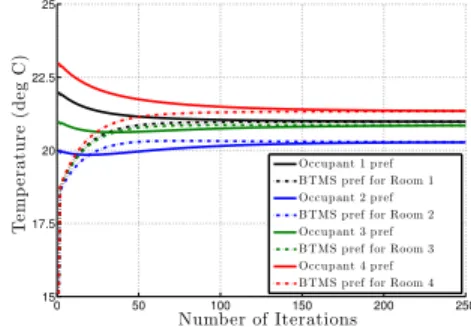
In Figure 2 we present the result of the distributed con-sensus algorithm using ADMM approach. Each zone (room) occupant starts with its ideally preferred temperature point as per Table I and the BTMS with the preferred set-point of the building operator for the corresponding zones.
0 50 100 150 200 250 15 17.5 20 22.5 25 Number of Iterations T em p er a tu re (d eg C ) Occupant 1 pref BTMS pref for Room 1 Occupant 2 pref BTMS pref for Room 2 Occupant 3 pref BTMS pref for Room 3 Occupant 4 pref BTMS pref for Room 4
Fig. 2. Convergence of temperature set-point preferences in each zone, for the occupants and the BTMS.
With each iteration of the algorithm, the difference be-tween the corresponding zonal temperature preference of the occupant and that of the BTMS narrows until there is a consensus in all the zones. The pricing for unit change in temperature varies with each iteration, as shown in Figure 3. The price increases for the zone occupant if the temperature choice is away from the BTMS’ preference and the ambient temperature. In Figure 3 the per-unit price for occupant 4 (located in zone 4) turns negative. This can be attributed to the fact that on consensus, the temperature for that zone moves away from the ambient and building operator’s pre-ferred temperature for the zone, even beyond the occupant’s preferred set-point. 0 50 100 150 200 250 −20 0 20 40 60 80 100 120 140 Number of Iterations P ri c in g fo r o c c u p a n ts Occupant 1 Occupant 2 Occupant 3 Occupant 4
Fig. 3. Pricing variation for the zone occupants for desired change in the zonal temperatures.
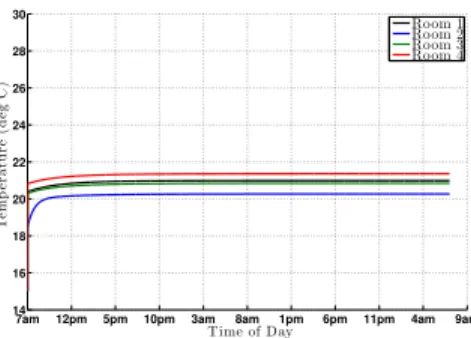
Next we use the consensus temperature of the zones as the target temperatures in the building dynamics model in (1) to simulate the temperature variation of the building for a 48 hour period. We present our simulation results with the
control law proposed in (14). The corresponding temperature dynamics for a 48 hour period is presented for the four zone model in Figure 4. The temperature of each zone converges to the corresponding component of the consensus temperature vectorz∗, as can be observed in the figure.
7am 12pm 5pm 10pm 3am 8am 1pm 6pm 11pm 4am 9am
14 16 18 20 22 24 26 28 30 Time of Day T em p er a tu re (d eg C ) Room 1 Room 2 Room 3 Room 4
Fig. 4. Temperature dynamics: 48 hour period with proportional feedback and model based feedforward controller.
Figure 5 presents the temperature dynamics with a real world working environment schedule. The occupants of each room/zone walk-in at 7 am on day 1 (start of the simulation), take an hour long lunch break at 12 pm and leave for the day at 5pm. The following day the occupants get in at 8 am, take the lunch break at noon and leave at 5 pm. When the zones are un-occupied we go into an energy saving mode during which the zonal temperatures start sliding to the ambient temperature. The occupancy of the zones can be obtained through an online occupancy sensor or can be an offline system scheduler.
7am 12pm 5pm 10pm 3am 8am 1pm 6pm 11pm 4am 9am
14 16 18 20 22 24 26 28 30 Time of Day T em p er a tu re (d eg C ) Room 1 Room 2 Room 3 Room 4
Fig. 5. Temperature dynamics: 48 hour period, real-world user occupancy.
V. CONCLUSION
In this work, we have proposed an approach for collab-orative temperature control in multi-occupant spaces, that uses pricing feedback to attain a consensus between the rational occupants (interested in minimizing their individual discomfort plus energy cost) and the building operator (ther-mal management system). Upon convergence, the consensus algoritm attains temperature set-points that minimize the sum of the aggregate discomfort of the occupants and the total energy cost in the building. The temperature set-points attained on consensus is then used by a control law with
proportional feedback and feedforward components, to drive the building to the desired (optimal) temperature. Through simulations, we have demonstrated the convergence of the consensus algorithm, as well as the control law, to the desired (optimal) temperatures.
REFERENCES
[1] L. Lombard, J. Ortiz, C. Pout, A review on buildings energy con-sumption information, Energy and Buildings, vol. 40, pp. 394-398, 2008.
[2] H. Sane, C. Haugstetter, S. Bortoff, Building hvac control systems -role of controls and optimization, In Proc. of ACC, 2006.
[3] G. Henze, Energy and cost minimal control of active and passive build-ing thermal storage inventory, Journal of Solar Energy Engineerbuild-ing, vol. 127, 2005.
[4] G. Henze, C. Felsmann, G. Knabe, Evaluation of optimal control for active and passive building thermal storage, International Journal of Thermal Sciences, vol. 40, 2004.
[5] Y. Ma, G. Anderson, F. Borrelli, A distributed predictive control approach to building temperature regulation, In Proc. of ACC, 2011. [6] N. Gatsis, G. Giannakis, Residential demand response with interrupt-ible tasks: Duality and algorithms, In Proc. of 50th IEEE CDC-ECC, 2011.
[7] V. L. Erickson, A. E. Cerpa, Thermovote: participatory sensing for efficient building hvac conditioning, BuildSys ?12 Proceedings of the Fourth ACM Workshop on Embedded Sensing Systems for Energy-Efficiency in Buildings Toronto, ON, Canada, 2012.
[8] S. Purdon, B. Kusy, R. Jurdak, G. Challen, Model-free hvac control using occupant feedback, IEEE 38th Conf. on LCN Workshops) Sydney, NSW, 2013.
[9] N. Klingensmith, J. Bomber, S. Banerjee, Hot, cold and in between: enabling fine-grained environmental control in homes for efficiency and comfort, Proceedings of the 5th international conference on Future energy systems, pp. 123-132, Cambridge, UK, 2014.
[10] S. K. Gupta, K. Kar, S. Mishra, J. T. Wen, Building temperature control with active occupant feedback, 19th World Congress, The International Federation of Automatic Control, Cape Town, South Africa, Aug 24-29, 2014.
[11] B. Mebee, Computational approaches to improving room heating and cooling for energy efficiency in buildings, PhD thesis, Virginia State and Polytechnic Institute, 2011.
[12] P. Riederer, D. Marchio, J. Visier, A. Husaunndee, R. Lahrech, Room thermal modeling adapted to the test of hvac control systems, Building and Environment, vol. 37, 2002.
[13] G. Fraisse, C. Viardot, O. Lafabrie, G. Achard, Development of simplified and accurate building model based on electrical analogy, Energy and Buildings, vol. 34, pp. 1017-1031, 2002.
[14] A. Athienitis, M. Chandrashekhar, H. Sullivan, Modelling and analysis of thermal networks through subnetworks for multizone passive solar buildings, Applied Mathematical Modelling, vol. 9, 1985.
[15] V. Chandan, Modeling and control of hydronic building hvac systems, Masters thesis, UIUC, 2010.
[16] S. Mukherjee, S. Mishra, J. Wen, Building temperature control: A passivity-based approach, IEEE 51st Annual Conference on Decision and Control, 2012.
[17] L. Lombard, J. Ortiz, C. Pout, A review on buildings energy con-sumption information, Energy and Buildings, vol. 40, pp. 394?398, 2008.
[18] D. P. Bertsekas and J. N. Tsitsiklis, Parallel and Distributed Compu-tation:Numerical Methods, Prentice Hall, 1989.
[19] S. Boyd, N. Parikh, E. Chu, B. Peleato, J. Eckstein, Distributed Optimization and Statistical Learning via the Alternating Direction Method of Multipliers, Foundations and Trends in Machine Learning, vol. 3, No. 1, pp. 1-122, 2010.
[20] K. Moore, T. Vincent, F. Lashlab, C. Liu, Dynamic consensus networks with application to the analysis of building thermal processes, In Proceedings of 18th IFAC World Congress, Milano, Italy, 2011.