How BPM, SOA and EA Can Meet True Customer Needs
By Dennis Rohan
Correctly assessing customer needs is a challenge for all organizations. SOA will benefit from BPM contributions that include an accurate assessment of true customer needs. When you satisfy genuine, unrealized customer needs you enhance SOA effectiveness and increase organizational demand for BPM and EA services. To discover these unsatisfied internal and external customer needs, analyze what your constituents do to be successful. Meeting unresolved customer needs will result in delivery of on-target, highly valuable services at reasonable costs.
How Can BPM, EA and SOA All Benefit?
While the lines between BPM, EA and SOA may be blurred, each has distinctive technological, skill set and problem perspective strengths. These three functions combine complementary strengths to produce the solutions that best resolve underserved needs.
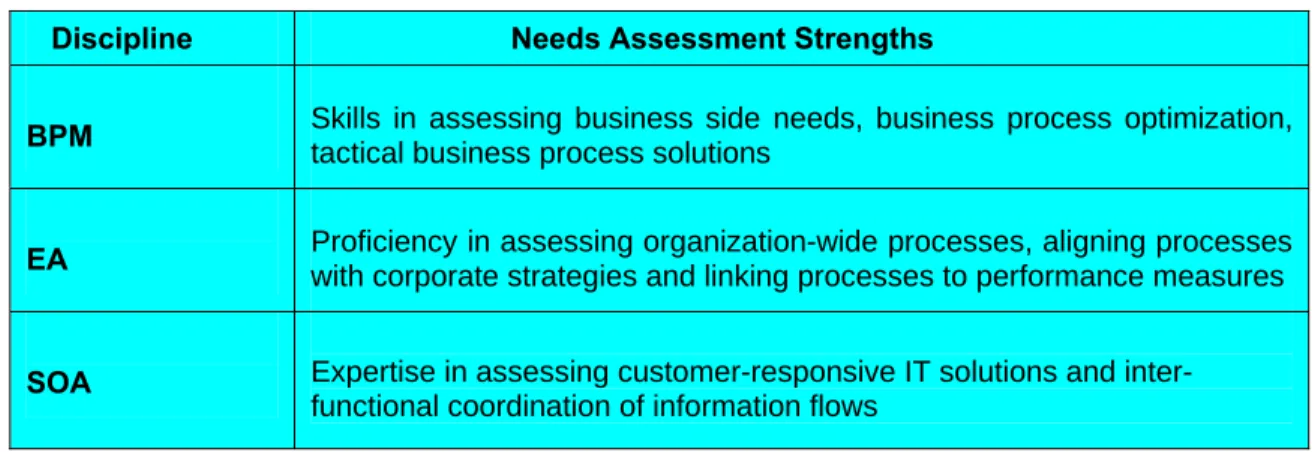
The common platform for cooperation is a shared realization that each discipline can contribute only part of the solution. BPM provides expertise in business process optimization that provides practical, tactical solutions to meet business-side customer needs. EA supplies answers that encompass organization-wide processes, how they are aligned with corporate strategies and how processes are linked to performance measures. SOA offers customer-responsive IT solutions and inter-functional coordination of information flows and a robust platform upon which the business can apply their applications.
Executing the Four Step Procedure for Identifying and Resolving Unmet Needs will create material benefits. By sharing customer analysis information, each discipline more successfully applies their distinctive strengths to satisfying constituent needs. Advancing to create cross-functional solutions can craft a win-win for all parties.
What is your true customer base?
We usually think our customer base is those individuals and groups who directly receive our services and products. A genuine customer base reaches beyond the direct customer. A true constituent platform should include our direct customers’ customers: the indirect customer. You must also treat your superiors as constituents.
What do customers want?
Customers place the greatest value on products and services that help them get their job done and meet their performance commitments. They are most enthusiastic about products and services which satisfy their unmet needs. These needs arise when currently available products and services do not allow customers to successfully complete their jobs and satisfy their performance commitments. Your greatest opportunity to build a solid customer base comes from satisfying those underserved BPM needs.
To determine the highest payoff customer needs, you must answer several questions. What are their most essential tasks, assignments and projects? What main jobs must they complete to be successful? Focus on what the customer is trying to do. How does the customer create success?
Identify the most important tasks they do to be successful. Concentrate on the outcomes. Complete results -focused analyses: concentrate on the metrics and performance standards that customers use to measure success when executing the jobs, tasks or activities. See Table 1.
Table 1 Interdisciplinary Assessment of Unmet Customer Needs
The Five Underserved Needs Parameters
The parameters for evaluating underserved needs are clear-cut, straight-forward and efficient. The three disciplines can apply the same guidelines to uncover the unmet needs of internal and external customers. A small but significant difference between your superiors and your other customers is reflected in parameters 1 and 1a below.
1. IMPORTANT TASKS (for your direct and indirect customers): What are the most significant tasks, assignments and projects the customer needs to accomplish in order to be successful? 1a. MAJOR COMMITMENTS (for your superiors): Major commitments including their foremost performance expectations, assignments and projects.
2. UNDERSERVED OPPORTUNITIES: Authentic customer needs are those that are not currently met by you or anyone else. In what areas of need are the customers underserved? 3. CONSTRAINTS: What are the items we or the customer can’t do to meet underserved needs? What are your limitations? What can you do help your customer overcome these limitations. 4. MEASURED OUTCOMES: What outcomes do the customers want and how are they measured?
5. ACTION: What actions should we take to satisfy underserved needs?
The Four Step Procedure for Identifying and Resolving Unmet Needs
Analyze the entire customer base to avoid needs assessment shortfalls. Begin your analysis by determining your superiors’ underserved needs. Include your superior and your boss’s superior. Understanding your boss’s needs does not require determining their work tasks but will include their major commitments, including their foremost expectations, assignments and projects.
Discipline Needs Assessment Strengths
BPM Skills in assessing business side needs, business process optimization, tactical business process solutions
EA Proficiency in assessing organization-wide processes, aligning processes with corporate strategies and linking processes to performance measures
SOA Expertise in assessing customer-responsive IT solutions and inter-functional coordination of information flows
Step 1. Define Your Boss’s Superiors’ Underserved Needs MAJOR COMMITMENTS UNDERSERVED OPPORTUNITIES: CONSTRAINTS: MEASURED OUTCOMES: ACTION: What are your
Boss’s supervisor’s major commitments, including their foremost expectations, assignments and projects. In what areas of need are your boss’s superior underserved?
What can’t you or your boss’s superior do?
What outcomes does your boss’s superior want and how are outcomes measured? What actions should you take?
Key Considerations for Addressing Your Boss’s Supervisor’s Major Needs Parameters • Major commitments: Focus on identifying one or two major strategic commitments
• Underserved needs: Determine which unmet needs resolution opportunities best address the one or two foremost strategic commitments
• Constraints: What are you and your direct superior’s budgetary and political limitations in resolving these needs
• Measured outcomes: Determine the most important performance metrics used to measure success
• Actions: Include underserved needs solutions that have high organizational visibility
Step 2. Define Your Immediate Superior’s Underserved Needs
MAJOR COMMITMENTS UNDERSERVED OPPORTUNITIES: CONSTRAINTS: MEASURED OUTCOMES: ACTION: What are your
supervisor’s major commitments, including their foremost expectations, assignments and projects. In what areas of need is your superior underserved?
What can’t you or your superior do?
What outcomes does your boss want and how are these outcomes measured? What actions should you take?
Key Considerations for Addressing Your Supervisor’s Major Needs Parameters • Major commitments: Limit your investigation to the two or three most significant
commitments.
• Underserved needs: Be sure to include at least one unmet need that will also satisfy your supervisor’s boss’s expectations
• Constraints: Be realistic in assessing the budgetary, time and political limitations you will incur satisfying these needs
• Measured outcomes: Consider both the short term and long range impact on performance metrics
• Actions: Be sure that the proposed actions fall within your areas of
responsibility and that are necessary inter-functional cooperation can be supported by your supervisors
Step 3. Define Your Direct Customers’ Underserved Needs
Key Considerations for Addressing Your Direct Customer‘s Major Needs Parameters • Important tasks: Determine the tasks, assignments and projects which produce the
best results
• Underserved needs: Define the opportunities that your products and services provide in resolving their unmet needs in meeting performance obligations. Any solutions that resolve direct customer needs and also satisfy your superiors’ underserved needs are highly valued.
• Constraints: Look for opportunities to overcome limitations while keeping within your superiors’ constraints
• Measured outcomes: Define the most important measurable performance outcome that can be improved by meeting underserved needs
• Actions: Plan solutions that will satisfy both your superiors and direct customers. Be aware that your services and products will not be viewed as a solution unless the customer sees a direct connection between those solutions and improved outcomes
4. Define the Underserved Needs of Your Customer’s Most Prominent Indirect Customers
Key Considerations for Addressing Your Customer’s Customer Major Needs Parameters • Important tasks: Determine, with the assistance of your direct customer, the critical
tasks, assignments and projects for one to two of your of customer’s most prominent customers
IMPORTANT TASKS: UNDERSERVED OPPORTUNITIES: CONSTRAINTS: MEASURED OUTCOMES: ACTION: What are the most
significant tasks, assignments and projects the customer needs to accomplish in order to be successful? In what areas of need is the customer underserved? What can’t we or the direct customer do? What outcomes does the customer want and how are these outcomes measured? What actions should you take? IMPORTANT TASKS: UNDERSERVED OPPORTUNITIES: CONSTRAINTS: MEASURED OUTCOMES: ACTION: What are the most
significant tasks, assignments and projects the customer needs to accomplish in order to be successful? In what areas of need is the customer underserved?
What can’t you or the indirect customer do?
What outcomes does the customer want and how are these outcomes measured? What actions should you take?
• Underserved needs: Identify underserved needs your direct customer believes are most relevant to their customers
• Constraints: Recognize that your indirect customer’s limitations may be difficult to evaluate and typically require a cooperative effort with your direct customer to create an accurate assessment
• Measured outcomes: A collaborative effort with your direct customer usually creates a more accurate definition of the more important outcome metrics
• Actions: Action plans to satisfy indirect customers will be more efficient and effective when developed in cooperative with your direct customer
Creating the Best Solutions for Resolving Underserved Needs
The Four Step procedure for defining unmet needs can be executed as a single project or a multifunctional venture that combines the distinctive strengths of BPM, EA and SOA. Joint venture solutions can provide a more complete needs resolution. Your expectations for the magnitude of the solutions that can be generated should be realistic. Blockbuster ideas are welcome but rare and frequently unachievable. Customer needs can be met with a little practical innovation. The simple reworking of existing ideas and methods can produce exceptional payoffs. For an excellent, in-depth discussion of concepts and practical methods for resolving underserved needs, see Anthony Ulwick’s What Customers Want. [1]
References
[1] Ulwick, Anthony W, What Customers Want, McGraw-Hill, 2005
________Author
Dennis Rohan is a Leadership Consultant, Performance Management Innovator, BPR practitioner and founder of Rohan and Associates. For more than 25 years, he has advised and mentored executives who manage business processes. Dennis is a frequent speaker for business and professional groups. He works primarily with technology, technological manufacturing and health care organizations. He helps executives create strategies that drive the successful development and sustained effectiveness of their business processes