• No results found

Meta-design Knowledge for Clinical Decision Support Systems

N/A
N/A
Protected

Academic year: 2021

Share "Meta-design Knowledge for Clinical Decision Support Systems"

Copied!
21
0
0

Loading.... (view fulltext now)

Full text

(1)

Meta-design knowledge for Clinical Decision Support

Systems

Shah Miah

VU Business School Victoria University Melbourne [email protected]

Jacqueline Blake

University of the Sunshine Coast Queensland

Don Kerr

University of the Sunshine Coast Queensland

Abstract

Knowledge gained from a Decision Support Systems (DSS) design should ideally be reusable by DSS designers and researchers. The majority of existing DSS research has mainly focused on empirical problem solving rather than on developing principles that could inform solution approaches for other user contexts. Design Science Research (DSR) has contributed to effective development of various innovative DSS artefacts and associated knowledge development, but there has been limited progress on new knowledge development from a practical problem context, going beyond product and process descriptions. For DSS applications such as Clinical Decision Support Systems (CDSS) design and development, relevant reusable prescriptive knowledge is of significance not only to understand mutability but also to extend application of theory across domains. In this paper, we develop new design knowledge abstracted from the approach taken in a representative case of innovative CDSS development, specified as an architecture and six design principles. The CDSS design artefact was initially designed for a specific clinical need is shown to be flexible for meeting demands of knowledge production both for diagnosis and treatment. It is argued that the proposed general strategy is applicable to designing CDSS artefacts in similar problem domains representing an important contribution of design knowledge both in DSS and DSR fields.

Keywords: DSS, clinical DSS, IS theory, design science research, public healthcare

1

Introduction

The aim of this paper is to describe meta-design knowledge1 that is generated from an existing CDSS project. Over the past few decades research has been grown rapidly in CDSS design for addressing many clinical and non-clinical decision-making issues. The majority of the research

1 In IS research, the meta-design refers to a type of artefact targeting to meet the requirements of

particular problem sets (Walls, Widmeyer, & El Sawy, 1992). Koehne, Redmiles, and Fischer (2011) described meta-design as a theoretical framework supporting for mapping individual users’

participations in system context. In this paper, new knowledge as a meta-design framework as a prescriptive knowledge (Gregor and Hevner, 2013) that we propose is to offer six design principles and a general design architecture to meet the requirements of particular problem sets for CDSS design.

(2)

is aimed at innovative technology and approach design for the improvement of clinical or and non-clinical processes. For example, Litvin et al. (2012) described a CDSS design for requirements of enhancing primary-care practices in public health, while Chang et al. (2016) proposed a CDSS for improving clinical outcomes with adherence to evidence-based clinical guidelines. Such CDSS research only focuses on problem solving paradigm rather than highlighting the requirement of developing new knowledge that may be applicable to other problem contexts. While Fischer and Eden et al. (2004) wrote on meta-design knowledge and its reusability in IS research, such ideas are rarely developed in the context of DSS development and particularly so with direct relevance to CDSS designers and practitioners. Analysing the design trends of CDSS literature we found that very few attempts have been made to develop new reusable theoretical knowledge from the design practices of existing CDSS development projects. O’Sullivan et al. (2014) discussed requirements of enhancing CDSS evaluation theory (such as for achieving greater usability), Chang et al. (2016) provided design guidelines that are based on the cognitive fit theory, and Marcos et al. (2013) described theories of a sustainable platform of CDSS for smooth integration of design components, for example, interoperability. This work used existing theories to encourage developing new design knowledge that could offer processes for better guiding CDSS designers and researchers. It is imperative to explore the requirements for revealing knowledge that could be potentially reusable for designing and implementing CDSS. Therefore, reusable design knowledge can provide practical guidelines for designers and IS researchers for similar CDSS design. This has implications not only for improving practices for developing technical components but also to obtain appropriate guidelines to map the behavioural and organisational settings for developing innovative CDSS artefacts.

There has been growing attention to Design Science Research (DSR) within the IS community since Nunamaker & Chen (1990) first introduced this as an effective design method for contemporary IS design. Since then many authors have elaborated different issues of DSR to locate the IT artefact in a theoretical context while retaining real-world relevance (Orlikowski & Iacono, 2001). Significant attention has been paid to extend DSR in many directions and one of the directions is artefact development (Hevner, March, Park, & Ram, 2004; March & Smith, 1995; Peffers, 2008), theoretical development (Baskerville et al. 2018; Gregor and Hevner, 2013) and contextual development (McKay et al. 2012; Carlsson, 2007). vom Brocke et al. (2020) indicated that it is important to generate prescriptive knowledge2 from DSR studies, which is seen as a contribution to the IS body of knowledge in terms of both theory and practices of solving real-work issues. Identifying limitations for accumulation and evaluation of design knowledge in IS, the authors (vom Brocke et al. 2020) provided a framework to derive this prescriptive knowledge from DSR studies for addressing further practically relevant IS design issues. There are other calls for IS researchers to pay more attention to the extent of artefact design process and the different dimensions of artefact design (Iivari, 2015).

In a relatively recent Design Science Research (DSR) special issue in the European Journal of Information Systems, senior IS researchers reinforced the importance of generating new design knowledge from DSR artefacts (Baskerville, Kaul & Storey, 2018b). De Leoz and Petter (2018)

2 Gregor and Hevner (2013) stated that prescriptive knowledge can be design knowledge that describes

principles of form and function, methods, constructs and justificatory understanding that may be used to develop an artefact.

(3)

eventually indicated “We encourage IS design science researchers to think beyond the creation and evaluation of the technical components of the IT artefact and also to consider the social impacts of the IT artefact.” (page. 156). This provides reinforcement for researchers to develop meta design knowledge from our practical CDSS design issues.

The DSR methodology has grown in importance for DSS solution design (Arnott & Pervan, 2014a) in general, although in designing specialised DSS such as CDSS solution artefacts was less in evidence. The increased application of DSR is positive in as much as it produces useful guidelines for developing innovative solution artefacts to address both human-oriented and organisational unsolved problems (Hevner et al., 2004). In this paper, we extend the design understanding around process development to offer better guidance for designing specific artefacts. While addressing the criteria of Gregor and Hevner (2013) regarding generality to a class of problems and the meta-requirements that specify the goal class to which the theory applies.

For developing relevant design knowledge we operationalise both the DSR theoretical statements by Gregor and Hevner (2013) and by Baskerville et al. (2015) for positioning understanding that was inductively generated from a specific design case. Adopting Hevner’s

et al. framework of DSR we describe meta-design3 knowledge for the problem class of diagnostic and treatment recommending CDSS, using an existing sleep-disorder CDSS project in which an innovative practitioner-specific CDSS artefact was developed (reference removed). We identified generic and essential design problems and based on abstracted requirements we developed a theoretical understanding and model through designing and evaluating the solution artefact for the particular decision support context.

This paper is structured as follows. The next section describes background literature and the problem case that we initially identified for designing the CDSS solution within an interactive practitioner context. The subsequent section defines the methodological details and the section after that provides the details of meta-design knowledge that we developed and modelled from the CDSS design case. The final section discusses the contribution, validation and applicability of the emergent theoretical understanding for similar CDSS designs along with future research directions.

2

Background

Clinical Decision Support Systems (CDSS) is one of the well-recognised sub-areas of information systems research. CDSS is “any computer program designed to help health professionals [and patients living in their communities] make clinical decisions and [non-clinical decisions]’’ (Marcos et al., 2013, p. 676). IT artefacts are inevitably embedded in their organisational settings (Orlikowski & Iacono, 2001) and such specialised artefacts do not only assist practitioners by providing patient-specific recommendations but can also be a system that uses clinical data to support decision making in patient care (Marcos et al., 2013). While Hevner et al. (2004) suggested that practices of designing IT artefacts must be based on

3 Markus et al. (2013) designed six principles of design process: 1) design for customer engagement by

seeking out native users, 2) design for knowledge translation through radical iteration, 3) design for offline action, 4) design for integrating expert knowledge with local knowledge sharing, 5) design for implicit guidance and 6) design to componentise everything including knowledge bases.

(4)

appropriate design theory or existing supportive knowledge, methodological studies for design process and guidelines are rare in the CDSS research field.

2.1

Relevant DSR knowledge

Design theories can be a type of prescriptive knowledge (Simon, 1969) and many theories have been offered in recent years to assist developers or IS researchers. Walls et al. (1992) defined the term “IS design theory” as an integrated prescription that comprises “a set of user requirements, a set of system features (or principles for selecting system features), and a set of principles deemed effective for guiding the process of development”. Further to this Markus et al. (2002) suggested that the role of IS design theories is to assist developers with guidelines to control, manage and operate any specific design process by focusing their attention and restricting their options. Knowledge contributions from effective DSR studies is also central to make contributions to the problem or domain of relevant literature (Hevner et al., 2004). Gregor and Hevner (2013) noted that any knowledge contributions in the form of a design theory should be treated as a type of artefact. Beyond the other artefact types defined by March and Smith (1995) such as constructs, models, methods, and instantiations, Gregor and Hevner (2013) outlined that a DSR research project can produce design knowledge in terms of artefact design at three different levels. level 1 - in the form of products and processes, whereas more abstract understanding can be treated as knowledge contributions at Level 2 (where contributions are design principles, technological rules etc). Level 3 represents a much broader abstraction of knowledge as “well-developed design theory”. While a Level 1 contribution represents artefact design as a situated implementation, the higher levels concern more abstract theorizing including design principles or architectures that may have further application in new artefact design studies.

2.2

DSR for DSS research

One of the promises of the DSR method is that it offers greater professional relevance in IS design that promote design practices for innovation. March and Smith (1995) draw a distinction clearly between natural sciences and design-science research: “Whereas natural science tries to understand reality, design science attempts to create things that serve human

purposes” (p. 253). Arnott (2014b) described a problem for a DSS developers; namely how to conceptualize aspects of the decision task that need improvement during iterations of the evolutionary development process. Many of the early DSS studies involved designing and implementing innovative IT-based systems through classic development methodologies (Arnott & Pervan, 2012). The DSR view shows promise beyond the classical approaches of IT system development, and using DSR guidelines provides a basis for considering how to improve both the quality and impact of DSS (Arnott & Pervan, 2012). This approach could contribute to bridging the gap between academic DSS design research and professional worlds of practice. As already noted, much of DSS design has been limited to specific techniques developed without looking at the practitioner’s contextual demands, and in many cases relevance issues have been ignored in favour of academic or technical priorities.

2.3

CDSS research

One of the most important purposes of CDSS is to reduce medical errors: recognised as a major issue in healthcare and medical domains. Agharezaei et al. (2013) suggested that CDSS generally improves the quality of healthcare services and meeting patient’s medical demands. Health domains are information intensive in which various demands apply for professional

(5)

consultation and support, both with everyday condition changes and emerging medical knowledge. In the past, CDSS research has been designed for the purposes of diagnosis, treatment, and medical follow-up.

Zolhavarieha and Parry (2017) developed a candidate matrix from their developed CDSS framework called Knowledge Quality Assessment (KQA) for discovering and evaluating the clinical knowledge for CDSS design. Chen et al. (2018) investigated an association of inhaled corticosteroids and fracture in order to develop a CDSS. In the research Chen et al. (2018) particularly addressed the issue of improving predictive performance of the CDSS. Yu (2015) improved the utility of the CDSS by focusing on the importance of the relationship of knowledge bases and the CDSS system as key drivers of rapid learning in clinical care service. These authors seldom mentioned the requirements of generating new understanding that may add value for contextual requirements of particular CDSS problem.

CDSSs show evidence of robust use for improving health professionals’ performance however, many studies questioned its design acceptance and effectiveness due to its context-sensitiveness for example in terms of lack of user uptake (Miah, Gammack & McKay, 2019; Miah, Kerr, Gammack, & Cowan, 2008; Miah, 2009) and a lack of options that offer flexible workflows (Wright & Sittig, 2008). Information system use is an essential construct that indicates human behaviour in IT utilization and successful IS adoption in organizations (Sun & Teng, 2012). An influential paper by Orlikowksi and Iacono (2001), which restored to IS a focus on the IT artefact, suggested five meta-categories covering its various conceptions within IS (namely: tool view, proxy view, ensemble view, computational view and nominal view). Of these the “ensemble view” concerns “the dynamic interactions between people and

technology” (Orlikowski & Iacono, 2001, p. 126), which describes the enmeshing of technologies of use. Orlikowski and Iacono (2001) promoted a strong socio-technical tradition for conducting IS design research in that all IT artefacts are inevitably embedded in a physical setting. Orlikowski and Iacono’s study suggested that comprehensive practices of the use of IT artefacts should be integrated into relevant theory. Also, the ensemble artefact should deal with outlining a combined process of problem-solving to align with both problem spaces of human – a working model of physicians and patients for their decision support. If this need can be addressed, both- physicians’ performance can be increased and patients’ care-support for their self-management can be enriched. At the same time, CDSS alignment within specific domain helps overcome the issue of information arrangement and representation for ease of use. On the other hand, CDSS alignment with task representation helps deal with the issue of incorporating clinical practice guidelines (CPGs) (Fox et al., 2010) and integrating with clinical workflows (Kesselheim, Cresswell, Phansalkar, & et al., 2011).

3

Method

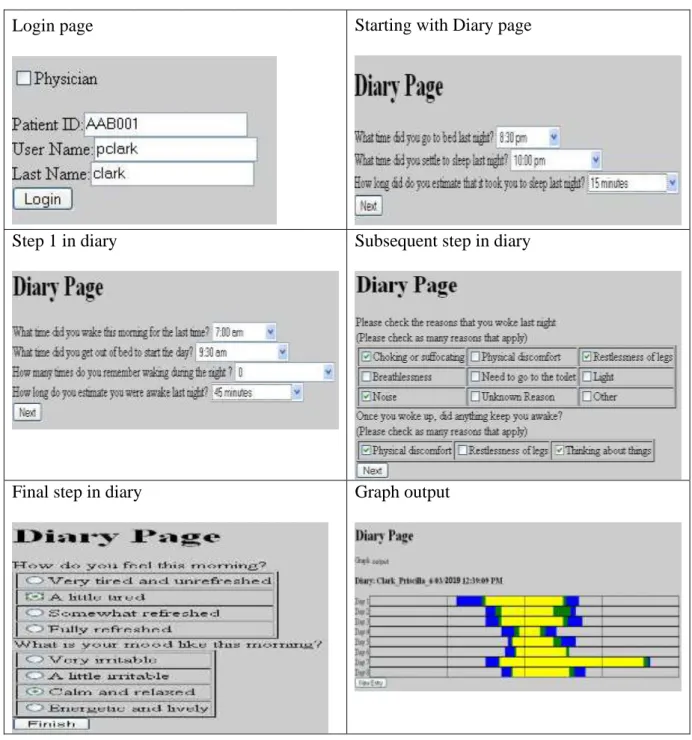
The study reported in this paper builds upon our previous work (Blake, Kerr & Gammack, 2016) which was focused on reporting a specific case of CDSS design and evaluation. The aim of design knowledge development from the specific CDSS design case was based upon an artefact called a knowledge based CDSS (KB-CDSS), shown in figure 1. The artefact prototype received initial data on patients from physicians. The physician uses sources such as referral or/and previous medical history and test results. The CDSS prototype offers decision support information to physicians for patient care, using user centred design principles (Miah, 2004). The artefact addressed issues of developing a major source of information that could be used to diagnose sleep disorders; namely the patient’s sleep diary, by developing an online sleep

(6)

diary. Going beyond what the artefact did, with the artefact design and evaluation, we attempt to build new design understanding, so that CDSS researchers and CDSS design professionals obtain guidelines.

Login page

Starting with Diary page

Step 1 in diary

Subsequent step in diary

Final step in diary

Graph output

Figure 1: Developed CDSS artefact

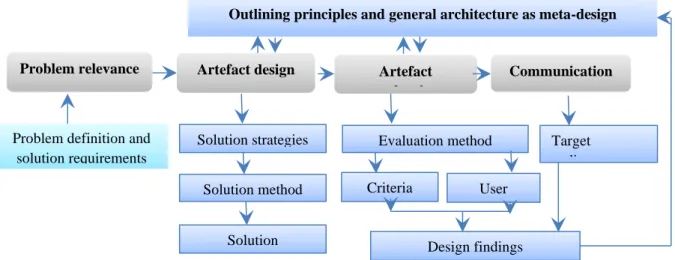
De Leoz and Petter (2018) analysed an existing DSR project examining the meta-requirements such as design objectives and how they were accomplished through the effective artefact design. The insights as new understandings are communicated as theory in terms of capturing principles of design function for identifying social impact of artefact. Following a similar pathway in a different problem context CDSS design, our objective is to further develop design knowledge as a theory artefact (Gregor & Hevner, 2013) based on DSR phases of problem relevance, artefact design, artefact evaluation and communication. Figure 2 illustrates the methodology we used.

(7)

Figure 2: Overall methodology for the design science research

The methodology may be conveniently partitioned into four sets of activities: problem relevance, artefact design, artefact evaluation and communication. The following table 1 includes the details of each activities. We followed Hevner et al. (2004) for conducting new knowledge generation from the artefact design study. The APSARA pattern retrieval approach described in Purao & Storey (2008) has parallels with case-based reasoning (Jonassen & Hernandez-Serrano, 2002), and while their focus was on technology acceptance of reused designs, their work was less appropriate to our context. Their approach was considered more suited to operational artefact design rather than generating new theory based on the characteristics of problems, design activities, user’s involvement and their viewpoints on design and evaluation. Likewise, as Goldkuhl and Sjöströmb (2015) note, March and Smith (1995), Hevner et al (2004) and Peffers et al (2008) approaches downplay theory as a DSR outcome. Hevner et al’s. (2004) seven guidelines however, do provide general considerations for defining a DSR problem space, specifying a design-based solution artefact, implementing the design solution, evaluating the design artefact and communicating study details and results, and as such provide for theory as an output of DSR. We grouped these guidelines for convenience into four phases to fit our purpose of new theory development study: Regarding problem relevance we utilised guideline 2; for the artefact design phase, we utilised guideline 1, 5 and 6, for the artefact evaluation phases, we used guideline 3 and for communication phase, guidelines 4 and 7 were used. Table 1 includes the details of the four phases.

Artefact design

Problem relevance Artefact

evaluation

Communication

Problem definition and solution requirements

Solution strategies

Solution method

Solution

Outlining principles and general architecture as meta-design

Evaluation method Criteria User groups Design findings Target audience

(8)

Activities in phases DSR guidelines Descriptions Problem relevance

Guideline 2 Sleep problems ... are common and have adverse health, social and economic costs (Adams et al. 2017). Extant CDSS solutions are inadequate. General practice healthcare provision is a specific problem of global relevance. This is the essence of the research gap addressed by the DSR study.

Artefact design Guidelines 1,5 & 6

Guideline 1: Design as an Artefact.

The study has produced a CDSS artefact designed to support healthcare decisions for patients in the domain of sleep disorders.

Guideline 5: Research Rigor.

Established methods and proven techniques were used. As the aim was differential diagnosis in a space of disorders this made clear the basis for specific diagnosis in a structured and defensible manner. Rule based decision support systems were also chosen as it was possible to simplify each decision point.

Guideline 6: Design as a Search Process.

Validated healthcare knowledge was employed to ground the design artefact in this study. The design process was iterative in order to cope with much of the uncertainty inherent in the problem space (e.g. patients concerns relevant to general practices are separated from the primary medical and healthcare requirements) and to allow progressive and incremental solution development at a level so it can be presented for evaluation and componential specification.

Artefact evaluation

Guideline 3 Guideline 3: Design Evaluation.

To demonstrate artefact utility, both focus group and field studies have been conducted with representative stakeholders to capture opinion on the prototype’s use.

Evolutionary prototyping development in consultation with representative doctors ensured ongoing evaluation and relevance, following established design science guidelines.

Communication Guideline 4 & 7

Guideline 4: Research Contributions.

The experimental and focus group outcomes and analysis have shown clear benefits to the target populations.

Guideline 7: Communication of Research.

This study presents detail relevant to academic, management and industry professionals, and has been verbally presented to such in workshops and presentations during its development and evaluation through focus groups.

Table 1: The adopted research methodology that was modelled on Hevner et al. framework

The design case concerned providing decision support to physicians and patients for treating sleeping disorders. Before abstracting to more generic context, we outline the phases, beginning with the first phase, problem relevance, where we explore and characterise the specific problem domain space.

In the Australian healthcare sector, sleep disorders are a significant and growing problem for the physical and psychological well-being of individual patients. Sleep disorders commonly affect people around middle-age so as the population ages there are an increased number of

(9)

people with sleep disorders with risk factors in adults being obesity, alcohol, smoking, nasal congestion and menopause (Young, Peppard, & Gottlieb, 2002). Physicians, who deal with sleep disorders, and their administrative support staff and facilities, are under constant pressure to find more effective methods to deal with the increasing backlog of patients. The main symptom of a sleep disorder is excessive daytime sleepiness and there are a number of lifestyle and physical consequences associated with this. Many of these patients face significant wait times before being able to attend a consultation and receive treatment to relieve symptoms. A large percentage of the Australian population is affected by some form of sleep disorder, and the direct and indirect costs of sleep disorders to the Australian society in 2016-170 was 66.3 billion dollars (Deloitte Access Economics, 2017).

In the second, (artefact design) phase, to operate an effective process for knowledge acquisition, the lead researcher formed a team with two sleep physicians and a psychologist. These three individuals were experts in the field of sleep disorder diagnosis and a participative approach was taken to help gain insights into their shared knowledge and experience and to develop the domain specific knowledge-base for the DSS.

The importance of gathering a detailed patient history during the consultation was highlighted in initial interviews with physicians. The inclusion of patient history as an input was therefore part of the system scope that the physicians expected and considered best practice during a consultation4. Gaining these stakeholders’ approval of the output from the CDSS and for the data gathering instrument for the patient history was therefore essential. Access to the sleep investigation clinics’ patient records allowed testing of the instrument and also gave the medical team a vested interest in the success of the project (Cornwall & Jewkes, 1995). The two sleep specialists provided expertise on the diagnostic criteria and process, while the psychologist was specialized in psychological sleep disorders such as insomnia, the psychology impacts of sleep disorders and compliance to sleep disorder treatment by patients. The researcher acted as a team leader to set agendas, produce questionnaire drafts, schedule and keep records of the meetings and keep the team focused on the required outcomes. From that an initial CDSS was planned which would automate patient history data gathering by using an online patient history questionnaire, which would act as a data-acquisition tool. This information would be stored in a database with the additional benefit of forming an evidence base of patient histories.

Our initial design of DSS was driven by a series of three one-hour interviews with the director of the Sleep Investigation Unit in a Brisbane, Australia hospital (one of the experts in the aforementioned medical team). The purpose of these interviews was to understand the environment within which the CDSS will be operating and discuss and record the protocol of the sleep disorder diagnostic process. An understanding of the context of the artefact was important in order to ensure that the IT artefact (CDSS) instantiation does not cause unseen

4 The CDSS we designed for recording patient histories and symptoms and mapping these against

International Sleep Disorder Classification categories. This was associated with a separate sleep history tool for recording sleep patterns, usually for 14 nights. Each day the patient notes details of the night's sleep, along with intakes of caffeine and alcohol, to build up a picture of sleep habits (known as sleep hygiene). Poor sleep hygiene, or insufficient time made available for sleep, may be a cause of excessive daytime sleepiness, the main symptom of a sleep disorder. The tool is used by health professionals, such as physicians and sleep specialists, as a primary diagnostic tool for identifying insomnia (Blake, Kerr, & Gammack, 2016).

(10)

side effects such as reporting misleading patient history. The CDSS also needs to meet the requirements of the end user (March and Smith 1995). In this instance the environment is medical and therefore a strong requirement is patient privacy, provision for multiple sleep disorders in one patient and awareness of co-existing conditions impacting on sleep disorders. In third phase, for evaluating the CDSS artefact for sleep physicians, real time data needed to be obtained. We used ten randomly chosen sleep patients filled in 14 days of sleep diary data and completed the patient history questionnaire. These data were used to input in our CDSS application, and the produced output was presented to the physicians. These outputs are: 1. sleep diary graph; 2. sleep diary statistics; and 3. physician report that was mainly generated from the diary graph and the statistics.

The CDSS artefact holds an option for sending reports via email to the physicians. This is equivalent to the second stage in the consultation process, in which physician categorises patients (analysing the report) into the three levels of appointment urgency. The physicians (participants) who were involved in the development of the CDSS artefact (e.g. web application) were asked to comment on the results. Participants considered the difference that having this information would make when they were consulting a patient. One physician made comments focusing on the operational aspects of the reports that is, the output of the CDSS rather than on how the application might affect the consultation process. The other physician focused on how the use of the application would affect a consultation, so that both points of view were discussed.

For the purpose of checking acceptance of the technology, evaluation focused firstly on the ease-of-use aspects, particularly addressing readability and layout, and secondly on the usefulness of the reports themselves for supporting professional decisions. The comments made by the physicians were grouped under these themes (Blake, Kerr, & Gammack, 2016). Various presentations and stakeholder focus groups affirmed the utility and ease of use within normal workflows. This, with the academic articles reporting the work, constituted the communication aspect of the DSR guidelines.

4

Design artefact as theory

To address artefact design requirements, Iivari (2015) proposed two strategies. The first strategy (Strategy 1) is evidenced when DSR researchers first construct an IT meta-artefact as a general solution concept, that can then be instantiated in multiple, specific solution contexts. The alternative strategy (Strategy 2) is evident when researchers attempt to address a user-specific problem by building an IT artefact for that user-specific problem context, and then distil from that artefact knowledge that can be generalised into a general solution concept. The case study on which this paper is based represent an example of a Strategy 2 approach being adopted. This enabled the learning and initial design principles and the meta-artefact design to be instantiated, and thus tested in practice. In this section, we utilize this work to theorise and extract firstly, the relevant problem class to which our meta-artefact applies, then the design principles and architecture underpinning the meta-artefact, to present a Practitioner-Centric Design Environment, a general solution concept suited to specific configurations applicable to problems that are representative of the problem class.

Design theory can include the other forms of design knowledge: constructs, models, methods, and instantiations that convey knowledge. Markus et al. (2002) suggested that design theory formalises knowledge in DSR and provides prescriptions for design and action: it says how to

(11)

do something. As such design theory constitutes prescriptive knowledge as opposed to descriptive knowledge, which encompasses the other types of theory identified in Gregor and Jones (2007). This view was reinforced by Gregor and Hevner (2013) who characterise “design theory as an abstract, coherent body of prescriptive knowledge that describes the principles of form and function, methods, and justificatory theory that are used to develop an artefact or accomplish some end

(p. A3).

4.1

A design theory for CDSS

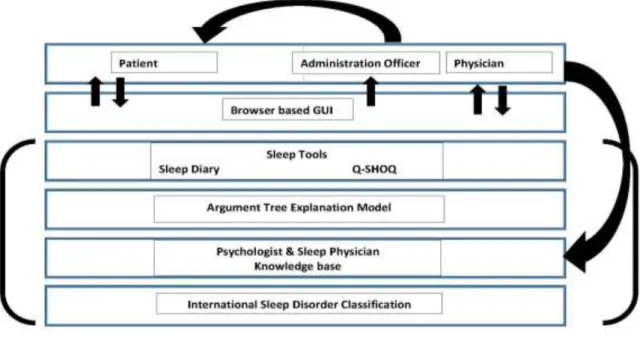
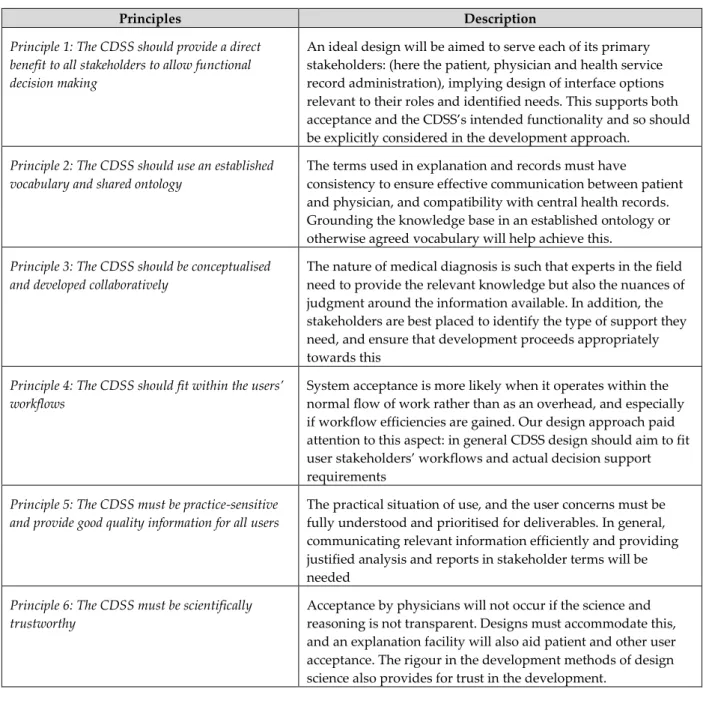
Our proposed design theory is comprised of a generic solution architecture for CDSS and six design principles. Find figure 3 and table 2 below for them.

The essential functions of CDSS are to first to support a correct diagnosis, and secondly to relate this to a suitable treatment. This implies relevant information should be input, and reasoning with it be justifiable in professional terms. Abstractly, this applies to all diagnostic domains from medicine to car mechanics, and indeed this activity has been formalised in a general “algorithm” for identifying component causes causing discrepancy from a normal system state. The reasoning involved follows established logic models and is applied from first principles, rather than heuristic rules derived from professional experience. Medicine is not an exact science however and equally recognises that clinical judgment is essential, with diagnostic reasoning “the most critical of a doctor’sskills” (Croskerry, 2009, p. 1022). These two, complementary, universal theories of diagnosis are supported in our theory and model as detailed further below.

Both patients and physicians are sources of the relevant information, both locally specific and general, and through the physician’s extra resource access, access to further and emerging scientific knowledge. The knowledge involved must however meet an objective standard: described in the true and justified terms of the scientific domains involved. Thus, the architecture provides for patient and physician interfaces, and grounds the knowledge base in the accepted international classification. In this case the domain terms concern the sleep specialisation, but the architecture naturally supports other clinical knowledge bases. An extra, administrative interface is provided in the architecture since stakeholders other than the two principals may require read access for management or technical monitoring, or to support epidemiological or other studies.

Between the interface and the terminology classification layer are the tools for supporting the general functionality of diagnosis and treatment recommendations. The classification layer provides a defined ontology for the knowledge categories, and as mentioned, can be replaced by other formal ontologies in different CDSS. The knowledge base itself in the layer above reflects the expert knowledge and rules involved, expressed in standard terms, and can be developed using standard knowledge acquisition techniques. We describe below our approach in developing the knowledge base for the sleep case, but this component is also generic to different specific designs and knowledge acquisition approaches. The other middle layer is the logic applied to the facts of the individual case and the domain knowledge in the system. Again, various reasoning models can be used here, whether rule base, statistical, pattern recognition or various logical analyses, and the generic architecture is agnostic as to which is preferred. In the top layer, the domain specific tools reside, in this case the record of relevant patient information, and the reports produced by or required by the users. These are the general type of input and output tools used in the reasoning module, the specific tools in the diagram include the patient’s sleep diary information and a specific, standard form of

(12)

report used widely in the field. This architecture constitutes the first part of the design theory. Before considering the general design principles we illustrate the theory as instantiated in the sleep case.

Figure 3: Generic Architecture of our proposed CDSS system

Logging into the sleep tools application presents either a physician or patient landing page dependent on the login details used. The patient has an option to complete a standard questionnaire over multiple sessions and once completed send the report as a pdf document to the clinic. They also have an option to complete a 14 day sleep diary, to form a baseline of their sleep patterns. After completion of each day’s sleep diary, the patient sees a graphical representation of their sleep patterns which builds day by day. This chart is designed to give the patient an easy-to-assimilate view of their sleep patterns and their morning moods to allow for functional analysis, for instance to assess any need to allow more time for sleep or whether they are getting more sleep than they were aware of. The user evaluation demonstrated that the sleep tools application helped the patient to understand their sleep patterns. They do not receive the report drawn from the questionnaire directly as the physicians and sleep psychologist felt that this was technical information which needed to be assessed by a specialist.

Equally the physician, can log in, select a patient from their clinic and retrieve reports from the patient. The report provides a representation of the patient history gained through the questionnaire. The information is presented such that the physician can quickly scan for the necessary information to diagnose the sleep disorder indicated by patient’s responses. This efficiently removes a lot of information gathering from the consultation and allows more time to talk about the patient’s specific disorder. Statistics and patterns useful for diagnosis are calculated within the sleep diary tool, again saving time in a face-to-face consultation. As well as being a springboard for the patient to discover information, the questionnaire also gives the patients a common basis for dialog. The biomedical information is in a format which fits the

physician’s disorder model, and can be accessed beforehand to allow more consultation time focus on listening to the patient’s narrative (Patel, Arocha, & Kushniruk, 2002).

(13)

Filling the patient history questionnaire online, away from the clinic, also allows time for patients to reflect on the questions and use standard information seeking behaviours such as discussing the questions with family and peers (Tuckett, 1987). After that, a registered administrative officer may obtain the reports for using in the patient history file. The CDSS artefact generated reports in pdf format and exportable in XML if required. Various report options were designed to support an acceptable workflow integration and efficiency.

The process of a medical diagnosis is logically described by Seising (2006, p. 238) as follows:

The doctor notes the patient’s signs and symptoms, combines these with the patient’s medical history, physical examination and laboratory findings and then diagnoses the disease”. However the author also argued that “it is very difficult to define sharp borders between various symptoms in the set of all symptoms and between various diseases in the set of diseases” (Seising, 2006, p. 240), reinforcing the point that medical science is not exact and judgment as well as logics are required. As no two clinical presentations are identical the physician uses a set of heuristics and their own intuition to diagnose a health disorder (Breslin, Mullan, & Montori, 2008; Seising, 2006). To justify a diagnosis, the physician might construct a logical argument to decide about the diagnosis. Toulmin (1958) contended that a diagnosis may be treated as an assertion, i.e. a statement which is intended to be taken seriously and if challenged can be defended with the foundation for the assertion. The author then describes how an argument is built using the details upon which the assertion was built. This argument will be presented in a series of stages or steps, however these steps do not necessarily reflect the process originally used to arrive at the assertion but rather reflects the best argument that can be put forward in its support (Toulmin, 1958, p. 17). The need to provide an explanation of the process of decision making is paramount in CDSS, since one of the critical factors for physicians to accept a clinical decision support system is openness and transparency of how the decision was derived. An explanation of the pathway to a decision by an application also leads to increased satisfaction and increased trust in the outcome by users.

The requirement for justified diagnosis and explanation functionality drove the adoption of small rule-based decision support systems at every decision point in the argument toward diagnosis as described variously e.g. by Stranieri et al. (1999). In this case we used Marriot et al. (2011) hi-trees structure which is suited to formal argument mapping and decision support in hierarchical domains generally. As the aim was differential diagnosis in a space of disorders this made clear the basis for specific diagnosis in a structured and defensible manner. Rule based decision support systems were also chosen as it was possible to simplify each decision point to a yes/ no response. Each recognised sleep disorder, as identified in the International Classification of Sleep Disorders (ICSD), followed by their individual criteria made twenty-eight natural decision points. The simplicity of the multiple decision support systems ensures that the system is flexible and easy to change in the event of additions to or changes in the diagnostic criteria. The architecture allows for other models to be used here, for instance based on likelihood ratios or Bayesian models.

The diagnostic environment around sleep disorders recognises them as chronic conditions which require lifestyle changes in order to manage and mitigate disorder impacts. This means that the function of the consultation along with diagnosis involves education and knowledge sharing with the patient to enable shared decision making for condition management. The method and design used aimed to benefit both the patient in this regard, allowing more consultation time for discussing treatment than previously, and in a consistently used

(14)

common vocabulary. Other later life onset chronic conditions requiring lifestyle changes and shared decision making to which this CDSS model could be applied include diabetes, arthritis and obesity management.

In addition to the architecture, the second part of our design theory specifies general principles that we believe contributed to the success of the CDSS case in our project. Venable et al. (2016) suggested that prescriptive design knowledge is about “means-end relationships” between problem and solution spaces (vom Brocke et al. 2020; Venable, 2006). DSR literature indicated that design knowledge can be represented in a form of designed artefacts (Hevner et al., 2004; Gregor and Hevner, 2013), design principles (Markus et al. 2002), or design theories (Gregor and Hevner, 2013; Gregor and Jones, 2007). Markus et al.’s (2002) study proposed a design knowledge in terms of design principles for a class of problems encompassing different processes, user requirements, and knowledge requirements.

Principles Description

Principle 1: The CDSS should provide a direct benefit to all stakeholders to allow functional decision making

An ideal design will be aimed to serve each of its primary stakeholders: (here the patient, physician and health service record administration), implying design of interface options relevant to their roles and identified needs. This supports both acceptance and the CDSS’s intended functionality and so should be explicitly considered in the development approach.

Principle 2: The CDSS should use an established vocabulary and shared ontology

The terms used in explanation and records must have

consistency to ensure effective communication between patient and physician, and compatibility with central health records. Grounding the knowledge base in an established ontology or otherwise agreed vocabulary will help achieve this.

Principle 3: The CDSS should be conceptualised and developed collaboratively

The nature of medical diagnosis is such that experts in the field need to provide the relevant knowledge but also the nuances of judgment around the information available. In addition, the stakeholders are best placed to identify the type of support they need, and ensure that development proceeds appropriately towards this

Principle 4: The CDSS should fit within the users’

workflows

System acceptance is more likely when it operates within the normal flow of work rather than as an overhead, and especially if workflow efficiencies are gained. Our design approach paid attention to this aspect: in general CDSS design should aim to fit user stakeholders’ workflows and actual decision support requirements

Principle 5: The CDSS must be practice-sensitive and provide good quality information for all users

The practical situation of use, and the user concerns must be fully understood and prioritised for deliverables. In general, communicating relevant information efficiently and providing justified analysis and reports in stakeholder terms will be needed

Principle 6: The CDSS must be scientifically trustworthy

Acceptance by physicians will not occur if the science and reasoning is not transparent. Designs must accommodate this, and an explanation facility will also aid patient and other user acceptance. The rigour in the development methods of design science also provides for trust in the development.

(15)

The artefact design and evaluation through the four activities (defined in table 1) was used to gather reflections. This process is a valid way as it was indicated by De Leoz and Petter (2018). If IS researchers seek to develop a new design understanding based on the resulting of a particular artefact design, the work could be a value creation as it includes assistive method or knowledge in terms of new design theory (De Leoz and Petter, 2018). The findings have been abstracted and are listed in table 2.

The descriptions in Table 2 characterise the principles applied in our design which we believe should also apply in CDSS developments more generally. Clearly any system developed should meet criteria both of rigour and relevance, but acceptance has also been an issue for CDSS and DSS generally. We believe acceptance, as well as relevance, is enhanced through collaborative and participative development approaches. Likewise, a system designed to integrate with workflow, making it more usefully productive from all stakeholder viewpoints is more likely to gain acceptance.

5

Discussion

The aim of the study was to outline design theory for CDSS researchers and designers that addresses both clinical and non-clinical design issues. Our aim was to construct meta design knowledge to inform and improve CDSS design practices for a particular class of problems that were addressed through our proposed KB-CDSS artefact. The technical specification of the KB-CDSS artefact was reported in Blake et al (2016), following DSR guidelines. Sleeping disorders were chosen as a problem domain in this study because effective diagnosis of sleep disorders takes time and has issues of handling massive amount of data, so efficient interaction is important not just for physician’s workflow, but also for patient wait times that have direct impact on the overall cost of treatment and patient wellbeing. Our design study aims to address common aforementioned issues of CDSS design (such as poor user uptake, ease of use and flexibility in supporting physicians and patients) with less cognitive effort and load. De Leoz and Petter (2018) recommended the design principles for IS researchers the opportunity to consider “social qualities embedded into artefacts beyond merely evaluating the utility of an artefact” (p.166). Following the approach, developing a sensible understanding of CDSS technical attributes and how the sleeping disorder issues were addressed was the central task of our study reported in this paper. We combined a new understanding that focuses both on problems context of use and the technical aspects of artefacts.

To justify the knowledge production out of the design study, researchers must talk about the theoretical basis of their artefact design or design science concepts that they propose. Baskerville et al. (2015) described four different modes of reasoning of knowledge production with respect to different knowledge goals and scope.

The design knowledge we produced through the important IS theories in DSR within the CDSS context of design will be contributing to both design researchers and professional healthcare system designers to improve their practice. This paper also provides a case demonstration for the significance of the latest theoretical improvement (e.g. for enhancing

effect of technological development such as “Internet of Things” (de Vass, Shee and Miah,

2018)) to increase clarity on why DSR should contribute to new knowledge production and also pay attention for generalized theory (Kuechler & Vaishnavi, 2012). Thus, it is important to clarify design issues concerned to improve solution design theory and understanding via appropriate artefact development.

(16)

Two key components of the theoretical understanding are outlined in the study: a) the general solution design or concept of artefact that is designed by following the theoretical articulations form initially design artefact for practitioners’ specific need but remains flexible for meeting both demands of knowledge production and support to transform patient’s data into useful knowledge. The knowledge acts to provide a staged approach towards a full sleeping diagnosis but also offers various evidence-based treatment options for the benefit of both patients and physicians. b) Design principles generated from the proposed design understanding and solution design concept that will be applicable to any to other similar problem domain for designing similar artefact design.

Knowledge that is directly relevant to artefact design is one of the outputs of design science research (DSR) and has an important application in improving DSS design research (Miah & Gammack, 2014; Miah & Genemo, 2016; Genemo, Miah & McAndrew, 2015; Miah, 2009). Although, several studies have been introduced for methods of constructing and evaluating artefacts (Hevner et al., 2004; Iivari, 2015; Orlikowski & Iacono, 2001; Miah 2008; Peffers, 2008); design theory (Gregor & Hevner, 2013; Iivari, 2015) , a very few attempts are made on contributing to the development of artefact design knowledge such as the key activities, ground rules and processes that may construct the artefact itself. Design combined within the artefact must be seen to result from the design that is defined as an “artificial objects having desired properties” (Simon, 1969, p. 4). For present purposes we refer to the “ensemble

artefact” that is positioned in the Action Design Research approach (Sein, Henfridsson, Purao, Rossi, & Lindgren, 2011). We also recognise the numerous guidelines that offer good analysis, coherent arguments and constructive suggestions but which have perhaps been hampered by a standardised conceptual coherence. Our intention here is not to add competing guidelines, but to identify theoretical components relevant to design that explicitly follows an ensemble view, and which can become operationalized in specific design contexts.

6

Conclusions

The study attempted to generalise new design knowledge from a case study and has multiple implications to CDSS designers and DSR researchers. The researcher developed design principles as guidelines could be an opportunity for other researchers to expand their view of the problem. Impacting not only their consideration of the technology aspects, but also equally weighting the problem context of use for an improved design knowledge. The proposed understanding would drive generating a more complete view of the problem and CDSS solution design space. Further study is required for evaluating the proposed architecture and design principles. Investigating new similar decision support problems that would ensure decision makers value and consider behavioural matters within an organizational context. Future evaluation could be a longitudinal study that may examine patterns of use and perceptions of value or utility over time, in a clinical/organisational setting. This would increase confidence that ongoing relevance could be an effective outcome of this research.

References

Adams, R. J., Appleton, S. L., Taylor, A. W., Gill, T. K., Lang, C., McEvoy, R. D., & Antic, N. A. (2017). Sleep health of Australian adults in 2016: results of the 2016 Sleep Health Foundation national survey, Sleep Health, 3(1), 35-42

Agharezaei, Z., Tofighi Sh, S. H., Nemati, A., Aagharezaei, L., & Bahaadinbeigi, K. (2013).

(17)

about the clinical decision support system designed for reducing the possibility of pulmonary embolism and deep vein thrombosis. Hospital Journal, 12(2), 29-38.

Arnott, D., & Pervan, G. (2012). Design Science in Decision Support Systems Research: An Assessment using the Hevner, March, Park, and Ram Guidelines. Journal of the Association for Information Systems, 13(11), Article 1.

Arnott, D., & Pervan, G. (2014a). A critical analysis of decision support systems research revisited: the rise of design science. J Inf technol, 29(4), 269-293. doi:10.1057/jit.2014.16 Arnott, D., & Pervan, G. (2014b). A critical analysis of decision support systems research

revisited: the rise of design science. Journal of Information Technology, 29(4), 269-293. doi:10.1057/jit.2014.16

Baskerville, R. L., Kaul, M., & Storey, V. C. (2015). Genres of inquiry in design-science research: justification and evaluation of knowledge production. MISQ., 39(3), 541-564. doi:10.25300/misq/2015/39.3.02

Baskerville, R. L., Baiyere, A., Gregor, S., & Rossi, M. (2018a). Design Science Research Contributions: Finding a Balance between Artifact and Theory, Journal of the Association for Information Systems, 19(5):358-376

Baskerville, R.L., Kaul, M., & Storey, V.C. (2018b) Aesthetics in design science research,

European Journal of Information Systems, 27(2), 140-153

Blake, J., Kerr, D., & Gammack, J. (2016). Streamlining patient consultations for sleep disorders with a knowledge-based CDSS, Information Systems, 56, 109-119

Breslin, M., Mullan, R. J., & Montori, V. M. (2008). The design of a decision aid about diabetes medications for use during the consultation with patients with type 2 diabetes. Patient Education and Counseling, 73(3), 465-472.

Chang, T.-M., Kao, H.-Y., Wu, J.-H., & Su, Y.-F. (2016). Improving physicians' performance with a stroke CDSS: A cognitive fit design approach. Computers in Human Behavior, 54, 577-586. doi:https://doi.org/10.1016/j.chb.2015.07.054

Chen, YF., Lin, C.S., Wang, K.A., Rahman, L.O.A., Lee, D.J., Chung, W.S., & Lin, H.H. (2018). Design of a Clinical Decision Support System for Fracture Prediction Using Imbalanced Dataset, Hindawi Journal of Healthcare Engineering, ID 9621640, 13.

Cornwall, A., & Jewkes, R. (1995). What is participatory research? Social science & medicine, 41

(12), 1667-1676.

Croskerry, P. G. (2009). A universal model of diagnostic reasoning. Academic medicine : journal of the Association of American Medical Colleges, 84(8), 1022-1028.

Deloitte Access Economics. (2017). Asleep on the job: Costs of inadequate sleep in Australia.

Retrieved from Australia: URL:

https://www.sleephealthfoundation.org.au/files/Asleep_on_the_job/Asleep_on_the_Job _SHF_report-WEB_small.pdf

De Leoz, G. & Petter, S. (2018). Considering the social impacts of artefacts in information systems design science research, European Journal of Information Systems, 27(2), 154-170

de Vass, T., Shee, H., & Miah, S.J. (2018). The effect of “Internet of Things” on supply chain

(18)

Journal of Information Systems, 22, URL: https://journal.acs.org.au/index.php/ajis/article/view/1734

Fischer, G., Giaccardi, E., Ye, Y., Sutcliffe, A. G., & Mehandjiev, N. (2004). Meta-design: a manifesto for end-user development. Communications ACM, 47(9), 33-37.

Fox, J., Glasspool, D., Patkar, V., Austin, M., Black, L., South, M., & Vincent, C. (2010). Delivering clinical decision support services: There is nothing as practical as a good theory. Journal of Biomedical Informatics, 43(5), 831-843. doi:https://doi.org/10.1016/j.jbi.2010.06.002

Geremo, H., Miah, S.J., & McAndrew, A. (2015). A Design Science Research Methodology for developing a Computer-Aided Assessment Approach using Method Marking Concept,

Education and Information Technologies, 21, 1769–1784

Goldkuhl, G. & Sjöström, J. (2015). Closing the practice loop: Practice design research. AIS SIGPRAG Pre-ICIS Workshop 2015 on “Practice-based Design and Innovation of Digital

Artifacts”, URL: https://www.semanticscholar.org/paper/Closing -the-practice-

loop%3A-Practice-design-research-Goldkuhla-Sj%C3%B6str%C3%B6mb/b4a10451f242a1736bfbb63c8069001667f065e6

Gregor, S., & Hevner, A. R. (2013). Positioning and Presenting Design Science Research for Maximum Impact. MIS Quarterly, 37(2), 337-355.

Gregor, S., & Jones, D. (2007). The Anatomy of a Design Theory,Journal of the Association for Information Systems, 8(5), 312–335.

Hevner, A. R., March, S. T., Park, J., & Ram, S. (2004). Design science in information systems research. MIS Quarterly, 28(1), 75-105.

Iivari, J. (2015). Distinguishing and contrasting two strategies for design science research.

European Journal of Information Systems, 24(1), 107-115. doi:10.1057/ejis.2013.35

Jonassen, D. H., & Hernandez-Serrano, J. (2002). Case-based reasoning and instructional design: Using stories to support problem solving. Educational Technology Research and Development, 50(2), 65-77. doi:10.1007/BF02504994

Kesselheim, A. S., Cresswell, K., Phansalkar, S., & et al. (2011). Clinical decision support systems could be modified to reduce 'alert fatigue' while still minimizing the risk of litigation. Health Aff (Millwood), 30, 2310-2317.

Kuechler, W., & Vaishnavi, V. (2012). A Framework for Theory Development in Design Science Research: Multiple Perspectives (Vol. 13).

Koehne B., Redmiles D., & Fischer G. (2011). Extending the metadesign theory: Engaging participants as active contributors in virtual worlds. In M. F. Costabile, Y. Dittrich, G. Fischer, A. Piccinno (Eds.) End-user development: IS-EUD 2011. Lecture Notes in Computer Science, vol 6654. Berlin: Springer.

Litvin, C. B., Ornstein, S.M., Wessell, A.M., Nemeth, L.S. & Nietert, P.J. . (2012). Adoption of a clinical decision support system to promote judicious use of antibiotics for acute respiratory infections in primary care. International Journal of Medical Informatics, 81, 521-526. doi:10.1016/j.ijmedinf.2012.03.002

(19)

March, S. T., & Smith, G. F. (1995). Design and natural science research on information technology. Decision Support Systems, 15(4), 251-266.

Marcos, M., Maldonado, J. A., Martínez-Salvador, B., Boscá, D., & Robles, M. (2013). Interoperability of clinical decision-support systems and electronic health records using archetypes: A case study in clinical trial eligibility. Journal of Biomedical Informatics, 46(4), 676-689. doi:https://doi.org/10.1016/j.jbi.2013.05.004

Markus, M. L., Majchrzak, A., & Gasser, L. (2002). A design theory for systems that support emergent knowledge processes. MIS Quarterly, 26(3), 179-212.

Marriott, K., Sbarski, P., Gelder, T. v., Prager, D., & Bulka, A. (2011). Hi-Trees and Their Layout. IEEE Transactions on Visualization and Computer Graphics, 17(3), 290-304. doi:10.1109/TVCG.2010.45

Miah, S.J., Kerr, D., Gammack, J., & Cowan, T. (2008). A generic design environment for the rural industry knowledge acquisition, Knowledge-Based Systems, 21(8), 892-899

Miah, S.J. & Gammack, J.G. (2014). Ensemble Artifact Design for Context Sensitive Decision Support, Australasian Journal of Information Systems, 18 (2), 5-20

Miah, S.J. & Genemo, H. (2016). A Design Science Research Methodology for Expert Systems Development, Australasian Journal of Information Systems, 20, 1-29

Miah, S.J., Gammack, J.G., & McKay, J. (2019). A Metadesign Theory for Tailorable Decision Support, Journal of the Association for Information Systems, 20(5), 570-603

Miah, S.J. (2009). End User as Application Developer for Decision Support. In Proceedings of the Americas Conference on Information Systems (AMCIS), p. 142. URL: http://aisel.aisnet.org/amcis2009/142

Miah, S.J. (2008). An ontology based design environment for rural decision support, Unpublished PhD Thesis, Griffith Business School, Griffith University, Brisbane, Australia.

Miah, S.J. (2004). Accessibility improvement of multicultural educational web interface by using the User Centred Design (UCD) approach, In Proceedings of the Informing Science & Information Technology Education Joint Conference. Rockhampton, Australia Nunamaker, J. F., & Chen, M. (1990, 2-5 Jan. 1990). Systems development in information systems

research. Paper presented at the Twenty-Third Annual Hawaii International Conference on System Sciences.

O’Sullivan, D., Doyle, J., Michalowski, W., Wilk, S., Thomas, R., & Farion, K. (2014). Expanding

usability analysis with intrinsic motivation concepts to learn about CDSS adoption: a case study. Health Policy and Technology, 3(2), 113-125. doi:https://doi.org/10.1016/j.hlpt.2014.02.001

Orlikowski, W. J., & Iacono, S. (2001). {Research Commentary: Desperately Seeking the "IT" in IT Research - A Call to Theorizing the IT Artifact}. Information Systems Research, 12, 121-134.

Patel, V. L., Arocha, J. F., & Kushniruk, A. W. (2002). Patients' and physicians' understanding of health and biomedical concepts: relationship to the design of EMR systems. Journal of Biomedical Informatics, 35(1), 8-16. doi:https://doi.org/10.1016/S1532-0464(02)00002-3

(20)

Peffers, K., Tuunanen, T., Rothenberger, M., & Chatterjee, S. (2008). A Design Science Research Methodology for Information Systems Research. Journal of Management Information Systems, 24(3), 45-77.

Purao, S., & Storey, V. C. (2008). Evaluating the adoption potential of design science efforts: The case of APSARA. Decision Support Systems, 44(2), 369-381. doi:https://doi.org/10.1016/j.dss.2007.04.007

Sein, M., Henfridsson, O., Purao, S., Rossi, M., & Lindgren, R. (2011). Action Design Research,

35.

Seising, R. (2006). From vagueness in medical thought to the foundations of fuzzy reasoning in medical diagnosis. Arificial Intelligence in Medicine, 38(3), 237-256.

Simon, H. A. (1969). The sciences of the artificial. Cambridge, Massachusetts: M.I.T. Press. Stranieri, A., Zeleznikow, J., Gawler, M., & Lewis, B. (1999). A hybrid rule – neural approach

for the automation of legal reasoning in the discretionary domain of family law in Australia Artificial Intelligence and Law, 7(2-3).

Sun, J., & Teng, J. T. C. (2012). Information Systems Use: Construct conceptualization and scale development. Computers in Human Behavior, 28(5), 1564-1574. doi:https://doi.org/10.1016/j.chb.2012.03.016

Toulmin, S. E. (1958). The uses of argument. London: Cambridge University Press.

Tuckett, D. (1987). Review of Meetings between experts: An approach to sharing ideas in medical consultations (Vol. 5).

Venable, J. R. (2006). The role of theory and theorising in design science research. Proceedings of the 1st Conference on Design Science Research in Information Systems and Technology, Claremont, CA, USA, 1–18.

Venable, J. R., Pries-Heje, J., & Baskerville, R. L. (2016). FEDS: A framework for evaluation in design science research. European Journal Information Systems, 25(1), 77–89.

vom Brocke, J., Winter, R., Hevner, A., & Maedche, A. (2020). Accumulation and Evolution of Design Knowledge in Design Science Research – A Journey Through Time and Space,

Journals of the Association for Information Systems (JAIS), (in press)

Walls, J., Widmeyer, G., & El Sawy, O. (1992). Building an information system design theory for vigilant EIS. Information Systems Research, 3(1), 36-59.

Wright, A., & Sittig, D. F. (2008). A four-phase model of the evolution of clinical decision support architectures. International Journal of Medical Informatics, 77(10), 641-649. doi:https://doi.org/10.1016/j.ijmedinf.2008.01.004

Young, T., Peppard, P. E., & Gottlieb, D. J. (2002). Epidemiology of Obstructive Sleep Apnea: A population health perspective. American Journal Respiratory Critical Care Medicine, 165(9), 1217-1239.

Yu, PP. (2015). Knowledge bases, clinical decision support systems, and rapid learning in oncology. J Oncol Pract. 11(2):e206-11.

Zolhavarieha, S. & Parrya, D. (2017). KQA: A Knowledge Quality Assessment Model for Clinical Decision Support Systems, MEDINFO 2017: Precision Healthcare through

(21)

Informatics, A.V. Gundlapalli et al. (Eds.), International Medical Informatics Association

(IMIA) and IOS Press, p. 983-986

Copyright: © 2020 Miah, Blake & Kerr. This is an open-access article distributed under the terms of the Creative Commons Attribution-NonCommercial 3.0 Australia License, which permits non-commercial use, distribution, and reproduction in any medium, provided the original author and AJIS are credited.

Figure

Figure 1: Developed CDSS artefact
Figure 2: Overall methodology for the design science research
Figure 3: Generic Architecture of our proposed CDSS system
Table 2: Design principles for CDSS

References

Related documents

Analysis at the plot level suggests similar impact, whereby plots that received SLM measures in the first period have 28.6% higher value of production in 2016 compared to

When the load address for Afterlife is reached portions of the loaded Afterlife application in memory are overwritten in the acquired image with metadata about the memory

For example, hypes fulfil the social function of bringing together actors to take high risks that oth- erwise would not be taken individually (van Lente et al. Thus, it is possible

De kortingen kunnen niet worden gecombineerd met Premier, Silver of Gold kortingen en met andere promoties, kortingen of credits die door Cisco worden aangeboden, met uitzondering

Teori atribusi menyatakan bahwa perilaku dari seseorang akan ditentukan oleh kekuatan internal yang meliputi kemampuan atau usaha serta kekuatan eksternal seperti kesulitan

President Donald Trump and his Attorney General, Jeff Sessions, have swiftly and starkly distinguished their criminal justice rhetoric and policies from those of their