JACK DONGARRA
University of Tennessee and Oak Ridge National Laboratory
TOM ROWAN
Oak Ridge National Laboratory and
REED WADE
University of Tennessee
Xnetlib is a new tool for software distribution. Whereas its predecessor nethbuses email as the user interface to its large collection of public-domain mathematical software, xnetlibuses an X Window interface and socket-based communication. Xnetlib makes it easy to search through a large distributed collection of software and to retrieve requested software in seconds.
Categories and Subject Descriptors: C.2.3 [Computer-Communication Networks]: Network
Operations—public networks; D.2.2 [Software Engineering]: Tools and Techniques—software
libraries; user interfaces; D.2.7 [Software Engineering]: Distribution and
Maintenance—doeu-mentation; portability; G. 1.0 [Numerical Analysis]: General—numerical algorithms; G.4 [Mathematics of Computing]: Mathematical Software—portubdity; H.3.O [Information Systems Applications]: Communications Applications; H.3.3 [Information Storage and Retrieval]: Information Search and Retrieval—search process; selection process; H.3.5 [Infor-mation Storage and Retrieval]: Online Information Services-databank sharing; H.5.2 [Information Interfaces and Presentation]: User Interfaces-windowing systems; K.6.3 [Management of Computing and Information Systems]: Software Management—software development; software maintenance; software selection
General Terms: Algorithms, Documentation, Management Additional Key Words and Phrases: Netlib, software repositories
1. INTRODUCTION
Xnetlib is a new software distribution tool recently developed at the
Univer-sity of Tennessee and Oak Ridge National Laboratory. The goal in developing
This work was supported in part by ARPA and ARO under contract DAA 03-91-C-0047, and in part by the Applied Mathematical Sciences subprogram of the Office of Energy Research, U.S. Department of Energy, under contract DE-AC05-840R21400.
Authors’ addresses: J. Dongarra and R, Wade, Department of Computer Science, University of Tennessee, Knoxville, TN 37996-1301; T. Rowan, Oak Ridge National Laboratory, Oak Ridge, TN 37831-6367.
Permission to copy without fee all or part of this material is granted provided that the copies are not made or distributed for direct commercial advantage, the ACM copyright notice and the title of the publication and its date appear, and notice is given that copying is by permission of the Association for Computing Machinery. To copy otherwise, or to republish, requires a fee and\or specific permission.
@ 1995 ACM 0098-3500/95/0300-0079 $03.50
xnetlib was to provide Internet users faster and easier access to netlib’s large
collection of software, data, and documents. Unlike netlib, which uses email to
process requests for software, xnetlib uses an X Window interface and
socket-based communication between the user’s machine and the xnetlib serverl
machine to process software requests. This enables users to search through a
large distributed collection of software easily and to retrieve requested
soft-ware in seconds.
2. BACKGROUND
Xnetlib’s predecessor, netlib, grew from a need to have a quick and easy
method for distributing small pieces of mathematical software. Netl ib services
began in 1985 at two sites, Argonne National Laboratory and AT&T Bell
Laboratories, and distributed software from about 30 libraries. For additional
information about netli b’s operation and use, see the introductory paper by
Dongarra and Grosse [1987].
One of the changes since netlib’s introduction has been the transfer of netlib
services from Argonne National Laboratory to Oak Ridge National
Labora-tory. Also, the availability on netlib of the netlib program itself has enabled
many other sites to set up their own software repositories.2 The netlib
software collection has now grown to over 150 libraries. The number of
software requests sent to netlib also has grown dramatically. The most
heavily used netlib server, at Oak Ridge National Laboratory, processed over
147,000 requests in 1993.
Xnetlib use has grown even more rapidly. In 1993, its third year of
opera-tion, xnetlib processed over 233,000 requests.
3. OVERVIEW
We based xnetlib’s design on the following requirements:
Speed. Retrieving software should take seconds, not minutes as typically
required by email.
Usability, The user interface should make searching through a large
collection of software and documents easy.
Organization. The system’s repository should be a moderated collection,
with up-to-date indexes and a database organized to facilitate searching and
ease of retrieval. The repository may be distributed over several sites.
Record Keeping. The system should have the capability of logging
re-quests so updates and corrections can be reported to users.
Security. The system should be secure from accidental or intentional
misuse.
lThroughout this paper seruer refers to the process-handling software requests and not to the X display server.
2 Send the message send sites from netlib to [email protected] to receive a list of netlib sites. ACM Transactions on Mathematical Software, Vol 21, No. 1, March, 1995.
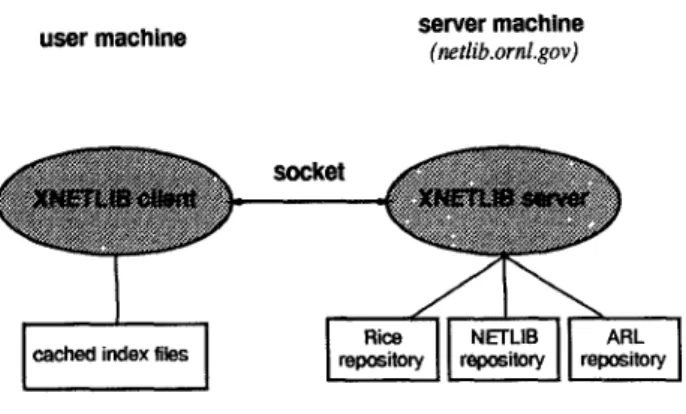
user machine server machine(netlib.ornl.gov)
Fig. 1. Xnetlib configuration.
Portability. The system’s implementation should be as portable as
possi-ble.
Accessibility. The system should be accessible to a large number of users.
There already exists a variety of tools for Internet browsing and for
software and document retrieval [Krol 1992; Studt 1993]. Archie, ftp, gopher,
mosaic, WAIS, and WorldWideWeb are among the most widely used.
In contrast to these other tools, xnetlib operates on a limited, moderated
collection that contains the most up-to-date version of software packages.
This approach of retaining control over the size and contents of xnetlib’s
repositories simplifies greatly any organization, record keeping, and security.
Xnetlib uses socket-based communication to provide the desired speed and a
client design based on X Windows for portability and usability. The
accessibil-ity requirement is satisfied by making the client software freely available
over the Internet.
Figure 1 shows the basic configuration of the xnetlib system. The system
consists of an xnetli bserver process running on a machine at a repository site,
an xnetlib X client process running on a user’s local machine, and TCP/IP
socket-based communication links between the client and server.
Xnetlib’s server process runs continually at an xnetlib repository site,
listen-ing for incoming requests from xnetlib client processes. Typically, the xnetl ib
server runs on the same machine and accesses the same software repository
as the netlib server. Upon receiving a request, the xnetlib server determines
the nature of the request and responds by transferring the appropriate file
from the repository to the xnetlib client process.
The xnetlib client running on the user’s local machine provides an X
Window interface to the xnetlib repository. It is programmed in C, using the
Athena widget libraries. This interface makes searching through the software
and document collection easy. For example, an xnetlib user can view the
contents of any library simply by clicking a button. Other commands, such as
key word searching or requesting software, also require just a few button
clicks. To avoid unnecessary communication between the client and server,
requested indexes are cached locally. Frequently requested information can
82 .
therefore be quickly retrieved from local cache instead of repeatedly retrieved
from the remote server. Other requests are passed to the server via sockets.
Section 4 describes the use of the interface in more detail.
4. FEATURES
Xnetlib features and capabilities include
—access to a distributed repository,
—searching by a software libraries list,
—searching by software classifications,
—searching by key word,
—software and document retrieval,
—access to a computer performance database,
—access to a conferences database,
—access to the NA-NET White-pages, and
—online help.
Many Internet sites have sizable collections of documents or software. It is
both unnecessary and undesirable to require that these collections reside at a
single site. Xnetlib gives users access to a distributed repository of software
and documents by establishing socket-based links with the xnetlib repository
sites. Users have access to any or all of these repositories through a single
interface.
Xnetlib users control which sites are linked into the distributed repository
using the set up button. Current repository sites include netlib. ornl. gov,
spark. brl. roil, and softlib. rice.edu. The timely message button displays news
about individual repository sites, and the index button displays their general
indexes.
The library button shows the libraries that are available through xnetlib.
The collection includes major packages such as LAPACK, LINPACK,
EIS-PACK, algorithms published in the ACM Transactions on Mathematical
Software, and a large variety of less well-established packages. Figure 2
shows a unified list of software and documents available at the repositories of
Oak Ridge National Laboratory, Rice University, and the U.S. Army
Re-search Laboratory.
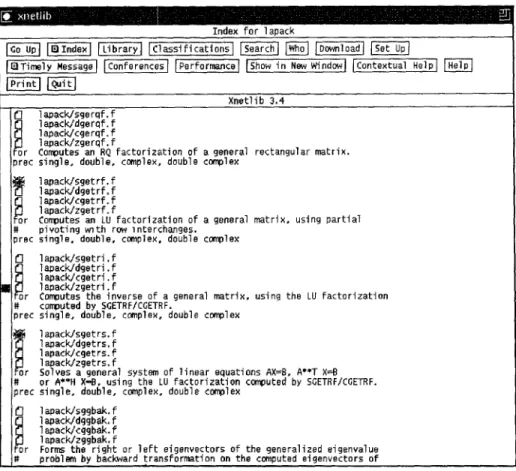
Clicking on a library name lists the contents of that library. For example,
clicking on lapack displays a partial listing of LAPACKS contpnts (Figure 3).
The complete contents list of LAPACK is too large to fit in the window, but
the provided scrollbar allows the user to scroll through the rest of the list.
Clicking on the box adjacent to a routine name selects that routine for future
downloading. In Figure 3 the user has selected sgetrf and sgetrs from the
LAPACK library.
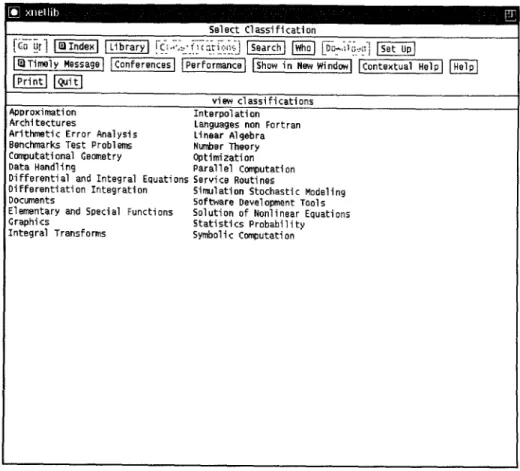
The classifications feature allows a user to narrow a search. The
classifi-cation of the xnetlib software libraries is based on the highest level of the
GAMS [Boisvert et al. 1985] classification system, augmented to include
classifications other than mathematical software. Selecting linear algebra
Select Library .. ,. ,,.,,.
@ . ::[:.] WI ~: :-i,: ~:y ~ ; . . . .
::”:!:::: n I Cl assi fi cations -1 ml 1k .,,...1, Set Up I Q Timel y Hessage ~ ~1 I Show i n Naw Window] I Contextual Hel P [ B ——
IIE!!Llw
%netlib 3.4 a f2c list pchip ai cm fftpack lp
al 1 i ant fi shpack machines anms f i tpack magi c anl-reports fmn microscope
apollo fn mi npack
benchmark fortran mist bib fp mpi bi har gcv na-di gest
bias great nag
brm go napack bnews graphics netlib c harwal 1 news c* hence nnt~ champ hompack nucnaralgo cheney-ki ncai d hpf ode cl apack hypercube odepack cnews i eeecss odrpack conf db i tpack opt conf ormal jakef p4 conti n ki nca.i d-cheney papers c rpc 1 anczos paragraph ddsv 1 anz uaranoia di erckx 1 apack parkbench demi no 1 aso parmacs ei spack linalg pascal el efunt 1 i npack pbwg pales performance picl pl tmg pol y2 Polyhedra popi port posi x pppack presto problenrset pm pvm3 quadpack research rn scalapack sched scilib sai spack sequent 5 flnn 51 ap slatec smi npack
Fig. 2, Library menu.
causes the names of the libraries with linear algebra software to be displayed
(Figure 4).
. .
A user may also wish to search by key word instead of viewing the
contents of a particular library, In this mode, index files containing lists of
files and their descriptions are searched by a key word string the user
provides. The key word search can be a search on the intersection or union of
the words in a search string, a literal search for an exact string (with or
without case sensitivity), or a fuzzy search based on the latent semantic
indexing technique [Deerwester et al. 1990]. Latent semantic indexing uses
statistical analysis to find useful matches that may not be uncovered by other
types of searches. In contrast, the fuzzy-search capability in WAIS is based on
a heuristic rather than on a statistical approach.
Clicking on the download button causes xnetlib to display a list of selected
software and documents. The download path button allows a user to change
the directory to which files will be downloaded. The dependency checking
button is a modal switch. If dependency checking is off, xnetlib will send
only the selected routines. If it is on, xnetlib will send the selected routines
ACM Transactions on Mathematical Software, Vol. 21, No. 1, March, 1995.
sodepack softlib sparse sparsa-bl as sparspak specfun spin Stoepl i tz stringsearch svdpack tennessee toeplitz tom trn typesetting uncon vanhuffel vfftpack vfnlib voronoi xmagi c xnetlib y12m
84 .
,
d
Index for 1 apack
m--l Classifications _ [~ - -J
ElTiiml Y Hessag@[ [-e=[ ~j ——
m!u.lw
Xnetlib 3.4
m or Corrrxrtes an R6 factorization of a general rectangular nratri x. prec 8
P
or#
prOc c1 I Por # prec ! or # prec D Bor #single. double, ccntplex, double cqlex 1apack/sgetrf. f
lapack/dgetrf .f lapackJcgetrf .f 1apack/zgetrf. f
Corruutes an LUfactorization of a general matrix, usi n9 Partial
pi voting w th row 1 nterchanges. 5ingle. double, cctnplex. double cwlex lapack/s9etri. f
lapak’dgetri. f 1 apack/cgetri. f lapack/zgetri. f
Corrmrtes the inverse of a general matrix, using the LU factorl zati on corrwuted by SGETRF/CGETRF.
single, double, ccmplex, double conwlex
1apacidsget rs. f 1 apack+’dgetrs, f 1 apack./cget rs. f 1 ack.lzgetrsi f
Y
So ves a general system of 1 i near equations AX=E,A**TX=8 or A**HX=6,using the LU factorization cwuted by SGETRF/CGETRF. single, double, mrrplex, double cm’rplex
1epack/sggbak. f 1 apack/dggbek. f 1 apacklcggbak. f 1 apacb’zggbak. f
Form tha right or left eigerrvectors of the generalized eigenvalue probl an by baclc+fard transformation on the cmnputed ei genvectors of
Fig. 3. LAPACK index.
and any routines that they call. If the user is satisfied with the selection list
and the target directory, the user should click on get files now to initiate the
transfer. The displayed “gas gauge” shows the progress of file transfers.
Figure 5 shows the downloading of selections made from the LAPACK,
SOFTLIB, and RN libraries. These three libraries reside in repositories at
separate sites. The selected files will appear in the specified directory, usually
within a few seconds.
The who button allows a user to search the NA-NET White-pages
[Dongarra and Rosener 1991; Kent 1988], a database containing information
about individuals interested in numerical analysis and other disciplines. For
simple searches the user need only enter an individual’s last name. The
modify search feature can be used to specify which fields the search applies
to, and the modi@ listing feature can be used to control the form of the
output .
The conferences database contains announcements of conferences and
meetings. Users can search announcements by title, dates, location, or
de-scription. Users can also submit conference announcements to the database
directly through xnetlib.
B1
Select Cl assi fl cati on
!’(~jr”) _ = [(:’:,,j:i:::il:$ii’ .,_ . . ..j -I m] ‘--”[DG-,;lfi,,(fl“ -:- _
]EITinwly Message] ~ ~1 I’Show in NSW MndWl lCgnteXtua.l Help~ m mm
view classifications %wroximation IntBrUOl ati on 4rchltectures Languages non Fortran Wthmatic Error Analysis li near Algebra )enchmarks Test Probl wns Nurrber Theory :o~utati onal Geometry Optimization
)ata Handling Paral 1 el CmnDutati on )i fferenti al and Integral Equations Service Routines
li fferenti atlon Integration SirmIl ati on Stochastic Model 1 ng )ocuments SOf tware Development Tools :1 errwntary and Special Functions Solution of Nonlinear Equations ;raphi cs Statistl cs Probabi 1 i ty :ntegral Transforms Symbol i c Camfwtati on
Fig. 4. Classifications menu.
The performance database [Berry et al. 1994] is a repository of computer
performance data for a wide variety of machines. Users can make selections
from a menu of computer vendors and from a menu of benchmarks to
generate a formatted display of benchmark results.
5. GETTING STARTED
Xnetlib requires release 4 (or later) of XII, and the Athena widget libraries as
supplied by MIT. The executable for the xnetlib client requires approximately
800 KB on a Sun SPARCstation2. The locally cached indexes can occupy up to
1 MB. One common customization at multiuser sites is to have a single cache
of index files so that indexing information can be shared by all local users.
The first step in installing xnetlib is to obtain the source code for the xnetlib
client. The software for the xnetlib client is itself available from netlib, so a
simple way to obtain the source is to send the message send xnetlib.shar
from xnetlib to [email protected]. Netlib will respond by sending a shar file
containing all necessary source code and documentation, Xnetl ib is also
avail-able by anonymous ftp from netlib2.cs.utk.edu in the xnetlib directory. The
86 . ~
F
lapack/sgetrf. f lapack/sgetrs. f 1apack/man~ages. tar. z softlib/trl lst. ps. Z ~ IFig. 5. Downloading the selected routines,
xnetlib distribution includes an Imakefile, so installation is normally trivial if
the X Window System has been configured properly on the client machine.
6. PLANS
Plans are already under way to expand xnetlib. One major addition will be the
capability of remote execution. Many useful utility programs are large,
making distribution tedious, or are more expensive to build than to execute.
In such cases, allowing remote execution may be a better use of resources
from both the distributor’s and user’s point of views. Tool pack [Pollicini 1989],
a large collection of Fortran software tools, and f2c [Feldman et al. 1990], a
Fortran-to-C translator, are logical candidates for this remote execution
service. Users could, instead of downloading, installing, and executing these
programs, submit suitable input and have a machine at a remote server site
execute the programs and return the output.
Another proposed capability will allow users to add their own servers to the
collection of servers globally available through xnetlib. Any xnetlib user could
then access this contributed software by adding the appropriate server to his
or her active server list. This feature will greatly expand the amount of
software available through xnetlib.
We also plan to expand the scope of the xnetlib system. In the future,
xnetlib’s distributed repository will include more nonmathematical software
and more reports. Additional software and document collections will be linked
into xnetlib’s existing collection.
Starting with LAPACK, xnetlib began distributing entire libraries. This
service will be extended to other libraries.
Xnetlib already provides fast and easy access to a large collection of
mathe-matical software. In the future xnetlib will provide greatly expanded
capabili-ties to satisfy more of the computational needs of users.
7, SUMMARY
Software distributed by netlib comes with the disclaimer that “anything free
comes with no guarantee.” In contrast to commercial vendors like NAG and
IMSL, netlib offers no support beyond whatever documentation contributing
authors choose to provide with their code. These caveats also apply to xnetlib.
On the other hand, both netlib and xnetlib provide free, easy access to a
large body of high-quality code, and the phenomenal growth of netlib and
xnetlib attests to the value of this service. We hope that xnetlib, by making
high-quality code even more accessible, will encourage software developers to
make their codes freely available and will make good programming easier for
the scientific computing community.
ACKNOWLEDGMENTS
Xnetlib is the product of the efforts of many people. Ken 13ateman, llavid Bolt,
Shirley Browne, Jennifer Finger, Tracy Gangwer, Stan Green, Brian LaRose,
Todd Letsche, Sharon Lewis, Keith Moore, Andrew Pearson, Jon Richardson,
Bill Rosener, and Andrea Van Hull all made valuable contributions to the
design, development, and testing of various versions of xnetlib. We also thank
the many users of early versions of xnetlib for their constructive comments
and for their patience.
REFERENCES
BERRY, M., DONGARRA, J., AND LAROSE, B. 1994. PDS: A performance database server. SCL. Comput. Tobe published.
BOISVERT, R. I?., HOWE, S. E., AND KAHANER, D. K. 1985. GAMS-A framework for the management of scientific software. ACM Trans. Math. Softw. 11, 4(Dec.), 313–355.
DEERWESTER, S., DUMAIS, S., FURNAS, G., LANDAUER, T., AND HARSHAMN, R. 1990. Indexing by latent semantic analysis. J. Am. Sot. Inf. Sci. 41, 6 (Sept.), 391-407.
DONGARRA, J., AND GROSSE, E. 1987. Distribution of mathematical software via electronic mail. Commun. ACM 30, 5 (May), 403-407.
DONGARRA, J., AND ROSENER, B. 1991. NA-NET numerical analysis net. Tech. Rep. ORNL/TM-11986, Oak Ridge National Laboratory, Oak Ridge, Term., Dec.
FELDMAN, S., GAY, D., MAIMONE, M., AND SCHRYER, N. 1990. A Fortran-to-C converter. Comput. Sci. Tech. Rep. 149, AT&T Bell Laboratories, Murray Hill, N.J., May.
KENT, M. 1988. The numerical analysis net, Tech. Rep. 85, Eidgenossische Technische Hochschle (ETH), Zurich, Jan.
KI?OL, E. 1992. The Whole Internet User’s Guide and Catalog. O’Reilly & Associates, Inc., Newton, Mass.
POLLICINI, A. A., (ED.). 1989. Using Toolpack Software Tools. Kluwer Academic, Deventer, The Netherlands.
STUDT, T. 1993. Access information anywhere on the internet. Res. Deuel. Mug. (Aug), 71.
Received April 1993; revised January 1994; accepted January 1994