
Masters Theses Student Theses and Dissertations
2014
M-Grid : A distributed framework for multidimensional indexing
M-Grid : A distributed framework for multidimensional indexing
and querying of location based big data
and querying of location based big data
Shashank Kumar
Follow this and additional works at: https://scholarsmine.mst.edu/masters_theses
Part of the Computer Sciences Commons
Department: Department:
Recommended Citation Recommended Citation
Kumar, Shashank, "M-Grid : A distributed framework for multidimensional indexing and querying of location based big data" (2014). Masters Theses. 7536.
https://scholarsmine.mst.edu/masters_theses/7536
This thesis is brought to you by Scholars' Mine, a service of the Missouri S&T Library and Learning Resources. This work is protected by U. S. Copyright Law. Unauthorized use including reproduction for redistribution requires the permission of the copyright holder. For more information, please contact [email protected].
by
SHASHANK KUMAR A THESIS
Presented to the Faculty of the Graduate School of the MISSOURI UNIVERSITY OF SCIENCE AND TECHNOLOGY
In Partial Fulllment of the Requirements for the Degree MASTER OF SCIENCE IN COMPUTER SCIENCE
2014 Approved by
Dr. Sanjay Madria, Advisor Dr. Sriram Chelappan
The widespread use of mobile devices and the real time availability of user-location information is facilitating the development of new personalized, user- location-based applications and services (LBSs). Such applications require multi-attribute query processing, handling of high access scalability, support for millions of users, real time querying capability and analysis of large volumes of data. Cloud computing aided a new generation of distributed databases commonly known as key-value stores. Key-value stores were designed to extract value from very large volumes of data while being highly available, fault-tolerant and scalable, hence providing much needed features to support LBSs. However complex queries on multidimensional data cannot be processed eciently as they do not provide means to access multiple attributes.
In this thesis we present MGrid, a unifying indexing framework which enables key-value stores to support multidimensional queries. We organize a set of nodes in a P-Grid overlay network which provides fault-tolerance and ecient query processing. We use Hilbert Space Filling Curve based linearization technique which preserves the data locality to eciently manage multi-dimensional data in a key-value store. We propose algorithms to dynamically process range and k nearest neighbor (kNN)
queries on linearized values. This removes the overhead of maintaining a separate in-dex table. Our approach is completely independent from the underlying storage layer and can be implemented on any cloud infrastructure. Experiments on Amazon EC2
show that MGrid achieves a performance improvement of three orders of magnitude in comparison to MapReduce and four times to that of MDHBase scheme.
First and foremost, I would like to express my deepest gratitude and appreci-ation towards my advisor Dr. Sanjay Madria for his continuous support of my M.S. study and research. I have greatly beneted from his, knowledge, advice and guid-ance, which was instrumental in the completion of this thesis. I am thankful to him for allowing some extra time to nish my experimental work.
I would also like to thank the members of my dissertation committee, Dr. Sriram Chellappan and Dr. Dan Lin, for their constructive comments and feedback. I would like to acknowledge the contributions of the current and former mem-bers of the research group especially, Dr. Vimal Kumar, Brijesh Kashyap Chejerla, Amartaya Sen and Dr. Roy Cabaniss, with whom I spent countless hours in the lab and engaged in numerous fruitful discussions. I am thankful to my k nearest friends
especially Sahil Parikh, Abhinav Saxena, Aditi Sharma, Manish Sharma and Anand Kishore, without them I would have graduated one year earlier.
I would also like to thank Daniel@uzaygezen and Deependra,John@Eucalyptus for helping me in various stages of the project.
Finally, I dedicate this thesis to my father Himmat Singh, mother Manorama, sister Ekta and brother Ashish for their constant support and encouragement in all my professional endeavors. I hope this would make them proud.
Page
ABSTRACT . . . iii
ACKNOWLEDGMENTS . . . v
LIST OF ILLUSTRATIONS . . . viii
LIST OF TABLES . . . ix
SECTION 1 INTRODUCTION . . . 1
1.1 TRADITIONAL ARCHITECTURE OF LOCATION BASED APPLI-CATIONS . . . 2
1.2 DEPLOYING LOCATION BASED APPLICATIONS IN THE CLOUD 4 1.3 MOTIVATION AND CHALLENGES . . . 5
1.4 RESEARCH GOAL AND SCOPE . . . 9
1.5 SOLUTIONS OVERVIEW . . . 10
1.6 OUTLINE OF THESIS . . . 11
2 BACKGROUND . . . 12
2.1 LINEARIZATION USING SPACE FILLING CURVE . . . 12
2.2 OVERLAY NETWORKS . . . 14
2.3 PREFIX-GRID (PGRID) OVERLAY NETWORK . . . 15
2.3.1 Searching in P-Grid . . . 16
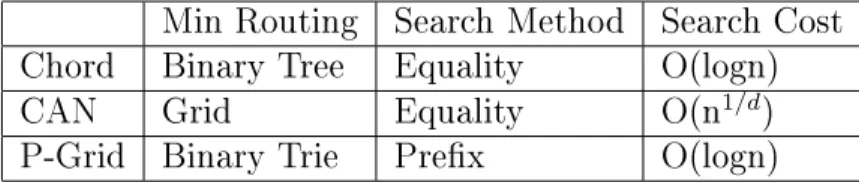
2.3.2 Comparison between P-Grid and Other Overlay Networks . . 17
3.1 SYSTEM ARCHITECTURE: MASTER-SLAVE VERSUS P2P BASED
SYSTEM DESIGN . . . 19
3.2 COMPARISON MATRIX . . . 24
4 THE MGRID INDEX FRAMEWORK . . . 26
4.1 OVERVIEW . . . 26
4.2 DATA STORAGE LAYER . . . 27
4.2.1 Apache HBase . . . 28
4.3 STORAGE MODELS . . . 29
4.3.1 Table per Node (TPN) Model . . . 29
4.3.2 Table Share (TS) Model . . . 29
5 QUERY PROCESSING . . . 30
5.1 DATA INSERT & POINT QUERY . . . 30
5.2 RANGE QUERY PROCESSING . . . 31
5.3 kNN QUERY PROCESSING . . . 39
6 EXPERIMENTAL EVALUATION . . . 41
6.1 PERFORMANCE OF INSERT . . . 42
6.2 PERFORMANCE OF POINT & RANGE QUERY . . . 42
6.3 PERFORMANCE OF kNN QUERY . . . 46
7 CONCLUSIONS . . . 50
BIBLIOGRAPHY. . . 51
LIST OF ILLUSTRATIONS
Figure Page
1.1 Traditional 3-Tier architecture of Location Based Applications . . . . 3
1.2 Location Based Application architecture in cloud environment . . . . 6
1.3 RDBMs versus Key-Value stores . . . 9
2.1 A 2-d space and its equivalent First order Hilbert Curve . . . 13
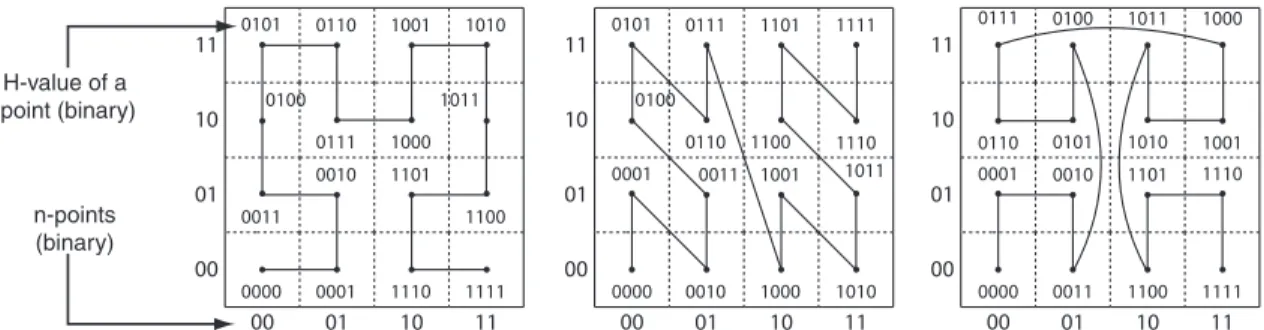
2.2 A tree representation of the second order Hilbert Curve in 2 dimension 13 2.3 Illustration of second order Hilbert, Z-Order and Grey-Order Curve for 2 dimensions . . . 14
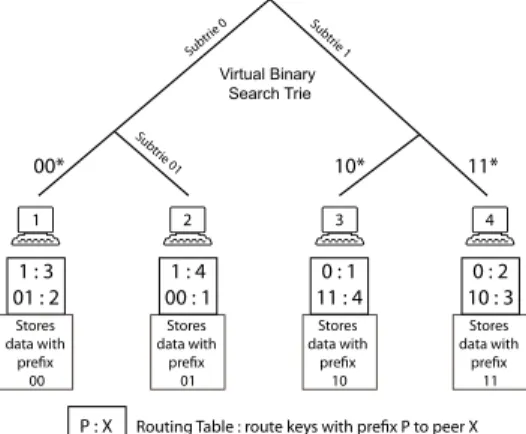
2.4 An example P-Grid trie . . . 16
3.1 EMINC index structure consists of a R-tree in master nodes and one KD-tree on each slave node [39] . . . 20
3.2 MD-HBase uses linearization technique to support multidimensional queries [43] . . . 21
4.1 MGrid's System Architecture . . . 28
5.1 Example of a Range Query on points mapped to the Second Order Hilbert Curve in 2 dimensions . . . 33
6.1 Performance of Insert Throughput as a Function of Load on the System 43 6.2 Performance of Point Query (D=3) . . . 44
6.3 Performance of Range Query (Nodes=4, D=2) . . . 45
6.4 Performance of Range Query (Selectivity=10%, D=2) . . . 45
6.5 Performance of Range Query (Nodes=4, D=3) . . . 46
6.6 Performance of Range Query (Selectivity=10%, D=3) . . . 46
6.7 Performance of kNN Query (Nodes=4, D=2) . . . 47
6.8 Performance of kNN Query (k=10K, D=2) . . . 48
6.9 Performance of kNN Query (Nodes=4, D=3) . . . 49
Table Page
2.1 Comparison between P-Grid and other p2p networks . . . 17
Cloud computing is a model for enabling ubiquitous, on-demand, utility based access to shared computing resources (hardware and software) where such resources are delivered as a utility based service. The Cloud has provided the IT industry a paradigm shift in the way services are delivered. According to NIST [1] the essen-tial characteristics of this service oriented model includes on demand self-service i.e. the ability to obtain, congure and deploy services without the assistance of service provider; broad network access which provide device and location independent access to the users; resource pooling which enables service provider to pool their resources to serve multiple users at once; scalability and rapid elasticity for adding new resources as per the need of the user and a measured pay-per-use model based service. The cloud's service model provides three levels of abstraction. The lowest level we have Infrastructure as a Service (IaaS) where cloud vendors provide physical resources like servers, storage and networking components. Platform as a Service (Paas) is the middle level of abstraction which provides an application deployment framework. Ap-plications need to be modeled after the PaaS provider's framework and the provider deploys and scales the application. Software as a Service (Saas) is the highest level of abstraction where the SaaS provider install and operate domain specic (like supply chain management) application in the cloud. As cloud computing is becoming increas-ingly popular and useful, our industry is gradually shifting from in-house hosting to cloud hosting and platforms including cloud data storage platforms.
In this chapter, we rst start with an introduction of how location based ser-vices can benet from cloud computing model and analyze the challenges of deploying such applications in cloud. Next, we discuss the motivation of our research which aims to provide advance features missing from current cloud data serving systems. Then,
we present specic goals and scope of our research and nally, we give an overview of our solution with a summary of our main contributions of this thesis.
1.1. TRADITIONAL ARCHITECTURE OF LOCATION BASED AP-PLICATIONS
The increasing need for mobility and recent advances in wireless technology have created one of the most promising value added services which are commonly known as Location Based Services (LBS). LBS are provided to mobile users accord-ing to their proximity. Such services use the ability to dynamically determine and transmit the location of users by the means of their communication device within a mobile network [2]. These services provide means to search for information about users, physical locations, nding routes to specied destinations, analyze real time trac etc.
Currently, a wide range of LBS are available for mobile users [3] which includes:
• Mapping applications, providing mapping directions to a vehicle driver • City guides, providing information for travelers about a given area
• Mobile yellow pages, assisting mobile users to locate the services they need • Location-aware marketing, triggering advertisements based on proximity to an
area
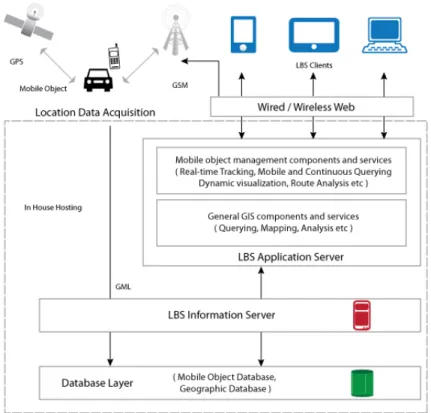
Figure 1.1 shows the 3-tier architecture for location based services which con-sists of a client tier, a middle tier and a database tier. Client Tier: In this tier, the user interacts with the system. User on their mobile devices visualizes web pages which contain spatial information. These web pages display interactive maps, search elds etc. and tracks actions performed by the user. For example, a user can issue a query to nd nearby places to its current geographic location. Such queries are
Figure 1.1 Traditional 3-Tier architecture of Location Based Applications
then routed to the LBS. In a typical scenario a web page displays a dynamic map served by the map renderer and other information from the LBS which is situated in the middle tier. Middle Tier: This tier provides the core services and functionalities of the system. A web application hosts the Web Server Pages which constitute the access point to the system for the users and the LBS, in which several web services are deployed and exposed on the Internet. This LBS tracks the user sessions, handles the user proles, logs all of the relevant actions performed by the clients and keeps track of the user location when available. The LBS application server handles user request, process/analyze them and provides the result or services to the user. Database Tier: The main function of this tier is to provide the other tiers with spatial information through LBS information server. It consists of a spatial DBMS, which stores spatial datasets (e.g. longitude and latitude points) and data related to the user proles. The relevant spatial datasets can be imported from an external data provider (e.g.
OpenStreetMap, web crawlers etc.) which can be stored in the spatial DBMS and updated on a regular basis.
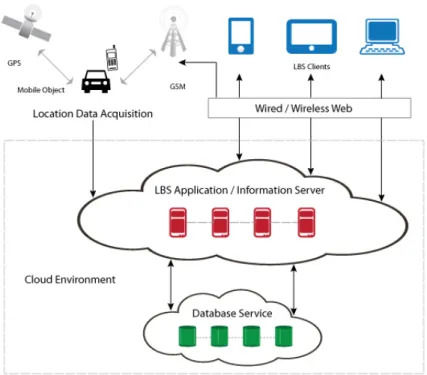
1.2. DEPLOYING LOCATION BASED APPLICATIONS IN THE CLOUD The architecture described in section 1.1 though provides much needed ex-ibility in terms of application development, it still suers from many drawbacks. First, LBS requires to handle millions of data insert and update requests per second, concurrently. Traditional single master server architecture therefore can become a bottleneck especially database servers and hence provide poor fault tolerance to the system. Next, in order to serve high query throughput and to provide low latency, LBS requires massive parallel processing of requests. Although traditional systems backed by Relational Database Management Systems (RDBMs) do provide a level of parallelism at the lowest level (query, bulk insert and update), it is still insucient as the load on the system increases. Not just that, the increase in the load as the number of user increases presents many threatening problems to the shared database architecture. The biggest problem it faces is of scaling. In traditional systems, there are two ways to achieve scalability either by scale-up or by scale-out. Scale-up is achieved by using larger and more powerful servers which simply have more process-ing cores, memory and faster storage disks. However it has to be noted that in a master-slave architecture, we need to scale-up both master and slave servers other-wise the slaves will fail to keep up with masters update rate and the reverse is also true. Scale-up incurs almost twice or sometimes thrice the cost of initial hardware setup cost and therefore it is not a viable option. Scale-out is achieved by increasing the overall capacity of the system by adding more secondary servers. This method also does not provide a feasible solution because scaling the database layer while preserving the strong consistency and referential integrity is not viable [4]. Another problem with scale-out is that Location Based Applications typically handle more
read queries than write queries which adds further CPU and I/O load on the sys-tem. Apart from scale-up or scale-out, other solutions to provide scalability and load balancing includes caching and sharding. Caching can reduce the load to a level as the system can now serve requests by keeping data and objects in-memory. However maintaining consistency across the servers now becomes a problem as the cache has to be invalidated and refreshed periodically. Sharding refers to the process of logi-cally separating the data into horizontal partitions across database servers. It is a very costly operation as the whole process has to be meticulously planned and the storage layout has to be rewritten. The characteristics of cloud computing model in which clusters of commodity servers are used to perform computing tasks with a utility based pay-per-use model, has now became a feasible and an acceptable solu-tion to all the above mensolu-tioned problems of the tradisolu-tional applicasolu-tion development architecture. Figure 1.2, shows the best design practice for LBS in a cloud environ-ment. The single master/slave architecture can now be easily elastically scaled-out by leasing virtual machines from cloud vendors as per the need. The low cost, ease of application setup and elastic scalability provided by cloud computing has paved way to a numerous cloud based applications like Facebook, Foursquare, and NetFlix etc. and cloud vendors like Amazon Web Services, Rackspace, HP Cloud Services and Oracle Cloud Services etc.
1.3. MOTIVATION AND CHALLENGES
One of the crucial characteristic which LBS exhibit is the ability to handle massive data generated by millions of service subscribers at once. For example, Foursquare has a user base of 30 million people around the world, Yelp has more than 100 million subscriber with 86 million monthly unique visitors etc. Irrespective of the cloud's abstraction, data forms the central and critical part of LBS.
Figure 1.2 Location Based Application architecture in cloud environment
Data processing in cloud can be divided into two categories which are Online Transaction Processing (OLTP) and Online Analytical Processing (OLAP). OLTP database is modeled for business transactional data processing applications which are mission-critical in nature for example an online banking application. Such applica-tions require real time processing of transacapplica-tions where data is changing at the same time and to provide low latency and high throughput. The OLAP databases, on the other hand, are modeled to provide business insights like decision making and plan-ning through data miplan-ning. Such databases forms the part of an organizations massive data warehouses. Databases in data mining applications require to handle more com-plex and longer running queries and also are more read oriented than write oriented. As LBS require to process queries in real time with short latency and high query throughput, our research will be focused on OLTP databases designed for elastically scalable could computing infrastructure.
Relational Database Management Systems (RDBMs) were invented by E. F. Codd of IBM research labs in 1970 [5] to handle the transactional workload of OLTP applications. The key characteristics which RDBMs provides includes, a relational data model which represents data in terms of tuples and declarative schemas, concur-rency controls by providing guarantee for Atomicity i.e. either all of the transactions will commit or none will, Consistency i.e. data only validated by pre-dened rules will be saved, Isolation i.e. multiple transactions should not interfere with each other, Durability i.e. transactions will not be reversed upon their completion (ACID), sup-port for normalization of data for removing data duplicity and a powerful and rich query and data manipulation language. Today there are number of RDMBs available which includes both commercial (Oracle SQL, IBM DB2 and Microsoft SQL) and open source (MySQL and PostGres).
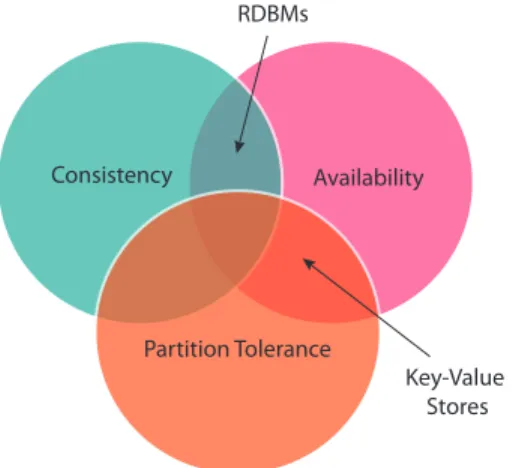
Although RDBMs have been proved highly successful for traditional transac-tional based systems, they are inecient for cloud infrastructures. One of the biggest problems of RDBMs is scaling. The relational architecture does not allow to scale-out the database to many nodes as the requirement of an application to handle trac increases. Scaling-out RDBMs while providing ACID guarantee is expensive due to distributed synchronization among database server. This can also be well explained by CAP theorem [6] which states that it is impossible for a distributed system to provide consistency, availability and partition tolerance simultaneously. Partition tolerance is essential for LBS built on cloud infrastructure as network partitions are inevitable. Choosing between availability and consistency, consistency is neglected as the LBS is expected to be remain online at all the times [7]. Apart from that, LBS need to handle Big Data which is a term to denote data sets which grows so rapidly in a small period of time, that it cannot be managed on a single system because of storage, CPU cycles and memory constraints. Other LBS characteristics which makes RDMS a poor design choice are, LBS queries are more read oriented than
write oriented and LBS queries are attribute focused rather than entity focused. In summary, data management system of LBS should be able to scale out on demand, should provide high availability and fault-tolerance and should be easy to administer. Recent years saw the emergence of key-value stores (also referred as NOSQL stores) which are modeled to scale-out and provide all the essential features necessary for cloud based applications. Examples of such key-value stores includes Google's BigTable [8], Yahoo's PNUTS [9] and Amazon's Dynamo [10] and their various open source counterparts such as Apache's HBase [11], Facebook's Cassandra [12] etc. Figure 1.3 shows the dierence between the traditional RDBMs and the Key-Value stores. Dierent key-value stores provide dierent data models for example, HBase is designed to provide availability and partition tolerance whereas Cassandra is designed to provide Consistency and partition tolerance. Irrespective of the data model, the property which is common in all these key-value stores is the key-value abstraction in which data is viewed and stored as independent key-value pairs and the access is supported only at the granularity of single keys. Such abstraction naturally allows ecient horizontal data partition and elastic scalability. This abstraction though satisfy the needs of many present applications, a large number of current web ap-plications need more than a single atomic key access pattern like LBS. The data in LBS is inherently multidimensional which mainly compromises of longitude, latitude, time, user id etc. and therefore it requires a multi-key access.
In key-value stores, data can only be queried based on the key, so a specic keyword or value must be known to perform a search. LBS require to handle mainly three types of queries - point, range and k nearest neighbor (kNN). These queries
cannot be implemented eciently because RDBMs like additional indexes are not available and any such query on a particular key-value store would require scanning of all the keys at a minimum to produce results, essentially making this approach not feasible. Without proper indexing method, even for a simple point query, we need to
Consistency Availability
Partition Tolerance RDBMs
Key-Value Stores
Figure 1.3 RDBMs versus Key-Value stores
scan the whole data set repeatedly and produce the necessary second indexes in an o-line batch manner. Problems with this approach are that the secondary index is not up-to-date and newly inserted data cannot be queried until they are indexed.
Our research goal is motivated by the fact that LBS requires multidimensional indexing capabilities to support its rich real-time querying functionality and scalabil-ity which no cloud data serving system supports currently.
1.4. RESEARCH GOAL AND SCOPE
Our ultimate research goal is to build an ecient multidimensional index struc-ture that can be built on an underlying key-value store to provide advance query capabilities for location based applications on cloud infrastructure.
We have also aimed to provide our indexing structure the ability to support skewed data set, a robust mechanism for fault tolerance, replication and consistency management and dynamic provisioning. The thesis focuses on the following lines:
• Distributed Indexing: the design of an ecient multidimensional index structure
for location based applications on cloud friendly key-value store.
• Rich Query Functionality: the ability to eciently process point, range and kNN queries.
• Elastic Scalability: the capability to extend the index structure in the presence
of dynamic workload.
1.5. SOLUTIONS OVERVIEW
In this paper, we propose MGrid, a novel distributed multidimensional index-ing framework to support LBSs on cloud platform. Because of the characteristics of key-value stores which includes availability, horizontal scalability and a distributed ar-chitecture, it became a natural choice for us to use them as MGrid's storage back-end. However, the key challenges in developing an index framework on top of a key-value store are, ecient modeling of multidimensional data and providing it the ability to process complex multidimensional queries. MGrid solves the former by using Hilbert Curve[13] based linearization technique and later by integrating PGrid overlay net-work. Hilbert Curve maps multidimensional attributes onto single dimensional while preserving its data locality. On the other hand, PGrid arranges the nodes in a virtual binary trie and partitions the multidimensional search space into subspaces. MGrid then processes complex queries by distributing them across the cluster according to P-Grid's prex based routing mechanism.
In summary, this thesis makes the following contributions:
1. We propose a new multidimensional indexing framework, MGrid, which can ef-ciently process point, range andkNN queries. MGrid integrates PGrid overlay
network and a range partitioned key-value store.
2. We leverage Hilbert Space Filling Curve based linearization technique to convert multidimensional data to a single dimension while preserving its data locality.
3. We propose algorithms which can dynamically process queries on linearized val-ues using PGrid's prex based routing mechanisms. This removes the overhead of creating and maintaining a separate index table,
4. We performed extensive experimental evaluations on Amazon EC2 to show the eectiveness and eciency of our framework.
1.6. OUTLINE OF THESIS
• Section 2 given background information that forms the basis of our research • Section 3 presents literature review on previously done related work
• Section 4 describes the design of our proposed distributed multidimensional
indexing framework.
In this chapter, we present background information for our research. We present the idea of linearization using space lling curves and present Hilbert Space Filling Curve in detail. We also discuss basic techniques for replication management and review peer-to-peer (P2P) overlay networks that are commonly used to facili-tate distributed search. We nish this chapter by presenting the overview of P-Grid overlay network which we use to eciently route queries in order to process complex multidimensional queries.
2.1. LINEARIZATION USING SPACE FILLING CURVE
Linearization is a dimensional reduction method which maps multi-dimensional attributes onto single dimensional space. Space-lling curve is a linearization tech-nique in which a continuous curve is constructed visiting every point in a n-dimensional hypercube without overlapping itself. The benets of using them is that, after map-ping, neighboring points in n-dimensional space remains close in one dimensional space also. Therefore, space-lling curves are widely used in applications like im-age processing [14], scientic computing [15] and geographic information systems [16] which require sequential access to datasets. In MGrid, we use Hilbert space-lling curve [13] to index multidimensional points in the underlying uni-dimensional key-value store to promote query eciency.
The Hilbert Curve is a continuous space lling curve which induces a sequen-tial ordering on multi-dimensional points. Formally, Hilbert Curve is a one-to-one function:
H:[0, 2mn-1]→[0, 2m-1]n
0 1 0 1 0 1 0 1 00 10 00 11 01 11 01 10
Figure 2.1 A 2-d space and its equivalent First order Hilbert Curve
determines the Hilbert value (H-value) of each point in the original coordinate space where H-value ∈[0, 2mn-1]. Fig. 2.1 illustrates the coordinates in a 2-dimensional
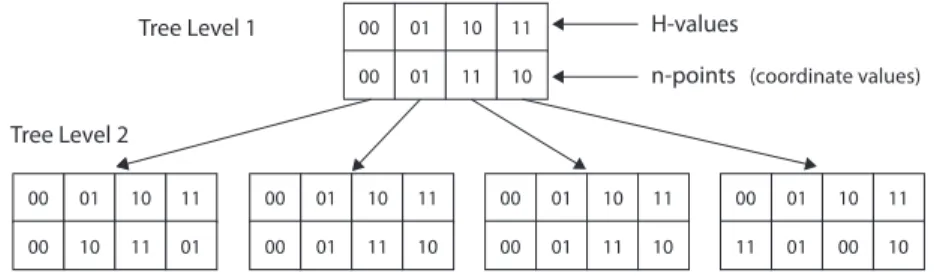
space and its equivalent Hilbert Curve of rst order. A curve of order i>1 is con-structed in a recursive manner where each vertex of the rst order curve is replaced by the curve of order i-1, after appropriately rotating and/or reecting it to t the new curve [17]. This recursive construction process can also be expressed as a tree structure (Fig. 2.3) to show the correspondence between the coordinate points (n-points) and their H-values in binary notation [18]. The depth of the tree is equal to the order of the curve and the root node corresponds to the rst order curve of Fig. 2.1. Also, a collection of nodes at any tree level, i, describes a curve of order i. Generating H-value of a point using a tree structure requires the cardinality of each attribute to be equal. However in LBSs, the cardinality of the attributes can be unequal. Hence in MGrid, we compute the H-value using the algorithm presented in [19] which uses logical operations to eciently compute direct and inverse mapping of a point having unequal attributes on the Hilbert Curve.
Tree Level 1 Tree Level 2 00 01 10 11 00 01 11 10 00 01 10 11 00 01 11 10 00 01 10 11 00 01 11 10 00 01 10 11 00 10 11 01 00 01 10 11 11 01 00 10 H-values
n-points (coordinate values)
Beside Hilbert Curve, several space-lling curves such as Z-Order Curve [20] and Gray Order Curve [21] are proposed. Fig. 2.3 shows the illustration of second order Hilbert, Z-Order and Gray Curves for 2 dimensional space. We chose Hilbert Curve to index multidimensional points in MGrid as it has superior clustering and strong locality preserving properties as compared to other space-lling curves [22] [23] [24]. These properties help MGrid to achieve ecient clustering of the location points in the database resulting in low query latency.
0000 0001 1110 1111 1100 1011 1010 1101 1000 1001 0010 0111 0110 0011 0100 0101 00 01 10 11 00 n-points (binary) H-value of a point (binary) 01 10 11 0000 0010 1000 1010 1011 1110 1111 1001 1100 1101 0011 0110 0111 0001 0100 0101 00 01 10 11 00 01 10 11 0000 0011 1100 1111 1110 1001 1000 1101 1010 1011 0010 0101 0100 0001 0110 0111 00 01 10 11 00 01 10 11
Figure 2.3 Illustration of second order Hilbert, Z-Order and Grey-Order Curve for 2 dimensions
2.2. OVERLAY NETWORKS
Peer-to-Peer (P2P) overlay networks oer a new paradigm for providing scal-ability, fault tolerance and robustness to distributed systems. In P2P networks, all nodes are considered as equal and have symmetrical roles. Each node can either act as a client or a server. The nodes can join or leave the network independently and they share their resources with other participating nodes. P2P networks are suitable for large scale distributed applications due to their cooperative nature and exible network architecture.
Based upon the search mechanisms used to identify indexed data, P2P net-works can be classied as either unstructured and structured. Unstructured P2P networks such as Freenet [25] distributes the data randomly on nodes and uses ei-ther a centralized index server or ooding mechanisms for searching. Such searching
mechanisms incurs high query latency and therefore are not suited for large scale data oriented applications such as LBSs. Structured P2P networks such as CHORD [26], BATON [27], CAN [28], PASTRY [29], P-Grid [30] and P-ring [31] uses a dis-tributed and scalable access structure to eciently distribute and search data items. Chord and Pastry only supports exact match queries. CAN supports multidimen-sional queries but it has a high routing cost for low dimenmultidimen-sional data. Baton, P-Grid and P-ring supports one dimensional range queries. However, except P-Grid, none of the other P2P networks have a truly decentralized architecture. Also, P-Grid supports prex based routing which is integral to our querying algorithms.
2.3. PREFIX-GRID (PGRID) OVERLAY NETWORK
P-Grid is a scalable, self-organized structured P2P overlay network based on a distributed hash table (DHT). Its access structure is based upon a virtual distributed binary trie. The canonical trie structure is used to implement prex based routing strategy for exact match and range queries. PGrid assigns each node n a binary bit
string which represents its position in the overall trie and is called path(n)of the node.
This path contains the sequence from leaf to the root. An illustration of P-Grid trie can be seen in Fig. 2.4. To store a data item, PGrid uses a locality preserving hash function to convert the data item's identier to a binary keyκ, where κ∈[0, 1[. The
data item is then routed to the node whose path has the longest common prex with
κ . For example, the path of node 2 in Fig. 2.4 is 10, therefore it stores all the data
items whose keys begin with 10.
P-Grid employs a completely decentralized, parallel and distributed construc-tion algorithm which can construct the overlay network with short latency. The construction process is strictly based on local peer interactions which is done by ini-tiating random walks on pre-existing unstructured overlay network. Each node in P-Grid maintains a routing table which stores the information about the paths of
other nodes in the network. Specically, for each bit position, it maintains the ad-dress of atleast one node that has a path with the opposite bit at that position. This information is stored in the routing table in the form of [path(n), FQDN(n)] where
FQDN(n) is the fully qualied domain name of the node. Details of the construction
algorithm can be found in [32].
2.3.1. Searching in P-Grid. P-Grid utilizes a simple but ecient strategy to process exact match and range queries [33]. For executing an exact match query, the query is mapped to a key and routed to the responsible node whose path is in a prex relationship with the key. For example, in Fig. 2.4, a query for 1111 is issued to node 2 which is responsible for storing the keys starting with 01. As Node 2 cannot satisfy the query request, it searches its routing table and forwards the query to node 4, which has the longest common prex of 1 with the query. Node 4, upon getting the request, searches its local storage to nd the data item associated with the key 1111. If the key exists, node 4 sends an acknowledgement message to node 6 which can then request the data. The complexity of the exact match process is O(logΠ),
whereΠ is the number of messages exchanged and is independent of how the P-Grid
is structured. Subtr ie 0 Virtual Binary Search Trie 00* 10* 11* 1 : 3 01 : 2
Routing Table : route keys with prefix P to peer X
P : X Stores data with prefix 00 1 : 4 00 : 1 Stores data with prefix 01 0 : 1 11 : 4 Stores data with prefix 10 0 : 2 10 : 3 Stores data with prefix 11 1 2 3 4 Subtr ie 1 Subtr ie 01
Figure 2.4 An example P-Grid trie
P-Grid processes a range query in a parallel and concurrent manner. The intuition behind the query processing strategy is to divide the P-Grid trie in subtries
and selectively forwarding the query to only those nodes of the subtries whose paths intersects with the query. For example, in Fig 2.4, node 1 issues a range query, having 1000 as the lower bound and 1101 as the upper bound. Node 1 splits the P-Grid trie in 2 subtries i.e. 01 and 1. Node 1 forwards the query for subtrie 1 to node 3. The subtrie 01 of node 2 does not intersect with the query and therefore ignored. Node 3, after getting the request, repeats the same process and forwards the query to node 4. The search cost of the range query process is independent of the size of range of the query but depends on the number of data items in the result set.
2.3.2. Comparison between P-Grid and Other Overlay Networks. Table shows the comparison between P-Grid and other popular overlay networks CHORD and CAN.
Table 2.1 Comparison between P-Grid and other p2p networks Min Routing Search Method Search Cost
Chord Binary Tree Equality O(logn)
CAN Grid Equality O(n1/d)
Query processing on large data volume has been the center of research in the computer science community since the evolution of cloud computing. This eld is predominantly dominated by two classes of scalable data processing systems. The rst class uses underlying key-value store to manage structured data, for example, Google's Bigtable [34], Apache HBase [11], Apache Cassandra [12], Amazon's Dy-namo [10] and Yahoo's PNUTS [9]. These systems while being fault tolerant, highly scalable and available, can eciently process simple keyword based queries. However, these systems do not provide multi-attribute access as they lack additional secondary indexing capabilities. The second class uses a distributed storage system such as Google's GFS [35] and Apache's HDFS [36] to manage unstructured data. Both the systems relies on scanning the entire dataset using parallel processing approaches (for e.g. Mapreduce [8]) in order to process complex queries such as range and kNN on
multidimensional data which incurs high query latency.
To address this problem, authors in [37] presents a general framework for e-cient processing of multidimensional data on cloud systems. In their index framework, processing nodes are arranged in a BATON overlay network and each node builds a local B+-tree or hash index on its data. To speed up query processing and data access,
a portion of local index is selected and published in the overlay network which forms its global index. Based upon the similar two level index architecture three more indexing schemes are proposed. Authors in [38] proposes RTCAN, which builds a global index by publishing selective local R-tree indexes on C2 overlay network.
EM-INC [39] is an indexing framework in which individual slave nodes builds a KD-tree [40] on its local data and a global R-tree index is build on a master node. QT-Chord [41] is an indexing framework which builds IMX-CIF Quad-tree on local data and
distributes the hashed codes to the Chord overlay network. Lastly, the work in [42] proposes an in-memory indexing framework PASTIS which uses compressed bitmaps to construct partial temporal indexes. All the aforementioned schemes provides e-cient algorithms to process queries. However, such solutions either lack stability in terms of handling data size as the local and global indexes have to be stored in main memory, or are expensive to implement.
In MGrid, we combine the best of both the systems by arranging the nodes in a overlay network and using a range partitioned key-value store to manage data without the overhead of maintaining a separate index table. This allows it to scale linearly as the data size grows while sustaining high insert and update rates. Further-more, MGrid can also eciently process point, range and kNN queries on secondary
attributes which is a key requirement for LBSs.
In this chapter, we survey the various proposed solutions in this area. Our goal is to critically examine the current state-of-the art and propose our advancements. We end this chapter by providing a comprehensive list of pros and cons of the current proposed solutions in a tabular form. .
3.1. SYSTEM ARCHITECTURE: MASTER-SLAVE VERSUS P2P BASED SYSTEM DESIGN
The current proposed solutions can be broadly classied into two categories based on the design of system architecture they employ. The rst category is of approaches which employ master-slave architecture. In 2009, Xiangyu Zhang et al. proposed an indexing framework called EMINC [39] for cloud data processing. The global multi-dimensional index of this platform is built by rst building local indices on each individual slave nodes using KD tree and then selectively publishing the set of KD tree nodes on the master nodes and maintaining them as R tree. Query processing can be done by choosing all the nodes in the cluster as candidates of the query as
knowledge about data distribution on each slave node is not maintained 3.2. In the record retrieving phase, each node utilizes the local KD-tree index to get records on that node.
Figure 3.1 EMINC index structure consists of a R-tree in master nodes and one KD-tree on each slave node [39]
Distributing local indices on slave nodes without maintaining any meta-data leads to ineciency of query processing which can be improved by maintaining bound-ing information of each dimension on each node and prune irrelevant nodes durbound-ing query processing. To prune irrelevant nodes, node cube for each slave node is con-structed. A node cube is a sequence of value intervals and each interval represents the value range of one indexed attribute on this node. After building a cube for each slave node, the cubes on master nodes is maintained as an R-tree. With EMINC, the authors uses bounding technique to lter unnecessary queries but it has some limitations and could be further extended using Extended EMINC (EEMINC). In EEMINC data records on one slave node will be represented by multiple node cubes. As the slave node accumulates more and more data update operations, node cubes may need to be updated (reshaping) since the data distribution within a node cube may be sparse or uneven again. The reshaping process is similar to the process of cutting the original single cube into several small cubes by using the techniques like
Random cutting, Equal cutting and Clustered based cutting. To decide when to do the reshaping, a Cost Estimation based update strategy is employed. Experimental evaluations demonstrated that such a framework can execute point and range query eciently. However, the framework has some limitations as the distribution of data records on slave nodes depends on the method used for cutting the original single node cube. If the method is not chosen properly, data records on a slave node will be represented by several node cubes and hence the performance of the framework will deteriorate.
Based on the similar system architecture, Shoji Nishimura et al. in 2011 proposed MD-HBase indexing scheme [43]. This approach uses the z-order space lling linearization technique to convert multi-dimensional space into a linear space. The key for the key/value data store is the z-value of the multi-dimensional data point. A global index is created of the linearized multi-dimensional data points. The design of multi-dimensional index layer is as follows. The indexing layer assumes that the underlying data storage layer stores the items sorted by their key and range-partitions the key space. The keys correspond to the z-value of the dimensions being indexed; for instance the location, user-id and timestamp. The author uses the trie-based
Figure 3.2 MD-HBase uses linearization technique to support multidimensional queries [43]
approach (splits the space at the mid-point of a dimension, resulting in equal size splits) for space splitting. The index partitions the space into conceptual subspaces that are in-turn mapped to a physical storage abstraction called bucket. The authors proposed a novel naming scheme for subspaces to simulate a trie-based KD-tree and
a Quad-tree, called as longest common prex naming. In this naming scheme, keys which share the longest common prex with other keys are stored in the same bucket. To execute a point query, the key is rst searched in the global index of sorted subspaces. The search for the subspace nds the entry that has the maximum prex matched with the z-value of the query point; this entry corresponds to the highest value smaller that the z-value of the query point. After nding the corresponding bucket-id, data item is searched locally in that bucket.
For range query, the z-value of the lower bound determines the rst subspace to scan. The search is continued until the subspace which corresponds to the upper bound is identied. All the subspaces which are between the lower and the upper bound are potential candidate subspaces and should be searched to get the points which satisfy the query. However, this technique has a drawback. As the number of data points increases the number of false positives also increases. Thus pruning those irrelevant subspaces incur delay in query processing.
The process of nding nearest neighbor is based upon the best rst algorithm which consists of two steps, subspace search expansion and subspace scan. During subspace search expansion, the search region is incrementally expanded and then the subspaces are sorted in the region in order of the minimum distance from the queried point. The next step scans the nearest subspace that has not already been scanned and sorts points in order of the distance from the queried point.
The maximum numbers of points which can be stored in a bucket is determined by the bucket size of the underlying storage layer. Since the index layer is decoupled from the data storage layer, a subspace split when an overow occurs in the data storage layer is handled separately. A split in the index layer relies on the rst property of the prex naming scheme which guarantees that the subspace name is a prex of the names of any enclosed subspace. A subspace split in the index layer therefore corresponds to replacing the row corresponding to the old subspace's name
with the names of the new subspaces. Experimental evaluations were conducted using open source key-value store called HBase and shows that this method is eective even while handing skewed datasets.
Both these frameworks though provides ecient query processing suers from a major drawback. As the number of users subscribed to LBS increases, the number of concurrent requests and the amount of data to be processed increases exponentially. As the size of the global index depends on the size of the data stored locally, the master server proves to be a single point of failure and thus the master-slave architecture is inecient for handing LBS.
To overcome the aforementioned drawbacks of a master-slave architecture, the next category of indexing frameworks employs overlay routing protocols to arrange nodes in a cluster. In 2010, Sai Wu et al. improved their previous work done in [37] and proposed CG-Index (Cloud-Global Index) [38]. In this approach, on a shared-nothing cluster, data is rst partitioned along the primary key and then the partitions are distributed to nodes in the cluster which are organized in a Baton overlay struc-ture. Each node builds a B+ tree index on its local data which facilitates search for a secondary key.
However, due to the absence of any centralized coordinator, to perform any query, the query has to be ooded on all nodes where the local search can be performed in parallel. This naive strategy is very costly and also not scalable. To overcome this drawback, the authors proposed to build a global primary index over the local B+ tree. As shown in gure 4.3, some of the B+ tree nodes (shown in red) are rst published and then indexed on the cluster nodes based upon the Baton's default routing mechanism.
To process a query, the B+ tree nodes which overlaps the query are rst identied in the CGIndex and then the query is processed locally on those B+ -tree nodes in parallel. The provide eventual consistency and to handle updates, the
authors proposed lazy update strategy in which after a predened time threshold, all updates are committed together on the corresponding nodes. Also, to guarantee the robustness of their index structure, replicas of both the CG-Index and B+ tree nodes are maintained in the cluster. This technique though ecient has several drawbacks. The proposed CG-Index can just index single column and thus cannot support queries referring to multiple attributes. Another problem is that B+ tree based index cannot support KNN queries due to irregular sub space shape.
In our research, we architect an indexing framework which combines the best of both these system model. Our proposed indexing framework M-Grid arranges the serving nodes in P-Grid overlay structure so that the system can be scaled to handle millions of user requests simultaneously and avoid the risk of being a bottleneck. To support queries on multiple attributes, we used h-curve based linearization technique which has the best clustering property. Furthermore, we use H-Base key-value store to demonstrate the eectiveness of our scheme.
3.2. COMPARISON MATRIX
Table 3.1 A Review of Presented Indexing Schemes
Categories CG-Index EMINC MDHBase
Supports multi-dimensional queries No Yes Yes Data Storage Layer Impacted by Approach No No yes Uses structured overlay Yes No No Users master nodes No Yes No Base indexing
approach CG-IndexGlobal B+ -tree
index for all the compute nodes in the network
local K-d tree index for each slave node
Global Index
Quad or kd in-dex of linearized data points
Scalability increases with
the increase
in number of processing node
linear with the
number of nodes table per bucketand table
shar-ing designs
showed low
scalability High
The MGrid indexing framework constitutes a federation of shared-nothing clus-ter of nodes leased from the cloud. Our primary goal in designing MGrid is to support LBSs by having a truly decentralized and a distributed architecture which can be scaled according to the need of the application. MGrid achieves this by adopting a simple two tiered architecture. The upper tier is based on the P-Grid overlay network which is responsible for routing queries and assigning sub-spaces to the computing nodes. Whereas, the lower tier utilizes the underlying key-value store (HBase in our implementation) to maintain data, depending on the type of data model being used (section 4.3).
4.1. OVERVIEW
Our architecture splits the query processing in two phases. In the rst phase, the node responsible for storing the subspace is identied by searching the routing table. The routing table holds the references of all the other nodes which are at an exponential distance from its own position in the search space. This is achieved by arranging the node in a virtual binary trie structure. In the second phase, the query is forwarded to the responsible nodes which processes it locally. Although P-Grid eciently divides the search space in a self-organizing manner, the cost associated with its maintenance protocol is very high. P-Grid dynamically assigns new sub-spaces to the nodes by extending their paths for distributing load in the network. This operation is very costly for LBSs as they manage large volumes of data, and, dynamically changing the assignment will lead to moving of data from one node to another. Furthermore, P-Grid is a probabilistic data structure which uses best-eort strategy for processing queries. Thus, after issuing a query, it is not possible for a
node to calculate the exact number for response messages it has to expect for getting the complete result. However, MGrid processes kNN queries by iteratively
perform-ing range searches and with each iteration, the system has to wait until it receives all the results for further processing which is not viable in P-Grid. MGrid solves these problems by making the following changes in the original architecture of P-Grid:
(i) It creates a balanced network by associating only one node with each leaf of the virtual trie. This assigns each node to a unique subspace.
(ii) It provides the ability to start a P-Grid network from a predened prex to handle data skewness.
(iii) It modies the maintenance protocol so that, after network stabilization, nodes do not extend their paths.
(iv) For ecient query processing, each node stores the information about all the other nodes in the network. Consequently, the cost of routing queries in terms of messages is reduces from O(logΠ) to 3 in the worst case scenario.
The resultant high-level overview of our architecture is shown in Fig. 4.1. We construct MGrid using the bottom-up approach in which, nodes are rst arranged in an HBase cluster and then joins the overlay network. The construction is done in an o-line procedure and has a small one time set-up cost. Data insertion can be done at any node. To insert the data, we rst calculate the H-value of the multi-dimensional point and insert it according to the data models presented in section 4.3.
4.2. DATA STORAGE LAYER
MGrid is a storage platform independent framework which allows us to use any key-value store as per the need of the application. We use Apache HBase [11] to store the H-value of a multidimensional point which we use as the unique rowkey. In
Local Data Local Data Local Data Local Data Application Client Query Request Query Response HBase 00* 0* 1* 01* 10* 11* Storage Layer Overlay Layer Data Insert Routing Table of node 1 01 : 2 10 : 3 11 : 4 1 2 3 4 1 2 3 4
Figure 4.1 MGrid's System Architecture
this section, we describe the overview of HBase and the two data models, Table per Node and Table Share, we used to store data in MGrid.
4.2.1. Apache HBase. Apache HBase is a distributed, non-relational key-value datastore modeled after Google's BigTable [34] and built on top of HDFS [36]. It is designed to provide high scalability, partition tolerance and row-level consistency which makes it suitable for big data applications such as LBSs. A table in HBase is composed of multiple rows and columns. Each row is identied by a unique primary rowkey. The columns are grouped into column families where each column family is identied by a pair of prex:qualier. The column prex is static and needs to be dened while creating the table whereas the qualiers can be added dynamically while inserting the data. Thus, we need to specify atleast two attributes in order to get a value from a table which are the rowkey and the column family identier. The physical architecture of HBase consists of a master server and a collection of slaves called region servers. Each region server contains multiple regions and each region stores a sorted continuous range of rowkeys which belong to a table. HBase provides auto-sharding, which means that when the size of a region exceeds a pre-dened threshold, it dynamically splits the region into two sub regions. This allows HBase to achieve horizontal scalability as the volume of data grows. Despite having
a Master/Slave architecture, the role of a master server is limited to handle adminis-trative operations like monitoring the cluster, assigning regions to region servers and creating, modifying or deleting a table. The read and write operations are provided directly from the region servers even if the master server fails.
4.3. STORAGE MODELS
4.3.1. Table per Node (TPN) Model. In this model, each node is re-sponsible for maintaining their own separate table. When a node joins MGrid, it creates a table in HBase by the name of its own FQDN. The nodes stores the rowkeys locally according to the subspace they are responsible for. For example, in Fig. 2.4, node 3 which has a path '10' will store all the rowkeys which has a '10' prex. This model eciently maps the key space to the responsible node allowing parallel and independent query operations. As the rowkeys are stored locally, this model provides low access latency. However, the insert operation is expensive since the prex of a rowkey needs to be checked for nding the responsible node before its insertion.
4.3.2. Table Share (TS) Model. In this model, all the nodes share a single table to manage data rowkeys. This model allow us to eciently insert keys directly in the table without checking their prexes. Thus this model can sustain high insert throughput. However, as each table is distributed across the server, this model has high access latency. An important observation to note here is that when we employ TPN, the overlay layer is used for both data partitioning and routing the queries where as in the case of TS model, the overlay layer is used just for the purpose of routing queries.
In this section, we present how MGrid inserts data in the network and it executes multi-dimensional point, range andkNN query processing.
5.1. DATA INSERT & POINT QUERY
Data insert and point query can be executed by using the P-Grid's search mechanism to forward the insert or query request to the responsible node but it involves additional routing cost. Our algorithm (Algorithm 1 & 2) eciently insert the data and process the point query respectively, by leveraging the key-value store's ability to provide direct data access. We modify the data insert point query algorithm with respect to two storage model described in section (4.3). In Algorithm 1, to insert a point, we rst compute the binary H-value(rowkey) of the point (line 1). Next, for Table per Node model, insert operation is split into two phases. In the rst phase, we search the routing table ρ, to nd the name (FQDN) of the node whose path has
the longest common prex with the rowkey (line 2). This model stores the data in a table whose name is set to the name of the node, hence this step is sucient to nd the name of the table responsible for storing the point. In the second phase, we insert rowkey by the standard insert operation on that table (line 3). For Table Share model, we can easily insert rowkey in the predened shared table (line 5). The steps for inserting a point pare shown below:
Given a d-dimensional point p = (p1, ...,pd), our point query strategy tries to identify the value v associated with p. To process the query, we rst compute the
H-value of the point to calculate the rowkey (line 1). Next, similar to our insert algorithm, for Table per Node model, the query processing is split into two phases.
Algorithm 1 Data Insert (point p) 1: rowkey ←computeH-value(p)
// Table per Node //
2: n.T able = PrexMatchingBinarySearch(ρ,rowkey) 3: n.T able.insert(rowkey)
4: return true // Table Share //
5: sharedT able.insert(rowkey) 6: return true
node whose path has the longest common prex with the rowkey (line 2). In the second phase, we retrieve v by the key-lookup operation on that table. For Table
Share model, we can easily retrievev by simple key-lookup operation on shared table.
Algorithm 2 Point Query Processing(p)
Input query pointp
Output valuev associated with p 1: rowkey ←computeH-value(p)
// Table per Node //
2: n.T able = PrexMatchingBinarySearch(ρ,rowkey) 3: return (v ←lookup(key,n.T able))
// Table Share //
4: return (v ←lookup(key,sharedT able))
5.2. RANGE QUERY PROCESSING
A range query is a hyper-rectangular region formed by lower and upper bound coordinates, (l1,l2, ..,ln)and (u1,u2, ..,un)with mini ≤li ≤ui ≤maxi. P-Grid's trie based partitioning divides the linearized space into equal size subspaces and assigns subspaces to the nodes according to their paths. The range query region intersects with one or more subspaces. A naïve range query strategy will try to retrieve all the points contained in the query region by searching between the subspaces which the query lower and upper bound intersects. This querying strategy works with other
space-lling curves such as Z-order which loosely preserves the data locality but not in Hilbert Curve as in each curve, the orientation of subspaces is dierent(Fig. 2.3). For example, consider the range query Q1 as shown in Fig. 5.1. Its lower bound and upper bound coordinates are A (01, 01) and F (11, 10). The equivalent H-value range of this query is h0010, 1011i. A level two binary trie partitions the space into
equal size four quadrants namely 00, 01, 10 and 11. The rst subspace to be searched is determined by the H-value of the lower bound which is 00. All the subsequent subspaces which lies between the lower and upper subspaces needs to be searched in order to get the points which are contained in the range query. In this example, the naïve querying strategy will search the 00, 01 and 10 subspaces. The subspace 11 though intersects with the query will be skipped.
Our range query algorithm (Algorithm 3) is based upon the method described in [44] and [45]. The intuition behind the algorithm is to nd the boundaries of only those subspaces which the query region intersects. Thus the original query range is divided into many smaller sub-ranges. Our algorithm divides the range query processing in two phases as described below:
(i) In the rst phase, we divide the original range query into smaller sub-queries, one for each subspace which the query region intersects (line 5). We perform this by calculating the lowest H-value of the point in each subspace lying within the query region. We call that point as the next-match and the function which calculates it as the calculate-next-match().
(ii) In the second phase, we process each sub-query according to P-Grid's search mechanism which forwards the sub-query to all the nodes whose path intersects with the upper and the lower bound of the sub-query.
00 01 10 11 00 01 10 11 00* 01* 10* 11* A B C D E F G Q1 Q2 query lower point query upper point
Figure 5.1 Example of a Range Query on points mapped to the Second Order Hilbert Curve in 2 dimensions
Subspaces can be viewed as logically ordered by the lowest H-value of a point in a subspace and we call it as the subspace-key. For example, the subspace-key of subspace 11 in Fig. 5.1 is 1100. In general terms, a subspace-key is also the point where the Hilbert Curve enters in a subspace. Subspaces which intersects with the query region are iteratively identied in ascending subspace-key order by calculate-next-match() function. In the rst iteration, the calculate-next-match() tries to identify the lowest H-value of any point lying within the query region. The rst subspace in which the next-match lies is identied by giving the value of 0 as the input. In the second iteration, the calculate-next-match() tries to nd the lowest H-value of a point which is equal or minimally greater than the subspace-key of the successor to the subspace searched in the previous iteration. The process is eected by a variable current-subspace-key which stores the current value of subspace-key in each iteration. For nding the intersecting subspaces, calculate-next-match iteratively performs a binary search on the node which will be explained later. To illustrate the operation of calculating sub-ranges using calculate-next-match() function, consider an example range query Q2 as shown in Fig. 5.1.
(i) The range query Q2, is dened by providing the lower and upper bound coordi-nates C (01,10) and E (10,11) respectively. The H-value equivalent of this range query is h0111, 1001i
(ii) The current-subspace-key is initially set to the subspace-key of subspace 00, ie to 0000
(iii) The calculate_next_match() function is called and it determines that the H-value of point C is the rst next-match to the query, i.e. 0111.
(iv) The current-subspace-key is set to the subspace-key of the successor subspace, ie subspace 10. Its subspace-key is the H-value of point D, i.e. 1000.
(v) The calculate_next_match() is called and it determines that the next-match to the key to be the H-value of point D, ie the current-subspace-key is its own next-match.
(vi) The current-subspace-key is set to the subspace-key of the successor subspace, ie subspace 11. Its subspace-key is the H-value of point G, i.e. 1100.
(vii) The calculate_next_match() is called and it determines that there is no higher next-match to the current-subspace-key. The query process therefore termi-nates.
To nd the next-match, we determine the lowest sub-space which intersects with the current query region by using the binary search algorithm. This algorithm iteratively determines the lowest sub-space which intersects with the current query region at any node of the tree (where a node of a tree represents a collection of sub-spaces ordered by their H-values). In each iteration we will discard half of the sub-spaces and descends down the correct branch of the tree until we nd the next-match at the leaf level. Also, this descent is an iterative process where with each iteration, we restrict the user dened search space with the bounds of the subspace being searched. The new bounds are collectively called at current-query-region which is initially set as the original query region. We start with computing the lower and upper n-points by concatenating the bits at position k (k is the level of tree) of the
lower and upper bounds of the current query region. Once we have these n-points, we determine whether the query regions intersects with the lower half or (and) upper half of the sub-spaces. To do so we use a function, h_to_c(). Solving this function using the H-values of a sub-space will give us its n-points. If the H-values of a sub-set of sub-spaces are in the following range:
[lowest,..., max-lower, min-higher,...,highest]
then all sub-spaces whose H-values are in the lower sub-range [lowest,...,max-lower] have same value (either 0 or 1), for their coordinates in one specic dimension, i. Whereas sub-spaces having their H-values in the higher sub-range have the opposite value in the same dimension, i. To nd the value of i, we compute a n-point variable called partitioning dimension (pd) by performing the operation:
pd : h_to_c(max-lower) ⊕ h_to_c(min-higher)
In order to nd the exact value of this dimension i (0 or 1) we calculate a variable j as:
j: pd ∧ h_to_c(max-lower)
If 'j' evaluates to '00', it indicates that the value at the ithdimension is 0, otherwise 1. We then compare the value of 'j' with that of the previously obtained lower n-point and upper n-point of the current-query-region. If the values (0 or 1) at dimension i, of lower and/or upper n-points is the same as that of the value at the ith dimension of j, then the current query region intersects with the nodes.
We extend our previous example to show how two next-matches, i.e. 0111 and 1100, are calculated for the query region Q2 with the help of the tree representation of the Hilbert Curve as shown in Fig 2.2
Step 1: Tree Level 1 (root): The current-subspace-key is initialized as the subspace-key of subspace 00, i.e. to 0000. Since we are at root level, the lower and upper bounds of current-query-region are same as original query region, i.e. (01,10) and (10,11). The n-points enclosing the current-query-region at this level are formed
from the top bits taken from its coordinates. Thus the lower n-point is 01 and the upper n-point is 11. In order to nd the lowest subspace intersecting with the current-query-region at root, the binary search proceeds as follows:
Step 1.1: The rst iteration of binary search determines whether the query region intersects with the lower subspaces (00 and 01) in the following manner. First,
pd is calculated as h_to_c(01) ⊕ h_to_c(10) which evaluates to 01 ⊕ 11, i.e 10.
This implies that lower subspaces 00 and 01 have the same coordinate value at x
dimension and higher subspaces 10 and 11 have the opposite coordinate value at the samexdimension. Secondly,j is calculated as h_to_c(01)∧pd which evaluates to 01 ∧10, i.e. 0. This implies that lower subspaces have the value of 0 for their coordinate
in the x dimension and higher subspaces have the value of 1 for their coordinate at
x dimension. This is also conrmed by Fig. 2. Since the lower n-point also has
the value of 0 for its x coordinate, the current-query-region must intersect with the
lower subspaces. We also note that, since the upper n-point has the value of 1 for its
x coordinate, the higher subspaces 10 and 11 also intersect with the
current-query-region and if the next-match is not found in lower subspaces, it will be found in one of higher subspaces.
Step 1.2: The second iteration of binary search now determines the lowest subspace, among 00 and 01 subspaces, intersecting with current-query-region. First,
pd is calculated as h_to_c(00) ⊕ h_to_c(01) which evaluates to 00 ⊕ 01, i.e 01.
Secondly, j is calculated as h_to_c(01) ∧ 00, i.e. 0. This implies that subspace
00 has a value of 0 and subspace 01 has a value of 1 for their y coordinate. Since
the lower and upper n-point have a value of 1 for its y coordinate, subspace 01 is
the lowest among the lower subspaces (00 and 01) which intersects with the current-query-region.Binary search at root node shows that subspace 01 is the lowest subspace which intersect with the current-query-region. The next-match is modied to 01.
Step 2: Tree Level 2: The search for next-match now descends one level down to level 2 following the subspace 01 in the root node. The current-query-region is restricted to subspace 01 which has the lower and upper bound coordinates of (00,00) and (01,01). The current-query-region is then calculated as the intersection of original query bounds with the 01 subspace bounds ((01,10) ∩(00,10) and (10,11) ∩ (01,11)). Query lower bound coordinates which are less than the restricted search
space equivalents are increased and upper bound coordinates which are greater than the restricted search space equivalents are decreased. The current-query-region is then bounded by the points (01,10) and (01,11). Similar to the previous steps, the rst iteration of binary search nds that the current-query-region intersects only with the higher subspaces. The second iteration of binary search nds that the subspace 10 is the lowest subspace intersecting with the current-query-region. The next-match is modied to 0110. Since there are no more levels to descend, calculate_next_match() terminates and the search for the next-match is now complete.
Step 3: Tree Level 1:In the next step, current-subspace-key is set to the subspace-key of the subspace following the one just searched, i.e 1000. A binary search of root node nds that subspace 10 is the lowest subspace intersecting with the current-query-region, i.e. (01,10) and (10,11). The next-match is modied to 10. Step 4: Tree Level 2: The search for next-match now descends one level down to level 2 following the subspace 10 in the root node. The current-query-region is then restricted to bounds (10,10) and (10,11). The binary search determines that 00 is the lowest subspace intersecting with the query region. The next-match to the current-subspace-key is determined to be the H-value of point D (10,10), i.e. 1000, current-subspace-key is its own match. As we are the leaf level, the search for next-match is now complete. After getting the required next-next-matches, we calculate the sub-ranges in the following manner. The lower bound of a sub-query is set as the next-match. The upper bound is set as the subspace-key of the successor subspace
minus one, if its not the last logical subspace. If the subspace is the last logical subspace, then the upper bound is set as the H-value of the last point on the curve. Thus for the previous example, we get the sub-ranges as (0110, 0111) and (1000-1011). After calculating the required sub-ranges, we use P-Grid's search mechanism to forward the sub-queries to the responsible node (line 7). For example, in Fig. 4.1, the sub-query (0110,0111) will be forwarded to node 1 and sub-query (1000-1011) will be forwarded to node 2. Upon getting the request, each node will search their local storage and return only those points which intersect with the sub-query to the node which has issued the query.
The complexity of the range query algorithm depends on two factors, the order of the curve which determined by the number of bits in the coordinate value of each dimension and the number of dimensions. Also, of the operations performed during each iteration, none has a complexity which exceeds O(n). Thus the overall complexity of the range querying algorithm is as O(kn) where k is the number of iterations.
Algorithm 3 Range Query Processing (ql,qh)
Input: query lower point ql, query higher point qh Output: result set Rq
1: Rq ←φ 2: Sr←φ 3: Hl ←computeH-value(ql) 4: Hh ←computeH-value(qh) 5: Sr←calculateSubRanges(Hl,Hh) 6: for each s∈Sr do 7: Rq←P Grid.Search(s)
8: end for each
5.3. KNN QUERY PROCESSING
Given a set of points N in a d-dimensional space S and a query point q ∈S,
our query processing algorithm returns a set of k ∈ N points which are closer to q
according to some distance function. It is challenging to executekNN query eciently
in overlay networks as we do not have any prior knowledge of data distribution among the nodes. Recent solutions proposed in [46] [47] [48] uses dierent distributed data structures built on decentralized P2P systems but such solutions are not scalable. [49] and [50] proposed solutions based on MapReduce framework to process k nearest neighbor query on large volumes of data. However, such methods incur high query latency.
To alleviate these problems, we present a simple query processing strategy. OurkNN
query processing algorithm iteratively performs range search with an incrementally enlarged search region until k points are retrieved. Algorithm 3 illustrates the steps
of our algorithm. In line 2, we rst construct a range r, centered at the query point q and with initial radiusδ = Dk/k, where Dk is the estimated distance between the query pointqand itskthnearest neighbor. D
kcan be estimated by using the equation [51]: Dk≈ 2d q Γ(d2 + 1) √ π (1− s 1− d r k N) (5.1)
whereΓ(x+ 1) =xΓ(x), Γ(1) = 1and Γ(12) = π2, dis the dimensionality andN is the
cardinality.
After getting the required lower (ql) and upper (qu) bounds of the range query in line 5 and 6, we perform a parallel range search is in line 7 to get desired k points
in the result set. Ifk points are not retrieved for the rst time, we increase the range
(line 11) and repeat the process from line 5 to 12. The complexity of our algorithm depends on two factors, the data distribution among the nodes and the value of k.
![Figure 3.1 EMINC index structure consists of a R-tree in master nodes and one KD-tree on each slave node [39]](https://thumb-us.123doks.com/thumbv2/123dok_us/10053304.2905028/30.918.376.612.229.500/figure-eminc-index-structure-consists-master-nodes-slave.webp)
![Figure 3.2 MD-HBase uses linearization technique to support multidimensional queries [43]](https://thumb-us.123doks.com/thumbv2/123dok_us/10053304.2905028/31.918.368.614.733.860/figure-hbase-uses-linearization-technique-support-multidimensional-queries.webp)

