Linked-Data based Domain-Specific Sentiment Lexicons
Gabriela Vulcu, Raul Lario Monje, Mario Munoz, Paul Buitelaar, Carlos A. Iglesias
Insight, Centre for Data Analytics, Galway, IrelandParadigma Tecnologico
Universidad Politecnica de Madrid, Spain
[email protected], [email protected], [email protected], [email protected], [email protected]
Abstract
In this paper we present a dataset componsed of domain-specific sentiment lexicons in six languages for two domains. We used existing collections of reviews from Trip Advisor, Amazon, the Stanford Network Analysis Project and the OpinRank Review Dataset. We use an RDF model based on the lemon and Marl formats to represent the lexicons. We describe the methodology that we applied to generate the domain-specific lexicons and we provide access information to our datasets.
Keywords:domain specific lexicon, sentiment analysis
1.
Introduction
Nowadays we are facing a high increase in the use of com-mercial websites, social networks and blogs which permit users to create a lot of content that can be reused for the sentiment analysis task. However there is no common way to representing this content that can be easily exploited by tools. There are many formats for representing the reviews content and different annotations.
The Eurosentiment project 1 aims to developing a large shared data pool that bundles together scattered resources meant to be used by sentiment analysis systems in an uni-form way.
In this paper we present domain-specific lexicons orga-nized around domain entities described with lexical infor-mation represented using the lemon2(McCrae et al., 2012) format and sentiment words described in the context of these entities whose polarity scores are represented using the Marl3(Westerski et al., 2011) format. Our language re-sources dataset consists of fourteen lexicons covering six languages: Catalan, English, Spanish, French, Italian and Portuguese and two domains: Hotel and Electronics. Part of the lexicons are built directly from the availale review corpora using our language resource adaptation pipeline and part using an intermediary result of sentiment dic-tionaries built semi-automatically by our project partners paradigma Tecnologico.
In section 2. we list the datasources that we used to build the lexicons. In section3. we describe the methods, tools and algorithms used to build the lexicons. In section 4. we provide details about the RDF structure of our lexicons con-version.
2.
Datasources
We used 10000 aspect-based annotated reviews from the Trip Advisor4 reviews dataset and 600 reviews from the
1http://eurosentiment.eu/ 2 http://lemon-model.net/lexica/pwn/ 3 http://www.gi2mo.org/marl/0.1/ns.html 4 http://sifaka.cs.uiuc.edu/ wang296/Data/index.html
Electronics dataset from Amazon5. The TripAdviseor data contains rated reviews at aspect level. Listing 1 shows the TripAdvisor data format:
Listing 1: TripAdvisor data format.
<A u t h o r>e v e r y w h e r e m a n 2 <C o n t e n t>THIS i s t h e p l a c e t o s t a y a t when v i s i t i n g t h e h i s t o r i c a l a r e a o f S e a t t l e . . . . <Date>J a n 6 , 2009 <img s r c =” h t t p : / / cdn . t r i p a d v i s o r . com / img2 / new . g i f ” a l t =”New”/>
<No . R e a d e r>−1 <No . H e l p f u l>−1 <O v e r a l l>5 <Value>5 <Rooms>5 <L o c a t i o n>5 <C l e a n l i n e s s>5 <Check i n / f r o n t d e s k>5 <S e r v i c e>5 <B u s i n e s s s e r v i c e>5
The Amazon electronics corpus consists of plain text re-views with custom ratings annotations. Listing 2 shows the Amazon electronics data format. The annotation [t] stands for the title of the review whereas the numbers in brackets stand for the rating of a certain aspect in the review.
Listing 2: Amazon electronics data format. [ t ] t h e b e s t 4mp c o m p a c t d i g i t a l a v a i l a b l e c a m e r a [ + 2 ] # # t h i s c a m e r a i s p e r f e c t f o r an e n t h u s i a s t i c a m a t e u r p h o t o g r a p h e r . p i c t u r e [ + 3 ] , macro [ + 3 ] # # t h e p i c t u r e s a r e r a z o r− s h a r p , e v e n i n macro . . . 5 http://www.cs.uic.edu/ liub/FBS/Reviews-9-products.rar
The industrial partners used the Stanford Network Analy-sis Project (SNAP)6 and the OpinRank Review Dataset 7 (Ganesan and Zhai, 2011). The Stanford Network Analysis Project dataset consists of reviews from Amazon. The data spans a period of 18 years, including 35 million reviews up to March 2013. Reviews include product and user informa-tion, review-level ratings, and a plaintext review as shown bellow in Listing 3
Listing 3: SNAP data format. p r o d u c t / p r o d u c t I d : B00006HAXW r e v i e w / u s e r I d : A1RSDE90N6RSZF r e v i e w / p r o f i l e N a m e : J o s e p h M. Kotow r e v i e w / h e l p f u l n e s s : 9 / 9 r e v i e w / s c o r e : 5 . 0 r e v i e w / t i m e : 1 0 4 2 5 0 2 4 0 0 r e v i e w / summary : P i t t s b u r g h r e v i e w / t e x t : I h a v e a l l o f t h e doo wop DVD’ s and t h i s one i s a s good . . . The OpinRank dataset provides reviews using teh XML for-mat and contains no ratings. The data forfor-mat is described in Listing 4
Listing 4: OpinRank data format.
<DOC>
<DATE>0 6 / 1 5 / 2 0 0 9</DATE> <AUTHOR>The a u t h o r</AUTHOR>
<TEXT>The r e v i e w g o e s h e r e . .</ TEXT> <FAVORITE>U s e r f a v o r i t e s t h i n g s a b o u t
t h i s h o t e l .</FAVORITE> </DOC>
We collected thousands of reviews (in English language, for both domains: Hotels and Electronics). It is important to re-mark that we do not publish these reviews; we publish the derive lexicons by provessing such reviews (i.e.: domain, context words, sentiment words). The language resources heterogeneity was one of the motivation of the EUROSEN-TIMENT project.
3.
Method and Tools
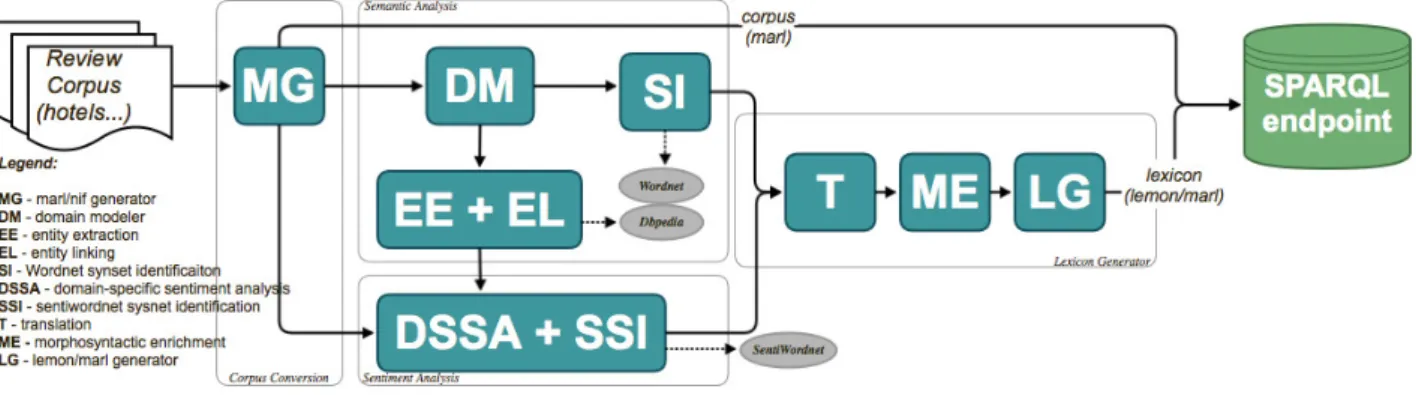
One of the tasks of the EUROSENTIMENT8 project is to develop a methodology that generates domain-specific sen-timent lexicons from legacy language resources and enrich-ing them with semantics and additional lenrich-inguistic informa-tion from resources like DBpedia and BabelNet. The lan-guage resources adaptation pipeline consists of four main steps highlighted by dashed rectangles in Figure 1: (i) the Corpus Conversion step normalizes the different re-view corpora formats to a common schema based on Marl and NIF4; (ii) the Semantic Analysis step extracts the domain-specific entity classes and named entities and iden-tifies links between these entities and concepts from the LLOD Cloud. It uses pattern-based term extraction al-gorithm with a generic domain model (Bordea, 2013) on each document, aggregates the lemmatized terms and com-putes their ranking in the corpus(Bordea et al., 2013) to
6http://snap.stanford.edu/data/web-Amazon-links.html 7
http://archive.ics.uci.edu/ml/datasets/OpinRank+Review+Dataset
8
http://eurosentiment.eu/
extract entity classes that define the domain. We use AELA (Pereira et al., 2013) framework for Entity Linking that uses a DBpedia as reference for entity mentioning iden-tification, extraction and disambiguation. For linking the entities to Wordnet we extend each candidate synset with their direct hyponym and hypernym synsets. Synset words are then checked for occurrence within all the extracted entity classes that define the language resource domain. (iii)The Sentiment Analysis step extracts contextual senti-ments and identifies SentiWordNet synsets corresponding to these contextual sentiment words. We base our approach for sentiment word detection on earlier research on senti-ment analysis for identifying adjectives or adjective phrases (Hu and Liu, 2004), adverbs (Benamara et al., 2007), two-word phrases (Turney and Littman, 2005) and verbs (Sub-rahmanian and Reforgiato, 2008). Particular attention is given to the sentiment phrases which can represent an op-posite sentiment than what they represent if separated into individual words. For determining the SentiWordnet link to the sentiment words we identify the nearest SentiWordNet sense for a sentiment candidate using Concept-Based Dis-ambiguation (Raviv and Markovitch, 2012) which utilizes the semantic similarity measure ’Explicit Semantic Analy-sis’ (Gabrilovich and Markovitch, 2006) to represent senses in a high-dimensional space of natural concepts. Con-cepts are obtained from large knowledge resources such as Wikipedia, which also covers domain specific knowl-edge. We compare the semantic similarity scores obtained by computing semantic similarity of a bag of words con-taining domain name, entity and sentiment word with bags of words which contain members of the synset and the gloss for each synset of that SentiWordNet entry. We consider the synset with the highest similarity score above a thresh-old. (iv) the Lexicon Generator step uses the results of the previous steps, enhances them with multilingual and mor-phosyntactic (i.e. using the CELEX9dataset for inflexions) information and converts the results into a lexicon based on the lemon and Marl formats. Different language re-sources are processed with variations of the given adap-tation pipeline. For example the domain-specific English review corpora are processed using the pipeline described in Figure 1 while the sentiment annotated dictionaries like the ones created by our industrial partner are converted to the lemon/Marl format using the Lexicon Generator step. 3.1. Paradigma Tecnologico sentiment dictionaries Our project partner Paradigma Tecnologico used the SNAP and OpiRank review corpora to build the intermediary sen-timent dictionaries linked to wordnet synset id following a semi-automatic approach that involved linguists. They used term frequency analysis on the reviews and we ranked the extracted terms based on their occurencies after filter-ing out hte stop words. These sorted lists were reviewed by linguists to filter only the domain-specific entities. The rel-evant entities are context entities (e.g. ’room’, ’food’ etc.) and sentiment words (e.g. ’clean’, ’small’ etc.).
Then they used a searching-chunking process to achieve the most relevant collocations of the corpora. This task consisted of identification of colocated context entities and
9
Figure 1: Methodology for Legacy Language Resources Adaptation for Sentiment Analysis.
sentiment words using a 3-word sliding window. The cal-culated collocations were reviewed again by linguists. A simple web application helped the linguists to:
• Accept or reject the collocations. Do they make sense? Are they useful in this domain?
• When accepted, disambiguate the context entity and the sentiment word included in the collocation us-ing Wordnet 3.010. The linguists read the gloss and synonyms included in the corresponding synset and we chose the most agreed upon appropriate meaning (synset ID).
• Scoring the collocation from a sentiment perspective, in a [0..1] range [10]. Figure 2 shows a snapshot of the web application where linguists could provide their in-puts for the sentiment scores.
A trade-off decision, between domain coverage and effort, was taken to include as many important domain entities as possible.
At the end of this process the resulted sentiment dictionar-ies are provided as CSV files, one file per language and domain, with the following fields:
entity, entityW N id, entityP OS, sentiment,
sentiW N id, sentiP OS, score where entity is the context entity; entityW N id is the wordnet synset id agreed for theentity;entityP OSis the part-of-speach of the context entity; sentimentis the sentiment word that occurs in the context of the entity; sentiW N id is the Sentiwordnet id agreed for the sentiment word;sentiP OS
is the sentiment word’s part-of speach adn finallyscoreis teh polarity score assigned to the sentimetn words bty the linguists.
As an example consider the following result from the ’Ho-tel’ domain in English:
04105893,n,room,01676517,a,f antastic,0.75. Here we see that the sentiment word fantastic is an adjective with the sysnet id 01676517 and has a polarity score of 0.75 in the context of the entity room which is a noun with the synset id 04105893.
10
http://wordnet.princeton.edu/
Paradigma provided also sentiment dictionaries in other 5 languages for the two domains. The non-english dictionar-ies were built using MultiWordnet11 translation based on the Wordnet synset ids from the English dictinoaries.
4.
Lexicon
Both the results of our pipeline (up to the Lemon/Marl Generator component) and the sentiment dictionaries from Paradigma were converted to RDF using the RDF extension fo the GoogleRefine12tool to create the RDF lexicons. We used the folowing namespaces listed in Listing 5 : lemon
- the core lemon lexicon model, marl- rdf properties for sentiment, w - WordNet 3.0 synsets, lexinf o- for part-of-speech properties,ed- domain categories, el - lexicon prefix,ele- lexical entries prefix.
The URIs for the lexical entries are built from the lee
namespace and the name of the lexicalentry. For each lex-ical entry we add their written form and their language within alemon : CananicalF ormobject and their part-of-speach information using a lexinf o object. For each different synset id of the same context entity we build a
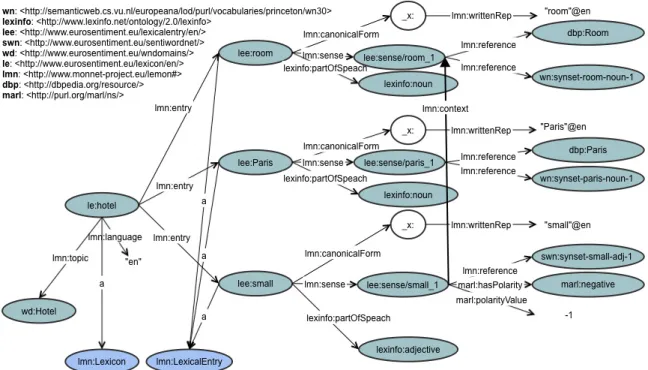
lemon : senseFor each sense we add the connections to other datasets using the lemon:reference property to refer to the Dbpedia and WordNet links. The sentiment words are represented similarly: for each sentiment word we cre-ate a lexical entry and for each of its distinct polarity val-ues and synset pairs we create a different sense of the lex-ical entry. Diferently from the lexlex-ical entries generated for entity classes and named entities, the senses of the senti-ment word lexical entries contain also the sentisenti-ment po-larity values and popo-larity using Marl sentiment properties
marl : polarityV alueandmarl : hasP olarity respec-tively.
Figure 3 shows an example of a generated lexi-con for the domain ’hotel’ in English. It shows 3 lemon:LexicalEntries: ’room ’ (entity class), ’Paris’ (named entity) and ’small’ (sentiment word) which in the context of the lexical entry ’room’ has negative polarity. Each of them consists of senses, which are linked to DBpe-dia and/or Wordnet concepts.
11
http://multiwordnet.fbk.eu/english/home.php
12
Figure 2: Snapshot of the Web applicatoin that allows linguists to specify the sentiment scores.
Listing 5: Namespaces used in the RDF lexicons.. lemon : h t t p : / / www. monnet−p r o j e c t . eu / lemon
m a r l : h t t p : / / p u r l . o r g / m a r l / n s wn : h t t p : / / s e m a n t i c w e b . c s . vu . n l / e u r o p e a n a / l o d / p u r l / v o c a b u l a r i e s / p r i n c e t o n / wn30 l e x i n f o : h t t p : / / www. l e x i n f o . n e t / o n t o l o g y / 2 . 0 / l e x i n f o ed : h t t p : / / www. e u r o s e n t i m e n t / d o m a i n s l e : h t t p : / / wwww. e u r o s e n t i m e n t . com / l e x i c o n /<l a n g u a g e>/ l e e : h t t p : / / www. e u r o s e n t i m e n t . com / l e x i c a l e n t r y /<l a n g u a g e>/
We use named graphs to group the data from each lexicon. The URIs that we use for the named graphs are the lex-icon URIs and they are built after the following pattern:
http : //www.eurosentiment.com/ < domain > / < language > /lexicon/paradigma for the lexicons ob-tained fmor the sentiment dictionaries from Paradigma and
http : //www.eurosentiment.com/ < domain > / < language > /lexicon/ < taor amz >for the lexicons obtained from the TripAdvisor adn Amazon corpora.
5.
Availability
The domain-specific lexicons are loaded in a Virtuoso13 SPARQL endoint which can be accessed from here: http:
//140.203.155.231 : 8890/sparql. We also installed the linked data frontend pubby14 on top of this SPARQL end-point to allow for easier browsing of the provided lex-icons. For example one can start at the following link
http://140.203.155.231 : 8080/eurosentiment/to see the available lexicons. Then he/she can click on the uri of
13
http://virtuoso.openlinksw.com/
14
http://wifo5-03.informatik.uni-mannheim.de/pubby/
any of the lexicons to explore its lexical entries.
6.
Acknowledgements
This work has been funded by the European project EU-ROSENTIMENT under grant no. 296277.
7.
References
Farah Benamara, Carmine Cesarano, Antonio Picariello, Diego Reforgiato, and V. S. Subrahmanian. 2007. Senti-ment analysis: Adjectives and adverbs are better than ad-jectives alone. InProceedings of the International Con-ference on Weblogs and Social Media, ICWSM’07. Georgeta Bordea, Paul Buitelaar, and Tamara Polajnar.
2013. Domain-independent term extraction through do-main modelling. In Proceedings of the 10th Interna-tional Conference on Terminology and Artificial Intelli-gence, TIA’13, Paris, France.
Georgeta Bordea. 2013. Domain Adaptive Extraction of Topical Hierarchies for Expertise Mining. Ph.D. thesis, National University of Ireland, Galway.
Evgeniy Gabrilovich and Shaul Markovitch. 2006. Over-coming the brittleness bottleneck using wikipedia:
En-Figure 3: Example lexicon for the domain ’hotel’ in English.
hancing text categorization with encyclopedic knowl-edge. In Proceedings of the 21st National Conference on Artificial Intelligence, AAAI’06. AAAI Press. Kavita Ganesan and ChengXiang Zhai. 2011.
Opinion-based entity ranking.Information Retrieval.
Minqing Hu and Bing Liu. 2004. Mining and summa-rizing customer reviews. In Proceedings of the Tenth ACM SIGKDD International Conference on Knowledge Discovery and Data Mining, KDD ’04, New York, NY, USA. ACM.
John McCrae, Guadalupe Aguado de Cea, Paul Buitelaar, Philipp Cimiano, Thierry Declerck, Asuncin Gmez-Prez, Jorge Gracia, Laura Hollink, Elena Montiel-Ponsoda, Dennis Spohr, and Tobias Wunner. 2012. Interchang-ing lexical resources on the semantic web.Language Re-sources and Evaluation.
Bianca Pereira, Nitish Aggarwal, and Paul Buitelaar. 2013. Aela: An adaptive entity linking approach. In Proceed-ings of the 22nd International Conference on World Wide Web Companion, WWW’13, Republic and Canton of Geneva, Switzerland.
Ariel Raviv and Shaul Markovitch. 2012. Concept-based approach to word-sense disambiguation. InProceedings of the 26th AAAI Conference on Artificial Intelligence. V.S. Subrahmanian and Diego Reforgiato. 2008. Ava:
Adjective-verb-adverb combinations for sentiment anal-ysis.Intelligent Systems.
Peter D. Turney and Michael L. Littman. 2005. Corpus-based learning of analogies and semantic relations. Ma-chine Learning.
Adam Westerski, Carlos A. Iglesias, and Fernando Tapia. 2011. Linked Opinions: Describing Sentiments on the Structured Web of Data. InProceedings of the 4th Inter-national Workshop Social Data on the Web.