Edge Cache-based ISP-CP Collaboration Scheme for
Content Delivery Services
Chao Fang
∗†, Haipeng Yao
‡, Zhuwei Wang
†, Pengbo Si
†, Yixin Chen
§, Xiaodong Wang
¶, Fellow, IEEE, and
F. Richard Yu
, Fellow, IEEE
∗
Faculty of Information Technology, Beijing University of Technology, Beijing, P.R. China
†
Beijing Advanced Innovation Center for Future Internet Technology, Beijing University of Technology, Beijing,
P.R. China
‡
State Key Laboratory of Networking and Switching Technology, Beijing University of Posts and
Telecommunications, Beijing, P.R. China
§
Department of Computer Science and Engineering, Washington University in St. Louis, St. Louis, USA
Electrical Engineering Department, Columbia University, New York, USA
¶
Department of Systems and Computer Engineering, Carleton University, Ottawa, ON, Canada
Abstract—With the explosive increase of mobile data traffic, content delivery issue in the Internet is a growing concern for both Internet Service Providers (ISPs) and content providers (CPs). To improve content transmission efficiency and reduce network delay, many ISP-CP cooperation schemes are designed, parts of which are trying to introduce the idea of in-network caching. However, the combination influence of edge cache and content popularity is largely ignored in the existing solutions. Therefore, we propose a novel edge cache-based ISP-CP collaboration model for content delivery services, where the two important factors are simultaneously taken into account. Then, the model is analyzed to obtain the maximal network profit from the perspective of online and offline, respectively. Simulation results show that the profit gains of the proposed solution over the existing Internet models only considering cooperation between ISPs and CPs in the heterogeneous network environments.
Index Terms—Edge cache, ISP-CP collaboration, content popu-larity, content delivery.
I. INTRODUCTION
As more and more end users access the Internet via mobile devices, such as mobile-connected PCs and Smartphones (in-cluding phablets), mobile traffic in the Internet is explosively increasing. According to the 2017 Cisco Visual Networking Index (VNI), global mobile data traffic has grown18-fold over the past 5 years, and will increase 7-fold in the next 5 years, reaching49exabytes per month by 2021[1]. Therefore, it has been a challenging problem to address the increasing mobile traffic represented by video contents [2], [3].
In order to cope with the rapid growth of mobile traffic, both Internet Service Providers (ISPs) and content providers (CPs) deploy a massive network equipments (e.g., servers and bandwidth) with different considerations [4]–[6]. For an ISP, its focus is to solve the traffic engineering (TE) problem, i.e., modifying the routing table to achieve minimal congestion probability in the network, which makes users have lower packet loss and latency, and the network gracefully absorb flash crowds. For a CP, its aim is to solve the server selection (SS) problem, i.e., choosing which server should deliver content to each client, which makes user demand satisfied as soon as
possible and realizes load balance of servers. However, the growth of demand for contents and the resulting deployment of content delivery infrastructures pose the pressure for cost reduction and customer satisfaction to ISPs and CPs, which motivates them to cooperatively work to provide better content delivery services [4].
Recently, several works have studied on this new field. Jiang
et al. propose a mathematical framework, which considers three
cooperative models between ISPs and CPs [6]. Hande et al. design a scheme to obtain the precise trade-off of benefits distributed among ISPs, CPs, and end-users [7]. To dynamically adapt to the traffic demand for contents hosted on CPs, Frank et
al. propose Content-aware Traffic Engineering (CaTE) by using
ISP network information and end-user locations during the SS process [4]. Moreover, given that the prominent advantages of in-network caching in content distribution [8]–[11], researchers are trying to introduce the idea of in-network caching to further improve network performance while considering the cooperative work of ISPs and CPs. Pham et al. model and analyze the interactions on prices and caching investments among transit ISPs, access ISPs and CPs in Information-Centric Networking (ICN) interconnection [12]. Based on extensive in-network caching ability of ICN, Arifuzzamanet al. [13] use game theory to analyze the decision making problem of caching contents to realize monetary compensation and revenue sharing among network players. Douros et al. propose to deploy a cache in an ISP and make the ISP and CPs cooperate to share deployment cost and additional profit [14]. Ndikumana et al. propose a joint incentive policy and a price-based cache replacement scheme for paid content in named data networking, which can increase the ISP’s and CPs’ profits [15], [16]. To deliver content of a CP over the “last mile” of an ISP’s infrastructure, Le et al. partition the buffer space at the BS and lease each cache slice to the service providers [17]. Then, Mitra et al. explore pricing and capacity decisions for bandwidths and caches, and model the ISP-CP interaction [18]. Mangili et al. analyze the allocation problem of unused bandwidth and available cache at the wireless access networks of ICN from the perspective of a CP’s revenue [19].
Although parts of these excellent works exploit the thought of in-network caching to improve content transmission effi-ciency and reduce network delay, the combination influence of edge cache and content popularity is largely ignored, and not analyzed theoretically in the current solutions. In this paper, therefore, we propose a novel edge cache-based ISP-CP collaboration scheme for content delivery services, which can achieve the optimal network profit. The main contributions of this paper are as follows.
• We theoretically analyze the cooperative working scheme of ISPs and CPs in content delivery services by simultaneously considering the effects of content popularity and edge cache.
• We formulate the edge cache-based ISP-CP collaboration problem to be a maximal network profit model, and analyze the model from the perspective of online and offline, respectively.
• Extensive simulations are done to evaluate the perfor-mance of the proposed model in the heterogeneous network environments. The results demonstrate that the profit gains of our proposed solution performs better than the existing Internet models only considering cooperation between ISPs and CPs.
The rest of this paper is organized as follows. In Section II, the optimization problem of network profit to resolve is formu-lated and analyzed from the perspective of online and offline. Simulation results are presented and discussed in Section III. Finally, we conclude this study in Section IV.
II. SYSTEMMODEL ANDANALYSIS
In this section, we formulate the maximal profit problem as an ISP-CP collaboration model for content delivery services, where both edge cache and content popularity are considered. Then, this model is analyzed theoretically to obtain the optimal and realistic solutions, respectively. Without loss of generality, only one ISP and CP scenario is considered in our model to simplify this problem. The notations of key parameters used in this paper are summarized in the Table I.
A. Content Popularity Model
Due to that network content popularity follows the Zipf distribution [20], we assume that the number of different contents provided by servers of a CP isK, whose rank is from 1 to K based on content popularity [21]. Thus, the content corresponding to the rank 1 has the highest popularity while the one labeled by the rankK is the leat popular content. Let the total number of requests be R, therefore, the number of requests about contentk,Rk, can be written as
Rk =R k −α K k=1k −α , k = 1,2,· · ·, K. (1) where the number of popular contents increases with the growth of the value for skewness factorα.
B. Network Model
As shown in Fig. 1, caches are deployed at the edge of the ISP, e.g., base stations (BSs), which can improve network
TABLE I
NOTATIONS OF THEKEYPARAMETERS
Symbols Notations
M Set of mobile clients B Set of base stations
K Set of different network contents R Set of content requests
M the number of mobile clients
B the number of base stations
K different network contents
R the total number of content requests of mobile clients
α Zipf skewness parameter
qk
i Request rate for contentkat mobile clienti
sk Size of contentk
xk
i,j Boolean variable to indicate whether mobile clientkfrom BSj irequests content
yk
j Boolean variable to indicate whether BSjcaches contentk
Hj,CP Shortest hops between BSjand CP
Cj Size of a cache deployed at BSj
PCP Membership fee of each mobile client charged by CP
PISP Average profit that a unit of bandwidth generates for ISP
CCP Average processing cost per unit of network flow, paid by CP
Cn Average processing cost per unit of network flow, paid by the nodesalong the path between a BS and CP
Cl Average transmission cost per unit of network flow, paid by the linksalong the path between a BS and CP
C0 Average cost per unit of bandwidth bought by ISP
Cca Average cost per unit of cache size
Cre Average retrieval cost per request
I Caching incentive of ISP, paid by CP
performance. Based on the rank of content popularity mentioned above, the vast majority of user requests can be satisfied by edge caches if popular contents that mobile clients (MCs) are interested in are buffered at the BSs. Although incurring additional cost for the ISP, the introduced caches can satisfy users’ requests at the wireless access points, which can reduce transmission traffic and work load of network equipments, and then increase network profit.
C. Problem Formulation and Objective
1) Revenue Model: In our system, the revenue model of
the whole network consists of two parts: membership fees of MCs charged by the CP and the traffic fees charged by the ISP. The ISP charges traffic fees to provide network support for mobile users and the CP. Due to that parts of network requests can be coped with at edge caches of the ISP, the traffic income of the ISP can be formulated as
i∈M k∈Kq k iskPISP + i∈M j∈B k∈Kq k iskxki,j 1−yk j
PISP, where the latter refers to
the bandwidth income to deal with the unsatisfied network requests at edge caches of the ISP. In the above expression,qik is the request rate for contentkat mobile clienti,sk is the size of contentk,PISP is the average profit that a unit of bandwidth generates for the ISP, andxki,jandyjkare boolean variables.xki,j takes the value of1if the contentkthat mobile userirequests is cached in BSj, and0otherwise.ykj takes the value of1if BS
Fig. 1. Network model. Each BS has a caching capability, and content requests of a mobile client are satisfied either by cached contents of BSs or by the servers of CP.
j caches content k, and 0 otherwise. Moreover, to encourage the ISP to buffer more popular contents, an incentiveImust be provided by the CP to the ISP due to its caching behavior. As for the CP, its revenueM·PCP is the sum of the membership fee PCP of each mobile client. Therefore, the total network revenue model can be written as:
M·PCP + i∈M k∈K qk iskPISP+ i∈M j∈B k∈K qk iskxki,j 1−yk j PISP +I. (2)
2) Cost Model: The total network cost is composed of
expenses of the ISP and CP, which is a mixed cost for both of them. The expenditures of the CP and traditional ISP mainly depends on processing cost, bandwidth cost and retrieval cost, which are caused by network devices (e.g., routers, switches and servers), network links, and users’ requests, respectively. Due to that the majority of content requests can be satisfied at the storage equipments of access networks, the introduced edge caches can reduce network transmission traffic, which reshapes the conventional cost models of the ISP and CP.
Specifically, after deploying a memory at each BS, the corre-sponding bandwidth input and processing cost of the ISP can be written as i∈M j∈B k∈Kq k iskxki,j 1−yk j C0 + i∈M k∈Kq k iskC0 and i∈M j∈B k∈Kq k iskxki,j 1−yk j (Hj,CP −1)(Cn+Cl), where Hj,CP is the shortest hop between BS j and CP, Cn and Cl are average processing and transmission cost
per unit of network flow paid by the nodes along the path between a BS and CP, and C0 is average cost per unit of bandwidth bought by ISP. Although the deployed memory can reduce network transmission traffic, it makes the ISP incur content caching cost
j∈B
k∈Ky k
jskCca and retrieval cost of
content requests in the caches
i∈M
k∈Kq k
iCre, where Cca is Average cost per unit of cache size. Similarly, the processing cost, bandwidth cost, incentive cost, and retrieval cost of the CP can be written as i∈M j∈B k∈Kq k iskxki,j 1−yk j CCP, i∈M j∈B k∈Kq k iskxki,j 1−yk j PISP, I, and i∈M j∈B k∈Kq k ixki,j 1−yk j Cre, respectively, where CCP
is average processing cost per unit of network flow paid by CP, and Cre is average retrieval cost per request. Therefore, the cost model of our system can be written as:
i∈M j∈B k∈K qk iskxki,j 1−yk j [CCP+ (Hj,CP −1)(Cn+Cl)] + i∈M j∈B k∈K qk iskxki,j 1−yk j (C0+PISP)+ j∈B k∈K yk jskCca+ i∈M k∈K qk iskC0+qkiCre+ i∈M j∈B k∈K qk ixki,j 1−yk j Cre+I. (3)
3) Profit Model: In this paper, our objective is to maximize
network profit of ISP-CP collaboration for content delivery by deploying caches at the BSs, which is equal to network revenue minus its cost. Therefore, the profit maximum problem can be formulated as the non-linear programming problem, which is written as (4) (On the top of the next page).
In the optimization problem, the first constraint forces each request of a mobile user to be assigned to only one BS or the content source to obtain the data. The second inequality ensures the maximal size of contents buffered in a BS j to be below cache capacity Cj of the BS. The third constraint represents that the variablexki,j andyjk can only take the value of0or 1.
D. Model Analysis
In this part, we analyze the optimal solution of the proposed system under the following three assumptions, which will provide an optimal bound to evaluate future solutions able to obtain near-optimal results under different network scenarios. The first assumption is that each BS has the same cache size. The second one is that the topN contents of content popularity rank are buffered in the cache, which can achieve the highest cache hit rate. The last one is that the average hop between a BS and the CP, and the average size of each content are represented byH andS, respectively.
Under these assumptions,
i∈M k∈Kq k isk(PISP−C0), j∈B k∈Ky k jskCca and i∈M k∈Kq k iCre can be rewritten as R·S·(PISP−C0), B·N·S·Cca, R·Cre, respectively. Besides, based on the zipf model of content popularity, the
max M·PCP + i∈M k∈K qk isk(PISP −C0)− j∈B k∈K yk jskCca− i∈M k∈K qk iCre− i∈M j∈B k∈K qk ixki,j 1−yk j Cre − i∈M j∈B k∈K qk iskxki,j 1−yk j [C0+CCP+ (Hj,CP −1)(Cn+Cl)] s.t. j∈B xk i,j≤1,∀i∈ M, k∈ K k∈K yk jsk≤Cj,∀j∈ B xki,j ∈ {0,1}, ykj ∈ {0,1},∀i∈ M, j∈ B, k∈ K (4)
max M·PCP +R·S·(PISP−C0)−B·N·S·Cca−R·Cre·
1 + K k=N+1 k−α/K k=1 k−α − C0+CCP +H−1(Cn+Cl) S·R· K k=N+1 k−α/K k=1 k−α s.t. j∈B xk i,j ≤1,∀i∈ M, k∈ K k∈K yk j ≤N,∀j∈ B xk i,j∈ {0,1}, yjk∈ {0,1},∀i∈ M, j∈ B, k∈ K (5)
number of requests unsatisfied at an edge cache can be calculated. That is to say,
i∈M j∈B k∈Kq k ixki,j 1−yk j can be rewritten as R· K k=N+1k −α/K k=1k
−α. Moreover, the second
constraint
k∈Ky k
jsk≤Cj,∀j∈ B also can be simplified to be
k∈Ky k
j ≤N,∀j ∈ B. Therefore, the profit model (4) can be
rewritten as the expression (5) (On the top of this page), where B is the number of base stations in an ISP.
Recall that M, B, H are parameters related to network topology, R, α, K, N, S are parameters related to network contents and requests, andPCP,PISP,Cca,Cre,Cn,Cl,C0are the given network parameters, which are all with fixed values. Hence, we can come to the conclusion that network profit of ISP-CP collaboration largely relies on cache size, content popularity, and average hops of data dissemination, which will be further discussed in the simulation.
III. SIMULATIONRESULTS ANDDISCUSSIONS
In this section, we use computer simulations to evaluate the performance of the proposed model. We first describe the simulation settings, and then present the simulation results.
TABLE II
VALUEINFORMATION OF THEKEYSIMULATIONPARAMETERS
Symbol/Attribute Value/Value Range
M 12000 B 100 K 1000 R 100000 Cj [0.1,1] α [0.6,1.5] PCP 198 CNY/Year PISP 0.29 CNY/MB Cca 0.2 CNY/MB
Topology Power-Law, Transit-Stub, Waxman
Num. of network nodes 64
A. Simulation Settings
1) Simulation Environments: In this part, the simulation
environments are presented to evaluate the proposed model, and the key simulation parameters are summarized in the Table II. In the simulation, cache size of each BS is abstracted as a proportion that cache size is defined as relative size to the total number of different contents in the network. Given that the cache size is small in realistic networks [22]–[26], we evaluate the network performance of each solution when cache size
varies from0.1%to1%[25]–[27]. Moreover, we set the range of skewness factorα in Zipf distribution to be 0.6 [28] -1.5 [20], [21]. Besides, the values of some important variables on the network charges are chosen or set by considering actual network situations. For example, the membership fee of each mobile client charged by iQIYI is 198 China Yuan (CNY) per year, and the traffic charge of each mobile user paid to China Mobile Ltd., the world’s largest carrier, is generally more than 0.29 CNY per MB. Finally, the simulation evaluation is carried out in the Power-Law topology generated by using Inet topology generator [29], Transit-Stub and Waxman topologies generated by using GT-ITM library [30], respectively. These topologies are randomly generated and includes 64 network routers in the simulation, where the average hopHvaries. Take the hypothetical United States backbone network US64 [21] for example, the value ofH is about 7.
2) Comparative Policy: To demonstrate the advantages of
our scheme, we compare the offline solution and online solution of the proposed model with the existing Internet model only considering cooperation between ISPs and CPs [5], [6], which are named as “Offline with Cache”, “Online with Cache” and “OPT without Cache”, respectively. Offline with Cache refers to the solution of the simplified profit model (5), where the most popular N contents are cached in the edge caches. Compared with Offline with Cache, Online with Cache uses the Least Recently Used (LRU) [31] as its cache replacement policy and then obtains the realistic solution. In the OPT without Cache scheme, ISPs and CPs can share their network information (e.g., network topology, traffic load of each network equipment and so on) to make optimal routing decision, which can realize load balance and minimal network delay.
Algorithm 1 describes the detailed process to achieve the solution of Online with Cache in the simulation. We first input values of the parameters related to expres-sion (4) in the given simulation environments, e.g., net-work topologies {B}, network contents {K, sk, α}, mo-bile users {M,R}, network caches {Cj}, network charges
{PCP, PISP, Cca, Cre, C0, CCP, Cn, Cl}. Then, the real-time
solution can be calculated by inputting the recorded parameter information, e.g.,{qki},{xki,j},{yjk},{Hj,CP}. In Offline with Cache, the profit maximum problem in expression (4) can be simplified to be the expression (5), where the optimal solution varies with the change of cache sizeN, content popularityαand average hopH. Therefore, the optimal solution can be obtained by inputting the values of related variables when the simulation environments are given.
B. Performance Evaluation Results
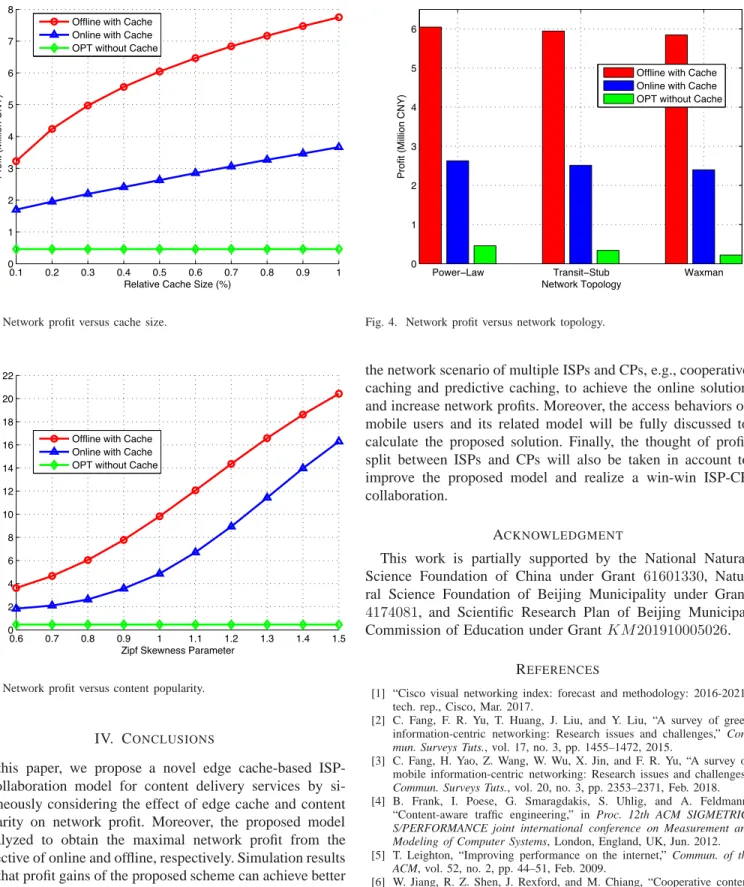
Fig. 2 shows network profits of the three solutions under different cache sizes when Zipf skewness parameterα is 0.8. Moreover, the simulation is carried out in the Power-Law topology. In spite of additional cost incurred by the deployed in-network caches at the BSs, due to the obviously reduced resource consumption and network traffic, the introduction of edge caches can efficiently improve network performance. Moreover, network profit of the proposed model is growing as cache size increases, because a larger cache can make more
Algorithm 1 Process to Solve the Online Model
Input: Network topologies{B}, network contents{K, sk, α}, mobile users {M,R}, network caches {Cj}, network charges {PCP, PISP, Cca, Cre, C0, CCP, Cn, Cl}
Output: {qki},{xki,j},{ykj},{Hj,CP}
1: for each request in R do
2: ifxki,j = 1, yjk= 0 then
3: Calculate and record the shortest hops{Hj,CP};
4: CP transmits contentkto useri;
5: if
k∈Ky k
jsk < Cj then
6: BSj directly caches contentk;
7: else
8: Contentkis cached to replace the least recently
9: used object buffered at BSj;
10: end if
11: else
12: if xki,j= 1, ykj = 1 then
13: BSj transmits the cached contentk to useri;
14: end if
15: end if
16: Update cache status of BSj according to LRU policy;
17: Record the information about{qki},{xki,j}, and{ykj};
18: end for
19: Compute the solution of expression (4) based on the record-ed statistics.
popular contents cached at the edge of Internet and more requests of users satisfied by the contents buffered at the BSs. Similarly, the gap between offline and online solution of our model is becoming larger when the cache size is increasing. The reason is that the cached contents are frequently updated when edge caches adopt the LRU cache replacement policy, which can not realize the optimal caching of network contents. However, a larger buffer makes the growth of network profit decline, because the cost caused by in-networking cache increases faster than its brought benefits.
Fig. 3 shows network profits of the three solutions under different content popularities when cache size is 0.6% and simulation is conducted in the Power-Law topology. From Fig. 3, we can observe that network profit of the designed model is growing as content popularity increases. The reason is that a larger Zipf skewness parameter generates a larger proportion of content requests for the popular contents in all the data source, which makes more MCs’ requests directly satisfied by the contents buffered at the edge caches and then brings a higher network profit.
Fig. 4 shows network profits of the three solutions under different network topologies when cache size is0.6%and Zipf skewness parameter α is 0.8. Compared with the traditional scheme “OPT without Cache”, our proposed solutions can always achieve better performance when network topology varies. Therefore, the proposed model has a universal charac-teristic, which can be widely applied to heterogeneous network environments.
0.1 0.2 0.3 0.4 0.5 0.6 0.7 0.8 0.9 1 0 1 2 3 4 5 6 7 8
Relative Cache Size (%)
Profit (Million CNY)
Offline with Cache Online with Cache OPT without Cache
Fig. 2. Network profit versus cache size.
0.6 0.7 0.8 0.9 1 1.1 1.2 1.3 1.4 1.5 0 2 4 6 8 10 12 14 16 18 20 22
Zipf Skewness Parameter
Profit (Million CNY)
Offline with Cache Online with Cache OPT without Cache
Fig. 3. Network profit versus content popularity.
IV. CONCLUSIONS
In this paper, we propose a novel edge cache-based ISP-CP collaboration model for content delivery services by si-multaneously considering the effect of edge cache and content popularity on network profit. Moreover, the proposed model is analyzed to obtain the maximal network profit from the perspective of online and offline, respectively. Simulation results show that profit gains of the proposed scheme can achieve better performance than the existing Internet models only considering cooperation between ISPs and CPs in the heterogeneous net-work conditions.
The offline solution of the proposed model provides an optimal bound to evaluate the future solutions able to obtain near-optimal results under different network scenarios. In future work, we intend to develop an more efficient caching policy in
Power−Law Transit−Stub Waxman 0 1 2 3 4 5 6 Network Topology
Profit (Million CNY)
Offline with Cache Online with Cache OPT without Cache
Fig. 4. Network profit versus network topology.
the network scenario of multiple ISPs and CPs, e.g., cooperative caching and predictive caching, to achieve the online solution and increase network profits. Moreover, the access behaviors of mobile users and its related model will be fully discussed to calculate the proposed solution. Finally, the thought of profit split between ISPs and CPs will also be taken in account to improve the proposed model and realize a win-win ISP-CP collaboration.
ACKNOWLEDGMENT
This work is partially supported by the National Natural Science Foundation of China under Grant 61601330, Natu-ral Science Foundation of Beijing Municipality under Grant 4174081, and Scientific Research Plan of Beijing Municipal Commission of Education under GrantKM201910005026.
REFERENCES
[1] “Cisco visual networking index: forecast and methodology: 2016-2021,” tech. rep., Cisco, Mar. 2017.
[2] C. Fang, F. R. Yu, T. Huang, J. Liu, and Y. Liu, “A survey of green information-centric networking: Research issues and challenges,” Com-mun. Surveys Tuts., vol. 17, no. 3, pp. 1455–1472, 2015.
[3] C. Fang, H. Yao, Z. Wang, W. Wu, X. Jin, and F. R. Yu, “A survey of mobile information-centric networking: Research issues and challenges,” Commun. Surveys Tuts., vol. 20, no. 3, pp. 2353–2371, Feb. 2018. [4] B. Frank, I. Poese, G. Smaragdakis, S. Uhlig, and A. Feldmann,
“Content-aware traffic engineering,” in Proc. 12th ACM SIGMETRIC-S/PERFORMANCE joint international conference on Measurement and Modeling of Computer Systems, London, England, UK, Jun. 2012. [5] T. Leighton, “Improving performance on the internet,” Commun. of the
ACM, vol. 52, no. 2, pp. 44–51, Feb. 2009.
[6] W. Jiang, R. Z. Shen, J. Rexford, and M. Chiang, “Cooperative content distribution and traffic engineering in an isp network,” in Proc. 7th international joint conference on Measurement and Modeling of Computer Systems, Seattle, WA, USA, Jun. 2009.
[7] P. Hande, M. Chiang, R. Calderbank, and S. Rangan, “Network pricing and rate allocation with content provider participation,” in Proc. IEEE INFOCOM’09, Rio de Janeiro, Brazil, Apr. 2009.
[8] B. Ahlgren, C. Dannewitz, C. Imbrenda, D. Kutscher, and B. Ohlman, “A survey of information-centric networking,” IEEE Commun. Mag., vol. 50, no. 7, pp. 26–36, Jul. 2012.
[9] J. Choi, J. Han, E. Cho, T. T. Kwon, and Y. Choi, “A survey on content-oriented networking for efficient content delivery,” IEEE Commun. Mag., vol. 49, no. 3, pp. 121–27, Mar. 2011.
[10] K. Thar, N. H. Tran, S. Ullah, T. Z. Oo, and C. S. Hong, “Online caching and cooperative forwarding in information centric networking,” IEEE Access, vol. 6, pp. 59679–59694, Oct. 2018.
[11] M. Hajimirsadeghi, N. B. Mandayam, and A. Reznik, “Joint caching and pricing strategies for popular content in information centric networks,” IEEE J. Sel. Areas Commun., vol. 35, no. 3, pp. 654–667, Feb. 2017. [12] T. M. Pham, S. Fdida, and P. Antoniadis, “Pricing in information-centric
network interconnection,” in Proc. IFIP Networking, Brooklyn, NY, USA, May. 2013.
[13] M. Arifuzzaman, K. Yu, and T. Sato, “Content distribution in information centric network: Economic incentive analysis in game theoretic approach,” in Proc. ITU Kaleidoscope Academic Conference, Saint Petersburg, Rus-sia, Jun. 2014.
[14] V. G. Douros, S. E. Elayoubi, E. Altman, and Y. Hayel, “Caching games between content providers and internet service providers,” Performance Evaluation, vol. 113, pp. 13–25, Aug. 2017.
[15] A. Ndikumana, K. Thar, T. M. Ho, N. H. Tran, P. L. Vo, D. Niyato, and C. S. Hong, “In-network caching for paid contents in content centric networking,” in Proc. IEEE Globcom’17, Singapore, Dec. 2017. [16] A. Ndikumana, N. H. Tran, T. M. Ho, D. Niyato, Z. Han, and C. S.
Hong, “Joint incentive mechanism for paid content caching and price based cache replacement policy in named data networking,” IEEE Access, vol. 6, pp. 33702–33717, Jun. 2018.
[17] T. H. T. Le, N. H. Tran, P. L. Vo, Z. Han, M. Bennis, and C. S. Hong, “Contract-based cache partitioning and pricing mechanism in wireless network slicing,” in Proc. IEEE Globecom’17, Singapore, Dec. 2017. [18] D. Mitra, Q. Wang, and A. Hong, “Emerging internet content and service
providers’ relationships: Models and analyses of engineering, business and policy impact,” in Proc. IEEE INFOCOM’17, Atlanta, GA, USA, May. 2017.
[19] M. Mangili, F. Martignon, S. Paris, and A. Capone, “Bandwidth and cache leasing in wireless information-centric networks: A game-theoretic study,” IEEE Trans. Veh. Tech., vol. 66, no. 1, pp. 679–695, Jan. 2017.
[20] K. Katsaros, G. Xylomenos, and G. C. Polyzos, “Multicache: an incremen-tally deployable overlay architecture for information-centric networking,” in Proc. IEEE INFOCOM’10, San Diego, CA, USA, Mar. 2010. [21] N. Choi, K. Guan, D. Kilper, and G. Atkinson, “In-network caching effect
on optimal energy consumption in content-centric networking,” in Proc. IEEE ICC’12, Ottawa, Canada, Jun. 2012.
[22] Z. Li, G. Simon, and A. Gravey, “Caching policies for in-network caching,” in Proc. 20st Int’l Conf. Computer Communications and Net-works (ICCCN), Maui, Hawaii, 2011.
[23] D. Rossi and G. Rossini, “Caching performance of content centric net-works under multi-path routing (and more),” tech. rep., Telecom ParisTech, 2011.
[24] H. Xie, G. Shi, and P. Wang, “TECC: Towards collaborative in-network caching guided by traffic engineering,” in Proc. IEEE INFOCOM’12, Orlando, FL, USA, Apr. 2012.
[25] J. Li, B. Liu, and H. Wu, “Energy-efficient in-network caching for content-centric networking,” IEEE Commun. Letters, vol. 17, no. 4, pp. 797–800, Apr. 2013.
[26] N. Laoutaris, S. Syntila, and I. Stavrakakis, “Meta algorithms for hierar-chical web caches,” in Proc. IEEE ICPCC’14, Phoenix, AZ, Apr. 2004. [27] C. Fang, F. R. Yu, T. Huang, J. Liu, and Y. Liu, “An energy-efficient
dis-tributed in-network caching scheme for green content-centric networks,” Comput. Netw., vol. 78, pp. 119–129, Feb. 2015.
[28] L. Breslau, “Web caching and zipf-like distributions: Evidence and impli-cations,” in Proc. IEEE INFOCOM’99, New York, NY, USA, Mar. 1999. [29] H. Chang, R. Govindan, S. Jamin, and S. Shenker, “Towards capturing representative as-level internet topologies,” Comput. Netw., vol. 44, no. 6, pp. 737–755, 2004.
[30] E. Zegura, K. Calvert, and M. Donahoo, “A quantitative comparison of graph-based models for internet topology,” IEEE/ACM Trans. Networking, vol. 5, no. 6, pp. 770–783, 1997.
[31] Y. Kim and I. Yeom, “Performance analysis of in-network caching for content-centric networking,” Comput. Netw., vol. 57, no. 13, pp. 2465– 2482, Apr. 2013.