Procedia Computer Science 75 ( 2015 ) 301 – 305
1877-0509 © 2015 The Authors. Published by Elsevier B.V. This is an open access article under the CC BY-NC-ND license (http://creativecommons.org/licenses/by-nc-nd/4.0/).
Peer-review under responsibility of organizing committee of the 2015 International Conference on Virtual and Augmented Reality in Education (VARE 2015)
doi: 10.1016/j.procs.2015.12.251
ScienceDirect
2015 International Conference on Virtual and Augmented Reality in Education
Augmented Reality app for Calculus: A Proposal for the
Development of Spatial Visualization
Eliud Quintero
a,*, Patricia Salinas
a, Eduardo González-Mendívil
a, Héctor Ramírez
a aTecnológico de Monterrey, Eugenio Garza Sada 2501, 64849 Monterrey, N.L., MéxicoAbstract
Spatial visualization is a crucial ability to understand and solve real world problems. Typically, important features of visual-spatial abilities in mathematics learning have been the skills required to construct mental models of mathematical objects from teacher drawings or oral descriptions. However, spatial ability is not a static trait but instead a dynamic process which could be fostered through interaction of real and virtual objects. This ability could be enriched with the development of new technologies such as augmented reality. We are part of a team of innovative and educational research aiming to foster mathematical cognitive skills, crucial but generally taken for granted. The purpose of this paper is to present an augmented reality application in order to promote spatial visualization in Calculus courses for engineering students.
© 2015 The Authors. Published by Elsevier B.V.
Peer-review under responsibility of organizing committee of the 2015 International Conference on Virtual and Augmented Reality in Education (VARE 2015).
Keywords: Augmented Reality; Calculus; spatial ability; spatial visualization, engineering education.
1.Background
Spatial ability is the basic perception skill for recognizing and understanding objects in the physical world1. In the study of numerous sciences, such as mathematics, physics and engineering, this ability is crucial. As Chen and Chi2
stated, from an engineering point of view, the education required to build up the spatial ability of students will
* Eliud Quintero. Tel.: +52-81-83581400, ext. 2504
E-mail address: [email protected]
© 2015 The Authors. Published by Elsevier B.V. This is an open access article under the CC BY-NC-ND license (http://creativecommons.org/licenses/by-nc-nd/4.0/).
Peer-review under responsibility of organizing committee of the 2015 International Conference on Virtual and Augmented Reality in Education (VARE 2015)
support them in transferring three-dimensional objects into their two-dimensional projections with ease. For engineering students this skill has many applications, like conceiving and sometimes building spatial models, interpreting diagrams and identifying spatial conflicts. In the case of manufacturing and construction industries, engineers need to describe and interpret geometrical properties and mechanisms of their products accurately.
The terms visual and spatial skills cover five components: spatial perception, spatial visualization, mental rotations, spatial relations and spatial orientation3. According to Park et al.4, spatial perception refers to the observed
magnitude and/or proximity of an object in relation to an individual; meanwhile, spatial visualization denotes the ability to perceive and mentally negotiate objects or models. Mental rotation suggests that a revolved perceptual structure of an object or model is enabled, through cognitive visualization. By its part, spatial relation is the proximity of an object in reference to an associative or relative object; and spatial orientation suggests the immediacy of an object in material or simulated space in relation to the individual5.
Samsudin, Rafi, & Hanif6 explain that those five components may be experiential, suggesting that the use of
multisensory applications can be influential. Nevertheless, the traditional method for teaching visual and spatial abilities to students is to ask them to analyze and interpret pictorial and orthogonal views from a blackboard or on a paper. This method has its evident limitations because it makes hard the conceptualization of the structure, due to a lack of interaction between the students and the images2.
Research related to the development of spatial skills in engineering education has shown that motor activity contributes to the comprehension of the concept of space7. This can be triggered by observing, describing,
constructing and deconstructing objects from various visual angles and relative positions. According to Kaufmann & Schmalstieg3, some other studies claim that visual and spatial abilities can be improved by emergent technology such as virtual and augmented reality. The integration of this technology into the classroom favors to a constructivist approach of learning by allowing teachers to use hands-on approaches through interaction and manipulation of models5. However, much work still needs to be done towards a systematic development of virtual and augmented
reality for educational purposes.
2.Augmented Reality (AR)
Augmented Reality (AR) offers many benefits supporting the teaching-learning process. AR applications make human-computer interaction more natural by enabling the preservation of the real user environment providing a reference frame for user actions8. This process can be accomplished by superimposing 3D virtual objects onto a
real-world environment5. The students can experience the ability to combine their physical environment to a
predesigned virtual one. In this sense, AR enhance individual’s physical and visual environments
2.1.Augmented Reality and Education
The New media Consortium, Educause and Horizon Report have predicted that AR will become a technical trend in higher education offering teaching improvements in institutions across the world9-10. Even though an important amount of literature has been devoted to AR apps in educational contexts, the state of current research in AR for this educational trend is still in its infancy11-12
. In this direction, it is suggested that the research in this matter should be addressed to find out the affordances and characteristics of AR in education that distinguish this technology from others13.
For Bujak et al.14, AR can support learning on the physical, cognitive and sociocultural dimensions. In the
physical dimension, AR encourages the creation of embodied representations for educational concepts because
physical manipulation affords natural interactions. On the other hand, the cognitive dimension scaffolds the progression of learning because spatiotemporal alignment of information through AR experiences can aid students’ symbolic understanding of abstract concepts. In the sociocultural dimension, AR facilitates meaningful experiences fostering collaborative learning around virtual content and in non-traditional environments,
This point of view represents an important approach to understand and benefit from AR for educational purposes, but a theory that explains the learning situations in an environment where the real and virtual combine is still needed. As a matter of fact, research has to explain not only the advantage of learning from the real and the virtual,
but also how they combine and create educationally beneficial experiences14. This is where our team is intended to
contribute.
2.2.Augmented Reality app for the learning of Calculus
In order to foster the development of spatial visualization related to the learning of mathematics, our research team conceive, design and build up an AR app. This technological tool includes some learning objectives of calculus I, II and III; seen as graphs of functions of one real variable, of solids of revolution, and of functions of two real variables. The development and design of this app is described in Salinas et al.15 The AR app consists of three
levels; to access to each of them, there is a menu to interact with different shapes, which means considering different mathematical functions that include parabolic, circular and sine forms.
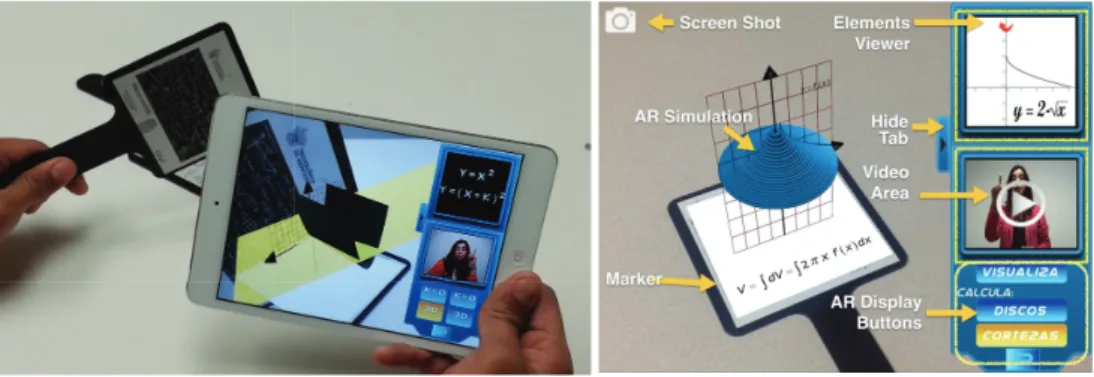
The AR simulation interface includes several elements. A short embedded video shows an explanation of the AR simulation. Above the video region, there is some mathematical information being considered during the interaction with the mathematical content, and below the video is the zone of the operable buttons to display the AR simulation. The hide tab stash all these elements expanding the visibility region. Figure 1 presents this organization.
Fig. 1. AR app interface and its elements.
The app design promotes learning of mathematics ideas, not only trying to show an AR object, but also emphasizing the visual process that takes place when constructing the object16. This purpose was reinforced at the three levels of the app. In particular, its use at the Calculus II level considers the action of interacting with the small paddle and the AR surface as an opportunity to reconstruct the process of generation of the surface, and at the same time to find different curves of intersection between the plain and the surface (see Figure 2). With this methodology it has been found out that AR is a big step in the transition from 2D line drawings to 3D projections17.
Because the purpose of the AR app is to develop the spatial visualization skill in students, much importance was given to the deliberate action to cut the surface in different ways. This is widely evoked in the Calculus III level, used to deconstruct the surface, cutting it, with parallel planes. Figure 3 shows this kind of interaction, representing reversible thought considered as a key element for the visualization process.
Fig. 3. A surface cut with parallel planes.
3.Pilot and learning experiences
In May 2013 a pilot study was conducted with engineering students from a Calculus I course. As stated in Salinas et al.15, the aim of this first experience was to describe the actions the prototype encourages from the students and to
capitalize these results to determine limitations and reaches of the prototype from a didactically and technically point of view. The analysis of the videos recorded, revealed the way in which the students worked with the didactic prototype in a very intuitive fashion.
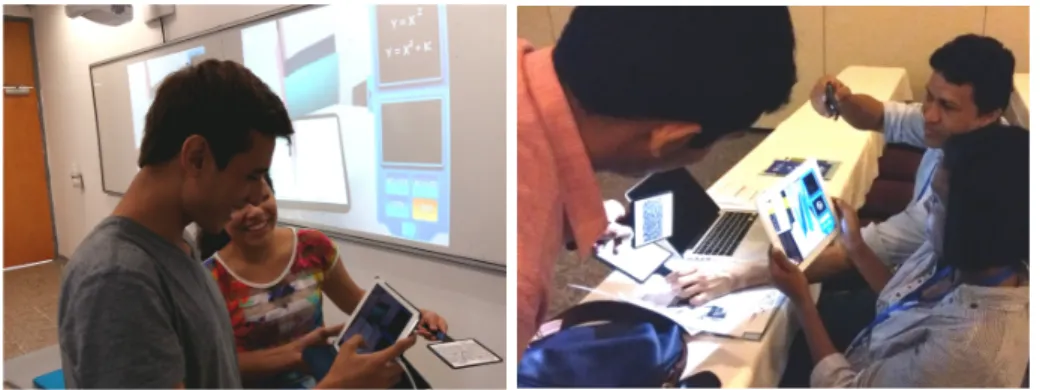
The little acrylic paddle (which contains a mark and shows a yellowish, 3D plane) was used to follow the process of generation of the solid synchronically; and also was used as a bladetocut the solid. Students observed different curves in space that gave information about the function itself. This reaction was intended, so students could cognitively generate a perception of the surface as a consequence of the intersection of the mark-generated plane and the 3D solid (see Figure 4a).
Fig. 4. (a) Students interacting with the AR app. (b) Teachers evaluating didactic possibilities.
Another recent experience that gave feedback about the instructional design of the app, took place at the workshop of educational innovations for teaching Calculus18. During this space of interaction between
Latin-American teachers, imparted by one of the authors of this work, was designed an activity in which participants generated in the RA app, surfaces and trim curves commonly found in natural and artificial environments. At the
end of the activity, participant teachers were interviewed about the potential of the application to support the development of spatial visualization in students (see Figure 4b).
4.Concluding remarks
During three years dedicated to the design, creation and pilot testing of the AR app, our team has sought explicitly to transform the teaching and learning of mathematics. In this matter, it has been promoted mathematical skills, rather than focusing only on learning a specific mathematical content. Now, the work in progress is related to the design of learning experiences into the classroom and the assessment of this didactical implementation. The team is committed to producing of a visual and tangible approach to certain themes that will foster the development of spatial visualization skill. Technology has come to transform the perception of what is possible in the teaching of mathematics, and consequently, the traditional approach of learning mathematics cannot remain unchanged. The question of the experience of efficient and effective learning, should be accompanied by the appropriate method that deepens in the kind of learning event that is taking place in the minds of the students.
References
1. Salkind N J. A cross-dimensional study of spatial visualization in young children. J. Genet. Psychol 1976;129:339–40.
2. Chen Y, Chi H. Use of tangible and augmented reality models in engineering graphics courses. Journal of Professional Issues in Engineering Education and Practice 2011;137:267–77.
3. Kaufmann H, Schmalstieg D. Mathematics and geometry education with collaborative augmented reality. Computers and Graphics
2003;27:339–45.
4. Park J, Carter G, Butler S, Slykhuis D, Reid-Griffin A. Re-dimensional thinking in earth science: From 3-d virtual reality panoramas to 2-d contour maps. Journal of Interactive Learning Research 2008;19:75-90.
5. Thornton T, Ernst J V, Clark A C. Augmented Reality as a visual and spatial learning tool in technology education. Technology and Engineering Teacher 2012:18–22.
6. Samsudin K, Rafi A, Hanif A S. Training in mental rotation and spatial visualization and its impact on orthographic drawing performance.
Educational Technology 2011.
7. Onyancha R M, Derov M, Kinsey B. Improvements in spatial ability as a result of targeted training and computer-aided design software use: Analyses of object geometries and rotation types. J. Eng. Educ 2009:157–67.
8. Mejías Borrero A, Andújar Márquez J. M. A pilot study of the effectiveness of Augmented Reality to enhance the use of remote labs in electrical engineering education. Journal of Science Education and Technology 2012;21:540–57.
9. Gutiérrez J M, Meneses Fernández M D. Applying Augmented Reality in engineering education to improve academic performance & student motivation. International Journal of Engineering Education 2014;30:625–35.
10.Johnson L, Smith R, Willis H, Levine A, Haywood K. The 2011 Horizon Report. Austin, Texas: The New Media Consortium 2011. Retrieved from: http://www.educause.edu/Resources/2011HorizonReport/223122
11.Wu H K, Lee S W Y, Chang H Y, Liang J C. Current status, opportunities and challenges of augmented reality in education. Computers & Education 2013;62:41–49.
12.Cheng K H, Tsai C C. Affordances of augmented reality in science learning: Suggestions for future research. Journal of Science Education and Technology 2012;22:449–62.
13.Bacca J, Baldiris S, Fabregat R, Graf S, Kinshuk. Augmented Reality trends in education: A systematic review of research and applications.
Educational Technology & Society 2014;17:133–149.
14.Bujak K R, Radu I, Catrambone R, MacIntyre B, Zheng R, Golubski G. A psychological perspective on Augmented Reality in the mathematics classroom. Computers & Education 2013;68: 536–44.
15.Salinas P, González-Mendívil E, Quintero E, Ríos H, Ramírez H, Morales S. The development of a didactic prototype for the learning of mathematics through augmented reality. Procedia Computer Science 2013;25:62–70.
16.Salinas P, Quintero E, Ramírez P, González-Mendívil E. Fostering spatial visualization through Augmented Reality in Calculus learning. In
122nd ASEE Anual Conference & Exposition. Seattle, Washington: ASEE Annual Conference and Exposition; 2015.
17.Meža S, Turk Ž, Dolenc M. Measuring the potential of augmented reality in civil engineering. Advances in Engineering Software 2015;90:1– 10.
18.13th LACCEI Annual International Conference on Engineering and Technologies. Santo Domingo, República Dominicana. Aula invertida, el uso de MOOCS y laboratorios remotos; 2015.