The Open University’s repository of research publications
and other research outputs
Learning and Teaching Languages in
Technology-Mediated Environments: Why Modes and
Meaning Making Matter
Thesis
How to cite:
Hauck, Mirjam (2019).
Learning and Teaching Languages in Technology-Mediated Environments: Why Modes
and Meaning Making Matter. PhD thesis The Open University.
For guidance on citations see FAQs.
c
2018 The Author
Version: Version of Record
Copyright and Moral Rights for the articles on this site are retained by the individual authors and/or other copyright
owners. For more information on Open Research Online’s data policy on reuse of materials please consult the policies
page.
https://docs.google.com/document/d/1jaLZ5qUIJx1FK3H1fYLsghw7wmi4SFYlzbotNE1Vqdk/edit#heading=h.30j0zll 1/341
Contents
Contents 1
Acknowledgements 6
Dedication 7
Figures and tables 8
Glossary 10
Acronyms 15
Abstract 16
Chapter 1 Introduction 20
Chapter 2 Theoretical backcloth 24
2.1 Metacognitive knowledge (MCK) and metacognitive strategies (MCSs) 24
2.2 Social semiotics 26
2.2.1 Multimodality 29
2.2.2 Multimodal competence 31
2.2.3 Technology mediation, modes and meaning-making 33
2.3 Learner autonomy 35
2.4 Task-based language learning and teaching (TBLT) 38 2.4.1 TBLT, multimodal communicative competence and multiliteracies 40 2.4.2 TBLT and semio-pedagogical competence 44
Chapter 3 Methodological approaches 45
3.1 Action research 45
3.2 Case studies 46
3.3 Exploratory practice 47
3.4 Ethnographic aspects 49
3.5 Data triangulation 50
3.6 Inductive and deductive approaches 51
Chapter 4 The publications 53
4.1 Contextual knowledge 55
1. Hauck, M. (2004). Exploring the link between metacognitive knowledge, efficient strategy use and learner autonomy in distance language learning. In U. Bernath & A. Szücs (Eds.), Supporting the learner in distance education and e-learning: Proceedings of the Third EDEN research workshop
(pp.183–190). Oldenburg: Universität Oldenburg. 56
1
https://docs.google.com/document/d/1jaLZ5qUIJx1FK3H1fYLsghw7wmi4SFYlzbotNE1Vqdk/edit#heading=h.30j0zll 2/341
2. Hampel, R., & Hauck, M. (2004). Towards an effective use of audio conferencing in distance language courses. Language Learning &
Technology , 8 (1), 66–82. 61
3. Hauck, M. (2005). Metacognitive knowledge, metacognitive strategies, and CALL. In J. L. Egbert & G. Petrie (Eds.), CALL Research Perspectives (pp.
65–86). New Jersey, USA: Lawrence Erlbaum. 67
4. Hauck, M., & Hurd, S. (2005). Exploring the link between language anxiety and learner self-management in open language learning contexts. European Journal of Open, Distance and e-Learning , 2005(2), n.p. 70
4.2 Multimodal competence 75
5. Hampel, R., & Hauck, M. (2006). Computer-mediated language learning: Making meaning in multimodal virtual learning spaces. JALT CALL Journal ,
2 (2), 3–18. 76
6. Hauck, M. (2007). Critical success factors in a TRIDEM
exchange. ReCALL, 19 (2), 202–223. 82
7. Hauck, M., & Youngs, B. L. (2008). Telecollaboration in multimodal environments: the impact on task design and learner interaction. Computer
Assisted Language Learning , 21 (2), 87–124. 91
8. Hauck, M., & Hampel, R. (2008). Strategies for online environments. In S. Hurd & T. Lewis (Eds.), Language Learning Strategies in Independent
Settings (pp. 283–302). Clevedon, UK: Multilingual Matters. 97
4.3 Multiliteracies 102
9. Hauck, M. (2010a). Telecollaboration: At the interface between Multimodal and Intercultural Communicative Competence. In S. Guth & F. Helm (Eds.),
Telecollaboration 2.0: Language, Literacies and Intercultural Learning in the
21st Century (pp. 219–244). Bern: Peter Lang. 104
10. Hauck, M. (2010b). The enactments of task design in Telecollaboration 2.0. In: M. Thomas & H. Reinders (Eds.), Task-based language learning and teaching with technology (pp. 197–217). London: Continuum. 108 11. Fuchs, C., Hauck, M., & Müller-Hartmann, A. (2012). Promoting learner autonomy through multiliteracy skills development in cross-institutional
exchanges. Language Learning & Technology , 16 (3), 82–102. 112
4.4 Digital literacies 122
12. Kurek, M., & Hauck, M. (2014). Closing the “digital divide” – a framework for multiliteracy training. In: J. Pettes Guikema & L. Williams (Eds.), Digital Literacies in Foreign and Second Language Education: Research,
perspectives, and best practice (pp. 119–140). CALICO Monograph Series
(12). San Marcos, TX: CALICO. 123
13. Hauck, M., & Kurek, M. (2017). Digital Literacies in Teacher Preparation. In S. Thorne & S. May (Eds.), Language, Education and Technology. Encyclopedia of Language and Education, Third Revised Edition (pp. 1–13).
Heidelberg: Springer. 129
4.5 Participatory literacy and social presence 135 14. Hauck, M., & Warnecke, S. (2012). Materials design in CALL: social presence in online environments. In: M. Thomas, H. Reinders, H. & M.
2
https://docs.google.com/document/d/1jaLZ5qUIJx1FK3H1fYLsghw7wmi4SFYlzbotNE1Vqdk/edit#heading=h.30j0zll 3/341
Warschauer (Eds.), Contemporary Computer-Assisted Language Learning
(pp. 95–115). London: Bloomsbury. 137
15. Hauck, M., Galley, R., & Warnecke, S. (2016). Researching participatory literacy and positioning in online learning communities. In: F. Farr & L. Murray (Eds.), The Routledge Handbook of Language Learning and Technology. Routledge Handbooks in Applied Linguistics (pp. 71–87). London: Routledge. 145
16. Hauck, M., & Satar, H. M. (2018). Learning and teaching languages in technology-mediated contexts: The relevance of social presence,
co-presence, participatory literacy and multimodal competence. In R. Kern & D. Develotte (Eds.), Screens and scenes: Online multimodal communication and intercultural encounters (pp. 133-157). London: Routledge. 148
Chapter 5 Concluding remarks and further research interests 156 Chapter 6 Reception of the publications 163
6.1 Impact in numerical terms 163
6.2. Impact in terms of beneficiaries, contributions to professional organisations,
projects and policy making 167
6.2.1 Beneficiaries 167
6.2.2 Professional organisations and funded projects 174
6.2.3 Policy making 179
6.3 Citations 181
1. Hauck, M. (2004). Exploring the link between metacognitive knowledge, efficient strategy use and learner autonomy in distance language learning. In U. Bernath & A. Szücs (Eds.), Supporting the learner in distance education and e-learning: Proceedings of the Third EDEN research workshop
(pp.183-190). Oldenburg: Universität Oldenburg. 181 2. Hampel, R., & Hauck, M. (2004) Towards and effective use of audio
conferencing in distance language education. Language Learning &
Technology , 8 (1), 66–82. 182
3. Hauck, M. (2005). Metacognitive knowledge, metacognitive strategies, and CALL. In J. L. Egbert & G. Petrie (Eds.), CALL Research Perspectives (pp. 65–86). New Jersey, USA: Lawrence Erlbaum. 188 4. Hauck, M., & Hurd, S. (2005). Exploring the link between language anxiety and learner self-management in open language learning contexts. European Journal of Open, Distance and E-Learning , 8 (2), n.p. 194 5. Hampel, R., & Hauck, M. (2006). Computer-Mediated Language Learning: Making Meaning in Multimodal Virtual Learning Spaces. The JALT CALL
Journal , 2 (2), 3–18. 200
6. Hauck, M. (2007). Critical Success Factors in a TRIDEM Exchange.
ReCALL , 19 (2), 202–223. 205
7. Hauck, M., & Youngs, B. (2008). Telecollaboration in multimodal environments: The impact on Task Design and Learner Interactions.
Computer Assisted Language Learning , 21 (2), 87–124. 211
3
https://docs.google.com/document/d/1jaLZ5qUIJx1FK3H1fYLsghw7wmi4SFYlzbotNE1Vqdk/edit#heading=h.30j0zll 4/341
8. Hauck, M., & Hampel, R. (2008). Strategies for Online Environments. In S. Hurd & T. Lewis (Eds.), Language Learning Strategies in Independent
Settings (pp. 283–302). Bristol: Multilingual Matters. 215 9. Hauck, M. (2010a). Telecollaboration: At the interface between Multimodal and Intercultural Communicative Competence. In S. Guth & F. Helm (Eds.),
Telecollaboration 2.0: Language, Literacies and Intercultural Learning in the
21st Century (pp. 219–244). Bern: Peter Lang. 217
10. Hauck, M. (2010b). The enactment of task design in Telecollaboration 2.0. In M. Thomas & H. Reinders (Eds.), Task-based language learning and teaching with technology (pp. 197–217). London: Continuum. 222 11. Fuchs, C., Hauck, M., & Müller-Hartmann, A. (2012). Promoting learner autonomy through multiliteracy skills development in cross-institutional
exchanges. Language Learning & Technology , 16 (3), 82–102. 224 12. Kurek, M., & Hauck, M. (2014). Closing the “digital divide” – a framework for multiliteracy training. In J. Pettes Guikema & L. Williams (Eds.), Digital Literacies in Foreign and Second Language Education: Research,
perspectives, and best practice (pp. 119–140). CALICO Monograph Series
(12). San Marcos, TX: CALICO. 230
13. Hauck, M., & Kurek, M. (2017). Digital Literacies in Teacher Preparation. In: S. Thorne & S. May (Eds.), Language, Education and Technology. Encyclopedia of Language and Education, Third Revised Edition (pp. 1–13).
Heidelberg: Springer. 233
14. Hauck, M. & Warnecke, S. (2012). Materials design in CALL: social presence in online environments. In: M. Thomas, H. Reinders, H. & M. Warschauer (Eds.), Contemporary Computer-Assisted Language Learning
(pp. 95–115). London: Bloomsbury. 233
15. Hauck, M., Galley, R. & Warnecke, S. (2016). Researching participatory literacy and positioning in online learning communities. In F. Farr & L. Murray (Eds.), The Routledge Handbook of Language Learning and Technology. Routledge Handbooks in Applied Linguistics (pp. 71–87). London: Routledge. 236
16. Hauck, M., & Satar, M. (2018). Learning and teaching languages in technology-mediated contexts: The relevance of social presence,
co-presence, participatory literacy and multimodal competence. In R. Kern & C. Develotte (Eds.), Online Multimodal Communication and Intercultural Encounters: Theoretical and Educational Perspectives (pp. 133–157).
London: Routledge. 237
6.4 Impact factors of the journals where my work has been published 238
7. References 240
8. Appendices 267
Appendix 1: Citations of my work (fuller versions) 267 Appendix 2: References from Professor Jozef Colpaert, Professor Robert Blake, Professor Andreas Müller-Hartmann and Professor Nicolas Guichon 333 Appendix 3: References from Hélène Pulker and Dr. Sylvia Warnecke 336 4
https://docs.google.com/document/d/1jaLZ5qUIJx1FK3H1fYLsghw7wmi4SFYlzbotNE1Vqdk/edit#heading=h.30j0zll 5/341
Appendix 4: Reference from Jon Rubin 338
Appendix 5: References from Dr. Carolin Fuchs, Dr. Shannon Sauro, and Ton
Koenraad 339
5
https://docs.google.com/document/d/1jaLZ5qUIJx1FK3H1fYLsghw7wmi4SFYlzbotNE1Vqdk/edit#heading=h.30j0zll 6/341
Acknowledgements
I am very grateful to my colleagues Stella Hurd and Marie-Noëlle Lamy. Stella who kick-started the journey with me and Marie-Noëlle who graciously agreed to be my mentor during the last eight months until submission. I thank Marie-Noёlle for her support and detailed attention to the arguments and evidence presented in my thesis. I thank Julia Clarke for giving me feedback at the halfway point of writing, Sullivan Navet for patiently combing through citations of my work in Google Scholar and Mike Britton for his editorial scrutiny of the finished thesis.
The work derives from my professional journey at the Open University starting with my appointment in 1996 all the way through to 2018, the last 15 years in particular. I have found great inspiration both at the OU and through my work as a member of research consortia and at higher education institutions in Europe and North America. Therefore I also owe a great debt of thanks to my colleagues from outside the OU with whom I have co-authored some of the publications which form part of this thesis. My individual research, as much as our joint projects, have undoubtedly formed a great part of my professional identity. All of my co-authors have become close friends and I enjoy being part of such a vibrant community of committed and visionary scholars.
6
https://docs.google.com/document/d/1jaLZ5qUIJx1FK3H1fYLsghw7wmi4SFYlzbotNE1Vqdk/edit#heading=h.30j0zll 7/341
Dedication
To Tarkan
Perseverance is not a long race;
it is many short races one after the other.
Walter Elliot
This is the story of 16 races.
7
https://docs.google.com/document/d/1jaLZ5qUIJx1FK3H1fYLsghw7wmi4SFYlzbotNE1Vqdk/edit#heading=h.30j0zll 8/341
Figures and tables
Figure 1: New Media Literacies (Hauck, 2010a) 43
Figure 2: Visual representation of the publications and the threads that link them
together 54
Figure 3: Project Task 1, Part 3 (Hauck, 2010a) 106
Figure 4: Amended version of Project Task 1, Part 3 (Hauck, 2010b) 114
Figure 5: Participants 2008 exchange 115
Figure 6: Participants 2009 exchange 115
Figure 7: Learner autonomy through multimodal literacy development 120
Figure 8: Trends in Literacy Developments (Kurek & Hauck, 2014) 125
Figure 9: Training components (Hauck & Kurek, 2014) 127
Figure 10: Participatory Literacy Development (Hauck & Satar, 2018) 136
Figure 11: Patterns of Participation (Hauck & Warnecke, 2012) 141
Figure 12: Community Indicators Framework (Galley et al., 2011) 144
Figure 13: Revised CIF (Hauck et al., 2016) 147
Figure 14: Copy of Aylin’s poster (Hauck & Satar, 2018) 153
Figure 15: Google Scholar Profile - Hauck, August 2018 163
8
https://docs.google.com/document/d/1jaLZ5qUIJx1FK3H1fYLsghw7wmi4SFYlzbotNE1Vqdk/edit#heading=h.30j0zll 9/341
Figure 16: Calculation of h-index (Spicer, 2015) 164
Figure 17: Methodological use of tools (EVALUATE) 178
Table 1: Tools in Lyceum and their affordances (Hampel et al., 2005) 83 Table 2: Data collection instruments used in the 2008 and 2009 telecollaborative
exchanges 116
Table 3: LAA impact summary 172
Table 4: Impact factors of journals where some of my work has been published 238 Table 5: Related Journals’ impact factor in comparison 239
9
https://docs.google.com/document/d/1jaLZ5qUIJx1FK3H1fYLsghw7wmi4SFYlzbotNE1Vqdk/edit#heading=h.30j0zll 10/341
Glossary
The following terms appear throughout the publications selected for this thesis. In some cases, the explanations offered are taken from the definitional debate around a term highlighting the aspect that is important to my work. As a result, the glossary applies primarily within the context of my work. A representative example to this effect is the definition of “autonomy”.
Affordances An affordance is a particular property of an environment that allows for action. In language learning, the environments that learners access and in which and with which they engage is “full of demands and requirements, opportunities and limitations, rejections and invitations, enablements and constraints – in short, affordances (Shotter & Newson, 1982, p.34)” (van Lier, 2000).
The term was originally coined by Gibson (1979), who defined an “affordance” as the quality of an object or an environment that allows an individual to perform an action. Affordances, then, are "action possibilities" latent in the environment. While they exist independently of the individual's ability to recognise them, their manifestations are highly dependent on the individual’s capabilities. It is this dependency that underpins my work.
Agency The individual’s socioculturally mediated capacity to act (Ahearn, 2001, p. 112), often seen as dynamic, emerging and shaped in and by interaction with others (e.g. van Lier, 2008). A number of scholars (Ahearn, 2001; Lantolf & Thorne,
10
https://docs.google.com/document/d/1jaLZ5qUIJx1FK3H1fYLsghw7wmi4SFYlzbotNE1Vqdk/edit#heading=h.30j0zll 11/341
2006; van Lier 2008; Wertsch, Tulviste & Hagstrom, 1993) describe agency as being mediated by social, interactional, cultural, institutional and other contextual factors.
Autonomy The informed use of a range of interacting resources in context (Palfreyman, 2006).
Contextual knowledge Awareness and knowledge of the learning context as reflected in awareness of the modes available in a bespoke VLE for meaning-making and communication and their affordances (Hauck, 2005).
Digital literacies The various ways of making meaning and the skills required in digital communication (Lankshear & Nobel, 2008).
Intercultural communicative competence Attitudes (for example, curiosity and openness), knowledge (of social groups and their products and
practices in one’s own and in one’s interlocutor’s country) and skills (for example, interpreting and relating), in addition to linguistic, sociolinguistic and discourse competence (Byram, 1997).
Learner self-management The definitive metacognitive strategy comprising both knowledge of cognition and control of cognition (White, 1995).
Metacognitive knowledge The part of long-term memory that contains what learners know about learning (Wenden, 2001).
Metacognitive strategies The general skills through which learners manage, direct, regulate, guide their learning (Wenden, 1998).
11
https://docs.google.com/document/d/1jaLZ5qUIJx1FK3H1fYLsghw7wmi4SFYlzbotNE1Vqdk/edit#heading=h.30j0zll 12/341
Modality In the context of CALL, the conjunction of the following semiotic resources makes up modality: (a) material tools (b) modes, such as written
language, spoken language, or visual language and (c) language learning objectives materialized through educational designs (Lamy, 2012).
Modes Culturally intelligible systems which are basic to meaning-making including language (written, spoken), the visual (figurative and non-figurative or coded, such as icons), sound (figurative and non-figurative such as music, or coded such as signals), and body-language (Lamy, 2012).
Multiliteracies A concept first coined by the New London Group (1996) which refers to a broadened understanding of literacy including electronic forms of multimedia, images and texts.
Multimodality The simultaneous use of several semiotic modes in the design of a semiotic product or event, together with the particular way in which these modes are combined (Kress & van Leeuwen, 2001).
Multimodal competence The ability to express ideas across a wide range of representational systems or modes including: words, spoken or written; images, still and moving; musical and 3D models (Kress, 2003).
Multimodal communicative competence In language learning, the ability to understand the combined potential of various modes for making meaning (Royce, 2002), that is the ability to process intersemiotic relationships and also the ability to produce these kinds of relationships (Royce, 2007).
12
https://docs.google.com/document/d/1jaLZ5qUIJx1FK3H1fYLsghw7wmi4SFYlzbotNE1Vqdk/edit#heading=h.30j0zll 13/341
Participatory cultures Encompass membership in formal and informal online communities, such as those found in social networking spaces like Facebook and among the communities that grow up around message boards, production of creative forms such as mash-ups, formal and informal teamwork of the sort that occurs in wiki spaces, and online distributions such as podcasting and blogging (Jenkins, Clinton, Purushotma, Robison & Weigel, 2006).
Participatory literacy The ability to create and share knowledge and content collectively through the use of online tools and the completion of collaborative tasks in online environments (Giger, 2006).
Social presence The means by which online participants inhabit virtual spaces and indicate not only their presence in the online environment but also their availability and willingness to engage in the communicative exchanges which constitute learning activity in these environments (Kehrwald, 2008).
Social semiotics A form of enquiry that focuses on how people regulate the use of semiotic resources in the context of specific social practices and institutions, and in different ways and to different degrees (van Leeuwen, 2005). Social semiotics seeks to understand how people communicate by a variety of means in particular social settings and to identify and inventorise the semiotic options that are available to them, and that they choose to make (Mavers, 2018).
Telecollaboration The use of online communication tools to bring together language learners in different countries for the development of collaborative project work and intercultural exchange (O’Dowd & Ritter, 2006).
13
https://docs.google.com/document/d/1jaLZ5qUIJx1FK3H1fYLsghw7wmi4SFYlzbotNE1Vqdk/edit#heading=h.30j0zll 14/341
Telecollaboration 2.0 A concept that integrates the traditional theories and
practices of telecollaboration with the new tools and opportunities offered by Web 2.0 (Guth & Helm, 2010).
14
https://docs.google.com/document/d/1jaLZ5qUIJx1FK3H1fYLsghw7wmi4SFYlzbotNE1Vqdk/edit#heading=h.30j0zll 15/341
Acronyms
ALs Associate Lecturers (at The Open University UK)
CALL Computer-assisted language learning
CMC Computer-mediated communication
CMU Carnegie Mellon University
DLL Distance language learning
KMI Knowledge Media Institute (at The Open University, UK)
LSM Learner self-management
NMC New Media Consortium
MCK Metacognitive knowledge
MCS Metacognitive strategy
OIE Online intercultural exchange
TBLT Task-based language teaching
VE Virtual exchange
VLE Virtual learning environment
15
https://docs.google.com/document/d/1jaLZ5qUIJx1FK3H1fYLsghw7wmi4SFYlzbotNE1Vqdk/edit#heading=h.30j0zll 16/341
Abstract
The developing argument presented in this thesis is based on seven articles, eight book chapters and one set of conference proceedings, some single-authored and some co-authored, on language learning and teaching in technology-mediated environments, published between 2004 and 2018. The publications chart my evolution as a researcher and practitioner at the Open University UK. There are several threads which weave themselves through my scholarly journey and which are reflected in the selected work:
•Thread 1: multimodal competence and language learning and teaching with technology
•Thread 2: task-based approaches to language learning and teaching with technology
•Thread 3: teacher (and learner) preparation for language learning and teaching with technology
•Thread 4: learner (and teacher) autonomy in language learning and teaching with technology.
The narrative cloth in the presentation of the publications draws these threads together and illustrates how they interconnect across my work. They are linked by my concern for online language learners’ awareness of the opportunities and demands of the learning environment and the impact that such awareness, or lack thereof, has on the learning process.
16
https://docs.google.com/document/d/1jaLZ5qUIJx1FK3H1fYLsghw7wmi4SFYlzbotNE1Vqdk/edit#heading=h.30j0zll 17/341
The empirical studies presented and discussed in my work use mostly qualitative research instruments. They take forward the knowledge in the field by offering original insights into the interrelationship between language learner awareness and
control over the learning context understood as awareness of online modes and their potential for meaning-making, communication, interaction and collaboration. This interrelationship is not only relevant for language learning in virtual environments per se, it also has repercussions on online learners’ development of intercultural
communicative competence, their digital participatory competence and social presence online, and on their autonomy.
Underpinning my work is a view shared by a growing number of researchers and practitioners in online learning and teaching of languages and cultures that a radical pedagogical shift is required: it is not sufficient to see the new technology-infused learning spaces as replicates of conventional face-to-face settings. Such a shift has to be informed by new learning theories which capture the dynamic nature of the enterprise in the wake of unabating technological advancements (e.g. Guichon, 2009; Hampel & Stickler, 2005; Hubbard & Levy, 2006; Hubbard, 2009; Kern, 2015; Sun, 2011). Moreover, I argue, it will need to include the systematic raising of learner awareness of learning context.
The presentation of the selected articles, book chapters and conference proceedings in Chapter 4 is divided into five parts in line with the thematic foci of the publications: (1) contextual knowledge, (2) multimodal competence (3) multiliteracies (4) digital literacies (5) participatory literacy and social presence.
17
https://docs.google.com/document/d/1jaLZ5qUIJx1FK3H1fYLsghw7wmi4SFYlzbotNE1Vqdk/edit#heading=h.30j0zll 18/341
The publications in Chapter 4, section 4.1 – Hauck (2004), Hampel and Hauck (2004), Hauck (2005), and Hauck and Hurd (2005) – focus on the concept of
contextual knowledge and are informed by two studies: one carried out with students when the former Department of Languages (DoL) at the Open University offered learners a choice between face-to-face and online tutorials via an audiographic conferencing application (Lyceum); the other one carried out with OU tutors, most of whom were at the time unfamiliar with using Internet-based conferencing for
language learning and teaching purposes.
The work presented in section 4.2 – Hampel and Hauck (2006), Hauck (2007), Hauck and Youngs (2008) and Hauck and Hampel (2008) – concentrates on
multimodal competence as well as the interface between multimodal communicative competence and intercultural communicative competence online. While Hampel and Hauck (2006) is a theoretical contribution, the other three publications are based on a telecollaborative exchange linking participants from three different parts of the world (the Tridem project). The former helped frame the empirical study at the center of the two articles and the chapter that followed.
The publications in section 4.3 – Hauck (2010a) and Hauck (2010b), and Fuchs, Hauck and Müller-Hartmann (2012) – explore multiliteracies with multimodal
competence understood as a core element of multiliteracies. They draw on data from a four-way telecollaborative exchange between teacher trainees and language learners in order to illustrate why telecollaboration provides the ideal set-up for fostering such competence development and therefore also online learner and teacher autonomy.
18
https://docs.google.com/document/d/1jaLZ5qUIJx1FK3H1fYLsghw7wmi4SFYlzbotNE1Vqdk/edit#heading=h.30j0zll 19/341
This leads to an examination of digital literacies in Kurek and Hauck (2014) and Hauck and Kurek (2017) in section 4.4. Both chapters are, again, theoretical
contributions to the field of technology-mediated language learning and teaching. We conceptualise digital proficiency as mastery of modes and meaning-making – in other words multimodal competence – and as a precondition for autonomy. In Kurek and Hauck (2014) we present a task framework for instructed learner reflection to this effect, ideally in telecollaborative settings.
Finally, in section 4.5 – Hauck and Warnecke (2012), Hauck, Galley and Warnecke (2016), also a theoretical contribution, and Hauck and Satar (2018) – my co-authors and I explore a subset of digital literacies, namely participatory literacy as reflected in multimodal competence, and its relevance for social presence in online language learning and teaching contexts.
An example of how these themes interlink with the aforementioned threads is the task-based approach to multimodal competence development (Threads 1 and 2) in telecollaborative settings which is advocated in all three publications in section 4.3.
Together, the publications make a substantial contribution to the field of language learning and teaching in technology-mediated environments, through the centrality they grant to the learning context, and increasingly also to multimodality (Kress & van Leeuwen, 2001; Kress, 2009) as an overarching approach to conceptualising context-related challenges for both students and teachers.
19
https://docs.google.com/document/d/1jaLZ5qUIJx1FK3H1fYLsghw7wmi4SFYlzbotNE1Vqdk/edit#heading=h.30j0zll 20/341
Chapter 1 Introduction
This thesis draws on publications spanning 15 years of my journey as a practitioner and researcher of distance language learning (DLL) and teaching in online
environments. My scholarly work began with the trials and then the introduction of audio-graphic conferencing for the delivery of language tutorials in the former Centre for Modern Languages at The Open University (OU). In 2001/2002, the team of academics I led at the time received an OU Teaching Award for “integrating Internet-based real-time audiographic conferencing tools into distance language-learning”, thus recognising the innovative character of our work.
I was from early on intrigued by issues related to what White (1999) had termed the “learner-context interface” in online DLL. White sees “the contribution of the learning context and the contribution of the learner as integral and reciprocal constructs” in DLL theory (White, 2005, p. 63). She conceptualises the interface as “the place at which and the means whereby learner and context meet and affect each other” (p. 66).
However, I was less concerned, at least initially, with the instructional context White refers to, i.e. course materials, tutor feedback and guidance. I was more interested in the materiality of the learning context, more specifically the online space where the learning and teaching of languages and cultures was supposed to take place: the tools and applications used, the various communication channels (written, aural, visual) at the learners’ disposal and their impact on the learning and teaching process, learner agency in particular, and the available modes and their affordances,
20
https://docs.google.com/document/d/1jaLZ5qUIJx1FK3H1fYLsghw7wmi4SFYlzbotNE1Vqdk/edit#heading=h.30j0zll 21/341
with their potential and constraints for making meaning and communicating (for a comprehensive definition of affordances see section 2.2.3).
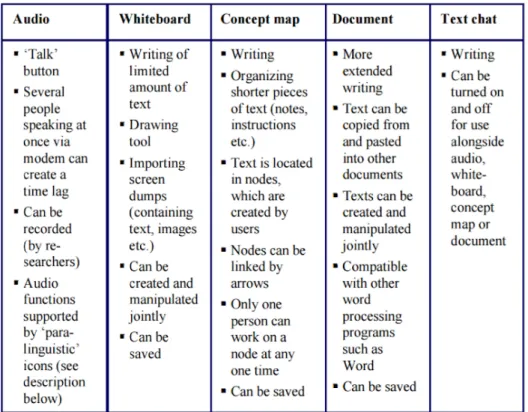
Lyceum, the audio-graphic conferencing application developed in house by the Open University’s Knowledge Media Institute (KMI), offered a synchronous audio channel, an on-screen whiteboard for writing and drawing and displaying visual input such as photos, charts and graphs, and a text chat window – all of which could be used either one at a time, or simultaneously, in any combination. I realised that the difficulties faced by some learners (and tutors) while using this virtual learning environment (VLE), and their reactions to it, were of a more complex nature than was captured by the term “technophobia”, that is, the fear or dislike of advanced technology or complex devices such as (at the time) desktop computers.
It also became clear to me that “multimodal” VLEs such as Lyceum made new demands on learners and tutors. While learning and practising a language online does undoubtedly require a certain degree of technical expertise, there are also challenges associated with the meaning-making and communication process itself . Kress’s work has significantly influenced my research in this regard. “Modes,” as he has reminded us yet again recently, “have a large effect in shaping what the
sign-maker (as learner or otherwise) can do and does. Modes set limits to the sign-maker’s agency” (Bezemer & Kress, 2016).
For some students, learning a language in online contexts might constitute a
challenge for reasons other than those they seem to be aware of, or believe they are aware of. They might, however, be unaware of the fact that virtual spaces are not replicates of face-to-face settings and require very different approaches to language
21
https://docs.google.com/document/d/1jaLZ5qUIJx1FK3H1fYLsghw7wmi4SFYlzbotNE1Vqdk/edit#heading=h.30j0zll 22/341
learning and teaching. Therefore, learner anxieties around the foreign language might actually be related to the way in which communication has to be carried out in VLEs, or, as Kress and van Leeuwen (2001) put it, the communicative potential provided by each available tool.
Thus, apart from their knowledge about language learning in cognitive terms, learners usually approach their studies with their own beliefs, assumptions and expectations regarding themselves as learners, the learning process, and importantly, the learning context in the sense I have described above.
As my work progressed, the themes listed earlier began to emerge: contextual knowledge, multimodal competence and their link with learner autonomy; the relationship between multimodal communicative competence and intercultural communicative competence; between multimodal competence and multiliteracies, digital literacies in particular; and finally, between multimodal competence,
participatory literacy and social presence – all with regard to language learning and teaching in VLEs.
As I will show, most of these constructs are interrelated in a number of ways and the links between them are neither linear nor unidirectional. They are dynamic and ever-evolving, just like the online learning contexts in which they have been explored.
The 16 co- and single-authored publications I have selected trace the evolution of my ideas as a researcher and practitioner in technology-mediated learning and teaching of languages and cultures. The outputs, which embrace a range of double-blind peer-reviewed international journal articles and invited chapters in refereed edited
22
https://docs.google.com/document/d/1jaLZ5qUIJx1FK3H1fYLsghw7wmi4SFYlzbotNE1Vqdk/edit#heading=h.30j0zll 23/341
volumes, are shaped by both hands-on experience and reflective observations which in some cases have led to contributions of a more conceptual nature (Hauck 2005, Hampel & Hauck, 2006; Kurek & Hauck, 2014, Hauck, Galley & Warnecke, 2016, Hauck & Kurek, 2017). I also refer to other work I have published, both on my own and with colleagues, which does not form part of the thesis.
My arguments and hypotheses have developed in tune with my professional path as an OU academic, research partner and co-investigator in EU-funded and other international projects. Together they constitute a set of threads weaving itself through my publications, which I have used to guide the reader through the presentation of my work in Chapter 4. In Chapters 2 and 3, I introduce the theoretical backcloth and the methodological approaches of the studies at the centre of the chosen
publications. Chapter 5 offers a brief look at my most recent work foregrounding the need for critical digital literacy education in online language learning and teaching contexts. The final chapter, Chapter 6, is concerned with the reception of the publications presented in Chapter 4: their impact in numerical terms as well as in terms of beneficiaries, projects, contributions to professional organisations and policy making.
23
https://docs.google.com/document/d/1jaLZ5qUIJx1FK3H1fYLsghw7wmi4SFYlzbotNE1Vqdk/edit#heading=h.30j0zll 24/341
Chapter 2 Theoretical backcloth
The studies which underpin my work are informed by learning theories grounded in second language acquisition (SLA) – metacognitive knowledge (MCK),
metacognitive strategies (MCSs) and task-based language learning and teaching (TBLT) – learner autonomy and, most importantly, social semiotics. What follows is a brief introduction to each of these theories. The order in which they are presented does not reflect their relevance for my developing academic argument. Instead, the narrative tries to create a logical connection among the constructs which are at the centre of each theory.
2.1 Metacognitive knowledge (MCK) and
metacognitive strategies (MCSs)
My considerations of MCK and MCSs, especially Learners Self-Management (LSM), draw on the work of Wenden (1991, 1998, 2001), White (1995, 1999, 2003) and Rubin (2001). Wenden (2001) defines MCK as “the part of long term memory that contains what learners know about learning” (p. 45). She distinguishes between
● person knowledge (the influence of cognitive and affective factors, such as age, language aptitude, personality, and motivation, on learning in general and one's own learning experience in particular),
● task knowledge (the purpose and the demands of a task), and ● strategic knowledge (the nature, adeptness, and effectiveness of
strategies),
24
https://docs.google.com/document/d/1jaLZ5qUIJx1FK3H1fYLsghw7wmi4SFYlzbotNE1Vqdk/edit#heading=h.30j0zll 25/341
depending on whether the learner, the learning task, or the process of learning is at the centre of attention. Wenden (1998) describes MCSs as the "general skills through which learners manage, direct, regulate, guide their learning" (p. 519). These include planning, monitoring, and evaluating, both language use and language learning – key elements in developing autonomy (Harris, 2003; Holec, 1981; Little, 2001).
I focus on the role of learning context , which according to Rubin’s (2001)
conceptualisation of MCK is part of a learner’s background (or prior) knowledge. Besides “contextual knowledge”, that is “knowledge about the physical setting and situations” (Rubin, 2001, p. 32), background knowledge also comprises of world knowledge, textual knowledge, cultural knowledge and linguistic knowledge.
In Hauck (2005) I propose to consider the role of contextual knowledge in language learning and teaching in VLEs. Several years of experience with audio and
audio-graphic conferencing in self-directed language learning at the OU had shown that “a high level of person and contextual knowledge and the degree to which learners have control over it at various stages of the learning process are pivotal to effective learning in such environments” (p. 70) (see also Hampel & Hauck, 2004; Hampel & Hauck, 2005; Shield, Hauck & Hewer, 2001; Shield, Hauck & Kötter, 2000). Thus I see knowledge of the learning context and control over it as defining elements of online language learners’ MCK and MCS.
Learning context has increasingly been acknowledged as a key factor influencing other factors in language learning. Gardner’s socio-educational model of SLA “explicitly proposes reciprocal causation” between individual differences, contexts
25
https://docs.google.com/document/d/1jaLZ5qUIJx1FK3H1fYLsghw7wmi4SFYlzbotNE1Vqdk/edit#heading=h.30j0zll 26/341
and outcomes, with particular emphasis given to the “very dominant role played by the social context” (Gardner & MacIntyre, 1993, p. 2–8). Other studies stress the importance of learning context in influencing learner beliefs and attitudes (e.g. Hurd, 2008). Yet, as I was able to show through the studies and theoretical contributions presented in Chapter 4, in VLEs such reciprocal causation and contextual influence is not limited to the dichotomy between formal and informal settings (Gardner & MacIntyre, 1993). In fact, it stretches across both, and has a far wider reach than learner attitudes and beliefs. It extends to learners’ awareness of modes and meaning-making and thus their multimodal competence (Kress, 2003).
With regard to DLL, White (1999, p. 449) sees “the relationship between the learner and the context as the critical aspect of self-instruction” with “each exerting an influence on the other”. While I agree with her assertion, I set out to show in my work that this applies not only to the instructional context as such (course materials, tutor feedback and guidance), but also to the context in a concrete sense, i.e. its
materiality. In online environments, the context is made up of the modes available and their affordances, that is, their specific potentials and limitations for
representation and making meaning (Hampel & Hauck, 2006; see also section 2.2.3). This points to the importance of social semiotics for my investigations.
2.2 Social semiotics
Social semiotics is, as van Leeuwen (2005) stresses, neither “pure” theory, nor a self-contained field (p. 2). It is a form of enquiry that focuses on how people regulate the use of semiotic resources in the context of specific social practices and
institutions, and in different ways and to different degrees (van Leeuwen, 2005, p. xi).
26
https://docs.google.com/document/d/1jaLZ5qUIJx1FK3H1fYLsghw7wmi4SFYlzbotNE1Vqdk/edit#heading=h.30j0zll 27/341
One such practice, I propose, includes learning and teaching languages and cultures in VLEs.
Social semiotics originate in Halliday’s Systemic Functional Linguistics and the notion that language and its functions (ideational, interpersonal, and textual) are a resource for meaning-making, which can be used for understanding linguistic texts (Halliday & Matthiessen, 2004). However, it marks a shift from the emphasis on language to other semiotic systems. Central to social semiotics is the principle that modes of communication offer historically specific and socially and culturally shared options, that is, semiotic resources, for meaning-making and communication. In other words, social semiotics develops the idea of meaning-making in social contexts through a variety of systems of representation of which language is one (Scollon & Scollon, 2003; Kress & van Leeuwen, 2001), or as Kress and van Leeuwen (2001) put it, meaning is made “in multiple articulations”, i.e. “in any and every sign, at every level, and in any mode” (p. 4).
I draw on social semiotics to explain the relevance of semiotic resources and modes and the many ways in which meaning can be made and communicated in virtual language learning and teaching environments conceptualised as multimodal
environments. For me, as for Scollon & Scollon (2003), meaning systems are located in the material world and from this perspective each online environment has its bespoke materiality and comes with its own rules of engagement and sociocultural practices. The communicative potential of the various interacting modes, which is a defining element of the materiality of the medium, is likely to have an impact on the language learning and teaching process. Therefore, I concur with Hampel in Hampel and Hauck (2006) and with reference to Kress (2003), that it is “vital to understand
27
https://docs.google.com/document/d/1jaLZ5qUIJx1FK3H1fYLsghw7wmi4SFYlzbotNE1Vqdk/edit#heading=h.30j0zll 28/341
the meaning making-potentials of the resources as precisely and as explicitly as we can” (p. 24) and so “attend to the materiality of the resources, the material stuff that we use for meaning making” (p. 32). In computer-mediated communication
(CMC)-based teaching and learning, as Hampel and Hauck (2006) point out, the “material stuff” is the computer, or – as would be more appropriate today – electronic and mostly mobile devices with their new possibilities for representation and
communication, including the ways in which modes can be combined and the way they function.
With reference to Lamy (2012), Chanier and Lamy (2017) explain it as follows: “In computer - mediated interactive language learning […] learning is affected by the resources that are available to learners and their use,” and conclude that “the design of learning activities […] needs to take into account the materiality of the modes available to learners and how they are used to create meaning multimodally” (p. 29). Hence, the relevance of multimodality to my work (see section 2.2.1).
Informed by social semiotics, we argue in Hampel & Hauck (2006) that the
materiality of resources and the affordances of the modes will have significant impact on interaction and communication. They also have implications for task design. The latter needs to take into consideration the affordances of the medium used: the potential and limitations of the semiotic resources available for meaning-making and communication (see also section 2.2.3). While tasks can encourage communicative interaction, awareness and knowledge of the specific meaning-making and
interactive potential of the semiotic resources available should become an integral part of task design. We call for bespoke tasks to this effect, that is, tasks which draw
28
https://docs.google.com/document/d/1jaLZ5qUIJx1FK3H1fYLsghw7wmi4SFYlzbotNE1Vqdk/edit#heading=h.30j0zll 29/341
the learner’s attention to the modes available in a given VLE and to their affordances (for concrete examples, see presentation of publications 9, 10 and 11 in Chapter 4) .
In fact, such awareness and knowledge seem useful in any learning environment but are particularly pertinent in relation to communicative language learning and
teaching in virtual spaces owing to their social and technological aspects (Murphy, 2009).
2.2.1 Multimodality
Researchers in computer-assisted language learning (CALL) and CMC-based language learning and teaching see multimodality as a defining characteristic of our field (e.g. Chapelle, 2009). Multimodality has emerged from social semiotics and has been defined by Kress & van Leeuwen (2001) as “the simultaneous use of several semiotic modes in the design of a semiotic product or event, together with the particular way in which these modes are combined - they may for instance reinforce each other […], fulfil complementary roles […] or be hierarchically ordered” (p. 20).
Bezemer and Kress (2016) understand any kind of teaching as an instance of multimodal communication based on the use of a range of different communicative resources to design a multimodal learning environment. They also perceive semiotic resources as providing "inroads into learning" and explain how through
"transformative engagement" with the available resources, the learners gradually expand their resources for making meaning and "acting" in a bespoke environment. Applied to the learning of languages and cultures in virtual spaces, this amounts to learners improving their linguistic and intercultural communication skills by drawing
29
https://docs.google.com/document/d/1jaLZ5qUIJx1FK3H1fYLsghw7wmi4SFYlzbotNE1Vqdk/edit#heading=h.30j0zll 30/341
on and interacting with and via the communication modes available to them, thus gradually building their semiotic budget.
“The engagement of multiple modalities (sight, sound, tactile, aural),” has been found to be “a highly positive contributing factor for the language learning process” (Meskill, 1999, p. 145), and in Hampel and Hauck (2006) we were able to show that the use of Web 2.0 technologies in DLL, Internet-based audio-graphic conferencing in
particular, promotes such engagement. More recently, Guichon and Cohen (2016) have put it like this: “ Multimodality makes sensory information accessible in diverse semiotic modes and offers the opportunity to produce, comprehend and exchange information simultaneously through different channels” (p. 510).
Moreover, these technologies allow us to combine semiotic modes more easily in an “orchestration of meaning” (Kress, Jewitt, Osborne & Tsatsarelis, 2001). In virtual language learning spaces shared on screen whiteboards, for example, text chat, emoticons and other clickable symbols such as the microphone and the video camera represent semiotic modes with meaning-making potential. Communication in these environments, therefore, is multimodal, with language in a traditional sense being one mode among others.
This prompted Lamy (2004) to expand so-called interactionist models of SLA to encompass multimodal contexts. She contends that learners need to develop new combined competences in receptive and productive skills, an assertion echoed in Kurek and Hauck’s (2014) understanding of language learners in VLEs as creative semiotic initiators and informed semiotic responders. Lamy’s (2004) study focuses on the ways in which learners interact with what she terms the “setting”, which,
30
https://docs.google.com/document/d/1jaLZ5qUIJx1FK3H1fYLsghw7wmi4SFYlzbotNE1Vqdk/edit#heading=h.30j0zll 31/341
based on investigations into the role of MCK in VLEs, I refer to as their “contextual knowledge and strategies” ( Hauck, 2004; Hampel & Hauck, 2004; Hauck, 2005; Hauck & Hurd, 2005), in order to make learning adjustments. The traces of these adjustments can then be observed in “discourses and other artefacts” (p. 525) produced within the environment. Yet, as I put forward, it is not only “traces” and “adjustments” that are at stake. My hypothesis from early on was that the degree to which language learners (and teachers) are aware of and have control over the modes available to them online will impact on their ability to make meaning and communicate and in turn their autonomy as defined by Palfreyman (2006): the informed use of a range of interacting resources in context.
A core aspect of such informed use is awareness of the interrelationship between meaning-making in VLEs and language learning in VLEs and support in navigating this interrelationship with multimodal competence.
2.2.2 Multimodal competence
Multimodal competence has been defined by Kress (2003) as the ability to express ideas across a wide range of representational systems or modes including “words, spoken or written; image, still and moving; musical . . . 3D models” (p. 21). Equipped with such competence, I deduce in Hauck (2010a) that language learners “could become ‘fluent’ in new communication modes such as online speech and writing and images and their simultaneous realization” (p. 205). I also suggest from Hauck (2010a) onward that telecollaboration provides the ideal conditions for task-based multimodal competence development.
31
https://docs.google.com/document/d/1jaLZ5qUIJx1FK3H1fYLsghw7wmi4SFYlzbotNE1Vqdk/edit#heading=h.30j0zll 32/341
Telecollaboration (or telecollaborative learning and teaching of languages and cultures), has been defined as the use of online communication tools to bring together language learners in different countries for the development of collaborative project work and intercultural exchange (O’Dowd & Ritter, 2006). Telecollaboration draws increasingly on Web 2.0 technologies which afford the transformation of existing visual, auditory and textual content into new multimodal content. These technologies also provide opportunities to represent ideas and the self to new and wide audiences and give access to openly interactive, collaborative and supportive environments in which to build these representations (Asselin & Moayeri, 2011).
However, as we know today, learners’ technology use, especially that of young learners, does not necessarily translate into mastering technology in a multimodally competent way. What is required is a sound grasp of the semiotic modes available in a given environment and the ability to match their affordances to task demands in order to achieve the learning outcome in an autonomous way (see definition of autonomy in 2.2.1 and the Glossary). “Therefore,” we conclude in Hampel and Hauck (2006), it “becomes increasingly important to use virtual learning spaces in a way that gives students control of meaning-making and enables them to cope
successfully with the challenge of their communication and interaction being doubly mediated both by the foreign language and the learning context” (p. 16).
This leads me to the close interrelationship between technology mediation, modes, and meaning-making in online language learning and teaching.
32
https://docs.google.com/document/d/1jaLZ5qUIJx1FK3H1fYLsghw7wmi4SFYlzbotNE1Vqdk/edit#heading=h.30j0zll 33/341
2.2.3 Technology mediation, modes and meaning-making
Picking up the thread from Hampel and Hauck (2006), I argue that in online language learning and teaching the practice of meaning-making happens via at least two layers of mediation: a linguistic layer and a technological layer. Taking the social interactional layer into account, that is, interaction with the tutor and with peers, which is particularly relevant in telecollaborative language learning, one could even claim that there are three layers of mediation to be considered. This means that language learners in VLEs have to negotiate the technological, as well as the linguistic, and social and often intercultural aspects of meaning-making and
interaction. In line with Kern (2014, 2015) and others, I therefore challenge the notion that technology is a neutral or transparent medium for communication and identity work, and see mediation as radically transforming these and other social processes.
Kern (2015) also reminds us that all interaction, not just technology-mediated interaction, is in fact multimodal. What technologies have added are new modalities and media for communication. Different media – as Hauck and Hampel (2006) and others (e.g. Bezemer & Jewitt, 2010) point out – can facilitate or favour different kinds of meaning-making. They can also constrain them through the design of the tools themselves and differential access to reception and production of meanings. The latter also depends on how aware and knowledgeable learners are in terms of modes and their affordances. Hence my continued arguing for the significance of “contextual knowledge” in technology-mediated language learning and its relevance for learner agency and autonomy.
33
https://docs.google.com/document/d/1jaLZ5qUIJx1FK3H1fYLsghw7wmi4SFYlzbotNE1Vqdk/edit#heading=h.30j0zll 34/341
Within the “mediation principle” (Helm, 2016), affordances are a key concept, framed originally by Gibson (1979) as what a particular environment offers to an agent, either to accomplish or to constrain their action. An affordance is therefore a mixed entity, combining the perception of the agent – and therefore their action – and the characteristics of the environment.
In accordance with van Lier (2000) who in turn draws on Shotter and Newson (1982), Helm (2016) offers a slightly narrower understanding, namely “the relationship between the properties of the environment and the active learner.” An affordance,” she proposes, “is a particular property of the environment that allows for further action” (2016, n.p.). In online language learning and teaching, then, the
environments which learners access and engage with, and within which they interact, make meaning and communicate, are “full of demands and requirements,
opportunities and limitations, rejections and invitations, enablements and constraints – in short, affordances (Shotter & Newson, 1982, p.34)” (van Lier, 2000, p. 253). In my work I refer to this conceptualisation of affordances as it foregrounds the learning context and relates directly to the understanding of learner autonomy which
underpins my studies, i.e. the informed use of a range of interacting resources (modes and their affordances) in context (Palfreyman, 2006).
Finally, technologies, networked technologies in particular, not only mediate but also remediate modes, meaning-making, communication and interaction. Remediation refers to “taking up the materials at hand,” – here the semiotic resources available in a VLE – and “putting them to present use, and thereby producing altered conditions for future action” Prior and Hengst (2010: 1). Therefore, we contend in Hampel and
34
https://docs.google.com/document/d/1jaLZ5qUIJx1FK3H1fYLsghw7wmi4SFYlzbotNE1Vqdk/edit#heading=h.30j0zll 35/341
Hauck (2006), that if online language learners are to become agentive in the
meaning-making process, they need to become aware of the communication modes at their disposal and of their respective affordances – a view echoed by Kramsch (2006, p. 251), who stresses that it is no longer “sufficient for learners to know how to communicate meanings; they have to understand the practice of meaning-making itself.” To this effect, I have been promoting a task-based approach in my work (see section 2.4 on TBLT).
2.3 Learner autonomy
Autonomy has been relevant to my research in so far as I see a direct link between autonomous learning in VLEs and awareness and control over modes and
meaning-making in VLEs. I have worked with a particular understanding of this concept, as presented in the Glossary, for reasons that I now explain.
Over the last 50 years, there have been two “schools” of thought about autonomy in language learning. The first one is mainly associated with Holec (1981) and his view of autonomy as “the ability to take charge of one’s learning,” and as a skill “to be acquired by “natural” means or in a systematic, deliberate way” (p. 3). In
technology-mediated language learning and teaching contexts – I maintain in my work – this ability is dependent to a significant degree on learner awareness and control of the learning context, more specifically, modes and their affordances, and should therefore be fostered through a task-based approach, or as Holec puts it, acquired in a systematic, deliberate way. Holec also believes in the absolute freedom
35
https://docs.google.com/document/d/1jaLZ5qUIJx1FK3H1fYLsghw7wmi4SFYlzbotNE1Vqdk/edit#heading=h.30j0zll 36/341
of the learner to take all decisions concerning their learning – the ‘what’, ‘when’, ‘how’, ‘in what order’ and ‘by what means’ – and to work with “a reality which he himself constructs and dominates” (Holec, 1981, p. 21). In online spaces, the ‘by what means’ is pre-determined by the representational resources available for making meaning and communicating which in turn have a direct impact on the degree to which learners can construct and dominate their learning reality. Their agency in terms of their learning reality is closely interrelated with their familiarity with the learning-environment-specific affordances and points to the demands on 21 st -
century language education professionals. They must make sure they themselves have the skills needed to construct a “reality” in “virtual” spaces which is conducive to language learning and that they are able to exercise what Kurek and Turula (2014) refer to as “digital teacher autonomy”.
The second school emphasises social interaction and has somewhat overtaken the first (see Benson, 2011; Murray, 2014). Little (1996), drawing on Vygotsky (1978), considers collaborative learning through social interaction as essential for the reflective and analytical capacity which are central to autonomy. Benson (2001) sees Little’s understanding as complementary to Holec’s as it adds “a vital psychological dimension, that is often absent in definitions of autonomy” (p. 49). Benson himself prefers the concept of exercising “control” over learning rather than taking “charge”, a notion that chimes with my understanding of autonomy, i.e. control over modes and meaning-making in VLEs through informed use of available resources which also requires analytical capacity. Such VLEs are increasingly becoming commonplace in education, not only in DLL.
36
https://docs.google.com/document/d/1jaLZ5qUIJx1FK3H1fYLsghw7wmi4SFYlzbotNE1Vqdk/edit#heading=h.30j0zll 37/341
Yet, Benson warned DLL providers that expecting autonomy to be one of the outcomes of self-access work and supplying students with DLL materials was an unhelpful assumption. In a similar vein, Hurd (1998) posits that “no amount of surrounding them [learners] with resources will foster in them the capacity for active involvement and conscious choice” (p. 72–3), if, Hurds adds, they are not trained for autonomy. While Benson and Hurd refer to concrete materials when referring to resources, I propose that the same applies to representational resources in online learning spaces. This is in line with Little’s (2001) remark that “the pursuit of autonomy in formal language learning environments must entail explicit conscious processes, otherwise we leave its development to chance” (p. 34). Similarly, we make the case in Hampel and Hauck (2006) for learner (and tutor) preparation informed by multimodal pedagogy (Stein, 2004) for language learning and teaching in technology-mediated environments. It is not sufficient, we say, to equip learners with creative representational resources and to assume that their agency and control over the meaning-making and learning process, and therefore their autonomy, will increase by default.
Holec (1985) considers the imposition of an autonomous approach on learners “a contradiction in educational terms” (p. 189) but agrees with Little that teachers are responsible for raising in learners the metacognitive awareness and skills associated with autonomy. My understanding of autonomy is closely related to metacognitive awareness. Yet it relates not only to awareness of self, task and strategy, as in Wenden’s (2001) definition of MCK, but also awareness of the learning context as included in Rubin’s (2001) framework of MCK. As Benson (2001) says, “Autonomy may be recognised in a variety of forms, but it is important that we are able to identify
37
https://docs.google.com/document/d/1jaLZ5qUIJx1FK3H1fYLsghw7wmi4SFYlzbotNE1Vqdk/edit#heading=h.30j0zll 38/341
the form in which we choose to recognise it in the context of our own research and practice” (p. 47–8).
Web 2.0 technology has undoubtedly given language learners access to new ways of exercising their autonomy. While some contend that this has given rise to “actual new forms of autonomy,” others maintain that what we are witnessing is simply “a case of ‘old wine in new bottles’” (Cappellini, Lewis & Mompean, 2017). In an effort to reconcile old and new ways of thinking about the nature of autonomy, Little and Thorne (2017) offer the following approach: “The concept of […] learner autonomy […] provides us with a framework within which we can think about language learning and teaching and then of course apply that thinking and adapt it to the needs of specific contexts” (p. 15). Like Benson, they acknowledge the context-dependent aspect of investigations into (language) learner autonomy, i.e. the fact that autonomy manifests itself in different ways in different environments. Hence, as Cappellini et al. (2017) conclude, “[l]earner autonomy, like learning itself, is contextual” (p. 3). In my work I draw on Palfreyman’s (2006) definition and understand autonomy as the informed use of interacting (representational) resources in context, more specifically, technology-mediated (language) learning and teaching environments.
2.4 Task-based language learning and teaching
(TBLT)
My contribution to the field of technology-mediated learning and teaching of languages and cultures draws on TBLT in so far as I have been promoting a task-based approach to, first:
38
https://docs.google.com/document/d/1jaLZ5qUIJx1FK3H1fYLsghw7wmi4SFYlzbotNE1Vqdk/edit#heading=h.30j0zll 39/341
● raising learners’ (and teachers’) awareness of modes and affordances in online environments (see Chapter 4, sections 4.1, 4.2 and 4.3), and then to: ● multiliteracy skills training for both learners and teachers (sections 4.3 and
4.4).
While I subscribe to van den Branden’s (2006, p. 4) understanding of tasks as an “activity in which a person engages in order to attain an objective and which necessitates the use of language,” I conceptualise spoken and written language in line with a social semiotics stance as one of several systems of representation we use to make meaning alongside the visual, audio, gestural and spatial modes of meaning. Hence, in VLEs, a wider definition of ‘task’ might be called for, namely ‘task’ understood as an activity in which a person engages in order to attain an objective and which necessitates the use of several representational systems including language.
This understanding of task is in line with Lai and Li (2011), who question the appropriateness of “a predominant focus on the linguistic aspects of language learning […] when applying TBLT in technology-enhanced language-learning contexts” (p. 501). In doing so, they refer to more traditional definitions of task such as the one propounded by Samuda and Bygate (2008), namely “a holistic activity which engages language use in order to achieve some non-linguistic outcome while meeting a linguistic challenge, with the overall aim of promoting language learning, through process or product or both” (p. 69). Similarly, Ortega (2009) reminds us that the focus on the linguistic dimension of language acquisition on the one hand, and a
39
https://docs.google.com/document/d/1jaLZ5qUIJx1FK3H1fYLsghw7wmi4SFYlzbotNE1Vqdk/edit#heading=h.30j0zll 40/341
strong inclination for controlled and structured activities on the other, represent the prevailing view in the field.
However, as Lai and Li (2011) highlight, adding technology to the equation increases the number of resources for task execution considerably. Yet they only consider ‘resources’ in the sense of authentic materials available online, including access to native speakers of the target language. Consequently, they operationalise tasks as “holistic activities in which learners make use of their language and (cross-) cultural and communicative resources to achieve some non-linguistic outcome through stretching their linguistic, (cross-)cultural, internet-based communication, and digital literacy skills” (p.501). Still, this definition gets much closer to the kind of task I have been promoting in my work to foster language learners’ multimodal competence gain and multiliteracies skills development in technology-mediated contexts.
2.4.1 TBLT, multimodal communicative competence and
multiliteracies
In Hampel and Hauck (2006), we argue that tutors require task-based training- in activity development informed by, and at the same time designed to raise,
multimodal awareness: “Tutors will also need to be trained in the design of activities that make efficient use of multiple modalities to ensure that learners stretch, change, adapt and modify all elements available. In doing so they will gradually turn into skilled ‘semantic traders’ – experienced in the realisation of the affordances of a variety of modes – and thus systematically develop their electronic literacy skills” (p.14) and, as I would add today, their semiotic budget.
40
https://docs.google.com/document/d/1jaLZ5qUIJx1FK3H1fYLsghw7wmi4SFYlzbotNE1Vqdk/edit#heading=h.30j0zll 41/341
From Hauck (2010a) onward, I make the case for telecollaboration as the ideal setting for online language learning and teaching, the development of multimodal communicative competence (see Glossary) and multiliteracy skills. Royce (2002), who has coined the term ‘multimodal communicative competence’, sees it as an “extension of [Hyme’s] communicative competence beyond its traditional (and narrow) linguistic view,” as it “incorporates a recognition of the need to focus on multimodal literacy” (Royce, 2007, p. 362). In fact, Royce’s term is the adaptation of multimodal competence to language learning and a synonym of multiliteracies (New London Group, 1996) but applied to second language learning and teaching
contexts. It is therefore more helpful to me in my discipline area.
In arguing for telecollaboration as the overall training context, I draw on Skehan (2003), who summarises the advantages of developments in technology for
task-based instruction as follows: “What is really exciting about the use of technology is its potential as a source of language learning materials and input. […] In addition to these opportunities to receive input, there are many opportunities to engage in interaction. A few years ago, this was restricted to typed communication, whether synchronous or asynchronous. Now it is likely that groups of learners can engage in real-time communication, so that the feasibility of exchange arrangements will grow exponentially, and “twinning” of learners and native speakers will become common place.” Today, such “twinning” or “telecollaboration” is considered one of the main pillars of online language learning (Thorne, 2005). “Telecollaborative tasks,” O’Dowd and Ware (2009) explain, “generally involve different linguistic and cultural
communities and producing negotiation of meaning and providing opportunities for the exploration of different cultural perspectives. This makes them particularly suited
41
https://docs.google.com/document/d/1jaLZ5qUIJx1FK3H1fYLsghw7wmi4SFYlzbotNE1Vqdk/edit#heading=h.30j0zll 42/341
to recent approaches to task-based learning which include a focus on issues related to intercultural communication […] and […] a focus on the skills of electronic literacy” (p. 174–5).
In their white paper entitled “Confronting the Challenges of Participatory Culture: Media Education for the 21 st Century”, Jenkins, Clinton, Purushotma, Robison, and
Weigel (2006) assert that more attention needs to be devoted to fostering new media literacies, which they define as “a set of cultural competencies and social skills that young people need in the new media landscape”, and which are developed through collaboration and networking. Online collaboration, I conclude in Hauck (2010a), seems to emerge as both the means and the end of the educational challenge described by Jenkins et al. (2006): it is through working together online to complete tasks and develop and share new knowledge that the ability to participate and engage with collaborative problem-solving is developed (see Figure 1). Hence the relevance of telecollaboration not only for the learning and teaching of languages and cultures but also for teacher (and learner) training in multimodal communicative competence and multiliteracy skills referred to by Jenkins at al. (2006) as new media literacies.
42