INTERACTIVE DRIVER EDUCATIONAL COURSEWARE
NURUL ASHIKIN BINTI MANSOR
THESIS SUBMITTED IN FULFILMENT OF THE DEGREE OF COMPUTER SCIENCE (GRAPHIC & MULTIMEDIA TECHNOLOGY)
FACULTY OF COMPUTER SYSTEM & SOFTWARE ENGINEERING 2013
ABSTRACT
Interactive Driver Educational Courseware (IDEC) is a learning process that was introduced to the driver education institutions. In achieving the primary goal and objective of this courseware application contains modules “Defensive Driving” in Driver Education Curriculum (KPP). This module is related to learning theory as found in the book of a KPP provided by the institutions. The main platform used to build this application is Adobe Flash Professional CS5. There is main session in this module; the session is a learning session to be received by the candidate. This application was built using the interactive multimedia software Adobe Photoshop CS5 and Adobe Illustrator CS5 aims to design objects to be developed as a 2D animation in Adobe Flash Professional CS5. In addition, the development of a prototype application provides learning CDs in an effort to assist candidates in preparation for the computerized testing the Road Transport Department (JPJ).
ABSTRAK
Interactive Driver Educational Courseware (IDTC) adalah satu proses pembelajaran yang diperkenal untuk institusi pendidikan pemandu. Dalam mencapai tujuan utama dan objektif, aplikasi courseware ini mengandungi modul “Pemanduan Berhemah” dalam Kurikulum Pendidikan Pemandu (KPP). Modul ini adalah berkaitan dengan teori pembelajaran seperti yang terdapat di dalam buku latihan calon yang disediakan oleh pihak institusi. Platform utama yang digunakan untuk membina aplikasi ini adalah perisian Adobe Flash Professional CS5. Terdapat sesi utama dalam modul pembelajaran ini, iaitu sesi pembelajaran yang akan diterima oleh calon. Aplikasi ini dibina menggunakan multimedia yang interaktif iaitu perisian Adobe Photoshop CS5 dan Adobe Illustrator CS5 yang bertujuan merekabentuk objek untuk dibangunkan sebagai 2D animasi dalam perisian Adobe Flash Professional CS5. Di samping itu, pembangunan aplikasi ini menyediakan satu prototype CD pembelajaran dalam usaha membantu calon dalam menghadapi persediaan ujian berkomputer Jabatan Pengangkutan Jalan (JPJ).
TABLE OF CONTENTS PAGE DECLARATION iii SUPERVISOR DECLARATION iv ACKNOWLEDGMENTS v ABSTRACT vi ABSTRAK vii
TABLE OF CONTENTS viii
LIST OF FIGURES xi
LIST OF TABLES xiii
TABLE OF CONTENTS
PART CONTENTS PAGE
PART I INTRODUCTION 1
1.0 Research Background 1
1.1 Statement of the problem(s) and Objective(s) 2
1.1.1 Problem Statement 2
1.1.2 Purpose and Objective of the Project 3 1.2 Review of Previous Work and Relationship to Current Project 4
1.2.1 Preview Research 7
1.2.2.1 Latihan Ujian Undang-Undang Jalan Raya 7
1.2.2.2 KPP Driving Test 8
1.2.2.3 SPEEDidu 9
1.2.2 Explain the comparison on existing system 10
1.3 Current System and Its Limitation 11
1.4 System Terminology 11
1.5 Indication of Scope and Limitations of The Study 12
1.7 Conclusion 13
PART II REPORT BODY 14
2.1 User Requirement 14
2.2 Method of Approach
ADDIE Instructional Design Model (ISD)
14 2.2.1 Analysis Phase 17 2.2.2 Design Phase 26 2.2.2.1 Storyboard 26 2.2.3 Development Phase 30 2.2.4 Implementation Phase 30
2.2.5 Evaluation Phase 31
2.3 Software and Hardware Used 32
2.3.1 Software Requirement 32
2.3.2 Hardware Requirement 33
2.4 Design Description 34
2.5 Content Design 34
PART III CONCLUSION AND FUTURE WORKS 43
3.1 Conclusion 43
3.2 Results 44
3.3 Limitations and advantages of the findings 44
3.3.1 Limitations 44
3.3.2 Advantages 44
3.4 Suggestion and Further Enhancement 45
APPENDIX A 46 APPENDIX B 48 APPENDIX C 50 APPENDIX D 54 APPENDIX E 56 APPENDIX F 58 APPENDIX G 61 APPENDIX H 63 REFERENCES 67
LIST OF FIGURES
FIGURE NO. TITLE PAGE
1.2-a Front Page of Kurikulum Pendidikan Pemandu Theory Book 5
1.2-b Book Page of Defensive Driving 5
1.2-c One of the examples Book Page of ‘Peraturan Jarak’ 6 1.2-d One of the examples Book Page of ‘Peraturan di Persimpangan’ 6 1.2-e Front cover of Buku Latihan Ujian Undang-Undang Jalan Raya 7 1.2-f Sample question of Latihan Ujian Undang-Undang Jalan Raya 8
1.2-g Sample question of KPP Driving Test 9
1.2-h Main Page of SPEEDidu 9
2.2-a ADDIE Instructional Design Model 15
2.2-b Integrating ADDIE Instructional Design Model into Courseware 16
2.2-c Context Diagram 18
2.2-d Use Case Diagrams 19
2.2-e Data Flow Diagrams 19
2.2-f Development of End User System Flow 20
2.2-g Development of End User System Flow-A 21
2.2-h Development of End User System Flow-B 22
2.2-i Development of End User System Flow-C 22
2.2-j Development of End User System Flow-D 23
2.2-k Development of End User System Flow-E 24
2.2-l Development of End User System Flow-F 24
2.2-m Flow Development of Current Application 25
1 Main Page 27
2 Introduction 27
4
Menu of the Topic
27 5The”halangan” learning session 28 6 The”halangan” animation of learning session 28
7 The”Peraturan” of learning session 28
8
The one of ”Peraturan” learning session
28 9The one of ”Peraturan” learning session
29 10 The one of ”Peraturan” learning session 29 11The one of ”Peraturan” learning session
2912 The “Olahgerak” learning session 29
2.5.1 The main page of the IDEC 34
2.5.2 The Introduction page of IDEC 35
2.5.3 The Inculcating Spirit page of IDEC 36
2.5.4 The Menu Option page of IDEC 36
2.5.5 The First Sub Topic page of IDEC 37
2.5.6 The Second Sub Topic page of IDEC 37
2.5.7 The Third Sub Topic page of IDEC 38
2.5.8 The Fourth Sub Topic page of IDEC 38
2.5.9 The Fifth Sub Topic page of IDEC 39
2.5.10 The Sixth Sub Topic page of IDEC 39
2.5.11 The Seventh Sub Topic page of IDEC 40
2.5.12 The One of Example Learning Topic 40
2.5.13 The One of Example Topic pages of IDEC 41
2.5.14 The One of Example Topic pages of IDEC 41
2.5.15 Appreciation page of IDEC 42
LIST OF TABLES
TABLE NO TITLE PAGE
1.1 Comparison on existing system 10
1.2 Conceptual of Instructional Design 17
1.3 Software Required 32
LIST OF ABBREVIATIONS
ABBREVIATION TITLE
GUI Graphical User Interface
2D 2- Dimensional Model
KPP Kurukulum Pendidikan Pemandu
CS5 Creative Suite 5
PART I INTRODUCTION
1.0 Research Background
In the education of view, an interactive multimedia improves the learning process of learners because there is increasing uses of multimedia technology are growing and beneficial. Meanwhile, everyone realizes that the standard of technology is addressed an important aspect in today's life. Reference derived from Bill Gates (1996), education will be an individual and personal. Fully suspension on teachers and textbook is considered primitive. It was not effective anymore for student's increase of knowledge. Besides learning books, slides in PowerPoint and oral consumption, more students should be exposed to learning in multimedia-based software. This is one of the main reasons why software development courseware has been selected in the project because there are many advantages that can be gained from this courseware.
Some of the advantages are to provide learning which is immediately available to every student in 24 hours a day. It provides easy navigation and interaction throughout the attractive content that motivating and entertaining. In fact, it is like an exploration with the use of multimedia which allows students to explore areas of interest. It is much easier to jump online to research a topic than to drag oneself to the library and read a book. In addition, Material is presented can be using various learning styles simultaneously such as uses of auditory and visual approaches that addresses multiple learning styles etc. Thus, the interactivity is mutual action between the learner, the learning system, and the learning material. Numerous studies have found that interactivity has a strong positive effect on learning (Bosco, 1986, Fletcher, 1989, 1990, Stanfford, 1990). For example, Bosco (1986) reviewed 75 learning studies and found that learners learn faster, and have better attitudes toward learning when using interactive multimedia.
1.1 Statement of the problem(s) and objective(s) 1.1.1 Problem Statement
Planning the development of this project arises from environmental education in institutions of driving; especially when students are known as candidates is compulsory and need to attend theoretical class of Kurikulum Pendidikan Pemandu (KPP). In general, any theory prepared by driving school for candidates is performed manually. Most of the teaching style at driving institution only confined of limited resources such as the use of slide presentations and videos as a tool used by the instructor. Thus, there is a vast amount of knowledge and teaching ideas may not have been explored. Candidates will use the book as a medium of learning. Learning is done traditionally is one of the obstacles to candidates gain knowledge with a keen interest. Learning a long and tedious definitely not get concentration of candidates. In fact, it is a reminder of knowledge that only an immediately forgotten afterwards.
However, despite the problems implicit learning manual and is also available in KPP learning, it covers one of the modules is known as ‘Defensive Driving’ module. Learning in this module is more likely to self-awareness of a driver. In fact, many of the candidates know the meaning of defensive driving is a good practice for safety. But, it's still a point wondering if the candidate is really understand how to deal with the real situation on the road and whether the concept of defensive driving continues to be practiced? These modules are highlighted, as it is supposed to be learning more clearly understood and practiced every driver. In fact, it should be initiated with a more effective way as described previously. The emphasis on audio and visual techniques should in line
to anticipate the situation, their reactions and responses to driving on the road may be contrary and risky to their lives and perhaps to others. Besides, for some people who do not realize the importance of understanding the rules of the road would likely convict demerit points for road offenses that have been committed.
In this study, several scenarios are introduced by KPP learning to users as a provided noteworthy alternative for driver learning to reduce accidents on the roads. Some of these situations that must be faced by users of this application are related to the environment and the real situation on the roads. Therefore, the interactivity of multimedia software development emphasizes the design of animated content with the problems that have been stated. Thus, it is focused on the development of the concept of defensive driving module which animated way that can be understood.
1.1.2 Purpose and objectives
In education field, multimedia allows individuals to better understand the knowledge acquired from traditional materials such as books. On the other hand, by applying the elements of multimedia has helped provide richer information. According to McGloughlin (2001), “Multimedia is a combination word of “multi” and “media”. Multi is refer to various, while media is refers to combination software and hardware that used for communication. Multimedia is an interactive presentation computer application that incorporating media elements such as graphic, animation, text, video, and sound, on a computer.” (McGloughlin, 2001).
Besides that, this project proposes the development of 2D animation to convey learning modules defensive driving. Animation has been widely used in multimedia applications. It is a process of making a static image that look like its moving. Furthermore, 2D animation to be built is a set of fast moving images to create the illusion of movement in two-dimensional environments, which coordinates x and y. Object 2D animation is done by vector method, so that it is clear and easy to create a smooth animation.
The main goal of this study is to enhancing the understanding concepts of defensive driving and rules on the road. This study proposes the development of the application that has the target objectives to achieve the main goal of the study and outlined below:
1. To suggest new development for driver training application courseware with 2-dimensional (2D) interactive computerized in road learning.
2. To implement courseware application with multimedia elements such as animation, graphics, audio and video to be more effective and quality.
3. To give guidelines to avoid accidents on the road based on KPP learning. 1.2 Review of Previous Research and Relationship to Current Project
In this chapter, as a whole discussed the previous research is concerned about the main topic as the study of application courseware development. In addition, also discusses existence of systems that have some relevance to the current project. The main topics discussed were about the decisions and actions of the individual drive. The proposed development of this courseware application, it is a topic to be associated with the desire objectives of the study and in line with the goals to be achieved.
Defensive driving by a driver on the road is encompassed several important aspects of a positive attitude, knowledge and skills that qualify a driver to make the best decisions and take care of their own safety and that of others while driving. Despite some conditions may cause a person involved in the accident such as s the situation involving the driver, road, vehicle, light, weather and traffic, a decisions and actions of the driver
From 3 defensive driving factors mentioned above, the driver can make the right decisions and act safely while driving as well as practice 'standard formula'.
The following is a figure showing an example topic in defensive driving module which can be found in the theory of KPP. Figure 1.2-a shows yhe front page of Kurikulum Pendidikan Pemandu (KPP) theory book from driving institution.
Figure 1.2-a: Front Page of Kurikulum Pendidikan Pemandu Theory Book
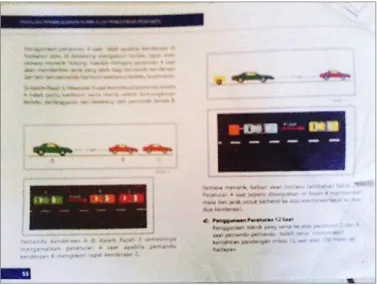
Figure 1.2-b: Book Page of Defensive Driving
Figure 1.2-b shows the example of the topic introduction to the Defensive Driving. While, the figure 1.2-c and figure 1.2-d are shows the one of the example from the topic
in ‘Peraturan Jarak’. Examples of this picture will help build a development environment design and animation should be within courseware applications. It also contains safety measures that should be there when driver are on the road.
Figure 1.2-c: One of the examples Book Page of ‘Peraturan Jarak’
Each topic in this defensive driving module will be developed into the application and use of multimedia way more interesting.
1.2.1 Preview Research
This chapter discusses previous studies that help in developing this project. This study was made to develop a reference model learning defensive driving module. Each study indicated only serve as a reference for defensive driving module only. There are 3 types of existed system in preview research that have some related with the development of the current system. It is stated as follows:
1.2.1.1 Latihan Ujian Undang-Undang Jalan Raya
Latihan Ujian Undang-Undang Jalan Raya is one of the existing systems implemented manually. It was the practice of the theory questions of road law and safety in the book. This book is provided by driving schools used during the KPPtheory class and in preparation for the candidate before taking the actual computerized test. Candidates have to answer 500 questions in the book to make sure they are able to answer 50 questions during the computerized test. Figure 1.1 shows the front of book cover for Latihan Ujian Undang-Undang Jalan Raya. Although this study is an exercise, it is an example of the development environment with a 2D animation as it is.
Figure1.2 shows the questions in the section A, the book has 20 questions related to the Halangan andPeraturan. In the development of the current system, it has a close resemblance to the current system.
Figure 1.2-f: Sample question of Latihan Ujian Undang-Undang Jalan Raya 1.2.1.2 KPP Driving Test
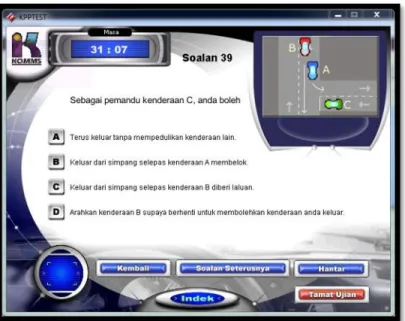
Another example for the current system development is system that similar to the system of JPJ computerized theory test. This system consists of 50 questions consisting of 3 parts of the question. The current system has in common the objective of driving training theory design makes application development more interactive as shown in Figure 1.2-g KPP Driving Test system also helps in enhancing the ability of the current system in order to make learning interactive and effective.
Figure 1.2.-g: Sample question of KPP Driving Test 1.2.1.3 SPEEDidu
SPEEDidu system is training test for candidates who want to take a real computerized test. In each of the different module of questions, candidates are required to answer the questions set and have to pass to get to the next part of question. This study is a one of good example for the new development system on designing the situation.
In Figure 1.2-i, it shows that there are examples of page in SPEEDidu system. The system provides questions that contain schema similarity features and design like actual JPJ computerized theory test questions. It also has a training system that includes aspects of defensive driving but there are only a few numbers of questions provided. It includes with the study of road development design. Almost of the studies is discussed more about the design and contribution of ideas in development of 2d environment. 1.2.2 Explain the comparison on existing system
Existing System Respondent Software/ Technique/ Platform Result Latihan Ujian Undang-Undang Jalan Raya Candidates of Driving Institution Print Media: Book
A required book is owned by each of the candidates enrolled in institutions of driving. Each candidate will need to do exercises from the book have been given before facing JPJ computerized theory test.
KPP Driving Test Candidates of Driving Institution and Community Standalone application A multimedia functions resembling actual JPJ theory test questions.
1.3 Current System and Its Limitation
Interactive Driver Educationl Courseware (IDEC) is the medium of education process theory through interactive multimedia courseware for candidates of driving school institutions. Compared with book practice in KPP theory lesson is reflected the existing system, the development of the training system is changing from still image diagram to a 2D animated learning and training with multimedia software support.
However, these applications are built to perform the learning contained in KPP modules. The application is including Defensive Driving Module.The module involves a main session for conducting learning. It carried out in the topic from which is contains 7 types of topics some information about learning in the KPP and to be priority in the development of defensive driving module discussed.
However, current system has limits the part which only covers Defensive Driving Module for driver education training in face the situation on the road. The system also accommodates learning in Malay language appropriate to the training provided by driving schools. This this application is intended to be understanding and make the candidate to improve knowledge and skills of its laws and road rules.
1.4 System Terminology
IDEC – Interactive Driver Educational Courseware UML – Unified Modelling Language
1.5 Indication of Scope and Limitations of The Study
This application courseware is related to Defensive Driving Module. The scope of this research were conducted a study that focuses on how candidates adopt defensive driving which involves the knowledge, skills and positive attitude to avoid accidents on the road. Education road has one important sessions to educate candidates in understanding the concept of learning defensive driving through the KPP.
I. Defensive driving module is describes into a main parts of education session: 1) Learning - It is the direction and guidance to candidates in
understanding and enhancing knowledge about defensive driving.
II. Road education sessions involving three (7) main types of topics in defensive driving modules:
1) Drivers who understand the concept of defensive driving which way drive to avoid accidents.
2) Driver who always be conscious to identify ‘hazards’. 3) Six (6) positions that can lead to violations of two vehicles. 4) Six (6) conditions that can cause accidents.
5) Improve the 'visual skills' and apply understanding of the affiliation real meaning from the following topics:
a. Peraturan jarak b. Peraturan memotong
III. Applications courseware developed for candidate and instructor of Akademik Memandu Sistematik Sdn.Bhd
IV. An application courseware that helps candidates to understand knowledge that covering defensive driving module.
1.6 Conclusion
The overall of this report contained three (3) main parts. Part 1 discussed the problem statement, the objectives of the proposed application courseware, the existing system that is related to the proposed application and also the scope and limitation of study. While, in Part 2 will discuss on the user requirement and design description of the proposed system, the final part will conclude the whole development process of the proposed system.
PART II REPORT BODY
2.1 User Requirement
This system was built for the Akademi Memandu Sistematik Sdn.Bhd. System applications should obtain consent from the driving institute. After getting a letter from the faculty for permission to serve the needs of the course, then the next task for the institutions to discuss the survey to be running smoothly. The institution has granted permission and be prepared to assist in the success of this application development studies. See the attachment reference in appendix A, B, C and D as evidence of studies that have been conducted.
2.2 Method(s) of Approach
Any one particular organization implemented using a structured process execution system. System development for this project requires a structured and systematic process to get the task done smoothly. This chapter discusses in detail the software process of Interactive Driver Educational Courseware (IDEC). It is a detailed study of the design in line with the purpose and objectives of the project. Among the methodology or the method used for the development of the system are: