Effect of Child Centred Methods on Teaching and Learning of
Science Activities in Pre-Schools in Kenya
Nelly C. Andiema
School of Education, University of Eldoret, Kenya P.O. Box 1625-30100 Eldoret, Kenya The research was funded by the author herself
Abstract
Despite many research studies showing the effectiveness of teacher application of child-centered learning in different educational settings, few studies have focused on teaching and learning activities in Pre-Schools. This research investigates the effect of child centered methods on teaching and learning of science activities in pre-schools in West Pokot County, Kenya. The study was descriptive in nature as it sought pre-school teachers and head teachers views. The instruments used for this study were; questionnaires, interview guide and observation checklist by the researcher. A total of 168 teachers and 35 head teachers responded to the research questionnaires. The research results showed that there existed significant relationship (p<0.01) between four child centered approaches and pupils teaching and learning of science in public early childhood education centres. For instance, use of child discovery (r=0.370 and p=0.001) and activity based approaches (r=0.360 and p=0.001) had higher correlations compared to child interest (r=0.215 and p=0.007) and child needs approaches (r=0.181 and p=0.024). The study concluded that teachers’ use of child-centred approaches affected pupils’ acquisition of science skills in schools. The study recommends that teachers should change their classroom learning to allow learners regular interaction with the outside the classroom (active learning).
Keywords: interest, discovery, need, science, activities
1 Introduction
Child-centered teaching is placing the pupil at the centre of the learning process in classroom (Gravoso, Pasa, Labra & Mori, 2008). The teacher provides pupils with opportunities to learn independently and from one another and coaches them in the skills they need to do so effectively (Collins & O'Brien, 2003). The original education schedule considered to be teacher-centered placed all the emphasis on the teacher and not the student, still dominates the education scene. In the traditional epoch, many teaching practitioners widely applied teacher-centered methods to impart knowledge to learners comparative to student-teacher-centered methods (Munyaradzi, 2013). With the advent of the concept of discovery learning approach, scholars widely adopt more supple child-centered methods to enhance active learning in classrooms. According to Hesson and Shad (2007) observed that most teachers today apply the child centered teaching approaches to promote interest, analytical research, critical thinking and enjoyment among pupils in schools. The teaching method that a teacher uses is regarded more effective since it does not centralize the flow of knowledge from the teacher to the learner. Questions about the effectiveness of child-centered teaching methods on pupils learning have consistently raised considerable interest in the thematic field of educational research. In addition, it is not clear whether teachers in early child hood development education (ECDE) schools utilise child-centered approaches in instruction in Kenya, a focus of this paper.
Early Childhood Care and Education (ECCE) supports children’s survival, growth, development and learning – including health, nutrition and hygiene, verbal and cognitive, social, physical, esthetic and emotional development – from birth to primary school in formal, informal and non-formal settings. Education systems in the majority of developed countries have been recently paying more attention to the early childhood education. The importance of consistent education of children, starting from the earliest age (of several months) to 7 or 9 years (usually this is the age when children go to school) is substantiated by numerous studies and practice in many countries.
For the purpose of teaching at any level of education is to bring a fundamental change in the learner (Tebabal & Kahssay, 2011). To facilitate the process of knowledge transmission, teachers should apply appropriate teaching methods that best suit specific objectives and level exit outcomes. This paper analyses the relationship between pre-school teachers’ application of child-centered approaches and science activities teaching. This is because one of the purposes of science teaching in ECDE is to enhance pupils understanding of scientific concepts. Another aim is to develop children’s capacity to understand scientific procedures and to investigate scientifically (Ediger, 2013). Susanne and Shu-Nu (2014) said that pupils need to know, understand and be able to be scientifically literate at different levels of education and connect scientific literacy with learners’ everyday experiences, curiosity in the hope that pupils become able to describe, explain and predict, read about science in popular press, discuss and evaluate information with science content.
According to Ng’asike (2012), in Kenya, science is a key subject that children study at all institutions of learning from early childhood to university. Science is critical in providing pupils with essential skills needed
for accelerating economic growth through industrialisation and advancement in technology (MoES&T, 2005). The primary school curriculum in Kenya has embedded the perspectives of science education, in which pupils skills in making socio-scientific decisions has been stressed. Ediger (2013) found out that teaching science is not an easy task especially in pre-school implying that teachers have to put more extra effort to ensure the goals of science education are realised. Science teaching methods need to incorporate how scientists work in the field. Problem solving and critical and creative thinking are necessary ingredients in ongoing science units of study. Individual differences need to be considered when implementing holistic teaching and learning (Ediger, 2013).
Textbooks and reading materials should be available for pupils to use in ongoing lessons (Ediger & Rao, 2009). Additional factors in instruction which must be tended to include the following: observing natural phenomenon carefully and accurately, developing reading skills which encourage quality comprehension, synthesis of gathered information, and development of accurate conclusions, writing which reflects thoroughness, standard English usage respective of background and ability level, appropriate sequence and syntax, and clarity in semantics, speaking in a meaningful, coherent manner respective of background and dialects and listening for a variety of purposes including answering questions and categorizing vital ideas in science as facts, concepts, and generalizations. Pupils should participate in small groups where the circulation and acceptance of others’ ideas is valued in an atmosphere of respect (Ediger, 2013). When these methods are applied, pupils will aqquire necessary scientific skills to increase their skills.
Ng’asike (2012) analysed teacher training in science education in early childhood development and primary grades in Kenya. The author found out that training of science teachers in early childhood and primary colleges nationally triggers a lot of quality questions. This was despite government emphasising science as critical for the achievement of vision 2030. This shows that training of preschool teachers at early childhood levels continues to face challenges in Kenya. The Kenya education policy describes the curriculum of ECD as anchored in experimental learning methods. However, the policy also acknowledges that there is pressure in ECD for teachers to ensure preschool children are provided an academic head start in preparation for primary school entry. Scientific knowledge is important in our daily lives. The ECDE curriculum is designed to ensure that learners are grounded with scientific knowledge by the time they are finishing nursery school. When learners develop interest in science activities while they are still in nursery schools, the country is sure of getting future doctors, engineers, physicians, environmentalist, and botanists among others. Therefore, the use of child-centred approaches is supposed to increase learners’ intrinsic motivation to learn scientific ideas while still young. This study sought to determine the degree to which child-centred approaches were being used by ECDE teachers in the teaching and learning of Science activities in public ECDE centres in West Pokot County. 1.1 Problem Statement
The purpose of conducting this study was to determine the reason for pre-school pupils’ low level of scientific skills when joining standard one in public primary schools in West Pokot County. Approaches have been made by government of Kenya to improve science teaching in schools but pre-school teachers have been overlooked despite the existence of science curriculum at this level, which covers the ages 3–6 years (MoE, 2004). Therefore, it is not known whether pre-school teachers are utilising child-centered approaches in teaching and learning of science activities in West Pokot County, a focus of this paper.
1.2 Purpose of the Research
The main purpose of this research is to investigate the degree to which pre-school teacher are utilising child-centered approaches in their classrooms. Moreover, the study seeks to determine how the approaches affected pre-school learners acquisition of science skills.
2. Literature Review
Science is a body of knowledge that includes observation, measurements and calculations in an attempt to understand the natural world and solve puzzling questions and problems in the society (KIE, 2008; Buyuktaskapu, 2011). In ECDE, learners must be given strong foundation in science through various activities to develop good and sound scientific principles that would help them pursue science-oriented courses like engineering and technology. In this case, they are able to appreciate nature through scientific aspects (Mutiso, 2014). The teacher’s role is critical to children’s science learning, and it is a complex one that is informed by her knowledge of children, of teaching and learning, and of pedagogical science knowledge (Balfanz & Brynes, 2006; Githinji & Kanga, 2011). Children’s scientific inquiry is guided by the teacher’s explicit understanding of the important underlying science concepts of the focus she has chosen (Worth, 2010). In order for learners to be successful in ECDE science, proper strategies should be applied to give the maximum benefits of scientific skills, activities and ideas (RoK, 2006b). This would make learners prepare to become future scientist (Mutiso, 2014). Learners must investigate and do analysis of what they have done to gain scientific knowledge and skills. This can be achieved if ECDE teachers use reflective teaching approach. Child-centred research suggests that learners
in classrooms utilizing a more contextualized approach to literacy development tend to view themselves as successful readers and writers and to maintain their initial interest in reading and writing activities (Rotumoi & Too, 2012; Andiema, Kemboi & M’mbone, 2013). Learners in classrooms that integrate literacy activities in child-centred interest areas appear to recognize that literacy is a way to communicate information (Nolen, 2001).
Meaningful science activities, which are relevant to children’s daily lives, allow children to make connections between what they already know and what they are learning (RoK, 2001; RoK, 2006a; Kangori, 2014). Sense-making discussions promote children’s awareness of the learning and concept development and facilitate the restructuring of alternative ideas into scientific mental models (Anne & Roa, 2013). As teachers work with children to develop their inquiry skills, the instructional strategies should move toward more open inquiry where children are posing their own questions and designing their own investigations (Banchi & Bell, 2008). Nasibi (2005) suggests that science activity gives the learner an opportunity to think. ECDE learners should therefore be allowed to perform activities and draw conclusions to come up with their own scientific ideas. K.I.E. (2003) in their guideline to ECDE teachers indicate that some of the many process associated with science and inquiry include; observing, inferring, hypothesizing, predicting, measuring and experimentation. Critical thinking as predicting and inferring require learners to apply new knowledge to new situations (RoK, 2006a). By doing experiment, scientific ideas can be proved. Similarly, some false beliefs that learners hold as true are eliminated (Blakemore & Frith, 2005; Davis, 2009). Another dimension of science is science and its interaction with society and technology.
Advancement in technology has made advancement in science (Lucas, 2001; MacHemer & Crawford, 2007). Similarly, advancement in science has made advancement in technology. As problem arises in the society, technology comes in to solve this issue (Mutiso, 2014). K.I.E (2003) noted that ECDE science curriculum consists of three dimensions: body of knowledge generated by science; process and procedures used to develop the body of knowledge and attitude and ideas which guide the scientists in their work. Therefore, acquisition of any knowledge must involve process to avoid memorization of information that is easily forgotten. Hence, process of acquiring knowledge is complimentary for better understanding of concept and utilisation of information. According to Karaka, Nyangasi and Githii (2004), learning is a highly personal and individual process. The children must be actively involved to carry out investigations, develop curiosity and powers of observation and inquiry, explore basic questions and suggests solutions (Lai, 2008; Macfarlane & Cartmel, 2008). The selection of and access to materials are critical to science (Linder et al., 2011). It is through the materials that children confront and manipulate the phenomenon in question (Majanga, 2011). To the extent possible, the instructional materials must be open ended, transparent, and selected because they allow children to focus on important aspects of the phenomenon (Worth, 2010). They must manipulate a variety of materials in search for patterns and relationships while looking for solutions to problems (Karaka et al, 2004). The teacher must prepare appropriate materials for learning activities, motivate children, discuss and coordinate activities to achieve desired objectives. He or she should assess the activities and suggest solutions to problems. The teacher must make an effort to teach children how to learn so that they can work as independently as possible (Kangori, 2014). According to Njenga and Kabiru (2005), children use their sense to explore the environment, manipulate objects and discover the nature of things, now they work and relate. They discover how things smell, taste, feel and how they look like. Children break things up and construct others to see what will happen (Madsen & Venka, 2012). They experiment with different things making discoveries and this increases their knowledge and concepts. Children learn by doing (Mukachi, 2006). They learn by hands on experiences with real materials and meaningful activities (Minner, 2010). Learning is an active process which involves the whole child. Children learn through practice, observation, imitation, exploration and problem solving (Njenga & Kabiru, 2005). When they explore and experiment, they discover new things and ways of doing things. As they engage in different activities they develop strategies or different ways of acquiring information and solving problems. This is referred to as learning how to learn.
During science teaching, teachers should ask questions that activate students’ prior knowledge, focus their attention, and invite them to make predictions, before, during, and after reading the expository text (Nolen, 2001; Mweru, 2012). These types of questions promote children’s comprehension of the text and improve science learning (Kinniburgh, & Shaw, 2009; Obuchere et al., 2014)). The structure of the text can affect science learning. The main ideas in the text should be supported with several examples, and these examples serve as cognitive support for the children. Examples should be highly relevant to the main idea so that children can establish connections between the text content and their own personal experiences (Beishuizen et al., 2003). Diagrams also support science learning. Effective, clear diagrams that represent causal relationships in the text support children’s comprehension of causal mechanisms (McCrudden, Schraw, & Lehman, 2009; Ogott et al., 2010). Illustrations and images in textbooks can be effectively integrated into inquiry-based instruction. Learning by inquiry involves, among other skills, observation in nature over time. However, teachers are presented with several challenges when they try to teach science concepts through actual observations in nature. For example, some phenomena are not observable during school hours.
Weather conditions and tall buildings or trees can make the observations of the sky difficult and frustrating, especially for young children (Kangori, 2014). Also, observations in nature can be time consuming for classroom teachers who want to teach science more effectively through an inquiry approach. Images can be used to allow children to make observations and inferences (Odinko & Williams, 2006; Popoola, 2010; Pollanen, 2011). Teachers also can have children compare observations in nature to illustrations and images in books. While many science educators might argue that observing phenomena in nature is important, the use of illustrations and images in the classroom offers a practical and effective way to introduce and teach science concepts with young children (Trundle & Sackes, 2008). The instructional use of cooperative learning through small groups allows children to work with their peers to enhance each other’s learning (Johnson & Johnson, 1999; RIC Publications, 2004). Research has shown that cooperative learning in small groups enhanced preschooler’s mathematics problem-solving abilities (Sarah, 2013; Tarim, 2009). In this approach, teachers guide children as they work together by providing materials and explaining when the children are in need of assistance. Teaching approaches should therefore be participatory to ensure that children acquire science process skills, enjoy learning and apply what is learnt to everyday life. This study determined whether the approaches to teaching were participatory.
Retention of knowledge that is actively acquired through activities is much higher than that learnt passively (Githinji & Kanga, 2011; Kang’ethe et al., 2015). Science is learnt through different approaches (KIE, 2003, 2008). Participatory approaches suitable in science learning include demonstration, practical activities, guided discussion, projects and field trips (KIE, 2003). Demonstration – it is important to have clear objectives (Sonia, 2006). Children should always be involved. Ensure that they are involved through questions, making observations, recording results and discussing conclusions (K.I.E, 1987). For preschool teachers to facilitate learning science through play, understanding of both science and play are important. Resnick (2004) states that integration of play and learning creates self-motivation, responsibility, and great concentration. According to Resnick children are likely to learn the most and enjoy the most when they are engaged as active participants, not passive recipients. Playful learning environment can be serious, creative, and imaginative as well as being fun and playful. From the above review of related liteature, there exist a gap in research determinign the degree to which teachers use of of child-centered approaches affected teaching and learning of science activities in pre-schools in West Pokot County, Kenya.
3. Methodology
The research design for this investigation was descriptive survey. The independent variables for the research were child centered approaches while the dependent variable was teaching and learning of science activities in pre-schools. A total of 168 ECDE teachers from preschool and 35 head teachers were invited to participate in this study. The majority of the participating teachers were women (76.4%); only 23.6% were male teachers. Questionnaires were developed to be used to collect data from teachers. Interview guides were also used during interview sessions with the head teachers while the researcher utilised observation checklist to record and observe learning process and facilities in public ECDE centres in West Pokot County, Kenya. The data collected was analysed using descriptive and inferential statistics for quantitative data. Qualitative data obtain from interviews was analysed using content analysis and presented together with the quantitative results.
4. Results
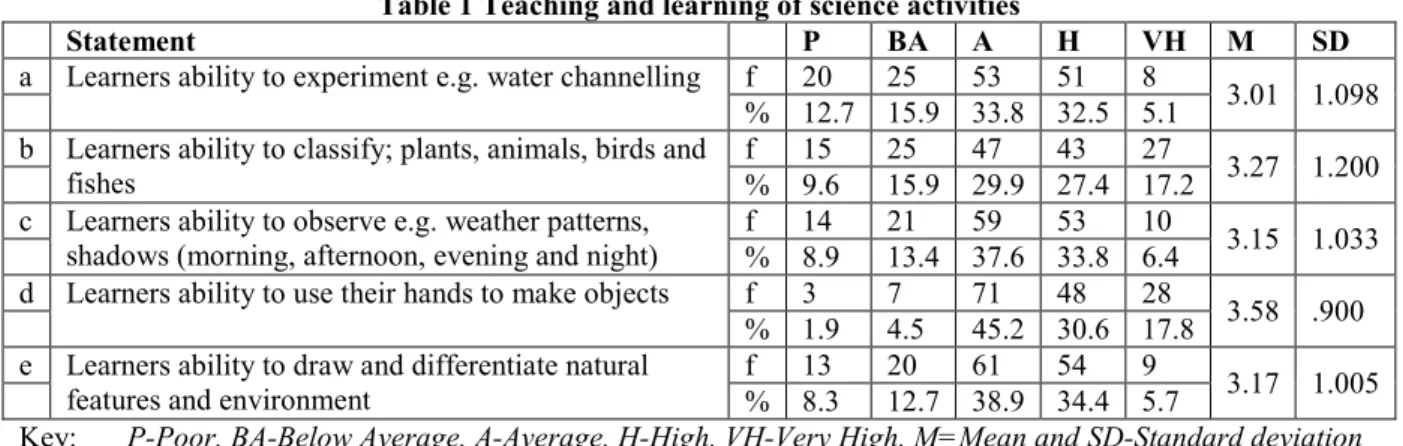
The objective of the study was to determine the utilisation of child-centred approaches on the teaching and learning of science activities in ECDE centres in West Pokot County. Science education is a process and is a way of discovering physical world. It is based on experimental assumption which argues that children learn things by means of five senses (smelling, listening, touching and tasting) and through language (as a means of explaining things) (Kolawole, 2002; KIE, 2003; Madlela, 2014). At first, the study sought to establish pre-school learners’ ability in regards to science activities. These were ability to experiment, classify living organisms, observe weather changes, use their hands to make objects and differentiate natural features and environment. These statements were measured on a Likert scale of five; poor (P), Below Average (BA), Average (A), High (H) and Very High (VH). The results are given in Table 4.20.
Table 1 Teaching and learning of science activities
Statement P BA A H VH M SD
a Learners ability to experiment e.g. water channelling f 20 25 53 51 8
3.01 1.098 % 12.7 15.9 33.8 32.5 5.1
b Learners ability to classify; plants, animals, birds and fishes
f 15 25 47 43 27
3.27 1.200 % 9.6 15.9 29.9 27.4 17.2
c Learners ability to observe e.g. weather patterns, shadows (morning, afternoon, evening and night)
f 14 21 59 53 10
3.15 1.033 % 8.9 13.4 37.6 33.8 6.4
d Learners ability to use their hands to make objects f 3 7 71 48 28
3.58 .900 % 1.9 4.5 45.2 30.6 17.8
e Learners ability to draw and differentiate natural features and environment
f 13 20 61 54 9
3.17 1.005 % 8.3 12.7 38.9 34.4 5.7
Key: P-Poor, BA-Below Average, A-Average, H-High, VH-Very High, M=Mean and SD-Standard deviation Table 1 findings of the study shows that 20 (12.7%) of teachers said that their learners ability to experiment was poor, 25 (15.9%) indicated to it was below average, 53 (33.8%) rated them as average, 51 (32.5%) rated learners competency as high and 8 (5.1%) rated learners ability to experiment as very high. From the results it is clear that ECDE children ability to do water channelling was above average as confirmed by descriptive results (M= 3.01, SD = 1.098). Therefore, teachers have made significant efforts to teach learners how to do small experiments and this helps them to build their scientific skills. This process only creates opportunities for scientific management and the introduction of new words. In relation to the theory of constructivism, when learners engage in experiments it enables them to grasp events in interaction with physical world while interpreting them with their own concepts (Buyuktaskapu, 2011). Buyuktaskapu (2011) found out that it is important that ECDE teachers to adopt constructivist approach when preparing science education programs and have higher science education self-efficiency perception levels to bring up a new generation of scientists. However, the results of the study are inconsistent with study results that showed that pre-school teachers in Turkey adopted traditional approaches more than constructivist approaches in science activities.
Secondly, 15 (9.6%) of respondents indicated that learners ability to classify living organisms into plants and animals was poor, 25 (15.9%) said it was below average, 47 (29.9%) rated learners ability as moderate, 43 (27.4%) said that it was high and 27 (17.2%) saw their learners ability as very high. It was therefore deduced that learners have moderate (M = 3.27 and SD = 1.2) level of understanding on plants and animal classification. When teachers were asked to indicate their ECDE learners ability to observe change in weather, day and climate patterns, 14 (8.9%) rated their capacity as poor, 21 (13.4%) pointed that it was below average, 59 (37.6%) said it is average, 53 (33.8%) said it was high and 6.4% indicated that it was high very high. The results suggests that learners have at least moderate (mean = 3.15 and SD = 1.033) capacity to identify and differentiate weather patterns, times of day and night and even climate changes. Their capability to identify the weather patterns is aimed at improving their science skills.
Moreover, 3 (1.9%) of ECDE teachers rated preschool learners skills to use their hands to make objects as poor, 7 (4.5%) rated them as below average, 71 (45.2%) termed the level as moderate, 48 (30.6%) said it was very high while 28 (17.8%) indicated it as very high. The obtained descriptive results was (M = 3.58 and SD = 0.9) indicating that preschool children skills in making objects was average. On the learners ability to draw and differentiate natural features and environment, 13 (8.3%) mentioned that their competency was poor, 20 (12.7%) of teachers said it was below average, 61 (38.9%) said it was average, 54 (34.4%) rated it as high and only 9 (5.7%) of teachers rated their preschool children ability to different natural features and environment as very high. This implies that ECDE children have average understanding of differentiating natural features and environment (M = 3.17, SD = 1.005) in West Pokot County ECDE centres. In conclusion to this section, the average computed mean for the five items on science activities was average (M=3.24 and SD=1.047).
Through observation checklist, the researcher also rated the ECDE learners’ skills and competencies in science activities. The responses are given in Table 2.
Table 2 Rating of learners competencies in science activities Science activities Low Below
average
Average High Very high
a Learners ability to experiment e.g. water channelling
7 9 18 2 5
b Learners ability to classify; plants, animals, birds and fishes
5 6 17 5 8
c Learners ability to observe e.g. weather patterns, shadows (morning, afternoon, evening and night)
2 6 21 5 7
d Learners ability to use their hands to make objects
10 12 16 3 0
e Learners ability to draw & differentiate natural features and environment
9 13 12 3 4
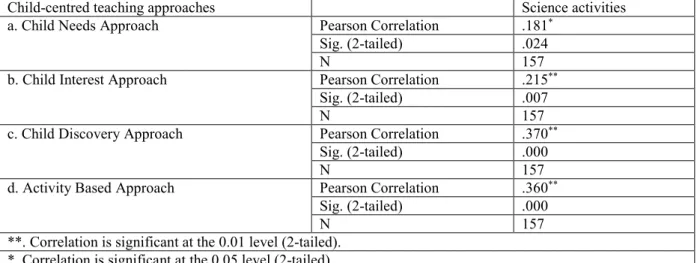
Results observed in Table 2 by the researcher showed that the learners competencies in science activities was average in many areas investigated. The statistics further showed that learners had difficulties in drawing and differentiating natural features and environment and ability to use their hands to make objects. However, they tended to show an average degree of skill in water channelling, classification of living organisms and ability to observe weather patterns. This shows that the learning strategies used did not adequately address the science skills that pre-school learners needed to acquire. To answer the third research question for the study, a Karl Pearson correlation coefficient was computed and the results are presented in Table 3.
Table 3 Correlations on the CCA on teaching and learning of science activities
Child-centred teaching approaches Science activities
a. Child Needs Approach Pearson Correlation .181*
Sig. (2-tailed) .024
N 157
b. Child Interest Approach Pearson Correlation .215**
Sig. (2-tailed) .007
N 157
c. Child Discovery Approach Pearson Correlation .370**
Sig. (2-tailed) .000
N 157
d. Activity Based Approach Pearson Correlation .360**
Sig. (2-tailed) .000
N 157
**. Correlation is significant at the 0.01 level (2-tailed). *. Correlation is significant at the 0.05 level (2-tailed).
Table 3 shows that there exist significant positive association between ECDE teachers’ utilisation of child-centred approaches and preschool children acquisition of scientific skills. Out of the four methods that were tested, the research study established that child discovery approach had higher correlation (r=0.370 and p=0.01) values meaning that child discovery approach method had a significant impact on teaching and learning of science activities in schools because learning the subject involves learners experimenting and discovering new things. Wilson (2015) supports this view by explaining that ECDE children need to discover or construct their own ideas. Developing new concepts or ideas is an active process and usually begins with child-centred inquiry, which focuses on the asking of questions relevant to the child. Inquiry involves a number of science-related activities and skills.
Secondly, activity based approach had significant positive influence (r=0.360 and p=0.01) on teaching and learning of science activities in pre-schools. Thirdly, the research established that child interest approach too had significant positive influence (r=0.251 and p=0.024) on teaching and learning of science activities. Lastly, it was also clear that child interest approach had also positive influence (r=0.181 and p=0.024) on pre-school children learning of science activities. On average, it is clear that there exist a positive degree of correlation between preschool teachers’ use of child-centred approaches in teaching and learning of science activities in ECDE.
The correlation also is significant at 0.01 and 0.05 levels (2-tailed) of confidence. Therefore, an increase in the utilisation of child-centred approaches increases teaching and learning of science activities. The study findings contradicts with Buyuktaskapu’s (2011) research in Turkey that found out that there was significant negative relationship between teachers belief in constructivist (learner centred) approach and their self-efficacy in science teaching. Buyuktaskapu found out that while teachers’ belief in constructivist approach
in pre-school science activities increased, their self-efficacy perceptions in science teaching decreased. This showed most of teachers preferred using traditional approaches in Turkey pre-schools and this affected learners’ acquisition of science skills.
5. Conclusions and Recommendations
Science is essential in the national development of any country. Teaching and learning of Science enables the ECDE learners to understand the world around them and be curious in nature. The desired goals of science in the early childhood curriculum include what we hope children will attain or achieve in three different areas: content, processes, and attitudes or dispositions. These all are accomplished when child-centred approaches are used for the purpose of improving science teaching methods. This study found out that there existed a positive degree of influence on the Utilisation of child-centred approaches in the teaching and learning of science activities in ECDE which was significant at 99% confidence level. The statistics suggested that learners’ ability to experiment, classify, observe, use their hands and differentiate natural features and environment could be adequately developed and enhanced if teachers would regularly use child-centred teaching method of discovery learning approach. To improve on the effective teaching and learning of Science activities, there is need for teachers to ensure that learners are not passive in classrooms but consider interaction with the natural world (active learning). It is important that ECDE teachers adopt constructivist approach when preparing for instruction in science in ECDE in order to bring up a new generation of scientists. Parents’ needs to support ECDE centres to purchase reference books in which sample science syllabi and activities based on constructivist approach are provided. To foster scientific thinking, teachers should view young children as active learners (versus recipients of knowledge) and give them varied opportunities to explore and experiment. Such opportunities can allow children to construct meaning and develop understandings that are not only valid but also valuable to their on-going intellectual development. Moreover, teachers need to consider organising classroom learning content in order to capture learner attention in Science activities.
References
Andiema, N., Kemboi, G., & M’mbonne, J. (2013). Challenges in teaching composition writing in secondary schools in Pokot County, Kenya. Journal of Education and Practice, 5 (1), 15-22.
Anne, C.S. B. & Roa, E. C. (2013). Assessment on learners’ science process skills: A learner-centred approach.
International Journal of Biology Education, 3(1), 24-44.
Balfanz, R., & Byrnes, (2006). Closing the mathematics achievement gap in high-poverty middle schools: Enablers and constraints. Journal of Education for Students Placed at Risk, 11(2), 143–159.
Blakemore, S-J., & Frith, U. (2005). The learning brain: Lessons for education. London: John Wiley & Sons Inc. Buyuktaskapu, S. (2011). Examination of ECDE teachers’ beliefs about Science education. The International
Journal of Research in Teacher Education, 5, 14-25.
Collins, J. W., 3rd, & O'Brien, N. P. (Eds.). (2003). Greenwood Dictionary of Education. Westport, CT: Greenwood.
Davis, B. S. (2009). Preschool children’s acquisition of mathematical competencies. Degree Project, Northern Michigan University.
Ediger, M. (2013). Science and the Common Core State Standards. Virginia Journal of Science Education, 5 (1), 8-11.
Ediger, Marlow, & D. Bhaskara Rao. (2009). School science education. New Delhi, India: Discovery Publishing House.
Githinji, F. W. & Kanga, A. (2011). Early Childhood Development Education in Kenya: A Literature Review on Current Issues. International Journal of Current Research, 3 (11), 129-136.
Government of Kenya, (2001). Guidelines for Early Childhood Development in Kenya. Nairobi: Kenya Institute of Education.
Government of Kenya, (2006). Economic Survey 2006. Nairobi: Government Printer.
Gravoso, R.S., Pasa, A.E., Labra, J.B. & Mori, T. (2008). Design and Use of Instructional Materials for Student-Centered Learning: A Case in Learning Ecological Concepts. The Asia-Pacific Education Researcher, 17(1), 109-120.
Hesson, M. & Shad, K.F. (2007). “A student-centered learning model,” American Journal of Applied Sciences, 628-636.
Kang’ethe, S.N., Wakahiu, J. & Karanja, M. (2015). Assessment of the Early Childhood Development Policy Implementation in Kenya, Case Study of Ruiru District. Journal of Education & Social Policy, 2 (1), 78-89.
Kangori, B.N. (2014). Teacher Related Factors in the Implementation of Science Activities in Preschools in
Nairobi County. MED Project, University of Nairobi, Kenya.
Kenya Institute of Education [KIE] (1987). Primary science guide. Nairobi: Kenya Literature Bureau. KIE (2003). Primary science guide. Nairobi: Kenya Literature Bureau.
KIE (2008). Handbook for early childhood development and education syllabus. Nairobi: KIE.
Kolawole, E. B. (2002). Sex difference in academic achievement in science subjects in Nigerian tertiary institutions. Research in Curriculum Studies (RICS), 2(1), 168-173.
Lai, K. W. (2008). ICT supporting the learning process: The premise, reality, and promise. In J. Voogto & G. Knezek (Eds), International Handbook of Information Technology in Primary and Secondary
Education (pp. 215- 230). New York: Springer.
Lucas, B. (2001). ‘Creative teaching, teaching creativity and creative learning’, in Craft, A., Jeffrey, B., & Leibling, M. (Eds) (2001).Creativity in education. London Continuum.
MacHemer, P. L. & Crawford, P. (2007).’Student perceptions of active learning in a large cross-disciplinary classroom’. Active Learning in Higher Education, 8 (1), 9-30.
Madlela, B. (2014). An investigation on how the child-centred approach is applied in the teaching of natural
science in Johannesburg East schools. MED Thesis, University of South Africa.
Majanga, E. K. (2011). The influences of class size on classroom interaction during mathematics discourse in the wake of Free Primary Education: A study of public primary schools in Nakuru Municipality. Research
Journal of Social Sciences, 3 (1), 44-49.
Ministry of Education, Science and Technology. (2005). Sessional Paper No. 1 of 2005 on policy framework for
education, training and research. Meeting the challenges of education, training and research in Kenya
in the 21st Century. Nairobi: Government of Kenya Press.
Mukachi, W. M. (2006). The extent to which science process skills of investigation is used in Biology practical
work. Unpublished master’s Thesis: Egerton University.
Munyaradzi, E.G. (2013). Teaching Methods and Students’ Academic Performance. International Journal of
Humanities and Social Science Invention, 2 (9), 29-35.
Mutiso, F. K. (2014). Impact of reflective teaching on ECDE learners’ performance in Science activities in Iveti
Division, Kathiani Sub-County, Machakos County in Kenya. MEd Project, University of Nairobi.
Nasibi, M. (2005). Early childhood education teaching at ECDE. Nairobi: Nehema Publisher.
Ng’asike, J. T. (2012). Training of Science Teachers for Early Childhood and Primary Grades in Kenya. New
Zealand Journal of Teachers’ Work, 9 (1), 36-49.
Njenga, A., & Kabiru, M. (2005). Early children development practices and reflections no.14: Following the footsteps, in The web of cultural transition. A tracer study of children in Embu District, Kenya . Nairobi: Bernard van Leer Foundation.
Nolen, S. B. (2001). Constructing literacy in the kindergarten: Task structure, collaboration, and motivation.
Cognition and Instruction, 19(1), 95-142.
Odinko, M. & Williams, J. (2006). Language of instruction and interaction patterns in pre-primary classrooms in Nigeria. Journal of Classroom Interaction, 41 (1), 22 – 32.
Pollanen, S. (2011). Beyond craft and art: a pedagogical model for craft as self-expression. International Journal
of Education through Art 7 (2), 111–125.
Popoola, A. A. (2014). Influence of play way method on the numeracy skills of early basic education school learners in Ekiti State Nigeria. Mediterranean Journal of Social Sciences, 5 (10), 318-324.
Republic of Kenya, (2006b). National Early Childhood Development policy Framework. Nairobi: Government Printer.
Resnick, M. (2004). Edutainment? No thanks. I prefer playful learning. Retrieved 30 December, 2015) from http://www.roboludens.net/Edut_Articoli/Playful_Learning.pdf
RIC Publications (2004). Multiple intelligences: A thematic approach. RIC Publication.
Rotumoi, J. & Too, J. K. (2012). Factors influencing the choice of approaches used by ECDE Teachers in Baringo County, Kenya. International Journal of Academic Research in Progressive Education and
Development, 1 (2), 177-187.
Sarah, M. (2013).The benefits of dramatic play in Early Childhood Development. Nigeria.
Sonia, M, H. (2006). Literacy practices and outcomes in kindergarten classrooms. Doctoral Dissertation, Faculty of the Graduate School at the University of North Carolina.
Susanne W. & Shu-Nu, C. R. (2014). Investigating preschool and primary school teachers' self-efficacy and needs in teaching science: a pilot study. In: CEPS Journal, 4 (1), 51-67.
Susanne W. & Shu-Nu, C. R. (2014). Investigating preschool and primary school teachers' self-efficacy and needs in teaching science: a pilot study. In: CEPS Journal, 4 (1), 51-67.
Tebabal, A. & Kahssay, G. (2011), “The effects of student-centered approach in improving students’ graphical interpretation skills and conceptual understanding of kinematical motion,” Lat. Am. J. Phy. Edu, 5(2): 374-381.
astronomy concepts with picture books. Science and Children, 46 (1), 36-39.
Worth, K. (2010). Science in Early Childhood Classrooms: Content and Process. STEM in Early Education and Development.
Biographical note
Nelly C. Andiema is currently a PhD student in biology education at University of Eldoret, Kenya. She is a teacher by profession. In her doctoral dissertation, she has focused on child centered approaches used to teach pupils in pre-schools in West Pokot County in Kenya.