Imperial College London Department of Computing
Assumption-based Argumentation
Dialogues
Xiuyi Fan
November 2012
Supervised by Francesca Toni
Submitted in part fulfilment of the requirements for the degree of Doctor of Philosophy in Computing of Imperial College London
Abstract
Formal argumentation based dialogue models have attracted some research in-terests recently. Within this line of research, we propose a formal model for argumentation-based dialogues between agents, using assumption-based argumen-tation (ABA). Thus, the dialogues amount to conducting an argumenargumen-tation process in ABA. The model is given in terms of ABA-specific utterances, debate trees and forests implicitly built during and drawn from dialogues, legal-move func-tions (amounting to protocols) and outcome funcfunc-tions. Moreover, we investigate the strategic behaviour of agents in dialogues, using strategy-move functions. We instantiate our dialogue model in a range of dialogue types studied in the litera-ture, including information-seeking, inquiry, persuasion, conflict resolution, and discovery. Finally, we prove (1) a formal connection between dialogues and well-known argumentation semantics, and (2) soundness and completeness results for our dialogue models and dialogue strategies used in different dialogue types.
Acknowledgements
I would like to express the deepest appreciation to my supervisor Francesca Toni for her patience, continued support and encouragement during my PhD study. Thanks to Francesca for her advice regarding both the technical training and aca-demic life in general. She has taken a lot of headache in training a student who had little experience in writing mathematical proofs to write a thesis that contains many formal results in three years. Without her guidance and persistent help this thesis would not have been possible.
Thanks to Tom Henderson for his mentoring in the past years. He continu-ally and convincingly conveyed the concept of “discipline and commitment” in research and scholarship. Tom started as my Master’s thesis advisor, then became a sounding board that giving helpful feedback on many naive thoughts I gave him, and my ski coach (with Joelle), poker teacher, ..., and, most importantly, a good friend. His kindness and humility is something I try to imitate (albeit not very suc-cessfully so far). Without him, I might have long dropped out of graduate school.
Thanks to Susan Eisenbach and Krysia Broda for helping me to get my Rector’s Award scholarship and bursary to study at Imperial, for arranging additional travel grants to support conference trips and for their encouragement and unfailing sup-port in many other occasions. Thanks to Amani El-Kholy, Naranker Dulay, Teresa Ng, Ann Halford and many others for looking after me so well in the department.
Thanks to Bob Kowalski, Henry Prakken, and Sanjay Modgil for their helpful comments and feedback on my work.
Thanks to everyone in my office and many others in the department for helping to create an enjoyable working environment. In particular, I would like to thank Yang Gao for the stimulating discussions. Thanks to Dianhuan Lin for reading an early draft of this thesis and providing helpful feedback. Thanks to Nick Ng for giving me opportunities to present my work at our friendly PhD student seminars. Finally, thanks to Tony Hunter and Abbas Edalat for taking the time to read this thesis and for examining me.
Contents
1 Introduction 12 1.1 Overview . . . 12 1.2 Structure of Thesis . . . 15 1.3 Contributions . . . 16 1.4 Statement of Originality . . . 17 1.5 Publications . . . 17 2 Background 19 2.1 Introduction . . . 19 2.2 Argumentation . . . 19 2.3 Abstract Argumentation . . . 22 2.4 Assumption-based Argumentation . . . 27 2.5 Dialogue . . . 32 2.6 Conclusion . . . 38 3 Argumentation Dialogues 40 3.1 Introduction . . . 40 3.2 Generic Dialogues . . . 40 3.3 Related Dialogues . . . 53 3.4 Strategy-move Functions . . . 54 3.5 Related Work . . . 55 3.6 Conclusion . . . 564 Dialogues and Argumentation Semantics 58 4.1 Introduction . . . 58
4.2 Debate Trees . . . 58
4.3 Focused Dialogues . . . 69
4.3.1 One-way Expansion Dialogue . . . 77
4.5 Illustration . . . 90 4.6 Related Work . . . 90 4.7 Conclusion . . . 91 5 Dialogue Strategies 94 5.1 Introduction . . . 94 5.2 Preliminaries . . . 95
5.3 Classes of Strategy-move Functions . . . 99
5.4 Results . . . 100
5.5 Illustration . . . 103
5.6 Related Work . . . 104
5.7 Conclusion . . . 104
6 Dialogue Instantiations (I) 106 6.1 Introduction . . . 106
6.2 Information-seeking and Inquiry . . . 106
6.2.1 Information-seeking Dialogues . . . 107
6.2.2 Inquiry Dialogues . . . 109
6.2.3 Related Work . . . 111
6.2.4 Summary . . . 111
6.3 Persuasion Dialogues with Mechanism Design . . . 111
6.3.1 Mechanism Design Background . . . 112
6.3.2 Preliminaries . . . 113
6.3.3 Strategy-move Functions used in Persuasion . . . 114
6.3.4 Persuasion Dialogue Results . . . 115
6.3.5 Related Work . . . 122
6.3.6 Summary . . . 123
6.4 Conclusion . . . 124
7 Dialogue Instantiations (II) 125 7.1 Introduction . . . 125
7.2 Preliminaries . . . 125
7.3 Conflict Resolution Dialogues . . . 126
7.3.1 Motivating Example . . . 126
7.3.2 Conflict and Conflict Resolution Agents . . . 127
7.3.3 Conflict Resolution Dialogues and Sequences . . . 130
7.3.5 Related Work . . . 134
7.3.6 Summary . . . 135
7.4 Discovery Dialogues . . . 135
7.4.1 Another Movie Example . . . 136
7.4.2 Discovery Dialogue Formulation . . . 137
7.4.3 Debate Trees Revisited . . . 140
7.4.4 Related Work . . . 144
7.4.5 Summary . . . 144
7.5 Conclusion . . . 145
8 Conclusion 146
List of Tables
2.1 Argumentation semantics for Example 1 . . . 25
2.2 Argumentation semantics Example 2 . . . 25
2.3 Argumentation semantics Example 3. . . 26
2.4 Dialogue types (adapted from [WK95]). . . 33
2.5 Black and Hunter’s inquiry dialogue framework. . . 35
2.6 Prakken’s persuasion dialogue framework. . . 37
3.1 Dialogueδfor Example 10. . . 44
3.2 A natural language reading of the dialogue in Table 3.1. . . 44
3.3 Summary of concepts introduced in Chapter 3. . . 57
4.1 A dialogue that draws a non-focused debate tree. . . 70
4.2 Another dialogue that draws a non-focused debate tree. . . 70
4.3 A sub-dialogue of the dialogue in Example 31 (part 1). . . 86
4.4 A sub-dialogue of the dialogue in Example 31 (part 2). . . 86
4.5 Summary of types of dialogues defined with legal-move and out-come functions from Chapters 3 and 4. . . 92
4.6 Summary of our dialogue framework. . . 92
5.1 ABA frameworks for Example 33. . . 96
5.2 A dialogue that is constructed with a truthful strategy-move func-tion in Example 33. . . 103
5.3 A dialogue that is constructed with a non-attack thorough strategy-move function in Example 33. . . 103
5.4 Summary of strategy-move functions defined in Chapter 5. . . 105
6.1 Information-seeking and inquiry dialogues (from [WK95]). . . . 107
6.2 Two formulations of information-seeking dialogues. . . 107
6.3 Information-seeking dialogue in Example 33. . . 109
6.5 An example dialogue constructed with aφp and aφo. . . 115
6.6 Dialogue as mechanism . . . 120
6.7 A persuasion dialogue example. . . 121
7.1 Jenny’s and Amy’s Concession and Non-Concession Rules . . . . 129
7.2 A conflict resolution dialogue example (part 1). . . 132
7.3 A conflict resolution dialogue example (part 2). . . 132
7.4 A conflict resolution dialogue example (part 3). . . 133
List of Figures
2.1 Toulmin’s layout of arguments. . . 20
2.2 An argumentation graph example. . . 23
2.3 Argumentation graph for Example 2. . . 25
2.4 Argumentation graph Example 3. . . 26
2.5 Arguments in Example 5. . . 30
2.6 An abstract dispute tree for the argumentAin Figure 2.2. . . 32
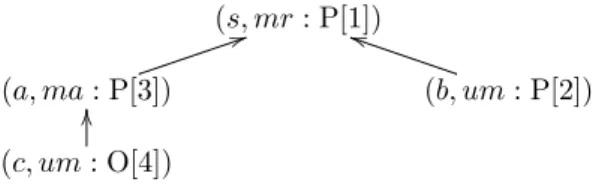
4.1 Nodes in a debate tree connected as in ABA arguments (left) or attacks between ABA arguments (right). . . 60
4.2 The debate tree drawn from the dialogue in Example 9. . . 63
4.3 The construction of the debate tree in Figure 4.2. Here the tree is constructed using utterancesu01, . . . , u09 as given in Example 11. . 64
4.4 Two proponent arguments (left) and one opponent argument (right) drawn from the debate tree shown in Figure 4.2. . . 65
4.5 The non-patient debate tree drawn from the dialogue in Example 22. 65 4.6 Filtered (left) and not filtered (right) debate trees. . . 66
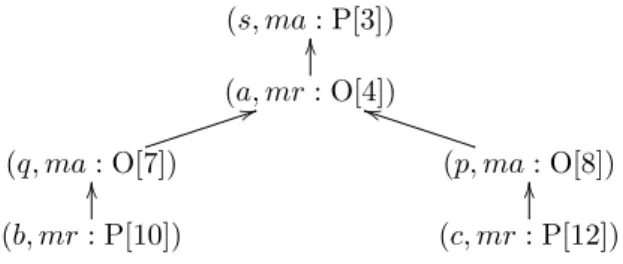
4.7 A non-focused tree. Note, in this tree, the opponent argument {a, b} `tshas two proponent nodes as its children:(c, um: P[7]) and(c, um: P[8]). . . 70
4.8 A non-focused tree. Note, in this tree, a proponent node (the root) has two “sets” of proponent children from two different utterances. 70 4.9 The debate tree drawn from the dialogue in Example 26. . . 72
4.10 The debate tree drawn from the dialogue in Example 19. . . 72
4.11 A non-positive dialogue in Example 28. . . 73
4.12 The expanded debate tree of the debate tree shown in Figure 4.10. 76 4.13 The (non-focused) debate tree drawn from the (non-focused) dia-logue in Example 31. . . 81
4.16 The construction of the debate forest in Example 31 (Part 2). . . . 85 4.17 The debate tree drawn from the dialogue in Example 10. . . 90
7.1 The construction of the debate tree drawn from the discovery dia-logue in Example 42. . . 143
1 Introduction
1.1 Overview
Argumentation based dialogue systems have attracted some research interests in recent years (e.g. see [Pra06]), largely due to the need for agents to commu-nicate and agree in multi-agent systems. The modern study of formal dialogue systems for argumentation starts from Charles Hamblin’s work [Ham71]. The topic was initially studied within philosophical logic and argumentation theory [Mac90, WK95]. Subsequently, researchers from the field of artificial intelligence & law [Gor94, Pra01] and multi-agent systems [APM00, PWA03] have looked into dialogue systems as well.
Much literature has explained the role agent systems plays in the current com-puting research (e.g., see [Woo09] for a thorough treatment on this subject). Here, we quote from [JMP05] that gives a nice summary of software agents.
The rise of the Internet, ambient computing, ad-hoc networks and virtual communities have led to a paradigm shift in how we view computer systems and computation. Instead of computer systems be-ing viewed simply as programs which execute some pre-determined method, a better analogy is to view systems as societies of interacting and autonomous entities, or “agents”, who combine together as and when necessary to achieve possibly-conflicting individual objectives. This agent-oriented perspective has become influential within com-puter science over the last decade, and has made connections with prior work in biology (e.g., ecology, evolutionary theory), physics (statistical mechanics), economics (game theory) and sociology (or-ganisation theory).
Wooldridge and Jennings give the following list of agent properties (quoted ver-batim from [WJ95]).
• autonomy: agents operate without the direct intervention of humans or oth-ers, and have some kind of control over their actions and internal state;
• social ability: agents interact with other agents (and possibly humans) via some kind of agent communication language;
• reactivity: agents perceive their environment (which may be the physical world, a user via a graphical user interface, a collection of other agents, the Internet, or perhaps all of these combined), and respond in a timely fashion to changes that occur in it;
• pro-activeness: agents do not simply act in response to their environment, they are able to exhibit goal-directed behaviour by taking the initiative.
We can think of multi-agent systems as a collection of agents that co-exist in a shared environment. Though it is uncertain if all agents in the environment share some overarching goals or not, each agent certainly has its own goals. More-over, usually it is the case that agents need to communicate in order to cooperate, coordinate, and negotiate with other agents so as to reach their individual goals. Therefore, it is easy to see the need for effective communication among agents exists.
Much research has been dedicated to low level inter-agent communication, in terms of languages and protocols for autonomous software agents. The most influ-ential example is the development of the FIPA’s Agent Communications Language (FIPA-ACL) [FIP02]. FIPA-ACL relies on speech act theory [Sea70, Aus75] de-veloped by Searle and Austin. It defines a set of performatives, including ask-if, ask-all, tell, deny, insert, etc. It also specifies allowed agent responses upon receiving these performatives. However, the communication framework given by FIPA-ACL, through its performatives, is a low level framework. To capture more sophisticated higher level agent communication behaviours, e.g., inquiry, and information-seeking, dialogue models have been proposed.
Two major questions need to be addressed in a study of dialogue models. Firstly, how to construct “coherent” dialogues? Secondly, how to construct dialogues with specific goals? The first question can be addressed by introducingdialogue pro-tocols; and the second question can be addressed by studyingdialogue strategies. This thesis is concerned with answering these two questions. Our goals are to:
• Develop a generic argumentation dialogue framework capable of supporting various types of dialogue.
• Study strategic behaviours of agents participating in different types of dia-logues.
Hence, we address the high level agent communication need as follows:
In multi-agent systems, argumentation dialogues are a viable and appropriate means for agents to exchange information and delib-erate.
Specifically, this thesis presents a two-agent argumentation based dialogue model. We use Assumption-based Argumentation (ABA) [DKT09] as the underlying rep-resentation for arguments, as ABA is a general purpose, widely used argumen-tation framework. In ABA, there are strong theoretical results to use, e.g., there are existing work in computing acceptable arguments within an ABA framework with respect to various argumentation semantics [DKT09]. Moreover, there is a clear relation between ABA and Abstract Argumentation (AA) framework, i.e., ABA and AA are instances of each other [DMT07]. Hence all theoretical results obtained in AA are applicable in ABA.
In ABA, we have rules, assumptions, and contraries. Informally, rules and assumptions form deductions (arguments); contraries of assumptions provide a means of specifying “counter-arguments” for arguments composed of rules and assumptions. Within an ABA framework, arguments are deemed “acceptable” if certain properties of these arguments are fulfilled, e.g., an argument does not “at-tack” itself and attacks all arguments that attack it. In our model, a dialogue is composed of utterances withcontentseither a rule, an assumption, a contrary, a topic, a goal, or pass. A dialogue starts with an agent posing a topic/goal and completes when both agents utter pass.
To ensure coherence of a dialogue, we introduce a set of legal-moveand out-comefunctions. Legal-move functions are mappings from dialogues to utterances. Hence, given an incomplete dialogue, a legmove function returns a set of al-lowed utterances that extends the dialogue. Legal-move functions can then be viewed as dialogue protocols. Outcome functions are mappings from dialogues to true/false. Given a dialogue, an outcome function returns true if a certain property holds within that dialogue.
Through dialogues, the participating agents construct a “joint knowledge base” by pooling all information disclosed in the dialogue to form theABA framework,
agents have uttered in the dialogue, it gives the context of examining the accept-ability of the claim of the dialogue. Conceptually, a dialogue is “successful” if its claim is “acceptable” inFδ. Rather than checking success retrospectively, once
the dialogue is completed, we define legal-move functions guaranteed to gener-ate successful dialogues. This main result is obtained by mapping thedebate tree generated from a dialogue to anabstract dispute tree[DKT06].
Some of the earlier studies on dialogue systems have categorised dialogues into six types:persuasion, negotiation, inquiry, deliberation, information-seekingand eristics[WK95]. Each of these types of dialogues has its own goals, and agents participating in different types of dialogue have different interests. Hence different types of dialogues call for differentdialogue strategies.
Building upon the aforementioned dialogue protocols, dialogue strategies can be formulated via strategy-movefunctions. These are mappings from dialogues and legal-move functions to utterances. Hence, given a dialogue and a legal-move function, a strategy-move function selects a subset of the set of utterances allowed by the legal-move function such that utterances within this subset advance the dialogue towards the agents’ and the dialogue’s specific goals.
For instance, in an information-seeking dialogue, a questioner agent poses a topic and an answerer agent puts forward information that is related to the topic. The aim of the dialogue is to build proper (arguments) for this topic. The be-haviours of the questioner and the answerer can be captured by two strategy-move functions: thepassand thenon-attackstrategy-move functions, respectively. Agents (questioners) that use a pass strategy-move function put forward the claim and no other utterance in a dialogue; agents (answerers) that use a non-attack strategy-move function only utter rules and assumptions, but not contraries.
To summarise, this thesis studies argumentation based dialogue models from two angles (1) dialogue protocols, which are used to keep the integrity of dia-logues and guarantee the acceptability of the claim of a dialogue and (2) dialogue strategies, which identify appropriate utterances that advance a dialogue towards its goal and the goals of the agents participating in the dialogue.
1.2 Structure of Thesis
This thesis is structured as follows. Chapter 2 presents background studies on argumentation frameworks, especially ABA, and argumentation dialogues.
ele-ments of our model, includinglegal-move, outcomeandstrategy-movefunctions, are introduced.
Chapter 4 discusses our dialogue protocols in detail and links dialogues to argu-mentation semantics. We present several legal-move functions and prove sound-ness results of our dialogue model. Basically, we show that for a dialogue that iscompatiblewith certain legal-move functions, the claim of this dialogue is “ac-ceptable” in the ABA framework drawn from the dialogue.
Chapter 5 discusses dialogue strategies that agents use through various dia-logues. Several strategy-move functions are presented in detail in this chapter. We prove soundness and completeness results for claims of dialogues.
Chapter 6 instantiates our dialogue framework to model information-seeking and inquiry dialogues. We formally define these two types of dialogues and prove completeness and soundness results with respect to information disclosed through-out dialogues with certain legal-move and strategy-move functions.
Chapter 7 further instantiates and extends our framework to model conflict res-olution and discovery dialogues.
We conclude in Chapter 8 with a summary of this thesis and a list of possible future works.
1.3 Contributions
The contributions of the thesis are as follows:
• Presentation of a generic dialogue model (Chapters 3, 4). This sets the foun-dation for all later formalisations of various types of dialogues.
• Presentation of a catalogue of dialogue strategies for agents (Chapter 5). This gives a way of specifying agent behaviours in dialogues.
• Formalisation of information-seeking and inquiry dialogues (Chapter 6). This illustrates our dialogue model and justifies it by showing various re-sults.
• Formalisation of persuasion dialogue with mechanism design techniques (Chapter 6). This gives an example on how mechanism design techniques can be applied in argumentation based dialogues. Our results include that: under specified conditions, neither the two agents in a persuasion will lie in
• Formalisation of discovery and conflict resolution dialogue (Chapter 7). This further justifies our dialogue model by applying it to more types of dia-logues.
1.4 Statement of Originality
I declare that this thesis was composed by myself and that the work it presents is my own, except where otherwise stated.
1.5 Publications
The work in this thesis brings together and builds upon work published as follows:
• (Chapter 4) Xiuyi Fan, Francesca Toni, Assumption-based Argumentation Dialogues, Twenty-Second International Joint Conference on Artificial In-telligence (IJCAI 2011), July 16-22, 2011, Barcelona, Spain [FT11a]
• (Chapter 5) Xiuyi Fan, Francesca Toni, Agent Strategies for ABA based Information-seeking and Inquiry Dialogues,20th European Conference on Artificial Intelligence (ECAI 2012), August 27-31, 2012, Montpellier, France [FT12a]
• (Chapter 6) Xiuyi Fan, Francesca Toni, Mechanism Design for Argumenta-tion based Persuasion Dialogues,Fourth International Conference on Com-putational Models of Argument (COMMA 2012), September 10-12, 2012, Vienna, Austria [FT12c]
• (Chapter 7) Xiuyi Fan, Francesca Toni, Argumentation Dialogues for Two-Agent Conflict Resolution, Fourth International Conference on Computa-tional Models of Argument (COMMA 2012), September 10-12, 2012, Vi-enna, Austria [FT12b]
• (Chapter 7) Xiuyi Fan, Francesca Toni, A First Step towards Argumenta-tion Dialogues for Discovery, First International Workshop on the Theory and Applications of Formal Argumentation (TAFA-11), July 16-17, 2011, Barcelona, Spain [FT11c]
• (Chapter 7) Xiuyi Fan, Francesca Toni, Two-Agent Conflict Resolution with Argumentation Dialogues (Extended Abstract),Tenth International Confer-ence on Autonomous Agents and Multiagent System (AAMAS 2011), May 2-6, 2011, Taipei, China [FT11b]
The work published in the following paper has also contributed to some early ideas that lead to this thesis, even though not explicitly included.
• Xiuyi Fan, Francesca Toni, Adil Hussain, Multi-Agent Conflict Resolution with Assumption-based Argumentation. Third International Conference on Computational Models of Argument (COMMA 2010), 8th-10th September 2010, Desenzano del Garda, Italy [FTH10]
2 Background
2.1 Introduction
In this chapter, we cover the following topics. Firstly, we look at argumentation from a historical perspective and develop a general understanding of what argu-mentation is about (Section 2.2). We then give some more formal discussion about theAbstract Argumentation (AA) framework(Section 2.3). After that, we move to the Assumption-based Argumentation (ABA) framework, which serves as the underlying framework for the rest of this thesis (Section 2.4). With a good un-derstanding of argumentation, and ABA in particular, we move to argumentation based dialogues (Section 2.5). We review two existing dialogue frameworks. This review helps us to put the research presented in this thesis into context.
2.2 Argumentation
Argumentation is usually traced back to ancient Greek philosophers [RS09]. In particular, it is often attributed to Aristotle, for his work in formal deductive rea-soning and rhetoric [Bil87, BH08].
It is interesting to consider some early development of argumentation. Toulmin, while aiming at the study of “twentieth-century epistemology” (Preface to the Up-dated Edition, 2003 edition, page vii [Tou58]), gives a description of a semi-formal argumentation model. Toulmin has touched upon many topics that have attracted the attention of several researchers later on.
In [Tou58], Toulmin has described that arguments are performed within a certain “field” with respect to a given “modal”. The “field” can be roughly understood as the scope or domain where an argument takes place. We can view this as defining the scope of a particular argumentation framework. The “Modal” can be viewed as an early attempt to understand argumentation semantics, whether we understand argumentation semantics broadly as criteria of classifying arguments into “accept-able” ones or not.
Furthermore, Toulmin has discussed about uncertainty in arguments. Intuitively, while an argument is constructed, the facts used to support the claim might be uncertain; the rules used to deduct the claim from facts might also be uncertain. While an argument is attacked, the attack relation between arguments might also be uncertain. Recent research has attempted to incorporate these uncertainty into their argumentation frameworks, e.g., [Zuk09] gives a few pointers to more recent research in these directions.
Toulmin’s layout of arguments is shown in Figure 2.1. In this figure, D stands for Data, Q stands for Qualifier, C stands for Claim, W stands for Warrant, B stands forBacking, and R stands forRebuttal[Tou58, Ver09]. Toulmin’s model is well recognised and acknowledged in later works such as [Dun95]. However, apart from mentioning “modal”, Toulmin has made little progress in formally un-derstanding “argument acceptability” or “argumentation semantics” as we know today.
Another line of influential work on early development of argumentation is by Pollock [Pol94, Pol91, Pol87]. Prakken and Horty [PH12] give a nice summary of Pollock’s contribution in computational argumentation. It is considered that Pollock developed one of the first formal systems for argumentation based infer-ence. Many topics in argumentation were first studied by Pollock, such as argu-ment structure, the nature of defeasible reasons, the interplay between deductive and defeasible reasons, rebutting versus undercutting defeat, argument strength, argument labelings, self-defeat, and resource-bounded argumentation [PH12].
In Pollock’s view, defeasible reasoning is the following [Pol95] (Page 85):
Defeasible reasoning is, a fortiori, reasoning. Reasoning proceeds by constructing arguments, where reasons provide the atomic links in arguments. Conclusive reasons logically entail their conclusions. Defeasibility arises from the fact that not all reasons are conclusive.
D //So, Q, C
Since W
On account of B Unless R
Those that are not are prima facie reasons. Prima facie reasons create a presumption in favour of their conclusion, but it is defeasible.
Pollock considers arguments as inference trees, where the nodes are statements, with the leaf nodes being premises, and the links are applications of “reasons”. Formally, Pollock considers sequences oflinesfrom anargument. Each line from an argument is a tuple (ϕ, r, l, s), whereϕis a proposition,ris the reason applied to infer ϕ, l is the set of preceding lines from which ϕ is inferred, ands is the line’s strength (a number). A sequence of such lines is a (linear) argument if each line is such that its proposition is either inferred from earlier lines or taken from the knowledge base [PH12].
With his definition of arguments, Pollock definesdefeatas follows.
• An argument line (ϕ, r, l, s) defeats an argument line (ϕ0, r0, l0, s0) if and only if
– r0 is a defeasible rule, and – s≥s0, and
– ϕ = ¬ϕ0 orϕ = ¬r0 (here¬r is shorthand for saying that the an-tecedents of rulerdo not support its consequent).
• An argumentAdefeats an argumentBif and only if a line ofAdefeats a line ofB.
In addition to argument construction, with argument defeat relation defined, Pol-lock has also worked on various argumentation semantics. For him, a semantics is an account of how the set of constructed arguments, taken together with their defeat relations, determines what a cogniser should believe. His understanding is the same as today’s view on argumentation semantics. Here we do not repeat Pollock’s two semantics definitions, which can be found in [Pol87] and [Pol95], respectively. We just point out that, as proved in [Dun95] and [JV99], under cer-tain conditions, Pollock’s two semantics are equivalent to Dung’sgrounded and preferredsemantics [Dun95] (both introduced later), respectively.
From a modern perspective, argumentation is a useful technique in comput-ing. Argumentation theories have been in rapid development in the field of artifi-cial intelligence, and logical computing in particular, e.g., Rahwan and McBurney [RM07] say:
[...] if logic is the means by which computers think, then argumenta-tion is the means by which intelligent computers interact, both with one another and with humans.
Hence, argumentation is a means for intelligent computer interaction.
Applications of argumentation in computing are developed in many areas. In the area of medical application, many argumentation based expert systems and tutorial systems have been developed [FGG+07]. Argumentation has long been used in legal reasoning, e.g. Bench-Capon et al [BCPS09] present a detailed overview of argumentation applications developed for legal reasoning in the past two decades. Argumentation has also been used in recommendation systems [CnMS06]. Here, contrary to machine learning based systems, argumentation provides awhite-box approach. Users of such systems not only receive the recommendation, but the reasoning behind it. In the context of Semantic Grid and Semantic Web, argu-mentation is also an emerging technology [TGK+08]. Supported by ontology frameworks, web services, and Grid computing, argumentation is a natural way for agents to interact with one another [RS09, TSL+07, TGC07, MS07].
A few informal definitions for argumentation are presented to set up the ground for our discussion. These definitions are based on the argumentation framework used throughout this thesis, though they represent similar concepts in most other argumentation frameworks as well. Formal definitions follow later.
Argument: An argument is a set of propositions composed of three parts: a claim, some premises, and an inference from the premises to the claim.
Contradiction:Two formulas are in contradiction, for example, if one negates the other.
Attack: One argument,A, attacks another argument,B, if and only if the con-clusion ofAis a contradiction with a premise ofB.
2.3 Abstract Argumentation
Abstract argumentation (AA) [Dun95] is developed as one of the first compu-tational argumentation frameworks. An AA framework is simply a pair AF =
hA,Ri, consisting of a set of arguments,A, and a binaryattackrelation,R. For example,
Ahh ((B //Cee
Figure 2.2: An argumentation graph example.
is an argumentation framework.
AA is abstract as its arguments and attacks are both atomic. Moreover, there is no other relation between arguments defined in AA, except attacks.
An abstract argumentation system captures “inconsistency” between arguments, given by the relation of attack, hence not all arguments can co-exist with each other. It is essential to determine which arguments are acceptable. Intuitively, arguments that are not attacked should be accepted; arguments that are attacked and cannot somehowwithstandtheir attacks should not be accepted. As we show in the next section, [Dun95, BG09] have proposed a full suite of policies, which are called semantics, to determine the acceptability of arguments in an abstract argumentation framework. These argumentation semantics have been adopted and used in many other argumentation frameworks.
Abstract argumentation is usually represented as directed graphs. As introduced in [Dun95], arguments are represented as nodes and attacks are represented as directed links in these graphs. Figure 2.2, is the directed graph for the ealier argu-mentation framework
AF =h{A,B,C},{(A,B),(B,A),(B,C),(C,C)}i.
From Figure 2.2, it can be noticed that in an argumentation framework, two argu-ments can attack each other (arguargu-mentsAandB) and an argument can attack itself (argumentC).
In the literature, extension is used to describe a subset of arguments. An “ac-ceptable” extension,E, is a set of arguments which jointly withstand from attacks according to a given semantics. Formally, given an abstract argumentation frame-workAF = hA,Riand a semanticsS, the set of extensions prescribed byS for AF is denoted asES(AF)⊆2A. The acceptability of an argumenta∈ Ais now
defined as its membership of elements ofES(AF).
Intuitively, an extension requires all elements in the extension not to attack each other, hence to beconflict-free.
• Formally, given an argumentation frameworkAF =hA,Ri, a setS⊆ Ais conflict-freeif and only if@a, b∈Ssuch that(a, b)∈ R.
A further requirement of an extension is that a set of arguments can withstand attacks by firing back counterattacks, hence beacceptable.
• Formally, given an argumentation framework AF = hA,Ri, an argument a ∈ A isacceptablewith respect to a setS ⊆ Aif and only if ∀b ∈ A : (b, a)∈ R ⇒(∃c∈S : (c, b)∈ R).
A set of arguments is acceptable if and only if all of its elements jointly defend the set by issuing counterattacks.
• Formally, a setS⊆ Ais acceptable if and only if∀x∈ A,∀b∈S: (x, b)∈ R ⇒ ∃c∈S(c, x)∈ R.
Withconflict-freenessandacceptabilitydefined, we can defineadmissibilityin terms of sets that are bothconflict-freeandacceptable.
• Admissible: Given an argumentation frameworkAF = hA,Ri, an exten-sionEisadmissibleif and only ifEis conflict-free and acceptable.
The admissible semantics is the most widely used semantics, both in abstract argumentation and other works [RS09]. Admissibility is easy to understand as a set of arguments which do not attack themselves but attack all arguments that attack this set. Several other semantics have been developed such that each of them is believed to have better use in certain applications.
• Complete: Given an argumentation frameworkAF =hA,Ri, an extension Eiscompleteif and only ifEis admissible and every argument ofAwhich is acceptable with respect toEbelongs toE.
• Grounded:An extension isgroundedif and only if it is the smallest set, with respect to set inclusion, of arguments which is complete.
• Preferred: An extension ispreferredif and only if it is a maximal set, with respect to set inclusion, of arguments which isadmissible.
• Ideal:An extension isidealif and only if it is a maximal set, with respect to set inclusion, of arguments which is admissible and a subset of allpreferred extensions.
A //B //C //D
Figure 2.3: Argumentation graph for Example 2.
Example 1. In the argumentation framework:
AF =h{A,B,C},{(A,B),(B,A),(B,C),(C,C)}}i,
shown in Figure 2.2, we can obtain extensions as shown in Table 2.1.
Table 2.1: Argumentation semantics for Example 1
Semantics Sets Conflict-free {},{A},{B} Admissible {},{A},{B} Complete {},{A},{B} Grounded {} Preferred {A},{B} Ideal {} Stable {B}
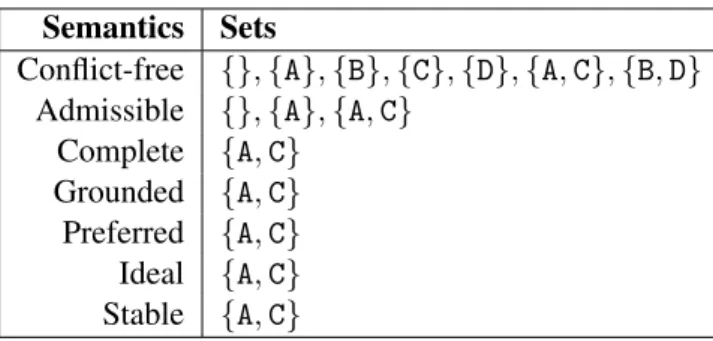
Example 2. In the argumentation framework: AF =h{A,B,C,D},{(A,B),(B,C),(C,D)}}i,
shown in Figure 2.3, we can obtain extensions as shown in Table 2.2.
Table 2.2: Argumentation semantics Example 2
Semantics Sets Conflict-free {},{A},{B},{C},{D},{A,C},{B,D} Admissible {},{A},{A,C} Complete {A,C} Grounded {A,C} Preferred {A,C} Ideal {A,C} Stable {A,C}
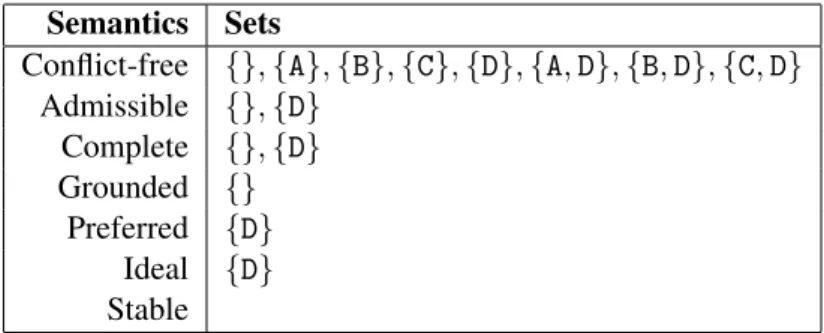
Example 3. In the argumentation framework,
AF =h{A,B,C,D,E},{(A,B),(B,C),(C,A),(D,E),(E,D),(E,E)}i, shown in Figure 2.4, we can obtain extensions as shown in Table 2.3.
A ++B w w Dhh ((Eee C V V
Figure 2.4: Argumentation graph Example 3.
Table 2.3: Argumentation semantics Example 3.
Semantics Sets Conflict-free {},{A},{B},{C},{D},{A,D},{B,D},{C,D} Admissible {},{D} Complete {},{D} Grounded {} Preferred {D} Ideal {D} Stable
In addition to the extension based approach introduced previously, thelabelling approach for computing semantics has been introduced [CG09]. As shown in [MC09], when computing extensions in Abstract Argumentation frameworks, many of the argumentation semantics (admissible, complete, grounded, preferred, and stable) can be computed with the labelling approach. The process works as fol-lows (sketch):
• Each argument in an argumentation framework can be either: IN,OUT or
UNDEC.
• Given an AA frameworkhA,Ri, for x, y ∈ A, thelabelling requirements specify the following:
– xisINif and only if everyythat attacksxisOUT.
– xisOUTif and only if there is at least oneythat attacksxsuch thaty isIN.
– xisUNDECif and only if there is noythat attacksxsuch thatyisIN,
and it is not the case that: for ally,yattacksximpliesyisOUT. Given a labelling L, in(L) and undec(L) denote the sets of arguments that is labelled INandUNDEC, respectively. With the above labelling specification,
• A labelling isadmissibleif and only if all arguments labelledINandOUT satisfy the labelling requirements.
• A labelling iscompleteif and only if all arguments labelledUNDECsatisfy the labelling requirements.
• LetLbe a complete labelling, then:
– L isgroundedif and only if there does not exist a complete labelling L0such thatin(L0)⊂in(L).
– L ispreferredif and only if there does not exist a complete labelling L0such thatin(L0)⊃in(L).
– Lisstableif and only ifundec(L) ={}.
With labelling defined, Modgil and Caminada have shown a result that links labelling with extension semantics. Theorem 6.1 in [MC09] states the following:
LetAF =hA,Ribe an argumentation framework, and a set of argu-mentsE ⊆ A. ForS ∈ {admissible, complete, grounded, preferred, stable},E∈ES(AF)if and only if there exists anSlabellingLwith
in(L) =E.
Modgil and Caminada state that the labelling approach not only is a viable way of computing argumentation semantics, but also is a useful tool for introducing argumentation semantics to people.
2.4 Assumption-based Argumentation
At the same time as the initial development of AA, another argumentation frame-work, Assumption-based Argumentation (ABA) [BDKT97, BTK93, DKT09], had been developed. Unlike attacks in abstract argumentation, which are abstract and atomic, logic deductions supported by assumptions are used to define arguments. The notion of contrary is introduced to facilitate attacks between arguments. The idea of contrary goes beyond negation. For instance, “it is raining” is not only contrary to “it is not raining” but also to “it is sunny.”
In ABA, arguments are trees, where the root of a tree is theclaimof the argu-ments; and leaves are eitherassumptionsorfacts. Using the notion of contrary, an argumentAattacks an argumentBif and only if the claim ofAis in contrary with an assumption ofB.
Formally, as in [DKT09], an ABA framework is a tuplehL,R,A,Ciwhere • hL,Riis a deductive system, with a languageLand a set of inference rules
Rof the formβ0 ← β1, . . . , βm(m ≥0)withβi ∈ L, and ifm >1, then
βi6=βj fori=6 j,1≤i, j≤m1;
• A ⊆ Lis a (non-empty) set, whose elements are referred to asassumptions, • C is a total mapping from A into 2L \ {{}}, where each c ∈ C(α) is a
contraryofα2.
Given β0 ← β1, ..., βm, β0 is referred as the head and β1, ..., βm as thebody.
We will use the following notation: Head(β0 ← β1, ..., βm) =β0;Body(β0 ←
β1, ..., βm) = β1, ..., βm. An ABA framework isflatif and only if no assumption
is the head of a rule.
Example 4. Given an ABA frameworkAF1 =hL,R1,A1,C1ias follows:
• L1={a, b, c, p, q, r}, • R1 ={p←a, q ←b, r←c}, • A1={a, b, c}, • C1is: C1(a) ={q},C1(b) ={p},C1(c) ={r, q}. AF1is flat. LetAF2 =hL,R2,A2,C2ibe: • L2={a, p, q}, • R2 ={p←a}, • A2={p, a},
1Standard ABA [DKT09] does not requireβ
i 6= βj, but this can be imposed with no loss of
generality. Suppose there are two otherwise identical ABA frameworks, one with rules such that βi = βj, one with rules such thatβi 6= βj(all corresponding rules are otherwise identical),
then, for any sentenceβin the language of the two ABA frameworks, the acceptability ofβ with respect to a given semantics (defined later) are the same in both frameworks, e.g., suppose we have two ABA frameworks that are otherwise identical, except one has a rulep ← q, q whereas the others has a rulep←q, we can show that for any sentenceβin the language, the acceptability ofβis the same in both frameworks.
2Here, as in [GT08], we define the contrary of an assumption as a total mapping from an assumption
• C2is: C2(a) ={q},C2(p) ={q}.
AF2is not flat aspis both the head of a rule(p←a)and an assumption.
ABA frameworks can be defined for any logic specified by means of inference rules. Sentences in the underlying language are assumptions. Arguments are de-ductions of a claim supported by a set of assumptions. Attacks are directed at the assumptions in inference rules.
Formally, given a deduction system hL,Ri, a set of rules R, and a set of as-sumptionsA ⊆ L, anargumentforc ∈ L (the claim) supported byA ⊆ Ais a tree with nodes labelled by sentences inLor by the symbolτ3, such that
1. the root is labelled byc 2. for every nodeN
• ifN is a leaf thenN is labelled either by an assumption or byτ; • if N is not a leaf andβ0 is the label ofN, then there is an inference
ruleβ0←β1, ..., βm(m≥0)and eitherm= 0and the child ofN isτ
orm >0andN hasmchildren, labelled byβ1, ..., βm(respectively)
3. Ais the set of all assumptions labelling the leaves.
We useA`cto denote an argument with assumptionsAand claimc.
With the notion of arguments and contrary of assumption, we can formally de-fineattackin an ABA framework as [DKT09]:
• an argumentA1 `c1attacks an argumentA2 `c2if and only if the claimc1
of the first argument is the contrary of one of the assumptions in the support A2of the second argument (∃α ∈A2such thatc1 ∈ C(α));
• a set of arguments As attacks a set of argumentsBs if an argument inAs attacks an argument inBs;
• a set of assumptions A1 attacks a set of assumptions A2 if and only if an
argument supported by a subset ofA1 attacks an argument supported by a
subset ofA2.
3
Example 5. (Continuation of Example 4) InAF1, we have{a} `pattacks{b} ` q,{b} `qattacks{a} `p,{b} `qattacks{c} `r, and{c} `rattacks{c} `r. We also say that{a}attacks{b},{b}attacks{a},{b}attacks{c}, and{c}attacks {c}.
Figure 2.5 illustrates arguments as trees.
{a} `p {b} `q {c} `r p q r a O O b O O c O O
Figure 2.5: Arguments in Example 5.
With argument and attack defined, all semantics introduced in abstract argumen-tation can be applied in ABA. These semantics can also be defined for assumptions, as follows [BTK93, BDKT97].
Formally, givenF =hL,R,A,Ci:
• a set of assumptions is admissible (in F) if and only if it does not attack itself and it attacks allA⊆ Athat attack it;
• a set of assumptions is complete (in F) if and only if it is admissible and contains all assumptions itdefends, where a set of assumptions Adefends another set of assumptionsA0if and only ifAattacks all sets of assumptions that attackA0;
• a set of assumptions is grounded(inF) if and only if it is the least set (with respect to⊆) that is complete;
• a set of assumptions is preferred(inF) if and only if it is maximally admis-sible (with respect to⊆);
• a set of assumptions is ideal (in F) if and only if it is the largest (with respect to⊆) admissible set contained in all maximally (with respect to⊆) admissible sets;
We can also define for individual argument and sentence to be acceptable, as follows:
• an argument A ` β is admissible (complete, grounded, preferred, ideal) (in F) supported byA0 ⊆ Aif and only if A ⊆ A0 andA0 is admissible (complete, grounded, preferred, ideal, respectively);
• a sentence is admissible(complete, grounded, preferred, ideal) (inF) if and only if it is the claim of an argument that is admissible (complete, grounded, preferred, ideal, respectively) supported by someA⊆ A.
Furthermore, it can be seen that ABA is an instance of AA [DMT07], as illus-trated in Example 6.
Example 6. (Continuation of Example 5) InAF1, we have arguments{a} ` p,
{b} ` q and{c} ` r. If we name these three arguments asA,B,C, respectively, then we have the argument-attack relation presented in Example 1.
Later on, we will use the termframeworksto describe tuples of the formhL,R, A,Cibut whereCis a mapping fromAinto2L. Obviously, ABA frameworks are frameworks but not vice versa.
We will use theabstract dispute treesof [DKT06] to prove some of our results later, where anabstract dispute treefor an argumentAis a (possibly infinite) tree Ta(afor abstract):
1. every node of Ta is labelled by an argument and is assigned the status of
either aproponent (P)node or anopponent (O)node, but not both;
2. the root ofTais a P node labelled byA;
3. for every P nodenlabelled by an argumentB, and for every argumentCthat attacksB, there exists a child ofn, which is an O node labelled byC; 4. for every O nodenlabelled by an argumentB, there exists exactly one child
ofnwhich is a P node labelled by an argument which attacks some assump-tionαin the set supportingB.αis said to be theculpritinB;
5. there are no other nodes inTaexcept those given by 1-4 above.
The set of all assumptions in (the support of arguments of) the proponent nodes in Tais called thedefence setofTa.
An abstract dispute tree isadmissibleif and only if no culprit in the argument of an opponent node belongs to the defence set ofTa. The defence set of an
in [DKT06]), andAis in an admissible extension and the sentence in the root node ofAis admissible.
An abstract dispute tree isgroundedif and only if it is admissible and finite. The defence set of a grounded abstract dispute treeTafor an argument
Ais grounded. An abstract dispute tree isidealif and only if for no opponent nodeOin the tree there exists an admissible tree with rootO. The defence set of an ideal abstract dispute tree for an argument is ideal (Theorem 3.4 in [DMT07]).
An abstract dispute tree example is shown in Figure 2.6. We can see that this tree is admissible, but not ideal.
P:A O:B O O P:A O O .. . O O
Figure 2.6: An abstract dispute tree for the argumentAin Figure 2.2.
2.5 Dialogue
In this thesis, we consider that a dialogue is composed of a sequence of utterances made by the participating agents. In [Car83], the author nicely summarises the use of dialogue systems:
[in agent systems] logic is used to define the condition under which a proposition is true and dialogue systems define the conditions under which an utterance is appropriate.
A well recognised dialogue taxonomy is given in [WK95]. Walton and Krabbe divide dialogues into six different types (see Table 2.4, adapted from [WK95]). Later parts of this thesis study information-seeking, inquiry, and persuasion dia-logues in some depth. For these three dialogue types, Walton and Krabbe state [WK95]:
Theinformation-seekingdialogue arises from an initial situation where one participant has some knowledge, or is in a position to know
some-Table 2.4: Dialogue types (adapted from [WK95]).
Type Initial Situation Main Goal Participants’ Aims Persuasion Conflicting Resolution of Persuade the Other(s)
Point of View Such Conflicts by Verbal Means
Negotiation Conflict of Making a Deal Get the Best out of Interests & Need it for Oneself Inquiry General Ignorance Growth of Find a “Proof”
Knowledge & or Destroy One Agreement
Deliberation Need for Action Reach a Decision Influence Outcome Information- Personal Ignorance Spreading Gain, Pass on, Show Seeking Knowledge & or Hide Personal
Revealing Knowledge
Positions
Eristics Conflict & Reaching a Strike the Others Antagonism (Provisional) Party & Win in the
Accommodation in Onlookers a Relationship
the initial situation for information-seeking dialogue is asymmetrical. The goal is some kind of spreading of knowledge.
The inquiry is a type of dialogue that strives to establish or “prove” propositions in order to answer a question (solve a problem) in such a way that a stable and general agreement on the matter at issue results.
The Persuasion dialogue (critical discussion) always arises from a conflict of opinions, and its goal is to resolve the conflict, to arrive at a final outcome of stable agreement in the end.
Walton and Krabbe’s taxonomy gives a summary of dialogue goals and partici-pants’ aims for different type of dialogues. Dialogue systems provide a computa-tional means of realising these goals and aims.
From the computational perspective, dialogue systems has been studied, e.g. in [Pra06]. In such systems, two or more participants exchange statements for a purpose, e.g., seeking information, resolving a difference of opinion, etc. Com-putationally, a complete dialogue system usually includes the following elements [Lou98]:
• Contents of utterances during the dialogue.
• Occasions of making any utterance (conditions on when an utterance can be made).
• Consequences of receiving an utterance.
• Mechanisms of determining the outcome of a dialogue.
The list above gives the principle elements of dialogue frameworks. An impor-tant factor is that an utterance is appropriate if it furthers the goal of the dialogue in which it is made. Carlson [Car83] has proposed a game-theoretic approach to dialogues, in which speech acts are viewed as moves in a game and rules for their appropriateness are formulated as rules of the game. Such treatment has since been the standard approach of dialogue systems [Pra06].
Prakken has further formalised dialogue systems [Pra06]. He proposes to anal-yse dialogue systems with a number of elements as follows.
• Dialogue goal: purpose of the dialogue.
• Topic language: the language that describes the content of each utterance. • Communication language: the language that facilitates the discussion. • Context: the background and the scope of the dialogue.
• Protocol: the rules defining the legal moves in a dialogue. • Effect rules: the rules that define the effect of an utterance. • Outcome rules: the rules that define the outcome of the dialogue.
This list is general enough that many dialogue systems follow suit. Chapter 3 and 4 of this thesis are dedicate to the presentation of our ABA based dialogue system. Though we do not explicitly follow this list while defining our terms, much of our effort can be mapped to this list.
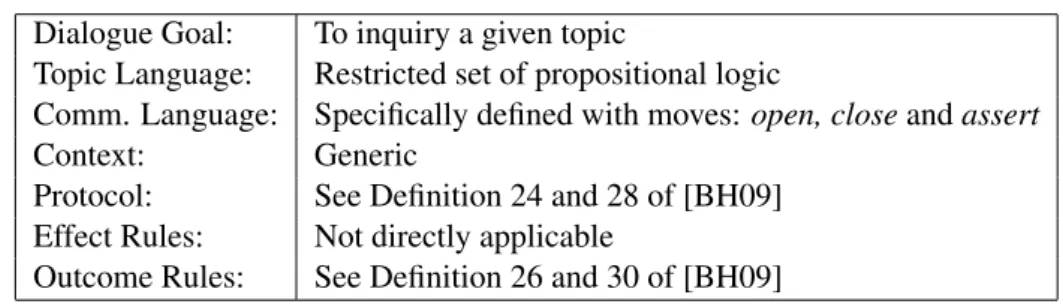
Black and Hunter [BH09] present a formal dialogue system for inquiry dia-logues using Defeasible Logic Programming (DeLP) [GS04] as its underlying ar-gumentation framework. Using Prakken’s framework as a guideline, we can view that dialogue system as shown in Table 2.5.
Table 2.5: Black and Hunter’s inquiry dialogue framework.
Dialogue Goal: To inquiry a given topic
Topic Language: Restricted set of propositional logic
Comm. Language: Specifically defined with moves:open, closeandassert
Context: Generic
Protocol: See Definition 24 and 28 of [BH09] Effect Rules: Not directly applicable
Outcome Rules: See Definition 26 and 30 of [BH09]
Black and Hunter have considered two types of inquiry dialogues in [BH09], argument inquiry and warrant inquiry. In both dialogues, the two participat-ing agents jointly inquire about topics. Argument inquiry dialogues allow two agents to share knowledge to jointly construct arguments (roughly speaking, in their frameworks, arguments are deductions of topics); whereas warrant dialogues allow two agents to share knowledge to jointly construct dialectical trees. The di-alectical tree defined by Black and Hunter resemble the abstract dispute trees we have presented earlier in that “the dialectical tree can be considered a tree with an argument at each node in which a child node is a counter argument to its parent”.
Black and Hunter have defined their framework in steps. Firstly, they define that their framework contains three moves (type of utterances): open, close and assert. Then, they define their dialogues as sequences of moves satisfying three requirements: (1) starting with anopenmove, (2) every move must be made to a participant of the dialogue, and (3) maintaining a strict interleaving between the two agents. A dialogue terminates when both agents make the close move. A dialogue proceeds by agents contributing sentences as thecontentof their moves. In argument inquiry dialogues, only sentences that “expand” the deduction of the topic are allowed in the dialogue; whereas in warrant dialogues sentences that are both expanding and in conflict with the topic can be uttered. In both cases, there is a “relevance” requirement such that all utterances are “related” to the claim in both dialogues.
Black and Hunter have used the “union” of the two agents’ knowledge as the benchmark for evaluation. They have proved that their framework is both sound and complete, i.e., for their argument inquiry dialogues, if there is an argument in the union of the two agents’ knowledge base, then such argument can be con-structed in their dialogues, and if their dialogue finds an argument, then this
argu-ment exists in the union of the two agents’ knowledge base. Similar results have been shown for their warrant inquiry dialogue as well. These results hold mostly because of theexhaustivestrategy they enforce, which defines that during a dia-logue, if the protocol allows making an utterance, then the agent has to make such utterance, i.e., agents cannot hide any information that is “relevant” to the topic in discussion.
Compare with their work, the work presented in this thesis have a few advan-tages. Namely,
1. by using a structured argumentation framework, i.e., ABA, we allow dia-logues to be computed with different argumentation semantics, e.g., admis-sibility and grounded, whereas their system uses DeLP and does not support this computation;
2. our framework is generic and supports many types of dialogues whereas their system is only used for inquiry.
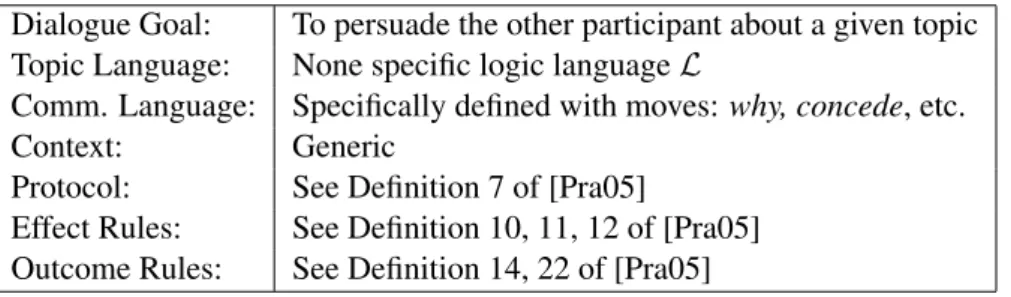
Prakken [Pra05] defines a formal dialogue system for persuasion dialogues. Properties of that system are summarised in Table 2.6. Similarly to Table 2.5, much of the detail of Prakken’s system could not be captured in a compact ta-ble. However, it can be seen that these two systems serve as examples of dialogue systems and they share the common framework described in [Pra06].
Prakken has introduced two notions of dialogues in [Pra05],liberalandrelevant. Both liberal and relevant dialogues are supported with moves:claim, why, argue, concedeandretract. Prakken’s liberal dialogues are somewhat similar to Black and Hunter’s dialogues, in that the dialogue starts with a topic, and all moves need to be related to some earlier moves. In Prakken’s framework, an argument is a deduction with a conclusion (conc) and premises (prem). Prakken definesextends as “An argument B extends an argumentA if conc(B) = ϕ and ϕ ∈ prem(A)
(for example,r sincesextendspsinceq, r).” Unlike Black and Hunter, Prakken requires no explicit interleaving between the two agents and he has specifically defined aturn-taking functionto decide which agent makes the next move. Another difference between the two frameworks is that Prakken’s system does not exploit internal structures of arguments. Therefore moves are operated at the level of arguments rather than at the level of logic sentences. This is less of a concern for Prakken as he has focused on persuasion dialogues and there is little need for the two agents to jointly construct arguments in persuasion.
Dialogue Goal: To persuade the other participant about a given topic Topic Language: None specific logic languageL
Comm. Language: Specifically defined with moves:why, concede, etc.
Context: Generic
Protocol: See Definition 7 of [Pra05]
Effect Rules: See Definition 10, 11, 12 of [Pra05] Outcome Rules: See Definition 14, 22 of [Pra05]
Table 2.6: Prakken’s persuasion dialogue framework.
Also similarly to Black and Hunter, Prakken represents his dialogues as trees. Nodes in trees are labelled proponent and opponent meaning they support and attack the topic, respectively. To determining the outcome of a dialogue, Prakken has used anin/out labelling. Conceptually, a node is in if it withstands its attacks; otherwise, it is out. Since the root of a dialogue tree is the topic, the proponent wins the dialogue if the root node is in.
Prakken’s relevant dialogue is his liberal dialogue with certain moves disallowed under specific conditions. Namely, moves that do not change the acceptability status of the topic (root) node is disallowed in relevant dialogues. This refinement ensures more compact and efficient dialogues.
Compare with Prakken’s work, the work presented in this thesis differs such that,
1. our framework is generic and supports many types of dialogues whereas his system is used for persuasion;
2. our dialogue protocol does not pre-assign the proponent or opponent roles to agents and allows agents to construct arguments jointly whereas his system assigns the roles to agents and does not allow joint construction of argu-ments.
Parsons et al. [PWA03] have presented a study on two-agent information seek-ing, inquiry, and persuasion dialogues. This research is performed in an agent-centric view. Though it defines a few utterances, e.g.,question, assert, challenge, etc., their definition of dialogue protocol specifies agent behaviours in a global view, not unlike a two-agent interaction algorithms, as shown in Example 7.
Example 7. This example presents the information-seeking dialogue protocol shown in [PWA03].
1. a1asksquestion(p).
2. a2 replies with either assert(p)orassert(¬p) if it can, andassert(U)if
it cannot. Which response is given will depend upon the contents of its knowledge base and its assertion attitude. U indicates that, for whatever reason,a2cannot give an answer.
3. a1 eitheracceptsa2’s response, if its acceptance attitude allows, or
challe-nges. U cannot be challengedand as soon as it is asserted, the dialogue terminates without the question being resolved.
4. a2 replies to achallengewith an assert(S), whereS is the support of an
argument for the last proposition challenged bya1.
5. Go to 3 for each proposition inSin turn. 6. a1acceptspif its acceptance attitude allows.
Compare to our work, Parsons’s results are not linked to any argumentation se-mantics and honesty of agents has been unconditionally assumed, whereas ours supports semantics and does not assume honesty in the level of dialogue proto-col. Since their protocols are given as algorithms, it is feasible to compute the complexity of their algorithms, which they have studied. Hence, though [PWA03] have touched upon some aspects of agent dialogues, their research differs from that of Prakken or Black and Hunter and is orthogonal to ours.
Applications of dialogue systems are abundant. Some of the early work in dia-logue systems include [Mac90, WW78, WK95]. Using diadia-logue systems in sup-porting resource-bounded reasoning is seen in [Lou98, Ger00]. In artificial intel-ligence and law, persuasion dialogue systems that promote fairness and effective procedure in legal reasoning have been studied [Gor94, HLL94, BC98, Pra01]. In the field of multi-agent systems, dialogue systems have been introduced to support agent interaction [KSE98, PSJ98, APM00, PWA03].
2.6 Conclusion
In this chapter, we briefly introduce the origin of argumentation, applications of computer based argumentation and basic argumentation concepts. A large por-tion of this chapter is devoted to introducing two well-developed argumentapor-tion
frameworks: abstract argumentation and ABA. We have also presented some back-ground on argumentation dialogues and introduced two dialogue frameworks.
In the next chapter, we will start to introduce our dialogue model, key ingredi-ents such aslegal-movefunctions,strategy-movefunctions, andoutcomefunctions will be presented. We will also compare our model with the two main dialogue frameworks presented in this chapter.
3 Argumentation Dialogues
3.1 Introduction
This chapter presents the basis of our model of argumentation based dialogues between (two) agents, using ABA. In our dialogue model, agents can utter claims (to be debated), rules, assumptions and contraries or pass. Thus, dialogues “build” an ABA framework shared between the agents.
The model is given in terms of (various kinds of)legal-move functions, to de-termine which moves agents can make during dialogues, andoutcome functions, to determine whether dialogues have been successful. While participating in di-alogues, agents use strategy-move functions to select utterances that fulfil their goals and / or the goal of the dialogue, amongst utterances allowed by legal-move functions.
We illustrate our dialogue framework with an example dialogue using elements from the classic movieTwelve Angry Men throughout this chapter (and use this example till Chapter 6).
The chapter is organised as follows. Section 3.2 presents the dialogue model, in-cludinglegal-movefunctions andoutcomefunctions. Section 3.3 presents a refined type of dialogue where utterances are related. Section 3.4 introduces strategy-move functions. Section 3.5 discusses a few related work. Section 3.6 concludes.
3.2 Generic Dialogues
We define dialogues as sequences of utterances between two agents a1 and a2
sharing a common languageL. We also assume there is a (non-empty, possibly infinite) setIDthat:
• is totally ordered, with the ordering described by the symbol “<”;
Example 8. For instance, we can defineID as the set of nonnegative integers, namely,N. The total order relation<is defined in the classic sense that fora, b∈ N,a < bif and only if there exists somec∈Nsuch thata+c=b.ID0is0.
Utterances are defined as follows:
Definition 1. Anutterancefrom agentaito agentaj (i, j= 1,2,i6=j) is a tuple hai, aj, T, C, IDiwhere:
• C(thecontent) is of one of the following forms: – claim(χ)for someχ∈ L(aclaim),
– rl(s0←s1, . . . , sm)for somes0, . . . , sm∈ Lwithm≥0(arule),
– asm(α)for someα∈ L(anassumption), – ctr(α, β)for someα, β∈ L(acontrary), – apasssentenceπ, such thatπ /∈ L. • ID ∈ ID \ {ID0}(theidentifier)
• T ∈ ID(thetarget); we impose thatT < ID.
We refer to an utterance with contentπas apass-utterance. We also useP ASS to denote the set of all utterances of the formh , , , π, i1. We refer to an utterance with content other thanπorclaim(χ)as aregular-utterance. In the remainderU will stand for the set of all possible utterances as in Definition 1. We will also adopt the following notation:Uistands for all utterances froma
i inU, namely of
the formhai, , , , i, and, for any utterancehai, , , , i=u, we also say thatu
ismade byai.
Intuitively, when the content of an utterance isπ, the utterance indicates that the agent making it does not have or want to contribute any information (i.e. claim, rule, assumption, contrary) that can be added to the dialogue, either because no such information is in the agent’s possession or because the agent chooses not to disclose such information. The target of an utterance is the identifier of some earlier utterance in the dialogue, as we will see below.
Note that until Chapter 7, we will assume that the identifier of an utterance in all of our dialogues, for simplicity, is a non-negative integer, withID = Nand ID0= 0, as seen in Example 8.
1
Definition 2. AdialogueDai
aj(χ)(between agentsai andaj,i, j ∈ {1,2},i6= j
forχ∈ L), is a finite sequencehu1, . . . , uni,n≥0, where eachul,l= 1, . . . , n,
is an utterance fromaioraj,u1 is an utterance fromai, and:
1. u1 =hai, aj, ID0, claim(χ), idi, for someid∈ ID;
2. the content ofulisclaim(χ)if and only ifl= 1;
3. the target of pass- and claim utterances isID0; the target of regular-utterance
is notID0;
4. for every utteranceui =h , , T, , i, such thati > 1andT 6= ID0, there
exists auk =h , , , C, Ti, such thatC6=πandk < i;
5. no two consecutive utterances are pass-utterances, other than possibly the last two utterances,un−1andun;
6. for0≤i, j ≤n, ifi < j, then the identifier ofui is less than the identifier
ofuj.
If the last two utterances are pass-utterances, then Dai
aj(χ) is referred to as
completed. If n = 0, Dai
aj(χ) is referred to as empty. Given a dialogue δ =
hu1, . . . , uniand an utteranceu, we defineδ◦u=hu1, . . . , un, ui.
Givenδ =hu1, . . . , uni, we say that eachui,1≤i≤n, isinδ.
In the remainderDwill stands for the set of all dialogues as in Definition 2. Note that condition 4 in Definition 2 enforces a basic notion of “relevance”, expressed by the following.
Definition 3. For any two utterancesui, uj ∈ U, ui =6 uj,ujisrelated touiif and
only ifui =h , , , , IDi,uj =h , , ID, , i.
The following example illustrates our notion of dialogue.
Example 9. Given L = {s, a, b, c, d, g, q, r}, and ID = N with ID0 = 0, a
possible (completed) dialogueDa1
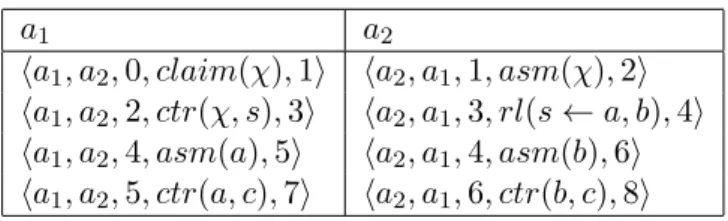
a1 a2 ha1, a2,0, claim(s),1i ha2, a1,0, π,2i ha1, a2,1, rl(s←a),3i ha2, a1,3, asm(a),4i ha1, a2,4, ctr(a, q),5i ha2, a1,5, rl(q←b),6i ha1, a2,6, asm(b),7i ha2, a1,7, ctr(b, c),8i ha1, a2,8, asm(c),9i ha2, a1,9, ctr(c, r),10i ha1, a2,0, π,11i ha2, a1,0, π,12i
Note that in this example (and in general)a1,a2may or may not be equipped with
an ABA framework. ABA is used as a lingua franca in the spirit of the Argument Interchange Format (AIF) [RR09], in the sense that internally, agents can represent their knowledge in representations other than ABA; while communicating, agents convert their internal representation into ABA. Even ifa1, a2 are equipped with
ABA frameworks, the agents may or may not be truthful, in that, for example, an agent may utter “made-up” rules which do not exist in its ABA framework.
We will illustrate the dialogue notions in the context of the following example, adapted from the movieTwelve Angry Men, an example of argumentation based collaborative reasoning [AB11]. Here, we focus on the reasoning of two of the jurors: juror 8, played by Henry Fonda (a1), and juror 9, played by Joseph Sweeney
(a2). These agents need to decide whether to condemn a boy, accused of murder,
or acquit him, after a trial where two witnesses have provided evidence against the boy. According to the law, the jurors should acquit the boy if they do not believe that the trial has proven him guilty convincingly.
Example 10. In this example, two agents perform a dialogueδto decide whether to condemn the boy. The example dialogue,δ=Da1
a2(boy innocent), is shown in Table 3.1. Utterances in this dialogue should be self-explanatory. For example,
boy innocent←boy not proven guilty
says that the boy should be deemed to be innocent if he cannot be proven guilty. In this example, it can be seen thata1starts the dialogue by putting forward the
claim:claim(boy innocent). Then both agents contribute rules, assumptions and contraries for and against the claim (directly or indirectly). A natural language reading of this dialogue is in Table 3.2. Utterances in this dialogue are (top-down) related and the dialogue completes with two consecutive passes.
Our dialogue model allows pass-utterances being uttered at any moment through-out a dialogue, but we are able to extract a “sub-dialogue” which contains no
pass-Table 3.1: Dialogueδfor Example 10. ha1, a2,0, claim(boy innocent),1i
ha2, a1,1, rl(boy innocent←boy not proven guilty),2i
ha1, a2,2, asm(boy not proven guilty),3i
ha2, a1,3, ctr(boy not proven guilty, boy proven guilty),4i
ha1, a2,4, rl(boy proven guilty←w1 is believable),5i
ha2, a1,5, asm(w1 is believable),6i
ha1, a2,6, ctr(w1 is believable, w1 not believable),7i
ha1, a2,7, rl(w1 not believable←w1 contradicted by w2),8i
ha1, a2,8, rl(w1 contradicted by w2←),9i
ha2, a1,4, rl(boy proven guilty←w2 is believable),10i
ha1, a2,10, asm(w2 is believable),11i
ha2, a1,11, ctr(w2 is believable, w2 not believable),12i
ha1, a2,12, rl(w2 not believable←w2 has poor eyesight),13i
ha2, a1,13, rl(w2 has poor eyesight←),14i
ha1, a2,0, π,15i
ha2, a1,0, π,16i
Table 3.2: A natural language reading of the dialogue in Table 3.1. a1: The boy is innocent.
a2: The boy is innocent if he is not proven guilty.
a1: We assume the boy is not proven guilty.
a2: The boy cannot be proven not guilty if he is guilty.
a1: The boy is guilty if witness 1 is believable.
a2: We assume the witness 1 is believable.
a1: Witness 1 is not believable if it cannot be believed.
a1: Witness 1 cannot be believed if it is contradicted by witness 2.
a1: Witness 1 is indeed contradicted by witness 2.
a2: The boy is guilty if witness 2 is believable.
a1: We assume the witness 2 is believable.
a2: Witness 2 is not believable if it cannot be believed.
a1: Witness 2 cannot be believed as it has a poor eyesight.
a2: Witness 2 indeed has a poor eyesight.
a1: OK.
utterance. This is defined using the notion ofπ-pruned sequence obtained from a dialogue, consisting of all regular-utterances in a dialogue. Note that, since no regular-utterance has a pass-utterance as its target (by condition 3 in Definition 2), the target of every utterance in a π-pruned sequence is guaranteed to be in this sequence. Also, since the first utterance in a dialogue can never be a pass utter-ance (by condition 2 of Definition 2), the first utterutter-ance in aπ-pruned sequence is always the same as the first utterance in the original dialogue. Moreover, it is trivially true that for any utteranceuthat ifuis not in a dialogueδ,uis not in the π-pruned sequence ofδ.
Example 11. Theπ-pruned sequence obtained from the dialogueδin Example 9 is the followingδ0: a1 a2 ha1, a2,0, claim(s),1i ha1, a2,1, rl(s←a),3i ha2, a1,3, asm(a),4i ha1, a2,4, ctr(a, q),5i ha2, a1,5, rl(q←b),6i ha1, a2,6, asm(b),7i ha2, a1,7, ctr(b, c),8i ha1, a2,8, asm(c),9i ha2, a1,9, ctr(c, r),10i
Note thatδ0 = hu01, . . . , u90iwhereu01 = u1, u02 = u3, u03 = u4, u04 = u5, u05 =
u6, u06=u7, u07=u8, u09=u10, forui =h , , , , iiin the originalδ.
In Example 9, we see the two agents taking turns in making utterances. A strict interleaving is enforced between these two agents. In general, such requirement is unnecessary, i.e., an agent is allowed to make a few consecutive utterances before the other agent makes any. We define a (generic) turn-making function to specify the agents that makes the next utterance.
Definition 4. Aturn-making functionis a mappingγ :D 7→ {a1, a2}such that,
givenδ =Dai aj(χ) =hu1, . . . , uni,i, j ∈ {1,2}, i6=j: γ(δ) = ai ifn= 0, ax∈ {ai, aj} otherwise.
A dialoguehu1, . . . , uni(n >0) iscompatible with a turn-making functionγ
if and only if for eachl= 1, . . . , n, iful=hax, , , , ithenγ(hu1, . . . , ul−1i) =
ax.
Our definition of turn-making function is very liberal, in that it states that ai
startsDai
aj(χ)and all subsequent utterances are made by any of the agents as
dic-tated byγ. As observed earlier,γ(δ)forδ =Da1
![Table 2.4: Dialogue types (adapted from [WK95]).](https://thumb-us.123doks.com/thumbv2/123dok_us/10981399.2986031/33.892.176.735.175.551/table-dialogue-types-adapted-from-wk.webp)