Study on cryptographic protocols
About ENISA
The European Union Agency for Network and Information Security (ENISA) is a centre of network and information security expertise for the EU, its member states, the private sector and Europe’s citizens. ENISA works with these groups to develop advice and recommendations on good practice in information security. It assists EU member states in implementing relevant EU legislation and works to improve the resilience of Europe’s critical information infrastructure and networks. ENISA seeks to enhance existing expertise in EU member states by supporting the development of cross-border communities committed to improving network and information security throughout the EU. More information about ENISA and its work can be found at www.enisa.europa.eu.
Authors
This work was commissioned by ENISA under contract ENISA D-COD-14-TO9 (under F-COD-13-C23) to the consortium formed by K.U.Leuven (BE) and University of Bristol (UK).
Contributors: Nigel P. Smart (University of Bristol), Vincent Rijmen (KU Leuven), Martijn Stam (University of Bristol), Bogdan Warinschi (University of Bristol), Gaven Watson (University of Bristol).
Editor: Nigel P. Smart (University of Bristol).
ENISA Project Manager: Rodica Tirtea.
Agreements of Acknowledgements
We would like to extend our gratitude to: External Reviewers: Michel Abdalla (ENS Paris), Kenneth G. Paterson (Royal Holloway, University of London), Ahmad-Reza Sadeghi (T.U. Darmstadt), Michael Ward (Mastercard) for their comments suggestions and feedback.
We also thank a number of people for providing anonymous input and Cas Cremers (Oxford University) and Hugo Krawczyk (IBM) for detailed comments on various aspects.
Contact
For contacting the authors please use [email protected].
Legal notice
Notice must be taken that this publication represents the views and interpretations of the authors and editors, unless stated otherwise. This publication should not be construed to be a legal action of ENISA or the ENISA bodies unless adopted pursuant to the Regulation (EU) No 526/2013. This publication does not necessarily represent state-of the-art and ENISA may update it from time to time.
Third-party sources are quoted as appropriate. ENISA is not responsible for the content of the external sources including external websites referenced in this publication.
This publication is intended for information purposes only. It must be accessible free of charge. Neither ENISA nor any person acting on its behalf is responsible for the use that might be made of the information contained in this publication.
Copyright Notice
© European Union Agency for Network and Information Security (ENISA), 2014 Reproduction is authorised provided the source is acknowledged.
Executive summary
Cryptographic algorithms, when used in networks, are used within a cryptographic protocol. In the ENISA algorithms report of 2013 [113], several protocols were discussed. In this document (which is the sister document of the 2014 report [115]) we extend the work in the 2013 report to cover more categories of protocols.
The focus of this report is on decision makers in corporations and governments making decisions as to what protocols to use so as to protect online communications which contain personal data which needs to be kept private. Even if the cryptographic primitives and schemes (discussed in [115]) are deemed secure, their use within a protocol can result in a vulnerability which exposes the supposedly secured data.
Another focus of the report is to point out the paucity of work, which demonstrates that standard protocols meet well defined security goals. Thus the report, hopefully, will act as a stimulus to researchers and funders in this area to focus efforts on the important area of cryptographic protocols. Whilst the security of basic cryptographic building blocks, such as primitives and protocols, is well studied and understood, the same cannot be said of cryptographic protocols. The scientific study of such protocols can be said to be still not mature enough.
As an example of this infancy we point to the discussion in this document on TLS (Transport Layer Security) security, Section 3.1. The TLS protocol is the protocol used to secure traffic from web-sites to browsers; despite a lot of effort on understanding this protocol in the last few years, basic protocol errors are still being found (e.g. Lucky13 [17]), as well as implementation errors (e.g. HeartBleed [87]). In this report we focus on the former type of problems as opposed to the latter type of problems. Guidelines
The following guidelines are addressed to researchers in the field:
1. Many cryptographic and security protocols have in the past been designed by networking and protocols experts, and not by cryptographic protocol experts. The design of cryptographic protocols is particularly challenging, and the associated security proofs to guarantee correctness are vastly more complicated than those for cryptographic schemes. Researchers need to work on simplifying the analysis, and enabling automated tools to provide strong computational guarantees using computational soundness results.
2. More attention needs to be paid to automated verification that an implementation of a protocol actually meets a given security goal. This is distinct from showing that an abstract protocol meets a given security goal described above. This problem is particularly challenging, compared to normal automatic code verification, due to the interactive nature of protocols. Thus researchers need to examine how such automated tools can guarantee correct implementation of a protocol design.
3. Designers and implementers should refrain from “optimising” well studied protocols to achieve some specific application need; unless they are prepared to revisit and re-evaluate the above security proofs. Small insignificant changes in protocols can result in invalidating the guarantees of such proofs.
The key problem with protocols today is that many result from cryptographic design many years (even decades) ago. Thus cryptographic protocols suffer more from legacy issues than the underlying cryptographic components. The goal should be to work towards a better cryptographic protocol infrastructure which does not exhibit such problems. Thus we provide the following guidelines to organisations which are developing new protocols:
1. Future protocols should be designed using solid and well-established engineering principles, but also with ease of formal security analysis in mind, and ideally in conjunction with the development of formal security proofs. They should also be designed in the light of the state of the art in cryptanalysis of their constituent primitives. The many issues that have arisen in real world protocols in recent years highlight the inadequacies of the ad hoc design approach, albeit it supported by well-established “rules of thumb”
2. Future protocols should not be any more complex than they need to be (eliminate extraneous options which only invite attacks - e.g. renegotiation attacks, and Triple Handshake attacks on TLS; the high number of key exchange options in IPSec).
3. Carefully designed protocols will exhibit algorithm agility and secure version negotiation to support future development (but not at the expense of simplicity). Thus, lock in of cryptographic protocols and schemes for many years should be avoided. It should be relatively easy to upgrade cryptographic components, by designing protocols in a modular manner. Enabling components which are no longer deemed secure to be swapped out.
4. More work needs to be performed on verifying Application Programming Interfaces (APIs) for application protocols. Both in terms of understanding their security properties and verifying that the API meets such properties. For example a secure channel API should be secure as long as the underlying cryptographic components are secure; no security weakness should be introduced by the API itself.
Acronyms
3DES Triple DES3GPP 3rd Generation Partnership Project (mobile phone system) A5/X Stream ciphers used in mobile phone protocols
ABE Attribute Based Encryption AE Authenticated Encryption
AEAD Authenticated Encryption with Auxiliary Data AES Advanced Encryption Standard
AESKW A Key Wrap Scheme AH Authentication Header
AKA Authentication and Key Agreement AKW1 A Key Wrap Scheme
AKW2 A Key Wrap Scheme AMAC ANSI Retail MAC
ANSI American National Standards Institute BB Boneh–Boyen (ID based encryption) BF Boneh–Franklin (ID based encryption) BPP Binary Packet Protocol
BPR Bellare, Pointcheval and Rogaway BMP Boyko, MacKenzie and Patel CBC Cipher Block Chaining (mode) CCA Chosen Ciphertext Attack CCM Counter with CBC-MAC (mode) CFB Cipher Feedback
CMA Chosen Message Attack CMAC Cipher-based MAC CPA Chosen Plaintext Attack CTR Counter (mode) CVA Ciphertext Validity Attack CWC Carter–Wegman + Counter DAA Direct Anonymous Attestation DEM Data Encapsulation Mechanism DES Data Encryption Standard DLP Discrete Logarithm Problem DSA Digital Signature Algorithm E0 A stream cipher used in Bluetooth EAX Actually stands for nothing (mode) EC2 Elastic Computing Cloud
ECB Electronic Code Book (mode) ECC Elliptic Curve Cryptography
ECDLP Elliptic Curve Discrete Logarithm Problem ECIES Elliptic Curve Integrated Encryption Scheme EEA EPS Encryption Algorithm
EIA EPS Integrity Algorithm EKE Encrypted Key Exchange EMAC Encrypted CBC-MAC
EME ECB-mask-ECB (mode)
EMV Europay–Mastercard–Visa (chip-and-pin system)
ENISA European Union Agency for Network and Information Security ESP Encapsulating Security Payload
FDH Full Domain Hash
FHE Fully Homomorphic Encryption GCM Galois Counter Mode
GDSA German Digital Signature Algorithm GMAC The MAC part of the GCM block cipher mode GSM Groupe Special Mobile (mobile phone system) HMAC A hash based MAC algorithm
IAPM Integrity Aware Parallelizable Mode IEC International Electrotechnical Commission IEEE Institute of Electrical and Electronics Engineers IETF Internet Engineering Task Force
IKE Internet Key Exchange
IND Indistinguishability of Encryptions INT-CTXT Integrity of Ciphertexts IPsec Internet Protocol Security ISO International Standards Organization IV Initialisation Vector (or Value)
KDSA Korean Digital Signature Algorithm KDF Key Derivation Function
KEM Key Encapsulation Mechanism KW AES Key Wrap
KWP AES Key Wrap with Padding LAMP Linux, Apache, MySQL, PHP
LTE Long Term Evolution (mobile phone system) LWE Learning With Errors
MAC Message Authentication Code MOV Menezes–Okamoto–Vanstone (attack) MPC Multi Party Computation
MQV Menezes–Qu–Vanstone (protocol) MS Mobile Station (i.e. a phone in UMTS/LTE)
NIST National Institute of Standards and Technology (US) NMAC Nested MAC
NTRU A Post Quantum Encryption Algorithm OAEP Optimal Asymmetric Encryption Padding OCB Offset Code Book (mode)
OFB Output Feedback (mode) OPE Order Preserving Encryption ORAM Oblivious Random Access Memory
PACE Password Authenticated Connection Establishment PAK Password Authenticated Key (PAK) Exchange PAKE Password Authenticated Key Exchange PEKS Public Key Encryption Keyword Search PKCS Public Key Cryptography Standards PKE Public Key Encryption
POR Proofs Of Retrievability PRF Pseudo Random Function
PRNG Pseudo Random Number Generator PRP Pseudo Random Permutation
PSEC Provable Secure Elliptic Curve (encryption) PSS Probabilistic Signature Scheme
PV Pointcheval–Vaudenay (signatures) RC4 Ron’s Cipher Four (a stream cipher) RDSA Russian Digital Signature Algorithm RFC Request For Comments
RAM Random Access Memory ROM Random Oracle Model RSA Rivest–Shamir–Adleman SA Security Association SHA Secure Hash Algorithm SIMD Single Instruction Multiple Data SIV Synthetic Initialization Vector SK Sakai–Kasahara (ID-based encryption) SN Serving Network (i.e. a provider in UMTS/LTE) SPAKE Single-Party Public-Key Authenticated Key Exchange SPD Security Policy Database
SQL Structured Query Language SSE Symmetric Searchable Encryption SSH Secure Shell
SSL Secure Sockets Layer TKW Triple-DEA Key Wrap TDKW A Key Wrap Scheme
TRNG True Random Number Generator UEA UMTS Encryption Algorithm UF Universally Unforgeable UIA UMTS Integrity Algorithm UMAC Universal hashing based MAC
UMTS Universal Mobile Telecommunications System VPN Virtual Private Network
WEP Wired Equivalent Privacy WPA Wi-Fi Protected Access
Table of Contents
Executive summary
iv
Acronyms
vi
1
Introduction
1
1.1 Designing and Verifying Protocols: Ideal World 2
1.2 Designing and Verifying Protocols: Real World 3
1.3 How to Read This Document 3
2
General Protocols
4
2.1 Key Agreement 4
2.2 Identification and Authentication Protocols 5
2.3 Password Authenticated Key Exchange Protocols 6
3
Specific Protocols
8
3.1 TLS 8
3.2 SSH 10
3.3 IPSec 11
3.4 Kerberos 14
4
Application Specific Protocols
15
4.1 WEP/WPA 15 4.2 UMTS/LTE 15 4.3 Bluetooth 16 4.4 ZigBee 17 4.5 EMV 17
5
Application Areas
19
5.1 Cloud Computing 19 5.1.1 Cloud Models 195.2 Cloud Computing Security 20
5.3 Data Security in the Cloud: Future Technology 22
5.3.1. CryptDB 25
1
Introduction
A cryptographic protocol is a procedure carried out between two parties which is used to perform some security task. Typically cryptographic protocols make use of one, or more, cryptographic primitives and/or schemes. An example might be the transmission of a credit card number from Bob to an e-commerce web site Alice. Such a protocol might involve a digital signature scheme (so Bob knows he is talking to Alice), and a form of encryption (to ensure Bob’s credit card details are not intercepted in transit). Examples of deployed protocols which perform such operations are TLS or IPSec.
Whilst the theory and design of cryptographic primitives and schemes (discussed in the sister report [115]) is relatively well established, and the feed through into deployed systems and products is progressing well, the same cannot be said for protocols. Due to the inherent complexity of the situations for which they are intended and the many subtleties that arise, cryptographic protocols are notoriously difficult to design, and even more difficult to analyse.
In this document we outline the current knowledge on various classes of protocols. Our choice of protocols to cover is mainly dictated by what we feel is of most interest to the type of reader specified in the Executive Summary. Thus the protocols are either deployed in products, or are defined in standards and are hence planned to be deployed. Much of what we discuss in this report is likely to change as the research community shifts its focus to analysing protocols over the coming decade. The reader will hopefully also see by our analysis that most of the deployed protocols which can be used by a naive user, are in fact either incredibly complex to configure in a manner which we would deem secure, or are in fact insecure by modern cryptographic standards.
How did such a poor state-of-affairs for the analysis of protocols arise? There are multiple answers to this question. Firstly, although academic researchers have put a large amount of effort in analysing protocols, the results are in settings that although informed and motivated by practice, do not immediately impact real uses of protocols. Some research, mainly that on formal methods (e.g. [88,275,298]) or the UC framework (e.g. [75]), aims to develop general frameworks for protocol analysis. However, concrete protocol analysis in such frameworks is confined to a small class of protocols (witness the numerous analyses of the Needham-Schroeder protocol [236]) or to generic results (for example general multi-party computation [138, 310]). Some academic results concern more specific classes of protocols such as key agreement [38]. However, this analysis has often been performed after the standards have been produced, and usually considers versions of the implemented protocols that are too simplified.
A second reason is that practitioners usually adopt an ad-hoc design mentality for protocols. In this approach a protocol is designed according to some well-established principles and then one tries to find attacks; if attacks succeed, then a fix is suggested and new attacks are searched. This was acceptable in the early days of the subject, but now that we have formal theories to capture security definitions for protocols this approach does not seem adequate anymore.
Thirdly, there is a certain (perhaps understandable) inertia that prevents practice from incorporating academic research. It is often the case that issues identified within the design of protocols already in place are dismissed as being only of “theoretical” interest, until the issues are exploited by a real attacker. Thus there is an inbuilt conservatism to not change anything, despite evidence that a given protocol may have a problem. This resistance to change can result in security vulnerabilities.
1.1
Designing and Verifying Protocols: Ideal World
After having discussed what can go wrong, we now explain how things could be improved. Firstly, we note there are two schools as to how to verify a protocol; we refer to these loosely as the computational and the symbolic schools.
• Computational School: In this school, often called the provable security school, a protocol is analysed according to some well-defined model. A complexity theoretic reduction is given which turns an adversary against the protocol into an adversary against a component. Thus the protocol is secure if all of its components are secure. To determine whether the component is secure (which is often a cryptographic scheme) a further reduction is provided to a cryptographic primitive. These reductions can be complex, with proofs being many pages long, and needing (currently) to be produced and verified by hand.
• Symbolic School: In this school, often called the formal methods school, a protocol is analysed assuming perfect cryptography. The protocol is then abstractly described in, for example, a process algebra, with the attacker’s goals being described by equations and the attacker’s capabilities defined by equational theories. After this stage an automated checking process is applied to ensure that the attacker can never reach the stated goals. This type of analysis is often said to use the “Dolev-Yao” model [105].
Each school has its advantages and disadvantages. The first school has the disadvantage that it requires hand generated and checked proofs; on the other hand it models the cryptography and adversary as close to the real world as possible. The second school has the disadvantage that it assumes perfect cryptography (which we know is not possible in real systems), but it allows for tools that automate devising proofs, or at the very least checking them [54, 91, 218, 258].
In recent years there has been some progress towards using the best of both worlds. For some
protocols the theory of computational soundness will imply that a protocol shown to be secure in the symbolic method will also be secure in the computational model [6, 89]. However, this method only applies to a restricted set of protocols. In the other direction, some researchers are applying the techniques from the symbolic school to try to automate the proof generation methods in the computational school [27, 28, 55]. However, both of these techniques are still in their infancy. A major problem is that whatever method is used an actual protocol may not follow the abstract specification which is analysed. The process, known as idealisation, of turning a protocol specification as found in a standard into one which is analysable by any of the above techniques is notoriously error prone.
Thus the “correct” way for a protocol to be designed is for a specification to be given, which allows for it to be easily translated into an abstract specification. Then the protocol should be analysed using the techniques of either of the above schools. The designer should feedback lessons learned from the analysis into the protocol design and the process should be repeated.
At the end, if analysis has been performed with symbolic methods, and computational soundness results do not apply, then we can conclude that the protocol has no structural weaknesses and no obvious attacks. If computational soundness results do apply, or the protocol has been proved secure in the computational school, then we can conclude that the protocol is secure with respect to the given computational security model. This latter point means that any insecurity will either be one of implementation or uses an attack vector which was not captured by the security model.
1.2
Designing and Verifying Protocols: Real World
In the real world protocols are almost always designed, deployed, patched and extended before any formal analysis of their properties happens. This is either for historic reasons (the protocols date to a time before verification techniques were understood), or for business reasons (for example a protocol is defined “in house” and only then is made public for public analysis, after a product has been produced). Thus formal verification using either symbolic or computational means is often applied post-hoc.
Often this post-hoc analysis finds faults in the standardised/deployed protocols (see for example our discussion of ISO 9798 in Section 2.2) or it can only be applied to small subsets of the actual protocol (see for example our discussion of TLS in Section 3.1). In the latter case one can obtain verification of the small part, but not of the whole protocol.
A major problem with protocols is the question of composition. A protocol which is secure when run in isolation may not be secure if run in composition (either sequentially or in parallel). Since most protocols are run in an online environment, with multiple executions happening at any one time, the issue of parallel composition is vital to ensure. Theoretically, techniques exist to enable composition of protocols to be designed in from the start, for example the UC Framework [75]. However, the analysis of most existing protocols has been carried out in the standalone setting, which may result in attacks in practical situations.
1.3
How to Read This Document
We divide our discussion on protocols into four sub-themes:
• General Protocols: These are protocols which are designed to meet some general security requirement and which can be used in a multitude of applications. They are generally simple stand-alone protocols with no “reference” implementation or deployment; examples include: General key agreement and general identification.
• Specific Protocols: These are protocols which often implement some well specified security requirement, but for which there are well known instantiations. These protocols are ones which can be used to provide various application services depending on the specific environment in which they are deployed; examples include: TLS and Kerberos.
• Application Specific Protocols: These are protocols which are designed for a tightly defined specific application; examples include: UMTS/LTE, WEP/WPA and ZigBee.
• Application Areas: These are areas to which various protocols can be applied, and for which ENISA specifically requested a discussion. In this document this section focuses on the area of cloud computing.
To understand the distinction between the latter three cases consider the following: Application developers often choose to use TLS as a means to securing a channel between applications, and the various parameters can then be selected by the developer; irrespective of whether the application is providing a web service or not. On the other hand, one is forced to use the mobile phone protocols UMTS/LTE if one wishes to use a standard mobile phone, with provider mandated parameters and algorithms. In addition the use of UMTS/LTE outside this application is very limited. Clearly this division is not complete, as in some sense one is also forced to use TLS when accessing secure web sites, but the usage of TLS is much wider than that. In particular TLS can be used in the context of cloud computing to secure connections from a client to a cloud, or between cloud installations.
Protocol choices also depend on the specific environment being considered. In this version of the report, at the request of ENISA, we include a section detailing issues related to the environment which has been called “Cloud Computing”.
2
General Protocols
In this section we detail some protocol classes; which on their own have been specified in standards but for which we know of no concrete implementation. Thus we call them general protocols as they essentially specify classes of protocols; some of which are then instantiated in Section 3 on Specific Protocols.
For each protocol class we specify a general description, standardization efforts, and limitations and then we give technical details.
2.1
Key Agreement
General Description: A key agreement protocol allows two parties to agree on a shared secret key. There are various properties which may hold in a protocol; for example, one or both parties may end up being authenticated to the other, the protocol may guarantee a random key is output even if one party is compromised, and so on. Authentication of parties is generally obtained by parties holding a
static public/private key pair, which are used in multiple sessions. Any key pairs used in a specific session are called ephemeral keys. An important distinction is between key transport where one party generates a key and sends it to the other, and key agreement where neither party has complete control over the key generation process.
We first discuss key agreement, since this is the one area in which there has been a rigorous analysis of protocols; with concrete security definitions being given. Despite this, the situation in relation to how these security definitions map onto real world protocols and their usages is still in a state of flux. Standardization Efforts: The NIST standard [240] (resp. [241]) and the ANSI standards [20, 22] (resp. [21]) define methods for general key agreement using discrete logarithm based systems (resp. factoring based systems). The standard [240] introduces a nice taxonomy for such schemes with the notation C(a, b), where a, b ∈ {0, 1, 2}. The number a refers to how many of the two parties contribute ephemeral keys to the calculation and the number b refers to how many of the two parties are authenticated by long term public/private key pairs. For example, traditional non- authenticated Diffie–Hellman is of type C(2,0), whereas traditional MQV [206] is of type C(2,2). The standards also provide various mechanisms for key confirmation.
There are a sequence of standards in the ISO/IEC 11770 series, which mirror the ISO/IEC 9798 series discussed below. The main set (ISO/IEC 11770-2,-3, and -4) detail mechanisms involving symmetric encipherment techniques [163], public key techniques [164], and weak secrets (such as passwords) [165].
Limitations: The general standards on key agreement mentioned above are very general. The reader should refer to the TLS, IPSec, etc discussions in Section 3 for examples of such protocols in more detail.
Technical Details: The security of key agreement schemes is somewhat complicated. The traditional security models of Bellare, Rogaway, et al base security on indistinguishablity of keys [37, 38, 53, 79]. This property is often not satisfied by real world protocols, and in particular by protocols using key confirmation. This issue has started to be treated in a number of works focusing on the TLS protocol (see below). Also discussion of the notion of one-sided authentication in key agreement protocols has only recently been considered in the academic literature [74,199]. Thus many of the options in these standards cannot be said to have fully elaborated proofs of security which are applicable in general situations.
The precise choice of which key agreement scheme to use is therefore highly dictated by the underlying application. However, the sister report to this one [115] can be used to determine key sizes
(for the underlying factoring and discrete logarithm based primitives) as well as the key derivation functions, MAC functions and any other basic cryptographic components used.
Finally, a crucial requirement which is becoming more important in the real world is that of forward secrecy. A key agreement scheme is said to be forward secure if the compromise of the long term static private key of a party does not compromise the confidentiality of the agreed key for sessions which occurred prior to the compromise of the key. Thus we are ensured that the key agreed now will be secure against any future compromise of the static keys.
2.2
Identification and Authentication Protocols
General Description: Identification protocols are protocols which enable a party to establish in an online protocol that they are both “live” and the claimed person at the other end of the communication. As such, parties have a static secret or private key whose possession is being verified. This static key may either be associated to the known static public key, or may be a shared secret held between the person verifying their identity and the person proving their identity.
In this work we make no distinction between identification and user authentication; however in some applications (for example those based on biometrics) the distinction is important. In general, in an authentication protocol we are aiming to verify the person against a known claimed identity, in an identification protocol the verifier is not given the claimed identity1 and needs to also output this
value. Thus, identification means a way of determining who someone is from a given population, whereas authentication means confirming a claimed identity.
Identification and user authentication are closely related to the topic of key agreement. Indeed in the academic key agreement literature these are often treated at the same time, see for example [79]. The reason for this linkage is that key agreement without user identification achieves relatively little. In addition, often keys are agreed for the primary purpose of authenticating a subsequent communication without the need to perform expensive public key operations on each communication. However, in terms of applications the usage of identification and authentication techniques have wider impact; for example in access to resources and/or physical settings.
Standardization Efforts: The main standards in this area are the ISO/IEC 9798 series [168–173]. The main set (ISO/IEC 9798-2,-3, and -4) detail mechanisms involving symmetric encipherment (i.e. encrypting a challenge under a secret key as a means of authentication) [169], those involving a cryptographic check function (i.e. applying a MAC function to a challenge as a means of authentication) [170], and those involving a digital signature (i.e. signing a given challenge as a means of authentication) [171].
Limitations: The standards in the ISO/IEC 9798 series are mainly “folklore” and as such their analysis has only recently been performed in the academic literature. Work in the provable security tradition was first performed as early as 2001 [34], despite this the original standards contained numerous problems which were identified in 2011 [29, 30] using the symbolic tradition. See below for an extensive discussion on this point.
Technical Details: The problems identified in [29, 30] were identified using a tool called SCYTHER, which found the weaknesses and determined whether proposed fixes were correct. A related tool called SCYTHER-PROOF was used to produce proof scripts which were then machine-checked using the Isabelle/HOL theorem prover. Various problems were identified including role-mixup attacks, type flaws, and reflection attacks; most of the flaws resulted from poor specification of message formats or crucial missing fields. Thus data intended for one person could be routed to another, or data
elements could be interpreted in different ways. The standards have since been revised to take into account the problems identified, but the analysis is a lesson in the importance of applying modern scientific techniques to protocol design as opposed to relying on folklore. As mentioned the analysis in [29, 30] is purely in the symbolic tradition. Thus we obtain guarantees of correctness and the identification of logical weaknesses. To our knowledge, no systematic analysis has been done in the computational tradition; nor has an analysis been conducted as to whether computational soundness results can be applied to the existing symbolic analysis. Clearly some of the protocols in ISO/IEC 9798-2, -3, and -4 have been analysed in the academic literature in a computational manner but this is not documented well, and there is always the issue of problems related to idealisation between the definition in the standard and the definition used in the academic literature.
The standard ISO/IEC 9798-5 [172] details protocols based on zero-knowledge techniques. Due to the difficulty of dealing with these using symbolic methods, these are not analysed in [29, 30]. However, all of the protocols in this standard have appeared in the academic literature with computational proofs of security. All of the basic techniques are based on the ideas behind the Fiat–Shamir identification scheme [117], and the closely related Guillou–Quisquater scheme [144]. In these protocols a user is identified by showing knowledge of some secret value which has been committed in their identifying information (e.g. by showing knowledge of a private key associated to a public key). As well as these “classic” methods the standard also contains the schemes of Girault, Poupard and Stern [133, 265], Girault and Pailles [134], Brandt et al [69] and Mitchell and Yuan [227]. The technique of Girault, Poupard and Stern [133, 265] also appears in ISO/IEC 29192-4 [166], which focuses on lightweight cryptographic techniques.
Despite being based on provably secure protocols there has been (to our knowledge) no analysis as to whether the idealisation process between the specification and the prior analysed protocols is correct, nor whether the protocols as specified are subject to type attacks (since the standardised protocols introduce many fields for various application specific reasons).
Standard ISO 9798-6 [173] examines mechanisms which utilise the need of a human operator to manually transfer a short data string from one device to another, or to manually verify that two short data strings are identical. The standard makes no reference to academic literature, although there is an extensive literature in this space, [25, 136, 181, 203–205,222,223,234,235,250,251,271, 292, 303].
2.3
Password Authenticated Key Exchange Protocols
General Description: Just like in key-agreement, password-based key exchange protocols (PAKEs) allow two parties to share a key. The difference is that the authentication of the entities involved in the exchange relies on passwords shared between clients and servers (thus reducing the dependence on a PKI). The challenge is to design protocols that are secure against off-line dictionary attacks – attacks where adversaries infer information about the password only from the transcripts of protocol executions. The guarantee one wants is that an adversary cannot impersonate a user except if he successfully guesses a password.
Standardization Efforts: There has been some standardization of PAKE protocols. But these are usually relatively limited in terms of application areas, being tied to a specific application, or have limited (if any) take up.
Limitations: Despite their intuitive usefulness there has been little take up in the real world of PAKE protocols. One reason, which is often cited for this, is the existence of a general patent on the EKE protocol. It may be useful to note that the patent on the EKE protocol expired in 2011
Technical Details: Syntactically, PAKE protocols fall in two classes, balanced and augmented. In balanced PAKEs the server and the users share passwords, whereas in augmented PAKEs (or
verifier-based PAKEs) the server has only a one-way function of the passwords (e.g. a hash of the passwords). The latter are preferable as they offer some degree of security even in face of a complete server breach.
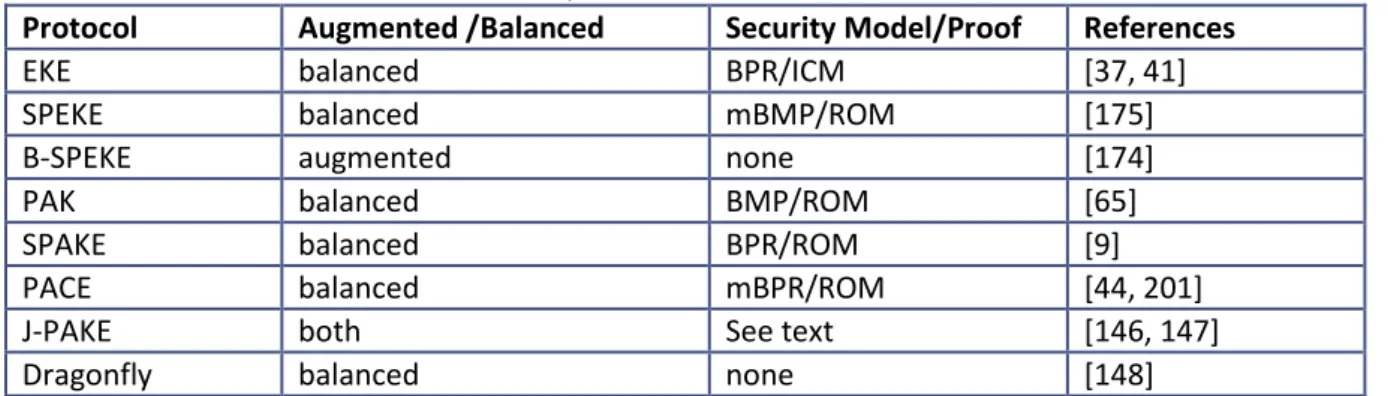
Two types of models are used in the security analysis of these protocols. The model proposed by Bellare, Pointcheval, and Rogaway (henceforth the BPR model) [37] is an indistinguishablity based model that builds on the ideas in [38]. There are two types of simulation based models, one due to Boyko, MacKenzie and Patel (henceforth the BMP model) [65], which in turn build on those of Bellare, Canetti, and Krawczyk [33] and Shoup [286], and one due to Canetti et al. (henceforth the CHKLM model) [78], which builds on the Universal Composability framework [75]. We start with an overview of existent efficient protocols in the Random Oracle Model, with Figure 3.1 summarising the discussion.
The seminal protocol in this area is the Encrypted Key Exchange (EKE) protocol of Bellovin and Merritt [41], followed by an augmented version [42]. The security of the protocol had been first analysed by Bellare et al. [37] but the analysis relies on the strong ideal cipher model. Slight variations that aim to preserve the efficiency of the protocol but reduce the assumptions needed in the proof have later been provided [70, 71]. The most efficient protocol that resulted from this line of work is the SPAKE protocol due to Abdalla and Pointcheval [9]; the protocol has a security analysis in the random oracle model.
The SPEKE B-SPEKE protocols proposed by David Jablon [174, 175] were two of the first proposed protocols following the publication of EKE. MacKenzie provides an analysis of SPEKE in a restricted variant of the BPR model [219] (the mBPR model). In a similar vein Boyko, MacKenzie and Patel [65] proposed PAK and prove it secure in the BMP model assuming the random oracle. They also provide an augmented version called PAK-X.
In contrast to the above protocols, the PACE protocol is one which was designed for a specific application. It was proposed by the German Federal Office for Information Security, and is intended for deployment in machine readable travel documents, and protocol is fully specified in standards, e.g. in [198]. The protocol has a security proof with respect to (a variant) of the BPR model. The proof assumes both random oracles and ideal ciphers [44].
Protocol Augmented /Balanced Security Model/Proof References
EKE balanced BPR/ICM [37, 41]
SPEKE balanced mBMP/ROM [175]
B-SPEKE augmented none [174]
PAK balanced BMP/ROM [65]
SPAKE balanced BPR/ROM [9]
PACE balanced mBPR/ROM [44, 201]
J-PAKE both See text [146, 147]
Dragonfly balanced none [148]
Figure 2.1: Summary of PAKE in the Random Oracle Model (ROM) and Ideal Cipher Model (ICM)
Some other protocols that have gained some traction recently (mainly as IP free alternatives) are J-PAKE [147] and Dragonfly [149]. Claims of security for these protocols are however not supported by fully worked-out proofs.
Just like for any other primitive/protocol PAKE protocols secure in the standard model, i.e. ones not using random oracles, are not very efficient; to the point where they are not really practical. A series of works starting with the protocol of Katz, Ostrovsky and Yung [185] and the more general framework of Goldreich and Lindell [137] propose PAKEs that are secure in the standard model. These protocols which include those in [8, 10, 26] but are significantly less efficient than those discussed above.
3
Specific Protocols
In this section we detail general purpose protocols for accomplishing various tasks, which can be used, and are, used in multiple application scenarios. Whilst the protocols here were designed for specific
tasks (for example TLS was designed to secure communication between a browser and a web site) they can, and are, used for other applications.
3.1
TLS
General Description: The TLS protocol (the current version being v1.2) is primarily aimed at securing traffic between an unauthenticated web browser and an authenticated web site, although the protocol is now often used in other applications due in part to the availability (and ease of use) of a variety of libraries implementing TLS. The TLS protocol suite aims to provide a confidential channel rather than simply a key agreement protocol as discussed before in Section 2.1. The protocol is broken up into two phases: A handshake (or key agreement) phase and a record layer encryption phase. Standardization Efforts: The protocol has been standardised by the IETF in various standards, of which we list just some [52,101–103,224,279]. The genesis of the protocol dates back to SSL v1.0, in 1993, and its current complex state is a symptom of both issues related to backward compatibility and mission creep. The protocol is currently undergoing a major revision so as to produce TLS v1.3. A complete list of ciphersuites for TLS is listed at the website http://www.iana.org/assignments/ tls-parameters/tls-parameters.xml. If following the recommendations of this document, the restrictions on the ciphersuites to conform to our guidelines for future systems means this large list becomes relatively small. We provide guidelines on specific ciphersuites, for both the hand- shake and record layer transport phases, below.
Limitations: Due to the non-systematic development process, the protocol is hard to analyse and easily prone to implementation weaknesses. Below we summarise the latest knowledge in this regard. Care must be taken in long term key generation as a number of TLS implementations have been shown to be weak due to poor random number generation, see [151] and [115][Section 6.2].
Technical Details: The handshake/key agreement phase has now been fairly thoroughly analysed in a variety of works [73, 176, 177, 199, 231]. A major issue in these analyses is the use of the derived key during key confirmation via the FINISHED messages.
The handshake/key agreement phase runs in one of essentially two main modes: either RSA- based key transport or Diffie–Hellman key exchange (an option also exists for pre-shared keys). The RSA key transport methodology uses RSA-PKCS#1 v1.5, which is discussed in [115][Section 4.6.1] is not considered secure in a modern sense. However, the use of this key transport methodology has been specifically patched in TLS to avoid the attack described in [56], and a formal security analysis supporting this approach in the TLS context can be found in [199]. This latter analysis shows that key transport in TLS can be made secure (but not forward secure) under a sufficiently strong number theoretic assumption and in the Random Oracle Model. The Diffie–Hellman based key agreement mode is considered much more secure, and offers the benefit of perfect forward secrecy of the agreed key. In both modes the output of the key agreement phase is a so-called pre-master secret.
For the handshake part of the protocol the principle issue is that the RSA signing algorithm in TLS 1.2 is PKCS# 1 v1.5. Since most certificates issued are certificates on RSA keys, this means that RSA-PKCS# 1 v1.5 is the default signing algorithm for use in TLS. As explained in [115][Section 4.8.1] we do not advise the use of this signature scheme in future systems.
Considering the discrete logarithm or elliptic curve signature variants, one finds that the situation is a little better. The required signature algorithm here is (EC)DSA, which also has no proof of security, bar
in the generic group model for the elliptic curve variant. See [115][Section 4.8.5] for more details. Thus for the key negotiation phase one is left to rely on cryptographic schemes which we only suggest for legacy use.
Given these caveats, we advise the following key exchange methods for legacy use in TLS as they provide forward secrecy
• TLS_DHE_DSS_WITH_⋆, • TLS_DHE_RSA_WITH_⋆, • TLS_ECDHE_ECDSA_WITH_⋆, • TLS_ECDHE_RSA_WITH_⋆,
Where the ⋆ suffix denotes an underlying record layer encryption method. The only thing which stops us recommending any key exchange methods for future use is the lack of a provably secure public key signature algorithm within the available choices. Of the four choices TLS_ECDHE_ECDSA_WITH_⋆ is probably to be preferred as ECDSA signatures are more likely to be secure in the long run than the RSA method.
In TLS 1.3 it is proposed to remove the key transport (i.e. RSA variant) and only have forward secure key agreement phases. In particular this would mean that long term public keys are only used to provide key authentication and are not used to provide key confidentiality. This change, as well as being good security practice, has been accelerated since summer 2013 due to the Snowden revelations.
During the handshake phase the key to use in the transport layer is derived from the agreed pre-master secret. This derivation occurs in one of two ways, depending on whether TLS 1.2 [103] is used or whether an earlier standard is used (TLS 1.0 [102] and TLS 1.1 [102]). As discussed in [115][Section 4.4.5], the use of TLS-v1.1-KDF should only be used for legacy applications, with the TLS-v1.2-KDF variant being considered suitable for future applications.
The record layer, i.e. the layer in which actual encrypted messages are sent and received, has received extensive analysis. In TLS 1.0 and TLS 1.1 the two choices are either MAC-then-Encode- then-Encrypt using a block cipher in CBC mode or the use of MAC-then-Encrypt using the RC4 stream cipher. Both these forms of the record layer have been shown to be problematic [16,17,81, 255,302]. The main problems here are that the MAC-then-Encode-then-Encrypt construction used in TLS is difficult to implement securely (and hard to provide positive security results about), and that RC4 is, by modern standards, a weak stream cipher. These issues are partially corrected in TLS 1.2 [103] by adding support for Authenticated Encryption, and with GCM mode and CCM mode for TLS being specified in [279] and [224], respectively. Other recent attacks include those by Duong and Rizzo, known as BEAST [107] and CRIME [108]. BEAST exploits the use of chained IVs in CBC mode in TLS 1.0, and CRIME takes advantage of information leakage from the optional use of data compression in TLS. In TLS 1.3 it is proposed that only AEAD methods are used to secure the record layer.
Looking at the record layer protocol (i.e. the algorithms to encrypt the actual data), we see that only the use of Camellia and AES, within a mode such as GCM or CCM, are compatible with the guidelines in [115], This means at the time of writing we would only advise the following cipher suites, for the record layer for future (and legacy) use within TLS
• ⋆_WITH_Camellia_128_GCM_SHA256, • ⋆_WITH_AES_128_GCM_SHA256, • ⋆_WITH_Camellia_256_GCM_SHA384,
• ⋆_WITH_AES_256_GCM_SHA384, • ⋆_WITH_AES_128_CCM,
• ⋆_WITH_AES_128_CCM_8, • ⋆_WITH_AES_256_CCM, • ⋆_WITH_AES_256_CCM_8.
where the ⋆ prefix denotes an underlying key exchange method.
Given the above discussion it is hard to recommend that TLS 1.0 and TLS 1.1 be used in any new application, and phasing out their use in legacy applications is advised. It would appear that TLS 1.2 is sufficient for future applications. However, there are currently very few implementations of clients, servers, or libraries which support TLS 1.2, although this is now increasing rapidly.
3.2
SSH
General Description: Secure Shell (SSH) was originally designed as a replacement for insecure remote shell protocols such as telnet. It has now become a more general purpose tool that is used to provide a secure channel between two networked computers for applications such as secure file transfer. In general the host one is connecting to is authenticated, whereas the client is not (although some corporations do insist on client side authentication for SSH usage).
Standardization Efforts: SSHv2 was standardised in a collection of RFCs [312–314] in 2006, other relevant standards are [32, 48, 93, 162, 215, 215]. The original version, SSHv1 has several design flaws and should no longer be used. OpenSSH [242] is the most widely used implementation of the protocol. In 2008 it accounted for more than 80% of all implementations. The transport layer of SSH [314] is responsible for the initial key-exchange, server authentication and, confidentiality and integrity of messages sent on the channel.
Limitations: The main issue with SSH, much like TLS above, is that most of the standard encryption algorithms for the transport layer are not sufficient to ensure complete security. They possess a number of cryptographic weaknesses, which would not exist if the protocol choices had been made more recently. See the following section for a technical discussion on these matters, as well as guidelines for going forward.
Technical Details: The key-exchange protocol is based on Diffie–Hellman and host authentication is provided by combining this with a signature. Client authentication is also possible but defined in a separate RFC [312]. Methods for authenticating the client are either using a password, public- key cryptography (DSA, RSA, X.509), an “interactive-keyboard” challenge-response method [93] or the GSSAPI [215] which allows the use of external mechanisms such as Kerberos. Support for the key-exchange methods, diffie-hellman-group1-sha1 and diffie-hellman-group14-sha1 is mandated by the RFC [314]. These methods use the Oakley Group 1 (1024-bit prime field) and Oakley Group 14 (2048-bit prime field) [195]. RFC4419 [123] describes a key-exchange method for SSH that allows the server to propose new groups on which to perform the Diffie–Hellman key exchange with the client. RFC4432 [150] specifies a key-transport method for SSH based on 1024- bit and 2048-bit RSA. RFC5656 [293] defines introduces support for Elliptic-Curve Cryptography; detailing support for ECDH and ECMQV.
Williams [309] has performed an analysis of the key-exchange methods in SSH. It has been shown the six application keys (two IV keys, two encryption keys and two integrity keys) generated by the protocol and passed to the next stage of the SSH protocol are indistinguishable from random. The analysis assumes the server’s public key is validated through a certificate from some secure public-
key infrastructure. The author of [309] notes that if no such certificate is used, then the protocol is vulnerable to attack, unless the client has some other method of verifying the authenticity of a server’s public key.
Once keys are established all message are then sent encrypted over the channel using the Binary- Packet Protocol (BPP) [314, Section 6]. This specifies an encryption scheme based on an Encode- then-Encrypt-and-MAC construction using a block cipher in CBC mode or the stream cipher RC4. The encode function specifies two length fields which must be prepended to messages prior to encryption and a padding scheme (for the case of CBC mode). The first length field specifies the total length of the packet and the second gives the total length of padding used. The specification recommends using CBC mode with chained IVs (the last block of the previous ciphertext becomes the IV of the following ciphertext). This has been shown to be insecure by Dai [94] and Rogaway [273]. Albrecht et al. [15] were able to perform plaintext-recovery attacks against SSH (when using CBC mode) by exploiting the use of encrypted length fields. As a result of these attacks we state that CBC mode should not be used. We note that OpenSSH Version 6.2 [242] supports a non- standard version of the BPP for use with CBC mode in an Encrypt-then-MAC construction where length fields are not encrypted but still authenticated. This style of construction would be secure against the Albrecht et al. attack.
A first formal security analysis of the SSH-BPP was performed by Bellare et al. [36]. As a result of the Albrecht et al. attacks this security analysis was proved to be incomplete and a further security analysis, which more closely matched actual implementations of SSH, was performed by Paterson and Watson [256]. They proved that the Encode-then-Encrypt-and-MAC construction utilising counter mode encryption is secure against a large class of attacks including those of Albrecht et al. We advise counter mode as the best choice of available cipher in the Encode-then-Encrypt- and-MAC construction when combined with a secure MAC algorithm. The original choice of MAC algorithms specified in RFC4253 was limited to HMAC with either SHA-1 or MD5. We advise neither of these hash functions for current use. RFC6668 [48] details the use of SHA-2 for HMAC. In addition to the Encode-then-Encrypt-and-MAC construction confidentiality and integrity in SSH may also be provided by GCM encryption as specified in RFC5647 [162].
A complete list of ciphersuites for SSH is listed at the website http://www.iana.org/assignments/ssh-parameters/ssh-parameters.xml.
Based on the guidelines of this document we would only advise the following encryption and MAC algorithms, for future use within SSH:
• aes128-ctr with hmac-sha2-256 or hmac-sha2-512 • aes192-ctr with hmac-sha2-256 or hmac-sha2-512 • aes256-ctr with hmac-sha2-256 or hmac-sha2-512 • AEAD_AES_128_GCM
• AEAD_AES_256_GCM
3.3
IPSec
General Description: IPSec is designed to provide security at the IP network layer of the TCP/IP protocol stack. This differs from protocols such as TLS and SSH, above, which provide security at higher layers such as the application layer. This is advantageous since no re-engineering of the applications is required to benefit from the security IPSec provides. The main use of IPSec has been to create virtual private networks (VPNs) which facilitates secure communication over an untrusted network such as the Internet.
The IPSec protocols can be deployed in two basic modes: tunnel and transport. In tunnel mode cryptographic protection is provided for entire IP packets. In essence, a whole packet (plus security fields) is treated as the new payload of an outer IP packet, with its own header, called the outer header. The original, or inner, IP packet is said to be encapsulated within the outer IP packet. In tunnel mode, IPSec processing is typically performed at security gateways (e.g. perimeter firewalls or routers) on behalf of endpoint hosts. By contrast, in transport mode, the header of the original packet itself is preserved, some security fields are inserted, and the payload together with some header fields undergo cryptographic processing. Transport mode is typically used when end-to- end security services are needed, and provides protection mostly for the packet payload. In either mode, one can think of the IPSec implementation as intercepting normal IP packets and performing processing on them before passing them on (to the network interface layer in the case of outbound processing, or to the upper layers in the case of inbound processing).
Standardization Efforts: The protocol was originally standardised in a collection of RFCs in 1995 and their third incarnation can be found in RFCs 4301–4309 [110,153,155,187,190–193,280]. For a more complete description of the cryptography in the IPSec standards we refer the reader to the survey by Paterson [252].
Limitations: The key agreement phase of IPSec, called IKE, is well studied and well defined. As for TLS and SSH the payload encryption algorithms have had a number of issues over the years, related to poor acceptance of the need for AEAD/IND-CCA encryption algorithms. More details are provided in the technical section below.
Technical Details: Each IPSec implementation contains a Security Policy Database (SPD), each entry of which defines processing rules for certain types of traffic. Each entry in the SPD points to one or more Security Associations (SAs) (or the need to establish new SAs). The SAs contain (amongst other information) cryptographic keys, initialisation vectors and anti-replay counters, all of which must be initialised and shared between appropriate parties securely. This can be solved manually, and such an approach works well for small-scale deployments for testing purposes.
However, for larger scale and more robust use of IPSec, an automated method is needed. The Internet Key Exchange (IKE) Protocol provides the preferred method for SA negotiation and associated cryptographic parameter establishment. The latest version of IKE, named IKEv2 [188], provides a flexible set of methods for authentication and establishment of keys and other parameters, supporting both asymmetric and symmetric cryptographic methods. There were initially two Diffie–Hellman Groups defined for use in IKEv2 [188, Appendix B], one with a 768-bit modulus the other with 1024-bit modulus. Further DH groups are defined in RFC3526 [195] of sizes 1536, 2048, 3072, 4096, 6144 and 8192 bits. Elliptic Curve groups are defined in RFC 5903 [124] with sizes of 256, 384 and 521 bits. RFC5114 [208] defines an additional 8 groups. Based on [115][Section 3.5] we advise for future use a group size of at least 3072 bits, and 256 bits in the case of elliptic curve groups. For key derivation, as discussed in [115][Section 4.4.4], the use of IKE-v1-KDF should only be used for legacy applications, with the IKE-v2-KDF variant being considered suitable for future applications.
There are two main IPSec protocols which specify the actual cryptographic processing applied to packets. These are called Authentication Header (AH) and Encapsulating Security Payload (ESP). AH provides integrity protection, data origin authentication and anti-replay services for packets through the application of MAC algorithms and the inclusion of sequence numbers in packets. There are a number of MAC algorithms defined for use with IPSec. These include HMAC (with MD5 [220], SHA-1 [221] or SHA-2 [189]), GMAC [225] and XCBC (a CBC-MAC variant) [121]. Based on earlier sections we only advise HMAC with SHA-2 for future use.
ESP provides similar services to AH (though the coverage of its optional integrity protection feature is more limited) and in addition provides confidentiality and traffic flow confidentiality services through symmetric key encryption and variable length padding of packets. ESP allows both encryption-only and authenticated encryption modes. The attacks we shall mention in the following paragraph demonstrate the encryption-only modes should not be used. ESP must therefore always be configured with some form of integrity protection. The encryption algorithms on offer are CBC mode (with either 3DES [259], AES [120] or Camellia [184]), CTR mode (with either AES [154] or Camellia [184]). Of these algorithms we would only advise CTR mode and stress it must be combined with a MAC algorithm. Further options for authentication encryption are provided by the combined algorithms CCM (with either AES [155] or Camellia [184]) and GCM with AES [155].
An initial analysis of the IPSec standards was performed by Ferguson and Schneier [116]. This was followed by Bellovin [40] who found a number of attacks against encryption-only ESP. Practical attacks were demonstrated by Paterson and Yau [257] against the Linux implementation of IPSec where encryption-only ESP was operating in tunnel mode. By adapting the padding oracle attack of Vaudenay [302], Degabriele and Paterson were then able to break standards-compliant implementations of IPSec [99] with practical complexities. These attacks were against encryption-only ESP using CBC mode and operating in either tunnel or transport mode. From these attacks, the need to use some form of integrity protection in IPSec is evident. It is therefore recommended that encryption-only ESP not be used. A further set of attacks by Degabriele and Paterson [100] breaks IPSec when it is implemented in any MAC-then-Encrypt configuration (for example, if AH in transport mode is used prior to encryption-only ESP in tunnel mode). On the other hand, no attacks are known if ESP is followed by AH, or if ESP’s innate integrity protection feature is used. To conclude, we reiterate that ESP should always be used with some form of integrity protection, and that care is needed to ensure an appropriate form of integrity protection is provided.
A close to complete list of ciphersuites for IPSec is listed at the website http://www.iana.org/assignments/isakmp-registry/isakmp-registry.xml.
Based on the guidelines in [115] we would only advise the following algorithms for future use within IPSec:
If only authentication is required then either AH or ESP may be used with one of the following MAC algorithms as defined in RFC4868 [189].
– HMAC-SHA2-256, – HMAC-SHA2-384, – HMAC-SHA2-512,
If confidentiality is required then ESP should be used by combining one of the following encryption algorithms with one of the MAC algorithms described above.
– AES-CTR, – CAMELLIA-CTR,
Alternatively one of the following combined authenticated encryption modes may be used: – AES-CCM_⋆,
– CAMELLIA-CCM_⋆, – AES-GCM_⋆,
Here, the ⋆ denotes the size (in bytes) of the integrity check value (ICV) and we advise choosing either 12 or 16.
3.4
Kerberos
General Description: Kerberos is an authentication service which allows a client to authenticate his or herself to multiple services e.g. a file server or a printer. The system uses a trusted authentication server which will grant tickets to participating parties allowing them to prove their identity to each other. It is primarily based on symmetric-key primitives; the specific construction being derived from the Needham-Schroeder Protocol [236]. Public-key primitives, namely RSA signatures, may also be used during the initial authentication phase [319].
Standardization Efforts: Kerberos was designed as part of project Athena at MIT during the 1980s [226]; the first three versions were not released publicly; Version 4 can therefore be viewed as the “original” release. The current version, Version 5 [237], fixed a number of security deficiencies present in its predecessor [39]. Version 4 required the use of DES; Version 5 expanded the possible ciphers and AES is now supported [269].
Limitations: Again there are issues related to the usage of strong encryption schemes (i.e. AEAD/IND-CCA schemes) due to the age of the documents defining the protocol.
Technical Details: Version 4 made use of a non-standard version of CBC mode called PCBC which has been shown to be insecure [196]. The encryption scheme used by Version 5 has been formally analysed by Boldyreva and Kumar [61], who first show that the Encode-then-Checksum- then-Encrypt construction defined in RFC3961 [270] does not meet the INT-CTXT definition of security. If a secure MAC algorithm is used for the checksum then this construction will be secure. Additionally, Boldyreva and Kumar analyse the Encode-then-Encrypt-and-MAC construction given in RFC3962 [269] and show this to be secure assuming the underlying primitives meet standard definitions of security. The encryption scheme specified for use in Version 5 is CBC mode with ciphertext stealing using either DES, 3DES [270], AES [269] or Camellia [157] as the underlying blockcipher.
A complete list of ciphersuites for Kerberos is listed at the website http://www.iana.org/assignments/kerberos-parameters/kerberos-parameters.xml. At the time of writing we advise the following ciphersuites for future use within Kerberos:
• aes128-cts-hmac-sha1-96 • aes256-cts-hmac-sha1-96 • camellia128-cts-cmac • camellia256-cts-cmac
4
Application Specific Protocols
In this section we present a quick overview of protocols which are used in relatively restricted application areas; for example wireless, mobile communications or banking.
4.1
WEP/WPA
General Description: The WEP/WPA protocols are used to protect communication in wireless networks; for example in securing the communication between a laptop and the wireless router (a.k.a access point) to which it connects. The key design requirement is to ensure that an eavesdropper is unable to break the confidentiality of the messages being sent. We discuss their use in the setting where the device and the access point to which it connects have a shared key.
Standardization Efforts: WEP (Wired Equivalent Privacy) is specified in the IEEE 802.11 standard [158]. The protocol is intended to offer confidential and authenticated communication. The protocol is symmetric key based (it uses either 40 bit, 104 bit, or 232 bit keys) and employs RC4 for confidentiality and CRC32 for authentication. WPA (Wi-Fi Protected Access) is a successor of WEP. It employs the Temporal Key Integrity Protocol (TKIP) a stronger set of encryption and authentication algorithms; but TKIP has been deprecated by the IEEE. The WPA2 is the latest version of the protocol suite which is described in [159].
Limitations: Practical key-recovery attacks against the WEP protocols have been devised [51, 119,297] and the protocol is considered completely broken. The use of this protocol should be avoided. WEP has been deprecated by the IEEE. The TKIP protocol was intended as a temporary replacement for WPA, and is capable of running on legacy hardware. The protocol fixes some of the design problems in WEP, but some attacks against TKIP have been found [145,228,230,281, 296,299]. A recent attack, [254], based on prior analysis of RC4 [16] in TLS, breaks the basic WPA protocol, and thus users should move to WPA2 as a matter of urgency.
Technical Details: The protocol WPA2 uses stronger primitives. It employs the Counter Cipher mode with Message Authentication Code Protocol (CCMP), an encryption scheme that uses AES in CCM mode (see [115][Section 4.3.3]) and offers both message confidentiality and message authentication. While some weaknesses in settings where WPA2 is used exist, no serious attacks are known against the protocol itself.
4.2
UMTS/LTE
General Description: The GSM, UMTS and LTE protocols are designed to secure communications between a mobile phone and the operators’ base station. The goal being to provide confidentiality services for the user and authentication services for the mobile phone operator. The protocols also define what happens when a user “roams” to another service provider’s network, by for example travelling to another country. In addition the protocols provide a limited form of anonymisation of the user, by preventing a passive eavesdropper from linking one communication with another from the same phone.
Standardization Efforts: The Universal Mobile Telecommunication System (UMTS) and its latest version called Long-Term Evolution (LTE) are standards for wireless communication in mobile phones and data terminals. The standard is developed by the 3rd Generation Partnership Project (3GPP) and is now at version 10. The protocol is intended as a replacement for GSM. All technical specification documents referenced in this section are available at www.3gpp.org.