Akzharkyn Duisembiyeva
School of Science
Thesis submitted for examination for the degree of Master of Science in Technology.
Espoo, Finland August 13, 2020
Supervisor
Prof. Jan-Erik Ekberg and prof. Mathias Ekstedt
Advisor
Author Akzharkyn Duisembiyeva
Title Automated security analysis in a SCADA system Degree programme School of Sciences
Major Security and Cloud Computing Code of major SCI3084 Supervisor Prof. Jan-Erik Ekberg and prof. Mathias Ekstedt
Advisor Engla Ling
Date August 13, 2020 Number of pages 112 Language English Abstract
Supervisory control and data acquisition (SCADA) is a computer system for analysing, and monitoring data, as well as, controlling a plant in industries such as power grids, oil, gas refining, and water control. SCADA belongs to the category of critical systems that are needed to maintain the infrastructure of cities and households. Therefore, the security aspect of such a system has a significant role. The early SCADA systems were designed with the operation as the primary concern rather than security since they were a monolithic networked system without external access. However, the systems evolved, and SCADA systems were embedded with web technologies for users to monitor the data externally. These changes improved the efficiency of monitoring and productivity; however, this caused a problem of potential cyber-attacks to a SCADA system. One such example was Ukraine’s power grid blackout in 2015. Therefore, it is beneficial for the security of a SCADA system to create a threat modeling technique that can understand the critical components of SCADA, discover potential threats, and propose possible mitigation strategies.
One issue when creating a threat model is the significant difference of SCADA from traditional Operational Technology (OT) systems. Another significant issue is that SCADA is a highly customisable system, and each SCADA instance can have different components. Therefore, for this work, we implemented a threat modeling languagescadaLang, which is specific to the domain of a SCADA system. We started by defining the major assets of a SCADA system, attackers, entry surfaces, and built attacks and defense strategies. Then we developed a threat modeling domain-specific language scadaLang that can create a threat model for a particular instance of SCADA taking the differences in components and connections into account. As a result, we achieved a threat modeling language for SCADA, ensured the reliability of the results by peer-reviewing of an engineer familiar with the domain of the problem, and proposed a Turing test to ensure the validity of the result of scadaLang as the future development of the project.
Författare Akzharkyn Duisembiyeva
Titel Automatiserad säkerhetsanalys av SCADA system Utbildningsprogram Säkerhet och molnberäkning
Huvudämne Säkerhet och molnberäkning Huvudämnets kod SCI3084 Övervakare Engla Ling
Handledare Prof. Jan-Erik Ekberg, Prof. Mathias Ekstedt
Datum August 13, 2020 Sidantal 112 Språk Engelska
Sammandrag
Supervisory control and data acquisition (SCADA) är ett datorsystem för att analy-sera och monitorera data samt kontrollera anläggningar för industrier såsom energi-system, olja, raffinering av gas och vatten. SCADA tillhör den kategori av kritiska system som krävs för att bibehålla städer och hushålls infrastruktur. Därför är säkerhetsaspekten av ett sådant system av stor roll. De tidiga SCADA systemen var utformade med funktionen som huvudsaklig oro istället för säkerheten då de var monolitiska nätverkssystem utan extern åtkomst. Systemen utvecklades emellertid och SCADA systemen blev inbyggda med webbteknologier så att användare kan monitorera data externt. De här förändringarna förbättrade effektiviteten av moni-torering och produktivitet men skapade problemet med potentiella cyber-attacker mot SCADA systemen. Ett sådant exempel är Ukrainas energy systems elavbrott som skedde 2015. Därför är det fördelaktigt för säkerheten av SCADA systemen att skapa en hotmodelleringsteknik för att bättre förstå de kritiska komponenterna av SCADA, hitta potentiella hot och föreslå potentiella förmildrande strategier.
Ett problem för utvecklingen av en hotmodell är den stora skillnaden mellan SCA-DA från traditionella nätverkssystem inom industri. Ett annat stort problem är att SCADA är ett justerbart system och varje SCADA instans kan ha olika komponenter. Därför utvecklar vi i detta arbete ett språk för hotmodellering scadaLang som är specifikt för domänen SCADA system. Vi började med att definiera de huvudsakliga komponenterna av SCADA system, angriparna, attack ytorna och även bygga attac-ker samt försvarsstrategier. Sen utvecklade vi ett språk för hotmodelleringen som är domänspecifikt, scadaLang som kan skapa en hotmodell för en specifik instans av SCADA där skillnaderna på komponenter och sammankopplingar tas till hänsyn. Som resultat har vi skapat ett språk för hotmodellering för SCADA,verifierat resultat med hjälp av en ingenjör med domänkännedom och föreslagit ett Turing test för att förbättra verifieringen av resultatet som ett framtida arbete.
Abstract (in Swedish) 3
1 Introduction 6
1.1 Motivation . . . 6
1.2 Problem Statement . . . 7
1.3 Goals of the Thesis Work. . . 7
1.4 Research Question . . . 7
1.5 Ethics and Sustainability . . . 8
1.6 Delimitation . . . 9
1.7 Structure of the Report. . . 9
2 Background 10 2.1 SCADA Overview . . . 10
2.1.1 SCADA architecture overview . . . 10
2.1.2 SCADA security assessment . . . 11
2.1.3 SCADA communication protocols . . . 13
2.1.4 Security zones in SCADA . . . 14
2.2 Threat Modeling . . . 15
2.2.1 Taxonomy of threat modeling techniques . . . 15
2.2.2 CVSS score . . . 17
2.3 Meta Attack Language (MAL) . . . 18
2.3.1 MAL Syntax and Overview . . . 18
2.3.2 Testing at MAL . . . 20
2.3.3 Probabilistic model of MAL . . . 22
2.4 Related Works. . . 24
2.4.1 Model-driven security engineering and Domain-specific languages 24 2.4.2 Threat modeling projects for SCADA . . . 25
3 Methodology 26 3.1 Method . . . 26
3.2 Data Collection . . . 26
3.2.1 Assets and Layers selection . . . 26
3.2.2 Data Sources and Processing . . . 28
3.3 Risk Assessment Strategy Design . . . 29
3.4 Assessing the Reliability and Validity of DSL for Threat Modeling based on MAL . . . 31
4 Implementation of scadaLang 33 4.1 Scope and Assumptions . . . 33
4.2 Assets and Categories . . . 33
4.2.1 Categories . . . 33
4.2.2 Domain Feature Matrix . . . 34
4.3 Actors . . . 35
4.4 Attacker Profiles . . . 36
4.5 Attacks . . . 36
4.5.1 Entry surface . . . 38
4.5.2 ICCP server (frontend and backend servers) . . . 38
4.5.3 RTU . . . 39
4.5.4 Communication front end . . . 39
4.5.5 HMI + Thin client . . . 42
4.5.6 Alarm . . . 44
4.5.7 App server . . . 44
4.5.8 Postgre and Oracle Database . . . 46
4.5.9 Real-time Database . . . 48
4.5.10 Antivirus Server. . . 48
4.5.11 Backup server . . . 50
4.5.12 Directory Service . . . 51
4.5.13 Product . . . 52
4.5.14 Other servers: DNS, NIS, NTP . . . 53
4.5.15 Data Engineering / new HMI server . . . 53
4.5.16 Accounts . . . 55 4.5.17 Firewall . . . 55 4.5.18 Zones . . . 55 4.5.19 Data diode . . . 55 4.5.20 Router . . . 55 4.6 Associations . . . 56
4.7 Potential Mitigation for SCADA . . . 58
4.7.1 ICCP server (frontend and backend servers) . . . 58
4.7.2 RTU . . . 59
4.7.3 Communication front end . . . 59
4.7.4 HMI + Thin client . . . 60
4.7.5 Alarm . . . 60 4.7.6 App server . . . 60 4.7.7 Databases . . . 61 4.7.8 Antivirus Server . . . 61 4.7.9 Backup server . . . 61 4.7.10 Directory Service . . . 63 4.7.11 Product . . . 63
4.7.12 Other servers: DNS, NIS, NTP . . . 63
4.7.13 Data Engineering / new HMI server . . . 63
4.7.14 Accounts . . . 64
4.7.15 Firewall . . . 64
4.7.16 Zones . . . 64
4.8 Risk Assessment. . . 65
4.8.1 ICCP server (frontend and backend servers) . . . 66
4.8.2 RTU . . . 66
4.8.4 HMI + Thin client . . . 67 4.8.5 App server . . . 67 4.8.6 Databases . . . 68 4.8.7 Antivirus Server . . . 68 4.8.8 Backup server . . . 68 4.8.9 Directory Service . . . 69 4.8.10 Product . . . 69
4.8.11 Data Engineering / new HMI server . . . 69
4.8.12 Accounts . . . 70
4.8.13 Firewall . . . 70
5 Creating a Threat Model for a SCADA Instance Using scadaLang 71 5.1 System Assets . . . 73
5.2 Security Assets . . . 73
5.3 Communication Assets . . . 73
6 Results of Attack Simulations 75 6.1 Loss of Availability . . . 75
6.2 Theft of Operational Information . . . 78
6.3 Loss of Control . . . 80
6.4 Loss of Safety . . . 82
7 Discussion, Limitations, and Future Work 84 7.1 Discussion . . . 84
7.2 Limitations . . . 84
7.3 Future work . . . 85
8 Conclusions 87
References 88
A Overall Attack Graph 94
B Example of Unit Testing a DSL Based on MAL 95
C All attacks and Mapping MITRE Into Threat Modeling of SCADA 98
tecture in a simplified logical view [6] . . . 11
2.2 Layers of a SCADA system. Figure taken from [6] . . . 12
2.3 Summary of Common Vulnerability Scoring System (CVSS) v3 Base Metrics. Figure taken from [38] . . . 18
4.1 Attacks relations for Inter-control communication protocol (ICCP) server . . . 38
4.2 Attacks relations for Communication front end server . . . 41
4.3 Attacks relations for Human Machine Interface (HMI) . . . 43
4.4 Attacks relations for App server . . . 45
4.5 Attacks relations for the Database . . . 47
4.6 Attacks relations for Antivirus server . . . 49
4.7 Attacks relations for Backup server . . . 51
4.8 Attacks relations for Directory Service . . . 52
4.9 Attacks relations for Data Engineering (DE) server . . . 54
4.10 General assets and associations selected for this implementation . . . 56
5.1 Creating a threat model for a particular SCADA instance based on scadaLang . . . 71
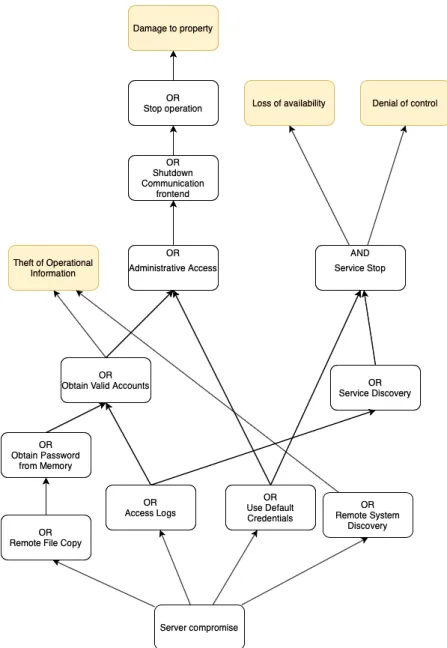
6.1 Attack steps to shut down Communication frontend . . . 75
6.2 Alternative path to shut down Communication frontend . . . 75
6.3 Full attack steps to shut down Communication frontend . . . 77
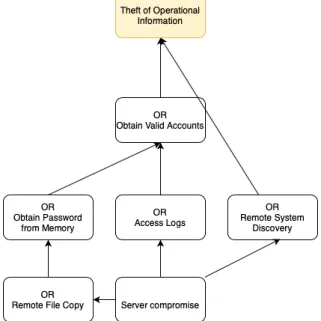
6.4 Attack steps to steal operational information . . . 78
6.5 Full attack steps to access files in Backup server . . . 79
6.6 Attack steps to control slave devices . . . 80
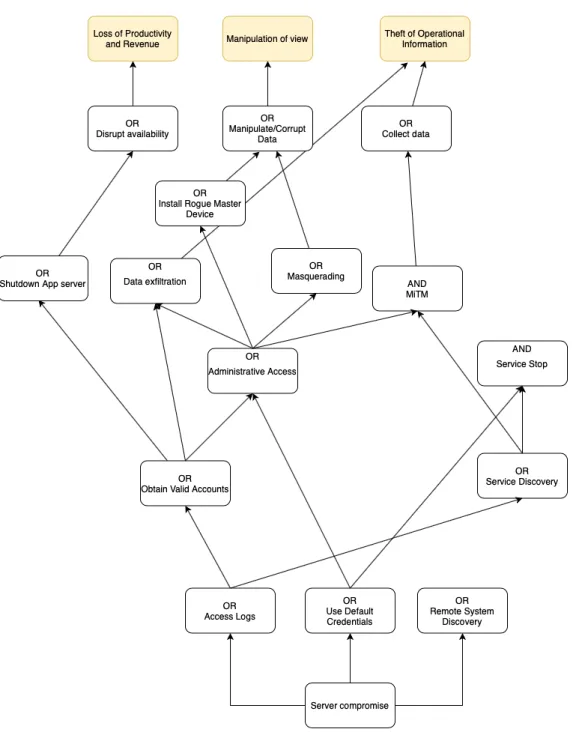
6.7 Full attack steps to install a rogue master device . . . 81
6.8 Attack steps to start the wrong alarm . . . 82
6.9 Alternative attack paths to start the wrong alarm . . . 82
6.10 Full attack paths to start the wrong alarm . . . 83
A.1 Overall attack graph . . . 94
2.2 Generalised zones in SCADA . . . 14
2.3 Severity levels in CVSS v3 system [37] . . . 17
2.4 Assertion methods for writing tests in Meta Attack Language (MAL) [39] 22 2.5 Distribution functions available in MAL [40]. . . 23
3.1 List of assets in a SCADA and their categorisation for this work based on KTH Threat Modeling Method (KTMM) . . . 28
3.2 Mapping CVSS score to MAL probability distribution . . . 30
4.1 Asset feature matrix . . . 35
4.2 List of main actors in SCADA . . . 36
4.3 Associations between assets and encoded attacks . . . 57
4.4 List of protection mechanisms for Inter-control communication pro-tocol (ICCP) asset in SCADA . . . 58
4.5 List of protection mechanisms for Communication front end asset in SCADA . . . 59
4.6 List of protection mechanisms for Human Machine Interface (HMI) asset in SCADA . . . 60
4.7 List of protection mechanisms for App server asset in SCADA . . . . 60
4.8 List of protection mechanisms for Database assets in SCADA . . . . 61
4.9 List of protection mechanisms for Antivirus Server asset in SCADA . 61 4.10 List of protection mechanisms for Backup Server asset in SCADA . . 61
4.11 List of protection mechanisms for Directory Service asset in SCADA 63 4.12 List of protection mechanisms for Product asset in SCADA . . . 63
4.13 List of protection mechanisms for Data Engineering (DE)/new Human Machine Interface (nHMI) asset in SCADA . . . 63
4.14 List of protection mechanisms for Accounts asset in SCADA . . . 64
4.15 CVSS for vulnerabilities and mapping to HMI4 attack step . . . 65
4.16 Severity scores and CIA impact for Inter-control communication protocol (ICCP) attacks . . . 66
4.17 Severity scores and CIA impact for Remote Terminal Unit (RTU) attacks . . . 66
4.18 Severity scores and CIA impact for Communication Frontend attacks 66 4.19 Severity scores and CIA impact for Human Machine Interface (HMI) attacks . . . 67
4.20 Severity scores and CIA impact for App server attacks . . . 67
4.21 Severity scores and CIA impact for Database attacks . . . 68
4.22 Severity scores and CIA impact for Antivirus Server attacks . . . 68
4.23 Severity scores and CIA impact for Backup Server attacks . . . 68
4.24 Severity scores and CIA impact for Directory Service attacks . . . . 69
4.25 Severity scores and CIA impact for Product attacks . . . 69
4.26 Severity scores and CIA impact for DE/nHMI Service attacks . . . . 69
4.27 Severity scores and CIA impact for Account attacks . . . 70
4.28 Severity scores and CIA impact for Firewall attacks . . . 70
7.1 List of attacker profiles for SCADA threat model . . . 86
Acronyms
AD Active Directory
API Application Program Interface
CC Control centre
CIA Confidentially, Integrity, Availability
CII Critical information infrastructure
Comm Communication
CVE Common Vulnerabilities Enumeration
CWE Common Weaknesses Enumeration
CVSS Common Vulnerability Scoring System
CNI Critical National Infrastructure
CDIO Conceive, Design, Implement, Operate
CDITO Conceive, Design, Implement, Test, Operate
DB Database
DBMS Database Management System
DE Data Engineering
DMZ Demilitarised Zone
DNP3 Distributed Network Protocol 3
DNS Domain Name Space
DoS Denial-of-Service
DDoS Distributed denial-of-service
DSL Domain-specific language
EPO ePolicy
ES Expert System
FAIR Factor Analysis of Information Risk
GUI Graphical User Interface
ICCP Inter-control communication protocol
ICS Industrial Control Systems
ICMP Inter Control Message Protocol
IDS Intrusion Detection Systems
IEC International Electrotechnical Commission
IED Intelligent Electronic Device
INSPIRE INcreasing Security and Protection through Infrastructure REsilience
IPS Intrusion Prevention System
HMI Human Machine Interface
nHMI new Human Machine Interface
KTH Royal Institute of Technology
KTMM KTH Threat Modeling Method
MAL Meta Attack Language
MiM Man-in-Middle attack
MAC Mandatory Access Control
NIS Network Information System
NIST National Institute of Standards and Technology
NGFW Next Generation Firewall
NTP Network Time Protocol
NVD National Vulnerability Database
ODBC Open Data Base Connectivity
OS Operating System
OT Operation Technology
PASTA Process for Attack Simulation and Threat Analysis
PBX Private Branch Exchange
PCN Process Control Network
PCS Process Control System
PLC Programmable Logic Controllers
ProdZone Production Zone
ROC Remote Operator Console
RDB Real-time database
RTU Remote Terminal Unit
SCADA Supervisory control and data acquisition
SIS Safety Instrumented Systems
SHARP Security-Hardened Attack Resistant Platform
SELinux Security-enhanced Linux
SQL Structured Query Language
SSO Site security officer
TCP Transmission control protocol
TTC Time-To-Compromise
UML Unified Modeling Language
VIKING Vital Infrastructure, Networks, Information and Control Systems Management
Glossary
Admin accounts type of account with high privileges. 28
Adversary The malicious actor. 64
ANSI/ISA a compliance institute that offers security standards for organisations. 14
CIA properties of the system that relate to the confidentiality, integrity and avail-ability of communication between entities of this system. 37
CISA: Industrial Control Systems US governmental standard for homeland se-curity. 8, 58, 87
CNI (the UK), a term used by governments to group the fields of industries, sectors and assets that are necessary for the economy, daily life of society and security. 6
Domain-specific language The language designed to solve the specific set of problems. 18
ExploitDB a vulnerability database for collecting and maintaining information about discovered computer security vulnerabilities. 46
IEC 60870-5-104 IEC standard used for control in electrical engineering and power system automation applications.. 64
IEC 622443-1 IEC standard used for the security of Industrial Control System (ICS) networks. 14
IEC 62254-1 IEC standard used for the manufacturing operations management domain (reference model for computer integrated manufacturing). 14
KTH threat modeling method Adaptation of the PASTA and FAIR method-ologies with the following phases: 0. Scope and Delimitations; 1. Business Analysis; 2. System Definition and Decomposition; 3. Threat Analysis; 4. Attack and Resilience Analysis; 5. Risk Assessment and Recommendations.. 28
Mimikatz Windows tool for post-exploitation and dumping passwords memory, PINs and Kerberos tickets. 48, 52
MITRE non-governmental organisation that conducts security research. 7, 8, 25, 26, 33, 37, 39, 41, 43, 45, 46, 50, 51, 54, 58, 60, 71, 72, 75, 84, 85, 87
Modbus a communication protocol originally designed for programmable logic controllers, and nowadays commonly available for connection of industrial electronic devices. 13
OCTAVE Operationally Critical Threat, Asset, and Vulnerability Evaluation, a threat modeling technique. 15
Sandia National Laboratories Part of the PCS security project of the Institute for Information Infrastructure Protection (http://thei3p.org). 14
SCADA is a computer system for analysing, monitoring data and controlling a plant in industries as electricity, oil, gas refining and water control.. 6
Service accounts type of non-human account dedicated for automation of services. These accounts are more privileged than a user, but do not have admin privileges. 28
STRIDE threat modeling framework proposed by Microsoft. 15, 16
Trust boundary an abstract logical zones that is different from another trust boundary due to access levels. 55
User accounts type of account that offers least privilege level and allows to have a limited read permissions only. 28
1
Introduction
Supervisory control and data acquisition (SCADA) is a computer system for data monitoring and analysis, as well as controlling a plant in industries such as power grids, oil, gas refining, and water control. SCADA is an essential core of Process Control System (PCS) [1], a key component of Critical National Infrastructure (CNI) [2], and have a signification role in daily life of Swedish population [3]. In early
SCADAsystems, there was no importance assigned to cyber-security, and, therefore, the topic of security analysis of SCADA systems is relatively new [4]. Section 1.1
provides a short introduction about SCADA and its security aspect. This thesis assesses the security of SCADAand proposes a tool to investigate potential attacks and vulnerabilities. Section1.2provides a problem statement for the work, section1.3
describes the goals, while section 1.4showcases the research questions in this work. Section 1.5 discusses the ethical concerns and issues related to sustainability. In section 1.6, we discuss the scope of the project and its delimitation. Section 1.7
navigates through the further chapters of the report.
1.1
Motivation
The Ministry of Justice of Sweden [3] states that the electric power industry, which utilizes systems likeSCADA, has a major impact on national well-being. The security topic of SCADA has national importance, which was stressed by the Protective Security Act (SOU 2015:25). Early SCADAwas a standalone, isolated system where cyber-security attacks were less priority than operation security. The significant change in the security of theSCADA system happened from the 2000s when these systems became embedded with web technologies for efficient monitoring [5]. These drastic shifts lead to a host of desirable advantages like the increase of data inter-exchange and easy management of production capabilities [5]. However, these drastic shifts also lead to disadvantages, the most important of which was the rise of cyber-attacks.
According to Ahmed et al. [6], the architecture ofSCADA systems drastically evolved compared to their earlier predecessors. The early-stage SCADA systems consisted of input/output devices, and the signals were transmitted between the master and remote units. Later, the communication between units became wireless and relied on IP. The key change occurred when the internal network and external components started to integrate, allowing theSCADAto connect with the corporate intranet. These internal components had direct access to the Internet, making the previously closed system available for connecting to the outside world, which led to potential threats.
One popular approach towards mitigating potential security vulnerabilities is a threat modeling. Threat modeling is a risk assessment technique that identifies potential threats to the system. Threat modeling consists of several phases. First of all, we assess the system and identify assets that are components of the system and actors who interact with the system. The next phase is to define potential attackers and their capabilities. This phase is followed by building attack graphs to identify
potential threats for each attacker. Finally, a threat model proposes a protection strategy and generates a risk assessment for the system. Creating threat models can be time-consuming, as the attack graphs grow larger and become more complex. To mitigate this drawback, we can use Domain-specific language (DSL) for attack simulations. Domain-specific language (DSL) for attack simulations provides a way to automate the generation of attack graphs. One such language is Meta Attack Language (MAL) [7].
In this work, we extend MAL to build a threat modeling language for SCADA, and create a tool that can generate a threat model for an instance ofSCADA using our language.
1.2
Problem Statement
As described in the section1.1, the attacks on SCADAincreased drastically in recent years. Moreover, SCADA is a highly customisable system and can have different setups. It makes it difficult to create a generalised framework for all instances of the sameSCADA system. How can we assess the security of SCADA? We can find important information in configuration files. However, to our best knowledge, no threat modeling tool can make use of this information. Can we utilize important information in configuration files to build a threat modeling tool for a generalised
SCADAsystem?
1.3
Goals of the Thesis Work
This project aims to assess the security of a SCADAsystem, and develop a Domain-specific language (DSL), which we can use to generate a threat model for a particular instance ofSCADA. We can achieve our goal with two objectives. The first objective is to develop a domain-specific threat modeling language specification based onMAL
that would fit the SCADA architecture. For this, we make use of state-of-the-art methodologies for threat modeling (Factor Analysis of Information Risk (FAIR),
KTMM, MITRE), which we thoroughly explore in chapters 3 and 4. The second objective is creating a threat model for a SCADA instance using the developed language. For that, we get the configuration files of a particular SCADA system. Based on information in the files, we generate a threat model for this instance.
1.4
Research Question
The project focuses on building the threat modeling language for SCADA. In this work, we ask the following research questions:
• How can we build a DSL for threat modeling specifically fit for SCADA? Can we utilise state-of-the-art methodologies for threat modeling (FAIR, MITRE) of SCADA?
• How can we apply this language for generating a threat modeling tool for a particular SCADA instance using configuration files? Do these configuration
files provide sufficient data to successfully model and assess the security of a
SCADA system?
1.5
Ethics and Sustainability
The general purpose of this work is to provide a security assessment for aSCADA
system using available data from configuration files and open-source security knowl-edge bases. We take all the data for attack steps from the open-source MITRE knowledge base. The general assets for the work correlate with assets described in MITRE knowledge base. There was no fabrication while taking the images of attack steps or reporting of results. The report and the degree work do not have plagiarised content. All the materials in this work are properly cited. The work does not leak any confidential information about a SCADAsystem.
The work output cannot be exploited with bad intent by attackers. Threat modeling provides the analysis of the system and the theoretical description of potential attack steps. At first glance, these attack steps could leak information on how the system could be exploited. However, the work uses attacks from open-source MITRE, which is publicly accessible. If the attacker prefers so, he or she can use the attack techniques from the MITRE knowledge base directly as a guideline. In addition to that, the names of assets and associations that were described in this work are not unique terms for a particular company, but rather an obfuscation. The protection mechanisms are also taken from MITRE knowledge base, or CISA: Industrial Control Systems, in case the protection mechanism are not available in MITRE. All these measures solve the problem of using this work as a directive of breaking into theSCADA system.
On the economic and sustainability front, we made the best effort to reduce time and computation while creating a threat model. In other words, time and complexity required for proposing a threat model. For example, our proposed solution’s main idea is to generate a threat model for a particularSCADA instance considering the proper assets. The instance might have a different setup from another instance, and, therefore, we propose attack steps that match only the needed asset. This avoids building unnecessary and redundant attack steps that do not possess a value for a threat model.
Our work contributes to making the SCADAsystem more secure and sustainable. The insecureSCADAsystems could be categorised as unsustainable systems in terms of operation and environmental impact. SCADAsuffers from inefficient patch delivery, time-consuming maintenance, and expensive hardware and software repair [8]. In addition to that, the system is geographically distributed with weak protection, and a successful exploit on one of the sites could spread on others [9]. Other issues connected with the impact of security breaches is the environmental pollution caused bySCADAincidents [10]. Examples of such breaches took place in Siberian Pipeline (1982), Bellingham, WA Gas Pipeline (1999), Maroochy Water System(2000), and others [10]. Contributing to the security of SCADA would benefit the sustainability of this system in terms of operation and ecology.
1.6
Delimitation
The work has the following delimitation due to time constraints. The following is not in the focus of this work:
• This work does not consider attacks against safety systems and protection against manual misconfiguration.
• This work does not consider any attacks toward field units. We consider field units to be an entry surface in this work.
• This work proposes a Turing test for enhancing the validation of results but does not implement it. Turing test for enhancing of the validation of results is a future extension of work.
1.7
Structure of the Report
Chapter 2 provides the background information to make a reader familiar with the notions used in this work. Chapter3gives information about the analysis of collected data and methodology. Chapter 4presents “scadaLang", DSL for threat modeling based onMALfor a general threat modeling forSCADA. Chapter5presents a threat model for a particular instance of SCADA using proposed scadaLang. Chapter 6
presents the results and findings. In chapter 7 we discuss our work and state limitations and future work. Chapter 8 concludes the work and summarizes our findings.
2
Background
This chapter gives the necessary background information for the reader to get familiar with the main notion and terms used in this work. Section 2.1 gives information aboutSCADAsystems, security issues in SCADA, communication media inSCADA
and the notion of zones. Section 2.2 explains the important definitions for threat modeling that are used for this work, as well as gives information about Common Vulnerability Scoring System (CVSS), a security metric used in threat modeling for describing criticality of an attack step. Section 2.3 dives into the MAL language framework. Section2.4 provides information about previous work in this topic.
2.1
SCADA Overview
In this section we explain what SCADA means. We discuss the architecture of
SCADAand security issues in this system.
2.1.1 SCADA architecture overview
Modern SCADAsystems have a complex heterogeneous architecture that consists of geographically distributed components [2]. Figure 2.1 demonstrates the simplified version of how the SCADA works. In general, a Control centre (CC) and field sites comprise aSCADA system.
Control centre (CC) is the hub of the system consisting of the following units:
HMI, database management system (Historian), and SCADA server. Based on the configuration, the system can also have the load sharing server, Inter-control communication protocol (ICCP) server, backup servers, replicas, antivirus servers, directory servers, workstations, and other. CC consists of a primary site and backup sites. The main functionality of CC is planning, monitoring, and control.
CC is connected with the Corporate Network (Company Support Zone), and the communication can be established through a network connection. Older versions of SCADA used Private Branch Exchange (PBX) for this communication, while modernSCADAuses internet connections between Corporate Network andCC. This connection is needed inSCADA to ensure the constant company support for CC.
On the other hand, field sites are connected with CC via satellite, radio/mi-crowave/cellular networks or Wide Area Network (WAN), and are geographically distributed in various locations. Field sites are equipped with Programmable Logic Controllers (PLC) or Remote Terminal Unit (RTU) that are needed to control the state of the system on-site. Field sites also send regular health checks toCC. Com-munication Frontend servers accept the data from all field devices. Human operators can access this data through Human Machine Interface (HMI), and Historian archives it.
Figure 2.1: A typical SCADAArchitecture in a simplified logical view [6]
2.1.2 SCADA security assessment
The earlySCADAsystems did not consider cyber-security attacks as a major concern due to its standalone nature [11]. The priority was given to operational security. Fernandez et al. [1] mentions thatPCSrequirements were the main requirements that
SCADAneeded to fulfil during the early stage. The assessment of the security of the system included only the physical security of components and networks. However, the situation changed in the last decade, since the early security standard became outdated [2]. Therefore, the SCADAsecurity standards needed to be reworked, and National Institute of Standards and Technology (NIST) published the risk assessment and security guide in 2014 in a document “System Protection Profile Industrial
Control Systems". SCADAsystems control critical industrial systems, and, therefore,
serve as a fascinating target for attackers [12]. One of the most well-known examples is the Stuxnet virus that was designed to harm automated systems, such as SCADA, in 2010 [10]-2012 [13]. As a result, the Stuxnet virus affected 50,000 - 100,000 computers worldwide. The example of Stuxnet inspired attackers to create more powerful and sophisticated attacks, such as“Flame", which is considered an espionage tool, and“Duqu" which used the same techniques as Stuxnet [10].
According to Schneider, Obermeier, and Schlegel [12], the security in SCADA
systems differ from traditional Operation Technology (OT) system in some ways. First of all, some systems have unprotected legacy parts that are of particular interest. Secondly, the main requirement for these systems is constant availability. This constant availability requirement is related to the fact that this system is connected to physical systems supported by a large number of sensors. These sensors also serve as an attack surface. Thirdly, unlike theOT systems, theSCADA system cannot be turned off, which, in the case of forensics, complicates the data acquisition and analysis [6]. Ahmed et al. [6] mentioned the following potential attacks in
SCADA:
• Security Component Malfunctioning
• Insider Attacks
• Unauthorized Access
• Technology Improvement as a threat
• Shifting of Trust Boundaries
Figure 2.2: Layers of a SCADAsystem. Figure taken from [6]
Figure 2.2 introduces the hierarchical concept of layers, which is a convenient way to group the components of SCADA based on their purpose, location and functionality. The regulatory levels handle process control [14], while supervisory
control layers are responsible for the diagnosis of the system [15].
According to Men et al. [16], HMI is the most straightforward way to get into the system. The first way to achieve it is social engineering or phishing of a human operator. The second way is to obtain the administrative privileges on the Communication frontend that communicates with remote units on the field. Obtaining administrative access to Communication frontend can lead to sending incorrect data to aCC and all connected RTUs. Thirdly, there is a threat connected with the external SCADA system. Taking over the Inter-control communication protocol (ICCP) would lead to gaining access to a CC. The potential threats involve internal SCADA’s trust boundary as well. The key component of the system is a
Directory Service. Directory Service is responsible for authentication, and in case of obtaining the administrative right on Directory Service, there is a great threat to the whole system.
2.1.3 SCADA communication protocols
When it comes to describing the communication means in SCADA, it is necessary to pay attention to the fact that the choice of communication means or protocol depends on the noise and speed of data transmission [17].
Currently, the most prevalent protocols include Modbus [1] and Distributed Network Protocol 3 (DNP3) [17] that is used to communicate with PLC. Table 2.1
presents some of the protocols in a SCADAsystem.
Protocol Description
Modbus A widely used, industrial control protocol which relies on a simple request/reply procedure be-tween a CCand field devices. There are two main variants Serial and TCP [18].
DNP3 The primary SCADAprotocol used in the electri-cal power grid [19]. The protocol supports three main communication models between a CC and field devices, unicast, broadcast, and a mode for unsolicited responses from field devices [20].
ICCP The standard CC-to-CC communication protocol. The protocol can run on top a range of transport layer protocols, but it is often used on top of TCP/IP to establish a point to point connection between to CCs [21].
IEC 60870-5-101 / 104 Communication between components of a
SCADA system relies on IEC 60870-5-101 and IEC 60870-5-104 international standards [22]. These standards were designed by International Electrotechnical Commission (IEC), and enable message transmission between CC and remote field units. These standards also include remote control protocols IEC 5-101 and IEC 60870-5-104 which use dedicated optical fibers, digital radio links or mobile networks [23]. These proto-cols define a communication between CC to field units.
2.1.4 Security zones in SCADA
Mahan et al. [24] defines security zone as “a collection of information systems connected by one, or more, internal networks under the control of a single authority and one security policy". The important features of security zones orzones are as follows [24]:
• Zones should separate the critical assets from common ones; • Assets under the same zone have the same zone policy;
• The boundary of the zones should be accurate, and the communication between the assets in this zone to other external assets should be filtered;
• Any services, application and protocols that are carrying information from the zone to outside environment should be blocked;
The number of zones vary based on necessity of the system, however, security stan-dards (ANSI/ISA, IEC 622443-1, IEC 62254-1) and Sandia National Laboratories [25] propose the generalised zones. Table 2.2 groups these zones together.
IEC 622443-1, IEC
62254-1
ANSI/ISA Sandia National
Labo-ratories
Automation Zone (pro-cess, safety and protec-tion, basic control/local control)
Enterprise (corporate) Zone
Corporate Zone
Operation Control (super-visory control) Zone
CC Zone (primary and backup CC)
Process Control Zone Operation support
(oper-ation management) Zone
DMZ (Historian and
ROC)
DMZ
Business support Zone (Business planning and
lo-gistics)
Site Control Zone (local operator and engineering workstations, servers, and
SCADA devices) Corporate (enterprise and
common services) IT zone External Integration Zone (third-party services)
Table 2.2: Generalised zones in SCADA
Figure 2.2demonstrate the example of zoning of SCADA system. DMZ is also referred as “screened subnet". This zone is located logically between two logical networks. The purpose of DMZ is being a shield for an internal protected network with releasing restricted access to data in the internal zone for external sources. The
recommendation by [24] states that the system should consist of external and internal
DMZ.
External DMZ should provide a public access to external-facing servers without
any traffic between servers inside DMZ as depicted in Figure 2.2.
Enterprise Zone is also termed as “Corporate Support Zone" to support SCADA
remotely for customers.
Secure Production Zone (ProdZone) has the highest priority, and it is responsible for processes handling. This zone is also termed as Process Control Network (PCN). Byres, Karsch, and Carter [26] mentions that this zone should be isolated from both Corporate (Enterprise) Zone and Internet systems through the firewalls.
2.2
Threat Modeling
In this section, we discuss the concept of threat modeling and provide the essential definitions that we use in this report.
2.2.1 Taxonomy of threat modeling techniques
UcedaVelez and Morana [27] shows that the majority of attacks took place when the system was unintentionally designed with flaws and security bugs or when security was not prioritised. This correlates with the issues at SCADA as described in section2.1.2. Therefore, the notion of “threat modeling" becomes important.
Definition 2.1. Threat modeling - “a strategic process aimed at considering strate-gic attack scenarios and vulnerabilities within a proposed or existing application environment to identify risk and impact levels". The application environment refers to the object of the threat modeling process [27].
Threat modeling is a risk assessment technique that identifies potentials threats to the system. These threats could be resolved while developing the system. Examples of threat modeling approach are STRIDE developed by Microsoft [28], OCTAVE created by CERT Division of the SEI [29], Factor Analysis of Information Risk (FAIR) [30] or Process for Attack Simulation and Threat Analysis (PASTA) introduced by UcedaV-elez and Morana [27]. Royal Institute of Technology (KTH) also developed a threat modeling technique KTMM [31]. KTMM is a combination of FAIR and PASTA. In summary, the core of threat modeling techniques as STRIDE and PASTA is identifying the main assets (described in definition 2.2), the attacker (described in definition2.3), actors of the system and their roles (administrative with higher privi-lege or user with lower priviprivi-lege), the data flow and architecture of the system. After analysing this information in this work, we can develop an attack tree (described in definition2.4). Finally, knowing the potential vulnerabilities and issues, we can propose the risk assessment (described in definition2.5), mitigation strategy, and how it can reduce the damage or possibility of an attack.
Definition 2.2. Asset - in general, can relate to “component of the system, function or process, data" which value can be “associated with business critically" [27].
The assets can be divided into groups or categories based on different factors. For the categorisation of assets in this paper, we selected the KTH Threat Modeling Method (KTMM) categorisation of assets. KTMMhas convenient and simple asset types. Below are categories of the assets that we use for this paper:
• Function - this category includes components “that feature some kind of
behaviour".
– Services - this subcategory includes applications and features that face
users (actors).
– Platforms - this subcategory includes non-end user-facing applications
and software, unlike services subcategory. These assets build an infras-tructure for services, e.g., Operating System (OS), middleware, Database Management System (DBMS), and servers.
– Hardware - this subcategory includes all physical assets that serve as
deployment infrastructure for platforms and services, e.g., computers, work stations.
• Data - this category includes assets that constitute some information in the system, e.g., log files, credentials, configuration data.
• Networks - these assets include communication media that connect functions
and transmit data, e.g., Ethernet, firewalls, routers.
Definition 2.3. Attacker (adversary) - a malicious actor with the intent to disrupt the Confidentially, Integrity, Availability (CIA) properties of the system.
Attackers use vulnerabilities to exploit the system. Attackers can differ based on their motivation, skills, and resources. Script kiddies have beginner skills with a motivation to learn and limited resources. They do not impose a critical risk to the
SCADAsystem. On the contrary, cyber-criminals and government-sponsored groups of attackers have high motivation, skills, financial resources, time, and equipment. Therefore, these types of attackers are a serious threat to theSCADAsystem. As for
SCADA, the attacks from the second category have a higher possibility of occurrence based on previous attacks described in 2.1.2. As an example, Sandworm Team is a cyber-espionage group of attackers that is related to the Ukrainian energy sector attack (2015) [32].
Definition 2.4. Attack tree - a threat modeling technique popularised by Bruce Schneider in 1999 [33] that places the attacks in a tree form where the root is a goal of an attack and leaves are the starting point to achieve it [33].
The nodes in a tree are divided into OR and AND nodes. When the node is marked withOR label, any attack branch of this node could be used (e.g., cheapest attack branch). In the case of AND label of the node, all the attack branches must be fulfilled [33]. Other risk assessment techniques adopted the method of building attack trees as STRIDE and PASTA.
Definition 2.5. Risk assessment - “is a process of identifying the risks to system security and determining the probability of occurrence, the resulting impact, and additional safeguards that would mitigate this impact" [34]. PASTA model is inte-grated with a generic risk assessment process asNISTRisk Assessment Methodology in Special Publication 800-30.
After building a risk assessment based on potential attacks, we can suggest mitigation for the particular issue.
2.2.2 CVSS score
CVSS is a system that allows us to assign numeric values of severity and impact of a vulnerability based on calculations by researchers [35]. The severity level of attacks is divided into low, mid, high, and critical impact levels by Stouffer, Falco, and Scarfone [36]. This work focuses on version 3 of the CVSS scoring model.
Rating CVSS Score Example
None 0.0 No impact
Low 0.1-3.9 Insignificant impact on
business or operation Medium 4.0-6.9 Limited access to key
com-ponents of the system
High 7.0-8.9 Significant data loss or
downtime of the system Critical 9.0-10.0 Root-level compromise of
key components of the sys-tem or infrastructure de-vices
Table 2.3: Severity levels in CVSS v3 system [37]
The CVSS v3 model uses three categories of metrics: base, temporal and
envi-ronmental. Base metrics are the characteristics of a vulnerability that are constant,
regardless of time or user environments. On the other hand, temporal metrics take into account properties of a vulnerability that might change over time, like patches. Environmental metrics gives the option to customise the score based on desired user environment factors. For this work, we only take into account the Base metrics. Table 2.3 represents the severity scores in Base metrics inCVSS v3.
Figure 2.3: Summary of CVSS v3 Base Metrics. Figure taken from [38]
2.3
Meta Attack Language (MAL)
In this section, we discuss the Meta Attack Language (MAL) developed by KTH, give the explanation of the language and probability distribution atMAL.
2.3.1 MAL Syntax and Overview
MAL[7] is a type of Domain-specific language that provides the syntax and compiler for building further language specification for a problem designed by KTH. In this work, we discover whether this technique can suit threat modeling ofSCADA. MAL
language utilises the terms“Asset", “Attacker",“Attack", “Association", “Category",
and “Defense" described in previous section 2.2.1.
Below we can see the sample code1 for creating a MAL specification:
category System { asset Computer {
let allFolders = folder.subFolder* | connect -> access E firewallExists <- firewall -> firewall.bypass E! noFirewall <- firewall -> firewallBypassed | firewallBypassed @hidden -> access | vulnerability -> compromise & access -> compromise & compromise -> allFolders().accessFolder // Let substitution 1https://github.com/mal-lang/mal-documentation/wiki/MAL-Code-Examples. Accessed on 29.06.2020
} asset Folder { | accessFolder -> stealSecrets | stealSecrets } } category Security { asset Firewall {
& bypass [Bernoulli(0.2)] -> computer.firewallBypassed # hardened -> bypass } } associations {
Computer [computers] * <-- Protect --> 0..1 [firewall] Firewall Computer [computer] * <-- Contains --> * [folder] Folder Folder [folder] 1 <-- Contains --> * [subFolder] Folder }
Asset are mainly zones, communication media, database records, accounts, and
servers in the SCADA system. MAL utilises the Abstract Assets type, which, in contrary to standardAsset cannot be instantiated. In addition to that,MAL enables the inheritance between parent and child assets, which helps avoid multiple definitions of the same attack steps in case a child class extends the base functionality of a parent asset. The code below exemplifies the inheritance between assets in MAL2.
asset Parent {
[parent logic] }
asset ChildextendsParent {
[parent + child logic] }
asset OperatingSystem {
[OperatingSystem logic] }
asset LinuxextendsOperatingSystem {
[OperatingSystem + Linux logic] }
Attacks are the ways to access the assets. For the work, one of the ways to get
these attacks are using the adversarial attack model at MITRE Industrial Control Systems (ICS) knowledge base. MAL files contain the attack steps. Each step is either logical conjunction (OR in attack trees in 2.4, | in MAL) or disjunction of other steps (AND in attack trees in 2.4, & inMAL). One attack step can lead to another attack step, which is denoted as -> inMAL. In other words, to reach the attack step“stealSecrets" in asset“Folder", we need to perform“accessFolder" attack step first. asset Folder { | accessFolder -> stealSecrets | stealSecrets }
Association is MAL defines the connection between two assets that can lead
to an attack from one asset to another. In other words, the association provides information about how one sensitive asset could be reached from another.
2The code was slightly modified because of a typo in the original resource. The authors were notified about the error.
associations {
Computer [computers] * <-- Protect --> 1 [firewall] Firewall Computer [computer] * <-- Contains --> * [folder] Folder Folder [folder] 1 <-- Contains --> * [subFolder] Folder }
In the example above, we can observe associations between two assets Computer
and Firewall, Computer and Folder, Folder and Folder. The associations are called
Protect and Contains. MAL language supports following relations between assets
(denoted asmultiplicities in associations inMAL): • Many-to-Many (e.g., * <– Contains –> *), • One-to-Many (e.g., 1 <– Contains –> *), • Many-to-One (e.g., * <– Contains –> 1), • One-to-One (e.g., 1 <– Contains –> 1),
A Firewall can be connected to zero or more assets Computer through the role
computers ([computers]) and aComputer can be connected to one Firewall through
the rolefirewall. The roles are denoted as [role], or in this case ([computers]) or ([firewall]). InMAL this is known as a role.
Category inMAL is a group of assets that are connected based on the security
properties and rules. In the aforementioned example we can see two categories “System"and “Security". MAL language allows us to choose names for categories
and grouping logic based on the developer’s judgment.
DefenseinMALis the mitigation strategy that helps to fight against the potential
attack. Defense against a particular attack step is denoted as # inMAL.
category Security { asset Firewall {
& bypass [Bernoulli(0.2)] -> computer.firewallBypassed # hardened -> bypass } } 2.3.2 Testing at MAL
MALlanguage supports unit testing that can be used to test attack steps and specific functions of the language. In order to run tests, a developer needs to use theJUnit
library of Java.
Let’s consider the following assets with attack steps: asset Network { | access -> hosts.connect } asset Host { | connect -> access | authenticate -> access | guessPassword -> guessedPassword | guessedPassword [Exponential(0.02)] -> authenticate & access }
In order to write a unit test we need to instantiate a model ofscadaLang with two test objects ofHost andNetwork. If two assets have an association,MALgenerates an addfunction between two objects. This function is written as<asset1>.add<Role2>, whereasset1 is a name of the first asset, which is a Network in our case, and Role2
is name of the role in a association with the capitalised first letter [39].
After creating assets and associations, we can initiate an attacker and provide an entry point as an initial attack step. After that, we can test whether we can expect to reach another attack step and how difficult the attack step was. MAL provides several assertion methods for the test. Table2.4 describes these methods3. In our
sample scenario, an attacker needs to spend some effort to access a server object of typeHost, starting from accessing a Network.
public classExampleLangTest { @AfterEach
public voiddeleteModel() { Asset.allAssets.clear(); AttackStep.allAttackSteps.clear(); Defense.allDefenses.clear(); }
}
public classTestGuessPasswordextendsExampleLangTest { private static classGuessPasswordModel {
public finalNetwork internet =newNetwork("internet"); public finalHost server =newHost("server"); publicGuessPasswordModel() {
internet.addHosts(server); }
} @Test
public voidtestGuessPassword() { var model =newGuessPasswordModel(); var attacker =newAttacker();
attacker.addAttackPoint(model.internet.access); attacker.addAttackPoint(model.server.guessPassword); attacker.attack(); model.server.access.assertCompromisedWithEffort(); } }
3Table from original source has some typos. The table in this work has some modifications compared to original source. Authors were notified about these errors.
Assertion method Description
assertUncompromised() Check for unsuccessful compromise of the attack step.
assertUncompromisedFrom(<parent>) Check for unsuccessful compromise of the attack step from the specified parent attack step.
assertCompromisedInstantaneously() Check for successful and immediate com-promise of the attack step.
assertCompromisedWithEffort() Check for successful compromise of the attack step but only after some effort/-time is spent.
assertCompromised Instantaneous-lyFrom(<parent>)
Same as assertCompromisedInstanta-neously from specified parent attack step.
assertCompromised WithEffort-From(<parent>)
Same as assertCompromisedWithEffort from specified parent attack step. Table 2.4: Assertion methods for writing tests in MAL [39]
2.3.3 Probabilistic model of MAL
MAL uses a probabilistic model to estimate Time-To-Compromise (TTC) for each attack step. TTC is used to measure the effort for an attacker to perform an attack. InMAL, TTC is evaluated in the number of days that attacker needs to perform an attack step [7] successfully.
MAL language uses global and local TTC measurements. Local TTC refers to a single attack step, while global TTC refers to several attacks steps to achieve a target asset. The probability of global TTC is computed as
Φ(A) =P(Tglob(A) =t),
where A is Attack step, Tglob isTTC the asset starting from initial step [7].
MALuses the probability distribution model, where givenn,m,k∈N, n < m < k: • 5 % of attacks success can happen within n time (s),
• 50 % of attacks success can happen within m time (s), • 95 % of attacks success can happen within k time (s).
Distribution Parameters Limits Expected Val-ues
Bernoulli p, probability 0 ≤ p≤ 1 E(Bernoulli(p)) = p
Binomial n, trials and p, probability
0 ≤ n, 0 ≤ p≤ 1 E(Binomial(n, p)) = n * p
Exponential λ, rate 0 < λ E(Exponential(λ)) = 1
λ
Gamma k, shape and θ, scale
0 < k, 0 < θ E(Gamma(k, θ)) = k * θ
LogNormal µ, mean and σ, standard deviation
0 < σ E(LogNormal(µ,σ)) =e(µ+σ2/2)
Pareto m, minimum and
α, shape
0 < m, 0 < α E(Pareto(m,α)) = ∞ if m ≤ 1, other-wise (m∗α)
(α−1) TruncatedNormal µ, mean and σ,
standard deviation
0 < σ E(TruncatedNormal(µ,σ)) =µ
Uniform min and max min ≤max E(Uniform(min,
max)) =
(min+max) 2 Table 2.5: Distribution functions available in MAL [40]
In this work, we focus on two probability distributions: Bernoulli andExponential. In Table2.5, the Bernouli(0.5) function represents the 50 % certainty of an attack success. For all uncertain attack steps, we multiply the probability of distribution by
Bernouli(0.5), while, in case of certain attack steps, we do not need this multiplication.
Exponential function here is responsible for attack difficulty. This function shows
how many days it is needed for an attacker to compromise an asset. As an example,
Exponential(0.1)is mapped to 10 days to compromise, while Exponential(0.01) is
mapped to 100 days to compromise. The more difficult attack step for an asset is, the more days it takes to compromise an asset.
In the following example, 4 we can see how probability distributions are attached
to an attack step in MAL.
category Systems { asset Computer { | compromise [Exponential(0.1)] } } 4 https://github.com/mal-lang/malcompiler/wiki/Supported-distribution-functions. Accessed on 29.06.2020
Here, to compromise aComputer, an attacker needs ten days with the certainty that this attack will succeed.
2.4
Related Works
Our research on previous works covers two topics: model-driven security engineering andDSL, and threat modeling projects for the domain ofSCADA. In subsection2.4.1
we cover the notion of model-driven security engineering andDSL. In subsection2.4.2
we discuss previous works on threat modeling for SCADA.
2.4.1 Model-driven security engineering and Domain-specific languages
Model-driven security engineering focuses on reusing the design models to perform a security analysis [41]. In other words, model-driven security engineering outputs security implementations automatically based on the security specifications model. A model-driven security engineering facilitated the application of DSL to express the security requirements of a system or a software [42]. Using the DSL, we can build systems or tools that assess the security of a system or software during phases of building, deployment, and production. Previous languages for security
asCORAS [43],UMLSec [44] andSecDSVL [45] are good examples of such DSLs.
CORAS is a model-driven risk-analysis language for threat modeling [43]. UMLSec extends the capabilities of Unified Modeling Language (UML) by assessing the security of the software as well [44]. However, one issue with UMLSec is that the security assessment happens at the beginning of the building of software, which overlooks the potential issues that can in the middle or end of the building. SecDSVL is also aDSL for enterprise security modeling [45] that extends the capabilities of UMLSec. In addition to that, Almorsy and Grundy [45] introduced a way to ensure the changes to the deployed system after finding security issues. The disadvantage of these languages, however, is a lack of automated analysis. Instead, these languages focus on producing security properties with manual analysis [42].
One way of addressing such a lack of automated analysis is an attack graphs-based DSL. Topological Vulnerability Analysis (TVA) system is one example of such a tool which models the security conditions in the network for multi-step network penetration, and applies the attacks from the database of exploits [46]. TVA system also proposes the computation of hardening measures and assess the alerts. Another example of attack graphs-based DSL is Meta Attack Language (MAL).
MALproduces the probabilistic attack graph from a given system specification. This
DSLcombines the attack graphs-basedDSLwith a model-driven security engineering approach.
There are good examples of how MAL could be extended for creating threat modeling languages for various domains: vehicleLang andcorelang. vehicleLang is dedicated for modeling of cyber-attacks towards the domain of vehicles, and corelang
is a core threat modeling language designed for modeling standard attacks towards an abstract Information Technology (IT) system [42].
2.4.2 Threat modeling projects for SCADA
KTH research groups worked on a Vital Infrastructure, Networks, Information and Control Systems Management (VIKING) project from 2008 to 2011 to build a threat modeling framework for determining security issues in a SCADAsystem [47]. According to to [21], the main security challenges in SCADA are as follows:
• Diversity of technology stack in SCADA. The field RTUs can have a code written in the ’70s, while the CC is the most modern system with the newest technology stack.
• ICCP was not designed with theCIA properties in mind.
• The Denial-of-Service (DoS) attacks are a prevalent threat to the continuous availability of SCADA.
The main limitations of a VIKING project was a focus on data exchange between a
CC and other components ofSCADA, and application layer security [47].
INcreasing Security and Protection through Infrastructure REsilience (INSPIRE) is another project which focuses on the security ofSCADA.INSPIRE provides direc-tives for properly configuring, managing, and securing Critical information infrastruc-ture (CII), such as SCADA [48]. INSPIRE presents a simulation tool PSS-Cincal
CRISP, which could be used in various industries. Nevertheless, the main
disadvan-tage of this project is the high-level approach in finding potential threats, which does not provide any concrete action points or protection mechanisms [48].
Recently, MITRE created a knowledge base for attacks against Industrial Control Systems (ICS), ATT&CK for Industrial Control Systems (ICS) [49]. According to MITRE knowledge base for attack adversaries towards ICS, the attacks towards these systems are different from attacks from other MITRE knowledge bases [49]. First of all, attackers focus on disturbing the system and causing harm to human operators. Secondly,ICSoperators are working continuously 24/7 and are responsible for collecting information about the state of the system. This makes them a target for attackers to incorrectly accept the incoming information about the state of the system. The third difference is the heterogeneous nature ofICS. Unlike other systems,
SCADAhas various environments, hardware, software, and communication protocols, which complicates the process of creating the attack adversaries and collecting the unified techniques applicable for allSCADA systems. The main advantages of this knowledge base are giving a full vision of the system, information about previous attacks and attackers, and covering all the possible security threats.
3
Methodology
This chapter describes the process of collecting and analysing data that is needed for creating a threat modeling language for aSCADA system based on MAL, as well as building a specific SCADAsystem threat model based on the proposed language. Section 3.1describes the selected methodology technique and the reasoning for its selection. Section3.2 describes how we collect the data from available sources and process it. In section 3.3, we present our suggested risk assessment strategy to incorporate Common Vulnerability Scoring System (CVSS) to MAL. Section 3.4
outlines the results assessment and validation process.
3.1
Method
This work followsEngineering Conceive, Design, Implement, Test, Operate (CDITO)
method. CDITO enhances Conceive, Design, Implement, Operate (CDIO) [50] framework with additional testing process. This method concentrates on creating and operating new products or systems focusing on the strategic importance of research and understanding the industry needs [51]. This method suits our needs, since we first of all design our language (choose the scope of assets and TTC), implement (gather all needed data and create a language based on MAL), perform available tests (MAL unit tests) and then operate. Method of surveying can be used for enhancing the validity of output using Turing tests. This is elaborated further in section3.4.
3.2
Data Collection
We collect relevant data that fall under these categories: AssetsandActors. According to MITRE [52], assets are software, hardware, OS, communication protocols and embedded devices. Actors are the key engineering roles that work directly with the
SCADAsystem.
3.2.1 Assets and Layers selection
Due to the heterogeneous nature of ICS systems, it is necessary to generalise and categorise assets. Section2.1.1 explains the architecture of a SCADAsystem. The generalisation of ICSassets are as follows [52]:
• Control server (referred further as“App server") • Data historian (referred further as “Database")
• Field Controller/RTU/PLC/Intelligent Electronic Device (IED) (referred fur-ther as “RTU")
• HMI
• Safety Instrumented System/Protection Relay • Engineering workstation (laptops, mobile devices)
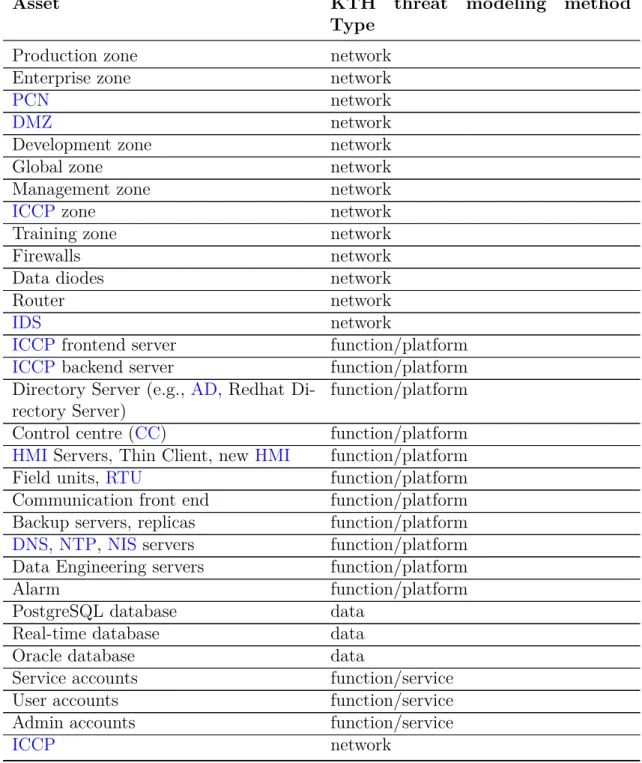
Table3.1represents assets available atSCADAfor this work, and categorises into three group based on the functionalities: network,function(platform and service) and
data as described in2.2.1. For the convenience, network is related to communication means, function/service is the category of assets that face the external clients or actors, andfunction/platform are internal assets that include infrastructure and are not accessible for external components.
Asset KTH threat modeling method Type
Production zone network
Enterprise zone network
PCN network
DMZ network
Development zone network
Global zone network
Management zone network
ICCPzone network
Training zone network
Firewalls network
Data diodes network
Router network
IDS network
ICCPfrontend server function/platform
ICCPbackend server function/platform Directory Server (e.g., AD, Redhat
Di-rectory Server)
function/platform Control centre (CC) function/platform
HMIServers, Thin Client, new HMI function/platform Field units,RTU function/platform Communication front end function/platform Backup servers, replicas function/platform
DNS, NTP, NIS servers function/platform Data Engineering servers function/platform
Alarm function/platform
PostgreSQL database data Real-time database data
Oracle database data
Service accounts function/service User accounts function/service Admin accounts function/service
ICCP network
Table 3.1: List of assets in a SCADAand their categorisation for this work based on
KTMM
3.2.2 Data Sources and Processing
We collect the data used in this work from various documents and configuration files: • IP packet filter rules (configured withiptables utility program),
• configuration files,
• output of configuration tools.
The project uses different configuration files that represent differentSCADAinstances. Having necessary input data to work with is important to build a threat modeling language for SCADA. Later, using this language, we can build a threat modeling tool for variousSCADA setups.
When the SCADA setup is built, configuration files store information about the hosts, networks, databases, and products. However, configuration files lack information about the firewall rules. We can find the rules for packet transmission and traffic that can via the use ofiptables command inside Linux hosts.
The steps for data processing in this work are as follows:
• Reviewing the provided script files and documents to assess the assets at
SCADA.
• Collecting and defining assets that are relevant to the scope of this work • Identifying threats and threat actors
• Summarising the most harmful threats • Iteration over the found results
• Providing the mitigation strategies • Generating a risk assessment
3.3
Risk Assessment Strategy Design
One of the challenges of creating a threat model forSCADAis performing an accurate risk assessment for a particular system. Not all of the attacks that utilise the same strategy have the same impact on differentSCADA [4] systems, and therefore, we need to evaluate which attacks have a higher impact on a specific system than others.
In this work, we map CVSS scoring system, which measures the severity of a vulnerabilities, into probabilistic model of MAL. As described in section 2.3.3, probabilistic model ofMAL uses TTC metric. TTC is computed as
TTC= attack difficulty∗certainty of attack success .
There is an explicit relation between attack difficulty and CVSS score. The
Base score and Environmental score of CVSS scoring system considers the Attack
Complexity as a factor that determines the score. Keramati, Akbari, and Keramati
[53] performed a similar mapping with regards toCVSS temporal scoring and attack difficulty. Keramati, Akbari, and Keramati [53] stated that the higher the temporal score is, the easier it is for an attacker to make an exploit. We consider this relation in this work.
![Figure 2.1: A typical SCADA Architecture in a simplified logical view [6]](https://thumb-us.123doks.com/thumbv2/123dok_us/9018514.2799669/21.892.129.804.152.479/figure-typical-scada-architecture-in-simplified-logical-view.webp)
![Figure 2.2: Layers of a SCADA system. Figure taken from [6]](https://thumb-us.123doks.com/thumbv2/123dok_us/9018514.2799669/22.892.269.632.399.797/figure-layers-of-scada-system-figure-taken-from.webp)