City, University of London Institutional Repository
Citation
:
Komninos, N. and Junejo, A. K. (2015). Privacy Preserving Attribute Based
Encryption for Multiple Cloud Collaborative Environment. Paper presented at the 1st
International Workshop on Cloud Security and Data Privacy by Design (CloudSPD'15),
07-12-2015 - 09-07-12-2015, Limassol, Cyprus.
This is the accepted version of the paper.
This version of the publication may differ from the final published
version.
Permanent repository link:
http://openaccess.city.ac.uk/12556/
Link to published version
:
Copyright and reuse:
City Research Online aims to make research
outputs of City, University of London available to a wider audience.
Copyright and Moral Rights remain with the author(s) and/or copyright
holders. URLs from City Research Online may be freely distributed and
linked to.
City Research Online:
http://openaccess.city.ac.uk/
[email protected]
Privacy Preserving Attribute Based Encryption for
Multiple Cloud Collaborative Environment
Nikos Komninos
Department of Computer ScienceCity University London,UK
Aisha Kanwal Junejo
Department of Computer ScienceCity University London,UK
Abstract—In a Multiple Cloud Collaborative Environment (MCCE), cloud users and cloud providers interact with each other via a brokering service to request and provision cloud services. The brokering service considers several pieces of data to broker the best deal between users and providers which can subsequently risks the privacy and security of MCCE. In this paper, we propose a Privacy Preserving Attribute-Based Encryption(PP-ABE) scheme which protects MCCE from a compromised broker. The proposed encryption scheme preserves the privacy by employing data access policy over sets of attributes. The iden-tifying attributes are anonymoized using pseudonyms. The data access policy is further anonymized so as it remain unknown to unauthorized parties. The PP-ABE achieves unlinkability between different data items which flows through the collaborative cloud environment and preserves the privacy of cloud users and cloud providers.
I. INTRODUCTION
Multiple Cloud Collaborative Environment (MCCE) is emerg-ing as the new facade of cloud computemerg-ing. A multiple cloud collaborative environment is conceptually similar to an e-commerce platform where several cloud providers outsource services to different users. International Organization for Stan-dardization defines a cloud service broker (CSB) [1] as a "cloud service partner that negotiates relationships between cloud service customers and cloud service providers." Such a collaborative environment is quiet different from traditional cloud setup where all the resources belong to a single cloud provider whereas in a multiple cloud environment resources belong to different cloud providers. Each resource being com-pletely distributed, heterogeneous, and totally virtualized. The MCCE is facilitated by an intermediary (brokering service) for efficient matching of cloud services (offered by a multitude of service providers) to satisfy user requirements. A brokering service is responsible for selecting optimal cloud resources to deploy a service, optimally distribute the different components of a service among different clouds, and to move a given service component from one cloud to another to satisfy the optimization criteria.
The basic components of MCCE under our consideration are cloud service users, brokering service, and cloud service providers. The steps of a typical transaction between different components are underlined below. Cloud Service Providers register their services with the brokering Service. Cloud Users specify their requirements and preferences (under business policy compliance) for selection of a reliable and trustworthy cloud service provider. The service user negotiates Service Level Agreement (SLA) with the service provider and make a SLA contract. The brokering service (resource matching module) selects and composites highly trusted resources and
allocates to users from the trusted resource pool. The brokering service sorts high performance resources by analysing the history information of the resources for dynamically providing the highly trusted resources. Users provide ratings for cloud service(s) at the end of transaction. The brokering service collects locally-generated user’s ratings and aggregates with the directly monitored state information i.e. Quality of Service (QoS) attributes to compute the global evaluation score. The global evaluation score is the overall degree of trust for a cloud service (i.e. aggregation of user feedback and directly monitored quality of service information).
It is imperative to underline the role of cloud brokering service in service provisioning cycle; and it is more important to do so for a multiple cloud collaborative environment. The cloud brokering service can be vulnerable for MCCE and it is therefore vital to adopt some security measures to control its behavior. The brokering service discussed in [2] takes into consideration cloud user’s requirements, preferences, business policy and QoS attributes of cloud providers to perform the above mentioned tasks. The storage and processing of such detailed information records(consisting of both identifying and non-identifying attributes) by a third party brokering service raises the security and privacy concerns. The brokering service can collude with the competitor cloud provider(s) or use the information for marketing purposes etc. The privacy require-ments of a MCCE are discussed below.
A. Requirements of a Privacy Preserved Multiple Cloud Col-laborative Environment
• Unlinkability:There must not be any link(or connec-tivity) between cloud user’s details and its require-ments, preferences, and feedback such that it could be used for malicious purposes.
• Anoymization: All the identifying details must be anonymized to preserve the privacy of collaborating entities.
B. Our Contribution
Privacy preservation is therefore the absolutely essential requirement of every brokering service; it is indeed the motivation of our research to propose a privacy preserving encryption scheme for both the cloud users and cloud ser-vice providers such that they are protected from any type of malicious behavior of the brokering service.The security and privacy can be guaranteed by considering the attribute based encryption scheme. In this paper, we propose a pri-vacy preserving attribute-based encryption scheme which uses cipher-text policy to anonymize attributes in order to achieve unlinkability between different data items which flows through the collaborative cloud environment.Attribute Anonymyzation
is achieved by considering the hidden data access policy.
C. Organization
The remainder of this paper is organized as follows. In section II, we present the most important studies related to cloud brokering services and privacy preserving encryption schemes. In section III, we discuss data access policy and the basic terms we use in the rest of the paper. In section IV, we present the privacy preserving scheme, while in section V we provide a security analysis of our proposed scheme. Finally, in section VI we conclude the paper.
II. RELATEDWORK
We review recent studies related to cloud brokering ser-vices(CBS) to underline their role, contribution, and require-ments in cloud computing environrequire-ments. We further review some privacy preserving attribute base encryption schemes.
In [3] authors discuss the current practices and upcoming challenges of cloud brokering. The legal and practical impli-cations of cloud brokering are highlighted. It is maintained that there can be different motivations(i.e. economical, special security, compliance regulation or specific requirements) be-hind the use of a brokering service but in any case the role of brokering service in data processing chain and respective liabilities must be clearly defined otherwise the security and privacy issues would become complex. It is argued that the brokering service must be independent and must not be bound by loyalty to a single company. The legal frameworks appli-cable to personal data must explicitly address the problems of data location, cross-border transfer, portability, access and accountability in wake of cloud brokering service appearing as a new phenomenon in cloud computing.
An open federated cloud computing model called Reser-voir is presented in [4]. The work is motivated by the fact the cloud computing has the potential of becoming a future service technology and that vision could be materialized by addressing the deficiencies in current cloud models. The identified deficiencies include 1) inherently limited scalability of single-provider clouds, 2) lack of interoperability among cloud providers, and 3) no built-in support for business service management. The Reservoir Model proposes an architecture where different cloud service providers can collaborate with each other to create a seemingly infinite pool of IT resources. The Reservoir architecture [4] consists of multiple com-ponents like service provider, infrastructure provider, virtual execution environment(VEE), reservoir site, reservoir cloud and various other sub-components. A service application is executed and deployed on a number of virtual hosts to ensure an on-demand provision of resources and services. The paper
does not discuss the roles(i.e. data owner, data controller, and data processor) and liabilities of these various components in service provisioning cycle. The lack of focus on these aspects affects the end user and risks it privacy and security.
A cloud brokering service based on the resource allocation perspective is proposed in [2]. The T-Broker service is a middle-ware for cloud trust management and service matching. T-Broker monitors the cloud services and computes the overall trust degree of the cloud service provider by aggregating the based trust and feedback trust. The experience-based trust is computed by monitoring cloud services on five kinds of QoS attributes(i.e. node spec profile, average resource usage information,average response time, average task success ratio, and the number of malicious access). The feedback trust is computed from the ratings of the users. The computed trust value is used to allocate the most trustworthy resources to users as per their requirements. Again, the proposed scheme does not discuss the security and privacy issues, the trustworthiness of the brokering service and the ways to control any malicious behavior on part of the brokering service.
The concept of a decentralized meta-broker for inter-cloud setting is introduced in [5]. Meta-broker enables the collaboration and inter-operation among several disperse (and highly likely heterogeneous) clouds. The idea is to develop coordination among different clouds for establishing a reactive cross-exchange and service automation process while offering transparency to users. Every cloud has a separate meta-broker which acts on behalf of its clients to map user requests to cloud data-centers. These meta-brokers establish inter-cloud collab-oration by exchanging information such as list of datacenter hosts, VMs, jobs (cloudlets) along with the characteristics of the datacenter (e.g. hosts CPU, Memory, number of processing elements (PEs), architecture etc.). This work recognizes the exchange of information between meta-broker can lead to security, privacy, and trust issues; and proposes the use of encryption techniques such as a shared key authentication process for fundamentally gaining secure access among clouds. A privacy preserving constant size cipher-text attribute-based encryption scheme is proposed in [6]. The two unique features of this scheme are privacy preservation and hidden data access policies. The recipient’s privacy is preserved by leveraging a hidden data policy construction. In this scheme,the cipher-text size remains constant with any given number of attributes. Our proposed scheme follows similar approach with [6] for user privacy preservation and attribute anonymization.
III. PRELIMINARIES OFPP-ABE
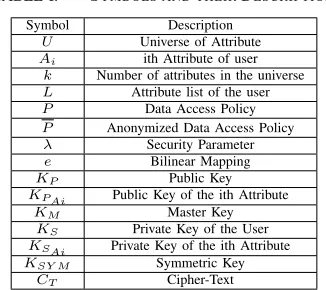
In this section, we discuss the notion of attributes, data access policy, and anonymized data access policy. First, we define these terms in an abstract way and then correlate them to a collaborative cloud computing environment. Table I lists the symbols we have used through out the paper.
A. Attributes, Policy, and Anonymity
LetU ={Ai}i∈[1, k]be the Universe of attributes and
k is the number of attributes in the universe. Each attribute
Ai has 3 values:{A+i ,A
−
i ,A∗i }. Intuitively,A +
i denotes the
user has Ai ; A−i denotes the user does not have Ai or it’s
not a proper attribute of the user. As for A∗
i, it denotes a
"wild-card" value, which means policy does not care about the value of attribute Ai. The attribute with a wild-card value
TABLE I. SYMBOLS AND THEIRDESCRIPTION
Symbol Description U Universe of Attribute Ai ith Attribute of user
k Number of attributes in the universe L Attribute list of the user P Data Access Policy P Anonymized Data Access Policy λ Security Parameter e Bilinear Mapping KP Public Key
KPAi Public Key of the ith Attribute KM Master Key
KS Private Key of the User
KSAi Private Key of the ith Attribute KSY M Symmetric Key
CT Cipher-Text
need to be privacy preserved. On the other hand, the attributes with identifying values are anonymized using "do-not care" values to preserve the privacy. When a user joins the system, it is tagged with an attribute list defined as follows: A user’s attribute list is defined asL ={L [i]i∈[1, k]}, whereL
[i]∈ {A+i ,A−i }.
AND-Gate Access Policy: Let P = { P [ i ]}i ∈ [1, k ] be an AND- Gate access policy, where[ P ] ∈ {A+i , A−i ,
A∗i }. The access policy contains both identifying and non-identifying attributes. We use the notation L ` P to denote that the attribute list Lof a user satisfiesP, as:
L`P⇔P⊂L[{A∗i}i∈[1, k]
A+i or A−i requires the exact same attribute in the user’s attribute list. Effectively, each user with A+i or A+i fulfills
A∗i automatically.
Anonymized AND-Gate Access Policy: Accordingly, we also define an Anonymized AND-gate policy that removes all identifying attribute values, i.e.{ A+i ,A+i}, except wild card values, i.e. A∗i. Formally, an anonymized AND-gate policy is defined as follows: Let
P=P\{A∗i}i∈[1, k]
be an anonymized AND-gate access policy. We note that the "do-not care" attribute values are included in the anonymized access policy. If we hide the "wild card" attributes, the decryp-tor will need to guess2k possible access policies if there are
kattributes in the policy, i.e., for its value can be eitherA∗i or the specific value (A+i or A−i ) assigned to the decryptor. This would make the scheme infeasible in terms of performance. The anonymity policy is defined as the state of being not identifiable within a set of subjects, i.e., the anonymity set. As the access policy is one-to-many mapped to users, we can extend this definition of policy anonymity set of blinded policy as the anonymity set of blinded policy P is the set of access policies which are identically blinded to P. Here, we briefly analyze the anonymity level of the blinded access policy. If there are no "wild-cards" in the original access policy (hidden), the blinded policy P will be empty. In this case, the size of anonymity set is2k, as there arej"wild-cards" in the original
access policy(hidden), the size of the anonymity set is 2k−j.
Bilinear Maps: A pairing is a bilinear map e: G0 ×G0 →G1, whereG0andG1 are two multiplicative cyclic groups
with large prime order p where the discrete logarithm problem on both G0 andG1 is considered hard to solve. Pairing has
following properties:
• Bilinearity:
e(Pa, Qb) =e(P, Q)ab,∀P, Q∈G0,∀a, b∈ZP∗. • Nondegeneracy:
e(g, g)6= 1
• Computability: A mapping is said to be computable if an algorithm exists which can efficiently computes
e(P,Q)for anyP,Q∈G0 .
Complexity Assumption: The security of our proposed scheme is based on a complexity assumption called the Bilin-ear Diffie-Hellman Exponent assumption (BDHE).
LetG0be a bilinear group of prime orderp. The K-BDHE
problem inG0is stated as follows: given the following vector
of 2K+1 elements (Note that gαK+1 is not in the list):
(h, g, gα, gα2, ..., gαK, gαK+2, ....gα2K)∈G20k+ 1
as the input and the goal of the computational K-BDHE problem is to output e(g,h)α
K+1
.
Decisional K-BDHE:The decisional K-BDHE assumption is said to be held in G0 if there is no probabilistic polynomial
time adversary who is able to distinguish
D
h, g, Yg,α,K, e(g, h)α
(K+1)E
and
h, g, Yg,α,K, e(g, h)R
with non-negligible advantage, where α, R∈ ZP andg, h ∈
G0 are chosen independently and uniformly at random.
B. Privacy Preservation for MCCE
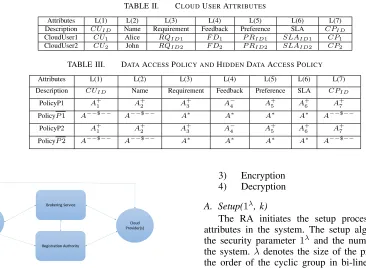
As has already been mentioned, the different entities in multiple cloud collaborative system interact with each other to request cloud service(s), provide cloud service(s), and broker the services between the cloud user(s) and cloud provider(s). An interaction between any of the two entities takes place on the basis of pre-agreed terms and conditions (i.e. Ser-vice Level Agreement(SLA) and policies). The policies and SLA(s) in turn consist of various data tuples and each tuple consist of several data attributes. Some of the data attributes contain the identifying information (i.e. IDs, personal details etc.) which must not be revealed to other entities in the system. Table II shows some attributes of cloud users such as ID, Name,Requirement, Feedback, Preferences, SLA, and Cloud Provider ID. Apart from ID and Name all other attributes are denoted by a unique identifier for that particular attribute.RQID1denotes the requirements identifier for cloud
user CU1. Similarly, F D1 , P RID1, SLAID1, and CP1
denotes the feedback, preferences, SLA, and cloud provider identifiers respectively. The attributes ID and Name represent user’s personal details whereas other attributes represent the linked information. We believe that the identifying attributes must be anonymized in order to preserve the privacy of the user(s). The anonymization is achieved by a hidden data access policy that specifies which attributes are to be disclosed and which not. The identifying attributes are anonymized by pseudonyms which are obtained from the registration authority. Table III lists data access policies (P1 and P2) and
anonymized data access policies (P1, P2) for cloud users
TABLE II. CLOUDUSERATTRIBUTES
Attributes L(1) L(2) L(3) L(4) L(5) L(6) L(7) Description CUID Name Requirement Feedback Preference SLA CPID
CloudUser1 CU1 Alice RQID1 F D1 P RID1 SLAID1 CP1 CloudUser2 CU2 John RQID2 F D2 P RID2 SLAID2 CP2
TABLE III. DATAACCESSPOLICY ANDHIDDENDATAACCESSPOLICY
Attributes L(1) L(2) L(3) L(4) L(5) L(6) L(7)
Description CUID Name Requirement Feedback Preference SLA CPID
PolicyP1 A+1 A+2 A+3 A−4 A+5 A+6 A+7
PolicyP1 A−−$−− A−−$−− A∗ A∗ A∗ A∗ A−−$−−
PolicyP2 A+1 A+2 A+3 A−4 A+5 A+6 A+7
PolicyP2 A−−$−− A−−$−− A∗ A∗ A∗ A∗ A−−$−−
Fig. 1. Privacy Preserved Multiple Cloud Collaborative Environment
specifies the user details by "do not care" and "wild card" attributes. A−−$−− denotes “do not care” attribute which means value is hidden (or privacy preserved) andA∗denotes a "wild card" value which means the policy does not care about the value of the attribute.
Whenever the cloud user sends some information to the brokering service or to cloud provider its identifying attributes are replaced with the "do not care" attribute values. The receiving party will verify the sender details by contacting the registration authority which confirms the registration of such a user. Upon verification from registration authority, the brokering service will respond to the query. Anonymizing the identifying details with pseudonyms preserves the user’s privacy. Similar attribute tables and anonymized data access policy tables can be created for cloud providers and brokering service.
IV. DESCRIPTION OFPP-ABE
In this section, we introduce our scheme which satisfies the above mentioned requirements and offers a privacy preserving mechanism for the users (i.e. cloud users and cloud providers) of a multiple cloud collaborative environment. Figure ?? shows the basic components of the scheme which includes cloud user(s), cloud service provider(s), registration authority (RA), and brokering service. Cloud users, cloud providers and brokering service all get registered with the registration authority. The registration authority asks for a number of attributes and upon verification creates secret keys for them. There are a number of attributes in the system. The registration authority also generates various parameters which are used by different algorithms. Our scheme consists of four fundamental algorithms:
1) Setup(1λ, k)
2) Key Generation
3) Encryption 4) Decryption
A. Setup(1λ, k)
The RA initiates the setup process. There are total k
attributes in the system. The setup algorithm takes input of the security parameter 1λ and the number of attributes(k) in
the system. λdenotes the size of the prime number which is the order of the cyclic group in bi-linear mapping. The size of prime number is usually λbits long. The setup algorithm returns public key KP and master key KM. The public key
KP is used for encryption while the master key KP is used
for private key generation.
B. Key Generation —KeyGen(KP,KM,L)
The KeyGen algorithm takes the public keyKP, the master
key KM and the user’s attribute listLas input. It outputs the
private key KS of the user.
C. Encryption —Encrypt(KP,M,P)
The encrypt algorithm takes the public key KP, the
mes-sage M and the specified access policy P (over the universe of attributes) as input. The algorithm outputs cipher-text CT
such that the only users whose private keys satisfy the access policy can decrypt the message. The cipher-text also associates the anonymized access policy P.
The encrypt algorithm is based on hybrid encryption scheme which can be constructed using public key encryption and symmetric key encryption schemes. The encryptor first encrypts the message using a symmetric keyKSY M and then
re-encrypt it using the public key KP and the public keys of
the attributes specified in the access policy.
D. Decryption —Decrypt(KP,KS,CT)
Before performing decryption, the receiver has little infor-mation about the access policy that is enforced over the cipher-text. Only ifL`Pthen user can successfully recover the valid plain text and access policy. Otherwise, user can only get a random string which can be easily detected. Moreover, the ac-cess policy remain unknown to the unsucac-cessful decryptor(s). It takes the public key KP, the private key KS of the user
and the cipher-text CT, which only includes the anonymized
access policy as input. It returns a valid plain-textM if the set of attributes of the private key satisfies the access structure of the cipher-text.
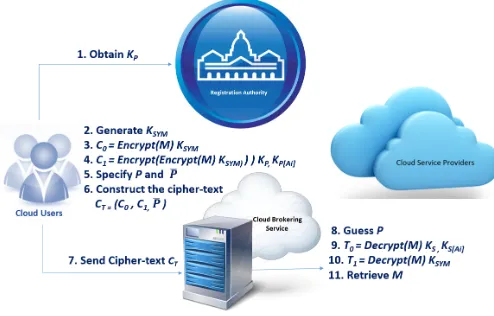
Fig. 2. Privacy Preserved Multiple Cloud Collaborative Environment
an access policy P by assigning an attribute value (Ai ∈ {1,0,∗}) for each of the n attributes in the universe and encrypts the message using public keys of the attribute values in the P. Each decryptor is generated as a set of private key components corresponding to attribute list L. All the private key components of the same user are tied together by a common random factor to prevent collusion attacks.
E. Example
We elaborate the execution of our proposed scheme by an example in which the cloud user wants to send a message to the brokering service. The steps of the encryption-decryption process are shown in figure 2. The same steps will be followed whenever a message is to be sent between any two parties in the multiple cloud collaborative environment (MCCE).
Encryption
First of all the cloud user obtains registration authority’s public key KP. It then generates a fresh one-time symmetric
key KSY M and encrypts the message Encrypt(M)K
SY M using the symmetric key just generated. The result of the encryption is first part of cipher-text i.e. C0 which is then
re-encrypted Encrypt( Encrypt(M)K
SY M)KP[Ai] using public
key KP and the public keys of policy attributes. This makes
the second partC1of the cipher-text. The attributes are already
defined in pre-agreed data access policy between the cloud User and the brokering service. The cloud user then specify the data access policyP and anonymizes data access policyP
by removing the identifying attributes with the "do-not-care" values. The cipher-text CT = (C0, C1, P) is then sent to the
brokering service. Decryption
To decrypt this hybrid cipher-text, the brokering service do the following. It uses the data policy attributes to make a guess of the access policyP. The brokering service then uses the parts of private key to decrypt the first part of cipher-text and retrieve symmetric key KSY M contained in. It then uses
this symmetric key KSY M to decrypt the message contained
in the second part of the cipher-text and retrieves the plain text messageM.
V. SECURITYANALYSIS
In this section, we discuss the security analysis of PP-ABE and further elaborate its robustness against some attacks.
A. Adaptive Chosen Cipher-text Attacks in PP-ABE
The PP-ABE is a hybrid encryption scheme which requires both the public key encryption (PKE) and symmetric key encryption (SKE) schemes to be secure against adaptive chosen cipher-text attacks because it then inherits those properties as well. Our proposed scheme is secure for both the encryption approaches. The generation of public/ private key pairs using bilinear-mapping makes it robust against key compromise and indistinguishability attacks. The one-time generation of the randomized symmetric key makes it hard to guess the
KSym symmetric key. Moreover, the K-BDHE complexity
assumption makes the PP-ABE more robust and secure against common security vulnerabilities. The security of the PP-ABE scheme is based on cipher-text indistinguishably i.e. indis-tinguishably under chosen plain-text attack(IND-CPA) which considers that the adversary should not learn any information from seeing a cipher-text and it should not be able to do better than a random guess. The goal of adversary in anonymous attribute-based encryption system can be either one of the following: 1) extracting information of plain-text from the cipher-text or 2) distinguishing underlying access-policy in the cipher-text.
The two goals of adversary can be integrated in the indistinguishability against cipher-text-policy and chosen cipher-text attacks (CP-IND-CCA). In this paper, we consider indistinguishability against selective cipher-text policy and chosen message attack (sCP-IND-CPA) [7] [8] [9]. The definition is similar to CP-IND-CCA, although in sCP-IND-CPA, the adversary has to submit its challenge attributes before the setup phase. Here, the adversary is allowed to control some users and access their attribute private keys that do not match the cipher-text-policy. Note that, the decryption oracle is not available to the adversary. The formal definition is given based on the following sCP-IND-CPA game between an adversary and a brokering service in MCCE.
Initial: The adversary commits to the challenge cipher-text policies P0,P1 before setup algorithm.
Setup: The challenger chooses a sufficiently large security parameter1λ, and runs setup to get public keyK
P and master
secret key KS. It retains KS and give KP to the adversary.
Phase 1: The adversary can perform a polynomially bounded number of queries to key generation oracle on attributesL, the only restriction on attribute list Lis that the it either satisfies both the policies or it does not satisfy any policy,
L`P0 = L`P1 = 0 or
L`P0 = L`P1 = 1.
Challenge:The adversary outputs two messagesM0andM1,
and it wishes to be challenged with respect to P0 and P1.
It requires that M0 = M1 if any attribute private key on L
satisfying L ` P0 = L ` P0 = 1 has been queried. The
challenger randomly chooses a bit b ={0,1}, computes CT
= Encrypt(KP,M,P) and sendsCT to the adversary.
to the challenge identity ID before the setup phase.
Pr[b= ´b]−1
2
The PP-ABE encryption scheme is fully secure if all poly-nomial time adversaries have at most a negligible advantage in sCP-IND-CPA. Our claim will remain true because of the Bilinear Diffie-Hellman Exponent (K-BDHE) assumption. The decisional K-BDHE ensures that no probabilistic polynomial time adversary would be able to guess the exponents for the private keys of the attributes. The data access policy is not revealed to any other user and the anonymity is not compromised.
B. Security Attacks in MCCE:
It is essential to protect the MCCE against security threats and vulnerabilities such that the colluding behavior of the brokering service can be controlled. The privacy requirements of the MCCE demand unlinkability of data, anonymity of users IDs, and control and audit of the collaborating entities. The privacy requirements of MCCE can be guaranteed if the PP-ABE is secure against the following security vulnerabilities: 1) Breaking the Anonymity: As we have already been dis-cussed in MCCE the privacy of cloud users and providers must be preserved, such that no adversary can break the anonymity of the identifying attributes and be able to link pieces of information. The privacy is protected by considering the hidden data access policy which is constructed using the "do-not-care" (A−−$−−) and "wild-card" (A∗) terms. The identifying
attributes (IDs) are represented by "do-not-care" (A−−$−−)
terms. The RA defines the pseudonyms for each of the identi-fying attribute i.e., the A−−$−− term. The pseudonyms are
generated by bi-linear mapping of cyclic groups with very large prime order i.e. security parameter λ in PP-ABE. It is computationally infeasible to guess the corresponding group element. Moreover, no adversary can determine if some target element is either a special combination of given parameters or a random element because of the K-BDHE complexity assumption of PP-ABE.
2) Data Modification: The other possible attack against any encryption scheme is data modification. Its indeed the basic security requirement of PP-ABE because the adversary can modify the IDs, ratings, feedback and trust values which can cost the entire collaborative environment. The PP-ABE is a hybrid encryption which makes it secure against data tampering. If an adversary is somehow able to steal the private keys, he/she can not modify the plain-text message because of the additional symmetric key encryption.
3) ID Spoofing: The adversary can impersonate as a a real cloud user or a cloud service provider to get registered with the RA. Once it does so it can gain access to the system and make falsified service requests and provisions. The PP-ABE is protected against the ID-spoofing attacks because of the application of formally robust methods for secret key generation. Whenever a user registers with the RAit submits a list of attributes L. Each of the attribute is mapped to a random number in cyclic group of prime order p, all those numbers are then summed up together. It then goes through other group operations and finally the cloud user ID CUID is
tied to another random element in G0. A similar process is
followed to generate the secret keyKS. In any case, if some
adversary knows the attribute list of the user it can not submit a
registration request to get exactly the same user IDCUIDand
secret key KS. This prevents the PP-ABE from ID-spoofing
attack.
4) White Washing: The PP-ABE is protected against the white-washing attack due to mathematically sound nature of applied techniques. The attack is facilitated by ID spoofing attack which is not possible because of the reasons already discussed above.
VI. CONCLUSION
In this paper, we have presented a privacy preserving attribute-based encryption(PP-ABE) scheme for a MCCE. Our proposed scheme is novel in a twofold manner: first, it preserves the privacy of cloud users and providers; and second, it curtails the malicious and colluding behavior of the brokering service. The MCCE is protected against any security and privacy risks if the brokering service is compromised. In future, we will further work on the trust and privacy issues of the MCCE. We aim to explore the trust from user’s perspective and see its correlation with privacy. We will also investigate the effects of human factors in establishment of trust.
REFERENCES
[1] I. I. T. T. F. (ITTF), “Information technology – cloud computing – overview and vocabulary, iso/iec 17788:2014,” ISO, Tech. Rep., Oct 2014.
[2] X. Li, H. Ma, F. Zhou, and W. Yao, “T-broker: A trust-aware service brokering scheme for multiple cloud collaborative services,” Informa-tion Forensics and Security, IEEE TransacInforma-tions on, vol. 10, no. 7, pp. 1402–1415, July 2015.
[3] M. Guzek, A. Gniewek, P. Bouvry, J. Musial, and J. Blazewicz, “Cloud brokering: Current practices and upcoming challenges,”Cloud Computing, IEEE, vol. 2, no. 2, pp. 40–47, Mar 2015.
[4] B. Rochwerger, D. Breitgand, E. Levy, A. Galis, K. Nagin, I. Llorente, R. Montero, Y. Wolfsthal, E. Elmroth, J. Caceres, M. Ben-Yehuda, W. Emmerich, and F. Galan, “The reservoir model and architecture for open federated cloud computing,” IBM Journal of Research and Development, vol. 53, no. 4, pp. 4:1–4:11, July 2009.
[5] S. Sotiriadis, N. Bessis, and N. Antonpoulos, “Decentralized meta-brokers for inter-cloud: Modeling brokering coordinators for interopera-ble resource management,” inFuzzy Systems and Knowledge Discovery (FSKD), 2012 9th International Conference on, May 2012, pp. 2462– 2468.
[6] Z. Zhou, D. Huang, and Z. Wang, “Efficient privacy-preserving ciphertext-policy attribute based-encryption and broadcast encryption,” Computers, IEEE Transactions on, vol. 64, no. 1, pp. 126–138, Jan 2015.
[7] J. Bethencourt, A. Sahai, and B. Waters, “Ciphertext-policy attribute-based encryption,” in Proceedings of the 2007 IEEE Symposium on Security and Privacy, ser. SP ’07. Washington, DC, USA: IEEE Computer Society, 2007, pp. 321–334. [Online]. Available: http://dx.doi.org/10.1109/SP.2007.11
[8] L. Cheung and C. Newport, “Provably secure ciphertext policy abe,” in Proceedings of the 14th ACM Conference on Computer and Communications Security, ser. CCS07. New York, NY, USA: ACM, 2007, pp. 456–465. [Online]. Available: http://doi.acm.org/10.1145/ 1315245.1315302
[9] D. Boneh and B. Waters, “Conjunctive, subset, and range queries on encrypted data,” in Theory of Cryptography, ser. Lecture Notes in Computer Science, S. Vadhan, Ed. Springer Berlin Heidelberg, 2007, vol. 4392, pp. 535–554. [Online]. Available: http://dx.doi.org/10.1007/978-3-540-70936-7_29