Cipher-Policy Attribute-Based Encryption
Jinguang Han1, Willy Susilo2, Yi Mu2, Jianying Zhou3and Man Ho Au2 1 Jiangsu Provincial Key Laboratory of E-Business, Nanjing University of Finance
and Economics, Nanjing, Jiangsu 210003, China
2 School of Computer Science and Software Engineering, University of Wollongong,
Wollongong, NSW 2522, Australia
3 Infocomm Security Department, Institute for Infocomm Research, 1 Fusionopolis
Way, Singapore 138632, Singapore
[email protected],{wsusilo,ymu,aau}@uow.edu.au, [email protected]
Abstract. Cipher-policy attribute-based encryption (CP-ABE) is a more efficient and flexible encryption system as the encryptor can control the access structure when encrypting a message. In this paper, we propose a privacy-preserving decentralized CP-ABE (PPDCP-ABE) scheme where the central authority is not required, namely each authority can work in-dependently without the cooperation to initialize the system. Meanwhile, a user can obtain secret keys from multiple authorities without releasing his global identifier (GID) and attributes to them. This is contrasted to the previous privacy-preserving multi-authority ABE (PPMA-ABE) schemes where a user can obtain secret keys from multiple authorities with them knowing his attributes and a central authority is required. However, some sensitive attributes can also release the user’s identity in-formation. Hence, contemporary PPMA-ABE schemes cannot fully pro-tect users’ privacy as multiple authorities can cooperate to identifier a user by collecting and analyzing his attributes. Therefore, it remains a challenging and important work to construct a PPMA-ABE scheme where the central authority is not required and both the identifiers and the attributes are considered.
Key words: CP-ABE, decentralization, privacy
1
Introduction
In network society, users can be identified by their distinct attributes. For exam-ple, European electronic identity cards often contain the attributes: nationality, sex, civil status, hair and eye color, and applicable minority status. These at-tributes are either binary or discrete numbers from a pre-defined finite sets [3]. Especially, they are very privacy-sensitive and require a selective disclosure of one while hiding others completely; otherwise, a user can be identified and im-personated by collecting and analyzing his attributes.
[30] introduced the seminal concept of attribute-based encryption (ABE). In this new encryption system, there is a central authority who monitors the universal attributes and distributes secrete keys to users accordingly. A user can decrypt a ciphertext if and only if there is a match between the attributes which he holds and the attributes listed in the ciphertext. Since it can protect the confidentiality of sensitive data and express flexible access control, ABE schemes have been focused extensively [2,11,15,26,19,31].
To reduce the trust on the central authority, Chase [9] proposed a multi-authority ABE (MA-ABE) scheme where multiple authorities must cooperate with the central authority to initialize the system. Then, Lewko and Waters [20] proposed a new MA-ABE scheme called decentralized CP-ABE (DCP-ABE) where multiple authorities can work independently without a central authority or any cooperation among them.
1.1 Privacy in Multi-Authority Attribute-based Encryption
In an MA-ABE scheme, malicious users may combine their secret keys to create a new secret key if the multiple authorities work independently [9]. For example, suppose that there is a ciphertext which can be decrypted by the attributes monitored by the authoritiesA1andA2. If Alice obtains secret keys fromA1and Bob obtains secret keys fromA2, they can collaborate to decrypt the ciphertext. To overcome this hurdle, each user in the system [9] must be designated an unique global identifier (GID) which is known by each authority. When generating secret keys for the user, the authorities tie them to his GID.
Privacy issues in MA-ABE are the primary concern of users as the author-ities can personate the target user if they know his attributes. Some schemes towards solving this problem have been proposed, but they cannot provide a complete solution, because, in all these schemes, only the privacy of the GID has been considered. Currently, there is no any scheme addressing the privacy issue of the attributes in MA-ABE schemes. However, it is extremely important as a user can be identified by some sensitive attributes. For example, suppose that the Head of the Department of Computer Science is Bob. Given two sets of attributes S1={Position=”Header”, Department=”CS”, Sex=”Male”} and S2= {Position=”PhD Student”, Department=”CS”, Sex=”Male”}, we can guess S1 is the attributes of Bob even if we do not know his GID. This clearly shows that controlled release of sensitive attributes is necessary.
1.2 Our Contributions
authority monitors a set of attributes and distributes secret keys to users ac-cordingly. To resist the collusion attacks, user’s secret keys are tied to his GID. Especially, a user can obtain secret keys for his attributes from multiple au-thorities without revealing any information about his GID and attributes to the authorities. Therefore, it provides stronger privacy compared to the previous PPMA-ABE schemes where only the identifier is protected. To encrypt a mes-sage, the encryptor selects an access structure for each authority and encrypts the message under them so that only the users whose attributes satisfy all the access structures can decrypt the ciphertext and obtain the plaintext. Compared to the existing decentralized ABE scheme [20] which was constructed in the ran-dom oracle model, our scheme is designed in the standard model. To the best of our knowledge, it is thefirstPPDCP-ABE scheme where both the identifiers and attributes are considered.
1.3 Organization
The remainder of this paper is organized as follows. In Section 2, the related work is introduced. We describe the preliminaries which are used throughout this paper in Section 3. In Section 4, a PPDCP-ABE scheme is proposed. Specifically, we first construct a DCP-ABE scheme, and then propose a privacy-preserving key extract algorithm. Finally, Section 5 concludes this paper.
2
Related work
In this section, we introduce the related work to our construction.
2.1 Attribute-based Encryption
Introduced by Sahai and Waters [30], attribute-based encryption (ABE) is a new encryption system where both the ciphertext and the secret key are labeled with a set of attributes. A user can decrypt a ciphertext if and only if there is a match between the attributes listed in the ciphertext and the attributes held by the user. Currently, ABE schemes can be classified as two types: key-policy ABE (KP-ABE) and cipher-policy ABE (CP-ABE).
KP-ABE.In these schemes, an access structure is embedded in the secret keys, while the ciphertext is associated with a set of attributes [30,9,10,15,26,17].
CP-ABE.In these schemes, the secret keys are associated with a set of attributes, while an access structure is embedded in the ciphertext [2,11,18].
The seminal ABE scheme [30] was proven in the selective-set model where, prior to seeing the public parameters, the adversary must submit a set of at-tributes which he wants to be challenged. The first fully secure ABE scheme was proposed by Lewkoet al. [19] where the limitation mentioned above is not required.
2.2 Multi-Authority Attribute-based Encryption
In the work [30], Sahai and Waters left an open problem, namely how to construct an ABE scheme where the secret key can be obtained from multiple authorities so that users can reduce the trust on the central authority. Chase [9] answered this question affirmatively by proposing an MA-ABE scheme. The technical hurdle in designing an MA-ABE scheme is to resist the collusion attacks. To overcome this hurdle, GID was introduced to tie all the user’s secret keys together. In [9], there is a central authority, and multiple authorities must interact to initialize the system.
Based on the distributed key generation (DKG) protocol [13] and the joint zero secret sharing (JZSS) protocol [12], Lin et al. [22] proposed an MA-ABE scheme where the cental authority is not required. To initialize the system, the multiple authorities must cooperatively execute the DKG protocol and the JZSS protocol twice andktimes, respectively, wherekis the degree of the polynomial selected by each authority. Each authority must maintaink+ 2 secret keys. This scheme is k-resilient, namely the scheme is secure if and only if the number of the colluding users is no more thank, andkmust be fixed in the setup stage.
M¨ulleret al.[24] proposed a distributed CP-ABE scheme which was proven to be secure in the generic group [2], instead of reducing to a complexity assump-tion. Furthermore, a central authority is required to generate the global key and issue secret keys to users.
Liu et al. [23] proposed a fully secure multi-authority CP-ABE scheme in the standard model. This scheme was derived from the CP-ABE scheme [19]. In this scheme, there are multiple central authorities and attribute authorities. The central authorities issue identity-related keys to users, while the attribute au-thorities issue attribute-related keys to users. Prior to possessing attribute keys from the attribute authorities, the user must obtain secret keys from the mul-tiple central authorities. This MA-ABE scheme was designed in the composite order (N =p1p2p3) bilinear group.
Lekwo and Waters [20] proposed a new MA-ABE scheme named decentraliz-ing CP-ABE (DCP-ABE) scheme. This scheme improved the previous MA-ABE schemes that require collaborations among multiple authorities to conduct the system setup. In this scheme, no cooperation between the multiple authorities is required in the setup stage and the key generation stage, and there is no central authority. Notably, an authority in this scheme can join or leave the system freely without reinitializing the system. The scheme was constructed in the composite order (N =p1p2p3) bilinear group, and achieves full (adaptive) security in the random oracle model. They also pointed out two methods to create a prime order group variant of their scheme. Nevertheless, the authorities can collect a user’s attributes by tracing his GID.
it. In [10], Chase and Chow provided an anonymous key issuing protocol for the GID where the 2-party secure computing technique is employed. As a result, a group of authorities cannot cooperate to pool the users attributes by tracing his GID. However, the multiple authorities must collaborate to setup the system. Furthermore, each pair of authorities must execute the 2-party key exchange protocol to share the seeds of the selected pseudo random functions (PRFs) [25]. This scheme is N −2 tolerant, namely the scheme is secure if and only if the number of the corrupted authorities is no more thanN−2, whereN is the num-ber of the authorities in the system. Although the authorities cannot know any information about the user’s GID, they can know the user’s attributes. Chase and Chow [10] also left an open challenging research problem on how to con-struct a privacy-preserving MA-ABE scheme without the need of cooperations among authorities.
Li [21] proposed a multi-authority CP-ABE (MACP-ABE) scheme with ac-countability, where the anonymous key issuing protocol [10] was employed. In this scheme, a user can be identified when he shared his secret keys with others. Notably, the multiple authorities must initialize the system interactively.
Recently, Han et al. [17] proposed a privacy-preserving decentralized KP-ABE (PPDKP-KP-ABE) scheme. In this scheme, multiple authorities can work in-dependently without any cooperation. Especially, the central authority is not required and a user can obtain secret keys from multiple authorities without releasing anything about his GID to them. Qianet al.[29] proposed a privacy-preserving decentralized CP-ABE (PPDCP-ABE) scheme which can support simple access structures. Nevertheless, similar to that in [10], the authorities in these schemes can know the user’s attributes.
2.3 Anonymous Credential
In an anonymous credential system [7], an identity provider can issue a creden-tial to a user, which includes the user’s pseudonym and attributes. By using it, the user can prove in zero knowledge to a third party that he obtains a cre-dential containing the given pseudonym and attributes without releasing any other information. In a multiple-show credential system [28], a credential can be demonstrated an arbitrary number of times, and cannot be linked to each other. Therefore, in our construction, we assume that each user has obtained an anonymous credential including his GID and attributes. Then, he can prove in zero knowledge to the multiple authorities that he has a GID and holds the corresponding attributes using the anonymous credential technique.
3
Preliminaries
ǫ:Z→Ris negligible if for anyz∈Zthere exists aksuch thatǫ(x)< 1 xz when
x > k. ByA(x)→y, we denote thaty is computed by running the algorithmA with inputx.KG(1κ) denotes the secret-public key pair generator which takes as input a security parameter 1κ and outputs a secret-public key pair. We denote
Zpas a finite field with prime orderp. Finally, byR r
−
→S andR←−s S, we denote that the partyRsendsrto the partyS and the partyS sendssto the partyR, respectively.
3.1 Complexity Assumption
LetGand Gτ be two cyclic groups with prime order p, andg be a generator of
G. A mape:G×G→Gτ is a bilinear group if the following properties can be satisfied:
1. Bilinearity.For alla, b∈Zpandu, v∈G, e(ua, vb) =e(ub, va) =e(u, v)ab. 2. Nondegeneracy.e(g, g)6= 1τ where 1τ is the identity of the groupGτ. 3. Computability.For allu, v∈G, there exists an efficient algorithm to compute
e(u, v).
Let GG(1κ) be a bilinear group generator, which takes as input a security parameter 1κ and outputs a bilinear group (e, p,G,Gτ) with prime orderpand a bilinear mape:G×G→Gτ.
Definition 1. (q-Strong Diffie-Hellman (q-SDH) Assumption [4]) Let x ←$ Zp,
GG(1κ)→ (e, p,G,G
τ)and g be a generator of G. Given a (q+ 1)-tuple −→y = (g, gx, gx2,· · ·, gxq), we say that the q-SDH assumption holds on (e, p,G,Gτ)
if no probabilistic polynomial-time adversary A can output (c, gx+1c) with the
advantage
AdvA= Pr[A(−→y)→(c, g 1
x+c)]≥ǫ(k)
where c∈Zp and the probability is token over the random choices x $
←Zp and
the random bits consumed byA.
Definition 2. (Decisional q-Parallel Bilinear Diffie-Hellman Exponent (q-PBDHE)
Assumption [31]) Let a, s, b1,· · ·, bq $
← Zp, GG(1κ) → (e, p,G,Gτ) and g be a
generator ofG. Given a tuple−→y =
g, gs, ga,· · ·, g(aq), g(aq+2),· · · , g(a2q)
∀1≤j≤q gs·bj, g
a
bj,· · · , g(aqbj), g(aq
+2
bj ),· · · , g(a
2q bj )
∀1≤j,k≤q,k6=j g
a·s·bk
bj ,· · · , g( aq·s·bk
bj ),
we say that the decisional q-PBDHE assumption hold on (e, p,G,Gτ) if no
probabilistic polynomial-time adversary Acan distinguish(−→y , e(g, g)aq+1s)from (−→y , R)with the advantage
AdvA=
Pr[A(
−
→y , e(g, g)aq+1s
whereR←$ Gτand the probability is token over the random choices ofa, s, b1,· · · , bq $
←Zp and the bits consumed byA.
3.2 Building Blocks
In this paper, the following building blocks are adopted.
Definition 3. (Access Structure [1]) Let P = (P1, P2,· · ·, Pn) be n parties. A
collection A⊆2{P1,P2,···,Pn} is monotonic ifB ∈AandB⊆C, then C∈A. An
access structure (respectively monotonic access structure) is a collection (respec-tively monotonic collection) Aof the non-empty subset of(P1, P2,· · · , Pn), i.e.,
A⊆2{P1,P2,···,Pn}\ {φ}. A setP is called an authorized set ifP ∈A; otherwise
P is an unauthorized set.
Definition 4. (Linear Secret Sharing Schemes [1]) A secret sharing scheme Q
over a set of parties P is called linear (over Zp) if it satisfies the following
properties:
1. The shares for each party form a vector overZp.
2. For Q
, there is a matrix M with ℓ rows and n columns called the share-generating matrix. For x = 1,2,· · ·, ℓ, the ith row is labeled by a party
ρ(i) where ρ : {1,2,· · ·, ℓ} → Zp. When we consider the vector −→v = (s, v2,· · ·, vn), where s∈Zp is the secret to be shared and v2,· · · , vn ∈Zp
are randomly selected, then M−→v is the vector of the ℓ shares according to
Q
. The shareMi−→v belongs to the partyρ(i), whereMi is theith row ofM.
Linear reconstruction property.LetSbe an authorized set andI={i|ρ(i)∈S}. Then, there exist constants {ωi ∈ Zp}i∈I such that, for any valid shares λi
according toQ, we haveP
i∈Iωiλi =s. The constants{ωi}i∈Ican be computed
in polynomial time with the size of share-generating matrixM.
Commitment Schemes. A commitment scheme consists of the following algo-rithms.
Setup(1κ) → params. This algorithm takes as input a security parameter 1κ, and outputs the public parametersparams.
Commit(params, m)→(com, decom).This algorithm takes as input the public parameters paramsand a message m, and outputs a commitmentcom and a decommitmentdecom. decomcan be used to decommitcomtom.
Decommit(params, m, com, decom)→ {0,1}.This algorithm takes as input the public parameters params, the message m, the commitment com and the de-commitmentdecom, and outputs 1 ifdecomcan decommitcomtom; otherwise, it outputs 0.
releases it later. The binding property requires that only the value decomcan be used to decommit the commitmentcomtom.
In this paper, we use the Pedersen commitment scheme [27] which is a per-fectly hiding commitment scheme and is based on the discrete logarithm as-sumption. This scheme works as follows. Let G be a cyclic group with prime order p, and g0, g1,· · ·, gk be generators of G. To commit a tuple of messages m1, m2,· · · , mk, the user selectsr
$
←Zp, and computes R=gr
0g1m1g2m2· · ·gkmk. Then, the user can userto decommit the commitmentR.
Proof of Knowledge. We use the notion introduced by Camenisch and Stadler [8] to prove statements about discrete logarithm. By
PoKn(α, β, γ) :y=gαhβ∧y˜= ˜gα˜hγo,
we denote a zero knowledge proof of knowledge of integersα,β andγsuch that y =gαhβ and ˜y = ˜gα˜hγ hold on the groupG=hgi=hhiand ˜G=hgi=hhi, respectively. Conventionally, the values in the parenthesis denote the knowledge that is being proven, while the rest of the values are known by the verifier. There exists an extractor that can be used to rewind the knowledge from the successful prover.
Set-Membership Proof. Camenisch et al. [5] proposed a set membership proof scheme. This scheme works as follows. Let GG(1κ)→(e, p,G,Gτ), andg,h be generators of G.
1. The verifier picks upx←$ Zp, and computesY =gxandTi=gx1+i fori∈Φ,
whereΦ⊆Zp is a finite set. Then, it sends{Y,(Ti)i∈Φ}to the prover. 2. To proveσ∈Φ, the prover selectsv, s, t, r, k←$ Zp, and computesC=gσhr,
D=gshk,V =gx+vσ andA=e(V, g)−s·e(g, g)t. Then, it sends (C, D, V, A)
to the verifier.
3. The verifier selects c←$ Zp, and sends it to the prover.
4. The prover computes zσ =s−cσ, zr=k−cr andzv =t−cv, and sends (zσ, zk, zt) to the verifier.
5. The verifier verifiesD=? Ccgzσhzr andA=? e(Y, v)c·e(V, g)−zσ·e(g, g)zr.
Theorem 1. This protocol is a zero-knowledge argument of set-membership proof for a set Φ if the|Φ|-SDH assumption holds on the bilinear group (e, p,G,Gτ)
[5].
3.3 DCP-ABE: Decentralized Cipher-Policy Attribute-based Encryption
A DCP-ABE scheme consists of the following five algorithms.
are N authorities {A˘1,A˘2,· · · ,AN˘ }, and each authority ˘Ai monitors a set of attributes ˜Ai. Each userU has a unique global identifierGIDU and holds a set of attributes ˜U.
Authority Setup(1κ)→(SKi, P Ki).Each authority ˘Ai takes as input the secret parameter 1κ, and runs the authority setup algorithm to generate its secret-public key pair (SKi, P Ki), whereKG(1κ)→(SKi, P Ki).
Encrypt(params,M,(Mi, ρi, P Ki)i∈I) → CT. The encryption algorithm takes
as input the public parameterparams, a messageM, a set of access structures (Mi, ρi)i∈I and a set of public keys (P Ki)i∈I, and outputs the ciphertextCT.
KeyGen(params, SKi, GIDU,U˜T ˜
Ai)→SKi
U.Each authority ˘Ai runs the key generation algorithm with inputs of the public parameterparams, his secret key SKi, a user’s global identifierGIDU and a set of attributes ˜UT ˜
Ai to generate a secret keySKi
U forU.
Decrypt(params, GID,(SKi
U)i∈I, CT) → M. The decryption algorithm takes as input the public parameter params, the user’s globe identifier GIDU, the secret keys (SKi
U)i∈I and the ciphertextCT, and outputs the messageM. Definition 5. A decentralized cipher-policy attribute-based encryption is correct if
Pr
Decrypt(params,Global Setup(1κ)→params; GID,(SKi
U)i∈I, Authority Setup(1κ)→(SKi, P ki);
CT)→ M Encrypt(params,M,(Mi, ρi, P Ki)i∈I)→CT;
KeyGen(params, SKi, GIDU,U˜T ˜
Ai)→SKi U
= 1
where the probability is token over the random bits consumed by all the algorithms in the scheme.
3.4 Security Model of Decentralized Cipher-Policy Attribute-based Encryption
We use the following game to define the security model of DCP-ABE schemes, which is executed between a challenger and an adversary A. This model is called selective-access structure model, and is similar to that introduced in [31,9,20,10,17,14].
Initialization.The adversaryAsubmits a list of corrupted authoritiesA={Ai˘}i∈I
and a set of access structures A={M∗
i, ρ∗i}i∈I∗, whereI ⊆ {1,2,· · ·, N} and
I∗ ⊆ {1,2,· · ·, N}. There should be at lease an access structure (M∗, ρ∗)∈A
which cannot be satisfied by the attributes monitored by the authorities in A
and the attributes selected byAto query secrete keys.
Authority Setup.There are two cases.
1. For the authority ˘Ai⊆A, the challenger runs theAuthority Setupalgorithm to generate the secret-public key pair (SKi, P Ki), and sends them toA. 2. For the authority ˘Ai*A, the challenger runs theAuthority Setupalgorithm
to generate the secret-public key pair (SKi, P Ki), and sends the public key P Ki toA.
Phase 1.Acan query secret key for a userU with an identifierGIDU and a set of attributes ˜U. The challenger runs the KeyGenalgorithm to generate a secret keySKU, and sends it toA. This query can be made adaptively and repeatedly.
Challenge. A submits two messages M0 and M1 with the same length. The challenger flips an unbiased coin with{0,1}, and obtains a bitb∈ {0,1}. Then, the challenger runs Encrypt(parmas,Mb,(M∗
i, ρ∗, P Ki)i∈I∗) to generate the challenged ciphertextCT∗, and sendsCT∗ toA.
Phase 2. Phase 1is repeated.
Guess.Aoutputs his guessb′ onb.Awins the game ifb′=b.
Definition 6. (Selective-Access Structure Secure DCP-ABE (IND-sAS-CPA)) A decentralized cipher-policy attribute-based encryption (DCP-ABE) scheme is(T, q, ǫ(κ))secure in the selective-access structure model if no probably polynomial-time adversary Amaking q secret key queries can win the above game with the advantage
AdvDCPA −ABE =
Pr[b′ =b]−1
2
> ǫ(κ)
where the probability is token over all the bits consumed by the challenger and the adversary.
3.5 PPDCP-ABE: Privacy-Preserving Decentralized Cipher-policy Attribute-based Encryption
A PPDCP-ABE has the same algorithmsGlobal Setup,Authority Setup,Encrypt
andDecryptwith the DCP-ABE scheme. The main difference is that we replace the KeyGen algorithm with a privacy-preserving key generation algorithm PP-KeyGen. Considering privacy issues, the authorities cannot know both the user’s identifier and attributes in PPDCP-ABE schemes. This is motivated by the blind IBE schemes [6,16]. ThePPKeyGenalgorithm is formally defined as follows.
PPKeyGen(U(params, GIDU,U , P Ki, decomi,˜ (decomi,j)ai,j∈U˜TA˜i)↔ ˘
Ai(params, SKi, P Ki, comi,(comi,j)ai,j∈T˜
Ai))→(SK
i
U,empty). This is an in-teractive algorithm executed between a userU and an authority ˘Ai.U runs the commitment algorithmCommit(params, GIDU)→(comi, decomi) and
sends (comi,(comi,j)ai,j∈T ˜
Ai) to the authority ˘Ai. Then,U and ˘Aitake as input
(params, GIDU,U , P Ki, decomi,(decomi,j)˜ ai,j∈U˜TA˜i) and (params, SKi, P Ki, comi,(comi,j)ai,j∈T˜
Ai), respectively. IfDecommit(params, GIDU, comi, dcomi) =
1 andDecommit(params, ai,j, comi,j, decomi,j) = 1, this algorithm outputs a se-cret keySKi
U forU and an empty bitemptyfor ˘Ai; otherwise, it outputs (⊥,⊥) to indicate that there are error messages.
3.6 Security Model of Privacy-Preserving Decentralized Cipher-policy Attribute-based Encryption
Now, we define the security of a PPDCP-ABE scheme, which informally is any IND-sAS-CPA-secure DCP-ABE scheme with a privacy-preserving key extract algorithm PPKeyGen that satisfies two properties: leak-freeness and selective-failure blindness. Leak-freeness requires that by executing the algorithm PPKey-Gen with honest authorities, the malicious user cannot know anything which it cannot know by executing the algorithmKeyGenwith the authorities. Selective-failure blindness requires that malicious authorities cannot know anything about the user’s identifier and his attributes, and cause thePPKeyGenalgorithm to se-lectively fail depending on the user’s identifier and his attributes. These two properties can be formalized by using the following games.
Leak-Freeness. This game is defined by a real world experiment and an ideal world experiment.
Real World Experiment. Runs the Global Setup algorithm and Authority Setup
algorithm. As many as the distinguisherDwants, the malicious userU chooses a global identifier GIDU and a set of attributes ˜U, and executes PPKeyGen(
U(params, GIDU,U˜, P Ki, decomi,(decomi,j)ai,j∈U˜TA˜i)↔Ai(params, SKi,˘ P Ki, comi,(comi,j)ai,j∈T˜
UTA˜i))→(SK
i
U, empty) with ˘Ai.
Ideal World Experiment. Runs the Global Setup algorithm and Authority Setup
algorithm. As many as the distinguisherDwants, the malicious user ¯U chooses a global identifierGIDU¯ and a set of attributes ˜U¯, and requires a trusted party to obtain the output ofKeyGen(params, SKi, GIDU¯,U˜¯TAi)˜ →SKUi¯.
Definition 7. An algorithm PPKeyGen(U ↔ Ai)˘ associated with a DCP-ABE scheme Q
= (GlobalSetup, AuthoritySetup,Encrypt,KeyGen,Decrypt) is leak-free if for all efficient adversary U, there exists a simulator U¯ such that, for the security parameter 1κ, no distinguisher Dcan distinguish whether U is playing
in the real world experiment or in the ideal world experiment with non-negligible advantage.
Selective-Failure Blindness.This game is formalized as follows.
1. The malicious authority Ai outputs his public key P Ki and two pairs of globe identifiers and attribute sets (GIDU0,U˜0) and (GIDU1,U˜1).
3. Ai is given comments
n
comb,(comi,j)ai,j∈U˜bTA˜i
o
and ncom1−b,(comi,j)ai,j∈U˜1−bTA˜i
o ,
and can black-box access oraclesU(params, GIDUb,Ub, P Ki, decomb,˜
(decomi,j)ai,j∈U˜bTA˜i) andU(params, GIDU1−b,U˜1−b, P Ki, decom1−b,
(decomi,j)ai,j∈U˜1−bTA˜i).
4. The algorithmU outputs the secret keysSKi
Ub andSK
i
U1−b, respectively.
5. IfSKi
Ub6=⊥andSK
i
U1−b6=⊥,Aiis given (SK
i Ub, SK
i
U1−b); ifSK
i
Ub6=⊥and
SKi
U1−b =⊥, Ai is given (ǫ,⊥); ifSK
i
Ub =⊥ and SK
i
U1−b 6=⊥, Ai is given
(⊥, ǫ); ifSKi
Ub =⊥andSK
i
U1−b=⊥,Ai is given (⊥,⊥).
6. Ai outputs his guess b′ onb.Ai wins the game ifb′=b.
Definition 8. An algorithm PPKeyGen(U ↔ Ai)˘ associated to a DCP-ABE schemeQ
= (Global Setup,Authority Setup,Encrypt,KeyGen,Decrypt)is selective-failure blind if no probably polynomial-time adversaryAican win the above game
with the advantage AdvSF B
Ai =
Pr[b′=b]−12
> ǫ(κ), where the probability is
token over the bits consumed by all the algorithms and the adversary.
Definition 9. A privacy-preserving decentralized cipher-policy attribute-based encryption (PPDCP-ABE) scheme Q˜
= (Global Setup,Authority Setup,Encrypt,
PPKeyGen,Decrypt)is secure if and only if the following conditions are satisfied:
1. Q
= (Global Setup,Authority Setup,Encrypt,KeyGen, Decrypt) is a secure DCP-ABE in the selective-access structures model;
2. thePPKeyGen algorithm is both leak-free and selective-failure blind.
4
Our Constructions
In this session, we propose a PPABE scheme. We first construct a DCP-ABE scheme, and then propose a privacy-preserving key extract protocol for it.
4.1 DCP-ABE: Decentralized Cipher-policy Attribute-based Encryption
Overview.Suppose that there areN authorities{A˘1,A˘2,· · ·,AN˘ }in the scheme, and each authority ˘Ai monitors a set of attributes ˜Ai for i = 1,2,· · ·, N. ˘Ai generates his secret-public key pair KG(1κ) →(SKi, P Ki). For each attribute ai,j ∈ Ai, ˘˜ Ai chooses a random number zi,j ←$ Zp. Then, the public key is computed as Zi,j = gzi,j and the authentication tag is computed as Ti,j =
hzi,jg
1
γi+ai,j whereγiis the partial secret key of ˘Ai.Ti,jcan be used to convince
˘
Ai that the attribute ai,j is monitored by him without revealing it.
To encrypt a messageMunder the attributes monitored by the authorities
(Mj, ρj) for each ˘Aj. Then, it splits sj into sharesλj,i according to the LSSS technique. Finally the messageMis blinded withQ
j∈Ie(g, g)αjsj.
To resist the collusion attack, when generating a secret key for a userU with GIDµand a set of attributes ˜U, ˘Aichooses two random numbers (tU,i, wU,i)←$
Zp. Specifically, tU,i is used to tie the user’s attribute keys to his GID by com-puting gtU,ig
βi+µ
tU,i where βi is the partial secret key of ˘Ai, and wU,i is used to
randomize the public keys by computing (Fx =ZwU,i
x )ax∈U˜TA˜i. Then, ˘Ai can
generate a secret key forU by using his secret key and (tU,i, wU,i).
To decrypt a ciphertext, eache(g, g)αjsj must be recovered. If the attributes
in ˜U satisfy the access structures (Mj, ρj)j∈I, the user can use his secret keys
and the corresponding ciphertexte elements to reconstructe(g, g)αjsj, and obtain
M.
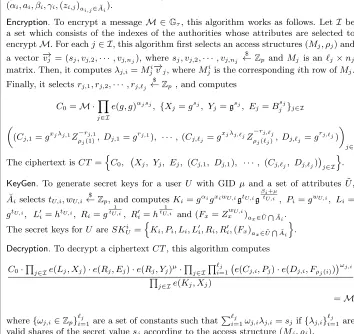
Our DCP-ABE scheme is described in Fig.1.
Correctness.Our scheme in Fig. 1 is correct as we have
Q
j∈Ie(Kj, Xj) =
Q
j∈Ie(gαjgxjwU,jgtU,jg
βj+µ
tU,j , gsj) =
Q
j∈Ie(g, g)αjsj ·e(g, g)xjwU,jsj ·e(g,g)tU,jsj·e(g,g)
βj sj
tU,j ·e(g,g) µsj tU,j,
Q
j∈Ie(Rj, Ej)·e(Rj, Yj)µ =
Q j∈Ie(g
1
tU,j, Bsj
j )·e(g
1
tU,j,gsj)µ=
Q j∈Ie(g
1
tU,j,gβjsj)·e(g
1
tU,j,gsj)µ=Q
j∈Ie(g,g)
βj sj
tU,j ·e(g,g) µsj tU,j,
Q
j∈Ie(Lj, Xj) =e(g, g)tU,jsj,
Q j∈I
Qℓj
i=1 e(Cj,i, Pj)·e(Dj,i, Fρj(i))
ωj,i
=
Q j∈I
Qℓj
i=1
e(ggxj λj,iZ−rj,i
ρj(i), g
wU,j)·e(grj,i, ZwU,j
ρj(i))
ωj,i
=
Q
j∈Ie(g, g)xjwU,j
Pℓj
i=1ωj,iλj,i =Q
j∈Ie(g, g)xjwU,jsj.
Therefore,
C0·Qj∈Ie(Lj,Xj)·e(Rj,Ej)·e(Rj,Yj)µ
Q
j∈Ie(Kj,Xj) · Q
j∈I
Qℓj
i=1 e(Cj,i, Pj)·e(Dj,i, Fρj(i))
ωj,i
=M.
Theorem 2. Our decentralized cipher-policy attribute-based encryption (DCP-ABE) is(T, q, ǫ(k))secure in the selective-access structure model if the(T′, ǫ′(k)) -decisionalq-PBDHE assumption holds on(e, p.G,Gτ), whereT′=T+O(T)and
ǫ′(κ) =1 2ǫ(κ).
The proof of this theorem is given in the Appendix A.
4.2 Privacy-Preserving Key Extract Protocol
Global Setup.This algorithm takes as input a security parameter 1κ, and outputs a
bilin-ear groupGG(1κ)→(e, p,
G,Gτ). Letg,handgbe generators of the groupG. Suppose
that there are N authorities {A˘1,A˘2,· · ·,A˘N}, and ˘Ai monitors a set of attributes
˜
Ai={ai,1, ai,2,· · ·, ai,qi}whereai,j∈Zpfori= 1,2,· · ·, N andj= 1,2,· · ·, qi. The
public parameters areP P= (g, h,g, e, p,G,Gτ).
Authorities Setup. Each authority ˘Ai selects αi, xi, βi, γi $
← Zp, and computes
Hi = e(g, g)αi, Ai = gxi, Bi = gβi, Γi1 = gγi and Γi2 = hγi, where i =
1,2,· · ·, N. For each attribute ai,j ∈ A˜i, ˘A chooses zi,j $
← Zp, and computes
Zi,j = gzi,j and Ti,j = hzi,jg
1
γi+ai,j. Then, ˘A publishes the public key P K
i = n
Hi, Ai, Bi,(Γi1, Γi2),(Ti,j, Zi,j)ai,j∈A˜i
o
, and keeps the master secrete key asSKi =
(αi, ai, βi, γi,(zi,j)ai,j∈A˜i).
Encryption.To encrypt a message M ∈Gτ, this algorithm works as follows. LetI be
a set which consists of the indexes of the authorities whose attributes are selected to encryptM. For eachj∈ I, this algorithm first selects an access structures (Mj, ρj) and
a vector−→vj = (sj, vj,2,· · ·, vj,nj), wheresj, vj,2,· · ·, vj,nj
$
←Zp and Mj is anℓj×nj
matrix. Then, it computesλj,i=Mji−→vj, whereMjiis the correspondingith row ofMj.
Finally, it selectsrj,1, rj,2,· · ·, rj,ℓj
$
←Zp, and computes
C0=M · Y
j∈I
e(g, g)αjsj, {X
j=gsj, Yj=gsj, Ej=B sj
j }j∈I
(Cj,1=gxjλj,1Z −rj,1
ρj(1), Dj,1=g
rj,1), · · ·,(C
j,ℓj =g
xjλj,ℓjZ−rj,ℓj
ρj(ℓj), Dj,ℓj =g
rj,ℓj
)
j∈I
The ciphertext isCT =nC0, Xj, Yj, Ej, (Cj,1, Dj,1), · · ·, (Cj,ℓj, Dj,ℓj)
j∈I
o
.
KeyGen. To generate secret keys for a userU with GIDµ and a set of attributes ˜U, ˘
Ai selectstU,i, wU,i $
←Zp, and computesKi=gαigxiwU,igtU,ig
βi+µ
tU,i , Pi=gwU,i, L
i=
gtU,i, L′
i=htU,i, Ri=g
1
tU,i, R′ i=h
1
tU,i and (Fx=ZwU,i
x )ax∈U˜TA˜i.
The secret keys forU areSKi U=
n
Ki, Pi, Li, L′i, Ri, Ri′,(Fx)ax∈U˜TA˜i
o
.
Decryption.To decrypt a ciphertextCT, this algorithm computes
C0·Qj∈Ie(Lj, Xj)·e(Rj, Ej)·e(Rj, Yj) µ·Q
j∈I Qℓj
i=1 e(Cj,i, Pj)·e(Dj,i, Fρj(i))
ωj,i
Q
j∈Ie(Kj, Xj)
=M
where{ωj,i∈Zp} ℓj
i=1are a set of constants such that Pℓj
i=1ωj,iλj,i=sj if{λj,i} ℓj
i=1are
valid shares of the secret valuesjaccording to the access structure (Mj, ρj).
Fig. 1. Decentralized Cipher-Policy Attribute-based Encryption
his GID. If ˘Ai records (tU,i, wU,i), he can computegµ= ( Ki
gαigxiwU,igtU,i)
tU,ig−βi
and (Zx=F
1
wU,i
x )ax∈U˜TA˜i. Hence, he can know the user’s GID and attributes.
Therefore, in order to protect the privacy of the user’s GID and attributes, (tU,i, wU,i) should be computed using the 2-party secure computing technique.
First, U chooses (k1, k2, d1, d2) $
← Zp. It uses (k1, k2) to commit his GID and (d1, d2) to commit his attributes and the corresponding authentication tags. Then, U proves in zero knowledge to ˘Ai that he knows the GID, and the at-tributes for which he is obtaining secret keys are monitored by ˘Ai. ˘Ai checks the proof. If it fails, ˘Ai aborts. Otherwise, ˘Ai chooses (cu, eu)←$ Zp and generates a secret key forU by using his secret key, the elements fromU and (cu, eu). Fur-thermore, ˘Aiproves in zero knowledge that he knows the secret key and (cu, eu); Finally, U can compute his real secret key by (k1, k2, d1, d2) and the elements from ˘Ai.
Actually, by executing the 2-party secure computing protocol, U and ˘Ai cooperatively computewU,i=eud1andtU,i=cku2, where (d1, k2) are fromU and (cu, eu) are from ˘Ai. Therefore, from the view of ˘Ai, the secret key computed by U is indistinguishable from the random elements inG.
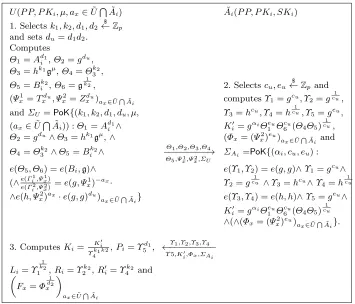
The privacy-preserving key extract protocol is given in Fig. 2.
Correctness. Let w = d1eu and t = cku2. The secret key generated in Fig. 2 is correct as the following equations hold.
Ki= K
′
iΥ
1
k2
Υk1k2
4
= g αiΘeu
1 (Θ4Θ5)
1
cugcuk2
Υk1k2
4
= g αiAd1eu
i ((hk1gµ)k2B k2
i )
1
cugcuk2
hk1cuk2
= g
αigxid1euh k1k2
cu g k2 (βi+µ)
cu gcuk2
hk1cuk2
=gαigxiwgtgβi
+µ t ,
Pi=Υd1
6 =gd1eu =gw, Li=Υ
1
k2
1 =g
cu k2 =gt,
Ri=Υk2
2 =g
k2
cu =g1t, R′
i=Υ4k2 =h
k2
cu =h1t
and
Fx=Φ
1
d2
x = (Ψx2)
eu d2 =Z
dueu d2
x =Zxd1eu =Zxw.
Theorem 3. The privacy-preserving key extract protocol in Fig. 2 is both leak-free and selective-failure blind under theq-SDH assumption, whereq=max{q1, q2,
· · · , qN}.
The proof of this theorem is given in the Appendix B.
ByTheorem2 andTheorem3, we have the following theorem.
Theorem 4. Our privacy-preserving decentralized cipher-policy attribute-based encryption (PPDCP-ABE) scheme Q˜
= (Global Setup,Authority Setup,Encrypt,
U(P P, P Ki, µ, ax∈U˜TA˜i) A˘i(P P, P Ki, SKi)
1. Selectsk1, k2, d1, d2←$ Zp
and setsdu=d1d2.
Computes Θ1 =Adi1,Θ2=g
du,
Θ3 =hk1gµ,Θ4=Θk32,
Θ5 =Bki2,Θ6=g
1
k2, 2. Selectscu, eu←$ Zpand
(Ψx1=Txdu, Ψx2=Zxdu)ax∈U˜TA˜i computesΥ1=g
cu, Υ
2=g
1
cu,
andΣU=PoK{(k1, k2, d1, du, µ, Υ3=hcu, Υ4=h
1
cu, Υ5=geu,
(ax∈U˜TA˜i)) :Θ1 =Adi1∧ K ′ i=gαiΘ
eu
1 Θ cu
6 (Θ4Θ5)
1
cu,
Θ2 =gdu∧Θ3=hk1gµ,∧ (Φx= (Ψx2)eu)ax∈U˜TA˜i and
Θ4 =Θk32∧Θ5 =Bki2∧
Θ1,Θ2,Θ3,Θ4 −−−−−−−−−→
Θ5,Ψx1,Ψx2,ΣU
ΣAi=PoK{(αi, cu, eu) :
e(Θ5, Θ6) =e(Bi,g)∧ e(Υ1, Υ2) =e(g, g)∧Υ1=gcu∧
(∧e(Γi1,Ψx1)
e(Γ2
i,Ψx2) =e(g, Ψ
1 x)
−ax· Υ
2=g
1
cu ∧Υ3=hcu∧Υ
4=h
1
cu
∧e(h, Ψx2)ax·e(g, g)du)ax∈U˜TA˜i} e(Υ3, Υ4) =e(h, h)∧Υ5=g
eu∧
K′ i=gαiΘ
eu
1 Θ cu
6 (Θ4Θ5)
1
cu
∧(∧(Φx= (Ψx2) eu)
ax∈U˜TA˜i}.
3. ComputesKi= K′
i
Υk1k2 4
,Pi=Υ5d1,
Υ1,Υ2,Υ3,Υ4 ←−−−−−−−−−
Υ5,K′
i,Φx,ΣAi
Li=Υ
1
k2
1 ,Ri=Υ2k2,R′i=Υ k2
4 and
Fx=Φ
1
d2
x
ax∈U˜TA˜i
Fig. 2.PPKeyGen: Privacy-Preserving Key Generation Protocol
5
Conclusion
Acknowledgement
We would like to thank the anonymous reviewers for their valuable comments. This work was partially supported by National Natural Science Foundation of China (Grant No. 61300213), National Center for International Joint Research on E-Business Information Processing (Grant No. 2013B01035) and A Project Funded by the Priority Academic Program Development of Jiangsu Higher Ed-ucation Institutions(PAPD).
References
1. A. Beime. Secure Schemes for Secret Sharing and Key Distribution. Phd thesis, Israel Institute of Technology, Technion, Haifa, Israel, 1996.
2. J. Bethencourt, A. Sahai, and B. Waters. Ciphertext-policy attribute-based en-cryption. InProc: IEEE S& P’07, pages 321–334. IEEE, 2007.
3. P. Bichsel, J. Camenisch, T. Groβ, and V. Shoup. Anonymous credentials on a standard java card. InProc: CCS’09, pages 600–610. ACM, 2009.
4. D. Boneh and X. Boyen. Short signatures without random oracles. In Proc: EUROCRYPT’04, volume 3027 ofLNCS, pages 56–73. Springer, 2004.
5. J. Camenisch, R. Chaabouni, and A. Shelat. Efficient protocols for set membership and range proofs. InProc: ASIACRYPT’08, volume 5350 ofLNCS, pages 234–252. Srpinger, 2008.
6. J. Camenisch, M. Kohlweiss, A. Rial, and C. Sheedy. Blind and anonymous identity-based encryption and authorised private searches on public key encrypted data. InProc: PKC’09, volume 5443 ofLNCS, pages 196–214. Springer, 2009. 7. J. Camenisch and A. Lysyanskaya. An efficient system for non-transferable
anony-mous credentials with optional anonymity revocation. InProc: EUROCRYPT’01, volume 2045 ofLNCS, pages 93–118. Springer, 2001.
8. J. Camenisch and M. Stadler. Efficient group signature schemes for large groups. InProc: CRYPTO’97, volume 1294 ofLNCS, pages 410–424. Springer, 1997. 9. M. Chase. Multi-authority attribute based encryption. InProc: TCC’07, volume
4392 ofLNCS, pages 515–534. Springer, 2007.
10. M. Chase and S. S. Chow. Improving privacy and security in multi-authority attribute-based encryption. InProc: CCS’09, pages 121–130. ACM, 2009. 11. L. Cheung and C. Newport. Provably secure ciphertext policy ABE. In Proc:
CCS’07, pages 456–465. ACM, 2007.
12. R. Gennaro, S. Jarecki, H. Krawczyk, and T. Rabin. Robust threshold dss signa-tures. InProc: EUROCRYPT’96, volume 1070 ofLNCS, pages 354–371. Springer, 1996.
13. R. Gennaro, S. Jarecki, H. Krawczyk, and T. Rabin. Secure distributed key gen-eration for discrete-log based cryptosystems. In Proc: EUROCRYPT’99, volume 1592 ofLNCS, pages 295–310. Springer, 1999.
14. V. Goyal, A. Jain, O. Pandey, and A. Sahai. Bounded ciphertext policy attribute based encryption. In Proc: ICALP’08, volume 5126 of LNCS, pages 579–591. Springer, 2008.
16. M. Green and S. Hohenberger. Blind identity-based encryption and simulatable oblivious transfer. InProc: ASIACRYPT’07, volume 4833 ofLNCS, pages 265–282, a, 2007. Springer.
17. J. Han, W. Susilo, Y. Mu, and J. Yan. Privacy-preserving decentralized key-policy attribute-based encryption. IEEE Transactions on Parallel and Distributed Systems, 23(11):2150–2162, 2012.
18. J. Herranz, F. Laguillaumie, and C. R`afols. Constant size ciphertexts in threshold attribute-based encryption. InProc: PKC’10, volume 6056 ofLNCS, pages 19–34. Springer, 2010.
19. A. Lewko, T. Okamoto, A. Sahai, K. Takashima, and B. Waters. Fully secure functional encryption: Attribute-based encryption and (hierarchical) inner prod-uct encryption. In Proc: EUROCRYPT’10, volume 6110 ofLNCS, pages 62–91. Springer, 2010.
20. A. Lewko and B. Waters. Decentralizing attribute-based encryption. In Proc: EUROCRYPT’11, volume 6632 ofLNCS, pages 568–588. Springer, 2011.
21. J. Li, Q. Huang, X. Chen, S. S. M. Chow, D. S. Wong, and D. Xie. Multi-authority ciphertext-policy attribute-based encryption with accountability. In g, editor,Proc: ASIACCS’11, pages 386–390. ACM, 2011.
22. H. Lin, Z. Cao, X. Liang, and J. Shao. Secure threshold multi authority attribute based encryption without a central authority. InProc: INDOCRYPT’08, volume 5365 ofLNCS, pages 426–436. Springer, 2008.
23. Z. Liu, Z. Cao, Q. Huang, D. S. Wong, and T. H. Yuen. Fully secure multi-authority ciphertext-policy attribute-based encryption without random oracles. In
Proc: ESORICS’11, volume 6879 ofLNCS, pages 278–297. Springer, 2011. 24. S. M¨uller, S. Katzenbeisser, and C. Eckert. Distributed attribute-based encryption.
InProc: ICISC’08, 2008.
25. M. Naor, B. Pinkas, and O. Reingold. Distributed pseudo-random functions and KDCs. InProc: EUROCRYPT’99, volume 1592 ofLNCS, pages 327–346. Springer, 1999.
26. R. Ostrovsky, A. Sahai, and B. Waters. Attribute-based encryption with non-monotonic access structures. InProc: CCS’07, pages 195–203. ACM, 2007. 27. T. P. Pedersen. Non-interactive and information-theoretic secure verifiable secret
sharing. In Proc: CRYPTO’91, volume 576 of LNCS, pages 129–140. Springer, 1992.
28. G. Persiano and I. Visconti. An efficient and usable multi-show non-transferable anonymous credential system. InProc: FC’04, volume 3110 ofLNCS, pages 196– 211. Springer, 2004.
29. H. Qian, J. Li, and Y. Zhang. Privacy-preserving decentralized ciphertext-policy attribute-based encryption with fully hidden access structure. InProc. ICICS’13, volume 8233 ofLNCS, pages 363–372. Springer, 2013.
30. A. Sahai and B. Waters. Fuzzy identity-based encryption. In Proc: EURO-CRYPT’05, volume 3494 ofLNCS, page 457, 2005.
A
Proof of Theorem 2
Proof. Suppose that there exists an adversaryAwho can (T, q, ǫ(k)) break our DCP-ABE in Fig. 1, we will show that there exists an algorithm B which can useAto break the decisionalq-PDHE assumption as follows.
The challenger generates the bilinear group GG(1k) → (e, p,G,Gτ), and chooses a generatorsg∈G. Let−→y =
g, gs, ga,· · ·, g(aq), g(aq+3),· · ·, g(a2q)
∀1≤j≤q gs·bj, g
a
bj,· · ·, g( aq bj), g(
aq+2
bj ),· · ·, g( a2q
bj )
∀1≤j,k≤q,k6=j g
a·s·bk
bj ,· · ·, g( aq·s·bk
bj ).
The challenger flips an unbiased coin with{0,1}, and obtains a bit ϑ∈ {0,1}. If ϑ= 0, he sends (−→y , Ω=e(g, g)aq+1s
) toB; otherwise, he sends (−→y , Ω=V) toB whereV ←$ Gτ.B will output his guessϑ′ onϑ.
Initialization.The adversaryAsubmits a list of corrupted authorities with index
I′ and challenge access structures A= (M∗
j, ρ∗j) j∈I∗ where I
∗ is a set
con-sisting of the indexes of the authorities ˘Aj. Let M∗ be a ℓ∗×n∗ matrix and
ℓ∗, n∗< q. Suppose that (M∗, ρ∗) is specified by the authority ˘A∗ with ˘A∗ ∈/ A
and cannot be satisfied by the attributes selected byAto query secrete keys.
Global Setup. B selects π, ̺←$ Zp, and computes h=gπ and g=g̺. Then, B sendsP P = (g,g, h, e, p,G,Gτ) toA.
Authorities Setup.
1. For the authority ˘Ai withi∈ I′,Bchoosesαi, xi, βi, γi, zi,j←$ Zp, and sets
Yi=e(g, g)αi, Ai=gbi, Bi=gβi, Γ1
i =gγi, Γ 2 i =hγi and Zi,j =gzij, Ti,j=Zπ
i,jg
1
γi+ai,j
ai,j∈A˜
.
This implies that the master secret key of ˘AiisSKi= (αi, xi, βi, γi,(zi,j)ai,j∈A˜i) and the public key isP Ki=Yi, Ai, Bi, Γ1
i, Γi2,(Ti,j, Zi,j)ai,j∈A˜i
.B sends (Ski, P ki) toA.
2. For the authority ˘Ai withi /∈ I′ and ˘Ai6= ˘A∗, it choosesαi, xi, βi, γi, zi,j←$ Zp, and computes
Yi=e(g, g)αi, Ai=gxi, Bi=gβi, Γ1
i =gγi, Γi2=hγi and Zi,j=gzij, Ti,j=Zπ
i,jg
1
γi+ai,j
ni
This implies that the master secret key of ˘AiisSKi= (αi, xi, βi, γi,(zi,j)ai,j∈A˜i) and the public key isP Ki= Yi, Ai, Bi, Γ1
i, Γi2,(Ti,j, Zi,j) ni
j=1
.BsendsP Ki toA.
3. For the authority ˘A∗,Bchoosesα′, β, γ←$ Zp, setsα=α′+aq+1+P i∈I′αi, and computes
Y∗=e(g, g)α=e(gα, gαq)·e(g, g)α′ Y i∈I′
e(g, g)−αi,
A∗=ga, B∗=gβ, Γ∗1=gγ, Γ∗2=hγ.
LetXbe the set consisting of the indexesiwithρ∗(i) =xfori= 1,2,· · ·, ℓ∗. (a) For the attribute ax with ρ∗(i) =x, B chooseszx←$ Z
p and computes
Zx=gzxQ i∈Xg
aMi,∗1 bi ·g
a2Mi,∗2 bi · · ·g
an∗Mi,n∗ ∗
bi andTx=Zπ
xg
!
γ+ax.
(b) For the attributesax withρ∗(i)6=x,Bchooseszx←$ Zp, and computes
Zx=gzx andTx=hzxgγ+1ax.
This implies that the master secrete key of ˘A∗ is
SK∗= α, a, b, γ,((zx+X i∈X
(aM
∗
i,1
bi +· · ·+ an∗
M∗
i,n∗
bi ))ρ∗(i)=x,(zx)ρ∗(i)6=x) !
and the public key is P K∗ = (Y∗, A∗, B∗, (Tx, Zx)
ax∈A˜∗). Then, B sends
P K∗to A.
Phase 1.Acan adaptively query secrete key for a userU with a global identifier µand a set of attribute ˜U which does not satisfyM∗.Bworks as follows.
1. For the authority ˘Ai withi∈ I′,Bchooseswi, ti←$ Zp, and computes
Ki=gαigxiwigtigβi
+µ
ti , Pi=gwi, Li=gti, L′
i=Lπi, Ri =gti1, R′
i=Riπ and (Fx=Txwi)ax∈Ai˜ TU˜.
Bsends the secret keySKi U =
n
Ki, Pi, Li, L′
i, Ri, R′i,(Fx)ax∈Ai˜ TU˜
o to A.
2. For the authority ˘Ai with i /∈ I′ and ˘Ai 6= ˘A∗, B chooseswi, ti ←$ Zp, and
computes
Ki=gαigxiwigtigβi
+µ
ti , Pi=gwi, Li=gti, L′
i=Lπi, Ri=gti1, Ri′=Rπ
i and (Fx=Txwi)ax∈Ai˜ TU˜.
Bsends the secret keySKi U =
n
Ki, Pi, Li, L′
i, Ri, R′i,(Fx)ax∈Ai˜ TU˜
3. For the authority ˘A∗,Bchoosest, r←$ Z
pand a a vector
− →
f = (f1, f2,· · · , fn∗)∈
Zn∗
p such thatf1=−1 and−→w·Mi∗= 0 for all ρ∗(i)∈U˜ T ˜
A∗. It computes P =grQn∗
i=1gfia
q−i+1
=gw. By this,B implicitly defines w =r+f 1aq+ f2aq−1+· · ·+fn∗aq−n
∗
+1. Then,Bcomputes
K=gα′−Pi∈I′αigra
n∗ Y
i=2
gfiaq−i+2gtgβ+tµ, L=gt,
L′=Lπ, R=g1t and R′=Rπ.
(a) For the attributeax∈A˜∗T˜
Ufor which there is noisuch thatρ∗(i) =x,
BcomputesFx=Pzx
(b) For the attributesax∈A˜∗T˜
U for which there does exist anisuch that ρ∗(i) =x,Bcomputes
Fx=Pzx· Y
i∈X n∗ Y
j=1
g
raj bi
n∗ Y
k=1,k6=j gfka
q+1+j−k bi
Mi,j∗
.
Bsends the secret keySK= (K, P, L, L′, R, R′,(Fx)
ax∈U˜TA˜∗) toA
We claim that the secret key created above is correct.
K=gα′−Pi∈I′αigra
n∗ Y
i=2
gfiaq−i+2gtgβ+tµ
=gα−aq+1gra n∗ Y
i=2
gfiaq−i+2gtgβ+tµ
=gαgra n∗ Y
i=1
gfiaq−i+2gtgβ+tµ
=gαga(r+Pn ∗
i=1fiaq−i+1)gtgβ+tµ
=gαgawgtgβ+tµ,
P =gr n∗ Y
i=1
gfiaq−i+1 =gr+Pn
∗
i=1fiaq−i+1 =gw,
L=gt, L′=Lπ=ht, R=g1
t andR′=Rπ=h
1
t.
For the attributeax∈A˘∗T ˜
U for which there is no anisuch thatρ∗(i) =x,
Fx=Pzx= (gw)zx= (gzx)w=Zw
For the attributeax∈A˘∗T ˜
U for which there does exist anisuch thatρ∗(i) =x,
Fx=Pzx Y
i∈X n∗ Y j=1 g raj bi n∗ Y
k=1,k6=j gfka
q+1+j−k bi
M∗
i,j
=gwzx Y
i∈X n∗ Y j=1 g raj bi n∗ Y
k=1,k6=j gfka
q+1+j−k bi
M∗
i,j
= (gzx)wY
i∈X (g
raMi,∗1 bi g
ra2Mi,∗2 bi · · ·g
ran∗Mi,n∗ ∗
bi ) n∗ Y j=1 n∗ Y k=1 gfka
q+1+j−k M∗
i,j bi
=Zxw
Challenge. Asubmits two messagesM0 andM1 with the same length to B. B flips an unbiased coin with{0,1}, and obtains a bit ˆϑ.
1. For the authority ˘Ai with i ∈ I∗ and ˘Ai = ˘6 A∗, B chooses si ←$ Z
p and computes Xi = gsg−si, Yi = X̺
i, Ei = (gsg−si)̺βi. Then, B chooses ri,1, ri,2,· · · , ri,ℓi, vi,2, vi,3,· · ·, vi,ni
$
←Zp, and sets−→vi= (s−si, vi,2,· · ·, vi,ni)
which is used to share the secrete (−si).Bcomputes
Ci,k =gsMik,1g−si
ni
Y
j=2
gvi,jMik,jZ−ri,k
ρi(k)
and Di,k=gri,k wherek= 1,2,· · ·, ℓiandMk,j
i denotes the element in the position (k, j) of the matrixMi.
2. For the authority ˘A∗, B computes X = gs, Y = gs̺, E = gsβ̺. Then,
B chooses r1, r2,· · ·, rn∗, v2, v3,· · · , vn∗ $
← Zp, and sets −→v = (s, sa+ v2, sa2 +v3,· · · , san
∗−1
+vn∗) which is used to share the secret s. Let
R be a set consisting of all i 6= j with ρ∗(i) = ρ∗(j). B computes Ck =
Zrk
ρ∗(k)( Qn∗
j=1(ga)M ∗
i,jvj(gbks)−zρ∗(k)·(Q l∈R
Qn∗ j=1(ga
j
s(bk/bl))M∗
l,j)) andDk=
g−rkg−sbk wherek= 1,2,· · · , ℓ∗.
Finally,Bcomputes
C0∗=Mϑˆ·Ω·e(gα ′
, gs)· Y i∈I∗,A˘
i6= ˘A∗
e(g, g)αis.
The challenge ciphertext isCT∗=
Phase 2. Phase 1is repeated.
Guess. A outputs his guess ˜ϑ on ˆϑ. If ˜ϑ= ˆϑ, B outputs ϑ′ = 0; otherwise, B
outputs ϑ′ = 1. As shown above, the public parameters, the public keys and
secret keys created in the simulation paradigm are identical to those in the real protocol. The remaining thing is to compute the probability with which Bcan break the decisionalq-PBDHE assumption.
If ϑ = 0, Ω = e(g, g)aq+1s
. Then, CT∗ is a correct ciphertext of M
0. Therefore, A can outputs ˜ϑ = ˆϑ with the advantage at least ǫ(κ), namely Pr[ ˜ϑ = ˆϑ|ϑ = 0] > 1
2 +ǫ(κ). Since B outputs ϑ
′ = 0 when ˜ϑ = ˆϑ, we have
Pr[ϑ′ =ϑ|ϑ= 0]>1
2+ǫ(κ).
Ifϑ= 1,Ωis a random number inGτ. ThereforeAcan outputs ˜ϑ6= ˆϑwith no advantage, namely Pr[ ˜ϑ6= ˆϑ|ϑ= 1] = 1
2. SinceBoutputsϑ
′= 1 when ˜ϑ6= ˆϑ,
we have Pr[ϑ′=ϑ|ϑ= 1] = 1 2.
Thereafter, the advantage with whichB can break the decisionalq-PBDHE is
1
2Pr[ ˜ϑ= ˆϑ|ϑ= 0]− 1 2Pr[ϑ
′=ϑ|ϑ= 1]
>1 2 ×
1 2+
1 2ǫ(κ)−
1 2×
1 2 =
1 2ǫ(κ)
⊓ ⊔
B
Proof of Theorem 3
Proof. We first prove that the PPKeyGen protocol is leak-free, and then prove that it is selective-failure blind.
Leak-Freeness. It requires that there exists an efficient simulator ¯U such that no efficient distinguisher can distinguish the real world experiment (where the malicious userUis executing thePPKeyGenalgorithm with the honest authority
˘
Ai) from the ideal world experiment (where ˘Aiis executing the algorithmKeyGen
with a trusted party). ¯U simulates the communication between U and ˘Ai by passing the input ofDtoU and the output ofU toD. The real world experiment is as follows.
1. ¯U sends the public parametersparamsand the public keyP Ki of ˘Ai toU. 2. Umust output (Θ1, Θ2, Θ3, Θ4, Θ5,(Ψx1, Ψx2)ax∈U˜TA˜i), and provePoK{(k1, k2,
d1, du, µ,(ax ∈U˜TAi)) :˜ Θ1 =Adi1∧Θ2 =gdu∧Θ3 =Γ3 =hk1gµ, ∧Θ4 = Θk2
3 ∧ Θ5 =gk2 ∧(∧e(Γ
1
i,Ψx1)
e(Γ2
i,Ψx2) =e(g, Ψ
1
x)−ax·e(h, Ψx2)ax·e(g, g)du)ax∈U˜TA˜i}.
If the proof fails, ¯U aborts; otherwise, ¯U can obtain (d1, du, k1, k2, µ,(ax ∈ ˜
UT ˜
3. ¯U can computeZx= (Ψ2 x)
1
du forax∈U˜TAi, and sends˜
µ,(Zx)ax∈U˜TA˜i
to the trusted party. The latter runs theKeyGenalgorithm to generate secrete keySK= (Ki, Pi, Li, L′
i, Ri, Ri′, (Fx)ax∈U˜TA˜i).
4. ¯U computesΥ1 =Lki2, Υ2 =R
1
k2
i , Υ3 =L ′
k2
i , Υ4 =R
′1
k2
i , Υ5 =P
1
d1
i , Ki′ = Ki(Υ4)k1k2 andΦx=F
du d1
x .
If Ki, Pi, Li, L′
i, Ri, R′i,(Fx)ax∈U˜TA˜i
is a correct secret key from the trusted
party in the ideal world experiment,Υ1, Υ2, Υ3, Υ4, Υ5, Ki′,(Φx)ax∈U˜TA˜i
is
cor-rect secret key from ˘Aiin the real world experiment. Hence, (Ki, Pi, Li, L′
i, Ri, R′i, (Fx)ax∈U˜TA˜i) and (Υ1, Υ2, Υ3, Υ4, Υ5, Ki′,(Φx)ax∈U˜TA˜i) are identically distributed.
Therefore, no efficient distinguisherDcan distinguish the real world experiment from the ideal world experiment.
Selective-Failure Blindness. The malicious authorityAi submits the public key P Ki and two pairs of GIDs and attributes: (µ0,U˜0) and (µ1,U˜1). Then, a bit ϑ∈ {0,1}is selected.Ai can black-box access the orales
Uparams, µ0,U˜0, P Ki, decomi,(decomi,j)ai,j∈U˜0TA˜i
and
Uparams, µ1,U˜1, P Ki, decomi,(decomi,j)ai,j∈U˜1TA˜i
.
After this,U executes thePPKeyGenalgorithm withAiwhereAi plays the role of the authority ˘Ai. U outputs secret keys SKU0 and SKU1 for (µ0,U˜0) and
(µ1,U˜1), respectively. If SKU0 6=⊥and SKU1 6=⊥, Ai is given (SKU0, SKU1);
ifSKU0 =⊥and SKU1 6=⊥, Ai is given (ǫ,⊥); ifSKU0 6=⊥and SKU1 =⊥,Ai
is given (⊥, ǫ); ifSKU0 =⊥and SKU1 =⊥, Ai is given (ǫ, ǫ). Finally, Ai will
output his guessϑ′ onϑ.
In thePPKeyGen protocol,U sends (Θ1, Θ2, Θ3, Θ4, Θ5,(Ψx1, Ψx2)ax∈U˜bTA˜i),
and prove PoK{(k1, k2, du, µ,(ax ∈ U˜TAi)) :˜ Θ1 = Adiu∧ Θ2 = gdu ∧Θ3 = hk1gµ,∧Θ
4=Θk32∧Θ5=Bki2∧e(Θ5, Θ6) =e(Bi,g)∧(∧e(Γ
1
i,Ψ
1
x)
e(Γ2
i,Ψx2) =e(g, Ψ
1 x)−ax· e(h, Ψ2
x)ax· e(g, g)du)ax∈U˜bTA˜i}. Up to this point,Ai runs one or both oracles.
So far,Ai’s view on the two oracles are computationally undistinguishable; oth-erwise, the hiding property of the commitment scheme and the zero-knowledge property of the zero-knowledge proof are broken. IfAi can use any computing strategy to output the secret key (Υ1, Υ2, Υ3, Υ4, Υ5, Ki′, (Φx)ax∈U˜b∈A˜i) for the first oracle, we show thatAican predictSKUb without the interactions with the
two oracles.
1. Ai checks PoK{(αi, cu, eu) : Υ1 = gcu ∧Υ2 = g
1
cu ∧ e(Υ1, Υ2) = e(g, g)
∧ Υ3 = hcu∧ Υ4 = h
1
cu ∧e(Υ3, Υ4) = e(h, h)∧K′
i = Υ5 = geu ∧ Ki′ = gαiΘeu
1 Θc6u(Θ4Θ5)
1
cu∧(∧(Φx = (Ψ2
x)eu)ax∈U˜TA˜i}. If the proof fails,A sets
2. Ai generates a different (Υ1, Υ2, Υ3, Υ4, Υ5, Ki′,(Φx)ax∈U˜b∈A˜i) for the second
oracle and a zero-knowledge proof PoK{(αi, cu, eu) : Υ1 = gcu ∧Υ2 = g
1
cu
∧ e(Υ1, Υ2) = e(g, g) ∧ Υ3 =hcu∧ Υ4 = h
1
cu ∧e(Υ3, Υ4) = e(h, h)∧K′
i = Υ5 =geu ∧ Ki′ =gαiΘ
eu
1 Θ6cu(Θ4Θ5)
1
cu∧ (∧(Φx = (Ψx2)eu)
ax∈U˜TA˜i}. If the
proof fails,Ai setsSKU1 =⊥.
3. If either test failed, then : if SKU0 =⊥ and SKU1 6=⊥, outputs (ǫ,⊥). If
(SKU0) 6=⊥ and SKU1 =⊥, outputs (⊥, ǫ). If both tests failed, outputs
(⊥,⊥).
4. If both tests succeeded,AiexecutesPPKeyGenwith himself on inputs (µ0,U˜0) and (µ1,U˜1). If either protocol fails,Aiaborts. Otherwise,Aioutputs (SKU1,
SKU2).
The prediction on (µ0,U˜0) and (µ1,U˜1) is correct, and has the identical distri-bution with the oracle. So,Ai can output the valid secret key which is the same as U obtains fromPPKeyGen(U ↔Ai) when the both the proofs are correct as˘
Aiperforms the same work asU. Therefore, ifAican predict the outputs of the two oracles, his advantage in distinguishing
Uparams, µ0,U˜0, P Ki, decomi,(decomi,j)ai,j∈U˜0TA˜i
from
U(params, µ1,U˜1, P Ki, decomi,(decomi,j)ai,j∈U˜1TA˜i)
is the same without the final output. Hence, the advantage of Ai should come from the received (Υ1, Υ2, Υ3, Υ4, Υ5, Ki′,(Φx)ax∈U˜b∈A˜i) and the proofPoK{(αi, cu, eu) : Υ1 = gcu ∧Υ2 = g
1
cu ∧ e(Υ1, Υ2) = e(g, g) ∧ Υ3 = hcu∧ Υ
4 = h
1
cu ∧
e(Υ3, Υ4) = e(h, h)∧Ki′ = Υ5 = geu ∧ Ki′ = gαiΘ1euΘc6u(Θ4Θ5)
1
cu∧ (∧(Φx =
(Ψ2
x)eu)ax∈U˜TA˜i}. By the hiding property of the commitment and the
wit-ness undistinguishable property, Ai cannot from one from the other with