City, University of London Institutional Repository
Citation
:
Sisarica, Anja (2015). Creativity support in games for motivated learning. (Unpublished Doctoral thesis, City University London)This is the draft version of the paper.
This version of the publication may differ from the final published
version.
Permanent repository link:
http://openaccess.city.ac.uk/14543/Link to published version
:
Copyright and reuse:
City Research Online aims to make research
outputs of City, University of London available to a wider audience.
Copyright and Moral Rights remain with the author(s) and/or copyright
holders. URLs from City Research Online may be freely distributed and
linked to.
Centre for Creativity in Professional Practice
School of Mathematics, Computer Science and Engineering City University London
A Thesis presented for the degree of Doctor of Philosophy
Creativity support in games
for motivated learning
by Anja Sisarica
THE FOLLOWING PARTS OF THIS THESIS HAVE BEEN
REDACTED FOR COPYRIGHT REASONS:
p 49: Fig 2.1. Screenshot from ‘Where in the world is Carmen Sandiego’.
p 64: Fig 2.6. Screenshots from ‘Elegy for a dead world’ and ‘Fallen London’.
p 68: Fig 2.7. Images from Smallab, EPOC, Big Huggin’ and JS Joust.
p 145: Fig 4.4. Images from mock up.
3
5
Table of Contents
LIST OF FIGURES & TABLES ... 11
ACKNOWLEDGEMENTS ... 17
DECLARATION ... 18
ABSTRACT ... 19
CHAPTER 1 – PROBLEM STATEMENT ... 21
1.1 INTRODUCTION ... 22
1.2 CONTEXT AND MOTIVATION ... 23
1.2.1 Playing creatively ... 27
1.2.2 Creating playfully ... 29
1.3 RESEARCH QUESTIONS ... 30
1.4 RESEARCH OBJECTIVES ... 32
1.5.1 Theoretical description of the relationship between CPS and SGs 34 1.5.2 Design and development of game prototypes that instantiate the CGBL framework ... 36
1.5.3 The partial CGBL framework validation ... 36
1.6 RESEARCH CONTRIBUTION ... 37
1.7 STRUCTURE OF THE THESIS ... 40
1.8 THE CHAPTER SUMMARY ... 44
CHAPTER 2 – LITERATURE REVIEW ... 46
2.1 SERIOUS GAMES ... 47
2.1.1 Definitions and background research ... 47
2.1.1.1 Engagement in games for motivated learning ... 50
2.1.1.2 Player types ... 52
2.1.1.3 Classifying serious games ... 54
2.1.1.4 Understanding game play: the IPO model ... 55
2.1.1.5 Understanding game design: the MDA framework ... 58
2.1.1.6 Understanding game mechanics: the AddingPlay toolkit ... 61
2.1.2 State-of-the-art of serious games ... 62
2.1.2.1 Contents ... 63
2.1.2.2 Outcomes ... 65
2.1.2.3 Technology ... 67
2.1.3 Conclusion ... 69
6
2.2.1 Definitions and background research ... 70
2.2.1.1 Press ... 75
2.2.1.2 Product ... 76
2.2.1.3 People... 77
2.2.1.4 Process ... 78
2.2.2 Creative problem solving ... 82
2.2.3 Creative learning ... 83
2.2.4 Creativity and play ... 87
2.2.5 Conclusion ... 88
2.3 PERSON-CENTRED DEMENTIA CARE ... 89
2.3.1 Definitions ... 89
2.3.2 Creative serious games for person-centred dementia care training ... 91
2.3.2.1 Instructional content ... 95
2.3.3 Conclusion ... 97
2.4 THE CHAPTER SUMMARY ... 97
CHAPTER 3 – THE CREATIVE GAME-BASED LEARNING FRAMEWORK ... 100
3.1 INTRODUCTION ... 101
3.2 THE DIMENSIONS OF A GOOD CSG USER EXPERIENCE ... 102
3.2.1 Challenge ... 104
3.2.2 Freedom ... 105
3.2.3 Trust and safety ... 106
3.2.4 Humour and playfulness... 107
3.2.5 Idea-support ... 107
3.2.6 Conflict ... 108
3.2.7 Idea-time ... 109
3.2.8 Risk-taking ... 110
3.2.9 Conclusion ... 110
3.3 THE CGBL FRAMEWORK ... 111
3.3.1 Positive CSG outcome ... 114
3.3.2 Creative learning outcomes ... 115
3.3.3 The CGBL Aesthetics ... 117
3.3.4 The CGBL Dynamics ... 119
3.3.5 The CGBL Mechanics ... 122
7
3.4 THE CHAPTER SUMMARY ... 131
CHAPTER 4 – DESIGN AND DEVELOPMENT ... 134
4.1 INTRODUCTION ... 135
4.2 CONCEPT STUDY ... 137
4.2.1 Ethnography... 138
4.2.1.1 Motivation ... 138
4.2.1.2 Method ... 138
4.2.1.3 Results ... 140
4.2.2 Creating a mock-up ... 142
4.2.2.1 Motivation ... 142
4.2.2.2 Method ... 144
4.2.2.3 Results ... 144
4.2.3 User observation study ... 147
4.2.3.1 Motivation ... 147
4.2.3.2 Method ... 149
4.2.3.3 Results ... 151
4.2.4 Threats to validity ... 154
4.2.4.1 Ethnography ... 154
4.2.4.2 Creating a mock-up ... 155
4.2.4.3 User observation ... 155
4.2.5 Conclusions ... 156
4.3 HAZEL COURT V1.0 ... 157
4.3.1 Design overview and physical prototyping ... 158
4.3.1.1 Premise ... 158
4.3.1.2 Challenges... 160
4.3.1.3 Outcome ... 160
4.3.1.4 Characters... 161
4.3.1.5 Resources ... 162
4.3.2 Mechanics ... 165
4.3.2.1 Variable challenge... 165
4.3.2.2 Resource management, Customisation & Feedback ... 166
4.3.2.3 Collecting ... 167
4.3.3 Dynamics ... 168
4.3.4 Playtesting ... 171
4.3.4.1 Motivation ... 172
4.3.4.2 Method ... 172
4.3.4.3 Results ... 174
4.3.4.4 Conclusions ... 177
8
4.4 HAZEL COURT V2.0 ... 179
4.4.1 Game re-design and digital prototyping ... 179
4.4.1.1 Resources ... 180
4.4.1.2 Mechanics ... 184
4.4.1.3 Dynamics ... 188
4.4.2 Usability testing ... 189
4.4.3 Playtesting ... 194
4.4.3.1 Motivation ... 194
4.4.3.2 Method ... 195
4.4.3.3 Results ... 198
4.4.3.4 Conclusions ... 211
4.5 HAZEL COURT V2.1 ... 213
4.5.1 Game re-design ... 213
4.5.2 Playtesting ... 219
4.5.2.1 Motivation ... 219
4.5.2.2 Method ... 219
4.5.2.3 Results ... 221
4.5.2.4 Conclusions ... 236
4.6 HAZEL COURT V3.0 ... 239
4.7 THE CHAPTER SUMMARY ... 248
CHAPTER 5 – IMPLICATIONS FROM THE FORMATIVE EVALUATIONS FOR THE CGBL FRAMEWORK INSTANTIATION ... 254
5.1 INTRODUCTION ... 255
5.2 IMPLICATIONS FOR THE INSTANTIATION OF THE CGBL MECHANICS 256 5.2.1 The dependency between the CGBL mechanics and the CGBL dynamics ... 257
5.2.2 The dependency between the CGBL mechanics and the dimensions of good CSG experience... 260
5.3 IMPLICATIONS FOR THE CGBL DYNAMICS ... 262
5.4 PLAYER MODE AND FACILITATION ... 266
5.5 CONCLUSION... 268
CHAPTER 6 – SUMMATIVE EVALUATION ... 270
6.1 INTRODUCTION ... 271
9
6.3 RESULTS ... 276
6.3.1 The CGBL aesthetics and engagement in the CGBL dynamics in Hazel Court v3.0 ... 277
6.3.1.1 Care team-A ... 278
6.3.1.2 Care team-B ... 279
6.3.1.3 Care team-D ... 281
6.3.1.4 Care team-H... 282
6.3.1.5 Care team-E ... 283
6.3.1.6 Care team-F ... 284
6.3.1.7 Care team-C ... 284
6.3.1.8 Care team-G ... 285
6.3.1.9 Conclusions ... 286
6.3.2 Domain-specific learning and motivational benefits ... 287
6.3.3 Creative outcomes ... 290
6.3.4 Threats to validity ... 292
6.4 CONCLUSIONS ... 293
CHAPTER 7 – DISCUSSION ... 296
7.1 SUMMARY OF THE RESEARCH OUTCOMES ... 297
7.2 DISCUSSION OF THE RESEARCH OUTCOMES ... 300
7.2.1 Addressing RQ1 ... 300
7.2.2 Addressing RQ2 ... 304
7.2.3 Addressing RQ3 ... 306
7.3 DISCUSSION OF THE RESEARCH CONTRIBUTIONS ... 309
7.4 EXPLOITATION AND FUTURE WORK ... 311
7.5 CONCLUSIONS ... 314
REFERENCES ... 316
APPENDICES ... 328
APPENDIX A-1:MOCK-UP... 329
APPENDIX A-2:MOCK-UP DEVELOPMENT ROADMAP ... 336
APPENDIX B-1:CALL FOR PARTICIPATION ... 337
APPENDIX B-2:INFORMED CONSENT ... 339
APPENDIX B-3:EXPLANATORY STATEMENT ... 340
APPENDIX B-4:DEBRIEF QUESTIONS IN USER OBSERVATION STUDY .. 341
APPENDIX C-1:HAZEL COURT V2.0 PLAYTESTING CHECKLIST ... 342
APPENDIX C-2:HAZEL COURT V2.0 DEBRIEF QUESTIONNAIRE ... 343
10
11
List of Figures & Tables
Figure 1-1: Doctoral research interdisciplinary context, bridging the gap
between creativity techniques, serious games and dementia care. ... 27
Table 1-1: The overview of project’s research design, where the research
questions, objectives and outcomes are mapped. ... 33
Table 1-2: Mapping of the research activities. For reference on research
questions and objectives, please see Sections 1.3 & 1.4, respectively. ... 34
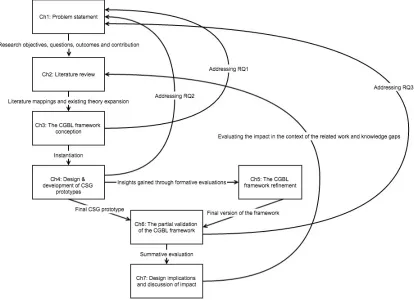
Figure 1-2: Flow diagram of the thesis structure by chapters. ... 43
Figure 2-1: Screenshot from the popular ‘90s serious game “Where in the World
is Carmen Sandiego?”. ... 49
Figure 2-2: Bartle’s main player types, adapted from [13]. ... 52
Table 2-1: Classification of serious games by Ratan & Ritterfeld (2009),
adapted from [150]. ... 54
Figure 2-3: The IPO model [66], describing the motivational learning game play
process construct. ... 56
Figure 2-4: The MDA model [86] bridges the gap between game design and
game experience. ... 59
Figure 2-5: Takatalo’s adaptation of the MDA framework: game system is
affected by the game designer (i.e. mechanics), play is when the user
interacts with a game (i.e. dynamics), whilst the UX characteristics
instantiation are affected by user background and psychology (i.e.
aesthetics). ... 61
Figure 2-6: Screenshots from: a) Elegy for a Dead World (right); b) Fallen
London, game developed on StoryNexus platform (left). ... 64
Figure 2-7: State-of-the-art games technology: a) Smallab (top left); b) EPOC
(top right); c) Big Huggin’ (bottom left); d).JS Joust (bottom right). ... 68
Figure 2-8: Creativity research timeline, adapted from [162]. ... 71
Figure 2-9: Rhodes’s “4Ps” model of creativity [89]. ... 75
Figure 2-10: Mapping of the creative process stages across the most influential
models that I created by combining reviews from the sources [89, 162,
182]. ... 81
Figure 2-11: The improvisational aspects of play [162]. ... 88
Figure 2-12: The positioning of the CGBL framework in the creativity research
field. ... 89
Table 2-2: My Home Life guidelines for delivering “Personalising and
12
Figure 3-1: Theoretical contribution in bridging the gap between creative
problem solving and serious games was the first objective of this research.
... 101
Figure 3-2: The CGBL framework overview, which illustrates the main
components of a CSG, their dependencies and involved actors. The CGBL
Mechanics created by a CSG Designer afford the CGBL Dynamics to play
out and are co-created by CSG Player. That process helps the CGBL
Aesthetics and creative learning outcomes to emerge, together making a
positive CSG outcome. ... 112
Table 2-1: Some examples of the dependencies between the dimensions of a
good CSG and targeted motivation aspects. ... 115
Figure 3-3: Defining creative learning outcomes. ... 117
Figure 3-4: The affordance of the dominant disposition outcomes (i.e. the CGBL
aesthetics) in the individual creative process stages. ... 121
Figure 3-5: Defining the CGBL mechanics. ... 125
Figure 3-6: The CGBL Mechanics support each of the creative process stages.
... 126
Figure 3-7: The i* SR model representation of the CGBL framework. ... 129
Figure 4-1: Iterative design and development of prototypes that instantiate the
CGBL framework was the second objective of this research. ... 135
Figure 4-2: The timeline of the Hazel Court game prototype design and
development process, which included 4 formative evaluations that lead to
the final prototype, Hazel Court v3.0. Mx, where x is for month number,
indicates the month into the PhD project when the fieldwork with users
took place. ... 136
Figure 4-3: Materials used in the ‘Data Quality and Case Study’ exercise, given
to the researcher with permission of TPIC, the owner of the materials:
fictional residents’ Care Plan, task instructions and scenario, additional
handouts related to the Data Quality theme - all of which was text-only.
Excerpts were examined and discussed in a group, and then used for
generating new resolutions to the task. ... 141
Figure 4-4: Wireframe from the mock-up, depicting the Cluedo-inspired
whiteboard with clues (top left). Clues could be zoomed in and shuffled
(top right). Location-Motive-Suspect combination gives structure to the
story players create about the missing resident (bottom left). A tutor, try
counter and notepad are there to support the mechanics of Feedback,
Variable challenge and Customisation (bottom right). See the full set of
wireframes in Appendix A-1. ... 145
13
Figure 4-6: 221b Baker Street board, case scenario, notes, booklet. ... 150
Figure 4-7: Photos from one of the concept study playtests, showing carers
playing 221B Baker Street game (left), and doing the role-playing exercise
(right). ... 151
Figure 4-8: The contribution of the individual methods applied in the study to
the CSG concept design. ... 156
Figure 4-9: The characters of Cluedo are mapped to carers, fellow residents and
family members of two residents, the Blacks, in Hazel Court care home.
Figure shows classic Cluedo character cards’ graphics mashed-up with
Hazel Court contents, in screenshots from the prototype prompts. ... 161
Figure 4-10: The Cluedo board (left) and weapons figurines (right), used as
resources in Hazel Court v1.0 dynamics... 162
Figure 4-11: Physical prototype resources - The clues hiding in the rooms of
Hazel Court. ... 163
Figure 4-12: Physical prototype resources - the clues provided by the characters
that appear when players explore different rooms of Hazel Court v1.0, also
presenting the choice of where to go next... 164
Figure 4-13: Physical prototype resources - the ‘read-me’ envelopes that
provided creativity prompts in Hazel Court v1.0. ... 164
Figure 4-14: The mechanics of Hazel Court v1.0, and the corresponding creative
process stages they intend to support in the dynamics. ... 168
Figure 4-15: A narrative prompt supporting the transfer of knowledge and
skills in Hazel Court v1.0. ... 170
Figure 4-16: A flowchart showing the dynamics of Hazel Court v1.0 and its
three stages: divergent thinking using card clues (yellow); divergent
thinking using object clues (green); convergent thinking (red). Choices
signify decision-making points (i.e. ‘where do you go next?’). ... 171
Figure 4-17: Paper-based prototype (Hazel Court v.1.0) playtest photos,
showing first level (photos up) and third level (photos bottom) of the game
dynamics. The iPad that is in the photos was present only for back-up
audio recording. ... 174
Figure 4-18a: Some screenshots from Hazel Court v2.0 web app, showing the
support to the various stages of clues exploration, discovery and
manipulation, from top to bottom: meeting the Blacks; meeting the other
characters. ... 181
Figure 4-18b: Some screenshots from Hazel Court v2.0 web app, showing the
support to the various stages of clues exploration, discovery and
manipulation, from top to bottom: kick-off in the Hall of Hazel Court; clue
14
Figure 4-19: Photo from the Hazel Court v2.0 playtest in the field, showing
players using the digital clues whiteboard in the web app on iPad 2,
together with the physical resources and clues. ... 184
Figure 4-20: Photo from the Hazel Court v2.0 playtest in the field, showing the
game-master facilitating the third level of dynamics in the CSG session
with 4 care staff players. ... 186
Figure 4-21: Screenshot from Hazel Court v2.0 web app, with a hidden clue (in
this case, a care plan) in the Library of Hazel Court. Can you spot it?
There is also Colonel Mustard, with something to say in audio format.
After you have noted all that, you can go to the Conservatory, to find out
more about how to cheer up Mr Black, or to the Billiard Room, to find out
more about how to cheer up Mrs Black. Where would you go? ... 187
Figure 4-22: The Hazel Court v2.0 dynamics description. ... 188
Figure 4-23: Photo from Hazel Court v2.0 playtest, showing the players
interacting with the web app. At the moment when the photo was taken,
players were in the Lounge of Hazel Court, listening to the audio
statement of Mrs White. ... 196
Table 4-1: Coding scheme applied on the timeline data, based on the CGBL
mechanics from the CGBL framework. ... 201
Table 4-2: Coding scheme applied on the timeline data, based on the CGBL
dynamics from the CGBL framework... 202
Table 4-3: The frequencies of the applied mechanics (Table 4-1) and dynamics
codes (Table 4-2) per session (i.e. JANx) and their average values. ... 210
Figure 4-24: Some of the design improvements in Hazel Court v2.1, from left to
right: a) projection of the web app on the wall to enhance visibility among
the players, Cluedo board and other prompts on the walls; b) creativity
triggers and flipchart for generating ideas; c) new function of the treasure
hunt and physical clue objects. ... 215
Figure 4-25: Photos from Hazel Court v2.1 playtesting, illustrating several
different CGBL dynamics stages, from top left to bottom right: a) clue
gathering; b) generating ideas; c) creativity triggers used for idea
selection; d) externalising the ideas and discussing the potential
application in practice (i.e. transfer from excursion). ... 216
Figure 4-26: The Hazel Court v2.1 dynamics description (see Section 3.3.4),
where: RM - Resource management; Cu - Customisation; Co - Collecting;
F - Feedback; VC - Variable challenge. ... 218
Figure 4-27: Word cloud generated using the mention frequencies in the debrief
15
Table 4-4: The frequencies of the applied mechanics (Table 4-1) and dynamics
codes (Table 4-2) per session (i.e. JUNx) and their average values. ... 235
Figure 4-30: One of the two Hazel Court v3.0 app game boards. ... 242
Figure 4-31: Images, from top left to bottom right, of Hazel Court’s interactive
pawn, magnifying glass, and clue box, and all elements together. ... 244
Figure 4-32: Making Hazel Court v3.0 hardware components. ... 247
Figure 4-33: The summary of the formative evaluations’ findings. ... 252
Figure 5-1: The comparison of the average occurrences of the assigned
mechanics codes (see Table 4-1) between Hazel Court v2.0 & Hazel Court
v2.1. ... 258
Figure 5-2: The comparison of the average occurrences of the assigned
dynamics codes (see Table 4-2) between Hazel Court v2.0 & Hazel Court
v2.1. ... 263
Figure 5-3: The methodological guidelines (G1-G10) for the CGBL framework
instantiation, which present a refinement of the CGBL framework,
inferred from the conducted formative evaluations reported in Chapter 4.
... 269
Figure 6-1: The partial CGBL framework validation was the third objective of
this research, which the work described in this chapter addresses by
investigating RQ3. ... 271
Table 6-1: The instantiation of the CGBL dynamics by the dynamics
implemented in the Hazel Court v3.0. ... 273
Figure 6-2: Photos from Hazel Court v3.0 playtesting with care team-A,
showing excerpts from the idea generation (top) and selection (bottom)
phases of the dynamics. ... 274
Figure 6-3: Photo from the playtest, showing care team-A in their training
environment in the care home, and the chart they made to externalise
their final idea. ... 279
Figure 6-4: Photo from a Hazel Court v3.0 playtest, showing: i) left, care
team-B of care staff players with the game resources: board, clue printer box,
pawn, magnifying glass; ii) right, the same group during Selection stage
with creativity triggers. ... 280
Figure 6-5: The restricted training space with care team-D was a former
private resident room in the attic. ... 281
Figure 6-6: Photo from the playtest, showing board exploration and clue
examination, with the CGBL mechanics supporting the engagement of the
16
Figure 6-7: Photos from the playtest: left - care team-E playing Hazel Court
v3.0; right - Who-where-when-how chart with attached clues that inspired
the final idea. ... 283
Figure 6-8: Photo from the playtest, showing care team-G in the last two stages
of the CGBL dynamics, selection and externalization of the final idea. . 286
Figure 6-9: Product Desirability test results between the conditions, showing a
considerable rise in engagement among exposure groups. Attribute
colours indicate an emotional disposition: blue - negative, pale purple -
neutral, dark purple - positive; numbers colours gradients signalise three
frequency levels - darkest are the highest (<15), lightest are the lowest
(>10). ... 288
Table 6-2: Quoted replies from the participants, collected via the follow-up
questionnaire. ... 290
Table 6-3: Average expert novelty, usefulness and person-centred ratings per
care activity generated by the care teams. ... 291
Table 6-4: Descriptive statistics showing average mean values and standard
deviation in expert scoring on three criteria: novelty (C1), usefulness (C2)
and person-centredness (C3) of eight samples from groups exposed to
17
Acknowledgements
Many people have contributed positively to the development of this thesis, being interdisciplinary as it is, and I am most grateful. I would like to acknowledge a few people who have been particularly helpful. Firstly, it has been a privilege working with the dementia care staff members who volunteered their time and expertise to playtest my prototypes and contribute their feedback. Thanks to people from The Partnership in Care, My Home Life London network, and Life Opportunities Trust, for helping the fieldwork happen. In this regard, special thanks to my second academic supervisor, Prof Julienne Meyer, for guiding my understanding of this challenging healthcare domain and its best practices.
My work was financially supported by State of Exit Foundation, DOSITEJA Studentship (Fund for Young Talents, Republic of Serbia), and the MIRROR Studentship (City University London, Imaginary S.r.l. & MIRROR EU FP7 project). I am very grateful for the rewarding experience of contributing to the MIRROR project, and many thanks to all my colleagues for collaboration, especially: Simone Mora & Monica Divitini (NTNU); Dalia Morosini & Lucia Pannese (Imaginary S.r.l.); Malcolm Rose & Kevin Pudney (RNHA); Kristine Pitts, Konstantin Zachos, Sara Jones & Monica Ferraro (City University London). I would also like to thank all my wonderful colleagues and office mates at the Centre for Human-Computer Interaction Design, and the Centre for Creativity in Professional Practice, for exchanging ideas, following my progress and encouraging me along the way.
Special thanks to my first academic supervisor Prof Neil Maiden, for his consistent patience and generous support throughout my project. His inspiring insights, and willingness to debate the issues and challenge me, left an invaluable impact on my professional learning and development, and for that I am very grateful.
18
Declaration
The work in this thesis is based on research carried out at the Centre for Human-Computer Interaction Design and Centre for Creativity in Professional Practice at City University, London, England. No part of this thesis has been submitted elsewhere for any other degree or qualification. All work is my own unless otherwise stated.
Signed: (Anja Sisarica)
Date:
Copyright © by Anja Sisarica, 2015
19
Abstract
A natural extension of play for creative thinking can innovatively drive technology-led changes to the facilitation of creative problem solving, and generate a new genre in serious gaming. Whilst the use of serious games has grown considerably in recent years, support for players to think creatively is often implicit in the game, and does not exploit the wide range of creativity techniques and software tools available. The work reported in this thesis is the first to explicitly integrate creativity support into serious games. The results show that creative serious games can systematically support acquisition of creativity skills, generation of creative learning outcomes, and induction of motivational and learning benefits amongst the players.
Therefore, this thesis introduces the concept of explicit creativity support in serious games, with a focus on games for motivated learning in adult professional setting, and reports formative and summative evaluations of new prototype games for this setting, in order to instantiate, refine and validate the concept. The creative learning objective of the prototype games was to train carers in creativity techniques to deliver more person-centred care to people with dementia.
The findings are delivered in the form of a new framework, which proposes recommendations for the design and understanding of creative serious games. Four formative evaluations of three prototypes of creative serious games with carers provided results that led to refinements of the framework and the design of more usable and effective games. A subsequent summative evaluation partially validated the framework, delivering both a framework and prototype creative serious game that demonstrated the potential to improve person-centred dementia care training. The thesis provides a proof-of-concept of the value of creative serious games, and shows the potential for the framework to be applied and have impact on other application domains.
21
Chapter 1 – Problem Statement
"Let my playing be my learning, and my learning be my playing"
1.1 Introduction
Motivated learning is a term that represents the reciprocal nature of the relation between motivation and learning: motivation influences learning and performance, and what one does and learns in the process of learning influences one’s motivation levels [48, 200]. A motivated learner has a willingness to engage in a learning task, and an intrinsic motivation to continue learning. This recursive process can be embedded in games [142], and computer-based serious games employ game mechanics to deliver social change and motivated learning rather than entertainment [111]. Interest in such game forms has increased significantly over the last five years. For example, Gartner [67] predicts that by 2015, more than 50% of organisations that manage innovation processes will have gamified those processes. Examples of domains for which serious games have been effectively delivered include defense, education, science, health care, city planning, engineering, religion, and politics [153].
23
But what would happen if, instead of imposing solutions, we let the players create a “reality fix” of their own? There has been little research that sought to introduce techniques to encourage creative thinking explicitly to support such problem solving and technology-enhanced social interventions in game-based learning. Indeed, although there are serious games that appear to have been designed to support creative exploration by users [74], most do not explicitly support creative problem solving using established creativity techniques [129] and software tools [168]. If creativity can be incorporated into serious games, then it can potentially allow players not only to immerse themselves in stories that make things meaningful [104] within game environments, but also to create their own stories, ideas and reflection spaces [24] beyond a game simulation. Creativity within games can also mean allowing the players in the game space to generate new rules that the designer had not considered (e.g. as in the Nomic game [203]). My doctoral project addresses this knowledge gap by contributing and exploring one new connection between the fields of creative problem solving and serious games.
1.2 Context and motivation
24
management, consulting, arts). Proposing a theoretical framework that is domain-independent, therefore, has numerous benefits in terms of exploitation. However, its recommendations have to taken with caution, as an in-depth evaluation requires more case studies in different domains. Investigating the generalisation of this hypothesis and the domain-independent nature of my theoretical recommendations would indeed be too big of a task for a single doctoral project. Therefore, I focused my research on the challenges posed by only one domain: personalized dementia care.
Dementia is a condition related to ageing, with major consequences for health and social care provision. For example, there are currently 750,000 people with dementia in the UK alone, a figure expected to double by 2050 [196]. Dementia care is often delivered in residential homes, and in the UK, two-thirds of all home residents have some form of dementia [196]. Serious games are already emerging as an important means of training care staff in residential homes, for example as an immersive virtual care home in which trainee carers can experience, resolve and reflect on challenging situations in a virtual, and hence safe environment [142]. However, an emerging need for creative thinking in dementia care has arisen from the shift towards person-centred care [26] that recognizes the uniqueness of each resident and/or carer, and some related work [114] supports this new model of the delivery of care to older people with dementia.
25
mind and a measure of creativity when faced with challenges [114]. Care needs to be adapted to the individual resident [26, 133], a form of activity that requires occasional creative problem solving to produce novel and useful care [177] unique to the resident.
People with dementia in economies where attaining great age has become the norm are increasingly cared for in residential homes by carers – typically busy women, often mothers and housewives who are not highly paid [133]. Training these carers in person-centered care practices and techniques to deliver care that is often adapted to each individual, and hence new to carers, has become a major challenge for care sectors in these economies [1, 26, 33, 47, 85, 128].
26
questions to create dilemmas for the players, but without supporting the players with techniques to address these dilemmas creatively or provide creative input to the game), which were platform-dependent and provided with limited instructional content. In contrast, other research undertaken in the scope of the Mirror project has revealed the potential for creative thinking by carers to enhance person-centered care, for example using a mobile app to support different forms of the other worlds creativity technique in response to encountered challenging behaviors [114, 199]. This technique encourages carers to address the chosen problem in a domain analogical to the problem domain, and then transfer the gained insight [129]. During evaluations of the app use in residential homes, carers were both receptive to face-to-face training in creativity techniques and able to use the creativity support app to change resident care [114].
27
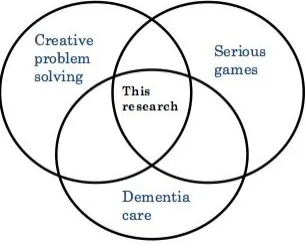
Figure 1-1: Doctoral research interdisciplinary context, bridging the gap
between creativity techniques, serious games and dementia care.
Existing theories of Creative Problem Solving (CPS) and games for social change and motivated learning are open to extension to support the creative learning process and enhance user experience in terms of innovation [180], flow [32], self-organization [152] and fun [104]. In the next two sections, let us consider the bilateral opportunities for integrating creativity support into serious games: how to play more creatively (Section 1.2.1) and how to create more playfully (Section 1.2.2).
1.2.1 Playing creatively
28
There is increasing evidence that utilizing games to train and educate is effective [3, 98, 145]. One consequence has been widespread gamification that has resulted in many different types of serious games [180], for example to train marine staff [14], treat cockroach phobia [23], overcome negative emotions [181], manage large-scale investment resources [87] and rediscover cultural heritage [70]. My assumption is that the trend of growth has the potential to be enhanced, and in return induce significant impact on various communities, if the game-based learning experience is empowered by integrating a creative approach to problem solving into games’ properties.
Creativity is defined as “the ability to produce work that is both novel (i.e. original, unexpected) and appropriate (i.e. useful, adaptive to task constraints)” [89, p.5]. There are many problems in the world that could be effectively addressed non-creatively, by using existing or previous solutions, delegating or consulting. However, there are also some vital tasks in professional environments that require outcomes that are new, unstructured and open-ended because no ready-made answers exist. Both working and gaming often include the following 2 processes that ask for such creative approach in problem solving [152].
1) Making decisions. In contrast to non-creative
29
factors). I assume that encouraging players to rethink these trade-offs in engaging, non-repeatable and self-regenerating ways could encourage collaborative creative problem solving in game play. Indeed, the complex strategies and behaviours that a player can demonstrate from a simple set of rules can enable effective learning, in contrast to games in which users simply play digitized versions of quizzes that do not lead to knowledge retention [105].
2) Developing and designing new applications, ideas, relationships, systems, or products [152]. The rule sets and
resources that each game provides can still constrain creative thinking – perhaps the player generates a new idea or seeks to undertake a new behavior that the game’s developer did not consider [74], and therefore cannot use or do. New rule and resource generation appears to be an important characteristic of creative serious games (see Sections 2.1.2.1 and 2.1.2.2) – one that is shifting games from simulation to interaction in order to create new combinations of rules and immersive environments.
Therefore, in order to provide more support to these two processes within serious games, there is a motivation to invest research effort into incorporating creativity support in serious games for professional learning.
1.2.2 Creating playfully
30
One often experiences the creative process as a form of play, because creative solutions are not accomplished by intellect alone, but by the play instinct [154]. Playing with ideas, trying out possibilities, breaking the usual patterns of thought – these can all be supported by a game [95].
Many creativity techniques, available for use in creative problem solving techniques, already have elements of play [129], such as contingency, inter-subjectivity and emergence [162] (see Section 2.2.4 for definitions), suggesting an appreciation of play in CPS. So, could creativity techniques benefit, in terms of amplified outcomes, from the more structured game mechanics, a game environment and game contents that come from game design frameworks and practices? Creative approaches to problem solving could be intentionally integrated, not only implicitly by designing an enabling game environment, but also explicitly by facilitation of the creative process in games (i.e. the creative process that is structured, customised and lead by a facilitating agent or a resource). These approaches to problem solving could present a new context for play for creative thinking – one that can innovatively drive technology-led changes to the facilitation of creative thinking and pose a new genre in serious gaming for motivated learning.
1.3 Research questions
31
initial framework proposal extends and integrates several game models and frameworks with creativity and learning support (see Section 2.1), employing my understanding of the intersections between these fields. The framework is called the Creative Game-based Learning (CGBL) framework, and the game prototype instances of it – Creative Serious Games (CSGs).
The desired positive outcome of playing a CSG would consist of: i) achieving creative learning outcomes: emergent creative outcomes (i.e. generated ideas), acquisition of creative thinking skills, and domain-specific motivational and learning benefits; ii) experiencing aesthetics of: joy, trust, anticipation and surprise (defined in Chapter 3). I consider achieving at least one creative learning outcome and experiencing of at least one of the CGBL aesthetics to be the threshold of the positive CSG outcome.
With the positive CSG outcome in mind, my design and development efforts focused on the most effective game mechanics, game environment, player mode, artefacts and creativity techniques (defined in Chapter 4).
In effect, the following research questions were posed:
RQ1: What are the shared and non-shared characteristics
of creativity support and good game design?
RQ2: Which game mechanics, game environment, player
32
that instantiates the CGBL framework in dementia care training domain?
RQ3: Does the final CSG prototype induce a positive CSG
outcome, as defined by the CGBL framework?
1.4 Research objectives
The research objectives were to:
OBJ1: Explore and theoretically describe the relationship
between creativity and gameplay for motivated learning by proposing a domain-independent framework for creative game-based learning (CGBL);
OBJ2: Design one or more customized game prototypes
with integrated creativity support that instantiate the CGBL framework in the application domain of dementia care;
OBJ3: Evaluate the CGBL framework with playtesting of
the final CSG prototype in an empirical study of the CGBL aesthetics and creative learning outcomes.
33
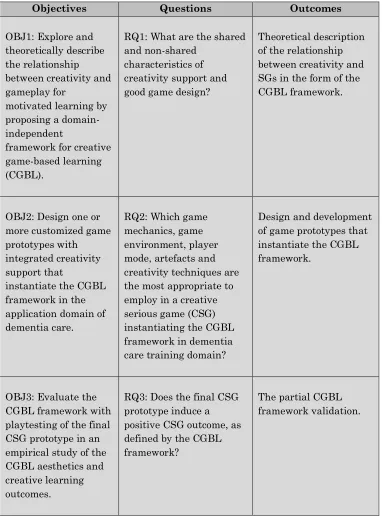
Objectives Questions Outcomes
OBJ1: Explore and theoretically describe the relationship between creativity and gameplay for
motivated learning by proposing a domain-independent
framework for creative game-based learning (CGBL).
RQ1: What are the shared and non-shared
characteristics of creativity support and good game design?
Theoretical description of the relationship between creativity and SGs in the form of the CGBL framework.
OBJ2: Design one or more customized game prototypes with integrated creativity support that
instantiate the CGBL framework in the application domain of dementia care.
RQ2: Which game mechanics, game environment, player mode, artefacts and creativity techniques are the most appropriate to employ in a creative serious game (CSG) instantiating the CGBL framework in dementia care training domain?
Design and development of game prototypes that instantiate the CGBL framework.
OBJ3: Evaluate the CGBL framework with playtesting of the final CSG prototype in an empirical study of the CGBL aesthetics and creative learning outcomes.
RQ3: Does the final CSG prototype induce a positive CSG outcome, as defined by the CGBL framework?
[image:35.595.108.490.92.608.2]The partial CGBL framework validation.
Table 1-1: The overview of project’s research design, where the research
34
The actions to achieve OBJ1 are described in Chapters 3 & 5; the efforts made towards achieving OBJ2 are described in Chapter 4; and the results of work to achieve OBJ3 are presented in Chapter 6. Table 1-1 presents an overview of the mapping between research questions, objectives and outcomes in this project.
1.5 Research design
The following sections provide an overview of the research design activities (Table 1-2) that addressed the individual objectives and research questions of the doctoral project. The Research Ethics Committee of City University London approved the MIRROR project research activities, including this doctoral research.
Activities Objectives &
questions Timeline
Framework development
OB1 / RQ1 Oct 2011-Jun 2012
Formative evaluations
OBJ2 / RQ2 Jul 2012-Feb 2014
Updated framework version Summative evaluation
OBJ3 / RQ3
Mar-May 2014 Updated framework version, design
recommendations & exploitation routes resulting from the framework application
Jun-Sept 2014
Table 1-2: Mapping of the research activities. For reference on research
questions and objectives, please see Sections 1.3 & 1.4, respectively.
1.5.1 Theoretical description of the relationship
between CPS and SGs
35
literature review that identified mappings between the dimensions of a creative climate and good game design principles [171]. A creative climate is an environment that promotes creative behaviour [89]. The review revealed shared characteristics between creativity and game play that included: challenge, freedom, trust and safety, humour and playfulness, persistence and idea-support; whilst conflict is a non-shared characteristic (defined in Chapter 3). These characteristics provided insight about what agood CSG user experience should be.
36
1.5.2 Design and development of game prototypes that
instantiate the CGBL framework
To achieve OBJ2 (see Section 1.3) and investigate RQ2 (see Section 1.4), I iteratively undertook two interventions, in the period July 2012-February 2014:
The creation of mechanics and dynamics that instantiated the initial CGBL framework proposal, combined with consultations with experts from fields of SGs design, creativity and dementia care;
Users playtesting game prototypes in real-life environment, from conceptual to physical paper-based versions [172], to digital environments as the final outcome that led to achieving OBJ3. The CGBL framework was used to guide design decisions (see Chapter 4).
1.5.3 The partial CGBL framework validation
OBJ3 was achieved by analysing data collected during the
37
The immediate creative outcomes by having ideas generated in gameplay rated by domain experts with respect to novelty, usefulness and person-centredness;
The effect that the mechanics and dynamics of the CGBL framework implemented into the prototype design have on subjects’ player experience, in terms of player engagement and aesthetics predicted by the CGBL framework.
1.6 Research contribution
The first research contribution of the project is a theoretical
framework to inform the design of a new form of serious games
that explicitly support players’ creativity. This framework provides recommendations on how to design new games to deliver creativity training [171]. Other researchers and designers are encouraged to adopt and validate it through development of their own creative serious games.
The second main contribution is the design and evaluation of a
creative serious game prototype consistent with the
framework to train carers to use more investigative and creative
38
carers to engage in the creative process in a gamified environment is a new development in residential care support. Finally, this research demonstrated that a serious game could be used to train people in creative thinking – a skill increasingly recognized as important in sectors such as healthcare. In this regard, the use of new digital technologies such as sensors for embodied interaction was important, both to deliver a seamless game experience and to trigger emotions such as trust and surprise that are associated with creative thinking and engagement.
This doctoral project focused its contribution to three fields:
1. Creative problem solving: The CSGs offer an opportunity to
39
2. Serious Games: Arguing for a new type of SG that explicitly
supports creativity is a valuable addition to the state-of-the-art in serious game design, as suggested by my formative and summative CSG prototype evaluation results in the domain of dementia care staff training. Lessons learned through my game design work can be valuable to others interested in designing CSGs. New instances of CSGs can be developed for other application domains that would benefit from creative problem solving in professional training. Moreover, the intention is that, in future work, the CGBL framework could be subjected to other instantiations of its components depending on new technologies, to provide opportunities for further validation of the framework and innovative technology-supported CGBL components, and in effect, CSGs that respond to the numerous modern challenges of motivated learning.
3. Person-centred dementia care: With this project, I
contributed to the application domain of dementia care by innovatively supporting training in person-centred care and the positive creative climate change in the sector [107, 128]. In particular, my intention was to:
Create opportunities for new engagements between the stakeholders, by introducing new sensory experiences using a technology-supported game environment;
40
Use game as a training tool to open up innovative ways of communicating, encourage curiosity and appreciative enquiry, and in effect provide a context for positive creative climate changes.
These arguments will be discussed in more detail in Chapter 7, in the context of accomplished results, state-of-the-art related works and potential exploitation routes.
1.7 Structure of the thesis
The structure of the thesis is as follows.
This chapter introduces the reader to the motivation that inspired the project and the initially identified opportunities for intervention (see Section 1.2), the research questions (see Section 1.3), the research objectives (see Section 1.4), an overview of research design (see Section 1.5) and the research contribution (see Section 1.6).
Chapter 2 puts this research in the context of the state-of-the-art theories and practices of serious games (see Section 2.1), creativity science (see Section 2.2) and the application domain of dementia care (see Section 2.3), using critical literature review methods that analyze the relevant background research and identify knowledge gaps and opportunities for intervention.
41
(CGBL) framework that this research has generated, by introducing the underlying literature mapping I created between creative climate and good game design principles (see Section 3.1) and detailed explanation and rationale of the main framework components (see Section 3.2).
Chapter 4 reports on the series of formative evaluations conducted in the iterative process of design and development of CSGs that instantiate the CGBL framework in the chosen application domain of dementia care, as well as the impact of these evaluations on understanding and refining of the CGBL framework.
Chapter 5 reports on the final version of the CGBL framework, where the dependencies between the components (i.e. aesthetics, dynamics, mechanics) and relationships between the stakeholders are refined using the lessons learned through design and development of CSG prototypes, resulting in ten methodological guidelines for the CGBL framework instantiation.
Chapter 6 reports on the qualitative summative evaluation of the final prototype application in order to achieve the third research objective regarding framework’s validation. The CGBL framework’s effectiveness is partially evaluated by assessment of the experienced game aesthetics and engagement. The study’s conditions, results and implications are explored.
42
recommendations, impact of the results and challenges for future work.
44
1.8 The chapter summary
The first section of this chapter introduces the problem statement: how to integrate creativity support into serious games, in particular, games for motivated learning for professional training? Next, Section 1.2 provides an insight on the context and motivation of this research project, as well as the two main identified challenges of interest to the investigation: how to play more creatively, and how to create more playfully.
Then, in Section 1.3 I outlined the three research questions (RQ1,
RQ2, RQ3): i) What are the shared and non-shared characteristics
of creativity support and good game design?; ii) Which game mechanics, game environment, player mode, artefacts and creativity techniques are the most appropriate to employ in a creative serious game (CSG) instantiating CGBL framework in dementia care training domain, in terms of players’ reactions to particular design choices?; iii) Does the final CSG prototype, designed to instantiate the CGBL mechanics and dynamics, induce a positive CSG outcome, as defined by the CGBL framework?
45
instantiate the CGBL framework in the application domain of dementia care (RQ2); iii) Evaluate the CGBL framework with playtesting of the final CSG prototype in an empirical study of the CGBL aesthetics and creative learning outcomes (RQ3).
Section 1.5 provided an overview of the research design, that lead to three main outcomes: Creative Game-Based Learning (CGBL) framework conception; design and development of its instances, creative serious games (CSGs); the partial validation of the CGBL framework.
Section 1.6 discussed the three main lines of the project’s contribution to the knowledge: creative problem solving (i.e. new mode of CPS facilitation), serious games (i.e. guidelines on how to make games for motivated learning that incorporate explicit creativity support) and person-centred dementia care (i.e. new mode of care staff training).
46
47
This chapter details my critical review of the relevant literature. It consists of three sections that address the targeted research contribution in three fields: i) serious games; ii) creative problem solving; iii) person-centred dementia care. Each section firstly provides a reader with the necessary definitions and background research, and then discusses the state-of-the-art theories, practices and the knowledge gaps that influenced the research objectives, questions and methods. In particular, this literature review has informed the CGBL framework conception, and design and development of my prototypes.
2.1 Serious games
This section is organised as follows: in the first subsection I introduce the serious games’ definitions and background research relevant for this project. In the second subsection, I analyse three concepts of interest that I identified in the critical review of the state-of-the-art of serious games, and explain the opportunities they provide for an academic contribution.
2.1.1 Definitions and background research
48
players who follow a set of interaction rules of board movement, competition and conduct, with a goal to win by eliminating opponents’ figures. In contrast, play is more open-ended, involves activities such as make-believe and world-building [162], and often is connected with children’s development, whilst a game is has the aforementioned structure.
Serious games are a subset of games. In this work, I use the following definition of serious games:
“Serious games are games for social change, development and
motivated learning that are “in any form of interactive
computer-based software for one or multiple players to be used on any
platform”, which “have been designed to have benefits other than
entertainment” [153, p.6].
Utilizing games by designing applications for such effects in non-game application domains is a process known as gamification [48], and it has received significantly encouraging research reports in recent years [59, 98, 145, 153, 180]. Gamification has achieved widespread results, for example to train marine staff [14], treat cockroach phobia [23], overcome negative emotions [181], manage large-scale investment resources [87], rediscover cultural heritage [70] and help cancer patients make decisions about their health [111].
One of the most famous and successful early examples of gamification of the learning process is a geography video game
Where in the World is Carmen Sandiego? (1990) [53] (Figure 2-1),
49
and schoolteachers. It employed game mechanics to teach young school children about the world’s major capitals and sights, which is by default a non-game domain. Usage of this game in the classroom contributed directly to the curriculum delivery, with encouraging results in student engagement and knowledge acquisition [53].
[image:51.595.140.432.220.402.2]
Figure 2-1: Screenshot from the popular ‘90s serious game “Where in the World
is Carmen Sandiego?”.
50
2.1.1.1 Engagement in games for motivated learning
According to [200], the power of gamification lies in the engagement and loyalty of players to the process of game play, where ideally, the players are in the zone of “flow” between boredom and anxiety [43]. In creating games for motivated learning, which are sometimes also referred to as “edutainment” [153] – the educational element, although important and necessary, often overshadows the engagement element [76, 90]. One recent attempt to bridge these two requirements is the Learning Mechanics-Game Mechanics (LM-GM) model [7] that supports designers in creating games with both pedagogical and entertainment features.
One way to achieve engagement is by explicitly designing for fun. In [109], four kinds of fun are outlined: i) hard fun, where a player is trying to win some form of competition; ii) easy fun, where a player is focused on exploring the system; iii) altered state fun, in which the game changes the way the player feels, and; iv) social fun, during which the player engages with other players. These definitions are useful, but according to [153], more systematic research is still needed in the future in order to define their implementation guidelines in the edutainment context.
51
agree that one has to be careful with the application of this paradigm, as for the serious games to be successful, the educational component has to be enjoyable in its own right, and reinforcement should not be the only player’s motivation to learn and engage [153]. Therefore, a serious game has to be designed to also provide intrinsic motivation [200], especially for the application domains where impact is not limited on knowledge acquisition or skills practice, but includes problem solving, exploration and incidental learning [170].
52
work within this doctoral project, the player engagement was given careful consideration.
2.1.1.2 Player types
[image:54.595.127.487.480.649.2]Bartle (1996) established a categorization of players that specified four main types [13, p.1]: Achievers (“players who prefer to gain points levels, equipment and other concrete measurements of succeeding in a game”), Explorers (“players who prefer discovering areas, creating maps and learning about hidden places, often feeling restricted when a game expects them to move on within a certain time, as that does not allow them to look around at their own pace”), Socializers (“players who gain the most enjoyment from a game by interacting with other players, and on some occasions, computer-controlled characters with personality”) and Killers (“players who thrive on competition with other players, and prefer fighting them to scripted computer-controlled opponents”) (Figure 2-2).
Figure 2-2: Bartle’s main player types, adapted from [13].
Killers Achievers
Socializers Explorers
ENVIRONMENT PEOPLE
53
Most people are not one type or the other, but a mixture of types. If Bartle’s categories were mutually exclusive, one study determined that the majority of people, as much as 75% - would be socializers [200]. The work on categorization was expanded in 2003 [12, p.3] by introducing subcategories: Friend, Griever, Hacker, Networker, Opportunist, Planner, Politician, and Scientist. Whilst the Opportunist (implicit Achievers, “if they see a chance, they take it; look around for things to do, but they don’t know what these are until they find them; if there’s an obstacle, they do something else instead; flit about from idea to idea like a butterfly”), and Scientist (explicit Explorers, “experiment to form theories; use these theories predictively to test them; methodical in their acquisition of knowledge; seek to explain phenomena”) do have some creative problem solving activities in their preference, in my understanding, none of these terms seem to explicitly recognize the player’s need to create within a game. Opportunists and Scientists apply different techniques to explore and manage the input provided by the game contents. However, they do not seem to have been given opportunities by game design to contribute input and bend the game’s rule space. Allowing the creation of artefacts within the game and expansion of the game rules beyond implemented boundaries would provide new context for interplayer and game-player interaction.
54
2.1.1.3 Classifying serious games
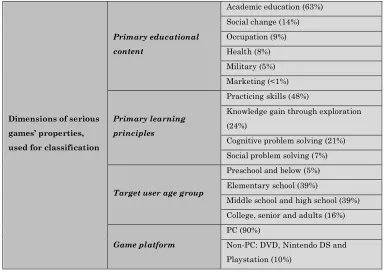
Ratan & Ritterfeld (2009) [150] developed a classification system of serious games (Table 2-1) based on an iterative examination of a dataset of about 600 serious games, and defined four distinctive dimensions of SGs: i) primary educational content; ii) primary learning principles; iii) target user age group; iv) game platform. The primary educational content is defined as the element that makes a game serious, and not just for entertainment purposes. The primary learning principles explain how the educational content is delivered in a game. The game platform indicates whether a game was designed to be played on a PC computer or other device(s).
Dimensions of serious games’ properties, used for classification
Primary educational
content
Academic education (63%)
Social change (14%)
Occupation (9%) Health (8%) Military (5%) Marketing (<1%) Primary learning principles
Practicing skills (48%)
Knowledge gain through exploration
(24%)
Cognitive problem solving (21%)
Social problem solving (7%)
Target user age group
Preschool and below (5%)
Elementary school (39%)
Middle school and high school (39%)
College, senior and adults (16%)
Game platform
PC (90%)
Non-PC: DVD, Nintendo DS and
[image:56.595.105.489.374.647.2]Playstation (10%)
Table 2-1: Classification of serious games by Ratan & Ritterfeld (2009),
55
In contrast, this doctoral research increases the diversity of serious games, and the establishment and investigation of the less represented subcategories of serious games according to this categorisation. The CGBL framework developed in my research focuses on games designed primarily for (but including elements of other categories): occupational skills as educational content, social problem solving as a learning principle, adults as the target age group and non-PC game platforms.
2.1.1.4 Understanding game play: the IPO model
Several authors have developed descriptive models of motivated user behavior during the playing of serious games [78, 101, 194, 198]. One such model from Garris et al. (2002) [66] proposes a theory that games should enable and allow the user to choose to enter them to accomplish a goal or overcome a problem, and describes the experience in Input-Process-Outcome (IPO) form (Figure 2-3).
The input components of a serious game according to this model
56
instructional content for the first time. This model puts an equal emphasis on educational and game features when triggering a game cycle, and the benefits of doing so have been discussed earlier in this section (see Section 2.1.1.1).
[image:58.595.115.481.420.590.2]In combination with the IPO model, instructional content and game characteristics trigger a game cycle that aims to support intrinsic, self-motivation. This type of motivation is preferred in the IPO model, and in general in the tradition of motivated learning [153]. Such game play involves repeated judgment-behavior-feedback loops that are triggered by instructional content and game characteristics, where user reactions lead to behaviours, which in turn lead to system feedback that affects the user judgement [66], with an aim of raising the overall levels of user engagement.
Figure 2-3: The IPO model [66], describing the motivational learning game play
process construct.
57
[66, p.455]: Skill-based (“Performance of technical or motor skills”); Cognitive-declarative (“Knowledge of the facts and data required for task performance”); Cognitive-procedural (“Knowledge about how to perform a task”); Cognitive-strategic (“Ability to apply rules and strategies to general, distal, or novel cases”); Affective (“Beliefs or attitudes regarding an object or activity”). These outcomes expand the primary educational content categories Ratan et al. [150] identified in their classification of serious games. As cognitive-strategic and affective outcomes are of large importance as objectives of creative learning in an occupational context [20, 125], they have been addressed by the CGBL framework by systematically supporting the acquisition of these creative skills.
Garris et al. in their work also discuss the importance of debriefing and scaffolding knowledge as part of the game cycle, how these link to the learning outcomes, allowing one to “to transform game events into learning experiences”, because “it is unrealistic to expect even the most self-directed learners to construct knowledge on their own”, and thus, “learning by doing must be coupled with the opportunity to reflect and abstract relevant information” [66, p.455]. This idea has a significant relevance to my research, as I looked at the role of the reflection and transformational creativity techniques in generating learning and creative outcomes (see Chapter 4).
58
facilitation and game components as a missing piece in experiential learning [121]. The game play process puts emphasis on engagement in serious games in a way that adapts game features for instructional purposes, where the game cycle “sustains self-directed interest, without squeezing out what is enjoyable about games in the first place” [66, p.459]. Finally, this model is useful because it joins together the principles of other established models and theories [78, 194, 198] that exist about its separate components (game features, user behavior, learning outcomes).
2.1.1.5 Understanding game design: the MDA
framework
In order to put the CGBL framework in the context of game design, I studied the MDA framework by Hunicke et al. (2004) [86], which is a descriptive theory that bridges the gap between game development (how the game is designed) and game player experience (how the game is perceived). The MDA framework formalizes the consumption of games by breaking them into their distinct components: Rules, System and Fun; and defining their design counterpart: Mechanics, Dynamics and Aesthetics (Figure 2-4).

![Figure 2-2: Bartle’s main player types, adapted from [13].](https://thumb-us.123doks.com/thumbv2/123dok_us/1493876.102070/54.595.127.487.480.649/figure-bartle-s-main-player-types-adapted.webp)
![Figure 2-3: The IPO model [66], describing the motivational learning game play](https://thumb-us.123doks.com/thumbv2/123dok_us/1493876.102070/58.595.115.481.420.590/figure-ipo-model-describing-motivational-learning-game-play.webp)
![Figure 2-4: The MDA model [86] bridges the gap between game design and](https://thumb-us.123doks.com/thumbv2/123dok_us/1493876.102070/61.595.204.370.480.658/figure-mda-model-bridges-gap-game-design.webp)