Scottish Universities Legal Network on Europe (SULNE)
The implications of Brexit for environmental law in Scotland
Edited by A. Cardesa-Salzmann and A. Savaresi
List of authors
Dr. A. Cardesa-Salzmann (Strathclyde University, Centre for Environmental Law and Governance, SCELG) Mr. M.M. Combe (University of Aberdeen)
Ms. M. Geelhoed (SCELG) Prof. A. McHarg (SCELG) Ms. M. Ntona (SCELG)
Prof. C.T. Reid (University of Dundee) Dr. A. Roger (University of Sheffield) Dr. A. Savaresi (University of Stirling) Dr. F. Sindico (SCELG)
Dr. S. Switzer (SCELG)
List of reviewers
Prof. G. Little (University of Stirling)
Dr. G. Marin Duran (University of Edinburgh) Prof. E. Morgera (SCELG)
Dr. T. Muinzer (University of Stirling) Prof. M. Poustie (SCELG)
Ms. D. Vlastari (Scottish LINKS)
Dr. O.A. Wooley (University of Aberdeen)
Contact: [email protected]
CONTENTS
EXECUTIVE SUMMARY ... 1
1 CROSSCUTTING ISSUES ... 2
1.1 Brexit scenarios ... 2
1.2 Law enforcement implications ... 3
1.3 Trade and competition implications ... 4
2 TYPES OF EU ENVIRONMENTAL LEGISLATION AND COMPETENCE ALLOCATION ... 5
2.1 Habitats and birds ... 6
2.2 Trade in endangered species and wildlife crime ... 7
2.3 Water ... 7
2.4 Air quality ... 8
2.5 Procedural rights ... 9
2.6 Environmental assessment ... 10
2.7 Energy ... 11
2.8 Noise ... 12
2.9 Waste ... 12
2.10 Chemicals ... 13
2.11 Agriculture ... 13
2.12 Marine and fisheries ... 14
EXECUTIVE SUMMARY
This report maps the possible implications of Brexit for environmental protection in Scotland, identifying core questions as well as solutions that may be adopted, with the objective of initiating a conversation about this complex subject matter. The report has been prepared as a joint endeavour by a group of environmental law experts based at Scottish Universities. Each section was drafted by a lead author, with inputs from the rest of the group. The paper is meant for a broad audience and intentionally uses a non-technical writing style.
The paper is divided in two sections. The first section addresses cross-cutting questions affecting environmental governance after Brexit, focusing on the main Brexit scenarios and their trade, competition, and law enforcement implications. This analysis identifies a series of common challenges for environmental law in Scotland after Brexit, which relate to:
• Loss of scrutiny and enforcement powers associated with the operation of EU law and institutions;
• Loss of long-term policy horizon and of the stable regulatory framework provided by EU law;
• Repositioning of the UK and Scotland in international and regional environmental governance cooperation; and
• Restriction/loss of access to EU funds and programmes.
1 CROSSCUTTING ISSUES
This section addresses cross-cutting questions affecting environmental governance after Brexit, focusing on the main Brexit scenarios and their trade, competition, and law enforcement implications.
1.1 Brexit scenarios (Annalisa Savaresi)
Even if the UK Government has on several occasions reiterated that ‘Brexit means Brexit’, this oracular statement sheds little light on the future relationship of the UK with the EU. Two main scenarios may be envisaged.
Under the first scenario, the UK would remain closely linked to the EU, for example as part of the European Economic Area (EEA), presently composed of Iceland, Liechtenstein and Norway. These States are not EU Members, but nevertheless enjoy some of the privileges associated with EU membership, including preferential access to the Single European Market. As a condition of access, they are subjected to most EU law, some enforcement procedures, and also provide bilaterally negotiated financial contributions to the EU. Research institutions in EEA States can access EU cooperation funds to varying degrees. The EEA Agreement does not cover the Common Agriculture and Fisheries Policies or nature conservation measures, but addresses aspects of trade in agricultural and fish products, as well as invasive species. As an EEA member, therefore, the UK would still be obliged to abide by EU environmental laws on numerous issues. Even when not obliged to do so, the UK could decide to act jointly with EU Member States, as other EEA members presently do in relation for example to climate change.
Under the second scenario, the UK would be outside both the EU and the EEA. Even then, the UK would be under pressure to align with some EU environmental standards concerning issues such as agricultural products and chemicals, in order to trade with EU member States. This is well exemplified by the case of Switzerland. Switzerland has a vast series of bilateral agreements with the EU and is part of the European Free Trade Association (EFTA), which provides for free trade with the EU in all non-agricultural goods. As a result of these arrangements, Switzerland’s environmental legislation has been progressively aligned with that of the EU in a number of sectors, for example in relation to aircraft noise emissions and agricultural products. Moreover, Switzerland has independently adopted elements of EU law in areas not covered by bilateral accords to avoid trade barriers. Therefore, even in this scenario, continued alignment with EU environmental law would be necessary at least in areas that are closely associated with access to the EU market. In other areas, there would be less of an incentive for the UK to align with EU standards. While the UK would continue to be bound by its present international law obligations on environmental matters, it would no longer be bound by the EU’s approach to implementing these. The matter of access to EU research cooperation, funding and partnerships would also have to be negotiated anew.
Little is known about how and to what extent the UK plans to cut loose from EU environmental law. What seems certain is that decisions will have to be made about who will assume the competences presently exercised by the EU. Environmental protection is one of the devolved competences of the Scottish Parliament. However, whether EU powers will by default go to the Scottish Parliament and other devolved administrations, or will be re-reserved to Westminster is yet to be seen.
devolved powers, including the capacity to conclude international agreements on matters within its competence, such as environmental protection. For example, Scotland could seek powers akin to those bestowed upon the Governments of the Faroe Islands and Greenland to negotiate and conclude international agreements with foreign states and international organisations that entirely relate to their fields of responsibility. This arrangement could be specifically beneficial to address international and regional cooperation on matters related, for example, to protected areas and fisheries. Another, less formal, way for Scotland to continue engaging with EU Member States and institutions is through autonomous membership of regional and networks and institutions working on issues such as energy, fisheries and environmental law enforcement.
1.2 Law enforcement implications (Antonio Cardesa-Salzmann and Annalisa Savaresi)
Enforcement of EU law rests on two pillars. The first consists in the supervisory powers of the EU Commission vis-à-vis Member States and, to a lesser extent, also members of the public. If the Commission identifies issues of compliance with EU law in a Member State, it has the power to bring the said Member State before the Court of Justice of the EU (CJEU). If found to be in breach, the Member State can be asked to pay fines until the compliance issue has been resolved. Members of the public can informally raise concerns over the implementation of EU law with the Commission, but the latter has ample discretion on whether or not to initiate enforcement proceedings. The Commission exercises its far-reaching enforcement powers with some restraint. In the case of the UK the Commission has exercised its enforcement powers in relation to nature protection, waste (landfills and packaging wastes), waste water collection and treatment, and air quality standards.
The second, and most important, pillar of EU law enforcement relies on the Member States themselves. Members of the public and pressure groups can initiate legal action before Member State courts to request compliance with EU law, as exemplified by recent litigation concerning air pollution in the UK. In these instances, the CJEU plays a complementary role in assisting national courts in the interpretation of EU law.
With Brexit, these enforcement mechanisms will cease to apply to the UK. Should the UK decide to remain in the EEA, some residual enforcement procedures would still exist. Under other Brexit scenarios, the EU law’s hard enforcement edge would be lost. Brexit will therefore entail the loss of a powerful means of scrutiny over how the UK manages its environment, with no obvious replacement for it. Instead, UK citizens will only be able to access national courts to complain about breaches of domestic environmental law. After Brexit, both Scotland and the UK could explore new avenues to ensure better law enforcement, such as the establishment of a dedicated environmental court, and/or an environmental ombudsman.
Protection Agency (SEPA) is already a member of IMPEL. Continuous involvement in IMPEL after Brexit could enable Scotland to continue engaging in European environmental governance, and aligning with EU environmental regulations and policies on devolved matters. The second section of the paper identifies specific areas where continued engagement with IMPEL may be desirable.
1.3 Trade and competition implications (Stephanie Switzer and Malcolm Combe)
The EU exercises its Member States’ rights and assumes responsibility for the performance of their obligations under the World Trade Organisation (WTO). The UK is a WTO member in its own right and will remain so upon withdrawing from the EU. So whilst the UK’s WTO commitments are currently tied with those of the EU, post-Brexit the UK will remain bound by the broad range of substantive obligations arising from the full gamut of so-called ‘covered agreements’ under WTO law only in its own right.
WTO membership not only requires adherence to the general corpus of WTO law but also entails member-specific commitments on, inter alia, market access and agricultural subsidies. These are contained in individual ‘Schedules of Concessions’. Questions have been raised over the UK’s ability to grant agricultural subsidies after Brexit. It cannot be assumed that a simple pro rata disaggregation of agricultural domestic support commitments based on the existing commitments in the EU Schedule of Concessions would be acceptable to the WTO membership. It should, however, be noted that the actual rate of trade distorting agricultural domestic support granted by the EU is significantly below its bound limits. Accordingly, apportionment of actual rather than bound subsidy levels may be less controversial, but it cannot be assumed this will be a straightforward process to negotiate. At the same time, certain forms of domestic agricultural support are currently exempt from bound commitments and are hence unlikely to be problematic. These include subsidies which are de minimis, as well as so-called ‘green box’ subsidies – i.e. agricultural subsidies which do ‘not distort trade, or at most cause minimal distortion’ and which include, among other things, decoupled income support and certain payments for environmental programmes. So-called ‘blue box’ subsidies are also not currently subject to a cap within the WTO and provide legal cover to payments for production limiting programmes.
Most domestic support provided under the EU Common Agricultural Policy (CAP) is green box. Equally, most of Scotland’s existing agricultural subsidies used to effect environmental ends are likely to be green box. Consequently, post-Brexit the continuation of the likes of the existing agri-environment climate scheme would be possible to the extent such support is recognised as green box. More generally, while a return to unfettered use of trade distorting agricultural subsidies is unlikely, post-Brexit there will be scope for targeted agricultural support to be used to achieve environmental ends, so long as the law of the WTO is adhered to.
perhaps from a public body transferring at undervalue, also have had to skate around rules relating to state aid. The impact of Brexit on this legislation is nevertheless likely to be small. While Brexit would release the UK from certain EU state aid or free movement rules, there are other rules at international/WTO level that could apply.
2 TYPES OF EU ENVIRONMENTAL LEGISLATION AND COMPETENCE ALLOCATION (Apolline Roger)
This section analyses specific questions likely to emerge in selected areas of environmental law, distinguishing between different types of EU environmental legislation and the related allocation of competences within the UK. With Brexit, the UK will re-acquire law-making powers on environmental matters that are presently within the remit of the EU. These powers are wide-ranging, and cover subjects as diverse as agriculture, air quality, chemicals, climate change, fisheries, protected areas and waste. The approach of EU law to regulating these matters varies greatly. Some areas are heavily centralised, vesting a great deal of control in the EU, such as chemical regulations. In others, EU legislation simply sets targets, for example in relation to renewable energy usage, leaving Member States considerable discretion over how to achieve them.
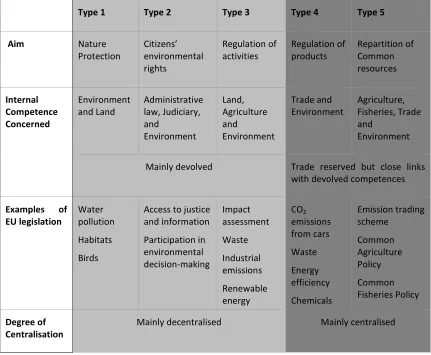
In this regard, EU legislation can be divided into five types: 1) nature protection; 2) citizens’ environmental rights; 3) regulation of activities; 4) regulation of products; and 5) repartition of common resources (Table 1).
Legislation types 1, 2 and 3 generally set compulsory objectives for Member States, leaving them discretion in deciding how to comply. The implementation of this legislation tends to be decentralized. In the UK, areas of environmental law that can be ascribed to type 1, 2 and 3 correspond to matters that are either entirely devolved or where there are varying degrees of cooperation between Westminster and the devolved administrations. Post-Brexit, the repatriation of competences presently exercised by the EU will entail decisions as to who is in charge of what was previously determined at EU level, such as objectives, timelines and general policy frameworks. For the authorities receiving these new tasks, it might be necessary to develop new administrative capacity in some areas, such as agriculture.
Legislation type 4 applies directly, mostly without any discretion left to the Member States. Presently, as norms concerning the regulation of products affect the internal market, their implementation falls within Westminster’s reserved trade competence. Post-Brexit, the allocation of competence between Westminster and the devolved administrations may continue to follow this model. However, the regulation of products has considerable environmental impacts and, accordingly, affects the exercise of the environmental competence of devolved administrations. Therefore, post-Brexit, these areas might either be devolved or subject to greater cooperation between Westminster and the devolved administrations.
The next sections analyse the implications of Brexit in various areas of environmental law, using the typology above to shed light on the characteristics of EU law, and the likely repercussions of the repatriation of EU powers in each area.
Table 1: Types of EU environmental legislation and how they relate to internal competences within Member States
2.1 Habitats and birds (Antonio Cardesa-Salzmann)
EU law has been a key driver of biodiversity protection in the UK, with the enactment of regulations and directives on protected areas and species [Habitats Directive (92/43/EEC)], especially concerning wild birds [Wild Birds Directive (2009/147/EC)]. These instruments broadly fall within EU legislation type 1, but do grant rather pervasive powers to the EU Commission on the management of Natura 2000 or Habitats sites, concerning e.g. the authorisation of plans or projects with negative effects on some priority protected habitats and species. The implementation of the Habitats and Wild Birds Directives falls within the remit of devolved administrations, except for reserved matters covered by the Conservation of Habitats and Species Regulations 2010, the Wildlife and Countryside Act 1981 and the Conservation (Natural Habitats, etc.) Regulations 1994. In the past the UK was brought before the CJEU for non-compliance with the Habitats Directive, amongst others, with respect to offshore oil and gas activities and the failure to implement it beyond its territorial waters [CJEU (case C-6/04)].
Type 1 Type 2 Type 3 Type 4 Type 5
Aim Nature
Protection Citizens’ environmental rights
Regulation of
activities Regulation of products Repartition of Common resources
Internal Competence Concerned
Environment
and Land Administrative law, Judiciary, and Environment Land, Agriculture and Environment Trade and
Environment Agriculture, Fisheries, Trade and
Environment
Mainly devolved Trade reserved but close links with devolved competences
Examples of
EU legislation Water pollution Habitats Birds
Access to justice and information Participation in environmental decision-making Impact assessment Waste Industrial emissions Renewable energy CO2 emissions from cars Waste Energy efficiency Chemicals Emission trading scheme Common Agriculture Policy Common Fisheries Policy Degree of
Brexit may affect the way in which the UK and Scotland conserve and sustainably use biodiversity. As the EEA Agreement excludes the Habitats and Wild Birds Directives from its scope of application, this is an area of EU law that will cease to apply, regardless of the specific way in which the UK leaves the EU. Losing the EU law’s enforcement edge and the EU Commission’s oversight of the most important conservation sites may be especially problematic in this sector. The same may be said in relation to access to the LIFE programme, which supports the implementation, updating and development of EU environmental and climate policy and legislation. Post Brexit, therefore, Scotland has a strong interest in the devolution of powers regarding protected areas and species protection, especially in the context of the re-allocation of powers currently exercised by the EU Commission for the management of Natura 2000 sites under the guidance of the Habitats Committee. If the UK re-reserved that power, there might be a lowering of standards regarding the designation of protected areas.
2.2 Trade in endangered species and wildlife crime (Colin Reid and Antonio Cardesa-Salzmann)
EU law restricts international trade in endangered species of flora and fauna and combats transnational wildlife crime. In international law these matters are addressed in the Convention on International Trade in Endangered Species of Wild Flora and Fauna (CITES), which identifies the species subjected to varying levels of trading restrictions and imposes requirements for licences for import and export. In the EU CITES is implemented by means of the Wildlife Protection Regulation (338/97), a piece of type 4 legislation which goes significantly beyond CITES requirements. In the UK compliance with CITES obligations is achieved through legislation implementing EU law [Control of Trade in Endangered Species (Enforcement) Regulations 1997 (SI 1997/132)], but the details of species covered by licences and the circumstances in which these can be issued are detailed in EU law. After Brexit, either these regulations will remain incorporated in UK legislation, or equivalent legislation will have to be enacted, raising questions over the internal allocation of competences on trade-related responsibilities.
EU law also addresses the issue of transnational wildlife crime, defining environmentally harmful conducts to be enacted as criminal offences by Member States [Environmental Crime Directive (2008/99/EC)]. These include trade in specimens of protected wild fauna or flora species, as well as conducts causing a significant deterioration of habitats within protected sites. In the UK and in Scotland, EU law was transposed into domestic law by the Wildlife and Countryside Act 1981, the Criminal Law Act 1977 and the Criminal Procedure (Scotland) Act 1995. After Brexit, the Environmental Crime Directive would remain applicable if the UK opted for remaining in the EEA. Otherwise, the UK would only be bound by lower CITES standards and monitoring procedures, which would be de-coupled from EU law and its enforcement mechanisms. This is an area where current levels of protection could be maintained through capacity building and homologation of practices by joining IMPEL-led projects, such as, for example, the recent initiative concerning implementation and enforcement of the EU Timber Regulation.
2.3 Water (Francesco Sindico)
allowing Member States to develop more stringent rules and standards. This is an area in which EU law and institutions have made a clear difference, pushing UK authorities to significantly improve their record.
Water regulation and management are devolved matters in the UK. As a result, Scotland has full competence in implementing the Water Framework Directive and has done so by passing the Water Environment and Water Services (Scotland) Act 2003. Implementation is mostly carried out by the Scottish Environment Protection Agency, which develops river basin management plans. The Scottish Government has committed to push forward a ‘Hydro Nation’ agenda, which envisions Scotland as a hub of excellence in water management.
Because of the devolved nature of freshwater management, Brexit is not expected to have immediate consequences in this sector. Scotland will therefore be able to carry on with its current water legislation and policies. Due to the critical role of water for Scottish industries, like the whisky and the shellfish sectors, it would seem important not relax current water standards and policies. The extent to which Scottish Water, the publicly owned company that controls access to water, will change its policies after Brexit depends on financial and economic considerations, rather than legal ones. Another potential implication of Brexit relates to cross-border arrangements for the Tweed and Solway. While presently these arrangements align with EU standards, they may become more contentious, should Scotland and England’s approach to water management significantly diverge in future. In this context, Scotland would likely benefit from continued involvement in the IMPEL network and its capacity-building and best practice exchanges on water and land.
2.4 Air quality (Annalisa Savaresi)
EU law regulates various sources of air pollution, including large and medium combustion plants and road and marine transport; and sets air quality standards that regulate cumulative pollution (most saliently, through the Ambient Air Quality and Clean Air Directive 2008/50/EC), as well as caps on national emissions through emissions ceilings (National Emission Ceilings Directive 2001/81/EC). EU law on air quality is therefore characterised by the coexistence of EU legislation types 1, 3 and 4. EU law implements a host of regional and international instruments on transboundary air and atmospheric pollution, chemicals regulation and the dumping of hazardous waste, often going beyond the obligations enshrined in these.
The implementation of EU law has resulted in improvements in air quality across Europe. However, urban air quality in the UK has fallen below EU standards in relation to some pollutants, triggering the exercise of enforcement action by the EU Commission. As a result, the UK has been asked to prepare and implement an Air Quality Plan. This matter has been the subject of a judicial saga that recently saw the High Court quashing the UK plan as inadequate to ensuring compliance with the Directive 2008/50/EC [ClientEarth (No.2) v Secretary of State for the Environment, Food and Rural Affairs [2016] EWHC 2740 (Admin)].
are only required to demonstrate that they are doing all that is reasonably possible in order to achieve the objectives. Data published by the Scottish Government shows that air pollution objectives are not being met at numerous locations, including all major Scottish cities.
Given the prominent role of EU law in setting air pollution standards, and the failure of UK and Scottish authorities to comply with them, Brexit may have a significant impact in this area. In the absence of EU law obligations, both Scottish and UK authorities may relax their standards on air quality, insofar as compatible with the UK’s international obligations on this issue. The same may happen when UK authorities find themselves faced with competing objectives, such as expansion of airport capacity, without the EU Commission watching over their shoulder. Due to the integrated nature of the problem and the demise of the EU’s centralised standard-setting and enforcement roles, coordination amongst central and devolved authorities in the exercise of regulatory powers over air pollution will likely need to intensify after Brexit. The role of public scrutiny by means of access to information and litigation may equally need to be safeguarded and strengthened. Conversely, in other areas, like emission standards for vehicles, both the UK and Scotland would remain under considerable pressure to comply with EU standards in order to continue exporting into the EU market.
2.5 Procedural rights (Colin Reid)
The public right of access to environmental information held by public authorities was established in EU law in the early 1990s (Directive 90/313/EEC). This and subsequent EU law instruments can be categorised as type 2 legislation, and generally set compulsory objectives for Member States, leaving them discretion in deciding how to comply. In Scotland, the Freedom of Information (Scotland) Act 2002 and the Environmental Information (Scotland) Regulations 2004 (SSI 2004/520) provide separate regimes for access to environmental information, implementing EU law requirements.
EU law has introduced much greater transparency in many regulatory regimes, notably through the establishment of public registers recording applications, permits and enforcement action. This is in addition to the specific right of members of the public under the 2004 Regulations to request environmental information from public authorities with only limited grounds on which it can be withheld.
Brexit will remove the need for the Scottish regulations to comply with the relevant EU law, allowing adjustments to the scope of the information covered, the bodies bound by the requirement to provide information, the timescale for responses, the charging regimes and the exceptions which allow requests for information to be refused.
International obligations are however especially relevant in this regard. The UK is party to the 1998 Convention on Access to Information, Public Participation in Decision-making and Access to Justice in Environmental Matters (Aarhus Convention), which imposes obligations on access to environmental information very similar to those in current EU law. The Convention’s compliance mechanism can hear complaints from individuals or groups and determine whether or not a state has complied with its obligations. The determinations of the Compliance Committee do not have legal force in domestic law, but can be a source of embarrassment to the government and have been referred to by UK courts (e.g. Walton v Scottish Ministers [2012] UKSC 44 at [100]).
decision-making and have access to means of challenging the legality of many decisions made by public authorities on environmental matters. This obligation has been partially implemented in EU law (Directive 2003/35/EC), so that compliance with the Convention’s obligations can in some circumstances be not only tested through the Aarhus Compliance Committee but also enforced as a matter of EU law.
Significant elements of the Aarhus provisions are the need to ensure wide standing to bring legal cases, notably for NGOs, and that legal proceedings are not prohibitively expensive. The former should no longer be an issue in Scotland following the Supreme Court’s relaxation of the rules on standing in recent years, particularly in environmental cases. The latter remains a live issue, with the need to comply with EU law on this point leading to the introduction of a specific regime for Protective Expenses Orders in environmental cases (Rules of the Court of Session, Chapter 58A). Initially this was only for those categories of cases covered by the EU measures that gave effect to the Aarhus requirements in certain areas, but more recently this has been extended to provide coverage that is broader, although possibly still not covering the full width of the Aarhus obligations.
One of the main risks arising from Brexit is losing the hard, enforceable edge that EU law provides to the Aarhus Convention’s provisions, and the potential lowering of standards in the domestic implementation of the Aarhus Convention if changes are made to existing legislation implementing EU law.
2.6 Environmental assessment (Colin Reid)
Environmental Impact Assessment (EIA) of individual projects, such as a dams, motorways, or major industrial developments, and Strategic Environmental Assessment of plans and strategies (SEA) were introduced in the UK as a result of successive iterations of the EIA Directive (notably, 85/337/EEC, 2011/92/EU and 2014/52/EU) and the SEA Directive 2001/42/EC.
As pieces of type 3 legislation, these instruments set objectives for Member States, leaving them discretion in deciding how to comply. Under present constitutional arrangements, implementation of these Directives in Scotland is encompassed, for EIA, in the Town and Country Planning (Environmental Impact Assessment) (Scotland) Regulations 2011 (SSI 2011/139) and parallel regulations for other forms of project; for SEA, in the Environmental Assessment (Scotland) Act 2005. The Scottish legislation contains occasional references to EU measures in setting the scope of certain provisions, but will essentially be able to continue unaffected by any change in the status of EU law. Scotland has chosen to go beyond EU law in the 2005 Act, which embodies a distinct policy choice in applying SEA to all public sector plans, not just to those in the specific categories identified in EU law as requiring this process, whereas the law in the rest of the UK is limited to the scope of the EU rules.
details of the procedure to be followed, since the law will no longer have to satisfy the relevant EU Directives which set out both in considerable detail. The potential to be more demanding than the Directives has been demonstrated by the 2005 Act: there will now be the potential to be less demanding.
2.7 Energy (Aileen McHarg)
The Scottish Government has strong energy policy ambitions, particularly regarding the promotion of low carbon energy, but relatively weak energy policy competence, making it vulnerable to decisions taken at UK level which conflict with its policy objectives. This was illustrated in 2015, when the newly-elected Conservative Government withdrew subsidies from onshore windfarms, cancelled funding for carbon capture and storage demonstration projects, and ended energy efficiency programmes.
In this context, EU law has been a valuable support for the Scottish Government’s energy goals. EU energy law broadly falls within legislation types 3 and 4. EU renewables targets have been a key driver behind the expansion of renewable energy in the UK, providing long-term policy stability and thereby increasing investor confidence, as well as requiring the UK Government to provide greater support for the renewables sector than it may otherwise have done. Similarly, EU legislation has been important in promoting energy efficiency, for instance via energy labelling, building energy performance assessment, and product standards.
EU membership also gives access to funding for research, development and demonstration of low carbon energy technologies and investment in energy infrastructure. Scottish businesses and universities have benefitted considerably from such funding, which may no longer be available post-Brexit. Brexit therefore increases the political risk of investing in low carbon energy, and is likely to create a more challenging economic climate, making it harder for the Scottish Government to achieve its policy aims.
A further benefit of EU membership is increasing integration of Member States’ energy systems, pursuant to plans to achieve an EU ‘Energy Union’. In order fully to exploit its renewable energy potential, Scotland needs to be able to export excess production, as well as to import electricity to keep the system running at times when intermittent renewables, such as wind, are not generating. The Scottish Government is therefore keen to secure greater integration with other European energy systems, for instance through the construction of a North Sea energy grid. This has been identified as a project of common European interest under the Trans-European Network programme, again benefitting from European funding and regulatory co-ordination. Maintaining close relations with the EU on energy matters and gaining greater competence over energy policy are therefore likely to be high priorities for the Scottish Government.
It is not essential to be in the EU in order to integrate energy systems. For instance, Norway, as an EEA Member, participates in the Internal Energy Market. However, EU membership does make integration easier, and since the Scottish Government currently has no international legal capacity, its ability to secure international cooperation by itself is greatly limited.
operation of energy facilities, such as the Habitats Directive, the Wild Birds Directive and the Industrial Emissions Directive.
2.8 Noise (Antonio Cardesa-Salzmann)
Noise is an area of environmental law where much legislation does not derive from EU law. However, the EU’s influence in this area has grown, particularly through type 3 and 4 legislation. EU-derived product standards address noise and the Industrial Emissions Directive regulates noise, amongst other things (Directive 2010/75/EU). The Environmental Noise Directive (2002/49/EC) identifies a common approach to reduce the harmful effects on health of the exposure of populations to environmental noise by mapping noise-sources. These standards are relevant for international commitments and obligations under the World Health Organisation and international human rights law, such as the right to respect for the home and private life (article 8 ECHR) and rights of access to information and participation in environmental decision-making under the Aarhus Convention.
Implementation of the Environmental Noise Directive in the UK is a devolved matter, except for regulations implementing directives on product-specific (motor vehicles and outdoor equipment) or activity-specific (airports) noise standards. Under the Environmental Noise (Scotland) Regulations 2006, two noise-mapping exercises have been commissioned, and Strategic Noise Action Plans for particularly exposed Scottish cities and sites have been adopted. The implementation of EU legislation on the regulation of activities pursuant to the Noise and the Industrial Emissions Directives are largely devolved matters. Accordingly, any decision on the continuing application of current standards and procedures rests with Holyrood. However, after Brexit clashes might arise between the approach to product standards taken by the Scottish Parliament and that taken by the UK Parliament.
2.9 Waste (Antonio Cardesa-Salzmann)
EU law has decisively shaped waste legislation across the UK. Since the adoption of the first EU-wide measures in this area in 1975, waste management in the UK has moved from landfilling all urban waste, to a regime of waste selection, recycling and treatment. This process has encountered numerous difficulties and obstacles. The CJEU found the UK to be lagging behind in the adoption of required standards especially on landfills and packaging waste. Despite enduring problems, the overall impact of EU law over waste treatment across the UK has been a positive one. Major difficulties with the implementation of waste legislation derive from its costliness, difficulty of enforcement, as well as the sheer complexity of legislation itself, as suggested by the ongoing saga of court cases relating to the definitions of terms used in waste legislation. EU law broadly aligns with and goes beyond the UK’s international obligations regarding transboundary movements of hazardous wastes under the 1989 Basel Convention on the Control of Transboundary Movements of Hazardous Wastes and their Disposal.
Very much as in the context of air pollution, the main risks of Brexit for waste legislation would be to lose the oversight of EU institutions in an area where historically the UK has lagged behind EU standards, as well as a relaxation in regulatory standards. The UK and Scotland could simply decide that all EU waste legislation applicable before Brexit would continue applying. In the unlikely event that the UK should decide otherwise, it would be faced with challenging questions on the reform of current waste management standards. In this connection, IMPEL membership could be a particularly promising means for Scotland to remain engaged with EU projects and programmes devising best practices and for capacity-building in areas such as transfrontier shipments of waste, electronic and e-waste and landfills.
2.10 Chemicals (Apolline Roger)
The EU has adopted several pieces of legislation on chemicals, which are primarily trade regulations harmonising the conditions under which chemicals can be placed on the market, largely falling within the scope of legislation type 4. These regulations aim at protecting the environment, human health and animals. However, first and foremost, they aim at harmonising national laws to avoid the barriers to trade that differences between national chemical regulations would create. Because chemical legislations aim at promoting the free circulation of goods, they leave little or no margin of appreciation to Member States. In addition, they create EU procedures, institutions and systems of cooperation between the Member States. For example, the Regulation on the Registration, Evaluation, authorisation and restriction of chemicals (REACH) created the European Chemical Agency (ECHA) in charge of registering chemicals and planning their assessment. Such procedures and institutions cannot simply be incorporated into UK law. Instead, an entirely new governance system would have to be recreated at national level. For example, current EU rules share the burden of conducting risk assessments amongst the Member States on e.g. biocidal products: the UK will have to consider how to carry the additional burden. EU chemical regulation also allocates administrative or scientific tasks to EU institutions that may not have an equivalent at the national level; e.g. for chemicals’ registration, evaluation, authorisation and restriction. Post-Brexit, therefore, the UK will have to develop new administrative capacity and scientific expertise to make up for gaps in chemical regulations. Given the complexity of the task and the global impact of EU chemicals norms on trade, however, the UK will be under pressure to continue to align with the EU system after Brexit.
The internal allocation of regulatory powers over chemicals is also likely to be particularly sensitive. Chemical regulations are environmental and health norms with a direct impact on trade, agriculture and industry. In the UK, trade and health and safety are presently reserved matters, whereas the promotion of good health, environmental protection and agriculture are devolved matters. This overlap explains why Scotland has power to control the import and export of food additives (SA 1998, Order 2005, S.I. 2005/849), pesticides, herbicides, fertilisers and biocidal products (SA 1998, sch 5, pt II, s C5) but not all chemicals.
2.11 Agriculture (Miranda Geelhoed)
pollution and protect biodiversity. Agriculture is an area where all five types of EU environmental legislation are at play.
Agriculture and the environment are devolved matters in the UK. Presently, Scotland’s powers to regulate these fields are limited by the level of harmonisation prescribed by EU law. For example, the CAP allocates national payments and sets out some conditions for further redistribution of subsidies amongst farmers, falling within legislation type 5. Yet the CAP leaves considerable leeway to accommodate local environmental and societal needs, as exemplified by Scotland’s agri-environment, climate and crofting rural development schemes. Similarly, EU environmental laws applied to agriculture provide only for minimum harmonisation, thus allowing Scotland to set stricter ones. Only type 4 product risk regulation – a matter that directly touches upon free movement of goods – is in principle fully harmonised, thus limiting the scope for Member States’ discretion, although exceptions may apply.
Brexit raises the question of whether the UK’s future legal framework on agriculture will be less, equally so or more supportive than the EU’s current regime towards Scotland’s regulatory ambitions to foster agro-environmental stewardship. Even as an EEA Member, the UK would no longer be in the CAP, which allocated £4 billion to Scotland for the period 2014-2020. The void left by the CAP creates opportunities for a less bureaucratic and greener British – or Scottish - Agricultural Policy, which is better tailored to Scottish needs and priorities. Yet, tools like targeted payments play a recognised role in enabling and enforcing sustainable agro-environmental management. Post Brexit, Scotland’s agro-environmental aspirations in this sector may be difficult to achieve, both due to the competitive advantage of subsidised farmers in the EU and of less-regulated famers elsewhere in the UK. Lastly, questions may arise regarding the division of powers within the UK on matters that are currently regulated by the EU. For example, the EU is presently in charge of assessing the environmental risks of genetically modified crops (GMOs), yet a two-tier risk-management system enables devolved administrations to prohibit the cultivation of GMOs on compelling socio-economic grounds. The shape and form of a future UK regime on GMOs is uncertain and depends on whether the authorisation procedure will be treated as primarily a trade (reserved) or environmental (devolved) matter. Stark differences between Scotland and the rest of the UK may surface, which may or may not leave space for derogations.
The effective exercise of Scotland’s powers in the agro-environmental realm will therefore greatly depend on the continuity of legal and financial arrangements within the UK.
2.12 Marine and fisheries (Mara Ntona)
EU law has made a crucial contribution to the management of marine and coastal areas across the UK. This policy area is characterised by the intersection of instruments belonging to all types of EU environmental legislation. At its heart lies the Marine Strategy Framework Directive (MSFD) (2008/56/EC), which aims to achieve ‘Good Environmental Status’ (GES) in Europe’s marine waters by 2020. The Directive serves as the environmental pillar of the Union’s Integrated Maritime Policy, which in turn seeks to realise the full economic potential of European seas in harmony with environmental protection. In addition, the EU framework Directive on Maritime Spatial Planning (2014/89/EU) and the Recommendation on Integrated Coastal Zone Management lay down ground rules for the governance of human activities in the marine and coastal context.
devolved powers, Scottish Ministers are responsible for implementing the MSFD in Scotland’s inshore and offshore regions, with specific powers under the Marine (Scotland) Act 2010 on marine planning, licensing, conservation, and enforcement.
Brexit negotiations will coincide with the review of the first cycle of the MSFD and the launch of the policy’s second cycle, which is intended to cover the period 2018-2024. Since the environment is a devolved matter, Scotland can decide how best to fill the gap left by Brexit in this area. However, Brexit may lead to a reduced impetus for cooperation at the regional and sub-regional levels, thus undermining the operationalisation of the ecosystem-based management measures foreseen by the MSFD and the Marine Strategy Regulations 2010. At the same time, Scotland’s lack of international legal capacity may complicate its attempts at coordinating with neighbouring EU Member States.
Additional implications for Scotland’s marine environment will arise from the UK’s departure from the EU’s Common Fisheries Policy (CFP). The CFP has received warranted criticism for being based on false or unrealistic premises vis-à-vis the availability and resilience of fish stocks; perpetuating or even aggravating unsustainable management practices; and allowing considerable leeway for political interests to dictate questionable management decisions. In recent years, however, the EU has made some progress in addressing these shortcomings, although there remains room for improvement. Since fisheries are a devolved matter, Brexit may enable Scotland to pursue a more ambitious, environmentally-friendly fisheries policy. The exercise of Holyrood powers would benefit from a strengthened presence in the international fora where fisheries management is debated. Such fora include the Regional Fisheries Management Organizations, of which the North East Atlantic Fisheries Commission (NEAFC) is the most prominent. Fisheries constitute an exclusive competence of the Union, and the UK is currently participating in NEAFC as an EU Member State. By virtue of their devolved powers, Scottish Ministers have been cooperating closely with the European institutions to ensure that the interests of Scotland’s fishing industry are reflected in the manner in which the Union conducts its external relations. Post-Brexit, the UK will have to apply for individual NEAFC membership, and in this context the matter of the protection of specific Scottish interests are likely to arise.
Finally, it is worth noting that Scotland’s island communities are likely to be adversely affected by the loss of funding opportunities under the European Structural and Investment Funds, including the European Maritime and Fisheries Fund. The special needs of islands have been acknowledged as one of the priorities of the EU economic, social and territorial cohesion policy. The European Parliament recently adopted a Resolution on the special situation of islands which, inter alia, called for the establishment of an EU Strategic Framework that would link up and integrate instruments with major territorial impact. It remains to be seen what opportunities for funding and institutional support will be made available to Scottish islands post-Brexit.
2.13 Climate change (Annalisa Savaresi)
The EU ETS is one of the most heavily centralized pieces of EU legislation, attributing a key role to EU institutions. Other pieces of EU climate legislation, conversely, afford a higher degree of discretion to Member States, setting targets they should meet, or providing tools to aid the development and testing of new technologies, but leaving them to determine how to proceed. Importantly, the EU is party to international climate treaties and its member States have opted to implement their obligations under those treaties jointly. As such, there is a direct link between EU member States’ obligations under international law and their obligations under EU law. EEA member States have also opted to implement their commitments jointly with the EU and have access to funds supporting the development and application of emission reduction technologies to varying degrees.
Under EU law the UK has committed to reduce its greenhouse gas emissions in the non-ETS sector by 16% for the period up to 2020, with a target to increase the proportion of renewable energy in total energy consumption to 15% by 2020. Around 1,200 UK installations are included in the EU ETS. While EU targets largely align with those adopted in UK legislation, the main implication of Brexit is whether the UK will continue to implement its obligations under international climate change law jointly with the EU, through schemes that enable integrated emission reductions across EU and EEA Member States. Should the UK decide to leave the EU ETS, it would have to address the question of how to discontinue membership of the scheme, whilst safeguarding the rights of installations presently holding allowances. Another major question is whether and how the UK will continue to have access to EU funds to support the development and application of emission reduction technologies.
Pursuant to its devolved powers, the Scottish Parliament has adopted the Climate Change (Scotland) Act 2009, committing to annual reductions up to 2050. The EU ETS presently covers 45% of Scotland’s emissions. Climate action in Scotland has benefited from measures designed to achieve the UK renewable energy targets under EU law. However, the UK Government’s recent reform of renewable energy subsidies created much uncertainty on the future of this sector. Present constitutional arrangements concerning both energy governance and international relations limit Scotland’s powers to address this state of affairs. With Brexit, Scotland could demand the devolution of further powers over energy and capacity to negotiate and conclude international agreements that relate to its devolved powers. Pursuant to these powers, Scotland could consider joining the EU ETS autonomously, or explore avenues to continue to access EU cooperation programmes. While there are no precedents concerning adhesion to the EU ETS by non EEA members, some EU cooperation programmes presently already include self-governing territories that are not within the EU, like the Faroe Islands and Greenland.