SCHEME
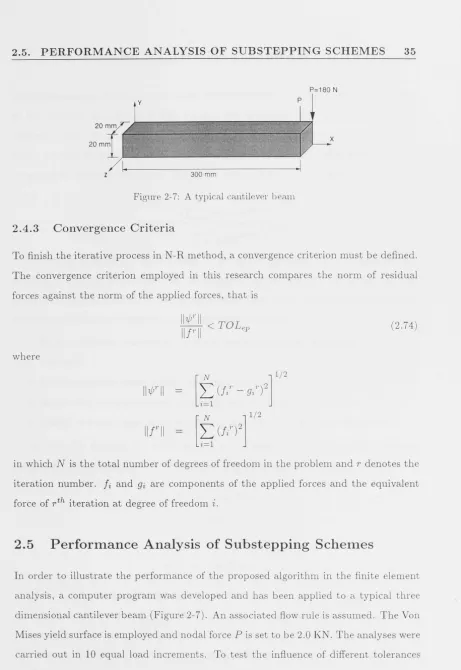
FOR ELASTO-PLASTIC
FINITE ELEMENT AN
AL YSIS
Zhongwen
Ding
B.E.
(Northeastern University, P.
R.
China)
September 1999
A thesis
submitted for the degree of Master of Engineering
of The
Australian National University
Department of Engineerin
g
This thesis contains no material which has been previously accepted for the award of any other degree or diploma in any university, institute or college, and contains no material previously published or written by another person, except where due reference
is made.
Canberra, September 1999.
Journal Papers:
Zhongwen Ding Department of Engineering Faculty of Engineering and Information Technology The Australian National University Canberra ACT 0200, AUSTRALIA.
[Jl]Z.
Ding, Dr. S. Kalyanasundaram, Dr. M. Cardew-Hall, Dr. S. Robert and Dr. L. Grosz. "Integration Algorithms for Three-dimensional Elasto-plastic Finite Element Analysis," Submitted to International Journal of Numerical Methods in Engineering, under review.Conference Papers:
[Cl]Z. Ding, Dr. S. Kalyanasundaram, Dr. L. Grosz, Dr. M. Cardew-Hall and Dr. S. Robert, "Parallel Substepping Schemes for Elasto-Plastic Finite Element Stress Anal-ysis," The Second Australasian Congress on Applied Mechanics (ACAM 99), Feb. 10 - 12, 1999, Canberra, Australia
[C2]Z. Ding, Dr. S. Kalyanasundaram, Dr. L. Grosz, Dr. M. Cardew-Hall and Dr. S. Robert, "Application of Parallel Conjugate Gradient Method to Non-linear Problem in Solid Mechanics," International Conference on Applied Modelling and Simulation (AMS'99), Sep. 1-3, 1999, Cairns, Queensland, Australia
[C3]Z. Ding, Dr. S. Kalyanasundaram, Dr. L. Grosz, Dr. M. Cardew-Hall and Dr. S. Robert, "Development of A New Method for Solving the Initial Value Problem in Elasto-Plastic Deformation Analysis," Submitted to the 9th Biennial Computational Techniques and Applications Conference and Workshops (CTAC99), September 20-24,
1999, Canberra, Australia
[C4JZ. Ding, Dr. S. Kalyanasundaram, Dr. L. Grosz, Dr. M. Cardew-Hall and Dr. S. Robert, "Parallel Elasto-Plastic Finite Element Analysis in a Workstation Cluster Environment," Submitted to The 7th International Symposium on Structural Failure and Plasticity (IMPLAST 2000), Oct. 4-6, 2000, Melbourne, Australia
In this thesis, we present the development of the parallel algorithms for elasto-plastic analysis by using finite element method. The method is based on dividing the original
structure into a number of substructures which are treated as isolated finite element models via the interface conditions. Separate input and output files are established for each subdomain. These files are read from and written to by local copies of the program executable operating in parallel. After reading corresponding input file, each
processor generates the substructure in parallel on which it will operate without any
need for communication. During the overall solution, each processor performs identical
instructions, but on different sets of data.
We focus on the establishment of algorithms for integration of the strain and stress
relations and solution of the resulting systems of equations. We employ a parallel
sub-structure oriented preconditioned conjugate gradient method combined with minimal
residual smoothing and the diagonal storage scheme to solve the systems of equations. The solution method proposed does not require the formation of global system of
equa-tions, but computes directly the displacements for each substructure, as opposed to solving a global system of nodal equations. Throughout the analysis, each processor
stores only the information relevant to its substructure and generates the local stiffness matrix.
After the displacements are calculated a substepping scheme is used to integrate elasto-plastic stress-strain relations. The procedure outlined controls the error of the computed stress by choosing each substep size automatically according to a prescribed
tolerance. The results indicate that the combination of this substepping scheme and the stress correction which is applied at the end of integration process can increase both accuracy and efficiency significantly.
When we implement the parallel algorithms we have to address the problems of load
balancing and interprocessor communication, etc. The method we use to balance the
load is to employ different partitioning schemes. The interprocessor communication is
optimized by using a special element numbering and an optimal communication scheme.
In
this thesis we will describe the implementation in further detail and give some examples of results obtained from experimental runs via Message Passing Interface onthe Linux-Alpha workstation cluster at the Australian National University
Supercom-puter Facility. The results are designed to highlight the performance of the algorithms
developed as well as their efficiency on a parallel machine.
Working on this project has been a source of great pleasure for me. At this juncture, I would like to acknowledge the people who worked with me and helped make this project a reality.
I would like to thank the people in the Department of Engineering at the Australian National University. They have helped to create a good working environment, both academically and socially. I would especially like to thank my supervisor, Dr. Shankar Kalyanasundaram for his patience and guidance. I am most indebted to him for his support throughout the duration of this project.
I would like to thank the staff at the Australian National University Supercomputer Facility, especially Roger Brown and David Singleton for their technical advice on parallel computing, particularly with regards to the Alpha-Linux workstation cluster.
I would also like to thank Dr. Lutz Grosz and Dr. Stephen Roberts, at the School of Mathematical Science, and Dr. Mick Cardew-Hall, head of the Department of Engi-neering, for their valuable input into this project.
Most of all, I would like to thank my wife, Xiaoli, for her affectionate support, patience, and encouragement all through my education at ANU.
Contents
Declaration
Abstract
Acknowledgements
Notation
1 Introduction
1.1 The Research Problem 1.2 Literature Review
1.2.1 Integration Algorithm for Elasto-Plastic Problems 1.2.2 Parallel Elasto-Plastic Finite Element Analysis 1.3 Aims . . . .
1.4 Organisation of the thesis
2 Finite Element Elasto-Plastic Analysis
2.1 Finite Element Method . . . . 2.1.1 History of Finite Element Method
iii
V
Xll
1
1 3
3
5
5
6
8 8
8
2.1.2 General Procedures of Finite Element Method . . . . . 9 2 .1.3 Basic Formulation of Finite Element Method for Non-Linear Prob
-lem . . . . . . . . . . . . . . . . 10
2.1.4 Applications of Finite Element Method 12
2.2 The Mathematical Formulation of Elasto-Plastic Problem 2.2.1 The Yield Criterion
2.2.2 Work or Strain Hardening
Vl
12
14
2.2.5 2.3
2.4
Determination of Initial Yielding State . . . Integration Algorithms for Stress-Strain Relations 2.3.1 Conventional Method . .
2.3.2 New Substepping Scheme Overall Solution Methods 2.4.1 Iterative Methods 2.4.2 Load Increment Control 2.4.3 Convergence Criteria . .
2.5 Performance Analysis of Substepping Schemes . 2.5.1 Accuracy
2.5.2 Efficiency 2.6 Summary . . . .
3 Parallel Finite Element Analysis 3.1 Parallel Computing .
Introduction 3.1.1
3.1.2 3.1.3
The Importance of Parallel Computing . The Application of Parallel Computing 3.1.4 Issues in Parallel Computing
3.2 Parallel Finite Element Analysis
3.2.1 Generation of Element Stiffness Matrices
3.2.2 Assembly and Solution of the Global System Equations 3.2.3 Calculations of Element Characteristics
3.3 Sequential Algorithm for Equation Solution 3.3.1 Conjugate gradient method . . . . . 3.3.2 Preconditioned conjugate gradient method. 3.3.3 Minimal Residual Smoothing . . .
3.4 Finite Element Transformation Relations 3.5 Parallel Algorithms for Equation Solution
3.5.1 Parallel Preconditioned Conjugate Gradient Method 3.5.2 Parallel Minimal Residual Smoothing method
4 Implementation of Parallel Algorithms 4.1
4.2
4.3
Parallel Environment .
4.1.1 Parallel Computer Architectures
4.1.2 Message Passing Interface
4.1.3 Compiler and Debugger
Performance Evaluation
4.2.1 Run time
4.2.2 Speedup .
4.2.3 Efficiency
4.2.4 Scalability .
Sources of Parallel Overhead
4.3.1 Interprocessor Communication
4.3.2 Load Imbalance . . .
4.3.3 Extra Computation
4.4 Implementation of Parallel FE Algorithms
4.4.1 Parallel Grid Generation .
4.4.2 Special numbering scheme
4.4.3 Load Balance . . . .
4.4.4 Interprocessor Communication
4.4.5 Storage Scheme .
5 Numerical Experiments 5.1 Material Parameters .
5.2 Performance of the Algorithms and Discussion
5.2.1 Application of 3-D Shallow Cantilever Beam
5.2.2 Application of 3-D Deep Cantilever Beam
6 Conclusion
6 .1 Concluding Remarks
6.2 Future Work
Bibliography
A Runge-Kutta Methods
1-1 Program structure for elasto-plastic analysis . . . . . . . 2
2-1 Geometrical representation of the Tresca and Von Mises yield surfaces
in principal stress space[2] . . . . . . . . . . . . . . . . . . . . . . . . 15 2-2 Geometrical representation of the Mohr-Coulomb and Drucker-Prager
yield surfaces in principal stress space[2] . . . . . . . . . . . . . . . 17 2-3 Mathematical models for representation of strain hardening behaviour[2] 18
2-4 Incremental stress changes in an already yielded point in an elasto-plastic
continuum. 25
2-5 Incremental stress changes at a point in an elasto-plastic continuum at initial yield. . . . . . . . . . . . . . . . . . . . . . . 26 2-6 Refined process for reducing a stress point to the yield surface. 27 2-7 A typical cantilever beam . . . . . . . . . . . . . . . . 35 2-8 Force vs displacement curve for problem with 288 d.o.f (no strain
hard-ening). . . . . . . . . . . . . . . . . . . . . . . . . . 38 2-9 Force vs displacement curve for problem with 288 d.o.f ( a linear strain
hardening is considered). . . . . . . . . . . . . . . . . . . . . . . 39 2-10 Force vs displacement curve for problem with 432 d.o.f (no strain
hard-ening). . . . . . . . . . . . . . . . . . . . . . . . . . . . . . . . . . . . . . 40 2-11 Force vs displacement curve for problem with 432 d.o.f ( a linear strain
hardening is considered). . . . . . . . . . . . . . . . . . . . . .
3-1 Cost versus performance curve and its evolution over the decades 3-2 Element-element connectivity information. . . . .
4-1 Structure of the Linux-Alpha workstation cluster
lX
41
48
59
4-2 A three dimensional cantilever beam (8 x 8 x 32) 76 4-3 A vertical strip-wise partitioning on 4 processors 76 4-4 A horizontal strip-wise partitioning on 4 processors 76 4-5 A box-wise partitioning on eight processors . . . . 76 4-6 Sequentialization caused by sends blocking until the matching receive is
posted. The shaded area indicates the time a process is idle. 78 4- 7 Optimizaton of communication by avoiding matching delay. 78 4-8 A sparse matrix stored in the diagonal format 79
5-1 3-D shallow cantilever beam 80
5-2 3-D deep cantilever beam . 81
5-3 Parallel program structure for non-linear analysis 81 5-4 Speedup of analyses of 3-D shallow cantilever beam using horizontal
strip-wise partitioning . . . . . . . . . . . . . . . . . . . . . . . . . . 84 5-5 Efficiency of analyses of 3-D shallow cantilever beam using horizontal
strip-wise partitioning . . . . . . . . . . . . . . . . . . . . . 84 5-6 Speedup of analyses of 3-D shallow cantilever beam using vertical
strip-wise partitioning . . . . . . . . . . . . . . . . . . . . . . . . . . . . . 85 5- 7 Efficiency of analyses of 3-D shallow cantilever beam using vertical
strip-wise partitioning . . . . . . . . . . . . . . . . . . 85 5-8 Speedup of analyses of 3-D deep cantilever beam 89 5-9 Efficiency of analyses of 3-D deep cantilever beam 89
2.1 Effective stress and uniaxial yield stress levels for the yield criteria in-cluded in the elasto-plastic computer code . . . . . . . . . . . . 21 2.2 Constants defining the yield surface in a form suitable for numerical
analysis . . . . . . . . . . . . . . . . . . . . . . 22 2.3 Results of errors for problem with 288 d.o.f with different tolerances 42 2.4 Results of errors for problem with 432 d.o.f with different tolerance . 42 2.5 Total substeps needed in the overall solution for problem with 288 d.o.f
with different tolerance . . . . . . . . . . . . . . . . . . . . . 44 2.6 Total substeps needed in the overall solution for problem with 432 d.o.f
with different tolerance . . . . . . . . . . . . . . . . . . . . . . 44 2.7 CPU time (seconds)spent on computation of stress-strain relation for
problem with 288 d.o.f with different tolerance . . . . . . . . . . . . . . 45 2.8 CPU time (seconds) spent on computation of stress-strain relation for
problem with 432 d.o.f with different tolerance . . . . . . . . . . . 45
3.1 PCG algorithm with MR smoothing . . . . 57
3.2 Parallel Substructure Preconditioned Conjugate Gradient Algorithm
com-bined with MR Smoothing . . . . . . . . . . . . . . . . . . . . . . . 65
5.1 Substructure of horizontal partitioning scheme for 3-D shallow beam 82 5.2 Substructure of vertical partitioning scheme for 3-D shallow beam 83 5.3 Substructure of horizontal partitioning scheme for 3-D deep beam 88
Notation
F pe E HH'
Q N DDep
B
Ji
J~
1,Ke,K
C T Ts Tp !::l.T A
w
WP Rs
Eyield function
equivalent nodal forces
Young's modulus
linear hardening parameter
derivative of the hardening function
plastic potential
shape functions
elastic matrix
elasto-plastic matrix
elastic strain matrix
stress invariants
invariants of the deviatoric stresses
stiffness matrix (element/global)
preconditioning matrix
time
serial run time
parallel run time
substep size
transformation matrix
potential energy of loads
total plastic work
residual in domain
speedup
efficiency
a
r
p
C
X, Xe
8d
8uf
b E .6.c: .6.Ee .6.c:p 8c: Ep ,\ V K, (J" .6.0" O"e 0 O"ya-er
.6.T </> \JIflow vector
residual
direction vector
cohesion parameter
displacement vector (global/ element)
virtual displacement
internal displacement
applied forces
distributed loads/unit volume
strain vector
strain increment
elastic strain increment
plastic strain increment
virtual strain
effective plastic strain
plastic multiplier
Poisson's ratio
hardening parameter
stress vector
stress increment
trial stress
uniaxial yield stress
effective stress
stress, finite element approximation
shear stress increment
angle of internal friction
Chapter
1
Introduction
1.1
The Research Problem
The finite element method is now firmly accepted as a powerful general technique for
the numerical solution of a variety of problems encountered in engineering. Among its
many applications, the finite element analysis of elasto-plastic behaviour is a subject of
great importance for fundamental and practical reasons. Elasto-plastic modelling can
help us make a more complete use of the strength resources of solids and leads to an
efficient method for calculating details of machines and structures as regards to their
load-bearing capacity. However, as increasingly large-scale three-dimensional finite
element models are currently being used in various disciplines for realistic simulation
of engineering problems, the use of such complex models raises a number of questions
in relation to accuracy and efficiency. A great deal of effort has therefore been invested
in developing algorithms that can quickly and accurately solve the large-scale problems
encountered in practice.
The analysis of nonlinear elasto-plastic problems must proceed in an incremental
manner since the solution at any stage may not only depend on the current
displace-ment of the structure, but also on the previous loading history. A simplified depiction
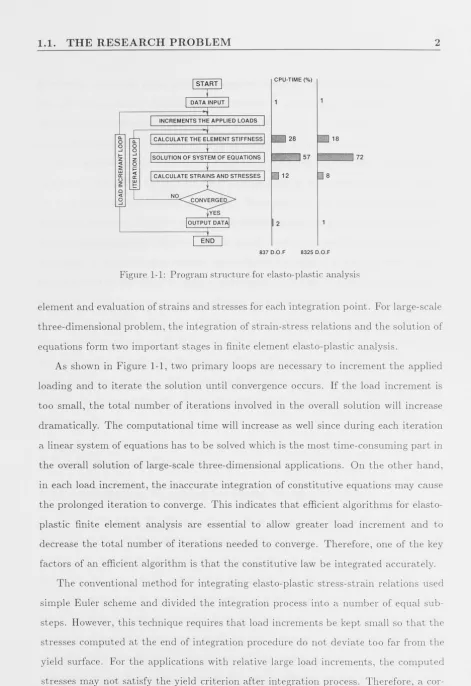
of sequential program structure is given in Figure 1-1. The diagrams on the right-hand
side of Figure 1-1 indicates the computing time spent on different parts of the
pro-gram. For large, three-dimensional problems the overall CPU time is dominated by the
solution of systems of equations. The only other parts of the program that require sig
-nificant computational resources are the computation of the stiffness matrices for each
INCREMENTS THE APPLIED LOADS
CALCULATE THE ELEMENT STIFFNESS' ~
SOLUTION OF SYSTEM OF EQUATIONS
CALCULATE STRAINS AND STRESSES
NO
837 D.O.F 8325 D.O.F
Figure 1-1: Program structure for elasto-plastic analysis
element and evaluation of strains and stresses for each integration point. For large-scale
three-dimensional problem, the integration of strain-stress relations and the solution of
equations form two important stages in finite element elasto-plastic analysis.
As shown in Figure 1-1, two primary loops are necessary to increment the applied
loading and to iterate the solution until convergence occurs. If the load increment is
too small, the total number of iterations involved in the overall solution will increase
dramatically. The computational time will increase as well since during each iteration
a linear system of equations has to be solved which is the most time-consuming part in
the overall solution of large-scale three-dimensional applications. On the other hand,
in each load increment, the inaccurate integration of constitutive equations may cause
the prolonged iteration to converge. This indicates that efficient algorithms for
elasto-plastic finite element analysis are essential to allow greater load increment and to
decrease the total number of iterations needed to converge. Therefore, one of the key
factors of an efficient algorithm is that the constitutive law be integrated accurately.
The conventional method for integrating elasto-plastic stress-strain relations used
simple Euler scheme and divided the integration process into a number of equal
sub-steps. However, this technique requires that load increments be kept small so that the
stresses computed at the end of integration procedure do not deviate too far from the
yield surface. For the applications with relative large load increments, the computed
stresses may not satisfy the yield criterion after integration process. Therefore, a
[image:17.535.30.501.35.721.2]1.2.
LITERATURE REVIEW
3frequently. Since the stress correction applied at the end of integration process does
not affect the accuracy significantly, it is difficult to ensure that the strain-stress
rela-tion can be integrated with adequate accuracy. Therefore, it is necessary to develop a
integration algorithm which can control the errors in the integration process.
It is well-known that most of the computations involved in the finite element
anal-ysis are carried out at the element level. Consequently, these operations can be carried
out in parallel independent of each other. However, after the elemental calculations
have been achieved, the calculation of the displacements can become a bottleneck for
parallel implementation, since the global matrix and vector need to be assembled at
this stage. It would be very natural, especially from a parallel processing viewpoint, if
the formation of the global equations could be avoided, that is, the selected numerical
algorithm could be operated at the element or substructure level. Generally, this is
the case for iterative solution methods based on matrix-vector. Also, since the
itera-tive method employed in the finite element analysis does not change the structure of
stiffness matrix, it maintains its sparsity. Hence, the computational costs and memory
space associated with zero fill-ins can be greatly reduced by using a suitable storage
scheme. So development of a efficient parallel algorithm is another important task for
this research work.
1.2
Literature Review
1.2.1
Integration Algorithm for
Elasto-Plastic Problems
In the past 20 years, significant advances have been made in the development and
application of numerical methods to the solution of elasto-plastic problems. It is well
known that one of the simplest numerical schemes, which has been used widely in
finite element codes, is the first order Euler algorithm. This has the advantage of being
straightforward but also has the disadvantage of being accurate only for very small time
steps. To avoid this shortcoming, it is usual to subdivide the particular time step into
a number of smaller substeps and apply the Euler schemes to each of these[l, 2]. This
partially overcomes the disadvantage of the Euler approach but usually leads to a set
of stresses which do not lie precisely on the yield surface at the end of each time step.
computation, it is usual to apply some form of correction[3] to the stresses to restore
them to the yield surface. Since the stress correction is normally applied at the end of integration process, it does not significantly affect the accuracy. [4]
A number of new integration algorithms therefore were developed with an aim to
control the error in the integration process[4]-[26]. Wissmann and Hauck[4] developed a algorithm with an aim to control the errors in the integration process by using
Richard-son extrapolation to selected number of fixed size substeps. Polat and Dokainish[5] took
into account the change in the plastic flow direction due to continuing plastic deforma-tion and an automatic subincrementation scheme has been proposed for further
accu-racy improvement. Eterovic and Bathe[6] presented a hyperelastic-based large strain formulation using the product decomposition of the deformation gradient into elastic
and plastic parts for metal plasticity. Pezeshk and Camp[7] have proposed an
integra-tion method based on a Modified Trapezoidal rule Method. The resulting algorithm is
extremely simple to use. However, it is conditionally stable. It is especially worthy not-ing that Sloan[8, 9] used a substepping scheme to integrate the stress-strain relations.
The substep size is decided by comparing a prescribed tolerance with an estimate of the error of the integrated stress increment. This error estimate is obtained by
compar-ing the estimated stress increments which result from two integration procedures with truncation errors of different order. Two substepping schemes are recommended in [8],
which are based on modified Euler method and the fifth order Runge-Kutta-England,
respectively. The application of a smooth rigid strip footing resting on an ealsto-plastic
soil mass indicated that no form of the stress correction is required. However, Gens
and Potts suggested in [10] that, the deviation from the yield surface is directly related
to the level of error in computed stresses and it is practically independent of the
1.3. AIMS 5
1.2.2
Parallel Elasto-Plastic Finite Element Analysis
At present, the parallel algorithms for linear analyses have made considerable
head-way. However, in the aspect of nonlinear analyses, wide-ranging research has not been
undertaken; Wilson and Farhat[33], Sun and Mao[34], Farhat and Crivell[35],
Shivaku-mar, Bigelow and Newman[36], Kacou and Parsons[37], Hu[38], Klaas, Kreienmeyer
and Stein[39], Feriani, Franchi and Genna[40][41] et al. have implemented such
non-linear analysis on parallel computer systems. However the integration schemes they
employed are based on the conventional finite element method in which no measure is
used to control the error in the integration process. In fact, the error in the computed stresses is very important for the non-linear elasto-plastic analysis, since large error can
cause a prolonged iteration to converge.
In parallel finite element analysis for elasto-plastic problem, solving the linearized
system of equations forms another important stage. Techniques to solve the equations
system may generally be classified into two categories, one is the direct parallel solution;
Melosh and Utku[42], Doi and Koyama[43], Noor, Kamel and Fulton[44], Farhat and
Wilson[45], Malone[46], Goehlich, Komzsik and Fulton[47] et al. have all conducted
some research work in this field. The other is the iterative solution; Hughes, Levit
and Winget[48], Law[49], King and Sonnad[50], Carter, Sham and Law[51], Johnsson
and Mathur[52], Kumar, Grama, Gupta and Karypis[53] et al. have proposed different
iterative algorithms. The main virtue of direct parallel solution is the strong
numer-ical stability, but the weak point is that synchronous control must be introduced in
most cases. The main advantage of iterative parallel solution is that the excessive
syn-chronous control steps can be avoided, but there are some problems in the numerical
stability of the algorithm. The direct parallel algorithms are commonly developed from
the substructuring techniques or the synchronous control solutions of the finite element
equations. The iterative parallel algorithms are generally based on preconditioned
con-jugate gradient PCG) or Jacobi methods.
1.3
Aims
The aim of this research project is to research methods for developing an
finite element solution procedure with relevance to elasto-plastic modelling.
In order to develop the above framework the following important areas needed to
be researched:
• Accurate integration algorithm for strain-stress relationships.
• Efficient parallel algorithm for the solution of linear system of equations. • A suitable storage scheme for overall solution.
• Implementation of the developed parallel algorithms on the computer platforms
to achieve optimal performance.
With these thoughts in mind, we will develop a substepping scheme for elasto-plastic
stress integration process. The resulting algorithm can be applicable to a general type
of constitutive law and controls the error in the integration process by adjusting the size
of each substep automatically in accordance with the behaviour of the constitutive law.
For the equation solution, a combination of preconditioned conjugate gradient method with minimal residual smoothing will be employed. In the resulting parallel algorithm, the formation of the global system_ matrix is not performed, but the displacements
for each substructure are computed directly, as opposed to solving a global system of
nodal equations. The resulting algorithms will be tested on a workstation cluster. To
obtain an optimal performance, a diagonal storage scheme will be employed. Different
partitioning scheme will be used with an aim to obtain better load balance. Also, a
special numbering of the elements and an optimized communication scheme are adopted
in this research work.
1.4
Organisation of the thesis
This thesis chronicles our experience with parallel finite element analysis in the context
of non-linear elasto-plastic finite element simulation over the past two years. An outline
of this thesis is as follows.
Chapter 2 commences with a brief review of finite element method and its
appli-cation to nonlinear problem. For elasto-plastic applications to be considered, basic
theoretical formulations are developed in a form suitable for numerical solution.
1.4. ORGANISATION OF THE THESIS
7an advanced substepping scheme will be introduced and its advantages will be
demon-strated. The overall solution method will also be presented for completeness.
Chapter 3 deals with the development of parallel algorithm for the solution of linear
system of equations. Both sequential algorithm and parallel algorithm are outlined. A finite element transformation relations is introduced which forms a bridge between sequential algorithm and parallel algorithm.
In Chapter 4, we present an introduction of parallel environment which is used in
this research work. Some of the important issues in implementation of the parallel algorithms on the chosen parallel machine are also reviewed.
Chapter 5 conducts application of the resulting parallel algorithms to a
three-dimensional elasto-plastic analysis. The speedup, efficiency and scalability will be studied.
Chapter 6 summarises the main conclusions of the study and provides some
Finite Element Elasto-Plastic
Analysis
A general introduction of finite element method is presented in this chapter. Basic
theoretical formulations for elasto-plastic problems are developed in a form suitable
for numerical solution. Based on it, a conventional method for integrating the
strain-stress relations will be discussed. An advanced substepping scheme will be developed
and its performance will be given. For a better understanding of the performance of substepping scheme, the overall solution methods which are employed in the finite
element code will be briefly introduced.
2.1
Finite Element Method
The finite element method is a numerical analysis technique for obtaining approximate
solution to a wide variety of engineering problems. Although originally developed to
study the stresses in complex airframe structures, it has since been extended and applied
to the broad field of continuum mechanics. Because of its diversity and flexibility as
an analysis tool, it is receiving much attention in engineering schools and in industry.
2.1.1
History of Finite Element Method
Finite element analysis was first developed in 1943. During its early development for stress analysis problems the method relied heavily on a physical interpretation in which
the structure was assumed to be composed of elements physically connected only at
2.1. FINITE ELEMENT METHOD
9a number of discrete nodal 'points. Later the application of the method to structural mechanics problems was developed through the use of the principle of virtual work and energy methods. The method was then generalised and its wider mathematical roots were recognised. It was shown that finite elements could be applied to any mathematical problem for which a variational functional existed. More recently, finite
element solutions have been developed which are based on the well known, classical techniques known as "weighted residual methods". Since the 1970's the rapid growth in engineering usage of computer technology has a significant effect upon the acceptance
of the finite element method. In fact the finite element method is now firmly established as an engineering tool of wide applicability. One of the principal advantage of the finite
element method is the unifying approach it offers to the solution of diverse engineering problems.
2.1.2
General Procedures
of Finite Element Method
Regardless of the approach used to different applications, the solution of finite element method always follows an orderly step-by-step process. To summarize in general terms how the finite element method works we will succinctly list these steps. These well-defined modules are a base of parallel finite element analysis.
l. Discretize the continuum. The first step is to divide the continuum or solution
region into elements. A variety of element shapes is available for different analysis.
2. Select interpolation functions. The next step is to assign nodes to each ele-ment and then choose the type of interpolation function to represent the variation
of the field variable over the element.
3. Find the element properties. Once the finite element model has been
estab-lished, we are ready to determine the matrix equations expressing the properties of the individual element.
4. Assemble the element properties to obtain the system equations. To find the properties of the overall system modelled by the network of elements we must "assemble" all the element properties.
values of the field variable. Technique to solve this equations system may generally
be classified into direct and iterative methods.
6. Calculate the element characteristics. Normally we use the solution of the system equations to calculate other important parameters, such as strains,
stresses, ... etc.
2.1.3
Basic Formulation of Finite Element Method
for Non-Linear
Problem
For any numerical approach an approximate solution is attempted by assuming that
the behaviour of the continuum can be represented by a finite nurn.ber of unknowns.
As previously mentioned in the finite element method the continuum is divided into
a series of elements which are connected at a finite number of points known as nodal
points.
For structural applications at least, the governing equilibrium equations can be
obtained by the principle of virtual work[2]. Consider the solid, in which the internal
stresses a, the distributed loads/unit volume b and external applied forces
f
form an equilibrating field, to undergo an arbitrary virtual displacements pattern 5d which results in compatible strains5c
and internal displacements 5u. Then the principle ofvirtual work can be expressed as
l
(OET
CY - OuTb)dO. - OdTf
= 0
(2.1)In the finite element displacement method, the displacement is assumed to have
un-known values only at the nodal points, so that the variation within any element 1s
described in terms of the nodal values by means of interpolation functions. Thus
ou
=
N5d (2.2)where N is the set of interpolation functions termed the shape functions. The strains
within the element can be expressed in terms of the element nodal displacements as
5c
=
Bod (2.3)where B is the strain matrix generally composed of derivatives of the shape functions.
Then the element assembly process gives
2.1.
FINITE ELEMENT METHOD
11where the volume integration over the solid is the sum of the individual element
con-tributions. Since this expression must be hold true for any arbitrary 5d value
l
BT adD - f -l
NTbdD=
0 (2.5)For the solution of nonlinear problems which will be described in the following,
Equa-tion 2.5 will not generally be satisfied at any stage of the computation, and
'¥
=
l
BT adD -(1
+
l
NTbdD) =/= 0 (2.6)where '1! is the residual force vector. For an elasto-plastic situation the material stiffness
is continually varying, and instantaneously the incremental stress/strain relationship is given
'6.a
=
Dep'6.E (2.7)For the purpose of evaluating the material tangential stiffness matrix Kr at any stage,
the incremental form of (2.6) must be employed. Thus, within an increment of load we
have
6.
1¥
=
l
BT 6.adD - ( 6.f+
l
NT 6.bdD) Substituting for '6.a from Equation 2.7 results in6. '¥
=
Kr6.d - ( 6.f+
l
NT 6.bdD)where
[Kr]=
l
BTDepBdD(2.8)
(2.9)
(2.10)
is termed the element stiffness matrix. The final system of equations that results from the above approximation is of the form
[K]
{x}
=
{J}
(2.11)where the global stiffness matrix
[K]
is really a collection of elemental stiffness matricesN
[K]
=
I)x
(e)]
(2.12)e=l
These equations are then solved by any standard technique to yield the nodal displace-ments. After this, the stresses within each element can then be calculated from the
2.1.4
Applications of Finite Element
Method
The range of possible applications of the finite element method extends to all
engineer-ing disciplines, although civil and aerospace engineers concerned with stress analysis
are the most frequent user of the method. Its applications mainly range from the stress
analysis of solids to the solution of acoustical, neutron physics and fluid dynamics
problems. Indeed the finite element process is now established as a general
numeri-cal method for the solution of partial differential equation systems, subject to known
boundary and/ or initial conditions.
For linear application, at least, the technique is widely employed as a design tool.
Similar acceptance for nonlinear applications is dependent on two major factors. Firstly,
in view of the increased numerical operations associated with nonlinear problems,
con-siderable computing power is required. Although developments of high-speed digital
computers in the last decade or so met this need to some extent, in fact, some
prob-lems can still be classified as 'difficult' to solve, even for modern vector supercomputers.
Parallel processing may be the most promising way to reduce the computation time as
new generations of parallel computers are rapidly emerging. Secondly, before the finite
element method can be used in design, the accuracy of any proposed solution technique
must be proven. Although the development of improved element characteristics and
more efficient nonlinear solution algorithms and the experience gained in their
appli-cation to engineering problems have ensured that nonlinear finite element analyses can
now be performed with some confidence, efficient and accurate algorithms for parallel
processing are still urgently needed. These suitable algorithms are essential to allow
greater load step and to decrease the total amount of computation. Hence the effort on
trying to remove the barriers to the common use of nonlinear finite element techniques
will never end.
2.2
The Mathematical Formulation of Elasto-Plastic
Prob-lem
In this section, we consider the elasto-plastic stress analysis of solid which conforms
to three-dimensional conditions. The basic laws governing elasto-plastic material
2.2. THE MATHEMATICAL FOR
MUL
AT
I
O
N OF ELASTO-PLASTIC
PROBLEM
13
the problem can be considered and to this end some concepts, such as the plastic
po-tential and the flow rule will be introduced. Only essential expressions will be provided
in this thesis and a more complete theoretical treatment can be found, for example, in
[2] and [29].
The object of the mathematical theory of plasticity is to provide a theoretical
de-scription of the relationship between stress and strain for a material which exhibits an
elasto-plastic response. In essence, plastic behaviour is characterised by an irreversible
straining which is not time dependent and which can only be sustained once a certain
level of stress has been reached. In this thesis we outline the basic assumptions and
associated theoretical expressions for a general continuum. In order to formulate a
theory which models elasto-plastic material deformation three requirements have to be
met:
• An explicit relationship between stress and strain must be formulated to describe
material behaviour under elastic conditions,i.e. before the onset of plastic
defor-mation.
• A yield criterion indicating the stress level at which plastic flow commences must
be postulated.
• A relationship between stress and strain must be developed for post-yield
be-haviour,i.e. when the deformation is made up of both elastic and plastic
compo-nents.
Before the onset of plastic yielding the relationship between stress and strain 1s
given by the standard linear elastic expression.
6..c
=
D-16.a (2.13)
For three-dimensional isotropic pro bl ems
{ 6.. a}
=
(
6.. a :r , 6.. a y , 6.. a z , 6.. T 1:y , 6.. Ty z , 6.. T z 1:) T (2.14)A1
D=
sym.
where
Ai=
E(l
-
v) .(
l+
v)(
l -
2v)'
A2 A2
0 0 0A1
A2
0 0 0A1 0 0 0
A3
0 0A3
0A3
Ev
A2
=
-(
l
+
V)(
1 -
2v) 1(2.16)
A - E 3
-2
(
l+v
)
in which E and v are respectively the elastic modulus and Poisson's ratio of the
mate-rials.
2.2.1
The Yield Criterion
The yield criterion determines the stress level at which plastic deformation begins and can be written in the general form[2]
(2.17)
where K is the hardening parameter. On physical grounds, any yield criterion should
be independent of the_ orientation of the coordinate system employed and therefore it
should be a function of the three stress invariants only,
Ji,h
andh.
Experimentalobservations indicate that plastic deformation of metals is essentially independent of
hydrostatic pressure. Consequently the yield function can only be of the form
(2.18)
in which
h'
andJ/
are the second and third invariants of the deviatoric stresses.The situation is complicated by the fact that different classes of materials exhibit
different elasto-plastic characteristics. In this thesis four commonly used yield criteria
are introduced. The Tresca and Von Mises laws which closely approximate metal
plas-ticity behaviour are considered and the Mohr-Coulomb and Drucker-Prager criteria
2.2. THE MATHEMATICAL FORMULATION OF ELASTO-PLASTIC
PROBLEM 15
Space diagonal
1r plane
a1
+
a2+
a3Tresca
/
/ /
Figure 2-1: Geometrical representation of the Tresca and Von Mises yield surfaces in
principal stress space[2]
Tresca Yield Criterion
The Tresca yield criterion states that yielding begins when the maximum shear stress
reaches a certain value. If the principal stresses are a1, a2, a3 where a1
2::
a22::
a3 then yielding begins whena1 - a3
=
Y(K) (2.19)where Y is a material parameter to be experimentally determined and which may be a function of the hardening parameter K. By considering all other possible maximum
[image:30.528.48.481.39.727.2]Von Mises Yield Criterion
Von Mises suggested that yielding occurs when the second invariants of the deviatoric
stresses, J2', reaches a critical value, or
1
(h')2
=
k(K,) (2.20)in which k is a material parameter to be determined. Figure 2-1 shows the geometrical
interpretation of the Von Mises yield surface to be a circular cylinder whose projection
onto the 1r plane is a circle. A physical meaning of the constant k can be obtained
by considering the yielding of materials under simple stress states. For most metals
Von Mises' law fits the experimental date more closely than Tresca's, but it frequently
happens that the Tresca criterion is simpler to use in theoretical applications.
Mohr-Coulomb Yield Criterion
This is a generalisation of the Coulomb friction failure law defined by
T
=
c - an tan¢ (2.21)where Tis the magnitude of the shearing stress, O-n is the normal stress, c is the cohesion
and ¢ the angle of internal friction. Again, as for the Tresca criterion, the complete
yield surface is obtained by considering all other stress combinations which can cause
yielding ( e.g. a3
S
0-1S
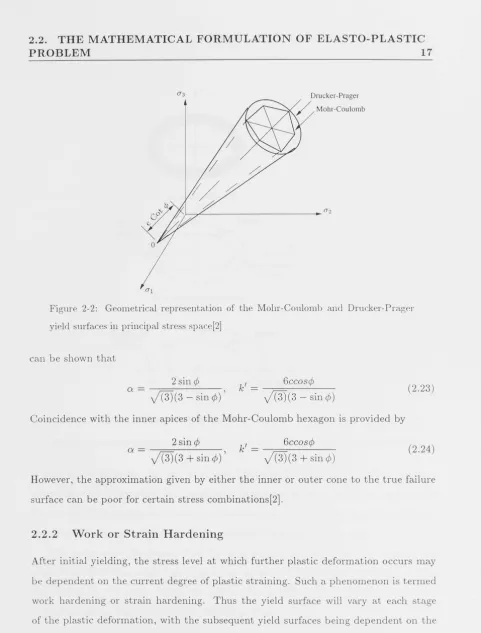
0-2). In principal stress space this gives a conical yield surfacewhose normal section at any point is an irregular hexagon as shown in Figure 2-2. This
criterion is applicable to concrete, rock and soil problems.
Drucker-Prager Yield Criterion
An approximation to the Mohr-Coulomb law was presented as a modification of the
Von Mises yield criterion. The influence of a hydrostatic stress component on yielding
was introduced by inclusion of an additional term in the Von Mises expression to give
1
aJi
+
(h')
2=
k' (2.22)This yield surface has the form of a circular cone. In order to make the Drucker-Prager
2.2.
THE MATHEMATICAL FORMULATION OF
ELASTO-PLASTIC
PROBLEM
17
0"3
I
~~D:::::;::~::b
i'/
(
I/
/;,
f/~
/
~ff/
I/
--
0"2o
7
0"1
Figure 2-2: Geometrical representation of the Mohr-Coulomb and Drucker-Prager
yield surfaces in principal stress space[2]
can be shown that
2 sin¢ a= /(3)(3 - sin¢)'
k'
=
6ccos¢/(3)(3 - sin¢) (2.23)
Coincidence with the inner apices of the Mohr-Coulomb hexagon is provided by
2 sin¢
a= /(3)(3 +sin¢)'
k'
=
6ccos¢/(3)(3 +sin¢) (2.24)
However, the approximation given by either the inner or outer cone to the true failure
surface can be poor for certain stress combinations[2].
2.2.2
Work or Strain Hardening
After initial yielding, the stress level at which further plastic deformation occurs may
be dependent on the current degree of plastic straining. Such a phenomenon is termed
work hardening or strain hardening. Thus the yield surface will vary at each stage
of the plastic deformation, with the subsequent yield surfaces being dependent on the
plastic strains in some way. Some alternative models which describe strain hardening
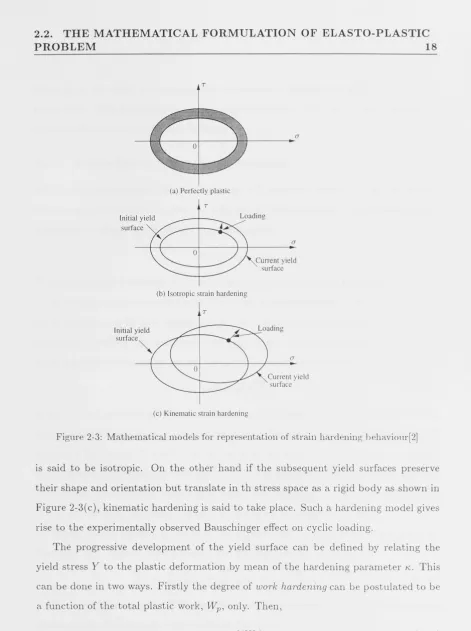
in a material are illustrated in Figure 2-3. A perfectly plastic material is shown in
Figure 2-3(a) where the yield stress level does not depend in any way on the degree of
plastification. If the subsequent yield surfaces are a uniform expansion of the original
[image:32.528.31.512.24.656.2]Initial yield
surface
Initial yield
surface~
(a) Perfectly plastic
T
0
(b) Isotropic strain hardening
T
(c) Kinematic strain hardening
0-Current yield surface
0-Current yield surface
Figure 2-3: Mathematical models for representation of straii1 hardening hehaviour[2)
1s said to be isotropic. On the other hand if the subsequent yield surfaces preserve their shape and orientation but translate in th stress space as a rigid body as shown in Figure 2-3( c), kinematic hardening is said to take place. Such a hardening model gives
rise to the experimentally observed Bauschinger effect on cyclic loading.
The progressive development of the yield surface can be defined by relating the
yield stress Y to the plastic deformation by mean of the hardening parameter "'-· This can be done in two ways. Firstly the degree of work hardening can be postulated to be
a function of the total plastic work, Wp, only. Then,
K,
=
f
(Wp) ( 2. 25)Alternatively K, can be related to a measure of the total plastic deforrnation termed the
effective plastic strain. Then the hardening parameter is assurn.ed to be defined as
[image:33.528.27.499.29.660.2]2.2. THE MATHEMATICAL FORMULATION OF ELASTO-PLASTIC
PROBLEM
19
where Ep is the result of integrating the increment of the effective strain dEp over the
strain path. This behaviour is termed strain hardening. Only an isotropic hardening model will be considered in this research.
2.2.3
Elasto-Plastic Stress/Strain relations
After initial yielding the material behaviour will be partly elastic and partly plastic.
During any incremental of stress, the total strain increment may be additively decom-posed into an elastic and a plastic part, respectively
~c =~Ee+ ~Ep (2.27)
The elastic strain increment is related to the stress increment by Equation 2.13.
In order to derive the relationship between the plastic strain component and the
stress increment a further assumption on the material behaviour must be made. In particular it will be assumed that the plastic strain increment is proportional to the
stress gradient of a quantity termed the plastic potential Q, so that
~Ep
=
~A 8Qaa
(2.28)where ~A is a proportionality constant termed the plastic multiplier. Equation 2.28 is termed the flow rule since it governs the plastic flow after yielding. The potential Q must be a function of
h'
andh'
but as yet it cannot be determined in its most generalform. However the relation F
=
Q
has a special significance in the mathematical theoryof plasticity, since for this case certain variational principles and uniqueness theorems can be formulated. Such assumption give rise to an associated plasticity.
When plastic yielding is occuring the stresses are on the yield surface given by
Equation 2.17. Differentiating this we can therefore write
8F
8F
8F
~F
= -
8
~a1+
-8
~a2+ ... + -
8
~"'
=
0a1 a2 "'
(2.29)
By using Equation 2.27-2.29, we obtain, after some transformation, the complete elasto-plastic incremental stress-strain relation to be
~a= Dep~E (2.30)
where
If the flow rule is assumed to be associated, then we can simply write Dep as
D ep =D- dn
=
Da (2.32)and
T
EJF
[
EJF EJF EJF
EJF
EJF
EJF
]
a - - -
--
EJa
-
Oa
:
r' Oay' EJa
z
' OT
:1
:
y'
OTy
z'
OT
z:1:
'
(2.33)Clearly for ideal plasticity with no hardening, H' is simply zero. When a linear
work hardening is considered, H' is obtained to be the local slope of the uniaxial
stress/plastic strain curve, which is constant and can be determined experimentally[2].
2.2.4
Alternative Form of the Yield Criterion for
Numerical
Compu-tation
For numerical computation it is convenient to rewrite the yield function in terms of
alternative stress invariants. The main advantage of this formulation is that it permits
the computer coding of the yield function and flow rule in a general form and
neces-sitates only the specification of three constants for any individual criterion. Normally
a parameter
e
(Lode angle) is used in such definition. By noting the cyclic nature ofsin(38
+
2mr) we have immediately the three possible values of sine which define thethree principal stresses. In [2], the total principal stresses are expressed as
{ a
1
} , .!. { sin (
e
+
2
t)
}
{
1 }2(h)2
• 11
a2
=
V3
sme
+
3
10"3 sin ( 8
+
4t)
1(2.34)
with a1
>
0-2>
a3 and -Tr/6
~e
~ 1r/6.
The four yield criteria considered in section 2.2.1 can now be rewritten in terms ofIi
,
h'
and 8 as follows.The Tresca Yield Criterion
Substitute for a1 and a3 from Equation 2.34 into Equation 2.19 gives
2 , .!. [ ( 21r) ( 41r)]
V3
(
h
)
2 sine
+
3
-
sine
+
3
=
y
(
K,)or expanding we have
1
2.2. THE MATHEMATICAL FORMULATION OF ELASTO-PLASTIC
[image:36.536.31.517.35.772.2]PROBLEM 21
Table 2.1: Effective stress and uniaxial yield stress levels for the yield criteria included
in the elasto-plastic computer code
Uniaxial Stress level ( or equivalent
Equation No. Yield criterion ( effective stress) yield stress)
(2.35) Tresca
1
2(h')2 cos
e
Jy(2.36) Von Mises v3(h')
!
oy(2.37) Mohr-Coulomb 3 lJ · 1 sm
cp
+
(J')12 /2 X ( cos 8 - sin 8 sincp
j/3)
ccos ¢
1
(2.38) Drucker- Prager
aJi
+
(h')2k'
The Von Mises Yield Criterion
There is no change in this case since this yield function depends on
h'
only. We rewriteEquation 2. 20
1
V3(h')2
=
0-y(K) (2.36)The Mohr-Coulomb Yield Criterion
Substitute for 0-1 and 0-3 from Equation 2.34 into Equation 2.21 results in.
iJisin¢, +
(h')l
/
2
(cos@ - ~)
=
ccos ¢ (2.37)The Drucker-Prager Yield Criterion
There is no change for this criterion and we can write directly from Equation 2.22 that
1
aJi
+
(h')2=
k' (2.38)where a and k' are defined in Equation 2.23 or 2.24. The four yield criteria are
sum-marised in Table 2 .1
In order to calculate the Dep matrix in Equation 2.32, we also require to express
the flow vector a in a form suitable for numerical computation. We can always write
BF
BF 81
BF
8(J ')
112BF ae
a T = - = - - 1 + 2
+
-80-
a11 ao-
a(
h'/
1
2ao-
ae Bo-
(2.39)we can then write
Table 2.2: Constants defining the yield surface in a form suitable for numerical analysis
Yield Criterion C1 C2 C3
-Tresca 0 2 cos 8(1 + tan
e
tan 38) v3 sineJ'
2 cos 38Von Mises 0 v3 0
Mohr-Coulomb
!
sine cos8[(1 + tan8tan38) ( v3 sine
+ cose
sin ¢)+sin8(tan38 - tan8)/v3] (2h' cos 38)
Drucker- Prager CY 1.0 0
where
a1T 8J1 a2T = B(h')1;2 T
oh
0(]'
'
0(]''
a3 = -0(]' (2.41)and
C1
BF
(
BF
tan3eBF)
8J1' C2 =
a(
h')
1;2 - (h')
1;2ae
-/3
1BF
C3
2cos38 (h')3/2
ae
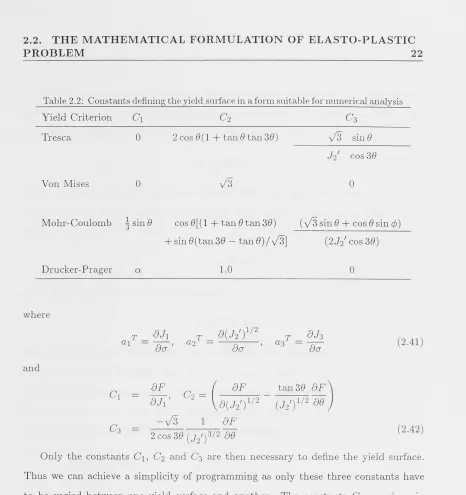
(2.42)Only the constants C1, C2 and C3 are then necessary to define the yield surface.
Thus we can achieve a simplicity of programming as only these three constants have
to be varied between one yield surface and another. The constants Ci are given in
Table 2.2 for the four yield criteria considered.
2.
·
2.5
Determination of Initial Yielding State
During the application of an increment of load an element, or part of an element,
may yield. All stress and strain quantities are monitored at each Gaussian integration
point and therefore we can determine whether or not plastic deformation has occurred
at such points. Consequently an element can behave partly elastically and partly
elasto-plastically if some, but not all, Gauss points indicate plastic yielding. For any
2.2. THE MATHEMATICAL FORMULATION
OF ELASTO-PLASTIC
PROBLEM
23
Within a particular load increment, the displacements increments 6.ur can be deter-mined by solving a linear system of equations. The strain increments at an integration point may be computed from the strain-displacement relations according to
L:l.Er
=
Bf:l.ur (2.43)where r denotes the rth iteration of current load step. Once the strains have been
determined, the elastic stress increments (i.e. the trial stress) may be calculated using
Hooke's law:
6.a/ = Df:l.cr (2.44)
and a trial stress state is obtained through
a/ = a·,·-l
+
6.a/ ( 2 .45)where the subscript e denotes that we are assuming elastic behaviour. The trial stress
aer is then tested in Equation 2.17. If F
<
0, then the elasticity assumption is taken tobe valid, and a er is considered as the new stress state. Otherwise, the strain increment
is partly in an elastic path and partly in a plastic path. In order to determine the
portion of the stress which cause purely plastic yielding, we need to find a scalar a such
that
F(ar,
H)
=
0where
ar
=
ar-1+
(1 - a)6.a/'A variety of schemes are available for determining scalar a. In [2], Sloan used a
Newton-Raphson iteration to compute a. It should be noted that performing iterations in the
integration scheme may lead to better results but the procedures often fails to converge.
In this thesis, a linear interpolation method is used. we rewrite Equation 2.17 in the
following form
F(a,H)
=
a- -
Y(H)=
0 (2.46)where
a-
and Y(H) denote the effective stress and the isotropic hardening function,this thesis, the hardening parameter is assumed to be related to some measure of the
plastic strains. So we can write
Y(H)
in the following form:Y(H)
=
Y(tp)
=
ay0+
H'
tp
(2.47)
where ay0 denotes the uniaxial yield stress. Then
a can be obtained by
F ( a
e1·,
yr-1)
a= -F(aer,
yr-1)
_
F(ar-1,yr-1)
a~ -
yr-1a~ - ar-1
(2.48)where yr-l
=
ay0+
H'
s;;-
1. After determining the portion of the stress incrementswhich cause purely plastic yielding, we must reduce the excess stress onto the yield
surface until yield criterion and the constitutive law are satisfied.
2.3
Integration Algorithms for Stress-Strain
Relations
Once the stresses at the onset of initial yielding have been computed, the integration
of stress-strain relations requires the solution of the initial value problem given by
da
dT
=
Depflc,TE [O, 1]
(2.49)in which ajT=O defines the stress state which already satisfy the yield criterion, and
ajT=l defines the stress at an end of load increment or iteration. Both the conventional
integration algorithm and a substepping scheme are studied in this research.
2.3.1
Conventional Method
The crudest method for solving the system of differential equations defined by 2.49 is
the Euler algorithm. Since the Euler scheme is accurate only for very small time steps,
it is always necessary to divide the whole integration process into a number of smaller
substeps. The conventional method is introduced in the following.
l. Enter with the stress ar-l and hardening modulus H', together with the
displace-ments incredisplace-ments for the current load step llur and the error tolerance TOL.
2. Compute the strain increment 6.cr and the trial stress increment lla/' using
2.3. INTEGRATION ALGORITHMS FOR STRESS-STRAIN
RELATIONS 25
3.
IfF(
ar-l)<
0
andF(
ar-l+
6.a /')>
0,
which means the Gauss point has yielded during application of load corresponding to this iteration as shown in Figure 2-5,compute the portion of 6.a / that cause purely plastic deformation (i.e. con1pute
the a factor as described in the section on initial yielding). If the point underwent
plastic yielding in the previous load step or iteration and F( ar-l
+
6.a /')>
0, theGauss point had yielded previously and the stress is still increasing. Therefore all
the stress must be reduced to the yield surface as indicated in Figure 2-4, then
set a= l.
4. Compute the portion of 6.a /' that causes plastic deformation according to 6.a e
=
aa / ' Then update the stresses at the onset of plastic yielding according to
CJ f--- CJr-1
+
(1 - a).6.aer.5. The remaining portion of stress, a.6.a; must be effectively eliminated in some way.
The point A (Figure 2-5) must be brought onto the yield surface by allowing
plastic deformation to occur. Physically this can be described as follows. On loading from point C, the stress point moves elastically until the yield surface is
met at B. Elastic behaviour beyond this point would result in a final stress state
defined by point A. However in order to satisfy the yield surface and consequently
the stress point can only traverse the surface until both equilibrium conditions
F=O t::..a / ::::: D D..f.r
D6./\a
=
D6.E/.<72 (J,·-1
\
~
~
~\
, . ( ~- ')
c/
-:::;..
(5 \_<7''
<71
<73