Copyright C) 1990,American Society for Microbiology
Human
Immunodeficiency Virus
Rev
Protein
Recognizes
a
Target
Sequence in Rev-Responsive Element RNA within the
Context
of RNA Secondary Structure
STEVEN M. HOLLAND,' NAFEES AHMAD,' RATAN K. MAITRA,' PAULWINGFIELD,2
ANDSUNDARARAJAN VENKATESANl*
Laboratory ofMolecularMicrobiology, National Institute ofAllergyandInfectious Diseases,' and
Protein Expression Laboratory, National Institutes of Health,2 Bethesda, Maryland20892 Received 24 May 1990/Accepted 23 August 1990
Human immunodeficiency virus type 1 Rev protein modulates the distribution of viral mRNAs from the
nucleus to the cytoplasm by interaction with a highly structured viral RNA sequence, the Rev-responsive element (RRE). To identify the minimal functional elements ofRRE, we evaluated mutant RREs for Rev
bindingin vitro and Rev responseinvivo in the context ofa Gag expression plasmid. The criticalfunctional
elementsfold intoastructurecomposed ofastem-loop A,formedbythe ends of theRRE, joinedtoabranched
stem-loop B/B1/B2, betweenbases49 and 113. The5' 132 nucleotides of RRE, RREDDE, whichpossesseda
similar structure, bound Rev efficiently but were nonfunctional in vivo, implying separate binding and functional domains within the RRE. Excision ofstem-loopAreduced Revbinding significantlyandabolished the invivo Revresponse.The B2 branch could beremoved withoutsevereimpairmentofbinding,but deletions intheBlbranch significantly reduced binding and function. However, deletionof 12nucleotides, includingthe 5' strand ofstemB, abolished both bindingandfunction,whileexcision of the 3' strand of stem Bonlyreduced
them. Maintenance ofthenativeRREsecondarystructurealonewasnotsufficientforRevrecognition. Many mutations that altered the primary structure of the critical region while preserving the original RNA conformationwereRevresponsive. However, mutations thatchangeda 5' . . CACUAUGGG . . 3' sequence inthe Bstem, withoutaffecting the overallstructureabolished boththe invitroRevbindingand the invivo Revresponse.
Human immunodeficiency virus type 1 (HIV-1) has at
least two novel genetic regulatory mechanisms which are mediated by the interactions of two conserved RNA ele-ments, the trans-acting-responsive (TAR) region and the Rev-responsive element (RRE), with the viral trans-activa-torproteins,Tatand Rev, respectively (5, 7, 12, 16, 19, 21, 27, 39). The 116-residue Rev protein, conserved in all HIV and simian immunodeficiency virus
isolates.
is a nuclear protein which is obligatory for the expession of viral struc-turalproteins (2, 13, 19, 38). The functional target of Rev isa 244-nucleotide (nt) mRNA sequence referred to as the RRE in the env open reading frame at the junction of the gpl20andgp4l domains.Inthe absenceofRev, transportof RRE-containingRNAsfromthenucleus to the cytoplasm is blocked; the RRE is either spliced out or the RNA is degraded (16, 17, 19, 21, 27). The RRE sequence is not highly conserved, and RREs from different primate immu-nodeficiency viruses can be functionally interchanged to a limited extent (25). The HIV-1 RRE can also be trans activated in a nonreciprocal manner by the Rex protein of the unrelated human retrovirus human T-cell lymphotropic virus type I (18, 22, 36).
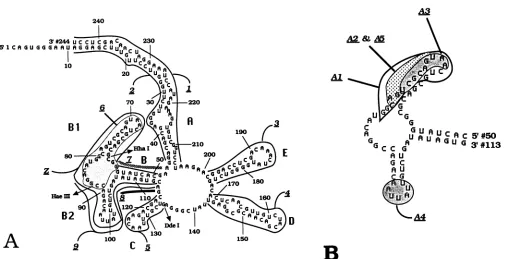
The Zuker RNA suboptimal folding program (41, 44, 45) predicts a preferred secondary structure for the RRE con-sisting offour distinct stem-loops (A, C, D, and E) and one branched stem-loop(B/B1/B2) surrounding a central single-strandedbubble (27) (Fig. 1A). Genetic and molecular stud-ies have identified distinct RNA-binding and functional domains within Rev (26). The RRE has been shown to bind
*Correspondingauthor.
directlytopurifiedRevexpressed in Escherichia coli(11,14, 43).Mutationalanalysesofthe RREhavesuggestedthat Rev function requiresthe presence ofa core elementcomposed of the 5' stem-loop A linked to the branched stem-loop B/B1/B2 (15,28, 33). It has furtherbeen suggestedthat the B/B1/B2branched stem-loopis necessary and sufficient for binding Rev in the absence ofother structures (28). These studies haveindicatedtheregion ofRRE-Revinteraction but have not clarified the primacy of RNA sequence versus structurefor theinteraction. In addition, thereis
disagree-mentabout the relative importance ofthe
Bi
or B2stem-loop forthe Rev response (15, 33).
RNA-protein interactions are fundamental to many bio-logical processes (6, 24, 29, 34). Studiesofthe rolesofthe primary and secondary structure of RNA in the Rev-RRE interaction may serve as aparadigm for biochemical mech-anisms related to mRNA splicingand transport. We report here that both the in vitro Rev binding and the biological response are dependent on the presence of at least one
sequence of 12 nt within an RNA secondary structural
context. These studies may help to define the critical
ele-mentsof Rev-RRE interactions and may facilitatestrategies
to interfere with HIV-1 replication.
MATERIALS ANDMETHODS
Purificationof HIV-1 Revexpressed in E. coli. HIV-1 Rev
was expressed in E. colifrom the thermally inducible coli-phage 1 PL promoter. The rev gene was constructed by fusingachemically synthesizedDNAfragment encodingthe first 30residuestoanAvaI-RsaIfragment(positions7970 to 8297 in the pNL432provirus [1]) which encodedthe C-ter-minal86 residues ofRev.Therevfragmentwasexchanged in
5966
on November 10, 2019 by guest
http://jvi.asm.org/
place of DNA encoding the Ner protein in plasmid pL-ner (4) to generate pL-Rev, which was used to transform E. coli MM294 (F- endAl hsdR hsdM supE44 thi-I X-). The Rev protein was recovered by urea extraction (4) and purified to homogeneity by successive column chromatographic proce-dures. Purity was checked by amino acid composition and automated N-terminal sequencing. The purified protein mi-grated as a single species of 16 kDa under denaturing conditions. At neutral pH, Rev oligomerized to a stable tetramer at a concentration of -1 mg/ml. Details of E. coli expression and biophysical studies will be described else-where.
Construction of RRE mutants. The 244-bp RRE sequence in the proviral plasmid pNL432 (positions 7749 to 7992) was amplified by the polymerase chain reaction (PCR) (30), using tagged DNA primers corresponding to the 20 nt at the 5' and 3' ends of the RRE, respectively. The primers were tagged with AspI-EcoRI-XhoI (5'-3') restriction sites. The PCR-amplified 292-bp RRE fragment was cloned into the lone AspI site of the HIV-1 Gag reporter plasmid, pRMK4 (see below). The cloned RRE fragment was further amplified with primer pairs corresponding to the ends of the RRE, except that the 5' primer was tagged with the bacteriophage T7 RNA polymerase promoter. The T7 promoter-tagged RRE fragment was used to synthesize T7 transcripts. The RRE mutants (Fig. 1) were generated by a two-step PCR amplifi-cation with mutant primer pairs. Initially, 5' and 3' half molecules extending from the mutated site were synthe-sized. In the second reaction, the mutated half molecules were reamplified with restriction site-tagged primer pairs corresponding to the ends of the mutant RREs. The mutant PCR fragments were inserted into the Gag reporter plasmid, pRMK4 (see below). The recombinants were verified by DNA sequencing. T7 promoter-tagged mutant RREs were then generated by PCR with a T7 promoter-tagged 5' primer. 3'-Truncated RRE DNA fragments weregenerated by PCR, using primers corresponding to the 3' ends of the respective truncations with T7 promoter-tagged 5' primers starting at the 5' end of the RRE. B/B1/B2 stem-loop RRE fragments were also generated by PCR except that the 5'fragment was tagged with a T7 promoter upstream of position 48 and the 3' fragment included a synthetic AluI site at position 116. The PCR fragments were cleaved with AluI and gel purified before T7 transcription.
In vitro RNA synthesis and structure determination. T7 promoter-tagged PCR-amplified RRE DNA fragments (0.5 pmol) were used as templates to generate unlabeled or uniformly labeled
([at-32P]UMP)
RRE transcripts by using a commercial kit from Promega Biotec (Milwaukee, Wis.). 5'-End-labeled RNAs were synthesized in a 25-,ul reaction mixture with[y-32PIGTP
(12.5 mM, 400 Ci/mmol) and 0.2 pmol of DNA template. For 3' end labeling, 1 pmol of the respective RRE RNAs was labeled with [32P]pCP (3',5'-cytidine bisphosphate; Amersham Corp.) with T4 RNA ligase according to themanufacturer(Pharmacia). All RNAs were purified by gel filtration on Sephadex G-100 columns. Purity was checked by electrophoresis on urea-acrylamide (10%) gels. Sequencing of the end-labeled RNAs with base-specific nucleases (RNase T1, U2, Phy M,Bacillius
cerelis) was done according to a commercial protocol (Pharmacia). The secondary structure of selected RRE RNAs was deter-mined by partial nucleasedigestions with the above enzymes and the double-strand-specific Vl RNase at neutral pH under native (0.2 M NaCl) or denatured (7 M urea) condi-tions. RNase digestion products were resolved by urea-acrylamide (8, 12, and 20%) sequencing gels.Nitrocellulose filter binding assay. Filter binding assays were done essentially by the method of Riggs et al. (35). Typically, 20 to 50 fmol of the labeled RRE RNAs was incubated at 25°C for 10 min in 10 ,ul of binding buffer (20 mM Trishydrochloride [pH 7.5], 0.05 M KCl, 1 mM dithio-threitol, 5 mM spermidine, 20 ,ug ofbovine serumalbumin, 1 ,ug of yeast tRNA) with increasing concentrations of purified Rev. The samples were filtered through prewetted 25-mm nitrocellulose filters (0.45-,m pore size; Schleicher & Schuell) at a flow rate of 5 ,lI/s. Filters were rinsed twice with 0.75 ml of binding buffer (without bovine serum albu-min, spermidine, or tRNA) and air dried, and the bound radioactivity was determined. From thesaturation curvesof RRE-Rev binding, the fractions offree andbound Rev were computed and used to determine the average
Kd
of the wild-type (wt)RRE-Rev interaction, which was on the order of -5 x10'
M. The RRE-Rev ratio at the saturation breakpoint was used to determine the stoichiometry of the reaction.RNA gel mobility retardation assay. Uniformly labeled RRE RNAs (0.2 to 0.5 pmol) were incubated for 10 min at
25°C with constant amounts of purified HIV-1 Revprotein in 10 plA of binding buffer as above except that 40
jig
of tRNA was used. Samples were electrophoresed through4% poly-acrylamide gels (cross-linked with 0.1% bisacrylamide)un-der native conditions in a buffer containing 16.5 mM Tris-borate (pH 8.3) and 0.4 mM EDTAfor 1 to 2 h at4°C at350 V. The radioactive bands were visualized bydry-gel autora-diography.
Transient expression assay. To measure the Rev response, we constructed a gag expression plasmid, pRMK4, by excising the sequence between the AspI sites at positions 3823 and 9003 of theinfectious proviral plasmid pNL4-3(1). AspI-cleaved PCR DNAscorresponding to thewtor mutant
RREs were then inserted between the above AspI sites of pRMK4. HeLa cell lines constitutively coexpressing HIV-1 Tat and Rev were generated by electroporating HIV long terminal repeat-linked Tat and Rev expression plasmids (3) with pRSV-Neo. Clones were selected for neomycin resis-tanceconferred by theexpressionof pRSV-Neo.
Neomycin-resistant cell lines were then evaluated for Rev expression by their ability to support virus production from a Rev-defective provirus (2). Individual gag plasmids (5 ,ug) werecoelectroporated with pHIV-Cat (2 pg) at250 Vinto thecell lines expressing both Tat and Rev (Bio-Rad). Cells were
harvested after 48 h and disrupted by three freeze-thaw cycles, and the extracts wereclarified bylow-speed centrif-ugation. gag expression was monitored by
immunoblotting
(40) and quantitated by p24 enzyme-linked immunosorbent assay (ELISA) of cell extracts and clarified culture fluid (CoulterDiagnostics). p24Ra' expressionlevels were normal-ized toconstant values ofchloramphenicolacetyltransferase activity expressed from HIVlongterminal repeat-linked cat(2, 20). None of the Rev-responsive RRE mutantsexhibited any disparity in the ratios of cell-associated and secreted Gag. Each value represented a mean from six or eight independenttransfections with multiple preparations of plas-mid DNA.
RESULTS
Construction of RRE mutants. The RRE RNA associated with the pNL4-3 HIV-1 virus differed from the HXB2 RRE at positions 106 (A-)G), 181 (C-4U), and 184
(G--A)
but folded into athermodynamically favored structuresimilartothat reported previously (27). Base-specific partial RNase
on November 10, 2019 by guest
http://jvi.asm.org/
S1CR GU GGG
A
A2& A5
Al
U AUU C A C #50
U GiU G #113
B
FIG. 1. Illustrations of theRRE structureanddeletions used in this study. Sequence coordinates for the deletions indicatedaregiven in Table 1. (A) Secondary structure prediction ofthe 244-nt RRE. The individual stem-loops are labeledA toE, respectively, and specific restriction endonuclease cleavage sites areindicated. Deletions RRE1 to RREZ, designedtodisrupt orexcise individual stem-loops, are indicated by the respective curves wrapping the RRE structure. Mutants that removed more than one stem-loop (e.g., RRE34 lacking stem-loops D and E)orexcisedstem-loopA(RRE12)aredescribed inthe text.(B) Branchedstem-loop B/B1/B2 (nt 50to113).Theenclosed areasindicatethedeletions made.
digestions ofthe RRE RNA were performed. We did not demonstrate the singly bulged bases C237, U233, A227, U222, A218, andA217inthe Astemand A78 in theBistem, and wedid find G220in anunpaired state. The remainderof thestructures, inparticular theB stem and theBi stem-loop, were confirmed under native conditions to be as predicted (datanotshown).
Mutations were engineered to specifically remove the individualstemsand/or loops (designatedA to EinFig.1A). Deletions RRE1 through RREZ, designed to excise or dis-rupttheindividual stem-loops,arealsoillustrated in Fig. 1A. Figure 1B shows the coordinates of deletions (RREA1 through RREA5) limited to the branched stem-loop, B/B1/ B2. Every mutant RRE used in this study was analyzed by thesuboptimalRNAfolding algorithm of Zuker(41, 44, 45). The structuresofselectedmutants wereadditionally verified byRNasedigestions. Mutant RRERNAswereevaluatedfor ribonucleoprotein (RNP) formation by gel mobility retarda-tion and filter
binding experiments.
Tocorrectlyevaluate the relativeaffinitiesof mutant RREs for Rev by gel retardation,wedeliberately chose Rev concentrations which gave >50% saturation ofwtRRE infilterbinding assays. Mutants were also transferred to agag reporter plasmidto measure their Revresponse in vivo.
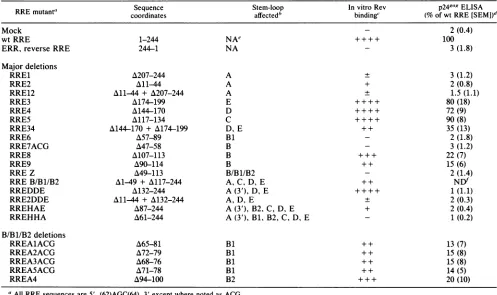
In vitro Rev binding and in vivo Rev response of major stem-loop deletions ofRRE. RRE mutants (RRE1 through RREZ;Fig. 1A) could be grouped into three setsaccording
toRevbindingresults: those that bound almost as well as wt RRE, those that did not bind, and a group exhibiting intermediatelevels of activity. Under the conditions used for binding, the wt RREtranscript bound Rev at a stoichiomet-ric ratio of 1:8 with an apparent
Kd,
of -5 x 10⁻⁹ M. Antisense RRE RNA (ERR) and HIV-1 TAR RNA wereused as negative controls. Under the conditions used for filterbinding, less than 10% of these two RNAswasbound by Rev even at a 200-fold molar excess (10 fmol of RNA versus2,000fmol of Rev).Removal ofstem-loopC, D, orE (RRE5, RRE4, RRE3) only resulted in marginal reduction in Rev RNP formationby filterbindingorgel retardation (Fig. 2A and B). Thesemutantsalsocompetedefficientlywithwt
RREfor Rev binding(data notshown). Rev-dependentgag expression from this group of mutant RRE plasmids was slightly less than that of wt RRE (Table 1). Although the
separate excision of the three 3' RRE loops was well tolerated, their combined excision (e.g., stem-loopsD and E,RRE34) resulted in greater than 50% reduction inbinding and in vivoresponse (Table 1).
In contrast tothe abovemutants,deletionsthat eliminated the entire branched stem-loop B/B1/B2 (RREZ), included the Bi branch (RRE6), or disrupted stem B (RRE7) were
severely impaired for in vitro Revbinding (Fig. 2A and B) and were not responsive to Rev in vivo (Table 1). These mutated RRE elements failed to compete with wtRRE for Revbindingeven at a20-foldmolarexcess(datanotshown). A third setof deletions wasintermediate in Rev binding. Deletions which excised the 3' strand ofstem B (RRE8) or
stem-loopB2and the 3' strandofstemB(RRE9)were-20%
asefficientas wtRRE in RNPformation(Fig.2A andB)and
in vivo Rev response(Table 1). Rev recognitionofmutants
that had lost either the 3' strand ofstem-loopA(RRE1)or
both strands of stem-loop A (RRE12) was more severely impairedand couldnotbe readilyvisualizedby gel retarda-tion(datanotshown). The mutant RRE2, which lacked the 5' strand ofstem-loop A, was better inthis regardandwas
abletocomplexwith Rev inagelretardation assay(Fig. 2B). When the RNP formation wasevaluated bya filterbinding
on November 10, 2019 by guest
http://jvi.asm.org/
[image:3.612.58.563.70.329.2]A
0
M
m
co
6P
0 400 800 1200
REV(fMOLs)
B
RRE WT 3 4 5 8 9
REV -+- + -+ - + - + -+
RRE WT 2 6 7 Z REV - +-+ -+ -+ -+
FIG. 2. RevbindingtomajorRREdeletionmutants. (A)Results offilterbindingassayswith the three classesof major RREdeletions describedin thetextand shown in Fig.1A.Fixedamounts(5 x10⁻⁹
M) of uniformly labeled mutant or wt RRE were incubated with increasing concentrations ofRevto obtain saturation breakpoints.
Eachpointwasdetermined in triplicate, and each mutantRREwas assayed three times. Each plot portrays the Rev binding
repre-sentative of the individual class. The members of each class are identified next to the respective plot symbol. Rev binding datafor the members in each class didnot vary bymore thanthe standard
deviation forany one member. (B) Results of gel shiftassays with mostofthe abovemutants. Forthisassay,0.5 pmolof eachmutant RREwasincubated with10pmol of Rev. Under these conditions,all the wt RRE was converted to RNP. Each mutant RNA was electrophoresed pairwise with (+) or without (-) Rev. The lane pairsareidentifiedatthetopby the namedmutants.
assay,all three stem-loopAmutants(RRE1, RRE2,RRE12)
were less efficient than RRE8 and RRE9 (Fig. 2A). Stem-loop A mutants RRE1 and RRE12 were also negative for
Rev-dependentgagexpression(seeFig.4). These gel retar-dation, filter binding and gag expression results suggested
that the minimal functional unit of RRE should include the stem-loop A andthe branched stem-loop B/B1/B2.
Rev response of deletions in Bi and B2 branches. To
identify the putative Rev recognition elementsin the Bi and
B2 branchesofstem-loop B, westudied the behavior offive
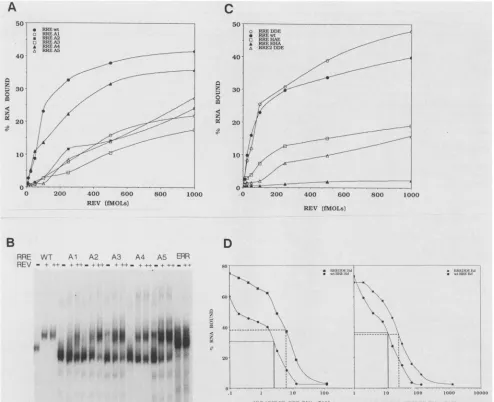
discrete deletions in these regions (Fig. 1B and Table 1). Excisionof thesmall loopattheend ofB2 (RREA4) reduced
in vitro filter binding only slightly (Fig. 3A). However, this RRE mutant shifted poorly in the gel retardation assay,
requiring moreRev thanwtRRE (Fig. 3B). Invivo,the Rev response ofa plasmid containing the RREA4 mutationwas
only 20% compared with wt (Table 1).
The Rev binding of the Bi stem-loop mutants (RREA1, RREA2, RREA3, and RREA5) was even more impaired;
they behaved like the intermediategroupofRRE mutantsin filter binding assays (Fig. 3A). Removal ofmost of the Bi
stem(RREA1) significantly reduced bindingasmonitoredby
gel retardation, requiring significantly more Rev than wt
RRE to effect only partial shift (Fig. 3B). Among the Bi
mutants, excision of the terminal loop(RREA3)had theleast effect in gel retardation assays (Fig. 3B). The tworemaining Bi deletion mutants (RREA2 and RREA5) shifted poorly at
low Rev concentrations; but ata twofold-higher
concentra-tion ofRev, someboundRev (Fig. 3B). gagexpressionfrom
all four Bi stem-loop lesions was significantly reduced
(Table 1).
Rev recognitionof3'-truncated RREs. Since stem-loopsC,
D, and E could be excised without severely affecting either binding or activation, we examined whether 3'-truncated
RREs which retained the branched stem-loop B/B1/B2were
Rev responsive. Three 3'-truncated RRE fragments were
studied: a 132-nt fragment, RREDDE (extending up to the DdeI site at position 132 of RRE); an 89-nt fragment,
RREHAE (shortened to the HaeIII site); and a 58-nt
frag-ment, RREHHA (trimmed to the HhaI site; Fig. 1A). The 132-nt RREDDE RNAwaspredicted tofold intoastructure
that preserved the branched stem-loop B/B1/B2 and
stem-loop C ofwtRREbutwithamodified branched stemA.The modified branched stem A consisted of two hairpin
struc-turesformed between nt1and 49of the RRE. The distal (3') hairpin ofthe RREDDE branched stem A was immediately
adjacent to the B/B1/B2 stem-loop, forming a structure
similarto wtRRE. RREDDEbound Revas wellaswt RRE in filter binding (Fig. 3C) and gel retardation (data not
shown)assays. In RNAcompetition experiments, RREDDE
exhibited four times moreaffinity for Rev thanwtRRE(Fig. 3D). RREHAE RNA, which folded into a structure lacking the B2 branch of the B/B1/B2 stem-loop, bound Rev less efficiently (Fig. 3C). The 58-nt RREHHA RNA structure lacked the B/B1/B2 stem-loop and was not recognized by
Rev (Fig. 3C). Rev binding ofRREDDE was reduced when
a 34-nt deletion, equivalent to the RRE2 deletion (Fig. 1), excisedthe modified stem-loopA (RRE2DDE, Fig. 3C). Rev also bound the
B/B1/B2
stem-loop RNA (seebelow)but withalower affinity than that forRREDDE. Although RREDDE
interacted with Rev by severalcriteriain vitro, gag reporter plasmids containing RREDDE were consistently
unrespon-sive toRev in transfection assays (Table 1).
Rev recognition of structure-disrupting and structure-pre-serving base substitutions in B/B1/B2 stem-loops. The above experiments localized the stem-loops B/B1/B2as the critical
subdomain required for in vitro Rev binding. Therefore, we analyzed theeffectsof base substitutionswithin this domain ofthe RRE RNA using the mutants described in Table 2.
Uncompensated mutations that altered the sequences of
stem B (RRE J23ACG, RRE X23ACG, and RRE C41) or
stem-loop B2 (RRE D23 and RRE Z23) disrupted the
pre-dicted RRE structure in the respective regions. However,
mutations that altered the 5' GGG 3' sequencebeyond the 5' strand ofstem B (RRE 3G3C andRRE3G3U) had no effect on the predicted folding in this region. Base
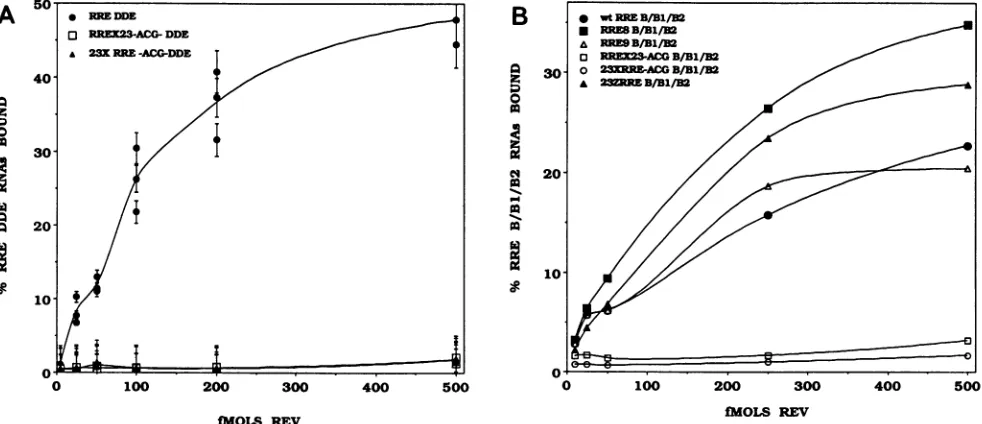
substitu-tions in the B2 stem (RRE D23 and RRE Z23) resulted in modest decreases in the in vitro Rev binding (Fig. 4A) but RR];4,
RRKE:3.4.5!j RRE:6,7,Z
80t A RRF8,9
RREIA2.12
~-!
*
60
40-1
/ rA
20A
A7-l
on November 10, 2019 by guest
http://jvi.asm.org/
[image:4.612.58.298.76.437.2]TABLE 1. In vitro and in vivoactivityof RREdeletions
RRE mutant' Sequence Stem-loop In vitro Rev
p245a5
ELISARRE
mutant"
coordinatesaffected'
binding' (% ofwtRRE[SEMI)d
Mock 2(0.4)
wtRRE 1-244 NAe ++++ 100
ERR, reverseRRE 244-1 NA 3(1.8)
Major deletions
RRE1 A207-244 A + 3(1.2)
RRE2 All-44 A + 2(0.8)
RRE12 A11-44 + A207-244 A + 1.5(1.1)
RRE3 A174-199 E ++ + + 80(18)
RRE4 A144-170 D ++++ 72(9)
RRE5 A117-134 C ++++ 90(8)
RRE34 A144-170 + A174-199 D,E + + 35(13)
RRE6 A57-89 B1 2(1.8)
RRE7ACG A47-58 B 3 (1.2)
RRE8 A107-113 B +++ 22(7)
RRE9 A90-114 B ++ 15(6)
RRE Z M49-113 B/B1/B2 2(1.4)
RREB/B1/B2 A1-49 + A117-244 A,C, D,E ++ NDf
RREDDE A132-244 A(3'), D, E ++++ 1(1.1)
RRE2DDE Al11-4 + A132-244 A, D, E + 2(0.3)
RREHAE A87-244 A(3'), B2. C,D, E + 2(0.4)
RREHHA A61-244 A (3'),Bi, B2,C, D, E - 1(0.2)
B/B1/B2 deletions
RREAlACG A65-81 B1 ++ 13(7)
RREA2ACG A72-79 B1 ++ 15(8)
RREA3ACG A68-76 B1 ++ 15(8)
RREA5ACG A71-78 B1 ++ 14(5)
RREA4 A94-100 B2 + + + 20 (10)
UAllRREsequences are 5'..(62)AGC(64)..3' except where noted as ACG.
b The stem-loops of the RRE structure (Fig. 1) disrupted by the deletions are identified.
The results of RRERNA filter binding and gel mobility shifts are symbolically denoted from- (nobinding) to++ + + (wtbinding).
d The normalized
p24TM"M
ELISA values represent averages from six oreight experiments with the standard error of the mean shown in parentheses. e NA, Not applicable.fND,Notdone.
markedreductionsin thein vivoRev response
(Table 2).
In contrast, mutations thataltered the sixbases ofstemB(RRE
J23ACG,
RREX23ACG,
and RREC41)
or the three G residues atpositions
56 to 58(3G3U)
resulted incomplete
loss of in vitro Revbinding (Fig.
4)
and Rev response in transfections(Table
2).
It is of interest that the 9-base sequence 5' . CACUAUGGG . 3' altered in the stem Bmutantsformsa subset ofthe 12ntdeleted in
RRE7,
whichwas also
unresponsive
to Rev both in vitro and in vivo. Because the sequence ofthe RREBi
region
is somewhatheterogeneous
in the 5' . .(56)GGGCGCAGC(64)
. . 3' tract, with the 3' AGC(underlined) replaced by
ACG insome
isolates,
we constructed several mutants with either AGCorACG in thisposition
(Tables
1 and2;
allconstructsare AGC except where
noted).
Changes
in this site could influencestem-loop Bi
structureortheunpaired
conditions oftheguanine
residues atpositions
57 and 58.Toevaluatethe roleof
primary
versussecondary
structureoftheB/B1/B2
stem-loops,
weintroducedbasesubstitutions into both strands of therespective
stems such that thesecondary
structure waspreserved.
The location andcom-position
ofthese mutants aregiven
in Table 2. Inthe 23X RREmutants, thetwostrands ofwt stemBwereexchanged,
while in the 23JRRE mutants, the strands wereexchanged
andinverted. In41C
RRE,
a5'. . CCCGGG . .3'SmaI
site anditscomplement
were substitutedfor thewtsequenceofstemB.Thetwostrandsofthe
Bi
stem werealsoexchanged
and inverted with respect to each other to generate the compensatory mutant 23B RRE.Structure-compensated
stemB2 mutants included inversion of the 5' and 3' strands as in 23Z RRE and substitution of a base-paired 5'
. . CCGC . . 3' sequence in 23D RRE (Table 2). The
pre-dictedstructuresof 23D RRE and 23Z RREwereverified by nuclease analysis to correspond to the wt RRE structure.
The compensatorymutants wereevaluated for in vitro Rev binding and Rev-dependent gag expression in vivo. All the stem B compensatory mutants, 23J RREACG, 23J RREAGC, 23X RREACG, 23X RREAGC, and 41C RRE, lostin vitro Rev binding (Fig. 4) and in vivo Revresponse (Table 2). In contrast, structure-preserving mutations of
stem B2 (23D RRE and 23Z RRE) were indistinguishable fromwt RRE inbinding studies (Fig.4B). In transfections, 23Z RRE was consistently better than wt RRE in Rev response, while23D RREwassomewhat less(Table 2).The structure-compensated Bi stem mutant, 23B RRE, had intermediatelevelsof Revbinding(Fig. 4B) andmoderately reduced in vivo Rev response(Table 2).
The abovestudiessuggestedthattheprimarystructureof theBstemwascrucial forRevrecognition. However, itwas
possible that the changes in the B stem destabilized the overallsecondarystructureofRREand causedalossof Rev binding. To examine this possibility, we evaluated theRev
bindingof DdeIfragments correspondingtothe 5' 132 ntof wt, RREX23ACG, and 23X RREACG RNAs. Neither the uncompensated 6-nt substitution (RRE X23DDE) nor the compensated substitution (23X RREDDE) was recognized byRevinvitro,underconditions inwhichwtRREDDE was readilybound(Fig.5A). We thenexaminedtheRev-binding
on November 10, 2019 by guest
http://jvi.asm.org/
A
0 0
C
lz
:D
0 02
ae
1000
REV (fMOLs)
REV (fMOLs)
B
RRE WT Al A2 A3 A4 A5 ERR
REV - +4i-- + --+ +-- + + +
i
I
II
r
.1 1
D
.a
,I
I,
":
...1.lt ...t.l l)---*-s}Vt :iZ
t__*~~~~~~~i
I0 I
FIG. 3. Rev binding of the branched stem-loop deletions and the 3'-truncated RRE RNAs. (A and C) Filterbinding results obtained with the branchedstem-loop deletions and the 3'truncations, respectively. The mutants used in each experimentareidentified in therespective panel. The conditionsweresimilartothosedescribed in the legendtoFig. 2, except that lower concentrations of Revwereusedtoevaluate therelative affinities of different mutants. (B) Gel shift assay of themutant RREsshown inpanelA. A0.5-pmol sample of the respective mutantRREs wasanalyzedwithout (-)orwith (+ [10 pmol] or ++ [20pmol]) Rev. (D) Results ofcompetitive inhibition ofwtRRE-Rev binding by RREDDE and viceversaanalyzed by filter binding.Ineach case,40 to 50fmol oftherespectivelabeledRNA wasincubated with 0.5pmolof Rev and the indicatedamounts of the cold competitorRNAs.
potential of isolated B/B1/B2 stem-loop RNAs synthesized fromwtand selectedmutant RRE templates (Fig. SB). The B2-compensatedmutant 23Z RRE B/B1/B2boundRev
bet-terthan the wtfragment. B/B1/B2 stem-loop RNAs of two RRE deletions that hadeither lost the 3' strand ofstem B (RRE8)orlostthe3'strand ofstemBand the entirestemB2 (RRE9) alsoboundRev better than wtRRE. However, the B/B1/B2RNAscarryingthe X23 and 23XstemBmutations remained negative in this assay (Fig. 5B).
DISCUSSION
Our studies show that Rev binding tothe RRE RNA isa
prerequisite forRevfunctionand that a minimalunit ofthe RRE composed ofthe branchedstem-loop B/B1/B2is suffi-cient forRev
binding.
Although this isessentially inagree-ment with other reports (15, 28, 33), some of ourfindings
differ. Zapp and Green (43) were unable to demonstrate RNase protection after
binding
of Rev to an RRE RNA truncated at the DdeI site. Although we were able todemonstrate RREDDE protection from RNase T1 degrada-tion in the presence ofRev (data not shown), we did not
attemptthis
experiment
with theaddition of RNaseAasdid Zapp and Green (43). Dayton et al. (15) suggested that sequence-specific binding information was most likely toreside in stem-loops B2 and A. We and others (28) have shown thatbinding is influenced bybutnotdependentonthe Astem.The B2stem-loopappearstobedispensable forboth binding and biological function, as shown by our mutants
RRE8 and RRE9 andby Olsenetal. (33).
Specific recognitionofnt50to58 representsacritical step in RRE-Rev RNPformation. Filter
binding
analysis
allowedus toevaluate the relativeaffinitiesof Revforwtandmutant
on November 10, 2019 by guest
http://jvi.asm.org/
[image:6.612.62.556.77.479.2]TABLE 2. In vitro and in vivoactivityof RRE mutants
RREconstruct" Relevantsequence" In vitro Rev
p24%
o awELISA
M)d
binding" (% ofwtRRE[SEMI)
Reverse RRE
50 66
CACUAUGGGCGCAGCGU GUGAUG.... GUCGCA
113 108 77 72
2(0.4)
2(1.5)
100
Stem-loop Band Bi mutations RREC41
RREJ23ACG RREX23ACG 41C RRE 23J RREACG 23J RRE 23XRREACG 23X RRE RRE3G3C RRE3G3U 23B RRE
Stem-loopB2mutations wt RRE
RRED23 RRE Z23 23DRRE 23ZRRE
CCCGGGGGGCGCAGCGU GUGAUA.... GUCGCA
AUAGUGGGGCGCACGGU GUGAUA.... GUCGCA
GUGAUAGGGCGCACGGU GUGAUA.... GUCGCA
CCCGGGGGGCGCAGCGU GGGCCC.... GUCGCA
AUAGUGGGGCGCACGGU UAUCAC.... GUCGCA
AUAGUGGGGCGCAGCGU UAUCAC.... GUCGCA
GUGAUAGGGCGCACGGU CACUAU.... GUCGCA
GUGAUAGGGCGCAGCGU CACUAU.... GUCGCA
CACUAUCCCCGCAGCGU GUGAUA.... GUCGCA
CACUAUUUUCGCAGCGU GUGAUA.... GUCGCA
CACUAUGGGCGCACGCUG GUGAUA... UGCGAC
89 CAGACA 94 104 GUCUGU 101
CCCGCA GUCUGU CUCUGA GUCUGU CCCGCA GGGCGU CUCUGA GAGACU
aAll RREsequences are5'..(62)AGC(64)..3'exceptwhere notedasACG.
bThenumberedsequence acrossfromwtRREdenotesthe RREsubsequencethatwasmutated. Themutantbasesareunderlined. The dots denoteunpaired
regions.
c Theresultsof RRE RNAfilter binding and gelmobility shiftsaresymbolically denoted from-(nobinding)to+ + + +(wtbinding).
dThe normalized p245"" ELISA valuesrepresentaveragesfrom sixoreight experimentswith thestandarderrorofthemeanshowninparentheses. eND,Not done.
RREs and to examine the importance ofstructure versus sequence for this reaction. In general, there was a good correlation between in vitro Rev binding and biological
response among the RREmutants. However, the 5' 132-nt
RREfragment(RREDDE) bound Rev moreavidly than the wtRREbut didnotfunction in vivo. RREDDE folded intoa structure similartothatofabiologically active mutant that had lostthe3' stem-loops C, D, andE(15,28, 33)exceptfor
amodified stemA, consisting of hairpin structures immedi-ately 5' to the B/B1/B2 branched stem-loop. When the modified stem A was excised from RREDDE, Revbinding was significantly reduced. Therefore, the presence ofstem
A, even in a modified form as in RREDDE, appears to
enhance the Rev binding of the branched stem-loop B/B1/
B2. The importance ofstemA in RRE bindingwas further
demonstrated by comparison of RREDDE with RRE1. RREDDE had better Rev-binding characteristics than wt
RRE, whereas RRE1, a 3' truncation of RRE at base 206,
had only trivial Rev binding. RRE1 has lost the central
bubble, andasaconsequence,thenearest hairpinstructure instemAbegins16nt5' tothe B/B1/B2branchedstem-loop.
Since the B/B1/B2 structure alone is capable ofbinding,
theremust besomefeature of the RRE1 structure which is unstableorinhibitory. Theinabilityof RREDDEtofunction in vivo implied separate binding and activation domains
within the RRE. Since Rev function may require spliceo-some formation (9), the missing component(s) of the Rev-RRE functional unit may be small nuclear RNPs or other host nuclear factors. RREDDE RNA may lack the target
sequences for these putative factors, or they may not be
correctly exposedaftercomplexation with Rev.
Althoughthe RREcoredomaincomposedofB/B1/B2was necessary and sufficientto elicit in vitro Revrecognition, it has been difficult to deduce the contribution of sequence
Mock ERR wtRRE
+
+
2(1.2)
3(1.4) 2(1.4) 6(3) 3(1.2) 7(2.2) 3(1.2) 3(1.5) 5(3)
5(3)
25(9) NDe
++
100 27(10) 18 (7) 67(11) 140(20)
on November 10, 2019 by guest
http://jvi.asm.org/
[image:7.612.68.555.87.495.2]A
0 0
B
0
fMOLS REV fMOLS REV
FIG. 4. Filter binding assay of uncompensated, structure-disrupting substitution mutants (A) and compensated, structure-preserving
mutants(B)in the B/B1/B2 stem-loop.Theconditionsaresimilartothosedescribed in thelegendtoFig. 3,and thevaluesrepresent averages from threeexperiments. The specific bases substitutedareshown inTable2.
elements in the Bi and B2 stem-loops (15, 28, 33). Fine-structure deletion mapping of
Bi
and B2 stem-loops gave ambiguousresults. Adeletionmutant(RRE9,positions90 to 114) thatremoved theB2stem-loop andthe 3' strandofstem B did not eliminate Rev binding or in vivo Rev response. Excision of the loop at the end of B2 (RREA4) only marginally affected filter bindingtoRev,although it reduced the in vivo response significantly. Therefore, the B2 stem-loop may not play a critical role in the initial steps ofRev binding but may stabilize the RNP once it is formed and augment the in vivo Rev response. In contrast, theBi
stem-loop appears to contain important recognition se-quences. TheRRE6deletionmutant, whichremovedstem-A 50 * IR DDE
o RREX23-ACG-DDE
23XRRE-ACG-DDE
40-0
30-0
20--e
0 100 200 300 400 500
fMOLS REV
loopB1, lost the Rev response. Somewhatsmallerdeletions which disrupted the predicted
Bi
stem (RREA1, RREA2, RREA3, and RREA5) markedly reduced but did not elimi-nate Rev binding. The lack ofacompletelynegative pheno-type ofthe structure-disrupting Bi stem-loop mutants sug-gests that this region is notrecognized exclusively on the basisofsecondary structure, atleast in vitro.In contrast to the above mutants, a 12-nt deletion ofthe main stem B (RRE7,
positions
47 to 58) gave anegative
phenotype. The sequencesabsent in thismutant(residues49 to56) normallybasepairwith thesequences 107 to113 inthe wt RRE. However, removalofsequences 107 to 113(RRE8) preserved the Rev bindingand the in vivoresponse, and aB
. tRR B/B1/B2* RREB/B1/B2
a RRE9B/B1/B2
o 2R.RE-ACGB/B1/B2
Z 30 A ZIZ3R.IEB/B1/B2 __
0 0
CN
20-
10-fMOLS REV
FIG. 5. Filterbinding assaysof 3'-truncated mutant RREs(A)andB/B1/B2stem-loopRNAs(B)derivedfrom severalmutantRREs.The mutantsused are identified in eachpanel. Conditions for in vitro Revbindingaresimilartothosedescribedin thelegendtoFig.3.
on November 10, 2019 by guest
http://jvi.asm.org/
[image:8.612.67.557.77.297.2] [image:8.612.67.558.491.703.2]largerdeletion mutant(RRE9, positions 90to 114) also did notlose the Rev response.Interestingly, RRE7, RRE8, and RRE9folded into differentstructures,each of which lacked the B/B1/B2 stem-loop arrangement. Moreover, truncated RNAscorrespondingto thecore B/B1/B2 domains of RRE8 and RRE9 mutants bound Rev efficiently,
although
these core domains hadmarkedly
differentstructuresfrom the wtcounterpart.The differentialRev responseof
RRE7, RRE8,
and RRE9 mutantsled us tosuspect that the nucleotides47 to 58 lost in the RRE7 deletion may represent theprimary
structural motif for Revrecognition. Indeed,
the 12 ntbetween nt 47and 58 may not even haveto be
partly
base paired for Rev binding. For instance, the 89-nt RREHAE RNA bound Rev, albeit inefficiently,despite lacking
the downstreamsequence that could have basepaired
with the bases49 to 56(Fig. 1A). Further, the verified structuresfor theRev-responsive RRE8 andRRE9mutantsshowedthe 12 ntbetween 47 and 58 tobe unpaired.Previous
analysis
of the stem-loops A,Bi,
and B2 has shownthatbasechanges inthese regions aretolerated, ifthe individual stem-loopsarepreserved.Forinstance, structure-preserving mutations in the A andB2 stemsresulted ina wtphenotype (15, 28, 33). Our compensatory mutants, 23D RRE and 23Z RRE, lay in the B2 stem and behaved similarly. Structural disruption of the B2 stem caused
by
mutating only the 5' strand (RRE D23 and RRE Z23) ledtoonly a modest decrease in Rev
binding
and in vivo Rev response. Mutations in theBi
stem which left the base pairing intact (23B RRE) reducedbutdidnotabolishthe Rev recognition. Therefore, the argumentthat therecognition of the RRE ofHIV and its close relatives byRev and human T-cell lymphotropic virus type I Rex isdependent
on the secondary ratherthan theprimary
structureofRNAseemed plausible. However, we identified asequence-specific
Rev interaction in the B stemofRRE. Threemutants (23J RRE, 23X RRE, and 41C RRE) that altered the 6bp
of stem B(nucleotides
50 to 55 and108to113)whilepreserving
thewtsecondary structurewere
unresponsive
toRev both in vitro and in vivo. These effects of the 23X and X23 mutations carried down to the DdeI and the B/B1/B2fragments.
The Rev recognition sequence probably includes the three G residues beyondthe 5' .(50)CACUAU(55)
. . 3' sequence sincemutation of thethreeGs toUUUorCCC(RRE
3G3U and RRE3G3C)
abolishedbinding
andbiological
response although thepredicted secondary
structure wasidentical tothat ofthe wt RRE. Twoofthe 3' Gs inthis
region
are in abulge sequence, and these bulged G residues may have a
protein-binding role analogoustotherolesenvisioned forthe bulged A residues in the RNA
bacteriophage
translational operators (37, 42) and the5, 16, and 23S rRNAs(10, 32).Recently, Rev binding has been shown to
specifically
shield a 33-nt RRE RNAfragment,
including
nt 47 to58,
from nucleasedigestion(23). In this region ofRRE, a 12-nt 5' . . CACUAUGGGCGC . . 3'sequenceis conservedin all HIV-1 isolates except for the substitution of G for U at position4.Althoughthis may reflect the strong codon bias in thisregionof the envopen readingframe inHIV-1,asimilar but somewhat degenerate 5' . . (U/G)GC(A/G)AUGGG . .3' sequence isalsofound in the RREsofHIV-2 andsimian immunodeficiencyvirusisolates, which use a different codon schemein this region. Computer-predicted RNAfolding of all HIV-1 RREs showed the 5' . . CACUAUG . . 3'
se-quence to be base paired to an equally conserved 3'
. . GUGAUAU . . 5' sequence atpositions 113 to 107. The
latter sequence is also conserved in the HIV-2 and simian
immunodeficiency
virus RREs, which are responsive toHIV-1 Rev. Unlike
HIV-1,
the abovetwo7-nt elementsarenot base
paired
with each other in the HIV-2 or simianimmunodeficiency
virusRREs.Therefore,
it islikely
that aprimary
structure motifbetween nt 47and 58ofthe HIV-1 RRErepresentsanoptimal
contactpoint
forRevwithin thecontext of the
B/B1/B2
stem-loop.
The exact sequencerequirements
for Revrecognition
must,however,
awaitbinding
studies with shortoligonucleotides
and exhaustive mutationalanalysis.
While it is
possible
that similarsequence-specific
interac-tions occur in otherregions
ofthe minimalRRE structuralmotif,
nonehavesofarbeendiscovered.Sequences
located instem-loops
AandBi
may be somewhatdegenerate
andnotbe
readily
identifiedby
in vitro studies but couldplay
crucial roles in vivo.
Alternatively, stem-loops
A,
Bi,
and B2maysimply
provide
thesecondary
structuralcontextforoptimal
Revrecognition
both in vitro and in vivo.There issome
precedence
for thecontext-sensitive
stabilization ofRNA-protein
interactions.The R17coatprotein recognition
of the
bulged
A residue and theloop
sequence 5'. . AUUA. . 3' in its target RNA was
stringent
for therequirement
of a stem structure(8,
37,
42).
On the otherhand,
although
U2 snRNPcan bind its target 5' . . CACC AAC. .3'sequencenearthesplice junction
branchpoint
outof thenatural RNA context,the
magnitude
ofthisinteractionwasenhanced when thesamesequencewas
presented
in thecontextofanauthentic intron
(31).
ACKNOWLEDGMENTS
We thank Charles E. Buckler forhelpin computeranalysisand Alicia Buckler-White foroligonucleotidesynthesis. Wearegrateful
toRobertJernigan, LaboratoryofMathematicalBiology,National Cancer Institute, and Samuel Wilson, Laboratory of Molecular
Genetics, National Cancer Institute,for many stimulating discus-sions.WealsothankBenjaminBerkhout and MalcolmA.Martin for
critically reviewingthe manuscript.
This workwassupportedin partbytheIntramural AIDSTargeted
Anti-Viral Program administered by the Office of the Director,
National Institutes of Health.
LITERATURECITED
1. Adachi, A.,H. E.Gendelman,S.Koenig,T.Folks,R.Willey,A.
Rabson,and M. A.Martin. 1986.Productionofacquired
immu-nodeficiency syndrome-associatedretrovirus inhumanand
non-human cells transfected withaninfectious molecular clone. J. Virol.59:284-291.
2. Ahmad,N.,R. K.Maitra,andS. Venkatesan. 1989.HIV-1 Rev induced modulation of Nefprotein underlies temporal
regula-tion of viralreplication. Proc. Natl. Acad. Sci. USA 86:6111-6115.
3. Ahmad, N.,andS. Venkatesan. 1988. NefproteinofHIV-1is a
transcriptional repressor of HIV-1 LTR. Science 241:1481-1485.
4. Allet, B.,M.Payton,R.J.Mattaliano,A. M.Gronenborn,G. M.
Clore,and P. T. Wingfield. 1988. Purification and characteriza-tion oftheDNA-binding proteinNerofbacteriophageMu.Gene 65:259-268.
5. Arya, S. K., C. Guo, S. F. Josephs, and F. Wong-Staal. 1985. Trans-activator gene ofhuman T-lymphotropic virus type III
(HTLV-III).Science 229:69-73.
6. Bandziulis,R. J.,M.S. Swanson,andG.Dreyfuss. 1989. RNA
binding proteinsasdevelopmental regulators.GeneDev. 3:431-437.
7. Berkhout, B., R. Silverman, andK.-T.Jeang. 1989. Tat
trans-activates human immunodeficiency virus through a nascent
RNAtarget. Cell 57:273-282.
8. Carey, J.,V. Cameron,P. L. deHasseth,and0.C. Uhlenbeck. 1983.Sequence specificinteraction ofR17coatproteinwith its ribonucleicacidbindingsite.Biochemistry22:2601-2610.
on November 10, 2019 by guest
http://jvi.asm.org/
9. Chang, D. D., and P. A. Sharp. 1989. Regulationby HIV Rev depends uponrecognition of splice sites. Cell 59:789-795. 10. Christiansen, J., S. R. Douthwaite, A. Christiansen, and R. A.
Garrett. 1985. Does unpaired adenosine-66 from helix II of Escherichia coli SS RNA bind to protein L18? EMBO J. 4:1019-1024.
11. Cochrane, A. W., C.-H. Chen, and C. A. Rosen. 1990. Specific interaction ofthe human immunodeficiency virus Rev protein with a structured region in the env mRNA. Proc. Natl. Acad. Sci. USA 87:1198-1202.
12. Cullen, B. R. 1986. Trans-activation of human immunodefi-ciency virus occursviaabimodalmechanism. Cell46:973-982. 13. Cullen, B. R., J. Hauber, K. Campbell, J. G. Sodroski, W. A. Haseltine, and C. A. Rosen. 1988.Subcellular localizationof the humanimmunodeficiency virus trans-actingrev geneproduct.J. Virol.62:2498-2501.
14. Daly, T. J., K.S. Cook, G. S. Gray, T. E. Maione, and J. R. Rusche. 1989. Specific binding of HIV-1 recombinant Rev proteintotheRev-responsive elementinvitro.Nature(London) 342:816-819.
15. Dayton, E. T., D. M. Powell, and A. I. Dayton.1989.Functional analysis of CAR, the target sequence for the Rev protein of HIV-1. Science 246:1625-1629.
16. Emerman, M., R. Vazeur, and K. Peden. 1989. The rev gene productof the human immunodeficiency virus affects envelope-specific RNA localization. Cell 57:1155-1165.
17. Feinberg, M. A., R. F. Jarrett, A.Aldovini,R. C. Gallo, and F. Wong-Staal.1986. HTLVIIIexpressionandproduction involve complexregulation at the levels ofsplicing and translation of viralRNA.Cell46:807-817.
18. Felber, B. K. 1989. Cross-activation of the Rex proteins of HTLV-1 and BLV and of the REV protein of HIV-1 and non-reciprocal interactions with their RNA responsive ele-ments.New Biologist 1:318-330.
19. Felber, B. K., M.Hadzopoulou-Cladaras, C.Cladaras,A. Atha-nassopoulos, A. Tse, and G. N. Pavlakis. 1989. Revproteinof human immunodeficiencyvirustype 1affects the stability and transport of the viral mRNA. Proc. Natl. Acad. Sci. USA 86:1495-1499.
20. Gorman, C. M., L. F. Moffat, and B. H. Howard. 1982. Recombinant genomes whichexpress chloramphenicol acetyl-transferase in mammalian cells. Mol. Cell. Biol.2:1044-1051. 21. Hadzopoulou-Cladaras, M., B. K.Felber,C.Cladaras, A.
Atha-nassopoulos, A. Tse, and G. N.Pavlakis. 1989.Therev(trslart) protein of human immunodeficiency virus type 1 affects viral mRNAandprotein expression viaacis-actingsequence in the envregion. J. Virol. 63:1265-1274.
22. Hanly,S.M.,L. T.Rimsky, M. H.Malim, J.H.Kim,J. Hauber, M. DucDodon,S.-Y.Le, J.V.Maizel,B. R.Cullen,and W. C. Greene. 1989. Comparative analysis of the HTLV-I Rex and HIV-1 Revtrans-regulatory proteins andtheir RNA response elements. GenesDev.3:1534-1544.
23. Heaphy,S., C. Dingwall,I.Ernberg, M. J.Gait,S. M.Green, J. Karn, A. D. Lowe, M.Singh, and M. A. Skinner. 1990. HIV-1 regulator of virion expression (Rev) bindstoanRNAstem-loop structure located in the Rev response element region. Cell 60:685-693.
24. Lazinski, D., E. Grzadzielska, and A. Das. 1989.
Sequence-specific recognitionofRNAhairpins by bacteriophage antiter-minationrequiresaconservedarginine-rich motif. Cell 59:207-218.
25. Malim,M.H., S. Bohnlein, R.Fenrick, S.-Y.Le,J.V. Maizel, and B. R. Cullen. 1989. Functional comparison of the Rev trans-activators encodedby differentprimate immunodeficiency
virusspecies. Proc. Natl.Acad.Sci. USA 86:8222-8226. 26. Malim, M. H.,S. Bohnlein, J. Hauber, and B. R. Cullen. 1989.
Functional dissection ofthe HIV-1 Rev trans-activator--deri-vation of a trans-dominant repressor of Rev function. Cell 58:205-214.
27. Malim, M. H., J. Hauber, S.-Y. Le, J. V. Maizel, and B. R. Cullen. 1989. The HIV-1 rev trans-activator acts through a structured target sequence to activate nuclear export of un-spliced viral mRNA. Nature(London)338:254-257.
28. Malim, M. H., L. S. Tiley, D. F. McCarn, J. R. Rusche, J. Hauber, and B. R. Cullen. 1990. HIV-1 structural gene expres-sion requires binding of the Rev trans-activator to its RNA targetsequence. Cell60:675-683.
29. Mattaj, I. W. 1989. A binding consensus: RNA-protein interac-tionsin splicing,snRNPs, and sex. Cell 57:1-3.
30. Mullis, K. B., and F. A. Faloona. 1987. Specific synthesis of DNAinvitro viaapolymerase-catalyzedchainreaction. Meth-odsEnzymol. 255:335-350.
31. Nelson, K. K., and M. R. Green. 1989. MammalianU2 snRNP has a sequence-specific RNA-binding activity. Genes Dev. 3:1562-1571.
32. Noller, H. 1984. Structure of ribosomal RNA. Annu. Rev. Biochem. 53:119-162.
33. Olsen,H. S., P. Nelbrook, A. W. Cochrane, andC. A. Rosen. 1990.Secondary structureisthemajor determinant for interac-tion of HIV revprotein withRNA. Science 247:845-848. 34. Query,C.C., R. C. Bentley, and J. D. Keene. 1989. A common
RNA recognition motif identified within a defined Ul RNA binding domain of the 70KUl snRNPprotein. Cell 57:89-101. 35. Riggs, A. D., S.Bourgeois, R. Newby, and M. Cohn.1968.DNA
binding of the lacrepressor. J.Mol. Biol. 34:365-368. 36. Rimsky,L., J.Hauber,M.Dukovich,M. H.Malim,A.Langlois,
B. R.Cullen, and W. C. Greene. 1988. Functional replacement of the HIV-1 rev protein by the HTLV-1 rex protein. Nature (London) 335:738-740.
37. Romaniuk,P.J., P. Lowary,H.-N.Wu, G. Stormo,and0. C. Uhlenbeck. 1987. RNA binding site ofR17 coat protein. Bio-chemistry 26:1563-1568.
38. Sodroski, J.G., R.Patarca, C. A.Rosen, and W. A. Haseltine. 1986. A second post-transcriptional trans-activator gene
re-quired for HTLVIIIreplication. Nature(London) 321:412-417. 39. Sodroski, J., C. Rosen, F. Wong-Staal, S. Z. Salahuddin, M. Popovic, S. Arya, R. C. Gallo, and W. A. Haseltine. 1985. Trans-acting transcriptional regulation ofhuman T-cell leuke-mia virustype IIIlong terminalrepeat. Science 227:171-173. 40. Towbin, M., T.Staehelin,andJ.Gordon. 1979.Electrophoretic
transfer ofproteins frompolyacrylamide gels tonitrocellulose sheets:procedure andsomeapplications.Proc.Natl.Acad. Sci. USA76:4350-4354.
41. Turner, D. H., N. Sugimoto, J. A. Jaeger, C. A. Longfellow, S.M. Freier, and R. Kierzek. 1987. Improved parameters for
predictionofRNAstructure.ColdSpring HarborSymp. Quant.
Biol. 52:123-131.
42. Wu, H.-N., and 0. C. Uhlenbeck. 1987. Role ofa bulged A residue in a specific RNA-protein interaction. Biochemistry 26:8221-8227.
43. Zapp, M. L., and M. R. Green. 1989. Sequence-specific RNA binding by theHIV-1 Rev protein. Nature (London) 342:714-716.
44. Zuker, M. 1989. Computer prediction ofRNA structure. Meth-odsEnzymol. 180:262-288.
45. Zuker,M. 1989. Onfindingall suboptimal foldingsofanRNA molecule. Science 244:48-52.