CopyrightC)1992, American Society for Microbiology
Extensive
Sequence-Specific Information throughout the CAR/RRE,
the
Target
Sequence of the Human Immunodeficiency Virus
Type 1 Rev
Protein
ELAHE T.
DAYTON,'
DANIELLE A. M. KONINGS,2t DOUGLAS M.POWELL,"3
BRUCE A. SHAPIRO,2LUCA
BUTINI,'l
JACOB V.MAIZEL,2
AND ANDREW I. DAYTONl*Laboratory of Immunoregulation, Building 10, Room I C112, National Institute of Allergy and Infectious Diseases, 9000
Rockville Pike, Bethesda, Maryland208921;Laboratory of Mathematical
Biology, Division of Cancer Biology & Diagnosis, National Cancer Institute,
Frederick, Maryland217012; and Genetics Department, George Washington University, Washington, D.C.
200523
Received 11 June 1991/Accepted4November 1991
Thesignificance andlocation of sequence-specific information in theCAR/RRE,the target sequence for the Rev protein of the human immunodeficiency virus type 1 (HIV-1), have been controversial. We present here a comprehensiveexperimental and computational approach combining mutational analysis, phylogenetic compar-ison, and thermodynamic structure calculations with a systematic strategy for distinguishingsequence-specific
information from secondary structural information. A targetsequence analog was designed to have a secondary structure identical to that of the wild type but a sequence that differs from that of thewildtype at everyposition. This analog was inactive. By exchanging fragments between thewild-typesequence and the inactive analog, we were able to detect anunexpectedly extensive distribution of sequence
specificity
throughouttheCAR/IRRE.
Theanalysis enabled us toidentify a critically important sequence-specific region, region IIb in the Rev-binding domain, strongly supports a proposedbase-pairing interaction in this location, and places forceful constraints on mechanisms of Rev action. The generalized approach presented can be applied to other systems.
Humanimmunodeficiency virus type 1 (HIV-1), the
etio-logicagentofAIDS, isacomplex retroviruswhoselifecycle
ischaracterizedbyaperiod of regulated latency that
under-liestheclinicalcourseof thedisease and its insidious spread
throughout the population (for reviews, see references 18
and 72). In tissue culture, the key viral mediator of the emergenceofHIVfrom latency and the transition fromearly tolate viralsynthesis followingacuteinfection isthe revaxis ofHIVautoregulation (forareview,seereference8). Asthis
apparatus regulates the cytoplasmic accumulation of virion genomic and structural mRNAs(2, 17, 20, 35, 38, 44, 52)and
isrequired for completion of the virus life cycle (62, 65), it
represents both a window onto the workings of critical cellularprocesses anda
legitimate
therapeutic target.Centraltotherevaxis of viralregulation isthe RNAtarget sequence for the viral Rev protein called CAR (cis
anti-repressor [12, 14, 55, 62])orRRE (Rev-responsive element
[20, 23, 44]) located in an approximately 220-bp region of
env,just3' totheaminoterminus of thegp4l coding region (2, 12, 23, 24, 29, 44, 55). Computational and mutational
analysis
has determined itto&onsist
ofalong central stem,I/I' (Fig. 1A), from which branchesaseries ofstem-loops,II
through VI (14, 40, 44, 45). Interaction of the CAR/RRE with
the Revprotein in the nucleus (9, 44, 51, 68) overcomesthe
constitutiverepressionof viral
genomic
and structuralRNAexpression
mediatedby
the viral cis repressor sequences(55)todirectlystabilizeandpromote exporttothe
cytoplasm
of viralgenomic
and structuralmRNAsor todirectly
inhibit splicing of viral messages(5, 17, 19, 20, 24, 38, 44).*Correspondingauthor.
tPresentaddress: Molecular, Cellular,and
Developmental
Biol-ogy, UniversityofColorado, Boulder, CO 80309.4:
Present address: Servizio di Immunologia Clinica, Istituto di ClinicaMedica, Ancona, Italy.The extent andsignificance ofsequenceinformation in the CAR/RREhave been controversial. Intheory,the informa-tioncontentoftheCAR/RRE shouldbepartitionedbetween sequence and higher-order structure. Suggestions that the
CARIRRE is sequence-specific have frequently beenbased
onfindings that antisense CAR/RRERNAneither bindsRev
protein in vitro nor functions in vivo (6, 10, 26, 49, 73).
AntisenseRNAmayadopt a structuredifferent fromthatof
sense RNA. RNA folding utilizes non-Watson-Crick base pairingthatisnotconserved in theconversion fromsense to
antisense. Even when the antisense molecules adopt the same setofsecondarystructures asthe sense, thesecondary
structureswill differ in theirdisposition withrespect tothe 5'-3' orientation ofthemolecule, exceptforthe degenerate
case in which they lie symmetrically distributed about a
dyad.Infact, antisenseRNAstructuresoften retain much of thesense sequence-specific information contentin the heli-cal stem regions but present it in a location different from thatofthe sense molecule. On the otherhand, the
consid-erable tolerance the CAR/RRE shows to sequence
alter-ations has suggested a lack of sequence
specificity
in therecognition
events (6, 49). Whether this tolerance derivesfromalack ofsequence
recognition
orfrom thepresenceofsequence
redundancy
has notpreviously
been addressed.The
ability
of Rev tooligomerize
with itself and withCAR/RRE
RNA in vitro(6,
10, 28, 45, 47-49)
suggests thepossibility
ofmultiple
Rev-binding
sites and underscores thepossibility of
redundancy.
Todate,
only
onestructure-conserving
sequence-altering
mutation has beenreported
tostronglyinhibitCAR/RRE function. Thisisamutation of the
entire stem Ila (28), which also inhibits Rev
binding.
Asystematic
examination ofthe restofthe molecule has notyet been
reported.
The structure
requirements
for CAR/RRE function areonly
partly
understood.Disruption
of any of the stem1139
on November 10, 2019 by guest
http://jvi.asm.org/
1140 DAYTON ET AL.
structures of the
CAR/RRE
severely impairs function,
al-though
individual removal ofmanyof them is oftenwithout effect(3, 6, 12, 14, 28, 45, 49).
Theelement retains consider-able in vivo function in the absence of thestem-loop
IVthrough
VIregions.
Undermostcircumstances,
it doesnotretainfunction in the absence of either
stem-loop region
IIorIII
(3,
6, 12-14, 28,
45,
49).
These latterstem-loop
regions
arethe
predominant,
ifnotexclusive,
locusofRevbinding
in band-shift andprotection
assays(3, 6, 10, 26, 28, 45, 49, 69,
73).Toassembleacoherent
picture
of the interactionsamongthe
CAR/RRE
and theproteins
itbinds,
Rev and(presum-ably)
cellularfactors,
it isnecessarytoanalyze
the distribu-tion ofsequence-specific
informationaswell asthelocation ofstructure-specific
information in the molecule. Towards thisend,
wepresent hereacomprehensive experimental
andcomputational
approach combining
mutationalanalysis,
phylogenetic
comparison,
andthermodynamic
structure cal-culations with asystematic
strategy
fordistinguishing
se-quence-specific
information fromsecondary
structural infor-mation. Thisgeneralized approach
canbeapplied
to othersystems.
(D.M.P.
contributed to this work inpartial
fulfillment of the Ph.D.requirements
of the Graduate GeneticsProgram
atthe
George Washington University.)
MATERIALS AND METHODS
Plasmid
design
andpreparation.
TheRev-dependent
indi-cator
plasmid, III-gag-CAR,
describedpreviously
(14)
con-sists ofa
367-bp
CAR/RRE
fragment
of HXB-2placed
in a"gutted"
HXB-2proviral
construct in PTZ19R(U.S.
Bio-chemicals)
to create aplasmid
with thegeneral
structurelong
terminalrepeat
(LTR)-gag-prot-CAR-LTR.
A simian virus 40replication
origin elsewhere on theplasmid
drivesamplification
in COS cells. As a source of rev, another simian virus 40ori-containing plasmid, pSV-CMV-rev-C,
wasused. Thisvectoris similarto
pSV-CMV-rev previously
described except for the insertion of a 21-base sequence
fromupstream ofthetatinitiation
codon,
GTCGACAGAG-GAGAGCAAGAA,
to boost translationefficiency (58).
Apolymerase
errorduring
thiscloning
introduced asingle
extraC-terminalCys
ontheRevprotein.
Allof theplasmids
used inthis workwereisolatedonQiagen columns, by using
the kits
provided
by
themanufacturer. Their concentrationswere determined
spectrophotometrically
and confirmedby
agarose
gel electrophoresis
of restrictiondigests
ofcarefully
measuredaliquots.
Construction of mutants. Mutants were constructed
by
either thepolymerase
chainreactionassembly
andligation
of shortoligodeoxynucleotides
orsite-directed
mutagenesis
in thecontextoftheentire
expression
vector,III-gag-CAR,
asdescribedpreviously
(14).
To avoid thepotential
artifact ofunanticipated
second-sitemutations outside of theCAR/
RRE,
allmutantCAR/RREfragments
madeby
directmuta-genesis
ofIII-gag-CAR
wereeventually
transferredby
sub-cloning
into avirgin III-gag-CAR
vector which had neverbeen
through
in vitromutagenesis.
Allofthesetransferred
mutations were tested to confirm the results of the initialtransfections
ofuntransferred mutations. Theproviral
mu-tantsweremade
by
firstmutagenizing
ashortBglII-HindIII
proviral
fragment
containing
theCAR/RRE.
This shortfrag-ment was then transferred intothe
provirus by
a series ofsubcloning
steps. The sequence of the entire mutagenizedfragment
was confirmed after its transfer into theprovirus,
as werethesequencesacrosseach restriction site used in the
transfers.
Sequenceconfirmation of mutations. The sequenceof the
entire minimal CAR/RRE region, as determined
previously
(14),of each mutant was confirmedby dideoxysequencing.
The identityof each plasmid preparationwas also checkedby sequencingtoavoid inadvertentswitches.
Cells, transfections, and assays. COS-1 cells in six-well
platesweretransfected as describedpreviously(14)with 0.5
,ugof indicatorplasmidwithorwithout either 0.25or0.5
,ug
of SV-CMV-rev-C as a source of Rev. For this series ofexperiments, 5 x 10⁵ cells were plated per well. Cell
monolayers were harvested and tested for
p249ag
byen-zyme-linked immunosorbent assay as describedpreviously (14). The results presented have not been normalized to
either cotransfected CAT expression plasmids orrecovered
protein. Attempts todo so consistently resulted in greater variability of the results of replicate cultures (data not
shown).
In our hands, variability was most effectivelyre-ducedby careful technique and multiple experiments. Statisticalanalysis of Revresponseratios. Wild-typevalues
determined on each of 13 different days were centered at
100%, and corresponding shiftsweremade in the experimen-tal data. Control valueswerethen
pooled,
andnormalitywasconfirmedby the Shapiro-Wilktest (60). Data collectedfor
eachmutantwerepooled, and themeanvaluewascompared with the control (wild type) mean by a one-tailed t test.
Comparisons
between pairs ofmutants also utilized the ttest.
Design ofmutants. The HIV-1wild-typesequence and all
the mutants
presented here,
both base-switched and pointmutants
(though
not the substitution mutants denoted by SUB), were studied in detail for features present in theirsecondary
structures.Optimal
and suboptimal foldings ofthesequenceswerecalculated
through
minimization offree energyby using the algorithm described by Zuker (74). Foreachsequence,
large
sets ofsuboptimal
foldingswere gen-erated with different window sizes(i.e.,
distance ofstruc-tural difference betweensubsequently generated suboptimal foldings) ranging from 0to10, including allstructureshaving
a
folding
energywithin 10% of the minimum. Theconsider-ation of
suboptimal foldings
is essential intermsofcheckingfor
possible
alternativeconfigurations, from bothamethod-ological and
abiological point
of view. This analysis wasperformed by using
theimproved
setoffree-energy valuesgiven by Jaeger
etal. (33). Thedesign of the base-switchedCAR/RREs followed in
principle
theforwardcomplement of thewildtype.However, thiswayofdesigningmutantsneedsadditional alterations for theoccurrenceofnew,undesirable
base-pairing
schemespossible
in the forward complementsequences.New
base-pairing interactions
canbe duetoG-Upairings
in the wild type which would be changed to thenonpairing
C-Aorto newpotential G-U pairings from C'sand A's in the wild type. The G-U base pairingspresent in
theCARIRREwere switchedto eitheraC-G, U-A, or U-G
pair, depending
ontherequired stabilityand potentialinter-ference elsewhere at each location, to prevent undesired
interactions.
Base switching only limited regions of themolecule can similarlypresent extensive new pairing
inter-actions. Allsuchpotential alternativesdetected were able to be eliminated
by
changing essentialparts of single-strandedregions
tonucleotides other thantheirWatson-Crick pairing partners, the final purpose of these mutants being to pre-serve structure butchange
base order. It should be notedthat
by studying
optimal and suboptimalfolding of designedmutants
by free-energy
minimization, one at least caneval-J. VIROL.
on November 10, 2019 by guest
http://jvi.asm.org/
uatethemost likely base-pairing schemes with reference to
those of the wild-type sequence. All potential base-pairing
interactions of a particular mutant that are certainly not
desired can subsequently be avoided by modifying the
sequence within the limits ofthe planned mutational test.
Phylogenetic analysis of structure. For the phylogenetic
comparison of the multi-stem-loop regions II and III, CAR/ RRE sequences of primate immunodeficiency viruses
present in the data base were compared by the
multiple-sequence alignment method TRIALS(27) and by individual
minimal-energy folding(asdescribed above). Similarity pat-ternsobtained with thetwoindependentanalyses, theoneof
primarystructureand the other of secondarystructure, were
then compared. The comparison included 25 HIV-1 (40), 6 HIV-2, and 13 simian immunodeficiency virus (SIV) CAR/
RRE sequences.
RESULTS
Sequence-specific informationis widely distributed through-outtheCAR/RRE.Consideringreportsthatattributedonlya
minor functional role to sequence specificity in the CAR/
RRE (6, 49), we first asked if there were any
sequence-specific information at all by analyzing a target sequence
analog, base-switched CAR/RRE. "Base switching" is a
termweproposeto representthefollowingprocedure. First, every base pair is switched and every unpaired base is
changedtoitsWatson-Crick pairingpartneraccordingtothe
secondarystructurepredicted by previous analyses (14, 40,
45) (Fig. 1B). This results in a sequence which differs from
the forward complement of the wild type only atthe posi-tions of atypical base pairs. Second, extensive
computa-tional analysis (see Materials and Methods) is performed to
search fornewalternativeconformationswhich might result
from new sequence patterns. Additional base substitutions
arethen introducedtoeliminate alternativestructureswhich might compete with the wild-type secondary structures.
Thus, base switching retains the same secondary structure
as that of the wild type yet presents a new base at every
position. Alterations in function caused by base switching thus can result only from alterations in information other
than secondary structure. Accordingly, we operationally
define sequence-specific information as any kind of
non-secondarystructure information.
The base-switched CAR/RRE has a predicted secondary
structure identical to that of the wild-type CAR/RRE buta
sequence that differs from that of the wild type at every
position. This base-switched CAR/RRE, BS(CARJRRE), was inserted intoour gagexpressionplasmid and tested for rev responsiveness in COS cells. The levels ofgag
expres-sion supported in the absence and presence of Rev are
presented in Table 1, and the ratios of expression (as a percentage of thewild-type ratio) aresummarized in Fig. 1
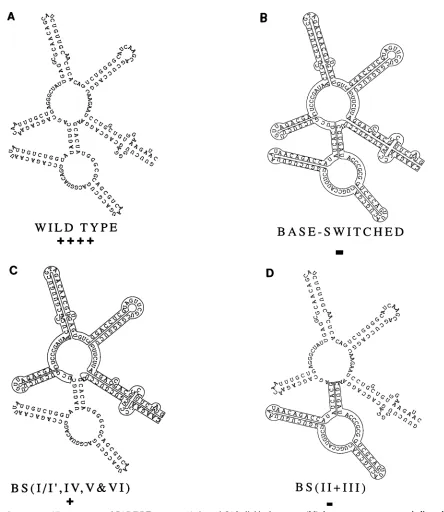
and Table 1. The base-switched CAR/RRE was almost totally inactive (Fig. 1B and Table 1). This is consistent with thepresence ofsequence specificity in theCAR/RRE.
To localize the sequencespecificity, we then instituted a
systematic exchange of fragments between the wild-type
CAR/RRE and the inactivebase-switched CAR/RRE. Each
oftheexchangemutantspresentedwasalsocomputationally
analyzed and altered, if necessary, to eliminate potential alternative structures which might compete with the wild-typestructures.Thelogicalfirst step,areciprocal exchange
of the Rev-binding domains (II and III) produced two analogs, eachwithimpaired function.Baseswitching
[image:3.612.315.554.94.273.2]every-where but domains II and III, BS(I/I', IV, V, & VI) (Fig.
TABLE 1. p249agproduction bybase-switched and substitution mutantsoftheCAR/RREin the absence and presence of Rev
p24gaR
Mutation ~productiona Rev
Mutation productiona response±SEb PC
-Rev +Rev
Wild type 3 100 100 ± 2.3
BS(CAR/RRE) 2 2 1 ± 0.4 <0.001
BS(I/I',IV, V, & VI) 3 37 31 ± 2.1 <0.001
BS(II+III) 3 4 5 ± 2.2 <0.001
BS(I/I') 2 137 157 ± 3.2 NSd
BS(V) 4 111 80 ± 5.0 <0.001
BS(VI) 5 126 58 ± 3.6 <0.001
BS(IIa) 3 62 48± 2.0 <0.001
BS(IIc+III) 3 20 16 ± 2.5 <0.001
BS(IIc) 4 89 63 ± 6.5 <0.001
BS(III) 4 61 50 ± 4.6 <0.001
BS(IIc&III-tips) 7 234 136± 18 NS
SUB7391-7393 2 2 2e <0.001
SUB7394-7395 3 3 3 ± 0.2 <0.001
SUB7413-7421 4 2 1 ± 0.1 <0.001
aProduction is expressed as a percentage of p24gag synthesized by the wild typestimulted by Rev and represents the averages of multiple experiments. Thisisappropriate forassessing whether baseline values (i.e., -Rev) are changed by the mutations.
b For the Rev response, the ratios of +Rev and -Rev for each mutant as a percentage of thewild-type ratio were determined for each experiment. The datapresented are the averages of these ratios. This method of calculation is more appropriate for analyzing the Rev response and differs slightly from determiningtheratioof the first two columns.
cP,probability that the mean is not less than that of the wild type. dNS, notsignificant.
eResultof oneexperiment.
1C),
reduced functiontoabout31%of that of the wildtype. Baseswitching just domainsIIandIII,BS(II+ III)(Fig.1D),completely eliminated function. This is consistent with
se-quence-specific
information lying both inside and outside theRev-binding domain.
Analysis of subregions outside the Rev-binding domain has not yetlocalizedtheapparent sequencespecificity. Base
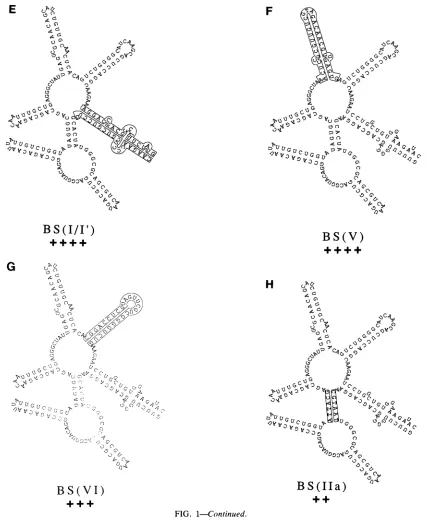
switching domain I/I', BS(I/I') (Fig. 1E), or V, BS(V)(Fig. 1F), did not impair function. Base switching domain VI,
BS(VI) (Fig. 1G), partially impaired function.
A more detailed analysisof the Rev-binding domain
sug-gested ittoo contains considerable sequence-specific infor-mation, much ofwhichisredundant. Base switching either
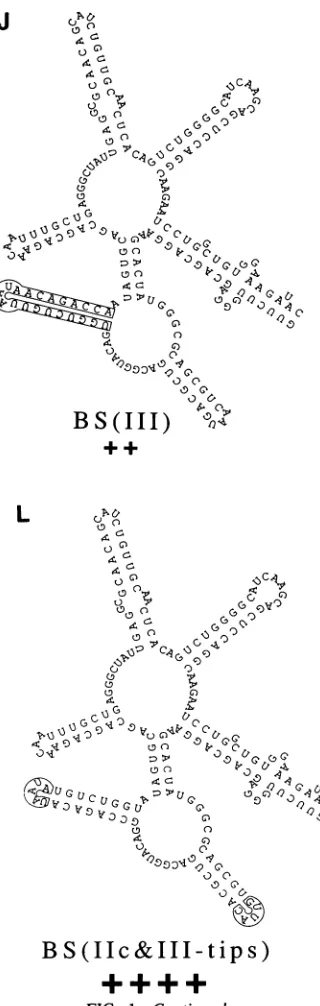
all of domain Ila (Fig. 1H) or all ofIII (Fig. 1J) reduced
functiontoabout50% of normal.Base switching domain lIc reduced function somewhat less, to 63%. However,
simul-taneous base
switching
of domains Ilc andIII,BS(IIc+III)
(Fig. 1I), reduced function toapproximately
16% ofthatofthewildtype. Simultaneously base switchingthe
tips
ofthe stems,BS(IIc&III-tips) (Fig.
1L), caused noimpairment
of function,confirming
a lack of sequencespecificity
in theloop regions. In contrast to the results of some
previous
investigators
(6, 45, 49), allmultiple
base substitutions(SUB)
of either the5'sideofdomainIlb, SUB7391-7393
andSUB7394-7395, or the 3' side, SUB(7413-7421)
(Fig.
1M), eliminated function.Phylogeneticconservation of basepairingin thelIb region.
Tofurther analyzethe apparent sequence
specificity
in therev-bindingdomain,it was necessarytounderstandasmuch
as
possible
aboutits invivosecondary
structure.Imperfec-tions in the helix we
originally
suggested
forthe Ilbregion
have
promoted
awidespread
viewofthe Ilbregion
asbeing
mostly
single
stranded,
not basepaired
(42, 44,
49).
Toon November 10, 2019 by guest
http://jvi.asm.org/
1142 DAYTON ET AL.
A
B
C) C
WILD TYPE
C
BASE-SWITCHED
D
w '2~~~~en
~~~UUGU~~~(
0CT )G
oca")
'L:2t0
B
S
(I/I',IV,jV&VI)
BS(II+III)
FIG. 1. Structure andRevresponseofCAR/RREmutants.(Athrough L)Individual mutants;(M)threeseparatemutants asindicated. Rev response datawereobtained from Tables1and2. Allmutants arediagrammed onlyfrom HIV-1position7363to7559(53).TheCAR/RRE
sequenceused in all of theconstructsstartedatposition7357. Wild-type5'endsthusarepreceded byUCCUUGG. Base-switched 5'ends arepreceded by AGGAACC.BS(CAR/RRE)andBS(I/I')terminatedatposition7567.Thus, theyarefollowedbyGGUUUCCT. Allwild-type
3' endswere atposition7723.The datapresentedaretheresultsofmultipletransfectionexperiments. + + ++,-80% function;+ ++,55to
80%;++,35 to55%; +, 15 to35%; +/-,5 to15%; -,s5%. BS, baseswitched; SUB,substitution.
resolve this issue, we performed aphylogenetic analysis of the conservation of base pairingintheIlb region.
Twenty-five HIV-1(40), 6 HIV-2, and 13 SIVCAR/RRE sequences were compared by multiple sequence alignment (27) of primary structure and by individual minimal-energyfolding
by using
thesuboptimalRNAfoldingprogram of Zuker(74)toconsideralarge setof alternativepossiblestructures(39).
The summary ofthe
comparison
ofthese twoindependent
analyses
fortheIlbregion
ispresented
inFig.
2.The overlap of the CAR/RREs with a
highly
conserveddomain ofgp4l allowed foranunambiguous primary
struc-ture
alignment.
Twostrikingly
conserved sequenceele-ments, AUGGG andCA, areshown inboldfaceinFig. 2 to serve as reference
points
in thephylogenetic
comparison.
J. VIROL.
on November 10, 2019 by guest
http://jvi.asm.org/
[image:4.612.99.543.59.571.2]4N
40C
ci0
LD 0~~~
C),
~ G
B
S(I/I')
0++
G tt'00
F
B
S
(V)
H
,>
I
H
C.G~~* z7Yl
Cw
[image:5.612.97.528.67.588.2]BS(VI)
BS(IIa)
FIG. 1-Continued.
The individualstructurespresentedallrepresenttheoptimal (minimal-energy) foldings of the depicted part of the CAR/
RREexceptfor theproposedG-A basepairings.Theseodd base pairs are nottreated as hydrogen bonded in the
pres-ently used free-energy rules. Taking into consideration the otherpossiblebasepairingsin themulti-stem-loopofHIV-1,
thebase-pairingschemeproposedhere forregionIlb clearly
fits both the phylogenetic data and the minimal-energy folding of HIV-1 the best (Fig. 2).
Analysis of point mutations in region Ilb supports the proposed base-pairing scheme and demonstrates that
se-quence-specificinformation in regionlIb isparticularly
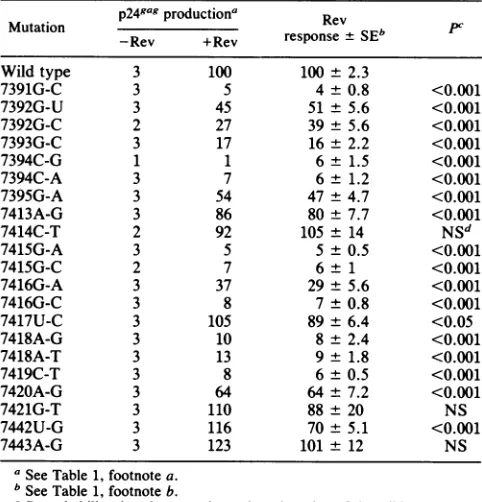
criti-cal. Consistent with the proposed region Ilb base-pairing scheme,noneof themutantsthat retain fullactivity interrupt
theproposed region Ilbbasepairing (Fig. 3A and Table2).
This includes mutations at positions 7413(?), 7414, 7417, 7421, 7442,and7443. The information atthesepositions is, therefore, notbase specific. Mutations 7392G-U,7418A-U, 7419C-U, and 7420A-G conservethe proposed base pairing yetimpairfunction. This stronglysuggeststhat the informa-tion atthesepositions is base specific.
Also consistent with the proposed base pairing is the
findingthat allmutantswhichcausemajor disruptionsin the
pairing scheme severely impairfunction(Fig. 3B andTable
on November 10, 2019 by guest
http://jvi.asm.org/
I 6 I C0
(IIc+
K
J C
0fh0
BS(III)
L
BS(IIc
M
-,>Cs
6 9VO
*G
)V) [image:6.612.362.522.42.545.2]SUB7413-21-B
S
(1Ic&III-tips)
FIG. 1-Continued.
2). This includes mutations 7391G-C, 7392G-C, 7393G-C, 7416G-C,and7418A-G. Thesedataalonedo notdistinguish
between sequence and structural
specificity.
However, we note that mutations either conserving or disrupting the 7392G-7418A base pair inhibit function. This further sug-gests that the informationatthesepositions is base specific.All of the mutations that were predicted to make only
minordisruptions ofthepairingscheme (e.g., disruption or
weakeningof only a single pair) reduce function, sometimes severely (Fig. 3C and Table 2). Mutations 7394C-A and 7415G-A more severely impair function than do nearby - mutationswith majordisruptive effects,such as7392G-Cor
7393G-C. This suggests that 7394C and 7415G should be
considered candidates for "probable" base specificity. However,wenotethatfromthepresentdata,thesecondary
-"'-urj 0Cyc C,
-12 V Ti3 rj v vI
,-Z
on November 10, 2019 by guest
http://jvi.asm.org/
TABLE 2. p249aBproduction by point mutants of theCAR/RRE
p249aR production' Rev
Mutation rsos SEb PC
-Rev +Rev response + SEb
Wildtype 3 100 100 ± 2.3
7391G-C 3 5 4± 0.8 <0.001
7392G-U 3 45 51 ± 5.6 <0.001
7392G-C 2 27 39 ± 5.6 <0.001
7393G-C 3 17 16 ± 2.2 <0.001
7394C-G 1 1 6± 1.5 <0.001
7394C-A 3 7 6 ± 1.2 <0.001
7395G-A 3 54 47±4.7 <0.001
7413A-G 3 86 80 ± 7.7 <0.001
7414C-T 2 92 105 ± 14 NSd
7415G-A 3 5 5 ± 0.5 <0.001
7415G-C 2 7 6± 1 <0.001
7416G-A 3 37 29± 5.6 <0.001
7416G-C 3 8 7 ±0.8 <0.001
7417U-C 3 105 89± 6.4 <0.05
7418A-G 3 10 8 ± 2.4 <0.001
7418A-T 3 13 9 ± 1.8 <0.001
7419C-T 3 8 6±0.5 <0.001
7420A-G 3 64 64±7.2 <0.001
7421G-T 3 110 88 ± 20 NS
7442U-G 3 116 70±5.1 <0.001
7443A-G 3 123 101 ± 12 NS
a See Table 1, footnote a.
bSee Table 1, footnote b.
.P,probabilitythatthe mean is not less than that of the wild type. cNS, notsignificant.
finestructure at thesesites isnotclear intermsofalternative
base
pairings.
Impairment ofviral replication by a CAR/RRE
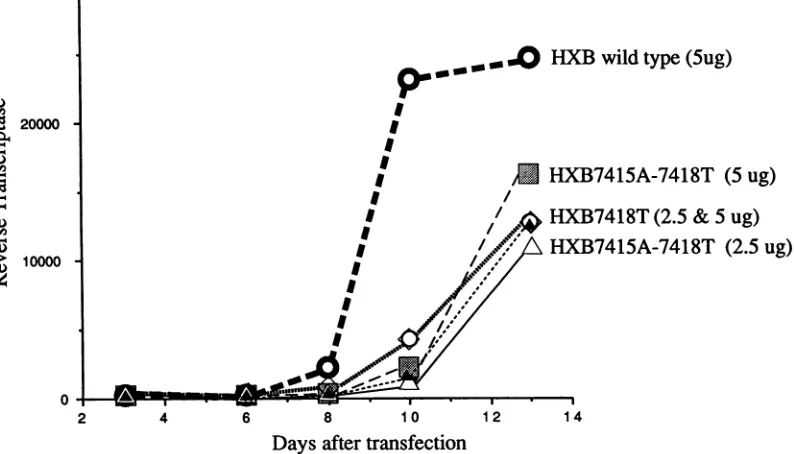
structure-conservingpoint mutation in region Ilb. To assess thevalidity of the HIV gag expression system used in ourassays, we constructed proviral derivatives of HXB-2 with single (7418A-T), structure-conserving, or double nonreciprocal
(7418A-T + 7415G-T) point mutations in the CAR/RRE. These point mutations were made in the third position of
degenerate
codons so as not to alter any envelope aminoacids
and were chosen to create new codons that arefrequently used by HIV. Mutant and wild-type proviral clones were transfected into A3.01, a human CD4+ T-cell
line. Both proviral mutants exhibited major, though not
absolute,
impairment of growth in thissystem(Fig. 4). Bothmutants also supported reduced levels of virionproduction after transfection into COS cells (datanot shown). These
dataclearly validate thegagexpressionassay usedinthese studiesas being relevanttoHIV biology.
DISCUSSION
Extensive distribution of sequence specificity. The data presented here demonstrate that sequence
specificity
issurprisingly widespread throughout
the CAR/RRE. What isthe significance ofthis
specificity?
Thebase-switching
ap-proach used rigorously
distinguishes
betweensecondary
structural andnonsecondary
structural information.For-mally, the latter includes
base-specific
contactpoints
for both inter- and intramolecular interactions(e.g.,
regulatory
factorbinding
andtertiary
structureformation,
respective-ly). Much of thesequence-specific
information identifiedhere is quantitatively and
possibly
mechanistically
redun-dant and islocated in
base-paired
helices. Thisinformationis,
therefore,relatively
unlikely
to make criticalcontribu-tionsto tertiary structure. More likely, the sequence
speci-ficity
derives from sequence recognition by proteins. Thissequencerecognition by proteins may involve direct contact with specific bases or recognition of specificfeatures ofthe phosphate backbone which are determined by stacking
in-teractions.
The distribution of sequence-specific information in the
CAR/RRERev-binding domain, loosely considered
regions
II and III (26, 28, 45, 49), was unexpected. The data
presentedhere suggest theexistence ofredundant informa-tionroughly evenlydistributedamong stemsIla,Ilc,and III. Although these stems are in the Rev-binding domain, some
of the sequence-specific information here may be required for the binding of critical cellular factors prior to the occu-pancy of the region byRev. However,it ismorelikely that the sequence specificity of this region derives from se-quence-specific recognition by Rev. The work of Holland et
al. (28)showedthatstemIlais acriticalbinding site for Rev. Their suggestion that the recognition site extendsalso into stemIIb was, unfortunately, based on mutations that did not
distinguish between sequence alterations and secondary
structuralalterations capable ofdisturbing neighboring bind-ing sites. Furthermore, their failure to detect a requirement
forstemsIlcandIII mayderive from theexistence of a1-bp
mismatch (bulge) found at the base of stem III in the pNL43
CAR/RRE used in their studies. The existence of this mismatch may render the pNL43 CAR/RREpartially defec-tive to begin with. Theprotection data of Kjems et al. (37)
suggested three binding sites inthis region, each binding site consisting of one stem with additional material extending into part of stem IIb. These data did not determine, how-ever, the relative importance of the binding sites. Nor did they distinguish between bases that were protected and bases that were required for binding and presumably func-tion. The data of Cook et al. (7) suggested the minimal
Rev-bindingelementconsists ofstems IIc andIlband the 5' strand of stem Ila.The data presented here demonstrate in
vivo that stems IIa and IIc are roughly equivalent in
signif-icance and suggest that stem III may play a relatively secondary role in CAR/RRE function. Previous data have
demonstrated that deletionofeitherstem IIc or IIIabolishes function (13, 14). Our data also support previous work
suggesting that Rev needs to multimerize on theCAR/RRE
to have function (43, 48). Entirely unexpected was the
findingofsequence-specific informationwithinbases in stem
IIb which byprotection analysis arenotbound byRev. We
discuss thismorefully immediately below.
Sequence specificity in the Ilb region is unusually critical.
The sensitivity of CAR/RRE function to structure-conserv-ingmutations in the Ilbregion clearlydemonstrates thatthis region is unique. Nowhere else inthe molecule is sequence
information so crucial. At least four bases in this
region,
7392G, 7418A, 7419C, and 7420A, contain critical base-specificinformation (summarized inFig. 5). Mutatinganyof these bases to bases which either disrupt or conserve the proposed basepairing
reducesfunction.Interestingly,
twoof these bases, 7392G and 7418A,pair
with each other. The informationatpositions7418 and 7419isparticularly critical. Consistent with the exquisite sequencespecificity
of7418A and7419C, we note that withgagexpression
vectors, suchas the one used here, all
previously
reported
deletions ofthese bases in the CAR/RRE
severely
impair
the Revre-sponse(14,28)orRev
binding (7).
Twobases in thisregion,
7394C and 7415G (which maypair
with oneanother),
arelisted as probably sequence
specific (Fig. 5)
becausemuta-tionscanbemadeatthese
positions
which,
whileonly mildly
on November 10, 2019 by guest
http://jvi.asm.org/
1146 DAYTON ET AL.
lla
':: oC(. HIVI
1'~Do:0
I1I1 G
UU
t G<-7 3 9...7394
7414 Ic
sIVcpz <aC:
lvD.:0
G U
r;
66
0
7
Lo0c
Hi V2BEN
0o( SIVAGM
A
nl
oCQ)
HI V2ROD HIV21SY
A
6
0° Q SlvSMMH4 :)Do>
oO
C5G
D °G)
(DaOQ SIVMINDGBI
&
[image:8.612.111.513.76.404.2]~:0
FIG. 2. Phylogenetic conservation of base pairingin the Ilb regionof the CARIRRE ofprimate
immunodeficiency
viruses. Allof the individualbase-pairingschemes shown representoptimalfree-energyfoldings,except for theproposed
G-A basepairings
(seeMaterials and Methods andDiscussion).Thedifferentpairingschemesof the HIV-2 and SIV strains shown represent themajor
variations of the theme of sequenceandbase-pairingpatternswithin these strains. The conserved sequence elements AUGGGand CAareshownasreferencepoints.Dotted lines indicatealternative basepairings.On the basis of bothphylogeneticdataand knownthermodynamiccontributions, thereisno
strongreason tofavoroneof thetwoalternative C-Gpairings (positions7394to7415or7394to7416 inHIV-1). Furthermore,thepossibility
thatinconjunction withatwo-nucleotidebulge (positions7414and7415inHIV-1), theIlcstemis extendedbyanadditional G-A basepair
mustbe consideredasanotheralternativeconformation. This latterconformation is also reflected in thebase-pairingschemes ofthe simian
immunodeficiency viruses.
disruptive of the proposed structure,
seriously impair
thefunction. However, it is difficult to factor out sequence
specificity from structural specificity with the mutations
analyzedatthesepositions. Furthermore, theproposedfine structure atthese
points
is unclear withrespect toalternativebase
pairings.
Atleastfivepositions,
7414, 7417, 7421, 7442,and 7443, in and around stem
lIb
have no or minimal base-specific information. Position 7413 may also lack sig-nificant base specificity. Structure-conserving substitutionscanbemadeatthesepositions withnoorminimal effecton
function. The presence or absence of base specificity at
positions 7390, 7391, 7393, 7395, 7413, and 7416 remains to be determined.
Theexquisite sequence
specificity
of theIlb region forcefully constrainsmechanistic models ofRev action. TheIlbregioniscentrally
located withrespect tothe stemregions protectedby Rev protein bound to the
CARIRRE
in vitro (37).IlIb
sequencesclose to stems
Ha,
lIc, and III are protected by Rev binding, but thefunctionally critical bases at positions7418 and7419 actually become hypersensitive to RNaseT2 upon Rev binding (37). This hypersensitivity has an
un-known physical
basis,
but itshouldpreclude thepossibility
that Rev remains bound to these basesdirectly.
This sug-gests twotestable alternativepossibilities
for the role ofthecentral Ilb region. One
possibility
is that it is a site forsequence-specific
recognition
by critical cellular factors ei-therbeforeorafter Revbinding.
In thelattercase, Rev maybindto
regions
hIa,
lIc, andIII,melt outthe Ilbregion,
andpresent it for cellular factor binding. In support of this
possibility,
we note the following twoobservations: (i) thelIb region is contained withina fragment of the CAR/RRE reported to specifically recognize a nuclear cellular factor (67)and
(ii)
uponbinding Rev, CAR/RRERNAundergoesaconformational change consistent with a partial unfolding (11). Anotherpossibility isthat the sequence-specific infor-mation within region Ilb may serve a critical role in Rev
binding.
For 7418 and 7419 to becriticalRevcontactpoints,however, rev would have to bind and then migrate away
from positions 7418 and 7419. The requirement that Rev
multimerizeonthe CARIRRE in ordertofunction properly (43, 48) suggests the attractive possibility that lIb
might
nucleateRevbinding. Asmallnumberofsequence-specific-J. VIROL.
U.0n
on November 10, 2019 by guest
http://jvi.asm.org/
A
7443A-G
7442U-G
Ila
74.46 738
0 n
0hiG
Ga
74240
7421IG-U++++N-,(
7420A-G
+++-4/
7419C-U
+/-0o
7418A-U
+/---
W?6I
7417U-C
++++9
7414C-U++++
7413A-G
++++-c,7392G-U
++Ila
7446 * .7387
7424 00,
//**.,,
0y-7394C-A
+/-iT)-7395G-A
++7416G-A + 398
7415G-A 7410 Ilc
bindingeventsin thecontiguous regions could extend intoa
nonspecific polymerization of Rev along an entire RNA
molecule, protecting it from the nuclear splicing machinery (cf. references 34 and 70).
Conservationofsequenceinregion Ilb. Because theCAR/
RRE is inaconserved and functionally important region of
gp4l, it is often difficulttoattributesequenceconservationin
this areatoeither protein-codingconstraints or CAR/RRE
requirements. Conservation of base 7418A, however, is unambiguously due to CAR/RRE requirements. This posi-tionis the third baseinavaline codon (Fig. 5). Regardless of
the significance of the proposed base pairing, valine could readily be encoded by G (structure disruptive) or U
(struc-tureconserving)atthisposition. These mutations would still
usecodonsfrequently used by HIV-1.
Conservation of secondary structure in region IIb. The strongestevidencesupporting the base-pairing scheme
pro-posed here for region IIb is thatthe base pairing is highly conserved among all primate immunodeficiency viruses,
eveninthepresenceofenvelopecodingsequence heteroge-neity. The datapresentedsupport theproposedbasepairing. Allmutations whichpreservewild-type activitypreservethe
region IIbbase-pairing scheme. All mutationswhichdisrupt this base pairing impair function. The exquisite sequence
specificity inthe IIb region has unfortunately preventedus
from obtaining functional double reciprocal mutants which
could provethe proposed structure(13). Although the
con-servationisproposedtoinclude G-A basepairs, theyarenot unusual. After the Watson-Crick and G-U base pairings occurringinfoldedRNA structures, the G-A is consideredto bethemostregularamongthenon-Watson-Crickbasepairs.
B
Ha
7446 .* 7387
0 n
4,
C:~
7391G-C
->
u
7392G-C++
IJII .:G
G
@
/7393G-C
+
742400
7418A-G
+/--
D
7416G-C
+7-0
IlcFIG. 3. Analysis of point mutations in and around the IIb region. Dotted lines indicate G-A base pairings. All other proposed base pairingsareindicatedby solid lines. (A)Mutations that conserve the proposed base pairing in region Ilb; (B) mutations that cause major disruptions in the pairing scheme; (C) mutations that cause only minordisruptions without grossly altering the proposed base-pairing scheme. Stability calculations were done as for thebase-switched mutants (see Materials and Methods). Quantitation is the same as forFig. 1.
G-A pairs have strong stacking properties and can show
hydrogenbonding (57, 64). They arefrequently foundboth flanking helicalends and closinginternal loops (22, 66, 71). The proposed helicity ofthis region is consistent with the
protectiondatareportedby Kjems et al. (37), which show a
lack of reactivity of these nucleotides to single-strand-specificreagents. Theseemingly inconsistentpoorreactivity of this region with double-strand-specific reagents, such as RNase CV, may derive from tertiary shielding by the
sur-roundingstems orby thebulgesandimperfectbasepairings presentinregion Ilb.RNaseCV is knowntofailtorecognize documentedRNAhelices (50).
Sequence specificity outside of the rev-binding domain. At present, the presence ofsequence specificity outside ofthe
rev-binding domain is indicated primarilyby the lowlevel of
function remaining after base switching together all of
do-mains
I/I',
IV, V, and VI. Admittedly, however, computa-tionally analyzing such a large and complexregion is moredifficultthananalyzingtheeffects ofbase switchingasingle
stem. Nevertheless, we note that base switching this large region reduces function by about the same amount as
deleting all of domain IV-VI (14). None ofthe information uniquely present in the
I/I',
IV, V, or VI domain seemssufficientto accountforalloftheinformationpresent in the
region taken as a whole. Base switching domain I/I' may
actually boost Rev-responsiveness. However, the small boost observedin this construct mayderive fromthe lackof
sequences 3' to the minimal CAR/RRE, which sequences havebeen deleted during the construction of this truncated CAR/RREanalog (14) (see Materials and Methods). Vectors similar to ours have been shown elsewhere to tolerate
deletion of domain IV with no loss ofRev
responsiveness
(28). Baseswitching
domain V has a minimal effect onfunction. Base
switching
domain VImoderately
impairs
function but not enough to accountfor theimpairment
inBS(I/I',
IV, V,&VI),P<0.01.Furthermore,deleting
allof domain VI has no discernible effect on function(14).
Al-though more extensive
mutagenic
analysis
of thisregion
needstobe done and isunder way,thesequenceinformation
on November 10, 2019 by guest
http://jvi.asm.org/
[image:9.612.334.551.69.221.2]1148 DAYTON ET AL.
.I
0og
oI
I
I I
I~~~~~~~~I 0i/
2 4 6 8 10
Days after transfection
HXB wild
type(5ug)
HXB7415A-7418T (5 ug)
HXB7418T (2.5 & 5 ug)
HXB7415A-7418T (2.5 ug)
[image:10.612.113.510.79.306.2]12 14
FIG. 4. Replication inT4+ cells of HXB-2provirus cloneswithpointmutations in theCAR/RRE.Twodifferent concentrations ofeach
mutant(2.5or5,ugof DNAper10 x 106cells)weretransfected into A3.01cellsatday0.Aliquotswereremoved forreversetranscriptase
attheindicatedtimes.
outside of the Rev-binding domain seems to be quantita-tively redundant. This information could determine minor
binding sites for Revassuggested by the protectionassaysof
Kjems et al. (37) or could determine binding by critical
cellular factors.
The interaction of the Rexprotein of human T-cellleukemia virus type I with the CAR/RRE supports the notion that
IIa
II:I .,'S
t '
I;
N7421 7394p
1420c 739
.0*I j.5f'
s 0~~~
s N,
?
pN?
IIc
FIG. 5. Sequence specificityand conservation in and around the IlbregionoftheCAR/RRE. Underlined basesareconservedamong
all the HIV-1 strainsanalyzed. Selectedenvelope amino acids are
listed neartheir codons. S, strongly sequence specific; s, mildly
sequencespecific; P, probably sequencespecific; N,notsequence
specific; ?, presentlyundetermined.
critical cellular factors recognize regions outside the
Rev-binding domain. Rev and Rex sharevirtuallyno aminoacid
homologies yet they are teleologically and mechanistically
almost identical (4, 15, 16, 21, 25, 30-32, 36, 59, 61). Although both functionally interact with the CAR/RRE(21, 41, 54, 56, 63), they interact with different regions: Rev
interacts primarily with regions IIand III and Rex interacts primarily with regions IV(?), V, and VI, both seeming to require various amountsofregion I/I' for full activity (1, 3, 29, 63). Itislikelythat HIV haspirated via theCAR/RREa
complex cellular system involved in RNA splicing and/or transport. In this cellular system, the RNA target would interact with multiple cellular factors, some of which are
presumably regulated to control the fate of the RNA to which theyareattached. We speculate (Fig. 6) that Rev and
Rex have each mimicked one set of cellular factors,
sup-planting their regulation but operating in conjunction withat leastsomeof the other factors. This suggests the existence of at least two sets ofcellular factors, of whichone set is Rev-likeand binds in conjunction with Rex while the other is Rex-like and binds in conjunction with Rev. According to
the model suggested in Fig. 6, the lack ofsynergybetween
Rev and Rex(1) could be explained byanintermediatesetof proteins which bind to regions of the CAR/RRE falling withinboth the Rev domain and the Rexdomain if Rev and Rex eachmimic the intermediate proteins as well.
Theimpaired growth of proviral clones with point muta-tions in the CAR/RRE validates the Rev-dependent gag
expressionassay. Discrepancies in the literature concerning
the biological effects of mutating various regions ofCAR/ RRE exist. In general, Rev-dependent expression systems
thatuseheterologous genetic material in the regulated tran-scriptional unit, such as heterologous splice sites (44) or
bacterialindicatorgenes(55),are moretolerantof mutations
than are HIV-1 gag expression systems similar tothe one
30000
'. 20000 04
*C
ut
H
ce
C-, sz
> 10000
0
J. VIROL.
on November 10, 2019 by guest
http://jvi.asm.org/
[image:10.612.71.276.464.663.2]Alternative
protein complexes
4
IV!
VI
CAR/RRE
FIG. 6. Protein-RNA interactions proposedfor maximal Revresponse. Only factors required for maximalresponse arediagrammed. Presumably other cellular factors bindtoundetermined locations, possibly region lIb. Suboptimalresponsescanpresumably occurin the
absenceofsomeof the diagrammed factors.
used here(12, 14, 28), which offer the advantage of contain-ingonly HIVgenetic material in the regulated transcriptional unit. Point mutations which impair the function of the
CAR/RRE in our assay system also impair viral growth in
tissueculture. Thisconvincingly validates theuseof thegag
expression assay as a measure ofCAR/RRE function. The variousalternativeassays arebyno meansinvalid, however. Reviscalleduponto functionatmultiple points duringthe
processing of RNA in the nucleus. To rescue full-length
genomic RNA and gag-pol mRNA, Rev must intervene
before the first splicing event. To rescue intermediately spliced RNAs, Revmustinterveneatvarious points beyond
the first splicing event. The kinetic requirements of these
diverse events should be expected to differ from one
an-other. It is likely that the diversity of assay sensitivities
mirrors thediversity of roles for the Revaxis of
autoregu-lation.
ACKNOWLEDGMENTS
We thank Alicia Buckler-White for providing oligodeoxynucle-otides andhelpwithsequencing, DavidAllingforstatistical analy-sis, and particularly Anthony Fauci for support, advice, and a
readingof themanuscript.
REFERENCES
1. Ahmed, Y.F., S. M. Hanly,M. H. Malim,B. C. Cullen, and W.C.Green. 1990. Structure-functionanalysisof theHTLV-I
Rexand Rev RNAresponseelements; insightsinto the mech-anismof Rex and Rev action. Genes Dev. 4:1014-1022. 2. Arrigo,S.J.,S.Weitsman,J.D.Rosenblatt,andI.S. Y.Chen.
1989.Analysisofrevgenefunctiononhumanimmunodeficiency virustype1replicationinlymphoidcellsby usingaquantitative
polymerasechainreactionmethod.J. Virol. 63:4875-4881.
3. Benko, D. M., R. Robinson, L. Solomnin, M. Melini, B. K.
Felber,andG. N.Paviakis.1990.Bindingof trans-dominantrev
protein of humanimmunodeficiency virus type 1 tocis-acting rev-responsiveelement does not affect the fate of viral mRNA. NewBiol. 2:1111-1122.
4. Black, A. C., I. S. Y. Chen, S. Arrigo, C. T. Ruland, T.
Aflogiamento,E.Chin, and J. D.Rosenblatt. 1991. Regulationof HTLV-II geneexpressionbyrexinvolvespositive and negative cis-acting elements in the 5' long terminal repeat. Virology
181:433-444.
5. Chang,D. D.,and P. A. Sharp. 1989. Regulationby HIVrev depends upon recognition of splice sites. Cell 59:789-795. 6. Cochrane,A.W., C. H.Chen, and C. A.Rosen.1990. Specific
interaction of the human immunodeficiency virus rev protein with astructured region in the env mRNA. Proc. Natl. Acad. Sci. USA 87:1198-1202.
7. Cook,K. S., G. J.Fisk,J. Hauber,N.Usman,T.J. Daly,and J. R. Rusche. 1991. Characterization of HIV-1 Rev protein: binding stoichiometry and minimal RNA substrate. Nucleic Acids Res. 19:1577-1583.
8. Cullen, B. R., and W. C. Green. 1989. Regulatory pathways
governingHIV-1replication. Cell58:423-426.
9.
Cuflen,
B. R., J. Hauber,K. Campbell, J. G.Sodroski, W. A.Haseltine, and C.A. Rosen.1988.Subcellular localization of the humanimmunodeficiencyvirustrans-actingartgeneproduct.J. Virol. 62:2498-2501.
10. Daly, T., K. Cook, G. Gray,T. Malone, andJ. Rusche. 1989.
Specific binding of HIV-1 recombinant rev protein to the
rev-responsiveelement in vitro. Nature(London)342:816-819. 11. Daly, T.J., J. R. Rusche, T. E.Maione,and A.D.Frankel.1990. Circular dichroism studies of the HIV-1 rev protein and its
specificRNAbindingsite. Biochemistry29:9791-9795. 12. Dayton, A. I.,E. F. Terwilliger, J. Potz, M. Kowalski, J. G.
Sodroski, and W. A. Haseltine. 1988. Cis-acting sequences
responsive tothe revgene productof the human immunodefi-ciencyvirus. J.Acquired ImmuneDefic.Syndr. 1:441-452. 13. Dayton,E.T.,and A. I.Dayton. Unpublishedobservations. 14. Dayton,E.T.,D. M.Powell,and A. I.Dayton.1989.Functional
analysis of CAR, the target sequence for the rev
protein
of HIV-1. Science246:1625-1629.v
1
4
1 1U-0
0-3mr,
----
~~~~EMR
i
II
I
on November 10, 2019 by guest
http://jvi.asm.org/
[image:11.612.150.474.91.328.2]1150 DAYTON ET AL.
15. Derse,D.1988.Trans-acting regulationof bovine leukemia virus mRNAprocessing. J. Virol. 62:1115-1119.
16. Dokhelar,M.C.,H.Pickford, J.Sodroski,and W. A. Haseltine. 1989. HTLV-1p27rexregulatesgagandenvproteinexpression.
J.Acquired ImmuneDefic.Syndr. 2:431-440.
17. Emerman, M., R.Vazeux, and K. Peden. 1989. The rev gene
productof the humanimmunodeficiencyvirusaffects envelope-specificRNAlocalization. Cell 57:1155-1165.
18. Fauci,A.S. 1988.Thehumanimmunodeficiency virus;
infectiv-ityandmechanisms ofpathogenesis.Science 239:617-622. 19. Feinberg,M.B.,R. F.Jarrett,A.Aldovini,R.C.Gallo,and F.
Wong-Staal.1986.HTLV-IIIexpressionandproductioninvolve
complexregulation at the levels ofsplicing and translation of viralRNA. Cell 46:807-817.
20. Felber,B.K., D.Derse, A. Athanassopoulos,M. Cambell,and G. N. Pavlakis. 1989. Cross-activation of the Rex proteins of HTLV-1 and BLV and of the Rev protein of HIV-1 and
non-reciprocal interactions with their RNA responsive
ele-ments. NewBiol. 1:318-328.
21. Felber,B.K.,M.Hadzopoulou-Cladaras, C.Cladaras,T. Cope-land, and G. N. Pavlakis. 1989. The rev protein of human
immunodeficiencyvirus type1affects thestabilityand transport of the viral mRNA. Proc. Natl. Acad. Sci. USA 86:1495-1499. 22. Gutell,R.R.,andG.E. Fox.1988.Compilationoflargesubunit RNAsequencespresentedinastructural format. Nucleic Acids Res. 16(Suppl.):r175-r269.
23. Hadzopoulou-Cladaras, M.,B. K. Felber,C.Cladaras,A. Atha-nassopoulos, A.Tse,and G. N.Paviakis. 1989. Therev(trslart)
protein of human immunodeficiency virus type 1 affects viral mRNAandprotein expression viaacis-actingsequencein the
envregion. J. Virol. 63:1265-1274.
24. Hammarskjold, M. L., J. Heimer, B. Hammarskjold, I.
Sang-wan, L. Albert, and D. Rekosh. 1989. Regulation of human
immunodeficiencyvirusenvexpression bytherevgeneproduct.
J. Virol. 63:1959-1966.
25. Hanly, S. M.,L. T.Rimsky,M. H.Malim, J.H.Kim, J. Hauber, M. D.Dodon,S.-Y. Le, J.V. Maizel, B. R. Cullen,and W. C. Greene. 1989. Comparative analysis of the HTLV-1 Rex and HIV-1 Rev trans-regulatory proteins and theirRNA response elements.GenesDev. 3:1534-1544.
26. Heaphy, S.,C.Dingwall,I.Ernberg,M.J.Gait,S.M.Green,J.
Karn, A. D.Lowe,M. Singh, and M. A.Skinner. 1990. HIV-1
regulatorofvirion expression (Rev) proteinbindsto an RNA
stem-loop structure located within the Rev response element
region.Cell60:685-693.
27. Hogeweg, P., and B. Hesper. 1984. The alignment of sets of sequences and construction of phyletic trees: an integrated
method. J. Mol. Evol. 21:323-333.
28. Holland,S.M.,N. Ahmad,R. K. Maitra,P. Wingfield,andS. Venkatesan. 1990.HumanimmunodeficiencyvirusRevprotein
recognizesatarget sequence in Rev-responsive elementRNA within the context of RNA secondary structure. J. Virol.
64:5966-5975.
29. Huang,X.,T.J. Hope,B. L.Bond,D.McDonald,K.Grahl,and T.G.Parslow. 1991. MinimalRev-response element for type1 humanimmunodeficiencyvirus.J. Virol. 65:2131-2134. 30. Inoue, J., M. Seiki, and M. Yoshida. 1986. The second pX
product p27x-IIIofHTLV-Iisrequiredfor gag gene expression. FEBS Lett. 209:187-190.
31. Inoue, J., M. Yoshida, and M. Seiki. 1987. Transcriptional
(p4Ox) and post-transcriptional (p27x-III) regulators are
re-quired for the expression and replication of human T-cell leukemia virus type I genes. Proc. Nati. Acad. Sci. USA 84:3653-3657.
32. Itoh, M., J. Inoue,H.Toyoshima,T.Akizawa, M. Higashi, and M. Yoshida. 1989. HTLV-1 rex and HIV-1 rev act through similar mechanisms to relieve suppression of unspliced RNA
expression.Oncogene4:1275-1279.
33. Jaeger, J. A., D. H. Turner, and M. Zuker. 1989. Improved
predictionsofsecondarystructuresfor RNA. Proc. Natl. Acad. Sci. USA86:7706-7710.
34. Karn,J., C. Dingwall, J.T.Finch, S. Heaphy, and M. J. Gait. 1991. RNA binding by the tat and rev proteins of HIV-1.
Biochimie 73:9-16.
35. Kim, S. Y., R. Byrn, J. Groopman, and D. Baltimore. 1989. Temporal aspects of DNA and RNA synthesis during human immunodeficiencyvirus infection: evidence for differential gene expression. J. Virol.63:3708-3713.
36. Kiyokawa, T.,M. Seiki, S. Iwashita,K. Imagawa, F.Shimizu, and M.Yoshida.1985.p27XIII and p21XIII proteins encoded by the pX sequence of human T-cell leukemia virus type I. Proc. Natl.Acad. Sci. USA82:8359-8363.
37. Kjems, J., M. Brown, D. D. Chang, and P. A. Sharp. 1991. Structuralanalysis of the interaction between the human immu-nodeficiency virus Rev protein and the Rev response element. Proc. Natl.Acad. Sci. USA 88:683-687.
38. Knight,D.M.,F. A.Flomerfelt,andJ.Ghrayeb. 1987. Expres-sion of the art/trsproteinof HIV and study of its role in viral envelope synthesis. Science 236:837-840.
39. Konings,D. A.M.,and A. I. Dayton. Unpublished data. 40. Le,S.-Y.,M. H.Malim,B. R.Cullen,andJ. V. Maizel. 1990. A
highly conserved RNAfolding region coincident with the Rev response elementofprimate immunodeficiencyviruses. Nucleic AcidsRes. 18:1613-1623.
41. Lewis, N., J. Williams, D.Rekosh, and M.-L. Hammarskjold. 1990. Identification ofacis-actingelement in human immuno-deficiency virus type2(HIV-2) that isresponsivetothe HIV-1 revandhumanT-cellleukemia virus typesIand IIrexproteins. J. Virol. 64:1690-1697.
42. Malim,M. H.,S.Bohnlein, J. Hauber,and B. R.Cullen. 1989. Functional dissection of the HIV-1rev trans-activator-deriva-tion ofatrans-dominant repressor ofrevfunction. Cell 58:205-214.
43. Malim,M. H., and B. R. Cullen. 1991. HIV-1 structural gene expression requires thebindingofmultiple Revmonomers to the viral RRE:implicationsfor HIV-1latency.Cell 65:241-248. 44. Malim, M. H., J. Hauber, S.-Y. Le, J. V. Maizel, and B. R. Cullen. 1989. The HIV-1 rev trans-activator acts through a structured target sequence to activate nuclear export of
un-splicedviral mRNA. Nature(London)338:254-257.
45. Malim, M. H., L. S. Tiley, D. F. McCarn, J. R. Rusche, J. Hauber,and B. R.Cullen. 1990. HIV-1structural gene expres-sion requires binding of the Rev trans-activator to its RNA target sequence.Cell 60:675-683.
46. Muesing,M.A., D. H. Smith,C. D.Cabradillo, D. V. Benton, L.A.Laskey,and D.J. Capon. 1985.Nucleic acidstructureand
expression of the human AIDS/lymphadenopathy retrovirus. Nature(London)313:450-458.
47. Nalin, C. M., R. D. Purcell, D. Antelman, D. Mueller, L. Tomchak, B. Wegrzynbski, E. McCareny, V.Toome, R. Kra-mer,andM.-C.Hsu. 1990.Purification and characterization of recombinant Rev protein of human immunodeficiency virus type 1. Proc.Natl. Acad. Sci. USA 87:7593-7597.
48. Olsen, H. S.,A. W. Cochrane,P. J. Dillon, C. M. Nalin, and C. A. Rosen. 1990.Interaction of the humanimmunodeficiency virus type1 revprotein with a structured region in env mRNA isdependent onmultimerformation mediated throughabasic stretchof aminoacids. Genes Dev. 4:1357-1364.
49. Olsen, H. S., P. Nelbock, A. W. Cochrane, andC. A. Rosen. 1990.Secondarystructureis themajor determinant for interac-tion of HIVrevprotein with RNA. Science 247:845-848. 50. Parker,K.A.,andJ.A. Steitz.1987. Structural analyses of the
human U3 ribonucleoprotein particle reveal a conserved se-quence available for base pairing with pre-rRNA. Mol. Cell. Biol. 7:2899-2913.
51. Perkins, A.,A. W. Cochrane, S. M. Ruben, and C. A. Rosen. 1989. Structural and functional characterization of the human
immunodeficiencyvirus rev protein. J. Acquired Immune Defic. Syndr.2:256-263.
52. Pomerantz,R.J., D. Trono, M. B. Feinnberg, and D. Baltimore. 1990. Cells nonproductively infected with HIV-1 exhibit an aberrant pattern ofviralRNAexpression;amolecular model for latency. Cell61:1271-1276.
53. Ratner, L.,W.Haseltine,R.Patarca,K.L. Livak, B. Starcich, S. F.Josephs,E. R.Doran, J.A.Rafalski,E. A.Whitehorn, K. Baumeister, L. Ivanoff, S. R. Petteway, M. L. Pearson, J. A. J. VIROL.
on November 10, 2019 by guest
http://jvi.asm.org/
Lautenberger, T. S. Papas, J. Ghrayeb, N. T. Chang, R. C. Gallo, and F.Wong-Staal. 1985. Complete nucleotide sequence
of the AIDS virus, HTLV-III. Nature (London) 313:277-283. 54. Rimsky, L., J. Hauber, M.Dukovich, M. H. Malim, A. Langlois,
B. R. Cullen, and W. C. Greene. 1988. Functionalreplacement of the HIV-1 rev protein by the HTLV-1 rexprotein. Nature
(London)335:738-740.
55. Rosen,C. A., E.Terwilliger, A.I.Dayton, J. G. Sodroski, and
W. A. Haseltine.1988.Intragenic cis-actingartgene-responsive
sequence of the human immunodeficiency virus. Proc. Natl. Acad.Sci. USA85:2071-2075.
56. Sakai, H., R. Shibata, T. Miura, M. Hayami, K. Ogawa, T. Kiyomasu, A. Ishimoto, and A. Adachi. 1990. Complementation of therevgenemutationamonghumanand simian lentiviruses. J. Virol. 64:2202-2207.
57. SantaLucia, J., R. Kierzek, and D. H. Turner. 1990. Effects of GAmismatchesonthestructureandthermodynamics ofRNA internal loops. Biochemistry 29:8813-8819.
58. Schwartz, S., B. K. Felber, D. M. Benko, E.-M. Fenyo, and G. N. Pavlakis. 1990. Cloning and functional analysis of multiply spliced mRNA species of humanimmunodeficiency virustype 1.J. Virol. 64:2519-2529.
59. Seiki, M., J. Inoue, M. Hidaka, and M. Yoshida. 1988. Two cis-acting elements responsible for posttranscriptional trans-regulation ofgene expression ofhuman T-cell leukemia virus type1. Proc. Natl. Acad. Sci. USA 85:124-128.
60. Shapiro,S.S., and M. B. Wilk. 1965. Ananalysisof variance
testfornormality (complete samples). Biometrika 52:591-611.
61. Siomi, H., H. Shida, S. H. Nam, T. Nosaka, M. Maki, and M. Hatanaka.1988. Sequence requirements for nucleolar localiza-tionof humanTcell leukemia virus typeIpX protein, which regulates viral RNA processing. Cell55:197-209.
62. Sodroski, J., W. C. Goh, C. A. Rosen, A. I. Dayton, E.
Terwilliger,and W. A.Haseltine.1986.Asecond post-transcrip-tional transactivator gene required for the HTLV-III replica-tion. Nature(London) 321:412-417.
63. Solomin,L., B. K. Felber, andG. N. Pavlakis. 1990. Different sites of interaction for Rev, Tev, and Rexproteins within the Rev-responsive element of human immunodeficiency virus type 1. J. Virol.64:6010-6017.
64. Sugimoto, N., R. Kierzek, and D. H. Turner. 1987. Sequence dependencefor the energetics of terminal mismatches in ribo-oligonucleotides. Biochemistry 26:4559-4562.
65. Terwilliger,E., R. Burghoff,R.Sia, J.Sodroski, W. A. Hasel-tine, and C. Rosen. 1988. The artgene productof the human immunodeficiency virus is required for replication. J. Virol. 62:655-658.
66. Traub, W., and J. L. Sussman. 1982. Adenine-guanine base pairing inribosomal RNA. NucleicAcids Res. 10:2701-2708. 67. Vaishnav,Y. N., M.Vaishnav,and F.Wong-Staal. 1991.
Iden-tification and characterization of a nuclearfactor that
specifi-cally binds to the Rev response element (RRE) of human immunodeficiency virus type 1 (HIV-1). New Biol. 3:142-150. 68. Venkatesh, L. K., S. Mohammed, andG. Chinnadurai. 1990.
Functional domains of the HIV-1 rev gene requiredfor trans-regulation and subcellular localization. Virology 176:39-47. 69. Walley, A. J., S. Heaphy, andI. M.Jones. 1989. Direct RNA
binding by the rev productof HIV-1. AIDS 3:859-861. 70. Wingfield,P. T., S. J.Stahl,M. A.Payton, S. Venkatesan,M.
Misra, and A.C. Steven. 1991. HIV-1 Revexpressed in recom-binant Escherichia coli:purification, polymerization, and con-formationalproperties. Biochemistry 30:7527-7534.
71. Woese, C. R., R. Gutell, R. Gupta, and H. F. Noiler. 1983. Detailed analysis of the higher-order structure of 16S-like ribo-somalribonucleic acids. Microbiol. Rev. 47:621-669.
72. Wong-Staal, F., and R. C. Gallo.1985. HumanT-lymphotropic
retrovirus. Nature(London)317:395-403.
73. Zapp, M. L., andM. R. Green. 1989. Sequence-specificRNA binding by the HIV-1 Rev protein. Nature(London) 342:714-716.
74. Zuker, M. 1989. Onfinding allsuboptimalfoldings ofanRNA molecule. Science 244:48-52.