City, University of London Institutional Repository
Citation
:
Gong, P. (2017). Energy efficient and secure wireless communications for wireless sensor networks. (Unpublished Doctoral thesis, City, University of London)This is the accepted version of the paper.
This version of the publication may differ from the final published
version.
Permanent repository link:
http://openaccess.city.ac.uk/18026/Link to published version
:
Copyright and reuse:
City Research Online aims to make research
outputs of City, University of London available to a wider audience.
Copyright and Moral Rights remain with the author(s) and/or copyright
holders. URLs from City Research Online may be freely distributed and
linked to.
City Research Online: http://openaccess.city.ac.uk/ [email protected]
Energy Efficient and Secure Wireless
Communications for Wireless Sensor
Networks
Pu Gong
School of Mathematics, Computer Science & Engineering
City, University of London
This dissertation is submitted for the degree of
Doctor of Philosophy
Declaration
I hereby declare that except where specific reference is made to the work of others, the contents of this dissertation are original and have not been submitted in whole or in part for consideration for any other degree or qualification in this, or any other university. This dissertation is my own work and contains nothing which is the outcome of work done in collaboration with others, except as specified in the text and Acknowledgements.
Acknowledgements
This achievement would not have been possible without the trust, encouragement, guidance and support of many different individuals. First and foremost, I would like to give my sincere thanks to my supervisor Prof. Tom Chen, who encouraged and guided me throughout my study, and provided me an enjoyable atmosphere to pursue knowledge and grow intellectually.
Great appreciation goes to Prof. Xinheng Wang, for the great support provided to me throughout not only my research project, but also many other aspects, when I was in Swansea University and even afterwards. Dr. Weixi Xing at Swansea University deserves special thanks for his great help in my PhD application. My thanks also extends to Ms. Nathalie Chatelain and other members of the academic staff in City, University of London for their assistance.
Especial thanks to colleagues at my home university, Chongqing University of Posts and Telecommunications, including Prof. Liuting Chen, Prof. Qianbin Chen, Prof. Hua Cao, Prof. Lun Tang, Prof. Qiong Huang, Dr. Jiang Zhu, Mr. Ting Zhang, Ms. Ying Yan, Ms. Lan Hu, Mr. Ke Xu, and many others, thank you for helping me on various issues when I was away. I also thank my friends, including Dr. Chao Ma, Dr. Quan Xu, Dr. Shancang Li, Dr. Yong Li, Dr. Lorenzo Bongiovanni, Dr. Karthik Raj, Dr. Liang Yang, Yan Liu, Peng Liu, Tonny Yang, Dong Wang, Danny Delaney, Qian Li, and many other friends. Thank you for giving me a happy campus life.
Abstract
This dissertation considers wireless sensor networks (WSNs) operating in severe envi-ronments where energy efficiency and security are important factors. This main aim of this research is to improve routing protocols in WSNs to ensure efficient energy usage and protect against attacks (especially energy draining attacks) targeting WSNs.
An enhancement of the existing AODV (Ad hoc On-Demand Distance Vector) routing protocol for energy efficiency, called AODV-Energy Harvesting Aware (AODV-EHA), is proposed and evaluated. It not only inherits the advantages of AODV which are well suited to ad hoc networks, but also makes use of the energy harvesting capability of sensor nodes in the network.
In addition to the investigation of energy efficiency, another routing protocol called Secure and Energy Aware Routing Protocol (ETARP) designed for energy efficiency and security of WSNs is presented. The key part of the ETARP is route selection based on utility theory, which is a novel approach to simultaneously factor energy efficiency and trustworthiness of routes in the routing protocol.
v
Table of contents
List of figures x
List of tables xii
List of Abbreviations xiii
1 Introduction 1
1.1 Motivations . . . 2
1.2 Research Problems . . . 4
1.3 Background Knowledge . . . 5
1.3.1 Overview of the Energy Harvesting Technology . . . 5
1.3.2 Security Issues in WSNs . . . 7
1.4 Dissertation Contributions . . . 8
1.5 Dissertation Outline . . . 9
2 Literature Review 11 2.1 Routing Issues in WSNs . . . 11
2.1.1 Protocols Classification Based on Network Structure . . . 11
2.1.2 Protocols Classification Based on Protocol Operation . . . 17
2.2 Energy Efficient Routing Protocols . . . 21
2.3 Energy Harvesting Aware Routing Protocols . . . 22
2.4 Conventional Types of Attack on WSNs . . . 23
2.4.1 Selective Forwarding Attack (Grey Hole Attack) . . . 23
Table of contents vii
2.4.3 Sybil Attack . . . 24
2.4.4 Existing Attack Countermeasures: Detection and Elimination of Malicious Behaviours . . . 25
2.4.5 Existing Attack Countermeasures: Efforts Made on Routing Solutions . . . 26
2.5 Routing Protocols Including Energy Efficiency and Security . . . 27
2.6 Security Concerns of Energy Depletion Attacks on WSNs . . . 28
2.7 Summary . . . 30
3 AODV-EHA: Energy Harvesting Aware Routing Protocol 31 3.1 Introduction . . . 31
3.2 Comparison of AODV-EHA and Competitors . . . 32
3.2.1 Overview of Original AODV Routing Protocol . . . 32
3.2.2 Overview of DEHAR . . . 32
3.2.3 New AODV-based Routing Approach: AODV-EHA . . . 34
3.3 Performance Evaluation . . . 37
3.3.1 Route Discovery in Simulator . . . 38
3.3.2 Simulation Setup . . . 40
3.3.3 Simulation Results . . . 42
3.4 Summary . . . 47
4 ETARP: An Energy Efficient Trust-Aware Routing Protocol 48 4.1 Introduction . . . 48
4.2 Essentials to Utility Theory . . . 49
4.2.1 General Concept . . . 49
4.2.2 Utility Theory Applied in Network Research . . . 51
4.3 ETARP Routing . . . 52
4.3.1 Energy Efficiency Routing in Absence of Attacks . . . 53
Table of contents viii
4.3.4 Route Discovery in ETARP . . . 64
4.4 Performance Evaluation . . . 65
4.4.1 Existing Protocols for Comparison . . . 66
4.4.2 Simulation Setup . . . 67
4.4.3 Experimental Results . . . 68
4.5 Summary . . . 75
5 Vampire Attacks Detection and Defence 76 5.1 Introduction . . . 76
5.2 General Concept and Passive Detection . . . 77
5.2.1 Defining Normal Case and Significant Deviation . . . 79
5.2.2 Practical Issues in Passive Detection . . . 81
5.3 Active Detection . . . 83
5.3.1 Detection of Suspicious Routes . . . 83
5.3.2 Detection of Route Loop Attackers (Carousel Attackers) . . . 85
5.3.3 Detection of Route Stretch Attackers . . . 85
5.4 Protection Against Vampire Attacks in Routing . . . 86
5.4.1 Monitoring Information Aggregation . . . 86
5.4.2 Security Information Distribution . . . 89
5.4.3 Route Discovery Based on AHP . . . 89
5.4.4 Details of AHP . . . 90
5.4.5 Priority Calculation in Optimal Route Determination . . . 92
5.4.6 Optimal Route Determination . . . 93
5.5 Simulation Results . . . 94
5.5.1 Simulation Setup . . . 95
5.5.2 Experimental Results . . . 96
5.6 Summary . . . 102
Table of contents ix
6.2 Future Work Directions . . . 105
References 107
List of figures
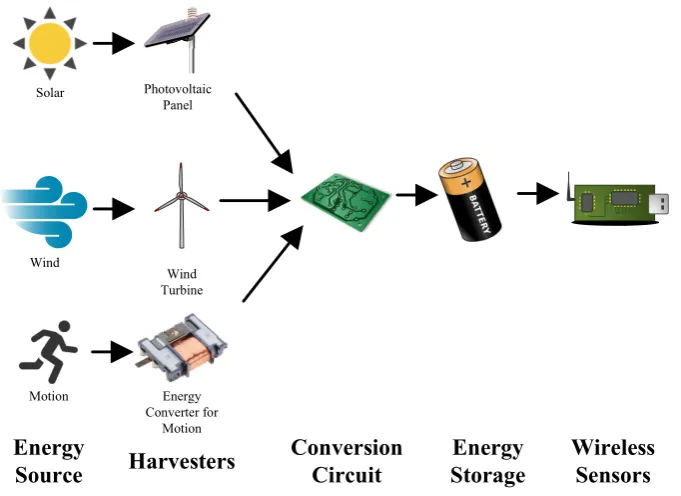
1.1 Energy harvesting sources: solar wind, and motion . . . 6
2.1 Classification of Routing Protocols . . . 12
2.2 Selective forwarding attack . . . 23
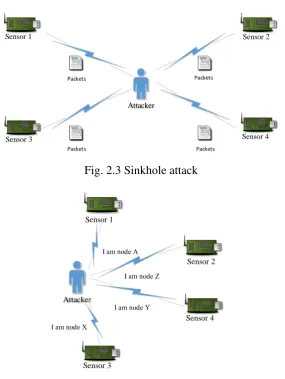
2.3 Sinkhole attack . . . 24
2.4 Sybil attack . . . 24
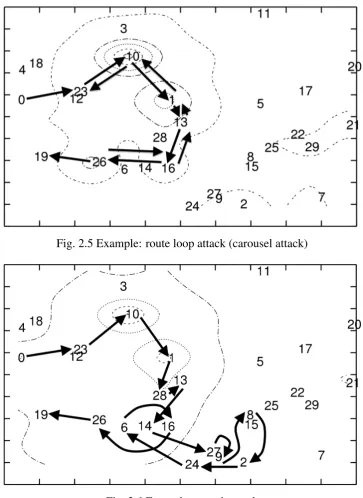
2.5 Example: route loop attack (carousel attack) . . . 29
2.6 Example: stretch attack . . . 29
3.1 Relation between energy availability and distance penalty . . . 33
3.2 RREQ message format in original AODV [80] . . . 34
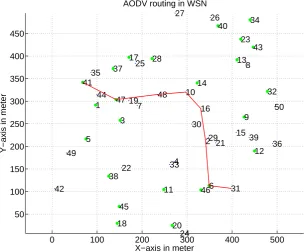
3.3 A simple example: route Determined by AODV . . . 39
3.4 A simple example: route determined by DEHAR . . . 39
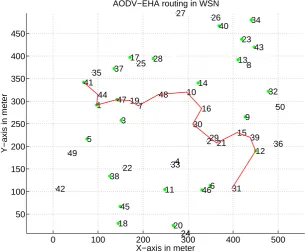
3.5 A simple example: route determined by AODV-EHA . . . 40
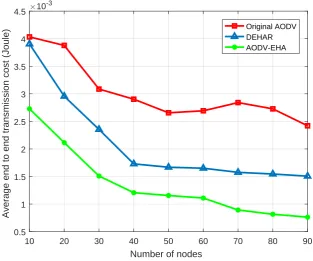
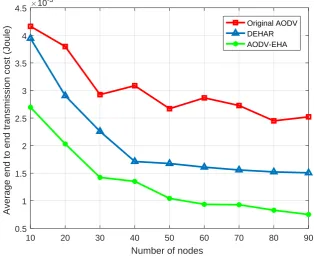
3.6 Average transmission cost versus the number of nodes . . . 42
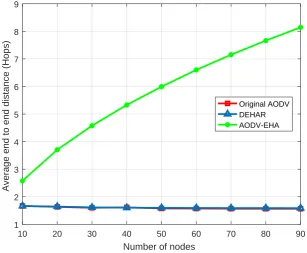
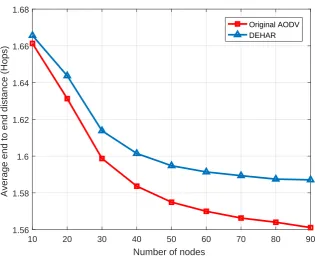
3.7 Average route length (hop count) versus the number of nodes . . . 43
3.8 Average route length (hop count) versus the number of nodes . . . 43
3.9 Average transmission cost versus the number of nodes . . . 45
3.10 Average route length (hop count) versus the number of nodes . . . 46
3.11 Average route length (hop count) versus the number of nodes . . . 46
4.1 Example of WSN application scenario . . . 52
4.2 RREQ message format in original AODV . . . 53
List of figures xi
4.4 A Bayesian network example . . . 59
4.5 Example of network decomposition . . . 69
4.6 Average route risk level (average number of compromised nodes en-countered on the route) . . . 69
4.7 Average end to end transmission cost (Joule) . . . 71
4.8 Average end to end transmission cost (Joule) . . . 71
4.9 Average end to end transmission cost (Joule) . . . 72
4.10 Average route length (hops) versus the number of nodes . . . 73
4.11 Average route length (hops) versus the number of nodes . . . 74
4.12 Average route length (hops) versus the number of nodes . . . 74
5.1 General concept of detection and protection against of Vampire attacks 78 5.2 Process of trilateration . . . 82
5.3 Format of data buffer . . . 84
5.4 Bayesian network for information aggregation . . . 86
5.5 Problem structure . . . 91
5.6 Route determination example . . . 96
5.7 Average end to end overall transmission cost (Joule) . . . 97
5.8 Average end to end transmission cost (Joule) . . . 97
5.9 Average end to end transmission cost (Joule) . . . 98
5.10 RCPED performance with different buffer size . . . 101
5.11 RCPED performance with different buffer size . . . 101
List of tables
3.1 Simulation setup . . . 40
4.1 Incomplete data setsD . . . 60
4.2 Initial estimates . . . 61
4.3 Completed data sets . . . 61
4.4 Simulation parameters . . . 67
5.1 Incomplete data setsD . . . 87
5.2 Initial estimates . . . 87
5.3 Degree of priority (importance) . . . 92
5.4 Different scales of priority setup . . . 92
List of Abbreviations
AHP Analytic Hierarchy Process
AODV Ad hoc On-demand Distance Vector
ASW Anti-Submarine Warfare
CBR Constant Bit Rate
DAG Directed Acyclic Graph
DoS Denial of Service
DSR Dynamic Source Routing
FIFO First-In First-Out
GPS Global Positioning System MCDA Multi Criteria Decision Analysis
RREP Route Reply
RREQ Route Request
SDT Soldier Detection and Tracking
Chapter 1
Introduction
Ad hoc networks are defined as self-configuring networks without infrastructure that are made up of mobile devices [106], and wireless sensor networks (WSNs) are a subset of ad hoc networks in which the “devices” are wirelessly interconnected sensor nodes. Sensor nodes may have functions including sensing, data relaying and data exchanging with other networks outside the WSNs [118], the number of nodes within a WSN may vary from a few to hundreds of thousands. WSNs are initially motivated by military applications (e.g. enemy detection and nuclear, biological or chemical attack detection), and later expanded to a wide range of civil applications, for instance, environmental applications (e.g. animals tracking, forest fire detection, and chemical leakage detection) and commercial applications (e.g. vehicles tracking) [121].
The general purpose of deploying WSNs is to transmit the useful information from any node to the desired destination. Usually this cannot be completed by direct transmission, and the data packet may travel through one or more intermediate nodes before reaching the destination. Thus the routing process to determine the best path between nodes is an important issue in WSNs.
1.1 Motivations 2
we are motivated to inquire into better routing solutions supporting WSN applications under the aforementioned constraints.
The reminder of this chapter is organized as follows. The motivations and research problems are presented in Section 1.1 and Section 1.2, respectively, followed by the background knowledge in Section 1.3. The contributions are addressed in Section 1.4. Section 1.5 presents the outline of this dissertation.
1.1
Motivations
While WSNs are useful for a wide variety of applications, this dissertation is focused on applications operating in extreme environments such as the battlefield and contaminated region, where the risk of harm prohibits any manual engineering work. Various WSN applications can be deployed in the battlefield. For soldier detection and tracking (SDT), unattended acoustic and seismic sensors are deployed at specific points to detect the approach of enemy soldiers in order to protect military sites or buildings [72]. At a distance, sensors can detect typical sounds made by soldier activities, e.g. walking, crawling, weapon handling, and talking. Another example of interest here is littoral anti-submarine warfare (ASW) that utilizes small and low cost sensors equipped with passive or active sonar, which can be deployed in large numbers (hundreds or thousands) to provide a high density sensor field to detect enemy submarines [107]. These sensors have a short detection range and are far less susceptible to multi-path reverberations and other acoustic artefacts.
For a reliable deployment of these aforementioned applications, some underlying issues need to be solved including energy efficiency, security guarantees and so on. Considering the inherent properties of the selected WSN applications, various aspects of the problems should be noted:
1.1 Motivations 3
network topology is not known a priori, and will likely change over time due to exterior forces (e.g. explosions and movements). The networks are ad hoc by necessity in these environments.
• Second, the nodes in the applications of interest are often physically unreachable after deployment. Consequently, replacement of the energy source (typically a battery) is difficult or impossible. In order for the network to operate as long as possible, nodes may be capable of harvesting energy, and network routing protocols should select routes to minimize energy cost.
• Third, the network faces the risk of attacks to interfere with operations, such as selective forwarding, wormhole attacks, sinkhole attacks, and Sybil attacks [49]. Nodes may become compromised which could be very difficult to detect. It is commonly assumed that compromised nodes may exhibit suspicious be-haviour, which is monitored and factored into a reputation system that calculates a reputation for every node and adapts route selections to avoid nodes with low reputations. Moreover, suspected nodes are prevented from participating in the routing protocol.
1.2 Research Problems 4
1.2
Research Problems
All throughout this dissertation, the main intention is to improve the performance and reliability of WSNs. To this end, based on the discussions above, we shall focus the research work on the following topics: energy efficiency and security. The research problems related to the topics will be investigated based on the inherent properties of WSNs, and we aim to propose solutions while paying attention to the characteristics of nominated WSN applications working in severe environments.
The first goal is to explore the possible external energy source that can be applied in WSNs. The available energy that can be harvested from the external energy source (e.g. solar energy harvested from sunlight) shall be statistically modelled. Based on the discovered energy harvesting model, it is expected to propose an enhanced (energy harvesting aware) Ad hoc On-Demand Distance Vector (AODV) routing protocol to improve the energy efficiency of network. The proposed protocol shall exhibit better performance in terms of lower overall energy consumption in data transmission. It is also preferable that the proposed protocol is designed without adding too much complexity.
In addition to the energy efficiency, this dissertation also targets security issues in WSNs. With respect to securities, the second research problem is set in the dissertation is to discover a way to analyse nodes’ behaviours, and extract useful information that can be further utilized in routing. The status of the sensor nodes shall be evaluated by watching and recording their behaviours, and the trustworthiness of nodes can be determined quantitatively. Based on the watching records, it is expected to propose a trustworthiness determination scheme that issues a novel way to detect compromised nodes in the network.
1.3 Background Knowledge 5
that here balances the two concerns (energy efficiency and security) simultaneously by means of the aforementioned novel method.
The final goal is to study a specific type of attack (Vampire attack) targeting the energy storage of WSNs. Existing routing solutions against Vampire attack are heavily relied on cryptographic authentication, while this dissertation is trying to propose a routing solution independent of the power consuming cryptographic methods. Certain information of previous transmissions in the network are recorded, and an energy efficient malicious node detection method shall be presented with the help of those transmission records. Based on the results, it is expected to provide a routing protocol that can bypass potential compromised nodes as much as possible in route discovery while paying attention to energy efficiency.
1.3
Background Knowledge
1.3.1
Overview of the Energy Harvesting Technology
As mentioned in Section 1.1, one interesting feature of the nominated WSN applications in this dissertation is that the nodes are often unreachable after deployment, as a result replacement of energy source (usually battery) is difficult or even impossible. In this case, when the energy of a node goes down the only option is deploy a new one and bring extra cost, hence we intend to make the nodes work as longer time as possible and energy efficiency become crucial under the provision of limited energy storage. To tackle this issue, some efforts on improving the energy efficiency of routing protocol itself have been made, such as the routing method described in [90] develop a way to minimize energy consumed for routing data packets, but the shortage is that location information is required.
1.3 Background Knowledge 6
Motion Solar
Energy Converter for
Motion
Energy
Source Harvesters
Conversion Circuit
Energy Storage
Wireless Sensors
Photovoltaic Panel
Wind
[image:20.595.122.463.68.316.2]Wind Turbine
Fig. 1.1 Energy harvesting sources: solar wind, and motion
load, where energy source is the source of energy that could be collected from (e.g. solar, wind, and thermal), harvesting architecture implies the mechanisms that how the energy is harvested and transformed to electricity, and load represents the consumption of harvested energy [104].
1.3 Background Knowledge 7
Among aforementioned potential candidates, wind power is not suitable for WSNs as the size of wind driven generator is too bulky to be mounted on a wireless sensor node. Motion power is also off the table since the WSN applications we are talking about are deployed in severe environment in which human activities are rare (means very limited energy source or even does not exist). The solar power is quite considerable because not only the sunlight is easy to access, but also the solar panel could be made small enough to be mounted on the wireless sensor nodes.
Then sensors with energy harvesting device can be deployed in the network and may contribute to reduction of the transmission cost. On the other hand, since the factor “energy harvesting” is injected, the existing mechanism of the WSNs might be affected, such as routing strategy, which brings opportunities of improving the existing routing solutions by taking advantage of the energy harvesting technology.
1.3.2
Security Issues in WSNs
Talking about the military WSN applications mentioned in Section 1.1, they are naturally under the threats from enemies, who are keen on paralysing the functionality of those WSNs. In general sense, security threats on WSNs have been well studied [123], most of these previously studied various types of attacks have a common feature: they interfere the functionality of network immediately, or in short term. Thus even the source of these attacks may not be determined promptly, but the disruptions caused are enough to trigger an alarm indicating that attacks are under way, and afterwards the network operator would take actions to mitigate or eliminate (if possible) the effect of these attacks sooner or later. From the attackers’ perspective, this kind of attack pattern may have very limited availability, especially when their targets are for military use, which means the users of WSNs have taken potential security threats into consideration before deployment.
1.4 Dissertation Contributions 8
may seek to undermine the network over time, disrupt its long-term availability without being noticed. They are so called Vampire attacks [110] that try to deplete the network resources (e.g. energy storage on nodes, usually batteries) silently. Since the WSN applications (such as environmental surveillance and enemy detection) we focused on are operating in extreme environments, they are very sensitive to energy storage and the damage of Vampire attacks can be fatal.
1.4
Dissertation Contributions
Research in this dissertation is intended to directly benefit WSN applications working in severe environments. This dissertation is expected to provide energy efficient, reliable and secure routing solutions for the relevant WSN applications. The main contributions are the following.
First, this dissertation considers energy efficiency of routing protocols in WSNs. Many routing protocols for sensor network have been proposed, some of them tried to cope with the ad hoc nature while some others focused on improving the energy efficiency. We propose an Energy Harvesting Aware Ad hoc On-Demand Distance Vector Routing Protocol (AODV-EHA) that not only inherits the advantage of existing AODV in dealing with WSN’s ad hoc nature, but also makes use of the energy har-vesting capability of the sensor nodes in the network, which is very meaningful to the data transmission in the environmental and military applications under consideration. Simulation results show the proposed routing protocol has an advantage over competing routing protocols in terms of energy cost for data packet delivery.
1.5 Dissertation Outline 9
incurring additional cost in overhead compared to the common AODV routing protocol. Simulation results show that in comparison to previously proposed routing protocols, namely AODV-EHA and LTB-AODV (Light-Weight Trust-Based Routing Protocol), the proposed ETARP can keep the same security level while achieving more energy efficiency for data packet delivery.
At last, we look into an instance of resource depletion attack – Vampire attacks, and provide a resource-conserving protection against energy draining (RCPED) protocol which is independent of cryptographic methods. RCPED collaborates with existing routing protocol, detects abnormal signs of Vampire attacks and determines the possible attackers. Route selection in RCPED is based on Analytic Hierarchy Process (AHP). The concept of AHP is an approach developed to help making decisions (in our case, choosing the best route) under multiple concerns (in our case, energy efficiency and risk level of routes under Vampire attacks). RCPED discovers and selects routes on the basis of maximum priorities which a calculated by AHP. Simulations results show that RCPED achieves the minimum overall energy cost (overall energy cost reflects the energy efficiency performance and security performance simultaneously), in comparison to existing routing protocols, i.e. AODV-EHA and PLGPa.
1.5
Dissertation Outline
The rest of the dissertation is organized as follows. The related work about WSN relevant topics are introduced in Chapter 2. Starting from the routing issues of WSNs, it gives an overview of existing routing solutions with various concerns, from which WSN applications could benefit from. Next, we give a brief review of security threats that may interfere with the functionality of WSNs, followed by the countermeasures already proposed.
1.5 Dissertation Outline 10
simulations, the performances of AODV-EHA are evaluated and compared with the existing work.
Chapter 4 introduces the ETARP routing protocol for WSN applications operating in extreme environments. The central concepts (such as the use of utility theory) in the ETARP are presented. The methods to estimate energy consumption and risk of node compromise are explained. Energy efficiency performance and safety performance evaluations in terms of simulation results are presented and compared with existing routing solutions.
Chapter 5 investigates how to protect routing protocols from the Vampire attacks in a more energy efficient way. The details of detection over Vampire attacks are given. We also discuss how to mitigate the harm come with the attacks. Performance evaluations of the proposed solution in terms of overall energy cost, which reflect the energy efficiency performance and security performance simultaneously, are presented as well.
Chapter 2
Literature Review
2.1
Routing Issues in WSNs
The main purpose of deploying WSNs is to transmit the useful information collected from sensor nodes to the desired destinations, and usually there are multiple choices of paths available. Determination of the best one, namely, the routing process is an important issue in WSNs. There have been tremendous works for the development of routing protocols in WSNs [3, 92, 106], furthermore, a lot of research is still ongoing. All these protocols can be classified into different categories, according to (including but not be limited to) application needs, architecture of the network, or protocol operation. For the sake of avoiding confusion, we use two categorizations, depending on network architecture and protocol operation, respectively, as illustrated in Figure 2.1.
2.1.1
Protocols Classification Based on Network Structure
2.1 Routing Issues in WSNs 12
Routing Protocols In WSNs
Based on Network Structure
Based on Protocol Operation
Flat Routing Hierarchical
Routing
Location Based Routing
Multipath Routing
Negotiation-Based Routing
Query Based Routing
Coherent and Non-Coherent
Routing
Fig. 2.1 Classification of Routing Protocols
Flat Routing
The term “flat” here implies that every node acts the same role in flat networks, and a flat addressing scheme is chosen in flat routing protocols [36]. In the rest of this subsection, we present some representative examples and highlight their characteristics.
Directed Diffusion [40] is data-centric, in that all communication is for named data. The sink node sends queries to certain regions and waits for data from the sensors located in the selected regions. In Directed Diffusion-based networks all nodes are application aware, which enables diffusion to achieve energy savings by selecting empirically good paths and by caching and processing data in-network. The evaluation and the performance results in [40] also show that even with relatively unoptimized path selection, Directed Diffusion outperforms an idealized traditional data dissemination scheme like omniscient multicast.
2.1 Routing Issues in WSNs 13
for data delivery, for instance, when an interested node is very far from the advertised, then that interested node will not get any data if nodes between these two nodes are not interested in the data.
Dynamic Source Routing (DSR) [45] adapts quickly to routing changes when hosts move frequently, yet only requires little or even no overhead during periods in which hosts move less frequently. This protocol performs well over a variety of environmental conditions such as host density and movement rates, according to the packet-level simulation results presented in this paper. However, in large networks where longer paths prevail, source routing packets cause larger overhead due to the stored path information.
In AODV [82], each mobile host operates as a specialized router, and routes are obtained as needed (on-demand) with little or even no reliance on periodic advertise-ments. AODV is quite suitable for a dynamic self-starting network, as required by users wishing to utilize ad hoc networks. AODV provides loop-free routes even while repairing broken links. In addition, this protocol requires no global periodic routing advertisements, the demand on the overall bandwidth available to the mobile nodes is significantly less than in those protocols that do necessitate such advertisements. On the other hand, AODV still inherit most of the advantages of basic distance-vector routing mechanisms. Nevertheless, since flooding is used for controlling message dissemination and route maintenance, routing control overhead may grow high [83].
2.1 Routing Issues in WSNs 14
to the scalability of the protocol, especially when user population is large (means large overhead).
Hierarchical Routing
Hierarchical, or the so called cluster-based routing methods, are with special advantages in scalability and efficient communication. The term “hierarchical” here means, higher-energy nodes with higher residual higher-energy are used to process and send the information, while the ones with lower residual energy can be used to perform the sensing tasks. The formation of clusters and assigning special tasks to cluster heads can greatly improve the overall system scalability, lifetime, and energy efficiency. In the rest of this subsection, we present some representative examples and highlight their characteristics.
Low Energy Adaptive Clustering Hierarchy (LEACH) [34] is a clustering-based protocol that utilizes randomized rotation of local cluster base stations (cluster-heads) to evenly distribute the energy load among the sensors in the network. LEACH uses localized coordination to enable scalability and robustness for dynamic networks, and incorporates data fusion into the routing protocol to reduce the amount of information that must be transmitted to the base station. LEACH minimizes global energy usage by distributing the load to all the nodes at different timing. At different times, each node has the burden of acquiring data from the nodes in the cluster, fusing the data to obtain an aggregate signal, and transmitting it to the base station. LEACH is completely distributed, not requiring any control information from the base station, and the nodes do not need knowledge of the global network in order to maintain the operation of LEACH. However, LEACH uses single-hop routing where each node can transmit data to the cluster-head and the sink directly, hence, it may not be suitable for networks deployed in large regions.
outper-2.1 Routing Issues in WSNs 15
forms LEACH by eliminating the overhead of dynamic cluster formation, minimizing the distance non leader-nodes must transmit, limiting the number of transmissions and receives among all nodes, and using only one transmission to the base station per round. The drawback of PEGASIS protocol is the redundant transmission of the data. This is due to the fact that PEGASIS does not consider the base station’s location about the energy of nodes when one of them is selected as the head node.
Hierarchical State Routing (HSR) [79] is a soft state wireless hierarchical routing protocol. The authors distinguish between the “physical” routing hierarchy (dictated by geographical relationships between nodes) and “logical” hierarchy of subnets in which the nodes move as a group HSR keeps track of logical subnet movements using Home Agent concepts similar to Mobile IP. Compared with flat, table driven routing schemes (such as DSDV (Highly Dynamic Destination-Sequenced Distance-Vector Routing) [81]) HSR achieves a much better scalability, at the cost of non-optimal routing and increased complexity.
Cluster Head Gateway Switch Routing (CGSR) [21] is a multicast protocol inspired by the Core Based Tree approach (initially developed for the internet). CGSR is robust to mobility, has low bandwidth overhead and latency, scales well with membership group size, and can be generalized to other wireless infrastructure (other than hierarchical). Nevertheless, it is difficult for CGSR to maintain the cluster structure in a mobile environment.
Location Based Routing
2.1 Routing Issues in WSNs 16
Geographic Adaptive Fidelity (GAF) [116] saves energy by identifying nodes that are equivalent from a routing perspective and then shutting down unnecessary nodes, keeping a constant level of routing fidelity. GAF moderates this policy by using application-level and system-level information; nodes that source or sink data remain on and intermediate nodes monitor and balance energy use. GAF focus on turning the radio off as much as possible. It adapts sleep time based on node location scaling back node duty cycles (and so reducing routing “fidelity” when many interchangeable nodes are present. The authors have shown that it performs at least as well as a normal ad hoc routing protocol for packet loss and route latency while conserving substantial energy, and allowing network lifetime to increase in proportion to node density. But the requirement of GPS devices may be difficult for some networks.
SPAN [18] is a location-based and distributed coordination technique that reduces energy consumption without significantly diminishing the capacity or connectivity of the network. Within SPAN, nodes make local decisions on whether to sleep, or to join a forwarding backbone as a coordinator. Each node bases its decision on an estimate of how many of its neighbours will benefit from it being awake, and the amount of energy available to it. SPAN provides a randomized algorithm where coordinators rotate with time, demonstrating how localized node decisions lead to a connected, capacity-preserving global topology. But on the negative side, existing and new coordinators do not have to be neighbours, which in fact makes SPAN less energy-efficient because of the need to maintain the positions of two- or three-hop neighbours.
2.1 Routing Issues in WSNs 17
LAR involves network-wise flooding to obtain location information, which makes the control overhead increases as the network grows.
2.1.2
Protocols Classification Based on Protocol Operation
Multipath Routing Protocols
In this type of routing, the protocol uses multiple paths instead of a single path, which has the advantage to enhance network performance. Furthermore, network reliability can be increased since multipath routing is more resilient to route failures (at the cost of overhead in maintaining alternative paths).
Label-based Multipath Routing (LMR) [37] is a routing protocol using only local-ized information. LMR can efficiently find a disjoint or segmented backup path to provide protection to the working path. LMR utilizes the label information to search segmented backup path if a disjoint path is not found, reducing overhead and delay. Furthermore, LMR can take advantage of local multicast, significantly reducing the routing overhead. However, to find the possible backup paths, LMR consumes extra overhead, to send label messages, label reinforce messages and backup exploratory messages.
In [16], the authors formulate the routing problem as to maximize the network lifetime. This problem formulation has revealed that the minimum total energy (MTE) routing is not suitable for network-wise optimum utilization of transmission energy. A shortest cost path routing algorithm is proposed which uses link costs that reflect both the communication energy consumption rates and the residual energy levels at the two end nodes. The algorithm is amenable to distributed implementation. It shows that significant improvement can be made in terms of maximizing the system lifetime, which can also be interpreted as maximizing the amount of information transfer between the source and destination nodes with limited energy supply.
2.1 Routing Issues in WSNs 18
node through some candidate parent nodes. Because distributing the load to the nodes has a great impact on system lifetime, therefore main idea of HMRP is minimizing the path loading of the system by distributing the energy consumption among the nodes. In HMRP, sensor nodes do not to maintain the information of the whole path and they just keep their node information tables. The drawback of HMRP is that it broadcasts the layer construction packet only once.
Query Based Routing
In Query-based routing protocols, the destination nodes propagate a query for data, or so called sensing task, through the network, and a node with this data sends the data that matches the query back to the node that initiated the query [94]. Normally, these queries are described in natural language or high-level query languages.
The Directed Diffusion [40] which has been introduced earlier can be considered as an example of query based routing as well. In Directed Diffusion, the sink node sends its interest messages to sensors. As the interest messages are propagated throughout the network, the gradients from the source back to the sink are set up. When the source has data for the interest, the source sends the data along the interest’s gradient path. For the sake of lower energy consumption, data aggregation is carried out en route.
2.1 Routing Issues in WSNs 19
trade-offs between setup overhead and delivery reliability, but the problem is that it may broadcast duplicated messages to the same node.
Negotiation-Based Routing
In this type of protocols, meta-data negotiations (high-level data descriptors through negotiation) are utilized to reduce redundant data transmissions. Communication decisions can be made based on the resources available to them as well.
The SPIN family protocols [35] mentioned earlier and the protocols in [56] are examples of negotiation-based routing protocols. The SPIN family of protocols consists of two basic ideas : first, sensor applications need to communicate with each other about the data that they already have and the data they still intend to obtain, so as to operate efficiently and to conserve energy; second, nodes must monitor and adapt to changes in their own energy resources to maximize the operating lifetime of the network.
QoS-based Routing
In QoS-based routing protocols, the network has to balance between energy consump-tion and data quality [1, 99]. Specifically, the network has to satisfy certain QoS metrics, such as delay, energy, bandwidth, and the like, when delivering data to the sink.
In the best-effort routing the main concerns are the throughput and average response time. QoS routing is usually performed through resource reservation in a connection-oriented communication that meet the QoS requirements for each individual connection. While many mechanisms have been proposed for routing QoS constrained real-time multimedia data in wire based networks, they cannot be directly applied to WSNs due to the limited resources, such as bandwidth and energy that a sensor node has.
2.1 Routing Issues in WSNs 20
SAR algorithm is to minimize the average weighted QoS metric throughout the lifetime of the network. However, in order to maintain tables and states that store the above mentioned information at each sensor node, the overhead may be high, especially when the nodes number is large.
Another QoS routing protocol for WSNs that provides soft real-time end-to-end guarantees is SPEED [32], which is designed to avoid congestion when the network is congested. The routing module in SPEED is called Stateless Geographic Non-Deterministic forwarding (SNFG) and works with four other modules at the network layer. Compared to DSR and AODV which are mentioned earlier, SPEED performs better in terms of end-to-end delay and miss ratio. Furthermore, the total transmission energy and control packet overhead are less because of the simplicity of the routing algorithm. Nevertheless, the performance of of SPEED is not very good when the network is heavily congested.
Coherent and Non-coherent Based Routing
In operation of WSNs, data processing is a major component. The sensor nodes cooperate with each other in processing the data within the network. The routing mechanism which initiates the data processing module is proposed in [100]. This mechanism is divided into two categories: coherent and non-coherent data-processing based routing. For non-coherent based routing [46], the raw data is processed by sensor nodes locally before it is sent to other nodes (aggregators) for further processing. In coherent based routing, only minimum processing (such as time stamping and duplicate suppression) is done for raw data before it is sent to aggregators.
In [11, 100], Single Winner Algorithm (SWE) and Multiple Winner Algorithm (MWE) are proposed for non-coherent and coherent processing, respectively.
2.2 Energy Efficient Routing Protocols 21
MWE is a simple extension of SWE. When all nodes are sources and send their data to the central aggregator node, a large amount of energy will be consumed. In order to lower the energy cost, limit the number of sources that can send data to the central aggregator node is a possible solution. Instead of keeping a record of only the best candidate node, each node will keep a record of up to n nodes of those candidates. At the end of the MWE process, each sensor in the network holds a set of minimum-energy paths to each source node. After that, SWE is utilized to determine the node that yields the minimum energy consumption.
2.2
Energy Efficient Routing Protocols
The most straightforward thinking of improving energy efficiency of WSNs is to design energy efficient sensors. Work was started in academic institutions, but a number of enterprises have joined the team in recent years, including companies such as Crossbow, Dust Networks, Ember Corporation, Sensoria and Wordsens. These commercial efforts make the sensor devices ready for real deployment in various WSN applications, together with a serious of tools for sensor programming and maintenance [76].
In parallel to the progress in sensor hardware, some efforts have been made to improve the energy efficiency of the routing protocols themselves. For example, the distributed position-based routing method described in [90] attempts to minimize the energy consumed for routing data packets, but the drawback is that location information is required. Given any number of randomly deployed nodes over an area, a simple local optimization scheme executed at each node guarantees strong connectivity of the entire network and attains the global minimum energy solution for stationary networks. Due to its localized nature, this protocol is self-reconfiguring.
ap-2.3 Energy Harvesting Aware Routing Protocols 22
proach may not be suitable for some WSN applications because the sink (or destination node) is assumed to be fixed.
Efficient Minimum-Cost Bandwidth-Constrained Routing (EMCBCR) [15] is de-signed to select the routes and the corresponding power levels for the sake of maximizing the time until batteries of the nodes drain-out. EMCBCR is local and amenable to distributed implementation. If there is a single power level, the problem is reduced to a maximum flow problem with node capacities and the algorithms converge to the optimal solution. If there are multiple power levels then the achievable lifetime is close to the optimal most of the time. EMCBCR is a simple, scalable and efficient solution for minimum cost routing in WSNs. In fact the term “minimum cost” refers to maximum network lifetime, achieved by choosing the route with maximum energy reserve which is not exactly the same as a route with minimum energy cost.
2.3
Energy Harvesting Aware Routing Protocols
Another research direction to improve energy efficiency is to consider renewable energy from an external energy source. Renewable energy can be harvested from the surround-ing environment by various means such as solar, wind, thermal, or motion [13], that is, energy harvesting which has been introduced in Section 1.3.1. Solar power is well suited to WSNs because not only sunlight is easy to access but also solar panels can be made small enough to be mounted on wireless sensor nodes.
A notable routing algorithm that is energy harvesting aware is the Distributed Energy Harvesting Aware Routing Algorithm (DEHAR) [42], which defines a new metric of “energy distance” (including energy harvesting) for selecting the best route. By this metric, DEHAR aims to find the route with minimum total energy distance rather than spatial distance. DEHAR calculates the shortest energy distance by using a method such as Directed Diffusion, a flooding mechanism incurring extra routing overhead.
2.4 Conventional Types of Attack on WSNs 23
Attacker
Sensor 1 Sensor 2
Packets: 1, 2, 3, 4, 5,
...
Packets: 4, 5, 6, ...
Fig. 2.2 Selective forwarding attack
adjust the duty cycle of each node adaptively in order to exploit the available energy resources efficiently in comparison to other opportunistic routing protocols. However, geographical information is required, which may not be well suited to some applications.
2.4
Conventional Types of Attack on WSNs
Security challenges in WSNs are similar to those in mobile ad hoc networks identified in [101, 123]. As being military applications, the network faces the risk of attacks from enemies to interfere with operations, such as selective forwarding, wormhole attacks, sinkhole attacks, and Sybil attacks [2, 49]. Nodes may become compromised which could be very difficult to detect. It is commonly assumed that compromised nodes may exhibit suspicious behaviour, which can be monitored and factored into a reputation system that calculates a reputation for every node and adapts route selections to avoid nodes with low reputations. Moreover, suspected nodes are prevented from participating in the routing protocol.
Below are examples of some conventional attacks that are the main threats to routing in WSNs.
2.4.1
Selective Forwarding Attack (Grey Hole Attack)
2.4 Conventional Types of Attack on WSNs 24
Attacker
Sensor 1 Sensor 2
Sensor 3 Sensor 4
Packets Packets
[image:38.595.156.442.60.440.2]Packets Packets
Fig. 2.3 Sinkhole attack
Attacker Sensor 1
Sensor 2
Sensor 3
Sensor 4
Fig. 2.4 Sybil attack
threat can make things even worse if a malicious node is explicitly included on the route [117].
2.4.2
Sinkhole Attack
As shown in Figure 2.3, a compromised node tries to attract all surrounding nodes to establish routes through itself. If the sinkhole attack is successful, then the network is also vulnerable to other attacks, such as eavesdropping or selective forwarding [71].
2.4.3
Sybil Attack
2.4 Conventional Types of Attack on WSNs 25
to geographic and multipath routing protocols, since the malicious node can appear in multiple positions [49].
In addition, the authors of [69, 70] have discussed more routing attacks that can threat WSNs, e.g. fairness attack, sleep attack [85], and wormhole attack [51].
2.4.4
Existing Attack Countermeasures: Detection and
Elimina-tion of Malicious Behaviours
To deal with Grey hole attack, the Forwarding Assessment Based Detection (FADE) [63] scheme is proposed to mitigate collaborative grey hole attacks. Specifically, FADE detects sophisticated attacks by means of forwarding assessments aided by two-hop acknowledgement monitoring. Moreover, FADE can coexist with contemporary link security techniques. The optimal detection threshold, that minimizes the sum of false positive rate and false negative rate of FADE, is analysed while considering the network dynamics due to degraded channel quality or medium access collisions.
For sink hole attack, [73] present an algorithm for detecting the intruder. This algorithm first makes a list of suspected nodes, and then effectively identifies the intruder in the list through a network flow graph. The algorithm is also robust to deal with cooperative malicious nodes that attempt to hide the real intruder.
As to Sybil Attack, [122] investigates Sybil attacks and defence schemes in Internet of Things (IoT). The authors first define three types of Sybil attacks according to the Sybil attacker’s capabilities, then present some Sybil defence schemes, including Social Graph-Based Sybil Detection (SGSD), Behaviour Classification-Based Sybil Detection (BCSD), and mobile Sybil detection with the comprehensive comparisons.
2.4 Conventional Types of Attack on WSNs 26
supersedes much of the previous work that deals with several types of attacks (usually one approach can only deal with a specific type of attack) including wormhole, rushing, partial deafness, routing loops, routing black holes, routing grey holes, and network partition attacks.
2.4.5
Existing Attack Countermeasures: Efforts Made on Routing
Solutions
Some existing routing protocols such as TinySec [48], SPINs [84], TinyPK [113], and TinyECC [62] attempt to eliminate unauthorized behaviour of malicious sensor nodes with the help of encryption or authentication on data packets. However, these solutions may be difficult for WSNs. For instance, data encryption is applicable for mobile ad hoc networks but generally not practical for WSNs because sensors have limited data processing capability and energy storage. Therefore, in addition to cryptographic solutions, routing algorithms that employ notions of trust and reputation have been proposed.
A trust-based reactive multipath routing protocol, Ad hoc On-Demand Trusted-path Distance Vector (AOTDV) [59], is an extension of the AODV routing protocol and the Ad hoc On-demand Multipath Distance Vector (AOMDV) [67] routing protocol. This protocol is able to discover multiple loop-free paths as candidates in one route discovery. These paths are evaluated by two aspects: hop counts and trust values. This two-dimensional evaluation provides a flexible and feasible approach to choose the shortest path from the candidates that meet the requirements of data packets for dependability or trust.
2.5 Routing Protocols Including Energy Efficiency and Security 27
in any routing protocol. Note that the authors have used AODV as the base routing protocol.
The above two approaches passively observe forwarded data traffic and then calcu-late the risk level of different routes in terms of “trust values”, the routing algorithm then chooses the most trusted route. But there are some drawbacks: first, reputation system used in AOTDV or LTB-AODV watches for a single specific behaviour only; furthermore, they solely focus on security with no special attention given to energy efficiency concerns. Therefore, new routing solutions that can monitor multiple node behaviours and make comprehensive judgements on node status, while giving enough attention to the crucial energy efficiency are worth studying.
2.5
Routing Protocols Including Energy Efficiency and
Security
There are a few papers starting to consider security and energy efficiency at the same time.
For instance, Ferng and Rachmarini [28] proposed a secure routing protocol for WSNs considering energy efficiency. With the location and energy-aware characteristics for routing, the protocol gives a better delivery rate, energy balancing, and routing effi-ciency. In addition, the proposed security mechanism ensures the data authenticity and confidentiality in the data delivery. But it has a disadvantage requiring information about node locations to improve energy efficiency. Furthermore, it depends on encryption which can be a heavy computation cost for sensor nodes.
2.6 Security Concerns of Energy Depletion Attacks on WSNs 28
The above schemes generate extra overhead, thus the grantee of security with reduced energy cost could be a research of interest.
2.6
Security Concerns of Energy Depletion Attacks on
WSNs
Since sensors deployed in WSNs have limited computation and energy resources, they are vulnerable to resource depletion attacks, such as Denial of Service (DoS) attack and the forced authentication attacks [33].
The power draining attack is a sub-category of resource depletion attack, given that battery is considered as the resource of interest. Rather than disabling the immediate availability, a power draining attack is trying to deplete the network’s power over a long time horizon. Vampire attacks, an instance of the power draining attack, target routing protocols used in WSNs even those designed to be secure [110]. Vampire attacks are not protocol-specific. Instead, they exploit the general properties of routing protocols. Even worse, they use protocol-compliant messages, which makes themselves difficult to be detected and prevented.
Some simple attempts similar to Vampire attacks have been made, such as the power draining or resource exhaustion attacks described in [78, 102]. Rather than generating tremendous data to paralyse the network, Vampire attacks tend to inflict harm on the network little by little. Since Vampire attacks comply with the existing routing protocols, and data deliveries will be accomplished at the end (but just cost more resources than usual), these features make them even more difficult to be detected.
2.6 Security Concerns of Energy Depletion Attacks on WSNs 29
strength of their attack by selecting destinations designed to
maximize energy usage.
Per-node energy usage under both attacks is shown in
Fig. 2. As expected, the carousel attack causes excessive
energy usage for a few nodes, since only nodes along a
shorter path are affected. In contrast, the stretch attack
shows more uniform energy consumption for all nodes in
the network, since it lengthens the route, causing more
nodes to process the packet. While both attacks significantly
network-wide
energy usage, individual nodes are also
noticeably affected, with some losing almost 10 percent of
their total energy reserve
per message
. Fig. 3a diagrams the
energy usage when node 0 sends a single packet to node 19
in an example network topology with only honest nodes.
Black arrows denote the path of the packet.
Carousel attack.
In this attack, an
adversary sends a packet
with a route composed as a series of loops
, such that the same
node appears in the route many times. This strategy can be
used to increase the route length beyond the number of
nodes in the network, only limited by the number of
allowed entries in the source route.
2An example of this
type of route is in Fig. 1a. In Fig. 3b, malicious node 0 carries
out a carousel attack, sending a single message to node 19
(which does not have to be malicious). Note the drastic
increase in energy usage along the original path.
3Assuming
the adversary limits the transmission rate to avoid
saturat-ing the network, the theoretical limit of this attack is an
energy usage increase factor of
O
ð
Þ
, where
is the
maximum route length.
Overall energy consumption increases by up to a factor
of 3.96 per message. On average, a randomly located
carousel attacker in our example topology can increase
network energy consumption by a factor of
1
:
48
0
:
99
. The
reason for this large standard deviation is that the attack
does not always increase energy usage—the length of the
adversarial path is a multiple of the honest path, which is in
turn, affected by the position of the adversary in relation to
the destination, so the adversary’s position is important to
the success of this attack.
Stretch attack.
Another attack in the same vein is the
stretch attack, where a malicious node constructs artificially long
source routes
, causing packets to traverse a larger than
optimal number of nodes. An honest source would select the
route
Source
!
F
!
E
!
Sink
, affecting four nodes
includ-ing itself, but the malicious node selects a longer route,
affecting all nodes in the network
. These routes cause nodes
that do not lie along the honest route to consume energy by
322 IEEE TRANSACTIONS ON MOBILE COMPUTING, VOL. 12, NO. 2, FEBRUARY 2013
Fig. 2. Node energy distribution under various attack scenarios. The
network is composed of 30 nodes and a single randomly positioned
Vampire. Results shown are based on a single packet sent by the
attacker.
Fig. 3. Energy map of the network in terms of fraction of energy
consumed per node. Black arrows show the packet path through the
network. Each dotted line represents an “energy equivalence zone,”
similar to an area of equal elevation on a topological chart. Each line is
marked with the energy loss by a node as a fraction of total original
charge.
[image:43.595.115.479.66.565.2]2. The ns-2 DSR implementation arbitrarily limits the route length to 16.
3. Energy usage is greatest at node 10 likely due to its distance from its
nearest neighbors.
Fig. 2.5 Example: route loop attack (carousel attack)
strength of their attack by selecting destinations designed to
maximize energy usage.
Per-node energy usage under both attacks is shown in
Fig. 2. As expected, the carousel attack causes excessive
energy usage for a few nodes, since only nodes along a
shorter path are affected. In contrast, the stretch attack
shows more uniform energy consumption for all nodes in
the network, since it lengthens the route, causing more
nodes to process the packet. While both attacks significantly
network-wide
energy usage, individual nodes are also
noticeably affected, with some losing almost 10 percent of
their total energy reserve
per message
. Fig. 3a diagrams the
energy usage when node 0 sends a single packet to node 19
in an example network topology with only honest nodes.
Black arrows denote the path of the packet.
Carousel attack.
In this attack, an
adversary sends a packet
with a route composed as a series of loops
, such that the same
node appears in the route many times. This strategy can be
used to increase the route length beyond the number of
nodes in the network, only limited by the number of
allowed entries in the source route.
2An example of this
type of route is in Fig. 1a. In Fig. 3b, malicious node 0 carries
out a carousel attack, sending a single message to node 19
(which does not have to be malicious). Note the drastic
increase in energy usage along the original path.
3Assuming
the adversary limits the transmission rate to avoid
saturat-ing the network, the theoretical limit of this attack is an
energy usage increase factor of
O
ð
Þ
, where
is the
maximum route length.
Overall energy consumption increases by up to a factor
of 3.96 per message. On average, a randomly located
carousel attacker in our example topology can increase
network energy consumption by a factor of
1
:
48
0
:
99
. The
reason for this large standard deviation is that the attack
does not always increase energy usage—the length of the
adversarial path is a multiple of the honest path, which is in
turn, affected by the position of the adversary in relation to
the destination, so the adversary’s position is important to
the success of this attack.
Stretch attack.
Another attack in the same vein is the
stretch attack, where a malicious node constructs artificially long
source routes
, causing packets to traverse a larger than
optimal number of nodes. An honest source would select the
route
Source
!
F
!
E
!
Sink
, affecting four nodes
includ-ing itself, but the malicious node selects a longer route,
affecting all nodes in the network
. These routes cause nodes
that do not lie along the honest route to consume energy by
322 IEEE TRANSACTIONS ON MOBILE COMPUTING, VOL. 12, NO. 2, FEBRUARY 2013
Fig. 2. Node energy distribution under various attack scenarios. The
network is composed of 30 nodes and a single randomly positioned
Vampire. Results shown are based on a single packet sent by the
attacker.
Fig. 3. Energy map of the network in terms of fraction of energy
consumed per node. Black arrows show the packet path through the
network. Each dotted line represents an “energy equivalence zone,”
similar to an area of equal elevation on a topological chart. Each line is
marked with the energy loss by a node as a fraction of total original
charge.
2. The ns-2 DSR implementation arbitrarily limits the route length to 16.
3. Energy usage is greatest at node 10 likely due to its distance from its
nearest neighbors.
Fig. 2.6 Example: stretch attack
• Route loop attack (carousel attack): as shown in Figure 2.5, in this attack pattern, an adversary purposely introduces routing loops and makes the same data packet travel repeatedly through the same group of nodes.
2.7 Summary 30
average route length, forcing packets to be received and forwarded by a number of nodes that are initially not supposed to participate.
To the best of our knowledge, there has been very little discussion on the prevention against the Vampire attacks. The existing proposed solution, such as PLGPa [110], a modified version of PLGP (clean-slate secure sensor network routing protocol) [78], highly rely on cryptographic methods, which can incur extra computation and transmis-sion cost. Considering the limited computing capability and energy storage of wireless sensors, better (meaning more energy efficient and requiring less hardware) mitigation scheme is worth investigating.
2.7
Summary
Chapter 3
AODV-EHA: Energy Harvesting
Aware Routing Protocol
3.1
Introduction
As addressed in Section 2.1, one limitation of traditional routing attempts for WSNs is that they just try to cope with either of two features, namely, WSN’s ad hoc nature and the utilization of energy harvesting technology in WSNs. Therefore, in this chapter, we propose the AODV-EHA that not only inherits the advantage of existing AODV on dealing with WSN’s ad hoc nature, but also make use of the energy harvesting capability of the sensor nodes in the network.
3.2 Comparison of AODV-EHA and Competitors 32
3.2
Comparison of AODV-EHA and Competitors
3.2.1
Overview of Original AODV Routing Protocol
As stated in [80], the network that adopts AODV is silent until a connection is requested. After that the sender (or source) node that needs a connection broadcasts a Route Request (RREQ) for connection. Other nodes in the network forward this message, and record the node that they heard it from, creating temporary routes back to the sender node. When a node receives such a message and already has a route to the desired receiver (or destination) node, it sends a Route Reply (RREP) backwards through a temporary route to the requesting node. The sender node then adopts the route with least hops through other nodes.
Eventually, the original AODV protocol attempts to figure out the route with least communication hops from any source node to the destination node. In other words, suppose the total number of possible routes in between isNr and along anyi-th route
(iis an integer and 1≤i≤Nr) there areJinodes, if thek-th route is the optimal one
determined by AODV, then it satisfiesJk=min[J1,J2, ...,JNr].
3.2.2
Overview of DEHAR
As mentioned in Section 3.1, the basic idea of DEHAR is to introduce a new concept of “energy distance”. The energy distance between a certain sender node and its receiver node can be considered as a weighted spatial distance that is related to the current energy status (how much energy could be harvested from ambient) of the sender. Assume along anyi-th route, the total energy distanceD(i)is defined as
D(i) =D(i,1) +D(i,2) +...+D(i,Ji−1) (3.1)
Supposemis an integer and 1≤m≤(Ji−1), thusD(i,m)is the energy distance
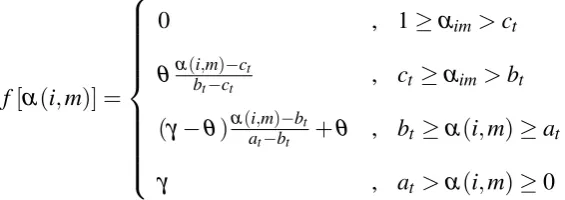
from nodemto m+1 and D(i,m) =d(i,m) +f[α(i,m)], whered(i,m)is the spatial