White Rose Research Online URL for this paper:
http://eprints.whiterose.ac.uk/110554/
Version: Accepted Version
Article:
Engstrom, J, Markkula, G orcid.org/0000-0003-0244-1582, Victor, T et al. (1 more author)
(2017) Effects of cognitive load on driving performance: The cognitive control hypothesis.
Human Factors, 59 (5). pp. 734-764. ISSN 0018-7208
https://doi.org/10.1177/0018720817690639
© 2017, Human Factors and Ergonomics Society. This is an author produced version of a
paper accepted for publication in Human Factors. Uploaded in accordance with the
publisher's self-archiving policy.
[email protected] https://eprints.whiterose.ac.uk/
Reuse
Unless indicated otherwise, fulltext items are protected by copyright with all rights reserved. The copyright exception in section 29 of the Copyright, Designs and Patents Act 1988 allows the making of a single copy solely for the purpose of non-commercial research or private study within the limits of fair dealing. The publisher or other rights-holder may allow further reproduction and re-use of this version - refer to the White Rose Research Online record for this item. Where records identify the publisher as the copyright holder, users can verify any specific terms of use on the publisher’s website.
Takedown
If you consider content in White Rose Research Online to be in breach of UK law, please notify us by
Effects of cognitive load on driving performance: The cognitive
1
control hypothesis
2
Johan Engström*a,b,c Gustav Markkulad, Trent Victorc,e and Natasha Meratd 3
! " #$ 4
"
% % % ! !% & !%! ! ' " ( 5
) !* ! + % % , * - % %! + . . ! " #$
6
& !%! ! + ! #! % - % %! + / /#( .0 / - %! 1% * 7
, , !% # + ! , ! 2 ! " #$ 8
3 , % ! 0 4 ! * % % % ! !% & !%! ! 5 6 (7 . 48* % 5
9
9 ! *: !!% !
10
11
Effects of cognitive load 12
Invited review article 13
15
;"9 !% 5The main objective of this paper was to outline an explanatory framework for understanding 16
effects of cognitive load on driving performance and to review the existing experimental literature in the 17
light of this framework. 18
' 5While there is general consensus that taking the eyes off the forward roadway significantly 19
impairs most aspects of driving, the effects of primarily cognitively loading tasks on driving performance 20
are not well understood. 21
! 5Based on existing models of driver attention, an explanatory framework was outlined. This can 22
be summarized in terms of the cognitive control hypothesis: , %!% !% %* % % %
23
"8! ! ! %!% ! " ! ! * !% + * ++ ! An extensive 24
literature review was conducted where existing results were re5interpreted based on the proposed 25
framework. 26
! 5It was demonstrated that the general pattern of experimental results reported in the literature 27
aligns well with the cognitive control hypothesis and that several apparent discrepancies between studies 28
can be reconciled based on the proposed framework. More specifically, performance on non5practiced or 29
inherently variable tasks, relying on cognitive control, is consistently impaired by cognitive load while the 30
performance on automatized (well5practiced and consistently mapped) tasks is unaffected and sometimes 31
even improved. 32
, % 5Effects of cognitive load on driving are strongly selective and task5dependent. 33
% !% 5The present results have important implications for the generalization of results obtained 34
from experimental studies to real world driving. The proposed framework can also serve to guide future 35
research on the potential causal role of cognitive load in real5world crashes. 36
37
Cognitive load, attentional processes, automatic and controlled processing, distractions and 38
interruptions, dual task, learning, working memory 39
40
42
43
The paper outlines an explanatory framework for understanding effects of cognitive load on driving 44
performance and reviews existing experimental literature in the light of this framework. The general 45
pattern of results reported in the literature aligns well with the proposed framework and several apparent 46
48
Driver inattention has long been recognized as one of the leading factors contributing to road 49
crashes (Treat et al., 1977; Wang, Knipling and Goodman, 1996). Driver distraction can be viewed as a 50
form of driver inattention, specifically referring to the engagement in activities not critical for safe driving 51
(Binder et al., 2011; Engström, Monk et al., 2013; Lee, Young and Regan, 2009). Driver distraction thus 52
includes engagement in activities related to objects both inside and outside the vehicle, such as looking at 53
billboards, texting, conversing on the cell phone or with passengers, and interacting with onboard systems 54
such as media players and navigation devices. This definition of driver distraction excludes activities 55
critical for safe driving, such as checking the mirrors before passing a lead vehicle or visually scanning an 56
intersection (Engström, Monk et al., 2013). Evidence, from both crash statistics and naturalistic driving 57
studies, suggests that driver distraction is the most prevalent form of inattention in road crashes (Dingus 58
et al., 2006; NHTSA, 2010; Wang et al., 1996). 59
A distinction is commonly made between (i) visual, (ii) manual and (iii) cognitive components of 60
distraction. The two former components usually refer to modality specific interference in perceptual and 61
motor processes (e.g., the competing needs for vision to monitor the road and read text on a display, or 62
the concurrent need for the hands to steer the vehicle and peel a banana) while the term cognitive 63
distraction is typically used to refer to a more general withdrawal of attention from the driving task (i.e., 64
“mind off road”, Victor, 2006). While most naturalistic tasks performed while driving involve all three 65
(and possibly other) components (Mehler and Reimer, 2013), the present paper focuses specifically on the 66
contribution of the cognitive component and its effect on driving performance. This relates, in particular, 67
to the performance effects of non5visual tasks such as handsfree phone conversation. For now, we will 68
broadly refer to the demand imposed by such tasks as %!% <,/=; a more precise technical 69
definition of the term is outlined in the following section. It should also be noted that, while the terms 70
cognitive distraction and cognitive load are often used synonymously, the former can be viewed as a more 71
general concept related to the diversion of attention away from driving toward a competing activity (Lee 72
et al., 2009). By contrast, cognitive load typically refers to the “amount” of cognitive resources demanded 73
sometimes occur in situations with high as well as low cognitive load, for example in the case of mind 75
wandering, which has also been referred to as internal driver distraction (Martens and Brouwer, 2013). 76
While mind wandering while driving is a very interesting topic (see He et al., 2011; Martens and 77
Brouwer, 2013), the present paper focuses exclusively on cognitive load imposed by secondary tasks. 78
There is general consensus in the experimental and naturalistic driving literature that tasks taking 79
the drivers’ eyes away from driving (such as texting) impair driving performance (e.g., Angell et al., 80
2006; Dingus et al., 2016; Greenberg et al., 2003; Horrey, Wickens and Consalus, 2006; Lee et al., 2002) 81
and increase crash risk (Hickman et al., 2010; Klauer et al., 2006; 2010; 2014; Olson et al., 2009; 82
Simmons, Hicks and Caird, 2016; Victor et al., 2015). However, the situation is less clear regarding the 83
effects of primarily cognitively loading tasks. First, the majority of the existing naturalistic driving studies 84
have not found evidence for increased crash risk associated with primarily cognitive tasks such as talking 85
on the phone or using the Citizen Band (CB) radio (Fitch, 2013; Hickman et al., 2010; Klauer et al., 2006; 86
2010; 2014; Olson et al., 2009; Victor et al., 2015; see the meta5analysis in Simmons et al., 2016). On the 87
contrary, several of these studies have found a significant !% in relative risk for such tasks 88
(Hickman et al., 2010; Olson et al., 2009; Victor et al., 2015). This apparently protective effect of CL 89
appears particularly pronounced for rear5end crashes and near5crashes, for which Victor et al. (2015) 90
found phone conversation to be associated with a ten5fold reduction in risk. A particularly striking finding 91
in the latter study was that none of the 47 rear5end crashes in this data (a subset of the SHRP2 dataset), 92
involved driver engagement in hands5free phone conversations. Yet other studies analyzing SHRP2 93
crashes (including any type of crashes) have found increased crash risk associated with phone 94
conversations (Dingus et al., 2016; Kidd and McCartt, 2015). However, these two latter analyses differ 95
from most of those cited above in that risk was calculated against a reference (no task) condition of 96
attentive and (in Dingus et al., 2016) non5impaired driving. 97
Second, a closer look at the experimental literature reveals a number of apparently inconsistent 98
and counterintuitive findings regarding the effects of CL on driving performance (see Engström, 2011, for 99
a review). While a large number of studies have reported various driving performance decrements due to 100
particular case of lane keeping there is evidence from a large number of studies (further reviewed below) 102
that cognitive load often %* performance. 103
Thus, the relationship between cognitive load, driving performance and road safety is still an 104
unresolved and strongly controversial issue, as shown, for example, by the recent paper by Strayer et al. 105
(2015) and the associated peer commentaries. The present paper focuses specifically on performance 106
effects of cognitive load reported in controlled experiments (including desktop, driving simulator, test5 107
track or on5road studies), while the potential effect of CL on crash risk is addressed in the Discussion. 108
We have previously (Engström, 2008, 2010, 2011; Engström, Markkula and Victor, 2013) 109
proposed that the apparent inconsistencies in the experimental literature on cognitive load may be 110
reconciled based on the distinction between automatic and controlled performance (Cohen, Dunbar and 111
McClelland, 1990; Schneider, Dumais and Schiffrin , 1984; Schneider and Shiffrin, 1977; Shiffrin and 112
Schneider, 1977). Automatic performance is effortless, generally unconscious and is established through 113
repeated exposure to (i.e., learning of) % ! ! * % between stimuli and responses (Schneider and 114
Shiffrin, 1977; Shiffrin and Schneider, 1977). By contrast, controlled performance, relying on executive 115
cognitive functions such as working memory, requires attentional effort and is needed to deal with novel, 116
non5routine or inherently difficult tasks (Schneider and Shiffrin, 1977; Shiffrin and Schneider, 1977). 117
Such executive cognitive functions can be generally subsumed under the concept of %!% !
118
(Miller and Cohen, 2001; see Gazzaniga, Ivry and Mangun, 2014, for a standard textbook account). The 119
concept of cognitive control is also closely related to the Supervisory Attentional System proposed by 120
Norman and Shallice (1986). 121
The general idea put forward by Engström (2011) and Engström et al. (2013) is summarized by 122
what will henceforth be referred to as the %!% ! ! % 5
123
124
, %!% !% %* % % % "8! ! ! %!% ! " !
125
! * !% + * ++ !
126
Engström (2011) conducted a literature review of existing studies on CL and driving performance 128
and found general support for this idea, across a range of driving sub5tasks, including object and event 129
detection, lateral control and longitudinal vehicle control. We have also proposed a conceptual model of 130
driver attention that may offer a general explanation for the effects predicted by this hypothesis 131
(Engström, 2008, 2010, 2011; Engström, Markkula and Victor, 2013). 132
In the present paper, we first outline a refined formulation of our conceptual model which makes 133
more direct contact with contemporary neuroscientific models of cognitive control, attention and 134
automaticity, more specifically, the Guided Activation Theory developed by Cohen and colleagues 135
(Botvinick and Cohen, 2014; Cohen et al., 1990; Feng et al., 2014; Miller and Cohen, 2000). We then 136
provide an updated, more exhaustive, review of existing experimental evidence on effects of CL on 137
driving performance, and how these results may be interpreted in terms of the cognitive control 138
hypothesis. The paper concludes with a discussion of the relation between the proposed framework and 139
existing accounts, novel specific predictions that could be tested in future experimental studies, 140
implications for the generalizability of experimental studies to the real world and some general 141
implications for the relation between cognitive load and road safety. 142
143
144
Our previous models of attention selection in driving (in Engström 2008, 2010, 2011; Engström, 145
Markkula and Victor, 2013) were based on the general concept of a set of perception5action mappings 146
activated bottom5up by stimulus input and/or biased top5down by higher5level cognitive faculties 147
(Markkula, 2015, used a similar framework as the basis for a theory of consciousness). These accounts 148
were inspired by existing models of cognitive control developed by Norman and Shallice (1986) and 149
Cooper and Shallice (2000) and the Guided Activation Theory (GAT) developed by Cohen and 150
colleagues (Botvinick and Cohen 2014; Cohen et al., 1990; Feng et al., 2014; Miller and Cohen 2000). 151
While our previous models conceptualized these perception5action mappings in terms of 152
* ! , GAT offers a more concrete neuroscientific account of automaticity and cognitive control on 153
terms of neural pathways and automaticity can be understood in terms of the strength of these pathways 155
(Cohen et al., 1990). With repeated exposure to consistent perceptual5motor contingencies that yield 156
valuable outcomes, neural pathways gradually strengthen to the point where performance becomes 157
automatized. Neuroscientific evidence suggest that this process can be understood based on reinforcement 158
learning principles, where unexpectedly positive outcomes, via dopamine modulation, leads to long5term 159
potentiation (LTP) (strengthening) of synapses in the currently active neural pathways. Conversely, 160
unexpectedly negative outcomes are believed to result in long term depression (LTD) (see Ashby, Turner 161
and Horvitz, 2010, for a review). 162
Thus, in line with the classical account of automaticity developed by Shiffrin and Schneider 163
(Shiffrin and Schneider 1977; Schneider and Shiffrin, 1977), tasks characterized by consistent and 164
frequent sensory5motor mappings are prone to become automatized while tasks with more variable and/or 165
infrequent mappings have to rely on cognitive control. In other words, through sensory5motor interaction, 166
the brain gradually adapts to behaviorally relevant statistical regularities in the world resulting in a 167
repertoire of automatized skills. It follows that automaticity should be viewed as a graded, rather than an 168
all5or5none phenomenon (Cohen et al., 1990). 169
Based on this model, limitations in multitasking may be understood as due to 8! between 170
overlapping pathways involved in the respective tasks (Cohen et al., 1990; Feng et al., 2014). Well5 171
practiced automatized tasks governed by stronger pathways will thus tend to override less practiced tasks 172
governed by weaker pathways. A prototypical example of this is the Stroop task, modeled by Cohen et al. 173
(1990), where word reading (an automatized task governed by strong pathways) interferes with color 174
naming (a non5automatized task) when participants are asked to name the ink color of displayed words, 175
and the words themselves are names of colors that can be incongruent with the actual ink color. 176
The key role of cognitive control, subsumed primarily by the frontal lobe, is then to enable 177
flexible, non5routine behaviors by boosting weaker pathways relevant for current goals, potentially 178
overriding stronger pathways (implementing automatized behaviors) thus resolving cross talk 179
interference. The result is flexible behavior, typical for humans, where well5practiced, stereotyped, 180
Mechanistically, as demonstrated in the computational GAT implementations by Cohen et al. 182
(1990) and Feng et al. (2014), cognitive control may be understood as a selective boost in activation of 183
the neural pathways governing the task in question, originating in neural populations at higher levels in 184
the neural hierarchy, in particular the pre5frontal cortex (PFC). In such a hierarchical neural architecture, 185
the risk for cross5talk interference increases as one moves up the neural hierarchy, thus potentially 186
limiting the number of high5level “task representations” that can be simultaneously activated (potential 187
neural mechanisms for this are reviewed by Feng et al., 2014). Thus, cross5talk at this higher level may 188
occur even for two (non5automatized) tasks with non5overlapping pathways at the lower, modality5 189
specific, sensorimotor levels (e.g., hands5free phone conversation and driving through a complex 190
intersection). Whether this implies a fundamental capacity limitation where cognitive control can only be 191
allocated to one (non5automatized) task at a time (as proposed by central bottleneck models such as 192
Pashler and Johnston, 1998) or whether it can, at least to some extent, be allocated concurrently to two 193
tasks (as proposed by Meyer and Kieras, 1997) has been debated. In a study supporting the latter notion, 194
Schumacher et al., (2011) found that with equal task priorities and a moderate amount of training, at least 195
some subjects were able to achieve near perfect time sharing of concurrent auditory5vocal and visual5 196
manual choice reaction tasks. Based on this, the authors suggested, with reference to the model of Meyer 197
and Kieras (1997), that interference in multitasking may be more due to individual task scheduling 198
! ! % than fundamental capacity limitations in cognitive control. In a similar vein, Feng et al. (2014) 199
propose that limitations in multitasking (of non5automatized tasks) may be due to a learned and/or 200
evolutionarily determined optimal control policy implying that concurrent processing is generally 201
associated with low utility or reward. Thus, “it makes ‘sense’ not to try to do more things than can be 202
done since the expected returns for doing so will be low” (Feng et al., 2014, p.15). However, regardless of 203
whether performance decrements during multitasking are due to fundamental (structural) capacity 204
limitations in cognitive control, a functional utility optimization, or both, the key notion for present 205
purposes is that non5automatized tasks will generally * ! for cognitive control. Hence, when 206
performing two (non5automatized) tasks that rely on cognitive control, performance on one or both tasks 207
sensorimotor levels (since cognitive control is needed to boost the weak pathways for both non5 209
automatized tasks). Thus, performing a cognitively loading (non5visual/manual) secondary task will 210
selectively impair performance on driving sub5tasks relying on cognitive control but leave automatized 211
driving sub5tasks unaffected (or, as we shall see below, sometimes even improve performance on certain 212
automatized tasks). The %!% imposed by a task can then be more precisely defined as !
213
* + %!% ! (Engström et al., 2013; Engström, Monk et al., 2013; ISO, 2016), where the 214
GAT model offers an explicit account of what types of neural mechanisms are demanded, that is, high5 215
level task “representations” in PFC able to boost weaker pathways at lower levels when needed. 216
This framework thus offers a way to predict, a5priori, whether a certain driving sub5task task is 217
likely to become automatized over time, and thus immune to cognitive load for experienced drivers. The 218
key notion here is that the development of automaticity depends fundamentally on statistical task structure 219
(i.e., the variability or degree of uncertainty associated with the task). Hence, automaticity (in terms of 220
increased neural pathway strength) is expected to develop for driving sub5tasks characterized by 221
consistently mapped stimulus5response contingencies (e.g., steering to correct for heading errors in lane 222
keeping) but to a lesser extent for less consistent (i.e. more variably mapped, uncertain) tasks (e.g., 223
negotiating a complex intersection with many uncertain elements). However, the development of 224
automaticity also depends critically on task exposure or practice. Thus, even simple, consistently mapped 225
tasks will only become automatized if they are extensively practiced. Hence, simplicity does not 226
necessarily imply automaticity. As we will see below, examples of simple tasks typically relying on 227
cognitive control include artificial laboratory tasks sometimes used as surrogates for driving, such as 228
simple detection5response tasks or manual tracking. 229
Everyday driving involves a mix of sub5tasks characterized by more or less variable stimulus5 230
response contingencies. Thus, for experienced drivers driving relies partly on a repertoire of automatized 231
skills governed by strong neural pathways, while cognitive control sometimes needs to intervene in novel 232
(not extensively practiced) or inherently uncertain situations. Viewed from this perspective, effects of 233
cognitive load on driving performance will depend strongly on the “default” ! * !%> !% ! ! !
234
driving performance as long as the driver’s repertoire of automatized routines can handle the driving 236
situation. However, performance impairments due to CL are expected whenever these automatized 237
routines are not able to deal with the current situation. In the following section, existing experimental 238
results are reviewed and interpreted based on this framework. 239
240
!" 241
A large body of experimental studies has addressed effects of cognitive load on driving 242
performance. These studies are typically based on the 8! experimental paradigm where participants 243
are instructed to perform cognitively loading tasks while driving, and resulting effects on driving 244
performance and/or driver state are evaluated. Cognitive tasks included in such studies range from 245
artificial working memory or conversation tasks, natural conversation with a confederate or speech 246
interaction with an in5vehicle device. In this section, results from existing experimental studies addressing 247
effects of cognitive load on driving performance are reviewed. 248
249
% $ * !
250
The general scope of the present review is effects of cognitive load on driving performance as 251
studied in controlled experiments (in driving simulator, on a test track or in real traffic) as opposed to 252
naturalistic driving studies. However, in order to make the review manageable, some further inclusion 253
criteria were adopted, as further outlined below. 254
The main starting point for identifying candidate articles was the existing review reported in 255
Engström (2011), complemented with additional articles based on existing knowledge among the present 256
authors. In addition, a new literature search was conducted using the Scopus database where the Article 257
Title, Abstract and Keywords fields were searched using the string: 258
259
(“cognitive load” OR “cognitive distraction”) AND “driving performance” 260
261
Regardless of original source, all of the identified candidate articles were then further examined, 263
and selected for inclusion based on the following criteria: First, articles had to describe controlled 264
driving experiments measuring effects of purely non5visual, cognitively loading tasks on driving 265
performance against a baseline (no task) condition. Second, only studies including active engagement in a 266
driving5 or driving5like tasks were included (thus excluding studies involving the passive viewing of 267
static or moving images). Third, articles needed to report objective measures (thus excluding studies 268
solely based on expert ratings) of at least one dependent variable relating to object/event detection5 269
response, lateral control performance, longitudinal control performance or decision making. Fourth, the 270
experimental methodology and dependent measures used needed to be defined at a detailed level. Finally, 271
the included studies needed to include at least one group of normal, healthy, subjects in the normal age 272
range (excluding studies that only involved very young or very old subjects; however, results for older or 273
younger subjects are reported in the review when relevant). 274
This resulted in the selection of 84 articles or reports on studies investigating effects of cognitive 275
load on driving performance and satisfying all the criteria above. The majority of these were journal and 276
conference papers reporting a single study or a set of multiple experiments. The selected literature also 277
involved meta5analyses and reports on a larger number of coordinated experiments. The review is 278
organized around the four main categories of driving performance measures outlined above: object/event 279
detection5response, lateral control performance, longitudinal control performance and decision making. 280
Furthermore, to allow for comparison, priority was given to frequently used methods and measures (e.g., 281
the ISO Detection Response Task, braking response to a lead vehicle, standard deviation of lane position 282
etc.) although results obtained with other methods and measures were included when appropriate. 283
284
;"9 !? ! ! !% 8
285
Object/event detection/response performance has been measured both with artificial and more 286
realistic stimuli (see Victor, Engström and Harbluk, 2006, for a review). Existing reviews and meta5 287
analyses, typically focusing on mobile phone conversation (e.g., Horrey and Wickens, 2006), have 288
CL. However, in contrast to this mainstream view, the present framework suggests that OED performance 290
should only be impaired for OED tasks that rely strongly on cognitive control, that is, novel, or inherently 291
difficult detection tasks for which automaticity has not developed, or inherently uncertain (i.e., variably 292
mapped) tasks. As we show below, a closer look at the literature seems to support this idea. 293
The Detection Response Task (DRT; formerly known as the Peripheral Detection Task, PDT), is 294
an increasingly popular method specifically addressing effects of CL on OED. The method, which is 295
defined by an international standard (ISO, 2016), involves responding to visual or tactile (and in some 296
cases auditory; Chong et al., 2014) stimuli presented at intervals of 355 s. Effects of CL are measured in 297
terms of response time or miss rate. Despite its simplicity, the DRT is typically not extensively practiced, 298
thus not automatized, and hence relying on cognitive control. Thus, according to the cognitive control 299
hypothesis, the DRT should be sensitive to interference from cognitively loading secondary tasks. This is 300
confirmed by a large number of studies reporting that cognitively loading tasks increase DRT response 301
times relative to a baseline (no5task) condition with effects typically in the range of 1005300 ms (Bruyas 302
and Dumont, 2013; Conti et al., 2012; Chong et al., 2014; Diels, 2011; Engström et al., 2005; Engström, 303
Larsson and Larsson, 2013; Harbluk et al., 2013; Mantzke and Keinath, 2015; Merat and Jamson, 2008; 304
Merat et al., 2015; Ranney et al., 2011; Patten et al. 2003; Törnros and Bolling, 2005; Nilsson et al., in 305
review; Young, 2013; see further references in ISO, 2016). 306
Similarly, many lead vehicle (LV) braking studies have found that CL increases the brake 307
response time, or accelerator pedal release time, compared to a baseline (no5task) condition (e.g., Alm and 308
Nilsson, 1995; Bergen et al., 2013; Brookhuis, de Vries and de Waard, 1991; Bergen et al. (2013); 309
Engström et al., 2010; Lee et al., 2001; Levy, Pashler and Boer, 2006; Salvucci and Beltowska, 2008; 310
Strayer, Drews and Johnston. 2003; Strayer and Drews, 2004; Strayer, Drews and Crouch, 2006; 311
Sonnleitner et al., 2014). 312
It may seem like responding to a braking lead vehicle is a common, and ecologically valid, task 313
that should be automatized for experienced drivers and that, hence, these results contradict the cognitive 314
control hypothesis. However, it should first be noted that all of the studies cited above involved the onset 315
as variably mapped since drivers normally don’t have to step on the brake as soon as they detect a brake 317
light. Hence, braking responses to brake lights are not expected to become automatized, even for 318
experienced drivers. In existing LV braking studies, the onset of LV braking generally coincided with the 319
onset of brake lights and, thus, the participant’s task was essentially to brake as soon as they detected the 320
brake light. In some studies, the participants were even instructed to brake as soon as the lead vehicle 321
started braking (Alm and Nilsson, 1995), or when they detected the lead vehicle’s brake light onset 322
(Salvucci and Beltowska, 2008; Bergen et al., 2013; Sonnleitner et al., 2014; in most studies, the precise 323
instruction given to the participants regarding the brake response task is not reported). 324
Moreover, each participant typically experienced several braking events, so even if not explicitly 325
instructed to respond as fast as possible to the braking LV, the participants likely learned to look for the 326
brake light after some repetitions of the scenario. Responding to brake light onsets under such artificial 327
conditions could thus be regarded a strongly unnatural, non5practiced, task not usually performed in real5 328
world driving, but rather functionally similar to the artificial Detection Response Task (DRT) described 329
above. Thus, in terms of the cognitive control hypothesis, such a task could be regarded as relying on 330
cognitive control and thus susceptible to interference from CL, just like the DRT. 331
By contrast, braking responses to strong looming (i.e., the optical expansion of the lead vehicle, 332
which typically occurs with some time delay after the brake light onset) can be considered largely 333
automatic, since this involves a strongly consistent stimulus5response contingency (drivers have to press 334
the brake pedal when they experience an object looming towards them at a high rate since they will 335
collide otherwise). This is further supported by studies showing that looming automatically captures 336
attention in a bottom5up fashion (Franconeri and Simons, 2003) and elicits automatic avoidance responses 337
in human and monkey infants (Náñez, 1988; Schiff, Caviness, and Gibson, 1962). Moreover, drivers’ 338
braking responses in naturalistic rear5end emergencies typically occur shortly after reaching specific 339
looming thresholds (Markkula et al., 2016). Thus, the cognitive control hypothesis predicts that responses 340
to looming objects should be immune to effects of CL. This critically implies that CL studies evaluating 341
responses to looming objects not preceded by brake lights or other predictive cues should have found a 342
Wickens (2004) investigated effects of an auditory working memory task on responses to looming objects 344
(a pedestrian, a bicycle, or a vehicle pulling out behind an occluding object, and oncoming vehicles 345
drifting into the driver’s lane) and found no significant effect of CL. Muttart et al. (2007) conducted a 346
lead vehicle braking simulator study with the brake lights of the braking lead vehicle turned off. As long 347
as the braking event was not cued, no effects of CL were found on braking performance but CL did 348
impair responses (relative to a non5task condition) in scenarios where the lead vehicle braking event was 349
cued by downstream traffic events. Similarly, Baumann et al. (2008) conducted a driving simulator study 350
investigating the effect of CL on the ability to use a predictive cue (a warning road sign) to guide the 351
response to an obstacle hidden behind a curve. Similarly to Muttart et al. (2007), it was found that CL 352
delayed response performance in the cued condition but not when the cue was absent (in which case 353
participants had to respond solely to the looming obstacle). Mantzke and Keinath (2015) found that their 354
cognitive task (a working memory task involving recalling a series of numbers in reverse order) increased 355
response times for the DRT but did not affect responses to suddenly appearing pedestrians. In a similar 356
study, Nilsson et al. (in review) evaluated effects of CL on both DRT and braking responses to a lead 357
vehicle in a relatively urgent, unexpected, lead vehicle braking scenario, where the brake light onset 358
almost co5occurred with the onset of looming cues. In line with the cognitive control hypothesis, they 359
found that CL significantly delayed response time on the DRT but did not affect brake response times in 360
the lead vehicle braking scenario. Finally, Engström et al. (2011, paper III) investigated braking and 361
steering reactions to an oncoming vehicle which suddenly turned across the drivers’ path, and found no 362
response delays due to CL for the first, truly surprising, scenario. However, with repeated exposure to the 363
event, the non5loaded drivers began to respond earlier in an anticipatory fashion (e.g., sometimes before 364
the vehicles started turning), while this was generally not the case for cognitively loaded drivers. To the 365
knowledge of the present authors, no existing study (using ecologically realistic looming stimuli) has 366
demonstrated a negative effect of CL on braking responses to unexpected looming. 367
If cognitively loaded participants in LV braking studies are impaired in their responses to brake 368
lights but not to looming, a further, more subtle, implication is that the response delay attributed to CL in 369
the time from the brake light onset until the appearance of looming cues. This is because non5loaded 371
participants will be able to respond relatively quickly to the brake light onset, while cognitively loaded 372
drivers will not be able to respond until looming become present, which depends on the scenario 373
kinematics (in particular the initial time headway, i.e., the time gap between the vehicles when the lead 374
vehicle started braking). Indeed, by contrast to the DRT results, the magnitude of the response delay 375
attributed to CL in existing LV braking studies are strongly variable, from 50 ms in the study by Salvucci 376
and Beltowska (2008) to about 1500 ms for older drivers in the study by Alm and Nilsson (1995). 377
Engström (2010) conducted a simple meta5analysis on a set of existing LV braking studies which 378
indicated that the observed effect of CL on response time in the included studies depended strongly on the 379
initial time headway implemented in the LV braking scenario. Studies reporting large effects of CL (e.g., 380
Alm and Nilsson, 1995) had LV braking scenarios with long initial time headways while studies reporting 381
small effects (e.g., Salvucci and Beltowska, 2008) had scenarios with short initial time headways. A 382
regression analysis on the response delays reported in these studies against the respective initial time 383
headways indicated an R2 value of 0.79, indicating that 79% of the variance in the response time 384
difference between cognitively loaded and non5loaded drivers could in fact be attributed to the initial time 385
headway. A computational model of this phenomenon, based on the GAT framework outlined above, is 386
presented in Engström, Markkula and Merat, forthcoming). 387
The results from OED studies on CL reviewed above are summarized in Table 1. Taken together, 388
the results strongly support the notion, implied by the cognitive control hypothesis, that CL selectively 389
impairs performance on non5practiced OED tasks relying on controlled performance, while leaving 390
automatic responses to looming stimuli unaffected. 391
392
393
394
Table 1 Summary of effects of CL on object and event detection performance and interpretation in terms of the cognitive control hypothesis. Studies that 396
found different effects on CL in different experimental conditions are marked with* 397
Aspect of driving performance/ specific measure
Effect of cognitive load (relative to no-task baseline condition)
References Interpretation in terms of the cognitive
control (CC) hypothesis
Response time for the Detection Response Task (DRT)
Increased RT (~100-300 ms delay) independent of stimulus modality
Bruyas and Dumont (2013), Conti et al. (2012), Chong et al.( 2014), Diels (2011), Engström et al. (2005), Engström et al. (2013), Harbluk et al. (2013), Mantzke and Keinath (2015), Merat and Jamson (2008), Merat et al. (2015), Ranney et al. (2011), Patten et al. (2003), Törnros and Bolling (2005), Nilsson et al. (in review), Young (2013); see further references in ISO (2016)
The DRT is a non-practiced task, thus relying on cognitive control and subject to
interference from CL.
Time to respond to brake light onsets in a lead vehicle braking scenario
Delayed responses (highly variable, depending on the criticality of the LV braking scenario, in particular the initial time headway)
* No brake lights, braking event cued
Alm and Nilsson (1995), Bergen et al. (2013), Brookhuis et al. (1991), Engström et al., (2010), Lee et al. (2001), Levy et al. (2006), Muttart et al. (2007)*, Salvucci and Beltowska (2008), Strayer, Drews and Johnston (2003), Strayer and Drews (2004), Strayer et al. (2006), Sonnleitner et al. (2014)
Speeded (often instructed) responses to anticipated brake light onsets is a non-practiced task (similar to the DRT), thus relying on cognitive control and subject to interference from CL. The effect depends on the initial time headway since cognitively loaded drivers respond based on kinematic-dependent looming cues.
No effect
* No brake lights, braking event not cued
Muttart et al. (2007)*, Nilsson et al. (in review) Braking to looming is automatized and thus unaffected by CL.
Time to respond to other looming stimuli
Delayed response
* Braking event cued
Baumann et al. (2008)* The utilization of non-standard (variably mapped) cues relies on cognitive control and is thus affected by CL
No effect
* Braking event not cued
Baumann et al. (2008)*; Engström et al. (2011, paper III), Horrey and Wickens (2004), Mantzke and Keinath (2015)
/ ! % !
398
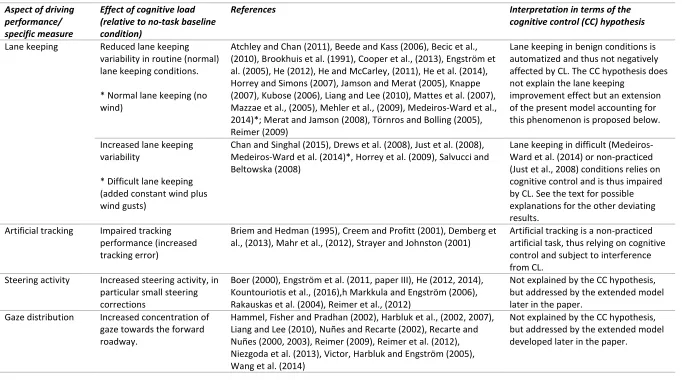
A large number of studies have investigated effects of CL on lane keeping performance, typically 399
in terms of the standard deviation of lane position (SDLP). Lane keeping in normal (benign) conditions 400
could be regarded as both highly practiced (for experienced drivers) and consistently mapped, and hence 401
largely automatized. Thus, the cognitive control hypothesis suggests that CL should not impair lane 402
keeping in normal conditions (“normal” and “benign” conditions here means cruising on a typical rural 403
road or motorway at the posted speed limit, with no adverse visibility or road surface conditions, no 404
heavy wind gusts etc.). 405
This prediction is confirmed by the great majority of existing studies on CL and lane keeping. In 406
fact, perhaps somewhat counter to intuition, most studies have found that CL lane keeping 407
variation (i.e., improves lane keeping) compared to a baseline condition with no cognitive task. This 408
effect was first reported in a field study by Brookhuis, de Vries and de Waard (1991) but has since then 409
been replicated in a large number of studies (Atchley and Chan, 2011; Beede and Kass, 2006; Becic et al., 410
2010; Cooper et al., 2013; Engström, Johansson and Östlund, 2005; He, 2012; He and McCarley, 2011; 411
He, McCarley and Kramer, 2014; Horrey and Simons, 2007; Jamson and Merat, 2005; Knappe et al., 412
2007; Kubose et al., 2006; Liang and Lee, 2010; Mattes, Föhl and Schindhelm, 2007; Mazzae et al., 2005; 413
Mehler et al., 2009; Medeiros5Ward, Cooper and Strayer, 2014; Merat and Jamson, 2008; Törnros and 414
Bolling, 2005; Reimer, 2009; see He, 2012, for a review). 415
While the cognitive control hypothesis, as formulated in the previous section, is not contradicted 416
by this lane keeping improvement effect (since the hypothesis only entails that lane keeping should not be 417
negatively affected by CL), it does not offer any explanation for the phenomenon. Some other commonly 418
reported performance effects that often co5occur with the lane keeping improvement may provide some 419
hints towards such an explanation. First, CL has been consistently demonstrated to induce increased 420
steering activity (Boer, 2000; Engström et al., 2011, paper III; He, 2012; Kountouriotis et al., 2016; 421
Markkula and Engström; 2006; Rakauskas, Gugerty and Ward, 2004; Reimer et al., 2012). A detailed 422
analysis by Markkula and Engström (2006), replicated in Engström (2011, paper III) and Kountouriotis et 423
of 1 degree or smaller. As reviewed by He et al. (2014), it has been debated whether this effect on 425
steering should be interpreted as a performance impairment or improvement. In support of the latter 426
interpretation, He et al. (2014) found that CL increased the between lateral wind perturbations 427
and steering inputs (coherence measures the strength of co5variation between two signals, with higher 428
values indicating a tighter coupling). This result thus indicates that the more frequent small steering wheel 429
reversals observed during CL were performed to counter lane keeping errors induced by the wind gusts, 430
rather than representing more noisy or erratic steering. This further suggests that the lane keeping 431
improvement occurs as a direct result of more focused steering. 432
Second, many studies have found that during periods of increased CL, the driver’s visual 433
scanning behavior narrows towards the center of the road. This > ! !% towards the road 434
center (Cooper et al. 2013, Hammel, Fisher and Pradhan, 2002; Harbluk et al., 2002, 2007; Liang and 435
Lee, 2010; Nuñes and Recarte, 2002; Recarte and Nuñes, 2000, 2003; Reimer, 2009; Reimer et al., 2012;
436
Niezgoda et al., 2013; Victor, Harbluk and Engström, 2005; Wang et al., 2014) has sometimes been
437
found to co5occur with the increased steering activity and improved lane keeping performance effects 438
(e.g. Engström et al, 2005; Reimer et al., 2012) which has led to the suggestion that the improved lane 439
keeping is at least partly caused by the gaze concentration (e.g. Engström et al, 2005). However, a number 440
of recent studies speak against this idea. He et al., (2014) observed lane keeping improvement and 441
increased steering wheel reversal rate without a gaze concentration effect. In line with this, Cooper et al. 442
(2013) controlled gaze direction and still observed the lane keeping improvement effect, at least in some 443
conditions. Moreover, a regression analysis conducted by Liang and Lee (2010) indicated that gaze 444
concentration only explained 5 percent variance of the lane position variation. Taken together, these 445
results indicate that the lane keeping improvement is not necessarily mediated by gaze concentration. In 446
other words, while the gaze concentration sometimes co5occurs with the lane keeping improvement under 447
cognitive load, the effects may not be causally related. This topic is returned to below where we discuss 448
different possible explanations for these effects. 449
In contrast to the great majority of studies reviewed above demonstrating the lane keeping 450
control performance (Chan and Singhal, 2015; Drews, Pasupathi and Strayer 2008; Horrey, Lesch and 452
Garabet, 2009; Just, Keller and Cynkar, 2008, Salvucci and Beltowska, 2008). There are several possible 453
reasons for these deviating results. First, three of these studies (Chan and Singhal, 2015; Drews, et al., 454
2008; Salvucci and Beltowska, 2008) used RSME (the root mean squared error relative to the lane 455
center), rather than SDLP, as the dependent measure. The key difference between RSME and SDLP is 456
that SDLP is only sensitive to increased swerving while RSME is sensitive to any stationary shift in lane 457
position (and thus cannot distinguish increased swerving from, e.g., strategic shift in lane position away 458
from the road center). 459
Second, Just et al. (2008) had subjects steering a simulated vehicle with a trackball while lying in 460
a brain scanner. Based on the cognitive control hypothesis, such artificial, non5practiced tasks would 461
clearly be expected to suffer under CL. 462
Third, in three of the studies (Chan and Singhal, 2015; Horrey et al., 2009; Salvucci and 463
Beltowska, 2008), subjects were explicitly instructed to maintain a central lane position (in Drews et al, 464
2008, the instruction is not reported). In terms of the present framework, the task of keeping the vehicle in 465
the center of the lane may be considered a rather unnatural, non5practiced, task, and thus potentially 466
vulnerable to cognitive load. Engström (2011, Paper III) aimed to test this idea by comparing effects of 467
CL on lane keeping in conditions with and without instructions to maintain a central lane position. As 468
expected, lane keeping improved for non5loaded participants instructed to maintain a central lane 469
position, as compared to non5loaded participants that did not receive the instruction, thus demonstrating 470
that lane keeping is usually performed in a non5optimal (satisficing) fashion. Also in line with 471
expectations, the lane keeping improvement effect was only found for the non5instructed drivers. 472
However, the predicted %* % * ! ++ ! of CL for instructed drivers (based on the assumption that 473
optimizing lane keeping would rely on cognitive control, and thus suffer during cognitive load) was not 474
found. It should also be noted that He et al. (2014) and Medeiros5Ward et al. (2014) both instructed their 475
drivers to keep a central lane position and still observed the lane keeping improvement effect. Moreover, 476
reported). Thus, it is unclear to what extent the lane keeping instruction or the use of RSME rather than 478
SDLP were the key factor behind these deviating results. 479
In general, the cognitive control hypothesis predicts that CL should impair lane keeping if the 480
lane keeping task is made sufficiently difficult (and thus reliant on cognitive control). Medeiros5Ward et 481
al. (2014) tested a specific version of this prediction where lane keeping difficulty was manipulated in 482
terms of the absence or presence of cross winds. The simulated cross winds included a constant lateral 483
wind and added wind gusts. The windy condition was further split into two levels, differing in terms of 484
the entropy (or predictability) of the wind gusts. In line with the main body of results reviewed above, 485
cognitive load improved lane keeping (reduced SDLP) in the absence of wind. However, lane keeping 486
performance deteriorated significantly under CL in the most difficult condition (with a constant cross 487
wind plus high5entropy wind gusts). This interaction effect offers strong support for the cognitive control 488
hypothesis: Lane keeping in benign conditions is consistently mapped, thus largely automatized for 489
experienced drivers and hence not negatively affected by CL. However, as the same task becomes more 490
difficult (when wind is added) it relies on cognitive control and is thus negatively affected by CL. 491
This result may seem to be at odds with the results reported by He et al. (2014), reviewed above, 492
who also used simulated wind gusts but still found a lane keeping improvement effect of CL, and, further, 493
that CL led to increased coherence between the wind gusts and steering corrections. The methodology for 494
generating wind gusts was similar in the two studies (based on Andersen and Ni, 2005). While the exact 495
amplitude and frequency of the wind gusts differed somewhat, they were on the same order of magnitude. 496
However, what seems to be the most likely cause of the discrepancy is the relatively strong constant 497
crosswind (40 mph=17.9 m/s) which was present in the windy conditions in Medeiros5Ward et al., (2014) 498
but not in He et al., (2014). Such a cross wind implies a constant lateral force which continuously needs to 499
be countered by steering corrections, thus leading to a rather unusual lane keeping task, which is made 500
even more difficult when adding the wind gusts. Thus, it may primarily have been the constant cross 501
wind, rather than the entropy of the wind gusts (as suggested by the authors) that made the lane 502
(without wind), thus causing a degradation in lane keeping performance under CL rather than the usual 504
lane keeping improvement. 505
Other studies have investigated the effect of CL on artificial tracking tasks. Just like the Detection 506
Response Task (DRT) discussed above, such tasks may be simple and consistently mapped but at the 507
same time not extensively practiced, thus relying on cognitive control and, according to the present 508
hypothesis, vulnerable to CL. In line with this, studies investigating the effect of CL on artificial tracking 509
have typically found performance to be strongly sensitive to CL in terms of increased tracking variability 510
or error (Briem and Hedman, 1995; Creem and Profitt, 2001; Demberg et al., 2013; Strayer and Johnston, 511
2001). In particular, the ConTRe (Continuous Tracking and Reaction) task (Mahr et al., 2012) , a driving5 512
like yet artificial tracking task, has been demonstrated to be strongly sensitive to fine5grained 513
manipulations of cognitive load (Demberg et al., 2013). 514
The results from the reviewed studies investigating effects of CL on lateral vehicle control are 515
summarized in Table 2. Taken together, the reported performance effects of CL on lateral control follow 516
the same general pattern as OED tasks: CL selectively affects those tasks that are not extensively 517
practiced or variably mapped (thus relying on cognitive control) but leaves performance on well5 518
practiced, consistently mapped, tasks unaffected. In the case of lane keeping, CL has even been reliably 519
found to improve performance, an effect often accompanied by increased steering activity and a 520
concentration of glances to the road ahead. Potential explanations for this effect are further discussed 521
below. 522
Table 2 Summary of effects of CL on lateral vehicle control and visual behavior, and interpretation in terms of the cognitive control hypothesis. Studies 524
that found different effects on CL in different experimental conditions are marked with*. 525
Aspect of driving performance/ specific measure
Effect of cognitive load (relative to no-task baseline condition)
References Interpretation in terms of the
cognitive control (CC) hypothesis
Lane keeping Reduced lane keeping variability in routine (normal) lane keeping conditions.
* Normal lane keeping (no wind)
Atchley and Chan (2011), Beede and Kass (2006), Becic et al., (2010), Brookhuis et al. (1991), Cooper et al., (2013), Engström et al. (2005), He (2012), He and McCarley, (2011), He et al. (2014), Horrey and Simons (2007), Jamson and Merat (2005), Knappe (2007), Kubose (2006), Liang and Lee (2010), Mattes et al. (2007), Mazzae et al., (2005), Mehler et al., (2009), Medeiros-Ward et al., 2014)*; Merat and Jamson (2008), Törnros and Bolling (2005), Reimer (2009)
Lane keeping in benign conditions is automatized and thus not negatively affected by CL. The CC hypothesis does not explain the lane keeping
improvement effect but an extension of the present model accounting for this phenomenon is proposed below.
Increased lane keeping variability
* Difficult lane keeping (added constant wind plus wind gusts)
Chan and Singhal (2015), Drews et al. (2008), Just et al. (2008), Medeiros-Ward et al. (2014)*, Horrey et al. (2009), Salvucci and Beltowska (2008)
Lane keeping in difficult (Medeiros-Ward et al. (2014) or non-practiced (Just et al., 2008) conditions relies on cognitive control and is thus impaired by CL. See the text for possible explanations for the other deviating results.
Artificial tracking Impaired tracking performance (increased tracking error)
Briem and Hedman (1995), Creem and Profitt (2001), Demberg et al., (2013), Mahr et al., (2012), Strayer and Johnston (2001)
Artificial tracking is a non-practiced artificial task, thus relying on cognitive control and subject to interference from CL.
Steering activity Increased steering activity, in particular small steering corrections
Boer (2000), Engström et al. (2011, paper III), He (2012, 2014), Kountouriotis et al., (2016),h Markkula and Engström (2006), Rakauskas et al. (2004), Reimer et al., (2012)
Not explained by the CC hypothesis, but addressed by the extended model later in the paper.
Gaze distribution Increased concentration of gaze towards the forward roadway.
Hammel, Fisher and Pradhan (2002), Harbluk et al., (2002, 2007), Liang and Lee (2010), Nuñes and Recarte (2002), Recarte and Nuñes (2000, 2003), Reimer (2009), Reimer et al. (2012), Niezgoda et al. (2013), Victor, Harbluk and Engström (2005), Wang et al. (2014)
/ %! % % !
526
Longitudinal vehicle control refers to speed selection and the control of headway in the presence 527
of a lead vehicle. Like we just saw for object and event detection and lateral control, experimental results 528
reported in the literature on the effect of CL on longitudinal control appear inconsistent. We will here 529
focus on two performance measures, mean speed and mean headway. 530
It is well5documented that drivers engaged in % demanding secondary tasks reliably reduce 531
their speed (e.g., Antin, Dingus, Hulse, and Wierwille, 1990; Curry, Hieatt, and Wilde, 1975; Östlund et 532
al., 2004), which can be interpreted as a compensation for the increased visual demand imposed by the 533
dual task situation (see Kujala et al., 2016, for a more detailed model of visual demand that could explain 534
such speed reductions as one way to control the uncertainty of visual information that builds up during 535
glances away from the road). 536
However, the corresponding results for cognitively loading (but non5visual) tasks are far more 537
heterogeneous. For mean speed, the majority of existing studies report a null effect of CL (e.g., Alonso et 538
al., 2012; Beede and Kass, 2006; Drews, Pasupathi and Strayer, 2008; Engström et al., 2005; He et al., 539
2014; Strayer and Drews, 2004; Recarte and
Nu
ñes, 2002;
Reimer et al., 2011; Törnros and Bolling, 5402005). In a set of thirteen parallel coordinated studies (including different experimental scenarios) 541
conducted in the HASTE EU5funded project (Östlund et al., 2004), seven reported a null effect of CL on 542
mean speed. 543
Other studies have reported that CL leads to a speed reduction (Patten et al. 2004; Reimer et al., 544
2012, 2013; five of the studies in Östlund et al., 2004). However, these effects are typically very small (a 545
reduction of a few km/h) and not reliably found across experimental conditions. For example, Patten et al. 546
(2004)found reduced speed during hand5held phone conversation but no speed effect of hand5held phone 547
conversation. 548
Yet other studies report a speed increase due to CL (Recarte and
Nu
ñes, 2002; Qu et al., 2013;
549
one study in
Östlund et al., 2004)
. In Qu et al. (2013), participants were instructed to maintain a rather 550unnatural low speed of 50 km/h on a three5lane motorway. This suggests that the observed speed increase 551
instruction to maintain the unusually low speed. This interpretation is supported by Recarte and Nuñes 553
(2002), who, in a field study, manipulated both speed instruction and CL. In the instruction condition, 554
drivers were told to maintain a speed (100 km/h) that was significantly lower than the typical speed (1105 555
120 km/h) for that road (a motorway with a posted speed limit of 120 km/h). When instructed to maintain 556
the lower speed, speed was higher in the CL condition compared to baseline (no CL). However, in the 557
condition without any speed instruction, CL had no effect on speed. 558
Similar results were obtained by Lewis5Evans, de Waard and Brookhuis (2011). In this simulator 559
study, participants were asked to drive at their preferred speed for 1 min in a driving simulator. The 560
vehicle speed was then automatically increased or decreased by 10, 20 30 km/h or left unchanged, and the 561
participants were instructed to maintain the new speed for 1 min. The speed was then changed again and 562
had to be maintained for another minute while the participant was engaged in a cognitively loading task 563
(mental arithmetic). Finally, participants were again asked to resort to their preferred speed for another 564
minute. This procedure was repeated for each speed manipulation (−30, −20, −10, +0, +10, +20 and +30 565
km/h). The results showed that cognitively loaded drivers tended to revert towards their preferred speed, 566
thus leading to a speed increase (compared to baseline) when instructed to maintain a speed lower than 567
the preferred speed, a speed reduction when instructed to maintain a higher speed than the preferred speed 568
and no effect when the instructed speed was about the same as the preferred speed. 569
As suggested by Recarte and Nuñes (2002), these results may be explained by the notion of an 570
optimal speed specific for each driver and traffic condition (corresponding to the preferred speed in 571
Lewis5Evans et al., 2011). This resonates with existing driver behavior theories such as that developed by 572
Fuller (2005), who proposed that drivers seek to maintain a constant level of task difficulty by controlling 573
the current driving task demand (e.g., in terms of speed) based on their individual capability. Since 574
individual capability varies, so will the individual preferred speed in a given scenario. Recarte and Nuñes 575
(2002) further suggest that the control of this optimal speed is largely automatized and thus not affected 576
by CL. However, intentionally deviating from this optimal speed, for example due to experimental 577
instructions or speed restrictions in real traffic, relies on cognitive control (i.e., is cognitively loading) and 578
instructed) speed is higher than the optimal speed, the theory predicts that CL would lead to a speed 580
reduction. Conversely, if the intended speed is lower than the optimal speed (e.g., due to instruction or 581
posted speed limits), CL would be expected to result in a speed increase. Both predictions are supported 582
by the results of Lewis5Evans et al. (2011) while the latter is supported by Recarte and Nuñes (2002). 583
The speed selection theory proposed by Recarte and Nuñes (2002) can be regarded as a specific 584
instance of the cognitive control hypothesis. The latter suggests more generally that cognitively loaded 585
drivers resort to their individual repertoire of automatized behaviors, which in this case is represented by 586
an optimal speed that is automatically adapted to the current task demand. This seems to reconcile the 587
apparently contradictory results reviewed above regarding the effect of CL on speed. For example, a 588
possible explanation for Patten et al.’s (2004) finding that CL led to a speed reduction during hand5held, 589
but not hands5free, phone conversation is that participants’ average optimal speed in the hand5held 590
condition (when having only one hand available for steering) was somewhat lower than the posted speed 591
limit (110 km/h). Thus, drivers loaded by hand5held phone conversation might have resorted to this lower 592
speed, while participants with both hands on the wheel had an optimal speed closer to the speed limit (or 593
even slightly above the speed limit, as the results showed a slight, but non5significant, speed increase in 594
the hands5free condition). This suggests that speed reductions due to CL should mainly be found in more 595
demanding driving scenarios where the automatized optimal speed is lower than the speed that the driver 596
intends to maintain (e.g., due to experimental instructions to keep to the speed limit). This generally 597
appears to be the case in studies reviewed above reporting speed reductions due to CL (e.g., three of the 598
five HASTE studies in Östlund et al., 2004, reporting speed reductions involved urban driving), although 599
no safe conclusions can be drawn based on this limited sample of studies. As pointed out by both Recarte 600
and Nuñes (2002) and Lewis5Evans et al. (2011), an interesting implication of this theory is that CL may 601
be an important factor behind unintentional speeding. This may at least partly explain the results from a 602
recent Swedish study finding that about 60% of all drivers violated the speed limit outside schools (30 603
km/h) while, at the same time this speed limit is widely accepted by the society (Motormännen, 2016). 604
With respect to headway, several studies have found that drivers tend to increase their headway 605
2013). However, also this effect appears rather unreliable. For example, Bergen et al. (2013) found 607
increased following distance for a cognitive language tasks with visual or motor content but not for tasks 608
with abstract content and Sonnleitner et al. (2014) found no effect at all of CL on headway. Furthermore, 609
in the HASTE studies (Östlund et al., 2004), where the effect of CL on headway was evaluated in nine of 610
the thirteen experiments, four found no effect of CL, four observed significantly increased headway and 611
one experiment found a significant reduction in headway during CL. 612
When increased headway is observed during CL, it is often interpreted as a compensatory effect 613
(e.g., Young, 2014). While this explanation cannot be refuted based on the available data, an alternative 614
(but not mutually exclusive) explanation is that the headway reduction, like the speed effects just 615
discussed, represents a resort back to an optimal, automatized, headway. It may be suggested that this 616
would be particularly expected if participants were instructed, or otherwise “forced”, to maintain a 617
headway that was shorter than their preferred headway. While this hypothesis is difficult to evaluate 618
based on the existing literature (e.g., due to the different ways to program the behavior of the simulated 619
lead vehicle), the results of Watson et al. (2013) at least offer some support for this idea. In this study, it 620
was found that participants’ working memory (WM) capacity was negatively correlated with following 621
distance (after subjects were initially trained on maintaining a 2s headway). This means that drivers with 622
high WM capacity tended to maintain the instructed headway while subjects with lower WM capacity had 623
a stronger tendency to increase headway. As suggested by Watson et al. (2013), this seems to indicate that 624
the increased headway was more due to failure in goal maintenance (among low WM capacity 625
participants) than risk compensation. It would thus be very interesting to conduct a study similar to that 626
by Lewis5Evans et al. (2011), reviewed above, but for headway instead of speed. The cognitive control 627
hypothesis predicts that the effect of CL will depend critically on the relation between the experimentally 628
controlled headway and the participants’ individually preferred (optimal) headway. 629
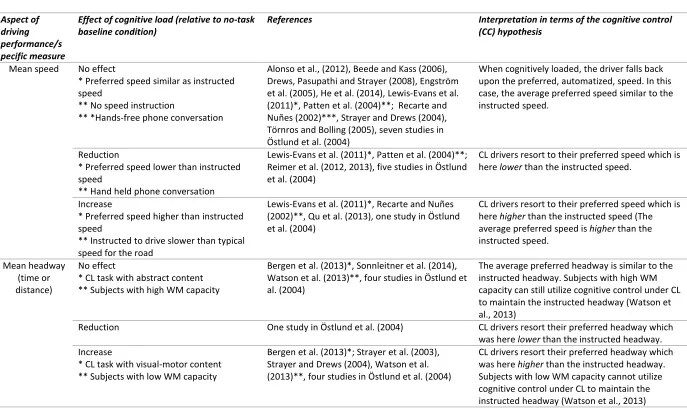
The reviewed results on the effects of CL on speed and headway are summarized in Table 3. A 630
key implication of the cognitive control hypothesis is that visual5manual and primarily cognitive tasks 631
affect longitudinal vehicle control in fundamentally different ways. While speed reductions (or headway 632
increased visual demand and associated uncertainty of visual information (Kujala et al., 2016), CL rather 634
makes drivers resort to their optimal (automatized) speed or headway, which may be higher or lower than 635
the current speed/headway, thus leading to apparently inconsistent effects in existing studies. This idea is 636
clearly supported in the case of speed (Recarte and Nuñes, 2002; Lewis5Evans et al., 2011), and there are 637
at least some indications in the headway data that also support this notion, although further studies are 638
clearly needed. 639
Table 3 Summary of effects of CL on longitudinal vehicle control and interpretation in terms of the cognitive control hypothesis. Studies that found 641
different effects on CL in different experimental conditions are marked with* 642
Aspect of driving performance/s pecific measure
Effect of cognitive load (relative to no-task baseline condition)
References Interpretation in terms of the cognitive control (CC) hypothesis
Mean speed No effect
* Preferred speed similar as instructed speed
** No speed instruction
** *Hands-free phone conversation
Alonso et al., (2012), Beede and Kass (2006), Drews, Pasupathi and Strayer (2008), Engström et al. (2005), He et al. (2014), Lewis-Evans et al. (2011)*, Patten et al. (2004)**; Recarte and Nuñes (2002)***, Strayer and Drews (2004), Törnros and Bolling (2005), seven studies in Östlund et al. (2004)
When cognitively loaded, the driver falls back upon the preferred, automatized, speed. In this case, the average preferred speed similar to the instructed speed.
Reduction
* Preferred speed lower than instructed speed
** Hand held phone conversation
Lewis-Evans et al. (2011)*, Patten et al. (2004)**; Reimer et al. (2012, 2013), five studies in Östlund et al. (2004)
CL drivers resort to their preferred speed which is here lower than the instructed speed.
Increase
* Preferred speed higher than instructed speed
** Instructed to drive slower than typical speed for the road
Lewis-Evans et al. (2011)*, Recarte and Nuñes (2002)**, Qu et al. (2013), one study in Östlund et al. (2004)
CL drivers resort to their preferred speed which is here higher than the instructed speed (The average preferred speed is higher than the instructed speed.
Mean headway (time or distance)
No effect
* CL task with abstract content ** Subjects with high WM capacity
Bergen et al. (2013)*, Sonnleitner et al. (2014), Watson et al. (2013)**, four studies in Östlund et al. (2004)
The average preferred headway is similar to the instructed headway. Subjects with high WM capacity can still utilize cognitive control under CL to maintain the instructed headway (Watson et al., 2013)
Reduction One study in Östlund et al. (2004) CL drivers resort their preferred headway which was here lower than the instructed headway. Increase
* CL task with visual-motor content ** Subjects with low WM capacity
Bergen et al. (2013)*; Strayer et al. (2003), Strayer and Drews (2004), Watson et al. (2013)**, four studies in Östlund et al. (2004)