This is a repository copy of Selectivity of C-H activation and competition between C-H and
C-F bond activation at fluorocarbons.
White Rose Research Online URL for this paper:
http://eprints.whiterose.ac.uk/133766/
Version: Accepted Version
Article:
Eisenstein, Odile, Milani, Jessica and Perutz, Robin N. orcid.org/0000-0001-6286-0282
(2017) Selectivity of C-H activation and competition between C-H and C-F bond activation
at fluorocarbons. Chemical Reviews. pp. 8710-8753. ISSN 0009-2665
https://doi.org/10.1021/acs.chemrev.7b00163
[email protected] https://eprints.whiterose.ac.uk/
Reuse
Items deposited in White Rose Research Online are protected by copyright, with all rights reserved unless indicated otherwise. They may be downloaded and/or printed for private study, or other acts as permitted by national copyright laws. The publisher or other rights holders may allow further reproduction and re-use of the full text version. This is indicated by the licence information on the White Rose Research Online record for the item.
Takedown
If you consider content in White Rose Research Online to be in breach of UK law, please notify us by
1 revised May 2017
Selectivity of C-H activation and competition between C-H and C-F bond
activation at fluorocarbons
Odile Eisenstein,*
‡
Jessica Milani,
and Robin N. Perutz*
‡ Institut Charles Gerhardt, UMR 5253 CNRS Université Montpellier, cc 1501, Place E. Bataillon,
34095 Montpellier, France and Centre for Theoretical and Computational Chemistry (CTCC), Department of Chemistry, University of Oslo, P.O. Box 1033, Blindern, 0315 Oslo, Norway
Department of Chemistry, University of York, York, YO10 5DD, United Kingdom
ABSTRACT
Partially fluorinated alkanes, arenes and alkenes can be transformed by a variety of transition metal and lanthanide systems. Although the C-H bond is weaker than the C-F bond regardless of the hybridization of the carbon, the reaction of the C-F bond at the metal is usually more
exothermic than the corresponding reaction of the C-H bonds. Both bonds are activated by the metal systems, but the preference for activating these bonds depends on the nature of the
hydrocarbon and of the metal system, so that the reaction can be directed exclusively toward C-H or C-F bonds or yield a mixture of products. Additionally, the presence of fluorine differentiates between C-H bonds at different positions resulting in regioselective C-H bond activation; paradoxically, the strongest C-H bond reacts preferentially. The purpose of this review is to
2 CONTENTS
1. INTRODUCTION
2. ENERGETICS OF FREE HYDROFLUOROCARBONS
3. ENERGETICS OF C-H AND C-F ACTIVATION AT METAL CENTERS 3.1 Energetics of coordination
3.2 Energetics and regioselectivity of C-H oxidative addition 3.3 Energetics and regioselectivity of C-F oxidative addition
4. SURVEY OF STOICHIOMETRIC REACTIONS WITH HYDROFLUOROCARBONS 4.1 Reactions of Metal Atoms and Ions
4.1.1 Neutral metal atoms 4.1.2 Cationic metal ions
4.1.2.1 Lanthanide ions
4.1.2.2 Non-lanthanide atomic ions 4.2 Reactions in Solution
4.2.1 Reactions with Aliphatic Hydrofluorocarbons 4.2.1.1 Lanthanides and metals of groups 3 to 5 4.2.1.2 Metals of group 6 and groups 9-11
4.2.2. Intermolecular Reactions with Aromatic Hydrofluorocarbons 4.2.2.1 Lanthanides
4.2.2.2 Early transition metals of groups 3 to 6. 4.2.2.3 Groups 7 and 8
4.2.2.4 Group 9 4.2.2.5 Group 10 4.2.2.6 Group 11
4.2.3 Intramolecular Aromatic Cyclometalation 4.2.3.1 Group 8
3 4.2.4 Intermolecular Reactions with Fluorinated Alkenes
4.2.4.1 Early transition metal complexes 4.2.4.2 Late transition metal complexes
5. EXAMPLES OF CATALYTIC REACTIONS INFLUENCED BY FLUORINE SUBSTITUENTS 6. GENERAL MECHANISTIC PRINCIPLES AND CONCLUSIONS
Author Information Acknowledgments Abbreviations References
1. INTRODUCTION
The importance of hydrofluorocarbons is well documented in pharmaceuticals,
agrochemicals, materials, refrigeration and air conditioning. A large proportion of new drugs and agrochemicals include fluorine substituents at sp3 or sp2 carbons in order to modify the acidity, the lipophilicity, the conformations and, especially, the metabolism of the drugs.1-4 The favorable radiochemical properties of 18F make it a crucial isotope for positron emission tomography, leading to a requirement for radiopharmaceuticals that include a fluorine substituent.1,5 Fluorinated
materials are employed for their hydrophobic properties, their chemical inertness and physical properties such as elasticity.6-8 The introduction of long fluorinated chains or “fluorous pony-tails” can produce phase behavior that is particularly favorable for catalysis, solvent extraction and chemical synthesis.9-13 Saturated hydrofluorocarbons have also found important applications as refrigerants, and propellants, but several of them will now be phased out following the Kigali agreement of 2016 for reduction of greenhouse gases, leading to disposal issues.
The chemical properties and reaction patterns of polyfluorinated compounds are different from those of the corresponding hydrocarbons. Hydrofluorocarbons present a particularly
4 the energetics and kinetics of C-H bond activation are modulated by the introduction of fluorine substituents. These effects, which depend on the number and location of fluorine substituents, lead to changes in chemoselectivity and regioselectivity of bond activation that vary with the metal and ligand centers and have an impact on both stoichiometric and catalytic reactions. In this review, our principal goal is to put across current understanding of the C-H bond activation of
hydrofluorocarbons at transition metal and lanthanide centers, indicating the circumstances that affect the balance between C-F activation and C-H activation, as derived from experimental and computational studies. To set the scene, we have selected for the introduction some key features of the interactions of hydrofluorocarbons with transition metal or lanthanide fragments.
Partially fluorinated arenes and alkenes can coordinate to transition metals without bond breaking. Such coordination of arenes can occur via -bonding to the carbon skeleton in 2, 4 or
6 modes or via C-F -coordination through the fluorine lone pairs;14,15 all of these possibilities except 4-arenes have yielded examples of characterized products (Scheme 1). Examples of fluorine-substituted hydrocarbons (excluding perfluorocarbons) binding as in Scheme 1 may be found in the references indicated: (2-fluoroarene) and (-2-2-fluoroarene),16,17 (6
-fluoroarene),18,19 (2
-F,F-fluoroarene),20 (1-F-fluoroarene),20,212-fluoroalkene and bridging -fluoroalkene.22 Partially fluorinated alkanes have been demonstrated to coordinate to tungsten pentacarbonyl by time-resolved IR spectroscopy23 and to metal ions in the gas-phase by mass spectrometry.24 In both cases, their geometries have been characterized computationally.25-27
Scheme 1. Coordination of hydrofluoroarenes and hydrofluoroalkenes without bond
5 When a hydrofluorocarbon reacts by bond breaking there is a possibility of either C-H or C-F bond cleavage. There is a tendency for early metals (especially d0 metals) to yield C-F bond activation products, while metals with occupied d shells (d6– d10) are more variable. Among the reactions of fluoroarenes, there are examples of chemoselective C-F or C-H bond cleavage, as well as situations where both are observed. Preference for C-F activation via F-coordination dominates in the reaction with atomic ions but considerable more diversity is observed with molecular transition metal complexes in solution. For example, the photochemical reactions of Cp*Rh(PMe3)(C2H4) or Tp'Rh(CNneopentyl)(carbodiimide) (Tp' =
hydrotris(3,5-dimethylpyrazolyl)borate) with partially fluorinated benzenes give C-H activation exclusively.28,29 The reactions of nickel complexes containing N-heterocyclic carbene ligands with partially fluorinated benzenes give C-F activation exclusively.30 The kinetic products of reactions of
Ni(PEt3)2L (L = phenanthrene, anthracene, isobutene) with partially fluorinated benzenes follow the C-H activation route, while the thermodynamic products involve C-F activation.17 Catalytic
6 In addition to chemoselectivity, the C-H activation of arenes raises questions of
regioselectivity. We distinguish intermolecular activation (Section 4.2.2) and intramolecular cyclometalation (Section 4.2.3) of arenes. We describe reactions as intermolecular when the reactant is a simple fluorinated benzene or pyridine, regardless of whether there is an intermediate with coordinated arene. The term intramolecular cyclometalation is used when the reactant
contains an anchoring group which is coordinated in the product. In numerous examples of
intermolecular activation of fluorinated arenes, strong selectivity for the C-H bonds ortho to fluorine substituents has been observed.35 This selectivity can have a kinetic or a thermodynamic origin. When we turn to cyclometalation by intramolecular C-H activation, it is possible to steer the selectivity to positions ortho or para to fluorine substituents by subtle alteration of the metal-ligand system.36,37
Several factors influence the selectivity. A coordination complex resulting from coordination of the substrate to the metal fragment, shown in Scheme 1, may be an intermediate on the way to the C-H activation product but this is not a requirement. The relative stability of the coordination complexes shown in Scheme 1 and any C-H activation products vary with the metal and its ligands. It is of particular importance that fluorine substitution modifies the C-H bond strength of hydrocarbons and, to an even greater extent, the bond strength of the M-C bonds in their C-H activation products, leading to profound effects on selectivity.38,29
Among stoichiometric reactions, we highlight several recent advances: the discovery of selective 1,2-C-H addition reactions of fluorinated benzenes at alkylidyne titanium complexes;39 the observation of reaction intermediates and the development of a kinetic model in the C-F and C-H activation reactions of Ni(PEt3)2(2-phenanthrene) with tetrafluoropyridine;40 the rearrangement of the hydride complex trans-[NiH(C6F4(CF3))(iPr2Im)2] via the 2-arene complex to two fluoride complexes;41 the experimental demonstration that M-C(aryl) bonds increase in strength far faster than H-C(aryl) bonds as the number of ortho fluorine substituents increases, as predicted by computation.29,38 The reactivity of CH
7 draw attention to the reactions of CH3F and CHF3 at iridium pincer complexes42 and the discovery of niobium complexes that are selective for activation of benzylic CF3 groups, even in the presence of C-H bonds.43
Carbon-fluorine bond activation has been the subject of numerous recent reviews,33-34,44-61 but competing C-H bond activation receives little attention in most of these publications. Two reviews pay particular attention to partially fluorinated substrates and C-H activation, one on nickel chemistry62 and the other on organometallic chemistry particularly with fluorobenzene and
difluorobenzene.15 There are a few more personal reviews that treat C-H activation of fluoroarenes specifically63,35 or address organofluorine chemistry at an individual metal.64
We start this review with thermodynamic considerations, considering the energetics of free hydrofluorocarbons and then the energetics of C-H bond activation at a metal. We follow these general sections, with a survey of stoichiometric reactions divided up into reactions at atoms or ions and reactions in solution, dividing the latter into reactions with aliphatics, aromatics and alkenes. In section 5, we move to catalytic activation. We do not survey the full range of catalytic reactions but review a few examples where the fluorine plays a major role. Finally, we tease out the major general mechanistic principles in the concluding section 6.
2. ENERGETICS OF FREE HYDROFLUOROCARBONS
8
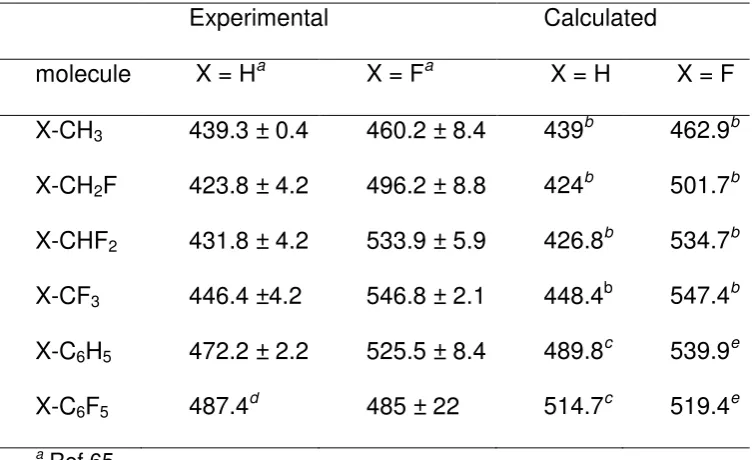
Table 1Experimental bond dissociation enthalpy (kJ/mol) in gas phase
Experimental
Calculated
molecule
X = H
aX = F
aX = H
X = F
X-CH
3439.3 ± 0.4
460.2 ± 8.4
439
b462.9
bX-CH
2F
423.8 ± 4.2
496.2 ± 8.8
424
b501.7
bX-CHF
2431.8 ± 4.2
533.9 ± 5.9
426.8
b534.7
bX-CF
3446.4 ±4.2
546.8 ± 2.1
448.4
b547.4
bX-C
6H
5472.2 ± 2.2
525.5 ± 8.4
489.8
c539.9
eX-C
6F
5487.4
d485 ± 22
514.7
c519.4
ea Ref 65
b high level computational protocol66
c DFT(B3PW91) calculations38
d no reported error range
e DFT(BP86) calculations from H
298 data67
9 The C-H bond in benzene is stronger than in methane and likewise the C-F bond is stronger in monofluorobenzene than in monofluoromethane; this is associated with the carbon hybridization with bonds to sp2 carbon stronger than to sp3 carbon. Another irregularity occurs in C
6F5X: the C-H bond in H-C6F5 is stronger than that in benzene but the C-F bond in F-C6F5 is weaker than that in F-C6H5, perhaps due to the electronic repulsion between the fluorine atoms. However, as
mentioned above the large or unknown uncertainty in the experimental values make these trends somewhat unreliable. High level calculations reproduce these experimental values with great accuracy, especially for the methane derivatives that have been studied with a particularly high level computational protocol which has been optimized to reproduce 261 bond dissociation enthalpy values.68
10
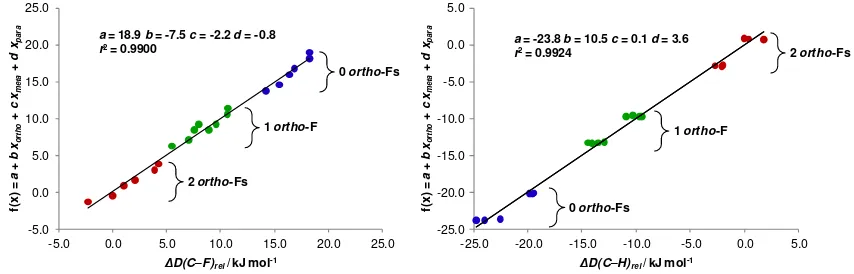
Figure 1. Plots of the best fit to the trends in DFT(BP86) calculated C-F (left) and C-H (right) bond
dissociation energies for C6F6-nHn (n = 0-5). D(C-F)rel and D(C-H)rel are defined relative to those of C6F5H (see text). Reproduced with permission from ref 67. Copyright 2013 Royal Society of Chemistry
Experimental determination of acidity of the C-H bond in fluorinated benzenes is rather limited. Values of the enthalpy of deprotonation of benzene determined in the gas phase by mass spectrometry range from 1663 to 1671 kJ/mol.69 A single F substituent decreases the energy of deprotonation of benzene in the gas phase by 56 kJ/mol and a CF3 substituent decreases it by 57 kJ/mol.70 Studies in solution based on proton exchange between a cesium ion pair and a substrate were used to determine pKa’s . In cyclohexylamine the pKa’s of benzene, 1,2-difluorobenzene, 1,2,3,4-tetrafluorobenzene, and pentafluorobenzene were determined as 43.0, 34.98, 31.52 and 23.81, respectively, at 34°C.71 In THF, the p
Ka’s of several hydrofluorobenzenes (but not
pentafluorobenzene) could be determined at 25 °C with an accuracy of 0.2 pKa units (values in red in Figure 2). The effect of fluorine in decreasing the pKa was shown to be additive with
contributions depending on its position. Thus, F decreases the pKa of benzene by 5.2, 3 and 1.4 units for ortho, meta and para positions, respectively, leading to an estimate of the pKa of benzene as 44.8 by extrapolation.72 Computational studies (B3LYP with large basis set and polarization on all atoms) including the cesium ion pair reproduced the data fairly well after careful calibration (values in black in Figure 2). However, the calculated and experimental pKa’s differ significantly for 1,2,3,4-tetrafluorobenzene, which is calculated to be less acidic than 1,3,5-trifluorobenzene in contrast to experimental values. This illustrates the difficulties in computing quantitative data on
-5.0 0.0 5.0 10.0 15.0 20.0 25.0
-5.0 0.0 5.0 10.0 15.0 20.0 25.0
f( x ) = a + b xo rt h o + c xm e ta + d xp a ra
D(C–F)rel/ kJ mol-1 a= 18.9 b= -7.5 c= -2.2 d= -0.8
r2= 0.9900
1 ortho-F
2 ortho-Fs
0 ortho-Fs
-25.0 -20.0 -15.0 -10.0 -5.0 0.0 5.0
-25.0 -20.0 -15.0 -10.0 -5.0 0.0 5.0
f( x ) = a + b xo rt h o + c xm e ta + d xp a ra
D(C–H)rel/ kJ mol-1 a= -23.8 b= 10.5 c= 0.1 d= 3.6
r2= 0.9924
1 ortho-F
0 ortho-Fs
11 this topic. The same computational protocol shows the pKa in DMSO to vary by less than 2 units compared to the value in THF.73 A related computational study was carried out for a full set of hydrofluorobenzenes in DMSO but the values cannot be compared to the experimental values because the cesium ion pair is not included in the protocol.74
[image:12.595.92.435.197.370.2]
Figure 2. pKa values of fluorinated benzenes. Experimental (red) for cyclohexylamine CyNH2 solvent,71 and THF solvent72 and calculated (black).73
Hammett -constants, which are also useful to describe the influence of fluorine,75 have been calculated from the core-electron binding energy of the carbon atom with PW86-PW91
functionals.76-77 The contribution of the acidity to the activation of the C-H bond at metal centers will be discussed in Section 3.2.38,78-80
Heterolytic cleavage of fluorinated species into either R+ and H or R+ and F has been
considered by computational studies. Insight into this question was obtained with DFT(M05-2X in the gas phase and in solution) calculations of the affinity for hydride (HA) and fluoride (FA) for a set of carbon-and silicon-based cations in gas phase and chlorobenzene solution.81 HA and FA are defined in equations 1 and 2.
12 R3X-H R3X+ + H- H = HA (2)
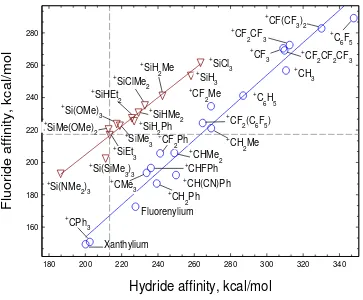
The calculations show that there are linear relationships between FA and HA for carbocations and Si-cations with slopes that are not far from unity (Figure 3). However, deviations from the
correlation line are more frequent for the carbocations than for the silylium cations. The hydride affinity is higher for carbocations than for related silylium systems by an average value of 60 kJ/mol. However, the fluoride affinity is higher for X3Si+ than for carbocations with similar substituents but the fluoride affinities of perfluorocarbocations far outstrip those of the X3Si+
[image:13.595.80.443.351.651.2]cations. The difference between HA and FA (∆H-F) is small for the silylium cations but varies widely in the range of 140-240 kJ/mol (33-57 kcal/mol) in favor of the hydride for the carbocations.
Figure 3. Calculated hydride and fluoride affinities (kcal/mol) of a series of carbenium and silylium
cations in the gas phase. Species above the horizontal dashed line have FA greater than FA(Et3Si+), and species to the right of the vertical dashed line have HA greater than HA(Et3Si+). Reproduced with permission from ref 81. Copyright 2011 Wiley.
160 180 200 220 240 260 280
180 200 220 240 260 280 300 320 340 +
C6H5
+ C6F5
+ CPh3 Xanthylium Fluorenylium + CMe3 + CHFPh + CH2Ph +
CF2Ph
+
CH(CN)Ph +
CHMe2 +
CF2(C6F5) +
CF2Me
+ CH2Me
+ CF3
+ CH3 +
CF2CF3
+
CF2CF2CF3 +
CF(CF3)2
+ Si(OMe)3 +SiEt 3 + SiMe(OMe)2 +
Si(SiMe3)3 +
Si(NMe2)3
+SiHMe 2 + SiMe3 + SiHEt2 + SiH2Ph +
SiClMe2 +
SiH2Me + SiH3
+ SiCl3
Hydride affinity, kcal/mol
13 For reference, we mention here the positions of nucleophilic attack in typical nucleophilic substitution reactions of partially fluorinated benzenes and fluorinated pyridines.
Pentafluorobenzene typically undergoes substitution at the position para to H; the positions of substitution of less fluorinated benzenes are summarized elsewhere.62 The rate of substitution is fastest for pentafluorobenzene and decreases very rapidly for less fluorinated benzenes.
3. ENERGETICS OF C-H AND C-F ACTIVATION AT METAL CENTERS
Bond enthalpies determine the thermodynamic feasibility of a chemical transformation in the gas phase, together with entropy. In the case of organic molecules, considerable information has been accumulated,82,83,65 but this is not the case for systems where a transition metal is present.
Determination of absolute values of metal-ligand bond enthalpies is very difficult and some simplifications are often necessary.84-86
There are three important aspects to the thermochemistry of hydrofluorocarbons that are needed for a general understanding of the thermodynamics of hydrofluorocarbon activation. One is the nature and magnitude of the interaction of the whole hydrofluorocarbon with the transition metal complex (Section 3.1), the second concerns the energetics of C-H oxidative addition,
including the interaction of hydrofluorocarbyl fragment with the metal fragment after bond activation (Section 3.2) and the third concerns the corresponding energetics of C-F oxidative addition
(Section 3.3).
3.1. Energetics of coordination
Quantitative information on the binding energy of fluoroalkanes is limited. No fluoroalkane complex has been isolated and structurally characterized, but spectroscopic information and computational studies indicate that fluoroalkanes interact with the metal center via F rather than via C-H. We present the limited data in section 4.2.1.2. More data has been accumulated for the
14 cyclotron resonance mass spectrometry and DFT(B3LYP) calculations, showed that increasing fluorination decreases the binding affinity.87 For all 1,2-difluoro substituted arenes, coordination through the F atoms is preferred over that via the -bond but the decrease in binding energy with the number of fluorine substituents applies to the two coordination modes. With metal-ligand complexes, coordination via the fluorine atoms rather than via the -arene bond has been reported in several cases. Thus, fluorobenzene and 1,2-difluorobenzene lead to isolable complexes
coordinated via either one or two fluorines, respectively with d0 Cp
2TiIV,21 d0 Cp2Sc+ and d1 Cp2Ti+ (but no coordination is observed with d2 Cp
2V+).20 DFT(BP86) calculations confirmed the
preference for F coordination in these systems and the decrease of binding energy from d0 to d1 and to d2. With other metal complexes, coordination to the
C,C--bonds (2- or 6-modes) has been observed. Fluoroarenes tend thus to coordinate via F to metal complexes with empty d shells due to the absence of back-donation needed for C-C -coordination. The same coordination may be obtained for dnwith n ≤ 2, but -complexes dominate with higher d occupancy.
A quantitative evaluation of binding energies of several fluorobenzenes to d8
15
Figure 4.Plot of ∆G(298K) versus degree of fluorine substitution for the equilibrium shown above.
Adapted with permission from ref 18. Copyright 2015 Elsevier.
The binding energy to a given fluorobenzene, as calculated in a d6 cyclopentadienyl rhenium complex with DFT(B3LYP) method, decreases from 2-HC=CH bond to 2-HC=CF, and to 2 -FC=CF (discussed in more detail in section 4.2.2.3).16,88 The preference for coordinating the least fluorinated double bond of fluoroarenes is not general. Ni(PEt3)2 forms an 2-complex with C6F5H which could be detected by NMR spectroscopy, but was fluxional even at the lowest temperatures measured. DFT(B3LYP) calculations indicate that the energy of coordination to the C(3)F=C(4)F double bond (numbering starting at C1(H)) is almost equal to that of coordination to the
C1(H)=C2(F), but the product of coordination to the C2(F)=C3(F) lies significantly higher in energy. Calculations of the 19F NMR chemical shifts and comparison with the experiment values support the proposed coordination preferences.17 A corresponding study was carried out for 1,2,3,4-tetrafluorobenzene and 1,2,3,5-1,2,3,4-tetrafluorobenzene in which NMR spectroscopy and DFT(B3LYP) calculations were combined to characterize the various species.89 Coordination by a single and two Ni(PEt3)2 moieties are observed by NMR spectroscopy and the various isomers of these
complexes are indicated to be in equilibria, as also supported by calculations. In the case of the monocoordinated complex, coordination to C(H)=C(F) is preferred for 1,2,3,5-tetrafluorobenzene and to C(F)=C(F) for 1,2,3,4-tetrafluorobenzene. These Ni complexes are discussed in more detail in section 4.2.2.5.
A related computational study was carried out for d10 Ni(H
16 [Rh(iBu2PCH2CH2PiBu2)]+ system compared with M(H2PCH2CH2PH2) (M = Ni, Pt). Considering the evidence that neutral centers such as CpM(PMe3) (M= Rh, Ir) form isolable, sublimable 2-C6F6 complexes but not 2-C
6H6 complexes,91 this switch may be charge controlled.
3.2 Energetics and regioselectivity of C-H oxidative addition
The energetics of an oxidative addition of a C-H bond describe the changes associated with the loss of the C-H bond and the formation of the metal-C and metal-H bond. As mentioned above, determination of the absolute energies of the bonds involving the metal is exceptionally difficult.84,86 In addition, the chemist is mostly interested in the energetics of the overall transformation.
Computational studies were carried out by Landis et al. to explore whether the concept of intrinsic bond energies could be defined for transition elements.92 For this purpose, the first bond dissociation enthalpies for neutral and cationic complexes of the type HnM-R (R = H, CH3, C2H5, CH(CH3)2, C(CH3)3, CH2F, C2H, C2H3, NH2, OH, F and BH2) were calculated for all transition elements with DFT(B3LYP) and CCSD(T) calculations and compared with related ion beam mass spectrometry data. This study showed great variations in bond energies across the Periodic Table and indicated that it was not possible to determine intrinsic bond energies in the case of transition metal complexes, since the ligands and their coordination modes influence the values too much.
It has been shown that it is possible to employ kinetic and equilibrium methods to determine the free energies for a series of related reactions. If it is assumed that entropic factors are constant within the series, bond enthalpies for M-X bonds may be estimated relative to a standard. For instance, Bryndza et al. were among the first to note that relative M-X bond enthalpies correlate with H-X bond enthalpies, where X was a carbon- or heteroatom-based group.93 Several related studies were published.94,95 Large numbers of studies focused on the relationship between M-C and H-C bond enthalpies. Wick and Jones established that there was a linear correlation between the M-C and H-C bond enthalpies with a slope slightly larger than unity in the case of a Rh
17 Absolute bond enthalpies were reproduced within 6% for the H-C bonds and relative bond
enthalpies for M-C bonds were reproduced within 30 kJ/mol for Rh and within 19 kJ/mol for Ti.99 This study indicated that computations can be used as a substitute for experiments when data cannot be obtained and several studies indeed followed.
DFT(B3PW91) calculations were used to determine the energetics of C-H oxidative addition of benzene and fluorinated benzenes ArF-H (ArF = C
6FnH5-n, n = 1-5) at a variety of metal fragments that differ by the metal (early to late), the coordination mode and nature of the ligands and the formal oxidation state.100,38 These metal fragments were selected as they are models of experimental systems that can undergo oxidative addition with C-H bonds. The calculations correlated the H-C and M-C bond dissociation energies for all possible C-H bonds in the substrates. The calculations indicated that fluorine substituents have a major influence on the energetics of C-H oxidative addition to the metal fragments, and that the determining factor is the number of fluorines ortho to the activated C-H bond. The M-C bond energy is much more sensitive than the H-C bond; thus the M-C bond energy increases by 25-30 kJ/mol while the H-C bond increases by only 10-12 kJ/mol for each ortho fluorine (Figure 5, correlations shown for
RhCp(PH3)). The minor role of the meta and para fluorines is illustrated by the grouping in three sets on the correlation with 0, 1 or 2 ortho fluorines. It is thus possible to write the relative bond
dissociation energy ∆D(M-C) as a linear function of the number n of fluorine substituents at the
ortho, meta and para positions, where b a or c (equation 3).
∆D(M-C) = a + bnortho + c(nmeta+ npara) kJ/mol (3)
The nature of the metal and its substituents has a relatively small influence as shown by the slope R M-C/H-Cof the correlation which ranges from 1.93 to 3.05. The values of the slope are as
18
Figure 5. Above: Correlation between the Rh-C bond dissociation energy of RhCp(H)(ArF)(PH3) and the H-C bond dissociation energies of fluorobenzenes. Below: schematic representation of the stabilization of the zwitterionic form of the M-C bond by ortho fluorine. Reproduced from ref 38. Copyright 2009 American Chemical Society
The origin of the ortho-fluorine effect revealed by these correlations is not fully understood92 but the larger ionic character of the M-C bond relative to the H-C bond is likely to be an important factor. This ionic character results in a negative charge at the ipso carbon of the M-aryl bond, which is stabilized by fluorine substituents especially at the ortho position where hyperconjugation is effective as shown by the lengthening of the C-F bonds (see schematic representation of the lone pair on the carbanion to the C-F * orbitals in Figure 5). This stabilization adds to the electron-withdrawal effect, which influences all carbons and decreases from ortho to para carbons. These computations offered an interpretation of the selectivity of the C-H activation ortho to the C-F bond for which there are many manifestations. One of the best illustrations is the reaction of
19 fluorine ortho to the Rh-C bond isomerize to a unique product in which the Rh-C bond lies ortho to two fluorine substituents as shown in Figure 6.28,35
Figure 6. Preference for ortho fluorine at [CpRh(PMe3)]. Adapted from ref 35. Copyright 2011 American Chemical Society
Furthermore, the quantitative aspect of the correlation, in terms of the value of the slope, was tested on Tp'RhH(ArF)(CNCH
2CMe3), where the experimental value of the correlation slope R M-C/H-C of 2.14 could be advantageously compared to the calculated value of 1.96.29
Similar results were obtained with other metal fragments.101 These studies highlight the large impact of a fluorine substituent on the C-H bond dissociation energy.
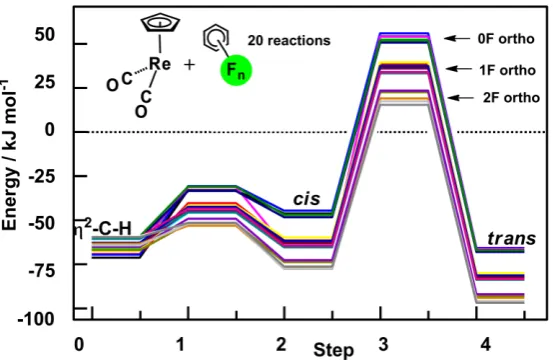
-20 [CpReH(ArF)(CO)
2]. The activation energies and the relative energies of the cis and trans products are separated into groups with 0,1 and 2 ortho fluorines (Figure 7).88 Selectivity of C-H bond activation was also observed in the arylation reactions of fluorinated arenes where only an M-C bond is made since the H atom does not transfer to the metal (Section 5). Two factors were put forward, the acidity of the activated C-H bond79,32 and the energy of the M-C bond being made.78 These two factors run in parallel since the most acidic C-H bond and the strongest M-C bond being formed both lie ortho to fluorine. At this stage, it is not easy to separate the two factors.
[image:21.595.62.339.279.459.2]
Figure 7. DFT(B3PW91) calculated electronic energies (kJ/mol) of steps on the pathway for
reaction of all possible fluorobenzenes C6FnH6-n (n = 0-5) starting from CpRe(CO)2(2-C-H-ArFH) to trans-CpReH(ArF)(CO)2. Each line represents the pathway for one of the 20 possible complexes. The energy zero is taken as the isolated reactants. Note that the activation energies follow the energies of the products in falling into groups with 0, 1 or 2 Fortho. Adapted with permission from ref 88. Copyright 2003 Royal Society of Chemistry.
21 disagreement between experiment and calculations is within the recognized limit of accuracy especially when solvent effects are not included in the calculations.17 An equilibrium between the C-H oxidative addition product and the Ni-coordinated fluorobenzene complexes was also shown to occur in the reaction of 1,2,4,5- and 1,2,3,5-tetrafluorobenzenes with Ni(PEt3)2. In this case the formation of Ni-H complex is also marginally endoergic relative to the coordinated Ni0 adduct.89 More details on these reactions will be given in Section 4.2.3.3 on nickel.
3.3 Energetics and regioselectivity of C-F oxidative addition
Twenty years ago, the authors of this review, on describing some of the failures to activate the C-F bond by molecular transition metal complexes, wrote “It is tempting to postulate that these
failures to effect C-F activation can be explained by it being thermodynamically unfavorable and to
point to the observation that C-F bonds are about 120 kJ/mol stronger than the C-H bonds. (…)
However, the validity of this argument is questionable since metal fluorine bond energies are
unknown.”102 From the experimental side, the situation remains unchanged but computationally
determined values are now considered as more reliable.103 This section will thus be based essentially on this approach.
22 which was attributed in part to the repulsion between the occupied metal d orbitals and the F lone pairs at the transition state.105
Moreover, computational studies showed show how much the metal matters in determining the relative thermodynamics of C-H vs. C-F activation. The oxidative addition of d10 M(PH
23
Figure 8. (a) Thermodynamics of reaction of M(dhpe) with pentafluorobenzene with calculated E
C-H and C-F activation at M(dhpe) (dhpe = H2PCH2CH2PH2, M = Ni, Pt) , (b) general differences between nickel and platinum (adapted for (a) from ref 35 and (b) from ref 90). Copyright American Chemical Society, 2011 and 2004, respectively
The corollary of exothermic C-F oxidative addition of aromatic C-F bonds is that reductive elimination is endothermic. However, we now know that this is not always the case. It has been shown that reductive elimination of Ar-F is possible from higher oxidation state palladium,
PdIV(Ar)F.106,107 Similarly, there is strong evidence that reductive elimination of C-F is possible from CuIII complexes by reaction of a macrocycle including an Ar-X (X = Cl or Br) bond with CuI and AgF. In this process, CuI reacts with the macrocycle undergoing oxidative addition to form a CuIII-Cl complex that is converted to CuIII-F before reductive elimination occurs to form an Ar-F bond.108 DFT(B3LYP) calculations indicate that the reductive elimination step is exothermic by 17 kJ/mol. In a simpler reaction, aromatic boronate esters have been fluorinated using an electrophilic
fluorinating agent in the presence of CuI and AgF, implicating reductive elimination from CuIIIF(Ar)(OTf)(NC
tBu).109 Further related reactions have been described using CuII(OTf)2 reagents and KF.110 It has also been reported that C-F reductive elimination is possible from 3-coordinate T-shaped PdIIF(Ar)L where L is a phosphine that blocks the fourth site on square-planar Pd (though there may be an agostic interaction at the fourth position).111,112
The regioselectivity of C-F oxidative addition has also been highlighted in several studies. Pentafluorobenzene typically undergoes C-F activation at the position para to H, just as in
24
4. SURVEY OF STOICHIOMETRIC REACTIONS WITH HYDROFLUOROCARBONS
4.1 Reactions of Metal Atoms and Ions.
The reactions between neutral or charged atoms and fluorinated aliphatic or aromatic molecules in the gas phase or in matrices have been studied by a combination of spectroscopic techniques and calculations (various DFT methods and high level correlated wave function methods). These reactions should inform of the intrinsic reactivity pattern of a naked element (neutral or charged depending on the techniques) towards activation of bonds in representative molecules in the absence of any interaction with other chemical systems such as the solvent. However, the solvent and the coordinated ligands have a major influence so that the pattern of C-H/C-F selectivity established in the gas phase for bare atoms and ions does not transfer fully to metal complexes in solution. On the same lines, computations show that that it is not possible to obtain intrinsic M-X bond energies because of the large influence of the other groups and ligands coordinated to the metal as described in section 3.2.92
4.1.1. Neutral metal atoms. Ablation of metal surfaces by a focused laser beam produces
atoms that react with simple molecules under further excitation. The resulting products have been studied mostly by combining IR spectroscopy in low temperature matrices with DFT(B3LYP) calculations. (Note that there are differences in nomenclature between the solution and gas-phase literature. Where solution chemists would use oxidative addition, gas-phase chemists use insertion. Similarly,complex formationorcoordination or adduct,as used by inorganic chemists, is replaced
by clustering in the physical chemistry literature.)A large number of studies with early transition
metals showed that activation of the C-F bond is systematically preferred. In the reactions of CH3F with Ti, Zr, and Hf ,113-115 the metal inserts into the C-F bond to yield (CH
3)MF and there is no trace of insertion into the C-H bond. However, the C-H bond can be cleaved after the formation of
25 Zr and that undetected CH3-Hf-F yielded the observed methylene complex via -H migration. The reaction of the same group 4 metal atoms with CH2F2 and CHF3 yielded CHF=MF2 and HC-MF3 in a triplet state for M = Zr and Hf.117 CASSCF-MRMP2 calculations were carried out to determine the mechanism of formation of (CH3)MF in the case of M = Zr.118
With later metals of the Periodic Table, C-H and C-F activation are in competition. For instance the reaction of atomic Pt with CH3F gives C-H and C-F insertion products to yield
(CH2F)Pt(H) and (CH3)PtF.119 Analysis of the relative intensities of vibrational modes suggests that four times as much (CH3)PtF is formed as (CH2F)PtH and that migration of one of the CH3
hydrogens to the metal is associated with the reverse migration of F yielding more (CH2F)PtH. This latter complex is calculated to be 40 kJ/mol more stable than (CH3)PtF. Analysis of bond energies suggests that Pt-H and Pt-F bond energies are similar and that the greater stability of (CH2F)PtH is due to the larger C-F strength. DFT(B3LYP) and single point CCSD(T) computations show that the coordination of CH3F to (3D and 1S) Pt is marginally stabilizing and that insertion of Pt into the C-F is energetically facile and exoergic.120 Migration of H from the methyl group to Pt has a very low energy barrier and the subsequent reverse F migration from the metal to the ligand has an accessible transition state and is energetically favorable.
4.1.2. Cationic metal ions. The reaction of cationic species with aliphatic (usually CH3F) and fluorinated aromatic hydrocarbons has been studied by mass spectrometry. The group of Schwarz used Fourier transform ion cyclotron resonance121 for the study of selected lanthanide ions with a variety of fluorinated molecules. The Bohme group used Inductively Coupled Plasma/Selected Ion Flow Tube (ICP/SIFT) tandem mass spectrometry to study the reaction of CH3F with the entire set of lanthanide ions (except Pm+).122 The same group also studied the reaction of CH
3F with 46 ions including early to late transition metals and main group ions.24
4.1.2.1. Lanthanide ions. With lanthanide cations (Ln+) the predominant primary reactive
channel is the activation of the C-F bond and the formation of M-F+. The efficiency of the reaction, studied with CH3F as the substrate, was shown to depend significantly on the nature of the
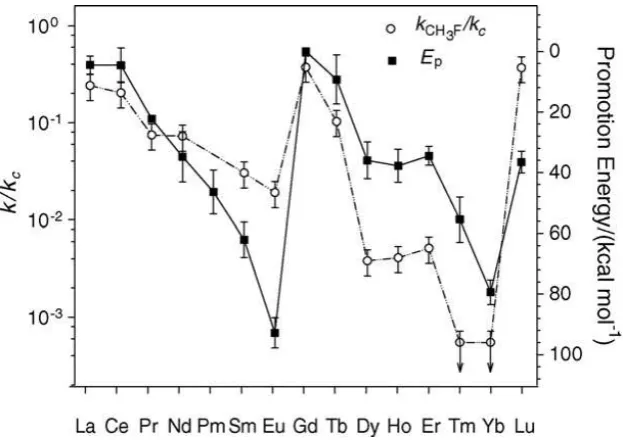
26 hexafluorobenzene, and fluorobenzene. However, trifluoromethane and perfluorinated alkanes compounds such as tetrafluoromethane, hexafluoroethane do not react with any of the lanthanide ions.123 Thus, C-F bond activation predominates for sp3 as well as sp2 carbon but the efficiency of the reaction depends on the metal as shown in Figure 9in the case of a study with CH3F. Two mechanisms, insertion-elimination and the harpoon mechanism were proposed but are unlikely to be distinguishable on the basis of rate measurements. They can differ by the correlations that can be established with some properties of the metal ions(Scheme 2).122
Figure 9. Reaction efficiency (open circles and left ordinate axis) and the promotion energy of Ln+
to the 5d16s1 electron configuration (filled squares and right ordinate axis in kcal/mol). Reproduced with permission from ref 122. Copyright 2005 Elsevier.
Scheme 2. Proposed mechanisms for the reaction of a lanthanide ion with a
27 A key aspect of the harpoon mechanism is that it requires an electron transfer from the lanthanide Ln+ to F-R through the encounter complex [Ln…F-R]+. A consequence is that the efficiency of the reaction should depend on the second ionization energy (I2) of the metal atom.
ACPF and CCSD(T) calculations using a calcium ion as model for the lanthanide and CH3F as the substrate confirmed that the harpoon mechanism applied in this case.124 The presence of a
correlation between the efficiency of the reaction and I2 was shown in the initial study where only a
limited number of lanthanide ions were used.123 However, inclusion of all lanthanide ions showed that this correlation was not valid and a better correlation was obtained with the promotion energy to the first 5d16s1 electron configuration of the ion (Figure 9).122 It was concluded that the insertion-elimination mechanism should not be ignored. As will be mentioned in Section 4.1, the energy barrier of the harpoon mechanism may not entirely account for the global rate so that the lack of relationship between the rate and I2 may have a variety of origins.125 DFT(B3LYP) computational studies of the reaction of La+ and Lu+ with CH
3F confirmed that the two mechanisms proposed in Scheme 2 are in competition.126,127 A study including the lanthanide ions from Ce+ to Yb+ showed that the harpoon and insertion mechanisms are feasible for all ions.128 As proposed by Bohme
et
28
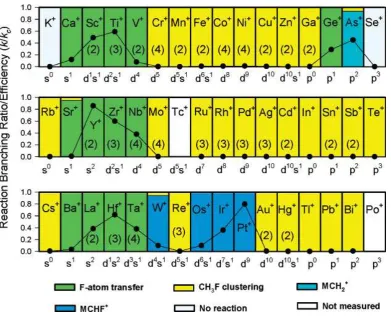
4.1.2.2. Non-lanthanide atomic ions. The systematic study of the reaction of CH3F with 46 atomic ions, the fourth-period atomic cations from K+ to Se+, the fifth period atomic cations from Rb+ to Te+ (excluding Tc+) and the sixth period atomic cations for Cs+ to Bi+, gives a broad perspective on the activation of naked atomic ions.24 Five reactive channels were observed in varying amounts with different atomic ions (Scheme 3).
Scheme 3. The five primary reactive channels describing the reactions between a
non-lanthanide atomic ion and CH3F (Adapted from Ref 24; Copyright 2006 American Chemical
Society)
29
Figure 10. Periodic variations observed in the efficiencies, k/kc(represented as solid circles), for
reactions of atomic cations with methyl fluoride, where k represents the measured reaction rate coefficient, and kc is the calculated collision rate coefficient. Also indicated are the observed
reaction channels and the electron configurations of the atomic cations. Note that the term
clustering in the physical chemistry literature is equivalent to complex formation or coordination as
used by inorganic chemists. The numbers in parentheses indicate the number of sequential
reactions of the same type. Trace amounts ( ≤ 12%) of MCH2+ that were observed in the reactions of Os+, Ir+, Pt+, and Au+ have not been included since these may be formed from excited M+. Reproduced from ref 24. Copyright 2006 American Chemical Society.
30 level (all electrons, 4-component Dirac-Coulomb approach) as the reference. This study shows that numerous functionals performed well and highlighted the need for a very rich basis set on the metal including f and g functions. The concerted oxidative addition is shown to be preferred to the SN2 reaction. Overall, all calculations cited in the following paragraph used appropriate methods.
As shown above, the C-H bond can be activated in the reaction of non-lanthanide ions with CH3F. Several experimental and computational studies have been carried out to search for the factors that control the selectivity. Reactions of Au+(1S) and Au+(3D) with CH
3F were carried out in a drift cell in He at room and low temperatures in order to show the influence of the electronic state of the ion on the outcome of the reaction.24,132 Ground state Au+(1S) has two reaction channels, one where a coordination adduct [Au(CH3F)]+ is formed and one where HF is eliminated and AuCH2+ is formed. Excited state Au+(3D) also eliminates HF presumably via formation of 3AuCH
2+. It initiates a second reaction sequence with CH3F+ yielding ultimately CH2F+. DFT(B3LYP) exploration and CCSD(T) single point calculations contributed to understand the influence of Au+ electronic state on the nature of the reaction.27 Au+(1S) and CH
3F form adducts via either F or one of the C-H bonds, the latter being less stable by about 50 kJ/mol. These two adducts lead to HF elimination in a multi-step process. The reaction with the lowest energy barrier corresponds to the C-H activation, which starts at the C-H coordinated Au+ adduct. With Au+(3D), only the C-H adduct is found to be stable and this adduct leads to C-H activation ultimately yielding H2 and AuCHF+.
The DFT(B3LYP) computational studies of the reactions of Ir+ with CH
3F highlighted the diversity of elementary steps that can occur. Although the adduct between CH3F and Ir+ is bound by way of the fluorine atom, the activation of the C-H bond is calculated to occur with lower energy transition states than that for C-F activation. The outcome of these activations is either the
elimination of H2 or of HF, the former having lower energy barriers and being more exothermic than the latter by 15 kJ/mol. For elimination of HF, the initial activation is that of the C-H bond. Reaction pathways have been identified for various spin states of the metal.133
31 obtained for all electronic states of Ru+ studied. The formation of RuF+ and CH
3 was found to be endothermic so that CH3RuF+ is the preferred product. Related calculations with neutral Ru showed that the insertion of the metal into the C-H bond is only possible for excited states of the metal while ground state of Ru yields the oxidative addition product, CH3RuF.135
One remarkable result of the comprehensive exploration of metal-ion reactions with CH3F by Bohme et al. was that formation of H2 was obtained with metals of the sixth period. This was addressed computationally by Kim et al. with a combination of DFT(PBE0), CASSCF and DKH2 methods to consider the scalar relativistic effect. They showed that inclusion of the spin-orbit coupling (SOC) in the potential energy surface leads to a negligible energy barrier (< 8 kJ/mol) for the insertion of Os+ into the C-H bond, while the energy barrier remains for insertion into the C-F bond. A full study of the reaction pathway established that indeed the elimination of H2 is the favored product.136 Not all heavy metals will be associated with large SOC and facilitate the C-H bond activation. Thus, Re+ has a small SOC due to its electron configuration 5d26s (7S state) and consequently coordination to CH3F is preferred (Figure 10). The results obtained for the effects of SOC on atomic metal ions are not transferable to coordinated metal complexes. Calculations show that the SOC depends significantly on the ligand coordination and oxidation state of the metal. SOC increases as the singlet-triplet gap decreases, the latter gap being smaller for less
coordinated metal complexes. Thus, SOC is smaller at the transition state for oxidative addition to ligated metal complexes of Pt0 and IrI, and the C-H activation barriers increase with SOC as shown by calculations at the CASSCF and CASPT2 levels.137
A computational study also tried to simulate the rate of reactions of metal ions with CH3F in order to get more insight on the controlling factors.125 The study focused on C-F activation at Sc+, Ti+, V+ and Zn+ where F abstraction is observed for the three first ions and coordination of CH
3F for the last (Figure 10). Combining DFT (mPW1K functional and QZVPP basis set) electronic
calculations and a RRKM approach gave a preference for the harpoon mechanism. It showed that it was not possible to neglect the exothermic coordination between M+ and CH
3F and the endothermic separation between the final product M-F+ and CH
32 of reaction and the second ionization energy of the metal fails. Finally, the lack of reaction with Zn+ was shown to be due to the low affinity of Zn+ for fluoride anion.
Dehydrohalogenation was observed by mass spectrometry in the reaction of Sc+, Ti+, V+, Fe+, Co+, and Ni+ with 1-fluoronaphthalene. An unusual loss of C
2H2 was obtained with Sc+.138
4.2 Reactions in Solution
4.2.1 Reactions with Aliphatic Hydrofluorocarbons. Overall the number of studies of the
reaction of fluoroalkanes or CF3 groups with transition metal complexes in solution is modest.
4.2.1.1 Lanthanides and metals of groups 3 to 5. The monomeric metallocene cerium
hydride Cp'2CeH (Cp' = 1,2,4-tri-t-butylcyclopentadienyl) reacts instantaneously with CH3F, but more slowly with CH2F2 to give Cp'2CeF and CH4 in each case.139 The reaction is thus formally a net H for F exchange. The cerium hydride complex reacts very slowly with CHF3 to give Cp'2CeF, H2 and 1,2,4- and 1,3,5-tri-t-butylbenzene and does not react at all with CF4. In the case of the reactions of CH3F and CH2F2, the formation of intermediates Cp'2CeCH2F and Cp'2CeCHF2 was inferred from the non-metal products which derive from the trapping of CH2 and CHF, respectively, by the solvent. Thus, the formation of Cp'2CeF is initiated by selective C-H bond activation of the fluoroalkanes. DFT(B3PW91) calculations indicated that a -bond metathesis reaction between Ce-H and Ce-F bonds via a 4-membered transition state has high energy barriers for all
fluoromethane substrates (Figure 11). A two-step reaction was shown to be preferred:
33
Figure 11. Mechanisms explored by DFT calculations (free energies in kJ/mol) for the reaction of
fluoroalkanes with bis(cyclopentadienyl)cerium hydride since Cp' was modeled by C5H5. The zero of free energy corresponds to Cp2CeH + substrate. Information taken from ref 139.
The reaction of Cp'2CeCH2Ph with CH3F yields the metathetical exchange products Cp'2CeF and CH3CH2Ph.141 Labeling studies show that the methyl group of CH3F is transferred intact, excluding a mechanism involving activation of the C-H bond of CH3F. DFT(B3PW91) computations excluded the traditional -bond metathesis mechanism via a 4-center transition state. They
suggested a transition state (Figure 12) in which the benzyl group interacts with the metal only by
34
Figure 12. Schematic representation of the transition state for the reaction of Cp'2CeCH2Ph with CH3F to form Cp'2CeF and CH3CH2F. Adapted from ref 141. Copyright 2010 Royal Society of Chemistry
Cp*2ZrH2 (Cp* = 5-C5Me5) reacts with primary, secondary and tertiary monofluorinated aliphatic hydrocarbons to give Cp*2ZrHF and/or Cp*2ZrF2 and alkane quantitatively through a radical chain mechanism. The rate decreases in the order primary to tertiary and is also greatly reduced by the presence of CF2H and CF3 groups on the hydrocarbon.142,143 The behavior of Cp*2HfH2 resembles that of Cp*2ZrH2 but with reduced reactivity.144The alkylidyne titanium complex (PNP)TiCtBu (PNP− = N[2-P(CHMe
2)2-4-methylphenyl]2) generated by elimination of neopentane from the alkylidene precursor dehydrofluorinates 1-fluorohexane and
fluorocyclohexane.39 The terminal olefin product is identified spectroscopically in the case of 1-fluorohexane. More information on the reactions of this titanium complex is presented in Section 4.2.2.2.
All three C-F bonds in CF3-substituted arenes are activated by a niobium imido complex as shown inScheme 4.43NMR spectroscopy revealed the intermediacy of an NbIII arene with C-F bonds that were still intact. DFT(B3LYP) calculations show a strongly exergonic pathway avoiding a concerted oxidative addition step and with no significant energy barrier to product. The
calculations suggest a two-step reaction initiated by an F abstraction with Nb bonded to the aryl and not to the CF2-Ph moiety. A 1,3 shift generates the Nb-CF2-Ph bond. The two subsequent C-F activations appear to occur stepwise. Attempts to extend this chemistry to non-aromatic CF3
35
Scheme 4. Selective activation of the CF3 group (Adapted from ref 43; Copyright 2013
American Chemical Society)
4.2.1.2 Metals of group 6 and groups 9-11. While complexes of various metal fragments
with hydrocarbons have been studied extensively, few studies concerned the coordination of fluorinated hydrocarbons. Fluoroalkanes have the potential to bind weakly to a metal complex with an empty coordination site through a C-H bond or through a lone pair on F, as was explored with photogenerated [W(CO)5].23 This study gave gas-phase equilibrium constants between this metal carbonyl complex and CH3F and C2H5F. Fluoromethane is more strongly bonded (around 48 kJ/mol) to W than methane (< 20 kJ/mol). Increasing the number of fluorines decreases the binding energy: the binding energy of CH2F2 is estimated to be ca. 20 kJ/mol and CHF3 is found not to coordinate to the metal. Fluoroethane forms a complex bound by around 50 kJ/mol whereas CH3CF3 does not bind. The nature of the atoms of the substrates involved in the interaction with the metal could not be determined and the authors presumed that the interaction was via a C-H bond.145 An ab-initio computational study of complexes of CH
3F, CH2F2 and CHF3 with W(CO)5 showed that the fluoroalkanes are bonded via the fluorine rather than by C-H and reproduced the decrease of bond dissociation energy with the increasing number of fluorines with BDE values of 58, 43 and 30 kJ/mol, respectively (at the MP2-BSSE corrected level) in good agreement with the experimental values.25 At the same time, time-resolved spectroscopy confirmed that
1-fluorohexane binds to F in preference to C-H in (1-C6H13F)W(CO)5.23
Fluoroalkanes such as CH3F, CH2F2 and CH3CF3 undergo C-H oxidative addition exclusively in the reaction with the unsaturated Tp'Rh(CNneopentyl) complex to yield
Tp’Rh(CNneopentyl)(R)(H).146 The kinetic selectivity was established to be CH
36 CH2F2, all of them being slower than CH4. This was attributed to the steric effect of the fluorine atoms on the carbon of the activated C-H bond. This study of the kinetics and thermodynamics of oxidative addition of R-H revealed that the presence of fluorine atoms on the alkyl group R
increases the Rh-R bond dissociation energy (see section 3.2). Due to the preference for activating a primary C-H bond, the reaction of 1-fluoropentane occurs selectively at the carbon that is more remote from the fluorine atom.147
The reactions of the IrI pincer complex (tBu4PCP)Ir(NBE) (NBE = norbornene) with CH
3F and with benzyl fluoride give products that derive formally from the insertion of the metal into the C-F bond, but proceed via an initial C-H bond activation (Figure 13).42The corresponding reaction with
CHF3 yields the C-H oxidative addition product, followed by HF elimination to form the
difluorocarbene complex. The hypothesis of initial C-H activation proposed for CH3F, is supported by the intermediates characterized in the reaction of CHF3. In addition, DFT(M06) calculations show that the reaction pathway initiated by the C-H bond activation is a multi-step process, in which the highest transition state at 69 kJ/mol is associated with the -fluorine migration. In contrast, the transition state for oxidative addition of the C-F bond is ca. 130 kJ/mol. This
mechanism accounts for the formation of an alkene via C-H bond activation followed by -fluorine elimination in the reactionwith ethyl and isopropyl fluoride. The mechanism proposed by Goldman in which the C-H activation is the initial step for the C-F activation is closely related to that
proposed for the cerium complex with CH3F in Section 4.2.1.1.139 In related chemistry of a rhodium complex,148 ( iPr4PNP*)Rh(TBE) (TBE =
t-butyl ethylene, iPr4PNP* = iPr2PC6H3Me-N-C6H3MePiPr2) was reacted with CHF3 and C2HF5 at 80° give Rh=CF2 and Rh=CF(CF3), respectively. No
37
Figure 13. Proposed mechanism for oxidative addition of CH3-F (above) and CHF3 (below) to (tBu4PCP)Ir. Adapted with permission from ref 42. Copyright 2011 American Association for the Advancement of Science.
The C-H bond is also activated selectively in the reaction of the PdII hydroxy complex shown inScheme 5.149 In this case, a phosphine (nBu
3P) serves as a Lewis base promoter for the deprotonation of CHF3 by the OH group. DFT(M06L) computations suggest that the phosphine activates the OH group by coordinating to the metal. The computed free activation barrier of ca. 90 kJ/mol is compatible with the observed rate.
Scheme 5. Activation of the C-H bond of CHF3 by a PdII complex (Adapted from Ref 149
Copyright 2013; American Chemical Society)
Fluoroform CHF3 was activated exclusively via C-H bond cleavage when treated with CuCl and MOR (M = K, Na, 2 equiv) (equation 4).150 The reaction involves the formation of
38 CF3 nor CF2 mediate the Cu-CF3 bond formation but that the counter ion plays a critical role since cryptands inhibit the reaction. A DFT(B97D) study of the reaction mechanism shows that the transition state is maintained at low energy by a network of non-covalent interactions which also contribute to increase the acidity of the C-H bond of fluoroform through the K…F interactions
(equation 4).151
4.2.2 Intermolecular Reactions with Aromatic Hydrofluorocarbons
39 Cp'2CeF and C6F5H that itself reacts to yield H2 (observed) and C6F4 and C6F3H (C-F activation). Pentafluorobenzene reacts with the Ce-H through coordination of the F ortho to the C-H-bond, activation of the C-H bond by way of proton transfer to the cerium hydride and formation of H2. In these reactions the C-H activation is associated with a lower energy barrier than the C-F activation but the final distribution of products is not determined by the relative energy barriers of these two events.
40
Figure 14. Above: reactions of C6F6 and C6F5H with Cp'2CeH. Below: mechanisms and transition states. Adapted from ref 152. Copyright 2005 American Chemical Society
4.2.2.2. Early transition metals of groups 3 to 6. The C-F activation reactions of group 4
elements have been reviewed.56 Of particular interest is the formation of isolable complexes of 1
-F-fluorobenzene and 2-F,F-1,2-difluorobenzene with Cp*2M cations: [Cp*2Sc(1-F-FC6H5)2]+, [Cp*2Ti(1-F-FC6H5)]+, [Cp*2Sc(2-F,F-1,2-F2C6H4)]+, [Cp*2Ti(2-F,F-1,2-F2C6H4)]+.20 A related fluorobenzene complex of TiIV [(nacnac)Ti=NAr(1
-F-FC6H5)]+ has also been described.21
[image:41.595.61.531.71.401.2]41 of the reaction pathway, calculated for C6H5F shows initial coordination of the hydrofluoroarene to Sc via F followed by proton transfer and Sc-aryl bond formation. C-F activation, which is
associated with the highest transition state of the reaction, occurs via -F migration as in the cerium complex described above.
Activation of C-H and C-F bonds has also been observed with metallocene derivatives. Although Cp2Ti{2-C2(SiMe3)2} reacts with pyridine to form C-H activation products, the
corresponding reaction with 2-fluoropyridine yields a dinuclear titanium fluoride.155 In contrast, zirconium analogues, Cp2Zr{2-C2(SiMe3)2}(THF) react with tetrafluoropyridines to form mononuclear products of C-H bond activation, Cp2Zr{C2(SiMe3)2H}(C5NF4).156
Cp*2ZrH2 reacts with fluorobenzene (1 equiv) under hydrogen to form Cp*2Zr(H)F, benzene and Cp*2Zr(C6H5)F in a 1:1:0.75 ratio. An intermediate formed by loss of H2 is identified as the C-H activation product, Cp*2Zr(2-C6FH4)H; this reaction is shown to be reversible. On heating in the absence of H2, this complex isomerizes to Cp*2Zr(C6H5)F; arguments are presented to support isomerization via the o-benzyne complex Cp*2Zr(H)(F)(C6H4). The formation of Cp*2Zr(H)F and benzene is postulated to occur by direct nucleophilic attack by hydride on the aromatic ring (SNAr2) and fluoride abstraction by zirconium. The reaction with 1-fluoronaphthalene is faster and the hydride intermediate is not observed.142 The hafnium analogue Cp*
2HfH2 reacts with
2-fluoropyridine and 3-2-fluoropyridine to form C-F activation products, Cp*2Hf(H)F and Cp*2HfF2.144 The alkylidyne titanium complex (PNP)TiCtBu (PNP– = N[2-P(CHMe
2)2-4-methylphenyl]2) generated by elimination of neopentane from the alkylidene precursor reacts with a series of partially fluorinated benzenes to form products by 1,2-C-H addition,
(PNP)Ti(alkylidene)(fluorophenyl).39 Initial elimination of neopentane generates a titanium
42 between benzene and fluorobenzene show no significant preference for one substrate and both reactions have negligible kinetic isotope effects. The ortho-selectivity may result from activation of a random C-H bond, followed by ring-walking to the preferred position. The C-F activation reaction has a free energy of activation that is estimated to be ca. 20 kJ/mol higher than that for C-H activation at 298 K. DFT(B3LYP) calculations suggest that C-H activation proceeds via a -F -fluorobenzene adduct. In contrast, reactions of the same alkylidyne complex with 2-fluoropyridine or 2,4-difluoropyridine form titanium fluoride complexes by cycloaddition with no sign of C-H activation. Exploration of the hypothetical C-H activation pathway shows that C-H activation has a higher barrier and yields a less thermodynamically stable product than C-F activation.157
Scheme 6. 1,2-C-H addition reactions of titanium alkylidyne complex with fluorinated
43 The reactions of niobium imido complexes ( -diketiminate)Nb(=NtBu)( 6-C
6H6) with partially fluorinated benzenes Ar-F yield C-F activation products (-diketiminate)Nb(=NtBu)(Ar)F.158
Similarly, TpW(NO)(PMe3)( 2-C6H6) reacts with fluorobenzene to form TpW(NO)(PMe3)(Ph)F with no sign of a C-H activation product or of TpW(NO)(PMe3)( 2-C6H5F).159 In contrast, the reactions of Cp*W(NO)(CH2tBu)( 3-CH2CHCHSiMe3) with fluorobenzenes ArF-H yield only C-H activation products Cp*W(NO)(ArF)( 3-CH
2CHCHSiMe3) (ArF = C6F5, 1,4-C6F2H3) releasing neopentane. The reaction with 1,2-C6F2H4 yields a mixture of Cp*W(NO)(C6F2H3)( 3-CH2CHCHSiMe3) with the tungsten ortho to a C-F bond and Cp*W(NO)(H){ 3-CH(C
6F2H3)CHCHSiMe3} in which the C6F2H3 substituent lies meta to the C-F bond (Scheme 7). The latter product is formed preferentially.160
Scheme 7. Reactivity of Legzdins’ tungsten complex toward 1,2-difluorobenzene (Adapted
from Ref 160Copyright 2012; American Chemical Society)
To summarize the reactivity of group 3-6 complexes toward fluorinated aromatics as far as it is known, many of the reactions result in C-F activation but C-H activation may also occur on making quite small changes to the ligand set. The most striking C-H bond activation reactions are the 1,2-addition reactions of (PNP)TiCtBu and the reactions of Cp*W(NO)(CH
2tBu)( 3 -CH2CHCHSiMe3) that occur irreversibly by elimination of neopentane.
4.2.2.3. Groups 7 and 8. The 18-electron complexes CpRe(CO)3, Cp*Re(CO)3, and their
dinitrogen analogues ( 5-C
44 ratio that vary systematically with the Re precursor and the fluoroarene. Additional products of types D-F are formed with different ratios of Re : fluoroaryl (Scheme 8).16,161-163 Product types A
and Erequire 2-coordination of the fluoroarene and offer choices between CH=CH, CH=CF and
CF=CF coordination in the cases of partially fluorinated arenes. Product type Brequires a 5
-C5Me5 precursor and involves C-F bond activation of the fluoroarene and abstraction of a hydrogen
from a methyl group to form ( 6-C
5Me4CH2)Re(CO)2(C6F5) and HF, with the formation of HF giving the reaction a strong thermodynamic driving force. Product type C effects C-H activation of the
fluoroarene. The dramatic changes in the product distribution are shown in Table 2 and originate in substantial part from the extra strength of metal-aryl bonds with ortho-fluorine substituents as discussed in Section 3.
Scheme 8. Product types from photo-reactions of fluorinated arenes with CpRe(CO)2 and
45
Table 2. Product distribution of CpRe(CO)2 and Cp*Re(CO)2 toward fluoroarenes (1:1
products only)
Fluoroarene Product type Cp Product type Cp* Reference
C6F6 A B
161,162
C6F5H C B and C
163
1,2,4,5-C6F4H2 C B and C
163
1,3-C6F2H4 - Ca
100
1,4-C6F2H4 A and C A and C
16
C6H6 - A
164
a Only Cp*Re(2,6-C
6F2H3)H(CO)2 product
We first consider products of type A-C and highlight the contrast between the reactivity of Cp
and Cp* precursors toward hexafluorobenzene. Whereas irradiation of CpRe(CO)3yields the ( 2 -arene) complex of type A, the corresponding reaction with the Cp* analogue results in a product of
type B.161,162 When one or two hydrogens are introduced into the substrate as C6F5H or 1,2,4,5-C6F4H2, the Cp complex gives a C-H activation product of type C while the Cp* analogues gives a mixture of types B and C.163 The reactions with 1,4-C6H4F2 yield products of type A and C with both Cp and Cp* precursors.16 Independent synthesis of the hydride Cp*ReH(2,5-C
6F2H3)(CO)2 at low
temperature shows that it converts to Cp*Re( 2-1,4-C
6F2H4)(CO)2 on warming, demonstrating that the 2-arene complex is the thermodynamic product and the hydride is the kinetic product. The
difluorobenzene in Cp*Re( 2-1,4-C
6F2H4)(CO)2 is coordinated by the CH=CH bond only.


![Figure 6. Preference for ortho fluorine at [CpRh(PMe3)]. Adapted from ref 35. Copyright 2011](https://thumb-us.123doks.com/thumbv2/123dok_us/7746300.166291/20.595.60.351.139.366/figure-preference-ortho-fluorine-cprh-pme-adapted-copyright.webp)