0022-538X/94/$04.00+0
CopyrightC 1994, AmericanSocietyforMicrobiology
Map
Locations of Mouse Hepatitis
Virus
Temperature-Sensitive
Mutants: Confirmation of Variable Rates
of
Recombination
KAISONG FU1 ANDRALPH S. BARICl 2*
Department ofEpidemiology, PrograminInfectiousDiseases,1andDepartment ofMicrobiologyand Immunology,2 University of North Carolina, Chapel Hill,North Carolina 27599-7400
Received23May1994/Accepted 16August 1994
Using standard genetic recombination techniques, studies in our laboratory suggest that recombination ratesareveryhighandvary indifferentportions ofthemousehepatitisvirus (MHV)genome.Todetermine theactualrecombination frequenciesintheMHVgenomeand localize the nucleotideboundaries of individual viralgenes, wehave sequenced temperature-sensitiveandrevertantviruses toidentifythelocation ofspecific mutantalleles. ComplementationgroupF
RNA'
tsmutants (LA7, NC6,andNC16)eachcontainedaunique mutationwhichwastightlylinkedtothetsphenotypeandresulted inaconservativeornonconservative amino acidchangeintheMHVSglycoproteingene.In agreement withpreviousrecombinationmapping studies,the mutation in LA7 and NC6 mapped within the Si domain while NC16 mapped within the S2 domain. To determine themap coordinates of the MHV polymerasegenes, several RNA- mutants andtheirrevertants belonging to complementation groups C (NC3 and LA9) and E (LA18 and NC4) were also sequenced.Mutationswere identified ineach virus thatweretightly linked tothets phenotypeand resulted in eithera conservativeornonconservative amino acidchange.ThegroupC allelespannedthe ORFla/ORFlbjunction,
while thegroupE mutants mapped attheC terminus ofORFlb about 20 to22kb from the 5' end of the
genome.Mutation rates, calculated from the reversion frequencies ofplaque-purifiedtsviruses requiring a
singlenucleotide alteration forreversion, approached1.32 (± 0.89) 10-4substitutions pernucleotide site
perround oftemplate copying. Detailedrecombinationmappingstudiesacrossknown distances between these
differentts alleles hasconfirmed that homologous recombination rates approached 25%and variedwithin different portionsof the MHVgenome.
Mouse hepatitis virus (MHV), a member of the family Coronaviridae, contains asingle-stranded nonsegmented
plus-polarityRNAofabout32 kb inlength (28, 39).Thegenomic RNA is surrounded by a helical nucleocapsid structure
con-taining multiple copies ofa 50-kDa phosphoprotein (N) (1,
47). The helical nucleocapsid is contained within a lipid
envelope containing twovirus-specific glycoproteins: the 180-kDaS andthe23-kDa Mglycoproteins (50).Some strains of MHVcontaina65-kDahemagglutininesterase(HE) (32, 46). The MHVRNApolymerasegenesareprobably encodedin two large open reading frames (ORFs), designated ORF la
and ORF lb, in the 5'-most 22 kb of the MHV genome.
Although the exact location and number of genetic alleles encoded ingene 1 arenotknown, sequence analysissuggests that ORF la contains a membrane anchoring domain, three
cysteine-rich domains, twopapain-like proteasemotifs, and a
poliovirus 3C-like protease motif, while ORF lb contains highly conserved polymerase, helicase, and metal binding motifstypicalof viral RNApolymerases (8, 9, 28). Six RNA-complementationgroupsofMHVhave beenisolated,andfive ofthese RNA-complementationgroups mapwithinthe 22-kb
polymerase regionof the MHVgenome (5, 25, 29, 34, 43). Inaddition to thepolymerase genes, thegenome ofMHV contains six to eight large ORFs which are expressed from
subgenomic-lengthmRNAs(26, 42, 45, 47, 48). ThesemRNAs arearranged intheform ofanestedset structurefrom the3' endofthegenomeandcontainaunique leaderRNAsequence atthe 5' endwhich isderived from the5' end of thegenome
(26,42, 44, 48). Although still under study, considerable data
*Corresponding author. Phone: (919) 3895. Fax: (919)
966-2089.
suggest that the MHV subgenomic mRNAs are initially
syn-thesized byaunique discontinuous "leader priming"
transcrip-tion mechanism from a full-length negative-strand RNAand
subsequently amplified bymRNAreplicationor transcription
from subgenomic negative-stranded RNAs containing anti-leaders (2, 7, 41, 44, 45). Each subgenomic mRNA encodes oneor morestructuralornonstructuralproteins, andasingle
RNA'
complementation group ofMHV-A59 has been iso-latedwhichmapswithin the Sglycoproteingene (15, 47).Duringmixedinfection, MHVundergoesRNA recombina-tion at high frequency, a phenomenon which is probably mediated by the large size of the genome, discontinuous transcription, and the presence of transcriptionally active subgenomic negative strands which contribute to increased recombination rates atthe 3' endofthegenome (5, 6, 15, 24,
30). Recombination between the genomes of nonsegmented RNAviruses alsoprovidesaconvenient methodtodetermine thelocation and orientation of distinctgeneticloci in the viral
genome, andgenetic mapsofpolioviruses, apthoviruses, and
coronaviruseshave been resolved(5,14, 15, 27).Sinceprevious studies havesuggestedthat the recombinationfrequencymay
vary in different portions of the MHV genome (15), we identified specificmutationswhichwere tightly linkedto the temperature-sensitive (ts) phenotype in ts mutants of MHV-A59 anddeterminedpreciserecombinationfrequenciesacross known distances in the MHVgenome.
MATERLALSANDMETHODS
Virus and cell culture.Temperature-sensitive mutants
rep-resentingthecomplementationgroupFRNA'mutants(NC6, LA7, andNC16) aswell asthe group C (NC3 andLA9) and
group E (LA18 and NC4) RNA- mutantswere used during
7458
on November 9, 2019 by guest
http://jvi.asm.org/
RECOMBINATION RATES OF MOUSE HEPATITIS VIRUS MUTANTS 7459 thecourseof thisstudy (15, 43).Viruseswereplaque purified
two to three times, and stocks were propagated at 32°C in 150-cm2flaskscontainingDBTcellsaspreviouslydescribed (5,
43).To select forrevertantsofthegroupC andgroupE RNA-mutants, virus stocks were plaque assayed at 39.5°C and individualplaqueswereisolated andrepurified by plaqueassay at the restrictive temperature. Individual stocks of revertant virusweregrownin 150-cm2 flasks at37°C, and the reversion frequenciesweredeterminedby plaqueassayat32 and39.5°C. Since itproved impossibletodirectlyisolate NC4revertantsat
39.5°C,stock viruswaspassagedforthreepassagesat37°Cand
onepassageat39.5°C, priortothe selectionofasingle plaque at 39.5°C. After plaque purification as described, virus titers weredeterminedat32 and 39.5°C by plaqueassay.
DBTcellsweremaintained inDulbecco's modifiedessential mediumcontaining6% fetal calfserum, 1% gentamicin/kana-mycin (GIBCO), and 5% tryptose phosphate broth. Plaque
assays were performed at either the permissive (32°C) or
nonpermissive (39.5°C)temperaturesin DBTcells inmedium containing 0.8% agarose (BRL). Plates were stained with neutralredat28to 36hpostinfection and counted.
Recombination analysis. Recombination frequencies were determined as the percentage ofts+ progeny virus present following ageneticcross between two differentts mutants at thepermissivetemperature andreportedas mean + standard deviation as previously described (5, 14, 15, 27). Following threetosevenindependentassays, standardized 1% recombi-nation rates (in base pairs) were first adjusted to 1% by dividing the recombination frequency for each independent
assay in a particular cross into the number of nucleotides separating the two distinct genetic markers. Average rates were determined, and allvalueswere reported as meanbase pairs + standard deviation. To determine the overall
recom-binationrateineachregionofthe MHVgenome,weaveraged the 1% recombination frequency in base pairs from all the available assays in each particularcross with those from all other crosses between ts mutants residing within the
poly-merasegene(NC3, LA9, LA18,andNC4) (n =28),within the
S glycoprotein gene (NC6, LA7, and NC16) (n = 18), or between the 3' end of thepolymerasegene(group E:NC4and LA18)and the Sglycoproteingene (groupF:NC6, LA7, and NC16) (n = 22). Means + standard deviationswererecorded in each region of the genome. Statistically significant differ-ences in recombination frequencies were identified by the Studentttest.
Intracellular RNA isolation and cDNA synthesis. Cultures of DBT cells in 60-mm2 petri dishes were infected at a
multiplicityof infectionof5withdifferenttsmutantsand their respective revertants for 1 h. After the addition of medium, intracellular RNA was harvested at 10 h postinfection with RNA-STAT-60 (TEL-test "B", INC) as described by the manufacturer.The purified RNAwas precipitatedunder eth-anol, washed, resuspendedinTEbuffer(10mMTris-HCl, pH 7.2, 1 mMEDTA), and useddirectlyas atemplatefor cDNA synthesis.
Briefly, cDNA synthesiswas accomplished in a 20-,ul reac-tion mixturecontaining 1 ,ugof intracellularRNA, 4 p.lof5x
first strandreaction buffer(BRL),2 ,ulof 0.1 Mdithiothreitol (BRL), 1 ,u1 of 10 mM deoxynucleoside triphosphate (Phar-macia), 200 U of Moloney murine leukemia virus reverse
transcriptase (BRL), and 1 U of RNase inhibitor (Promega) for 1 h at 37°C. The cDNA products were precipitated in ethanol andresuspendedin 50,ul of deionized distilled H20. PCR and subcloning strategies. The MHV S glycoprotein and ORF lb genetic domains were cloned by PCR. Briefly, three unique sets of overlapping primer pairswere used to
TABLE 1. Oligonucleotide primers designed for PCR of ORF la and ORF lb in MHV
Name Oligomer (5'-3') Location(nt) Direction'
Pla TAGATGAGGCCAAGGC 12369-12384b +
Plb AAACGGAAGCACCACC 8671C
-P2a TGTGACCATGCTGGCAC 1-17c +
P2b TATCCACCATGGTGGG 1660-1645C
-P3a GAGGGGAGCTCCGTTG 1555-1570c +
P3b GGTCTCATCAGTAAAC 3021-3006C
-P4a TCAGATCCTGGACAGC 2955-3010c +
P4b ATACGGCGTTACTCCAACTG 4588-4569C -P5a GGCCAGACTACACATGAGAG 4489-4508C +
P5b CATTACAGCCAGGGAGAT 60886071C
-P6a GGAACTGCAATGTGGAT 5996-6012c +
P6b GCTAGAGC-FlCATTACCGC 7073-7055C -P7a GCCTIGAACCGAGCCATTA 6989-7007C +
P7b TTCACAGCCACGACAAGT 26-9
-a +, sequencecorrespondingto mRNA strand; -, sequencecomplementaryto mRNAstrand.
bSequencedescribedbyLee etal.(28).
cSequencedescribedby Bredenbeeketal.(9).
d Sequence describedby Luytjeset al.(32).
clone theMHVSglycoprotein gene (15, 31). Seven additional setsofoverlapping primer pairs were synthesized from highly conserved regions within the MHV A59/JHM ORF la and ORF lb domains(9,29) (Table 1).Theseprimerpairs span the entire ORF lbdomain,aswellasthe 3'-most1kbof the ORF la and the 5' end of the HE gene (32). Following cDNA synthesis and 25 cycles of PCR, the DNA products were separated on agarose gels, purified by Geneclean Kit II
(BiolOl, Inc.) as described by the manufacturer, and used
directly forsubcloning or sequencing by asymmetric PCR. PCR products were also subcloned into pGEM-T vector systemI(Promega)asdescribedbythemanufacturer. Follow-ing ligation, the recombinantplasmid DNAs were transformed into Escherichia coli DH5-competent cells (Stratagene) and screenedon LBplates containing 50 ,ug of ampicillin per ml, 100 mM IPTG
(isopropyl-3-D-thiogalactopyranoside),
and 100 ,u of 2% X-Gal(5-bromo-4-chloro-3-indolyl-3-D-galactopyr-anoside) (USB). PlasmidDNA wasisolated and screened for
the presence of insert DNAby restriction mapping or oligo-nucleotide probing.
Forasymmetric PCR, 1/25 of theinitial PCR productwas
mixed with primer pairs added at a ratio of 1:100 (Primer
A/PrimerB = 1/100). Followingthe addition of
deoxynucleo-sidetriphosphatesandTaqpolymeraseand 25 PCRcycles,the
DNAproductwaspredominantly single-strandedDNAwhich
wasuseddirectly forsequencing without further denaturation (55).
Sequence analysis. DNA sequencing was accomplished by
the dideoxyribonucleotide chain termination method. For
se-quencing of double-stranded plasmid DNA, the DNA was
denatured witha 1:1volume of 5 MNaOH for 5 minat25°C and thenprecipitatedin4/5volume of 5 MNH4OAcand1OX volume of100% ethanol for 10 min at -80°C. The samples
wereprecipitated bycentrifugationandwashed twicewith70%
ethanol before sequencing. TheSequenase Version 2.0DNA Sequencing Kit (USB)and
[35S]dATP
wereused for sequenc-ingas describedby the manufacturer. The 1.0-to 1.5-kb PCR products amplified with theoligonucleotide primer pairs de-scribed in Table 1 were sequenced by using oligonucleotideprimers corresponding to nucleotides (nt) 12369 to 12384 or
12872 to 12887, or complementary to nt 12956 to
12941,
inORF la(28)orcorrespondingto nt 1 to 16,460to
475,
1050VOL.68, 1994
on November 9, 2019 by guest
http://jvi.asm.org/
TABLE 2. Complementationgroup C, E,and Fts and revertantvirustiters
Titerattemp(°C)
Mutant
32 39.5 39.5/32
RNA- mutants
LA18 6.08x 10⁷ 2.43x 10³ 4.05x10⁻⁵ LA18Ri 2.25x 10⁷ 9.50x10⁶ 4.02x10⁻¹ LA18 R2 2.20 X 10⁷ 2.25x10⁷ 1.08 x100 NC3 2.40x 10⁸ 5.50x 10⁴ 2.30x10⁻⁴ NC3Ri 2.00x 10⁸ 2.00x 10⁸ 1.00x100 NC3 R2 1.90X 10⁸ 1.80x10⁸ 9.50x10⁻¹ NC4 1.20 X 10⁷ <lo <8.30X10⁻⁷ NC4Ri 7.00x 10⁶ 5.2x 10⁶ 0.70x10⁻¹ LA9 8.60x 10⁷ 7.75x10³ 9.68x 10⁻⁵ LA9Ri 2.85x 10⁷ 1.00X10⁷ 3.50x 10⁻¹ LA9 R2 3.95 X 10⁷ 1.40x10⁷ 3.50X10⁻¹ RNA' mutants
NC16 8.50 X10⁷ 2.30X 10⁴ 2.70X10⁻⁴ NC16Ri 8.12 X10⁷ 9.25 X 10⁷ 1.10 X100 NC16 R2 1.00X 10⁸ 9.00X 10⁷ 0.90X10⁻¹
NC6 2.83X 10⁷ 3.52x 10³ 1.2 X10⁻⁴
NC6Ri 2.30x 10⁷ 2.40X 10⁷ 1.00 X 10° NC6R2 1.57 X 10⁷ 2.12X 10⁷ 1.35 X 100 LA7 2.70X 10⁷ 1.00X 10³ 3.70 X10⁻⁵ LA7Ri 6.98 X 10⁷ 8.73x 10⁷ 1.25 X 100 LA7 R2 7.25x 10⁷ 7.15x10⁷ 9.80x10⁻¹
to1065,1555 to 1570, 2076to2091,2453 to2468,2955 to2970,
3502to3517,3981 to3996,4489to4508,4987to5002,5470to
5485,5996to6012, 6482to6497, 6989to7007,7497 to7512,
or8015 to 8030,orcomplementarytont86to71, 564to549, 1113to1098, 1660to1645, 2140 to 2125, 2558to2573, 3021to
3006, 3550to3535, 4052to4037,4588 to4573,5052to5037,
5504to5489,6088to6071,6508to6493,7073to7058,7527to
7512,or8068to8053,inORF lb (9).Primerscomplementary
to nt26to9 in ORF 2awerealsousedtosequencethe very 3' end of the polymerase gene (32). The oligonucleotides
de-signedforsequencingtheSglycoproteingenecorrespondedto
nt 2143to2160 in A59 gene 2 (32) and nt642to 662, 901 to 916, 1449 to 1465, 2078to2094, 2549to2564, 3012to3027, or 3524to3540in A59 gene S.Complementaryprimersto nt439 to424, 677to662,985to970, 1498to1481, 2115to2103, 2558 to2537, 3078to3063, 3567to3551, or4023to4008 were also used in the S gene(31).
RESULTS
Temperature-sensitive and revertant virus of the C, E, and Fcomplementation groups of MHV. All ofthe ts mutants used inthis study have beenisolated and characterized previously in
ourlaboratory (5, 15,43). Identification of the mutant allele in
MHV ts viruses is complicated by the large
size
ofthe viral genome (31.6 kb) including a -22-kb polygenic polymerase regionatthe 5' end of the genome which encodes six or moredistinctgenetic domainsfunctioning in RNA synthesis (5, 25,
29, 34, 39, 43).To simplify this problem, we initially focused ourstudies onthe RNA' ts mutantswhich mapped in the S
glycoprotein gene of MHV and the RNA- ts mutants which
were probably located near the 5' and 3' ends of the poly-merasegene inORF lbby recombination mapping techniques
(5). Since infectious vectors for MHV have not been
devel-oped, severalrevertantviruseswereisolatedby plaque
purifi-cationattherestrictive temperature forLA9,NC3, and LA18 toassist in theidentification of themutantallele.Revertants of
NC4provedverydifficulttoisolate andrequiredpassageof the
virus at 37°C (three times) and 39°C (once) prior to the isolation ofasingle plaqueat39°C. Revertants of the
RNA'
ts mutants LA7, NC6, and NC16 have been previously pub-lished (15).Revertant viruses had similartiters,produced syncytia, and wereof the
RNA'
phenotype when assayed at bothpermissive and restrictive temperatures (Table 2). When cultures were infected and maintained at the restrictive temperature, the replication oftsviruswasinhibited while the revertant viruses and MHV-A59 wild-type controls grew equally well at both temperatures (15) (data not shown).Sequence analysis of
RNA'
ts and revertant viruses. The strategy forcloning and sequencing thetsandrevertant viruses is shown in Fig. 1. Unique sets ofoverlapping primer pairs weredevelopedtoclone 1.0-to1.5-kb stretches of viral RNA in the MHV ORF lb and S glycoproteingenesby PCR(Table 1). To obviate potential PCR-induced mutations and high polymeraseerrorratesinRNA viruses (19), the PCRproduct was reamplified by asymmetric PCR and the products were sequenced directly as described in Materials and Methods. This approachensuredthat the"mastersequence"of thevirus population will be determined. After identification of the putativets allele, wild-type A59,ts and revertant virus cDNA products were subcloned into plasmid DNA and resequenced to ensurethe presence of themutationorwild-typesequence in independent clones. For theRNA'
mutants (LA7, NC6, andNC16),the entire Sglycoprotein genewassequencedin ts and revertant viruses. For the RNA- mutants (NC4, LA18, LA9, and NC3), the entire ORF lbregion of the polymerase gene wassequencedin ts and revertant viruses. Inaddition, the 3'-most 1 kb of ORF la of NC3and LA9 was alsosequenced in the process ofidentifying
thets lesion. In all cases except NC4, at leasttwo independent revertants weresequencedto demonstrate the location of thetsallele.Among the group F
RNA'
mutants, NC6 contained a nucleotidesubstitutionatthe5' end of theSglycoproteingene which wastightlylinked tothetsphenotype and resulted inan2 3 45678
1 . ..
I
ORFIb
ORF
I...
-I 0 1 2 3 4 5 6 7 8 (kb)
Pl P7
P2 P6
P3 P5
P4
FIG. 1. Cloningandsequencingstrategy in the MHV ORF laand ORF lb genes. TheorganizationoftheMHV genome isdivided into eightlargeORFsdesignated1through8(8, 26, 28, 42, 47). TheMHV polymerasegeneisdepicted, andthebrokenline in ORF laindicates that the actual size of this genetic domain is much larger than illustrated.PCR-amplifiedDNAsspanningtheC terminusof ORF la and the entireORFlbregionwere obtainedbyusing MHV-specific overlapping primer pairs (9), and the PCRproducts were used as templates for sequencing.
I
on November 9, 2019 by guest
http://jvi.asm.org/
RECOMBINATION RATES OF MOUSE HEPATITIS VIRUS MUTANTS 7461
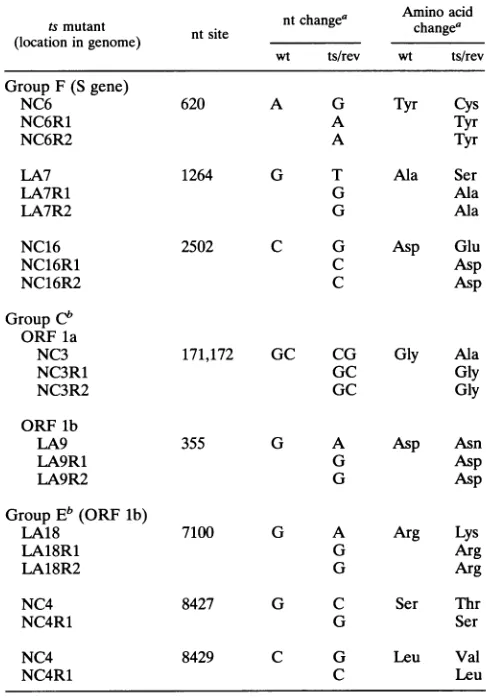
TABLE 3. Nucleotide locations of theMHVA59tsalleles
Amino acid tsmutant ntsite ntchange change'
(locationingenome)
wt ts/rev wt ts/rev
GroupF(S gene)
NC6 620 A G Tyr Cys
NC6R1 A Tyr
NC6R2 A Tyr
LA7 1264 G T Ala Ser
LA7R1 G Ala
LA7R2 G Ala
NC16 2502 C G Asp Glu
NC16R1 C Asp
NC16R2 C Asp
GroupCb ORFla
NC3 171,172 GC CG Gly Ala
NC3R1 GC Gly
NC3R2 GC Gly
ORF lb
LA9 355 G A Asp Asn
LA9R1 G Asp
LA9R2 G Asp
GroupEB (ORF lb)
LA18 7100 G A Arg Lys
LA18R1 G Arg
LA18R2 G Arg
NC4 8427 G C Ser Thr
NC4R1 G Ser
NC4 8429 C G Leu Val
NC4R1 C Leu
awt,wildtype; ts,temperature-sensitivemutant; rev, revertant.
b Sequencereported by Bredenbecketal.(9).
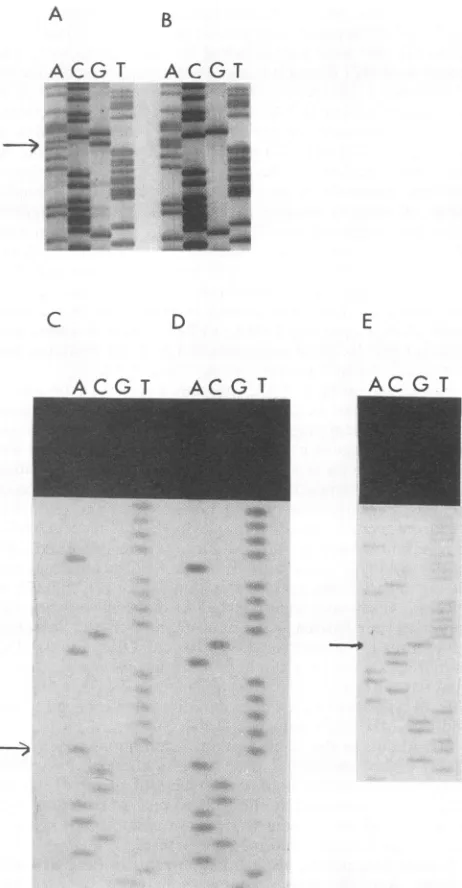
A-to-G transition at nt 620. The mutation had uniformly reversed to A in revertant viruses. The mutation at nt 620 resulted inanonconservativereplacementofTyr(TAC)toCys (TGC) atamino acid 207 in the Sglycoproteinof NC6(Table 3 andFig. 2).LA7alsocontainedasinglenucleotidechangeat position1264 in the Sl domain whichwastightlylinkedtothe
ts phenotype, a G-to-T transversion which resulted in a con-servative amino acidchangefromAla(GCC)toSer(TCC)at amino acid 422 (Table 3). In LA7revertants, thisnucleotide change also had reversed to theoriginal wild-type sequence.
NC16containedasinglenucleotidechange involvingaC-to-G transversion at nt2502 in the S2 domain of the Sglycoprotein
genewhich was linked to thets phenotypeand resulted in a conservative amino acid change from Asp (GAC) to Glu (GAG).Inrevertants ofNC16, themutation had reversed to theparental wild-type sequence (Table 3). The location and orientation of these ts mutants in the S glycoprotein gene
closely approximated their position as predicted from the genetic recombination map reportedpreviously (15). Several additional nucleotidechangeswerealsonoted in eachmutant andrevertantwhichwerenotlinkedtothetsphenotype (Table 4).
Sequence analysisof theRNA-tsand revertant viruses. The
group E RNA- mutants hadpreviously mapped near the 3' end of thepolymerasegeneby geneticrecombinationmapping
techniques
(5).
NC4 contained two nucleotide changes nearthe 3' endof thepolymerasegeneat nt8427(GtoC) and8429
(C to G) that were tightly linked to the ts phenotype. The
mutationat8427(CtoG)resulted in thereplacementofaSer
(AGC)withaThr(ACC),while the mutationat nt8429(Cto
G)resulted inaLeu
(CTA)
toVal(GTA)
change. Collectively, both mutationswere conservative and resulted in changes at amino acids 2728 and 2729 in ORF lb,respectively (Table 3).
Since both nucleotides had changed back to the originalwild-type sequence in the NC4 revertant and NC4
comple-ments all other ts mutants except several group E mutants, these data suggested that NC4 contained a double mutation
affectingthe group Egeneticfunction. LA18containedasingle
nucleotide substitutionat nt 7100,whichwastightlylinked to
thetsphenotype and located about 1.4 kb from the 3' end of
the polymerase gene. The G-to-A transition led to a
conser-vative change from Arg (AGA) to Lys (AAA) at amino acid 2286 inORF lb. Inall revertants ofLA18,the mutation had revertedtothewild-type sequence(Table 3, Fig. 2).
Amongthe group C RNA-mutantswhichwerethoughtto
contain mutations near the ORF la/lb boundary by
genetic
recombinationmappingtechniques(5),
LA9containedasingle nucleotidechangeatnt355 in the ORF lb domain whichwastightlylinkedtothetsphenotype.Themutationresidedwithin
theribosomal
frameshifting
site whichregulates
expression
oftheORF lbpolyprotein
(9).
TheG-to-A transition resulted inanonconservativealterationfromAsp
(GAC)
toAsn(AAC).
Inrevertantviruses, the alterednucleotide had reversed back
to the
wild-type
sequence(Table
3).
NC3 contained twodirectly adjacent nucleotide alterations at nt 171 and 172 in
ORF la which were
tightly
linked to the tsphenotype.
The mutationswerelocatedjust65ntupstreamfrom theribosomalframeshifting site between ORF la and ORF lb
(9).
Thealteration (GC to CG) resulted in anonconservative
change
fromGly
(GGC)
toAla(GCG)
ataminoacid 4438 in ORF la(29).
Inrevertantviruses,both mutations hadchanged
to thewild-type MHV-A59sequence
(Table
3).
In addition to the identification of mutations which were
closely linked to the ts
phenotype,
additional nucleotidechangeswerefound in bothtsandrevertantviruses
(Table
4).
Allof these alterationsresultedeither in silent mutations that
didnot
change
theprotein
sequence orinnucleotidechanges
thatexisted in bothts andrevertant viruses.
Establishing precise recombination ratesin the MHV A59
genome. Recombination
frequencies
between some of the individual ts mutantssequenced
in thisstudy
have beenpreviously reported
(5, 15).
However, additionalrecombina-tion
mapping
experiments
were necessary tocompletely
en-compass the spectrum of available crosses between these different combinations ofmutants. Each mutant was crossed threeto seven times with the othermutantsused in the
study
and standardized to the standard cross. Recombinationfre-quenciesare
expressed
as mean + standard deviation(Table
5).
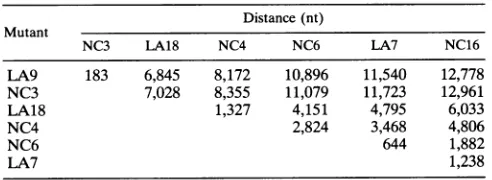
Tostandardizerecombinationrates across known distances between
highly
defined tsalleles,
the nucleotide distances between different ts alleles(Table
6)
were dividedby
each individual recombinationfrequency
recorded betweena par-ticularcross(n
= 3 -7).
Thestandardized 1% recombination rate was then calculated in mean basepairs
± standard deviation for eachcross(Table
7).
Theoverall1% recombina-tion rate across different domains in the MHV genome wascalculated
by
averaging
eachstandardized recombinationraterecorded from all of the available crosses
involving
mutants whichmapped
in either the Sglycoprotein
gene(LA7, NC6,
and
NC16),
thepolymerase
gene(LA9, NC3,
LA18,
andNC4),
VOL. 68,1994
on November 9, 2019 by guest
http://jvi.asm.org/
7462 FU AND BARIC
TABLE 4. Additional mutations in MHV A59ts and revertant viruses
Locationin ntchange' Aminoacid
tsmutant genome
change
(nt) wt ts rev wt ts rev
GroupF(S gene)
NC6 131 A C C Glu Asp Asp
NC6 514 C T C Gln Gln Gln
LA7 2069 G C G Gln Gln Gln
NC16 2242 T C T Tyr Tyr Tyr
NC16 2275 G C G Gly Gly Gly
Group C/Eb (ORF lb)
NC3 209 A G G Glu Val Val
LA9 3056 G A G Leu Leu Leu
LA18 7112 C T T Ser Phe Phe
awt,wildtype; ts,temperature-sensitive mutant;rev, revertant.
bSequenceasreported byBredenbeck et al.(9).
AC C, T
0.0001) and between ratesspanningthe 5' end of theS gene
and 3' end of polymerasegeneascomparedto rateswithinthe polymerasegene(P < 0.02)orthe S glycoprotein gene (P< 0.0001). Toaccount forthe presence of the doublets pheno-typethat wouldnotbe detected underourrecombinationassay
conditions (15),theaverage recombination rate in base pairs would probably be twofold the reported averagevalues(Fig.
3).
DISCUSSION
FIG. 2. Identification of mutations linked to the ts phenotype. Intracellular RNAwasisolated from cells infected withtsorrevertant
viruses, PCR amplified, and sequenced asdescribed in Materials and
Methods. The arrows designate the locations of specific mutations
linked to the ts phenotype. (A) LA18 revertant R1; (B) group E
mutantLA18; (C and D) NC6revertantsRl andR2, respectively; (E)
groupFmutant NC6. The gelsareread from the bottom.
orboth domains(NC4, LA18, LA7, NC6, and NC16). Within the Sglycoproteingenetheoverallaveragerecombinationrate wasmeasuredas 1%/1,133 ± 762 bp (n = 18) compared with
an average meanrecombinationrate of1%/5,393 + 3,558bp
(n = 28)withinthe polymerase gene. Between the 5' end of theSglycoprotein gene (group F: NC6, LA7, and NC16) and
the 3' end ofthepolymerasegene(groupE:NC4andLA18), theaveragerecombinationratewas1%/3,192 ± 1,792 bp(n =
22) (Table 7 and Fig. 3). Statistically significant differences
were detected between theratesof recombination measured within the Sglycoproteingeneandthepolymerasegene(P<
Wehave isolated and characterizedapaneloftsmutantsof MHVA59 whichweredividedinto five RNA- complementa-tiongroupsandone
RNA'
complementationgroupandhave been mapped by standard genetic recombination techniques (5, 15, 43).These studies havesuggested thatthe RNA- and theRNA'
complementation groups of MHV resided within the 22-kb polygenic polymerase region at the 5' end of thegenome and the S glycoprotein gene, respectively, and
sug-gested that the recombination frequencyof MHVwasamong
thehighest in thenonsegmented RNA viruses(5, 14, 15, 27). In this study, ts and revertant viruses were sequenced to identify specificmutationswhichcorrelated with thets pheno-type. While this approach suffers from the practical limits of sequencing the entire 32-kb genome ineach mutantand the lack of infectiousvectors toprovewhetheraspecificmutation encodes the ts phenotype, avariety of data suggest that the mutations identified in this study are tightly linked to and probablyrepresentthetsallele.Eachmutationwaspresentin
tsbutnotinrevertantviruses. In eachcase,thelocationof the
ts allele corresponded to its putativedomain aspredicted by standard genetic recombination mapping techniques (5, 15). For example, the predicted orientation and location of the
RNA'
mutants, 5'-NC6-LA7-NC16-3', was confirmedbyse-quenceanalysiswithNC6 and LA7residinginthe Si domain andNC16 in the S2 domain of the S glycoproteingene.The location of mutants in both the C and E complementation
groupswerealso close to the site predictedfrom the genetic recombination map (5). Importantly, RNA recombinant vi-ruses, isolated between LA7 and wild-type JHM following selectionat39°C,containedcrossoversites whichwerewithin 100 bp of (25%) or completely replaced (75%) the LA7 mutation with heterologous JHM sequences (3, 33). While these dataprovideastronglinkbetween individual mutations
B
A
C
G
T
A
ACG T
... _
ivE
}.2j3: 1,,$.1r,
..._::#
:,
>C,
_;:t::.:'-
_EFsjs.2
u_....-w ;
:.... 4_
'-C
D
E
J.VIROL.
on November 9, 2019 by guest
http://jvi.asm.org/
[image:5.612.319.560.94.240.2]RECOMBINATION RATES OF MOUSE HEPATITIS VIRUS MUTANTS 7463 TABLE 5. Recombination frequencies between MHV-A59 ts mutants'
Recombinationfrequencyb
Mutant
NC3 LA18 NC4 NC6 LA7 NC16
LA9 0.1 +0.09 3.1 + 1.80 2.2 0.56 5.13 +0.97 4.5 +0.80 ND
NC3 0.84 ± 0.21 1.67 ± 0.70 5.5 ± 2.10 3.74 ±2.30 ND
LA18 0.91 ± 0.90 0.9+ 0.20 1.2 + 0.30 4.6 ±0.60
NC4 0.78 ± 0.21 1.40 ± 0.40 1.30 0.10
NC6 0.2 ± 0.02 2.8 ± 0.90
LA7 3.0 ± 1.20
'N=3 to 7.
bMean ±standard deviation. ND, not done.
and thets allele, definitive proofmustawait the development of MHVinfectious clones.
Thetsmutantsutilized inthis studywereisolated inseparate
experiments using either5-fluorouracil (LA18and NC16) or
5-azacytidine (LA7, NC6, NC3, NC4, and LA9) as mutagen andcaused point mutations that resultinconservative (struc-turally similar) or nonconservative (structurally dissimilar)
amino acid changesintheproteinsequence(43). Interestingly,
5-fluorouracil,which shouldresult inchanges fromT(U) orA toothernucleotides (GorC) in the RNAsequence,wasnot detected in LA18 and NC16. Incontrast, 5-azacytidine, which
causes asubstitutionof CorGwith otherbases,wasevidentin ts LA7, NC4, LA9, and NC3 butnot in NC6. Similar results
were reported with Sindbis virus ts mutants in which the mutation couldnotalways be equated with the mechanism of actionof the selecting mutagen,suggesting that the mutation
mayhavebeencaused byRNApolymerase error(17, 18).
It is well documented that viral RNA-dependent RNA polymerases do not contain proofreading capabilities and, consequently, have high mutation rates approaching
10'
to 10-5perround ofreplication (19).Notsurprisingly,tsmutants of RNA viruses also have reversionfrequenciesontheorder of 10-3to 10-5(25, 29, 34, 43). In the caseofpolioand Sindbisviruses, reversion to the wild-type phenotype is normally accompanied by reversion atthesite ofmutation (17, 18, 23). In contrast, ts mutants of double-stranded RNAviruses like reovirusesoftenrevertfromattenuating second site mutations (40).Inthisstudy,allof the MHVts mutants,includingthose with doublemutations, reverted tothewild-type sequence at the siteof mutation. Reversionfrequencieswereusually lower when single rather than double nucleotide changes were
required forreversion to thets+ phenotype (Table 2).
How-ever, NC3 contained a double mutation resulting in a single aminoacidchangeinORFla,yetsurprisingly,ithadrelatively high reversion frequencies on par with other mutants that containedsinglenucleotidechanges. Sequence analysisof the wild-type and NC3 genomes indicates thata single ordouble nucleotide substitutionateitherthesecond and thirdpositions
orthethirdposition onlyin thetripletcode could result in a
wild-type ts+ phenotype (MHV-A59-Ala [GCG]; NC3-Gly [GGC]; NC3R1 or NC3R2 revertants-Ala [GCG]; putative ts+ revertant-Ala [GCC]). Itis less clearwhythe NC3 rever-tants had completely returned to the wild-type sequence at
both positions unless the primary sequence provided some selectiveadvantages followingtwoplaque purificationsand the generation of virus stocks. In contrast, NC4 also contained a doublemutation inthegroupEgeneticfunctionwhich altered
two amino acids near the C terminus of ORF lb,and rever-tantsof this virus werevirtually impossible to isolate until it had been serially passaged at semipermissive and restrictive temperatures. While we do not have direct evidence, NC4
probably changed to the wild-type phenotype by the accumu-lation of two independent reversion events which occurred during serial passage.
Althoughcoronavirus polymerase errorrateshave notbeen rigorously examined, mutation and reversion frequencies of MHV-A59 and MHV-JHMts mutants generally range from
10-3 to 10-5, suggestingthatproofreadingactivitieswere not
presentin the MHVpolymerase(25,29, 34,43). From highly plaque-purified ts mutants requiring a single nucleotide alter-ationatthe site of mutation for reversiontothe ts+phenotype
(LA9, NC3, LA18, NC6, NC16, and LA7),we calculated the
average polymerase error rate in the MHV genome to ap-proach 1.32x 10⁻⁴ ±0.89 x
10-4,
orabout 2.4 mutations per genomeround ofreplication(range,1.5to7.4).This is similar toerror ratescalculated for otherpositive-strand RNAviruses (19, 36, 52). Ithasbeensuggested that theMHVpolymerase maycontain a ribonuclease activity which trims leader RNA mismatches at intergenic start sites during "leader-primed" transcription and may also encodeanRNAediting function(2, 21). If proofreading or editing activities are encoded in the MHVpolymerase,ourdata suggest thattheyprobablyfunction poorlyor not at all in therepair of mismatchesincorporated into nascent chainsduring RNA transcription.TheMHVgenomicRNAcontainstwolarge ORFsatthe 5'
end, and ORF lb is translatedbyribosomalframeshiftingas a large ORF la/lb polyprotein which is subsequently cleaved by cellular orviral proteasesinto individual viralproteins (8, 9, 28). It is not clear whether functional viral proteins are encoded which span the ORF la/lb junction (28). Previous studies in our laboratory suggest that the group C and E RNA- mutantsencode genetic functionsregulating
negative-and positive-strand RNA synthesis, respectively (43). The
group E genetic function is located between nt 7100 and nt
8427(aminoacids 2274to2728 inORFlb),while the group C
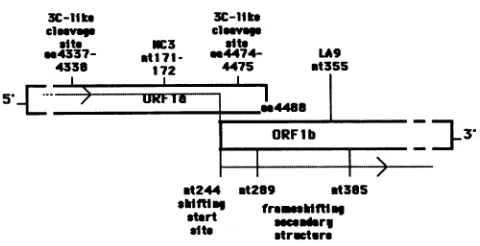
function probably spans the ORFla/lbribosomal frameshift-ing site since NC3 and LA9are locatedatthe C andNtermini of ORF la and ORF lb, respectively (Fig. 4). These data clearly demonstrate thatgeneticalleles in ORF lbfunction in
TABLE 6. Distances betweentsalleles
Distance(nt)
Mutant
NC3 LA18 NC4 NC6 LA7 NC16
LA9 183 6,845 8,172 10,896 11,540 12,778
NC3 7,028 8,355 11,079 11,723 12,961
LA18 1,327 4,151 4,795 6,033
NC4 2,824 3,468 4,806
NC6 644 1,882
LA7 1,238
VOL. 68, 1994
on November 9, 2019 by guest
http://jvi.asm.org/
[image:6.612.315.561.636.726.2]TABLE 7. Standardized1%recombination frequencybetween different combinations of MHV-A59tsmutants Recombinationfrequencya
Mutant
NC3 LA18 NC4 NC6 LA7 NC16
LA9 6,718±6,093 2,962± 1,410 3,930±787 2,145±355 2,683 ±460 ND
NC3 8,979± 1,191 6,006 +2,041 2,214+658 4,399±2,238 ND
LA18 4,199±3,274 4,723±450 4,508+ 1,728 1,054± 139
NC4 3,964±1,357 2,723±878 3,721±313
NC6 2,169± 1,031 629±331
LA7 615±234
aInmean base pairs ± standard deviation. ND, notdone.
RNA synthesis. More mutants must be sequenced before reliable estimates of the size and exactlocation ofthe func-tional domains of thegroupCandE complementationgroups
can be determined. Since the location of the NC3 and LA9
mutationsare notinregionsdemonstrated toblockribosomal frameshifting in infectious bronchitis virus(11), it is possible that the mutationsmayablateproteolyticprocessingofone or more N-terminal ORF lbpolyproteins (9, 28).
Previous studies in ourlaboratory have predicted that the overall RNA recombination rates in the polymerase and S glycoprotein genes of MHV approached 1%/1,800-2,500 bp
and 1%/575-667 bp, respectively (5, 15). The physical map
locationsof thesevenmutantssequenced in thisstudyallowed us to determine precise recombination rates across defined
distances. In the polymerase and S glycoprotein genes, the average recombinationrateswereabout 1%/5,393 ± 3,558 bp
and 1%/1,133 ± 762bp;respectively,whichwere significantly
different (P < 0.0001). Recombination rates measured from the -S glycoprotein gene to the polymerase gene approached
1%/3,192 ± 1,792bp,andthiswassignificantly different from
ratescalculated in eitherthepolymerase (P<0.02)orS(P<
0.0001) glycoprotein genes. Assuming that recombination
events occur in both directions and result in the double ts
phenotype, these results closely parallel previous predictions andclearly demonstrate that variable rates ofrecombination occurwithindifferentregionsof the MHVgenome. Usingthe
markers identified in thisstudy,wecanalsopredictthe overall
recombination frequency in different portions of the MHV
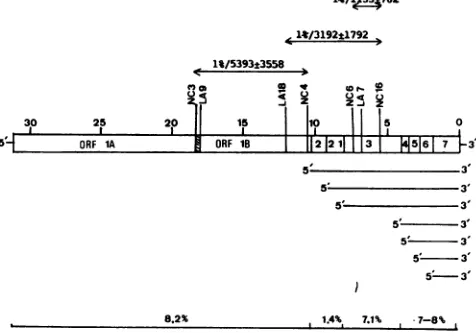
genome.Assumingthatrecombinationeventsalso result inthe double ts phenotype, recombination frequencies approach 8.2% in the 22-kbpolymerasegene, -1.4%acrossthep30/HE
genes(-2.2 kb),and-7.1%acrossthe -4.0-kb Sglycoprotein
gene(Fig. 3).While markersarenotavailabletomeasurethe
recombination frequency at the 3'-most -4.0 kb of the viral
genome,it haspreviouslybeen demonstrated that recombina-tionevents atthe 3' end of thegenome canbe detected in the absence of selective markers(20).Thus,itseemslikelythat the
recombination frequencywillapproachorexceed ratesinthe S glycoprotein gene,approximately 7to8% ormore.
Several explanations could account for the increase in the
rateofrecombination withintheMHVgenome,including high
negativeinterference, preferred "hotspots"of recombination, and the presence of nested set subgenomic negative strands andsubgenomic mRNAwhich increase the amount of avail-able template for switching (15, 24). High negative
interfer-ence seems unlikely since recombination frequencies did not
increase as the physical distance between two ts alleles de-creased and RNArepair mechanisms have notbeen demon-strated in MHV (16). Since aprogressive, statistically signifi-cantincrease intherecombinationratewasdetected from the 5' tothe 3' endofthegenome, these findingsareinconsistent withrecombinationhotspotswhich predict thatsimilarratesof
recombination will be detected 5' and 3' tothepreferred site. Extensive sequenceanalysis of RNA recombinant viruses also supportsthe notion ofnon-site-specific homologous recombi-nation or the idea thatcrossover events mayoccur nearUU dimers orinregionsofsecondarystructurein siteschosento minimize the adverse free energychange involved in template switching (4, 13, 22). It has beenreportedthatapreferredsite ofrecombination exists in MHV betweennt 1146 and 1431 in the Sglycoprotein gene(3).Thelocations of thetwo ts mutants LA7 (nt 1264) and LA12 (located -0.2 recombination units from LA7, or about 250 bp) and the monoclonal antibody neutralization sites (near the C-terminal domain of Si at nt 1766or1950) usedtoselect these recombinants havenowbeen identified (54); the actual distance between the two selective markers was only about 0.5 to 0.8 kb. It seemsmore likely that the clustering of recombination sites in the S glycopro-tein gene was defined by the selective markers used in the study (3).
Amorelikely explanationfor differentratesof
recombina-tion in the MHV genome is the presence oftranscriptionally active subgenomic negative strands and nested set mRNAs whicheffectively increase the amount of templateRNAwhich
canparticipateinswitchingby copy choice(15).In supportof
11/1ja33762
A11/319241792
1%/5393t3558
30 25 20 15 |10 | 5
5 6ORF1A ORF 1B |
112|21||131|516
7 35 3'
5' 3'
5 3
5 3
5 3
5 3
8.2% 1.4%, 7.1% - 7-8%
FIG. 3. Recombination rates in different portions of the MHV genome. The relative locations of the MHV-A59 ts mutants are
superimposeduponthegenetic organization andtranscriptional strat-egyof MHV. The groupCRNA- mutants,NC3 andLA9, flankthe ribosomalframeshifting site (hatched region) delineatingORF laand ORF lb(9). Standardized 1% recombination rates weredetermined
across the indicated areas as described in Materials and Methods. Overallpredictedrecombinationfrequenciesfor differentregions of the MHV genomeareshownatthe bottom of thefigure.
on November 9, 2019 by guest
http://jvi.asm.org/
[image:7.612.323.561.474.642.2]RECOMBINATION RATES OF MOUSE HEPATITIS VIRUS MUTANTS 7465
3C-IlkS cissvags
sits
-4337-4338 -.
3C-lske
celv mC3 sits
mt171- -4474- LA9
172 4475 mt355
:iJs
44488ORFlb
mt244 shifting
strt sits
I
I
mt289 mt3
fr_sshMftmg s.csbrg
strinturs
P
FIG. 4. The location of the group Cmutantswithrespect to the
ribosomal frameshiftingsite. ORF laand ORF lbrepresent thetwo large ORFs in the polymerase geneof MHV. The locations of the
mutations in LA9 and NC3 are shown relative to the ribosomal frameshifting site (9)andputativepoliovirus 3C-likeproteasecleavage
sites (28).These datasuggestthatcomplementationgroupCspansthe
ORF la/lb junction.
thishypothesis, in vitro transcribedmRNAs and 5'-truncated RNA products thatweretransfected into infected cells
partic-ipated in recombination (24, 30). In addition, recombinant viruseshave alsobeen isolated from persistently infected cells which contain leader RNA sequences inserted into the
genomic RNA at highly conserved intergenic sequences
sug-gesting that recombination events occurred between sub-genomic-length and full-length mRNA or negative-stranded
RNAs (51). Recombination has also been demonstrated be-tween genome-length RNA and subgenomic-length defective interfering RNAs, indicatingthatdifferentially sized templates
canparticipate in RNArecombination (53).
Thehigh rateofcoronavirus RNArecombination coupled with high polymerase error rates would not only provide a
naturalmechanism forrapid antigenic variation and evolution within the highly immunogenic structural genes but, as with
influenzavirus, suggests that these viruses possess significant
latent capacity as emerging pathogens (36). Coronaviruses
cycle through the human population every couple of years,
causing 15 to20% of the commoncolds in winter. Occasion-ally, theyare associated with lower respiratorytractinfections likebronchitis and pneumonia, andthey have been implicated inperimyocarditis and infectionsof the centralnervoussystem,
includingmultiplesclerosis (37, 49). Itis also clear that MHV can rapidly alter its species specificity and infect rats and primatesinvivo.Theresulting variantviruses produce enceph-alitis ordemyelination in thenewhost(35, 38).Newly
recog-nizedanimalcoronaviruses include porcinerespiratory disease virus and porcine epidemic diarrhea coronavirus (10, 12). Porcine respiratory disease virus probably evolved from
por-cinetransmissiblegastroenteritis virus bymutation and
recom-bination, resulting in numerous deletions and mutations in structural and nonstructural genes (12). In contrast, porcine epidemic diarrhea coronavirus is more closely related to the humancoronavirus229E than porcine transmissible
gastroen-teritis virus, suggesting that it may have evolved from or
recombinedwith human strains (10). The high mutation and RNArecombinationrates ofcoronaviruses suggestthatthese viruses have the potential to evolve rapidly, transverse the species barrier under the appropriateconditions, andemerge
asmajor pathogens associated with significant morbidity and
mortality.
ACKNOWLEDGMENTS
Wearegrateful to Robert E. Johnston and J. Ed Hall for valuable advice and Wan Chen, Sheila Peel, and Boyd Yount for excellent technical assistance.
This research was supported by grants from the American Heart Association (AHA 90-1112) and the National Institutes of Health (AI-23946) and was performed during the tenure of an Established Investigator Award from the American Heart Association (AHA 89-0193) to R.S.B.
REFERENCES
1. Armstrong,J., S.Smeekens, and P. Rottier. 1983. Sequence of the Ngene from murine coronavirus MHV-A59. Nucleic Acids Res. 11:883-891.
2. Baker, S.C., andM.M. C.Lai. 1990. An in vitro system for the leader-primed transcription of coronavirus mRNAs. EMBO J. 9: 4173-4179.
3. Banner, L.R.,J. G. Keck, and M. M.Lai. 1990. A clustering of RNArecombination sites adjacent to a hypervariable region of the peplomergene ofmurinecoronavirus. Virology 175:548-555. 4. Banner,L.R., and M. M. Lai. 1991. Random nature of
coronavi-rus RNA recombination in the absence of selection pressure. Virology 185:441-445.
5. Baric,R. S., K.S. Fu, M. C. Schaad, and S. A. Stohiman. 1990. Establishing ageneticrecombination map for MHV-A59 comple-mentation groups. Virology 177:646-656.
6. Baric, R.S.,C.K. Shieh, S. A.Stohiman,and M. M. C. Lai. 1987. Analysis of intracellular small RNAs of mouse hepatitis virus: evidence fordiscontinuous transcription. Virology 156:342-354. 7. Baric,R. S., S. A. Stohlman, and M. M. C. Lai. 1983.
Character-izationofreplicative intermediate RNA of mouse hepatitis virus: presence ofleader RNA sequences on nascent chains. J. Virol. 48:633-640.
8. Bonilla, P. J., A. E. Gorbalenya, and S. R. Weiss. 1994. Mouse hepatitisvirusstrainA59 RNA polymerase gene ORF la: heter-ogeneityamongMHVstrains. Virology 198:736-740.
9. Bredenbeek, P. J., C. J. Pachuk,A.F. H. Noten, J. Charite, W. Luytjes, S. R. Weiss, and W. J. M. Spaan. 1990. The primary structure andexpressionofthesecondopenreading frame of the polymerase geneofthecoronavirus MHV-A59; a highly conserved polymerase is expressed by an efficient ribosomal frameshifting mechanism. NucleicAcids Res. 18:1825-1832.
10. Bridgen,A.,M.Duarte,K. Tobber, H. Laude, and M. Ackermann. 1993.Sequencedeterminationofthenucleocapsid protein gene of theporcine epidemicdiarrhoeavirus confirms that this virus is a coronavirus related to human coronavirus 229E and porcine transmissible gastroenteritis virus.J.Gen. Virol. 74:1795-1804. 11. Brierly, I., P. Digard, and S. C.Inglis.1989.Characterizationof an
efficientcoronavirusribosomalframe-shifting signal: requirement for an RNApseudoknot. Cell 57:537-547.
12. Britton, P.,K.L.Mawditt, andK.W.Page. 1991.Thecloning and sequencing ofthe virion protein genes from a British isolate of porcine respiratory coronavirus: comparison with transmissible gastroenteritis virus genes.VirusRes.21:3.
13. Cascone, P. J., T. F. Haydar, and A.E. Simon. 1993. Sequences and structures required for recombination between virus-associ-atedRNAs. Science 260:801-805.
14. Cooper, P. D. 1968. A genetic map of poliovirus temperature-sensitive mutants. Virology 35:584-596.
15. Fu, K., and R. S. Baric. 1992. Evidence for variable rates of recombination in the MHV genome. Virology 189:88-102. 16. Glickman, B. W., and M. Radman. 1980. E.coli mutator mutants
deficient in methylation-instructed DNA mismatch correction. Proc.Natl.Acad. Sci. USA77:1063-1067.
17. Hahn, Y. S., A. Garkovi, C. M. Rice, E. G. Strauss, andJ. H. Strauss. 1989. Mapping of RNA-temperature-sensitive mutants ofSindbis virus:complementationgroup Fmutantshave lesions in nsP4. J. Virol.63:1194-1202.
18. Hahn, Y. S., E. G. Strauss, and J. H.Strauss. 1989. Mapping of RNA-temperature-sensitivemutantsofSindbisvirus:assignment ofcomplementation groups A, B, and G tononstructuralproteins. J. Virol.63:3142-3150.
19. Holland, J., K. Spindler, F. Horodyski, E. Grabau, S.Nichol, and
VOL.68,1994
lL
on November 9, 2019 by guest
http://jvi.asm.org/
[image:8.612.56.296.78.201.2]S. Vandepol. 1982. Rapid evolution of RNA genomes. Science 215:1577-1585.
20. Keck, J. G., L. H. Soe, S. Makino, S. A. Stohlman, and M. M.C. Lai. 1988. RNArecombination ofmurinecoronaviruses: recom-bination between fusion-positive mouse hepatitis virusA59 and fusion-negative mousehepatitis virus2.J. Virol. 62:1989-1998. 21. Kim, Y.-N., M. M. C. Lai, and S. Makino. 1993. Site specific
sequencerepair ofcoronavirus defectiveinterferingRNAbyRNA recombination and edited RNA. Adv. Exp. Med.Biol. 342:143-148.
22. King, A. M. Q. 1988.Preferred sites of recombination inpoliovirus RNA: an analysis of 49 intertypic crossover sequences. Nucleic Acids Res. 16:1705-1723.
23. King, A. M. Q., S. A. Ortlepp, J. W. Newman, and D.McCahon. 1987. Genetic recombination in RNA viruses, p. 129-152. In R. J. Rowlands, M. A. Mayo, and B. N. Mahy (ed.), The molecular biology of the positive strand RNA viruses. Academic Press, London.
24. Koetzner, C. A., M. M. Parker, C. S. Ricard, L. S. Sturman, and P.S. Masters. 1992. Repair and mutagenesis of the genome of a deletion mutant of the coronavirus mouse hepatitis virus by targeted RNArecombination. J. Virol. 66:1841-1848.
25. Koolen, M. J. M., A. D. M. E. Osterhaus, G. Van Steenis, M.C. Horzinek, and B. A. M. van der Zeijst. 1983. Temperature sensitive mutants of mouse hepatitis virus strain A59: isolation, characterization and neuropathogenic properties. Virology 125: 393-402.
26. Lai, M. M. C., R. S. Baric, P. R. Brayton, and S. A. Stohlman. 1984.Characterization ofleader RNA sequences on the virionand mRNAs of mouse hepatitis virus, acytoplasmic virus. Proc. Natl. Acad. Sci. USA 81:3626-3630.
27. Lake, J. R., R. A. J. Priston, and W. R. Slade. 1975. A genetic recombination map of foot and mouth disease virus. J. Gen. Virol. 27:355-367.
28. Lee, H.-J., C.-K. Shieh, A. E. Gorbalenya, E. V. Koonin, N. La Monica, J. Tuler, A. Bagdzhadzhyan, and M. M. C. Lai.1990.The complete sequence (22kilobases) of murine coronavirus gene 1 encoding the putative proteases and RNApolymerase. Virology 180:567-582.
29. Leibowitz, J. L., J. R. de Vries, and M. V. Haspel. 1982.Genetic analysis ofmurine hepatitis virus strainJHM. J.Virol. 42:1080-1087.
30. Liao, C.-L., and M. M. C. Lai. 1992. RNArecombination in a coronavirus: recombination between viral genomic RNA and transfected RNA fragments. J. Virol. 66:6117-6124.
31. Luytjes, W., P. J. Bredenbeek, J. Charite, B. A. van der Zeijst, M. C. Horzinek, and W. J. Spaan. 1987. Primary structureof the glycoprotein E2 ofcoronavirus MHV-A59 and identification of the trypsincleavage site.Virology161:479-487.
32. Luytjes, W., P. J. Bredenbeek, A. F. H. Noten, M. C. Horzinek, and W. J. M. Spaan. 1988. Sequence of mouse hepatitis virus A59 mRNA 2: indications for RNArecombination between coronavi-rus andinfluenzaCvirus. Virology 166:415-422.
33. Makino, S., J. 0. Fleming, J. G. Keck, S. A. Stohiman, and M. M. C. Lai. 1987. RNA recombination ofcoronaviruses: local-ization of neutralizing epitopes and neuropathogenic determi-nants on the carboxyl terminus of peplomers. Proc. Natl. Acad. Sci. USA 84:6567-6571.
34. Martin, J. P., F. Koehren, J. J. Rannou, and A. Kirn. 1988. Temperature sensitive mutants of mouse hepatitis virus type 3 (MHV-3): isolation, biochemical and genetic characterization. Arch. Virol. 100:147-160.
35. Mohanda, D. V., and S. Dales. 1991. Infection by coronavirus JHM of rat neurons and oligodendrocyte-type 2 astrocyte lineage cells during distinct developmental stages. J. Virol. 65:5103-5108. 36. Morse, S. S. 1994. The viruses of the future? Emerging viruses and
evolution, p. 325-335. In S. S. Morse (ed.), The evolutionary biology of viruses. Raven Press, Ltd., New York.
37. Murray, R. S., B. Brown, D. Brian, and G. F. Gabirac. 1992. Detection of coronavirus RNAand antigen inmultiple sclerosis brain.Ann.Neurol. 31:525-533.
38. Murray, R. S., et al. 1992.Coronavirus infects andcauses demy-elinationintheprimate centralnervous system.Virology 188:274-284.
39. Pachuk,C.J.,D.J. Bredenbeck,P. W.Zoltick,W.J.M.Spaan, and S. R. Weiss.1989.Molecularcloningof the geneencodingthe putative polymerase of mouse hepatitis coronavirus strainA59. Virology 171:141-148.
40. Ramig,R. F. 1980. Suppression oftemperature-sensitive pheno-type in reovirus: an alternative pathway from ts to ts+phenotype, p. 633-642. In B. N. Fields, R. Jaenisch, and C. F. Fox (ed.), Virology. Animal virus genetics.
41. Sawicki, S. G., and D. L. Sawicki. 1990.Coronavirus transcription: subgenomic mousehepatitisvirus replicative intermediates func-tion in RNA synthesis.J. Virol. 64:1050-1056.
42. Schaad, M. C., and R. S. Baric. 1993. Evidence for new transcrip-tional units encoded at the 3' end of themouse hepatitis virus genome. Virology196:190-198.
43. Schaad, M. C., S. A. Stohlman, J. Egbert, K Lum, K. Fu, T. Wei, Jr., and R. S. Baric. 1990. Genetics of mouse hepatitis virus transcription: identification of cistrons which may function in positive and negative strand RNA synthesis. Virology 177:634-645.
44. Sethna, P. B., M. A. Hofmann, and D. A. Brian. 1991. Minus-strandcopies ofreplicatingcoronavirusmRNAscontain antilead-ers. J.Virol. 65:320-325.
45. Sethna, P. B., S.-L. Hung, and D. A.Brian. 1989. Coronavirus subgenomic minus-strand RNAs and the potential for mRNA replicons. Proc. Natl. Acad. Sci. USA 86:5626-5630.
46. Shieh, C.-K., H.-J. Lee, K. Yokomori, N. LaMonica, S.Makino, and M. M. C. Lai. 1989. Identification ofa newtranscriptional initiation site and the corresponding functional gene 2b in the murinecoronavirus RNA genome. J. Virol. 63:3729-3736. 47. Siddell, S. 1983. Coronavirus JHM: codingassignments of
sub-genomic mRNAs. J. Gen. Virol. 64:113-125.
48. Spaan, W., H. Delius, M. Skinner, J. Armstrong, P. Rottier, S. Smeekens, B. A. M. van der Zeist, and S. G. Siddell. 1983. Coronavirus mRNA synthesis involves fusion ofnon-contiguous sequences. EMBO J. 2:1839-1844.
49. Steward, J. N., S. Mounir, and P. J. Talbot. 1992. Human coronavirus gene expression in the brains of multiple sclerosis patients. Virology191:502-505.
50. Sturman, L., and K. Holmes. 1985. The novel glycoproteins of coronaviruses. TrendsBiochem. Sci. 10:17-20.
51. Taguchi, F., T. Ikeda, S. Makino, and H. Yoshikura. 1994. A murinecoronavirus MHV-S isolate frompersistently infected cells has aleaderand two consensus sequencesbetween theMandN genes.Virology 198:355-359.
52. Topal, M. D. 1988. DNA repair, oncogenes, and carcinogenesis. Carcinogenesis 9:691-696.
53. van der Most, R. G., L. Heqnen, W. J. M. Spaan, and R. J. deGroot. 1992. Homologous RNArecombination allows efficient introduction ofsite-specificmutationsinto thegenome of corona-virus MHV-A59viasyntheticco-replicating RNAs.Nucleic Acids Res. 20:3357-3371.
54. Wang, F. I., J. 0. Fleming, and M. M. C. Lai. 1992. Sequence analysis of thespike protein gene ofmurinecoronavirus variants: study ofgenetic sites affecting neuropathogenicity. Virology186: 742-749.
55. Winship, P. R. 1989. Animproved method fordirectlysequencing PCR amplified material usingdimethyl sulphoxide. Nucleic Acids Res. 17:1266.