promoting access to White Rose research papers
White Rose Research Online
[email protected]
Universities of Leeds, Sheffield and York
http://eprints.whiterose.ac.uk/
This is a copy of the final published version of a paper published via gold open access
in
Journal of Materials Chemistry A
.
This open access article is distributed under the terms of the Creative Commons
Attribution Licence (http://creativecommons.org/licenses/by/3.0), which permits
unrestricted use, distribution, and reproduction in any medium, provided the
original work is properly cited.
White Rose Research Online URL for this paper:
http://eprints.whiterose.ac.uk/79459
Published paper
E
ff
ects of cationic substitution on structural
defects in layered cathode materials LiNiO
2
Hungru Chen,* James A. Dawson and John H. Harding
The electrochemical properties of layered rock salt cathode materials are strongly influenced by defects. The three most common defects in LiNiO2-based compounds, namely extra Ni, Li–Ni anti-site and oxygen vacancy defects have been investigated. The calculated defect formation energies are very low in LiNiO2, consistent with the difficulty in synthesizing stoichiometric defect-free LiNiO2. A systematic study is conducted to examine the effect of Co, Mn and Al substitution on defect formation. It is shown that the presence of Ni2+ in the Li layer can be rationalized using ideas of superexchange interactions. In addition, a correlation between oxygen vacancy formation energy and oxygen charge is noted. This explains the better thermal stability obtained by early transition metal or Al substitutions.
Introduction
Layered rock salt structure materials with the general formula LiMO2 (where M is a transition metal) have been studied
intensively due to their applicability as cathode materials in lithium ion batteries. LiCoO2 is the prototype commercially
used cathode. However, cobalt is toxic and expensive and therefore the search for replacements for cobalt-based cathodes has lasted for decades. LiNiO2is one of the potential cathode
materials for lithium ion batteries. Although this compound has been studied for many years, the electronic, magnetic and local structures are still highly controversial.1,2
Experimentally it is not yet possible to synthesize perfect, stoichiometric LiNiO2. A certain fraction of extra nickel ions
occupy the lithium sites making the true formula of the mate-rial [Li1xNix]NiO2(ref. 3) (this is referred to hereaer as extra Ni
defects on the Li site). A recent theoretical study on LiNiO2also
predicts an unavoidable high concentration of Ni present in the Li layers at high temperature.4Besides, 11% of Li–Ni interlayer
mixing (cation exchange between Li and Ni in the expected layered structure) is reported to occur in the LiNiO2-based
material LiNi1/2Mn1/2O2and 6% in LiNi1/3Mn1/3Co1/3O2.5,6The
presence of Ni in the Li layers has a detrimental effect on the electrochemical performance of the material as a cathode. First, it disrupts the lithium diffusion by blocking the diffusion pathways.7Second, it has been suggested that the presence of
nickel in the lithium layer is responsible for rst-cycle irre-versibility.8–10During therst charge, the Ni2+ions at Li sites are
oxidized to smaller Ni3+ ions. This causes a local shrinkage around those nickel ions and therefore it is difficult to insert lithium ions back into the positions around them.
Oxygen loss is another issue in layered cathode materials. A recent study on LiNi0.8Mn0.1Co0.1O2d demonstrated that up
to 12% oxygen loss occurs depending on the synthesis conditions and that there is a strong correlation between oxygen content and electrochemical performance.11Delithiated
Li1xNiO2is not thermally stable. It undergoes a phase
transi-tion accompanied by oxygen evolutransi-tion. It has been shown that the extent of oxygen evolution increases asxincreases.12This
irreversible structural change is concomitant with oxygen loss and maybe responsible for the observed capacity fading.13,14
In order to improve the electrochemical performance of LiNiO2, the strategy of partial substitution of Ni by other metal
cations has been deployed. It is known that Co substitution gives better 2-D layered character. For LiNi1xCoxO2withx> 0.3, nickel
is no longer present in the lithium layer.15As a result, the
irre-versibility seen at therst-cycle mentioned above disappears. By contrast, the interlayer mixing increases with Mn doping.16
Nevertheless, LixNi0.5Mn0.5O2 exhibits excellent structural
stability against oxygen loss17at low Li content and therefore better
safety. Al doping improves the thermal stability although Ni is still found in the Li layer.18,19Cycling tests show that 10% Al suppresses
all the phase transitions observed for the LixNiO2system.19
Although the properties produced by partial cationic substi-tution are well studied, the reasons why these foreign dopants produce them are not clear. In this study, rst-principles calculations are performed to investigate the structural defects of Li–Ni anti-site, extra Ni and oxygen vacancy in LiNiO2and the
effect of Ni substitution by Co (LiNi0.5Co0.5O2), Al (LiNi0.5Al0.5O2)
and Mn (LiNi0.5Mn0.5O2). The same structural defects in NaNiO2
and LiCoO2are also calculated for comparison.
Defect formation energies
In this study, we consider the presence of extra Ni in the Li layers, the Li–Ni interlayer mixing and the oxygen loss as point
Department of Materials Science and Engineering, University of Sheffield, S1 3JD, UK. E-mail: [email protected]
Cite this:J. Mater. Chem. A, 2014,2, 7988
Received 6th February 2014 Accepted 5th April 2014
DOI: 10.1039/c4ta00637b
www.rsc.org/MaterialsA
Materials Chemistry A
PAPER
Open Access Article. Published on 08 April 2014. Downloaded on 19/06/2014 15:34:09.
This article is licensed under a
Creative Commons Attribution 3.0 Unported Licence.
defects in the supposedly perfect layered LiMO2. The extra Ni
defect can be considered as occurring through the following defect reaction
}LiMO2}þ2NiO/2Ni$Liþ2M
0
MþLi2Oþ
1 2O2
Similarly the interlayer mixing defect occurs through the reaction
}LiMO2}/NicLiþM
0
M
and the oxygen vacancy defect occurs through the reaction.
}LiMO2}/VccOþ2M0Mþ
1 2O2
In this work we dene defect formation energies as the formation enthalpies of the above defect reactions at 0 K. Two assumptions are made here. First, in solid phases the volume term can be neglected and therefore the enthalpy corresponds to the internal energy. Second, defects are assumed to distribute evenly in the crystal. In the case of extra Ni defects in LiNiO2, the defect formation energy per defect is then
given as
DFEðextra NiÞ ¼DG
¼DHTDSz EðperfectÞ EðNiOÞ
þEðdefectiveÞ þ1
2EðLi2OÞ þ 1 4EðO2Þ
whereE(perfect) is the lattice energy of a perfect LiNiO2cell and
E(defective) is the lattice energy of the cell containing one extra Ni defect.
Similarly the defect formation energy of interlayer mixing is
E(interlayer mixing)¼ E(perfect) +E(defective)
where E(perfect) is the lattice energy of the perfect cell and E(defective) is the lattice energy of the cell containing one interlayer mixing defect.
The defect formation energy of oxygen vacancy is
Eðoxygen vacancyÞ ¼ EðperfectÞ þEðdefectiveÞ þ1 2EðO2Þ
where E(perfect) is the lattice energy of the perfect cell and E(defective) is the lattice energy of the cell containing one oxygen vacancy.
For LiNiO2, the concentrations of Ni present in the Li layers
and oxygen vacancies are reported to be a few percent and are far beyond the dilute limit. However by an appropriate choice of the supercell size, the correct defect concentration can be simulated by substitution of the appropriate number of defects in the cell.
Computational approach
In this study, rst-principles calculations are performed to investigate the structural defects of interlayer mixing, extra Ni and oxygen vacancy in layered LiNiO2 and the effect of Ni
substitution by Co (LiNi0.5Co0.5O2), Al (LiNi0.5Al0.5O2) and Mn
(LiNi0.5Mn0.5O2). The structural defects in layered NaNiO2and
LiCoO2are also calculated for comparison.
All calculations are based on Density Functional Theory (DFT) in combination with the projector augmented wave (PAW) method.20The generalized gradient approximation (GGA) is used
with the Perdew–Burke–Ernzerhof functional21and a Hubbard
model U correction22is incorporated for the d electrons to give a
better description of this strongly correlated system. The U parameters used for Ni, Co and Mn are 6.5, 4.9 and 4.5 eV, respectively. These parameters are adapted from a self-consistent calculation.23The plane wave energy-cutoffis set to 500 eV. For all
cells, thek-point spacing is less than 0.05˚A1in the Brillouin zone. Structural optimizations were performed until the residual force acting on each ion was less than 0.01 eV A1. All calculations were carried out using the Viennaab initiosimulation package (VASP).24
For the calculation of perfect layered LiNiO2, a possible
ground state cell with space group symmetryP21/cis used as the
starting structure.2In thisP2
1/ccell the Jahn–Teller distortions
of Ni3+in the NiO
2slab are in a zigzag ordering. For calculations
of layered LiNi0.5Co0.5O2, LiNi0.5Al0.5O2and LiNi0.5Mn0.5O2the
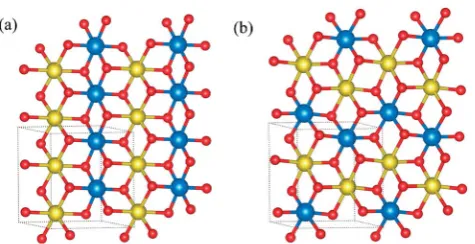
two simplest in-plane cation orderings, linear and zigzag orderings, are considered as shown in Fig. 1. Supercells with 32 formula units containing 128 atoms are used in all defect calculations. The interlayer mixing defects and extra Ni defects in such a supercell correspond to a concentration of 3.125%, which is well within the experimentally reported range of defect concentration in LiNiO2. Therefore the size of the cell is
adequate for simulating the observed defects in LiNiO2 and
there is no need for extrapolation to the innite limit.
The interlayer mixing defect in layered AMO2(A¼Li, Na) is
constructed by swapping one Ni (Co in the LiCoO2case) in the
MO2 slab with the nearest A ion. The extra Ni defect is
con-structed by replacing one A ion by Ni in the supercell. The oxygen vacancy defect is constructed by removing one oxygen atom from the supercell.
Results and discussion
Properties of undoped compounds
Before proceeding to the defect structure calculations, the crystal and electronic structures of perfect LiNi0.5Co0.5O2,
LiNi0.5Al0.5O2 and LiNi0.5Mn0.5O2 are rst determined. In
Fig. 1 (a) Linear and (b) zigzag ordering of cations. Red denotes oxygen, blue and yellow denote the two different cations. Lithium is omitted for clarity.
Paper Journal of Materials Chemistry A
Open Access Article. Published on 08 April 2014. Downloaded on 19/06/2014 15:34:09.
This article is licensed under a
Creative Commons Attribution 3.0 Unported Licence.
[image:3.595.311.549.568.690.2]LiNi0.5Co0.5O2and LiNi0.5Al0.5O2the linear ordering of cations
with space group symmetryP2/mis found to be more energet-ically favorable than the zigzag ordering and is therefore used for subsequent defect calculations. In LiNi0.5Mn0.5O2, the zigzag
ordering of Ni and Mn with space group symmetry P2/c is energetically more favorable, in agreement with a previous theoretical study.25
Fig. 2 shows the calculated density of states for each material. The insulating behaviour of these compounds is well repro-duced with band gaps of about 0.7 eV, 0.9 eV and 1.1 eV for LiNi0.5Co0.5O2, LiNi0.5Al0.5O2 and LiNi0.5Mn0.5O2, respectively.
The local density of states (DOS) of Ni in LiNi0.5Co0.5O2shows
one empty spin-up and two empty spin-down states which indicates that the electronic conguration of Ni is t6
2ge1g(S¼1/2),
Fig. 2 Total density of states and local density of states on metal ions for (a) LiNi0.5Co0.5O2, (b) LiNi0.5Al0.5O2and (c) LiNi0.5Mn0.5O2.
Open Access Article. Published on 08 April 2014. Downloaded on 19/06/2014 15:34:09.
This article is licensed under a
[image:4.595.51.544.148.707.2]which is low-spin Ni3+, in accordance with the calculated magnetic moment 1.12mB. A Jahn–Teller distortion occurs as
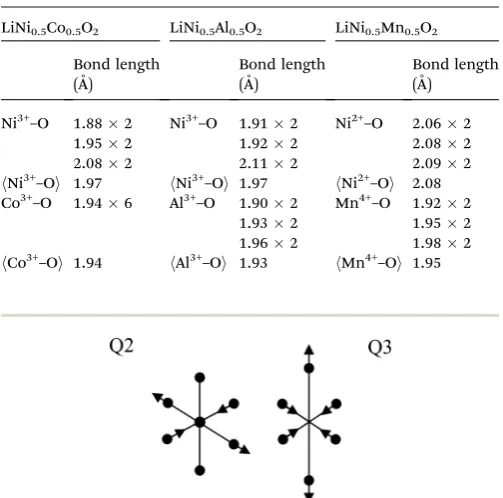
expected for low-spin Ni3+as shown from the Ni–O bond lengths in Table 1. Cobalt ions are therefore anticipated to be Co3+for
the sake of charge neutrality. Indeed the empty spin-up and empty spin-down states from the local density of states of cobalt indicate that its electronic conguration is t6
2ge0g(S¼0) implying
low-spin Co3+, along with its calculated zero magnetic moment. Likewise, nickel ions are determined to be low spin Ni3+ in LiNi0.5Al0.5O2with a Jahn–Teller distortion. Nevertheless, from
the Ni3+–O bond lengths in Table 1, it is clear that Ni3+displays two different modes of Jahn–Teller distortion, Q2 and Q3 in
LiNi0.5Co0.5O2and LiNi0.5Al0.5O2respectively, as shown in Fig. 3.
The Q3mode of Jahn–Teller distortion is the one observed in
LiNiO2.26In LiNi0.5Co0.5O2, the low-spin Co3+ions are very stable
in the isotropic octahedral environment with 6 identical Co3+– O2 bond lengths. The structural constraint imposed by the presence of rigid Co3+octahedra makes the more distorted Q3
mode less favourable and results in the Q2mode for distorted
Ni3+. This result is in agreement with an EXAFS study that in
LiNi1yCoyO2 the Jahn–Teller distortion of NiO6 octohedra is
suppressed with increasingy.27 In LiNi
0.5Mn0.5O2, two empty
spin-down egstates seen in the local density of states of nickel
and fully-occupied spin-downt2gstates seen in the local density
of states of manganese indicate that their electronic con gura-tions are t62ge2g and t2g3 e0g corresponding to Ni2+ and Mn4+, in
agreement with previously reported results.28
Inuence of defect formation on cation charge state
In all LiMO2cells with extra Ni and interlayer mixing defects,
the calculated magnetic moment of 1.7mB (S¼ 1) for the Ni
present in the Li layer along with its average Ni–O bond length 2.07˚A together imply that Nickel is present as Ni2+. Therefore in the LiNiO2, LiNi0.5Co0.5O2 and LiNi0.5Al0.5O2 cells with the
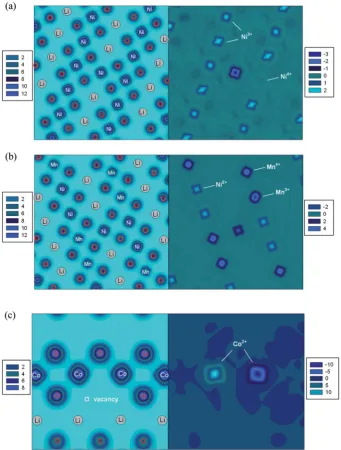
interlayer mixing defect, in order to retain charge neutrality one Ni in the NiO2slab is oxidised from Ni3+to Ni4+ with a
calcu-lated magnetic moment 0.19 mB (S ¼0), as seen in the spin
density contour map in Fig. 4(a), and the average Ni–O bond length of 1.89˚A. In the LiNi0.5Mn0.5O2cell, the interlayer mixing
defect does not cause any change of charge state as nickel ions are already Ni2+.
In cells with the extra Ni defect, since one Li+is replaced by Ni2+, one metal ion in the MO2 layer must be reduced to
maintain charge neutrality. In the LiNiO2, NaNiO2, LiNi0.5
-Co0.5O2and LiNi0.5Al0.5O2cells, it is the Ni in the MO2layer that
gets reduced from Ni3+ to Ni2+ with a calculated magnetic moment of 1.7mB(S¼0) and an average Ni–O bond length of
2.07˚A. The change of preferred charge state on Ni rather than Co in LiNi0.5Co0.5O2 is probably due to the relatively stable
electronic conguration of Co3+ (t6
2ge0g). In LiNi0.5Mn0.5O2, the
charge state of Ni2+cannot be reduced further and therefore the
charge compensation accompanied by the extra Ni defect takes place on manganese with Mn4+ /Mn3+. Fig. 4(b) shows the
case of the extra-Ni defect in LiNi0.5Mn0.5O2. The eg orbital
character on Ni2+ (t62ge2g) can be seen from the shape of spin
density pointing towards oxygen ions. Similarly, the spin density on Mn4+ (t32ge0g) pointing away from the oxygen
repre-sents the t2gorbital character. The Mn ion showing the different
shape of spin density is the one that is reduced from Mn4+to Mn3+.
For cells with the oxygen vacancy defect, two metal ions in the MO2 layer next to the oxygen vacancy site are reduced to
keep the charge neutrality. Fig. 4(c) clearly shows that two Co3+ ions are reduced to Co2+upon the removal of one oxygen ion.
Stability of defects and the effect of cation substitution
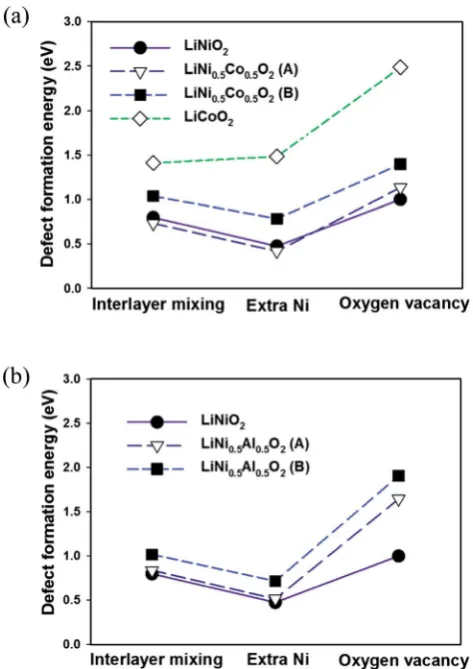
The calculated defect formation energies in LiNiO2are shown in
Fig. 5. The calculated formation energies of the three defects in LiNiO2are all small, ranging from approximately 0.3 to 1.0 eV.
This is consistent with the difficulty in synthesizing stoichio-metric defect-free LiNiO2. It is possible to rationalize these
results using the idea of superexchange interactions.29–31Both
Ni2+(t62ge2g) and Ni3+(t62ge1g) have fullylled t2gstates but partially lled egstates. Consequently the 180Ni–O–Ni superexchange
is much stronger than the 90 Ni–O–Ni superexchange plus direct exchange. This means there is a larger energy gain through orbital interactions when Ni–O–N is in the 180 conguration than the 90 conguration. In fact it has been shown that there is a tendency for Ni ions to locate as second-nearest neighbors (180 Ni–O–Ni conguration) in the cation sublattice of the rocksalt structure due to the energy gain from the 180superexchange interaction.32Therefore the presence of
Ni ions in the Li layers of LiNiO2 can be viewed as being
[image:5.595.42.294.459.708.2]stabilized by the 180 Ni–O–Ni superexchange interaction, giving rise to low formation energies for both interlayer mixing and the extra Ni defects. However, the extra Ni defect is the most Table 1 Calculated metal–oxygen bond lengths
LiNi0.5Co0.5O2 LiNi0.5Al0.5O2 LiNi0.5Mn0.5O2
Bond length (˚A)
Bond length (A)˚
Bond length (A)˚
Ni3+–O 1.882 Ni3+–O 1.912 Ni2+–O 2.062 1.952 1.922 2.082 2.082 2.112 2.092
hNi3+–Oi 1.97 hNi3+–Oi 1.97 hNi2+–Oi 2.08 Co3+–O 1.946 Al3+–O 1.902 Mn4+–O 1.922
1.932 1.952 1.962 1.982
hCo3+–Oi 1.94 hAl3+–Oi 1.93 hMn4+–Oi 1.95
Fig. 3 Two modes of Jahn–Teller distortion.
Paper Journal of Materials Chemistry A
Open Access Article. Published on 08 April 2014. Downloaded on 19/06/2014 15:34:09.
This article is licensed under a
Creative Commons Attribution 3.0 Unported Licence.
[image:5.595.42.295.462.710.2]favorable and therefore is the predominant defect species in LiNiO2.
In LiNi0.5Co0.5O2and LiNi0.5Al0.5O2, due to the linear cation
ordering in the transition metal plane, there are two inequiva-lent Li sites on which to place the Ni in the interlayer mixing and the extra Ni defects, as shown in Fig. 6. These are referred to as congurations A and B. In LiNi0.5Mn0.5O2, the zigzag
ordering of Ni and Mn also results in two inequivalent Li sites referred to as A and B. Similarly in the cells of LiNi0.5Co0.5O2,
LiNi0.5Al0.5O2 and LiNi0.5Mn0.5O2, there are two inequivalent
oxygen ions, one bonding with two Ni and one bonding with one Ni, in the cell, which can be removed to create the oxygen vacancy. We refer to the removal of the oxygen bonded to two Ni as conguration A and the removal of the oxygen bonded to only one Ni as conguration B.
The effect of Co substitution can be seen in Fig. 5(a). It isrst noted that the defect formation energies of the interlayer mix-ing and the extra Ni defects in LiNi0.5Co0.5O2with conguration
A are lower than in LiNiO2. This is unexpected since it is known
experimentally that Co substitution in LiNiO2 suppresses the
presence of Ni in the Li layer. Nevertheless the formation energies of the interlayer mixing and extra Ni defects are higher in conguration B than conguration A by about 300 meV and 360 meV respectively. The result can also be rationalized by considering superexchange interactions. As seen in Fig. 6(a), in conguration A, the Ni in the Li layer forms six 180Ni–O–Ni chains. In conguration B, the six 2nd-nearest-neighbours in the cation sublattice, of the Ni in the Li layer are Co3+, forming 180 Ni–O–Co chains which do not give rise to the 180 super-exchange interaction due to the empty egorbitals of Co3+(t62ge0g).
Fig. 4 Charge density (left) and spin density (right) contour maps (eA˚3) of LiNiO2with the (a) Li–Ni anti-site defect, (b) LiNi0.5Mn0.5O2with the extra-Ni defect and (c) LiCoO2with the oxygen vacancy defect.
Open Access Article. Published on 08 April 2014. Downloaded on 19/06/2014 15:34:09.
This article is licensed under a
[image:6.595.127.469.49.500.2]This again suggests that the presence of Ni2+in the Li layer is stabilized by the 180Ni–O–Ni superexchange interaction. The higher number of the 180 Ni–O–Ni chains gives rise to the lower energy. In the real LiNi0.5Co0.5O2 compound, the Co3+
ions distribute randomly in the MO2slab and the main effect of
cobalt substitution would be to screen the 180 Ni–O–Ni superexchange interaction. This is different from a previous proposed size effect,15and destabilizes the presence of Ni in the
Li layer.
The defect formation energies in LiCoO2are also shown in
Fig. 5(a). The defect energies of the interlayer mixing defect and the extra Co defect are considerably higher than the Ni
containing compounds. This agrees with the experimentally observed perfect layering of LiCoO2. Given the closed-shell
d6(t62ge0g) electronic conguration of Co3+in the CoO2layer, there
is no interaction between Co ions that can stabilize the presence of Co in the Li layer.
Since there are no d electrons in the Al3+ion, there can be no
superexchange interaction between Al3+and Ni2+. The effect of
Al substitution on defect formation energies is therefore expected to be similar to that of Co substitution since Al substitution should also effectively screen the Ni–O–Ni super-exchange interaction. Indeed by adopting the linear cation ordering in the LiNi0.5Al0.5O2 cell (Fig. 1(a)), as shown in
Fig. 5(b) the calculated formation energies of the interlayer mixing and the extra Ni defects are very similar to those in LiNi0.5Co0.5O2. Defects of conguration A are also more
favourable than conguration B due to the stabilisation by the exchange interaction. However, unlike in LiNi1xCoxO2withx>
0.3, neither the interlayer mixing defect nor extra Ni defects are observed.15 Experimentally 5% of extra-nickel ions are still
found in the lithium layer in LiNi1xAlxO2with 0.1 <x< 0.5.19
This is because Al tends to segregate to interfaces33and hence a
core–shell structure can be formed34in LiNi
0.5Al0.5O2.
Conse-quently, the extra-Ni and Li–Ni anti-site defects can still occur in Ni-rich domains in LiNi0.5Al0.5O2as in LiNiO2, where the
pres-ence of Ni in the Li layer can be stabilized by the 180Ni–O–Ni exchange interaction.
As shown by Fig. 7(a) there is no signicant difference in congurations A and B for the formation energy of the interlayer mixing and the extra Ni defects in LiNi0.5Mn0.5O2. The
forma-tion energy of the interlayer mixing is markedly lower than that of the extra-Ni defect. This is consistent with the experimentally observed high concentration of interlayered mixing defects in LiNi0.5Mn0.5O2. Also the formation energy of the interlayer
mixing defect is lower by about 0.3 eV than that of LiNiO2.
Unlike in LiNi0.5Co0.5O2and LiNi0.5Al0.5O2where the 180Ni–
O–Co and 180 Ni–O–Al interactions are absent, in LiNi0.5Mn0.5O2the electronic conguration of Mn4+(t32ge0g) could
give rise to moderate 180 Ni2+–O2–Mn4+ interactions.31
Consequently, although the number of 180 Ni–O–Ni interac-tions is reduced due to Mn substitution, the presence of Ni2+ can be stabilized not only by the 180Ni–O–Ni interaction but also by the 180Ni2+–O2–Mn4+interaction. Moreover, since the ionic radius of Ni2+ is similar to Li+, these ions can exchange sites readily without signicant rearrangement of the surrounding atomic positions. No charge compensation is necessary to create the interlayer mixing defect in LiNi0.5Mn0.5O2. In contrast to the interlayer mixing defect, the
defect formation energy for the extra Ni defect is much higher in LiNi0.5Mn0.5O2 compared to LiNiO2. The probable reason for
this is that the reduction of Mn4+to Mn3+, which is the charge
compensation accompanying the extra-Ni defect, is consider-ably less favorable than the reduction of Ni3+to Ni2+due to the stable electronic conguration of Mn4+(t32ge0g).
In NaNiO2, there is a structural constraint arising from the
large ionic size of Na+. It is shown in Table 2 that the LiO6
octahedron must undergo signicant distortion for the zigzag ordering of the Ni3+ Jahn–Teller distortions or charge Fig. 5 The effect of (a) Co and (b) Al substitution on the calculated
defect formation energies.
Fig. 6 Two inequivalent positions in the Li layer: (a) configuration A and (b) configuration B. The grey spheres denote Ni, the blue spheres denote Co, the green spheres denote Li and the red spheres denote O.
Paper Journal of Materials Chemistry A
Open Access Article. Published on 08 April 2014. Downloaded on 19/06/2014 15:34:09.
This article is licensed under a
Creative Commons Attribution 3.0 Unported Licence.
[image:7.595.49.286.48.383.2] [image:7.595.49.289.427.525.2]disproportionation Ni3+ / Ni2+ + Ni4+ in the NiO2 layer to
happen. However, the larger Na+ionlls up the interlayer space and so forbids the zigzag ordering of the Ni3+ Jahn–Teller distortions or charge disproportionation Ni3+/Ni2++ Ni4+in the NiO2layer. Hence the Ni3+Jahn–Teller distortions in NaNiO2
are forced to align collinearly as observed experimentally, which results in undistorted NaO6octahedra. This gives a good 2-D
layered character and is less susceptible to defects as shown by the high defect formation energies for NaNiO2 compared to
LiNiO2in Fig. 7(b). Because of the dramatic difference in ionic
radii between Na andrst-row transition metal ions, the size effect dominates the interactions between cations and conse-quently all NaMO2form perfect layered structures.
[image:8.595.49.285.47.364.2]Oxygen vacancy
Fig. 8 shows the calculated defect formation energies of the oxygen vacancy plotted against the oxygen charge calculated using the Bader analysis.35,36The formal charge on oxygen is2 in
highly ionic compounds. However, in transition metal oxides, there is a considerable overlap between the oxygen 2p and metal 3d orbitals, particularly for late transition metals or metals with high charge states. This is reected in the calculated oxygen charge as shown in Fig. 8, from leto right (LiAlO2/LiNiO2and
LiCoO2/Li0.5CoO2) the decrease of calculated oxygen charge is a
consequence of the increase in overlap between oxygen 2p and metal ion 3d orbitals or equivalently greater metal–oxygen cova-lency. A correlation can be clearly seen between the formation energy of the oxygen vacancy defect and the calculated oxygen charge. Also, as shown in Fig. 5 and 7, in LiNi0.5Co0.5O2,
LiNi0.5Al0.5O2and LiNi0.5Mn0.5O2, the defect formation energy for
removing the oxygen bonded to two Ni (conguration A) is lower than the oxygen bonded to one Ni (conguration B). The oxygen bonded to two Ni has a lower charge. The smaller the oxygen charge is, the easier it seems to be to remove the oxygen. It has previously been suggested that the strength of the metal–oxygen bond depends on the effective charge on oxygen.37In addition
when the charge on oxygen ions is low, there would be a tendency for them to form peroxide at the surface as suggested by Good-enoughet al.38and then dissociate through the following reaction:
2(O2)2¼2O2+ O2
This is consistent with experimental results that the temper-ature for oxygen evolution on heating (i.e.the thermal stability) decreases asxdecreases in layered LixMO2.39–41It seems that low
oxygen charge/high metal–oxygen covalency causes the chemical instability of an oxide compound against oxygen loss. A recent study has also proposed that a greater metal–oxygen covalency promotes the surface oxygen evolution reaction which involves the creation of surface oxygen vacancies.42
On comparing LiNiO2 with LiCoO2 there is no noticeable
difference in the oxygen charge, but the defect formation energy Fig. 7 Calculated defect formation energies in (a) LiNi0.5Mn0.5and (b)
[image:8.595.41.292.431.553.2]NaNiO2compared to LiNiO2.
Table 2 Li–O bond lengths in the three different LiNiO2cells
Structure
Li–O bond lengths (˚A)
C2/m(collinear ordering of the Ni3+ Jahn–Teller distortions)
2.114 2.132 P21/c(zigzag ordering of the Ni3+
Jahn–Teller distortions)
2.042 2.102 2.242 P2/c(charge disproportionation
Ni3+/Ni2++ Ni4+)
2.032 2.082 2.192
Fig. 8 The correlation between oxygen charge and defect formation energy for an oxygen vacancy for a series of structures.
Open Access Article. Published on 08 April 2014. Downloaded on 19/06/2014 15:34:09.
This article is licensed under a
[image:8.595.308.549.518.700.2]of the oxygen vacancy in LiCoO2is signicantly higher than in
LiNiO2(by1.2 eV). This is probably due to the relatively stable
electronic conguration of low-spin Co3+ t62ge0g. Therefore by
creating an oxygen vacancy, it costs more energy to reduce Co3+
to Co2+ than to reduce Ni3+ to Ni2+ in LiNiO
2. Although the
defect formation energy of an oxygen vacancy in LiCoO2 is
markedly higher than in LiNiO2, it drops drastically by1.5 eV
in Li0.5CoO2upon the removal of half the lithium ions. This can
again be explained by the decrease of oxygen charge that is associated with the creation of Co4+ions.
Given this correlation between oxygen charge and the defect formation energy of the oxygen vacancy, doping with a more electro-positive cation should mitigate the oxygen loss in layered LixMO2 compounds and result in better thermal
stability. Indeed doping with Mn4+decreases the oxygen loss43
and so does Al or Mg doping,18,44,45or Ti4+substitution for Mn4+
in Li[Li0.33Mn0.67xTix]O2.46
Conclusions
All the calculated formation energies for the various LiMO2
compounds are consistent with experimental results. It is demonstrated that the defect formation energies in LiNiO2are
low, in agreement with the experimental difficulty of synthe-sizing stoichiometric defect-free LiNiO2. The presence of Ni in
the Li layer can be rationalized in terms of the 180 Ni–O–Ni superexchange interaction. Substituting Ni with Co in the MO2
layer screens the 180Ni–O–Ni congurations and thus eff ec-tively reduces the concentration of Ni in Li layers. A correlation between the defect formation energy of the oxygen vacancy and oxygen charge (as measured from a Bader analysis) is reported. It appears that the smaller the oxygen charge/higher metal– oxygen covalency, the lower the oxygen vacancy formation energy. This can explain the thermal instability of LixCoO2and
LixNiO2 at low x, as well as the improved electrochemical
behavior in Al, Mg or early transition metal doped LiMO2. In the
quest for designing better cathode materials, the use of high electropositive cations is highly desirable.
Acknowledgements
We thank EPSRC for funding under Grant number – EP/ G005001/1. Via our membership of the UK's HPC Materials Chemistry Consortium, which is funded by EPSRC (EP/ F067496), this work made use of the facilities of HECToR, the UK's national high-performance computing service, which is provided by UoEHPCx Ltd at the University of Edinburgh, Cray Inc and NAG Ltd, and funded by the Office of Science and Technology through EPSRC's High End Computing Programme.
References
1 J. H. Chung, T. Proffen, S. Shamoto, A. M. Ghorayeb, L. Croguennec, W. Tian, B. C. Sales, R. Jin, D. Mandrus and T. Egami, Phys. Rev. B: Condens. Matter Mater. Phys., 2005,71(6), 064410.
2 H. Chen, C. L. Freeman and J. H. Harding, Phys. Rev. B: Condens. Matter Mater. Phys., 2011,84(8), 085108.
3 R. Kanno, H. Kubo, Y. Kawamoto, T. Kamiyama, F. Izumi, Y. Takeda and M. Takano, J. Solid State Chem., 1994, 110(2), 216–225.
4 Y. Koyama, H. Arai, I. Tanaka, Y. Uchimoto and Z. Ogumi, Chem. Mater., 2012,24, 3886.
5 S. Venkatraman and A. Manthiram, Chem. Mater., 2003, 15(26), 5003–5009.
6 J.-M. Kim and H.-T. Chung, Electrochim. Acta, 2004, 49(6), 937–944.
7 H. Arai, S. Okada, H. Ohtsuka, M. Ichimura and J. Yamaki, Solid State Ionics, 1995,80(3–4), 261–269.
8 J. P. Peres, C. Delmas, A. Rougier, M. Broussely, F. Perton, P. Biensan and P. Willmann, J. Phys. Chem. Solids, 1996, 57, 1057–1060.
9 S. Zheng, R. Huang, Y. Makimura, Y. Ukyo, C. A. J. Fisher, T. Hirayama and Y. Ikuhara, J. Electrochem. Soc., 2011, 158(4), A357–A362.
10 C. Delmas, J. P. P´er`es, A. Rougier, A. Demourgues, F. Weill, A. Chadwick, M. Broussely, F. Perton, P. Biensan and P. Willmann,J. Power Sources, 1997,68(1), 120–125. 11 M. S. Idris and A. R. West,J. Electrochem. Soc., 2012,159(4),
A396–A401.
12 K.-K. Lee, W.-S. Yoon, K.-B. Kim, K.-Y. Lee and S.-T. Hong,J. Power Sources, 2001,97–98, 321–325.
13 S. Muto, Y. Sasano, K. Tatsumi, T. Sasaki, K. Horibuchi, Y. Takeuchi and Y. Ukyo,J. Electrochem. Soc., 2009,156(5), A371–A377.
14 L. Wu, K.-W. Nam, X. Wang, Y. Zhou, J.-C. Zheng, X.-Q. Yang and Y. Zhu, Chem. Mater., 2011, 23(17), 3953– 3960.
15 A. Rougier, I. Saadoune, P. Gravereau, P. Willmann and C. Delmasa,Solid State Ionics, 1996,90(1–4), 83–90. 16 E. Rossen, C. D. W. Jones and J. R. Dahn,Solid State Ionics,
1992,57(3–4), 311–318.
17 N. Yabuuchi, Y.-T. Kim, H. H. Li and Y. Shao-Horn,Chem. Mater., 2008,20(15), 4936–4951.
18 M. Guilmard, L. Croguennec, D. Denux and C. Delmas, Chem. Mater., 2003,15(23), 4476–4483.
19 M. Guilmard, A. Rougier, M. Gr¨une, L. Croguennec and C. Delmas,J. Power Sources, 2003,115(2), 305–314.
20 G. Kresse and D. Joubert,Phys. Rev. B: Condens. Matter Mater. Phys., 1999,59(3), 1758.
21 J. P. Perdew, K. Burke and M. Ernzerhof, Phys. Rev. Lett., 1996,77(18), 3865.
22 S. L. Dudarev, G. A. Botton, S. Y. Savrasov, C. J. Humphreys and A. P. Sutton,Phys. Rev. B: Condens. Matter Mater. Phys., 1998,57(3), 1505–1509.
23 F. Zhou, M. Cococcioni, C. A. Marianetti, D. Morgan and G. Ceder,Phys. Rev. B: Condens. Matter Mater. Phys., 2004, 70(23), 235121.
24 G. Kresse and J. Furthm¨uller,Phys. Rev. B: Condens. Matter Mater. Phys., 1996,54(16), 11169–11186.
25 Y. Won-Sub, I. Steven, P. G. Clare, C. Dany, G. John, R. John and C. Gerbrand, Electrochem. Solid-State Lett., 2004, 7(7), A167–A171.
Paper Journal of Materials Chemistry A
Open Access Article. Published on 08 April 2014. Downloaded on 19/06/2014 15:34:09.
This article is licensed under a
Creative Commons Attribution 3.0 Unported Licence.
26 A. Rougier, C. Delmas and A. V. Chadwick, Solid State Commun., 1995,94(2), 123–127.
27 I. Nakai, K. Takahashi, Y. Shiraishi, T. Nakagome and F. Nishikawa,J. Solid State Chem., 1998,140(1), 145–148. 28 J. Reed and G. Ceder, Electrochem. Solid-State Lett., 2002,
5(7), A145–A148.
29 J. B. Goodenough,Phys. Rev., 1960,117(6), 1442–1451. 30 J. Kanamori,J. Phys. Chem. Solids, 1959,10(2–3), 87–98. 31 J. B. Goodenough, Magnetism and the Chemical Bond,
INTERSCIENCE (WILEY), 1963.
32 Y. Kumagai, A. Seko, F. Oba and I. Tanaka, Phys. Rev. B: Condens. Matter Mater. Phys., 2012,85(1), 012401.
33 L. Croguennec, Y. Shao-Horn, A. Gloter, C. Colliex, M. Guilmard, F. Fauth and C. Delmas,Chem. Mater., 2009, 21(6), 1051–1059.
34 X. Xu, K. Takada, K. Watanabe, I. Sakaguchi, K. Akatsuka, B. T. Hang, T. Ohnishi and T. Sasaki,Chem. Mater., 2011, 23(17), 3798–3804.
35 R. F. W. Bader,Atoms in Molecules: A Quantum Theory, Oxford University Press, 1990.
36 W. Tang, E. Sanville and G. Henkelman,J. Phys.: Condens. Matter, 2009,21, 084204.
37 K. Tatsumi, Y. Sasano, S. Muto, T. Yoshida, T. Sasaki, K. Horibuchi, Y. Takeuchi and Y. Ukyo, Phys. Rev. B: Condens. Matter Mater. Phys., 2008,78(4), 045108.
38 J. B. Goodenough and Y. Kim, Chem. Mater., 2009, 22(3), 587–603.
39 J. R. Dahn, E. W. Fuller, M. Obrovac and U. von Sacken,Solid State Ionics, 1994,69(3–4), 265–270.
40 H. Konishi, T. Yuasa and M. Yoshikawa,J. Power Sources, 2011,196(16), 6884–6888.
41 Y. Furushima, C. Yanagisawa, T. Nakagawa, Y. Aoki and N. Muraki,J. Power Sources, 2011,196(4), 2260–2263. 42 J. Suntivich, K. J. May, H. A. Gasteiger, J. B. Goodenough and
Y. Shao-Horn,Science, 2011,334(6061), 1383–1385.
43 T. A. Arunkumar, E. Alvarez and A. Manthiram, J. Mater. Chem., 2008,18(2), 190–198.
44 A. D'Epifanio, F. Croce, F. Ronci, V. Rossi Albertini, E. Traversa and B. Scrosati, Chem. Mater., 2004, 16(18), 3559–3564.
45 H. Kondo, Y. Takeuchi, T. Sasaki, S. Kawauchi, Y. Itou, O. Hiruta, C. Okuda, M. Yonemura, T. Kamiyama and Y. Ukyo,J. Power Sources, 2007,174(2), 1131–1136.
46 Z. Q. Deng and A. Manthiram, J. Phys. Chem. C, 2011, 115(14), 7097–7103.
Open Access Article. Published on 08 April 2014. Downloaded on 19/06/2014 15:34:09.
This article is licensed under a