Introducing Jass Easterman: My Second Life learning
space
Sue Gregory School of Education University of New England Belinda Tynan
Faculty of The Professions University of New England
Virtual worlds are an emerging technology being used by an increasing number of educational institutions around the world. It is a technology, environment, medium, learning (or elearning) and teaching tool (ie a shared social space). A pilot study was conducted in Second Life with postgraduate education students to ascertain student perceptions of learning in a virtual world. Results and methodology of this study will be discussed and the implications and impact for students learning in a virtual world from the perspective of the student will be explored. A number of themes have emerged from the study. There have been a variety of studies undertaken on virtual worlds with very little on their implications for the academic who is teaching in this environment. The implications of these findings will be the foundation for future research.
Keywords: virtual worlds, Second Life, pedagogy, virtual classroom, education, learning spaces
Introduction
A virtual world such as Second Life can be used as a learning and teaching tool and is “a computer program that attempts to simulate certain aspects of the real world (or a fantasy world). As a result, it becomes a low cost space to substitute for many real world activities” (Gregory, 2009a). It is an online electronic presence that imitates real life in the form of personal presence through someone’s avatar (Gregory & Smith, 2008b). An avatar is a person's alter ego and character, a graphical representation of a person and a character that can personalised and used when in a virtual environment (Wikipedia, 2009) and, as at 11 November 2008, an avatar’s name can be trademarked (Dannenberg, 2008; Collins, 2008). In the virtual world an avatar can virtually talk, walk, run, sit, dance, fly, drive, ride, teleport, make gestures (such as clapping or waving), change appearance (such as size, clothing, gender, hair and skin colour), interact with other avatars and the environment, including land formations, trees, buildings, water, grass, daylight and the different seasons (Gregory & Smith, 2008a).
The number of available virtual worlds is increasing at a rapid rate. Early in 2008 Johnson (2008) claimed that there were over 70 virtual worlds and later that year Collins (2008) stated that there were 150 virtual worlds available or to be released in the next 12 months. Second Life is just one of the numerous worlds available to the public since 2003 (Linden Research, 2008). Second Life enables a high level of freedom in allowing members to inhabit and build their own 3D world (Linden Research, 2008) and appears to be the choice of most universities (Jennings & Collins, 2008). Lester (2008), the academic director of Linden Lab, the proprietors of Second Life, states that there are approximately 1,000 educational institutions world wide using Second Life.
When students engage in learning activities in a virtual world they have to:
1. master the technology, eg computer skills, Internet access and speeds and download the software 2. learn how to make meaning in this medium using its multi-modal resources (ie text, audio, sound,
animated image)
3. learn how to interact effectively in this social space (especially difficult if the students are not used to this kind of thing or it doesn’t align with their teaching and learning style)
4. transform the virtual world and its elements into a learning tool or collection of learning tools This pilot study was conducted to refine the virtual environment, strategies, data collection instruments, methodology and data analysis. Students were invited to participate in pre and post semester surveys and agreed to the recording of online discussions whilst in the virtual world. An Ethics application was approved prior to the study as the research dealt with people and their views.
Background
Virtual worlds as a learning space
There is currently a shift in pedagogical perspectives with the introduction of emerging technology (Beldarrain, 2006) where “student interaction is at the heart of learning-centred constructivist
environments”. Virtual worlds can provide an alternative space for interaction and engagement related to learning. They combine synchronous (at the same time, such as a chat room) and asynchronous (at different times, such as email) activities for collaboration and simulation that emulate the learning environment in context. Constructivist pedagogy is demonstrated in a virtual world when activities are designed which allow students to use the technology to explore and reach new understandings of concepts (Gregory, Reiners, & Tynan, 2009).
Butler (2008) supports the notion that a virtual world is a suitable environment for designing learning experiences underpinned by a constructivist approach to learning. In his teaching he used a variety of tools within the environment which enhanced students construction of knowledge. Finally, virtual worlds should look to connectivism as an alternate learning theory for the digital age. Siemens (2004) reports that with the introduction of technology “knowledge is growing exponentially”. When academics explore the use of virtual worlds for teaching they need to be aware of how students learn and adjust pedagogical practices.
Academics can use Second Life as an enhancement to the pedagogy they already use if they are using a “full and diverse range of pedagogic approaches” (Hollins & Robbins, 2008). Second Life can assist student educational needs by using methods with which they can identify (Carr, Oliver, & Burn, 2008). The pedagogy of educators will vary depending on their level of experience with a virtual world (Gregory et al., 2009). Schutt & Martino (2008) believe that educators need to re-think their position on virtual worlds in their “repertoire of pedagogic practices and help to claim these spaces for social and
educational purposes” (p. 900). Virtual worlds provide flexibility to students who are not on campus to interact through a highly interactive, immersive, multi-modal and connected virtual learning environment (Wood & Hopkins, 2008).
McLoughlin & Lee (2008) claim that educators are discovering that there are new models of pedagogy required to meet the new generation of learners who need greater autonomy, connectivity and
opportunities for socio-experiential learning. However, Jeffery (2008) suggests that non-player characters in a virtual world, such as academics, “require a knowledge model, a dialogue model and a
user-performance model in addition to any physical and behavioural traits necessary to make them interesting and credible members of the environment” (p. 181).
Learning spaces for higher education students
the introduction of a virtual world such as Second Life, students can come together in a context that feels like face-to-face lectures and workshops in their own lounge room.
In 2008 a pilot study was undertaken at the University of New England to clarify students acceptance of a virtual world as a learning space that might have applicability for their own study as distance learners and also in their roles as neophyte teachers. The study found that the virtual world of Second Life is an engaging environment for the students.
Students enrolled at the University of New England had the opportunity to experience learning in Second Life for a component of their studies. The students were enrolled in postgraduate studies and were studying to become primary, high school and higher education teachers. Their key learning areas included almost all areas of the curriculum, such as English, Science, Information Technology, HSIE (Human Society and its Environment), Music, Drama, Religious Studies and Economics. The learning objectives of their studies in Second Life included developing a plan and personal philosophy for integrating the virtual world for learning in an educational setting and strategies for using the technology. Students were self-selecting as this was one of several other assessment tasks to choose from.
With this in mind, and with the requirement to explore the use of technologies that can enhance the learning experience of distance education students, Jass Easterman was created and a range of learning activities were designed based on constructivist or connectivist ideals. Her story follows where students attended session in Second Life so they could learn how they could use a virtual world in their future teaching.
Methodology
Communicating in Second Life was conducted via text through a designated chat room (instant
messaging). Audio voice was rarely used because of potential bandwidth and hardware problems. A slow connection to the Internet or not enough RAM slows down the running of Second Life and audio can become distorted.
“Education Online Headquarters” was created for students to provide a meeting place to give them a sense of “home”. Evenings were divided into two one-hour sections. Students met at Education Online Headquarters at the beginning of each weekly session and were encouraged to use the area whenever they desired. The first hour was designated for inworld face-to-face discussions and then students went on virtual tours of other educational institutions where guest academics would discuss how they were using Second Life with their students, via their avatar.
The study triangulated data collection methodologies (both quantitative and qualitative) through various formats: surveys, recording of online dialogue and questioning. By conducting the research in this manner the analysis strengthens interpretations based on more available evidence. Findings were corroborated across data sets, reducing the impact of potential biases that can exist in a single study (University of Southern California, 2007). This study provided data to support the notion that a virtual world is an effective teaching and learning environment in terms of engaging postgraduate education students.
Quantitative data collection: Student perceptions
The method of data collection was via pre and post semester surveys. The pre semester survey was directed towards finding out students’ computer expertise, knowledge of Web 2.0 tools and virtual worlds. The post semester survey was to ascertain knowledge and experience developed over the semester from using different Web 2.0 tools and find out the perception of student experiences in Second Life. The survey questions were based on a mixture of dichotomous questions such as yes/no, multiple-choice questions and the use of a likert scale (Fisher, 2007).
Qualitative data collection: Recording of online dialogue
academics via their avatar in Second Life, from the Universities of Sydney; Hamburg, Germany; Torino, Italy; Griffith, Gold Coast; Deakin, Geelong and also included St Joseph’s School, Sydney. Students visited guest institutions created in Second Life where they were given tours and the virtual guest discussed how they were using the environment with their students. Students could then consider how they might use a virtual world with their future students. All conversations were recorded.
Focus discussions addressed by the students each week were based on “guided peer questioning”, outlined by (Cuseo, 2000). Focus discussions for the students were based on generic questions such as:
• what are the implications of using social computing tools to create an educational environment? • why is it important to use social computing tools to educate students, or not, if you don’t think it is
important?
Questions that encouraged reflection and were open ended were:
• what is the educational purpose of the tool you chose?
• why did you choose the tool that you are creating and where did you find the resources to do so? Further topics for discussion were:
• what elearning tool did you choose to use to create your educational tool and why? • discuss the pros and cons of your elearning tool
• if you were to have input from anyone else, what sort of input would you want
Jass and her story
Following is the case of Jass Easterman as presented to twelve students at the University of New England who chose to use Second Life as a component of their studies.
Twelve months prior to beginning data collection, “Jass
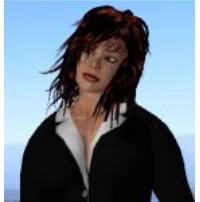
Easterman” was created, an avatar or virtual being in Second Life. Once Jass had created a look by adjusting her skin colour, body size, hair and clothing, these were not changed because this would assist students in recognising Jass quickly (see Figure 1 – Jass Easterman). Students were encouraged to change the original appearance of their avatar so that they didn’t all look the same, otherwise, when in a group conversation, the only identifying feature would have been their name above their head.
Learning activities
[image:4.595.383.483.394.495.2]Over the semester, students undertook many learning activities. To give an overall feel of what was achieved, the 16 ways to use virtual worlds in the classroom as presented by Ryan (2008) when demonstrating pedagogy in Second Life, are displayed in Table 1. The first column outlines these 16 pedagogies. The second column indicates how Jass used Second Life as a teaching and learning tool with her students and the third column are quotes from students demonstrating how the pedagogy affected these students.
Table 1: 16 ways to use virtual worlds in the classroom
16 ways to use virtual worlds in the classroom (Ryan, 2008)
How did Jass use the Pedagogy in Second
Life with students? Student Comments
Adding a Visual Element (Data Visualization)
Jass demonstrated this by offering students a range of experiences so that they could visualize how they would use a virtual world in their future teaching.
Georgie: I found this activity daunting at first but have learnt so much now. I think the hardest part is actually imaging how you would teach a lesson.
Georgie: I was imagining you could teach students and then organise a virtual
excursion to language lab and they could trial there new language skills.
[image:4.595.82.508.631.765.2]Interactive Library Jass and other academics demonstrated virtual resources to create learning environments that balanced technology and good teaching.
Andrew: In a strange way I think exploring a virtual world can actually make that world more real than say looking at pictures or reading texts or even viewing a video.
Connection Device Communication was undertake with people
who couldn’t be present by the sending of messages, inventory items or notes via
Second Life to students asynchronously, so that they would receive these notices when next they went online to Second Life (and, in the meantime, receive an email to alert them that there were inventory items to be collected when they next logged on).
Cheryl: Maybe we should keep in contact via notecards about interesting things after we finish.
Barb: Thanks again for your emails and support earlier this week. 5 notecards rec'd so far.
Cheryl: Jass, I have to go - would you be able to copy and paste this IM session into a very, very long email for us? I don't want to miss out!
Role Playing Device Role play was undertaken by students in their own time to explore Second Life and experiment with environments to see what it had to offer.
Karen: … we want to develop teaching simulations for our education students so that they role play before they go out on teaching practicum.
Simulation Device Students were able to experience simulations developed by other educators to see how they could be used in an educational setting.
Tom: … next is the logic for the avatar to influence the process. You can have some machines … check for the bottle to be operated by someone. If a dirty broken bottle, a button must be pushed to get rid of it. Otherwise the production will stop and must be checked by someone.
Games for Learning Students experienced games when visiting other educational institutions. These games were often used as icebreakers and to enhance a learning skill. Jass also
demonstrated many educational games that could be used in Second Life.
Jass: Have a look at this when it becomes available - it is something that you can set up with your students, small quizzes and things like that.
Cheryl: Is it a revision game?
Donna: Does touching it make it respond to us?
Soft Skill
Development Soft skills development was used on alloccasions when students were in the virtual world, discussing the virtual world and through experimentation with building in the virtual environment.
Andrew: I think that the key to using online resources in teaching is to start small/safe and then when parents and students get enthusiastic you scale up.
Research The students undertook research as they
explored ways in which they could use
Second Life or another virtual world for their future teaching.
Terese: one of them is to simply show teachers what can be done and hopefully inspire them to think about virtual world pedagogy as being something different to offline pedagogy.
Virtual Tourism and Field Trips
Students regularly participated in virtual tours and field trips meeting other academics “face-to-face” and visiting locations that they were unable to in “real-life”, such as Collab, the National Science Museum which has replica NASA rockets, or the Sistine Chapel which has replica Michael Angelo paintings.
Jass: Tom teaches IT students at the University of Hamburg in Germany. He has a couple of projects going with them and he might take us on a tour of Hamburg's campus and see the two projects and the campus building.
John: Would it be possible to swing by Intel Island if we have time, you can pick up a great jet pack and laptop for free, and I thought it nifty to show everyone Intel’s set up.
Social Device Second Life is a social space where social activities are held. The inworld discussions that were held each week were achievable because students felt comfortable with the environment through ice breaking activities and being introduced to places and activities where they could have fun.
Cheryl: I love these discussions Jass! I am going to miss them.
Andrew: yep! Cheryl: absolutely.
Andrew: the learning was reward enough in itself
Create Anonymity Anonymity was assured on all occasions by creating avatar names. Students knew avatar names but not the owner’s real name. Everyone was referred to by their avatar’s name. All students knew who the academics really were, but no one knew who the students were except for the unit coordinator. This enabled them to be anonymous and therefore give the students the freedom to speak honestly, take risks and overcome fears, which they may not do in a real face-to-face situation.
Cheryl: They had a Y11 boy want to quit HSC music this morning, because of nerves, but I see Second Life performance as a good bridge between practice and Real Life performance for kids who are nervous. Jass: Remember - they don't know who you are - I am the only person who does, and that is locked away on my computer.
Machinima Creation (Video Filmed Inworld)
No Machinima was used due to not having the facilities to be able to do so. However, over 500 photos were taken in the sessions and used as a resource.
Cheryl: we should all do tai chi and take photos for Jass.
Cheryl: find a spot and we'll take a photo. Cheryl: I took a photo before you raced off! Jass: I have taken about 1000 pics … great record.
Recruitment Recruitment was occurring all the time over
the semester. On several occasions the students would ask if it was possible to bring along a fellow teacher or friend to share their experiences in Second Life.
Georgie: Ben was my Head teacher where I did my Prac.
Ben: I'm just a gatecrasher but this is fascinating thanks! Danke!
Nancy: Thank you everyone for making me feel so welcome as I was only a guest. Build Awareness
and/or Promote an Event
Awareness building occurred by the academics and the students from week to week to promote learning. Students were asked to perform or speak at special presentations to demonstrate what they had been learning and these were promoted as special events.
Cheryl: today I told my music department what I was going to do here tonight and they said something about it not being a real performance. It made me sad that they saw it that way. I had them convinced by the end, but that was their initial reaction.
Building for the Sake of Learning How to Build
Students were given instructions on how to build in Second Life so that they had the ability to do so if they wish to use the skill in the future. These building skills were utilised where one student created a stage for the other students to perform on.
Jass: maybe we could have a session … to learn how to build a stage …
Cheryl: …- building a stage - promotes team work.
As an Open Learning Environment (Virtual Action Learning)
Second Life is an open learning environment where learning takes place through a range of enabling, interactive and collaborative technologies. This can simply mean getting students to participate in the decision making process, which occurred where students decided what they wanted to do over the semester, when they wanted to meet and what they wanted to get out of the sessions.
Wendy: Right through all Stages of learning, ICT is part of the 'cross-curriculum'. I believe that Second Life will be useful for most subjects and that subjects like Ancient History could really come to life in here. Last night I went to 'Roma' visited the Colosseum and even went to the Sistine Chapel.
Results
Of a possible 12 participants, 11 students completed the first survey, eight the second survey. All conversations were recorded during the online Second Life sessions. In Table 2 is an overview of the results of the surveys.
After completing their semester of studies, responses of student surveys were quite different to initial responses. Students were not originally familiar with Web 2.0 technology but by the end they not only understood Web 2.0 technology but also how to use a virtual world for educational purposes. This indicates that this is a suitable environment for these future teachers to explore as a teaching environment. As noted in Table 2, one student was not as positive in their reflections as the other students. This was due to being unable to participate until session 8 because of technical difficulties (upgrading of computer) and found it difficult to get to the same level of expertise as other students.
Students learnt how to use the environment for their own advantage. Instant messaging enabled students to talk to others online via text through one-on-one, group created and local discussions where everyone could hear (read) what the others were saying (writing).
motivated learners in any situation and it may not have mattered what they were studying to receive these high grades.
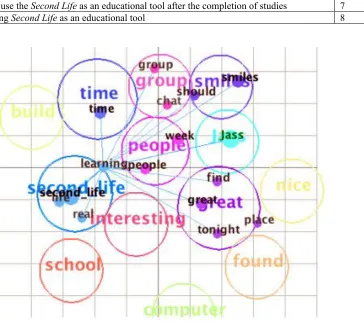
[image:7.595.88.511.165.630.2]Using Leximancer for the analysis of the dialogue of the sessions (with the dialogue of Jass removed), several themes emerged as shown in Figure 2. However, the one that is demonstrated here is that learning is linked to many other texts and was a key topic of conversation when in the virtual world.
Table 2: Overview of results (total students = n12)
Survey 1 Pre Semester N=11
• Distance Students 8
• Internal Students 3
Used Web 2.0 technology such as blogs and wikis (mostly Facebook =6)
• Daily or weekly 7
• Rarely 4
Used a virtual world before 1
Survey 2 Post Semester N=8
Used Web 2.0 technology such as blogs and wikis, including virtual worlds daily or weekly 8
Usefulness of a virtual world as an educational tool 8
Use Second Life with little or no assistance 7
Felt comfortable in being able to interact in and with the environment in up to four hours 8
Felt very comfortable in using the environment to carry out tasks 7
Used the virtual tools often 7
Able to find answers to questions quickly and easily 7
Discussed study materials with peers when the academic wasn’t present 7 Continue to use the Second Life as an educational tool after the completion of studies 7
Enjoyed using Second Life as an educational tool 8
Figure 2: General themes of online dialogue
Several of the students’ statements below demonstrate perceptions they had whilst learning in the virtual environment (Gregory, 2008b). As their skill levels increased, so too did their capacity to see the potential of the virtual world:
[image:7.595.133.497.358.683.2]Julie: Well, had another interesting session in Second Life last night. It all seems to be coming together as our understanding and control increases. Other students have some useful ideas and have been very creative with their outfits and abilities... I think that this tool has great potential for use in schools ... At first I did not see the use for English in particular but have since changed my viewpoint and now feel that it would be a great learning tool for students. It has the capacity to be individualised for every class and teacher and therefore will become essential in the future.
John: This is great ... love the change almost like face to face with lecturer.
Andrew: I had a defining experience last week when we sat down in that open-air lecture space and I sat on one side and the rest of you sat on the other side. Suddenly I felt lonely and, without thinking, got up and moved to where you were all sitting. And then, I thought, that felt so real!
These are but a few of the dialogue that demonstrate how students felt about their learning in the virtual world of Second Life and also how they reflected on their experience in regard to their future teaching. It also illustrated how the virtual environment can be perceived as real to people.
Discussion
How an academic teaches in a virtual world is something that hasn’t been explored in great detail. This study demonstrated that while research has been occurring around the experiences of the student, there is limited research around the experience of the academic. The study used an academic who was familiar with the environment and had spent a considerable time in learning how to use Second Life as a learning and teaching tool. The implications of the findings will frame ideas for future research and how the Second Life environment is created for the students for ease of use.
The research will draw conclusions on how learning theories can be applied to the use of a virtual world for higher education students and it will also explore pedagogical approaches in the virtual environment. Second Life is an environment that brings distance students closer to their peers and academics. One thing that was clear from student online dialogue and reflections, was that even though they were mostly distance students, Second Life gave them the perception of being there, being in a real, face-to-face discussion. Due to the nature of Second Life, it is not only a chat room but provides extra resources so that someone can get the feeling of “being there”. Other resources can be used such as video,
presentations, online surveys, automatic email generators, blog posting uploads, interaction with the environment, other people’s avatars and “bots” (robots) to simulate real life or aspects of real and fantasy life. Student feedback was that by seeing another person’s avatar gave them the sense of the other person actually being there. They felt like they were in a face-to-face discussion. Hewitt, Spencer, Mirliss, & Twal (2009) support the notion that virtual worlds can provide “engaging, learning-intensive alternatives to face-to-face scenario exercises”.
Second Life provides a “variety of different regions and environments that enable learners to explore the meaning of information” (Kirriemuir, 2009). Students in the pilot study were able to experience this from the variety of sessions that they attended in the virtual environment. The results from both quantitative and qualitative data indicate that students felt that their learning in Second Life was informative, educational and engaging.
Moving forward
There are now several studies on the impact and implications for students who are using a virtual world as part of their studies. A further study is currently being undertaken to discover academic perception of teaching in a virtual world and the implications and impact for them as teachers. It is not resolved how to ensure that all academics that choose to use a virtual world in which to teach can seamlessly transfer their face-to-face or online teaching abilities into a virtual world. That is, can they teach in a virtual world without having to endure too many hours of learning how to operate in the environment and can they transfer their real life skills to the virtual world?
This study seeks to explore the experiences of novice Second Life academics teaching in Second Life and student perceptions of the virtual workshops compared to the real life workshops.
Data will be collected via two surveys, one after the face-to-face workshop and the other after the virtual world workshop. Both surveys are gathering student and academic perceptions of engagement of the workshops through likert scale questioning. The second survey has some extra questions for students to disclose their experiences using Second Life via open-ended questions. Academics teaching the
workshops have a survey to complete to explore their perceptions of students engagement in the lessons within the two environments (real life and Second Life). The researcher will be observing both sessions and also completing the same forms. Ethics has been approved for this continuing research.
The study seeks to build teaching strategies and study skills to support effective teaching and learning in the virtual world.
Conclusion
This is an overview of some of the results of the pilot study. Preliminary data indicate that students who undertook the Second Life component of their studies were immersed and engaged in the content of their sessions. However, these may be the students who would have been engaged no matter what they had chosen to do. On the other hand, these students are among our future teachers who will provide their students with a rich learning environment and ensure that they are abreast of emerging technology. Second Life provides an environment for extensive engagement and collaborative work between students in higher education for both internal and distance students. It is yet to be found if a virtual world is an environment that suits academic teaching when it is an unfamiliar environment in which to teach. There is currently enthusiasm from academics to teach in virtual worlds, however, the results of research is required to find out if a novice user of Second Life can easily transfer skills of teaching in real life into the virtual environment.
Once the second study has concluded, data from both studies will be collated to ascertain overall
experience of the environment from the point of view of both the students and the academics, experienced and novice users. This will be the basis for future research.
References
AVWW 2008 Australasian Virtual Worlds Workshop. (2008). Retrieved November 29, 2008, from http://avww.org/?q=node/35
Beldarrain, Y. (2006). Distance Education Trends: Integrating new technologies to foster student interaction and collaboration. Distance Education, 27(2), 139;154.
Butler, D. (2008). Air Gondwana: Teaching negotiation skills by utilising virtual worlds for an authentic learning experience In Hello! Where are you in the landscape of educational technology? Proceedings ascilite Melbourne 2008. http://www.ascilite.org.au/conferences/melbourne08/procs/butler-d-poster.pdf Carr, D., Oliver, M., & Burn, A. (2008). Learning, Teaching and Ambiguity in Virtual Worlds. In
Researching Learning in Virtual Environments International Conference (pp. 83-93). The Open University, Milton Keynes, UK. Retrieved April 22, 2009, from http://www.open.ac.uk/relive08/ Collins, C. (2008, November 29). AVWW 2008 Program | Australasian Virtual Worlds Workshop.
Swinburne University of Technology, Hawthorn Campus and Second Life. Retrieved November 29, 2008, from http://avww.org/?q=node/35
Cuseo, J. (2000). Questions that promote deeper thinking. On Course. Retrieved March 19, 2008, from http://www.oncourseworkshop.com/Learning030.htm
Dannenberg, R. (2008, November 17). Patent Arcade: News: Trademark Registration for Second Life Avatar. Retrieved November 21, 2008, from http://www.patentarcade.com/2008/11/news-trademark-registration-for-second.html
Ereaut, G. (2007). What is Qualitative Research? QSR International Pty Ltd 2007. Retrieved November 15, 2008, from http://www.qsrinternational.com/what-is-qualitative-research.aspx
Fisher, C. (2007). Researching and Writing a Dissertation: A Guidebook for Business Students (2nd ed.). Harlow: Prentice Hall Financial Times. Retrieved November 14, 2008.
Gregory, B. (2009, June 10). Business uses of a virtual world. Virtual Classrooms: Business in Second Life. Retrieved June 9, 2009, from http://www.virtualclassrooms.info/slbusiness.htm.
Gregory, S. (2008, November). Online Dialogue in Second Life Sessions. Retrieved from http://www.virtualclassrooms.info/
Gregory, S., & Smith, H. (2008). How Virtual Classrooms are changing the Face of Education: Using Virtual Classrooms in Today’s University Environment. In ISTE Conference. Armidale.
Gregory, S., & Smith, H. (2008). Virtual Worlds: Can virtual worlds promote a higher level of collaboration, engagement and deeper thinking for students than traditional Web 2.0 tools? In Proceedings of the 3rd Annual Postgraduate Research Conference (pp. 85-92). Faculty of The Professions: University of New England.
Hewitt, A. M., Spencer, S., Mirliss, D., & Twal, R. (2009). Preparing graduate students for virtual world simulations: Exploring the potential of an emerging technology. Innovate, 5(6).
http://www.innovateonline.info/index.php?view=article&id=690&action=article
Hollins, P., & Robbins, S. (2008). The Educational affordances of Multi User Virtual (MUVE). In Researching Learning in Virtual Environments International Conference (pp. 172-180). The Open University, Milton Keynes, UK. Retrieved April 22, 2009, from http://www.open.ac.uk/relive08/. Jeffery, C. (2008). Using Non-Player Characters as Tutors in Virtual Environments. In Researching
Learning in Virtual Environments International Conference (pp. 181-188). The Open University, Milton Keynes, UK. Retrieved April 22, 2009, from http://www.open.ac.uk/relive08/.
Johnson, L. (2008). Committee on Energy and commerce; Subcommittee on the Telecommunications and the Internet, US House of Representatives: Virtual Worlds: Applications and Avatars in a User-Generated Medium. US: US House of Representatives.
Kirriemuir, J. (2009). Virtual World Watch; Choosing virtual worlds for use in teaching and learning in UK higher education. UK. Retrieved October 20, 2009, from http://virtualworldwatch.net/2009/10/19/ choosing-virtual-worlds-for-use-in-teaching-and-learning-in-uk-higher-education/
Lester, J. (2008, July 22). Conversation with Pathfinder Linden.
Linden Research. (2008). Second Life | Economic Statistics. Retrieved October 20, 2008, from http://secondlife.com/whatis/economy_stats.php.
McLoughlin, C., & Lee, M. J. (2008). Future Learning Landscapes: Transforming Pedagogy through Social Software. Innovate, 4(5), 1:8.
Ryan, M. (2008). 16 Ways to Use Virtual Worlds in your Classroom: Pedagogical Applications of Second Life. In Researching Learning in Virtual Environments International Conference (pp. 269-178). The Open University, Milton Keynes, UK. Retrieved April 22, 2009.
Schutt, S. & Martino, J. (2008). Virtual worlds as an architecture of learning. In Hello! Where are you in the landscape of educational technology? Proceedings ascilite Melbourne 2008.
http://www.ascilite.org.au/conferences/melbourne08/procs/schutt-poster.pdf
University of Southern California. (2007, November). Triangulation. Institute for Global Health: Triangulation. Retrieved July 31, 2008, from http://www.igh.org/triangulation/.
Avatar (computing) - Wikipedia, the free encyclopaedia. (2009, July 21). Retrieved July 22, 2009, from http://en.wikipedia.org/wiki/Avatar_(computing)
Wood, D. & Hopkins. L. (2008). 3D virtual environments: Businesses are ready but are our ‘digital natives’ prepared for changing landscapes? In Hello! Where are you in the landscape of educational technology? Proceedings ascilite Melbourne 2008.
http://www.ascilite.org.au/conferences/melbourne08/procs/wood-2.pdf
Authors: Sue Gregory, School of Education, University of New England, Australia. Sue Gregory is a long term adult educator and currently a Lecturer in Information Communication Technology in the School of Education at the University of New England. She has been involved with many university projects on creating learning spaces in virtual worlds. Email: [email protected]
Professor Belinda Tynan is Academic Director, Faculty of the Professions, University of New England. Professor Tynan’s research covers areas such as music teaching, distance education, academic staff development and collaboration. Email: [email protected]
Please cite as: Gregory, S. & Tynan. B. (2009). Introducing Jass Easterman: My Second Life learning space. In Same places, different spaces. Proceedings ascilite Auckland 2009.
http://www.ascilite.org.au/conferences/auckland09/procs/gregory.pdf
Copyright © 2009 Sue Gregory and Belinda Tynan