R E S E A R C H A R T I C L E
Open Access
Foreskin cutting beliefs and practices and the
acceptability of male circumcision for HIV
prevention in Papua New Guinea
David MacLaren
1*, Rachael Tommbe
2, Tracie Mafile
’
o
3, Clement Manineng
4, Federica Fregonese
5,
Michelle Redman-MacLaren
1, Michael Wood
6, Kelwyn Browne
7, Reinhold Muller
8,9, John Kaldor
10and William John McBride
1Abstract
Background:Male circumcision (MC) reduces HIV acquisition and is a key public health intervention in settings with high HIV prevalence, heterosexual transmission and low MC rates. In Papua New Guinea (PNG), where HIV prevalence is 0.8%, there is no medical MC program for HIV prevention. There are however many different foreskin cutting practices across the country’s 800 language groups. The major form exposes the glans but does not remove the foreskin. This study aimed to describe and quantify foreskin cutting styles, practices and beliefs. It also aimed to assess the acceptability of MC for HIV prevention in PNG.
Methods:Cross-sectional multicentre study, at two university campuses (Madang Province and National Capital District) and at two‘rural development’sites (mining site Enga Province; palm-oil plantation in Oro Province). Structured questionnaires were completed by participants originating from all regions of PNG who were resident at each site for study or work.
Results:Questionnaires were completed by 861 men and 519 women. Of men, 47% reported a longitudinal foreskin cut (cut through the dorsal surface to expose the glans but foreskin not removed); 43% reported no foreskin cut; and 10% a circumferential foreskin cut (complete removal). Frequency and type of cut varied significantly by region of origin (p < .001). Most men (72-82%) were cut between the ages of 10–20 years. Longitudinal cuts were most often done in a village by a friend, with circumferential cuts most often done in a clinic by a health professional. Most uncut men (71%) and longitudinal cut men (84%) stated they would remove their foreskin if it reduced the risk of HIV infection. More than 95% of uncut men and 97% of longitudinal cut men would prefer the procedure in a clinic or hospital. Most men (90%) and women (74%) stated they would remove the foreskin of their son if it reduced the risk of HIV infection.
Conclusion:Although 57% of men reported some form of foreskin cut only 10% reported the complete removal of the foreskin, the procedure on which international HIV prevention strategies are based. The acceptability of MC (complete foreskin removal) is high among men (for themselves and their sons) and women (for their sons). Potential MC services need to be responsive to the diversity of beliefs and practices and consider health system constraints. A concerted research effort to investigate the potential protective effects of longitudinal cuts for HIV acquisition is essential given the scale of longitudinal cuts in PNG.
Keywords:Male circumcision, Acceptability, Foreskin cutting, Papua New Guinea, HIV, Prevention, Beliefs, Foreskin cutting practices, Longitudinal Foreskin cut, Circumferential Foreskin cut
* Correspondence:[email protected] 1
School of Medicine and Dentistry, James Cook University, McGregor Road, Smithfield, Cairns 4878, Queensland, Australia
Full list of author information is available at the end of the article
© 2013 MacLaren et al.; licensee BioMed Central Ltd. This is an Open Access article distributed under the terms of the Creative Commons Attribution License (http://creativecommons.org/licenses/by/2.0), which permits unrestricted use, distribution, and reproduction in any medium, provided the original work is properly cited. The Creative Commons Public Domain Dedication waiver (http://creativecommons.org/publicdomain/zero/1.0/) applies to the data made available in this article, unless otherwise stated.
Background
Male circumcision (MC), or the surgical removal of the foreskin, has received intense public health attention since three large randomised trials, published between 2005 and 2007, reported that the procedure can reduce male susceptibility to heterosexual acquisition of HIV by approximately 60% [1-3]. These results confirmed earlier observational studies that documented an association between lower HIV infection rates and MC [4,5]. In 2007 it was estimated that up to 5.7 million new HIV in-fections could be averted over 20 years through the im-plementation of MC services in sub-Saharan Africa [6-8]. WHO and UNAIDS now recommend MC pro-grams be included in comprehensive HIV prevention packages in settings of high HIV prevalence with hetero-sexual transmission and low MC rates [9].
MC for HIV prevention is viewed favourably across numerous high HIV prevalence settings in East and Southern Africa, both in traditionally circumcising and non-circumcising communities [10-21]. MC programs are now being implemented across this region, ac-companied by ongoing acceptability studies [12,22-35]. However, a detailed understanding of local social, cul-tural, gender, religious and medical issues must under-pin such MC programs [36-39].
MC may also play an important public health role in moderate HIV prevalence countries. However very few in-vestigations of MC’s acceptability, feasibility and epi-demiological impact have been conducted in such settings [40-46]. Papua New Guinea (PNG), the largest South Pa-cific Island country, has the second highest HIV preva-lence of the Asia-Pacific region (after Thailand). In 2012 PNG had an estimated adult HIV seroprevalence of 0.79% (15–49 years), associated with widespread behav-ioural risk and high rates of sexually transmitted infec-tions [47-49]. More females than males are infected with HIV, suggesting heterosexual intercourse as the primary driver. The PNG health system does not pro-vide routine MC services. Investigating MC for HIV prevention is a current research priority for the PNG National AIDS Council [50].
PNG has extreme social, cultural and geographical diversity. PNG’s 7.1 million people speak over 800 dis-tinct languages and live in different settings: from vil-lages on remote coral atolls to highland valleys to regional and provincial towns and their associated peri-urban squatter settlements. Reflecting this diver-sity, HIV prevalence is unevenly distributed: Highlands and Southern Regions have 0.89% and 0.88% respect-ively and Momase and New Guinea Islands Regions 0.66% and 0.58% respectively [47]. PNG’s unparalleled diversity means national HIV policy formulation is complex and requires evidence from a wide range of studies [51,52].
The context of MC in PNG is also complex. Most cul-tural groups do not traditionally practice MC, however there is a wide variety of foreskin cutting practices across the country [53,54]. The full removal of the fore-skin, commonly referred to as a‘round cut’, is produced by a circumferential cut to the foreskin and produces re-sults equivalent to medical MC. Local variations, with many local descriptive names, are produced by a longi-tudinal cut along the dorsal surface of the foreskin. This exposes the glans penis and leaves the foreskin hanging loose beneath the penis. These variations are often gen-erically referred to as ‘straight cut’ or ‘split’. Most of these cuts take place in the community with few occur-ring through the formal health system [55-57]. The rich ethnographic and anthropological record in PNG has detailed descriptions of initiation and blood-letting rit-uals in some cultural groups that involve multiple cuts to the foreskin and penis [58-60].
In recent years there appears to have been a shift in foreskin cutting practices in PNG that have paralleled dramatic social, economic and religious change [54,60]. A National HIV/AIDS Behavioural Surveillance Study in 2006 documented 26 – 70% of men had some form of foreskin cut, however the study did not differentiate be-tween the ‘round cut’or ‘straight cut’ [61]. More recent studies have made the distinction [62,63] and found 25 -50% of men had some form of foreskin cut, with consid-erable diversity in the extent and type of foreskin cut reported. Qualitative studies are expanding knowledge about beliefs and practices of the various styles of fore-skin cutting, and their implications for HIV prevention in PNG [45,46,57]. Men in these studies were generally in favour of MC being introduced for HIV prevention, but women were cautious or not in favour because of cultural and religious concerns and fear of sexual disin-hibition of husbands or partners [45,46]. Building on these studies, it was important to quantify the diversity of foreskin cutting styles, practices and beliefs in PNG and assess the proportion of men and women who may find MC acceptable for HIV prevention.
This paper reports on the collaborative ‘Acceptability of Male Circumcision for HIV Prevention in PNG’study carried out from July 2010 to February 2011. Here we report quantitative results for two objectives of the study: (i) describe and categorise male genital cutting, which includes MC; to ii) examine social, cultural and religious practices and their influence on the acceptabil-ity of MC for HIV prevention.
Methods
Participants
The study was undertaken at four sites in four provinces: (i) Pacific Adventist University (PAU), Port Moresby, National Capital District; (ii) Divine Word University (DWU), Madang, Madang Province; (iii) Higaturu Oil Palms, Popondetta, Oro Province; and (iv) Porgera Joint Venture, Porgera, Enga Province. The first two sites are major universities that have predominantly residential student bodies. The latter two are a major oil palm pro-duction facility on the coastal plains and a major gold mine in the highlands. Sites were chosen to provide ac-cess to a wide a variety of socio-cultural, geographic, re-ligious and educational backgrounds. All four sites attract people from across all PNG regions and most cultural backgrounds, to study or work. Key collabora-tors at each site had also been involved with previous HIV research or prevention programs.
A sample of 200 men per site was necessary for a preci-sion of at least 5% to estimate the prevalence of male cir-cumcision in a range of 5–50%. Further, a sample of 100 women per site was deemed feasible to collect data on women’s social, cultural and religious perspectives of fore-skin cutting and the acceptability of MC for HIV preven-tion. Therefore, considering possible 20% attrition, at each site 250 males and 175 female were invited to enrol. At the two university campuses students were selected via a systematic sampling approach (by alphabetised student lists). Blank envelopes containing self-administered ques-tionnaires were given to the selected students via regional student group leaders. At the two rural development sites men and women who attended the health centre for rou-tine workplace health and safety checks or minor health issues were invited to participate sequentially, until the targeted sample size was reached and allowing for recruit-ment gaps if researchers were still engaged in assisting previous participants with the questionnaire. To achieve the sample size in women, recruitment also took place by inviting all women employed in selected company depart-ments to participate.
Questionnaires
The structured questionnaire contained eight sections and covered demographics, province of origin, know-ledge and attitudes, sexual history and foreskin cutting/ penile modification. Both closed and open ended ques-tions were used. Questionnaires were offered in English or Tok Pisin (PNG lingua franca) for use in rural sites. The questionnaire had an information sheet attached that clearly stated that participation was voluntary and to complete and return the questionnaire meant consent was given for results to be used in the study. The male questionnaire contained a seven level classification of foreskin cutting. A photograph accompanied the written description for each of the seven foreskin cutting types
with the statement ‘please circle the number beside the picture that looks most like your own foreskin’. See Additional file 1: Figure S1 for male questionnaire in English and Additional file 2: Figure S2 for female ques-tionnaire in English. Quesques-tionnaires were generally self-administered but assistance was rendered at rural sites by a researcher of the same sex if literacy skills did not allow for self-administration. In addition to question-naires, individual interviews and focus groups discus-sions were conducted. Findings from these qualitative methods will be published separately.
Data handling and analysis
Collected questionnaires were collated and data were en-tered into an Excel spreadsheet which was subsequently imported into the statistical package SPSS (Version 20) for analysis. The actual data analysis was preceded by exten-sive plausibility checks and data cleaning procedures. Nu-merical information was summarized as percentages or mean and standard deviation or median and inter-quartile range. Bivariate analyses were undertaken by employing exact versions of standard test procedures such as exact binomial test of two categorical variables. Non parametric Kruskal-Wallis tests were used for comparison of nu-merical values between behavioural categories since the underlying distributions proved to be skewed.
Ethics
Ethics clearance was granted by Human Research Ethics Committees of Pacific Adventist University, Divine Word University, James Cook University (Australia) and Papua New Guinea National AIDS Council. Endorse-ment was also provided by the Provincial AIDS Commit-tees of the National Capital District and Oro, Enga and Madang Provinces.
Results were provided to institutions, key stakeholders and participants during interactive workshops at the four study sites between Oct 2011 and March 2012.
Results
Demographic characteristics of study population
The structured questionnaire was completed by a total of 1,380 participants (861 men and 519 women) at the four sites. DWU contributed 24% (n = 208) of men to the sam-ple; PAU 24% (n = 204); Porgera 26% (n = 227) and Popondetta 26% (n = 222). For women, the respective pro-portions were DWU 20% (n = 103); PAU 30% (n = 157); Porgera 30% (n = 158) and Popondetta 20% (n = 101). Over-all, age in men ranged from 18–65 years (median 25 IQR 21–32) and in women from 18–58 (median 24 IQR 21–30). The majority of participants at PAU and DWU were under 25 years of age (77% and 77% of men; 91% and 80% of women respectively). The majority of participants at Porgera and Popondetta were 25 year or older (88% and
MacLarenet al. BMC Public Health2013,13:818 Page 3 of 17
63% of men; 82% and 75% of women respectively). Region of origin in the overall sample was distributed as follows: Highlands (men 47%; women 42%); Southern (men 27%; women 28%); Momase (men 18%; women 14%); New Guinea Islands (men 8%; women 16%) and reflects regional distribution from 2011 national population census (High-lands 43%; Momase 25%; Southern 19%; New Guinea Islands 14%) [64]. More details on socio-demographic in-formation by Region of Origin are presented in Table 1.
Prevalence of foreskin cuts
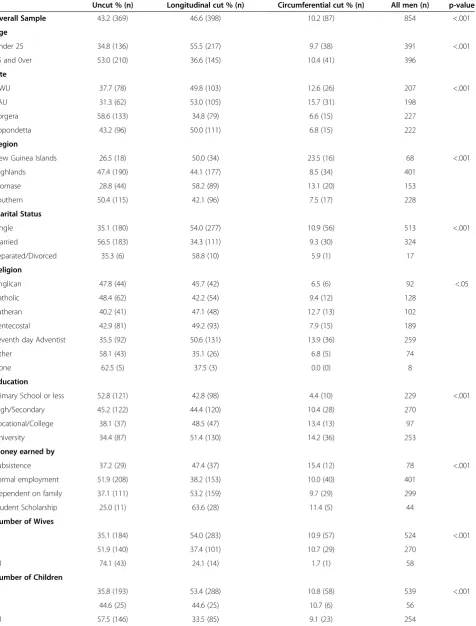
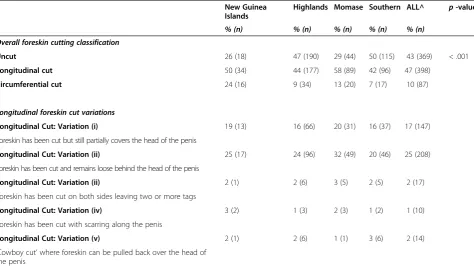
Ninety-nine percent of men (854/861) provided data on foreskin cutting: 10% (n = 87) reported a circumferential cut; 47% (n = 398) reported some form of longitudinal cut, and 43% (n = 369) no cut at all. The cutting varied significantly with age, education and region of origin (Table 2). Longitudinal cut was most frequent in men from Momase (58% of all men from that region); cir-cumferential cut most frequent in men from New Guinea Islands (24%) and an uncut foreskin was most frequent in men from the Southern (50%) and Highlands (47%) regions (p < 0.001) (Table 3). Five variations or styles of longitudinal cut were recorded and varied by region of origin (Table 3).
Circumstances of foreskin cutting
Most cut men (82% longitudinal cut men; 72% circum-ferential cut men) reported having their foreskin cut be-tween the ages of 10 and 20, with mean age 17 years (SD 4.77; Range 2–38) at longitudinal and 15 years (SD 6.66; Range 1–30) at circumferential cut (p < 0.001). The place and person performing the cuts varied significantly between longitudinal and round cut (p < 0.001). Longitu-dinal cuts were most frequently done in the village by a friend. Round cuts were most frequently done in a clinic by a health professional. Razors and surgical blades were the most utilized tools in all cuts (>90%), with scissors or bamboo used for 6% of circumferential cuts and a needle and rubber used for 5% of longitudinal cuts. For more details on place, person and tool used for foreskin cutting see Figure 1.
Attitudes and beliefs about foreskin cutting
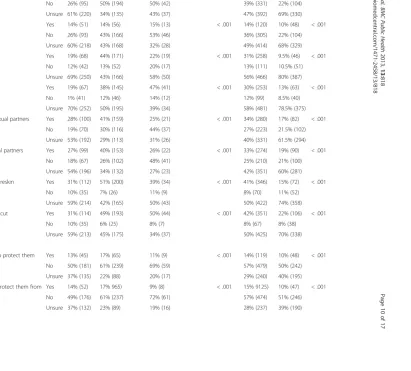
Attitudes and beliefs about foreskin cutting were investi-gated with both men and women around five thematic areas: (i) foreskin cutting and socio-cultural practice; (ii) foreskin cutting and sexual practice; (iii) foreskin cutting and sexual health; (iv) safety of foreskin cutting; (v) fore-skin cutting and socio-cultural belief. Statements that participants responded to (yes, no, unsure) in each theme were deliberately mixed on the original question-naire, however results are presented here in the five the-matic areas. Responses to statements by uncut men,
longitudinal cut men, circumferential cut men, all men and all women are given in Table 4.
Key findings for (i) Foreskin cutting and socio-cultural practice: Most men (63%) stated that foreskin cutting was not a part of their cultural practice/tradition. For women 42% stated it was not their cultural practice/ tradition, although half (51%) were unsure. Around a third of men and less than one in five women agreed that having a cut foreskin proves manhood. Less than 20% of men and women stated that foreskin cutting was forbidden by their custom/tradition or by their religion.
Key findings for (ii) foreskin cutting and sexual practice: A third of men and around 20% of women agreed that having a cut foreskin encourages men to have more sexual partners. Less than 15% of men and 10% of women agreed that having a cut foreskin de-creases sexual pleasure for men with about half of men and the majority of women responding they were un-sure. Around a third of men and one in ten women agreed to the statement that sex lasts longer for men with a cut foreskin. More than 40% of men but less than 20% of women agreed to the statement that women pre-fer to have sex with man with cut foreskin; half of men and almost three-quarters of women responded they were unsure.
Key findings for (iii) foreskin cutting and sexual health: More than half of men and a little under half of women agreed that men with a cut foreskin can become infected with HIV. Around a third of men and women agreed that having a cut foreskin reduces the risk of be-coming infected with HIV. The majority of both men (57%) and women (51%) disagreed with the statement that men with a cut foreskin do not need to use con-doms to protect from STI and HIV.
Key findings for (iv) safety of foreskin cutting: Around 10% of men and 5% of women agreed that fore-skin cutting in a village by a friend or relative was a safe procedure. Almost all men and three quarters of women disagreed that it is safe to use the same blade or razor to cut the foreskin of many men at one time. Most men (88%) and women (71%) agreed that having a foreskin cut by a health professional in a health facility is a safe procedure.
Table 1 Demographic characteristics by region of origin
Characteristic^ New Guinea Islands Momase Southern Highlands % (n) % (n) % (n) % (n) Male Female Male Female Male Female Male Female n = 72 n = 80 n = 153 n = 72 n = 230 n = 146 n = 402 n = 218 Age
Under 25 50.8 (32) 66.2 (51) 61.9 (91) 70.6 (48) 48.1 (104) 48.9 (68) 45.9 (168) 47.4 (91)
25 and over 49.2 (31) 33.8 (26) 38.1 (56) 29.4 (20) 51.9 (112) 51.1 (71) 54.1 (198) 52.6 (101)
Site
DWU 31.9 (23) 27.5 (22) 35.9 (55) 38.9 (28) 12.2 (28) 17.8 (26) 25.1 (101) 12.4 (27)
PAU 45.8 (33) 56.3 (45) 25.5 (39) 33.3 (24) 18.7 (43) 19.9 (29) 21.6 (87) 26.6 (58)
Porgera 16.7 (12) 8.8 (7) 10.5 (16) 12.5 (9) 5.2 (12) 6.2 (9) 46.5 (187) 60.6 (132)
Popondetta 5.6 (4) 7.5 (6) 28.1 (43) 15.3 (11) 63.9 (147) 56.2 (82) 6.7 (27) 0.5 (1)
Marital status
Single 70.8 (51) 72.5 (58) 71.9 (110) 81.9 (59) 56.5 (130) 44.8 (65) 55.7 (224) 45.9 (100)
Married 27.8 (20) 21.3 (17) 26.8 (41) 15.3 (11) 40.9 (94) 49.7 (72) 42.3 (170) 44 (96)
Separated/Divorced 1.4 (1) 6.3 (5) 1.4 (2) 2.8 (2) 2.6 (6) 5.6 (8) 1.9 (8) 10.1 (22)
Religion
Anglican 1.4 (1) 0 (0) 6.3 (6) 1.4 (1) 36.1 (83) 27.4 (40) 0.5 (2) 0 (0)
Catholic 31.9 (23) 22.5 (18) 21.1 (32) 18.3 (13) 6.1 (14) 9.6 (14) 14.4 (58) 7.4 (16)
Lutheran 0 (0) 0 (0) 28.3 (43) 18.3 (13) 1.7 (4) 3.4 (5) 13.7 (55) 4.6 (10)
Pentecostal 8.3 (6) 10 (8) 24 (15.8) 16 (22.5) 27.4 (63) 23.3 (34) 24.1 (97) 33.2 (72)
Seventh day Adventist 45.8 (33) 55 (44) 23.6 (40) 33.8 (24) 16.5 (38) 20.5 (30) 37.3 (150) 51.2 (111)
Other 12.5 (9) 12.5 (10) 3.3 (5) 5.6 (4) 11.7 (27) 15.8 (23) 8.7 (35) 3.7 (8)
None 0 (0) 0 (0) 1.3 (2) 0 (0) 0.4 (1) 0 (0) 1.2 (5) 0 (0)
Education
Primary School or less 2.8 (2) 0 (0) 22.5 (34) 8.7 (6) 45.9 (105) 25 (36) 21.8 (87) 6.6 (14)
High/Secondary 36.1 (26) 75 (57) 23.8 (36) 75.4 (52) 32.8 (75) 54.9 (79) 34.3 (137) 58.7 (125)
Voc/Tech college 18.1 (13) 11.8 (9) 12.6 (19) 8.7 (6) 6.1 (14) 12.5 (18) 13.0 (52) 28. (61)
University 43.1 (31) 13.2 (10) 41.1 (62) 7.2 (5) 15.3 (35) 7.6 (11) 31.0 (124) 6.1 (13)
Money earned by
Subsistence 1.5 (1) 13 (1) 4.9 (7) 9.4 (6) 15.5 (35) 14.1 (19) 9.0 (35) 5.3 (11)
Formal employment 37.3 (25) 27.3 (21) 38.7 (55) 14.1 (9) 51.3 (116) 43.7 (59) 61.5 (205) 57.4 (120)
Dependent on family 46.3 (31) 70.1 (54) 51.4 (73) 70.3 (45) 29.2 (66) 41.5 (56) 95.4 (132) 34.4 (72)
Student scholarship 14.9 (10) 1.3 (1) 4.9 (7) 6.3 (4) 4.0 (9) 0.7 (1) 4.6 (18) 2.9 (6)
Number of wives#
0 70.8 (51) 73.7 (112) 59.4 (136) 56.5 (227)
1 29.2 (21) 66.6 (10) 25.7 (39) 66.6 (6) 37.1 (85) 82.5 (47) 31.3 (126) 67.7 (63)
More than 1 0 (0) 33.3 (5) 0.7 (1) 33.3 (3) 3.5 (8) 17.5 (10) 12.3 (49) 32.3 (30)
Number of Children
0 73.6 (53) 75 (60) 76.3 (116) 80.6 (58) 62.0 (142) 82.5 (66) 576 (230) 50 (109)
1 4.2 (3) 6.3 (5) 7.2 (11) 1.4 (1) 5.7 (13) 11.0 (16) 7.3 (29) 12.4 (27)
More than 1 22.2 (16) 18.7 (15) 16.4 (25) 18 (13) 32.3 (74) 43.5 (66) 35.1 (140) 37.6 (82)
^
Totals are not the same for all characteristics. Some participants did not answer all questions. #
For females - number of wives their husband is married to.
MacLarenet al. BMC Public Health2013,13:818 Page 5 of 17
Table 2 Demographic characteristics by foreskin cutting type
Uncut % (n) Longitudinal cut % (n) Circumferential cut % (n) All men (n) p-value Overall Sample 43.2 (369) 46.6 (398) 10.2 (87) 854 <.001
Age
Under 25 34.8 (136) 55.5 (217) 9.7 (38) 391 <.001
25 and 0ver 53.0 (210) 36.6 (145) 10.4 (41) 396
Site
DWU 37.7 (78) 49.8 (103) 12.6 (26) 207 <.001
PAU 31.3 (62) 53.0 (105) 15.7 (31) 198
Porgera 58.6 (133) 34.8 (79) 6.6 (15) 227
Popondetta 43.2 (96) 50.0 (111) 6.8 (15) 222
Region
New Guinea Islands 26.5 (18) 50.0 (34) 23.5 (16) 68 <.001
Highlands 47.4 (190) 44.1 (177) 8.5 (34) 401
Momase 28.8 (44) 58.2 (89) 13.1 (20) 153
Southern 50.4 (115) 42.1 (96) 7.5 (17) 228
Marital Status
Single 35.1 (180) 54.0 (277) 10.9 (56) 513 <.001
Married 56.5 (183) 34.3 (111) 9.3 (30) 324
Separated/Divorced 35.3 (6) 58.8 (10) 5.9 (1) 17
Religion
Anglican 47.8 (44) 45.7 (42) 6.5 (6) 92 <.05
Catholic 48.4 (62) 42.2 (54) 9.4 (12) 128
Lutheran 40.2 (41) 47.1 (48) 12.7 (13) 102
Pentecostal 42.9 (81) 49.2 (93) 7.9 (15) 189
Seventh day Adventist 35.5 (92) 50.6 (131) 13.9 (36) 259
Other 58.1 (43) 35.1 (26) 6.8 (5) 74
None 62.5 (5) 37.5 (3) 0.0 (0) 8
Education
Primary School or less 52.8 (121) 42.8 (98) 4.4 (10) 229 <.001
High/Secondary 45.2 (122) 44.4 (120) 10.4 (28) 270
Vocational/College 38.1 (37) 48.5 (47) 13.4 (13) 97
University 34.4 (87) 51.4 (130) 14.2 (36) 253
Money earned by
Subsistence 37.2 (29) 47.4 (37) 15.4 (12) 78 <.001
Formal employment 51.9 (208) 38.2 (153) 10.0 (40) 401
Dependent on family 37.1 (111) 53.2 (159) 9.7 (29) 299
Student Scholarship 25.0 (11) 63.6 (28) 11.4 (5) 44
Number of Wives
0 35.1 (184) 54.0 (283) 10.9 (57) 524 <.001
1 51.9 (140) 37.4 (101) 10.7 (29) 270
>1 74.1 (43) 24.1 (14) 1.7 (1) 58
Number of Children
0 35.8 (193) 53.4 (288) 10.8 (58) 539 <.001
1 44.6 (25) 44.6 (25) 10.7 (6) 56
Foreskin cutting and sexual practice
Men with circumferential cut had significantly fewer life-time female sexual partners (median 5) compared to the men with longitudinal cut (6) or uncut men (7) (p < 0.05). There was no difference in condom use at last fe-male sex between circumferential cut, longitudinal cut and uncut men (35%, 32% and 33% respectively; p = 0.9).
Acceptability of male circumcision
Most uncut men and longitudinal cut men stated they would remove their foreskin or its remnant part, if it re-duced the risk of HIV infection (71% and 76%) or if it had an overall health benefit (84% and 88%) (Table 5). The vast majority would prefer the procedure done in a formal health facility by a health worker. Almost two-thirds (64%) of uncut men and half (51%) of longitudinal cut men stated they were planning to have their foreskin removed at some time in the future (Table 5).
Almost all men and three-quarters of women (74%) stated they would remove the foreskin of their male child if it reduced the risk of HIV infection, and even higher proportions if it had an overall health benefit (Table 5).
Discussion
This is the first study conducted in PNG that combines the investigation of prevalence, beliefs, attitudes and prac-tices about foreskin cutting and the acceptability of male circumcision. It thus addresses a vital area for public
health and HIV prevention in the country. Results expand the evidence vital for the National AIDS Council, National Department of Health and other policy makers to more ef-fectively plan HIV prevention strategies.
[image:7.595.61.536.100.366.2]The overall prevalence of foreskin cutting in the study was 57%, however only 10% of men reported the complete removal of the foreskin, the procedure on which international HIV prevention strategies and rec-ommendations are based upon. The prevalence of fore-skin cutting in this study was higher than the 25.8% longitudinal cut and 3.4% circumferential cut docu-mented in recent studies in plantation workers in the Highlands region, but similar to studies in the national capital [61-63,65]. The deliberate approach to include participants from diverse geographic locations and cul-tural backgrounds allowed a sample with a similar re-gional proportionality to the PNG population. Although this does not automatically imply representativeness or generalisability across the PNG population, this charac-teristic does enable closer analysis of the diversity of opinions and experience. The highest prevalence of both longitudinal and circumferential cuts in this study were from men from New Guinea Islands and Momase. This was not surprising given the numerous cultural groups with a tradition of foreskin cutting in these regions. However around half of men from the Highlands and Southern regions also reported having a cut foreskin (most often longitudinal cut). This was surprising given
Table 3 Foreskin cutting classification by region of origin
New Guinea Islands
Highlands Momase Southern ALL^ p-value
% (n) % (n) % (n) % (n) % (n)
Overall foreskin cutting classification
Uncut 26 (18) 47 (190) 29 (44) 50 (115) 43 (369) < .001
Longitudinal cut 50 (34) 44 (177) 58 (89) 42 (96) 47 (398)
Circumferential cut 24 (16) 9 (34) 13 (20) 7 (17) 10 (87)
Longitudinal foreskin cut variations
Longitudinal Cut: Variation (i) 19 (13) 16 (66) 20 (31) 16 (37) 17 (147) Foreskin has been cut but still partially covers the head of the penis
Longitudinal Cut: Variation (ii) 25 (17) 24 (96) 32 (49) 20 (46) 25 (208) Foreskin has been cut and remains loose behind the head of the penis
Longitudinal Cut: Variation (ii) 2 (1) 2 (6) 3 (5) 2 (5) 2 (17) Foreskin has been cut on both sides leaving two or more tags
Longitudinal Cut: Variation (iv) 3 (2) 1 (3) 2 (3) 1 (2) 1 (10) Foreskin has been cut with scarring along the penis
Longitudinal Cut: Variation (v) 2 (1) 2 (6) 1 (1) 3 (6) 2 (14)
‘Cowboy cut’where foreskin can be pulled back over the head of the penis
^
Totals in the ALL column for uncut and longitudinal cut classifications differ from the sum of regions because some participants did not provide information on region of origin.
MacLarenet al. BMC Public Health2013,13:818 Page 7 of 17
there are far fewer cultural groups with a tradition of foreskin cutting in these regions. Older men from Highlands and Southern regions were less likely to have a foreskin cut, or have detailed knowledge about foreskin cutting. This reflects recent rapid changes that enable modern education, travel and work practices that facili-tate the exchange of knowledge, beliefs and practices, in-cluding foreskin cutting.
This study provides further evidence that longitudinal cuts are the major forms of foreskin cutting in PNG [54,57,66,67]. Of men with dorsal longitudinal cuts in this study, more than half reported a variant where the glans penis is totally exposed. In this variant, the remnant foreskin hangs loosely on the ventral surface of the penis permanently exposing the inner surface of the foreskin. The foreskin then reduces in size, becomes dry and is visually similar to the outer surface of the fore-skin. In some men with this variant, the foreskin reduces to such an extent that the penis appears very similar to a circumcised penis (See Figure 2). It is unclear what the implications of such longitudinal cuts are for HIV pre-vention. The major explanation of how MC protects against HIV is that the inner aspect of the foreskin is the prime site for HIV entry on the penis. The inner aspect (and the frenulum) have a thinner keratin layer than the glans or penile shaft and so enable HIV entry to Langer-hans cells which carry specific HIV receptors [68]. Re-moving the foreskin through MC removes the prime site for HIV entry and so reduces the risk of HIV infection. This leads to the potential that changes to the exposed inner surface and reduction in the surface area of the remnant foreskin may provide some protection against HIV infection for men with this variant. However the potential protective effect is currently unknown [57,69]. A concerted research effort to investigate the potential protective effects of longitudinal cuts for HIV acquisition in PNG is essential given the scale of longitudinal cuts documented. This is particularly important given that most of the foreskin cutting does not occur within trad-itional initiation rituals or within the formal health sec-tor, but predominantly between peers as an evolving contemporary socio-cultural practice. Moreover, many men with longitudinal cuts in PNG consider themselves as‘circumcised’because of the appearance of their penis and because the commonly used Tok Pisintermskatim
skin bilong kokorkatim kokdo not differentiate between longitudinally cut or totally removed foreskin [46]. Stud-ies from PNG, Rwanda, Swaziland and Kenya have highlighted regional and cultural variations of foreskin cutting that do not completely remove the foreskin, and that many of these men consider themselves ‘ circum-cised’. This re-enforces the need for further research and more nuanced understanding of MC for HIV prevention in such settings [33,57,70,71]. This is particularly im-portant given cultural contexts are constantly evolving and adapting to new influences and circumstances [72].
MC for adult men was viewed positively. Three quar-ters of uncut men (76%) stated that they would remove their foreskin if it had a health benefit and 71% if it re-duced the risk of HIV infection. These results reflect similarly high proportions (86%) of male university stu-dents willing to have the foreskin removed in a pilot
0 10 20 30 40 50 60
Percentage
Person who performed the cutting
0 5 10 15 20 25 30 35 40
Percentage
Place of foreskin cutting
0 10 20 30 40 50 60 70
Percentage
[image:8.595.56.292.91.590.2]Tool used for cutting
Table 4 Attitudes and beliefs about foreskin cutting
Uncut men % (n)
Longitudinal cut men % (n)
Circumferential cut men % (n)
p–value men
All men % (n)
Women % (n)
p-value men and women
Theme (i) Foreskin cutting and socio-cultural practice
Having a split foreskin is a part of my culture Yes 9% (32) 25% (97) 24% (21) < .001 18% (150) 8% (37) < .001
No 68% (246) 57% (222) 60% (52) 62% (520) 42% (204)
Unsure 23% (85) 19% (73) 16% (14) 20% (172) 51% (248)
Having a round cut is part of my culture Yes 8% (28) 15% (58) 38% (33) < .001 14% (119) 10.5% (51) < .001
No 69% (247) 63% (245) 47% (41) 64% (533) 37% (182)
Unsure 23% (83) 22% (86) 15% (13) 22% (182) 52.5% (256)
Having a split foreskin proves manhood Yes 25% (90) 51% (200) 34% (29) < .001 38% (319) 18% (80) < .001
No 32% (114) 19% (72) 30% (26) 26% (212) 18% (79)
Unsure 43% (153) 30% (116) 36% (31) 36% (300) 63% (274)
Having a round cut proves manhood Yes 24% (87) 44% (173) 51% (44) < .001 36% (304) 22% (107) < .001
No 31% (113) 19% (74) 23% (20) 25% (207) 18% (87)
Unsure 45% (161) 37% (142) 26% (23) 39% (326) 60% (288)
Men with a split foreskin are respected by their peers Yes 18% (65) 35% (135) 29% (25) < .001 27% (225) 7% (35) < .001
No 29% (107) 32% (124) 40% (34) 32% (265) 11% (53)
Unsure 53% (191) 33% (130) 31% (27) 41% (348) 82% (396)
Men with a round cut are respected by their peers Yes 17% (61) 31% (122) 42% (36) < .001 26% (219) 11.5% (56) < .001
No 28% (102) 31% (120) 32% (28) 30% (250) 11% (55)
Unsure 55% (198) 38% (148) 26% (23) 44% (360) 77.5% (378)
Having a split foreskin is forbidden by my religion Yes 23% (82) 15% (59) 12% (10) < .001 18% (151) 13% (63) < .001
No 42% (122) 52% (205) 55% (47) 45% (374) 28% (137)
Unsure 44% (158) 33% (127) 34% (29) 37% (314) 59% (284)
Having a round cut is forbidden by my religion Yes 22% (79) 15% (59) 9% (8) < .001 18% (146) 13% (62) < .001
No 35% (125) 51% (199) 64% (55) 45% (379) 29% (141)
Unsure 43% (157) 34% (131) 27% (23) 37% (311) 58% (276)
Having a split foreskin is forbidden by my custom/culture Yes 18% (63) 13% (50) 14% (12) < .001 15% (125) 11.5% (54) < .001
No 44% (156) 65% (250) 64% (55) 56% (461) 30% (145)
Unsure 39% (139) 22% (86) 22% (19) 29% (244) 58.5% (281)
Having a round cut is forbidden by my custom/culture Yes 19% (68) 15% (58) 11% (10) < .001 16% (136) 11.5% (55) < .001
No 43% (157) 61% (236) 70% (61) 54% (454) 30% (145)
Unsure 38% (136) 24% (95) 18% (16) 30% (247) 58.5% (280)
MacLaren
et
al.
BMC
Public
Health
2013,
13
:818
Page
9
o
f
1
7
http://ww
w.biomedce
ntral.com/1
No 26% (95) 50% (194) 50% (42) 39% (331) 22% (104)
Unsure 61% (220) 34% (135) 43% (37) 47% (392) 69% (330)
A round cut decreases sexual pleasure for a man Yes 14% (51) 14% (56) 15% (13) < .001 14% (120) 10% (48) < .001
No 26% (93) 43% (166) 53% (46) 36% (305) 22% (104)
Unsure 60% (218) 43% (168) 32% (28) 49% (414) 68% (329)
Sex lasts longer for men who have a split foreskin Yes 19% (68) 44% (171) 22% (19) < .001 31% (258) 9.5% (46) < .001
No 12% (42) 13% (52) 20% (17) 13% (111) 10.5% (51)
Unsure 69% (250) 43% (166) 58% (50) 56% (466) 80% (387)
Sex lasts longer for men who have a round cut Yes 19% (67) 38% (145) 47% (41) < .001 30% (253) 13% (63) < .001
No 1% (41) 12% (46) 14% (12) 12% (99) 8.5% (40)
Unsure 70% (252) 50% (195) 39% (34) 58% (481) 78.5% (375)
Having a split foreskin encourages men to have more sexual partners Yes 28% (100) 41% (159) 25% (21) < .001 34% (280) 17% (82) < .001
No 19% (70) 30% (116) 44% (37) 27% (223) 21.5% (102)
Unsure 53% (192) 29% (113) 31% (26) 40% (331) 61.5% (294)
Having a round cut encourages men to have more sexual partners Yes 27% (99) 40% (153) 26% (22) < .001 33% (274) 19% (90) < .001
No 18% (67) 26% (102) 48% (41) 25% (210) 21% (100)
Unsure 54% (196) 34% (132) 27% (23) 42% (351) 60% (281)
Women prefer to have sex with a man who has a split foreskin Yes 31% (112) 51% (200) 39% (34) < .001 41% (346) 15% (72) < .001
No 10% (35) 7% (26) 11% (9) 8% (70) 11% (52)
Unsure 59% (214) 42% (165) 50% (43) 50% (422) 74% (358)
Women prefer to have sex with a man who has a round cut Yes 31% (114) 49% (193) 50% (44) < .001 42% (351) 22% (106) < .001
No 10% (35) 6% (25) 8% (7) 8% (67) 8% (38)
Unsure 59% (213) 45% (175) 34% (37) 50% (425) 70% (338)
Theme (iii) foreskin cutting and sexual health
Men with a split foreskin do not need to use condoms to protect them from STIs & HIV
Yes 13% (45) 17% (65) 11% (9) < .001 14% (119) 10% (48) < .001
No 50% (181) 61% (239) 69% (59) 57% (479) 50% (242)
Unsure 37% (135) 22% (88) 20% (17) 29% (240) 40% (195)
Men with a round cut do not need to use condoms to protect them from STIs & HIV
Yes 14% (52) 17% 965) 9% (8) < .001 15% 9125) 10% (47) < .001
No 49% (176) 61% (237) 72% (61) 57% (474) 51% (246)
Unsure 37% (132) 23% (89) 19% (16) 28% (237) 39% (190)
al.
BMC
Public
Health
2013,
13
:818
Page
10
of
17
ntral.com/1
[image:10.595.184.673.75.521.2]Table 4 Attitudes and beliefs about foreskin cutting(Continued)
Men with a split foreskin can become infected with HIV Yes 59% (211) 64% (251) 65% (56) .015 63% (518) 45% (219) < .001
No 6% (20) 10% (39) 9% (8) 8% (67) 10% (50)
Unsure 36% (127) 26% (100) 26% (22) 30% (249) 44% (213)
Men with a round cut can become infected with HIV Yes 58% (209) 64% (250) 68% (60) .059 62% (519) 41% (198) < .001
No 7% (26) 9% (36) 10% (9) 8% (71) 13% (64)
Unsure 35% (126) 27% (106) 22% (19) 30% (251) 46% (220)
A split foreskin reduces the risk of becoming infected with HIV Yes 31% (112) 37% (145) 33% (28) .324 34% (285) 27% (130) < .001
No 25% (92) 26% (101) 28% (24) 26% (217) 22% (105)
Unsure 44% (157) 37% (142) 39% (34) 40% (333) 51% (248)
A round cut reduces the risk of becoming infected with HIV Yes 35% (126) 39% (153) 36% (32) .813 37% (311) 33.5% (162) < .001
No 26% (93) 25% (98) 24% (21) 25% (212) 17% (82)
Unsure 39% (141) 36% (141) 40% (35) 38% (317) 49.5% (239)
Theme (iv) foreskin cutting and safety
It is safe to use the same blade or razor to split or remove the foreskin of many men at one time
Yes 5% (17) 8% (30) 6% (5) < .001 6% (52) 3% (16) < .001
No 81% (293) 87% (339) 89% (77) 85% (709) 75% (365)
Unsure 14% (51) 5% (21) 5% (4) 9% (76) 21% (104)
Splitting the foreskin in a village by a friend or relative is a safe procedure Yes 8% (27) 15% (60) 17% (15) .005 12% (102) 5.5% (26) < .001
No 67% (237) 64% (245) 65% (55) 65% (537) 63.5% (297)
Unsure 26% (91) 21% (80) 18% (15) 23% (186) 31% (146)
Removing the foreskin in a village by a friend or relative is a safe procedure
Yes 8% (27) 12% (46) 17% (15) .043 11% (88) 6% (30) < .001
No 67% (243) 66% (258) 66% (57) 64% (558) 61.5% (296)
Unsure 25% (92) 22% (87) 17% (15) 23% (194) 32.5% (157)
Having a round cut by a doctor or nurse in a clinic or hospital is a safe procedure
Yes 83% (298) 92% (360) 88% (77) .005 88% (735) 71% (342) < .001
No 3% (10) 2% (7) 3% (3) 2% (20) 5% (23)
Unsure 14% (51) 6% (25) 8% (7) 10% (83) 24% (118)
Theme (v) foreskin cutting and socio-cultural beliefs
Allowing blood to flow when the foreskin is split or removed is important in my custom/culture
Yes 21% (76) 26% (102) 30% (26) .067 24% (204) 7% (33) < .001
No 42% (151) 46% (180) 38% (33) 43% (364) 25% (121)
Unsure 40% (133) 28% (111) 32% (28) 32% (272) 68% (326)
A man needs to eat special food in the days after having his foreskin split or removed
Yes 46% (166) 71% (278) 61% (53) < .001 59% (497) 25% (123) < .001
No 7% (26) 11% (42) 18% (16) 10% (84) 10% (47)
Unsure 47% (170) 18% (70) 21% (18) 31% (258) 65% (311)
MacLaren
et
al.
BMC
Public
Health
2013,
13
:818
Page
11
of
17
http://ww
w.biomedce
ntral.com/1
Unsure 41% (148) 10% (41) 15% (13) 24% (202) 68% (327)
A man needs to avoid women in the days after having his foreskin split or removed Yes 68% (245) 91% (355) 90% (78) < .001 81% (678) 48% (230) < .001
No 4% (16) 3% (10) 2% (2) 3% (28) 4% (18)
Unsure 28% (101) 7% (27) 8% (7) 16% (135) 48% (232)
A split foreskin makes a man’s body grow strong Yes 30% (108) 54% (213) 43% (37) < .001 43% (358) 16% (76) < .001
No 11% (39) 9% (36) 16% (14) 11% (89) 12% (56)
Unsure 59% (210) 37% (144) 41% (35) 46% (389) 72% (349)
A round cut makes a man’s body grow strong Yes 31% (111) 53% (209) 50% (44) .001 43% (364) 18% (86) < .001
No 9% (33) 7% (27) 14% (12) 9% (72) 11% (52)
Unsure 60% (217) 40% (156) 36% (32) 48% (405) 71% (343)
A split foreskin makes the penis grow bigger Yes 31% (111) 53% (206) 37% (32) < .001 42% (349) 11% (52) < .001
No 9% (33) 14% (55) 19% (16) 12% (104) 13% (61)
Unsure 60% (217) 33% (131) 44% (38) 46% (386) 76% (369)
A round cut makes the penis grow bigger Yes 31% (112) 48% (189) 42% (37) < .001 40% (338) 14% (68) < .001
No 10% (35) 14% (54) 22% (19) 13% (108) 11.5% (55)
Unsure 59% (214) 38% (149) 36% (32) 47% (395) 74.5% (358)
al.
BMC
Public
Health
2013,
13
:818
Page
12
of
17
ntral.com/1
[image:12.595.72.700.67.327.2]study [65] and qualitative findings showing PNG men to be generally in favour of MC for HIV prevention [46]. Further, men with an existing longitudinal cut were overwhelmingly in favour of having the remnant foreskin removed if it reduced the risk of HIV infection. Most of
these men had their longitudinal cut in a community setting, but almost all stated they would prefer to have the removal procedure conducted in a health facility by a health professional which they considered a safer op-tion. The high proportion of men willing to have MC is similar to studies in high HIV prevalence settings in Africa (median 65%) but somewhat greater than studies in other moderate prevalence settings, such as India (58%), Thailand (14% and 25% before and after informa-tion) and Dominican Republic (29% and 67% before and after information) [13,40,41,43]. Methodology, study popu-lation, HIV prevalence and socio-cultural context are so different across these studies that comparisons are hard to interpret. Moreover men in these studies were categorised in a circumcised –uncircumcised dichotomy, making in-terpretation even more difficult for the PNG context where the longitudinal cut is the major form of cutting. However, these studies do reflect the need to investigate understand-ings and cultural contexts of specific populations to inform if, or how, MC may be a part of the local response to HIV.
[image:13.595.57.538.98.443.2]MC for children was viewed positively. More than 90% of men and three quarters of women stated they would
Table 5 Acceptability of male circumcision for self and male child for uncut, longitudinal cut and round cut men
Uncut men Longitudinal cut men
Round cut men
p-value % (n)^ % (n) % (n)
Would have foreskin completely removed if it had a health benefit Yes 76 (269) 88 (278) <.001
Maybe 12 (45) 0
No 12 (42) 12 (38)
Would have foreskin completely removed if it reduced the risk of getting HIV Yes 71 (250) 84 (258) <.001
Maybe 13 (46) 0
No 15(55) 16 (49)
Preferred place to have foreskin removed Hospital/clinic 95 (312) 97 (247) .26
Others 3 (9) 2 (5)
Not sure 2 (8) 1 (2)
Preferred person to remove foreskin Health worker 90 (298) 95 (292) <.01
Other 4 (14) 3 (10)
Don’t know /not want MC
6 (19) 1 (4)
Planning to remove foreskin Yes 64 (229) 51 (163) <.001
Maybe 14 (50) 26 (84)
No 22 (78) 22 (70)
Recommend foreskin removal to friends Yes 64 (210) 64 (209) 89 (57) <.001
No 36 (116) 36 (116) 11 (7)
Would have the foreskin removed from male child if it had a health benefit Yes 86 (260) 92 (280) 95 (58) <.05
No 14 (43) 8 (26) 5 (3)
Would have the foreskin removed from male child if it reduced the risk of HIV or STIs Yes 87 (250) 93 (285) 91 (53) <.05
No 13 (38) 7(20) 9 (5)
^
Totals are not the same for all characteristics. Some participants did not answer all questions.
Figure 2Longitudinal Foreskin cut: Variant (i) Foreskin cut but still partially covers the glans penis; Variant (ii) Foreskin cut and remains loose behind the glans penis.
MacLarenet al. BMC Public Health2013,13:818 Page 13 of 17
[image:13.595.57.292.558.696.2]remove the foreskin of their child if it had a health bene-fit and/or reduced the risk of HIV. These rates are simi-lar to parents in some high prevalence African settings and provide some of the first evidence about parents’ willingness to circumcise their sons in a moderate HIV setting [13]. This provides a unique challenge to the PNG health system that struggles to provide even basic primary health care services for the majority of the popu-lation. There are only 0.5 doctors and 5 nurses/midwives per 10 000 people in PNG and only 39% of births are supervised by skilled birth attendants [73,74]. Having a large number of adults, adolescents or infants present for MC would require considerable training, infrastructure and resource allocation across the entire health system.
Specific attitudes and beliefs documented in this study have direct relevance for policy makers. When given the ability to respond yes, no, or unsure to statements about foreskin cutting it was common for around a third of men and often more than half of women responded ‘unsure’. Although this high level of uncertainly may be of concern to some service providers or policy makers, it reflects the dynamic socio-cultural context in PNG and that many people are aware of foreskin cutting but may not have fixed attitudes or beliefs towards foreskin cutting. This provides an opportunity for public health campaigns, as called for by Kelly et al. [46], to provide accurate information in a cultur-ally sensitive way that builds on the strength of culture, rather than destroying it. In a country where one’s culture and religion is so explicitly referred to in everyday life, it is important to note that few men and women stated foreskin cutting was forbidden by their custom/tradition or religion. Further, none of the beliefs about culture, religion or sexual practice documented in this study contradict the positive views of men and parents towards MC, or the appropriate-ness of providing MC services in this setting.
It is pleasing to note that the majority of both men and women believe men with a cut (or removed) foreskin still need to use condoms to prevent STI and HIV. However, of concern is one quarter of men and 40% of women stated they were unsure. This requires current public health messages about STI and HIV prevention to empha-sise that condoms are for everyone regardless of a man’s foreskin cutting status. It is also encouraging that almost all men and women think it is unsafe to use the same blade to cut many men. This is likely to be due to cultural beliefs about the contagion potential of blood re-enforced by public HIV prevention messages about the danger of sharing tools for body cutting, tattooing or scarification practices [75]. Nevertheless, 19% of men and 52% of women were not sure or do not think it is necessary to avoid sexual contact in the days after the foreskin cut, highlighting the need for more specific MC education.
As in other low-moderate HIV burden settings with heterosexual transmission, a key challenge is how to
expand existing clinical MC services, increase the safety of existing community foreskin cutting practices and/or introduce new MC services appropriate to local con-texts. Decision makers must consider programs that de-liver the greatest epidemiological and public health impact while being responsive to diverse socio-cultural practices and health service capacity [33,45,46]. In this context, researchers and policy makers in PNG are ac-tively considering international and local evidence to in-form policy making and future research [76,77].
The major strength of this study was that it was a partnership between PNG and Australian universities and two large resource companies across four prov-inces at sites where people from across PNG come to study or work. This allowed access to a great diversity of men and women who provided data on traditional and contemporary foreskin cutting practices and be-liefs. However, only some major descriptive analysis of this large quantitative data set on foreskin cutting prac-tices and beliefs could be presented in this paper. Fur-ther more detailed analyses of quantitative data and findings from qualitative interviews and focus group discussions will be published separately. Given the hyper-diversity of having more than 800 languages, and thus diverse sets of beliefs and practices in the country, this study provides a limited, although valuable snap-shot of current foreskin cutting and the acceptability of MC in PNG.
Conclusion
Additional files
Additional file 1: Figure S1.Male Questionnaire in English. Additional file 2: Figure S2.Female Questionnaire in English.
Competing interests
The authors declare there they have no competing interests.
Authors’contributions
DM and WJM conceived, designed and coordinated the study and drafted the manuscript. RT, TM, CM, FF, MRM, MW, KB participated in the design and coordination of the study; collected, managed and analysed data; helped draft and revise the manuscript. RM and JK managed, analysed and interpreted data and help to draft and revise the manuscript. All authors have read and approved the final manuscript.
Acknowledgements
We wish to thank the study participants, local steering group members and all members of the‘Acceptability of Male Circumcision for HIV Prevention in Papua New Guinea’study. A special thanks to Divine Word University, Pacific Adventist University, James Cook University, Higaturu Oil Palms and Barrick Gold (Porgera Joint Venture) for partnering in the study, including in-kind support. Thanks also to the Papua New Guinea National Department of Health/Asian Development Bank HIV Prevention in Rural Enclaves Project for intellectual and logistic support throughout. Capacity building workshops and ongoing support throughout the study were facilitated by Associate Professor Petra Buttner from James Cook University; Ethics approvals were granted by Papua New Guinea National AIDS Council, Pacific Adventist University, Divine Word University and James Cook University and endorsed by Provincial AIDS Committees of Enga, Oro and Madang Provinces and National Capital District, all for which we are grateful. The study was funded by National Health and Medical Research Project Grant 601003 and Capacity Building Workshop for PNG staff funded by Australian Leadership Award Fellowships Agreement Number 59019.
Author details
1School of Medicine and Dentistry, James Cook University, McGregor Road, Smithfield, Cairns 4878, Queensland, Australia.2School of Health Science, Pacific Adventist University, Port Moresby, National Capital District, Papua New Guinea.3Deputy Vice Chancellor, Pacific Adventist University, Port Moresby, National Capital District, Papua New Guinea.4Faculty of Health Science, Divine Word University, Madang, Madang Province, Papua New Guinea.5Global Health Unit, University of Montreal Hospital Research Centre, Montreal, Quebec, Canada.6School of Arts and Social Science, James Cook University, Cairns, Queensland, Australia.7Rural Primary Health Services Delivery Project, National Department of Health, Port Moresby, Papua New Guinea.8School of Public Health, Tropical Medicine and Rehabilitation Science, James Cook University, Cairns, Queensland, Australia.9Tropical Health Solutions, Townsville, Australia.10Kirby Institute, University of New South Wales, Sydney, New South Wales, Australia.
Received: 9 May 2013 Accepted: 5 September 2013 Published: 9 September 2013
References
1. Auvert B, Taljaard D, Lagarde E, Sobngwi-Tambekou J, Sitta R, Puren A: Randomized, controlled intervention trial of male circumcision for reduction of HIV infection risk: the ANRS 1265 Trial.PLoS Med2005,2(11):e298. 2. Bailey RC, Moses S, Parker CB, Agot K, Maclean I, Krieger JN, Williams CF,
Campbell RT, Ndinya-Achola JO:Male circumcision for HIV prevention in young men in Kisumu, Kenya: a randomised controlled trial.Lancet2007, 369(9562):643–656.
3. Gray RH, Kigozi G, Serwadda D, Makumbi F, Watya S, Nalugoda F, Kiwanuka N, Moulton LH, Chaudhary MA, Chen MZ,et al:Male circumcision for HIV prevention in men in Rakai, Uganda: a randomised trial.Lancet2007,369(9562):657–666. 4. Weiss HA, Quigley MA, Hayes RJ:Male circumcision and risk of HIV
infection in sub-Saharan Africa: a systematic review and meta-analysis. AIDS2000,14(15):2361–2370.
5. Siegfried N, Muller M, Deeks JJ, Volmink J:Male circumcision for prevention of heterosexual acquisition of HIV in men.Cochrane Database Syst Rev2009,2, CD003362.
6. Nagelkerke NJ, Moses S, de Vlas SJ, Bailey RC:Modelling the public health impact of male circumcision for HIV prevention in high prevalence areas in Africa.BMC Infec Dis2007,7:16.
7. Londish GJ, Murray JM:Significant reduction in HIV prevalence according to male circumcision intervention in sub-Saharan Africa.Int J Epidemiol 2008,37(6):1246–1253.
8. Auvert B, Taljaard D, Rech D, Lissouba P, Singh B, Shabangu D:Effect of the Orange Farm (South Africa) male circumcision roll-out (ANRS-12126) on the spread of HIV. In6th IAS Conference on HIV Pathogenesis, Treatment and Prevention: 20 July 2011.Rome, Italy: International AIDS Society; 2011. 9. WHO:[Press Release] WHO and UNAIDS announce Recommendations from
Expert Meeting on Male Circumcision for HIV Prevention.Geneva: WHO; 2007. 10. Nnko S, Washija R, Urassa M, Boerma JT:Dynamics of male circumcision
practices in northwest Tanzania.Sex Transm Dis2001,28(4):214–218. 11. Jayeoba O, Dryden-Peterson S, Okui L, Smeaton L, Magetse J, Makori L,
Modikwa V, Mogodi M, Plank R, Lockman S:Acceptability of male circumcision among adolescent boys and their parents, Botswana. AIDS Behav2012,16(2):340–349.
12. Iliyasu Z, Abubakar IS, Sani IH, Jibo AM, Karaye IM, Salihu HM, Aliyu MH: Male circumcision and HIV risk behavior among University students in Northern Nigeria.Am J Mens Health2012,25:401–406.
13. Westercamp N, Bailey RC:Acceptability of male circumcision for prevention of HIV/AIDS in sub-Saharan Africa: a review.AIDS Behav2007, 11(3):341–355.
14. Lukobo MD, Bailey RC:Acceptability of male circumcision for prevention of HIV infection in Zambia.AIDS Care2007,19(4):471–477.
15. Ngalande RC, Levy J, Kapondo CP, Bailey RC:Acceptability of male circumcision for prevention of HIV infection in Malawi.AIDS Behav2006, 10(4):377–385.
16. Scott BE, Weiss HA, Viljoen JI:The acceptability of male circumcision as an HIV intervention among a rural Zulu population, Kwazulu-Natal, South Africa.AIDS Care2005,17(3):304–313.
17. Mattson CL, Bailey RC, Muga R, Poulussen R, Onyango T:Acceptability of male circumcision and predictors of circumcision preference among men and women in Nyanza Province, Kenya.AIDS Care2005,17(2):182–194. 18. Halperin DT, Fritz K, McFarland W, Woelk G:Acceptability of adult male
circumcision for sexually transmitted disease and HIV prevention in Zimbabwe.Sex Transm Dis2005,32(4):238–239.
19. Lagarde E, Dirk T, Puren A, Reathe RT, Bertran A:Acceptability of male circumcision as a tool for preventing HIV infection in a highly infected community in South Africa.AIDS2003,17(1):89–95.
20. Kebaabetswe P, Lockman S, Mogwe S, Mandevu R, Thior I, Essex M, Shapiro RL:Male circumcision: an acceptable strategy for HIV prevention in Botswana.Sex Trans Infect2003,79(3):214–219.
21. Bailey RC, Muga R, Poulussen R, Abicht H:The acceptability of male circumcision to reduce HIV infections in Nyanza Province, Kenya. AIDS Care2002,14(1):27–40.
22. WHO, UNAIDS:Joint Strategic Action Framework to Accelerate the Scale-Up of Voluntary Medical Male Circumcision for HIV Prevention in Eastern and Southern Africa (2012–2016).Geneva: UNAIDS; 2011.
23. WHO, UNAIDS:Progress in Scale-up of Male Circumcision for HIV prevention in Eastern and Southern Africa.Geneva: WHO; 2011.
24. WHO:Use of devices for adult male circumcision in public health HIV prevention programmes - Conclusions of the WHO Technical Advisory Group on Innovations in Male Circumcision.Geneva: WHO; 2012.
25. Westercamp M, Agot KE, Ndinya-Achola J, Bailey RC:Circumcision preference among women and uncircumcised men prior to scale-up of male circumcision for HIV prevention in Kisumu, Kenya.AIDS Care2012,24(2):157–166.
26. Waters E, Stringer E, Mugisa B, Temba S, Bowa K, Linyama D:Acceptability of neonatal male circumcision in Lusaka, Zambia.AIDS Care2012,24(1):12–19. 27. Tarimo EA, Francis JM, Kakoko D, Munseri P, Bakari M, Sandstrom E:The
perceptions on male circumcision as a preventive measure against HIV infection and considerations in scaling up of the services: a qualitative study among police officers in Dar es Salaam, Tanzania.BMC Publ Health2012,12(1):529. 28. Sheldon WR, Nhemachena T, Blanchard K, Chipato T, Ramjee G, Trussell J,
McCulloch CE, Blum M, Harper CC:Male circumcision for HIV prevention: clinical practices and attitudes among healthcare providers in South Africa and Zimbabwe.Sex Transm Dis2012,39(7):567–575.
MacLarenet al. BMC Public Health2013,13:818 Page 15 of 17
29. Ngo TD, Obhai G:Male circumcision uptake, postoperative complications, and satisfaction associated with mid-level providers in rural Kenya. HIV/AIDS - Research and Palliative Care2012,2012:37–43.
30. Mavhu W, Hatzold K, Laver SM, Sherman J, Tengende BR, Mangenah C, Langhaug LF, Hart G, Cowan FM:Acceptability of early infant male circumcision as an HIV prevention intervention in Zimbabwe: a qualitative perspective.PLoS One2012,7(2):e32475.
31. Lundsby K, Draebel T, Wolf Meyrowitsch D:‘It brought joy in my home as in the area of my wife’. How recently circumcised adult men ascribe value to and make sense of male circumcision.Global Public Health2012, 7(4):352–366.
32. Kuznik A, Lamorde M, Sekavuga DB, Picho B, Coutinho A:Medical male circumcision for HIV/AIDS prevention in Uganda - the cost of disposable versus re-usable circumcision kits.Trop Doct2012,42(1):5–7.
33. Gasasira RA, Sarker M, Tsague L, Nsanzimana S, Gwiza A, Mbabazi J, Karema C, Asiimwe A, Mugwaneza P:Determinants of circumcision and willingness to be circumcised by Rwandan Men, 2010.BMC Publ Health 2012,12(1):134.
34. Andersson N, Cockcroft A:Male circumcision, attitudes to HIV prevention and HIV status: a cross-sectional study in Botswana, Namibia and Swaziland.AIDS Care2012,24(3):301–309.
35. Siegler AJ, Mbwambo JK, Diclemente RJ:Acceptability of medical male circumcision and improved instrument sanitation among a traditionally circumcising group in East Africa.AIDS Behav2012,16(7):1846–1852. 36. Sawires SR, Dworkin SL, Fiamma A, Peacock D, Szekeres G, Coates TJ:Male
circumcision and HIV/AIDS: challenges and opportunities.Lancet2007, 369(9562):708–713.
37. Muula AS:Male circumcision to prevent HIV transmission and acquisition: what else do we need to know?AIDS Behav2007,11(3):357–363. 38. Peltzer K, Niang CI, Muula AS, Bowa K, Okeke L, Boiro H, Chimbwete C:Male
circumcision, gender and HIV prevention in sub-Saharan Africa: a (social science) research agenda.Sahara J2007,4(3):658–667.
39. Kippax S, Holt M, Friedman S:Bridging the social and the biomedical: engaging the social and political sciences in HIV research.J Int AIDS Soc 2011,14(Suppl 2):S1.
40. Tieu HV, Phanuphak N, Ananworanich J, Vatanparast R, Jadwattanakul T, Pharachetsakul N, Mingkwanrungrueng P, Buajoom R, Teeratakulpisarn S, Teeratakulpisarn N,et al:Acceptability of male circumcision for the prevention of HIV among high-risk heterosexual men in Thailand. Sex Transm Dis2010,37(6):352–355.
41. Brito MO, Caso LM, Balbuena H, Bailey RC:Acceptability of male circumcision for the prevention of HIV/AIDS in the Dominican Republic. PLoS One2009,4(11):e7687.
42. Brito MO, Luna M, Bailey RC:The feasibility and acceptability of male circumcision among men, women, and health providers of the Altagracia Province, Dominican Republic.AIDS Care2010,22(12):1530–1535. 43. Madhivanan P, Krupp K, Kulkarni V, Kulkarni S, Klausner JD:Acceptability of
male circumcision for HIV prevention among high-risk men in Pune, India.Sex Transm Dis2011,38(6):571.
44. Madhivanan P, Krupp K, Chandrasekaran V, Karat SC, Reingold AL, Klausner JD:Acceptability of male circumcision among mothers with male children in Mysore, India.AIDS2008,22(8):983–988.
45. Kelly A, Kupul M, Aeno H, Shih P, Naketrumb R, Neo J, Fitzgerald L, Kaldor JM, Siba PM, Vallely A:Why women object to male circumcision to prevent HIV in a moderate-prevalence setting.Qual Health Res2013,23(2):180–193. 46. Kelly A, Kupul M, Fitzgerald L, Aeno H, Neo J, Naketrumb R, Siba P, Kaldor J,
Vallely A:“Now we are in a different time; various bad diseases have come.” Understanding men’s acceptability of male circumcision for HIV prevention in a moderate prevalence setting.BMC Publ Health2012,12(1):67. 47. National AIDS Council Secretariat: Global AIDS Report:Country Progress Report,
Papua New Guinea, Reporting Period January 2010 - December 2011.Port Moresby, Papua New Guinea: National AIDS Council Secretariat; 2012. 48. National AIDS Council Secretariat and Partners PNG:UNGASS 2008 Country
Progress Report: Papua New Guinea.Port Moresby: National AIDS Council Secretariat; 2008.
49. Vallely A, Page A, Dias S, Siba P, Lupiwa T, Law G, Millan J, Wilson DP, Murray JM, Toole M,et al:The prevalence of sexually transmitted infections in Papua New Guinea: A systematic review and meta-analysis. PLoS One2010,5(12):e15586-1–e15586-10.
50. National AIDS Council Secretariat:National Research Agenda for HIV&AIDS in PNG 2008–13.Port Moresby: National AIDS Council Secretariat; 2008.
51. National AIDS Council Secretariat:National HIV and AIDS Research Capacity Building Plan 2010–2013.Port Moresby: National AIDS Council of Papua New Guinea; 2010.
52. National AIDS Council Secretariat:Papua New Guinea National HIV and AIDS Strategy 2011–2015.Port Moresby: National AIDS Council Secretariat; 2010. 53. Hogbin H:The island of menstruating men: Religion in Wogeo New Guinea.
Scranton: Chandler; 1970.
54. Hammar LJ:Sin, Sex and Stigma: A Pacific Response to HIV and AIDS. Wantage: Sean Kingston Publishing; 2010.
55. Caldwell J, Isaac-Toua G:AIDS in Papua New Guinea: situation in the Pacific.J Health Popul Nutr2002,20(2):104–111.
56. Hull TH, Budiharsana M:Male circumcision and penis enhancement in Southeast Asia: matters of pain and pleasure.Reprod Health Matters2001, 9(18):60–67.
57. Hill PS, Tynan A, Law G, Millan J, Browne K, Sauk J,et al:A typology of penile cutting in Papua New Guinea: Results of a modified delphi study among sexual health clinicians.AIDS Care2011,24(1):77–86.
58. Kempf W:The politics of incorporation: masculinity, spatiality and modernity among the Ngaing of Papua New Guinea.Oceania2002,73(1):56–77. 59. Tuzan D:The Voice of the Tambaran.Berkeley: University of California; 1980. 60. Buchanan HR, Frank R, Couch M, Amos A:The Re-Making of men and
penile modification. InTechnologies of Sexuality, Identity and Sexual Health. Edited by Manderson L. London: Routledge Press; 2012.
61. Millan J, Yeka W, Obiero W, Pantumari J:HIV/AIDS Behavioural Surveillance Survey: Within High Risk Settings - Papua New Guinea (2006).Port Moresby: National AIDS Council Secretariat, National HIV/AIDS Support Project; 2006. 62. Buchanan HR, Akuani F, Kupe F, Amos A, Sapak K, Be F, Kawage T, Frank R, Couch M:Behavioural Surveillance Research in Rural Development Enclaves in Papua New Guinea: A Study with the Oil Search Limited Workforce.Port Moresby, Papua New Guinea: The National Research Institute; 2011. 63. Kelly A, Kupul M, Man WYN, Nosi S, Lote N, Rawstorne P, Halim G, Ryan C, Worth
H:Askim na save (Ask and understand): People who sell and/or exchange sex in Port Moresby. Key Quantitative Findings.Sydney, Australia: Papua New Guinea Institute of Medical Research and the University of New South Wales; 2011.
64. National Statistical Office of Papua New Guinea:Preliminary Figures: Papua New Guinea Census 2011.Papua New Guinea: Port Moresby; 2011. 65. Tommbe R, Asugeni L, MacLaren D:What Can be Learned about Male
Circumcision and HIV Prevention from a Cohort of Students and Staff at a Papua New Guinea University?.Port Moresby, Papua New Guinea: Pacific Adventist University; 2012.
66. Jenkins C, Buchanan-Aruwafu H:Cultures and Contexts Matter: Understanding and Preventing HIV in the Pacific.Manila, Phillipines: Asian Development Bank; 2007. 67. Buchanan-Aruwafu H:An integrated picture: HIV risk and vulnerability in the
Pacific.Noumea, New Caledonia: Secretariat of the Pacific Community; 2007. 68. McCoombe SG, Short RV:Potential HIV-1 target cells in the human penis.
AIDS2006,20(11):1491–1495.
69. Kigozi G, Wawer M, Ssettuba A, Kagaayi J, Nalugoda F, Watya S, Mangen FW, Kiwanuka N, Bacon MC, Lutalo T,et al:Foreskin surface area and HIV acquisition in Rakai, Uganda (size matters).AIDS2009,23(16):2209–2213. 70. Brown JE, Micheni KD, Grant EM, Mwenda JM, Muthiri FM, Grant AR:
Varieties of male circumcision: a study from Kenya.Sex Transm Dis2001, 28(10):608–612.
71. Thomas AG, Tran BR, Cranston M, Brown MC, Kumar R, Tlelai M:Voluntary medical male circumcision: a cross-sectional study comparing circumcision self-report and physical examination findings in Lesotho. PLoS One2011,6(11):e27561.
72. Montgomery C, Pool R:Critically engaging: integrating the social and the biomedical in international microbicides research.J Int AIDS Soc2011, 14(Suppl 2):S4.
73. Rule J, Worth H, Roberts G, Taylor R:Human resource challenges in scaling up the response to HIV in Papua New Guinea.WPSAR2012,3(3). 10.5365/ wpsar.2012.3.2.006.
74. Dawson A, Howes T, Gray N, Kennedy E:Human resources for health in maternal, neonatal and reproductive health at community level: A profile of Papua New Guinea.Sydney, Australia: Human Resources for Health Knowledge Hub and Burnet Institute; 2011.
76. Vallely A, MacLaren D, on behalf of PNGIMR, UNSW, UQ, DWU, PAU, JCU investigator teams:[Briefing Document] Male circumcision for HIV prevention in Papua New Guinea: a summary of two research projects: briefing document. InNational Policy Forum: Male Circumcision on HIV prevention in Papua New Guinea: November 2011.Port Moresby, Papua New Guinea: Papua New Guinea Institute of Medical Research and James Cook University; 2011.
77. Vallely A, MacLaren D:National Policy Forum on Male Circumcision for HIV Prevention in Papua New Guinea: Summary and recommendations for public health. InNational Policy Forum on Male Circumcision for HIV Prevention in Papua New Guinea: 2011.Port Moresby, Papua New Guinea: Papua New Guinea Institute of Medical Research and James Cook University; 2011. on behalf of PNGIMR, UNSW, UQ, DWU, PAU, JCU investigator teams.
doi:10.1186/1471-2458-13-818
Cite this article as:MacLarenet al.:Foreskin cutting beliefs and practices and the acceptability of male circumcision for HIV prevention in Papua
New Guinea.BMC Public Health201313:818.
Submit your next manuscript to BioMed Central and take full advantage of:
• Convenient online submission
• Thorough peer review
• No space constraints or color figure charges
• Immediate publication on acceptance
• Inclusion in PubMed, CAS, Scopus and Google Scholar
• Research which is freely available for redistribution
Submit your manuscript at www.biomedcentral.com/submit
MacLarenet al. BMC Public Health2013,13:818 Page 17 of 17
Massey Documents by Type Journal Articles