International Journal of Innovative Technology and Exploring Engineering (IJITEE) ISSN: 2278-3075, Volume-8 Issue-9, July 2019
Abstract: In this paper, an efficient RNS based multiply-accumulate (MAC) unit is proposed to implement residue number system (RNS) based finite impulse response filter (FIR). The proposed MAC (PMAC) approach reduces the number of adders in critical path delay. In this work, a FIR filter with PMAC approach is implemented using structural Verilog HDL language. The United Microelectronics Corporation 90 nm technology library has been used for synthesis. The performance metrics such as area, power and delay are obtained using Cadence RTL compiler. The synthesis results shows that RNS filter with PMAC improves clock frequency and reduces delay and area when compared to conventional MAC (CMAC).To compare the performance of the filters power delay product (PDP) is also considered. The PMAC architecture has improved PDP gain by 30.63% when compared to CMAC.
Index Terms: FIR filter, residue number system, Multiply-accumulate unit.
I. INTRODUCTION
Digital signal processing (DSP) systems such as IOT devices, biomedical devices and traction converters uses finite impulse response (FIR) filters as the building blocks which allows an AC components and blocks DC components. FIR filters are stable and have linear phase as compared to infinite impulse response (IIR) filters. The transposed direct form FIR filter structure is suitable for higher clock frequencies than the direct form FIR filter structure [1]. Previously, to improve clock frequency RNS based FIR filters are used which performs arithmetic operations in parallel with small size residue numbers [2]. It also provides delay advantage as compared to the conventional binary method. Further, the implementation of proposed work also uses RNS based FIR filters. A binary number can be represented by a set of numbers {m1, m2, m3 . ., mq} called moduli in RNS method [3]. Here, the relatively prime values are the number of modulus represented as q. The dynamic range is defined as [0, M-1] and M is given by,
M = (1)
Where
, mi means modulus. In some of the popular modulisets such as {2k-1; 2k; 2k+1} and {2k-1; 2k; 2k+1 -1} mi can be
Revised Manuscript Received on July 05, 2019.
P. Bhargavi, Electronics and Communication Engineering, Vr. Siddhartha Engineering College Vijayawada, India.
K. Srinivasa Reddy, Electronics and Communication Engineering, Vr. Siddhartha Engineering College Vijayawada, India.
M. Durga Prakash, Electronics and Communication Engineering, Vr. Siddhartha Engineering College Vijayawada, India.
represented by powers of 2 [2-4].The RNS moduli set for q = 3 is defined as {m1, m2, m3}. The residues of two inputs A and B with respect to (m1, m2, m3) moduli set are represented as (a1, a2, a3) and (b1, b2, b3), respectively. The residues are defined as a1 = |A|m1, a2 = |A|m2, a3 = |A|m3 and b1 = |B|m1; b2
= |B|m2; b3 = |B|m3. They can be represented as
a * b =
(2)
From equation (2), it is clear that the modulus arithmetic operations are performed in parallel in RNS. Therefore, RNS based systems are faster than the binary number systems. The RNS-based FIR filters are implemented using forward converter (i.e. binary to residue conversion), arithmetic circuits such as modulo multipliers and modulo adders for each modulus and a reverse converter (i.e. residue to binary conversion).In present work, modulo set M1 {2n-1, 2n, 2n+1-1} is selected. There are some previous papers who worked on M1 moduli set. Mohan had implemented the design of residue number system (RNS) to binary converters for a new powers-of-two related three-moduli set {2n+1 -1,2n, 2n -1} is considered [3]. Kotha & Sahoo had used an efficient new modular multiplication method for {2k−1,2k, 2k+1−1} moduli set is proposed to implement a residue number system (RNS)-based fixed coefficient finite impulse response filter [5]. Wang et.al [6] had first taken a new formulation of the Chinese remainder theorem is proposed that reduces the size of modulo operation. Zivalijevic et.al [7] had designed and implemented for modulo set 2n +1 for arithmetic operations. The fixed coefficient FIR filter implementation, PMAC is proposed using the M1 moduli set. In this work, the input binary number is split into groups with the length of K bits each. The partial products are selected using K bit number of a particular filter coefficient.The filter uses a 3:2 compressor and ripple carry adder (RCA) instead of two mod adders [8]. When compared to conventional CMAC hardware cost of a filter is reduced. The paper consists of four sections. The proposed PMAC approach with the M1 moduli set is explained in section 2. In section 3, the implementation methods of filter, synthesis results have been discussed and concluded in section 4.
Design and Implementation of RNS Filter using
Modular-Multipliers
II. PMAC DESIGN
In this section, FIR filter architectures and their functionality has been discussed. A FIR filter of order N is given by a transfer function Y (n).
Y (n) = (3)
A. Conventional MAC
A conventional multiply-accumulate RNS filter architecture
(CMAC) is implemented with conventional
modulo-multiplier CMM) and a modulo-adder (MA) as
shown in figure 1. The RNS representation of A and hl are (a1, a2, a3) and (h1, h2, h3), respectively. The residues of each coefficient are represented as {hl,1,hl,2,hl,3}, where
hl,1=|hl|2k-1, hl,2=|hl|2k, hl,3=|hl|2k+1-1.Both the numbers have bit
[image:2.595.138.464.220.404.2]size of {n,n,n+1}. In fig. 1, CMAC consists of partial products generation, CSA stages and two mod-adders (MA) for adding the sum and carry bits generated from CSA stages. For n=8, when modulo set M1 is {2n-1, 2n, 2n+1-1}, the modular multiplication of A * hl consists of {8, 8, 9} partial products are generated. The moduli set M1 requires six CSA stages and two modulo adders for each modulus. The critical path that takes high computation time is forward converter, CMM and MA as shown in figure.
Fig. 1: A Conventional RNS filter multiply-accumulate architecture (CMAC) [4]
B. PMAC Implementation
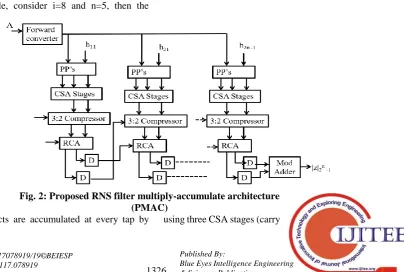
In the proposed work, RNS based multiply-accumulate architecture (PMAC) is implemented. In this work, partial products generation, CSA stages, 3:2 compressor and ripple carry adder are proposed for fixed coefficients as shown in fig. 2. The proposed architecture increases the clock frequency and provides implementation of delay and area efficient RNS filter. In the proposed filter, i bit input A is multiplied with n bit filter coefficient hl using binary multiplier. For example, consider i=8 and n=5, then the
modulo-set is {2n -1, 2n, 2n+1 -1} i.e. {31, 32, 63}. Now, assume that A=100 and hl=25 for 2n -1 modulo-set, the residues of each modulus A (n) =|100|2n -1 and hl (n) =|25|2n -1
are computed. When these residues are multiplied, partial products PP (n) are generated which can be expressed as follows:
[image:2.595.141.546.555.827.2]PP (n) = A (n) * hl (n) (4)
Fig. 2: Proposed RNS filter multiply-accumulate architecture (PMAC)
International Journal of Innovative Technology and Exploring Engineering (IJITEE) ISSN: 2278-3075, Volume-8 Issue-9, July 2019
save adder), where they are adjusted in same bit size by shifting the MSB bits to LSB bits. The output sum and carry bits along with previous sum bit are given to 3:2 compressor which is followed by one ripple carry adder (RCA).The output sum and carry bits of RCA are stored in the delay registers at every single tap of the filter. The delay elements passes the values delaying them by certain amount of time so that the signal values of the previous steps are multiplied with the corresponding coefficients. Hence the sum and carry bits in the registers are added at the last tap by using modulo adder (MA) before the reverse converter implementation. The filter output in the RNS form |Y (n)| 2n-1 just before the reverse
[image:3.595.310.538.103.251.2] [image:3.595.49.247.303.445.2]converter is:
|Y (n) |2n-1 = |COE (n) * 2 * X (n)| 2n-1 (5)
Where, X (n) and Y (n) are the residue representations of input and output values. The filter output can be obtained in binary form using the reverse converter block. The typical blocks such as RCA and MA used in the proposed filter are discussed in the following subsections.
C. Ripple carry adder (RCA)
Fig. 3: Ripple carry adder (RCA) [4]
This block does the addition operation of carry from the previous tap of delay register. It is used for accumulating the product values at each tap. In fig. 3, RCA block adds two n-bit inputs A, B with 1-bit Cin which generates n-bit sum and 1-bit
Cout. Here the critical path goes from cin to cout. In RNS for 2n
-1 and 2n+1 -1 modulo addition, Cout and sum will be added
using another adder at the last tap of filter. To reduce the adder’s cost, Cout will be assigned to Cin of the next tap.
However, for 2n modulus Cout will be neglected at each tap.
D. 3:2 Compressor
Fig. 4: 3:2 Compressor [8]
The block adds the outputs obtained from the CSA stages along with the previous tap sum stored in register. It gives sum
and carry as a result. The logic inside the compressor is similar to full adder operation. These outputs are given to RCA for the final sum.
E. Modulo adder (MA)
Fig. 5: Modulo adder (MA) for Modulo set [4] This block is used in PMAC architecture for addition of sum and carry bits at the last tap of filter as shown in figure. The MA shown in figure has two inputs A and B. They are added in parallel with Cin as '0' and '1', which results in Sum0,
Cout0 and sum1, Cout1, respectively. As shown in figure a 2:1
multiplexer is used to obtain sum with select signal Cout1.
III. RESULTS AND DISCUSSIONS
In this work, five filters denoted as S2, Y1, G1, L3 and S1 of orders of the filter as 60, 30, 16, 36 and 24 respectively are implemented and used for comparison. The filter specifications and their coefficients used in this work are same as given in Shi and Yu et.al. [9].
Every filter is implemented with 16-bit input X. PMAC and CMAC filter architectures are implemented using gate-level Verilog hardware description language (HDL). For a16-bit input, the proposed filter PMAC is implemented with the filter structure as shown in fig. 2. So, in PMAC filter, the register and RCA blocks are equal to the number of partial products (PP) values. The registers are realized using D-flip-flops in the filter architectures.
Table 1: Synthesis Results of PMAC filter
Filter N K Method Delay(ns) Area(um^2) Power(mW) PDP PDP
gain (%)
S2 16-bit 10 CMAC 13.214 502367 140.688667 1859.06005 9.421
PMAC 10.712 570218 165.544188 1683.91548
Y1 9 CMAC 11.774 166809 45.1312716 531.375585 18.568
PMAC 9.335 163853 46.35341706 432.709148
G1 8 CMAC 10.887 78305 20.6104837 224.386328 28.7
PMAC 9.096 67629 17.58865566 159.986406
L3 8 CMAC 11.197 168013 45.19004198 505.992889 27.983
PMAC 9.318 141948 39.10683089 364.397442
S1 8 CMAC 11.09 103131 27.63517362 306.474069 30.631
PMAC 8.845 90996 24.03582156 212.596925
It is observed that the proposed filter PMAC for the filters G1, L3 and S1 with 16-bit input size and operating size at n=8, has achieved smaller values than the conventional filter CMAC in the aspects of area, delay and power. As the operating bit size n increases the area and power increases whereas delay reduces. It can be seen in table 1 for filters Y1 and S2. For the comparing the performance of PMAC architecture with CMAC architecture, PDP and PDP gain values are considered. The PDP and PDP gain values are reviewed in Table 1. PDP gain values among PMAC and CMAC has small difference in case of higher order filters (S2 and Y1). Conversely, the PDP gain is high in PMAC architecture for lower order filters (G1, L3 and S1). The reason is for higher input bits, no of partial products (PP) are increased and thus the no of CSA stages are increased in PMAC architecture for higher order filters.
Fig. 6: K vs. PDP
[image:4.595.62.550.68.370.2]The PDP values are plotted beside K values are shown in fig. 5. For every K value the PDP values are reduced in PMAC when compared with CMAC. In fig. 5, when k=8, PMAC gives improved PDP.
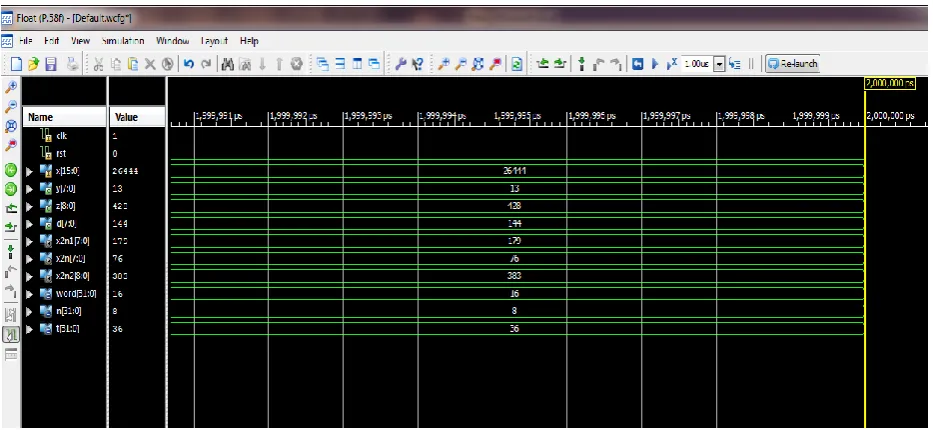
Fig. 7: Simulation Results of PMAC Design By implementing the PMAC architecture, the simulation
results are obtained. These results are shown in fig. 6. In the fig. 6, a binary input of word size 16-bit and clock are given to the PMAC design. The number of filter coefficients of the filter L3 is order of 36. The outputs obtained are modulus of {2n -1, 2n, 2n+1 -1} with n size as 8-bit.
IV. CONCLUSION
In this work, a RNS based multiple-accumulate PMAC is proposed with the {2n -1, 2n, 2n+1 -1} moduli set. PMAC is implemented using 3:2 compressor and a ripple carry adder. With this the computation
time has been reduced. The
proposed filter PMAC
[image:4.595.70.537.440.655.2]International Journal of Innovative Technology and Exploring Engineering (IJITEE) ISSN: 2278-3075, Volume-8 Issue-9, July 2019
orders are compared to the conventional CMAC architecture.
REFERENCES
1. Mohan, Pemmaraju V. Ananda. "RNS-To-Binary Converter for a New
Three-Moduli Set $\{2^{{n}+ 1}-1, 2^{n}, 2^{n}-1\} $." IEEE Transactions on Circuits and Systems II: Express Briefs54, no. 9: 775-779 (2007).
2. Parhi, K. K. (2007). VLSI digital signal processing. India: Wiley.
3. Hiasat, Ahmad A. "New efficient structure for a modular multiplier for
RNS." IEEE Transactions on Computers 49, no. 2: 170-174 (2000).
4. Hiasat, Ahmad A., and S. H. Abdel-Aty-Zohdy. "Residue-to-binary
arithmetic converter for the moduli set (2/sup k/, 2/sup k/-1, 2/sup k-1/-1)." IEEE Transactions on Circuits and Systems II: Analog and Digital Signal Processing 45, no. 2 (1998): 204-209
5. Srinivasa Reddy, Kotha, and Subhendu Kumar Sahoo. "An approach for
fixed coefficient RNS-based FIR filter." International Journal of Electronics 104, no. 8: 1358-1376 (2017).
6. Wang, Wei, M. N. S. Swamy, M. Omair Ahmad, and Yuke Wang. "A
study of the residue-to-binary converters for the three-moduli sets." IEEE Transactions on Circuits and Systems I: Fundamental Theory and Applications 50, no. 2 (2003): 235-243.
7. Živaljević, Dragana, Negovan Stamenković, and Vidosav Stojanović.
"Digital filter implementation based on the RNS with diminished-1 encoded channel." In 2012 35th International Conference on Telecommunications and Signal Processing (TSP), pp. 662-666. IEEE, 2012.
8. Residue Number Systems: Theory and Implementation by A. Omondi
(Yonsei University, South Korea) and B. Premkumar (Nanyang Technological University, Singapore)
9. Shi, Dong, and Ya Jun Yu. "Design of linear phase FIR filters with high
probability of achieving minimum number of adders." IEEE Transactions on Circuits and Systems I: Regular Papers58, no. 1 :126-136 (2010).
10. Kotha, Srinivasa Reddy, Sumit Bajaj, and Sahoo Subhendu Kumar. "An
lut based rns fir filter implementation for reconfigurable applications." In 18th International Symposium on VLSI Design and Test, pp. 1-6.
IEEE, 2014.
AUTHORS PROFILE
P Bhargavi from Vijayawada, Andhra Pradesh, India. She received his B. Tech degree in the year 2017 from PVP Siddhartha, Vijayawada (A.P), India. Currently she is pursuing M. Tech in VLSI & ES from VR Siddhartha engineering college, Vijayawada (A.P), India. Her research interests are digital design implementations.
K Srinivasa Reddy He received his Doctorate Degree from BITS-PILANI, Rajasthan. Then he joined as Associate Professor in Vr. Siddhartha Engineering College, Department of Electronics and Communication Engineering, Vijayawada (A.P), India. His area of research interest is VLSI signal processing circuits, arithmetic circuits for DSP and Bio medical applications.
![Fig. 4: 3:2 Compressor [8]](https://thumb-us.123doks.com/thumbv2/123dok_us/8194538.258978/3.595.49.247.303.445/fig-compressor.webp)