International Journal of Innovative Technology and Exploring Engineering (IJITEE) ISSN: 2278-3075, Volume-8 Issue-9, July 2019
Abstract: This paper presents the implementation of Wireless Multimedia Sensor networks (WMSN) using datafusion methods with aggregation that comprise of huge number of sensor hubs that are sent in some land territory. The motivation behind the system was to detect the earth and record what occurs in a territory it’s sent in. With different prospective applications wireless multimedia sensor network has numerous difficulties. In this method, each node is equipped with multiple sensors (like camera, temperature and humidity). Use of more than one sensor provides additional information about the environmental conditions. The datafusion approach based on the competitive-type hierarchical processing is considered for experimentation. Energy sources are the principle requirement for a wireless sensornode organizer because of restricted batteries power provided to every sensor node hub, so it’s important to join energy consciousness into each phase of the system structure and activity. So as to augment the lifetime of sensor arrangements, the system needs forceful energy streamlining strategies, guaranteeing energy awareness is joined into individual sensor hubs as well as into gatherings of coordinating hubs and into a whole sensor organize. The multiple data fusion process improves the reliability and accuracy of the sensed information and simultaneously saves energy, which was our primary objective. The proposed algorithms were simulated using Matlab. This article gives a datafusion (aggregation) methods to assume significant job for improve the PSNR, error performance and Security of the data which get by whole sensor network system. By classification of grouping (clustering) in WSN this articlepresents the design diagram for information datafusion in multimedia sensor network arrangement.
Index Terms: Multimedia Transmission, Data Fusion, Security, PSNR, Energy consumption, QOS.
I. INTRODUCTION
The wireless multimedia sensor network is a kind of network system. It is fundamentally a gathering of little and minor gadgets this little gadget called wireless sensornode hub or node (sensor) hub, which is screen or records physical domain circumstance, for example, temperature, movement or weight and so on. Every hub is a PC with close sensors that can improvement, supplant detecting information, just as impart remotely among them to execute different obligations [1]. Sensor systems are utilized to assess high temperature or weight, or it could be utilized for article following or edge observation. It could be likewise sent in production lines so as to screen harmful or hazardous assets. It is likewise used to
Revised Manuscript Received on July 09, 2019
Harish H M, Department of Electronics& Communication Engg, Government Engineering College, Haveri, India.
Nagaraja B G, Department of Electronics& Communication Engg, Jain Institute of Technology, Davangere, India.
SrinivasaraoUdara, Department of Electronics& Communication Engg, STJ Institute of Technology, Ranebennur, India.
assess the shortcoming in structure structures, or in vehicles and planes. The design of the sensor hub, this engineering comprises four noteworthy parts. Energy supply, sensor node and simple computerized converter i.e. ADC, central processor and a memory, finally the handset.Basically handsets are utilized for send and get information at the same time.The battery supply is to control the sensornode hub.
The node (sensor) hardware is capable of change physical quantity to an electrical signal. An Analog-to-Digital converter converts the simple signal produced by the sensornode into a digital signal and transmits it to acentral processor. The central processor can perform simple activities on the got computerized signal (in digital), and can save it inside the memory. Finally, the handset transmits and
gets information. Fundamentally sensors hubs
straightforwardly interface with the one another, just as sensor hubs speak with sink hub or base station associate with the web. Client gets a data from web.But on the off chance that we converse about setup the node (sensor) organize. This gives a two sort of arrangement form. The arrangement technique for the remote sensor organizes. In the two arrangements the hubs are dissipated in a topographical area, the distance is separated into bunches of a group head in each and every bunch. Hubs in every group converse with itsbunch head, the bunch head gathers information and forward it to the client node.
In a hubs use anchoring in sort out to speak to the bunch head at the same time as in other hubs legitimately speak to the bunch head. Utilizing tying diminishes the vitality utilized in conduction, however expands the energy utilized in handling since every hub ought to get and advance the message to and from different hubs. Various sensor systems may have additional than one dimension of collection. Typically, a sensor system operates in any one of its two available modes. Lasting activity or question mode. In changeless activity mode, the hubs are ceaselessly detecting the environment and move the information (or prepared information) to nearby or in a local hub. In question mode, the hub is commonly shutdown sitting tight for an order from a local hub, or neighboring hub. At the point when the hub gets the directions. It gathers information from the node (sensor) and transports it to the mentioning hub. WMSN systems have numerous expertise applications and advantages in armed forces and universal, it may be group into 3 classes: information gathering, observation, and target (goal) tracking [2].
Remote nodes (sensor) system guarantees a ample assortment of use and understands all applications in genuine
An Improvement of Energy Efficient and
Extending Life Time of WMSN through Data
Fusion Method
humankind. Arranging or structuring another calculation or convention address a few challenges, these are pursues.
II. LITRATURE SURVEY
Numerous scientists are functioning for improving the WMSN life-time. Different calculations and conventions have been proposed in the distributed writing, for example, information conglomeration, effective planning and part more to expand the life-time of the system. Information combination in WMSN is still in the formative stage and scientists all around have begun creating calculations dependent on information combination, for example, group head and tree-based information combination methods.
Zhaiet. al. [3], in this article they, proposed a calculation Space-Wireless-Sensor-Networks for Planetary-Exploration (SWIPE), where two kinds of information are prepared independently in the information combination module. They discussed house-keeping and logical information and how they are prepared or melded depending on the need. A fluffy rationale based information combination calculation to surmise the wellbeing condition of a hub is being projected.
In paper [5], Hui-tooth Chen H.F andet.al. projected a calculation of reconciliation of bunch based and versatile information combination so as to avoid the low dependability brought about by CH hub failure.
In paper [6], KaihongZhanget.al. have proposed the sensor node hub information combination calculation dependent on time-driven system information total with the blend of sensor hubs planning and clump estimation. They demonstrated that the unwavering quality of the system information and system vitality utilizations are superior to those of Low Energy Adaptive Bunching Hierarchy (LEACH) and Threshold touchy Vitality Efficient sensor Network convention (TEEN).
In article [7], Chair I and Varshney P proposed an information combinationcalculation for neighborhood basic leadership utilizing the base likelihood of mistake model. To execute the standard, the likelihood of discovery and a likelihood of false alert for every sensor node must be known. According to research work carried in [8–11], the utilization of information combination innovation can limit the absolute vitality utilization of the WSNs to a bigger degree.
Nikolidakis A.S.et.al. article [15] proposed another convention called Evened out Cluster Head Election-Routing Protocol (ECHERP). This convention seeks after energy preservation through adjusted grouping. ECHERP protocol models the system as a straight framework utilizing aGaussian end calculation, and after that computes the blends of hubs that are plausible CHs so as to build the system life-time. This convention was proficient as far as system life-time at the point when assessed against other surely understood conventions. Hot spots in a WSN came into view, for example, areas under substantial traffic load. Hubs in problem area rapidly gobbled up vitality assets, prompting an intrusion in the system. This issue was broad for information gathering in which CHs had an extraordinary heap of social affair and directing information. Design of multi-sensor information combination framework. Directing burden on CHs specifically developed as the separation 1084 Soumitra Das et. al., to the sink diminished. To adjust the traffic load and the vitality usage in the system, the CH must be substituted among all hubs and the bunch sizes were warily
decided at assorted pieces of the system. A conveyed bunching calculation called vitality productive grouping that set up reasonable group sizes, contingent upon the bounce separation to the sink, while accomplishing assessed evening out of a sensornode hub life-time and diminished vitality utilization were proposed [13].
One of the key worries in WMSN is steering because of the portability of the hubs. Moreover, the trouble increments because of different qualities like a dynamic topology, time-differing QOS (Quality of Service) necessities, constrained vitality, and so forth. QoS steering plays a key job in giving QoS in WMSNs. The greatest investigation in this sort of systems is to discover a way between the correspondence endpoints fulfilling the clients QoS necessity. Nature-roused calculations, for example, ACO calculations have been demonstrated to be a decent strategy for creating directing calculations for portable specially appointed systems (MANETs).
In Roy et al [14], another Quality of Service (QoS) calculation for Mobile Ad-hoc Network (MANET) have been advanced. This proposed calculation joined the possibility of ACO and advanced connection state steering (OLSR) convention to distinguish various ways among source and goal hubs. DTR (Dynamic Traffic Routing) alludes to the procedure of diverting traffic on intersections in a rush hour gridlock organize resultant to the creating traffic circumstances as time advances [15].
Taking into consideration of the DTR (Dynamic Traffic Routing) issue in support of a traffic arrange as a coordinated diagram, the procedure manages numerical feature of the subsequent streamlining issue from the perspective of arrange hypothesis. Systems have a large number of edges and hubs, bringing about an extensive and computationally difficult DTR streamlining issue. ACO be picked as the ideal technique to take care of issues in [16].
Notwithstanding, the standard ACO calculation isn't prepared to do tackling the steering advancement issue; in this way another algorithm ACO was created to accomplish the objective of finding the best dissemination of traffic in the system [15]. The key contrasts of WSNs contrasted and other networks were restricted vitality assets and generally low handling abilities. In this manner, running force and diminishing vitality usage are of incredible hugeness in WSNs.
In article [20], the creators Jafariet.al. Introduced a method for WSN routing,which can be increasingly viable with respect to the criteria of way length, delay and sensor hub vitality for the nature of administration. The anticipated technique utilized an insect state based steering calculation and neighborhood request to discover ideal courses. A fluffy deduction framework was likewise used to choose the course predominance.
III. METHODOLOGY
A. Physical asset requirement:
International Journal of Innovative Technology and Exploring Engineering (IJITEE) ISSN: 2278-3075, Volume-8 Issue-9, July 2019
Accordingly lifetime of sensor hub likewise perceives by the power supply. In this manner energyutilization is significant plan issue, singular sensornode hub can store measure of information so restricted calculation power and memory capacity is requirement that effects on putting away information that is the reason structuring calculation and convention ought to be light weighted and basic.
B. QOS (Quality of Service)
Some utilization of remote sensornode system is relying upon time basic. Which means a information ought to be conveyed with a certain timeframe from the rather it is detected; generally the information will be imprudent that is the reason this could be a nature of administration parameter for some application.
C. WMSN Clustering
Sensornode hub are thickly deploy in remote sensornode organize that implies physical condition would deliver fundamentally the same information in the vicinity of to sensornode hub and transmit such sort of such information is pretty much excess. Hence every one of these certainties energize utilize some kind of collection of sensornode hubs with the end goal that gathering of sensornode hub be capable of joining or pack information collectively and transport just minimized information. It can decrease restricted traffic in individual assembly and furthermore lessen worldwide information. This gathering procedure of sensornode hubs in a densely conveyed enormous scale sensornode hub is known as grouping. The technique for brushing information and bunch information having a place with a solitary bunch called information grouping (collection).
Issues of grouping in remote sensor organize:
1. What number of sensor center points should be taken in a lone gathering? Assurance strategy for bundle head in a individual gathering.
2. In Heterogeneity framework, it infers customer can place a couple of intensity full center points, in term of essentialness in the framework which can act like gathering head and fundamental center in a bundle fill in as a pack part figuratively speaking. Various conventions and figuring have been proposed with plan for each individual issue.
D. Aggregation of Data (DataFusion)
The point of aggregation of data (DataFusion) is that dispenses with repetitive information transmission and upgrades the existence time of vitality in remote sensor organize. Information combination is the procedure of one or a few sensors at that point gather the location and the carried work related to the other sensor. The final collected information compulsory arranged by sensors to the low transmission problems after them passing to the destination.
The most straightforward information combination capacity is copy concealment of two sources both sends same information; information combination hub will transmits just to forward. Information combination is vital in remote sensor organize in light of the fact that sensor hub have an ability of sense information subsequent to detecting that data. They are transmitting sensedsignal (data) to a BS (BaseStation) or sink. It is mainly quick way of transmission and it’s a exorbitant, since base station may be found far away and a sensor center point in a framework needs greater essentialness ability to transmit data over long division. Hence better plans are that less center points transmit data to
its far partition. Those less center points named as gathering head of individual group head in wireless multimedia sensor arrange.
IV. RESULTS AND DISCUSSIONS
In this, we portray our tests results to quantify the presentation of our proposed plan and approve the systematic outcomes. So as to assess the viability of our proposed calculation, we first contrast our proposed plan and the plan without preparing and the low-level combination of video information proposed in [6] as for the all-out transmission volume just as an energy utilization of every sensornode hub when the sensornode hubs sends video information on progressive remote video sensor organize. Adjusting video information quality and vitality utilization, the video information quality is estimated by the precision rate.
Fig.1. Multimedia data input and encoding of information before transmission (Video, Image, Audio
and Text)
Since multimedia information is a lot bigger than average sensor information, another information accumulation strategy is required. The proposed accumulation procedure is made out of three phases, which are (1) bunching, (2) choosing the versatile sink's way, and (3) gathering information, as appeared in Fig.2. At the grouping stage, bunching is worked by checking the thickness of sensor hubs, which is the area thickness grouping strategy. A portable sink moves along a predefined direction and assembles detected information from sensor hubs in a solitary jump. When it completes the process of social affair information at predefined focuses, it transfers the gathered information to a base station. The speed of the portable sink is consistent, and it knows about all sensor hub areas. All sensor hubs have a similar constrained vitality source. At the point when sensor hubs come up short on vitality, they are characterized as dead hubs. The base station and sensor hubs are in fixed positions. Each sensor hub is given its own recognizable proof number, with area data and sensor hub IDs got at arrangement
A. Experimental Configuration
So as to assess our methodology in a reproduced situation, the remote sensor arranges test system is executed in Mat lab. Accept that couple of sensors is individually sent consistently in a 100*100m2 system area and the span of correspondence is 25frames. Every hub has been randomized and arranges. None of two unique hubs shares similar directions. The information utilized for assessing the framework comprises of 25 video casings, every one of them comprising of 15 seconds.
B. Experimental Analysis and Result
In this segment, Fig.3 exhibits the outcomes as far as the absolute transmission amount (volume) in various quantities of sensornode hubs. From the quantities of sensornode hubs developing, the all out communication increments. Clearly, the proposed plan gives a less transmission amount (volume)than the current plans and the plan without handling. From the consequence of reproduction investigation, the measure of transmission amount (volume) is decreased near about 40.1. Sensor hubs of different functionalities have been put into utilization, and after that the vitality devoured by various sensor hubs are dissimilar during various tasks. For correlation purposes, the paper guesses that 10 sensors on progressive remote video sensor system move the video information all together. As in Fig. 2 appeared, first fifth hubs are accountable for stepping sound information, sixth hub is in charge of sound information combination, and the tenth 40th hubs (choose source and goal node)transmitcombination information. In the proposed plan, the sixth hub is multiple occasions that of different hubs. It devours about 950mA vitality while the normal utilization of different hubs is 270mA. In any case, the proposed plan diminishes the absolute energy utilization and lessens the all out transmission volume in remote mixed media sensor systems. The examination exactly demonstrates that our proposed strategy is productive and can accomplish results that contrast positively and the current strategies.Errors have been introduced in the course of similarity model during the data aggregation (datafusion) at intermediate nodes.
Fig.3. PSNR performance for different video data frames.
Fig.4. Packet delivery rate for different frames Fig.4 represents the normal PDR as for the quantity of sensornode hubs for the proposed systemcalculation and LEACH. The chart clearly demonstrates the proposed calculation has 99% of a normal PDR as contrasted with LEACH.
International Journal of Innovative Technology and Exploring Engineering (IJITEE) ISSN: 2278-3075, Volume-8 Issue-9, July 2019
[image:5.595.49.287.175.406.2]Fig.5 demonstrates the general exactness rate of the entire reproduced video information from different situations. The general exactness rate is the normal estimation of the precision rate of each square information. It tends to be seen that the picture outline characteristics of our proposed plan, leaving plan and without handling. Blunders have been presented during the time spent likeness model during the information total at middle of the road hubs. Alongside the scene intricacy builds, the proposed plan makes increasingly immediate advantage.
Fig.6. Energy Consumption for different frame
Fig.6 the energy utilization of every hub is diminished by its related modules and the complete vitality utilization is decreased by different strategies. In the event that the sensor hub is with low energy, at that point we have to place it in rest mode till it recovers its energy. The separation between the transmitter hub and the other are assessed and dependent on that the vitality will be determined and the way or plan with most reduced energy will be utilized to move the information.
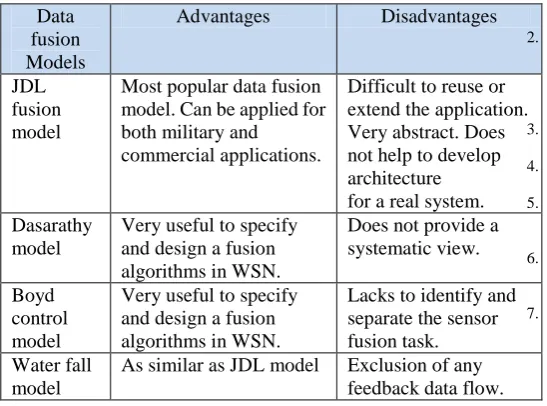
Table 1. DataFusion comparison models Data
fusion Models
Advantages Disadvantages
JDL fusion model
Most popular data fusion model. Can be applied for both military and commercial applications.
Difficult to reuse or extend the application. Very abstract. Does not help to develop architecture for a real system. Dasarathy
model
Very useful to specify and design a fusion algorithms in WSN.
Does not provide a systematic view.
Boyd control model
Very useful to specify and design a fusion algorithms in WSN.
Lacks to identify and separate the sensor fusion task. Water fall
model
As similar as JDL model Exclusion of any feedback data flow.
Intelligenc e cycle model
It is general and applied in any application domain
Do not fulfill the specific aspects of fusion domain. Omni bus
model
It is cyclic in structure. Can be used multiple times for the same application.
Decomposition is not supported. Need to implement, test and reuse separately for different
Applications. Hierarchy
model
It is a clustering structure. can be used multiple sensors with data fusions methods for to transmit real time multimedia data stream in WMSNS for border applications
Lack of identifying the malicious nodes. Need to implement, test for different of
applications.
V.CONCLUSION
In this paper, we presented a novel way of saving energy by exploiting data fusion methods and technology for WMSNs. The wireless multimedia sensor network includes with design of an energy aware routing based on multi sensor data fusion, which can fuse the data at the fusion center (cluster head) and is able to deliver better results based on the data aggregation techniques for WSN with probability of route selection based on energy requirements. The simulation results proved better residual energy, requirement of lesser communication energy, good packet delivery ratio and extension of overall network lifetime with multi sensor datafusion as compared with any other protocols. Thus, our proposed method is more energy efficient; it saves a lot of energy and ultimately prolongs the network lifetime. in WMSN an imperativeness is in a general sense eaten up by data transmission, and generally 76% essentialness is eaten up by data transmission so transmission of data should be improved in remote senso rnode sort out, for growing the life-time of framework. Data transmission can be streamlined through the help of incredible show and reasonable strategies for information combination (total).
REFERENCES
1. W. Choi, P. Shah, and S. K. Das, “A Framework for Energy-Saving Data Gathering Using Two-Phase Clustering in Wireless Sensor Networks”, in Proceedings of the International Conference on Mobile and Ubiquitous Systems: Networking and Services (MobiQuitous), Boston, 2004, pp. 203-212.
2. H. Cam, S. Ozdemir, P. Nair, and D. Muthuavinashiappan, “ESPDA: Energy-Efficient and Secure Pattern-based Data Aggregation for Wireless Sensor Networks”, in Proceedings of IEEE Sensor- The Second IEEE Conference on Sensors, Toronto, Canada, Oct. 22-24, 2003, pp. 732-736.
3. Zhai X, Jing H and Vladimirova T 2014 Multi-sensor data fusion in wireless sensor networks for planetary exploration.
4. Proceedings of the NASA/ESA Conference on Adaptive Hardware and Systems (AHS), IEEE, pp. 188–195
5. Chen H F, Mineno H and Mizuno T 2008 Adaptive data aggregation scheme in clustered wireless sensor networks. Computer Communication. 31(25): 3579–3585.
6. Zhang K, Li C and Zhang W 2013 Wireless sensor datafusion algorithm based on sensor scheduling and batch estimate. Int. J. Future Computer Communication. 2(4): 333–337.
7. Chair I and Varshney P 1992 Optimal data fusion of correlated local decisions in multiple sensor detection system. IEEE Trans. Aerosp. Electron. System. 28(3):
[image:5.595.41.315.572.775.2]8. S. Madden et al., “TAG: a Tiny Aggregation Service for Ad-hoc Sensor Networks,” OSDI 2002, Boston, MA, Dec. 2002.
9. K. Dasgupta et al., “Maximum Lifetime Data Gathering and Aggregation in Wireless Sensor Networks”, In Proc. of IEEENetworks’02 Conference, 2002.
10. Chair I and Varshney P 1992 Optimal data fusion of correlated local decisions in multiple sensor detection system. IEEE Trans. Aerosp. Electron. Syst. 28(3): 916–920
11. Choi W, Shah P and Das S K 2004 A framework for energy saving data gathering using two-phase clustering in wireless sensor networks. In: Proceedings of The First Annual International Conference on Mobile
and Ubiquitous Systems: Networking and Services,
MOBIQUITOUS2004, pp. 203–212
12. Chen Y, Liestman A L and Liu J 2006 A hierarchical energyefficient framework for data aggregation in wireless sensor networks. IEEE Trans. Veh. Tech. 55: 789–796
13. Mitchell H B 2007 Multi-sensor data fusion. Springer
14. Mhatre V and Rosenberg C 2004 Design guidelines for wireless sensor networks: communication, clustering and aggregation. Ad Hoc Networks. 2: 45–63
15. Nikolidakis S A, Kandris D, Vergados D D and Douligeris C 2013 Energy efficient routing in wireless sensor networks through balanced clustering. Algorithms 6(1): 29–42
16. Wei D, Jin Y, Vural S, Moessner K and Tafazolli R 2011 An energy-efficient clustering solution for wireless sensor networks. IEEE Trans. Wire. Commun. 10(11): 3973–3983
17. Roy B, Banik S, Dey P, Sanyal S and Chaki N 2012 Antcolony based routing for mobile ad-hoc networks towards improved quality of services. J. Emerg. Trends Comput.Inf.Sci. 3(1): 10–14
18. Cong Z, De Schutter B and Babuska R 2011 A new antcolony routing approach with a trade-off between system and user optimum. In: Proceedings of the 14th International IEEE Conference on Intelligent Transportation Systems (ITSC), pp. 1369–1374
19. Xing L N, Rohlfshagen P, Chen Y W and Yao X 2011 Ahybrid ant colony optimization algorithm for the extended capacitated arc routing problem. IEEE Trans. Sys. Man Cybernet. Part B: Cybernet. 41(4): 1110–1123
20. Jafari M and Khotanlou H 2013 A routing algorithm based an ant colony, local search and fuzzy inference to improve energy consumption in wireless sensor networks. Int.J. Elect.Comput. Eng. 3(5): 640–650
AUTHORS PROFILE
Harish H.M. He received B.E degree in Electronics and Communication Engineering and M.Tech., in Digital Communication and Networking from Kuvempu University, India. Currently a research scholar of Visveswaraya Technological University, Belagavi, India. He has a total experience of more than fifteen years. Has a six years of an experience in IT industries, are ThoughtFocus and Wipro technologies, before into teaching. He has been awarded best guide of the year from KSCST, Bangalore in 2012-13. His research interests include wireless sensor networks, Wireless Multimedia Sensor Networks, Datafusion and Artificial intelligence. Currently working as a Assistant professor in Department of Electronics and Communication Engineering, Government Engineering College, Haveri, India.
Nagaraja B.G. He received B.E and M.Tech degree from Visveswaraya Technological University, Belagavi, India. He has an experience of more than fourteen years in teaching. He has been awarded Dr. A. P. J. Abdul Kalam Young Scientist Award for the year 2016, Innovative & Informative Technology Solutions (iiTECH). He published more than fifteen international and national journals. His research interests include wireless sensor networks, Signal Processing, Speech processing and Artificial intelligence. He has served different responsibilities in VTU as BoE and question paper scrutinizer as subject expert. Presently he is guiding six research scholars. Currently working as a professor and Head of Department of Electronics and Communication Engineering, Jain institute of Technology, Davangere, India.
Srinivasarao Udara. He received B.Tech from JNTU Hyderabad and M.Tech degree from SJCE Mysore under Visveswaraya Technological University, Belagavi, India. He has submitted his thesis for the award of his PhD and Waiting for the defense. He has an experience of more than 15 years in teaching. His research work has been funded by Department