Abstract: The present paper focuses on the mixture of Discrete Wavelet Transform and Discrete Cosine Transform used in the purpose of Digital Image Watermarking. People nowadays need Digital media as an alternate of paper media. With the growth of technology, digital media while transferring requires protection through internet or other mediums. Process of hiding information in any form image, text, audio and video in original image without corrupting its perceptual quality is called Digital Image Watermarking. Watermarking is useful method for protection of integrity of the original data, it is done by computing statistical values like Peak signal to noise ratio (PSNR) & Mean square error (MSE) for various attacks like image cropping, noise and resize.
Index Terms: Application, Attacks, DCT, DWT, MSE, PNSR, Watermarking.
I. INTRODUCTION
Watermarking on host information proves to be a remarkable technique of concealing digital information onto virtual data such as video, audio, image etc for avoiding unlawful replication of information and to guarantee copyright security & conservation. The origin of digital watermarking was introduced as a variant of steganography. Steganography can be classified as the study of corresponding in such a manner which conceals secret information onto the core information. Previously the method of watermarking has been utilized to embed unique brand identification of the manufacturer on their respective products to attain authenticity. In the present scenario as a part of internet technology, it is essential to create a copy, pass on & share digital data.
Digital image watermarking is a useful technique by which the owner can verify and authenticate his ownership accurately. In the Digital image watermarking technique by the secret images watermark can be hidden in an original image by allowing smallest amount of perceptual disturbance in the original image [10]. There are several parameters like robustness, transparency, capacity & blind watermarking by which the quality of the watermarking can be determined. The watermarking can either be done in spatial domains where the intensity values are modified or in frequency domain where the image coefficients are modified.
Revised Manuscript Received on June 05, 2019
Mr. Kaushik Raviya1, Research Scholar, Computer Engineering, Faculty of Technology & Engineering, C. U. Shah University, Wadhwan, Gujarat, India.
Dr. Dwivedi Ved Vyas2, Pro Vice Chancellor, C. U. Shah University, Wadhwan, Gujarat, India.
Dr. Ashish M. Kothari3, Associate Professor, Department of Electronics & Communication Engineering, Atmiya University, Rajkot, Gujarat, India.
DWT is extensively utilized in digital image watermarking just for the reason that its multi resolution features which are just alike practical replicas of human vision, whereas DCT has a property of concentrating the helpful information of digital image in just few coefficients. Furthermore, while using DCT for watermarking; it compresses the image and DWT gives the scalability. Therefore, thorough these two different transformation it is said that the fact that joint transformation could overcome the boundaries of one another, resulting in efficient watermarking [11,12].
In general sense watermark techniques can be categorized into two categories. The first one can be classified as human perceptible watermarking which is performed if embedded watermark is to be made detectable and perceptible by human perception, for e.g., a symbol placed in one of the sections of picture or bitmap. The second one can be classified as imperceptible or undetectable watermarking which is performed when the watermark embedded onto the original picture using well-structured techniques and helps keep the watermark imperceptible to any individual’s perception. This paper intense a Mixture of DWT – DCT based digital watermarking algorithm. Here different images are tested against various attacks like cropping, noise and resize attack.
II. RELATEDWORK
In the initial stage, the technique of watermarking was developed by using special domain which was simple to easy & comparatively less complex. Shyndel [1] proposed LSB implanting as an important watermarking technique. As per this method, the lowest relevant bit of the binary transformed pixel of the test image is marked and it was substituted by the pixel value of the imprint image. By doing this, unnecessary individuals may not make out the fact that the watermark is embedded in the image itself. The amalgamation of DWT with DCT to implant a binary mark was also suggested by Kasmani & Naghsh-Nilchi.[2]. They executed 3-levels of DWT decomposition and then performed DCT to it, which presented a better watermark retrieval after applying various attacks however this technique undergoes through increased time complication. Nikita and Sinha [3] have introduced Digital Watermark Embedding Technique of Discrete wavelet transform using 3 levels. According to them, in this approach, a multiple bit mark is implanted into the inferior frequency sub band of a test image by utilizing α combination method by using statistical
parameter. Authors have revealed that the watermarks
A Mixture of DWT-DCT based Digital
Watermarking Algorithm against various Attacks
and its Application
embedded using the suggested processes are imperceptible and clarity of watermarked are improved.
In 1997, Cox et al. [4] made use of the one of its kind DCT established spread spectrum communication regarding media watermarking, a group of methods that have become very well-known and have also been used by a lot of researchers. This method makes use of a group of free and identically dispensed Gaussian random orders are implanted in huge quantity visually effective frequencies of bitmap. As spread spectrum communication suggests, the indication power in whichever occurrence is invisible if it is the contracted band signal is conveyed through even larger bandwidth of frequencies, which will make the watermark to spread all over the frequencies so, potential in every frequency is minimal. However the Cox approach is still unfinished, because it needs the original picture in order to perform the extraction. In S Sahar Afshan Indrabi & Sheenam’s paper [5] they make use of the frequency domain amalgam of DCT with DWT watermarking techniques. They have compared DCT, DWT and DCT-DWT with Different types of attacks.
In 2010 [6], Thi Hoang Ngan Le, Kim Hung Nyugen & Hoai Bac Le’s paper, They work on creating a huge list of watermarking tools, benchmarking tools & how to use them to your advantage. They also list various types of attacks done to direct the original image and the watermark itself.
Arfoja akter , Ulha [7], come up with a novel approach for digital watermarking algorithm named as NEA (New Embedding Algorithm). This new approach is non-blind and based on amalgamation of DWT & DCT transforms. This algorithm can be applied 2, 3 or 4 level of DWT which also give relative analysis for all levels. Further, authors have also compared the performance of NEA with the I.J. cox’s additive technique. Two parameters have been tested as imperceptibility & robustness for performance analysis. According to Authors imperceptibility as the attained quality of the test image must never be altered by the existence of the secret message. Robustness must be calculated by applying attacks on the watermark implanted image & calculate the similarity between original watermark and extracted watermark using correlation value.
Al-Haj [8] projected the amalgamation of DCT with DWT transforms. According to this technique, watermark implanting is undertaken by performing 2 levels of DWT transform, splitting the middle frequency sub-band into 4x4 blocks and performing DCT on every block. In a way, implanting is done on the middle frequency DCT coefficient. The research results have proved that the mixed domain watermarking algorithm’s non visibility is better than DWT algorithm.
Xiao-Ping Zhang Li-Sheng Tian and Ying-Ning Peng [9] explained the idea of the initialization from the Wavelet Series to Discrete Wavelet Transform. They claimed that they have formulated the question and debated the methods to explain the problem by suggesting 2 algorithms for initialization.
III. IMPLEMENTATION
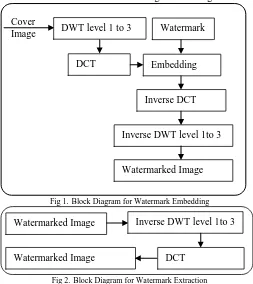
[image:2.595.304.557.102.386.2]In this algorithm, for inserting watermark and extracting watermark two popular methods are used in a mixture of DWT & DCT this method shown in Figure 1 and Figure 2.
Fig 1. Block Diagram for Watermark Embedding
Fig 2. Block Diagram for Watermark Extraction
IV. RESULTANAYLSISWITHDISCUSSIONS
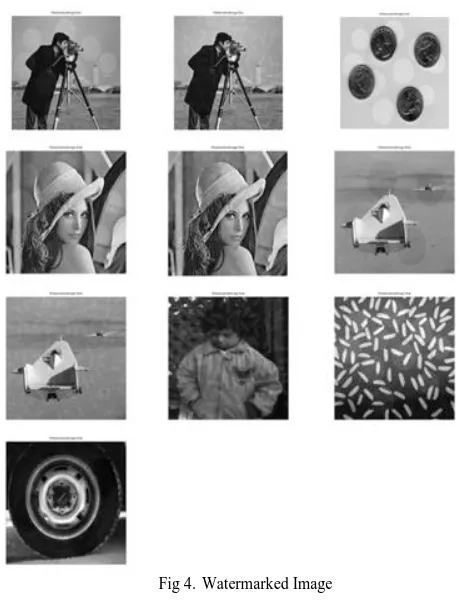
[image:2.595.318.551.448.662.2]We have experimented with the Mixture of DWT-DCT watermarking algorithm on different cover image (shown in Figure 3) and watermarked image (shown in Figure 4).
Fig 3. Different Cover Image
The performance is calculated by measuring PSNR & MSE Through this simulation results it can be seen that mixture method is not visible and robust on variety of attacks.
Watermarked Image Inverse DWT level 1to 3
DCT Watermarked Image
DWT level 1 to 3 Watermark
Inverse DCT
Inverse DWT level 1to 3
DCT Embedding
Cover Image
Fig 4. Watermarked Image
[image:3.595.53.284.49.351.2] [image:3.595.55.551.262.817.2]A. Compare Different Image Processing Resize Attack Table I Reflects collective test results for Resize Attack done to subject images embedded with their respected watermark images. The readings for MSE and PSNR are included.
Table I. Reflects collective test results for Resize Attack
Original Cover Image
Water- mark image
Image After Attack
Extracted Water-
mark
MSE PSNR
lena.jpg rice.png
0.082 24.98
lena.jpg coin.png
0.0396 32.27
liftingbody.
png eight.png
0.0349 33.5536
cameraman
.tiff coin.png
0.0394 32.3442
tire.tiff eight.png
0.0408 31.9977
pout.tiff rice.png
0.1026 22.7736
rice.png coin.png
0.0394 32.3326
eight.png coin.png
0.0396 32.2978
cameraman
.tiff rice.png
0.0822 24.9898
liftingbody.
png rice.png
0.1060 22.4415
B. Compare Different Image Processing Cropping Table II Reflects collective test results for Gaussian Noise Attack done to subject images embedded with their respected watermark images. The readings for MSE and PSNR are included.
Table II. Reflects collective test results for Resize Attack
Original Cover Image
Water- mark Image
Image After Attack
Extracted
Watermark MSE PSNR
lena.jpg rice.png
0.08 25.20
lena.jpg coin.png
0.0394 32.3481
liftingbody.png eight.png
0.0343 33.7211
cameraman.tiff coin.png
0.0394 32.3481
tire.tiff eight.png
0.0343 33.7211
pout.tiff rice.png
0.0804 25.2057
rice.png coin.png
0.0394 32.3481
eight.png coin.png
0.0804 25.2057
cameraman.tiff rice.png
0.0804 25.2057
liftingbody.png rice.png
C. Compare for Attack on Different Image Processing Gaussian Noise
[image:4.595.302.548.57.426.2]Table-III reflects collective test outcome for the attack of Gaussian noise done to subject images embedded with their respected watermark images. The readings for MSE and PSNR are included.
Table III.Reflects collective test results for Gaussian Attack
Original Cover Image
Water- mark Image
Image After Attack
Extracted
Watermark MSE PSNR
lena.jpg rice.png
0.10 22.44
lena.jpg coin.png
0.0854 24.6037
liftingbody.
png eight.png
0.0523 29.5150
cameraman
.tiff coin.png
0.0706 26.5047
tire.tiff eight.png
0.0444 31.1445
pout.tiff rice.png
0.1030 22.7276
rice.png coin.png
0.0822 24.9917
eight.png coin.png
0.2100 15.6054
cameraman
.tiff rice.png
0.0944 23.6047
liftingbody.
png rice.png
0.1066 22.3883
We have tested the mixture DWT-DCT watermarking algorithm on various original cover images and with different images are used as watermark image.
The robustness of DCT combined with DWT method, separating the watermarked image is evaluated by determining the Peak signal to noise ratio and Mean square error. Similarity Index parameters are recorded after attacking the watermarked image. Attacks like resize, crop & noise are applied.
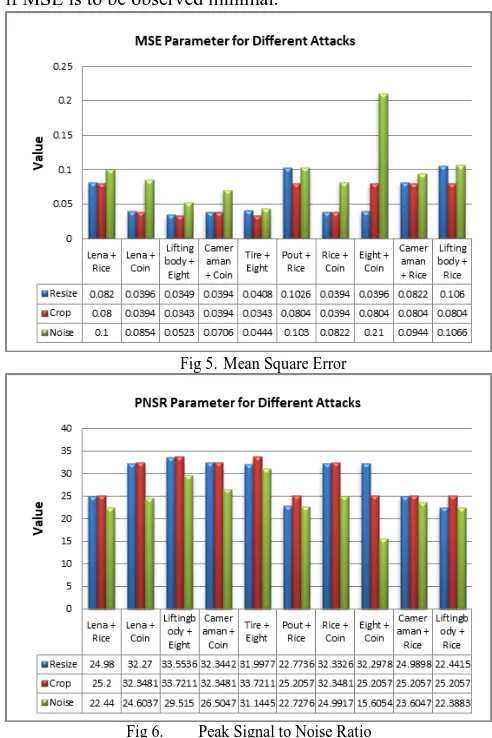
The Comparative results for all the respective different images are shown in Figure .5 and Figure 6. PSNR means Peak Signal-to-Noise Ratio, it is better when ratio of PSNR gets higher. MSE means Mean Square Error. Also it is better
if MSE is to be observed minimal.
Fig 5. Mean Square Error
Fig 6. Peak Signal to Noise Ratio
V. DIGITALIMAGEWATERMARKING
APPLICATIONS
In the recent years, the growing interest in watermarking encourages researchers. It is observed that the last decade, the increasing number of research on watermarking has been essentially run by its significant application in digital copyright management and security. In the today’s rapid changing technological world, the applications of watermarking become fundamental tool for managing digital copyright and security. The major applications of watermarking are listed below.
1)Copyright Protection: In this process, the owner of the data can implant a unique mark onto the data for the defense of the personal property. In a way, the embedded watermark can be utilized as evidence. For example, in a hearings when someone decisively violates the rights [14].
2)Fingerprinting: The proprietor uses fingerprinting technology to find out the resource of untruthful replicas. On such occasions, the proprietor can implant dissimilar unique trademarks or symbols onto the distributable media of the information that are provided to diverse clients [13,14].
3) Duplication Control: The media implanted with the
watermark or the authentication mark may
straightforwardly govern virtual footage devices for duplicate safety intentions.
[image:4.595.51.286.153.632.2]indicates do-not-copy prohibition information and a watermark fetching algorithms in the watermark extractor concludes that the information which is supplied to the application can or cannot be stored.
4) Monitoring the Transmission: It is used to track the broadcast of a given file over a channel where watermark embedded into advertisement division..
5) Medical Application: patient’s name and data embedded with the medical images as watermark for convenient safety measure [14].
6) Hiding of Data: to transmit secret messages, watermark technique can be used It is seen that different governments limits the usage of encryption services, an individual can cover their media on other media format.
7) Authentication of Data: A few breakable watermarks may be utilized in order to ensure originality of the media. A delicate unique mark suggests is useful to identify if the data has been altered or not. Moreover, it also points out in which part the data is being altered or changed [14].
VI. CONCLUSION
The Mixture of DWT-DCT approach performed strongly against different attacks like Resize, Noise and Crop. All the tests result show better and higher Peak Signal to Noise Ratio (PSNR) value, also minimal Mean Square Error (MSE) value. All these factors prove that proposed algorithm is a powerful approach that helps to embed and extract a watermark from an image which has gone through different attacks.
Comparison of proposed method (DCT-DWT) with other applied method, our proposed method is directly compared with I.J. Cox Method [4] and arfoja akter method [8]. We state this fact by comparing the PSNR and MSE values achieved after applying various attacks on watermarked images. Hands the proposed algorithm has improved greatly keeping robustness in mind.
REFERENCES
1. Van Schyndel, R. G., Tirkel, A. Z., & Osborne, C. F. (1994, November). A digital watermark. In Proceedings of 1st International Conference on Image Processing (Vol. 2, pp. 86-90). IEEE.
2. Kasmani, S. A., & Naghsh-Nilchi, A. (2008, November). A new robust digital image watermarking technique based on joint DWT-DCT transformation. In 2008 Third International Conference on Convergence and Hybrid Information Technology (Vol. 2, pp. 539-544). IEEE.
3. Kashyap, N., & Sinha, G. R. (2012). Image watermarking using 3-level discrete wavelet transform (DWT). International Journal of Modern Education and Computer Science, 4(3), 50.
4. Cox, I. J., Kilian, J., Leighton, F. T., & Shamoon, T. (1997). Secure spread spectrum watermarking for multimedia. IEEE transactions on image processing, 6(12), 1673-1687.
5. S Sahar Afshan Indrabi, Sheenam (2015). Watermarking Digital Images: Hybrid Approach. International Journal of Advance Research in computer Science and Software engineering (Vol.5,pp.1778-1785). IJARCSSE.
6. Le, T. H. N., Nguyen, K. H., & Le, H. B. (2010, June). Literature survey on image watermarking tools, watermark attacks and benchmarking tools. In 2010 Second International Conferences on Advances in Multimedia (pp. 67-73). IEEE.
7. Akter, A., & Ullah, M. A. (2014, May). Digital image watermarking based on DWT-DCT: Evaluate for a new embedding algorithm. In 2014 International Conference on Informatics, Electronics & Vision (ICIEV) (pp. 1-6). IEEE.
8. Al-Haj, A. (2007). Combined DWT-DCT digital image watermarking. Journal of computer science, 3(9), 740-746.
9. Zhang, X. P., Tian, L. S., & Peng, Y. N. (1996). From the wavelet series to the discrete wavelet transform-the initialization. IEEE Transactions on signal processing, 44(1), 129-133.
10. Wang, F. H., Pan, J. S., & Jain, L. C. (2009). Digital watermarking techniques. In Innovations in Digital Watermarking Techniques (pp. 11-26). Springer, Berlin, Heidelberg.
11. Potdar, V. M., Han, S., & Chang, E. (2005, August). A survey of digital image watermarking techniques. In INDIN'05. 2005 3rd IEEE International Conference on Industrial Informatics, 2005. (pp. 709-716). IEEE.
12. Kothari, A. M., Suthar, A. C., & Gajre, R. S. (2010). Performance Analysis of Digital Image Watermarking Technique–Combined DWT–DCT over individual DWT. International Journal of Advanced Engineering & Applications, 177-182.
13. Nikolaidis, A., Tsekeridou, S., Tefas, A., & Solachidis, V. (2001). A survey on watermarking application scenarios and related attacks. In Proceedings 2001 International Conference on Image Processing (Cat. No. 01CH37205) (Vol. 3, pp. 991-994). IEEE.
14. Podilchuk, C. I., & Delp, E. J. (2001). Digital watermarking: algorithms and applications. IEEE signal processing Magazine, 18(4), 33-46.
AUTHORSPROFILE
Mr. Kaushik H. Raviya has completed his B.E.degree in the Computer Engineering from North Maharashtra University, India, in 2008 and M.Tech Degree from Dharmsinh Desai University, Nadiad- Gujarat, India, in 2011. He is currently pursuing his Ph.D. in the same discipline from C.U.Shah University, Wadhwan,, Gujart, India. His Area of research is Digital image watermarking. He is currently working as a Head of the department in the department of computer engineering at Kalyan Polytechnic, Jamnagar, Gujarat, India. He has presented 4 national papers and published 02 international papers. He has published a book titled Performance Evaluation of structured peer to peer protocol with Lambart Publishing house, Germany. His area of interest is Image processing, peer to peer network. E-Mail: [email protected]
Dr. Ved Vyas Jayprakash Narayan Dwivedi is a prominent educationist, academic manager & core researcher having great deal of expertise for conveying knowledge & administrating the educational institutions in and around many districts throughout the state of Gujarat. He had been actively working as a Pro- Vice-Chancellor at the C. U. Shah University Wadhwan in Gujarat. He completed his Bachelor of Engineering degree, Master of Engineering degree and PhD in the field of Electronics and Communication Engineering field. Energy sensing wireless RF antenna for mobile, microwave technology and sciences are some of his academic interest. He has published /authored /co-authored 9 books, 133 researches /review articles/papers in refereed international/ national journals /conference proceedings, successfully guided 5 Ph.D. theses, inspected and evaluated 9 Ph.D. theses. There are 4 Indian patents under his name, successfully carried out 7 researches and production consultancy based ventures, carried out 38 professional and expert talks. He has lead and inspected 54 Master of Technology discussions. He has been honored as a Chief Guest / Guest at more than 37 national /international seminars, gatherings, techshops and yearly events or social affairs. E-Mail: [email protected]