Part
I
Introduction and Background
This thesis presents my PhD research about evaluating, modeling and enhancing the performance of cluster OpenMP systems. This part consists of two chapters. In the first Chapter, we present the thesis motivation and objectives, followed by a summary of contributions. Chapter 2 describes background knowledge of:
• OpenMP programming model,
• Software Distributed Shared Memory (sDSM) systems,
• Intel Cluster OpenMP (CLOMP) implementation,
• Alternative approaches to sDSMs.
and reviews related work on:
• Existing performance models,
• Page prefetch techniques for cluster OpenMP systems,
Chapter
1
Introduction
Contents
1.1 Motivation . . . . 4
1.1.1 Research Objectives . . . 5
1.2 Contributions . . . . 6
1.2.1 Performance Evaluation of CLOMP . . . 6
1.2.2 Region-based Performance Models . . . 7
1.2.3 Region-based Prefetch Techniques . . . 8
Cluster OpenMP systems [38, 98, 83, 84, 50, 42] provide programming environ-ments which enable the use of OpenMP programming model [75, 76] on distributed memory architectures such as clusters. These systems utilize software Distributed Shared Memory (sDSM) systems [58, 10, 32, 52, 87, 59, 89, 34, 40] to construct and maintain a virtual global shared memory space across all computer nodes. In late 2006, Intel released the first commercial Cluster OpenMP system, Intel Cluster OpenMP (CLOMP) [38], with support of Intel C/C++ and FORTRAN compiler. Consequently, the research interest on such systems increased dramatically.
In this thesis, a set of region-based techniques are investigated and designed to evaluate, model, and enhance the performance of page-based cluster OpenMP implementations such as CLOMP.
1.1
Motivation
Parallel applications usually exhibit irregular and/or dynamic behaviour. Devel-opment of these applications for distributed memory architectures using the de facto standard programming model, Message Passing Interface (MPI) [74, 67, 68], has been considered a hard task. This is because the MPI model requires that programmers explicitly specify all inter-process communications. This not only leads to good scalability and performance, but also can be very tedious and is potentially error prone.
On the other hand, the share memory programming model, such as OpenMP that utilizes a fork-join like parallelism approach, limits the need of data commu-nication between threads to well defined consistency points (i.e. OpenMP barrier and flush operations). This has been shown to simplify the development of parallel applications [35]. This feature frees programmers from explicit data communic-ation for synchronizcommunic-ation opercommunic-ations which greatly improves programmability on distributed memory architectures. Hence, researchers have made many attempts to utilize the programmability advantage of OpenMP over clusters. One of these attempts is known as cluster OpenMP systems, which typically consist of a software Distributed Shared Memory (sDSM) system, a communication layer and a support compiler. Inheriting the good programmability of OpenMP programming model, cluster OpenMP systems are used as alternative programming models on distributed memory architectures.
1.1 Motivation
memory models used, page-based sDSMs can be further categorized ashome-based
andhomelesssystem as follows.
• Home-based sDSM: each shared page is assigned a home where the master copyof the page is maintained. The status of the page at its home defines the most up-to-date view of that page. These systems include SCASH, SCLIB, Danui, ParADE, and JIAJIA.
• HomelesssDSM do not assign homes to shared pages. Instead, changes made to pages by other process are patched into the local view when required. Systems which take this approach include IVY, Munin, and TreadMarks.
Consequently, cluster OpenMP implementations are also divided into these two categories, home-based, such as Omni-SCASH [84, 83, 82], and homeless, such as CLOMP [38]
The most notable cluster OpenMP implementation is the Intel Cluster OpenMP (CLOMP), which is the first commercial such system released in 2006 with the Intel C/C++ and FORTRAN compilers [38]. The sDSM layer of CLOMP is derived from TreadMarks [51, 5, 6, 7, 24], which manages and maintains a virtual global shared memory space across different computing nodes. The communication layer of CLOMP utilizes socket APIs for Ethernet communication and the user Direct Access Programming Library (uDAPL) [22] for high perform-ance interconnects with remote direct memory access (RDMA) support, such as InfiniBand [46]. CLOMP is the first cluster OpenMP system deployed for high performance interconnects.
Cluster OpenMP systems showed various performance for different applic-ations. Reasonable performance was observed for some scientific application, such as selected workloads of Gaussian03 quantum chemistry code [100], and unsatisfactory performance was observed for other applications or benchmarks [92, 17, 96]. Therefore, it is important to understand the performance of cluster OpenMP system by identifying its major overhead, and effectively reduce it.
1.1.1 Research Objectives
1.2
Contributions
In order to achieve the research objectives, we investigated and designed a set of region-based techniques to evaluate, model and enhance performance of page-based cluster OpenMP systems, such as CLOMP.
Firstly, the performance of CLOMP is quantitatively evaluated using different programs on various hardware platforms. Secondly, based on the well defined OpenMP consistency points, we decompose OpenMP programs into parallel and sequential regions. Thirdly, two region-based performance models for the core operation in CLOMP are presented. Fourthly, a stride-augmented run-length encoding (sRLE) method is developed to effectively reconstruct and compress historical page misses records, and facilitate an efficient analysis of their temporal and spatial behaviour. Lastly, based on the proposed sRLE method, three region-based prefetch (ReP) techniques are designed and implemented to improve the performance of CLOMP. As a result, the ReP techniques significantly improve both the prefetch efficiency and the coverage based on some well-known page prefetch techniques. Moreover, the major overhead of CLOMP is significantly reduced by the ReP techniques.
Since CLOMP is the first commercialized cluster OpenMP implementation, and its supporting compiler, generates unique region IDs for OpenMP programs, it is selected as the target research platform. We use CLOMP as the target system to address these issues throughout this whole thesis. To be noted, these contributions are not limited to CLOMP, and they can be applied to other page-based cluster OpenMP systems as well. The details of these contributions are summarized in the following three sections.
1.2.1 Performance Evaluation of CLOMP
The CLOMP system is quantitatively evaluated using the NAS Parallel Bench-marks OpenMP suite (NPB-OMP) on different hardware platforms, and the page faults servicing cost, also known as the memory consistency cost, is identified as the major system overhead by breaking down elapsed time. Furthermore, since all existing OpenMP benchmarks only measure individual OpenMP operations, we co-designed a memory consistency cost benchmark, called MCBENCH [99, 96], to measure the memory consistency cost of OpenMP implementations. It is used in this thesis to characterise the system overhead of CLOMP.
1.2 Contributions
InfiniBand and QDR InfiniBand. In addition, MCBENCH is also used to compare the performance of different shared memory systems including both hardware and software implementations. In this thesis, MCBENCH is also used to measure and compare the memory consistency cost of the original CLOMP and the RePs enhanced CLOMP.
Partial details of the MCBENCH and the performance evaluation results have been published in the following articles:
• Hsien Jin Wong, Jie Cai, Alistair P. Rendell, and Peter E. Strazdins, “Micro-benchmarks for Cluster OpenMP Implementations: Memory Consistency Costs.” International Workshop on OpenMP (IWOMP), LNCS 6070, 5004, 2008.
• Rui Yang, Jie Cai, Alistair P. Rendell, and V Ganesh, “Use of Cluster OpenMP with the Gaussian Quantum Chemistry Code: A Preliminary Performance Analysis”, 2009 International Workshop on OpenMP (IWOMP 2009), page 53-62, LNCS 5568 (2009).
• Jie Cai, Alistair P. Rendell, Peter E. Strazdins, and H’sien Jin Wong, “Predict-ing Performance of Intel Cluster OpenMP with Code Analysis Method”, ANU Computer Science Technical Reports, TR-CS-08-03, 2008.
1.2.2 Region-based Performance Models
To further understand the performance of cluster OpenMP systems, we have identified parallel and sequentialregionsof OpenMP programs, and developed two region-based SIGSEGVdriven performance (SDP) models based on the page fault statistics of each OpenMP program region.
The first model uses critical path analysis [39, 86] and requires a detailed knowledge of the number and type of page faults occurring for each thread in each parallel region. The second takes a more holistic approach requiring just the aggregate number of page faults occurring for all threads.
These models propose that the performance of an OpenMP application running on a cluster can be estimated from the number and type of page faults encountered, and knowledge of the approximate cost of these events as obtained from running a simple OpenMP program on just two nodes of the cluster.
• Jie Cai, Alistair P. Rendell, Peter E. Strazdins, Hsien Jin Wong, “Performance Models for Cluster-Enabled OpenMP Implementations.” In proceedings of 13th IEEE Asia-Pacific Computer Systems Architecture Conference, pp.18, 46 Aug, 2008.
1.2.3 Region-based Prefetch Techniques
Based on patterns of memory accesses and page misses observed in different OpenMP programs, three region-based prefetch (ReP) techniques are developed to reduce the dominant overhead of cluster OpenMP systems. These techniques improves on existing page prefetch techniques in sDSM systems.
We have firstly developed the temporal ReP (TReP) and hybrid ReP (HReP) techniques to consider temporal and spatial memory access patterns, with the following contributions.
• Based on regions, more comprehensive observations were made for paging behaviours of running different OpenMP programs on cluster OpenMP systems, which lead to an accurate assumptions for prefetch techniques.
• Two region-based prefetch (ReP) techniques were designed based on histor-ical execution records of different regions to address the above assumptions.
– TReP addresses the temporal paging behaviour between consecutive executions of a region.
– HReP addresses both the temporal paging behaviour between consecut-ive executions of a region and spatial paging behaviour within a region execution.
TReP and HReP greatly reduce number of page misses for the applications exhibiting temporal paging behaviour between consecutive executions of a region. However, for the applications exhibiting dynamic paging behaviour between consecutive executions of a region, neither technique performs well.
1.3 Thesis Structure
• The dynamic paging behaviour, including both temporal and spatial locality between consecutive region executions, of OpenMP programs with CLOMP are summarised via detailed analysis of two LINPACK OpenMP benchmarks.
• A novel stride-augmented run-length encoding method is developed to effect-ively compress and restructure page miss records for executions of regions. It successfully facilitates an efficient analysis of dynamic paging behaviour.
• DReP addresses both the temporal and spatial paging behaviour between region executions.
• All three ReP techniques are implemented in the CLOMP runtime. The implementation issues and challenges are described in detail.
As data are aggregated by the ReP techniques, network latencies are amortized and the benefit brought by high performance interconnects is leveraged. Details of the how regions are identified and partial details of the prefetch techniques have been published in following articles:
• Jie Cai, Peter E. Strazdins, and Alistair P. Rendell, “Region-Based Prefetch Techniques for Software Distributed Shared Memory Systems”, 10th IEEE/ACM International Symposium on Cluster, Cloud and Grid Computing (CCGrid 2010), page 113-122, May 2010.
• Jie Cai, and Peter E. Strazdins, “An Accurate Prefetch Technique for Dynamic Paging Behaviour for Software Distributed Shared Memory”, under review.
1.3
Thesis Structure
Chapter
2
Background
Contents
2.1 OpenMP . . . 12
2.1.1 OpenMP Directives . . . 12
2.1.2 Synchronization Operations . . . 16
2.2 Cluster OpenMP Systems . . . 17
2.2.1 Relaxed Memory Consistency . . . 18
2.2.2 Software Distributed Shared Memory Systems . . . 19
2.2.3 Intel Cluster OpenMP . . . 23
2.2.4 Alternative Approaches to sDSMs . . . 26
2.3 Related Work . . . 29
2.3.1 Performance Models . . . 29
2.3.2 Prefetch Techniques for sDSM Systems . . . 31
2.3.3 Run-Length Encoding Methods . . . 35
This thesis is about evaluating, modeling and enhancing the performance of cluster OpenMP systems. This chapter provides background information on cluster OpenMP systems, especially Intel Cluster OpenMP (CLOMP). It also reviews related work to model and improve performance of these systems.
In general, cluster OpenMP systems extend OpenMP programs to clusters utilizing software Distributed Shared Memory (sDSM) [58, 10, 32, 52, 87, 59, 89, 34, 40] systems to create global virtual shared memory spaces across all processes (nodes) and maintain consistency by deploying the different memory consistency models. The virtual shared memory is protected against access if it is not up-to-date, and accesses to invalid shared memory are translated into inter-process communications (IPC) according the sDSM memory consistency protocols. Among different memory consistency protocols, a lazy release consistency model (LRC), derived from relaxed memory consistency models [23, 28], enables sDSMs to reduce the volume of IPC required by memory consistency work [52], and it is used by CLOMP to maintain its virtual global shared memory space [38].
In Section 2.1, the OpenMP programming model is briefly described. Some background knowledge of memory consistency models, sDSM systems, CLOMP and other approaches are described in Section 2.2. Related work on the performance models and some existing prefetch techniques for the sDSM layer and run-length encoding methods is reviewed in Section 2.3.
2.1
OpenMP
OpenMP is an application programming interface (API) that supports multi-platform shared memory multiprocess programming in C, C++ and Fortran on many architectures. It consists of a set of compiler directives, library routines, and environment variables that influence runtime behaviour. OpenMP has been widely recognized as the standard shared memory programming model and is supported by various vendors and open source communities [77], including GNU [29], IBM, Intel, Oracle/SUN and many more. A fork-join parallel mechanism is used by OpenMP, as shown in Figure 2.1.
2.1.1 OpenMP Directives
2.1 OpenMP
Figure 2.1:OpenMPfork-joinmulti-threading parallelism mechanism [93]
andthreadprivateconstruct [75].
2.1.1.1 Parallel Construct
The purpose of aparalleldirective is to specify a block of code that will be executed by multiple threads and forms a parallel section. Figure 2.2 shows the parallel
directive with associated clauses in the C/C++ languages.
#pragma omp parallel [clause ...] newline
if (scalar_expression) private (list)
shared (list)
default (shared | none) firstprivate (list)
reduction (operator: list) copyin (list)
num_threads (integer-expression)
{
... block of code ... }
Figure 2.2:OpenMPparalleldirectives and associated clauses in C and C++.
code. There is an implicitbarrierat the end of a parallel section, and only the master thread continues execution past this point.
2.1.1.2 Work-sharing Construct
A work-sharing construct divides the execution of the enclosed code region among the members of the team that encounter it. The work-sharing construct consists of multiple directives, includingDO/for,section,WORKSHARE, andsingledirectives. We will focus on introducing the most used DO/for directive. TheDO/for directive specifies that iterations of the loop immediately following it must be executed in parallel by the team. This assumes a parallel region has already been initiated, otherwise it executes in serial on a single processor. The DO and for directives are used in Fortran and C/C++ languages respectively. Figure 2.3 shows the for
directive with its associating clauses.
#pragma omp for [clause ...] newline
schedule (type [,chunk]) ordered
private (list) firstprivate (list) lastprivate (list) shared (list)
reduction (operator: list) collapse (n)
nowait for_loop
Figure 2.3:OpenMPfordirectives and associated clauses in C and C++.
TheDO/forwork-sharing directive assumes that the program correctness must
not depend upon which thread execute a particular iteration. In other words, there are no data dependencies between loop iterations. When the nowait clause is not used, there is an implicitbarrierat the end of theDO/forloop.
2.1.1.3 Combined Parallel Work-sharing Construct
As the most widely used OpenMP construct is the work-sharing construct, OpenMP provides three combined directives merely for convenience. They are PARALLEL
DO/parallel for, PARALLEL SECTIONS and PARALLEL WORKSHARE directives. We
2.1 OpenMP
inherits their associated clauses. Figure 2.4 shows an example of usingparallel for
directive.
...
#pragma omp parallel for \
shared(a,b,c,chunk) \ private(i) \
schedule(static,chunk) for (i=0; i < n; i++)
c[i] = a[i] + b[i]; ...
Figure 2.4:An example OpenMP program in C usingparallel fordirectives.
When the parallel fordirective is used, the whole parallel region is theforloop immediately after it. As for theparalleldirective, there is an implicitbarrier at the end of this parallel region. In addition, the parallel fordirective also assumes that there are no data dependencies between different loop iterations.
2.1.1.4 Synchronization Construct
OpenMP also provides number of synchronization directives to maintain data consistency and program correctness between threads. They are master, critical,
atomic, barrier and flush directives. In this section, barrier and flush directives are
described in detail. Figure 2.5 shows these two directives.
(a) | (b)
#pragma omp barrier | #pragma omp flush (list)
Figure 2.5: OpenMP synchronization directives in C and C++ languages: (a)barrier, and (b)flush.
The barrieris the only global synchronization operation provided by OpenMP.
When a barrieris reached, a thread is block-waiting until all others have reached the same barrier. It guarantees that all threads complete the parallel section above
thebarrierbefore any enter the section below it.
Theflushdirective identifies a synchronization point at which the
there must be a way to instruct the compiler to actually insert the read/write machine instruction and not postpone it. Keeping a variable in a register in a loop is very common when producing efficient machine language code for a loop.
2.1.1.5 Threadprivate Construct
The threadprivate directive, as shown in Figure 2.6, is used to make global file
scope variables (C/C++) or common blocks (Fortran) local and persistent to a thread through the execution of multiple parallel regions.
#pragma omp threadprivate (list)
Figure 2.6:OpenMPthreadprivatedirective in C and C++ languages.
The directive must appear after the declaration of listed variables/common blocks. Each thread then gets its own copy of the variable/common block, so data written by one thread is not visible to other threads.
2.1.2 Synchronization Operations
OpenMP provides memory that is shared by all threads, which allows each thread to access the shared memory directly. However, there is no guarantee for the order of memory accesses between threads. In other words, writes to memory are allowed to overlap other computation, and reads from memory are allowed to be satisfied from a local copy of memory, referred to in the OpenMP 2.5 specification as the thread’s temporary view [75]. Each thread can also create thread-private variables that may not be accessed by any other thread. Therefore, synchronization operations are provided by OpenMP to maintain memory consistency.
As described in the previous section, OpenMP provides two explicit synchron-ization operations (the flushand barrier directives) which represent for non-global and global synchronization respectively. In addition, there are number of OpenMP directives containing implicit synchronization operations. These directives are summarised in Table 2.1.
When thenowaitclause is not present,DO/for,sections,singledirectives contain an implicit global synchronization upon exit, andcritical directive contains an im-plicit flushoperation upon both entry and exit. All combinedparallelwork-sharing directives include a global synchronization upon exit.
2.2 Cluster OpenMP Systems
Table 2.1:OpenMP synchronization operations.
OpenMP Global Synchronization Non-global Synchronization
Directives Explicit Implicit Explicit Implicit
parallel √ √
DO/for *√ *√
sections *√ *√
single *√ *√
parallel DO/for √ √
parallel sections √ √
PARALLEL WORKSHARE √ √
critical *√
flush √
barrier √ √
* withoutnowaitclause
standard, all the directives listed in Table 2.1 include implicit non-global synchron-izations.
2.2
Cluster OpenMP Systems
A typical cluster OpenMP system consists of three major components, an OpenMP compiler, a sDSM runtime and a communication library. The supporting OpenMP compiler compiles OpenMP directives to the sDSM runtime. The sDSM runtime use the communication library for inter-process communication and data ex-changes.
Since the relaxed memory consistency model of OpenMP limits the need to move globally shared memory between nodes to well defined consistency points (i.e. OpenMP barrier and flush operations), it is possible to implement a software distributed shared memory (sDSM) version of OpenMP efficiently.
2.2.1 Relaxed Memory Consistency
Memory consistency models [23, 28, 3, 11, 45] describe the behaviour that can be expected from a memory system. They are important for reasoning about the correctness of a program. In detail, a memory consistency model describes when the effect of a store operation has to be visible to load operations, and what the effect of a store operation implies about other load and store operations.
Usually, the correctness of a program is easier to maintain with a stricter memory consistency model, and the performance is potentially greater with a weaker consistency model [23, 28, 99]. For example, compared to program order
1 [3] and sequential consistency 2 [55] models, relaxed memory consistency models
provide weak guarantees to the programmer but, in exchange, offer the potential of greater performance [23, 28]. This is achieved by adding synchronization semantics to the shared memory programming paradigm, such as OpenMPbarrier
and flush directives, that explicitly notifies the shared memory system when to
make modifications of shared memory visible to other threads. The remainder of this section introduces one relaxed consistency model: release consistency (RC).
2.2.1.1 Release Consistency Model
Release consistency (RC) is a kind of relaxed memory consistency. It allows the effects of shared memory access to be delayed until certain competing (special) memory accesses occur. The special memory accesses are divided into synchroniz-ation and non-synchronizsynchroniz-ation accesses, the synchronizsynchroniz-ation accesses are in turn divided into acquiresand releases. RC is defined by Gharachorlooet al. in [28] as follows:
A system is release consistent if it satisfied the following three conditions:
1. before an non-competing (ordinary)LOADorSTOREaccess is allowed
to perform with respect to any other processor, all previous acquire
accesses must be performed,
2. and before a release access is allowed to perform with respect to any
other processor, all previous ordinaryLOADandSTOREaccesses must
be performed,
1The
program order, a memory consistency model used by sequential programs, can be satisfied only when memory operations appear to happen in the order in which they occur in the actual program.
2The
2.2 Cluster OpenMP Systems
3. and special accesses are sequentially consistent with respect to one
another.
To further explain RC, a RC system has the following memory access features. First, with respect to the local dependencies within the same process, the ordinary read/write operations following arelease access are allowed to execute before the completion of the release access. The release synchronization access indicates the completion of memory accesses before it, and it has no effect to the order of any accesses after it. Second, since an acquire synchronization access does not give permissions to any other process to read/write the previous pending memory locations, it does not need to wait for the completion of the ordinary accesses before it. Thirdly, a non-synchronization special access does not affect the ordinary accesses. In detail, a non-synchronization special access does not wait for the completion of ordinary access before it, and does not delay any ordinary access after it. Fourthly, the special accesses are required to be sequentially consistent.
Lazy release consistency (LRC), developed by Keleher et al. in [52], further relaxes release consistency to achieve better performance. The main difference between RC and LRC is the order of special accesses.
RC maintains the sequential consistency between special accesses, while LRC delays the completion of non-synchronization accesses until another process performs an acquire access. In other words, all previous release accesses, and non-synchronizing accesses before these release accesses, must be complete to allow the acquire access to proceed. With this further relaxation, accesses only need to be completed with respect to the processes that require them to be complete, which results in fewer number of data transfers compared to that of RC.
2.2.2 Software Distributed Shared Memory Systems
As mentioned previously, cluster OpenMP systems utilize software distributed shared memory (sDSM) systems to create and maintain a virtual globally shared memory space across different processes (nodes). There are two typical methods to categorize sDSM systems.
By determining how the virtual shared memory is constructed, sDSM systems can be categorized aspage-basedandobject-basedas follows:
pages. These systems typically make use of the underlying operating system virtual memory mechanism. They include IVY [58], Munin [10], Tread-Marks [51, 5], SCASH [34, 73], Danui [98, 97], ParADE [50], JIAJIA [41, 40], Delphi [89, 88].
• Object-based sDSM: On the other hand, for object-based sDSM systems, shared memory is an abstract storage space for storing shared objects of variable sizes. Coherency is managed with application specific granularity that is defined by objects. These systems are typically associated with object-oriented languages. They include SilkRoad [80], PJava [63], Adsmith [59, 60], DiSOM [32].
By the memory management model, sDSM systems can be categorized as
home-basedandhomelessas follows:
• Home-based sDSM: Each page (or object) in the shared address space is assigned a home where the master copy of the page/object is maintained. The status of the page/object at its home node is what defines the most “up-to-date” view of that page/object. They include SCASH, Danui, ParADE, JIAJIA, Adsmith, SilkRoad.
• HomelesssDSM: In contrast, homeless sDSM systems do not assign page (or object) homes. Instead, changes made to a page/object by other processes (nodes) are patched into the local view when required. They include IVY, Munin, TreadMarks, DiSOM.
Our selected software platform, Intel Cluster OpenMP (CLOMP), uses page-based sDSM. This section will therefore provide an overview of some well-known page-based sDSM systems.
2.2.2.1 IVY
IVY was the first sDSM system described in the literature [58]. It was built into an operating system. The global virtual address space was formed by the physical memories of every processor, and this space is managed in units of pages, where the page size can be any multiple of that used by the underlying Memory Management Unit (MMU). Thus IVY is a page-based SDSM system.
2.2 Cluster OpenMP Systems
state transition of virtual shared pages was maintained between read-only and
read-writable. Read-only is the page state that invalidates shared pages. Each
read-only page may have multiple copies residing in the physical memories of multiple processes. Each read-writable page may only have one copy residing at the processes that most recently modified it.
When a page is invalid, access to it caused a page fault. IVY brought an up-to-date copy of that page from its remote location into local memory and restarted the process. IVY also distinguished between read and write faults. For read faults, the page is replicated with read-only access for all replicas, and for write faults, an invalidation message is sent to all processes with copies of the page. Upon receiving this message, each process invalidated its copy of the page and sent an acknowledgment back to the writer, resulting the writer’s copy becomes the sole copy of the page. Therefore, it is important to keep track of the writer’s copy. Three algorithms, Centralized Manager, Fixed Distributed, and Dynamic Distributed, were described in [58] to track the single copy of the read-writable page.
Along with the advantages of simplicity and intuitive appeal of sequential consistency, IVY suffers from the consequent large amount of communication to keep this consistency, and also the “false sharing” problem, which describes the situation where more than one writer modified different regions of the same shared page.
2.2.2.2 Munin
Munin [10, 18] is a page-based sDSM system which allows a separate consistency protocol for each each shared variable, and the protocol for a variable can be changed over the course of execution of the program. This is achieved by source code annotation. One release consistency memory model was supported by Munin as well, which delays the propagation of modifications until a release access occurred.
When a release access is encountered, Munin tracks modifications to shared memory using a “twinning-diffing” mechanism. Intwinning, a twin copy of a shared page is made before modifications to the page. During the diffing procedure, the twin page is compared to the modified page. The diffs between two copies are calculated, and then propagated by sending them to other processes.
Utilizing multiple memory consistency models, especially RC, greatly reduced the number of communications. Furthermore, the RC model enables the use of a
twinning-diffingmechanism, which in turn solves the false sharing problem because
by diffing twin pages and may be merged at a later stage.
The main disadvantage of Munin is that the programmer must annotate each shared variable in the source code to get optimum performance. This can be very cumbersome and error prone for a large-scale applications.
2.2.2.3 TreadMarks
The research on Munin led to the most well known page-based sDSM system, TreadMarks [52, 51, 5, 6], in which lazy release consistency (LRC) was developed and utilized. The communication network traffic is further reduced by using LRC. Additionally, use of LRC achieves as good application performance as the adaptive multiple consistency protocols used by Munin. Therefore, it greatly simplified the task of writing applications for sDSM systems.
TreadMarks used an invalidation protocol together with the LRC model. The invalid virtual shared pages are protected against access using mprotect. Under the invalidation protocol, only write notices indicating the set of modified pages are sent to the acquiring process on the acquire access rather than the actual diffs. The pages listed in the write notices are invalidated upon arrivals of the write notices. The diffs for an invalidated page are only requested in the future if the page is actually accessed by the process.
Each process stores the diffs in order to send them to the remote requesters. Therefore, the stored diffs of the same shared memory region may overlap. To solve this, timestamps are used to order diffs temporally. In more detail, LRC divides the execution of each process into intervals with an unique interval index. These intervals are identified by a release or acquire access. In a synchronization, write notices indicating which page has been modified in a particular interval are sent to other processes.
2.2 Cluster OpenMP Systems
Figure 2.7:Processes and threads in CLOMP
2.2.3 Intel Cluster OpenMP
Intel Cluster OpenMP (CLOMP) was the first commercially released cluster OpenMP system. It is supported by Intel C/C++ and Fortran compilers and the Intel native OpenMP runtime.
The sDSM layer of CLOMP (TMK) was derived from TreadMarks [38] and consequently inherits many features from TreadMarks. It uses the same invalida-tion protocol, with the lazy release consistency (LRC) memory model, and garbage collection mechanism as TreadMarks. Moreover, CLOMP also has some extra features which TreadMarks does not have.
The TMK layer interacts with the communication layer of CLOMP (CAL) for IPC and data exchanges. The CAL layer can work individually on Linux operating systems and supports both Ethernet and InfiniBand interconnects [38].
In this section, we describe some features of CLOMP in detail, including its parallelism model, page state transition machine, and OpenMP directive to sDSM library mapping and its support profiling tools.
2.2.3.1 Parallelism Model
CLOMP deploys an process-thread parallelism model. In this model, when an OpenMP program is launched, the home process (where the program is executed) will create all processes on the involved computation nodes in a round-robin fashion. Figure 2.7 shows the relationship between nodes, processes and threads in CLOMP.
• DSM support thread: this is used to handle asynchronous I/O request, such as
barrier,lock,flush,page/diffsrequests. It is also used to manage shared memory
access of its own copy detect heart beats and provide the timeout mechanism.
• OpenMP thread: this is the actual working thread which is in charge of the distributed working data computation.
In this model, virtual memory consistency is only maintained between different processes using the lazy release consistency model. The threads within a process are implemented using pthreads to exploit the smaller communication overhead provided by threading.
2.2.3.2 Page State Transition
CLOMP uses a lazy release memory consistency model (LRC) from Tread-Marks [52]. It augments OpenMP to include a new sharabledirective that is used to identify variables that can be referenced by more than one OpenMP thread. These variables are placed in shared pages that are created, maintained, and synchronized across all OpenMP threads within the sDSM system.
Shared page access is detected by giving different protection types to the page, e.g. “read-valid” for read only access, “write-valid” for read write access, and “invalid” for full protection. Whenever accessing a protected (read-valid and invalid) page, a SIGSEGV signal is triggered. Upon aSIGSEGVsignal, a CLOMP inserted signal handler is invoked to resolve the memory consistency and change the page protection. After the memory consistency is satisfied, the process is re-executed. Figure 2.8 shows the page state machine of CLOMP.
Transitions between the possible page states are given in Figure 2.8. Before shared pages are initialized, they stay in the “empty” state, and access to is protected. On the first access to these pages, fetch or/and write page faults will be raised, and full page requests are sent to the corresponding page manager and these pages are transferred to the requesters. Then, the page state will be set to “read-valid” or “write-valid” with respect to the type of access operation.
Write notices are passed between threads when OpenMPbarrier,lockandflush
2.2 Cluster OpenMP Systems
Figure 2.8: State machine of CLOMP (derived from [47], [38], and experimental observation).
from “read-valid” to “write-valid” occur the first time a write is made to a page, at which point awritefault will be issued necessitating the creation of a twin copy.
During garbage collection, when a process does not have a most up-to-date copy of an “invalid” page, this page will be discarded and the page state will be set to “empty” and the protection remains.
2.2.3.3 OpenMP and sDSM Mapping
The key issue of mapping OpenMP to an sDSM system is to map both the explicit and implicit synchronization directives in OpenMP into corresponding sDSM operations. In CLOMP, thebarrierandflushOpenMP directives are mapped.
OpenMP barriers are implemented in CLOMP using a two-level structure. A barrier between threads is done within each node, then across nodes. The nodes exchange lists of pages modified since the last synchronization, causing each node to protect the pages modified by other nodes. Write notices from all threads are sent to all other threads at barriers.
The flush operation is implemented similarly using a two-level structure,
variables. In other words, flush directives in CLOMP will flush all visible shared variables, which sends the write notice from the node which made the changes to the nodes requesting the updated page.
2.2.3.4 SEGVprof Page Faults Profiling Tools
With the assistance of the Intel compiler and OpenMP runtime that generate unique region IDs, CLOMP provided the SEGVprof tool that reports a profile of the segmentation faults caused by a user’s code on a per region basis. This allows a user to find out which part of their code takes the most time due to keeping memory consistency[47].
Major segmentation faults caused by memory consistency protocol are the
FETCH fault and WRITE fault. The number of SIGSEGVs reported by SEGVProf
is an aggregate.
Different costs of segmentation faults:
• FETCH faults: diffsorpagetransferring and applying.
• WRITE faults: Twin copy creation.
2.2.4 Alternative Approaches to sDSMs
This section reviews other alternative techniques to sDSM systems, includingdirect
translation techniques that translate from OpenMP to MPI and Global Array at
compile time [9, 43], partitioned global address space language (PGAS) [25, 101, 91, 21, 19], and single-system-image hardware virtualization [2].
2.2.4.1 Direct Translation Techniques
The direct translation techniques directly translate OpenMP programs into MPI or Global Array [71] programs to extend OpenMP applications on to clusters. They are briefly introduced in this section.
2.2 Cluster OpenMP Systems
MHz Linux nodes connected by 100MB Ethernet and 16 IBM SP2 WinterHawkII nodes connect by high performance switch. The results show variable performance based on different workloads.
Another source-to-source translation strategy was presented in [43] to imple-ment OpenMP on clusters by translating OpenMP programs to Global Arrays (GA) programs. This techniques uses GA to handle the shared data and communication across different nodes in a cluster. In addition to GA, MPI library calls (MPI Send and MPI Recv) were used in the translation to guarantee the execution order of processes, which increased the complexity of the translated code. With the larger number of processes, the overhead in communication will be non-trivial.
A linear speedup was obtained when running the Jacobi translated OpenMP program on a NERSC IBM cluster composed of 380 nodes, each of which consists of 16×375MHz POWER 3+ CPUs, connected to an IBM “colony” high speed switch via “GX Bus Colony”. A speedup of 28 on 40 processors is achieved obtained by a computational fluid dynamics OpenMP code that solves the Lattice Boltzmann equation on an Itanium2 cluster, which contains 24 nodes with dual 900MHz cores, with Scali interconnect.
2.2.4.2 Partitioned Global Address Space Languages
Partitioned Global Address Space (PGAS) languages partition a global shared memory address space and distribute it to all participating processes. On the other hand, sDSM systems do not explicitly specify whether the shared address space is partitioned. For example, each process of TreadMarks maintains a local view of the whole global shared address space. That is, the key difference is that PGAS lan-guages make shared memory partitioning explicit to the programmer. Examples of PGAS languages are Unified Parallel C (UPC) [25], Co-Array FORTRAN [72], Titanium [101], Fortress [91], Chapel [21], and X10 [19].
PGAS languages are usually implemented in two different approaches which expose locality to users in different ways.
In the first approach, any part of the global address space is accessible to any process, regardless of where it is mapped (e.g. UPC). However, high overhead is associated with accesses to remote partitions. The parallel programs which access local partitions are preferable in this approach. Programmers are encouraged to minimize the number of accesses to remote partitions.
are limited to instructions for creating new processes and transferring of the computing results. Compared to the first approach, since this approach only allows access to local partitions, it enforces locality.
2.2.4.3 Single System Image Hardware Virtualization
ScaleMP developed the Versatile Symmetric Multi-Processors (vSMP), a software-based computing-architecture, to virtualize a single-system-image on number of physical x86 computers [2].
Unlike other hardware virtualization hypervisors, such as Xen and VMware ESX, that allow multiple virtual hosts running on the same physical computer [8, 1], ScaleMP creates a single operating system on multiple physical computers connected via interconnects, which aggregates the compute, memory and I/O capabilities of each system and presents a unified virtual system to both the operating system and the applications running above the OS. The cache coherency between different compute cores is maintained by retrieving data between physical computers through interconnects.
In fact, ScaleMP provides an alternative approach to run shared memory applications on distributed memory architecture. For different applications, different systems can be created by ScaleMP. For example, a homogeneous system with large memory size and number of compute cores can be used for compute intensive applications, and a imbalanced heterogeneous system can be used for memory or I/O intensive applications.
In terms of handling inter-process communication and data exchange, ScaleMP is similar to sDSM systems, because both techniques remove the explicit control of data exchange between compute nodes from the programmers. Moreover, in terms of implementation, ScaleMP presents an single operating system to programmers, while sDSM systems are runtimes.
There is very limited academic literature available on ScaleMP. The most relevant is that Schmidlet al. evaluated ScaleMP vSMP using both kernel bench-marks and real-world applications in [85]. The kernel benchbench-marks including page access benchmark, memory bandwidth benchmark, sparse matrix multiplication benchmark, allocation time benchmark, and EPCC syncbench [14], explored the different core operations of a computer system. The evaluation results revealed a number of performance characteristics of ScaleMP vSMP as follows:
2.3 Related Work
• The OpenMP synchronization constructs are around two orders of magnitude slower on the ScaleMP vSMP compared to physical SMP machines.
The two real-world applications, FIRE and SHEMAT-suite, benefitted from the high core count and the aggregated memory bandwidth of the ScaleMP machine. In summary, the ScaleMP vSMP revealed obvious cc-NUMA behaviour.
2.3
Related Work
There is limited related work on performance models and they are not in the context of OpenMP. On the contrary, there were different approaches developed to improve the performance of sDSM systems, such as improving memory consistency protocols, and deploying page prefetch techniques.
Over the past couple of decades, the memory consistency protocols of sDSM systems have been extensively discovered, which also reflects the developing and improving road-map of sDSM system, from IVY to Munin and then TreadMarks. This is already discussed in previous sections.
In this section, we will focus on some previous research work on performance modeling and prefetching techniques for cluster OpenMP or its sDSM layer.
2.3.1 Performance Models
The purpose of performance evaluation is to understand the behaviour of a system, and the purpose of performance modeling is to provide a quantitative view of the system and confirm this understanding. There is very limited research work on performance models for cluster OpenMP systems. In this section, we review some hardware and software DSM system performance models.
2.3.1.1 Hardware DSM Performance Model
Waheedet al.proposed a performance model to characterize the the parallelization overhead of a compiler directives-based parallel program in [95]. Then this performance model was used to evaluate the performance of NPB benchmarks on the SGI Origin2000 hardware DSM system with a cache coherent non-uniform memory access (ccNUMA) architecture.
Waheed et al. decomposed a sequential program into N blocks, and use Ti
can be denoted as Ts = PNi=iTi. Furthermore, it was assumed that each block
may be parallelized, and the parallel execution time Tp can be derived as sum
of sequential and parallel computation with addition parallelization overhead, as
Tp=PNi=1(Tsi+Tpi) +To.
As per Amdahl’s law, the theoretical parallel execution time is calculated based on the calculated parallelism coverage (P C), the ratio of parallelizable computation load to the total sequential computation work load. Then, the parallelization overhead can be given as:
To =Tp−
Ts
p (P C+p(1−P C)) (2.1)
whereTp measures parallel execution time andpstands for number of processors.
The derived parallelization overhead (To) contains following factors:
• aggregate synchronization time between threads during execution of a paral-lelized program;
• number of parallel loops;
• aggregate load imbalance between threads during execution of a parallelized program;
• non-local memory accesses by each thread; and
• resource contention between a thread and other users on the system.
The aim of this performance model is to measure the overhead of DSM system, rather than quantitatively evaluate the overall execution time.
2.3.1.2 Software DSM Performance Models
Parsonset al. presented a performance model to predict the performance changes of page-based sDSM on different hardware platforms based on fine-grained sDSM operations in [78]. This model divided the execution time of an application into busy time and overhead. The busy time refers to the time spent by the application on actual computation, and the overhead refers to the time spent on sDSM operations. TreadMarks was used as an example to validate this model. The sDSM operations for TreadMarks were decomposed into following components:
2.3 Related Work
– request sending, – waiting for replies.
• Empty time refers to the time consumed in handling first time misses for pages accessed by each processor, which corresponds to page state transition from “empty” to “read-valid” or “read-write”.
• Garbage collection timerefers the time consumed by garbage collection, which is initiated at the end of a barrier if the amount of memory consumed by TreadMarks data structures exceed a pre-defined threshold.
• Lock acquisition and release time refers to the time consumed in acquiring and releasing locks, which are typically used to serialized access to shared data.
• Sigio time is consumed by handling asynchronous I/O requests from remote processors resulting from sDSM operations, such asbarriers,faults, orlocks.
• Barrier timerefers to the time consumed by barrier operations, which are the global synchronization points. The barrier operation is further divided into the following sub-components:
– the time for last processor to send a message to the master, – the time to merge write notices,
– the time for the master to send a message to all the slaves.
The above-listed components of TreadMarks were measured, which revealed that sDSM overhead can be very significant, around 60% of overall execution time. As the hardware platform was limited the cost of barrier, sigio and locking operations were high. However, this model was not presented in a numerical and quantitative form in [78].
Another performance model was developed in [80] for object-based sDSM. In this model, computation time, scheduling overhead and global synchronization overhead have been considered. This model was evaluated on NQueens problem which showed around 10% difference from the actual measurements. Since this model was designed for an object-based sDSM system, the “twinning-diffing” overhead of page-based sDSM systems was not considered at all.
2.3.2 Prefetch Techniques for sDSM Systems
An effective prefetch technique can significantly reduce number of page faults and associated page fault handling costs, and also is able to aggregate pages and diffs to take advantage of interconnects with reduced latency and higher bandwidth.
2.3.2.1 Taxonomy of Data Prefetching Mechanism
In [15], a taxonomy of data prefetching mechanism has been introduced. In order to perform a proper prefetch, five issues that need to be addressed are:
• what data to prefetch?
• when to prefetch?
• what is the prefetching source?
• what is the prefetching destination?
• who initiates a prefetch?
The five issues are fundamental for any prefetching strategy, and will definitely concern the most important component for page/diff prefetch for CLOMP as well.
2.3.2.2 Dynamic Aggregation Technique
The Dynamic Aggregation technique [7] records all page access faults as a fault sequence list at process basis, that is divided into multiple groups with a pre-defined group size.
After a global synchronization point, when the first access fault occurs to any page in a group, prefetches are issued for all other pages in that group. In order to record the page fault history, only the faulting page is set to valid after the requested data arrives. After the group is fetched, it is freed. All prefetches need to be guaranteed to arrive before the next synchronization point. At the next synchronization point, groups are re-calculated based on the access faults experienced by the processor prior to the synchronization point with the following rules.
2.3 Related Work
Besides prefetching, Dynamic Aggregation also improves performance by combining multiple diff requests to the same processors, thus reducing the number of messages involved in fetching diffs to validate the pages of a group.
2.3.2.3 SCASH Prefetch Technique
The SCASH sDSM system utilized a simple historical based prefetch technique in [73]. Similar to Dynamic Aggregation, this technique prefetched all page misses that happened in the previous iteration. A communication thread is used to perform the prefetches. The pages to be prefetched are passed to the communication thread using an explicit prefetch instruction. The communication thread checks, locks and starts prefetch communication if the page does not exist in its local view of global memory. Upon receive of the page data, pages are unlocked and protection is changed to read only. The computation thread resumes after detecting the arrival of prefetched pages.
2.3.2.4 B+ Technique
B+ [12] is an invalidation-driven prefetch technique, which uses page invalidation to guide prefetching. B+ is a very straightforward prefetching technique because it assumes that a page that has been recently accessed by a processor and is later invalidated by another processor will likely be referenced again in the near future. Thus, the B+ technique prefetches diffs for each of the pages invalidated at synchronization points. Prefetches are issued right after synchronization points, includingbarrierandlock acquire operations. Upon arrival of prefetched pages, the page is marked as valid at the local node.
In summary, B+ has the following features and limitations:
• it issues prefetches after both lock acquire and barrier points;
• it is driven by page invalidation;
• it is not suitable for applications with irregular memory access and page fault patterns;
2.3.2.5 Adaptive++ Technique
7 9101214 5
3 1 Chosen_list
7 910 1214
5
3 1
Repeated-Phase Mode
7 911 1315
5
3 1
Repeated-Stride Mode 1719
3 Fault pagewith ID
5 Prefetch-issued page with ID
Legend:
11
21 2 1 2 2
2 2 2
strides Most common stride: 2Frequency (F) = 6/7
…...
Figure 2.9:Illustration of two prefetch modes for Adaptive++ techniques.
the current barrier, the similarity between the two lists is calculated, and the page fault list for the previous region (p list) will be chosen if the similarity is greater than 50%. Otherwise, the list for the “before previous” region (bp list) will be chosen.
The first mode is named therepeated-phase mode. In the current barrier,p pre-defined pages from the chosen list (starting from the first page) will be prefetched. After the barrier, at each page fault, if the page is in the chosen list, the q pre-defined pages following the faulting page from the chosen list will be prefetched3.
The second mode is named therepeated-stride mode. The most frequent page fault stride of the chosen list is used to determine the pages to prefetch in the next phase. Post the current barrier, at each page fault, if the faulting page is in the chosen list, the next q pages with a multiple of the most frequent stride from the faulting page are prefetched.
The decision of which mode to use for the next phase is made during the barrier. If the repeated-phase mode is used for the last region, the efficiency of previously issued prefetches is calculated, using page fault information collected during the execution of the previous regions. If the repeated-phase mode is not used for the last region, the efficiency of what would be issued by this mode is calculated. If the efficiency of the repeated-phase mode is greater than the frequency of the most common stride for the chosen list, the repeated-phase mode is chosen; otherwise the repeated-stride mode is chosen. If neither is greater than 50%, prefetching is avoided until the next barrier.
Figure 2.9 illustrate the chosen list and the derived strides list, as well as
3In [13],
2.3 Related Work
the two prefetch modes of Adaptive++. The repeated-stridemode can issue pages which are not listed in the chosen list, while repeated-phase mode can only issue pages experienced before. This difference results in more pages potentially being prefetched withrepeated-stridemode, and it has some ability to exploit the spatial data locality.
2.3.2.6 Third Order Differential Finite Context Method
The third-order differential finite context method (TODFCM) is used to predict the most likely page to be accessed next for the Delphi sDSM system [88]. A predictor that continuously monitors all misses to globally shared memory is implemented for TODFCM. For any three consecutive page misses, the predictor records the page number of the next miss in a hash table. During a prediction, a table lookup determines which page miss followed the last time the predictor encountered the same three most recent misses. The predicted page needs to be prefetched before the next actual page miss.
The predictor contains two levels of records. The first level retains the page numbers of the three most recent misses. However, only the most recent page number is stored as an absolute value. The remaining values are the strides between consecutive page numbers. The second level is a hash table which stores the target stride to calculate the next possible page. The entry of second level can be calculated by a given hash operation on the strides stored in first level. The records will be updated when the prediction is not correct. The target stride is replaced by the new stride and the corresponding first level records are updated with the new stride as well.
2.3.3 Run-Length Encoding Methods
Run-Length Encoding (RLE) [30] is a lossless data compression method, in which
runs of data are stored as single data value and the number of runs (run length) rather than the original format. The following shows an example of RLE.
Input original format: WWWWWWWWWWWWBWWWWWWWWWWWWBBB
Output RLE format: 12W1B12W3B
RLE method is widely used in image processing [54, 53, 70, 69, 44], and some other application areas, such as network security [27] and pattern recognition [37].
In [70], Messom et al. utilized the following RLE format to preserve the position, size and color of objects in an image.
(Color, StartIndex, EndIndex, ObjectID)
As shown in above format, they augmented the traditional RLE method with i) the start and the end index of a contiguous region of same colour pixels in a line, and ii) an object identifier that is unique for each element on an image. The RLE algorithm achieved linear time complexity in both height and width of the image. It shows good performance in the case of robotics applications where there are a small number of small objects.
In [44], Xuet al.used a RLE matrix and its texture descriptor to perform volu-metric texture analysis in three dimensions computed tomography (CT) images. For a given 3D image, the RLE matrixP is defined as follows: each elementP(i, j) represents the number of runs with pixels of gray level intensity equal to i and length of run equal to j along thed(x, y, z) direction. The size of the matrix P is
n×k, wherenis the maximum gray levelnin the CT image andkis equal to the possible maximum run length in corresponding image. Based on the RLE matrix, eleven descriptors were extracted to reflect specific characteristic in the image, such as the distribution of short runs in an image etc. Their preliminary results showed that the run-length features calculated from the volumetric run-length matrix are capable of capturing the texture primitives properties for different structures in 3D image data.
In [37], Hindset al. reduced the computational cost of Hough transforms, RLE was used to compress data within a document image through the computation of its horizontal and vertical black run-lengths. Histograms of these run-lengths are used to determine whether the document is in portrait or landscape orientation. A grey scale “burst image” is created from the black run lengths that are perpen-dicular to the text lines by placing the length of the run in the run’s bottom-most pixel. This data reduction procedure decreased the processing time of the Hough transform and reduced the effects of non-textual data on the determination of skew and interline spacing.
2.4 Summary
2.4
Summary
This chapter reviews the relevant background knowledge to this thesis, which includes:
• OpenMP shared memory programming model and its synchronization opera-tions;
• the memory consistency models which is utilized in software distributed shared memory systems;
• the evolution and development road-map of software distributed shared memory systems;
• some detailed features of the first commercialized Intel Cluster OpenMP systems (CLOMP);
• alternative approaches to sDSM systems;
• the existing performance models for both software and hardware DSM systems;
• some relevant prefetch techniques for sDSM systems;
• the run-length encoding method with some of its applications.
The cluster OpenMP systems implement the OpenMP version of sDSM sys-tems mainly through mapping OpenMP synchronization directives into sDSM operations. The relaxed memory consistency model deployed by OpenMP program-ming model makes its sDSM based implementation viable.
In the review of the road-map of sDSM systems and their memory consistency models, the lazy release consistency (LRC) with invalidation protocol had the best performance. The first commercialized cluster OpenMP system, CLOMP, is derived from TreadMarks to inherit its LRC and the invalidation protocol.
There are no existing performance models for the sDSM systems were designed for the OpenMP context. Most performance models were designed for specific purposes, such as evaluation of system overhead and performance prediction. Moreover, some models does not have numerical expression, and some models did not include all major sDSM operations.
Part
II
Performance Issues of Intel
Cluster OpenMP
Chapter
3
Performance of Original Intel
Cluster OpenMP System
Contents
3.1 Hardware and Software Setup . . . 42 3.2 Performance of CLOMP . . . 43
3.2.1 NPB OpenMP Benchmarks Sequential Performance . . . 44
3.2.2 Comparison of CLOMP and Intel Native OpenMP on a
Single Node . . . 44
3.2.3 CLOMP with Single Thread per Compute Node . . . 48
3.2.4 CLOMP with Multiple Threads per Compute Node . . . 48
3.2.5 Elapsed Time Breakdown for NPB-OMP Benchmarks . . . . 53
3.3 Memory Consistency Cost of CLOMP . . . 55
3.3.1 Memory Consistency Cost Micro-Benchmark – MCBENCH . 56
3.3.2 MCBENCH Evaluation of CLOMP . . . 57
Cluster OpenMP systems extend OpenMP shared memory programs on to clusters, which inherit the good programmability of OpenMP programming model. Since the first commercialized cluster OpenMP implementation was released by Intel at 2006, the interest on the performance of such system raised rapidly.
As many other parallel systems, an program execution time on cluster OpenMP implementations can be decomposed into the sequential part, the parallelizable part, and the system overhead [4, 33]. In this chapter, the first commercialized cluster OpenMP implementation, Intel Cluster OpenMP (CLOMP) selected as the target system, is comprehensively evaluated with different NAS Parallel OpenMP benchmarks (NPB-OMP) on different hardware platforms.
To obtain a deeper understanding of the performance and discover the major overhead, the measured elapsed time on CLOMP is broken down. This overhead is further characterised by a proposed micro-benchmark (MCBENCH).
3.1
Hardware and Software Setup
A widely used OpenMP benchmark suite, NAS Parallel OpenMP benchmarks (NPB-OMP) [26, 49] is used to to measure the performance of CLOMP. The meas-ure elapsed time for NPB-OMP benchmarks are broken down to identify the major system overhead of CLOMP. Then, a memory consistency cost micro-benchmark (MCBENCH) [96] is developed to characterise such overhead.
Both NPB-OMP and MCBENCH has been ported to CLOMP by specifying the global shared variables using the sharable directive. In addition, malloc
function calls in C benchmarks have been replaced with the kmp sharable malloc
function provided by CLOMP. Moreover, in order to ensure that the runtime system overhead corresponds to the reported benchmarking time, parallel regions which are not included in the timed section of the benchmark are serialized. This is a particularly important for the IS and FT benchmarks.
Two different supercomputers, hosted locally and in the Australian National Computational Infrastructure National Facility (NCI NF), are used to run the experiments.
3.2 Performance of CLOMP
Table 3.1:Evaluation experimental hardware platforms.
Platform XE VAYU
CPU
Model Intel Xeon E5472 Intel Xeon X5570 Clock Speed 3.0GHz 2.93GHz
# of Cores 2x Quad Core (8) 2x Quad Core (8) L2 Cache 6MB (shared) 8MB (shared)
Memory 16GB 16GB
Operating System CentOS 5.6 CentOS 5.6
File System Lustre Lustre
Interconnect GigE, DDR IB GigE, QDR IB
on XE, and Quad Data Rate (QDR) IB is used on VAYU.
NCI NF provides a shared computing service to large number of users from different research discipline. The maximum number of physical nodes that can be used for my PhD project is limited to 8, which consist of 64 cores in total.
3.2
Performance of CLOMP
Performance of CLOMP is evaluated using benchmarks from the NPB-OMP suite on XE and VAYU supercomputers hosted by NCI NF.
As we mentioned in Section 2.2.3, CLOMP uses both processes and threads. A process (p) can contain multiple threads (t). Therefore, the experiments can be configured in two ways.
The first is by using a single thread for each process denoted asp×1, where the equivalent number of OpenMP threads isp. Similarly, the second configuration is denoted asp×t, where the equivalent number of OpenMP threads isp×t.
Based on the above feature of CLOMP, the rest of this section is managed in four aspects:
• the sequential elapsed time for NPB-OMP benchmarks,
Table 3.2: Sequential elapsed time (sec) of NPB with CLOMP.
Platform Size BT EP FT IS LU SP CG
XE
A 79.7 10.3 11.4 0.4 60.8 66.1 3.0 B 341.7 41.3 n/a 3.6 523.9 296.9 122.1 C 1441.6 165.0 n/a 29.9 2188.4 1216.4 334.2
VAYU
A 58.2 8.3 8.37 0.4 46.3 35.12 1.9 B 251.2 33.1 n/a 2.2 219.2 150.1 76.7 C 1055.4 128.0 n/a 16.4 910.7 882.3 227.4
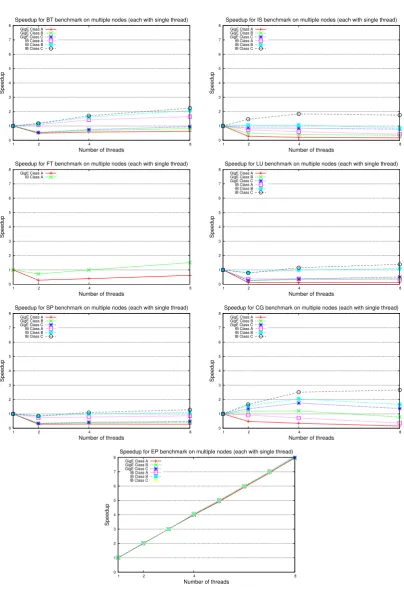
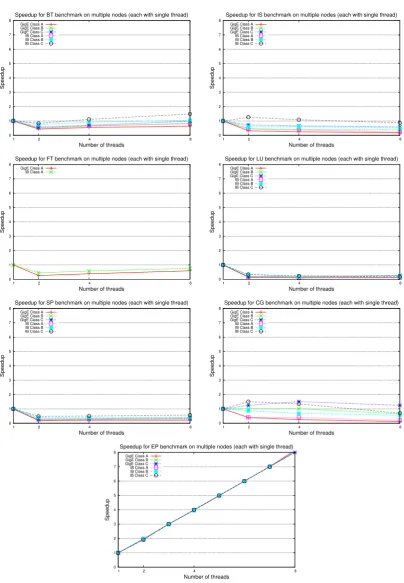
• performance of CLOMP on multiple nodes with a single thread per node (p×
1),
• performance of CLOMP on multiple nodes with multiple threads per node (p×t).
The details of performance of CLOMP is demonstrated and discussed in the rest of this section.
3.2.1 NPB OpenMP Benchmarks Sequential Performance
Due to the NPB-OMP benchmark classes S and W being too small (sequential elapsed time is usually less than couple of seconds), the larger classes A, B and C are used to present different data sizes.
The sequential elapsed time of NPB benchmarks on three different platforms are shown in Table 3.2. This is measured by running NPB-OMP benchmarks over CLOMP with a single OpenMP thread. 1
3.2.2 Comparison of CLOMP and Intel Native OpenMP on a Single Node
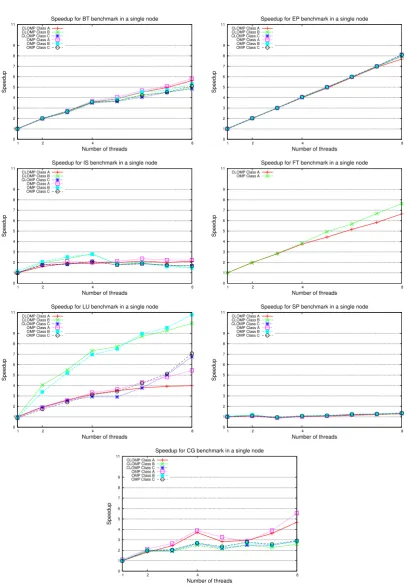
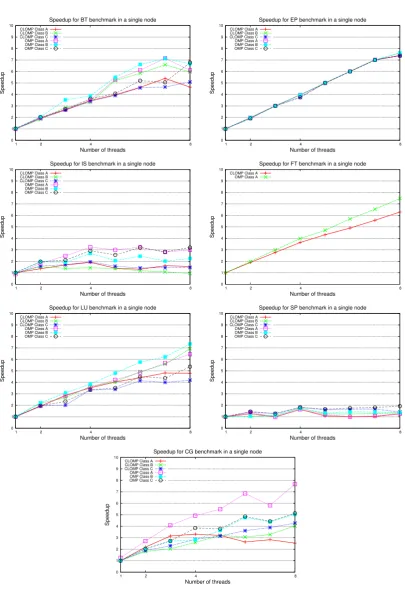
For the 1×t scenario, CLOMP is compared with native Intel OpenMP directives on a single compute node. The comparison, as shown in Figure 3.1 and 3.2, is presented in terms of speedup based on the sequential elapsed time listed in Table 3.2.
1FT class B and C can not be compiled on our system due to memory limits. Since MG can not be
3.2 Performance of CLOMP 0 1 2 3 4 5 6 7 8 9 11
1 2 4 8
Speedup
Number of threads Speedup for BT benchmark in a single node
CLOMP Class A CLOMP Class B CLOMP Class C OMP Class A OMP Class B OMP Class C
0 1 2 3 4 5 6 7 8 9 11
1 2 4 8
Speedup
Number of threads Speedup for EP benchmark in a single node
CLOMP Class A CLOMP Class B CLOMP Class C OMP Class A OMP Class B OMP Class C
0 1 2 3 4 5 6 7 8 9 11
1 2 4 8
Speedup
Number of threads Speedup for IS benchmark in a single node CLOMP Class A
CLOMP Class B CLOMP Class C OMP Class A OMP Class B OMP Class C
0 1 2 3 4 5 6 7 8 9 11
1 2 4 8
Speedup
Number of threads Speedup for FT benchmark in a single node CLOMP Class A
OMP Class A
0 1 2 3 4 5 6 7 8 9 11
1 2 4 8
Speedup
Number of threads Speedup for LU benchmark in a single node CLOMP Class A
CLOMP Class B CLOMP Class C OMP Class A OMP Class B OMP Class C
0 1 2 3 4 5 6 7 8 9 11
1 2 4 8
Speedup
Number of threads Speedup for SP benchmark in a single node CLOMP Class A
CLOMP Class B CLOMP Class C OMP Class A OMP Class B OMP Class C
0 1 2 3 4 5 6 7 8 9 11
1 2 4 8
Speedup
Number of threads Speedup for CG benchmark in a single node CLOMP Class A
[image:45.595.119.527.85.672.2]CLOMP Class B CLOMP Class C OMP Class A OMP Class B OMP Class C
0 1 2 3 4 5 6 7 8 9 10
1 2 4 8
Speedup
Number of threads Speedup for BT benchmark in a single node
CLOMP Class A CLOMP Class B CLOMP Class C OMP Class A OMP Class B OMP Class C
0 1 2 3 4 5 6 7 8 9 10
1 2 4 8
Speedup
Number of threads Speedup for EP benchmark in a single node
CLOMP Class A CLOMP Class B CLOMP Class C OMP Class A OMP Class B OMP Class C
0 1 2 3 4 5 6 7 8 9 10
1 2 4 8
Speedup
Number of threads Speedup for IS benchmark in a single node CLOMP Class A
CLOMP Class B CLOMP Class C OMP Class A OMP Class B OMP Class C
0 1 2 3 4 5 6 7 8 9 10
1 2 4 8
Speedup
Number of threads Speedup for FT benchmark in a single node CLOMP Class A
OMP Class A
0 1 2 3 4 5 6 7 8 9 10
1 2 4 8
Speedup
Number of threads Speedup for LU benchmark in a single node CLOMP Class A
CLOMP Class B CLOMP Class C OMP Class A OMP Class B OMP Class C
0 1 2 3 4 5 6 7 8 9 10
1 2 4 8
Speedup
Number of threads Speedup for SP benchmark in a single node CLOMP Class A
CLOMP Class B CLOMP Class C OMP Class A OMP Class B OMP Class C
0 1 2 3 4 5 6 7 8 9 10
1 2 4 8
Speedup
Number of threads Speedup for CG benchmark in a single node CLOMP Class A
[image:46.595.67.473.84.674.2]CLOMP Class B CLOMP Class C OMP Class A OMP Class B OMP Class C
![Figure 2.8:State machine of CLOMP (derived from [47], [38], and experimentalobservation).](https://thumb-us.123doks.com/thumbv2/123dok_us/8205493.262000/25.595.158.492.97.322/figure-state-machine-clomp-derived-experimentalobservation.webp)