PROLOG
PROGRAMMING
FOR
ARTIFICIAL
INTERNATIONAL COMPUTER SCIENCE SERIES
Consulting editors A D McGettrick University of Strathclyde
J van Leeuwen University of Utrecht
OTHER TITLES IN THE SERIES
Programming in Ada (2nd Edn.) J G P Barnes
Computer Science Applied to Business Systems M J R Shave and K N Bhaskar
Software Engineering (2nd Edn.) I Sommerville
A Structured Approach to FORTRAN 77 Programming T M R Ellis
The Cambridge Distributed Computing System R M Needham and A J Herbert
An Introduction to Numerical Methods with Pascal L V Atkinson and P J Harlev
The UNIX System S R Bourne
Handbook of Algorithms and Data Structures G H Gonnet
Office Automation: Concepts, Technologies and Issues R A Hirschheim
Microcomputers in Engineering and Science I F Craine and G R Martin
UNIX for Super-Users E Foxley
Software Specification Techniques N Gehani and A D McGettrick (eds.)
Introduction to Expert Systems P Jackson
Data Communications for Programmers M Purser
Local Area Network Design A Hopper, S Temple and R C Williamson
PROLOG
PROGRAMMING
FOR
ARTIFICIAL
INTELLIGENCE
lvan
Bratko
E. Kardelj University . J. Stefan Institute Yugoslavia
YV
ADDISON-WESLEY PUBLISHING
COMPANY
Wokingham, England . Reading, Massachusetts . illenlo Park, Californta Don Mills,Ontario . Amsterdam . Sydney ' Singapore . Tokyo
@
o
1986 Addison-Wesley 1986 Addison-Wesley Publishers Publishing LimitedCompany, Inc.All rights reserved. No part of'this publication may be reproduced, stored in a retrieval system, or transmitted in any form or by any means, electronic, mechanical, photocopying, recording, or otherwise, without prior written permission of the publisher.
Cover graphic by kind permission of Dicomed (UK) Ltd. Phototypeset by Computerset (MFK) Ltd., Ely, Cambs. Printed in Great Britain bv Commercial Colour Press.
British Library Cataloguing in Publication Data Bratko. Ivan
Prolog programming for artificial intelligence. 1. Artificial intelligence-Data processing 2. Prolog (Computer program language) I. Title
006.3'02855133 Q336
ISBN 0-20r-14224-4
Library of Congress Cataloging-in-Publication Data Bratko, Ivan.
Prolog programming for artificial intelligence.
Includes index.
1. Artificial intelligence-Data processing. 2. Prolog (Computer program language) I. Title. Q336.874 1986 006.3
ISBN 0-20t-1.4224-4
ABCDEF 89876
86-1092
Foreword
In the Middle Ages, knowledge of Latin and Greek was essential for all scholars. The one-language scholar was necessarily a handicapped scholar who lacked the perception that comes from seeing the world from two points of view. Similarly, today's practitioner of Artificial Intelligence is handicapped unless thoroughly familiar with both Lisp and Prolog, for knowledge of the two principal languages of Artificial Intelligence is essential for a broad point of view.
I am dedicated to Lisp, having grown up at MIT where Lisp was invented. Nevertheless, I can never forget my excitement when I saw my first Prolog-style program in action. It was part of Terry Winograd's famous Shrdlu system, whose blocks-world problem solver arranged for a simulated robot arm to move blocks around a screen, solving intricate problems in response to human-specified goals.
Winograd's blocks-world problem solver was written in Microplanner, a language which we now recognize as a sort of Prolog. Nevertheless, in spite of the defects of Microplanner, the blocks-world problem solver was organized explicitly around goals, because a Prolog-style language encourages prograrn-mers to think in terms of goals. The goal-oriented procedures for grasping, clearing, getting rid of, moving, and ungrasping made it possible for a clear, transparent, concise program to seem amazingly intelligent.
Winograd's blocks-world problem solver permanently changed the way I think about programs. I even rewrote the blocks-world problem solver in Lisp for my Lisp textbook because that program unalterably impressed me with the power of the goal-oriented philosophy of programming and the fun of writing goal-oriented programs.
But learning about goal-oriented programming through Lisp programs is like reading Shakespeare in a language other than English. Some of the beauty comes through, but not as powerfully as in the original. Similarly, the best way to learn about goal-oriented programming is to read and write goal-oriented programs in Prolog, for goal-oriented programming is what Prolog is all about.
FOREWORD
programmers could speak in their own language, or nearly so, using a notation that made only moderate concessions to the one-dimensional, 80-column
world. i
Fortran and nearly all other languages are still how-type languages, however. In my view, modern Lisp is the champion of these languages, iot iisp in its Cbmmon Lisp form is enormously expreriiu", but how to do something is still what the Lisp programmer is allowed to be expressive about. Prolog, on the other hand, is a language that clearly breaks away from the how-type languages, encouraging the programmer to describe situations and problems, not the detailed means by which the problems are to be solved.
Consequently, an introduction to Prolog is important for all students of Computer Science, for there is no better way to see what the notion of what-type programming is all about.
In particular, the chapters of this book clearly illustrate the difference between how-type and what-type thinking. In the first chapter, for example, the difference is illustrated through problems dealing with family relations. The Prolog programmer straightiorwardly describes the grandfather concept in explicit, natural terms: a grandfather is a father of a parent. Here is the Prolog notation:
grandfather(X, Z) :- father( X, Y), parent( Y, Z).
Once Prolog knows what a grandfather is, it is easy to ask a question: who are Patrick's grandfathers, for example. Here again is the Prolog notation, along with a typical answer:
?- grandfather( X, patrick). X = james;
X : carl
It is Prolog's job to figure out how to solve the problem by combing through a database of known father and parent relations. The programmer specifies only what is known and what question is to be solved. The programmer is more concerned with knowledge and less concerned with algorithms that exploit the knowledge.
Given that it is important to learn Prolog, the next question is how. I believe that learning a programming language is like learning a naturaf language in many ways. For example, a reference manual is helpful in learnin$ a programming language, just as a dictionary is helpful in learning a natural language. But no one learns a natural language with only a dictionary, for th( words are only part of what must be learned. The student of a natural languagd must learn the conventions that govern how the words are put legally together, and later, the student should learn the art of those who put the words together with style
manual, for a reference manual says little or nothing about the way the primitives of the language are put to use by those who use the language well. For this, a textbook is required, and the best textbooks offer copious examples, for good examples are distilled experience, and it is principally through experience that we learn.
In this book, the first example is on the first page, and the remaining pages constitute an example cornucopia, pouring forth Prolog programs writ-ten by a passionate Prolog programmer who is dedicated to the Prolog point of view. By carefully studying these examples, the reader acquires not only the mechanics of the language, but also a personal collection of precedents, ready to be taken apart, adapted, and reassembled together into new programs. With this acquisition of precedent knowledge, the transition from novice to skilled programmer is already under way.
Of course, a beneficial side effect of good programming examples is that they expose a bit of interesting science as well as a lot about programming itself. The science behind the examples in this book is Artificial Intelligence. The reader learns about such problem-solving ideas as problem reduction, forward and backward chaining, 'how' and 'why' questioning, and various search techniques.
In fact, one of the great features of Prolog is that it is simple enough for students in introductory Artificial Intelligence subjects to learn to use immedi-ately. I expect that many instructors will use this book as part of their artificial-intelligence subjects so that their students can see abstract ideas immediately reduced to concrete, motivating form.
Among Prolog texts, I expect this book to be particularly popular, not only because of its examples, but also because of a number of other features:
o Careful summaries appear throughout. o Numerous exercises reinforce all concepts.
o Structure selectors introduce the notion of data abstraction.
o Explicit discussions of programming style and technique occupy an entire chapter.
o There is honest attention to the problems to be faced in Prolog program-ming, as well as the joys.
Features like this make this a well done, enjoyable, and instructive book.
Patrick H. Winston Cambridge, Massachusetts
Preface
Prolog is a programming language centred around a small set of basic mecha-nisms, including pattern matching, tree-based data structuring, and automatic backtracking. This small set constitutes a surprisingly powerful and flexible programming framework. Prolog is especially well suited for problems that involve objects - in particular, structured objects - and relations between them. For example, it is an easy exercise in Prolog to express the spatial relationships suggested in the cover illustration - such as, the top sphere is behind the left one. It is also easy to state a more general rule: if X is closer to the observer than Y and Y is closer than Z, then X must be closer than Z. Prolog can now reason about the spatial relations and their consistency with respect to the general rule. Features like this make Prolog a powerful language for Artificial Intelligence and non-numerical programming in general.
Prolog stands for programming in logic - an idea that emerged in the early 1970s to use logic as a programming language. The earty developers of this idea included Robert Kowalski at Edinburgh (on the theoretical side), Maarten van Emden at Edinburgh (experimental demonstration), and Alain Colmerauer at Marseilles (implementation). The present popularity of Prolog is largely due to David Warren's efficient implementation at Edinburgh in the mid 1970s.
Since Prolog has its roots in mathernatical logic it is often introduced through togic. However, such a mathematically intensive introductisn is not very useful if the aim is to teach Prolog as a practical prograrnming tool. Therefore this. book is not concerned with the mathematical aspects, but concentrates on the art of making the few basic mechanisms of Prolog solve interesting problems. Whereas conventional languages are procedurally oriented, Prolog introduces the descriptive, or declerative, view. This greatly alters the way of thinking about problems and makes learning to program in Prolog an exciting intellectual challenge.
PREFACE
although they do not strictly belong to AI. These techniques are often used in AI programs and their implementation helps to learn the general skills of Prolog programming. Throughout, the emphasis is on the clarity of programs; efficiency tricks that rely on implementation-dependent features are at'oided. This book is for students of Prolog and Artificial Intelligence. It can be used in a Prolog course or in an AI course in which the principles of AI are brought to life through Prolog. The reader is assumed to have a basic general knowledge of computers, but no knowledge of AI is necessary. No particular programming experience is required; in fact, plentiful experience and devotion to conventional procedural programming, for example in Pascal, might even be an impediment to the fresh way of thinking Prolog requires.
Among several Prolog dialects, the Edinburgh syntax, also known as DEC-10 syntax, is the most widespread, and is therefore also adopted in this book. For compatibility with the various Prolog implementations, this book only uses a relatively small subset of the built-in features that are shared by many Prologs.
How to read the book? In Part One, the natural reading order corre-sponds to the order in the book. However, the part of Section 2.4thatdescribes the procedural meaning of Prolog in a more formalized way can be skipped. Chapter 4 presents programming examples that can be read (or skipped) selectively. Part Two allows more flexible reading strategies as the chapters are intended to be mutually independent. However, some topics will still be naturally done before others - for example, the basics of data structures (Chapter 9) and basic search strategies (Chapters 11 and 13). The following diagram summarizes the constraints on natural reading sequences:
Part One: 1 -+ 2 --+ 3-+ 4 (selectively) -+ 5 -+ 6 ---> 7 --+ 8
Part Two: 9 +
J 1 0
' 7
L 1 - + 1 3 . 1 - 1 3 . 3 -- - >
J
J \
12 13.4
t 4 1 5 1 6
There are some controversial views that historically accompanied Prolog. Prolog has fast gained popularity in Europe as a practical programming tool. In Japan, Prolog was placed at the centre of the development of the Fifth Generation computers. On the other hand, in the United States its acceptance began with some delay, due to several historical factors. One of these origi-nated from a previous American experience with the Microplanner language, also akin to the idea of logic programming, but inefficiently implemented. This early experience with Microplanner was unjustifiably generalized to Prolog, but was later convincingly rectified by David Warren's efficient implementa-tion of Prolog. Reservaimplementa-tions against Prolog also came in reacimplementa-tion to the 'orthodox
approach with the traditional, procedural one. A third factor that delayed the acceptance of prolog was that for a long time Lisp had no serious competition utttong languages for AI. In research centres with strong Lisp tradition, there was therefore a natural resistance to Prolog. The dilemma of Prolog vs. Lisp has softened over the years and many now believe in a combination of ideas from both worlds.
Acknowledgements
Donald Michie was responsible for first inducing my interest in Prolog. I am grateful to Lawrence Byrd, Fernando Pereira and David H. D. Warren, once members of the Prolog development feam at Edinburgh, for their programming advice and numerous discussions. The book greatly benefited from comments and suggestions of Andrew McGettrick and Patrick H. Winston. Other people who read parts of the manuscript and contributed significant comments include: Igor Kononenko, Tanja Majaron, Igor Mozetic, Timothy B. Niblett and Franc Zerdin.I would also like to thank Debra Myson-Etherington and Simon Plumtree of Addison-Wesley for their work in the process of making this book. Finally, this book would not be possible without the stimulating creativity of the international logic programming community.
Ivan Bratko The Turing Institute, Glasgow
CONTENTS
Foreword
Preface
PART ONE
Chapter,zl
1 . 1 t . 2 1 . 3 L . 4 1 . 5
Chaptev'2
2 . 1 2 . 2 2 . 3 2 . 4 2 . 5 2 . 6 2 . 7
Chapter,z3
3 . 1 3 . 2 3 . 3 3 . 4
Chapter 4
tt'4,1
t . 4 . 2
/ + . t
4 . 4 4 . 5
THE PROLOG LANGUAGE
An Overview of Prolog
An example program: defining family relations Extending the example program by rules A recursive rule definition
How Prolog answers questions
Declarative and procedural meaning of programs
Syntax and Meaning of Prolog Programs
Data objects Matching
Declarative meaning of Prolog programs Procedural meaning
Example: monkey and banana Order of clauses and goals
Remarks on the relation between Prolog and logic
Lists, Operators, Arithmetic
Representation of lists Some operations on lists Operator notation Arithmetic
Using Struclures: Example Programs
Retrieving structured information from a database Doing data abstraction
Simulating a non-deterministic automaton Travel planning
The eight queens problem
CONTENTS
Chapterr.'5
5 . 1 5 . 2 5 . 3 5 . 4
Chapter 6
6 . 1 6 . 2 6 . 3 6 . 4 6 . 5
Chapter 7
7 . 1 7 . 2 7 . 3 7 . 4 7 . 5 7 . 6
Chapter 8
8 . 1 8 . 2 8 . 3 8 . 4 8 . 5
Controlling Backtracking
Preventing backtracking Examples using cut Negation as failure
Problems with cut and negation
Input and Output
Communication with files Processing files of terms Manipulating characters
Constructing and decomposing atoms Reading programs: consult, reconsult
More Built-in Procedures
Testing the type of terms
Constructing and decomposing terms: :.., arg, name Various kinds of equality
Database manipulation Control facilities bagof, setof and findall
Programming Style and Technique
General principles of good programming How to think about Prolog programs Programming style Debugging Efficiency 120 r20 125 r29 133 I37 r37 140 t47 149 152 155 155 163 168 169 174 175 179 179 1 8 1 184 187 188 201, 203 203 211, 2r7 222 224 233 233 241, 246 246 25t 256
PART TWO PROLOG IN ARTIFICIAL INTELLIGENCE
Chapter 9 Operations on Data Structures
Representing and sorting lists Representing sets by binary trees
Insertion and deletion in a binarv dictionarv Displaying trees
Graphs
Advanced Tree Representations
The 2-3 dictionary
AVL-tree: an approximately balanced tree
Basic Problem-Solving Strategies
Introductory concepts and examples Depth-first search strategy
Breadth-first search strategy 9 . 1
9 . 2 9 . 3 9 . 4 9 . 5
Chapter l0
1 0 . 1
r0.2
Chapter 11
Comments on searching graphs, on optimality, and on search
complexity 262
11.4
Chapter 12
1 2 . l 1 2 . 2 12.3
Chapter 13
1 3 . 1 13.2 1 3 . 3 13.4
Best-first: A Heuristic Search Principle
Best-first search
Best-first search applied to the eight puzzle Best-first search applied to scheduling
Problem Reduction and AND/OR Graphs
AND/OR graph representation of problems Examples of AND/OR representation Basic AND/OR search procedures Best-first AND/OR search
265 265 273 278 286 286 290 294 299 314 314 3 1 5 316 323 329 347 355 359 3s9 361 3& 368 370 373
Chapter 14 Expert Systems
l4.l Functions of an expert system 14.2 Main structure of an expert system 14.3 lf-then rules for representing knowledge L4.4 Developing the shell
'J..4.5
Implementation
14.6 Dealing with uncertainty 14.7 Concludingremarks
Chapter 15
1 5 . 1 15.2 1 5 . 3
1 5 . 4 1 5 . 5 1 5 . 6
Chapter 16
1 6 . 1 16.2 1 6 . 3 16.4
Game Playing
Two-person, perfect-information games The minimax principle
The alpha-beta algorithm: an efficient implementation of minimax
Minimax-based programs: refinements and limitations Pattern knowledge and the mechanism of 'advice' A chess endgame program in Advice Language 0
Pattern-Directed Programming
Pattern-directed architecture
A simple interpreter for pattern-directed programs A simple theorem prover
Concluding remarks 390 390 394 396 402 405 Solutions to Selected Exercises
PART ONE
THE PROLOG
LANGUAGE
parent
An Overview
of Prolog
This chapter reviews basic mechanisms of Prolog through an example program. Although the treatment is largely informal many important concepts are introduced.
1.1 An example
program:
defining
family relations
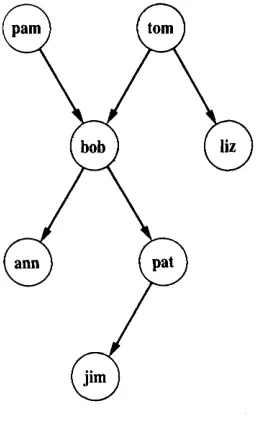
Prolog is a programming language for symbolic, non-numeric computation. It is specially well suited for solving problems that involve objects and relations between objects. Figure 1.1 shows an example: a family relation. The fact that Tom is a parent of Bob can be written in Prolog as:
parent( tom, bob).
Here we choose parent as the name of a relation; tom and bob are its
[image:21.416.132.262.387.604.2]4 PROLOG PROGRAMMING FOR ARTIFICIAL INTELLIGENCE
ments. For reasons that will become clear later we write names like tom with an initial lower-case letter. The whole family tree of Figure 1.1 is defined by the following Prolog program:
parent( pam, bob). parent( tom, bob). parent( tom, liz). parent( bob, ann). parent( bob, pat). parent( pat, jim).
This program consists of six clauses. Each of these clauses declares one fact about the parent relation.
When this program has been communicated to the Prolog system, Prolog can be posed some questions about the parent relation. For example, Is Bob a parent of Pat? This question can be communicated to the Prolog system by typing into the terminal:
?- parent( bob, pat).
Having found this as an asserted fact in the program, Prolog will answer: yes
A further query can be: ?- parent( liz, pat).
Prolog answers no
because the program does not mention anything about Liz being a parent of Pat. It also answers 'no'to the question
?- parent( tom, ben).
because the program has not even heard of the name Ben.
More interesting questions can also be asked. For example: Who is Liz's parent?
?- parent( X, liz).
answer ls: X : t o m
The question Who are Bob's children? can be communicated to Prolog as: ?- parent( bob, X).
This time there is more than just one possible answer. Prolog first answers with one solution:
X : a n n
We may now want to see other solutions. We can say that to Prolog (in most Prolog implementations by typing a semicolon), and Prolog will find other answers:
;g - pat
If we request more solutions again, Prolog will answer 'no' because all the solutions have been exhausted.
Our program can be asked an even broader question: Who is a parent of whom? Another formulation of this question is:
Find X and Y such that X is a parent of Y. This is expressed in Prolog by:
?- parent{ X, Y).
Prolog now finds all the parent-child pairs one after another. The solutions will be displayed one at a time as long as we tell Prolog w€ want more solutions, until all the solutions have been found. The answers ar€ output as:
X - p a m Y : bob; X : t o m Y : bob; X : t o m Y : liz;
PROLOG PROGRAMMING FOR ARTIFICIAL INTELLIGENCE
Figure 1.2 The grandparent relation expressed as a composition of two parent relations.
Our example program can be asked still more complicated questions like: Who is a grandparent of Jim? As our program does not directly know the grandparent relation this query has to be broken down into two steps, as illustrated by Figure 1.2.
(1) Who is a parent of Jim? Assume that this is some Y. (2) Who is a parent of Y? Assume that this is some X.
Such a composed query is written in Prolog as a sequence of two simple ones: ?- parent( Y, jim), parent( X, Y).
The answer will be: X : b o b Y - p a t
Our composed query can be read: Find such X and Y that satisfy the following two requirements:
parent( Y, jim) and parent( X, Y)
If we change the order of the two requirements the logical meaning remains the same:
parent( X, Y) and parent( Y, jim)
We can indeed do this in our Prolog program and the query ?- parent( X, Y), parent( Y, jim).
will produce the same result.
Prolog's answers are: X : b o b
Y : ann; X : b o b Y - p a t
Yet another question could be: Do Ann and Pat have a common parent? This can be expressed again in two stePs:
(1) Who is a parent, X, of Ann? (?) Is (this same) X a parent of Pat? The corresponding question to Prolog is then:
?- parent( X, ann), parent( X, pat). The answer is:
X : b o b
Our example program has helped to illustrate some important points: o It is easy in Prolog to define a relation, such as the parent relation, by
stating the n-tuples of objects that satisfy the relation.
o The user can easily query the Prolog system about relations defined in the program.
o A Prolog program consists of clauses. Each clause terminates with a full stop.
o The arguments of relations can (among other things) be: concrete objects, or constants (such as tom and ann), or general objects such as X and Y. Objects of the first kind in our program are called atoms. Objects of the second kind are called variables.
. Questions to the system consist of one or more goals. A sequence of goals, such as
parent( X, ann), parent( X, pat) means the conjunction of the goals:
X is a parent of Ann, and X is a parent of Pat.
The word 'goals' is used because Prolog accepts questions as goals that are to be satisfied.
PROLOG PROGRAMMING FOR ARTIFICIAL INTELLIGENCE
whether the corresponding goal can be satisfied or not. In the case of a positive answer we say that the corresponding goal was satisfiable and that the goalsucceeded. Otherwise the gbalwas unsatisfiable anditfailed. o If several answers satisfy the question then Prolog will find as many of
them as desired by the user.
Exercises
1.1 Assuming the parent relation as defined in this section (see Figure 1.1), what will be Prolog's answers to the folrowing questions?
(a) (b) (') (d)
parent( jim, X). parent( X, jim).
parent( paffi, X), parent( X, pat).
parent( paffi, X), parent( X, Y), parent( Y, jim).
1.2 Formulate in Prolog the following questions about the parent relation: (a) Who is Pat's parent?
(b) Does Liz have a child? (c) Who is Pat's grandparent?
1.2 Extending
the example
program by rules
Our example program can be easily extended in many interesting ways. Let us first add the information on the sex of the people that occur in the parent relation. This can be done by simply adding the following facts to our program:
female( pam). male( tom). male( bob). female( liz). female( pat). female( ann). male( jim).
of program would then be: sex( pam, feminine). sex( tom, masculine). sex( bob, masculine).
As our next extension to the program let us introduce the offspring relation as the inverse of the parent relation. We could define offspring in a similar way as the parent relation; that is, by simply providing a list of simple facts about the offspring relation, each fact mentioning one pair of people such that one is an offspring of the other. For example:
offspring( liz, tom).
However, the offspring relation can be defined much more elegantly by making use of the fact that it is the inverse of parent, and that parent has already been defined. This alternative way can be based on the following logical statement:
For all X and Y,
Y is an offspring of X if X is a parent of Y.
This formulation is already close to the formalism of Prolog. The correspond-ing Prolog clause which has the same meancorrespond-ing is:
offspring( Y, X) :- parent( X, Y).
This clause can also be read as:
For all X and Y,
if X is a parent of Y then Y is an offspring of X.
Prolog clauses such as
offspring( Y, X) :- parent( X, Y).
are called rules. There is an important difference between facts and rules. A fact like
parent( tom, liz).
is something that is always, unconditionally, true. On the other hand, rules specify things that may be true if some condition is satisfied. Therefore we say that rules have:
10 PROLOG PROGRAMMING FOR ARTIFICIAL INTELLIGENCE
o a conclusion part (the left-hand side of the rule).
The conclusion part is also called the headof a clause and the condition part the body of a clause. For example:
offspring( y, X) :- parent( X, y).
head body
If the condition parent( X, Y) is true then a logical consequence of this is offspring( Y, X).
How rules are actually used by Prolog is illustrated by the following example. Let us ask our program whether Liz is an offspring bt rom:
?- offspring( liz, tom).
There is no fact about offsprings in the program, therefore the only way to consider this question is to apply the rule about offsprings. The rule ii genlral in the sense that it is applicable to any objects X and Y; therefore it can also be applied to such particular objects asliz and tom. To apply the rule to liz and tom, Y has to be substituted with liz, and X with tom. We sav that the variables X and Y become instantiated to:
X = t o m a n d Y : l i z
After the instantiation we have obtained a special case of our general rule. The special case is:
offspring( liz, tom) :- parent( tom, liz). The condition part has become
parent( tom, Iiz)
Now Prolog tries to find out whether the condition part is true. So the initial goal
offspring( liz, tom)
has been replaced with the subgoal parent( tom, liz)
This (new) goal happens to be trivial as it can be found as a fact in our program. This means that the conclusion part of the rule is also true, and Prolog will answer the question with yes.
9.:'"'
parent
I I mother
€r
grandparento.*"8'
-.-rB
Figure 1.3 Definition graphs for the relations offspring, mother and grandparent in terms of other relations.
specification of the mother relation can be based on the following logical statement:
For all X and Y.
X is the mother of Y if X is a parent of Y and X is a female.
This is translated into Prolog as the following rule: mother( X, Y) :- parent( X, Y), female( X).
A comma between two conditions indicates the conjunction of the conditions, meaning that both conditions have to be true.
Relations such as parent, offspring and mother can be illustrated by diagrams such as those in Figure 1.3. These diagrams conform to the following conventions. Nodes in the graphs correspond to objects - that is, arguments of relations. Arcs between nodes correspond to binary (or two-place) relations. The arcs are oriented so as to point from the first argument of the relation to the second argument. Unary relations are indicated in the diagrams by simply marking the corresponding objects with the name of the relation. The relations that are being defined are represented by dashed arcs. So each diagram should be understood as follows: if relations shown by solid arcs hold, then the relation shown by a dashed arc also holds. The grandparent relation can be, according to Figure 1.3, immediately written in Prolog as:
grandparent(X, Z) :- parent( X, Y), parent( Y, Z).
12 PROLOG PROGRAMMING FOR ARTIFICIAL INTELLIGENCE
goal of the body on a separate line. When doing this, we will indent goals in order to make the difference between the head und th. goals more visible. For example, the grandparent rule would be, according to this convention, written as follows:
grandparent(X, Z) :-parent( X, Y), parent( Y, Z).
Figure 1.4 illustrates the sister relation: For any X and Y,
X is a sister of Y if
(1) both X and Y have the same parent, ancl ( 2 ) X i s a f e m a l e .
female
Figure 1.4 Defining the sister relation.
The graph in Figure L.4 can be translated into Prolog as: sister( X, Y)
parent( Z, parent( Z, female( X).
Notice the way in which the requirement'both X and Y have the same parent' has been expressed. The following logical formulation was used: some Z must be a parent of X, and this same Z must be a parent of Y. An alternative, but less elegant way would be to say: Z1.is a parent of X, andz2is a parent of y, and Zt is equal to 22.
We can now sister( ann, pat).
conclude that the sister relation, as defined, works correctly' There is, how-ever, a rather subtle flaw in our program which is revealed if we ask the question Who is Pat's sister?:
?- sister( X, pat).
Prolog will find two answers, one of which may come as a surprise: X : ann;
X - p a t
U : / B R
So, Pat is a sister to herself?! This is probably not what we had in mind when defining the sister relation. However, according to our rule about sisters Prolog's answer is perfectly logical. Our rule about sisters does not mention that X and Y must not be the same if X is to be a sister of Y. As this is not required Prolog (rightfully) assumes that X and Y can be the same, and will as a consequence find that any female who has a parent is a sister of herself.
To correct our rule about sisters we have to add that X and Y must be different. We will see in later chapters how this can be done in several ways, but for the moment we will assume that a relation different is already known to Prolog, and that
different( X, Y)
is satisfied if and only if X and Y are not equal. An improved rule for the sister relation can then be:
sister( X, Y) :-parent( Z, X), parent( Z, Y), female( X), different( X, Y).
Some important points of this section are:
Prolog programs can be extended by simply adding new clauses. Prolog clauses are of three types: facts, rules and questions. Facts declare things that are always, unconditionally true.
Rules declare things that are true depending on a given condition. By means of questions the user can ask the program what things are true. Prolog clauses consist of the headand the body.The body is a list of" goals separated by commas. Commas are understood as conjunctions. Facts are clauses that have the empty body. Questions only have the body. Rules have the head and the (non-empty) body.
o
o
O
o
o
t4 PROLOG PROGRAMMING FOR ARTIFICIAL INTELLIGENCE
In the course of computation, a variable can be substituted by another object. we say that a variable becomes instantiated.
Variables are assumed to be universally quantified and are read as .for all'. Alternative readings are, however, possible for variables that appear only in the body. For example
hasachild( X) :- parent( X, y). can be read in two ways:
(u) For all X and Y,
if X is a parent of Y then X has a child.
(b) For all X, X has a child if
there is some Y such that X is a parent of y.
Exercises
1.3 Translate the following statements into prolog rules:
(a) Everybody who has a child is happy (introduce a one-argument relation happy).
(b) For all X, if X has a child who has a sister then X has two children (introduce new relation hastwochildren).
1.4 Define the relation grandchild using the parent relation. Hint: It wilt be similar to the grandparent relation (see Figure 1.3).
1.5 Define the relation aunt( X, Y) in terms of the relations parent and sister. As an aid you can first draw a diagram in the style of Figure 1.3 for the aunt relation.
1.3 A recursive
rule definition
Q-..
parent
I i predecessor
(a) q
predecessor
Figure 1.5 Examples of the predecessor relation: (a) X is a direct predecessor of Z; (b) X is an indirect predecessor of. Z.
The first rule is simple and can be formulated as: For all X and Z,
X is a predecessor of. Z if X is a parent of Z.
This is straightforwardly translated into Prolog as: predecessor(X, Z)
:-parent( X, Z).
The second rule, on the other hand, is more complicated because the chain of parents may present some problems. One attempt to define indirect pre-decessors could be as shown in Figure 1.6. According to this, the predecessor
predecessor
predecessor
predecessor
Figure 1.6 Predecessor-successor pairs at various distances.
q,
parent I
tt
0.,.".?'
Q,
narenrrlt/
(b) 9
,**$,,
@
n".ent
I
@
o**'E'
16 PROLOG PROGRAMMING FOR ARTIFICIAL INTELLIGENCE
relation would be defined by a set of clauses as follows: predecessor(X, Z)
:-parent( X, Z). predecessor(X, Z)
:-parent( X, Y), parent( Y, Z). predecessor( X, Z)
:-parent( X, Y1), parent( Yl, YZ), parent( Y2, Z). predecessor(X, Z)
:-parent( X, Y1), parent( Yl, Y2), parent( Y2, Y3), parent( Y3, Z).
This program is lengthy and, more importantly, it only works to some extent. It would only discover predecessors to a certain depth in a family tree because the length of the chain of people between the predecessor and the successor would be limited according to the length of our predecessor clauses.
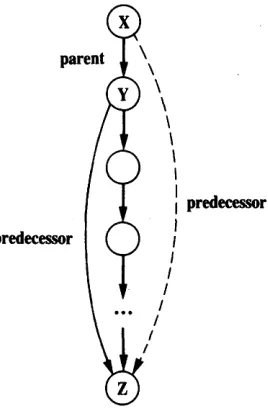
There is, however, an elegant and correct formulation of the predecessor relation: it will be correct in the sense that it will work for predecessors at any depth. The key idea is to define the predecessor relation in terms of itself. Figure 1.7 illustrates the idea:
For all X and Z.
X is a predecessor of Z if there is a Y such that (1) X is a parent of Y and (2) Y is a predecessor of. Z.
A Prolog clause with the above meaning is: predecessor( X, Z)
:-parent( X, Y), predecessor(Y, Z).
We have thus constructed a complete program for the predecessor rela-tion, which consists of two rules: one for direct predecessors and one for indirect predecessors. Both rules are rewritten together here:
predecessor(X, Z) :-parent( X, Y), predecessor(Y, Z).
The key to this formulation was the use of predecessor itself in its definition. Such a definition may look surprising in view of the question: When defining something, can *" ut" this same thing that has not yet been completely defined? Such definitions are, in general, called recursive definitions. Logically, they are perfectly correct and understandable, which is also intiitiveiy obvious if we look at Figure 1.7. But will the Prolog system be able to use recursive rules? It turns out that Prolog can indeed very easily use recursive definitions. Recursive programming is, in fact, one of the fundamen-tal principles of programming in Prolog. It is not possible to solve tasks of any significant complexity in Prolog without the use of recursion.
predecrcssor
predecessor
Figure 1.7 Recursive formulation of the predecessor relation.
Going back to our program, we can cessors? That is: Who is a person that Pam
?- predecessor( pam, X). X: bob;
X : ann; X : pat; I = j i m
[image:35.416.132.266.252.456.2]18 PROLOG PROGRAMMING FOR ARTIFICIAL INTELLIGENCE
Prolog's answers are of course correct and they logically follow from our definition of the predecessor and the parent relation. There is, however, a rather important question: How did Prolqg actually use the program to find these answers?
An informal explanation of how Prolog does this is given in the next section. But first let us put together all the pieces of our family program, which
parent( pam, bob). parent( tom, bob). parent( tom, liz). parent( bob, ann). parent( bob, pat). parent( pat, jim). female( p.am). mal{ tom). mal{ bob). femal{ liz). female( ann). female( pat). male( jim).
offspring( Y, X) :-parent( X, Y). mother( X, Y)
:-parent( X, Y), female( X).
grandparent(X, Z) :-parent( X, Y), parent( Y, Z). sister( X, Y) :-parent( Z, X), parent( Z, Y), female( X), different( X, Y). predecessor(X, Z)
:-parent( X, Z). predecessor( X, Z)
:-parent( X, Y), predecesso4Y, Z),
Vo Pam is a parent of Bob
Vo Pam is female Vo Tom is male
Vo Y is an offspring of X if Vo X is a parent of Y
%o Xis the mother of Y if Vo Xis a parent of Y and % X is female
Vo Xis a grandparent of Z if Vo Xis a parent of Y and Vo Y is a parent of Z
7o Xis a sister of Y if
X and Y have the same parent and X is female and
X and Y are different
Rule prl: X is a predecessor of. Z
Vo Rlle pr2: X is a predecessor of Z Vo
Vo Vo
Vo
was extended gradually by adding new facts and rules. The final form of the program is shown in Figuri 1.8. Looking at Figure 1.8, two further points are in brder here: the first will introduce the term 'procedure', the second will be about comments in Programs.
The program in Figure 1.8 defines several relations - parent, male, female, pt.d.ce.ror, etc. The predecessor relation, for example, is defined by two clauses. We say that these two clauses are about the predecessor relation. Sometimes it is convenient to consider the whote set of clauses about the same relation. Such a set of clauses is called a
pr-Qcedure-In Figure 1.8, the two rules abodT the predecessor relation have been distinguished by the names'pr1' and'pr2', added as comments to the program. These names will be used later as references to these rules. Comments are, in general, ignored by the Prolog system. They only serve as a further clarification to the person who reads the program. Comments are distinguished in Prolog from the rest of the program by being enclosed in special brackets 'l*' and'* l' . Thris comments in Prolog look like this:
/* This is a comment */
Another method, more practical for short comments, uses the percent charac-ter'Vo'. Everything between'Vo' and the end of the line is interpreted as a comment:
Vo This is also a comment
Exercise
1.6 Consider the following alternative definition of the predecessor relation: predecessor(X, Z)
:-parent( X, Z\. predecessor(X, Z)
:-parent( Y, Z), predecessor( X, Y).
Does this also seem to be a proper definition of predecessors? Can you modify the diagram of Figure 1.7 so that it would correspond to this new definition?
1.4 How Prolog
answers
questions
20 PROLOG PROGRAMMING FOR ARTIFICIAL INTELLIGENCE
assuming that the relations in the program are true. In other words, to satisfy a goal means to demonstrate that the goal togically follows from the facts and rules in the program. If the question containi variables, Prolog also has to find what are the particular objects (in place of variables) for wtriitr the goals are satisfied. The particular instantiation of variables to these objects is displayed to the user. If Prolog cannot demonstrate for some instantiation of vaiiables that the goals logically follow from the program, then Prolog's answer to the question will be 'no'.
An appropriate view of the interpretation of a Prolog program in mathematical terms is then as follows: Prolog accepts facts and rules as a set of axioms, and the user's question as a conjectured theorem;then it tries to prove this theorem - that is, to demonstrate that it can be logically derived from the axioms.
We will illustrate this view by a classical example. Let the axioms be: All men are fallible.
Socrates is a man.
A theorem that logically follows from these two axioms is: Socrates is fallible.
The first axiom above can be rewritten as: For all X, if X is a man then X is fallible.
Accordingly, the example can be translated into Prolog as follows: fallible( X) :- man( X).
man( socrates). ?- fallibl{ socrates). yes
Vo All men are fallible
Vo Socrates is a man
7o Socrates is fallible?
A more complicated example from the family program of Figure 1.8 is: predecessor( tom, pat).
We know that parent( bob, pat) is a fact. Using this fact and rule prl we can conclude predecessor{ bob, pat). This is a derived fact: it cannot be found explicitly in our program, but it can be derived from facts and rules in the program. An inference step, such as this, can be written in a more compact form as:
parent( bob' pat) ::) predecessor( bob' pat)
rule prL Further, we know that parent( tom, bob) is a fact. Using this fact and thederivedfactpredecessor( bob, pat)wecanconcludepredecessor( tom, pat)' by rule pr|. We have thus shown that our goal statement predecessor( tom, pat) is true. This whole inference process of two steps can be written as:
parent( bob, pat) ::) predecessor( bob, pat)
parent( tom, bob) and predecessor( bob, pat) :=) predecessor( tom' pat) We have thus shown what can be a sequence of steps that satisfy a goal -that is, make it clear -that the goal is true. Let us call this a proof sequence. We have not, however, shown how the Prolog system actually finds such a proof sequence.
Prolog finds the proof sequence in the inverse order to that which we have just used. Instead of starting with simple facts given in the program, Prolog starts with the goals and, using rules, substitutes the current goals with new goals, until new goals happen to be simple facts. Given the question
?- predecessor( tom, pat).
Prolog will try to satisfy this goal. In order to do so it will try to find a clause in the program from which the above goal could immediately'follow. Obviously, the only clauses relevant to this end are prl and pr?.These are the rules about the predecessor relation. We say that the heads of these rules match the goal. The two clauses,prl andpr2, represent two alternative ways for Prolog to proceed. Prolog first tries that clause which appears first in the program:
predecesso(X, Z) :- parent( X, Z). Since the goal is predecessor( tom, instantiated as follows:
X : t o m , l - p a t
pat), the variables in the rule must be
The original goal predecessor( tom, pat) is then replaced by a new goal: parent( tom, pat)
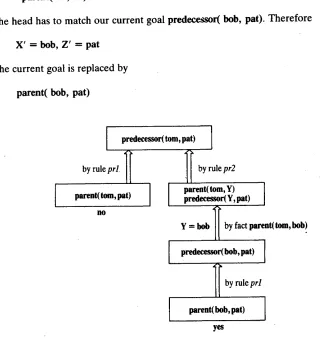
This step of using a rule to transform a goal into another goal, as above, is graphically illustrated in Figure L.9. There is no clause in the program whose head matches the goal parent( tom, pat), therefore this goal fails. Now Prolog backtracks to the original goal in order to try an alternative way to derive the top goal predecessor( tom, pa|. The rule pr2 is thus tried:
PROLOG PROGRAMMING FOR ARTIFICIAL INTELLIGENCE
Figure 1.9 The first step of the execution. The top goal is true if the bottom goal is true.
As before, the variables X and Zbecome instantiated as: X : t o m , 7 : p a t
But Y is not instantiated yet. The top gbal predecessor( tom, pat) is replaced by two goals:
parent( tom, Y), predecessor( Y, pat)
This executional step is shown in Figure 1..1.0, which is an extension to the situation we had in Figure 1.9.
Being now faced with rwo goals, Prolog tries to satisfy them in the order that they are written. The first one is easy as it matches one of the facts in the program. The matching forces Y to become instantiated to bob. Thus the first goal has been satisfied, and the remaining goal has become:
predecesso( bob, pat)
To satisfy this goal the rule prl isused again. Note that this (second) applica-tion of the same rule has nothing to do with its previous application. Therefore, Prolog uses a new set of variables in the rule each time the rule is applied. To
parent(tom,Y) predecessor( Y, pat)
indicate this we shalt rename the variables in rule prl for this application as follows:
predecessor(X', Z') :-parent( X', Z').
The head has to match our current goal predecessor( bob, pat). Therefore X' : };p;b, Z' : pst
The current goal is rePlaced bY parent( bob, pat)
predcesso(tomrpat)
by rule
0,,1f lf '
ule pr2 prrent(tom,pat) perent(tom,Y)predecessor( Y, pat)tf
Y=bob ll uyractpar,
predecessor( bob, pat)
1f
I I by rule prl
parent(bob,pat)
yes
[image:41.416.36.367.125.463.2]paren(tom,bob)
Figure 1.ll The complete execution trace to satisfy the goal predecessor( tom, pat). The right-hand branch proves the goal is satisfiable.
This goal is immediately satisfied because it appears in the program as a fact. This completes the execution trace which is graphically shown in Figure L.11..
24 PROLOG PROGRAMMING FOR ARTIFICIAL INTELLIGENCE
During the search Prolog may enter an unsuccessful branch. When prolog discovers that a branch fails it automatically backtraclcs to the previous node and tries to apply an alternative clause at that node.
Exercise
1.7 Try to understand how Prolog derives answers to the fotlowing questions, using the program of Figure 1.8. Try to draw the correrponiing deriva-tion diagrams in the style of Figures 1.9 to 1.11. Will any backlracking occur at particular questions?
(a)
(b)
(c)
(d)
"l-parent( pam, bob). mother( p&D, bob). grandparent( pam, ann). grandparent( bob, jirn).
1.5 Declarative
and procedural meaning of programs
In our examples so far it has always been possible to understand the results of the program without exactly knowing how the system actually found the results. It therefore makes sense to distinguish between two levels of meaning of Prolog programs; namely,
o the declarative meaning and . the procedural meaning.
The declarative meaning is concerned-only with the relations defined by the program. The declarative meaning thus determines what will be the output of the program. On the other hand, the procedural meaning also determines how this output is obtained; that is, how are the relations actually evaluated by the Prolog system.
This declarative approach indeed often makes programming in Prolog easier than in typical procedurally oriented programming languages such as Pascal. Unfortunately, however, the declarative approach is not always suffi-cient. It will later become clear that, especially in large programs, the pro- i cedural aspects cannot be completely ignored by the programmer for practical I reasons of executional efficiency. Nevertheless, the declarative style of think- | ing about Prolog programs should be encouraged and the procedural aspects ignored to the extent that is permitted by practical constraints.
Summary
o Prolog programming consists of defining relations and querying about relations.
o A program consists of clauses. These are of three types: facts, rules and questions.
o A relation can be specifiedby facts, simply stating the n-tuples of objects that satisfy the relation, or by stating rules about the relation.
o A procedure is a set of clauses about the same relation.
Querying about relations, by means of questions, resembles querying a database. Prolog's answer to a question consists of a set of objects that satisfy the question.
In Prolog, to establish whether an object satisfies a query is often a complicated process that involves logical inference, exploring among alternatives and possibly backtracking. All this is done automatically by the Prolog system and is, in principle, hidden from the user.
Two types of meaning of Prolog programs are distinguished: declarative and procedural. The declarative view is advantageous from the program-ming point of view. Nevertheless, the procedural details often have to be considered by the programmer as well.
The following concepts have been introduced in this chapter: clause, fact, rule, euestion
the head of a clause, the body of a clause recursive rule, recursive definition
procedure atom, variable
instantiation of a variable goal
goal is satisfiable, goal succeeds goal is unsatisfiable, goal fails backtracking
PROLOG PROGRAMMING FOR ARTIFICIAL INTELLIGENCE
References
Various implementations of Prolog use different syntactic conventions. In this book we use the so-called Edinburgh syntax (also called DEC-10 syntax, established by the influential implementation of Prolog for the DEC-1d com-puter; Pereira et al. 1978) which has been adopted by many popular prologs such as Quintus Prolog, CProlog, poplog, etc.
B9w9n, D. L. (1981) DECsystem-I| Prolog llser's Manual. University of Edinburgh: Department of Artificial Intelligence.
Mellish, C. and Hardy, S. (1984) Integrating Prolog in the POPLOG environ-ment. Implementations of Prolog (J. A. Campbell, ed.). Ellis Horwood. Pereira, F. (1982) C-Prolog (Jser's Manual. University of Edinburgh: Depart-ment of Computer-Aided Architectural Design.
Pereira, L. M., Pereira, F. and warren, D. H. D. (197g) IJser's Guide to DECsystem-L| Prolog. University of Edinburgh: Department of Artificial Intelligence.
Syntax
and Meaning
of
Prolog
Programs
This chapter gives a systematic treatment of the syntax and semantics of basic concepts of Piolog, und introduces structured data objects. The topics included are'.
o simple data objects (atoms, numbers, variables) . structured objects
. matching as the fundamental operation on objects o declarative (or non-procedural) meaning of a program o procedural meaning of a Program
. relation between the declarative and procedural meanings of a program o altering the procedural meaning by reordering clauses and goals Most of these topics have already been reviewed in Chapter L- Here the treatment will become rnore formal and detailed.
2.1 Data objects
Figure 2.L shows a classification of data objects in Prolog. The Prolog system reiognizes the type of an object in the program by its syntactic form. This is portibl. because the syntax of Prolog specifies different forms for each type of
const
,/
atoms
data objects
/ \ , / \
simple objects structures , / \
/ \
ants variables \
numbers
28 PROLOG PROGRAMMING FOR ARTIFICIAL INTELLIGENCE
data objects. We have already seen a method for distinguishing between atoms and variables in Chapter 1: variables start with upper-case letters whereas atoms start with lower-case letters. No additional iniormation (such as data-type declaration) has to be communicated to Prolog in order to i".ognize the type of an object.
2.1.1 Atoms and numbers
In Chapter L we have seen some simple examples of atoms and variables. In general, however, they can take more complicaied forms-that is, strings of the following characters:
o upper-case letters A, B, ..., Z o lower-case letters 8, b, ..., z o d i g i t s 0 , L , 2 , . . . , 9
. special characters such as + - * I <) : : . & _-\.
Atoms can be constructed in three ways:
(1) Strings of letters, digits and the underscore character, '-', starting with a lower-case letter:
anna nil
,Os
,L25 x-25A8 x_ x-y
alpha-beta-procedure miss_Jones
sarahjones
(2) Strings of special characters:
When using atoms of this form, some care is necessary because some strings of special characters already have a predefined meaning; an example is':-'.
it in quotes we make it distinguishable from variables: 'Tom'
'South-America' 'Sarah Jones'
Numbers used in Prolog include integer numbers and real numbers. The syntax of integers is simple, as illustrated by the following examples:
1 3 1 3 -97
Not atl integer numbers can be represented in a computer, therefore the range of integers is limited to an interval between some smallest and some largest number permitted by a particular Prolog implementation. Normally the range allowed by an implementation is at least between - 16383 and 16383, and often it is considerably wider.
The treatment of real numbers depends on the implementation of Prolog. We will assume the simple syntax of numbers, as shown by the following examples:
3.t4 -0.0035 100.2
Real numbers are not used very much in typical Prolog programming. The reason for this is that Prolog is primarily a language for symbolic, non-numeric computation, as opposed to number crunching oriented languages such as Fortran. In symbolic computation, integers are often used, for example, to count the number of items in a list; but there is little need for real numbers. Apart from this lack of necessity to use real numbers in typical Prolog applications, there is another reason for avoiding real numbers. In general, we want to keep the meaning of programs as neat as possible. The introduction of real numbers somewhat impairs this neatness because of numerical errors that arise due to rounding when doing arithmetic. For example, the evaluation of the expression
1 0 0 0 0 + 0 . 0 0 0 1 - 1 0 0 0 0
may result in 0 instead of the correct result 0.0001.
2.1.2 Variables
Variables are strings of letters, digits and underscore characters. They start with an upper-case letter or an underscore character:
x
30 PROLOG PROGRAMMING FOR ARTIFICIAL INTELLIGENCE
Shoppinglist r23
23
When a variable appears in a clause once only, we do not have to invent a name for it. We can use the so-called'anonymous'variable, which is written as a single underscore character. For example, let us consider the following rule:
hasachild( X) :- parent( X, y).
This rule says: foi all X, X has a child if X is a parent of some Y. We are defining the property hasachild which, as it is meant here, does not depend on the nurni of the child. Thus, this is a proper place in which to use an anonymous variable. The clause above can thus be rewritten:
hasachild( X) paren( X, -).
feacntime a single underscore character occurs in a clause it represents a new I anonymous variable. For example, we can say that there is somebody who has
a child if there are two objects such that one is a parent of the other: somebody-has-child :- parent( _, _).
This is equivalent
somebodyJras-child parent( X, Y). But this is, of course, quite different from:
somebody-has-child parent( X, X).
If the anonymous variable appears in a question clause then its value is not output when Prolog answers the question. If we are interested in people who have children, but not in the names of the children, then we can simply ask:
?- parent( X,
The lexical scope of variable names is one clause. This means that, for example, if the name X15 occurs in two clauses, then it signifies two different variables. But each occurrence of X15 within the same clause means the same variable, The situation is different for constants: the same atom always means the same object in any clause - that is, throughout the whole program.
2.1.3 Structures
date(
I
I
I
functor
\/
arguments
(b)
Figure 2.2 Date is an example of a structured object: (a) as it is represented as a tree; (b) as it is written in Prolog.
the date can be viewed as a structure with three components: day, month, year. Although composed of several components, structures are treated in the program as single objects. In order to combine the components into a single object we have to choose afunctor. A suitable functor for our example is date. Then the date 1st May 1,983 can be written as:
date( t, may, 1983) (see Figure 2.2).
All the components in this example are constants (two integers and one atom). Components can also be variables or other structures. Any day in May can be represented by the structure:
date( Duy, may, 1983)
Note that Day is a variable and can be instantiated to any object at some later point in the execution.
This method for data structuring is simple and powerful. It is one of the reasons why Prolog is so naturally applied to problems that involve symbolic manipulation.
Syntactically, all data objects in Prolog are terms. For example, may
and
date( 1, may, 1983) are terms.
All structured objects can be pictured as trees (see Figure2,.2 for an example). The root of the tree is the functor, and the offsprings of the root are the components. If a component is also a structure then it is a subtree of the tree that corresponds to the whole structured object.
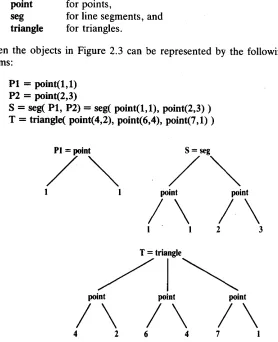
Our next example will show how structures can be used to represent some simple geometric objects (see Figure2.3). A point in two-dimensional space is
l9E3
l,mayr 1983)
I may
32 PROLOG PROGRAMMING FOR ARTIFICIAL INTELLIGENCE
P2 = (2,3)
t 2 3 4 5 6 7 8
[image:50.416.119.312.58.206.2]Some simple geometric objects. Figure 2.3
defined by its two coordinates; a line segment is defined by two points; and a triangle can be defined by three points. Let us choose the following functors:
point for points,
seg for line segments, and triangle for triangles.
Then the objects in Figure 2.3 can be represented by the following Prolog terms:
p1 : point(l,l) p2: point(2,3)
S : seg( Pl, P2): seg( point(l,1), point(2,3)) T : triangle( point(4,Z), point(6,4), point(7,l) )
p1 = proint
/ \
(4.2)
(7,1)
S = s e g
/ \ , / \
I point point
/ \ / \
/ \ / \
l 1 2 3
T = triangle
-/ l\
./l\
point point point
/ \ / \ / \
[image:50.416.69.347.262.604.2]4 2 6 4 7 1
The corresponding tree representation of these objects is shown in Figure 2.4. In general, the functor at the root of the tree is called the principal functor of. the term.
If in the same program we also had points in three-dimensional space then we could use another functor, point3, say, for their representation:
point3( X, Y, Z)
We can, however, use the same name, point, for points in both two and three dimensions, and write for example:
point( X1, Y1) and point( X,Y, Z)
If the same name appears in the program in two different roles, as is the case for point above, the Prolog system will recognize the difference by the number of arguments, and will interpret this name as two functors: one of them with two arguments and the other one with three arguments. This is so because each functor is defined by two things:
(1) the name, whose syntax is that of atoms; (2) the arity - that is, the number of arguments.
As already explained, all structured objects in Prolog are trees, repre-sented in the program by terms. We will study two more examples to illustrate how naturally complicated data objects can be represented by Prolog terms. Figure 2.5 shows the tree structure that corresponds to the arithmetic expression
( a + b ) * ( c - 5 )
According to the syntax of terrns introduced so far this can be written, using the symbols '*', '*' and '-' as functors, as follows:
*( +( a, b), -( c, 5) )
Figure 2.5 A tree structure that corresponds ( a + b ) * ( c - 5 ) .
\
/ ./
+ \
b
/ \
5
PROLOG PROGRAMMING FOR ARTIFICIAL INTELLIGENCE
This is of course a legal Prolog term; but this is not the form that we would normally like to have. We would normally prefer the usual, infix notation as used in mathematics. In fact, Prolog also allows us to use the infix notation so that the symbols '*' ,'*' and '-' are written as infix operators. Details of how the programmer can define his or her own operators will be discussed in Chapter 3.
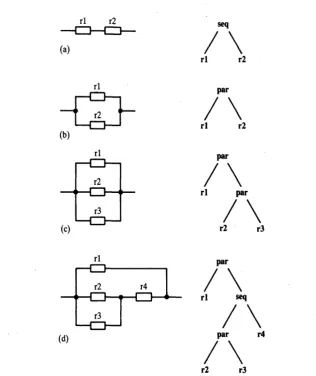
[image:52.416.63.380.187.564.2]As the last example we consider some simple electric circuits shown in Figure 2.6. The right-hand side of the figure shows the tree representation of these circuits. The atoms tl, 12, 13 and 14 are the names of the resistors. The
r1 12
+
(a)
Figure 2.6 Some simple electric circuits and their tree representations: (a) sequential composition of resistors r1 and 12; (b) parallel composition of two resistors; (c) parallel composition of three resistors; (d) parallel composition of r1 and another circuit.
\ 12 seq / I par / \ / \
rl 12
par / \ / \
rl par
/ \ / \
12 r3
per / \ / \
rl seq
/ \ / \
per r4
/ \ / \
12 r3
r1
l-1.---,-l
H
(b) r1r:l
l r 2
l
- , - 7
t-.,'LJ
(c) H
rl
Fr
I ' r l
#
functors par and seq denote the parallel and the sequential compositions of resistors respectively. The corresponding Prolog terms are:
seq( 11, 12) par( r1, 12)
par( 11, Par( r2, 13) )
par( r1, seq( Par( 12, r3)' 14) )
Exercises
2.1 Which of the following are syntactically correct Prolog objects? What kinds of object are they (atom, number, variable, structure)?
(a) Diana (b) diana (c) 'Diana' (d) -diana
(e) 'Diana goes souttrl (f) goes( diana, south)
(e) as
(h) s( x, Y)
(i) *( north, west) (j) three( Black( Cats) )
2.2 Suggest a representation for rectangles, squares and circles as structured Prolog objects. Use an approach similar to that in Figure 2.4. For example, a rectangle can be represented by four points (or maybe three points only). Write some example terms that represent some concrete objects of these types using the suggested representation.
2.2 Matching
In the previous section we have seen how terms can be used to represent complex data objects. The most important operation on terms is matching. Matching alone can produce some interesting computation.
Given two terms, we say that they match if.: (1) they are identical, or
36 PROLOG PROGRAMMING FOR ARTIFICIAL INTELLIGENCE
For example, the terms date( D, M, 19g3) and date( Dl, may, yl) match. one instantiation that makes both terms identical is:
. D is instantiated to Dl o M is instantiated to may . Y1 is instantiated to 1983
This instantiation is more compactly written in the familiar form in which Prolog outputs results:
D : D 1 M : m a y Yl : 1983
on the other hand, the terms date( D, M, l9s3) and date( Dl, Ml, 1444) do not match, nor do the terms date( X, y, Z) and point( X, y, Z).
Matching is a process that takes as input two terms and checks whether they match. If the terms do not match we say that this process/ails. If they do match then the process succeeds and it also instantiates the variables in both terms to such values that the terms become identical.
Let us consider again the matching of the two dates. The request for this operation can be communicated to the Prolog system by the following ques-tion, using the operator ':':
?- date( D, M, 1983) = date( Dl, may, Y1).
We have already mentioned the instantiation D = D1, $t : hay, Yl = 1983, which achieves the match. There are, however, other instantiations that also make both terms identical. Two of them are as follows:
D = 1 D l : 1 M : m a y Yl : 1983 D : third D1 : third . M : m i y
Yl : 1983
possible freedom for further instantiations if further matching is required. As an example consider the following question:
?- date( D, M, 1983) : date{ Dl, maY, Y1), date( D, M, 1983) : date( 15' M' Y).
To satisfy the first goal, Prolog instantiates the variables as follows: D : D l
M : m a y Yl : 1983
After having satisfied the second goal, the instantiation becomes more specific as follows:
D = 1 5 D l : 1 5 M : m a y Yl : 1983 Y : 1 9 8 3
This example also illustrates that variables, during the execution of consecutive goals, typicatly become instantiated to increasingly more specific values.
The general rules to decide whether two terms, S and T, match are as follows:
(]*)
ffi
(3)i
38 PROLOG PROGRAMMING FOR ARTIFICIAL INTELLIGENCE
triangle
[image:56.416.72.376.52.269.2]triangle
Figure 2.7 Matching triangl{ poin(l,l), A, point(2,3) ) : triangl{ X, point(4,Y), point(Z,Z) ).
following sequence of (simpler) matching operations: triangle : triangle,
poin(l,l) : X, A - point(4,Y),
point(2,3; : point(z,Z).
The whole matching process succeeds because all the matchings in the sequence succeed. The resulting instantiation is:
;5 : point(l,l) 4 = point(4,Y) Z : 3
The following example will illustrate how matching alone can be used for interesting computation. Let us return to the simple geometric objects of Figure 2.4, and define a piece of program for recognizing horizontal and vertical line segments. 'Vertical' is a property of segments, so it can be formalized in Prolog as a unary relation. Figure 2.8 helps to formulate this relation. A segment is vertical if the x-coordinates of its end-points are equal, otherwise there is no other restriction on the segment. The property'horizon-tal' is similarly formulated, with only x and y interchanged. The following program, consisting of two facts, does the job:
vertical( seg( point(X,Y), point(X'Yl) ). horizontal( seg( point(X,Y), pornt(Xl,Y) ).
./ point
/ \
l l
./
x
\
point
/ \ 2 3
\
point
/ \ 2 Z point


![Figure 3.1 Tree representation of the list I ann, tennis, tom, skiing].](https://thumb-us.123doks.com/thumbv2/123dok_us/8100173.233963/83.417.125.279.471.598/figure-tree-representation-list-ann-tennis-tom-skiing.webp)