Variable Weight Multi-Service OCDMA Code for
Optical Domain Prioritization
Saleh Seyedzadeha, Farzad Pour Rahimiana, Ivan Gleska, Majid H. Kakaeeb
a
Faculty of Engineering, University of Strathclyde, Glasgow G1 1XW, UK.
b
Department of Computer and Communication Systems, Faculty of Engineering, Universiti Putra Malaysia, 43400 UPM Serdang, Selangor, Malaysia.
Abstract
The emergence of heterogeneous applications such as internet data, video streaming, and online gaming, brings in a demand for a network environ-ments with capability of supporting diverse Quality of Services (QoS). Pri-oritizing the services is essential to ensure the delivery of information is at their best. This paper proposes a new code family to support optical domain service differentiation using spectral amplitude coding techniques within an optical code division multiple access (OCDMA) scenario. A particular user or service has a varying weight applied in order to obtain the desired signal quality. The proposed variable-weight code (VW-code) is constructed based on basic multi-service (MS) code. Mathematical model is developed to for performance evaluation of VW-MS code. In addition, the properties of pro-posed code is compared with other VW-OCDMA codes. It is shown that the proposed VW-MS provide an optimal code length with minimum cross-correlation compared to other VW-codes. Performance of VW-MS designed for triple-play services operating at bit rates of 0.622, 1.25 and 2.5 Gbps is demonstrated.
Keywords:
Variable weight code, optical code-division-multiple-access, QoS
differentiation, optical fibre communication, Spectral amplitude coding.
1. Introduction
multiple access (CDMA) was emerged as a solution for providing QoS differ-entiation in physical layer [1]. Hence, OCDMA received great attention in metro networks where heterogeneous applications require for different quali-ties. Realization of QoS using OCDMA system was carried out by varying the code weight [2]. Later, two dimensional code families was proposed to sup-port multiple services in optical networks [3]. Further, multilevel OCDMA system was intruded in which high and low weight users transmit their sig-nal at a lower and higher power levels, respectively [4]. OCDMA systems have also received attention in last mile access networks [5], optical sensor networks [6, 7] and free space optical communication [8].
Spectral Amplitude Coding (SAC) is one of several techniques developed for OCDMA systems which attracts much attention due to the reduction of the Multiple Access Interference (MAI) effects [9, 10], simplicity and lower cost of system components [11]. In variable weight SAC-OCDMA, higher quality services received more weights (more wavelengths). VW-Code was first developed using optical orthogonal code (OOC) family [2] and followed by other codes such as IL-OOC [12], VW-OOC [13] and VW-KS [14]. Pro-viding service differentiation have been also achieved using fixed weight but varying the number of users in basic matrix [15, 16]. QoS differentiation using SAC-OCDMA system for multimedia application have been experimentally demonstrated [17].
In this paper, a new VW-code family for SAC-OCDMA system based on basic matrix construction has been proposed. Despite of VW-codes based on double weight code family, VW-MS support any integer as code weight and maintain an optimal code length in comparison with other counterparts. The rest of this paper is organized as follows. Section 2, describe and explains MS and VW-MS code design and construction and gives example codes. In section 3, a comparison of VW-MS and four other VW-codes in terms of maximum cross-correlation and code length is presented. Section 4 presents the mathematical analysis of VW-MS code employing AND detection scheme to support multimedia services. Section 5 discusses the results of VW-MS code performance. Finally, Section 6 concludes the findings of the study.
2. Design and Development of VW-MS Code
2.1. Construction of MS Basic Matrix
MS code for SAC-OCDMA system is matrix based and characterized by (LB, WB, NB, λc) where WB = 2,3, ... is the code weight and the number of
users in basic matrix, NB is equal to WB. λc denotes the cross-correlation
between each pair of codewords in OCDMA, and due to the structure of MS code, the ideal cross-correlation ofλc ≤1 is maintained in order to eliminate
MAI. The length of code (LB) for basic matrix can be calculated as
LB = WB
X
i=1
(i) (1)
In case the number of users in the basic matrix NB is less thanWB, the
code length of constructed matrix is as:
LB = W
X
i=1
i− W−NB
X
i=1
i (2)
The basic matrix for MS code consists of a NB×LB matrix, where
el-ements taking the value of either ‘0’ or ‘1’ representing the spectral chips. Unlike most OCDMA codes, MS code is constructed using mathematical equation and can be easily implemented using software programming. The following steps explain how the code is constructed:
Step 1: Let Pw be the position of wth ‘1’ in the code where w = {1,2,· · ·, W}, then Pw for the first codeword is defined as
Pw =
1, w= 1
P(w−1)+ (w−1), w >1 (3) Step 2: LetCij ∈ {0,1}be a position inith code, wherei={1,2,· · · , NB}
and j ={1,2,· · · , LB}. Thus,Ci is defined as Ci ={Ci1, Ci2, Ci3,· · ·, CiLB}
and assume that {C1, C2,· · · , Ci−2, Ci−1}be previous codewords.
To construct the subsequent code,Ci, starting from first code find the first
‘1’ in previous codeword that has no overlapping with any of other generated codewords, and place ‘1 in this position to get the cross-correlation of one with that code. Let this position be Cij. Subsequently, the bit values for the
rest positions of {Ci(j+2), Ci(j+3),· · ·, CiLB} are obtained by shifting the bits
of previous code, [i.e. {C(i−1)(j+1), C(i−1)(j+2),· · · , C(i−1)(LB−j)}] one unit to
Step 3: Repeat step 2 for the subsequent codes until the basic code sequence CB generated which is equal to the maximum number of basic
users, NB.
Step 4: Fill empty spaces with ‘0’.
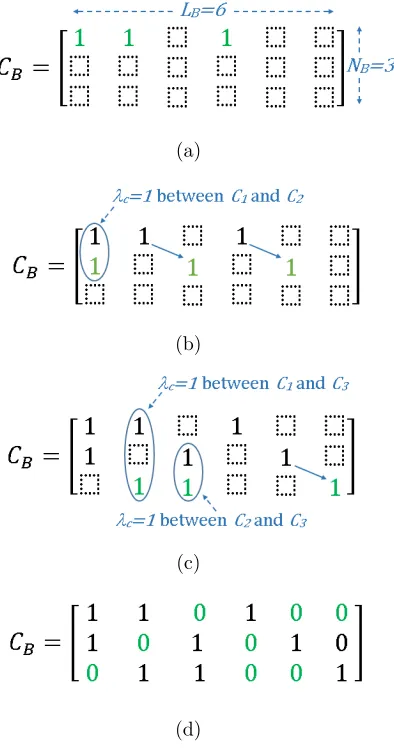
Fig. 1(a) to (d) demonstrates an example of MS code basic matrix con-struction for WB = 3 for steps 1 to 4, respectively. The length of code
calculated by (1) is 6 and there are NB = 3 users which makes a 6×3
matrix.
(a)
(b)
(c)
[image:4.612.209.406.207.582.2](d)
2.2. Mapping Technique for Larger Number of Subscribers
In order to increase the number of users from the basic matrix, CB, a
mapping technique can be utilized. If we assume the total number of required users isN, the basic matrix repeated by M =N/NB times, where NB is the
number of users in CB, as the following matrix:
C(M) =
CB(1) 0 0 0 0
0 CB(2) 0 0 0
0 0 CB(3) 0 0
0 0 0 . .. 0
0 0 0 0 CB(M)
hereCB(m) is themth mapping sequence wherem= 1,2, ..., M. Each ‘0’
in mapping matrix is a sequence of zeros with same size ofCB. The maximum
cross-correlation λc between users in the same matrix is one and between
users from different mappings is zero, hence; using mapping technique the
λc = 1 is obtained for all users.
Assuming the total required number of users isNmax with code weight of
W, then the number of mapping M can be calculated as:
M =
Nmax
W
(4)
If result of division expressionNmax/W is an integer then there will beM
mapping of basic matrix with NB = W, otherwise the number of mappings
for such matrix will be Nmax
W
and there will be one matrix with following number of users
NBr =Nmax−W ×
Nmax
W
(5)
whereNBr is the number of users for the last remaining mapping matrix.
2.3. Variable Weight Code Construction using MS Code
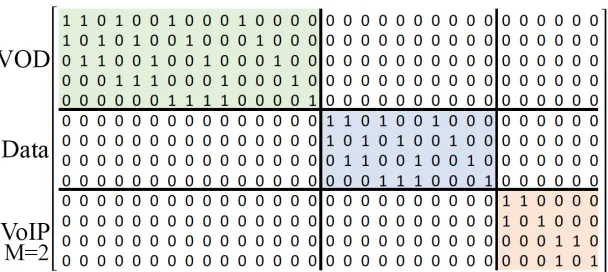
It must be noted that for each service code weight can be chosen indepen-dently in a way to satisfy the required quality. Here, the weights of 5, 4 and 2 are chosen for video, data and voice, respectively.
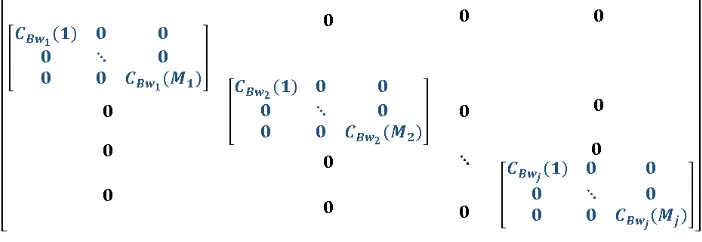
Construction of VW-code, is based on mapping technique so that code weight of mapping matrices are different from each other. Services are grouped based on the quality they demand and a matrix with suitable code weight is assigned for them. If the number of subscribers is higher than one basic matrix, using (4) and (5) more number of mapping is assigned to the group to support all users. Fig. 2, illustrates the structure of VW-code con-struction to support J number of multiple services using MS code. CBWj(m)
shows the mth mapping basic matrix forjth service which is appointed with weight of Wj. In this technique, the λc = 1 between all users with different
[image:6.612.132.483.284.405.2]weight is sustained.
Figure 2: General structure of VW-Code construction using MS code family.
The total code length of VW-MS code, L, can be derived from (1), (2), (4) and (5) and is expressed as
L=
J
X
j=1
Mj × Wj
X
i=1
i
−
W−NBrj
X
i=1
i
(6)
Figure 3: Generated VW-MS code for 13 number of subscriber with different weights of 5,4 and 2.
3. Code Evaluation and Comparison
In every code family developed for OCDMA system, the cross-correlation property plays significant role in MAI cancellation ability of that code. In the proposed VW-MS, codes are categorized into J different code weights having the same code length, LB. Therefore, an interference at a user node can
be triggered by cross-correlation between other users with any code weights. In order to demonstrate the cross-correlation property of VW-MS, a code analysis similar to [13, 18, 15] is performed.
LetJ be the different code weights in a system with W1>···>Wj···>WJ, and
the number of users in the jth code weights is NBj. The final generated
code can be presented as C ={CW1, CW2,· · · , CWj,· · · , CWJ} where CWj is
the matrix code related to particular code weight, j. The exact value of maximum cross-correlation property of VW-MS code can be expressed as
λ=
λW1,W1 λW1,W2 · · · λW1,WJ
λW2,W1 λW2,W2 · · · λW2,WJ
... ... . .. ...
λWJ,W1 λWJ,W2 · · · λWJ,WJ
(7)
where λWj,Wj′ indicates the correlation value between code weights Wj
and Wj′. Intra-weight correlation falls out when j = j′, means the
cross-correlation between codes with same code weight. Inter-weight cross-correlation is present when j 6=j′ (codes with different weight and mapping). For VW-MS
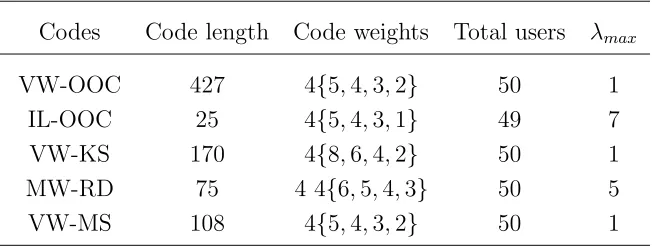
intra-Table 1: Comparison of different variable weight codes properties
Codes Code length Code weights Total users λmax
VW-OOC 427 4{5,4,3,2} 50 1
IL-OOC 25 4{5,4,3,1} 49 7
VW-KS 170 4{8,6,4,2} 50 1
MW-RD 75 4 4{6,5,4,3} 50 5
VW-MS 108 4{5,4,3,2} 50 1
weight correlation can be either 0 or 1, while inter-weight correlation is 0 due to the code design.
For comparison purposes, four other codes are evaluated in terms of their code properties including cross-correlation value, λmax, code length, number
of supportable users and number of different code weights. The four codes are VW-OOC [13], IL-OOC [12], Multiple Weight Random Diagonal (MW-RD) [19] and hybrid dynamic VW-KS [20]. Table 1 presents code properties comparison of these code with VW-MS.
The four variable weight codes in Table 1 are chosen to support about 50 users of 4 different code weights. It is shown that VW-OOC has a very long code length which is not desirable in OCDMA code design, but with ideal λmax of one. IL-OOC and MW-RD have the shortest code length;
however, their λmax can reach as high as seven and five, respectively which
might lead to poor MAI cancellation during photodetection. Although, VW-KS provides λmax = 1, the generated code length is not promising which
suffers from higher weights selection due to the nature of the code family. Even though the proposed VW-MS has longer code length than IL-OOC and MW-RD, λmax is maintained at one and is much ideal for MAI cancellation.
4. Mathematical Analysis of VW-MS Code
[image:8.612.143.469.100.224.2]Fur-thermore, the VW-MS performance is analysed employing AND subtraction technique [21] which is based on balanced detection.
4.1. VW-OCDMA System description
[image:9.612.122.490.193.341.2]The general architecture of a VW-SAC-OCDMA system with AND de-tection is depicted in Fig. 4. For simplification purpose, only a pair of transmitter and receiver for n user with weight of Wj is shown in the figure.
Figure 4: Architecture of a VW-SAC-OCDMA system.
At the transmitter side, power from a broad band source spectrum is split among K users. A series of fibre Bragg Gratings filter different wavelengths of λ1,· · · , λw from the spectrum to form the different signature code with
weight of w. Users’ binary data is then modulated, which formed as Non-Return-to-Zero (NRZ) signal to the optical carrier. Modulated signals from all users are then combined using a power combiner, and transmitted over the optical medium. At the receiver part, two decoders are required in a single receiver which are the upper and lower decoders. The upper decoder detects the desired code, x(λ) while the lower decoder detects binary logical AND of desired and interfering code, x(λ)∩y(λ), with y(λ) being the interferer signal of other codes having overlapping chip with desired user.
4.2. Development of Mathematical Model for VW-MS
hI2i=hIshot2 i+hIP IIN2 i+hIthermal2 i (8)
WhereIshot denotes the shot noise, IP IIN represent the PIIN andIthermal
is thermal noise. The coherence time of the thermal source, τc is given by
[22]
τc =
R∞
0 G2(v)dv
R∞
0 G2(v)dv
2 (9)
Where G(v) is the source power spectral density (PSD). An ideal SAC-OCDMA system is assumed with ideally flat source spectra over the band-width, ∆v , and ideal rectangular spectrum of each chip. For development of mathematical model some assumptions are considered [23, 24, 25] as the light source spectra is ideally unpolarised and its spectrum is flat over the bandwidth [v0−∆v/2 + ∆v/2], where v0 is the optical centre frequency and
∆v is the bandwidth of the optical source in hertz, each power spectral com-ponent has identical spectral width, each user has equal power at the receiver and bit stream from all users is synchronized.
The PSD of the received signals can be written as [18]
r(v) =
Psr
∆v
NBj
X
n=1
dn L
X
l=1
cn(l)Π(l) (10)
Where Psr is the effective power of broadband source at receiver, N and
Lare number of users and code length respectively, dnis the information bit
of nth active user which is either ‘1’ or ‘0’ (dn ∈ {0,1}) and cn(l) is the lth
element of the nth MS code sequence. Π(l) is a function defined as
Π(i) =u
v−v0−
∆v
2L(−L+ 2l−2)
−
u
v −v0−
∆v
2NBj
(−L+ 2l)
=u
∆v
2L
(11)
u[v] =
1, v ≥0
0, v <0 (12)
Suppose Cn(l) is the lth element of thenth new code sequence, and the
properties of the proposed VW-code at upper and lower arm of AND balanced receiver can be defined as:
L
X
l=1
Cn(l)Cm(l) =
Wj , n =m
1 , n 6=m
Same mapping matrix 0 , n 6=m Different mapping matrix
(13)
and
L
X
l=1
Cn(l) (Cm(l)•Cn(l))
=
NBj−1, n =m
1 , n 6=m
Same mapping matrix 0 , n 6=m Different mapping matrix
(14)
In this analysis, the AND operation of [Cm(l)·Cn(l)] is valid for n 6= m
only, n, m ∈ {1,2,· · ·, N}. However, the cross correlation of Cn(l)[Cm(l)•
Cn(l)] is valid forn =mandn6=m, while the cross-correlation ofCn(l)Cm(l)
is Wj for n =l. Wj is the weight assigned for service j, where NBj denotes
the number of users in basic matrix of that service andN is the total number of subscribers.
Substituting (13) and (14) in (10) and integrating them results into the total power incident at the upper and lower photodetectors, PIN 1 and PIN 2, respectively which can be written as:
Z ∞
0
G1(v)dv =
Z ∞ 0 Psr ∆v NBj X n=1 dn L X l=1
Cn(l)Cm(l)
u ∆v L dv
= Psr ∆v ∆v L NBj X n=1 dn L X l=1
Cn(l)Cm(l)
= PsrWj
L dl+ Psr
L
NB
X
n=1,n6=m
dn
and
Z ∞
0
G2(v)dv=
Z ∞ 0 Psr ∆v NBj X n=1 dn L X l=1
Cn(l) Cm(l)•Cn(l)
u ∆v L dv
= Psr ∆v ∆v L NBj X n=1 dn L X l=1
Cn(l) Cm(l)•Cn(l)
= Psr(NBj −1)
L dl+
Psr
L
NBj
X
n=1,n6=m
dn
(16) LetI1 and I2 be the photocurrent at PIN 1 and PIN 2, respectively. The
photocurrent I, therefore, is given by:
I =I1−I2 =ℜ
Z ∞
0
G1(v)−
Z ∞
0
G2(v)
ℜPsr(Wj−NBj + 1)
L
(17)
WhereR=ηe/hvis the photodiode responsivity, ηis quantum efficiency,
eis the electron charge, his Planck’s constant, andv is the central frequency of optical source’s spectra.
The variance of shot noise in the photocurrent can be expressed as
Ishot2
= 2eB(I1+I2)
= 2eBℜ
Z ∞
0
G1(v) +
Z ∞
0
G2(v)
= 2eBℜPsr Wj + 3NBj−3
L
(18)
Where B is half of the bit rate, denotes the noise-equivalent electrical bandwidth of the receiver.
The mean squared power of both upper and lower photodetectors is first obtained by integrating G2
1(v) and G22(v) to calculate the noise variance of
Z ∞
0
G21(v)dv= P
2 sr ∆vL L X l=1 (
cn(l)
" N X
n=1
dncn(l)
#
" N X
m=1
dmcm(l)
#) (19)
and
Z ∞
0
G22(v)dv= P
2 sr
(Wj −1)2∆vL L
X
l=1
(
¯
cn(l)
" N X
n=1
dncn(l)
# " N X
m=1
dmcm(l)
#) (20)
Using similar method as [26, 23] and approximationPN
n=1Cn≈ N WL [27],
the variance of PIIN can be written as
IP IIN2
=Bℜ
Z ∞
0
G21(v) +
Z ∞
0
G22(v)
∼
= Bℜ
2P2 sr
L∆v
L X l=1
Cn(l)
NW L · NBj X n=1
Cn(l)
+Bℜ
2P2 sr
L∆v
L X l=1
Cn(l)•Cn(l)
NWj L · NBj X n=1
Cn(l)
= Bℜ
2P2 srNWj
L2∆v
Wj + 3NBj −3
(21)
The thermal noise is given as
Ithermal2
= 4KbTnB
RL
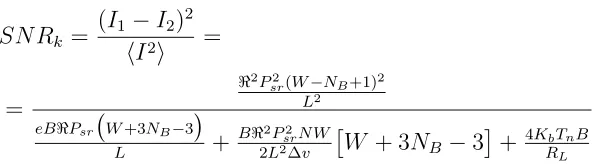
SNRk=
(I1−I2)2 hI2i =
=
ℜ2P2
sr(W−NB+1)2
L2
eBℜPsr W+3NB−3
L +
Bℜ2P2
srN W
2L2∆v
W + 3NB−3
+4KbTnB
RL
(23)
Therefore, using Gaussian approximation, the probability of error for users of particular weight of interest, Wj of a multiple weight system, Pe,k is
given by [26]
Pek =
1 2erf c
r
SNR
8
!
(24)
It should be noted that the proposed model provide an upper bound approximation for BER of user, The proof of this method using experimental as well as simulation analysis is presented by [17].
5. Theoretical Results and Discussion
[image:14.612.157.463.96.180.2]The parameters used in the analysis are listed in Table 2. These param-eters were chosen to provide a fair comparison with other published works [18, 22, 20]. In this work, it is assumed that the number of subscribers in each service (Wj) is almost equal.
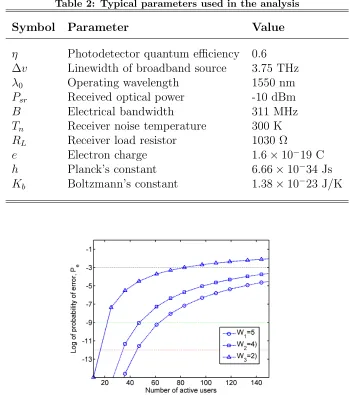
Fig. 5 shows the probability of errors for users with different weights versus number of active users, when Psr is -10 dBm and bit rate is set to 633
Mbps (ITU-T STM-4 standard). With reference to the BER of 10−3, 10−9
and 10−12 for voice, data and video, respectively, the maximum number of
active users that can be supported in a VW-OCDMA with proposed VW-MS code is 46.
Fig. 6 demonstrate the probability of error against the received optical power (ROP) per chip in presence of different noises, when the total number of active users is 36. It can be seen that whenPsris high (Psr >−6 dBm), the
effect of shot and thermal noise is negligibly small compared to PIIN, which is the main limitation factor of the system performance. However, when
Psr is low (Psr < −6 dBm), the PIIN effect is minimal and thermal noise
Table 2: Typical parameters used in the analysis
Symbol Parameter Value
η Photodetector quantum efficiency 0.6 ∆v Linewidth of broadband source 3.75 THz
λ0 Operating wavelength 1550 nm
Psr Received optical power -10 dBm
B Electrical bandwidth 311 MHz
Tn Receiver noise temperature 300 K
RL Receiver load resistor 1030 Ω
e Electron charge 1.6×10⁻¹⁹ C
h Planck’s constant 6.66×10⁻³⁴ Js
[image:15.612.134.479.103.290.2]Kb Boltzmann’s constant 1.38×10⁻²³ J/K
Figure 5: Probability of error versus number of total users with weight 5, 4 and 2.
saturates at 10−15 at -5 dBm, which is better than users of smaller weights,
where Pe of weight 4 and 2 saturates at 10−1 and 10−5, with Psr equals to -6
dBm, respectively. It can be observed that even by increasing transmitted power therewith the received power it is not possible to improve the quality of signals in presence of PIIN.
Figure 6: Probability of error against effective received power, Psr,considering different noise contribution with number of active users is 36.
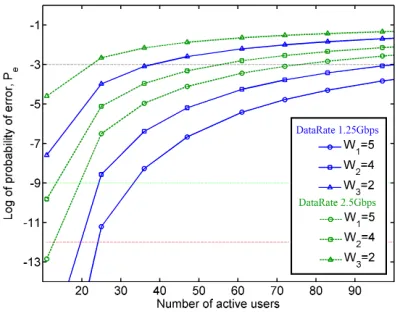
data rates of 1.25 and 2.5 Gbps, where Psr is -10 dBm. It can be seen that
the number of supportable users for OCDMA system with VW-MS is 23 and 13 for bit rates of 1.25, 2.5 respectively, regard to the acceptable error rate for triple services.
Figure 7: Probability of error versus number of active users for different bit rates of 1.25 and 2.5 Gbps.
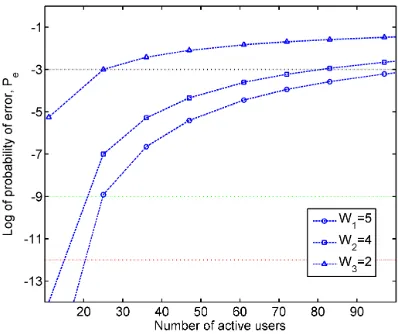
[image:16.612.200.398.385.541.2]services or reducing the NBj for basic matrix. Fig. 8 illustrate the
perfor-mance of system when number of users in basic matrix is reduced for weight of 5 and 4. Using this configuration, number of supported subscribers is increased from 13 to 20. The performance degradation which is observed in service with weight 2 is due to the increment of total code length as a results of higher number of mapping matrices. It should be considered that NB for
[image:17.612.199.398.259.426.2]weight 2 is not reduced as the quality of service with total number of 20 is already in acceptable area. If the number of required subscribers for each service is not equal, then a weight optimization could be conducted to get the acceptable quality for all services, while keeping minimum value for the code weights as well as code length.
Figure 8: Probability of error versus number of active users with data rate of 2.5 Gbps andN B is 3,2 and 2 for weights of 5, 4 and 2, respectively.
6. Conclusions
proposed code and AND detection was mathematically modelled and the performance analysed for triple-play system. With regard to BER of 10−12,
10−9and 10−3 for video (W
j = 5), data (Wj = 4) and voice (Wj = 2) services,
it was demonstrated that VW-MS with supports 46, 24 and 13 simultaneous subscribers in OCDMA system with data rate of 0.622, 1.25 and 2.5 Gbps, respectively. Further service quality improvement using variation of num-ber of users in basic matrix was demonstrated. In conclusion, the overall results prove the suitability and flexibility of VW-MS code for integrated multi-service optical networks.
References
[1] H. Ghafouri-Shiraz, M. M. Karbassian, Optical CDMA Networks: Prin-ciples, Analysis and Applications, Wiley-IEEE Press, 2012.
[2] G.-C. Yang, Variable-weight optical orthogonal codes for CDMA net-works with multiple performance requirements, IEEE Transactions on Communications 44 (1) (1996) 47–55.
[3] W. Liang, H. Yin, L. Qin, Z. Wang, A. Xu, A new family of 2D variable-weight optical orthogonal codes for OCDMA systems supporting multi-ple QoS and analysis of its performance, Photonic Network Communi-cations 16 (1) (2008) 53–60.
[4] H. Beyranvand, B. Ghaffari, J. Salehi, Multirate, Differentiated-QoS, and Multilevel Fiber-Optic CDMA System via Optical Logic Gate Ele-ments, Journal of Lightwave Technology 27 (19) (2009) 4348–4359. [5] S. Seyedzadeh, G. A. Mahdiraji, Y. G. Shee, F. R. M. Adikan, A
Novel Asynchronous Hybrid Duty-Cycle Division Multiplexing/Optical Code Division Multiple Access Systeme, in: International symposium on Telecommunications, Tehran, 2014.
[6] A. Noura, S. Seyedzadeh, S. Anas, Simultaneous vibration and humidity measurement using a hybrid WDM/OCDMA sensor network, in: 2013 IEEE 4th International Conference on Photonics (ICP), IEEE, 2013, pp. 163–165.
using SAC-OCDMA with direct decoding techniques, Optik - Interna-tional Journal for Light and Electron Optics 125 (17) (2014) 4803–4806. [8] M. Moghaddasi, S. Seyedzadeh, S. B. Ahmad Anas, Optical Code Divi-sion Multiple Access Codes comparison in free space optics and optical fiber transmission medium, in: 2014 IEEE REGION 10 SYMPOSIUM, IEEE, 2014, pp. 181–184.
[9] C.-c. Yang, The application of spectral-amplitude-coding optical CDMA in passive optical networks, Optical Fiber Technology 14 (2) (2008) 134– 142.
[10] T. S. Lee, H. M. H. Shalaby, H. Ghafouri-Shiraz, Estimation and cancel-lation of multi-user interference in synchronous fiber-optic PPM-CDMA system using Manchester coding, Optics and Laser Technology 33 (8) (2001) 573–580.
[11] P. R. Prucnal, Optical code division multiple access: fundamentals and applications, CRC Taylor & Francis, 2006.
[12] I. Djordjevic, B. Vasic, J. Rorison, Multi-Weight Unipolar Codes for Multimedia Spectral-Amplitude-Coding Optical CDMA Systems, IEEE Communications Letters 8 (4) (2004) 259–261.
[13] N. Nasaruddin, T. Tsujioka, Design of strict variable-weight optical or-thogonal codes for differentiated quality of service in optical CDMA networks, Computer Networks 52 (10) (2008) 2077–2086.
[14] S. Ahmad Anas, M. Abdullah, M. Mokhtar, S. Aljunid, S. Walker, Opti-cal domain service differentiation using spectral-amplitude-coding, Op-tical Fiber Technology 15 (1) (2009) 26–32.
[15] M. H. Kakaee, S. Seyedzadeh, H. Adnan Fadhil, S. Barirah Ahmad Anas, M. Mokhtar, Development of Multi-Service (MS) for SAC-OCDMA sys-tems, Optics & Laser Technology 60 (2014) 49–55.
[17] S. Seyedzadeh, G. A. Mahdiraji, R. K. Z. Sahbudin, A. F. Abas, S. B. A. Anas, Experimental demonstration of variable weight SAC-OCDMA system for QoS differentiation, Optical Fiber Technology 20 (5) (2014) 495–500.
[18] Z. Wei, H. Shalaby, H. Ghafouri-Shiraz, Modified quadratic congruence codes for fiber Bragg-grating-based spectral-amplitude-coding optical CDMA systems, Journal of Lightwave Technology 19 (9) (2001) 1274– 1281.
[19] H. A. Fadhil, S. Aljunid, R. Badlisha, Triple-play Services using Ran-dom Diagonal Code for Spectral Amplitude Coding OCDMA Systems, Journal of optical communications 30 (3) (2009) 155–159.
[20] S. B. A. Anas, S. Seyedzadeh, M. Mokhtar, R. K. Z. Sahbudin, Variable weight Khazani-Syed code using hybrid fixed-dynamic technique for op-tical code division multiple access system, Opop-tical Engineering 55 (10) (2016) 106101.
[21] S. Seyedzadeh, M. Moghaddasi, Variable-Weight Optical Code Division Multiple Access System using Different Detection Schemes, Journal of Telecommunications and Information Technology 3 (2016) 50–59. [22] E. Smith, R. Blaikie, D. Taylor, Performance enhancement of
spectral-amplitude-coding optical CDMA using pulse-position modulation, IEEE Transactions on Communications 46 (9) (1998) 1176–1185.
[23] R. K. Z. Sahbudin, M. K. Abdullah, M. Mokhtar, Performance improve-ment of hybrid subcarrier multiplexing optical spectrum code division multiplexing system using spectral direct decoding detection technique, Optical Fiber Technology 15 (3) (2009) 266–273.
[24] S. Kumawat, M. Ravi Kumar, Generalized optical code construction for enhanced and Modified Double Weight like codes without mapping for SAC-OCDMA systems, Optical Fiber Technology 30 (2016) 72–80. [25] N. Jellali, M. Najjar, M. Ferchichi, H. Rezig, Development of new